Law Firm SEO That Clears Your Compliance Review
Practice-area authority, local instructions, and every claim written inside SRA rules
Most legal SEO stalls in internal review rather than in Google. Copy arrives, the COLP reads it, half of it cannot be published, and the programme loses two months. We write inside the SRA Transparency Rules from the first draft, so the work reaches the site instead of the rejection pile.
- Written to clear the COLP first time. Price information, outcome language and review handling drafted against the rules, not retrofitted after a rejection
- Structured by practice area, not by firm. Conveyancing, family, PI, employment, probate and immigration are separate markets with separate buyers
- Measured against instructions. Not sessions. We agree the queries and the enquiry target before the first invoice
- Practice-area architecture
- SRA transparency
- Multi-office firms
- Legal directories
- Cardiff and UK wide

You leave knowing three things
- Which practice areas you can realistically win, and which are already taken
- What your site would fail if the SRA ran a web sweep tomorrow
- Whether the constraint is your website, your content, or neither
No charge, no obligation, and you keep the written query list.
Law firm SEO in five points
A law firm does not have one search market. It has six or seven, each with a different buyer, a different urgency and a different definition of a good enquiry. Most firm websites treat them as one page called Services.
- The practice area is the unit, not the firm. Somebody searching for a conveyancing quote and somebody searching about a workplace dismissal share nothing except your letterhead.
- The regulated half is where programmes die. SRA rules decide what can be published. A supplier who writes first and checks later produces content your COLP will not sign.
- Most legal search traffic is research, not instruction. Ranking for “can I claim for stress at work” brings volume. It rarely brings a client. The distinction has to be designed in.
- Multi-office firms compete with themselves by default. Three offices and one location page means two towns you do not appear in and three pages fighting over one.
- Nobody can promise you instructions. What we agree instead is the query set and the enquiry target, before the first invoice, so month six has something to be judged against.
Not sure whether search is your constraint?
The free thirty-minute strategy call looks at which practice areas you actually want more of, what the site ranks for now, and what would fail a compliance review. If the honest answer is that your budget belongs in technical and on-page work first, we will say so on the call.
What does a law firm need that a general SEO retainer does not give it?
Someone who understands that the content has to pass two reviews, not one. It has to satisfy a search engine and it has to satisfy your compliance officer, and the second one is where generic legal SEO falls over.
Why a firm can buy a good website and a retainer and still not rank
Look at layer two for a moment, because it is the one that surprises people. Your web developer was asked for a website. They delivered a website: it loads, it is responsive, it lists what the firm does, and it has a contact form. Everything in layer two (a page for each practice area in each town, price information structured so a search engine can read it, markup naming your solicitors and their qualifications) was never in their brief and is not their trade.
Layer three is the one that costs money quietly. A general retainer produces content on a schedule. That content reaches your COLP, who reads a paragraph promising a successful outcome, and rejects it. Nothing gets published, the month is billed anyway, and by month four everybody has stopped expecting anything. We have picked up firms three retainers deep with a folder of unpublished drafts.
Which legal searches actually produce instructions rather than research traffic?
The ones where somebody has already decided they need a solicitor and is choosing which. Searches that ask whether a situation is legally actionable are research, and they convert at a fraction of the rate however well they rank.
Five legal searches, and the intent hiding underneath each one
| Search type | Where they are | What the page must do | Worth targeting? |
|---|---|---|---|
| Service plus place “conveyancing solicitor Cardiff” | Choosing between firms, now | Named office, named people, a price indication, a way to start today | Yes. This is the instruction |
| Price “how much does probate cost” | Comparing quotes in several tabs | An actual range with what changes it. The SRA already requires this | Yes, and most firms answer it badly |
| Eligibility “can I claim for…” | Establishing whether they have a case | An honest answer, then a route to a check | Selectively. High volume, low conversion |
| Funding “no win no fee solicitor” | Ready to act, worried about cost | Plain explanation of the funding model and what happens if you lose | Yes. Strong intent, rarely answered well |
| Process “how long does a divorce take” | Preparing, may instruct in weeks | Realistic timescales, then a named person to ask | Yes, as a supporting page |
| Definition “what is a TR1 form” | Reading, possibly a rival firm | Very little. This is not your buyer | No |
The last row matters more than it looks. A great deal of legal content is written because the phrase has volume, and a firm ends up ranking beautifully for definitions that bring students, journalists and competitors. Traffic goes up, the enquiry line stays quiet, and the report looks like progress.
Your first month costs nothing, and your COLP reads the work before you pay
The first month of a law firm programme is free. You get the practice-area audit, the SRA transparency check and the first batch of drafted copy, and your COLP reads all of it before an invoice exists.

- The nine mandatory transparency pages checked against your current site
- The practice areas you can realistically win, and the ones already taken
- First batch of copy written to clear internal review rather than to be retrofitted
Your first month of SEO, free
Answer three quick questions to claim yours.
Thank you, that is with us.
We will email your onboarding form and payment link, and call within one working day if you would rather talk it through first.
Pick a time that suits you below. We will confirm by email too.
Book your 30 minute meetingHow should a firm structure pages for each practice area?
One page per practice area, then one page per practice area per office where you genuinely serve that town. A single Services page cannot rank for six markets, because it is not the most complete answer to any of them.

The shape is a tree, not a list. At the top sits the firm. Below it sit the practice areas you actually want work in, which is rarely all of them. Below each of those sit the specific questions that area’s buyers ask, and, where you have more than one office, the town-level version of the main page.
The discipline is in what you leave out. A firm that offers eleven services but wants growth in three should build depth in three. Publishing eleven thin practice-area pages spreads the same authority across four times the surface and none of them becomes the best answer to anything.
Depth beats breadth here for a specific reason: a conveyancing buyer comparing firms will read four or five pages before calling. A page that answers only the top-level question loses to a firm that also answered what happens if the chain collapses.
| Level | Example | What it is for |
|---|---|---|
| Firm | The homepage | Brand searches and people who already know your name. Not a ranking asset for services |
| Practice area | Residential conveyancing | The main commercial page. Owns the service term nationally and in your primary town |
| Practice area by office | Conveyancing solicitors in Newport | The second and third towns, where the main page will not reach on its own |
| Supporting question | What happens if the chain collapses | Catches the searcher earlier, proves competence, links up to the commercial page |
| Price and process | Conveyancing fees and what changes them | Satisfies the SRA requirement and captures the comparison search at once |
| Named solicitor | The person who would handle it | The trust layer, and the part search engines and AI assistants use to verify expertise |
That last row is doing more work than most firms realise. Search engines and AI assistants both lean on whether a page can be tied to a qualified, identifiable person. A practice-area page written by nobody, reviewed by nobody and signed by nobody is weaker than the same words attributed to a named solicitor with their admission year on the page.
What can a solicitor say in marketing content under SRA rules?
Rather more than most firms assume, provided the price and service information is there. The SRA Transparency Rules make publishing certain prices mandatory rather than optional, which turns a compliance duty into the commercial page most firms were missing anyway.
| Requirement | What the rules say | What it means for the page |
|---|---|---|
| Which services (individuals) | Residential conveyancing, uncontested probate within the UK, non-asylum immigration applications, First-tier Tribunal immigration appeals, summary-only motoring offences, and unfair or wrongful dismissal claims | Six mandatory price pages, each of which is also a commercial page |
| Which services (businesses) | Employment Tribunal defence, debt recovery up to £100,000, and licensing applications for business premises | Three more, and the commercial ones for most firms |
| What the price must include | Total cost, or an average or range where a total is not practicable; the basis of charges; the experience and qualifications of staff; likely disbursements and their cost; VAT treatment | A structured table, not a sentence saying “prices on application” |
| Scope and timescales | What the service covers, the key stages, indicative timescales, and what is excluded | The exact content the comparison searcher wants anyway |
| Conditional and damages-based fees | What the client must pay under any conditional fee or damages-based agreement | Answers the “no win no fee” search honestly |
| Where it goes | “Clear and accessible and in a prominent place on your website” | Not a PDF, not three clicks deep, and readable by a crawler |
| Complaints | Complaints procedure, plus how to complain to the Legal Ombudsman and the SRA | A trust signal as well as a duty |
| Identity | The firm’s SRA number and the SRA digital badge, displayed prominently | Corroborates the entity for search engines as well as for clients |
Read that table as a content brief rather than as a compliance chore, because that is what it is. Nine mandatory price pages, each carrying scope, stages, timescales and exclusions, is precisely the architecture a firm needs commercially. Most firms have discharged the duty with a thin PDF and left the commercial value on the floor.
What the rules do not permit is the language most marketing copy reaches for by default: guaranteed outcomes, comparative claims about other firms, and anything that sets an expectation the firm cannot evidence. We write to that constraint from the first draft, which is why our legal content tends to clear internal review in one pass rather than three.
How do solicitors handle client reviews without breaching confidentiality?
By asking for reviews of the service rather than the matter, and never confirming a person was a client of a particular type. The safe version describes how it felt to be looked after; the unsafe version describes the case.
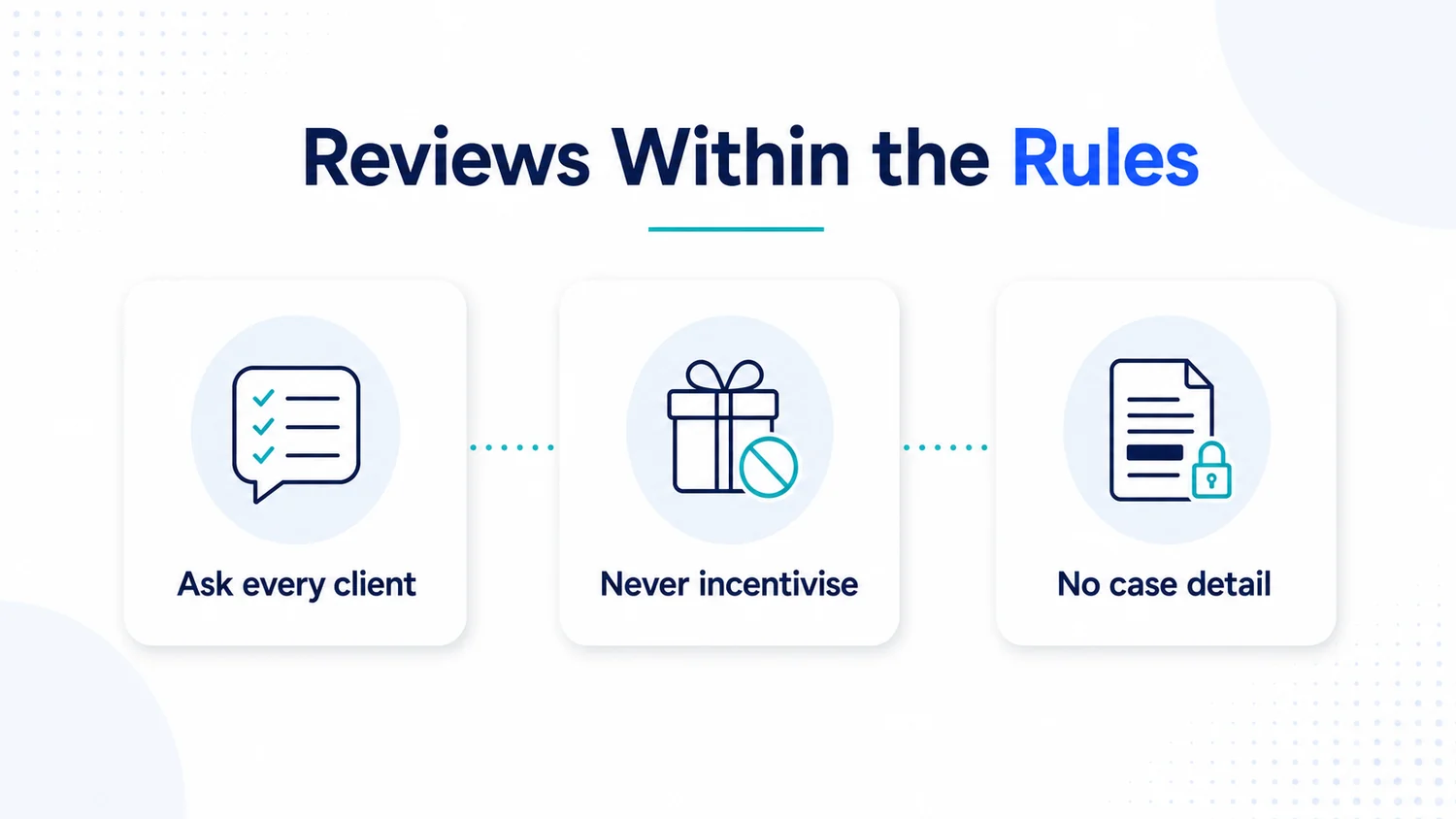
Reviews matter here more than in most sectors, because legal buyers are choosing under stress and a Business Profile with four reviews from 2022 reads as a firm that has stopped caring. They also feed the local pack directly, which is where a large share of “solicitor near me” traffic resolves.
The mechanism firms get wrong is the request itself. Asking at the end of a matter, by email, with a direct link, at the point the client is most relieved, produces reviews. Asking in a newsletter does not. Neither does a QR code in reception, because nobody is at their happiest in reception.
Where confidentiality genuinely limits what a client can say, the answer is not to give up on proof. Anonymised matter summaries, written by the firm and published as short case notes, do the same job for a reader and carry none of the risk. They also rank, which a Google review does not.
How do multi-office firms rank in more than one town?
With a real page for each office that has genuinely different content, and a separate Google Business Profile for each address with its own reviews. Duplicating one page and swapping the town name is the failure mode, and it is extremely common.
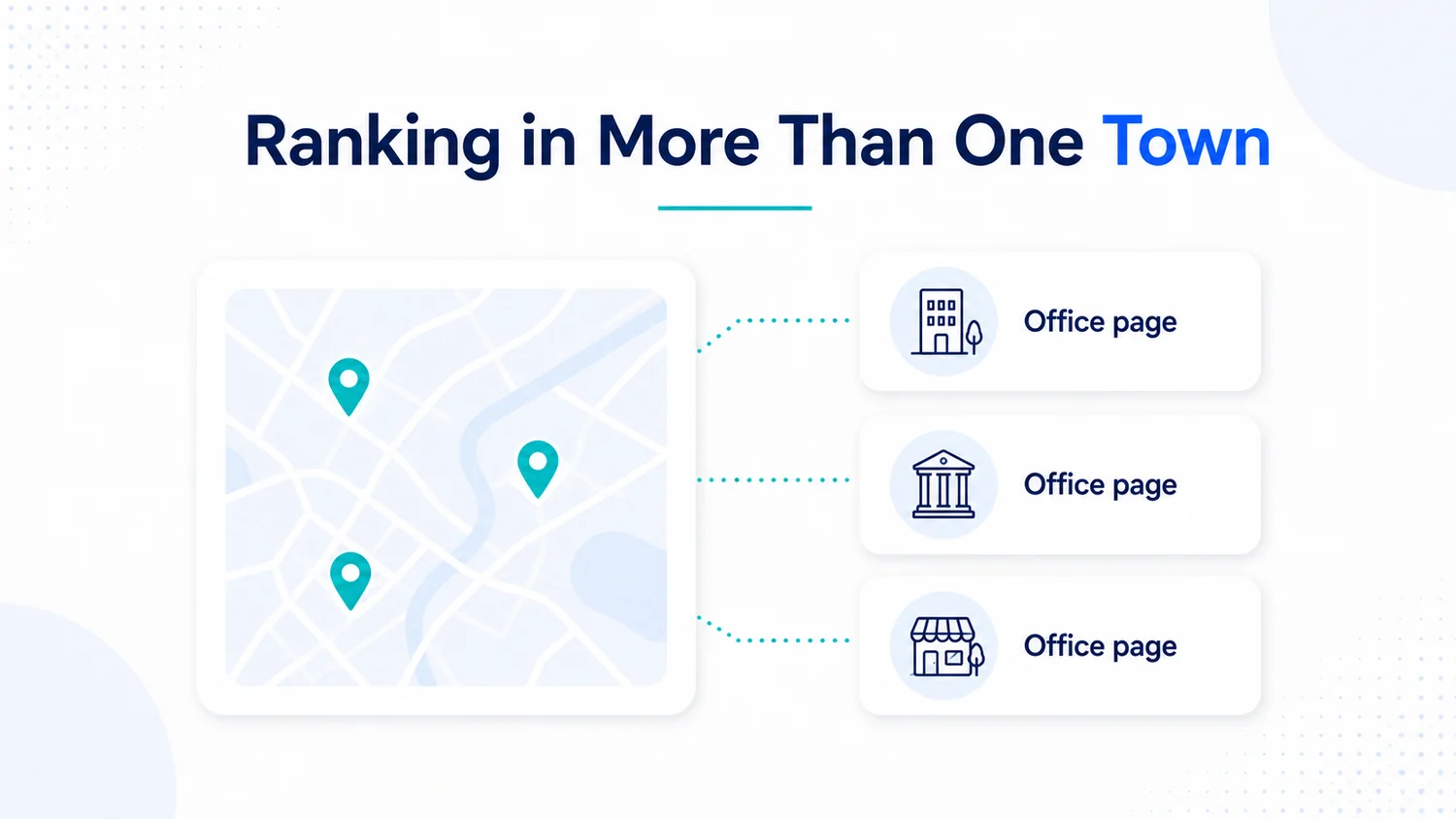
The reason it fails is straightforward. Two pages that differ only in a place name are two answers to the same question, and a search engine picks one and disregards the other. The firm ends up ranking in one town, invisible in the second, and unable to work out why the page it built for Newport does nothing.
A page that earns its place says something only true of that office: which solicitors sit there, which courts and land registries it deals with, which local matters it handles most, parking, opening hours, and the phone number that rings on that desk. That is not padding, it is the difference between a page and a duplicate.
The Business Profile side matters just as much. Each office needs its own profile, its own review flow and its own consistent name, address and phone number wherever it appears. We cover the mechanics of that on our page about local and multi-location SEO, which applies to firms with two offices as much as to chains with forty.
Do legal directories still pass authority?
Some do, most do not, and the ones worth having are worth having for referrals rather than for links. Treat a directory listing as a corroboration signal and a referral channel, not as a ranking purchase.
The genuinely useful ones are the sector’s own: the Law Society’s Find a Solicitor, Chambers and Legal 500 where a firm qualifies, and the specialist panels relevant to a practice area. These are read by buyers, they confirm the firm exists and is regulated, and the profile itself sometimes ranks for the firm’s name.
The rest of the directory market is a paid-listing business. A tier of legal directories sells enhanced profiles at several hundred pounds a year and describes the link as an SEO benefit. Most of those links are nofollow or sit on pages with no readership, and the value, if any, is in the referrals.
The test we apply is the same one we use for any placement: would this be worth having if search engines did not exist? A Legal 500 ranking passes that test easily. The fourteenth solicitor directory does not, and we would rather that budget went into earned coverage that a real audience reads.
How is legal SEO measured against cost per instruction?
By tracking enquiries to the practice area they came from, then dividing spend by instructions rather than by leads. A firm that measures leads optimises for volume, and volume in legal search is mostly people who will never instruct anyone.
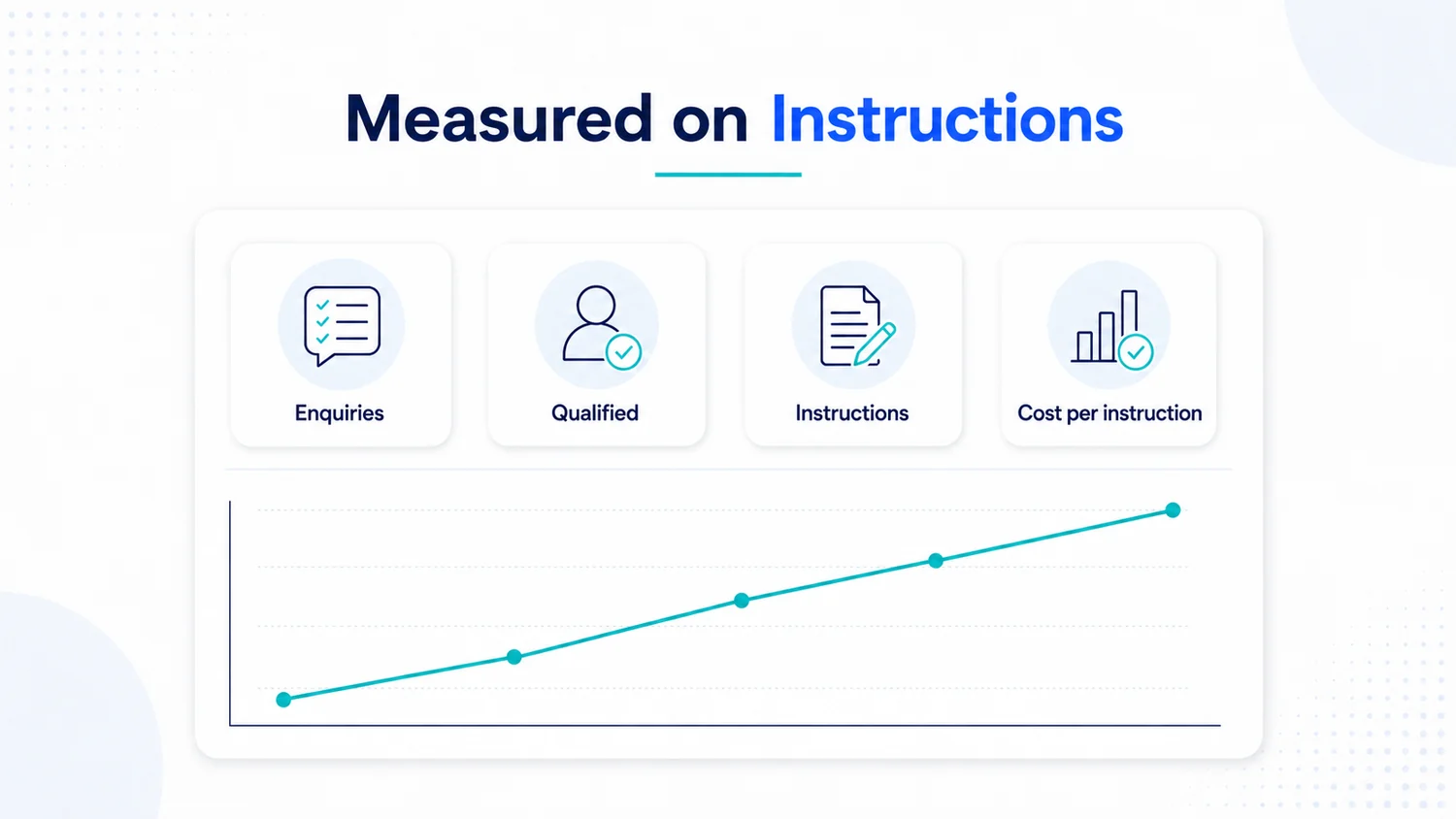
The measurement problem is real and worth naming. A conveyancing enquiry and a personal injury enquiry have different values, different conversion rates and different timescales, so a single cost-per-lead number across a firm tells you almost nothing. Split by practice area and the picture becomes usable immediately.
The second complication is the phone. A large share of legal enquiries arrive as calls, often days after the visit that caused them, and default analytics attributes none of it. Call tracking that assigns a number per page or per practice area closes most of that gap, and it is the single change that most improves how legible a legal programme is.
What we agree at the start is a short list: the ten queries that matter, an enquiry target, and which practice areas are being measured. Every monthly report is written against that list. It is a duller document than a dashboard export, and it is the one that lets a managing partner decide whether to continue.
How does a firm get named when someone asks an AI assistant for a solicitor?
By being verifiable. Assistants name firms they can corroborate from more than one source: a site that says who the solicitors are and what they are qualified in, a regulated identity that matches, and profile information that agrees everywhere.

This has become a live commercial question rather than a curiosity. A meaningful share of people now ask an assistant to shortlist before they search properly, and the assistant answers from whatever it can verify. A firm with no named solicitors, no practice-area depth and inconsistent details across its profiles simply is not verifiable, so it is not named.
What makes a firm nameable is unglamorous. Solicitors named on the site with their qualifications and admission dates. Practice areas described specifically enough to be matched to a question. An SRA number displayed. Address and phone consistent across the site, the Business Profile and the directories. None of that is exotic, and almost none of it is on a typical firm site.
We treat it as an extension of the same work rather than as a separate product, because it is. The page that answers a buyer’s question completely is the page an assistant can cite. Our page on ranking in AI and LLM answers covers the mechanism in more depth.
How does the first ninety days actually run?
It starts with a free thirty-minute call and a written query list you keep either way. Then a compliance and technical baseline, then the practice-area architecture, then the price and people pages that make the whole thing defensible.
Ninety days, with something checkable at every stage

The sequence is not arbitrary. The compliance audit comes first because it decides what can be written; discovering in week nine that the price page cannot say what it says means rewriting nine weeks of work. The architecture comes second because every later page needs somewhere to sit.
The pages that convert best (price and process, and the named solicitor profiles) come last deliberately. They depend on decisions made in the first two stages, and writing them early produces pages that have to be redone once the tree is settled.
Nothing about this is fast, and we would rather say so on the call than in month five. Positions on competitive legal terms move over quarters. What moves inside ninety days is coverage, indexing and impressions, and those are the leading indicators worth watching.
Which firms is this right for, and which is it wrong for?
It suits firms with two or more practice areas they want to grow and a site that already functions. It is wrong for a firm whose real constraint is capacity, and wrong for one hoping to rank nationally for a term the large consumer brands own.
The clearest fit is a regional firm with several offices and a handful of practice areas where it genuinely competes. That firm usually has more authority than its site expresses, and the work is mostly structural: build the tree, publish what the SRA already requires, name the people. Results follow reasonably predictably.
The second good fit is a specialist firm in a defined area such as employment, immigration or court of protection, where depth beats budget. Those markets reward the firm that answers the question most completely, and that is winnable without outspending anyone.
The clearest mismatch is a firm already turning work away. If you cannot take on more instructions this quarter, more enquiries are a cost rather than a benefit, and we will say so. The other mismatch is a firm expecting to compete nationally on personal injury head terms against businesses spending seven figures on brand advertising. That is not an SEO problem.
Do you work with firms in Cardiff and South Wales?
Yes. We are a Cardiff consultancy and a good share of our legal work is for firms across South Wales, with the rest across England and Wales, delivered remotely.
For legal work in particular there is a practical benefit to being close. Half an hour with the person who actually answers the enquiry line tells us which practice areas convert and which produce time-wasters, and that shapes the query list more usefully than any keyword tool.
Everything else is identical wherever you are. Our Cardiff SEO work covers the local search side, and the practice-area programme runs the same way nationally.
Other regulated sectors
Accountancy practices, where the same review problem applies.
SEO for accountantsFrequently asked questions about law firm SEO
Will our COLP have to approve everything?
Yes, and the process works better when they do. We write to the SRA rules from the first draft and send content in batches with the reasoning attached, so review is a read rather than an argument. Firms that involve their COLP at the outline stage lose far less time than those who involve them at the final draft.
How long before we see instructions?
Coverage and impressions move inside the first quarter. Positions on competitive practice-area terms take two to three quarters, and instructions follow positions rather than leading them. If somebody has told you otherwise, ask them which specific queries will move and by when, in writing.
Can you guarantee we will rank first for our main practice area?
No, and the SRA rules would take a dim view of us claiming otherwise about our own service. What we agree instead is the query set and an enquiry target before the first invoice, so there is something specific to be judged against in month six.
We have three offices. Do we need three websites?
Almost never. One site with a genuine page per office, and a separate Google Business Profile per address, outperforms three thin sites splitting the same authority. Separate sites only make sense where the offices trade under genuinely different brands.
Do we have to publish our prices?
For nine defined service types, yes. The SRA Transparency Rules make it mandatory rather than optional, and they set out what has to sit alongside the figure. Most firms discharge the duty with a thin PDF, which satisfies nobody and ranks for nothing.
What about the practice areas we do not want to grow?
They stay on the site and we leave them alone. Building depth in an area you do not want more of spends budget attracting work you will turn down. We would rather concentrate the effort on two or three areas than spread it evenly across eleven.
Our previous agency produced content we never published. Is that recoverable?
Usually, and it is worth reviewing before commissioning anything new. A fair amount of rejected legal content fails on a handful of phrases rather than on substance, and rewriting those is far cheaper than starting again. Bring the folder to the call.
Does the firm need to write anything?
Not the drafting, but we do need a solicitor’s time to check technical accuracy and to be named on the pages in their area. Around an hour a month per practice area is typical, and firms that give it get noticeably better pages than firms that do not.
How is this different from a general SEO retainer?
The regulated half has an owner. A general retainer treats SRA rules as your problem, delivers content that gets rejected, and bills anyway. We treat the rules as a constraint on the writing, which is why the work reaches the site instead of the rejection pile.
The next step
Book a free thirty-minute strategy call
We look at which practice areas you can realistically win, what your site would fail if the SRA ran a web sweep tomorrow, and whether search is your constraint at all. You leave with a written query list whether or not you decide to work with us.
This is one of eighteen UK sectors True SEO works in. See how the same method works across eighteen UK industries.