Healthcare SEO Written By People Who Read The Rules
YMYL pages, named clinicians, and copy that survives an ASA complaint
A clinic website is the hardest page type on the internet to rank, and the reason is not technical. Google assesses medical pages on who wrote them and whether that person is verifiably qualified. Most clinic sites name nobody, cite nobody and are written by an agency that has never read the CAP Code.
- Written inside ASA and CAP rules first time. Including the rule that prescription-only medicines cannot be advertised to the public at all
- Built around named clinicians. Qualifications, registration numbers and authorship marked up, because that is what a YMYL page is judged on
- One page per treatment. Not one Treatments page carrying eleven separate patient questions
- YMYL and E-E-A-T
- ASA and CAP compliance
- Clinician authorship
- Private GP and aesthetics
- Cardiff and UK wide

You leave knowing three things
- Which treatments you can realistically win, and which are saturated
- What is currently published that would not survive an ASA complaint
- Whether your constraint is the website, the content, or neither
No charge, no obligation, and you keep the written findings.
Healthcare SEO in five points
Private healthcare is the one sector where the quality of the writer is a ranking factor. Google classifies clinical content as Your Money or Your Life, and assesses it on whether a qualified, identifiable person stands behind it.
- Authorship is structural, not decorative. A treatment page written by nobody and reviewed by nobody is weaker than the same words signed by a named, registered clinician.
- The advertising rules decide what can be written. Some treatments cannot legally be named in an advertisement at all, which changes how the page has to be built rather than whether it can exist.
- One page per treatment, per question. Seven provider types and eleven treatments on one page means no page is the best answer to anything.
- Patients research for weeks and book in minutes. The content has to catch them early, at the “is it worth it” stage, and still be there at the “cost” stage.
- Nobody can promise you patients. What we agree is the query set and an enquiry target before the first invoice, so month six has something to be judged against.
Not sure whether search is your constraint?
The free thirty-minute strategy call looks at which treatments you can realistically win, what is currently published that would not survive a complaint, and whether search is the right place for your budget. If the answer is that it belongs in technical and on-page work first, we will say so.
Why does Google hold healthcare sites to a higher standard?
Because a wrong answer about a medical procedure can hurt somebody. Pages that could affect health, safety or finances are classified Your Money or Your Life, and they are assessed on the demonstrable expertise behind them rather than on the writing alone.
Why a clinic can buy a good website and a retainer and still not rank
Layer two is the one that quietly costs a clinic its rankings. Your developer built something clean and clinical that takes bookings, because that is what a clinic website brief asks for. Nothing in that brief said “a separate page for each treatment, written to answer the question a patient actually types”, and nothing said “clinician profiles carrying registration numbers, marked up so a machine can verify them”. Those are not web design tasks.
Layer three is where the money goes. A general retainer produces copy that names a treatment it is not permitted to advertise, or promises an outcome, and the clinical lead refuses to sign it. That has happened to most clinics we speak to. The invoices continued; the pages never went live.
Practically, the fix is to treat the constraint as part of the writing brief rather than as a review step. It is slower to draft and very much faster to publish.
How does a clinic prove expertise through its named clinicians?
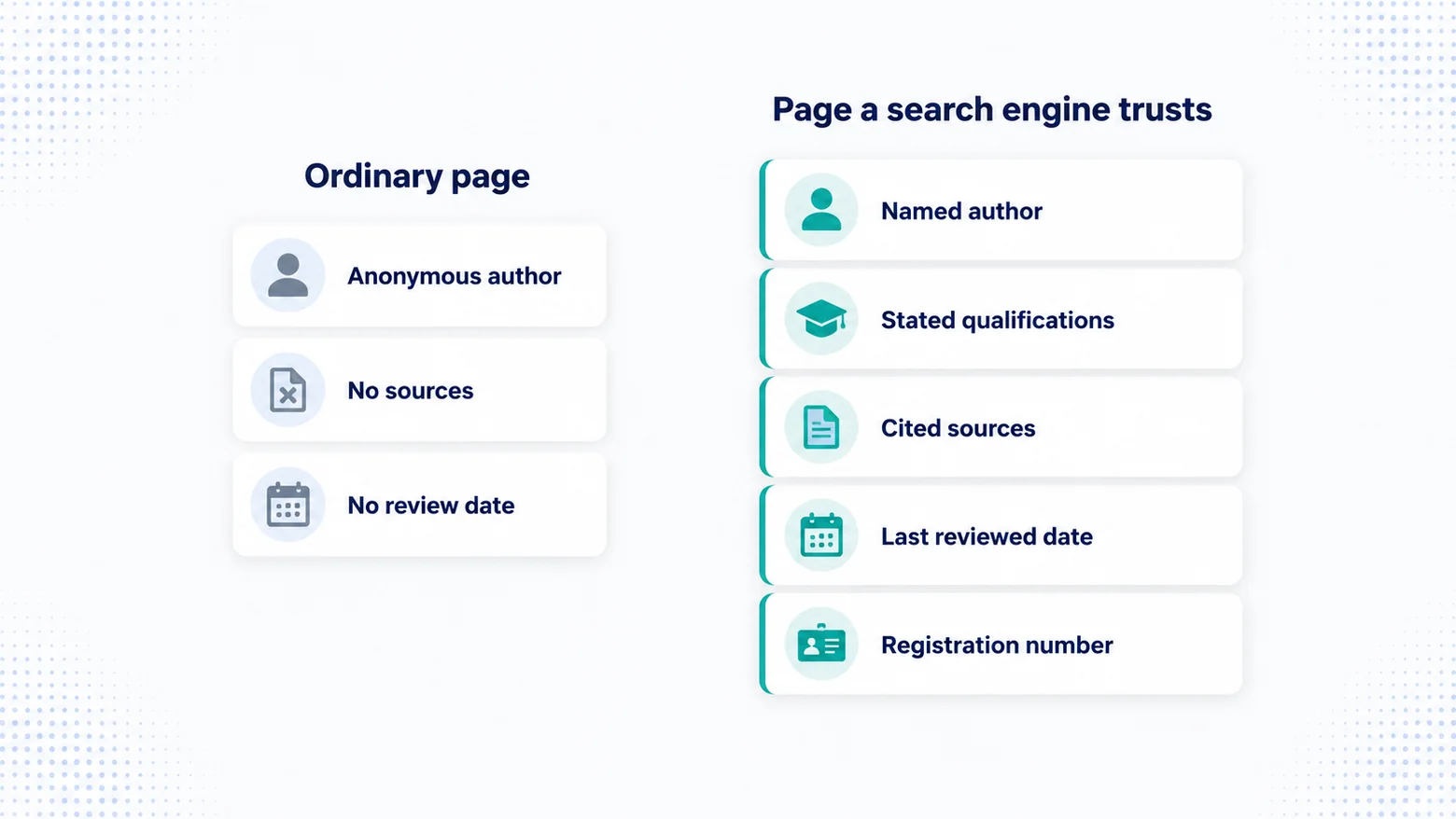
By naming them, stating their registration, and connecting them to the pages they are responsible for. An anonymous treatment page asks the reader and the search engine to take clinical claims on trust, and neither of them will.

A clinician profile that does the job carries a name, the professional registration and its number, the qualifications and where they were earned, the treatments that person actually performs, and how long they have been doing them. Not a paragraph of warm biography and a headshot.
The connection matters as much as the profile. Each treatment page should say who wrote or reviewed it and when, and link to that person’s profile. That is a small piece of markup and a line of visible text, and it converts a page from an anonymous claim into an attributable one.
It also happens to be what patients want. A person deciding whether to have a procedure is choosing a clinician, not a clinic, and a page that will not tell them who would perform it loses to one that will.
There is a secondary benefit that has become commercially significant. AI assistants asked to recommend a provider name the ones they can verify, and a named, registered clinician with consistent details across the site and the professional register is verifiable in a way an anonymous clinic is not. For chiropractors, that means the Dr title wording and GCC number on every clinician profile.
What do ASA and CAP rules stop a clinic claiming?
Rather more than most clinics realise, and the biggest one surprises people: a prescription-only medicine cannot be advertised to the public at all. That is not a style guideline, it is why a great deal of aesthetic clinic marketing is technically unlawful.
| Area | What the rules say | What that means for the page |
|---|---|---|
| Prescription-only medicines | Cannot be advertised to the public. The ASA treats almost any reference, direct or indirect, as likely to breach, including hashtags and euphemisms | The treatment name cannot be the page’s selling point. The page is built around the consultation instead |
| What is permitted instead | A clinic may advertise consultations. A reference may appear in a price list or as a possible outcome of a consultation, if purely informational and not on the homepage | A consultation page can rank. A promotional treatment page cannot exist |
| Paid and social promotion | Social media, paid advertising, leaflets and price promotions are off-limits for those medicines entirely | Organic search and the consultation page carry the whole load |
| Under-18s | Since 25 May 2022, ads for non-surgical cosmetic interventions must not be targeted at under-18s, and must not run where under-18s are 25 per cent or more of the audience | Affects channel choice and influencer work, not the website itself |
| Before and after images | Signed, dated proof the images are genuine and undigitally altered. They are visual claims and need evidence. Makeup, filters and retouching that exaggerate the effect are not permitted | Usable, with a consent and evidence process behind them. A disclaimer does not rescue a misleading image |
| Testimonials | Must relate to the treatment advertised, must be genuine with evidence held, must not reference a prescription-only medicine, and permission is required | Reviews are usable. Reviews naming a restricted treatment are not |
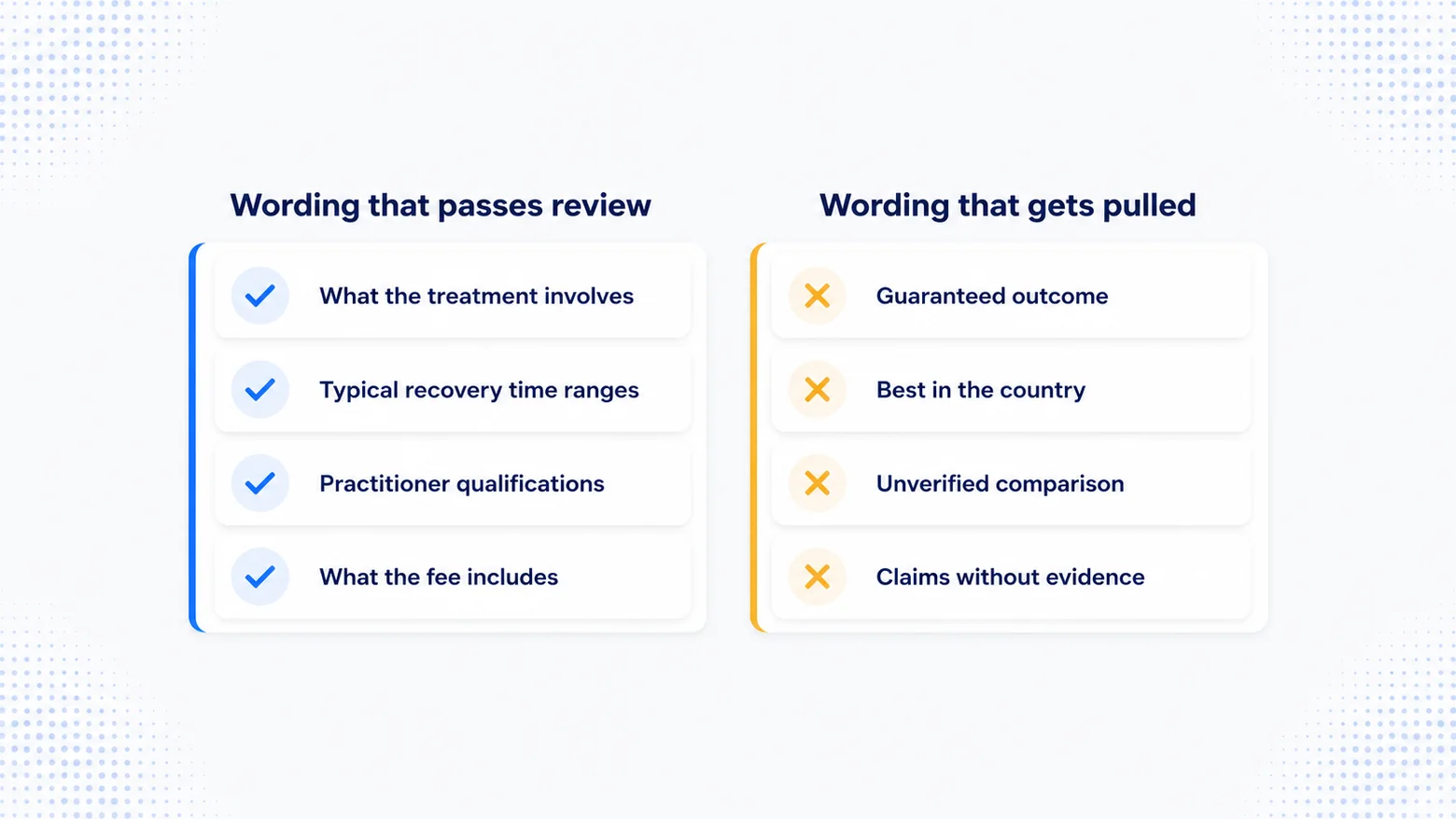
| Outcome claims | Claims must not create an unjustified expectation of results | No guarantees, no “permanent”, no implied certainty. Honest ranges instead |
Read as a constraint this table looks punishing. Read as a brief it is an advantage, because almost nobody writes to it. A clinic that publishes a genuinely useful consultation page, with honest ranges and a named clinician, is competing against a market of pages that either breach the rules or say nothing. Chiropractic shows how specific these limits get: our guide to what chiropractors can claim to treat walks through the 19 conditions on the accepted list.
It also explains a pattern we see constantly: an aesthetic clinic whose best-performing page is an educational one, because that was the only page the agency could get signed off. The lesson was there and nobody drew it.
How do patients actually search before choosing a private clinic?
In stages, over weeks. They start by asking whether the treatment is worth having, move to what it costs, then to who is good, then to a specific name. Each stage is a different search and needs a different page.
Five patient searches, and the intent hiding underneath each
The commercial mistake most clinics make is writing only for the last stage. A page optimised for “[treatment] near me” catches somebody who has already decided, which is a small and heavily contested group. The larger group is still deciding, and they are reading the pages that answer honestly.
The second mistake is answering the cost question badly. Private patients compare, and a page that says “prices on request” loses to one that gives a range and explains what moves it. The clinic that publishes the range is not competing on being cheapest; it is competing on being answerable.
Start with a free month, and judge us on pages your clinicians will sign off
The first month of a healthcare programme is free. You get the compliance read, the clinician authorship plan and the first drafted pages, and your clinical lead sees every word before anything is billed.

- Every page checked against advertising rules for regulated treatments
- A named clinician attached to each area of expertise, marked up so it is verifiable
- First drafted pages your clinical lead can approve or reject on the merits
Your first month of SEO, free
Answer three quick questions to claim yours.
Thank you, that is with us.
We will email your onboarding form and payment link, and call within one working day if you would rather talk it through first.
Pick a time that suits you below. We will confirm by email too.
Book your 30 minute meetingWhich private healthcare providers gain most from SEO?
The ones patients refer themselves to and pay for directly. Where a GP referral or an insurer sits between the patient and the clinic, search matters less, and we will say so before you spend anything.
| Provider | How patients arrive | How much search decides |
|---|---|---|
| Aesthetic and cosmetic clinics | Self-referred, self-funded, heavily researched | A great deal, constrained by what may be advertised |
| Private GP practices | Self-referred, usually urgent, local | A great deal. Speed of access is the selling point and it is searchable |
| Physiotherapy and musculoskeletal | Self-referred, local, condition-led | A great deal. Condition pages are the whole programme |
| Chiropractic clinics | Self-referred, local, condition-led | A great deal, inside the CAP list of conditions a chiropractor may claim to treat |
| Fertility and IVF | Self-referred, long research cycle, high value | A great deal, and the research stage is where it is won |
| Specialist consultants | Mixed. GP referral plus a growing self-referred share | Moderate and rising. The consultant’s own name matters most |
| Private hospitals | Insurer networks, consultant relationships, some self-referral | Moderate. Brand and consultant pages do the work |
| Insurer-led services | Directed by the insurer | Little. We would advise against a search programme here |
The last row is not a throwaway. We have turned down clinics whose patient flow is contractually determined, because a search programme would have produced traffic that could not convert. That conversation costs us a client and saves them a year.
Chiropractic clinics fit the self-referred pattern but work to their own rulebook: the CAP list of conditions a chiropractor may claim to treat. We run them as a separate programme, and our page on SEO for chiropractic clinics covers that list, the GCC registration details patients look for, and what our crawl of 50 clinic websites found.
How is dental SEO different from healthcare SEO?
Different regulator, different search behaviour, and a different relationship to the local pack. Dentistry is governed by the GDC, is far more local, and turns on routine repeat treatment as much as on one-off decisions.
The regulatory difference is concrete. Dental practices answer to the General Dental Council, whose advertising guidance has its own requirements about registration numbers, the use of the word “specialist” and comparative claims. Private medical clinics answer to the ASA and CAP framework, and where CQC registration applies, to that as well. Copy written for one is not automatically safe for the other.
The search difference is just as practical. A patient looking for a dentist is almost always looking locally and often looking for an ongoing relationship. A patient researching a private medical procedure will travel, will compare nationally, and is making a single decision. That changes which pages matter and how much weight the Google Business Profile carries.
We keep the two separate for that reason, and if you are a dental practice the page you want is our dental SEO page rather than this one.
What should a clinic do when a Google update drops its traffic?
Work out whether the pages that lost ground were the anonymous ones. Core updates re-assess whether a page deserves its position, and medical content written by nobody is the first thing re-assessed downwards.
The instinct after a drop is to look for a technical fault, and there usually is not one. What there usually is, on a clinic site, is a set of treatment pages with no named author, no review date, no citations and no way for an assessor to establish that anybody qualified stood behind them. When the standard rises, those are the pages that move.
The diagnostic is straightforward. Pull the pages that lost position, and ask of each: who wrote it, what are they registered as, when was it last reviewed, and does the page say so. If the answer is nobody, nothing and never, the update did not break the page. It corrected it.
Recovery is slow but it is not mysterious. Attribute the pages, add the review dates, connect them to real clinician profiles, and cite where clinical claims come from. We wrote about the mechanics of one of these events on our March 2025 core update analysis.
How do you measure SEO when patients still book by phone?
With call tracking assigned by page or treatment, so a call can be traced to the search that caused it. Without it a clinic’s best-performing pages look like its worst, because their conversions happen on a telephone that analytics cannot see.
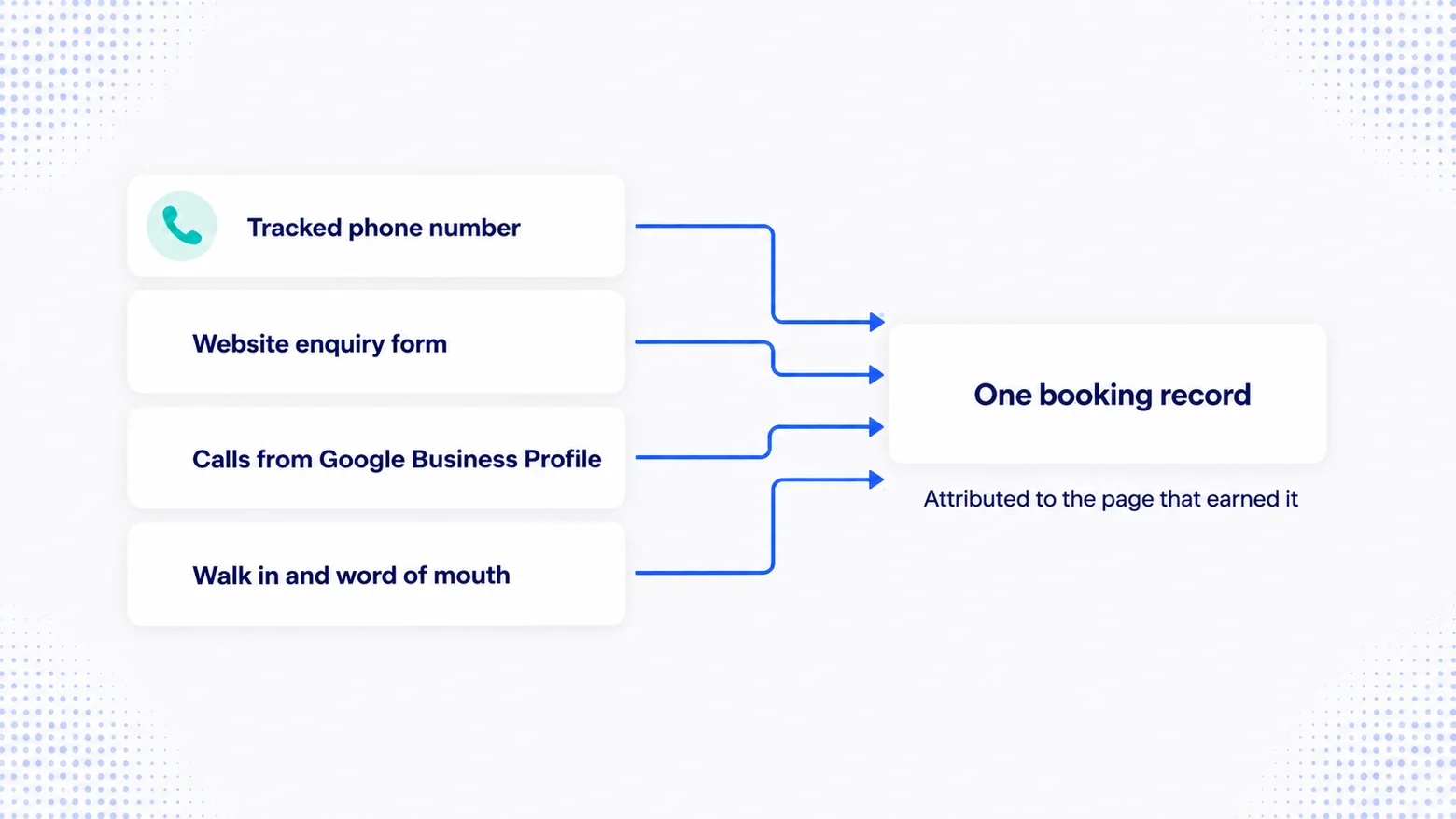
This is not a minor gap in private healthcare, it is most of the picture. Patients making a health decision phone. They phone because they have a question they do not want to type into a form, and they often phone days after the visit that convinced them. Default analytics records that visit as a bounce.
The fix is unglamorous and it works: a tracked number per treatment area, recorded against the landing page, reviewed monthly alongside positions. Clinics that add it are usually surprised by which page is actually producing patients, and it is rarely the homepage.
The other half is agreeing what counts. A booked consultation and an enquiry are different things, and a programme measured on enquiries optimises for volume. We agree the ten queries and the outcome that matters before the first invoice, then report against that list every month.
Why do AI assistants name one clinic and not another?
Because one of them can be verified. Assistants answering a health question are conservative: they name providers whose qualifications, registration and details are consistent and checkable across more than one source.
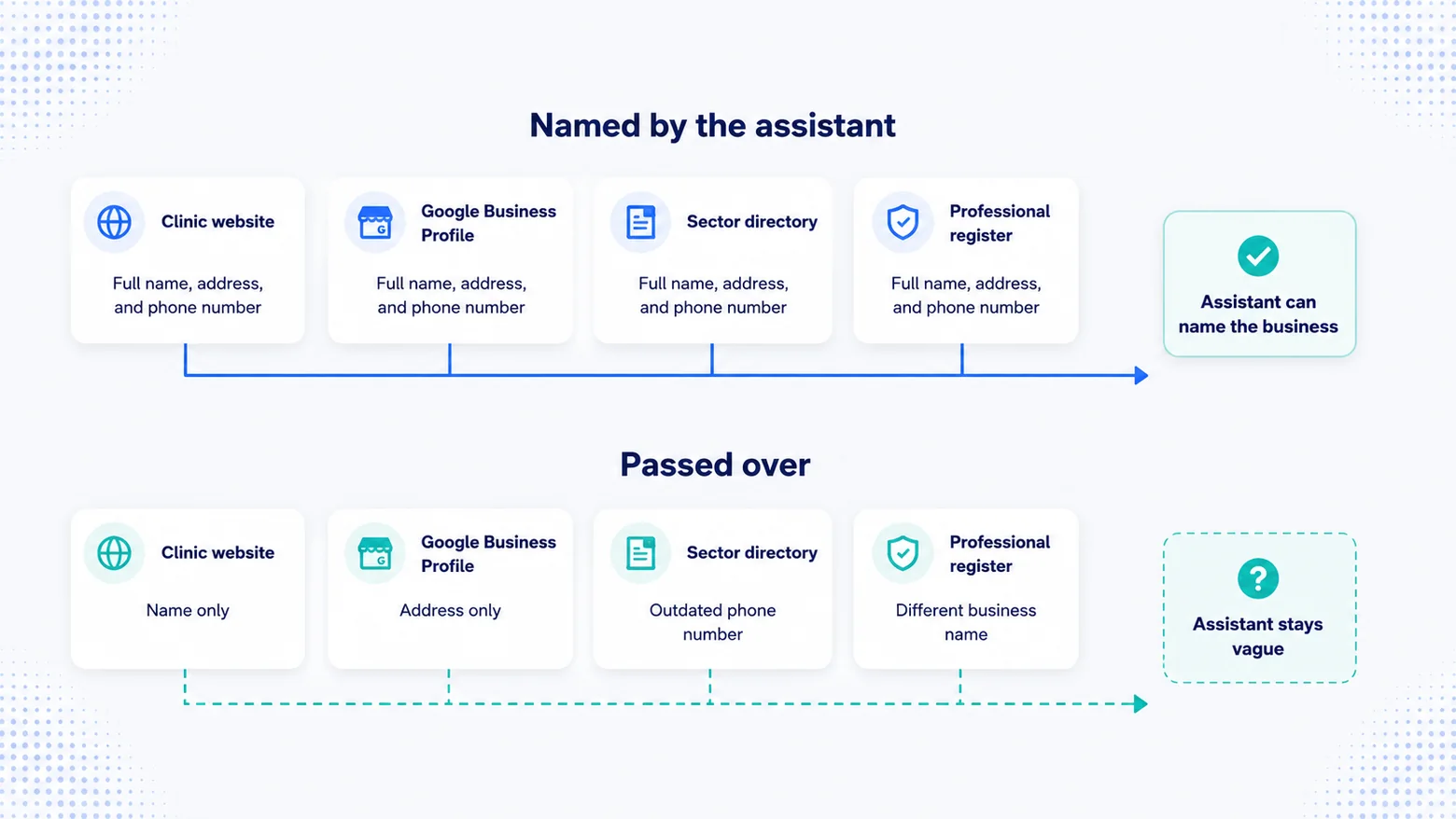
The behaviour is easy to test on your own clinic and worth doing before you read further. Ask an assistant to recommend a provider for one of your treatments in your city and see whether you appear. Most clinics do not, and the reason is almost always the same: nothing on the site establishes who is qualified to do what.
What makes a clinic nameable is the same work that makes it rank. Named clinicians with registration numbers. Treatment pages specific enough to be matched to a question. A consistent name, address and phone across the site, the Business Profile and the professional registers. Claims that are moderate enough to be repeatable without risk.
That last point is doing quiet work. An assistant will not repeat an outcome claim it cannot support, so a page full of guarantees gets skipped in favour of the clinic that gave an honest range. The compliance constraint and the AI visibility strategy turn out to be the same thing, which is a genuinely useful coincidence. Our page on ranking in AI and LLM answers covers the mechanism in more depth.
How does the first ninety days actually run?
A free thirty-minute call, then a compliance and technical baseline, then treatment pages and clinician profiles, then the cost and comparison content. Every stage produces something you can check.
Ninety days, with something verifiable at every stage

The order is deliberate. The audit first, because a clinic that discovers in month three that its flagship treatment cannot be advertised has to rebuild its whole content plan. The treatment pages second, because everything later links to them. Cost and comparison content last, because it depends on decisions made in the first two stages.
What moves inside ninety days is coverage, indexing and impressions. Positions on competitive treatment terms move over two to three quarters, and booked patients follow positions rather than leading them. We say that on the call rather than in month five.
Clinics with more than one site need the local layer running in parallel: a Business Profile per location, consistent details everywhere, and a real page per site. That is covered on our multi-location SEO page.
Which clinics is this right for, and which is it wrong for?
It suits self-referred, self-funded providers with treatments patients research before choosing. It is wrong for insurer-directed services, and wrong for a clinic already at capacity.
The strongest fit is a clinic with two or three treatments it wants more of, a clinical lead willing to be named on the pages, and a site that already functions. That combination is unusually winnable, because most competitors will not name anybody and cannot write inside the rules.
The second fit is a clinic recovering from a core update. Those sites usually have the substance and lack the attribution, and adding the missing layer is faster and cheaper than starting again.
The mismatches are worth stating plainly. A clinic whose appointments come from an insurer network will not benefit. A clinic with a six-week waiting list does not need more enquiries. And a clinic unwilling to name a clinician on its clinical pages cannot be helped much by us or anybody, because the missing ingredient is the one thing the sector is judged on.
Do you work with clinics in Cardiff and South Wales?
Yes. We are a Cardiff consultancy and a good share of our healthcare work is for clinics across South Wales, with the rest across the UK, delivered remotely.
For clinics there is a practical benefit to proximity: half an hour with whoever answers the phone tells us which treatments produce bookings and which produce questions, and that shapes the query list far better than a keyword tool does.
Everything else is identical wherever you are. Our Cardiff SEO work covers the local search side, and the clinical programme runs the same way nationally.
Frequently asked questions about healthcare SEO
Do our clinicians have to be named on the site?
For clinical pages, yes, if you want them to compete. Google assesses medical content on demonstrable expertise, and an anonymous treatment page cannot demonstrate any. If a clinician is uncomfortable being named, a named clinical reviewer for the page is the workable compromise.
Can we advertise our aesthetic treatments at all?
Not the ones that are prescription-only medicines, and the ASA reads that restriction broadly enough to catch euphemisms and hashtags. What you can advertise is the consultation, and a consultation page can rank perfectly well. It changes the shape of the page, not whether you can have one.
How long before we see new patients?
Impressions and coverage move in the first quarter. Positions on competitive treatment terms take two to three quarters, and booked patients follow positions. Anyone giving you a number for month two is describing a mechanism that does not operate.
We lost traffic after a Google update. Can it be recovered?
Usually, and the work is rarely technical. Pull the pages that lost ground and check whether they name an author, carry a review date and cite their clinical claims. On clinic sites the answer is normally no, and that is both the cause and the fix.
Can we use before and after photos?
Yes, with a process behind them. You need signed and dated proof that the images are genuine and unaltered, and they must not be enhanced in a way that exaggerates the result. They count as claims, so they need the same evidence any claim would.
Should we publish our prices?
A range, with what moves it. Patients compare, and “prices on request” loses to a clinic that answers. A range also filters out enquiries you were never going to convert, which your reception team will appreciate more than the extra volume.
How much clinician time does this take?
Roughly an hour a month per treatment area, for accuracy checks and to be named on the relevant pages. We draft, they correct. Clinics that give that hour get noticeably better pages than clinics that sign off without reading.
Is this different for a multi-site clinic group?
Yes, and the difference is the local layer. Each site needs its own Business Profile, its own genuinely different page and consistent details everywhere. The treatment content is shared; the location content cannot be, or the sites compete with each other.
Do you write the content or do we?
We draft to the rules and your clinicians correct the clinical detail. That order works better than the reverse, because the constraint that stops content being published is a regulatory one rather than a clinical one, and it is easier to write inside it than to edit into it.
The next step
Book a free thirty-minute strategy call
We look at which treatments you can realistically win, what is currently published that would not survive a complaint, and whether search is your constraint at all. You leave with a written query list whether or not you decide to work with us.
This is one of eighteen UK sectors True SEO works in. See the full list of industries we build search programmes for.