Automotive SEO for dealers, garages and parts retailers
Billed on agreed KPIs. No minimum commitment, 30 days’ notice.
Vehicle buyers and drivers do not start on your website. They start on Google and on Auto Trader, and by the time they reach you the decision is usually half made. Automotive SEO gets you into that earlier moment: the stock search, the “MOT near me”, the model comparison, the finance question.
- Stop renting your leads. Own the searches a marketplace charges you for.
- Two buyers, two programmes. Vehicle sales and workshop bookings scoped separately.
- We will tell you if it is not worth it. Three situations get an honest no.
- Car dealerships
- Dealer groups
- Van dealers
- MOT centres
- Garages
- Mobile mechanics
- Auto parts

Find out which searches you could realistically win this year
- Your winnable searches, named and prioritised
- What is blocking you today, with the evidence
- Whether a programme, an audit, or just a better profile is the answer
You keep the shortlist whether or not you work with us.
What a dealer or garage owner should know before buying SEO
Every automotive programme starts with a free 30-minute review. We look at your site, your stock or service pages, your Google Business Profile and your Search Console data, then tell you which searches you could realistically win this year. Book the free automotive SEO review and you will leave the call with a shortlist whether or not you work with us. It sits inside our wider range of SEO services.
Which automotive businesses is this page for?
This page is for UK businesses that sell, service or supply parts for vehicles, and that take enquiries or bookings from a defined local area or a national delivery footprint.
| Your business | What you are really competing for | Where we start |
|---|---|---|
| Independent car dealer | Model and stock searches in your travel-to area, against Auto Trader | Stock page architecture and local visibility |
| Franchised dealer or dealer group | Brand plus location terms across every site, without the sites competing | Multi-location structure and group-level consistency |
| Van and commercial dealer | Payload, size and finance searches from business buyers | Buyer-question content and finance pages |
| MOT centre and garage | Service, repair and near-me bookings within a few miles | Google Business Profile and the map pack |
| Mobile mechanic | Service-area searches with no shopfront | Service-area structure and review velocity |
| Auto-electrical, diagnostics, bodyshop | Specific fault and symptom searches | Problem-led content and technical pages |
| Auto parts retailer | Part, fitment and compatibility searches, often national | Ecommerce category and fitment structure |
Three sectors we no longer serve from this page
Motor insurance, vehicle logistics and transport, and automotive technology suppliers. Those are different buyers with different search behaviour, and covering them here made this page vaguer for everyone.
Parts retailers selling online are usually better served by our Shopify and ecommerce SEO work, because the problem is category and fitment structure rather than local visibility.
How do car buyers and drivers actually search before they visit?
They search in two completely different patterns, and treating them as one audience is the most common mistake on dealer and garage websites.

What a buyer types, and what they actually want next
The vehicle buyer researches for weeks and narrows slowly. The sequence usually runs: a broad need (“best family SUV under £15,000”), then a model shortlist (“Kuga vs Sportage reliability”), then a specification and finance question (“Kuga Titanium PCP deposit”), then finally stock and location (“used Ford Kuga Cardiff”). Only that last step has your name anywhere near it, and it is the step every dealer competes on. The earlier steps are where the decision is actually made, and where almost nobody local is publishing anything.
The driver with a problem searches once and books immediately. The sequence is short: symptom or need (“grinding noise when braking”, “MOT due”), then proximity and availability (“garage near me open Saturday”), then a check (“reviews” plus your name). There is no research phase. Speed, proximity and trust decide it, usually inside one session.
That split drives everything else on this page. A dealer needs content that arrives early and a stock structure that holds. A garage needs to own a small radius and be impossible to doubt. The same programme does not serve both, which is why we scope them separately.
Why does Auto Trader outrank you for your own stock?
Marketplaces outrank dealers on model-level searches because they hold thousands of examples of every model, refreshed constantly, with more links and more behavioural data than any single dealer can accumulate.
On “used Ford Kuga” you are not going to beat them, and chasing that term is how dealer budgets get wasted. You beat them on the ground they cannot hold.
- Location plus model, at the specificity they generalise. A marketplace page for “used Kuga in Cardiff” is a filtered list. A dealer page can name the actual forecourt, the test-drive process, the part-exchange terms and the people.
- The questions they do not answer. Marketplaces list stock. They do not explain whether a cambelt is due at 100,000 miles on a specific engine, what happens to negative equity on a part exchange, or whether a warranty transfers.
- Your own service and aftersales. A marketplace has no interest in your workshop. Service, MOT, parts and repair searches are entirely yours to win, and they produce the repeat revenue vehicle sales alone do not.
- Being the named business rather than a listing. When someone searches your dealership by name, or asks an assistant for a recommendation, the marketplace listing is not the answer. Your entity data is.
The practical shape of this is a site that stops competing on model head terms and starts owning every local, aftersales and question-led search around them.
What does SEO for a car dealership involve?
Dealership SEO is mostly structural. Content matters, but what decides whether a dealer site ranks is how stock pages are built, indexed and retired.

Four layers of a motor trade website, and who leaves each one undone
Four problems account for most of what we find.
- Vehicle detail pages that appear and vanish. Stock turns, and each sold vehicle leaves a dead URL. Sites returning a 404 for every sold car train Google to crawl them less. Sites redirecting everything to the homepage lose the signal entirely. The correct handling is a redirect to the closest equivalent stock or the model category, with the category holding the durable ranking rather than the individual car.
- Search results pages that generate infinite variations. Filters for colour, transmission, fuel, price band and mileage can produce tens of thousands of near-identical URLs. Left open they consume crawl budget and dilute the pages that matter.
- Model and location pages that do not exist. Most dealer sites have a stock feed and a homepage and nothing in between. The page that should rank for “used vans Newport” is usually a filtered stock URL with no copy and no local signal.
- Finance and part-exchange questions left unanswered. PCP, HP, balloon payments, negative equity and settlement figures carry sustained search volume, and they sit directly before a purchase decision.
Underneath all four sits the crawl and indexing layer, which is where our technical and on-page SEO work does the repair before any content is written. Dealer groups running several sites have an extra problem, their own sites competing with each other, handled through our multi-location and local SEO service.
A three-site dealer group we worked with shows the pattern. It ran roughly 900 live vehicle URLs and drew about 2,400 organic visits a month across the group, with the three sites ranking against each other on nine location terms. We consolidated the stock architecture, gave each site its own location territory, redirected sold stock to model categories instead of the homepage, and published 14 model-and-town pages plus a finance question set. After seven months organic visits reached about 6,100 a month, the group held first-page positions on 38 local terms, and workshop bookings from organic search had roughly doubled.
Take the first month free, and check it against your MOT and service bookings
The first month of an automotive programme is free. We start on the servicing and local side, because that demand converts in hours rather than weeks, and you can check it against your own booking diary.

- Which service and repair searches you are invisible for in your own towns
- The buyer questions marketplaces cannot answer, and which ones you can own
- Google Business Profile fixed properly, which does most of the local work
Your first month of SEO, free
Answer three quick questions to claim yours.
Thank you, that is with us.
We will email your onboarding form and payment link, and call within one working day if you would rather talk it through first.
Pick a time that suits you below. We will confirm by email too.
Book your 30 minute meetingWhat does SEO for a garage or MOT centre involve?
Garage SEO is local visibility plus trust, and it is a smaller, faster job than dealership work. Most garages can be competitive within a few miles inside three to six months, because the competition is usually doing very little.

Five things decide it.
- Google Business Profile completeness. Services listed individually, hours accurate including bank holidays, photos of the actual workshop, questions answered. This does more for a garage than anything on the website.
- A page per service, not one services page. MOT, air conditioning regas, cambelt, clutch, diagnostics, brakes, tyres and servicing are separate searches. One combined page ranks for none of them well.
- Symptom and fault content. Drivers search what they hear and feel, not what the repair is called. “Juddering when braking” brings in people who do not yet know they need a brake disc.
- Review velocity, not review count. A steady flow of recent reviews outperforms a large but stale total. This is the cheapest lever most garages ignore.
- Booking friction. A phone number is not enough. Online booking with a visible next-available slot converts a materially higher share of the traffic SEO brings.
MOT work has a rhythm worth exploiting. Every test has an expiry date, so demand for each customer is predictable a year ahead. A garage that captures registration details and sends reminders converts its own past traffic without paying for it twice. The DVSA operates the MOT scheme and publishes the testing standards, and a garage that explains what a tester actually checks tends to earn the questions competitors ignore.
An independent MOT centre we worked with started at roughly 40 organic visits a month, with no Google Business Profile categories set beyond “Car repair and maintenance”. We rebuilt the profile, split one services page into nine, added eleven symptom-led pages and set up a review request at invoice. Within five months it was appearing in the map pack for MOT and servicing terms across four surrounding towns, organic visits had reached about 520 a month, and it was taking 30 to 40 additional bookings a month from search.
How do you win the map pack for a forecourt or workshop?
You win the map pack through proximity, prominence and relevance, and only two of those are inside your control.

Proximity to the searcher is fixed. You cannot move the workshop, which is why claiming to rank “everywhere” is dishonest. What you can change is prominence and relevance.
Relevance is telling Google exactly what you do. A profile listing “MOT test”, “clutch replacement” and “air conditioning regas” as distinct services is relevant to those searches. A profile listing “garage” is relevant to nothing in particular.
Prominence is everything corroborating that you exist and are trusted: reviews, consistent name, address and phone across directories, local press and sponsorship mentions, and links from nearby businesses. Automotive directories and trade bodies carry more weight here than general citation lists.
- Service areas are not a way to fake proximity. Setting a 30-mile radius does not make you rank 30 miles away. It helps only where you actually operate without a shopfront, which is the mobile mechanic case.
- Categories are ranked, not equal. The primary category does most of the work. A dealership that also services vehicles usually needs to decide which the profile is for, or run a second profile with a separate entrance and phone line.
- Name stuffing gets suspended, not ranked. Adding “MOT Cardiff Cheap” to your business name is a violation and a suspension risk that costs far more than the ranking was worth.
Which keywords actually matter for a garage or dealership?
The keywords worth chasing are the specific, high-intent ones, not the head terms every competitor is bidding on. Volume without a realistic route to page one is a budget with no return.
| Search type | Example | Why it is worth having |
|---|---|---|
| Service plus town | MOT test Caerphilly | Direct booking intent, usually winnable within months |
| Job plus price | Cambelt change cost Cardiff | Buyer is comparing, not browsing, and few sites answer it |
| Symptom | Grinding noise when braking | Arrives before the customer knows what to book |
| Make plus service | BMW servicing near me | Specialist positioning, far less contested than generic servicing |
| Model plus location | Used Ford Kuga Newport | Winnable locally where the model head term is not |
| Finance question | PCP settlement figure explained | Sits directly before a purchase decision |
| Part plus fitment | Brake discs Ford Focus Mk3 | Commercial intent for parts retailers, with no local limit |
| Urgency | MOT today near me | Small volume, very high conversion, almost no competition |
Head terms such as “car dealer” or “garage” on their own are usually the worst use of budget. They are contested nationally, they mix intents, and the traffic they produce converts poorly. Our guide to how keyword intent should shape a page sets out the method we use to sort a list like this before any content is planned.
Will AI assistants recommend your dealership or garage?
They will if your business resolves cleanly to a known entity, your services are stated in machine-readable terms, and independent sources agree with what your site says.
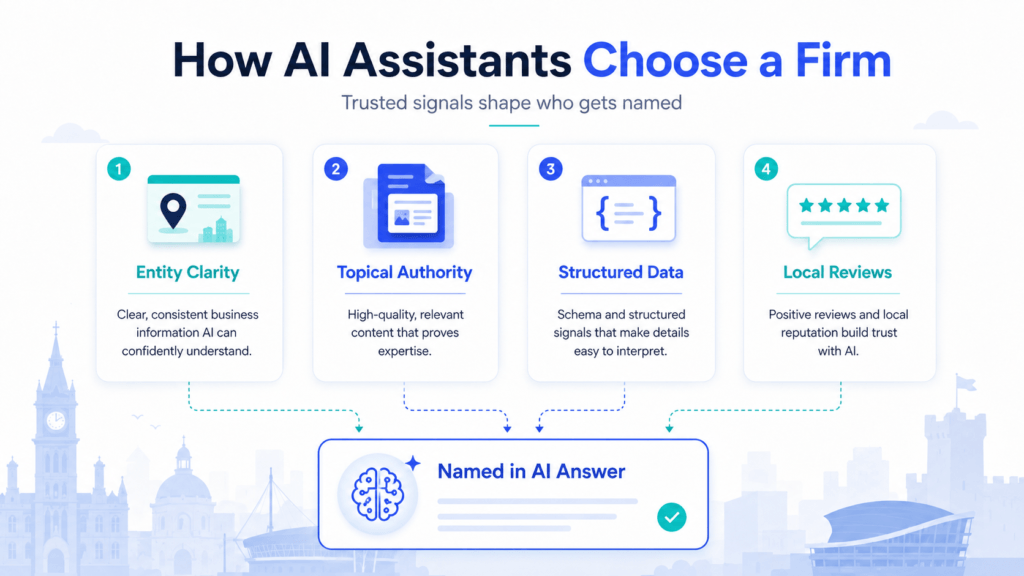
Roughly a third of UK Google searches now show an AI summary above the standard results, and more than half of UK adults say they see those summaries regularly. For a local automotive business the consequence is narrow: when someone asks an assistant for a garage that can do a cambelt in your town, one or two businesses get named.
Being named requires consistent name, address, phone and opening hours everywhere they appear, service-level structured data rather than a generic business listing, genuine reviews that mention the specific service, and content that answers the question directly rather than burying it. This is the same work as ranking, done to a stricter standard, and it is the basis of our AI and LLM search visibility service.
What does automotive SEO cost, and how is it billed?
We bill against agreed KPIs rather than hours, with no minimum commitment and 30 days’ notice. We do not publish a single price for automotive work, because the scope really does change it.
A number that ignored your stock system or your site count would be a guess. So we publish what moves it instead.
| What changes the price | Why |
|---|---|
| Number of sites or locations | A dealer group needs each site given its own territory and checked against the others |
| Stock system and feed quality | A site whose vehicle pages cannot be controlled needs development work before SEO work |
| Condition of the existing site | Crawl waste, redirect chains and thin pages are repairs that come before growth |
| Sales, service, or both | Two audiences means two content programmes, not one |
| Local competition | A town with three active competitors costs less to win than a city with thirty |
| Who writes the content | We can plan it for your team or write it ourselves |
Our published monthly programmes start from £499 a month, and the monthly SEO packages page sets out what each tier includes. Where you want a diagnosis before committing to anything ongoing, the SEO audit service is available on its own.
What we removed from this page, and why
This page used to publish a website design price range alongside the SEO figures. A design quote is a different service with a different scope, and mixing the two made both numbers meaningless. Our wider breakdown of what SEO costs in the UK gives the market context instead.
How does a True SEO automotive programme run?
Six stages, and nothing is published before the plan is agreed. Stage two often shrinks stage three.

The first ninety days, and what you can check at each stage
| Stage | What happens | What you get |
|---|---|---|
| 1. Free review | 30 minutes on your site, stock or service pages, profile and Search Console | A shortlist of winnable searches, yours either way |
| 2. Diagnosis | Crawl, stock URL audit, map pack position check, competitor coverage | A prioritised list of what is blocking you, with evidence |
| 3. Plan | Every page to build or rebuild, its target search, and the link structure | A build specification your team or ours can follow |
| 4. Fix and build | Stock architecture repair, service pages, symptom content, profile rebuild | Live pages and a clean technical base |
| 5. Local authority | Reviews, automotive directories, trade citations, local coverage | Corroboration that supports the map pack |
| 6. KPI review | Monthly review of positions, map pack visibility, calls and bookings | A report naming outcomes, not activity |
What happened to my traffic after the last Google update?
Core updates reassess how well a site satisfies the intent behind searches, so automotive sites that fell usually did so for one of three reasons.
Thin stock pages with no unique content. Service pages written for search engines rather than drivers. Or a site that ranked on structure while answering less completely than a competitor.
There is nothing to appeal after a core update. The recovery route is the same work done properly: cut what is thin, answer what is asked, and make the local signals unambiguous. Our write-up of the March 2025 core update explains what that reassessment looks like in practice, and the underlying method is our semantic SEO and topical authority work.
Where a drop followed a site migration or a stock system change rather than an update, the cause is usually technical and the fix is usually faster. The diagnosis tells you which of the two you are dealing with before any money goes into content.
Is automotive SEO the right spend for you right now?
Four questions. No email, no form. One of the three answers tells you to spend your money somewhere other than with us.
Question 1 of 4
When you search your main service plus your town, where do you appear?
Question 2 of 4
Who can change your website templates?
Question 3 of 4
How soon do you need more enquiries?
Question 4 of 4
How many Google reviews have you had in the last three months?
You may not need a monthly programme at all.
You are already visible, your reviews are healthy and you are not under time pressure. The honest answer is that a Google Business Profile tidy-up and a review process will get you most of the available return. We would rather set that up in one conversation than sell you a retainer that cannot pay for itself.
A focused local programme is the right first spend.
You have visibility gaps and review gaps, and you are working to a sensible timescale. That is exactly what a local automotive programme fixes: profile rebuild, a page per service or model, symptom content and a review process. Start with the diagnosis so the build list is evidence-led rather than guessed.
Fix the foundation before you buy any content.
Your answers point at a site you may not fully control, little or no visibility, and pressure for results quickly. Content will not solve that. Start with an audit to establish what your platform will actually let you change, and use paid search to cover the short term while the structural work happens.
Answer the first question to begin.
Who should not buy this?
Three situations where we will say no, and we would rather say it on the call than after an invoice.
You need enquiries in four weeks
A dealership needing leads inside a month should spend on paid search and marketplace listings first. SEO does not work on that timescale, and anyone promising it is selling something else.
You do not control your website
Where a stock platform provider owns the templates, the structural work cannot be done at all. We will tell you what to ask your provider for, and there is no charge for that conversation.
Your town has very little demand
A single-site garage in a low-volume area may not justify a monthly programme. A one-off profile rebuild and a review process gets most of the return, and we would rather set that up.
Who does the work?
The work is led by Mohammad A Mahmud, a qualified accountant in search since 2010 and trained in Koray Tugberk Gubur’s semantic SEO framework, with commercial oversight from Julie Williams, a fractional finance director and certified business coach.

The accountancy background matters more in automotive than in most sectors, because margin structure differs so sharply between vehicle sales, finance commission, service and parts. A programme that lifts traffic to the lowest-margin part of your business has not helped you. You can read more about how the practice is run and see documented results in our SEO case studies.
Frequently asked questions about automotive SEO
How long before a dealership or garage sees results?
A garage in a modest local market often sees map pack movement within eight to twelve weeks, because the work is concentrated and the competition is usually inactive. A dealership competing against marketplaces and other dealers usually takes four to eight months for meaningful position change, longer where the stock architecture needs rebuilding first.
Can I rank for a model when Auto Trader holds the first page?
Not for the bare model term, and we will not take money to try. You can rank for that model plus your location, plus condition, plus the finance and part-exchange questions around it, and those searches convert better because the person is closer to buying from someone local.
Do I need SEO if I already advertise on Auto Trader?
They do different jobs. A marketplace rents you access to buyers and charges per lead for as long as you keep paying. SEO builds an asset you own, and it captures the aftersales and service demand a marketplace has no interest in. Most dealers we work with keep both and shift the balance over time.
What happens to my rankings when a car sells?
Handled properly, nothing. Individual vehicle pages should never be the thing that ranks. The model and location category pages hold the position, and sold stock redirects into them, so turnover stops costing you visibility.
Is this worth it for a single garage with one location?
Usually yes, and it is one of the cheapest sectors to compete in, because most independent garages do almost nothing. The exception is a town with very little search volume, where a profile rebuild and a review process gets most of the return without a monthly programme.
Where automotive SEO connects to the rest of the work
Automotive is the sector. These are the services that do the work underneath it, and the guides that show how we think.
Book the free automotive review
Thirty minutes, and you will know which searches are worth your money this year
True SEO Consultants Ltd, company number 16563516, works from Startup Stiwdio, University of South Wales, 86-88 Adam Street, Cardiff, CF24 2FN. We work with dealers, garages and parts retailers across the UK, and onboard clients worldwide through a fully remote digital onboarding and delivery process, so the work described here applies whether your forecourt is in Cardiff, Bristol, Manchester or further north.
The first conversation costs nothing and commits you to nothing. We will tell you which searches your business could realistically win, what is stopping you today, and whether a monthly programme, a one-off audit or simply a better Google Business Profile is the right next step. You keep the shortlist either way.
Automotive SEO from Cardiff, delivered across the United Kingdom.
This is one of eighteen UK sectors True SEO works in. See which other UK industries we run search and AI visibility work for.