Digital Marketing Campaigns, Planned To Pay
Campaign planning and delivery from a consultancy led by a qualified accountant
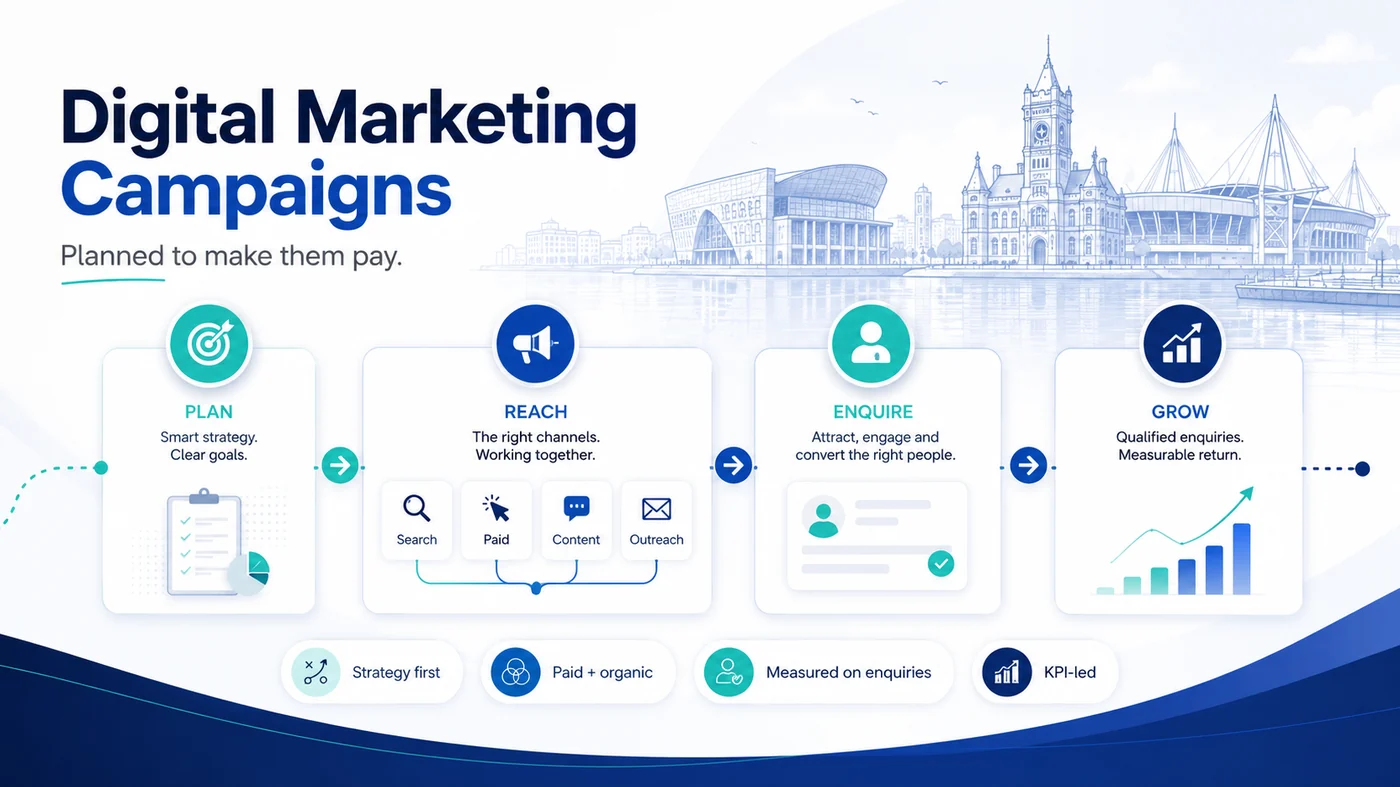
A digital marketing campaign is a fixed period of coordinated work aimed at one commercial outcome, covering the pages, the paid advertising, the outreach and the follow up, measured on enquiries rather than reach. We tell you what the campaign has to return before it starts, and we bill against that rather than against hours.
- One number agreed in writing before any media spend is committed, and a stop condition written beside it
- Search at the centre, because that is where buying intent already lives, with paid and outreach built around it
- Media spend is yours and never marked up, and the fee sits on a separate line from it
- Campaign planning
- Paid advertising
- Targeted outreach
- Niche marketing
- Conversion tracking
- Search and content
Find out what a client is actually worth to you
- The arithmetic on what an enquiry may cost you
- Whether your site can convert what a campaign sends it
- An honest answer on whether to spend at all yet
No charge, no obligation, and you keep the written read either way.
Key takeaways
- Most campaigns fail in the planning rather than the execution. The creative was fine, the ads ran, and nobody could say afterwards which part produced an enquiry.
- Planning comes first and it is a strategy job, not a channel job. The outcome, the audience and the stop condition are agreed before a channel is chosen.
- Reach is built from search, paid, content and outreach working to one plan, not four suppliers working to four reports.
- The enquiry, not the impression, is the unit. A campaign that lifted reach and produced nothing has not worked, whatever the dashboard says.
- Growth is judged on cost per client and the month the campaign pays itself back, both taken from your CRM rather than from a platform.
- The entry point is a free 30 minute review, and it ends with a straight answer about whether a campaign is the right spend for you right now.
Start with the arithmetic, not with a proposal
Our free 30 minute consultancy and SEO audit works out what a client is worth to you in gross profit, what enquiries would have to cost for that to make sense, and whether your site can convert what a campaign would send it. There is no charge and no obligation to continue.
Who plans the campaign, and what qualifies them?
Campaign planning at True SEO is done by the two directors, one an ACCA qualified accountant, the other a certified business coach with over thirty years of commercial experience.
That pairing is the reason the reporting starts with margin rather than sessions. Mohammad A Mahmud trained in business finance and management accounting years before he worked in search, and has been in search since 2010. Julie Williams has worked hands on across a range of business verticals, so the plan gets tested against how the business actually runs rather than how a marketing deck says it should.
The practical difference shows up in month three. A marketer looks at a campaign that doubled traffic and calls it a success. An accountant asks what the gross profit on those enquiries was, and whether it cleared the fee. Sometimes the honest answer is no, and you need to hear that from the person you are paying. More on both directors on our about page and on Mohammad’s profile.
What is a digital marketing campaign, and what does one contain?
A digital marketing campaign is a fixed period of coordinated work aimed at one commercial outcome, covering the pages, the paid advertising, the outreach and the follow up, measured on enquiries rather than reach.
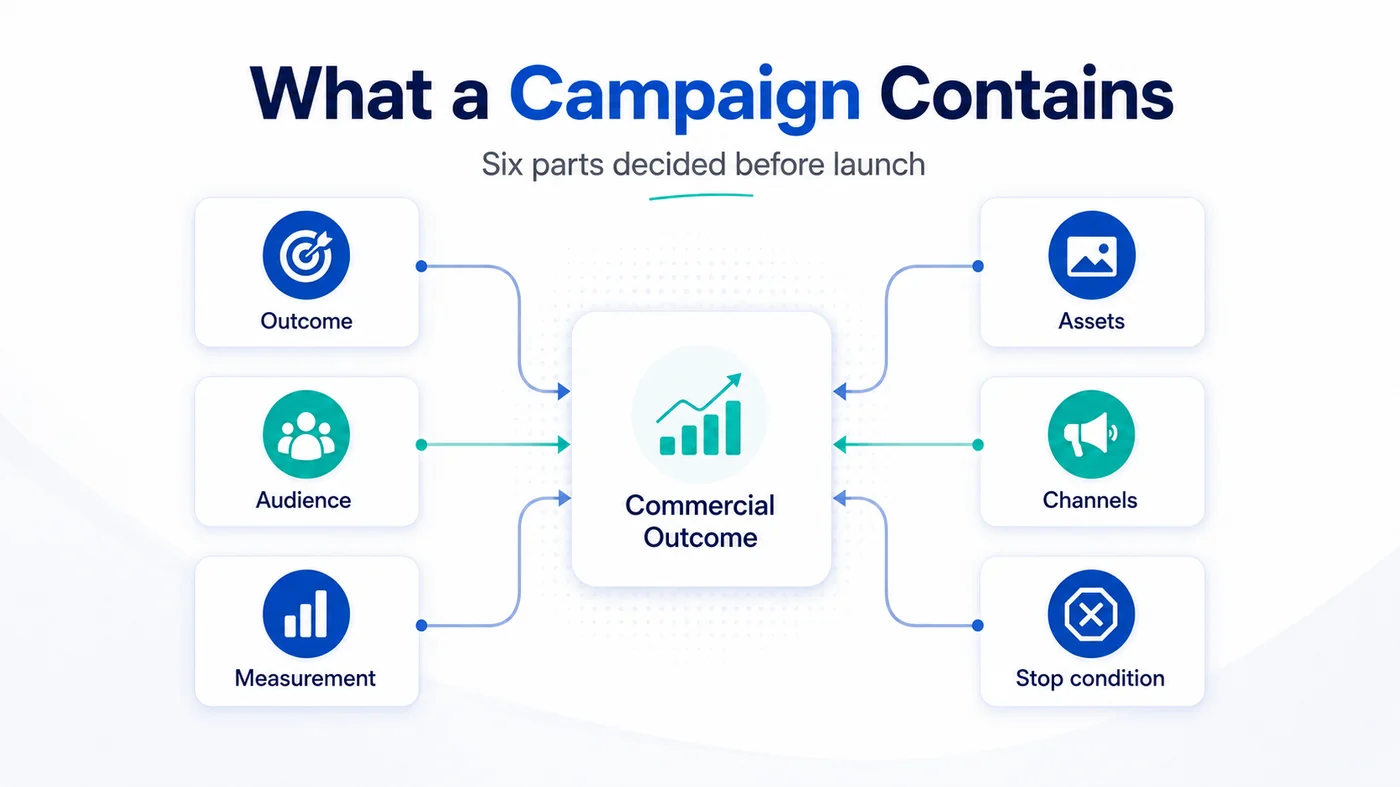
The six parts of a campaign, and the one outcome they are all pointed at
Swipe the chart sideways to read the labels on a phone.
Six parts, and all six are decided before anything goes live.
The outcome. One number, agreed in writing. Not “more visibility”. Fifteen qualified enquiries a month, or twenty new instructions in the quarter, or a named position on a named query list.
The audience. Who is buying, in their words rather than yours. This comes out of your own Search Console data and your CRM, not a persona workshop.
The assets. The landing pages, the ad copy, the emails and whatever else the campaign needs. Most campaigns need fewer than the brief assumes, and the ones they do need usually already exist in a worse form.
The channels. Search first, because it is where buying intent already lives. Paid search where organic cannot reach the position in time. Social where the sector genuinely buys through it.
The measurement. Set up before launch. If a phone call cannot be traced back to the search that caused it, the campaign will end in an argument about attribution, and we would rather have that argument in week one.
The stop condition. What has to be true for the campaign to continue, and what ends it. A campaign with no stop condition is a retainer wearing a costume.
What gets decided before any money is spent?
Five things, in this order, and none of them costs you media spend to answer.
- Whether the site can convert what the campaign sends it. Traffic into a page that does not convert is a donation. We check this first because it is the cheapest thing to fix and the most expensive thing to ignore.
- Whether the pages the campaign needs already exist. They usually half exist. Rebuilding a page is faster and ranks better than publishing a new one beside it.
- Whether your own pages are competing with each other. Across our own estate we found 1,203 queries landing on two or more pages before we started consolidating. That is our data, on our own site, and it is a common enough fault that we check yours before proposing anything.
- What a lead is worth to you. Without this the campaign cannot be judged, and every review meeting becomes a discussion about impressions.
- What the stop condition is. Written down, agreed, and quoted back at us if we miss it.
The order matters. Question one is answered before question four is asked. A business that cannot convert does not need to know what a lead is worth yet, because the answer will not change what has to happen first.
What does a campaign cost, and how is it billed?
Campaigns are billed against the KPIs you set, not against hours, and we quote after the free audit rather than before it.
We do not publish a price list, and there is a reason that is not evasion. The cost of a campaign depends almost entirely on what the diagnosis finds, and a number given before anyone has looked at your crawl is a guess dressed as a quote. A firm with clean URLs and a converting site needs a fraction of the work of one carrying a broken migration.
| The line | How it is set | Who owns it | What moves it |
|---|---|---|---|
| Consultancy and delivery fee | Against the KPIs agreed at the start, quoted after the free audit | Invoiced by us | What the diagnosis finds. A clean site needs less work than one carrying a broken migration |
| Media spend | Set by you, held in your own advertising account | Yours, and never marked up | How much of the query list organic has already taken. It should fall as the search work lands |
| Build work on pages | Scoped once we know which pages already half exist | Yours permanently, campaign or no campaign | Whether the pages the campaign needs can be rebuilt rather than published new |
Two things we will say plainly about money. Media spend is yours and is never marked up. And the fee is separate from the spend, so you always know which is which. For the wider picture on what search work costs in the UK, our guide on SEO cost in the UK sets out the bands and what moves them.
What happens in the first thirty days?
Week one is diagnosis, week two is the plan, weeks three and four are build and launch. You get the written diagnosis whether or not you continue.
| Week | What happens | What you get |
|---|---|---|
| 1 | Crawl, Search Console segmentation, competitor coverage, conversion path review | A written read on what is stopping the site, with evidence for each finding |
| 2 | The campaign plan: outcome, audience, assets, channels, measurement, stop condition | The plan and the number it will be judged on |
| 3 | Pages built or rebuilt, tracking installed and tested | Working measurement before a penny of media spend |
| 4 | Launch, first read on early signals | The first weekly report and any change of course |
Nothing goes live before the measurement works. That single rule is why our month three conversations are about results rather than about attribution.
What do we need from you before we start?
Four things, and none of them takes long: access, numbers, a decision maker and honesty about capacity.
Access. Google Search Console, Google Analytics, Google Business Profile and the website back end. Read access is enough to start.
Numbers. What a client is worth in gross profit, and roughly what proportion of enquiries close. Approximate is fine. Absent is not, because without them nothing can be judged.
A decision maker. One person who can approve a page going live. Campaigns die in approval queues more often than they die in the market.
Honesty about capacity. How many new clients you can actually take this quarter. We will size the campaign to that rather than to the budget.
Which businesses does this suit?
Campaigns suit businesses with a defined commercial event and a measurable enquiry, which in practice means professional services, healthcare, hospitality, automotive and ecommerce.
- Accountancy practices running an acquisition push before the January deadline, where the buying cycle is long and the trust signals matter more than the ad copy. Our SEO for accountants work is the deepest cluster we hold.
- Law firms and healthcare providers, where compliance shapes what a campaign may claim and a generalist agency will write something that has to be pulled.
- Hotels and serviced accommodation, where the campaign is seasonal by definition and the stop condition writes itself.
- Ecommerce brands on Shopify, WooCommerce or Shopwired, where the campaign is usually a category or a launch rather than the whole catalogue. See our ecommerce SEO work.
- Multi-location businesses, where the same campaign has to work differently in each town. Local and multi-location SEO is the structural half of that.
For a smaller firm in one sector, the Niche Marketing SEO Blueprint is often the better starting point, because owning one narrow market completely beats competing broadly and losing. Every sector we run programmes for is listed on our industries we run SEO programmes for.
How do you measure a campaign properly?
You measure a campaign on cost per client, not cost per lead, and you set the measurement up before launch rather than reconstructing it afterwards.
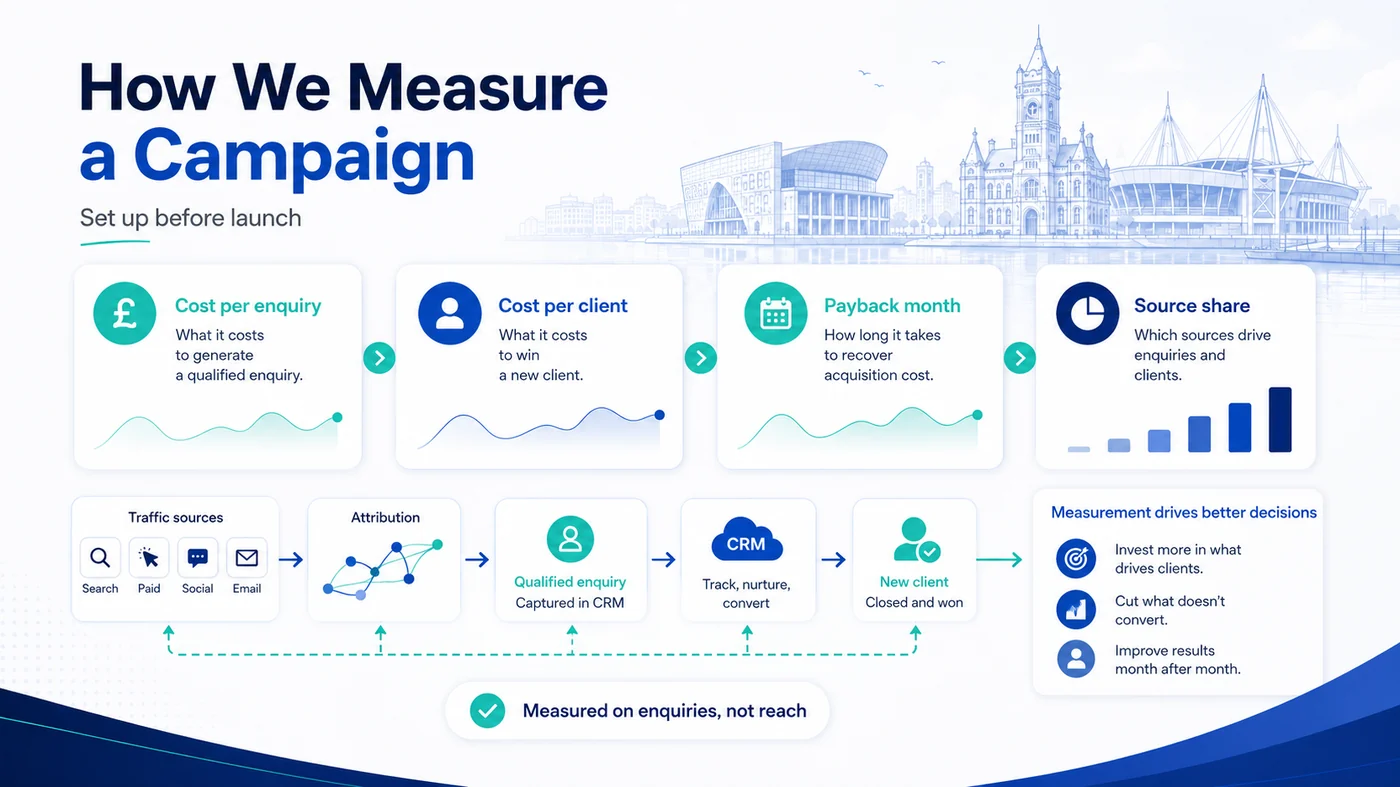
The four numbers, and the chain that has to be intact before any of them can be trusted
Swipe the chart sideways to read the labels on a phone.
Four numbers, all of which come from your systems rather than ours.
| Number | What it is | What it tells you |
|---|---|---|
| Cost per enquiry | Total campaign cost divided by enquiries attributed to it | Whether the front of the funnel is working. Falls month on month once the structural work lands |
| Cost per client | The same sum with your close rate applied | Whether the campaign worked. This is the number most reports leave out |
| Payback month | The month cumulative gross profit from the campaign passes cumulative cost | The return itself. Rankings and sessions are progress indicators. This crossing is the result |
| Source share | The proportion of new clients that came from the campaign, taken from the source field in your CRM | Which part of the plan to put more money behind, and which part to cut |
None of that works unless the chain behind it is intact. A search, a click or a call has to be tied to a named source, the source has to survive into the enquiry record, and the enquiry record has to be marked won or lost. Break any of those three and every number above becomes an opinion. That is why the tracking is installed and tested in week three, before launch, rather than argued about in month three.
A worked example, using arithmetic rather than a case study
Take a professional services firm where a client is worth £4,000 in gross profit over the relationship, and one enquiry in four becomes a client. Each client therefore needs four enquiries. If a campaign produces enquiries at £250 each, a client costs £1,000 to acquire against £4,000 of gross profit. That is a programme worth continuing.
Change one input. If the close rate is one in ten rather than one in four, the same enquiry cost produces a £2,500 acquisition cost, and the sensible move is to fix the sales follow up before buying another enquiry. The campaign was never the problem.
These are illustrative figures used to show the method. Your inputs come from your CRM, and we work the sum with your numbers in the first thirty minutes.
How is a campaign different from a monthly SEO retainer?
A campaign has an end date and a single outcome. A retainer has a cadence and a scope. They solve different problems and the wrong one costs you a year.
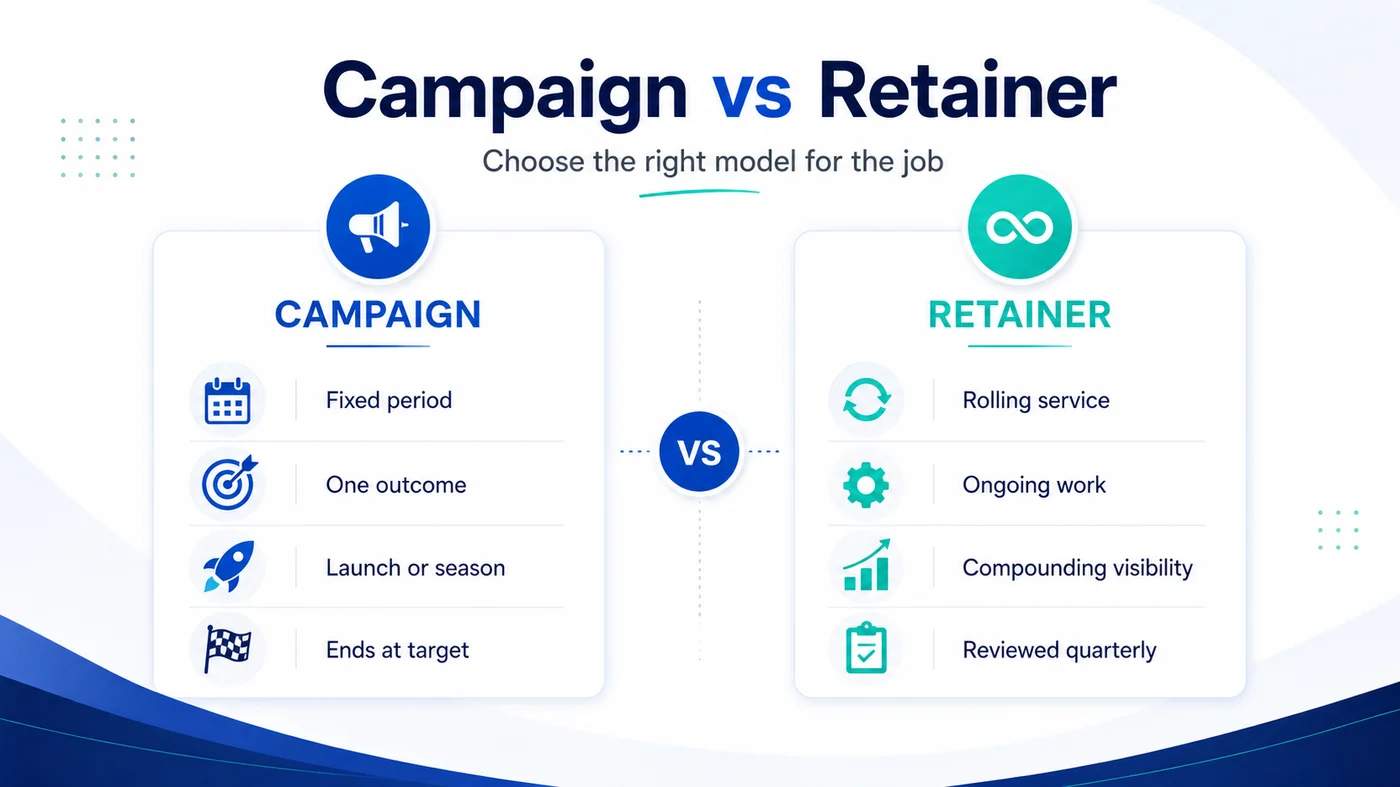
Two delivery models, and the one question that separates them
Swipe the chart sideways to read the labels on a phone.
| Campaign | Retainer | |
|---|---|---|
| Time frame | Fixed period, usually eight to sixteen weeks | Rolling, reviewed quarterly |
| Outcome | One agreed number | A programme of work |
| Best for | A launch, a season, a new service, a location opening | Compounding search visibility |
| Ends when | The outcome is hit or the stop condition triggers | You give notice |
| Risk | Spends fast if the measurement is wrong | Drifts if nobody reads the report |
Most businesses that ask us for a campaign need one campaign and then a retainer. A few need only the campaign. If your search foundations are broken, a campaign will pour money through the holes, which is why the free review looks at the crawl before it looks at the brief. Our monthly SEO package for small businesses is the retainer side of that decision.
Why should the same firm run your search and your campaigns?
Because they are the same work. The pages a campaign needs are the pages search needs, the tracking is shared, and splitting them across two suppliers means neither can be held to the outcome.
This is the argument the search data makes on its own. Look at what people actually type when they go looking for this:
- local seo marketing agency
- seo marketing consultants
- seo marketing agency in cardiff
- internet marketing seo consultant
- seo and digital marketing consultant
Nobody searches for “an SEO agency and separately a marketing agency”. They search for the two joined up, because from the buyer’s side it was never two things. It became two things because agencies organised themselves that way.
We hold a position on this and we will defend it: paid advertising should be buying the positions organic has not reached yet, and it should stop buying the ones it already holds. That decision needs one person looking at both, every month. Two suppliers will never make it, because the paid supplier has no reason to switch spend off. The mechanics of that decision sit on our SEO and PPC management page.
How do campaigns and SEO share one plan?
They share the topical map. The map decides what must exist, in what order, and the campaign borrows from it rather than inventing a parallel set of pages.
Four inputs, one plan, and a single number that judges all of it
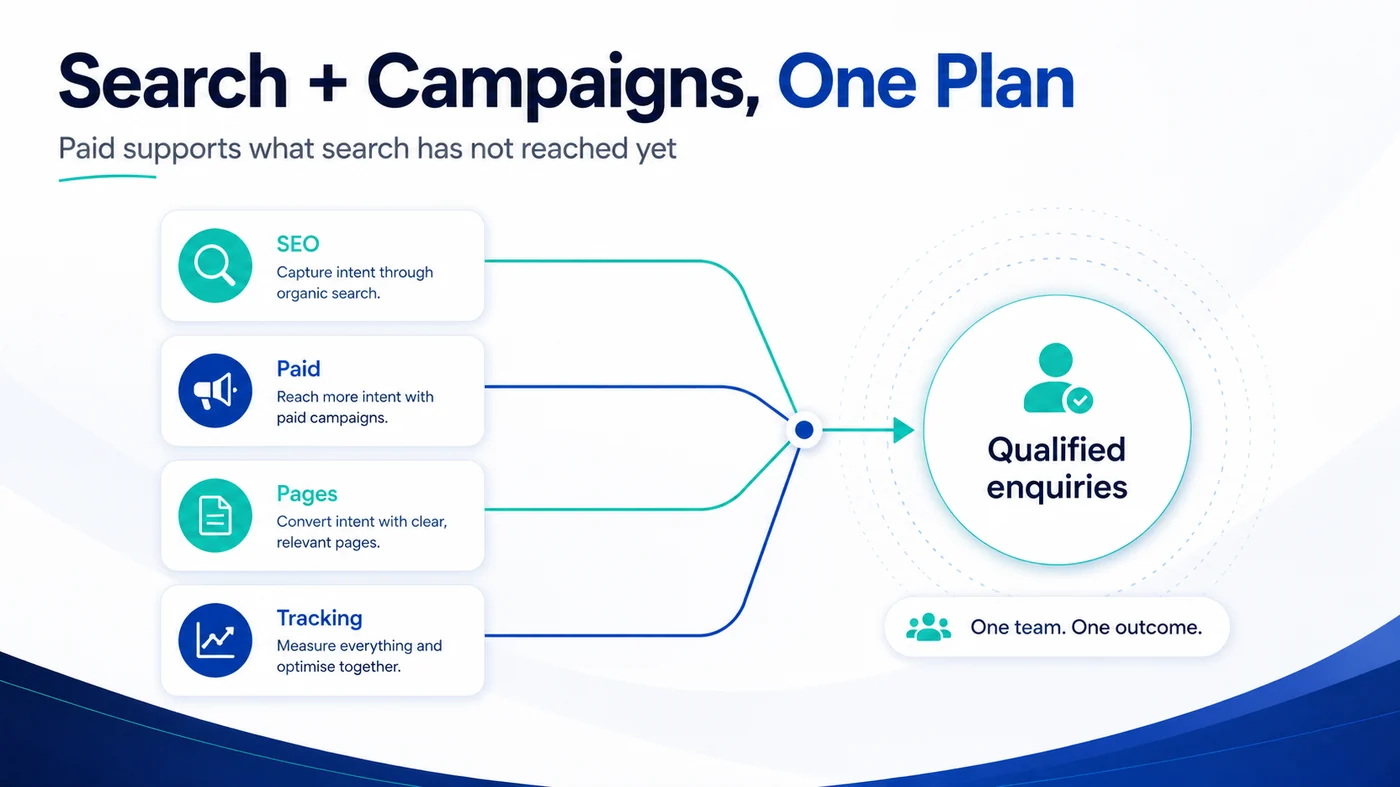
Swipe the chart sideways to read the labels on a phone.
This matters more than it sounds. A campaign that builds its own landing pages, separate from the site’s structure, leaves you with orphaned URLs the moment it ends. A campaign that builds the pages the map already called for leaves you with permanent assets that keep ranking after the spend stops.
Four things feed the same enquiry, and one plan decides how much of the work each of them does. Organic search takes the intent it can already reach. Paid covers the intent it cannot reach yet. The pages have to turn either kind of visit into a conversation. And the tracking has to see all three well enough to tell you which one to fund next month. Take any of the four away and the other three stop being measurable.
The method behind the map is our semantic SEO and topical authority work. The campaign is what happens when you decide to accelerate part of it with paid support and outreach rather than waiting for it to compound.
Around the search core sit the pieces that make a campaign land: targeted outreach for the coverage and citations that make a new name credible, social where the sector genuinely buys through it, and conversion-led web design where the pages themselves are the constraint.
When is a campaign the wrong answer?
A campaign is the wrong answer when the site cannot convert, when the offer is not competitive, or when the business cannot handle the enquiries a successful campaign would produce.
We turn work away on all three, and it is worth saying why the third one matters. A campaign that delivers thirty enquiries into a business that can service eight produces twenty two bad experiences and a reputation problem that outlasts the campaign. If that is your position, the conversation should be about capacity and pricing first.
Two more cases where we would tell you to wait. If your search foundations are broken, fix them first through technical work and let the campaign follow. And if you have never measured a conversion, spend the first month setting that up, because a campaign without measurement is an expensive way to learn nothing.
Do you need a digital marketing agency or a consultancy?
If you want the work done and do not need to know why, an agency is fine. If you need to defend the spend to a board, a partner or yourself, you need the reasoning as well as the delivery.
That is the whole difference, and it is why we lead with the word consultancy even though most people search for the word agency. You get the diagnosis, the numbers and the plan before anyone spends money, and then the work gets done. Both halves, one supplier, one number to judge it on.
We are True SEO Consultants Ltd, based at Startup Stiwdio, University of South Wales, 86 to 88 Adam Street, Cardiff CF24 2FN, and we work with businesses across Cardiff, Newport, Swansea and the whole of South Wales as well as UK-wide. If you are searching for a digital marketing agency in Cardiff, that is us under a more accurate name.
Digital marketing campaign questions we are asked most
How long does a campaign usually run?
Eight to sixteen weeks is the usual range. Shorter than eight and there is rarely enough data to judge the outcome honestly. Longer than sixteen and it has stopped being a campaign and become a retainer without anybody agreeing to that, which is what the stop condition exists to prevent.
Do we have to pause our existing SEO work while a campaign runs?
No, and pausing it is usually the wrong move. The campaign borrows from the same topical map the search programme is already working through, so the two accelerate each other. What does change is the order things get built in, because the campaign pulls certain pages forward.
Who owns the advertising account and the tracking after the campaign ends?
You do, in every case. The advertising account is opened in your name and stays in your name, the media spend is billed to you directly and never through us, and the conversion tracking stays installed on your site. Nothing about ending an engagement takes any of it away from you.
Can you run a campaign for a business outside Cardiff?
Yes. We are based in Cardiff and a good deal of our work is across South Wales, but campaigns run UK wide and the planning happens over video calls either way. Location only changes the work when the campaign itself is local, in which case the map pack and the local query set come into the plan.
What happens if the campaign misses the number it was set?
We tell you before you notice, and we tell you why. The weekly reads exist so that a miss surfaces in week five rather than at the end. Sometimes the honest answer is that the number was set wrong, sometimes that the market said no, and occasionally that we got something wrong. All three get said plainly rather than buried under a chart of impressions.
Do you write the creative, or do we?
We write the pages, the ad copy and the outreach, because those are search assets as much as campaign assets and they have to survive the campaign ending. Brand creative, photography and video usually sit better with whoever already holds your brand. We will tell you which is which at the planning stage rather than quietly billing for both.
Start with the free thirty minutes
The first conversation costs nothing and ends with a straight answer
It carries no obligation, and it ends with a straight answer about whether a campaign is the right spend for you right now.
You will leave it with a written read on where you stand, the arithmetic on what a client is worth against what enquiries would cost, and an honest view on whether the work suits you. Sometimes that answer is that you do not need us yet. We would rather say so in the first thirty minutes than in month three.
If you would rather start with a paid diagnostic and no commitment beyond it, our SEO audit service is the standalone version of the first stage. The full range of what we run sits on our services page.