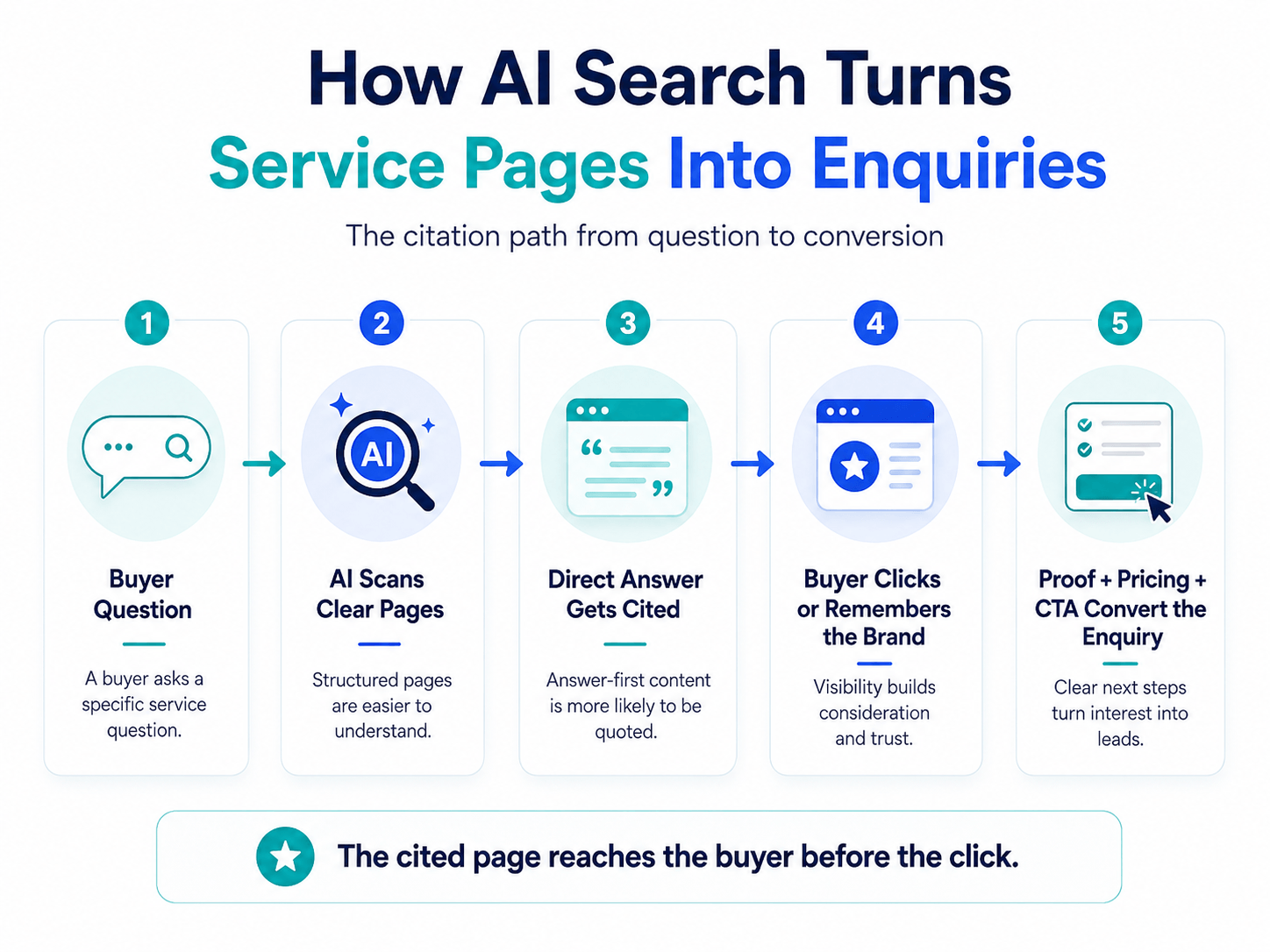
Service pages now have one job: get cited by answer engines and turn UK buyers into enquiries. Most still fail at both. Around a third of Google searches in the UK sit under an AI summary, and more than half of UK adults see those summaries on a regular basis. A page that buries the answer, hides the scope and stays silent on price loses the citation, the click and the enquiry in the same moment.
This guide is how we, at True SEO, rebuild service pages for accountants, solicitors, clinics, consultants and ecommerce founders so AI Overviews, ChatGPT, Perplexity and Google still rank and quote them. You will see the structure answer engines prefer, the methods that turn vague copy into citable answers, the named tools to track AI visibility, the metrics that prove the page is working, the UK reviews law that changes how proof is presented, and the mistakes that quietly lose the lead.
- Answer engines cite pages that answer the buyer’s question in the first 40 to 70 words, not the third paragraph.
- Service pages must work as standalone passages because AI systems extract sections in isolation.
- Tools like Google Search Console, Ahrefs, Sistrix and Profound show whether a page is cited, not only ranked.
- Trackable metrics, such as AI Overview impressions, brand mentions in ChatGPT, scroll depth and form submissions, replace position-only thinking.
- One strong service page outperforms five near-duplicate location pages every time.
- UK reviews law, in force from April 2025, changes how testimonials and proof appear on service pages.
- Schema confirms what the visible page already says, and cannot rescue weak copy.
Want an honest review of how your service pages sit against the current AI search landscape?
Book your free site reviewWhat does answer engine visibility mean for a service page?
Answer engine visibility means your service page is clear, complete and structured enough to be picked, summarised and cited by AI search systems alongside ranking on traditional Google. AI Overviews, ChatGPT, Perplexity, Gemini, Claude and voice assistants now sit between the search and the website for a significant share of buyer questions, and they cite the pages that read like clean, self-contained answers.
The shift is not academic. Conductor’s 2026 AEO benchmark, drawn from roughly 3.3 billion sessions across 13,770 enterprise domains, found Google AI Overviews now appear on about a quarter of Google searches, with higher rates in finance and healthcare. A 2025 Bain & Company study referenced widely across the UK industry press put zero-click searches at around 60% of total Google queries. The buyer is still searching. The page that earns the citation gets pulled into the answer; the page that does not is invisible by the time the user finishes reading.
For a UK service business this changes what a service page needs to do. The page must satisfy human buyers who are cautious by nature, often comparing three or four providers, and it must satisfy AI systems that lift sections of clean copy into their answers. The two jobs are not in conflict. Both reward clarity, structure, proof and direct answers. Both punish vague copy, hidden pricing and filler paragraphs.
That is why a strong service page is the most valuable asset on a UK service website. It sits between the search and the enquiry, and it has to do its work in one read.
Why service page visibility now decides who wins UK enquiries
Service page visibility now decides who wins UK enquiries because most professional service searches end with the buyer either reading an AI summary or comparing two or three sites that earned the citation. Ranking alone no longer guarantees the click. Being the cited answer does.
UK digital behaviour supports this. Roughly 95% of UK adults are online, spending close to four and a half hours a day online, and they meet AI summaries on a routine basis. The UK has around 5.7 million SMEs, about 99.9% of all UK businesses, employing roughly 16.9 million people. Demand for professional services across that base is enormous, and most of it begins with a question typed into a search box or an AI assistant, which is why answer engine optimisation now sits next to traditional SEO on every brief we run.
The reward for getting this right is disproportionate. Conductor’s data shows AI-referred traffic still accounts for a small share of total website visits but converts at roughly five times the rate of traditional organic. For UK accountancy alone, a market of around 30,000 firms worth close to 40 billion pounds, even a small share of cited buyer questions is commercially significant. A Cardiff accountancy firm that ranks first for “VAT return services” but gets summarised away in the AI Overview now competes with a firm whose VAT page was quoted directly in that summary. The cited page wins the consideration set before the click.
The next sections move from why this matters to how a service page should actually be built.
How a service page should be structured for answer engines
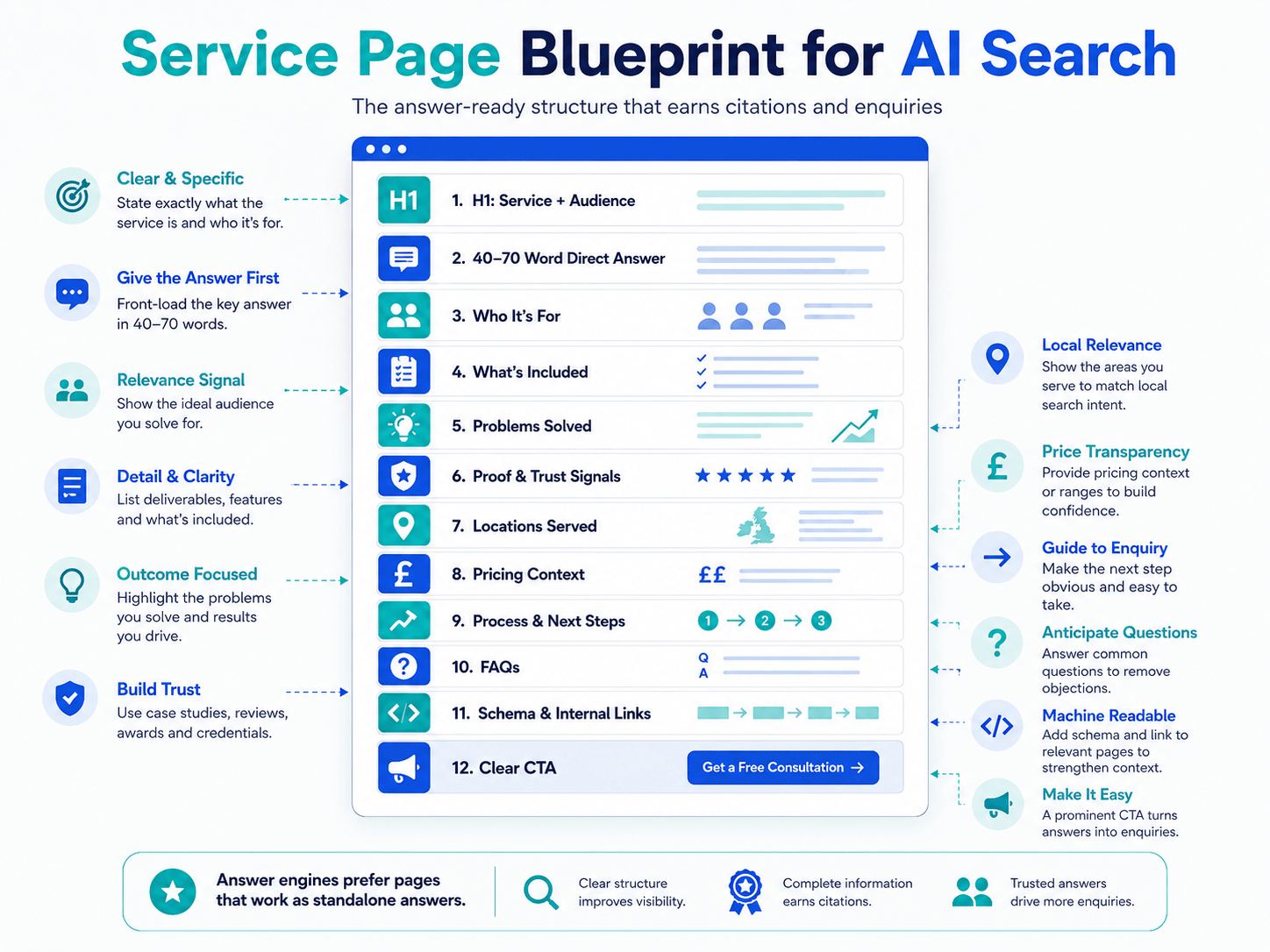
A service page should follow the buyer’s decision path and present each step as a standalone answer that an AI system can lift. The order is the same one a careful B2B buyer uses to filter providers, and it matches the contextual flow that semantic search systems reward.
The structure that consistently works for our clients across SEO for accountants and adjacent sectors is:
- H1 stating the service and target market.
- Direct answer paragraph in 40 to 70 words.
- Short benefit summary written for a busy buyer.
- Who the service is for.
- What is included (the real scope, not benefits).
- The problems solved.
- Proof and trust signals.
- Locations served.
- Pricing and fee context.
- Process and next steps.
- FAQs that answer real objections.
- Schema that confirms the visible content.
- Internal links to related services and decision content.
- A clear, descriptive CTA.
That sequence is not a checklist for engines. It is a useful sales conversation, written in the order a serious buyer asks questions. Skipping a step almost always lowers conversion, and very often lowers AI citation rates too, because answer engines tend to extract pages where every important question is answered visibly on the page.
Start with a direct answer block
The direct answer block is the most important block on a service page, and the one most often missing. It sits below the H1 in 40 to 70 words and explains the service in plain English. AI systems consistently quote this kind of block.
A working example for a technical SEO service page: “Technical SEO consultancy finds and fixes the website issues that stop pages being crawled, indexed, ranked and converted. The work usually covers crawl errors, site structure, internal linking, page speed, indexation, schema and the technical barriers that quietly lose organic visibility for UK service businesses.” That paragraph defines the service, names the problem, hints at the scope and uses natural search language.
Make service scope a named list, not a benefit blur
Service scope tells the buyer and the answer engine exactly what is included. Most UK service pages fail here. They list benefits (“we improve conversions”, “we grow your visibility”) and skip the actual deliverables.
For a CRO page, the scope should name landing page review, CTA review, enquiry path analysis, heatmap interpretation, analytics setup, copy and layout recommendations, A/B testing priorities and lead quality review. Each of those is a citable phrase in an AI answer. “We grow your conversions” is not. Our CRO guide for accountants walks through how this looks in practice for a UK accountancy firm.
Put proof before persuasion
Proof has to appear before the page asks for commitment. Buyers in professional services are cautious by default, and AI systems are increasingly weighting first-party evidence as a signal of authority.
Proof on a service page can include: years of experience, named consultants, sector cases, client types, qualifications, process detail, before-and-after figures, review snippets, named tools used and local presence. For True SEO, that proof includes Mohammad A Mahmud’s ACCA-qualified background and 15 years of practitioner experience, Julie Williams’s 30+ years as a fractional CFO, a Cardiff base, and real client outcomes such as Total Books Accountants Ltd growing from roughly 200 to about 1,600 organic visits a month after a topical-authority and trust-signal rebuild. “Trusted by businesses” is weak proof on any service page. Named, sectored, quantified proof is the version that converts and gets cited.
The ten methods that turn a service page into an answer engine asset
There are ten methods that consistently lift a service page from rank-only to cited-and-converting. Each method works in isolation, and they compound when used together. We apply all ten across our semantic SEO and topical authority work for UK service firms.
- Answer-first writing. Open the page and every H2 with a direct sentence that answers the heading.
- Named service scope. List the actual deliverables in parallel structure, not as benefit slogans.
- Buyer-led headings. Write headings as the question the buyer would type, not the agency would label.
- Quantified proof. Give years, sector, percentages and named tools rather than slogans.
- Honest pricing context. Explain what affects cost and where ranges sit, even when exact figures are quote-based.
- Location relevance. Explain where you serve and how delivery works, instead of repeating place names.
- Decision content. Tell the buyer why to choose you, what happens after enquiry and how to prepare.
- Real FAQs. Answer five to eight live objections with the answer in the first sentence.
- Schema that matches the visible page. Organisation, LocalBusiness, Service, BreadcrumbList, WebPage and FAQPage where the FAQs exist on the page.
- Topical clustering. Connect the page to its supporting guides, sector pages and money pages with descriptive internal links.
Each method is small. Together they convert a page that reads like an agency brochure into a page that reads like the answer.
Tools to research, build and measure answer-engine-ready service pages
Building and measuring an answer-ready service page is much easier with a small, intentional stack. Most UK service businesses do not need every tool on the market; they need a few in each job, used regularly. The stack we use across our bespoke SEO service work is below.
For keyword and intent research: Google Search Console for first-party query data, Ahrefs or Semrush for competitive intent mapping, AlsoAsked or AnswerThePublic for question discovery, and Google’s “People also ask” plus AI Overview footprints for live intent signals. Ahrefs publishes that around 91% of pages get no traffic from Google, which is a useful reality check before any new service page launches.
For AI search visibility: Profound and Otterly to track citations in ChatGPT, Perplexity, Gemini and Claude; Ahrefs and Sistrix for AI Overview presence; and a manual monthly check inside the AI assistants themselves, asking the question your buyer would ask and noting whether you appear. Manual checks still matter because tool coverage of AI citation data is improving fast but is not complete.
For technical and schema work: Google’s Rich Results Test and Schema Markup Validator, Screaming Frog for crawling, PageSpeed Insights and Lighthouse for Core Web Vitals, and Sitebulb for full-page audits. Schema does not save a vague page, but broken or mismatched schema is one of the fastest ways to lose AI confidence in a page that is otherwise strong.
For conversion measurement: GA4 with proper event tracking, Microsoft Clarity for heatmaps and session recordings, Hotjar for poll-style intent capture, and a call tracking tool such as ResponseTap or CallRail where phone enquiries matter. A solicitor in Bristol may take 60% of enquiries by phone; a London consultant may take 90% by form. The mix decides which tools earn a place in the stack.
The point of naming tools is not to look thorough. The point is that each metric below has a tool that captures it, and a service page programme without that loop is guessing.
Is your service page answer-engine ready?
Five quick questions, an honest result, and the next step that fits.
1. Does your service page open with a direct, 40 to 70 word answer to the buyer’s main question?
2. Is your service scope a named list of deliverables, or a list of benefits?
3. Does the page give pricing context, even if exact figures need a quote?
4. Do you track AI Overview impressions or citations in ChatGPT and Perplexity?
5. How many near-duplicate location pages does your site carry?
Prefer to skip the quiz? Get advice on your next step from a real person.
How to measure whether service pages are working in AI search
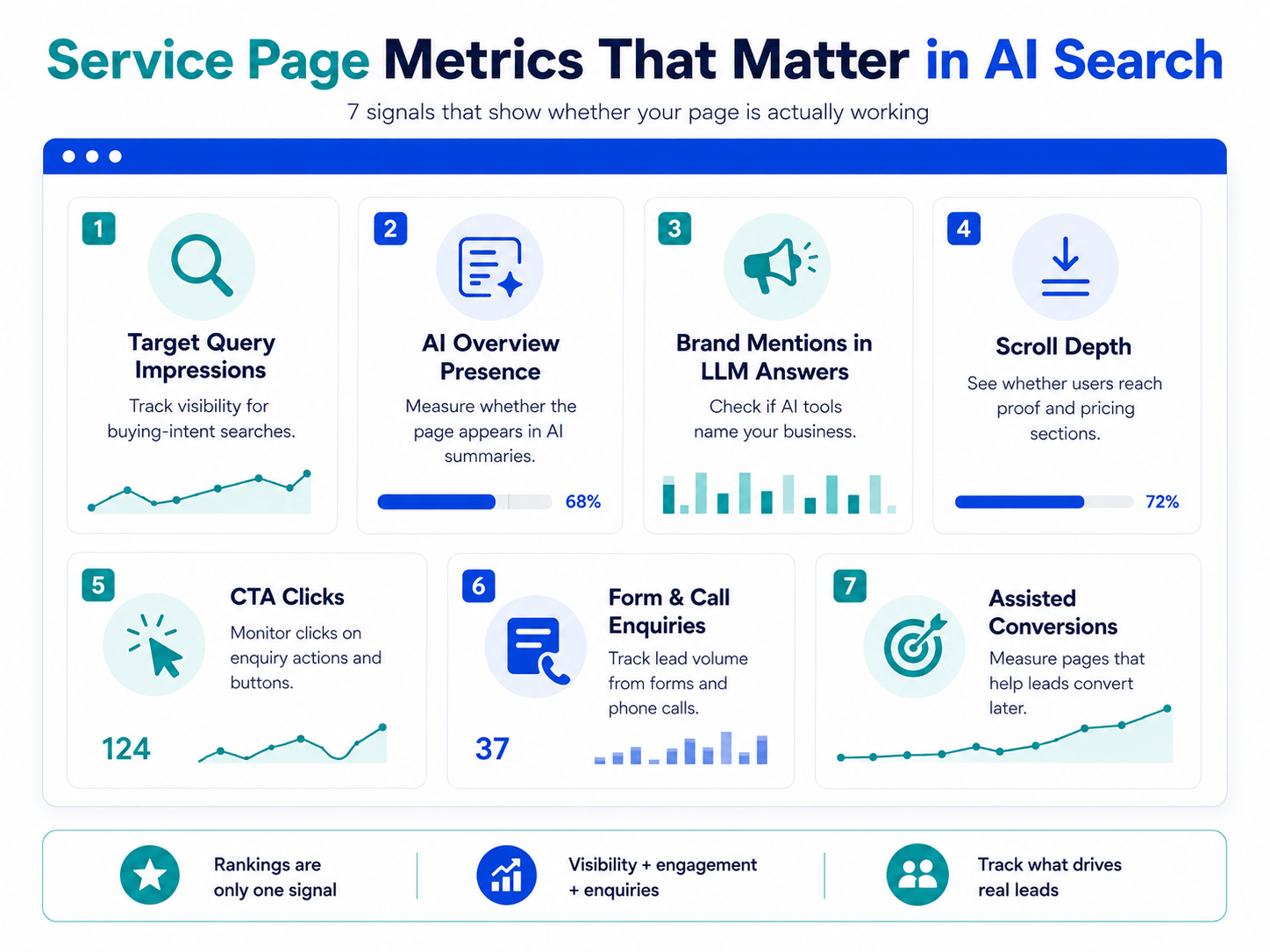
Service page performance should be measured against visibility, engagement and enquiry quality, with a clear method for tracking each one. Rankings still matter, but they are only one of seven measures that decide commercial outcome.
The seven measures and how to track each:
- Target query impressions. Source: Google Search Console, Performance report filtered by URL. Track impressions for the cluster of buying queries the page targets, not just the head term.
- AI Overview and citation presence. Source: Ahrefs or Sistrix for Overview tracking, Profound or Otterly for ChatGPT and Perplexity citations, plus a manual monthly query log inside each AI assistant.
- Brand mentions in LLM answers. Source: Profound and a manual prompt set. Ask the assistant the buyer question and note whether the firm is named in the answer.
- Engagement on the page. Source: GA4 engagement metrics, Microsoft Clarity scroll heatmaps and session recordings. A page that loses readers before the proof block is not converting, regardless of impressions.
- CTA and internal link clicks. Source: GA4 events on the primary CTA and the related-service links. A weak CTA shows here first.
- Enquiry volume and quality. Source: GA4 form submission events, CRM lead source tagging and call tracking. Track not just the count, but the fit of the lead.
- Assisted conversions. Source: GA4 conversion paths. A service page often acts as the trust step rather than the entry step, and ignoring assisted credit punishes pages that are doing real work.
The right question is not only whether traffic grew. It is whether the page brought more of the right buyers and helped them enquire with confidence. One Cardiff accountancy firm we work with halved its raw traffic after a rewrite that removed thin location pages, and tripled qualified enquiries in the same quarter. The number that mattered was the second one.
Standard service page vs answer-ready service page
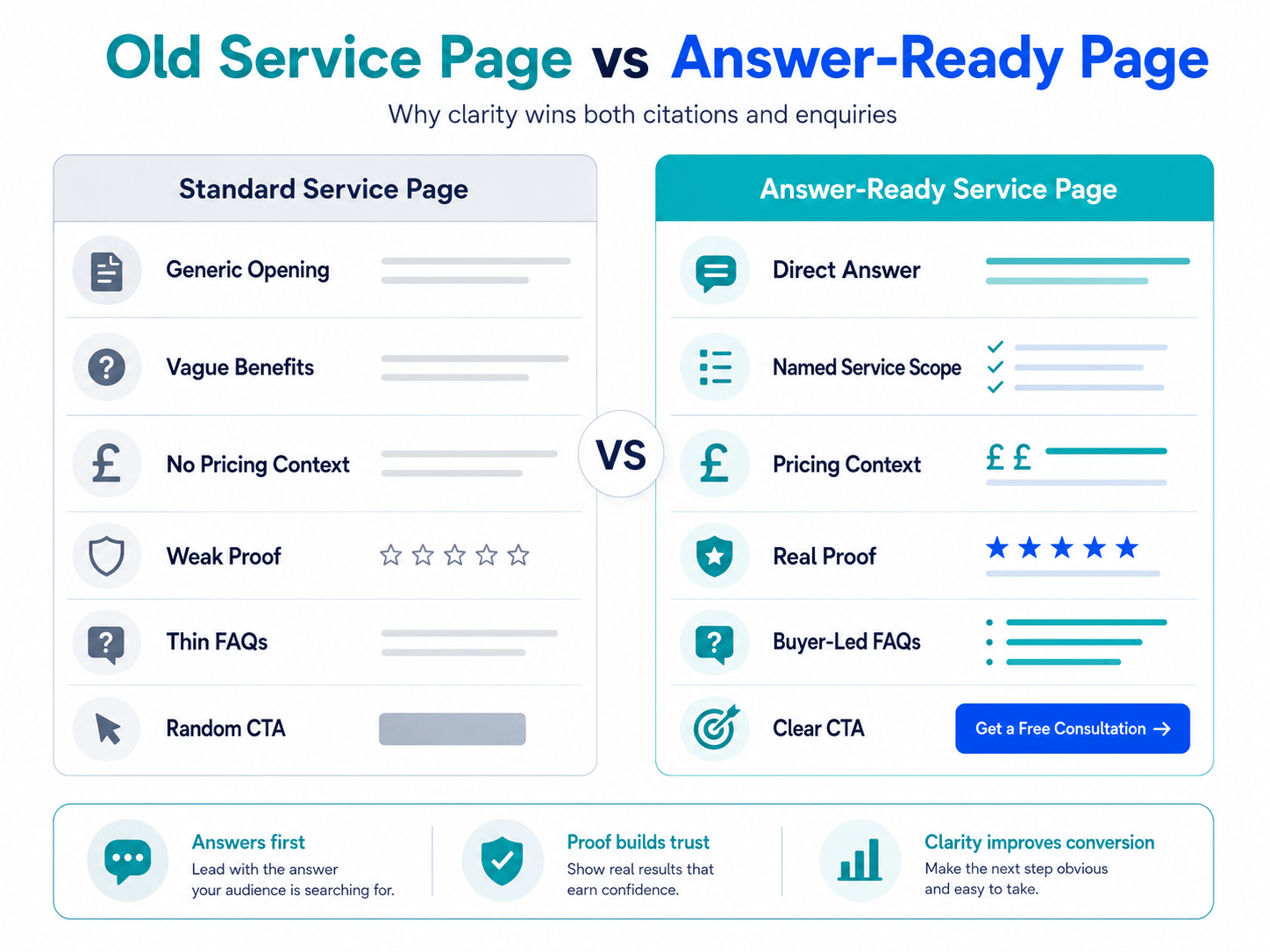
A standard service page focuses on persuasion before clarity. An answer-ready service page gives direct, useful information at every step of the buying journey, and that is what AI systems and cautious buyers both reward.
| Page element | Standard service page | Answer-ready service page |
|---|---|---|
| Opening | Generic brand claim | Direct answer naming service, audience and result |
| Headings | Broad marketing labels | Buyer-led, question-shaped |
| Service scope | Vague list of benefits | Named, parallel list of deliverables |
| Proof | “Trusted by clients” | Years, sector, qualifications, named outcomes |
| Location | Place names repeated | Real service-area explanation |
| Pricing | Avoided | Context on what affects cost |
| FAQs | Generic filler | Five to eight live objections answered first |
| Schema | Added as a fix | Confirms the visible content |
| Internal links | Random block at the foot | Descriptive links inside sections |
| CTA | “Contact us” | Specific action tied to the service |
The shift is not more words. It is better answers in the right order.
What proof belongs on a service page
Strong proof on a service page now needs to satisfy a UK buyer, an AI system and the latest UK consumer law. Bottom-of-funnel visitors are not only researching; they are comparing options, and they are doing it inside a regulatory frame that hardened in 2025.
Useful proof points include named consultants and their qualifications, sector experience with quantified outcomes, named tools and platforms, before-and-after metrics, short genuine testimonials, process detail, local presence and any relevant industry membership or alliance. For SEO for financial advisors, proof must lean heavily into qualifications and named regulators. For a clinic, proof leans into clinician credentials and case numbers. For a consultant, proof leans into sectors served and the named transformations delivered.
Testimonials must be real, attributable and recent. UK reviews law, in force from April 2025, bans fake and concealed-incentive reviews and gives the regulator the power to fine up to 10% of worldwide turnover, with active enforcement that began mid-2025. A service page that displays unverifiable or paid testimonials is now a legal risk, not only an SEO weakness. The fix is straightforward: name the client where they have consented, attribute quotes to a real person and role, and remove anything you cannot stand behind.
How location relevance still earns AI citations without keyword stuffing
Location relevance on a service page now matters most for searches with local or regional intent, and the answer engines treat it like any other entity: the page either gives clear, contextual signals or it does not. Repeating “Cardiff” twenty times on a Cardiff page is not relevance; it is the oldest mistake on the list.
A location section that works names where the business is based, the wider area served, how delivery happens (remote, in person or both), and where the service changes by location. For True SEO, that section explains that we are based in Cardiff, serve UK firms remotely, and onboard clients worldwide through a fully remote digital process. A Bristol letting agent we have worked with similarly explains the three offices it covers and the postcodes it serves, then connects the page to a single, strong local and multi-location SEO hub rather than spinning up six near-duplicate town pages.
The point is the page tells the buyer whether the firm is right for their area, with proof that the firm has worked there. AI Overviews and Google’s local pack both reward that kind of grounded, specific signal, and both ignore thin location pages built only to capture a place name.
Pricing context, honestly handled
Service pages should include enough pricing context to reduce hesitation, even when an exact figure depends on scope. Hidden pricing is one of the loudest signals that a buyer leaves with: it tells them the firm is either expensive or unsure, and they go and check the next provider.
Useful pricing content includes starting points, ranges, what is included at each tier, what is not included, what shapes a final quote and what happens on the first call. On our own pages and across accountancy firm work, we explain pricing in ranges and explain the factors. A bookkeeping engagement quote depends on transaction volume, software in use, sector, VAT scheme and number of bank accounts; a service page that says that earns trust before the call even happens.
Pricing context also improves enquiry quality. A firm that gives no signal attracts a higher share of mismatched leads; a firm that explains the model attracts buyers who are already broadly within range. Less time chasing the wrong fit, more time closing the right ones.
Schema, used as confirmation rather than rescue
Schema helps answer engines and search engines understand a service page, but schema only confirms what the visible page already says. Marking up services, reviews or FAQs that a human reader cannot see on the page creates a mismatch that Google now actively distrusts.
For most UK service pages the useful schema set is small: Organisation, LocalBusiness where premises and area matter, Service for the offer itself, BreadcrumbList for path, WebPage for the page entity, and FAQPage where the FAQs are visibly on the page. Person schema fits where a named expert is part of the trust story. Review and AggregateRating schema fits only when the reviews are genuine, attributable and compliant with UK consumer law as of April 2025.
The way to think about it: the visible page does the work, schema labels the work so machines do not have to guess.
The biggest service page mistakes that lose AI citations and enquiries
Service pages lose answer engine visibility for a small set of repeatable reasons. We see the same pattern across audits, regardless of sector.
The most common mistakes are: opening with a brand slogan instead of a direct answer; hiding the actual scope; using headings that do not answer questions; adding weak FAQs that repeat the page; running schema that contradicts the visible content; treating pricing as taboo; missing location signals; offering no proof; linking to random pages instead of contextual ones; writing for keywords rather than buyers; failing to explain the process; and creating near-duplicate location pages.
The duplicate location page problem deserves its own paragraph. A firm with offices in Cardiff, Newport and Swansea will often spin up three pages that swap only the town name, sometimes with five or six bullet points reordered. Google’s quality systems detect this quickly, and AI Overviews almost never cite that kind of page. One strong, well-proofed core service page and a small number of genuinely distinct location pages beats five thin clones every time. We have rewritten that pattern for clients in legal, accountancy and lettings and the consistent outcome is fewer pages, more impressions and better leads.
The other quiet killer is the filler FAQ. Ten questions that repeat the same point look thorough but read like padding. Five to eight real objections, answered first, do more work for both citation and conversion.
Service pages for accountants, solicitors and clinics
Professional firms need service pages that match how cautious B2B and high-trust B2C buyers actually search. A buyer looking for a payroll accountant, a family solicitor or a tax planner is not browsing casually. The search has a real problem behind it, and a single broad services page rarely answers any of them well.
A UK accountancy firm will usually need separate pages for bookkeeping, payroll, VAT returns, self-assessment, corporation tax, cloud accounting, tax planning, contractor accounting and any niche the firm specialises in (such as childcare, pharmacy, dental or property accounting). RX Virtual Finance Ltd, a pharmacy accountant we worked with, reached number one for “pharmacy accountants” and first-page presence within about 60 days after the firm moved from a generic services page to a niche service page with proper scope, proof and topical support.
A solicitor will need separate pages for the practice areas the firm wants to win, such as divorce, child arrangements, conveyancing, employment law, wills and probate, commercial contracts and dispute resolution. Each one with its own proof, location and decision content. A consultant will often need service pages around problems rather than service names, because that is how the client actually searches: “sales process review”, “operational improvement”, “market entry support”.
The pattern repeats: clearer pages, fewer of them, deeper proof, real pricing context. That is the version answer engines cite, and the version buyers convert from.
A practical service page template
A template helps if it forces clarity rather than filler. The skeleton below works for UK accountants, solicitors, clinics, consultants, ecommerce founders and local service businesses, and it is the structure we apply across our monthly SEO package and bespoke work.
- H1: Service for audience or location.
- Opening paragraph: 40 to 70 words, direct answer to the main buying question.
- Early CTA: descriptive, low-pressure, named action.
- H2 What is this service? Plain English definition.
- H2 Who is this for? Buyer types, sectors and situations.
- H2 What does the service include? Named scope, parallel list.
- H2 How does the process work? Discovery, delivery, reporting.
- H2 Why choose this firm? Proof, sector, founders, named tools.
- H2 Locations served. Where and how the firm delivers.
- H2 Pricing and what affects cost. Ranges or factors, never a blank.
- H2 FAQs. Five to eight real objections, answer-first.
- Closing CTA: specific, descriptive, easy to act on.
This works because it gives every audience, human and machine, what they came for, in the order they will ask.
Two worked examples
A Cardiff-based accountancy practice with five staff arrived at us with one general “Services” page and Google impressions of around 1,800 a month for accountancy-related queries. The page opened with a slogan, hid pricing entirely and listed nine services as benefit bullets. We rebuilt it into eight specific service pages (bookkeeping, payroll, VAT, self-assessment, corporation tax, cloud accounting, tax planning and contractor accounting) each with a 60-word direct answer, named scope, fee ranges and a five-question FAQ. Within four months impressions rose to roughly 9,400 a month, AI Overview presence appeared for VAT and payroll queries, and qualified enquiries from the website rose from about 6 a month to 19, with a higher proportion converting to retained clients.
A three-branch UK letting agency had separate town pages for each branch that shared roughly 85% of their copy. Cited content from those pages in AI Overviews was effectively zero. We collapsed the three into one strong “Lettings Service” hub and three lean location pages, each with genuinely local proof (recent let figures, named local schools and transport, branch-specific testimonials). Total page count dropped from 14 to 7, organic impressions for tenant-finding queries rose by about 60% over two quarters, and tenant enquiry forms more than doubled. The mistake had not been too few pages. It had been too many almost-identical pages.
How True SEO improves service pages for AI search
True SEO Consultants Ltd helps UK service businesses turn weak service pages into the version answer engines cite and buyers enquire from. The work covers buyer intent and query mapping, page-by-page rewrites in the answer-first format, scope and proof structuring, pricing copy, internal link planning, schema guidance, conversion event tracking and AI citation monitoring.
We are Cardiff-based and serve UK firms remotely, with a particular depth in SEO for accountants because Mohammad A Mahmud is an ACCA-qualified accountant who has run SEO work since 2011, and Julie Williams brings 30+ years as a fractional CFO. We work either as the implementation partner or as the mentor inside a team that wants to keep the work in-house. There is no minimum commitment, and the entry point is a free 30-minute consultancy with an honest review of how your live service pages are sitting against the current AI search landscape.
FAQs
What is answer engine visibility for a service page?
Answer engine visibility is the ability of a service page to be picked, summarised and cited by AI search systems such as Google AI Overviews, ChatGPT, Perplexity, Gemini and Claude, alongside ranking on traditional search. It depends on clear answers, structured content, named entities, proof and schema that confirms the visible page.
How do I optimise a service page for AI search?
Open the page with a 40 to 70 word direct answer to the main buying question, write each H2 as the question a buyer would ask, name the service scope in a parallel list, add proof with numbers and named clients, give pricing context, include FAQs that answer real objections, and confirm the page with schema that matches the visible content.
Does FAQ schema still help service pages?
FAQ schema can still help when the FAQs are visibly on the page and answer real buyer objections. The visible FAQ content matters more than the schema itself, and weak or filler FAQs add little value either way. The version that wins is five to eight live objections answered first.
Should a UK service page include pricing?
Yes, in context. Exact figures are not always suitable, but explaining ranges and the factors that shape cost reduces hesitation, improves enquiry quality and increases the chance an answer engine quotes the page on cost questions. Silence on price is one of the strongest negative signals on a UK service page.
How many FAQs should sit on a service page?
Five to eight is the right range for most service pages. Fewer leaves obvious objections unanswered. More tends to drift into filler that adds length without value. The test is whether each FAQ matches a real question a buyer would ask before enquiring.
Turn your service pages into the answer AI search keeps citing.
True SEO Consultants Ltd is a Cardiff-based semantic SEO consultancy led by Mohammad A Mahmud, ACCA-qualified accountant and SEO practitioner since 2011, and Julie Williams, fractional CFO with 30+ years’ experience. We help UK accountants, solicitors, clinics, consultants and ecommerce founders earn organic and AI-search visibility through topical authority, technical SEO and answer-first service pages. Cardiff-based, serving the UK, and onboarding clients worldwide through a fully remote digital process.
Table of Contents
- What does answer engine visibility mean for a service page?
- Why service page visibility now decides who wins UK enquiries
- How a service page should be structured for answer engines
- The ten methods that turn a service page into an answer engine asset
- Tools to research, build and measure answer-engine-ready service pages
- How to measure whether service pages are working in AI search
- Standard service page vs answer-ready service page
- What proof belongs on a service page
- How location relevance still earns AI citations without keyword stuffing
- Pricing context, honestly handled
- Schema, used as confirmation rather than rescue
- The biggest service page mistakes that lose AI citations and enquiries
- Service pages for accountants, solicitors and clinics
- A practical service page template
- Two worked examples
- How True SEO improves service pages for AI search
- FAQs