SEO for Letting Agents and Property Management Companies
Two people find you, and they search nothing alike. Most agency websites are built for only one of them
Your website was built around the property feed, and the feed answers one of your two markets. It puts stock in front of tenants, which fills properties and matters. What it cannot do is answer a landlord deciding who should manage theirs: fees, management options, rule changes, whether the current agent is worth keeping. Both are worth winning, and they need different pages.
- Landlord search and tenant search, kept apart. Different words, different moments, different pages. Separating them is most of the work
- A page for every town you take instructions from. One office ranks in one place. The rest of your patch is invisible
- Compliance content you are already required to publish. The fee and scheme information the law demands is also the cheapest trust content you own
- Landlord acquisition
- Branch and town pages
- Map pack visibility
- Compliance content
- Portal independence

You leave knowing three things
- Which towns your instructions come from, and where you are invisible
- Whether your site reaches landlords at all, or only tenants
- Whether your fee and scheme page meets what the law already requires
No charge, no obligation, and you keep the written town list.
Letting agent and property management SEO in five points
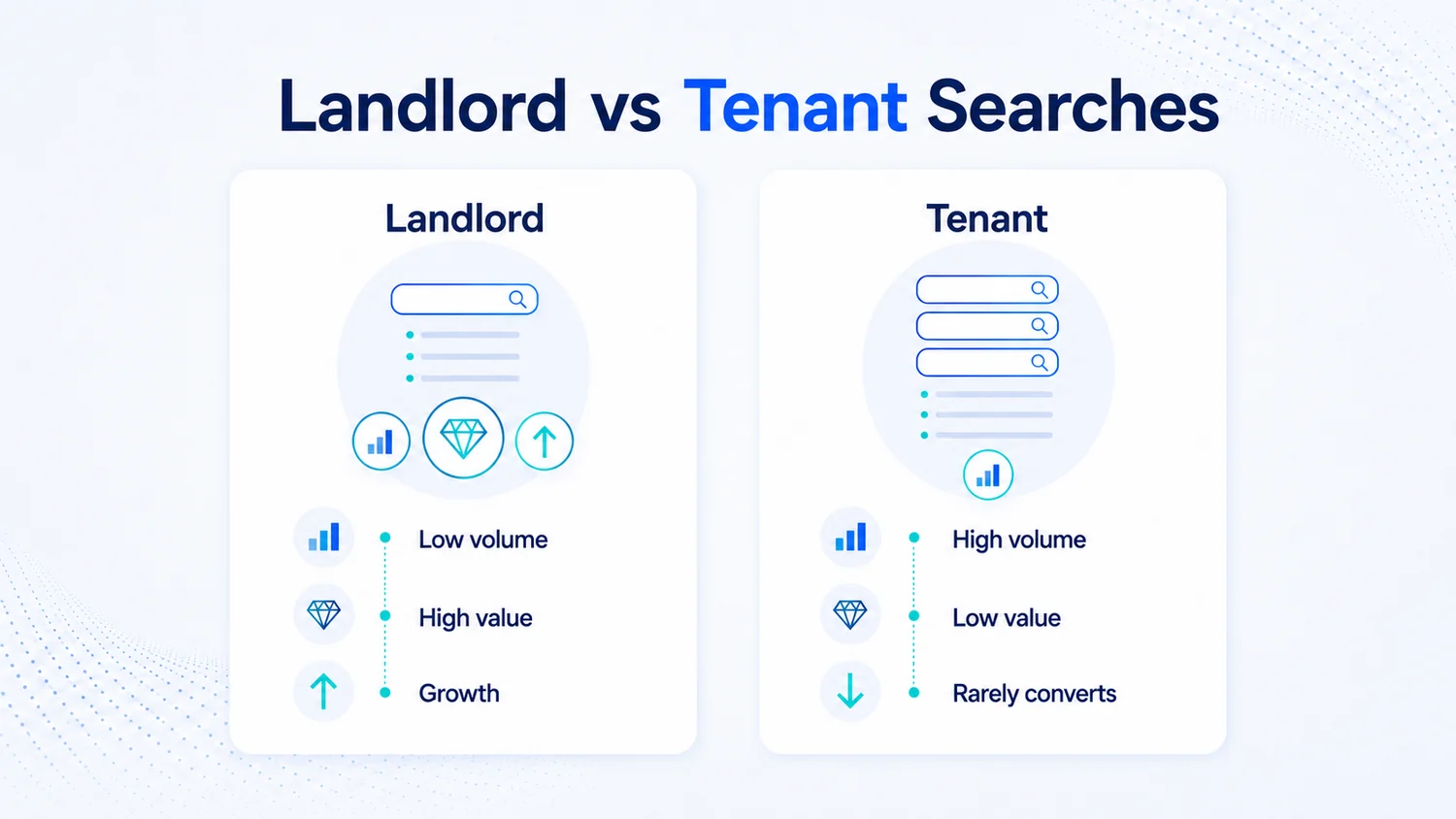
A lettings or property management business has two audiences with opposite economics. Tenants are numerous, urgent, and won in an afternoon. Landlords are few, slow, and worth a management fee every month for years. Both need answering, and most agency websites answer only the first.
- Landlords and tenants are different search markets. They use different words, arrive at different times and want different pages. A site built around available stock reaches one of them properly and the other by accident.
- The instruction is decided weeks before anybody rings. A landlord who searches fees or management options has usually already decided to look. The agency that answered the question is on the shortlist.
- You are invisible outside one town. Your office address ranks in one place. Every other town you take instructions from needs a page written about that town, or search has nothing to rank there.
- Your compliance obligations are content. The law already requires letting agents to publish their fees and scheme memberships on their website. Doing it properly is trust content that most competitors get wrong.
- Portals are a channel, not a strategy. Rightmove and Zoopla bring tenants to your listings. They bring nothing to your landlord acquisition, which is the half of the business that decides whether you grow.
Not sure whether your site reaches landlords at all?
The free thirty-minute call goes through your search data and separates landlord intent from tenant volume. You keep the written breakdown either way. Talk to True SEO.
What do landlords actually search before they change agent?
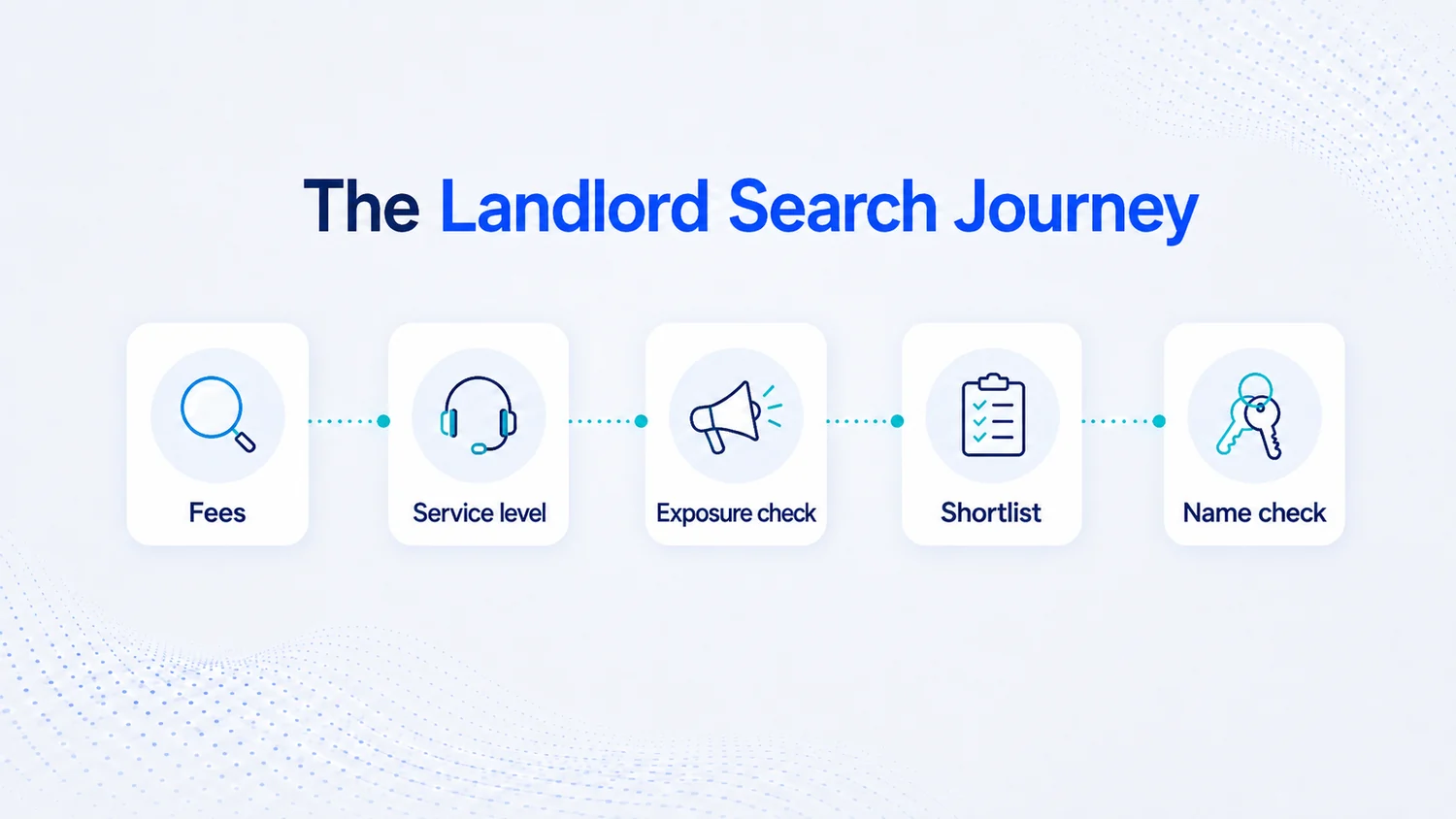
Fees, management options, their legal obligations, and how to complain about the agent they already have. Only one search in five is for a letting agent by name, and by the time a landlord makes that one, the shortlist is largely settled. The full sequence is set out in what landlords search before they switch agent.
What a landlord types, and what they actually mean
This is the gap that costs the most, and it’s invisible from inside the business: the enquiry arrives looking cold. It rarely is. The landlord has usually been reading for weeks, and the pages they read belonged to somebody.
| Search | Who is searching | What it is worth | Does your site answer it? |
|---|---|---|---|
| “2 bed flat to rent [town]” | Tenant, urgently | Fills a property you already have | Yes. This is what the feed does |
| “letting agent fees [town]” | Landlord, comparing | A management instruction, recurring | Rarely, and never in full |
| “fully managed vs let only” | Landlord, deciding scope | The higher-margin service, if you win it | Almost never |
| “do I need [certificate] to re-let” | Landlord, checking exposure | Trust, and a reason to hand it over | No. This is where portals and forums win |
| “letting agents in [town]” | Landlord, shortlisting | Direct instruction competition | Only in the town of your office |
| “how to complain about letting agent” | Landlord or tenant, unhappy | A competitor’s client, in motion | No, and few agencies dare |
| “[your agency] reviews” | Landlord, checking you | The final gate before the call | Partly, and it is decided off-site |
Six of these seven rows are landlord searches. Most agency websites are built to answer the first one.
Why is your agency invisible in towns you already take instructions from?
Because local search ranks a business against a place, and your office address gives it exactly one place. Every other town in your patch needs a page written about that town, with real local substance, or there is nothing for search to rank there. Where a real staffed branch exists, it also needs its own Google Business Profile, because proximity is measured from a point.
Four layers of a letting agency website, and who leaves each one undone
Nobody in that chain did anything wrong. The developer wired the property feed and built a good-looking site, because that was the brief. Nobody briefed a page for each of the nine towns you cover, a landlord section, or the fee information the law already requires you to publish.
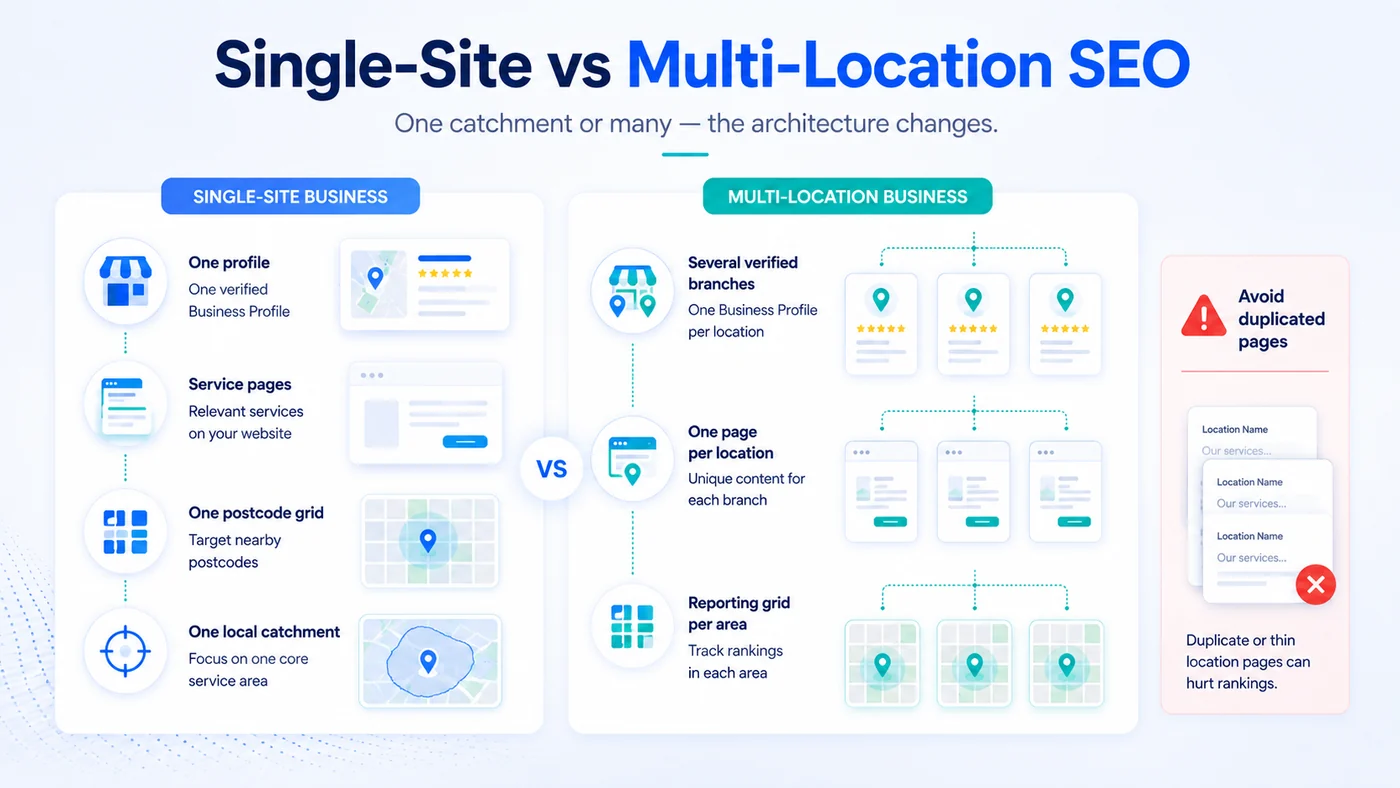
Multi-branch agencies get this wrong in a specific way: they duplicate one template across every town, change the place name, and end up with pages that compete with each other rather than with rivals. Search sees near-identical pages and picks one, usually not the one you wanted.
- Real local substance. The streets and areas you actually let in, the stock type, the tenant profile, the local authority. A page that could describe anywhere ranks nowhere.
- The council by name. Licensing schemes are set locally. A landlord in one borough faces different obligations from one two miles away, and that is exactly what they are searching.
- One Google Business Profile per branch. With a real address, real hours and its own reviews. A single profile cannot rank in six towns however it is worded.
- Honest coverage. If you do not genuinely take instructions in a town, do not build a page for it. Thin coverage pages are visible to search engines and to landlords.
The mechanics are set out in full on the local and multi-location SEO page.
What do tenants search, and which of those searches can an agency win?
The ones the portals do not already own. A tenant typing “flats to rent in [town]” lands on Rightmove or Zoopla, and no agency website is going to change that. What tenants also search, and what portals answer only generically, is everything around the tenancy itself.
- The property search is lost, and it costs less than it looks. A portal lists the whole market and you list your share of it. That gap is structural rather than a matter of effort, and the tenant who found the property on a portal still has to deal with you to rent it.
- The tenancy questions are wide open. Holding deposits, referencing, right to rent, deposit protection, and how notice works now that fixed terms have gone. Tenants search all of it, and a national platform cannot answer it for every agency and every council.
- “Letting agents in [town]” is a tenant search as well as a landlord one. Registering with local agencies to hear about stock before it is listed is real behaviour, and that search resolves in the map pack rather than on a portal, which is ground an agency can hold.
- The tenant side feeds the landlord side. Tenant experience is what most of your reviews describe, and the landlord checking your agency name at the end of their own search reads those reviews before they ring.
None of this competes with the portals, which is the point. The full argument, including the four advantages no agency can close, is on why agents rank below Rightmove and Zoopla.
Is this different for a property management company?
The search behaviour is the same. The vocabulary and the competitor set are not. A landlord looking for management searches management words, and those pages are usually missing from a site that describes itself only as a letting agent.
- Name each service the way the client searches it. Tenant find, let only, rent collection, fully managed, block management, HMO management. Each is a separate decision for the landlord and usually deserves a separate page. One combined services page competes for none of them.
- The competitor set widens. Management searches pull in firms that do no lettings at all, including block managers and national managing agents. The local page has to say what you manage, not only where your office is.
- Portfolio landlords and accidental landlords are different readers. A landlord with eight properties asks about reporting, arrears handling and how many properties one manager carries. A landlord with one asks whether the fee is worth paying at all. The same page rarely satisfies both.
- Compliance content carries more weight here. Client money protection, redress and licensing matter more to somebody handing over a portfolio than to somebody letting a single flat, and they are the first thing a careful landlord checks.
Where an agency does both, the structure follows the money: lettings and management as separate service pages, each with its own town coverage, rather than one page trying to rank for both.
Take the first month free, and see both halves of your own search data
The first month of a letting agency programme is free. You get the landlord and tenant split of your current visibility, the town map, and a compliance read on your fee page, before an invoice exists.

- Your Search Console data split into landlord intent and tenant volume
- Every town you take instructions from, mapped against where you rank
- Your fee and scheme page checked against what the Consumer Rights Act requires
First month free · a few places at a time
Your first month of SEO, free
Answer three quick questions to claim yours.
Thank you, that is with us.
We will email your onboarding form and payment link, and call within one working day if you would rather talk it through first.
Pick a time that suits you below. We will confirm by email too.
What are you already required to publish, and why does it help you rank?
Your fees and your scheme memberships, on your website, by law. Part 3 Chapter 3 of the Consumer Rights Act 2015 requires a letting agent with a website to publish a list of its fees there, and to state its redress scheme and, where it holds client money, its client money protection scheme.
Worth stating precisely, and worth doing properly, because the requirement is more detailed than most agencies realise.
- A description of each fee, in enough detail that somebody can understand the service it buys.
- Whether a tenant fee applies per dwelling or per tenant, which removes the most common source of dispute.
- The amount inclusive of tax, or a clear explanation of how it is calculated where a fixed figure is not possible.
- Your redress scheme by name, and in England your client money protection scheme if you hold client money.
- Displayed at your premises and on your website. The website requirement is explicit where a website exists.
Trading standards can impose a financial penalty of up to £5,000 per breach. That is the compliance argument. The commercial argument is better: a landlord comparing three agencies is doing exactly this research, and the agency whose fee page is complete, plainly written and easy to find looks like the one that will not surprise them later. Two of the three usually make them ring to find out.
This is not legal advice, and a page that says so keeps a reader’s trust. It is a description of a requirement your business already lives under.
How did the Renters’ Rights Act change what landlords search for?
It moved the questions from “how do I let this” to “what am I now exposed to”. The main tenancy reforms commenced on 1 May 2026, abolishing fixed-term and shorthold assured tenancies and section 21 evictions for private assured tenancies, so every tenancy is now an assured periodic one.
Four months in, landlords have been through their first cycle under the new regime, and a great many of them are quietly reassessing whether their agent is worth the fee. That is a window, and it closes. The detail, including the Welsh terminology split and the audit that finds your out-of-date pages, is on how the Renters’ Rights Act changed landlord searches.
- The possession questions changed shape. With section 21 gone, landlords are searching about grounds for possession rather than notice periods, and they are searching anxiously.
- Rent increase mechanics are now a live question. The transitional provisions around rent increases and existing notices are exactly the sort of thing a landlord looks up rather than asks, because asking feels like admitting they do not know.
- Agents who explain it get remembered. Not as legal advice, but as an operator describing what changed in practice for the landlords on their own books.
- The self-managing landlord is reconsidering. Every increase in complexity moves some proportion of self-managing landlords toward full management. They arrive by search.
The date matters for content planning as much as for compliance. Pages written before May are describing a regime that no longer exists, and a landlord can tell within a paragraph.
Do the portals help or hurt a lettings and management business?
They do one job well and a different job not at all. Rightmove and Zoopla put your available stock in front of tenants, which fills properties. They do nothing to bring you landlords, and they rank above you for your own market.
- They are the tenant channel, and they work. Nobody serious suggests leaving them. The mistake is treating tenant distribution as if it were marketing.
- They outrank you on property searches, permanently. A portal has more pages, more links and more freshness on “flats to rent in your town” than any single agency will ever have. That fight is not winnable and does not need to be.
- They own the relationship you are renting. A landlord who found you through a portal listing found the property, not the agency.
- Landlord acquisition is the winnable ground. Portals publish very little that answers a landlord’s questions about fees, management scope, licensing or the new tenancy regime. That entire market is open.
- Your brand search is yours to lose. When a landlord searches your agency name after a recommendation, everything on that results page should be under your control.
Have you ever separated landlord and tenant search?
The free call splits your Search Console data into the two audiences and shows you what proportion of your visibility is worth an instruction. Book the free thirty minutes.
What does this look like when it works?
The clearest way to answer that is to let a client say it. Lets Rent Bristol is a lettings agency we work with, and the brief was the one described on this page: reach landlords, stop measuring tenant volume, and build something that produces instructions rather than traffic.
“Their attention to detail and depth of knowledge in search engine optimisation is second to none. They helped us improve our Google rankings, increase organic traffic and build a proper digital marketing strategy focused on real lead generation, not vanity metrics. Professional, transparent and genuinely invested in delivering results.”
The phrase worth pulling out of that is “not vanity metrics”, because it is the whole argument of this page in three words. A lettings website can produce a great deal of traffic that will never pay a management fee, and a report full of it looks like progress. The work that matters is narrower, slower and measured against instructions.
How is letting agent SEO measured?
On landlord enquiries and instructions won, split by town, against a list agreed before the work starts. Sessions are the wrong measure here, because the cheapest traffic a lettings site can attract is also the least valuable.
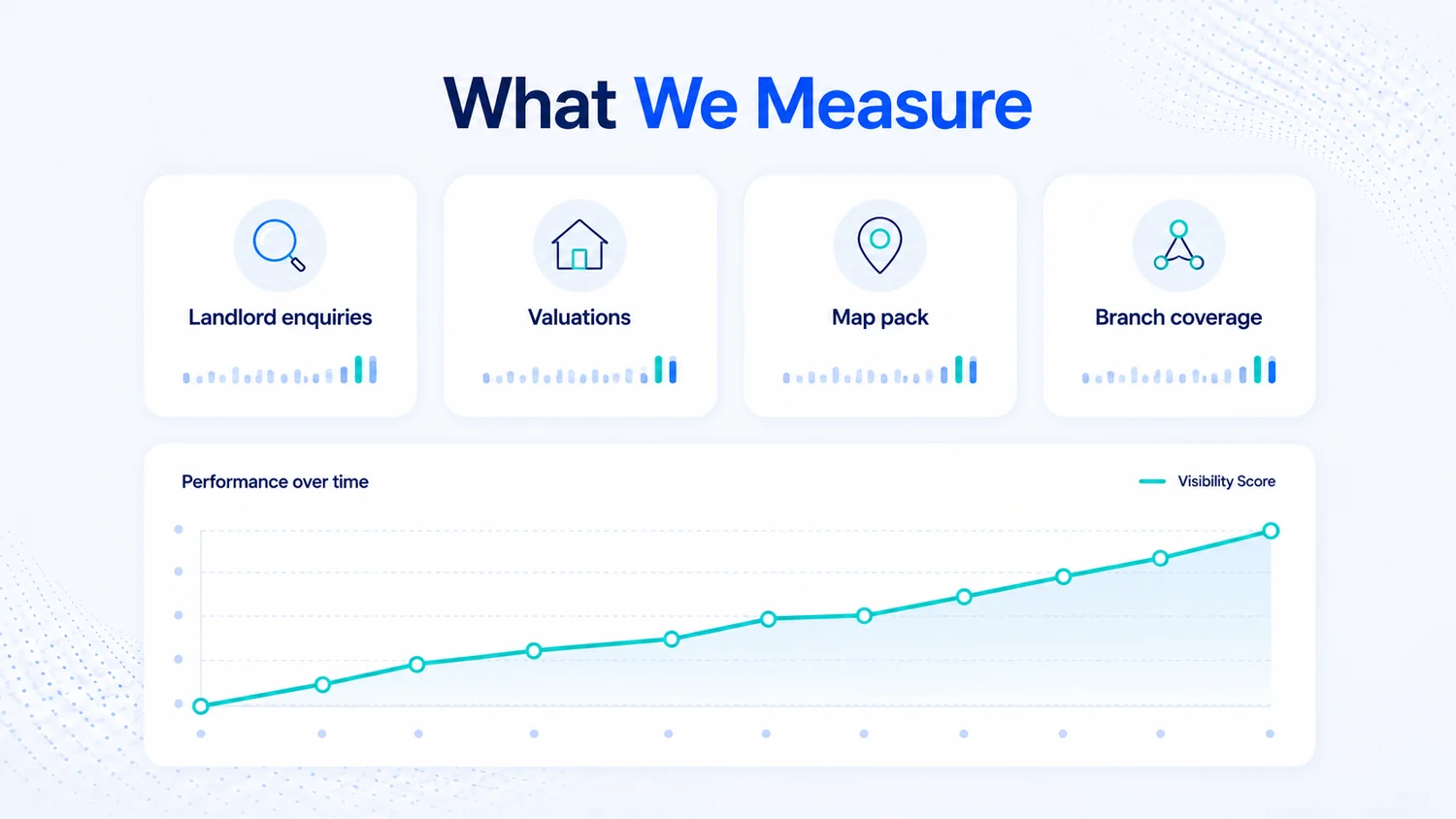
| Measure | Why it is used | What it cannot tell you |
|---|---|---|
| Landlord enquiries, split by town | The only number that becomes a management fee | Whether the instruction was won. That is your valuation conversation |
| Impressions on landlord queries vs tenant queries | Shows whether the site has stopped serving only one audience | Value. A landlord impression is not a landlord |
| Map pack position per branch | Decides who gets rung in each town, and moves fastest | Anything about the landlord side, which is not a map search |
| Valuation and appraisal bookings | The step immediately before an instruction | Quality. A booked valuation on an unsuitable property is a cost |
| Properties under management | The real business outcome, and the one worth reporting to owners | Attribution. Search is one of several reasons this moves |
| Brand search volume over time | The honest long-run measure of whether the agency grew | Cause. Brand demand moves for many reasons besides search work |
If you take one thing from this table, take the landlord and tenant split. Without it, every marketing decision in a lettings business is a guess.
How does a True SEO letting agency programme run?
It opens with a free thirty-minute call that maps where your instructions come from, then runs four stages over roughly ninety days: profile and compliance, landlord and town pages, then the licensing and rules content that keeps landlords coming back.
The first ninety days, and what you can check at each stage
The order follows what moves fastest. The Google Business Profile and the fee page can both be fixed inside a fortnight, and the fee page is required anyway. Landlord and town pages take longer to settle. The rules and licensing content is slowest and most durable, and it is what makes an agency the one landlords check first when something changes.
You keep everything from the first call regardless of what you decide: the town list, the landlord-versus-tenant split of your current visibility, and an honest read on whether your fee page meets the requirement.
What does letting agent SEO cost, and how is it billed?
It is scoped after the free call rather than listed, because the two things that drive the work are how many towns you take instructions from and how much of the landlord side already exists. A single-branch agency and a five-branch group are not the same job.
- The scoping call is free and produces a written document. Town list, landlord and tenant visibility split, and a compliance read on your fee page.
- Branch and landlord pages are scoped as a project. A defined build with a defined end, billed that way rather than spread across a retainer.
- Ongoing work is monthly. Licensing and rules content, review flow, profile maintenance and the brand results page.
- You own everything. Pages, profiles, reviews and analytics, on your domain and in your accounts.
If a fixed monthly structure suits you better, the monthly SEO packages page explains how those are built, and SEO cost in the UK covers what drives price generally.
Who should not buy this?
Agencies at capacity, agencies whose real problem is service quality, and anyone hoping to outrank Rightmove for property searches. All three are common and none are fixed by search.
- If you cannot take on more managed properties. More instructions you cannot service produces poor reviews, which costs more than the marketing saved.
- If landlords are leaving faster than they arrive. Retention is a service problem. Filling the top of the funnel while the bottom leaks is expensive theatre, and we will say so.
- If the objective is beating the portals on property searches. That fight is not winnable and does not need to be. If that is the brief, we are the wrong supplier.
- If the website cannot be changed. Some agency platforms wrap the property feed and allow almost no editable pages. That is a platform conversation before it is a search one.
- If nobody will approve content. Compliance and rules content needs a named person who can sign it off, or it sits in a queue and the programme stalls.
Who does the work?
True SEO Consultants Ltd is a UK semantic SEO consultancy based in Cardiff and led by Mohammad A Mahmud. The engagement is direct, and the person who scopes the programme is the person who runs it.
The approach is semantic rather than keyword-led. For a letting agency that matters because the central problem is an entity one: your site currently describes properties, and it needs to describe an agency that serves landlords in named towns under named schemes. Making those relationships explicit is what moves the landlord side.
You can read more about the consultancy, see the full range of services, or read about Mohammad A Mahmud.
Frequently asked questions about lettings and property management SEO
Can we outrank Rightmove and Zoopla?
For property searches, no, and any supplier promising it is selling something. A portal has more listings, more links and more crawl freshness than a single agency can build. What you can own is everything the portals do not publish: fees, management scope, licensing, the tenancy rules, your towns and your own agency name. That is where landlord instructions come from, and portals barely compete there.
We are a property management company rather than a high-street letting agent. Does this apply?
Yes, and the landlord half of it applies more strongly. A management client is choosing who looks after an asset rather than who finds a tenant once, so they research longer and check compliance harder. The differences are in the vocabulary and the competitor set: management searches bring in block managers and national managing agents alongside local lettings firms, and the pages have to name what you manage rather than only where you are based. If you do lettings and management both, they are two service pages, not one.
We get plenty of website traffic already. Why is this needed?
Because most of it is tenants, and tenants do not pay your management fee. The first thing we do on the free call is split your Search Console data into landlord and tenant intent. Most agency owners are surprised by the ratio. Where traffic is high and landlord visibility is thin, that is usually why the reports look healthy while instruction numbers sit still.
Should each branch have its own Google Business Profile?
Yes, where each branch is a genuine staffed premises with its own address and hours. A single profile cannot rank across six towns however it is worded, and the map pack is where a large share of landlord and tenant calls originate. What does not work is creating profiles for virtual offices or addresses you do not actually occupy, which breaches Google’s guidelines and risks the whole listing rather than just that one.
Is publishing our fees online really a legal requirement?
Yes. Part 3 Chapter 3 of the Consumer Rights Act 2015 requires a letting agent that has a website to publish a list of its fees on that website, with each fee described, stated inclusive of tax or with its calculation explained, and marked as per dwelling or per tenant. Agents must also state their redress scheme and, in England where they hold client money, their client money protection scheme. Trading standards can impose a penalty of up to £5,000 per breach. It is worth checking your own page against that list line by line.
How long before we see more landlord enquiries?
Google Business Profile work and the compliance page can move within weeks, because profile gaps and thin fee pages are the two things we most often find unfixed. Landlord and town pages typically take two to three months to settle. Licensing and rules content is slower and compounds over a year. Nobody can promise a position or a number of instructions, and any supplier who does is describing something outside their control.
Do you work with sales as well as lettings?
Yes, and most agencies we speak to do both. The searches are genuinely different: a vendor deciding to sell behaves nothing like a landlord deciding to hand over management, and the two need separate pages rather than one combined services page. If sales is the larger half of your business, say so at the scoping stage and the plan is weighted accordingly.
Our website is locked to the property feed provider. Is that a problem?
It depends on whether you can add pages and edit titles, descriptions and structured data. Several agency platforms allow the property side to be driven by the feed while leaving the rest of the site editable, which is fine. A few lock everything, and those are a genuine constraint. We check this before quoting rather than discovering it in week three, and if the platform is the blocker we will tell you that instead of taking the work.
Does ARLA Propertymark membership help us rank?
Not directly, and anyone claiming a ranking benefit is guessing. What it does is give search engines and AI assistants something verifiable to attach to your business, and give a cautious landlord a reason to choose you. The common mistake is showing the badge in a footer and nowhere else. Stated in text, explained in a sentence and marked up so a machine can read it, an accreditation does real work. As a logo, it does almost none. The full argument, and what to write instead, is on does ARLA Propertymark membership help you rank.
What about the Renters’ Rights Act? Should we be writing about it?
Yes, and quickly, because the window is open now rather than indefinitely. The main tenancy reforms commenced on 1 May 2026 and landlords have since been through their first cycle under them. They are searching about grounds for possession, rent increase mechanics and what it means for existing tenancies. An agency that explains what changed in practice, as an operator rather than as a lawyer, becomes the one they check first. Content written before May describes a regime that no longer exists, and a landlord notices within a paragraph.
Further reading for letting agencies
Five guides covering the parts of this that deserve their own answer: how landlords actually search, what the tenancy reforms changed, why the portals win property searches, how branch profiles work and whether accreditation moves anything.
What landlords search before they change letting agent
The five stages a landlord moves through before switching, and why only one looks like a search for an agency.
What the Renters’ Rights Act changed for landlords
The reforms commenced on 1 May 2026, and landlord search behaviour changed with them.
Why agents rank below Rightmove and Zoopla
Four structural advantages you cannot close, and the searches where portals barely compete.
One Google Business Profile per branch, or per agency?
What makes a branch profile eligible, and the mistakes that cost multi-branch agencies the map pack.
Does Propertymark membership help an agency rank?
Accreditation is not a ranking factor. What it actually feeds, and how to write it so it counts.
Where letting agent SEO connects to the rest of the work
Local search, the branch profiles and the landlord content are the three halves of this that matter, and every agency programme uses all of them.
Every industry we work in
The sectors True SEO builds search programmes for, and what changes between them.
Branches and towns
How to rank in places where you do not have an address, without pages that fight each other.
Being recommended by assistants
How answer engines pick a local firm, and what makes yours quotable.
Short lets and holiday rentals
The same direct-versus-platform argument, in the accommodation market.
The site underneath it
Speed, crawlability and markup, which decide whether any of the above works.
Start the conversation
A free thirty-minute call, a written town list, and no obligation afterwards.
Find out how much of your visibility is worth an instruction
Thirty minutes, no charge, and you leave with the landlord and tenant split whatever you decide next. If the honest answer is that your site is already reaching landlords well, we will tell you that too.