Landlords rarely leave an agent in a temper. They decide quietly, weeks or months before they say anything, and almost all of that deciding happens in a search box. If you know what they type during that period, you can be the agency that is already answering.
What follows is the sequence as it usually runs, drawn from how landlord-side queries behave rather than from what agencies assume. The order matters more than the individual terms, because each stage rules out a different set of agencies, and because four of the five stages are questions rather than shopping. An agency website built around available stock only enters the process at stage four, by which point the shortlist is largely settled.
What do landlords actually search before they change agent?
Fees first, then service levels, then their own legal exposure. Only after that comes the shortlist, and last of all your name. Just one of those five is a search for a letting agent, and by the time a landlord makes it, they have usually already met two or three agencies without contacting any of them.
Five stages, and what the landlord is deciding at each
The reason the sequence matters is that each stage removes agencies from consideration on a different basis. A thin fee page loses you the landlord at stage one, before they have any idea who you are. An unclear service page loses you a landlord who was ready to upgrade; a page that lays the levels out plainly keeps them. Silence on a rule change loses you the self-managing landlord who has just decided the admin has outgrown them. None of those losses shows up anywhere in your analytics, because the landlord never arrived.
Stage one: the fee search, and why it starts everything
The first search is almost never “letting agents near me”. It is a fee search: letting agent fees, letting agent management fee percentage, or the same thing with a town attached. At this point the landlord hasn’t decided to move. They are checking whether what they pay is normal.
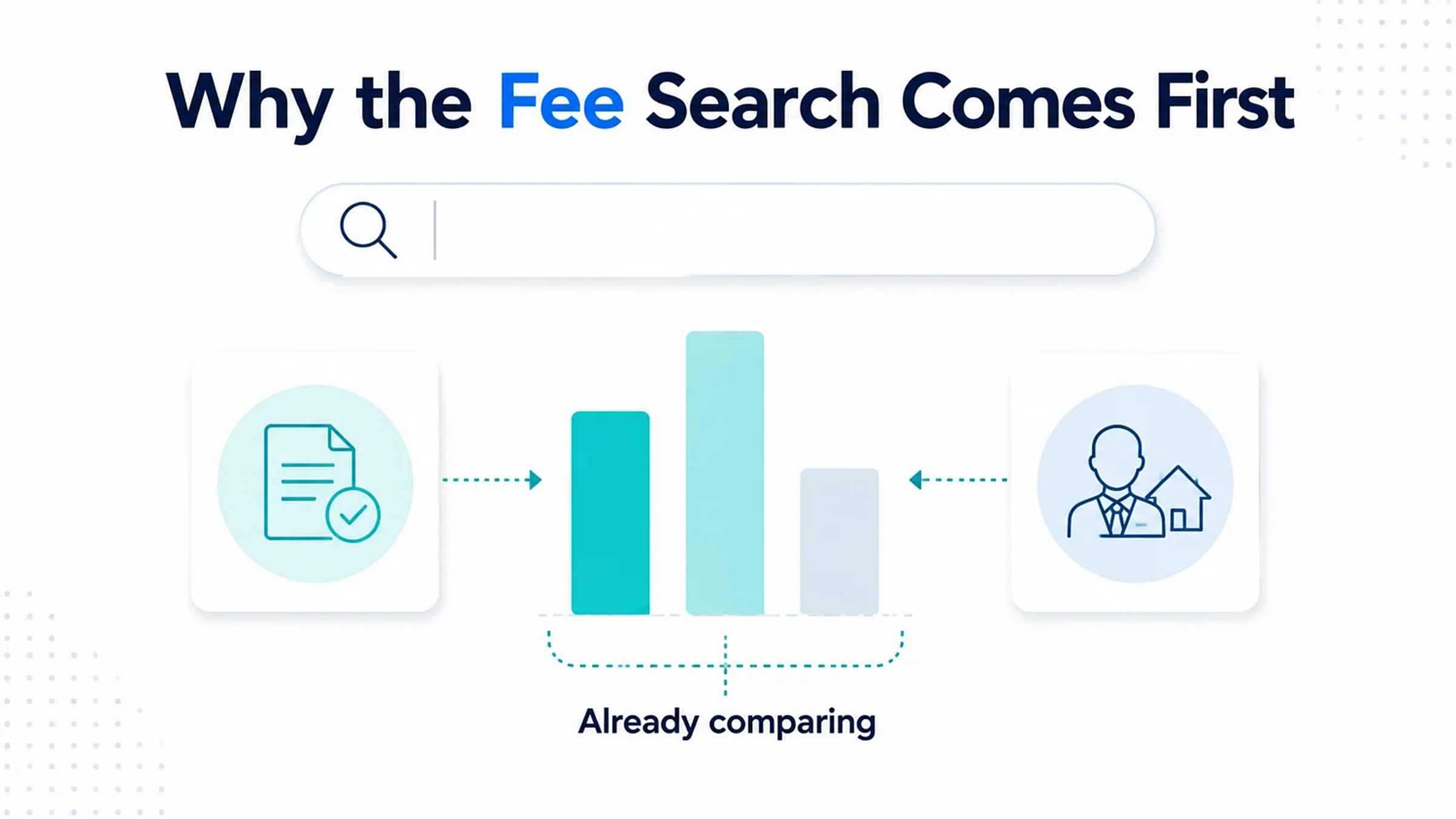
This is the cheapest landlord to reach and the one almost nobody reaches, because agency websites treat pricing as a conversation to be had on the phone. The agency that publishes a clear, complete fee page wins twice here: it answers the search, and it looks like the agency that won’t surprise anyone later.
There is a second reason to do it properly. Publishing your fees is not optional. Part 3 Chapter 3 of the Consumer Rights Act 2015 requires an agent with a website to publish that list there, with each item described, stated inclusive of tax or with its calculation explained, and marked as per dwelling or per tenant. Agents must also state their redress scheme, and in England, where they hold client money, their client money protection scheme. Trading standards can impose a penalty for a breach.
That makes the question not whether to publish a fee page, but whether to publish a good one. Most are a short paragraph and an invitation to call, which satisfies neither the landlord nor the requirement, and which reads to somebody already suspicious about fees as confirmation of the suspicion.
Stage two: which service level are they actually buying?
Once the fee looks high, the next question is whether they are buying the right thing. This is where fully managed vs let only, what does a letting agent actually do and is a letting agent worth it appear, and it is the stage where a clear page changes somebody’s mind.
Two things are happening at once. Some landlords are talking themselves into self-managing; others are realising they have been paying for a full service and receiving a let-only one. Both groups are in play, and the page that lays out what each service level genuinely includes will keep some of the first group and win some of the second.
| Service level | What it usually includes | Who it suits | How the fee is usually charged |
|---|---|---|---|
| Tenant find only | Marketing, viewings, referencing, right to rent checks, the tenancy agreement and deposit registration. The agency then steps back. | A landlord who is local, confident and has time, or who already has a trusted contractor list. | A one-off fee, often expressed as a share of the first month’s rent. |
| Rent collection | Everything in tenant find, plus collecting the rent, chasing arrears and providing statements. | A landlord who will handle maintenance themselves but does not want the payment conversation. | A smaller ongoing percentage of rent collected, usually with the set-up fee still charged. |
| Fully managed | Everything above, plus repairs, contractor management, inspections, certificate renewals, notices and the day-to-day tenant relationship. | A landlord who is remote, time-poor, holds several properties, or wants the compliance burden carried. | An ongoing percentage of rent, typically the largest of the three, sometimes with additional charges set out separately. |
Publish that comparison as three pages rather than one. A landlord searching “fully managed letting agent [town]” and a landlord searching “let only agent [town]” are at different points in the same decision, and a single combined services page competes properly for neither.
The mistake here is defensive writing. A page that argues management is always worth it reads as a sales pitch to somebody actively looking for reasons to leave. A page that says plainly which landlords should self-manage, and which should not, is far more persuasive precisely because it concedes something.
Stage three: something changes and they check their exposure
This is the largest and least served stage. A rule changes, a certificate expires, a tenant gives notice, and the landlord searches to find out where they stand. Deposit timescales, right to rent, certification, licensing, and since May 2026 the grounds for possession that replaced section 21.
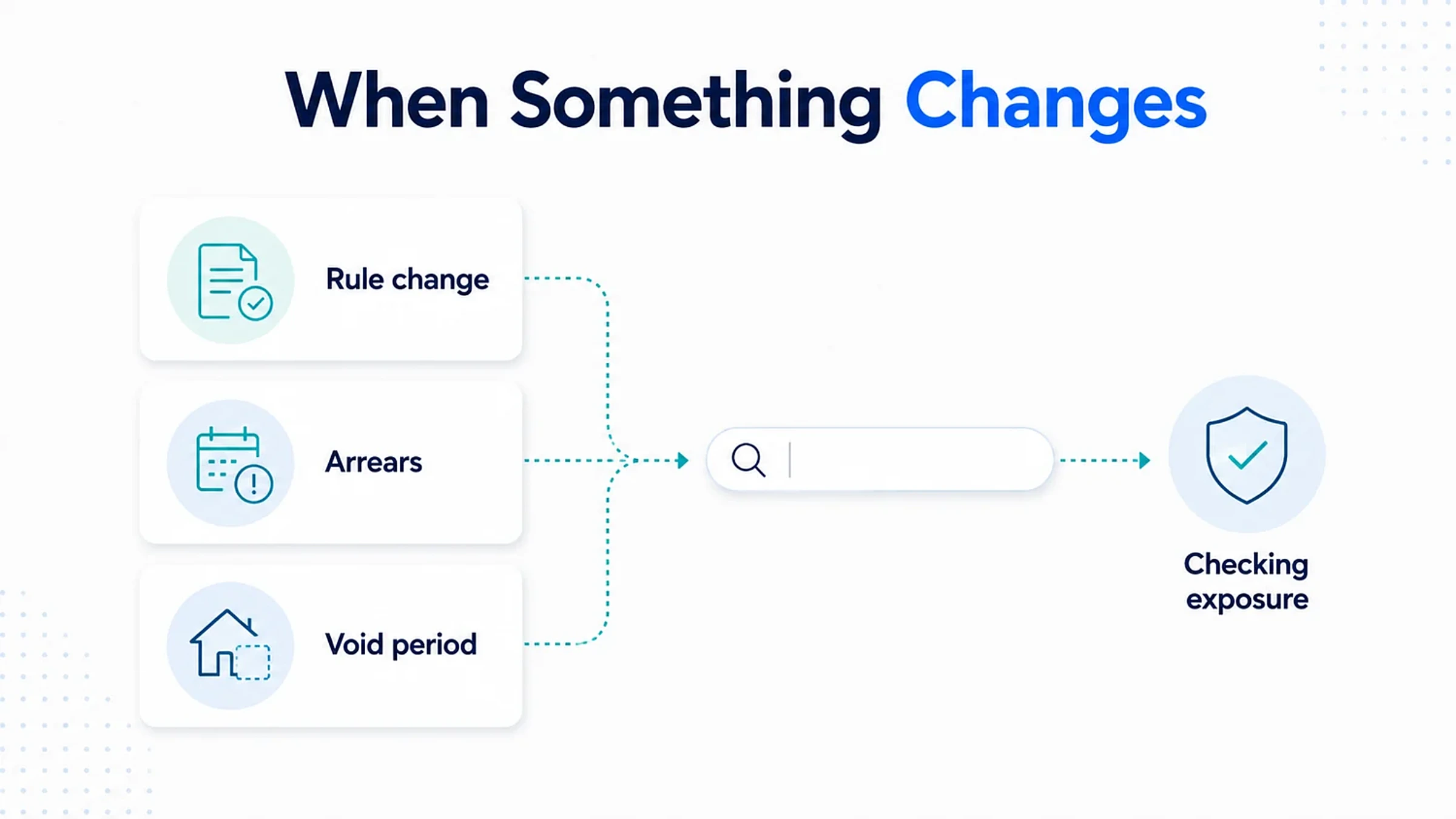
Agencies avoid this content because it feels like legal territory. It isn’t, provided it is written as an operator describing what changed in practice rather than as advice. The distinction is easy to hold and easy to state on the page.
It also happens to be the content that separates a local agency from a national portal. Licensing is set by the local authority, so the answer genuinely differs between one borough and the next. Selective licensing in one ward and not the next, an additional HMO scheme with its own conditions, a council that inspects on a different cycle: a portal cannot write that page for every council in Britain. You only have to write it for yours.
The self-managing landlord matters most at this stage. They are not searching for an agency and they would tell you they do not want one. What moves them is the moment the admin outgrows them, and that moment almost always follows a rule change or a difficult tenancy. The agency whose page explained the change is the one they remember when they give up. That is why the Renters’ Rights Act changed landlord search behaviour is worth understanding as an acquisition question rather than a compliance one.
Stage four: the shortlist, and the only search that looks like a search for you
Only now does letting agents in [town] appear, and by this point the landlord has usually met two or three agencies through the earlier stages without ever contacting them. This is why landlord acquisition feels like a series of cold enquiries that arrive already warm, and why agencies consistently underestimate how long the process took.
What they search, and the page that has to exist
Two practical consequences follow. First, competing only at this stage means arriving late to a decision that is largely made. Second, visibility that stops at the town the office sits in leaves an agency off every other shortlist, whatever the standard of service.
That second point is a structural problem rather than a content one, because local ranking is decided partly by proximity and proximity is measured from a point. An agency covering nine towns from one office competes in eight of them at a permanent disadvantage. The fix is a genuinely distinct page for each town plus, where a real staffed branch exists, a Google Business Profile for that branch. The two work together: the profile gets you into the map pack; the page decides what happens next.
Stage five: the name check that quietly decides it
The last search is your name. Reviews, complaints, and occasionally the agency name plus a word like “problems”. Everything on that results page is part of the decision, and the parts you do not own are the parts that carry the most weight.
The counter-intuitive one is the complaint search. How to complain about a letting agent is searched constantly, and agencies never write about it because it feels like inviting trouble. In practice a page explaining the redress process, including your own scheme, reads as confidence. The landlord searching it is usually complaining about somebody else.
| What they check | What they are really asking | Where it should sit |
|---|---|---|
| Reviews, and how you answered the bad ones | Does this agency handle problems, or hide from them? | Your Google Business Profile, plus the reviews pulled through onto your own branch pages. |
| Redress scheme membership | If this goes wrong, who do I go to? | Stated in text on your own site rather than only as a footer badge. It is required of you anyway. |
| Client money protection | Is my rent safe if the agency fails? | The same page as redress, named scheme and status, in text. |
| Accreditation and professional body | Is this a proper firm? | Written out, with the membership number and what it obliges you to do. A badge on its own does almost nothing. |
| The complaint search | Is there anything I should know before I ring? | Your own page explaining the process, which is how the search gets answered by you rather than by somebody else. |
How does a letting agent reach landlords rather than tenants?
By treating them as two separate search markets and building for both deliberately, rather than letting the property feed decide. Tenants are numerous, urgent and won in an afternoon; landlords are few, slow, and worth a management fee every month for years.
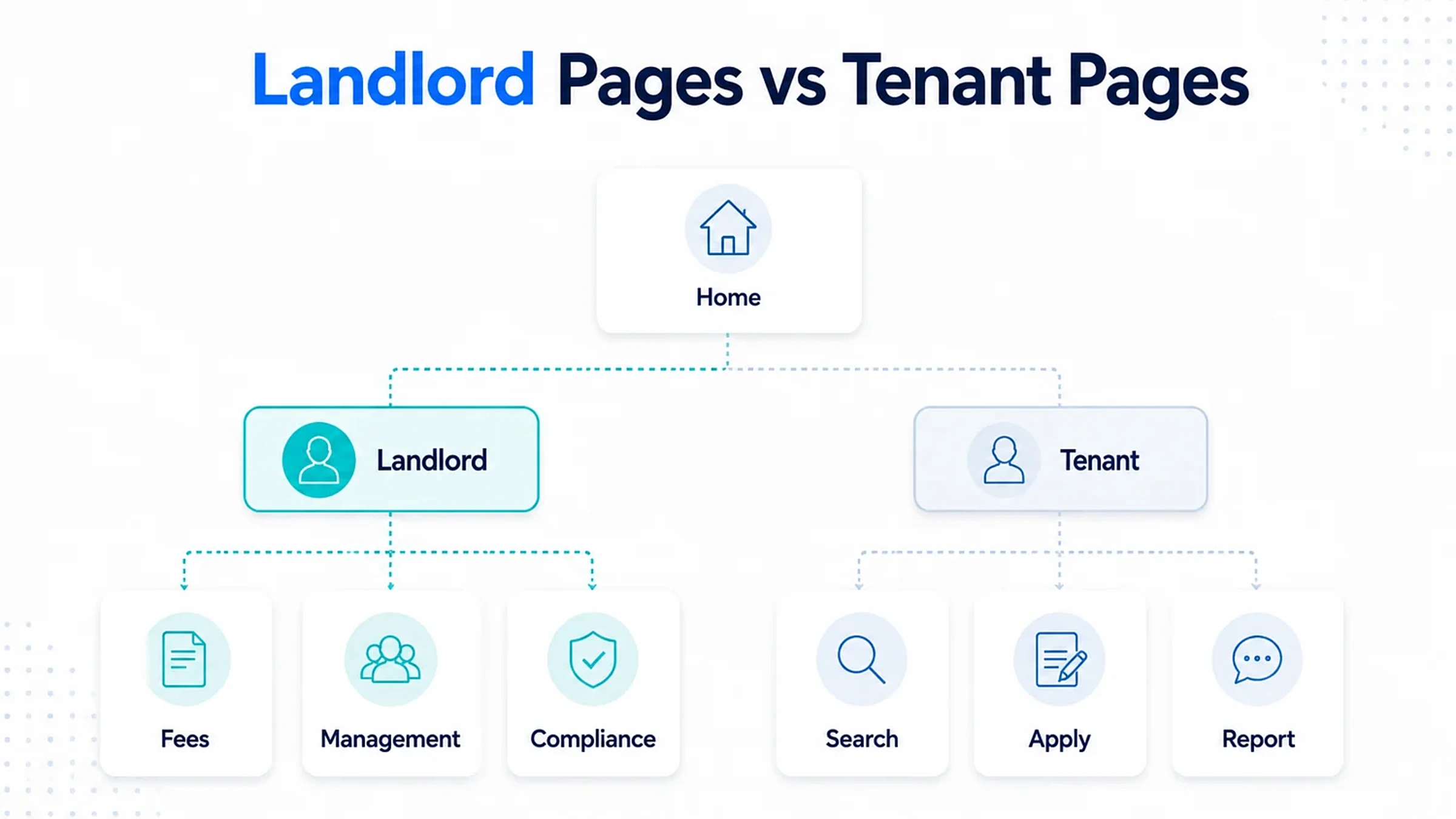
Most agency websites are wired to the property feed, and the feed is genuinely good at its job: it puts available stock in front of the people looking for somewhere to live. What it cannot do is answer a landlord deciding who should manage a property. Those are different words, typed at different moments, needing different pages, and the site that serves one by accident rarely serves the other at all.
None of this argues for abandoning the tenant side. Tenant experience is what most of your reviews describe, and the landlord at stage five reads those reviews. The argument is only that the two need separating, so you can see which half of your visibility is landlord demand and plan for both. The SEO for letting agents and property management page sets out how that split works in practice and what it usually reveals.
Why does a number one ranking sometimes produce no enquiries?
Because a ranking is worth exactly what the person making the search is worth to you. An agency can sit at the top for property searches, receive a healthy-looking traffic report, and take no new instructions from any of it.
Four layers, and why the top position produces nothing
The diagnosis takes about twenty minutes. Open Search Console, filter the query list to terms containing landlord, fee, managed, licensing, notice and the service words, and compare that set against everything else. Most agency sites find the landlord set is a small fraction of impressions and a large fraction of what actually matters. Then filter by country and device, because a position that averages 1.4 across every market can be considerably worse in the one you sell in.
How do you know whether any of it worked?
Count instructions by town, not traffic. An instruction is the only event in this business that changes revenue, and it is the only number worth reporting against.
Agree the measure before the work starts, because it is much harder to agree afterwards. A workable set is short: landlord enquiries by town, instructions by town, and the query set those enquiries came from. Traffic and rankings can sit underneath as diagnostics, which is what they are, rather than as the headline.
Expect the timescale to be uncomfortable. The fee search that starts the process often happens months before any contact, so a change made in March is answering a landlord who will ring in June. That is a season, not a month, and judging the work after four weeks produces the wrong conclusion in both directions: it hides progress that is real, and it flatters a lucky fortnight.
What this means for an agency website
- Four of the five stages are questions, not shopping. A site built entirely around available stock competes only at stage four.
- The fee page is the highest-value page most agencies never write. It is required by law, searched constantly, and almost universally thin.
- Service levels are three pages, not one. Tenant find, rent collection and fully managed are three different decisions being made by three different landlords.
- Rules content is the defence against portals. Local licensing is the one thing a national platform cannot cover properly.
- Coverage decides reach. Stage four is a local search, and a single address ranks in a single place.
- The name search is the final gate. Reviews and redress information belong on your own site as well as on the third-party platforms that carry them.
If you want this mapped against your own data rather than described in general, the SEO for letting agents and property management page sets out how the landlord and tenant split works and what it usually reveals. The related reading below covers the individual questions in more depth.

Take your first month free, measured on landlord enquiries rather than on traffic
The first month of a lettings programme costs nothing. It starts with the landlord side of your query set, staged the way this page describes, so the stages you already answer are visible before anything is billed.
What the free month covers
- The landlord-side queries separated from tenant search, and mapped to the five stages
- A read on your fee page against the Consumer Rights Act requirement and against what landlords actually type
- The stage-three gaps: the rules and licensing questions the patch is asking that the site does not answer

First month free · a few places at a time
Your first month of SEO, free
Answer three quick questions to claim yours.
Thank you, that is with us.
We will email your onboarding form and payment link, and call within one working day if you would rather talk it through first.
Pick a time that suits you below. We will confirm by email too.
Answer the four questions and the reply covers the landlord side of your search picture, staged the way this page sets it out. The terms of the free month sit with the form.
Common questions
How long does a landlord take to change agent?
Longer than agencies expect. The fee search that starts the process often happens months before any contact, and the intervening stages are silent. That is why landlord acquisition responds slowly to marketing changes and why judging it after four weeks produces the wrong conclusion. Plan on a season, not a month.
How long before the work produces more landlord enquiries?
The compliance and profile work shows up fastest, because a fee page and a complete Google Business Profile can start answering searches within weeks. Town pages take longer, usually a couple of months before they hold a position worth having. Licensing and rules content is the slowest and the most durable, because it compounds as the library grows and because a national publisher cannot copy it. Nobody can promise a position or a number of instructions, and any supplier who does is describing something outside their control.
Should we publish our fees if competitors do not?
Yes, and the fact that competitors do not is the argument for it rather than against. Publishing a fee list on your website is already required of letting agents under the Consumer Rights Act 2015, so the choice is between doing it well and doing it badly. Doing it well answers a high-intent search that your competitors are ignoring.
Should the fee page show real numbers or a range?
Real numbers where you can, a clearly explained basis where you cannot. The requirement is that each fee is described and either stated inclusive of tax or accompanied by an explanation of how it is calculated, so a percentage with its basis spelled out satisfies it. What doesn’t work is a page that lists fee names with no figures and no method, because that answers neither the landlord nor the requirement, and a landlord already suspicious about fees reads it as evasion.
Is it risky to write about complaints and redress?
Less risky than being absent from it. Agents are required to state their redress scheme anyway, and a page that explains how the process works reads as an agency that expects to be judged fairly. The landlord searching that phrase is far more often unhappy with a different agent than with you.
Do these stages apply to self-managing landlords too?
They apply more strongly. A self-managing landlord moves toward an agent when the admin outgrows them, which usually follows a rule change or a difficult tenancy. They arrive through stage three content rather than through anything commercial, which is exactly why rules and licensing pages are worth writing.
More on winning landlord instructions
- Does Propertymark or RICS membership help an agency rank?Accreditation is not a ranking factor. What it is instead, and why a logo in the footer does none of the work the words would do.
- What the Renters’ Rights Act changed about how landlords choose an agentThe reforms commenced on 1 May 2026. What changed, how landlord searching shifted with it, and which pages are now describing a regime that has gone.
- One Google Business Profile per branch, or one per agency?Why a single profile cannot cover a patch, what makes a branch listing eligible, and the mistakes that quietly cost multi-branch agencies the map pack.
- Why agents rank below Rightmove and ZooplaThe four advantages the portals hold that no agency can close, and the searches where they barely turn up at all.