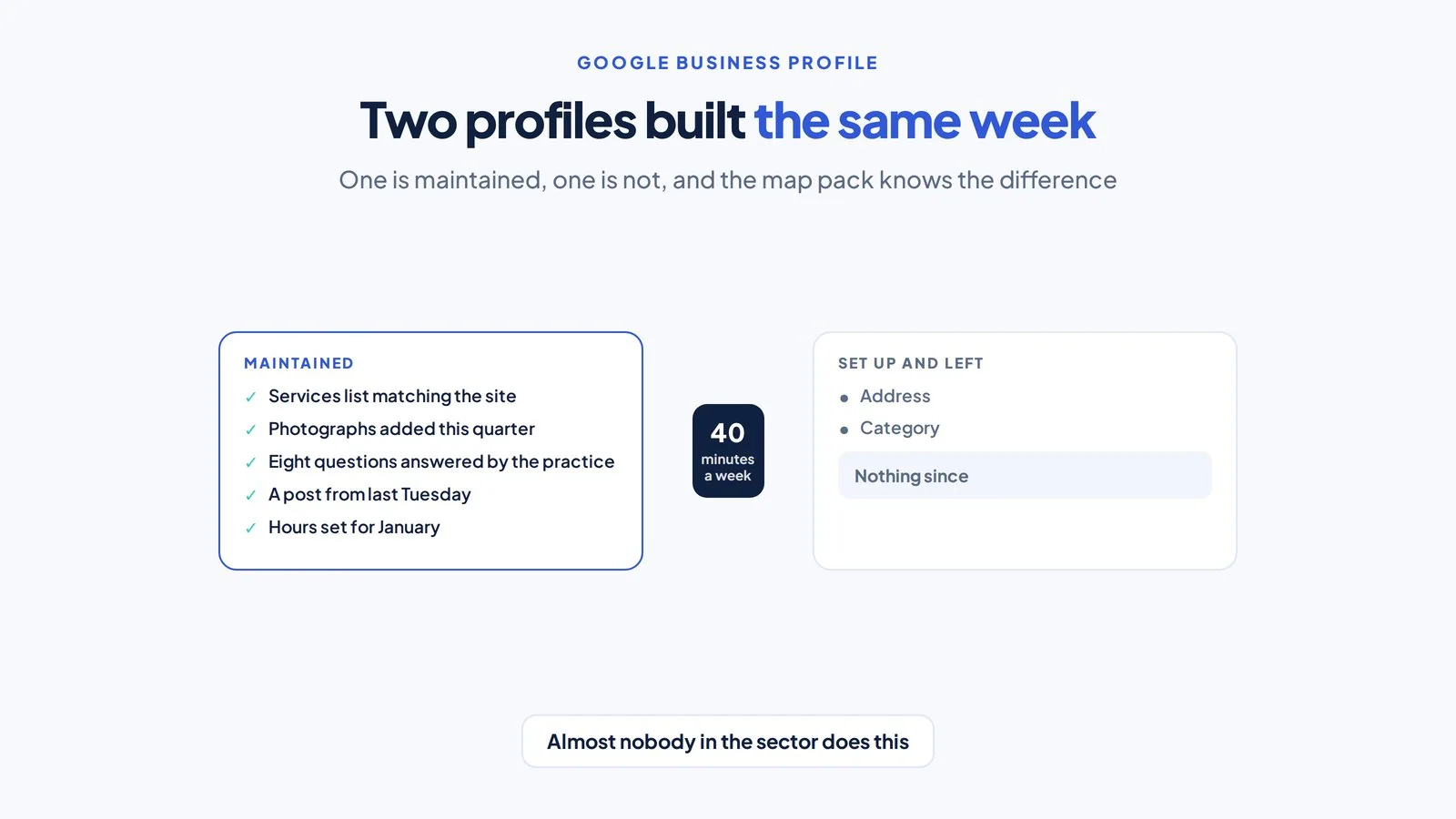
You lose the map pack to the firm that maintains its profile rather than to the firm that set one up better. Both profiles were built the same week. One has a services list matching the site, photographs added this quarter, eight questions answered by the practice itself and a post from last Tuesday. The other has the address, the category and nothing since. Open yours and see which it is.
On our estimate the routine runs to about forty minutes a week, and almost nobody in your sector does it, which is your opportunity.
Key Takeaways
- Setting your profile up is a one off. Running it is a weekly routine, and the second is where practices separate.
- Google says a custom service name must avoid “profanity, gibberish, personal information, prices, or phone numbers”. A price can go on the service itself.
- Posts come in three types, and Google states that “Posts older than six months are archived unless a date range is set”.
- Questions and answers can be seeded by the practice. Most practices leave the section for competitors and strangers to fill.
- Hours matter more for your practice than for most businesses, because January is when the searches happen and your office pattern changes.
- Give your profile an owner by name. A profile owned by everyone is a profile owned by nobody.
- The profile, the website and the Companies House record have to agree, because three sources confirming each other is what lets an assistant name your practice at all.
- Read calls and direction requests. Ignore the view count, which tells you almost nothing you can act on.
Local SEO for accountants
Profile set up two years ago and untouched since?
We take the profile through the whole list, set the routine up and hand it to whoever is going to run it.
Measured on a real practice
What a maintained profile produced across three cities, and the booking gap we found across 494 practice sites.
- 193 of 415tracked searches showing Total Books
- 84searches where only the profile appeared
- 92.5%practices with no way to book a call
What does running a profile involve once it is set up?
Your profile takes seven kinds of attention once it is live, and six of them take minutes rather than hours. The services list, the posts, the photographs, the questions and answers, the messaging, the hours, and the performance figures you read at the end of the month.
The setup decisions sit outside this page deliberately. Which category to choose, how to describe regulated services without overclaiming and how reviews work under client confidentiality are all covered in local SEO for accountants. Everything below assumes your profile is already verified, correctly categorised and correctly named.
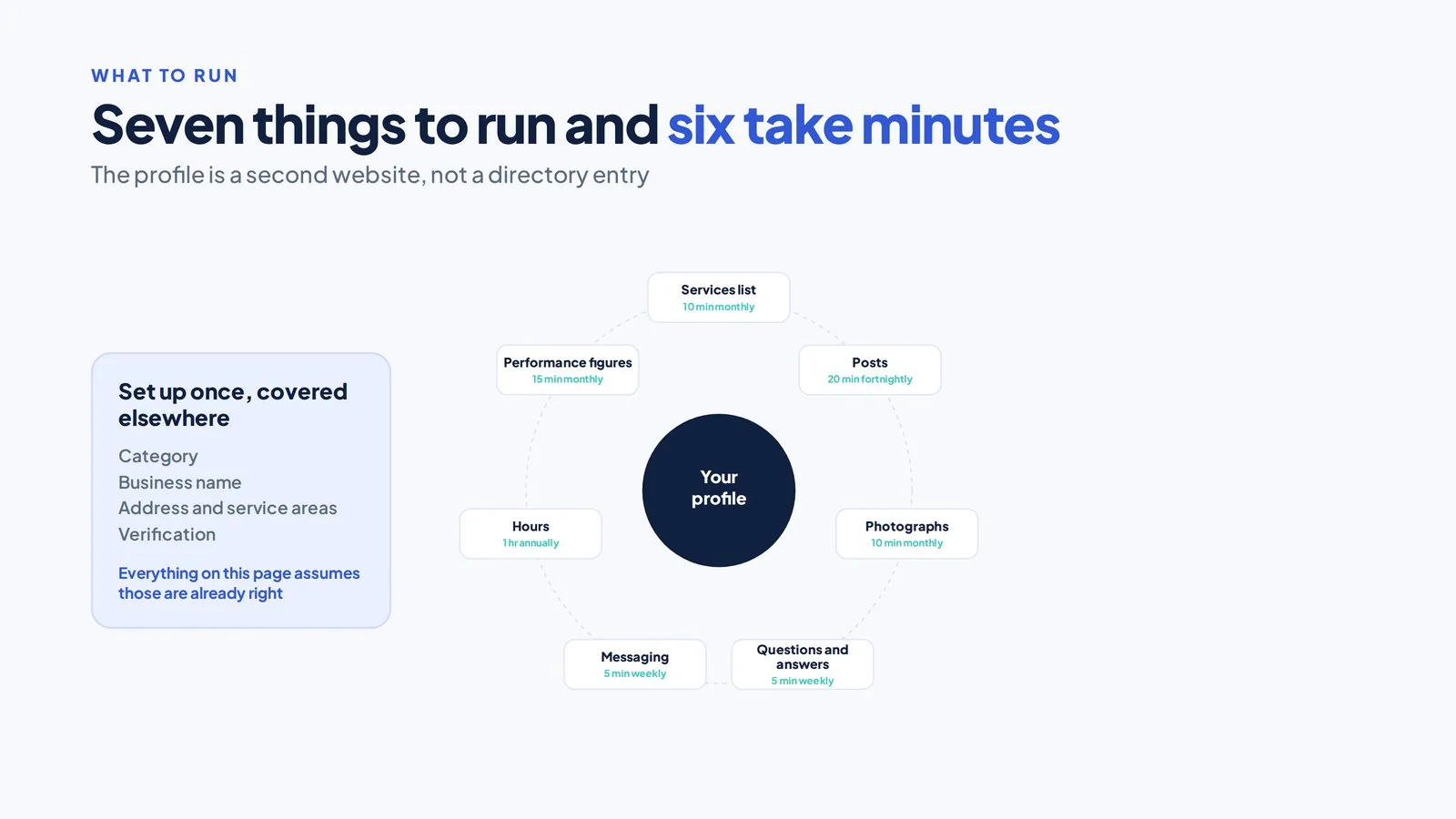
Start from the position that your profile is a second website rather than a listing. It has pages, it has a contact route, it has a content stream and it has its own analytics, and treating it as a directory entry means using about a fifth of it.
What should the services list contain?
Your services list should carry every service you sell, named the way a client would say it, matching your service pages one for one.
Google notes that businesses in certain categories, service businesses among them, may have the option to set out their offerings directly on the profile. Where the option is there, use all of it. Offer twelve services and list four and you have told Google about a third of what you do.
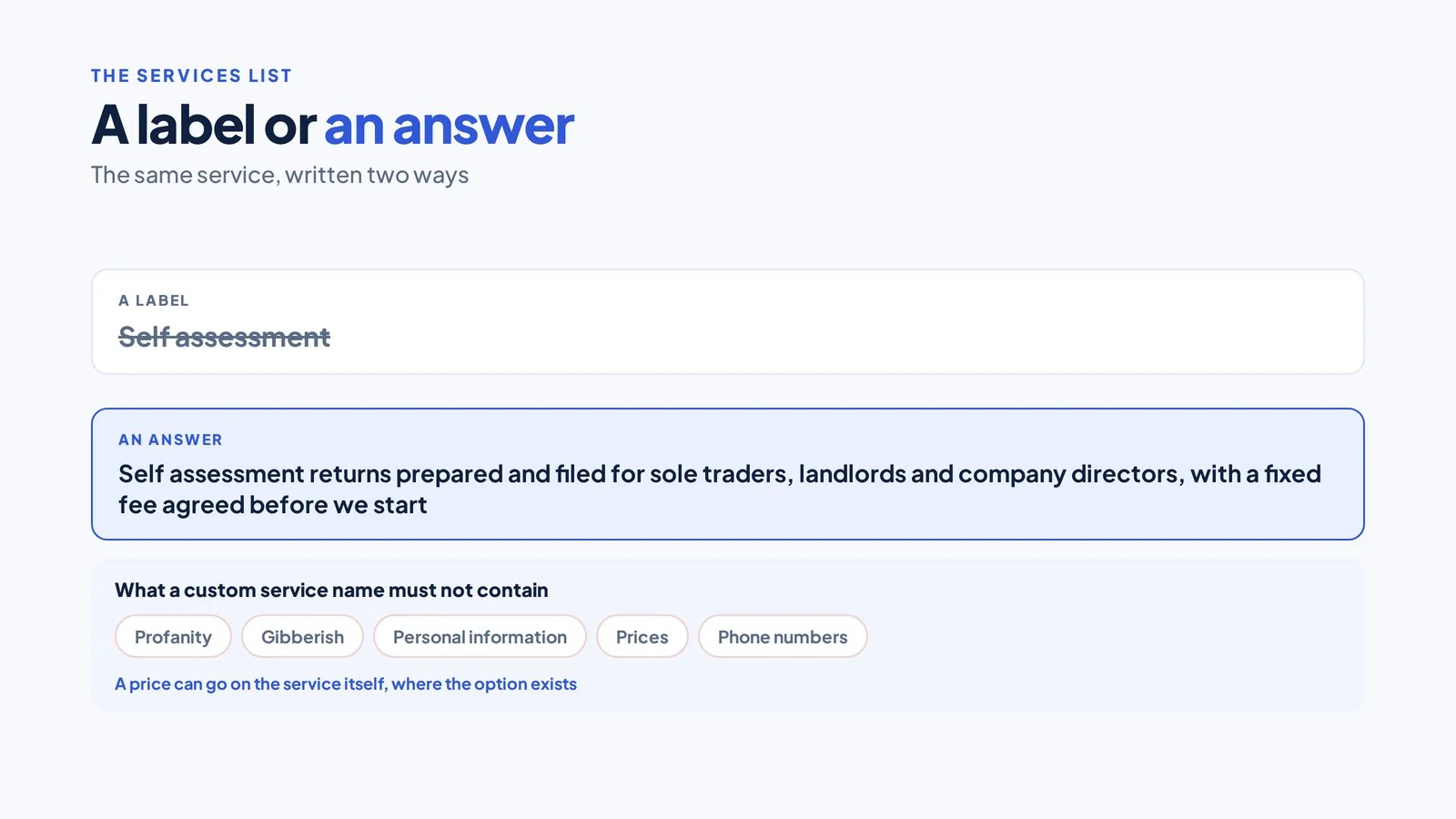
Two rules govern what your service names can contain. Google states that “Custom services that violate policy will be automatically rejected”, and that a practice should “Avoid including profanity, gibberish, personal information, prices, or phone numbers in custom service names”. A price is not banned from the service itself, only from the name, so if you publish a fee you can put it on the service entry where the option exists.
Write each of your service descriptions as an answer rather than as a label. “Self assessment” is a label. “Self assessment returns prepared and filed for sole traders, landlords and company directors, with a fixed fee agreed before we start” is an answer, and it is the version that matches how somebody searches.
Keep your list and your website aligned. A service on the profile with no page behind it sends a visitor to a site that does not mention it, which is the fastest way to lose somebody who was ready to call your reception. The services list is the part of the profile that stays still. The next part is the one that has to keep moving.
What should a practice post about, and how often?
Post fortnightly, about whatever is happening in your practice’s year, and accept that your posts do two jobs rather than one.
Google offers three post types: Updates, Offers and Events. Updates carry most of what you have to say. Google states that “Posts older than six months are archived unless a date range is set”, which is the reason a dormant profile looks dormant even when it once had content.
The content rules are worth reading before writing anything. Google asks businesses to avoid “misspelled words, extra characters, text that adds no value”, to keep posts family friendly, and warns that a phone number in a post description can be rejected where it cannot be verified.
Your practice year supplies the calendar without anybody inventing one. The self assessment deadline. The end of the tax year. A payroll year end. A filing pattern. A change in a threshold. A new service. A new person joining. A guide you have published. A local event you are at.
Write each of your posts as one useful fact plus one action. “The deadline for online self assessment returns is 31 January. We are taking on new self assessment clients until 20 December so there is time to do it properly.” Two sentences, one fact, one action, no adjectives.
Treat your posts as something a human reads rather than as a signal. Google publishes nothing saying posts affect ranking, so anybody telling you they do is telling you something they cannot support. Posts are read by people deciding whether your practice is still trading, which is reason enough.
What is there to photograph in an accountancy practice?
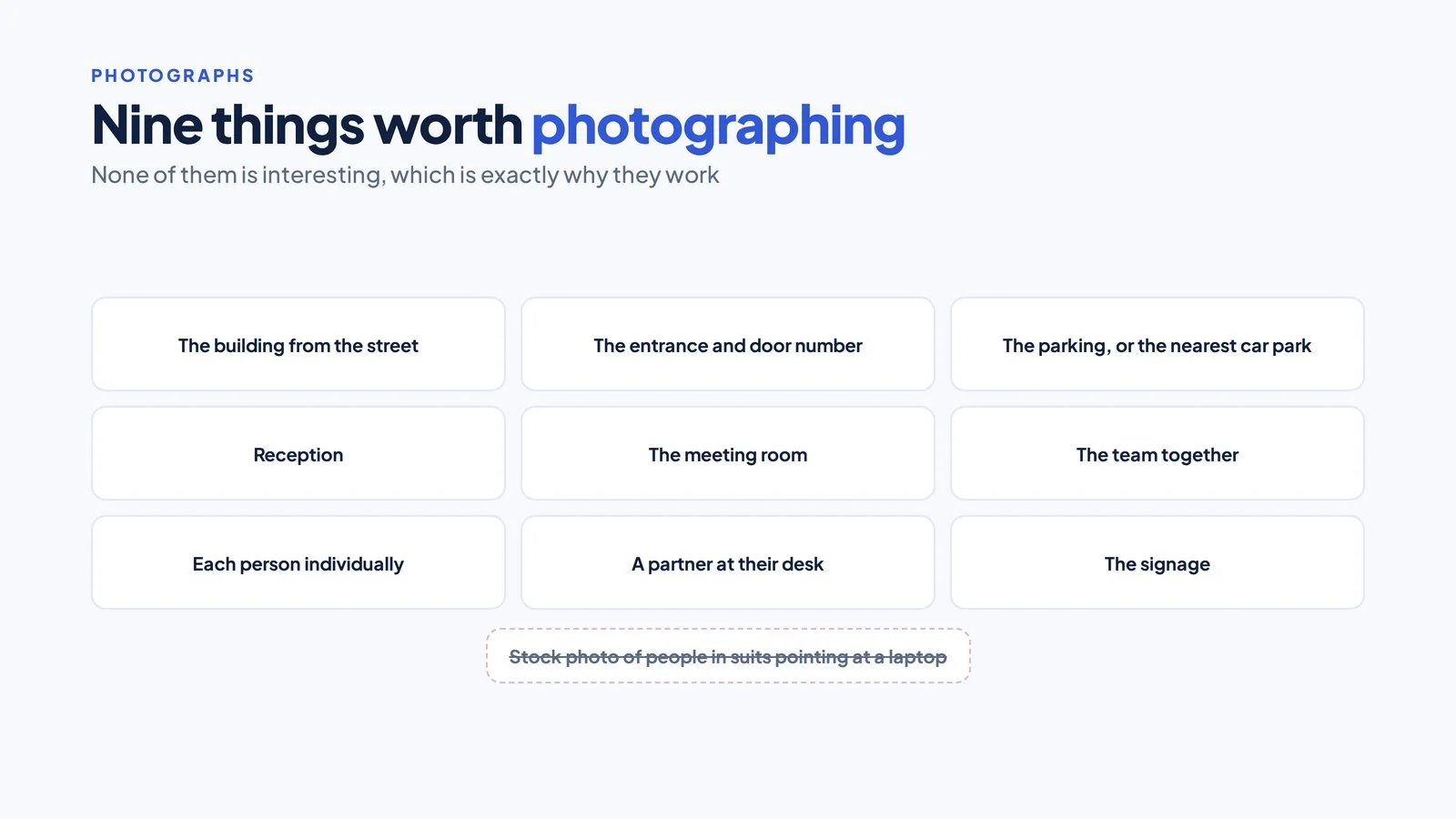
You have more to photograph than you expect, and nothing on this list is interesting, which is exactly why it works.
Your building from the street, as somebody arriving would see it. The entrance and the door number. The parking, or the nearest car park, which is the single most useful photograph you can add if clients visit. Reception, and the meeting room. Your team, individually and together. A partner at their desk. The signage. The view from the window, which sounds pointless and reassures somebody who has never been there. Nine of those ten are worth doing this quarter.
Skip the stock photography entirely. A generic office with people in suits pointing at a laptop tells your visitor you had nothing of your own to show.
Add a few each quarter rather than thirty at once, and take them on a phone rather than hiring anybody. A practice photographed as it actually is beats one photographed expensively, because your visitor is checking whether the place is real. They are also reading the questions underneath, and those are the part of your profile anybody can write.
How do you use questions and answers when nobody asks?
Seed the questions yourself, because the section fills with or without you and the alternative is letting strangers decide what your profile says.
The mechanism allows anybody to ask and anybody to answer, which means a competitor, a former client or somebody who has confused you with another firm can put text on your profile. Post eight good questions and answer them and you have crowded that out, and you have also answered the eight things every caller asks your reception.
Post the questions your clients actually ask before engaging. What does a set of accounts cost. Do you take on clients partway through a year. How does moving from my current accountant work. Do you do payroll as well. Can everything be done remotely. Are you registered for anti money laundering supervision. How quickly do you reply. Do you charge for the first meeting.
Answer each one in two or three sentences, and answer as the practice rather than as a marketing department. Then check the section monthly, because a stranger’s question sitting there unanswered looks like neglect to everybody who reads it.
Should a practice turn messaging on?
Turn messaging on if somebody in your office will answer it within the working day, and leave it off if nobody will.
The calculation is straightforward. Messaging converts people who will not ring, and an unanswered message converts nobody while making you look absent. With a person on your front desk, turn it on. Three partners, no administrator and a full diary, leave it off.
Decide three things before you switch it on. Who answers, what response time you are committing to, and what gets said in the first reply. A first reply that acknowledges, answers what it can and offers a call at a named time will out-convert one that simply asks the person to phone you.
Never take confidential detail through it. A message thread is not a secure channel and a client describing their affairs in one should be moved to email or a call, politely and immediately. Whether messaging is on or off, most people who decide to act will click a link instead, so it matters where that link goes.
More than one office
Two offices means two profiles, not one cloned twice
Different categories, different service lists and different hours where the offices differ, so the two stop competing on the same signal.
Where should the booking link point?
Point your booking link at the page that completes the action, which is rarely your home page.
A profile offering a free consultation should link to the page that books one, not to a general contact page and not to your front page. Our audit of 494 UK accountancy practice websites found 92.5% advertising a free consultation with no way to book it anywhere, so this is a common failure and a cheap one to fix.
The same rule applies to every link on your profile. A service entry that can carry a link should carry the link to that service’s own page. Every step your visitor has to take after clicking is a step some of them do not take.
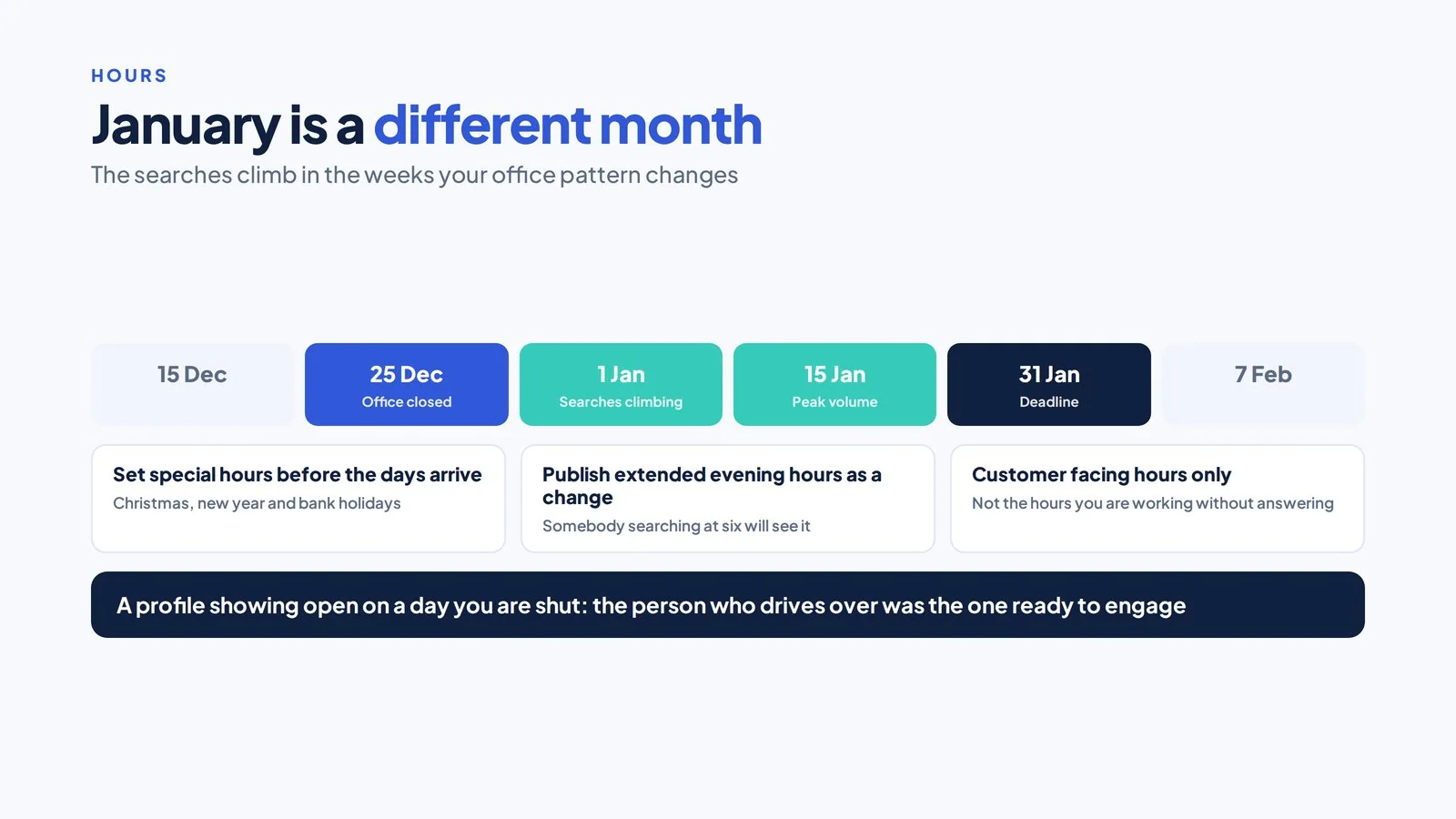
What about opening hours, and the January exception?
Publish the hours somebody can actually reach you, and treat January as a separate case, because that is the month your searches happen.
Google’s guidance is to “Provide your regular customer-facing hours of operation”, and adds that a business may use current seasonal hours as its regular hours where that applies. Read customer facing literally. The hours you are working but not answering the phone are not customer facing hours, and publishing them produces the unanswered call that becomes your next bad review.
Set your special hours for the days that differ before they arrive, not after. Christmas and the new year, which is exactly when self assessment traffic climbs. Bank holidays. Any day your office closes for training or a team event. A profile showing open on a day you are shut is a small fault with a large effect, because the person who drives over was the one ready to engage.
Publish your extended January hours as a change rather than leaving them unsaid. Open until seven on weekdays through January and you have something worth saying, and your profile is where somebody searching at six in the evening will see it.
Which attributes are worth setting?
Set the attributes that answer a real question your clients have, and leave the rest alone.
The useful ones for you cluster around access and arrangement. Whether there is wheelchair accessible entry and parking. Whether you take appointments. Whether you offer online appointments, which matters if your clients never visit. Whether there is on-site parking, which is the detail that decides between two firms for somebody with a meeting booked.
Identity attributes are your decision rather than a recommendation from anybody else. They are published by the business about itself, and you should only set one you mean.
Review your set once a year. Attributes change as Google adds them, and a profile set up three years ago will have options available now that nobody in the practice has looked at. That is the last of the seven, and none of them happens unless somebody has it in their diary.
What does the weekly routine look like, and who owns it?
Name one person, give them forty minutes a week, and put it in their diary rather than in an intention.
Weekly, they check for new reviews and reply to them, check for new questions and answer them, check for suggested edits Google has applied without asking, and read any messages. That is about twenty minutes in a normal week.
Fortnightly, they write and publish one post. Another twenty minutes.
Monthly, they add two or three photographs, check the services list still matches your website, and read the performance figures.
Annually, they review the category against what you now sell, review the attributes, refresh the description and check the hours against how your practice actually works.
Set out as a table it fits on one side of paper, which is the point.
| Frequency | What gets done | Roughly how long |
|---|---|---|
| Weekly | Reply to new reviews | Five minutes |
| Weekly | Answer new questions | Five minutes |
| Weekly | Check suggested edits Google has applied | Five minutes |
| Weekly | Read and answer messages, where messaging is on | Five minutes |
| Fortnightly | Write and publish one post | Twenty minutes |
| Monthly | Add two or three photographs | Ten minutes |
| Monthly | Check the services list against the website | Ten minutes |
| Monthly | Read calls, clicks and the search terms report | Fifteen minutes |
| Annually | Review category, attributes, description and hours | An hour |
Make it your practice manager in most firms, or the partner who cares most in a small one. What does not work is handing it to a marketing agency alone, because they cannot see your reviews arrive, cannot answer a question about your fees and do not know your office is shut on Friday.
What are the most common Google Business Profile mistakes an accountancy practice makes?
Six mistakes account for almost everything that goes wrong on a profile that is already verified and correctly set up. All six are errors of running rather than of setup, which is why they survive the initial configuration and then sit there for years.
- Services left at the defaults. Google suggests a short generic list at setup and most practices accept it, so the profile offers tax preparation and accounting while the practice sells R&D claims and fractional finance direction. The services list is the part of the profile that describes what you actually sell, and nobody edits it.
- Hours that are wrong in January. A practice working through the self assessment run with extended hours and a profile still showing 9 to 5 is turning away the calls it worked hardest to earn.
- Posts used as an announcement board. Office news and holiday greetings fill the posts panel on most practice profiles. A post answering a question a client actually asks is worth a dozen of them.
- Questions and answers left to strangers. Anybody can answer a question on your profile, and an answer from a stranger carries the same visual weight as an answer from you. An empty panel on a practice profile is an invitation.
- Photos that show the building and nothing else. One exterior shot uploaded in 2019 is the norm. The profile is a shopfront for a service nobody can see, and the images are the only part of it that behaves like one.
- No named owner inside the practice. This is the mistake that produces the other five. A profile owned by everybody is updated by nobody, and the first four months of neglect are invisible because nothing on the profile breaks.
Each of the six has its own section above or below. The point of listing them together is that a practice can check all six in about fifteen minutes, and most will find at least four.
What goes wrong when nobody owns the profile?
Five things go wrong on an unowned profile, and all five are visible to a prospect before they are visible to the practice.
Google’s own updates get applied without anybody noticing. Google states that it “gathers info from different sources, like user reports and licensed content”, and that you “can’t manage all Google updates through your Business Profile”. For some suggested edits you are notified and have “4 days to accept or reject the suggestion”, and where nobody replies Google “may automatically publish the update if it is supported by other publicly available information”. Four days is shorter than most practices check. Google’s own changes show in blue in the profile editor, so a monthly look catches what the four days did not.
Questions accumulate unanswered. A prospect reading three questions with no reply from you has learned something about how quickly you respond, and it is not what you would want them to learn.
Reviews sit without replies. Reply to every review, including the good ones, and you read as a practice paying attention. Silence reads as the opposite, and it takes about a minute per review to fix.
Hours drift out of date. Your office moves to a four and a half day week, or closes between Christmas and the new year, and the profile says otherwise. Somebody drives over.
Your services list falls behind your website. A new service launches, the page goes up, and the profile still lists what you offered two years ago. The profile is often the first thing a searcher sees, so it is describing an older version of your firm to everyone.
None of the five is expensive to prevent. All five come from a profile belonging to nobody in particular.
What should you read in profile performance, and what should you ignore?
Read calls, direction requests, website clicks and the search terms. Ignore the view count.
Calls are the closest thing to an outcome your profile reports, and you should know how many you get and in which weeks. Direction requests matter if clients visit you and almost nothing if they do not. Website clicks tell you the profile is doing its job of handing somebody on.
The search terms report is the most useful and the least read. It shows the phrases people used before they reached the profile, and it is the cheapest keyword research a practice will ever get, because it is measured on real searches that actually found you. Take the terms that appear and check whether your website has a page for each one.
Views tell you the profile was shown, which is a function of how many people searched rather than of anything you did. A month with more views and fewer calls is a worse month, and reading only views means recording it at your partners’ meeting as a better one.
Judge a change over a quarter and against the same quarter last year rather than against last month, because your own seasonality moves these numbers more than anything on this page will.
Self-check quiz
Is your profile being run, or just sitting there?
Eight questions you can answer by opening your own profile. Have it in another tab before you start.
Question 1 of 8Your services list:
Question 2 of 8Your most recent post went up:
Question 3 of 8Photographs added in the last twelve months:
Question 4 of 8Questions on your profile:
Question 5 of 8Your booking link points at:
Question 6 of 8Special hours for Christmas and the new year:
Question 7 of 8The person responsible for the profile is:
Question 8 of 8You have read the search terms report:
Show the answer key
- Your services list: Carries every service and matches the website. A practice listing four of twelve services has described a third of itself.
- Your most recent post went up: In the last fortnight. Posts older than six months are archived unless a date range is set.
- Photographs added in the last twelve months: Several, taken at the practice. A visitor is checking whether the place is real.
- Questions on your profile: Seeded by you and all answered. The section fills with or without you.
- Your booking link points at: The page that books a call. 92.5% of practices advertise a free consultation with no way to book it.
- Special hours for Christmas and the new year: Set before the days arrive. That fortnight is when self assessment searches climb.
- The person responsible for the profile is: Named, with it in their calendar. A profile owned by everyone is owned by nobody.
- You have read the search terms report: This quarter. It is the cheapest keyword research a practice will ever get.
Does the profile affect what AI assistants say about your practice?
It does, because the profile is one of the few places where a machine can read facts about your practice that it can check against another source. The name, the address, the phone number, the categories, the services and the hours all exist as structured fields rather than as sentences, and structured fields are cheap for a machine to use with confidence. A practice whose profile, website and Companies House record agree gives an assistant three sources that confirm each other. Disagreement between the three is the commonest reason a real and findable firm does not get named.
Reviews do a second job here. An assistant asked to recommend an accountant has nothing to weigh except what sources say about the firm, and review text is the only large body of writing about your practice that you did not write yourself. A profile with four reviews gives it almost nothing to work from, whatever the star rating says.
Two cautions before this turns into a project. No provider controls whether an assistant names your practice, so treat an absence as a signal rather than a fault, and test it more than once, because assistants answer differently between accounts and runs. And nothing in this section is extra work. It is the same services list, the same hours and the same review routine described everywhere else on this page, done properly.
Frequently asked questions
How often should an accountancy practice post?
Fortnightly is enough, and consistent beats frequent. Google archives posts older than six months unless a date range is set, so a profile with nothing recent reads as dormant even when you are at your busiest.
Do posts help a practice rank?
Google publishes nothing saying they do, so treat any claim you are given as unsupported. Posts are read by people deciding whether your firm is active and worth contacting, which justifies the twenty minutes on its own.
Can we put our prices on the profile?
Not in a custom service name, which Google asks businesses to keep free of prices and phone numbers. A price can go on the service entry itself where that option is available, and if you publish fees on your website you should use it.
Should we answer questions asked by people who are not clients?
Yes, briefly and factually. An unanswered question sits on your profile indefinitely and reads as neglect. Answer as the practice, keep it short, and move anything specific to a private conversation.
We have no office clients ever visit, does any of this apply?
Almost all of it applies to you and two parts change. Photographs of parking and the entrance matter less, and direction requests stop being a useful measure. Your services list, posts, questions, messaging, hours and search terms report all work exactly the same way.
Who should own the profile inside the practice?
One named person, usually your practice manager. The work is forty minutes a week and it needs somebody who can see reviews arrive and answer a question about your fees, which is why handing it entirely to an outside agency does not work.
Is a Google Business Profile free, and is the time worth it?
The profile costs nothing and the time is the real price. Google charges no fee to create, verify or run a profile, and anyone quoting a setup fee for one is charging you for an afternoon’s work you can do yourself. The weekly routine above runs to about twenty minutes, which is the only number worth weighing. For a practice drawing enquiries from its own town, that is the cheapest line in the whole marketing budget. For a practice whose clients are all national and referred, it is close to the least valuable thing on this page.
Where the profile sits in the rest of local work
Treat your profile as the part of the local job that compounds. The category, the name and the address are decisions you make once. The services, the posts, the questions and the photographs accumulate, and two years into the routine you have a profile a competitor cannot match by spending money, because what you have is time.
True SEO Consultants Ltd works from Startup Stiwdio at the University of South Wales, 86-88 Adam Street, Cardiff, CF24 2FN, and delivers UK wide through remote digital onboarding and delivery. Mohammad A Mahmud completed the ACCA professional examinations and holds an MSc in Applied Accounting from the University of South Wales, and Julie Williams is a fractional finance director and certified business coach, which is why the routine above is built around forty minutes a week rather than around a content calendar nobody will keep. We bill on KPIs, not hours, with milestones in writing. Total Books Accountants appeared in the map block on 193 of 415 tracked searches and was the practice’s only appearance on the page 84 times, and the Total Books case study sets out how that was measured.
We will go through your profile on the call
Have it open and we will work down the seven items with you, then tell you which three are worth doing this month.
Book my free strategy callRead the map pack diagnosis