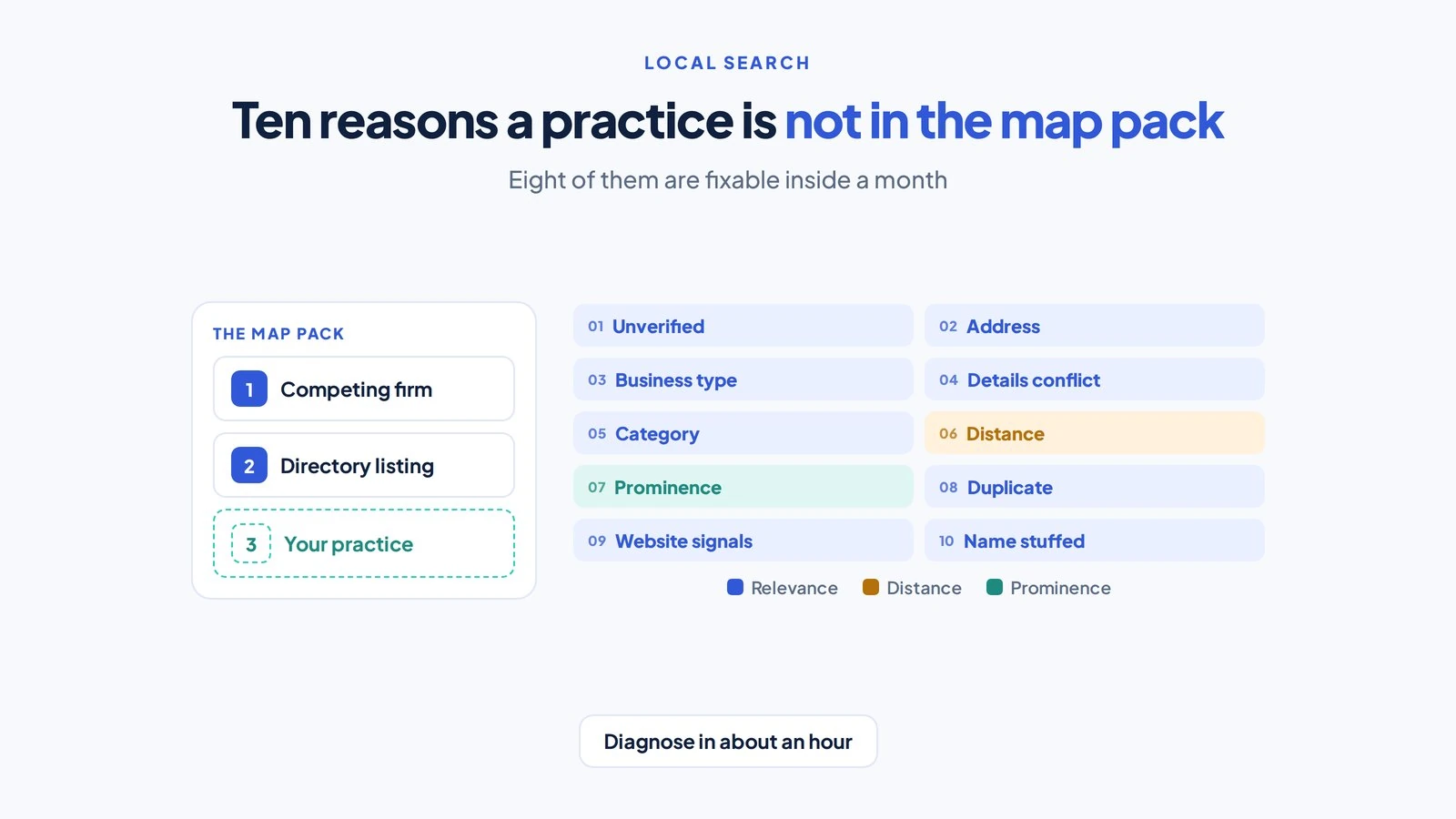
Your practice is missing from the map pack for one of ten reasons, and eight of the ten are within your control. Your profile is unverified or suspended, your address does not qualify, the business type is set wrongly, your contact details conflict across the web, your primary category does not match the search, the searcher is too far away, your practice is not prominent enough, a duplicate listing is splitting your signals, the website behind your profile does not back the claim, or the name field has been stuffed and the listing has been penalised.
Working out which one applies to you takes about an hour, and it is worth the hour, because every one of the ten has a different fix and several of them look identical from the outside.
Key Takeaways
- Absence and low ranking are different problems. Establish which one you have before doing anything else.
- Never diagnose from your own desk. Your location changes the result, so check across your catchment.
- Google names three factors for local ranking: relevance, distance and prominence. Eight of the ten causes below sit inside relevance.
- A registered office you do not operate from does not qualify for a profile, and Google’s guidelines name virtual offices and remote mailboxes directly.
- Our audit of 494 practice websites found a tight cluster of missing local signals, led by 17.4% with no LocalBusiness markup.
- Verification and category fixes typically show within days. Prominence takes months.
- Stacked secondary categories spread a profile across competing result sets rather than strengthening it, and more than three on a single office practice is usually the first thing to cut.
- A suspended listing needs reinstatement rather than edits, and nobody can promise the outcome.
Local SEO for accountants
Not sure which of the ten applies to you?
We check the profile, the address eligibility and the catchment in one pass and tell you which cause is yours.
Measured across catchments
Grid measurement on a real practice, plus the local signal cluster from our published research.
- 193 of 415tracked searches showing Total Books
- 84searches where only the profile appeared
- 494UK practice websites in our published study
Why is my accountancy firm not showing in the Google map pack?
Your firm is not showing because one of ten conditions is unmet, and all ten sit inside the three factors Google publishes for local ranking. Google describes them as relevance, “how well a Business Profile matches what someone is searching for”, distance, “how far each business is from the customer who’s searching”, and prominence, “how well-known a business is”.
Distance you cannot change. Relevance and prominence you can. Eight of the ten causes below are relevance problems, which is why you will probably fix this faster than you expect once you know which one you have.
The broader picture, including what the map pack measures that a website does not, sits in local SEO for accountants. This page is the diagnosis.
First, is the profile missing or is it ranking below the three on show?
Absence and low ranking are different problems with different fixes, and treating one as the other costs you a quarter. A missing profile is usually a verification, eligibility or duplication problem. A profile ranking fourth or eleventh is usually a relevance or prominence problem.
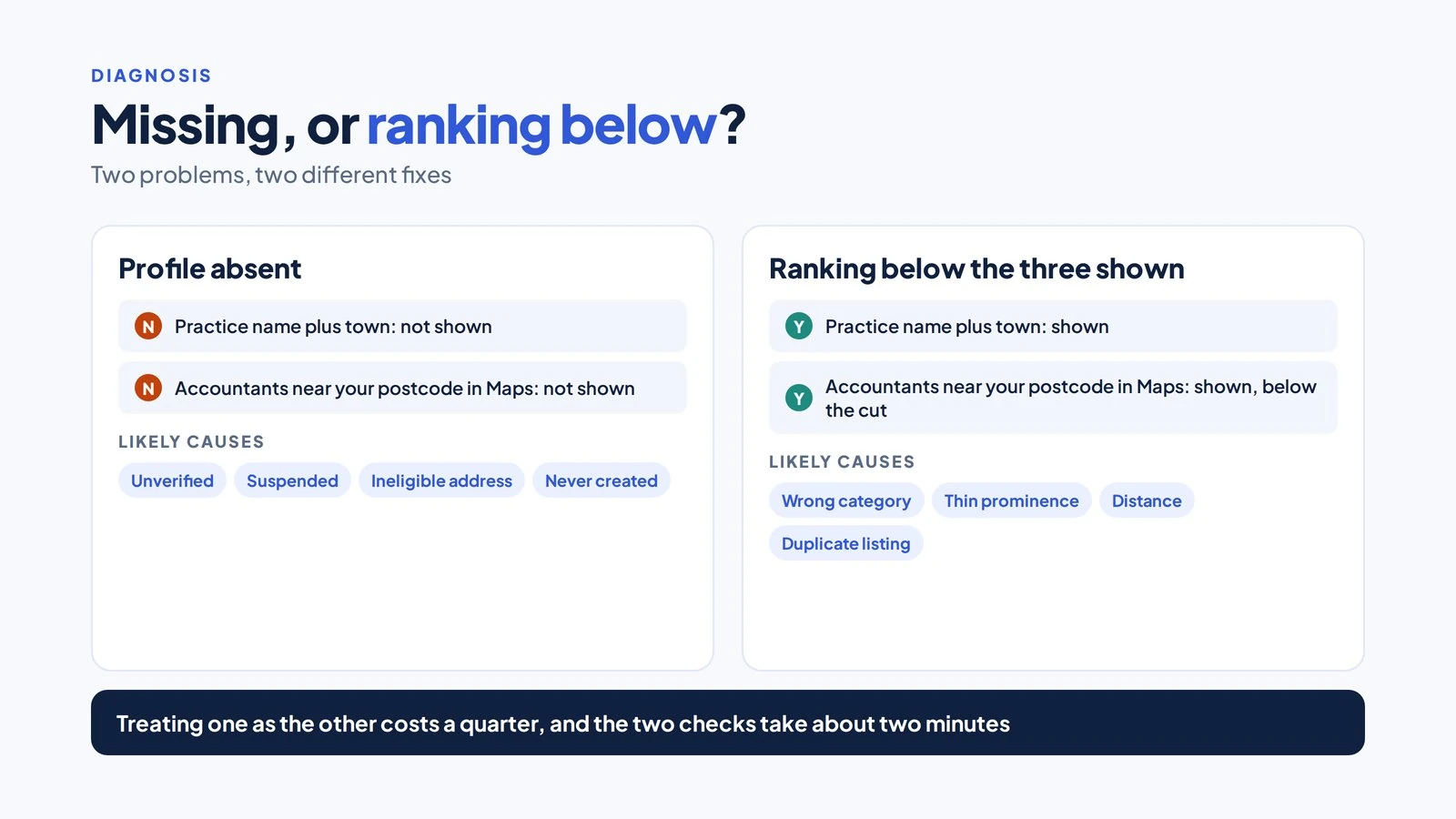
Two checks separate them. Search your practice name plus your town: a profile that appears here exists and is visible, so absence from a generic search is a ranking problem rather than an existence problem. Then open Google Maps and search for accountants near your own postcode: a profile appearing in the full list but not in the three shown on a normal search is ranking below the cut, not missing.
A profile that fails both checks is either unverified, suspended, or was never created. Start at cause one.
How do you check where your profile really ranks across the catchment?
Check from several points across your catchment rather than from your own desk, because where you stand changes the result. Sitting at your own office you will almost always see yourself in the pack, which is how a profile comes to be reported as fine while clients a few miles away cannot find it.
Three methods work, in ascending order of reliability. Ask three of your clients in different parts of the catchment to search and screenshot what they see. Use a grid ranking tool that samples positions across a map. Or run the search from a browser with the location set to a specific postcode rather than to your own.
The scale of the variation is larger than a single position number suggests. Total Books Accountants appeared in the map block on 193 of 415 tracked searches, was first on 79 of them, and on 84 searches was the only appearance of the practice anywhere on the page. One position number cannot describe that. The figures come from the Total Books case study.
The ten causes below run in the order worth checking them: whether the profile exists at all, then whether it is set up correctly, then whether it is known well enough to win.
Cause one: the profile is unverified or suspended
An unverified profile does not appear in the map pack at all, and a suspended one disappears without an announcement. Both look identical from outside: your practice is simply not there.
Check by signing in to the profile itself. An unverified profile shows you a prompt to verify. A suspended profile shows a notice, and the listing either disappears from search entirely or reverts to an unmanaged state that anyone can suggest edits to. A profile showing neither and still not appearing is a different cause.
Verification for professional services at shared or serviced addresses now often asks for video rather than a postcard. Where it does, Google asks to see the location, the signage and evidence that you manage the business, so film in one continuous take covering the street, the building number, your signage, the interior and your working equipment, then sign in to the profile on camera. A rejected verification can be reattempted, and preparing properly the first time is faster than appealing.
Cause two: the address does not qualify
A Google Business Profile needs an address you actually operate from. Google’s own guidelines are explicit: a rented physical mailing address you do not operate out of, “also known as a virtual office, that location isn’t eligible for a Business Profile”, and “P.O. boxes or mailboxes located at remote locations aren’t acceptable”. Accountancy practices fall foul of that more often than most sectors, because a registered office is so often somewhere nobody sits.
Multi location and catchment
Two offices, or one office and a county to cover?
Practices with more than one real location need the profiles, the pages and the service areas set up deliberately rather than duplicated.
Four common accountancy setups fail that test:
- A registered office at your own accountants or at a formation agent. You do not operate there, so the address does not qualify.
- A virtual office or mail forwarding address. Named in Google’s guidelines as not eligible.
- A hot desk in a co-working space with no dedicated signage or staffed presence during stated hours. Usually not eligible.
- A home address used without hiding it, where you do not receive clients there.
Two setups are fine and are often assumed not to be. Working from home, you can hold a profile with the address hidden, as a service area business. Google’s own guidance tells a service area business to “hide your business address from customers”. A dedicated office in a serviced building with your own signage and staffed hours qualifies, and that is where video verification matters most.
Getting this wrong is not a technicality. Your listing at an ineligible address can have been running for years and still be suspended at the next review, and the recovery is harder than the original setup.
Cause three: the profile is set up as the wrong kind of business
Meeting clients at your office makes you a storefront listing with a visible address, and going to your clients or working remotely makes you a service area business with the address hidden. Setting this wrongly costs you visibility in both directions.
The trade-off is real and worth stating plainly. Hiding your address removes you from some proximity based results near the office and shows you across your declared service area instead. Showing an address you do not staff risks the eligibility problem above. With an office that you also work out of when visiting clients, show the address, because the office is the stronger signal.
Service areas should describe where your clients are, not where you would like them to be. A list of forty towns is a weaker signal than three real ones, and Google limits how wide an area a service area business can declare.
Cause four: name, address and phone details conflict across the web
Conflicting details weaken the confidence a search engine has in your profile, and accountancy practices accumulate conflicts faster than most sectors. Professional body directories, accounting software partner listings, legacy directories and Companies House records all hold a version of your details, and they are rarely updated together.
Four events create most of the conflict: an office move, a rebrand or merger, switching from a landline to a mobile or a virtual number, and adding a trading name alongside your limited company name. Each one leaves the old version in place across dozens of sources.
Fix the sources that matter rather than all of them. Your profile, your website footer and contact page, Companies House, your professional body directory, the main accounting software partner listings, and the three or four directories that actually appear when you search your own practice name. Chasing the long tail of scraped directories gives you very little.
Cause five: the primary category does not match the search
The primary category is the strongest relevance signal on your profile, and a mismatch removes you from searches you should win. A profile set to a general business services category, or to one describing only part of what you do, loses to a competitor whose category matches the search exactly.
Two failure patterns recur. The first is a category chosen at setup years ago that no longer describes you, most often after a firm has moved from bookkeeping into advisory. The second is a primary category chosen to cover everything, which matches nothing precisely.
A third pattern is specific enough to accountancy to be worth naming on its own. Practices stack secondary categories, adding tax preparation, bookkeeping, payroll, business management consultant and financial planner to a profile whose primary category is accountant, on the reasoning that more categories reach more searches. The reverse happens. Secondary categories spread the profile across competing result sets rather than strengthening it in one, and a profile competing weakly in six categories loses the map pack to a profile competing strongly in two. Count the secondary categories on your profile. More than three on a single office practice is usually the first thing to cut.
Which category a practice should choose, and how secondary categories interact with it, is answered in detail in our guide to local search for practices.
Cause six: distance, and how far a practice can reach
Distance is the factor you cannot influence, and it limits the map pack more sharply than the other nine. Google’s own description is plain: distance is “how far each business is from the customer who’s searching”. Five miles outside a city centre you will rarely appear for a search made in that centre, whatever else you do.
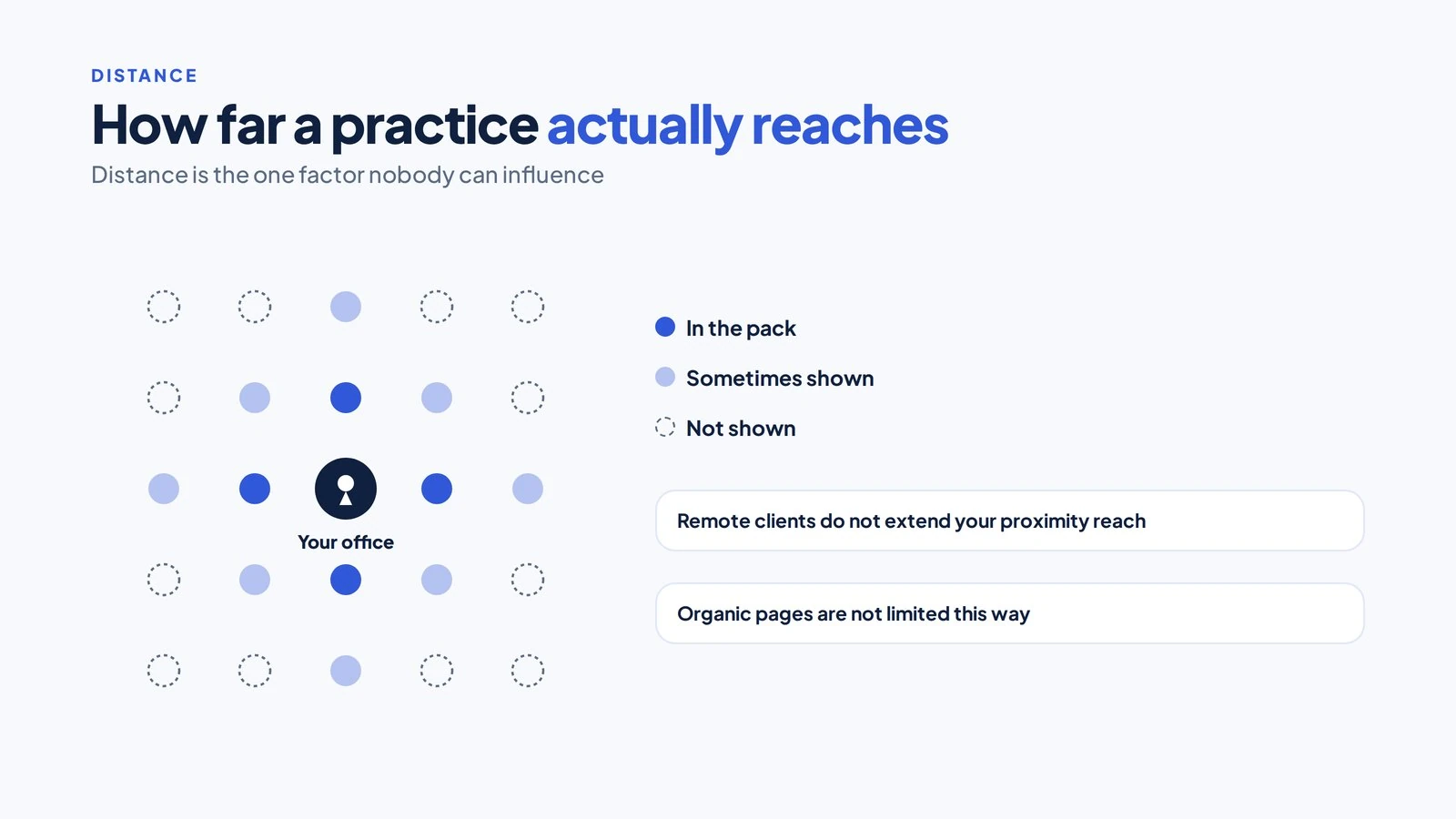
Two consequences follow for accountancy specifically. Clients who work with you remotely and never visit your office contribute nothing to your proximity position, however loyal they are. And serving a whole county from one office, you hold the pack near that office and drop away quickly at the edges.
Two responses work. Build organic pages for the places outside your proximity reach, because organic results are not distance limited the same way. And where you have a second staffed location, a second profile is legitimate. Where you do not, creating one is the eligibility problem in cause two with extra steps. Practices with real multiple sites should read our multi location optimisation work.
Cause seven: prominence is thin, in Google’s own words
Prominence is “how well-known a business is”, in Google’s own words, and it is built from things that mostly sit outside your profile. With a correct, verified, well categorised profile and no prominence you will sit just below the pack and stay there.
Four inputs carry most of the weight. Reviews count in volume, in recency and in how often you reply to them. Mentions of the practice across the web count more where the source has standing of its own, such as a professional body, the local press or an industry publication. The third is how strongly your own website ranks on related searches, and the fourth is the consistency of everything in cause four.
Reviews are the input you will find hardest, because client confidentiality limits what a review can say. The BrightLocal Local Consumer Review Survey 2026, based on 1,002 US adult consumers, found 97% read reviews for local businesses and 41% always do, up from 29% the year before. The same survey found 45% now use ChatGPT and AI tools for local recommendations, against 6% a year earlier. Those are US figures, and the direction is the useful part. How to run a review programme inside professional confidentiality rules is covered in how accountants get reviews.
Cause eight: a duplicate listing is splitting the signals
A duplicate listing splits your reviews, mentions and clicks between two profiles, and neither reaches the threshold the combined profile would have. Duplicates are common, because most of them were never created deliberately.
Three origins account for nearly all of them. A listing auto generated from a directory or a data aggregator before anyone claimed your business. A second profile created by a former partner, a marketing supplier or an employee who could not find the login. And an old listing left behind after your office move, still carrying the previous address.
Find them by searching your practice name, your previous name, your previous address and your old telephone number, each in Google Maps. Merge rather than delete, and use Google’s own duplicate reporting route to do it. Deleting a listing that holds reviews risks losing them, where a merge is designed to carry them across to the surviving profile.
Cause nine: the website behind the profile does not back the claim
Your profile draws on the website it points at, and a site with no location signals gives it nothing to draw on. Our audit of 494 UK accountancy practice websites recorded these signals as a co-occurring cluster, so they tend to be missing together rather than one at a time.
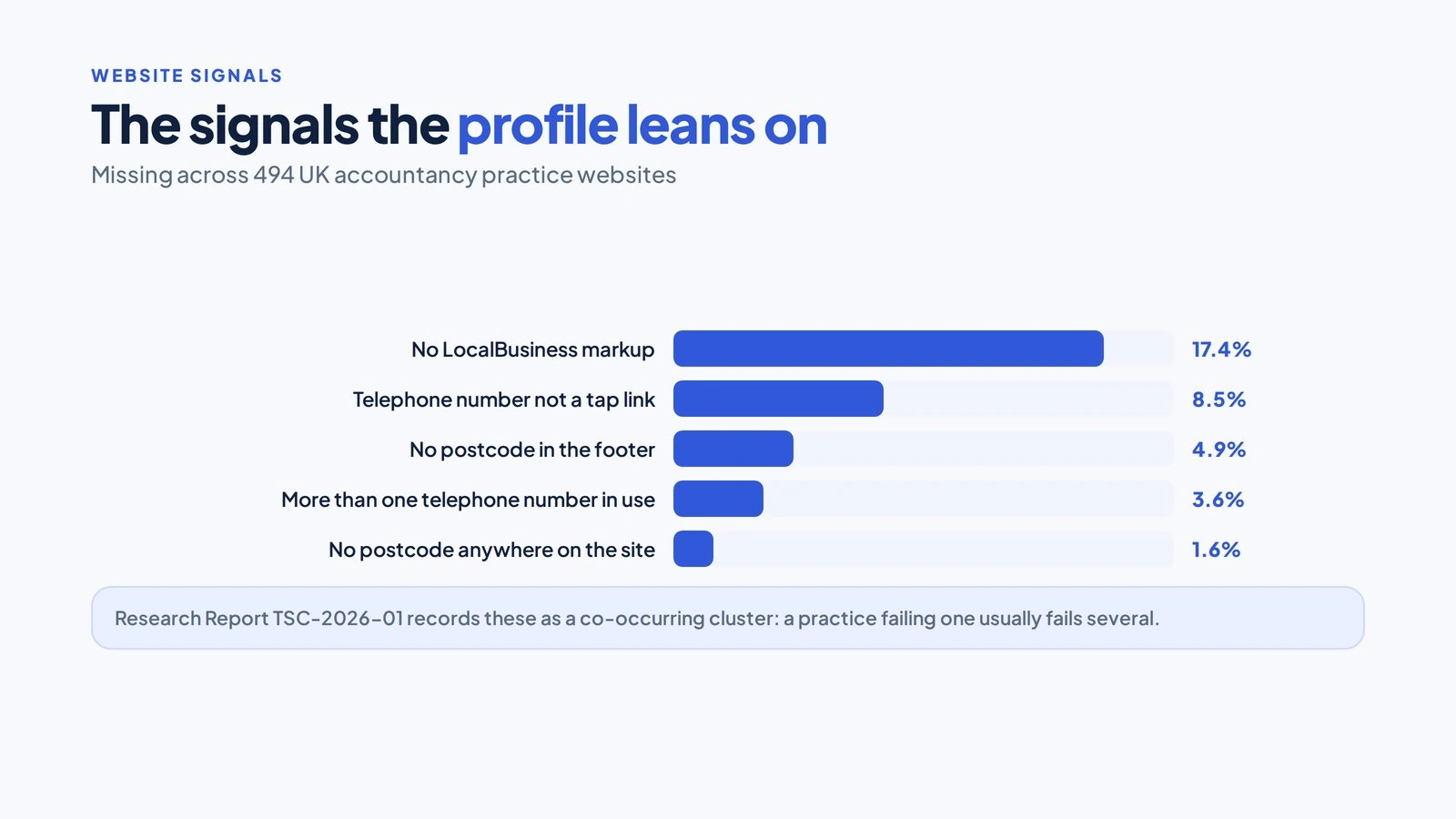
| Missing signal | Share of practices | Effect |
|---|---|---|
| No LocalBusiness markup | 17.4% | Nothing machine readable ties the site to the place |
| Telephone number not marked as a telephone link | 8.5% | The number cannot be dialled from a phone |
| No postcode in the footer | 4.9% | The strongest location signal on the site is absent |
| More than one telephone number in use | 3.6% | Conflicts with the number on the profile |
| No postcode anywhere on the site | 1.6% | Nothing confirms where the practice operates |
Four fixes cover the cluster. Put your full address and postcode in the footer of every page. Mark your telephone number as a telephone link. Publish one number and use it everywhere, including on your profile. And add markup describing your practice, its address, its hours and its regulator, which is set out in schema markup for accountancy websites.
Cause ten: the name field has been stuffed
Keyword stuffing in the business name field is against Google’s guidelines, and a listing caught doing it can be edited back or suspended. Google’s wording is that your name “should reflect your business’s real-world name, as used consistently on your storefront, website, stationery, and as known to customers”, with taglines, hours, phone numbers, URLs and location details excluded.
Two versions cause trouble in accountancy. Adding services to the name, such as your practice name followed by accountants, tax advisers and payroll. And adding a location you are not named after. Both give you a short term gain and a standing risk, because a competitor can report the listing and Google will act on it.
Removing the extra words usually costs some visibility immediately, which is the reason most practices leave them. That visibility rests on a guideline breach. Keep it and you are one competitor report away from a suspension, and the conduct question matters too in a regulated sector, which we cover in the marketing rules for ICAEW and ACCA firms.
Which cause is yours? A symptom to cause table
Ten causes, and one of them is yours. Match your symptom to the most likely cause below, then run the test in the third column before you change anything.
| What you are seeing | Likely cause | The test |
|---|---|---|
| Profile absent from every search, including your practice name | Unverified, suspended or never created | Sign in to the profile and read the status |
| Profile visible on your name, absent on generic searches | Relevance or prominence | Check the primary category, then count reviews against the three firms shown |
| Appears near the office, disappears a few miles out | Distance | Run the search from three postcodes across the catchment |
| Appeared for years, then vanished | Suspension, or an address review | Check the profile status, then check address eligibility |
| Reviews split across two entries | Duplicate listing | Search the old name, old address and old number in Maps |
| Competitors with worse websites ranking above you | Prominence | Compare review counts, recency and external mentions |
| Ranking dropped after an office move | Address and details conflict | Check the footer, Companies House and the professional body directory |
| Ranking dropped after a name change on the profile | Name field edited back or penalised | Compare the profile name with your signage |
Change one thing at a time. Run four fixes in the same week and when something moves you will not know which fix moved it.
How long does each fix take to show?
Verification and category changes typically show within days. Details, duplicates and website signals take weeks. Prominence takes months, because it is built from things that accumulate slowly. Knowing which band your fix sits in is what stops a practice abandoning a correct change three weeks in.
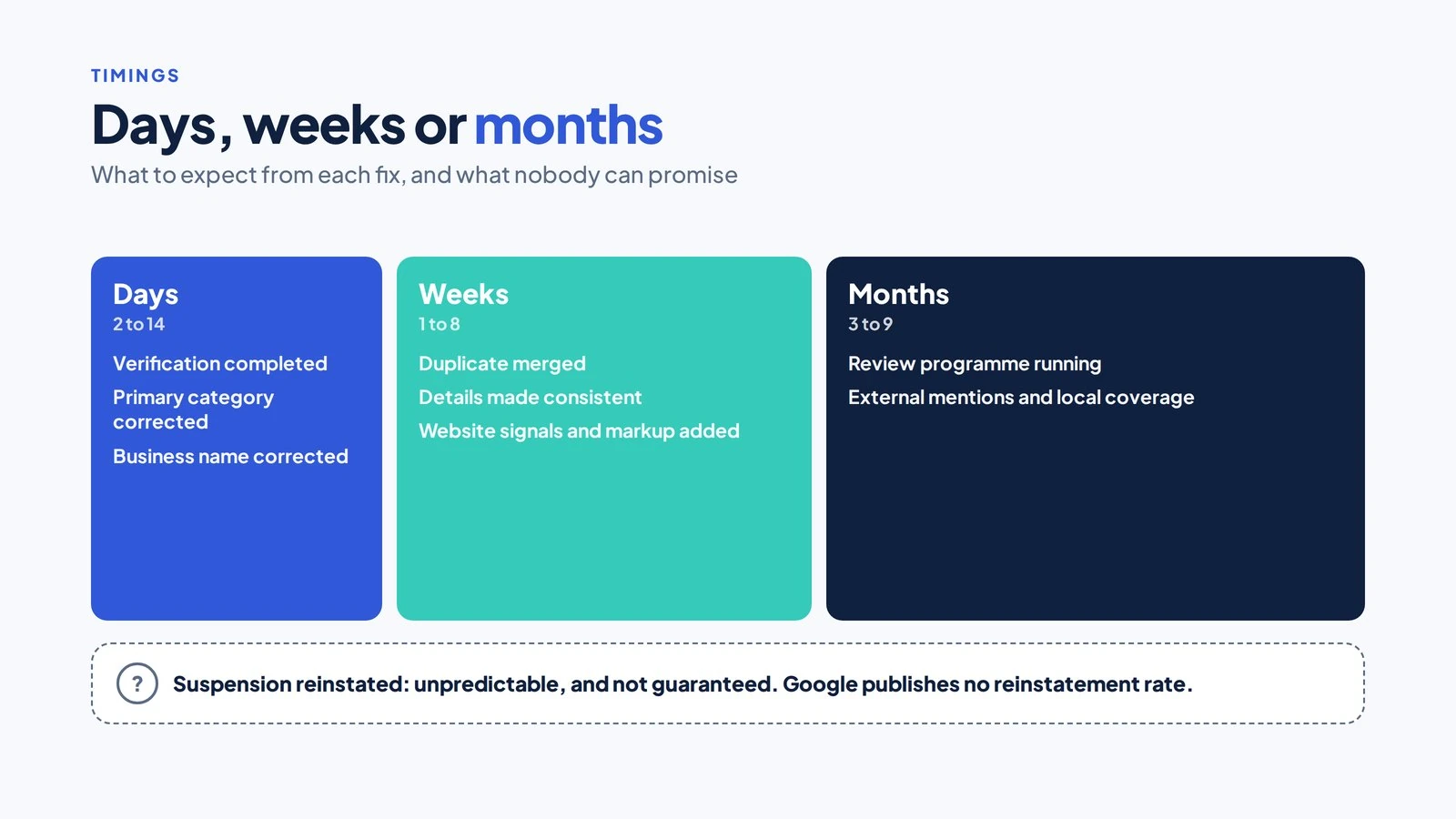
| Fix | Typical time to show |
|---|---|
| Verification completed | 2 to 7 days |
| Primary category corrected | 3 to 14 days |
| Business name corrected | 3 to 14 days |
| Duplicate merged | 1 to 4 weeks |
| Address and details made consistent | 2 to 6 weeks |
| Website location signals and markup added | 2 to 8 weeks |
| Review programme running | 3 to 6 months |
| External mentions and local coverage | 3 to 9 months |
| Suspension reinstated | Unpredictable, and not guaranteed |
Nobody can commit to the last row, and a provider who does is selling something they do not control.
What to do when the profile is suspended
A suspended profile needs reinstatement rather than edits, and editing it while suspended can make your case worse. Work out what triggered it first, because your appeal has to address the trigger.
Four steps, in order. Read the notice and identify which kind of suspension it is. The milder form leaves the listing visible but takes it out of your control, and the harder form removes it from search altogether. Fix the underlying eligibility problem before you appeal, which in accountancy usually means the address or the name. Gather evidence that you operate where you say you do: signage photographs, a utility bill, the lease, the insurance certificate, and your professional body listing. Then submit one complete appeal rather than several partial ones.
Two things to avoid. Do not create a new profile while your appeal is open, because a second listing weakens the case and creates a duplicate you will have to resolve later. And do not accept any promise about the outcome, from anyone. Google publishes no reinstatement rate, and the decision is not one your provider controls. Read the status on your own profile before you pay anybody to look at it.
Quiz: find the cause in eight questions
Self-check quiz
Find the cause in eight questions
Eight questions about what you can see today. Have the profile open in another tab.
Question 1 of 8Searching your practice name plus your town, the profile:
Question 2 of 8Signed in to the profile, the status shows:
Question 3 of 8At your registered address, clients:
Question 4 of 8Your primary category:
Question 5 of 8Searching your old name, old address or old phone number in Maps returns:
Question 6 of 8Your website footer carries:
Question 7 of 8Against the three firms shown in the pack, your review count is:
Question 8 of 8Your business name on the profile matches your signage:
Show the answer key
- Searching your practice name plus your town, the profile: Appears. Absence here points at verification, eligibility or a listing that was never created.
- Signed in to the profile, the status shows: Verified, no notices. A suspended profile needs reinstatement rather than edits.
- At your registered address, clients: Are received during your stated hours. A profile requires face to face contact at the address during stated hours.
- Your primary category: Names exactly what you do. The primary category is the strongest relevance signal on the profile.
- Searching your old name, old address or old phone number in Maps returns: Nothing. A duplicate splits reviews and mentions between two profiles.
- Your website footer carries: Full address, postcode and a tappable number. 4.9% of the practices we audited had no postcode in the footer at all.
- Against the three firms shown in the pack, your review count is: Similar or higher. Reviews are one of the main inputs to prominence.
- Your business name on the profile matches your signage: Exactly. Extra words in the name field are a guideline breach a competitor can report.
Frequently asked questions
Can an accountancy practice have a Google Business Profile if it works from home?
Yes, as a service area business with the address hidden. The practice declares the areas it serves rather than a public address. What it cannot do is display a home address it does not receive clients at, or claim a service area far wider than it operates in.
Does a registered office address qualify for a profile?
Only where the practice actually operates from it. Google’s guidelines rule out a rented mailing address you do not work from and remote mailboxes, which covers a registered office held at a formation agent, at another accountant, or at a virtual office.
Will more reviews get my practice into the map pack?
Reviews contribute to prominence, which is one of the three factors, so they help where prominence is the limiting factor and not where eligibility or category is. Fix the profile first, then run the review programme, because reviews cannot make up for a category that does not match the search.
How long does verification take for an accountancy practice?
Between a few days and several weeks, depending on whether video verification is required. Professional services at serviced or shared addresses are more likely to be asked for video, so prepare the footage before starting rather than after a rejection.
Can we rank in a town where we have no office?
Not reliably in the map pack, because distance is a factor nobody can influence. Organic results are the route into those towns, through pages that carry real local content, and the approach is set out in why accountancy location pages fail.
Should we remove keywords from our business name even though it is working?
Yes. The visibility rests on a guideline breach, a competitor can report it at any time, and the suspension that follows costs far more than the ranking gained. The conduct question also applies in a regulated sector.
The website ranks well but the profile does not. Why?
Because they are scored differently. Organic results weigh the page, the map pack weighs the profile, its eligibility, its category and the practice’s prominence. A strong website helps prominence and does not substitute for a correctly configured profile.
Where the map pack sits in local SEO for a practice
The map pack is one surface among several, and it carries the highest intent, because a searcher looking at three profiles is choosing rather than researching. That is why your absence from it costs more than the search volume suggests. Start with the two checks in section three, then work down the ten causes in order.
True SEO Consultants Ltd works from Startup Stiwdio at the University of South Wales, 86-88 Adam Street, Cardiff, CF24 2FN, and delivers UK wide through remote digital onboarding and delivery. Mohammad A Mahmud completed the ACCA professional examinations and holds an MSc in Applied Accounting from the University of South Wales, and Julie Williams is a fractional finance director and certified business coach. We bill that work on KPIs, not hours, with milestones in writing at three, six and twelve months, and we publish our own research rather than relying on borrowed statistics. Research Report TSC-2026-01, our audit of 494 UK accountancy practice websites, is published in full under a Creative Commons licence, and the local signal cluster above comes from it. Where the website rather than the profile is the problem, the diagnosis runs through why an accountancy firm is not ranking.
We will tell you which cause is yours
Bring your profile and your postcode and we run the catchment check with you on the call, then name the fix and the order to do it in.
Book my free strategy callSee the wider accountancy work