Become theDefault: SEO, AEO and GEO for Ambitious Business Owners
The one Google, Maps and AI hand the customer to.
Become the Default is an SEO book for business owners. It shows how Google, Google Maps and AI assistants decide which business to put forward, and how to become the one they choose, without an agency or expensive tools. It is told as the story of four businesses over two years, in plain English.
Sold on Amazon. Read the first pages free before you buy.

What is Become the Default about?
Become the Default is about the gap between being found and being chosen. Search engines and AI assistants now answer questions for your customers, and they hand most of those customers to one name. The book explains how that name is picked, then gives you the work, in order, to make it yours.
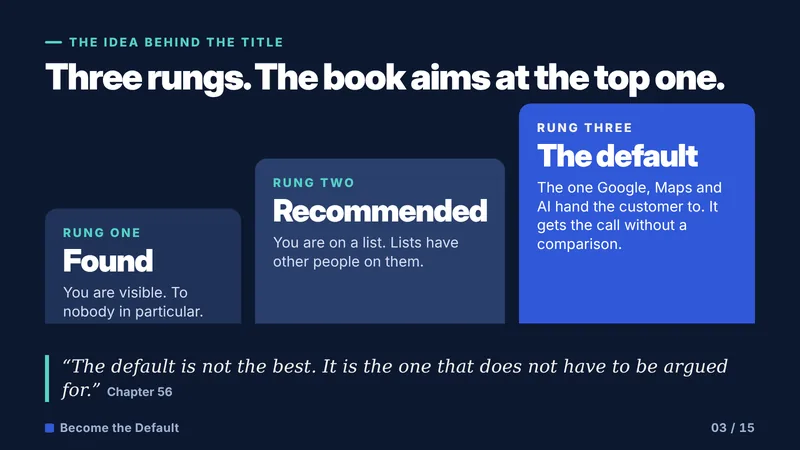
Found
You appear when somebody searches. So do eleven other firms, and the searcher picks one.
Recommended
You are on the shortlist a search engine or an AI assistant offers. Lists have other names on them.
The default
You are the one they name. The call comes without a pitch, a discount or a comparison.
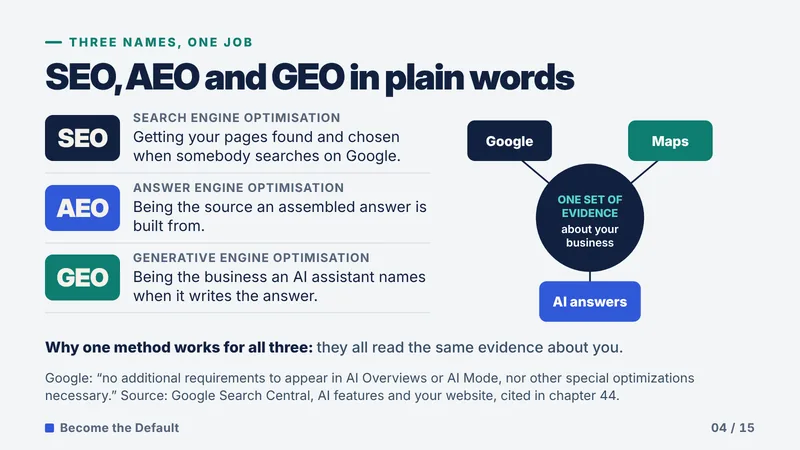
Search engine optimisation: being found when somebody searches for what you sell.
Answer engine optimisation: being the answer they are shown, instead of a list to choose from.
Generative engine optimisation: being the business an AI names when it writes the answer itself.
You are renting your customers. Here is how to own them.
Four businesses, followed for two years
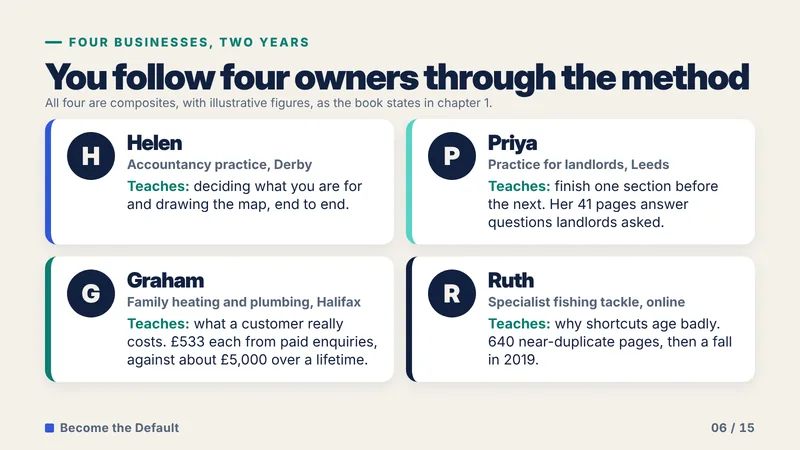
The book is a story, not a manual. You follow an accountancy practice, a landlord specialist, a heating firm and an online shop for two years. The difficult parts are explained by comparing them to things you already understand: a toy shop, a building, a file, a map.
Four partners, £1.4m in fees, a good-looking website, and no page for the work that pays her best.
Three people, seventy miles away, found for the question Helen’s clients ask, because somebody wrote the answer out.
Six vans and nine engineers, with boilers, bathrooms and repairs sharing one page and one sentence.
About four hundred products, and her best-margin range three clicks deep behind a filter.
Helen, Priya, Graham and Ruth are composites, built from patterns seen many times. Their figures are illustrations. Every measured number in the book carries a source.
Who is this SEO book for?
This SEO book is for the owner or partner who signs the invoice, in a business of between about 2 and 200 people. You have paid to be found for years and have never been able to tell whether it worked.
It is written for you if
- You paid for a website that looks right and brings in very little.
- You pay an agency you cannot judge, or ads you cannot stop.
- The firm down the road sits above you, and you do not believe they are better at the work.
- You want to grow the business, and you can give each page about one hour of your time.
It is not written for
- Marketers and SEO professionals
- Anybody learning SEO in order to sell it
- Anybody looking for a trick or a shortcut
- Owners who want it done while they look away
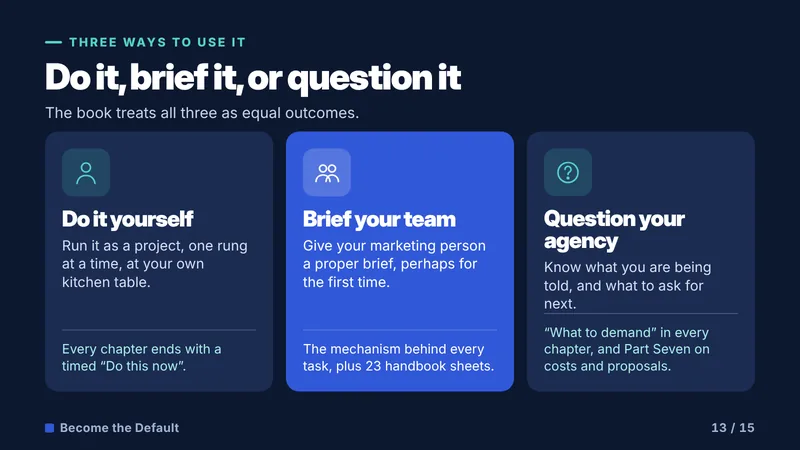
Do it yourself
Run the work as a project. Every chapter ends with a job and the time it takes.
Brief your own team
Hand your marketing person a plan they can follow, written in your words.
Question your agency
Every chapter lists what to demand from anybody you pay, so you know what you are being told.
The book treats all three as equal outcomes. Doing it yourself is one choice, not the only one.
Read a sample from the book
Read the opening of chapter one and three shorter extracts, take a page by page tour of one chapter, or try one of its tests. Scroll inside the page to read on.
CHAPTER 1
The Website You Paid For, and the Website You Needed
An accountancy practice opens this chapter. A heating firm with six vans and a shop selling fishing tackle online follow it four pages later, because this is one fault in three trades and you need to see it in yours.
Helen is one of four partners in an accountancy practice in Derby. Eleven staff, about four hundred clients, one point four million pounds in fees. She wants to double that in three years.
Two years ago the practice spent nine thousand pounds on a new website. It is a good website. It loads fast, it works on a phone, and the partners spent two meetings on the photography.
On a Sunday in January, in the worst fortnight of her year, she did something she had never done. She searched the way a client would search. She typed accountant derby self assessment.
Eleven practices came back. She opened eight of them.
Every one of the eight had a page called Self Assessment. Six of those pages said the same three things in a different order. Deadlines are stressful. Penalties are expensive. We can take it off your hands. Hers was one of the six. Two of them had bought the same stock photograph of a calculator.
Helen has been in Derby for twenty years and she could not tell her own practice apart from seven others on her own high street.
That part she had half expected. The part she had not expected came ten minutes later.
Still curious, she typed something a client had actually asked her in November: should I put my rental properties into a limited company. Nobody from Derby came back at all. Near the top was a firm she had never heard of. Three people, in Leeds, seventy miles away, not competing with her for the word accountant and not trying to.
They were there because somebody in that firm had sat down and written the answer out.
She did not get ripped off. She got exactly what she asked for.
Nobody sold you a bad website. They sold you a website with no job.
A note on the people in this book. Helen, Priya, Graham, Ruth and every firm you will meet in these pages are composites. They are built from patterns I have seen many times, and their figures are illustrative. They are not research findings and they are not real clients. Every measured number carries a source marker like this [1] and a citation. If a number has no marker, it belongs to a composite and you should treat it as an illustration, not evidence.
The brief nobody wrote
Here is the conversation Helen had with her developer. It is the same conversation almost every business owner has.
She said she wanted a website that looked professional and gave the right impression. She got exactly that. The developer did his part well.
Nobody in that conversation asked what the website was for.
Not what it should look like. Not which pages she wanted. What is it for. Who is supposed to arrive on it, what were they doing thirty seconds before they arrived, what did they type, and which page are they meant to land on when they get there.
That was never asked, so it was never answered, so it was never built. A developer cannot build a brief that does not exist. He genuinely does not know that a year of advisory work for an owner managed company is worth several times a tax return, or that half of Derby publishes the same page about January, or what a landlord with four flats types into his phone on a Tuesday night.
Helen knows all of that.
Here is the uncomfortable half. The brief was yours to write. Not the design, not the code, not the colours. The brief. Which services or product ranges deserve a page, who each page is for, and what question it answers. Nobody can hand you a plan built on information only you hold.
And here is what Helen's missing brief has produced, which is worse than nothing on the page.
The practice earns most from year round advisory work for owner managed companies. There is no page for it. It exists on the website as one sentence in a paragraph on the About page.
So the only thing Helen is findable for is the cheapest, most crowded, most seasonal thing she sells, and eleven other firms are findable for it too.
She is visible for the cheapest work in the practice and invisible for the most expensive.
This is not one practice in Derby
In a study of 494 UK accountancy practice websites, 344 of them, 69.6 per cent, had no dedicated page for the service the practice itself presents as its main or specialist work. [1]
Not a thin page. Not a badly written page. No page at all. The thing the firm leads with had nothing on the website pointing at it.
Then the number that explains the rest of this chapter. Among the smallest quarter of practices by size it was 98 per cent. Among the largest quarter, 39 per cent. [1] A gap that wide, moving that cleanly with the size of the firm, is not about skill and it is not about effort.
The study cannot tell you why, because it measured websites and nothing else. My reading, from the work rather than from the data, is that this is what a missing brief looks like. Larger firms are not better at websites. They are more likely to have somebody whose job includes writing down what the website is supposed to do.
The sample is accountancy practices because that is the register I could draw a proper sample from. The fault is not an accountancy fault, and the rest of this chapter shows you the same thing in three other trades.
[1] Mohammad A Mahmud, The Accountancy Web Estate: A Cross-Sectional Audit of 494 ACCA and ICAEW Practice Websites with Measured Instrument Error. Report TSC-2026-01, September 2026. doi.org/10.5281/zenodo.22280523
That is where the sample ends. The rest of chapter 1, and the other 55, are in the book.
CHAPTER 5
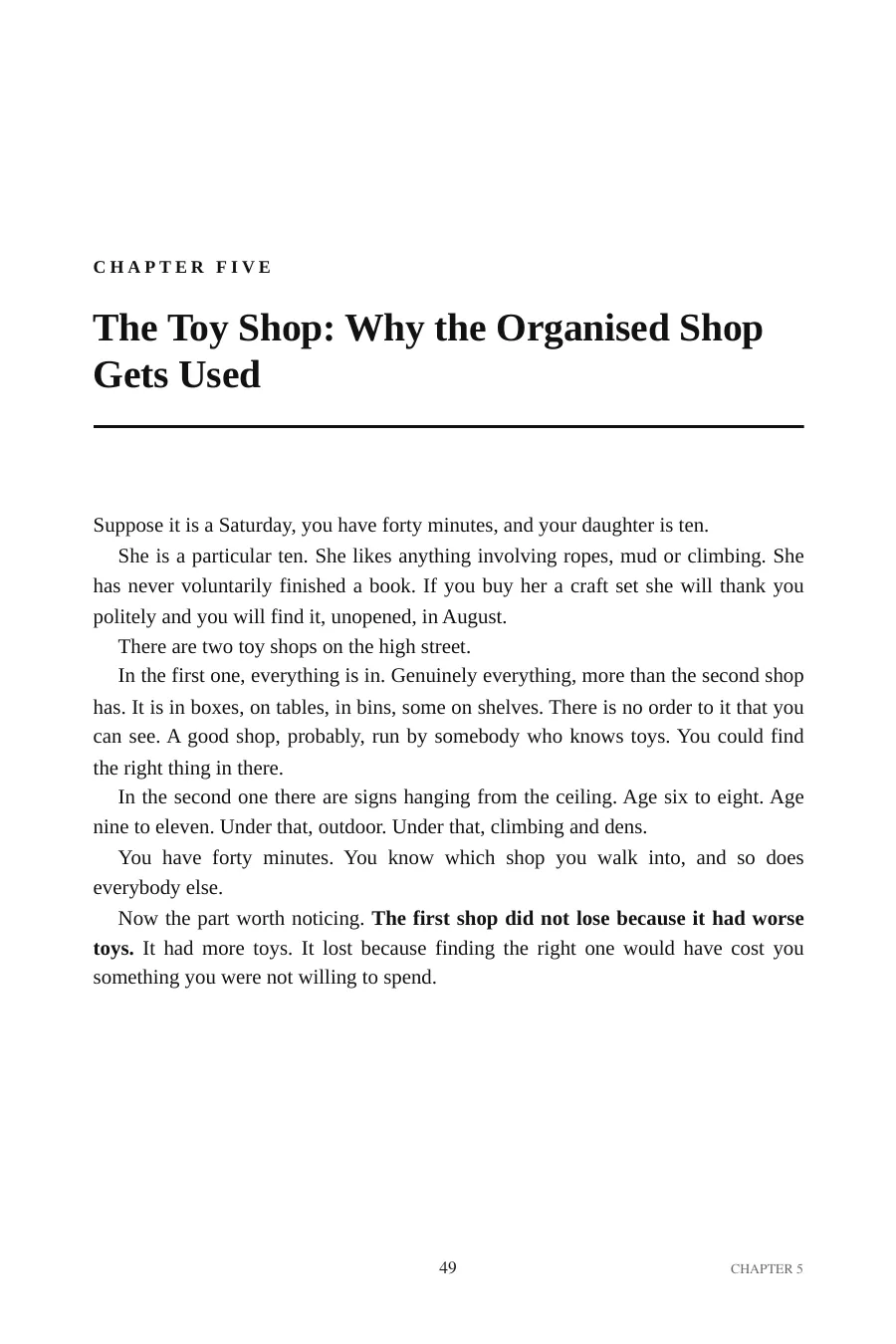
The Toy Shop: Why the Organised Shop Gets Used
Suppose it is a Saturday, you have forty minutes, and your daughter is ten.
She is a particular ten. She likes anything involving ropes, mud or climbing. She has never voluntarily finished a book. If you buy her a craft set she will thank you politely and you will find it, unopened, in August.
There are two toy shops on the high street.
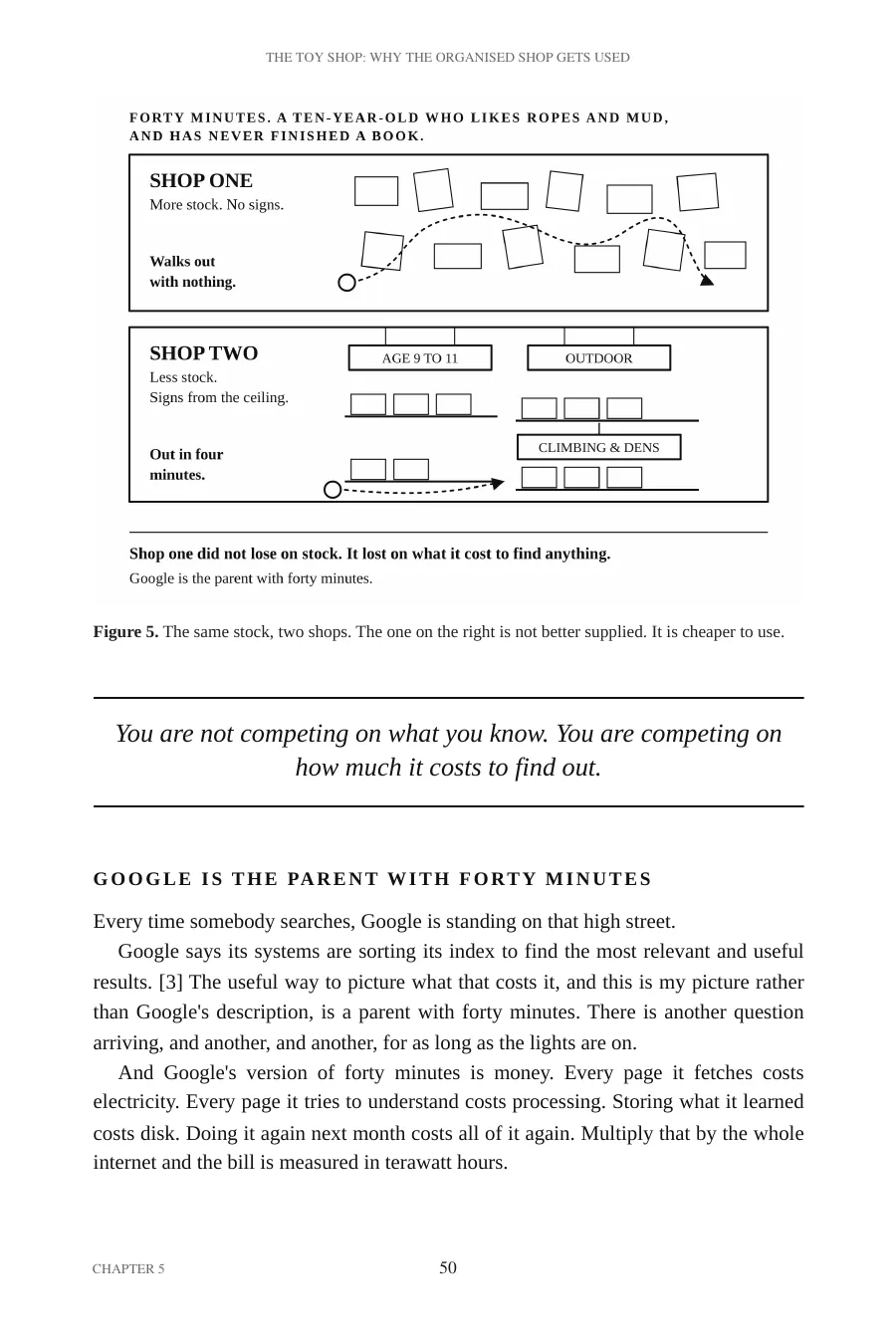
In the first one, everything is in. Genuinely everything, more than the second shop has. It is in boxes, on tables, in bins, some on shelves. There is no order to it that you can see. A good shop, probably, run by somebody who knows toys. You could find the right thing in there.
In the second one there are signs hanging from the ceiling. Age six to eight. Age nine to eleven. Under that, outdoor. Under that, climbing and dens.
You have forty minutes. You know which shop you walk into, and so does everybody else.
Now the part worth noticing. The first shop did not lose because it had worse toys. It had more toys. It lost because finding the right one would have cost you something you were not willing to spend.
You are not competing on what you know. You are competing on how much it costs to find out.
Google is the parent with forty minutes
Every time somebody searches, Google is standing on that high street.
Google says its systems are sorting its index to find the most relevant and useful results. The useful way to picture what that costs it, and this is my picture rather than Google's description, is a parent with forty minutes. There is another question arriving, and another, and another, for as long as the lights are on.
And Google's version of forty minutes is money. Every page it fetches costs electricity. Every page it tries to understand costs processing. Storing what it learned costs disk. Doing it again next month costs all of it again. Multiply that by the whole internet and the bill is measured in terawatt hours.
Google is not reading your website for pleasure, and it is not reading it at the moment somebody searches. It is working out, in advance and at enormous scale, what each page is about and who it would be a good answer for.
A page that makes that obvious gets understood. A page that makes it difficult may simply not get understood. Not punished. Not demoted. Just filed as something vague, which is worse, because nothing vague is ever in the running for anything specific.
An extract. Source markers are removed here; the citations are in the book.
That is where the sample ends. The rest of chapter 5, and the other 55, are in the book.
CHAPTER 32
The Page That Sells
One. What it is, in one line, at the top.
Not a welcome. Not your history. What this is and who it is for, in the first thing on the screen. Year-round advice for owner managed companies that intend to sell or hand over in the next five to ten years.
A visitor should know within four seconds whether they are in the right place. So should a machine.
Two. What you actually get.
Specific. Not "a tailored service". The actual things: a quarterly meeting, the numbers prepared beforehand, access between meetings, the annual filing included or not.
The test: could a competitor's customer read this and know exactly what they would be buying?
Three. What it costs, or what it depends on.
The section most businesses leave out, and the reason most of their enquiries are unqualified.
If you can publish a price, publish it. If you genuinely cannot, publish what it depends on, with numbers: between X and Y depending on turnover, number of entities and whether payroll is included. A range with the variables named is not a vague answer. It is a useful one, and it filters the people who were never going to buy.
Four. The working.
What happens, in order, from the first conversation to the thing being done. Four to six steps, with rough timings.
This section does more to remove worry than anything else on the page, because what stops people ringing is usually not price. It is not knowing what happens next.
Five. The proof.
Chapter 20, applied here rather than on an About page. Registration numbers, named people, years, the relevant piece of evidence for this particular service.
Six. What usually goes wrong, and who this is not for.
The section nobody writes and everybody respects. Say who should not buy this. Say what the common mistake is.
Telling somebody this is not for them is the strongest possible signal that you are not simply trying to sell to everybody, and it is also step four material, because only somebody who has done it knows who it goes wrong for.
Seven. The questions.
The list from your map, linked. This is the section from chapter 27, visible, doing three jobs at once.
Eight. Who wrote this and why they would know.
A name, a face, a reason. Chapter 35 is the full version.
Nine. One next step.
One. Not a form and a telephone number and a chat and a newsletter. The single thing you want them to do, stated plainly, with what will happen when they do it.
An extract. Source markers are removed here; the citations are in the book.
That is where the sample ends. The rest of chapter 32, and the other 55, are in the book.
CHAPTER 44
What Changed When Machines Started Answering
Helen's daughter looked something up for her in the spring and did not visit a single website.
She typed a question, read an answer that had been assembled for her, asked a second question that followed from the first, and then said a name out loud: this one seems to be the one that knows about it.
Helen had spent twenty years being findable. Her daughter had just demonstrated a different thing entirely, which is being named.
This part of the book is about that difference. It is four chapters, and the first thing to say is the thing almost nobody selling services about it will say.
The question changed from whether you can be found to whether you get named. Almost nothing about the work changed.
What is actually different
An answer now arrives assembled. Instead of ten results and a decision, the person often receives a paragraph with two or three businesses named in it and links beside them.
The conversation continues. The second question depends on the first, and the third on the second. Nobody starts again.
Fewer people click, and the ones who do are further along. Google states that "when people click from search results pages with AI Overviews, these clicks are higher quality" and that this means "users are more likely to spend more time on the site".
And the answer has to come from somewhere. It is assembled out of material that already exists, which is to say out of pages, and the pages it is assembled from are the pages it names.
An extract. Source markers are removed here; the citations are in the book.
That is where the sample ends. The rest of chapter 44, and the other 55, are in the book.
Six real pages from one chapter, in the order you meet them. Swipe along, or tap a page to see it full size.
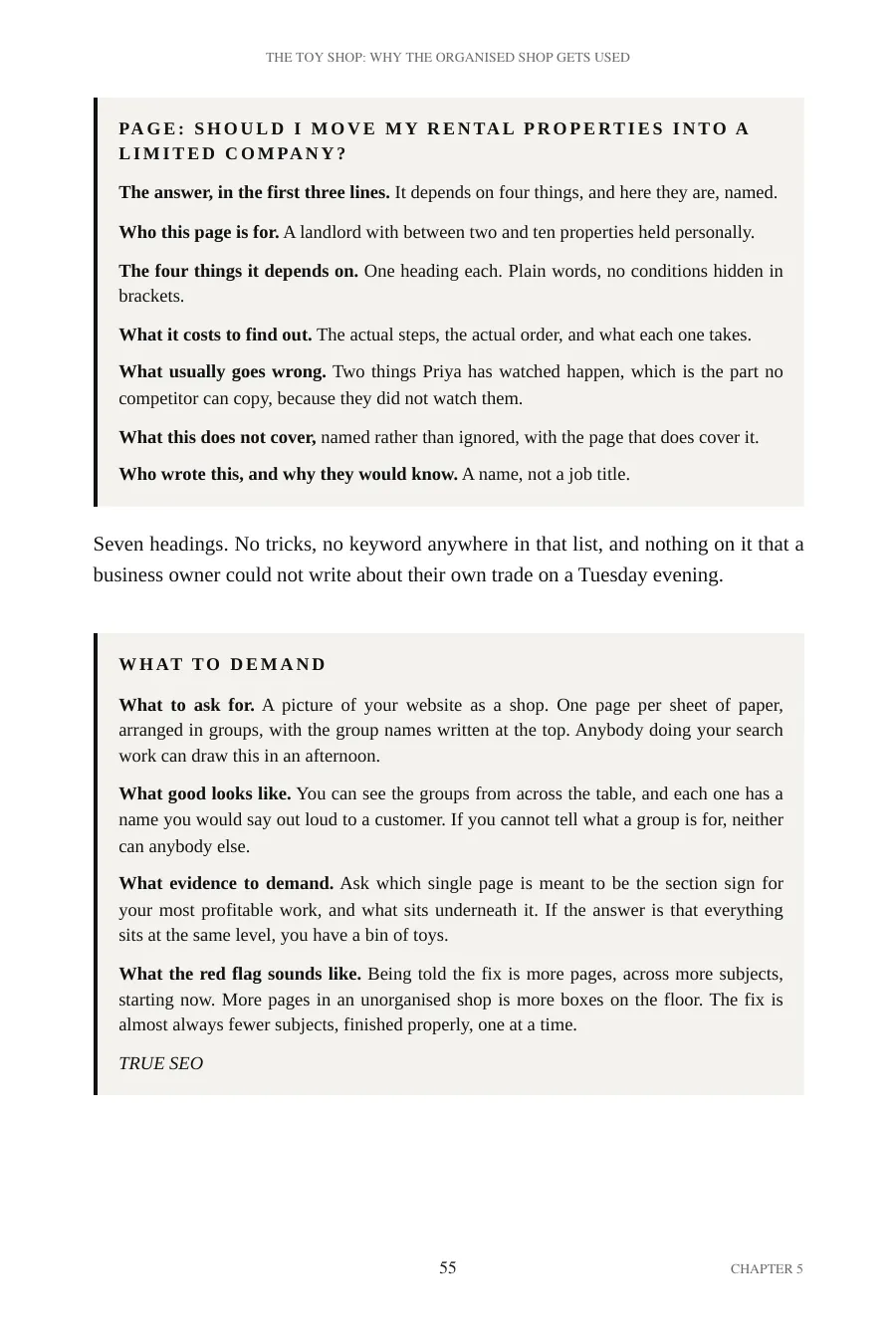
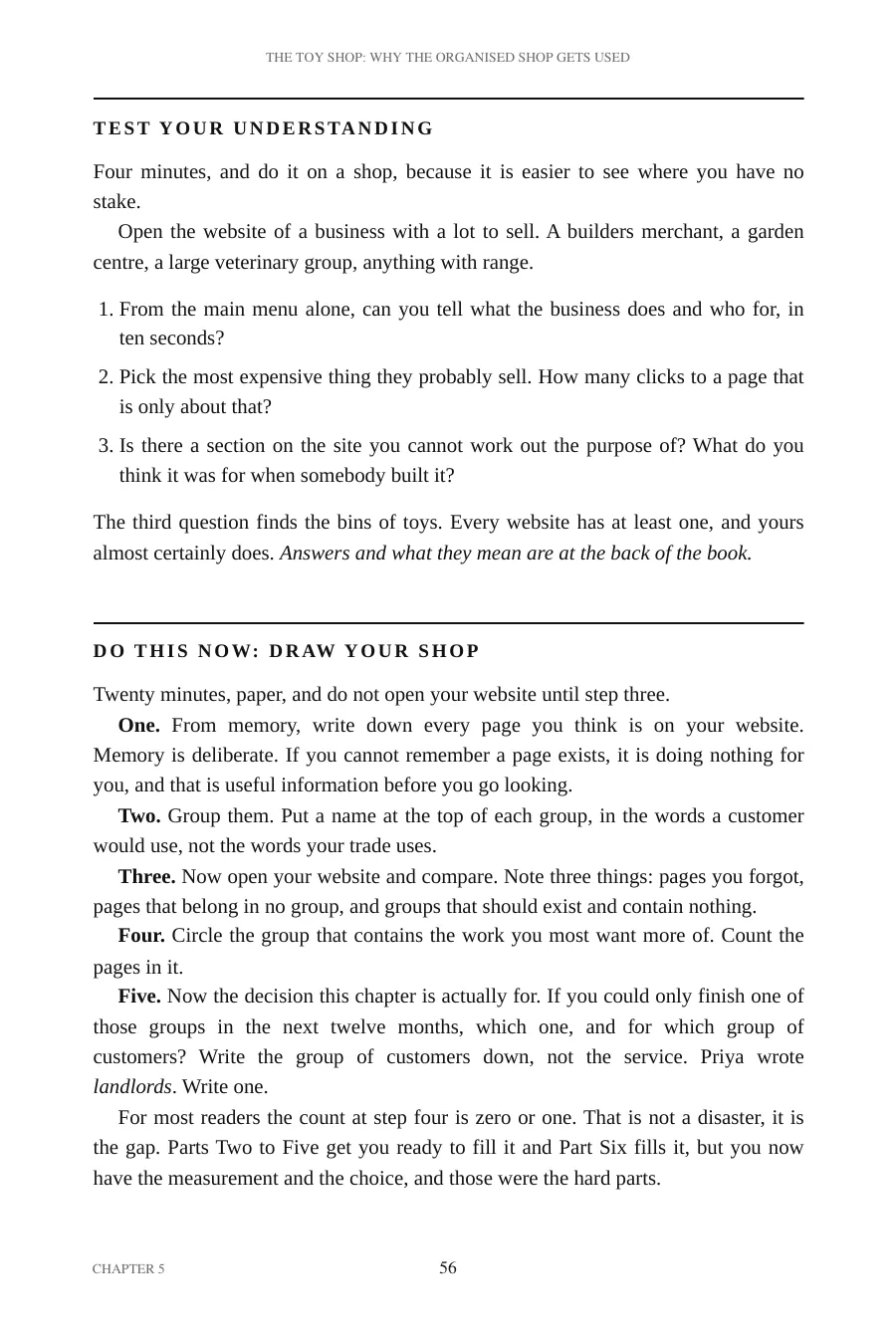
That is where the sample ends. The rest of chapter 5, and the other 55, are in the book.
Four minutes, and do it on a shop, because it is easier to see where you have no stake. Open the website of a business with a lot to sell: a builders merchant, a garden centre, a large veterinary group, anything with range. Answer each question, then tap to see what the book says it usually means.
From the main menu alone, can you tell what the business does and who for, in ten seconds?
What the book says it usually means
Ten seconds on the menu usually tells you the trade and almost never tells you who it is for.
Pick the most expensive thing they probably sell. How many clicks to a page that is only about that?
What the book says it usually means
The most expensive thing is often three or four clicks away.
Is there a section on the site you cannot work out the purpose of? What do you think it was for when somebody built it?
What the book says it usually means
The section nobody can explain is usually a resources or news area, built with enthusiasm in year one and abandoned in year two.
That is where the sample ends. The rest of chapter 5, and the other 55, are in the book.
Download the free preview27 pages exactly as printed: the contents, chapter one in full, a chapter from the middle and two handbook pages. PDF, no email needed.
Paperback or ebook: which to buy
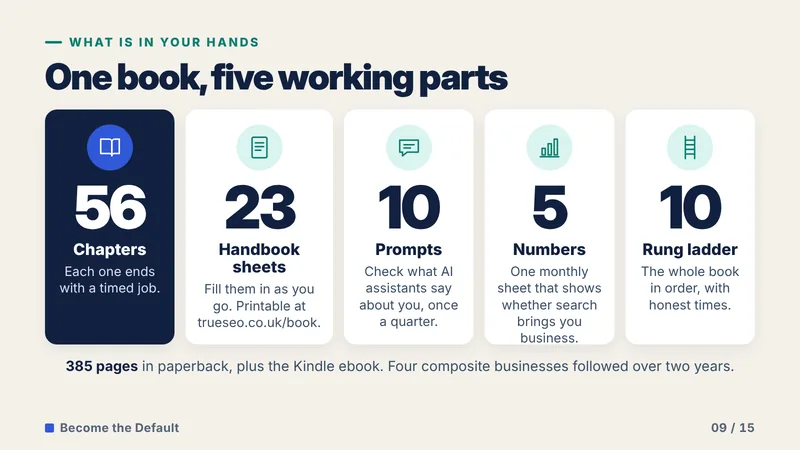
Buy the paperback if you plan to fill in the sheets as you read. Buy the Kindle ebook if you read on your phone. Both carry the same 56 chapters, and the 23 handbook sheets are free to print from this page whichever you choose. £19.99 for the whole method. Chapter 39 shows what the same work costs when you pay somebody to do it.
Paperback
For working through- Pages
- 385, with 59 diagrams
- Trim size
- 6 x 9 inches
- ISBN
- 978-1-0655847-0-4
- Publisher
- True SEO Consultants Ltd
- Best for
- Filling in the 23 sheets as you go
Kindle ebook
For reading anywhere- Format
- Kindle, on any device
- ISBN
- 978-1-0655847-1-1
- Publisher
- True SEO Consultants Ltd
- Sheets
- Printable versions on this page
- Best for
- Reading on your phone between jobs
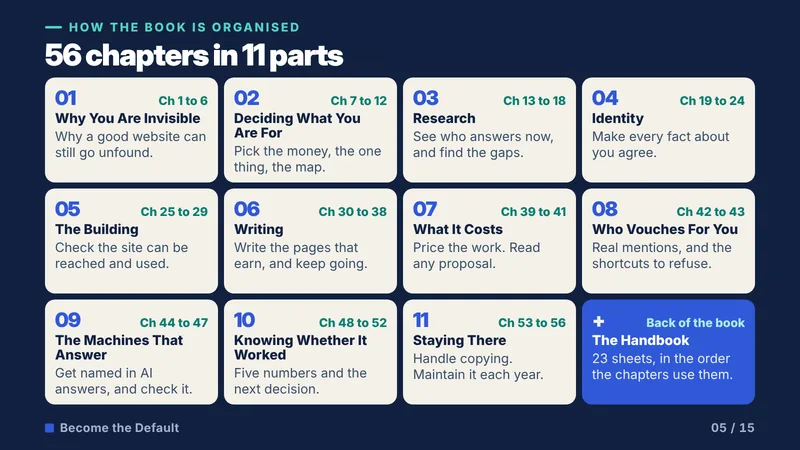
56 chapters in 11 parts, and what each one gives you
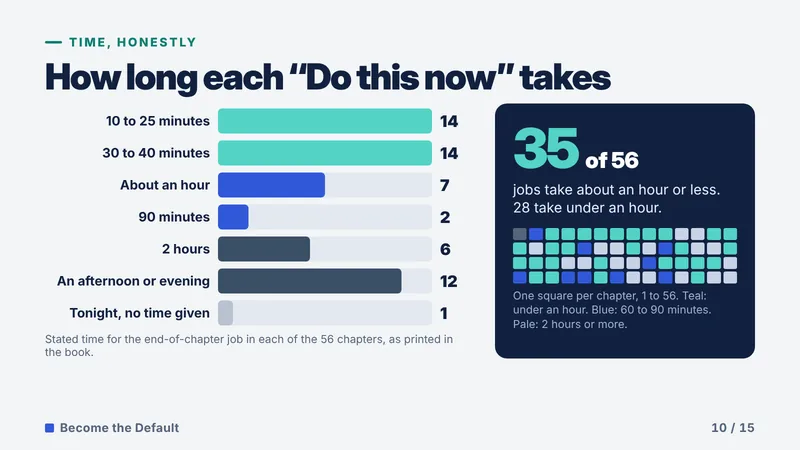
Pick a part to see its chapters. Every chapter ends with one job and the time it takes, from ten minutes to two evenings.
Part 1. Why You Are Invisible
Why a good website can still go unseen, and what one customer is really worth to you.
The Website You Paid For, and the Website You Needed
See why a good-looking website can still be invisible, and write the one-page brief your developer never had.
- Four shapes of one fault: missing, merged, borrowed, or one page for two customers
- 69.6 per cent of 494 accountancy sites lacked a page for their main work
- Visitor and machine share one thing: the question your customer typed
What One Customer Is Worth, and What You're Paying to Rent Them
Work out what one ordinary customer is worth and what each one really costs you to win.
- Value a customer: ordinary yearly spend times years, plus realistic referrals
- Measure cost per customer won, not per enquiry: Graham pays £533 each
- Ask what arrives next month if you cancel: rented or owned
Twenty Years of Google, and What It Was Asking For Each Time
Understand twenty years of Google updates as one pattern, so you can judge any update, and anybody selling a fix for one.
- Every major update priced out a shortcut, never clear original work
- 120 town pages with the name swapped is one page, repeated
- When only you fell, the reason is on your own website
Google Has Never Cooked a Meal: It Just Knows Whose Recipe to Trust
Learn what Google and AI assistants are really deciding, and how to get on the short list they answer from.
- Google repurposes answers; its only decision is whose version to show
- Authority means being in the running before the question is asked
- AI assistants work the same way: they name the source they trust enough to repeat
The Toy Shop: Why the Organised Shop Gets Used
See why an organised website gets understood and chosen, and decide the one section worth finishing first.
- A vague page is never in the running for anything specific
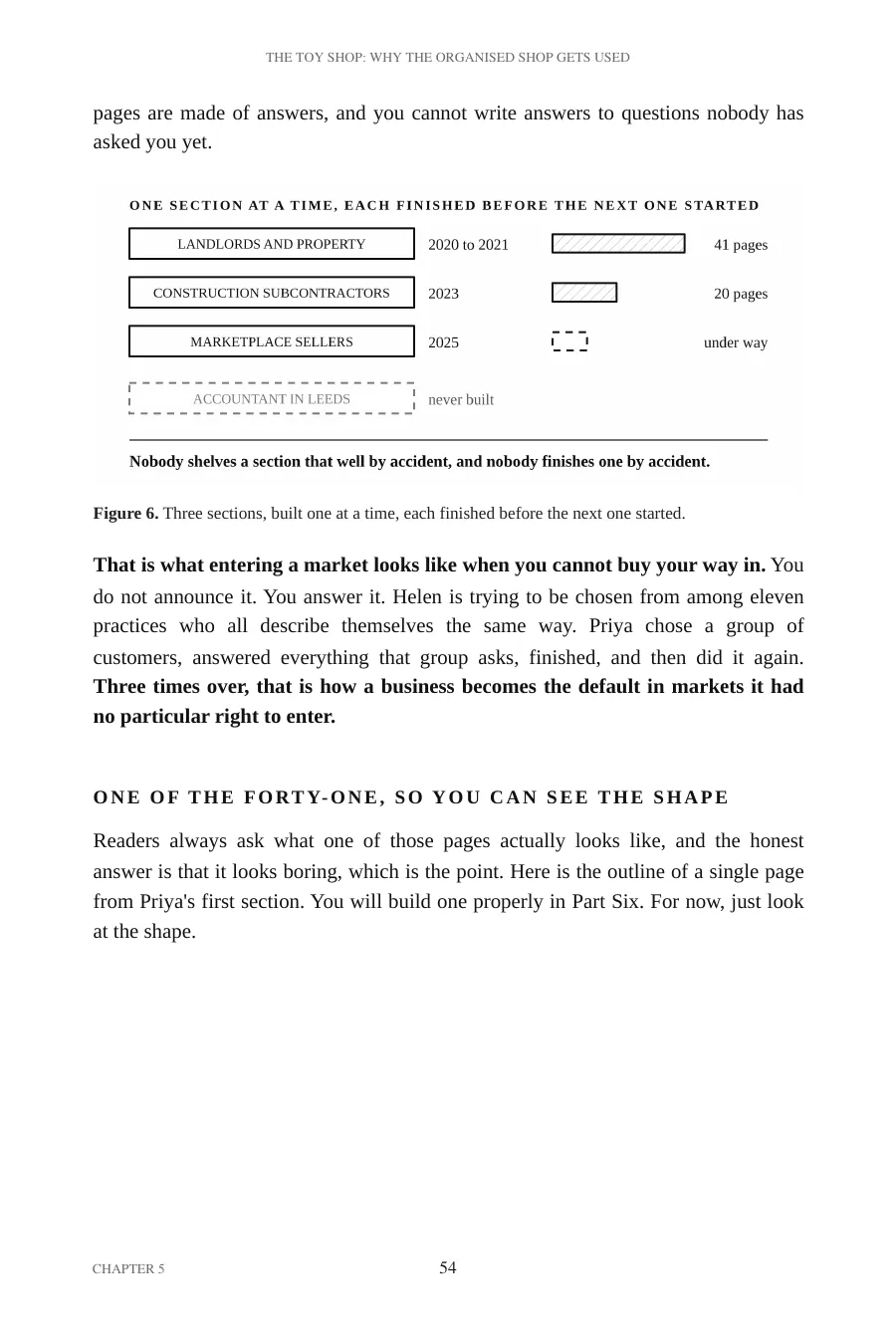
- One well arranged section beats forty scattered pages: it is a position
- Finish one customer group's section before starting the next, as Priya did
Your Page Does Not Arrive Alone
Stop benchmarking word counts against one rival page and see why everything your business has published travels with each page.
- Google ranks pages, but site-wide signals shape how each page is understood
- A strong site gives no free pass; a weak site is no wall
- Count your pages on your chosen subject; that number is your baseline
Part 2. Deciding What You Are For
The money you want more of, the one thing you want to be known for, and the map of what to own.
What Kind of Money Do You Actually Want?
Separate the work that funds growth from the work that fills the diary, and build your website for one.
- Two questions per service: what one customer pays, and does he return
- Helen's £1.4m splits into £900k compliance and £500k advisory
- Build the website around high-value customers who come back on their own
The One Thing You Want to Be Known For
Write the one sentence that says who you are for, so strangers and machines can repeat it.
- Be known for one subject first; add others only once it is finished
- Four arms hang off the centre: what, where, who, and proof
- The test: could someone repeat your sentence to a friend from memory?
The Customer You Want More Of, and the Words He Uses
Find the exact words your best customers type, using free sources you already hold, not keyword software.
- Start from the person, not the keyword; the words follow
- Free sources: inbox, telephone, Search Console, first meetings, Google suggestions
- Lead with the customer's words, then your trade's, on every page
Your Customers Search in Shapes, Not Words
Use six question shapes to generate every question your customers ask, and spot the ones nobody answers.
- Six shapes: place, cost, time, A or B, can I, what if
- Cross out any box no customer has actually asked you
- A filled grid is territory, not a plan for dozens of thin pages
Your Services, Your Places, Your People, and Your Proof
Build the three parts of a website competitors skip: real place pages, named people and visible proof.
- Service page first, with the questions hanging beneath it
- Only build place pages where you can say something true and local
- Do the proof arm first: an afternoon, free, and hard to fake
Drawing Your Territory: The Map of What You Should Own
Turn your sheets into one map of what you intend to own, with every page, parent and link planned.
- Eleven steps from one sentence to a build order, in about two hours
- Each question becomes a page, heading, table row or FAQ entry
- Write the page that earns first; its sentences point to the question pages
Part 3. Research
Reading the search results and the businesses above you, with free tools and no software.
Ask Google What It Already Thinks About Your Subject
Use Google's own AI answers and a free chat window to map any subject and see who you really compete with.
- Read Google's AI answers for the questions they cover and the sources they name
- Your real competition is whoever Google cites, not the firm next door
- Treat anything a chatbot says about your trade as a flag to check
Reading the Businesses Above You
Read competitor pages in four minutes each by their skeleton, and see which ground is already occupied.
- Record five things: headings, author, update date, page count, what the page asks you to do
- Mark each sub-question ALL, SOME or NONE across competitors
- Never publish a longer, combined version of what already ranks
Finding the Questions Nobody Above You Answered
Find the gaps competitors leave, especially the ones only a practitioner can see, and pick one to own.
- Three gaps: the hole, the thin answer and the generic answer
- Gaps cluster where answering properly requires having done the work
- Check every gap: has a customer ever actually asked me this?
Turning Their Gaps Into Your Headings
Build a page outline nobody in your trade could copy, by adding the knowledge only you hold.
- Five steps in order: Google's shape, competitors, gaps, your knowledge, answer first
- Test each sentence: could a writer who never did the job write it?
- Add your numbers, what goes wrong, your decision, the unasked question
The Business Across Town
Find out exactly why a competitor ranks above you, using four free tests that take about twenty minutes.
- Four reasons: they answered, have more pages, are clearer, get mentioned more
- Paid placements above you are rented space, not evidence of anything
- Nothing in Google's systems measures whether you are better at the work
The Tools Everyone Will Tell You to Buy, and How to Do It Without Them
Know which search tools a business your size actually needs, and do the rest free with ordinary Google searches.
- Seven jobs tools do, each with a free method and honest time cost
- Ordinary Google searches reveal a competitor's size, subjects and outside mentions
- Buy a tool only for scale, somebody's weekly time, or a day you will open it
Part 4. Identity
Making every listing, profile and review agree about who you are and where you work.
Google Is Building a File on You, Whether You Help It or Not
See the file Google builds about your business from every source, and make it agree with itself.
- Sources that agree produce a confident description; contradictions produce a vague one
- Five common faults: old address, two names, two numbers, spellings, claims
- Every listing should carry your subject, not just your name
The Proof You Already Have That Nobody Can Fake
Find the checkable proof already sitting in your files and photos, and put it where customers and machines can verify you.
- A two-column table separating claims that look like proof from real proof
- A proof inventory for practices, trades, business to business firms and online sellers
- Five free proof items you can publish this week, no writing needed
Your Google Business Profile: Your Entry in That File
Take back control of your Google Business Profile and fix the fields that decide how you appear on Maps.
- Why keywords in your business name break Google's published rules
- The primary category is the field most worth fixing today
- Hours, service area and real photographs: the fields customers check first
Reviews: The Asset You Can't Buy
Set up an honest review habit that asks every customer at the right moment and stays inside Google's rules.
- Ask everybody the same way; incentives, staff reviews and gating are prohibited
- Ask at the moment of relief, not when the invoice lands
- Write review replies that name the job, the place and one real detail
Winning the Towns Next Door, Without Faking an Office
Win work in nearby towns honestly, without the mailbox addresses that get Business Profiles removed.
- Google's own wording on why virtual offices and mailboxes are ineligible
- Town pages need facts only someone working there could write
- Skip the map pin you cannot win and own the questions instead
Saying the Same Thing Everywhere You Appear
Write one facts sheet about your business and copy it everywhere, so every listing finally agrees.
- A one-page source document covering identity, contact, description, people and proof
- The rule: change the sheet first, then push the change everywhere
- Fix dangerous errors like wrong phone numbers; outweigh the rest
Part 5. The Building
The website checks and the order of work that come before anybody writes a word.
Where SEO Actually Starts, and It Isn't Blogging
Learn the right order for search work, identity then shelves then content, before you pay anyone to write.
- Why good articles fail when written before identity and structure exist
- One question that exposes any content plan with nothing underneath it
- How to rescue content you already published in the wrong order
Your Website Is a Building: The Survey, the Doors and the Phone
Check your own website's technical health in one afternoon with three free tests and no jargon.
- Use Search Console to confirm your three most important pages are in Google at all
- Count clicks from your home page to find rooms with no door
- Test your phone number and enquiry form on mobile data, as a customer
Shelving and Signage: Arranging Things the Way a Customer Shops
Rebuild your menu around what customers want, using slips of paper and an afternoon, without writing a word.
- Four rules: customer words, one job per group, no Resources, click limits
- A paper slip method that stops you defending the current menu
- Question pages sit as a linked list beneath the page they support
Labels on the Window: Telling Machines Exactly What You Are
Know what the labels on your pages do and do not do, and brief a developer on them in one sentence.
- The short list worth labelling: business, people, products, reviews, questions, articles
- Google's four rules: labels must match visible, truthful page content
- Fake review stars are a common way to lose the extra detail Google shows
Before Anyone Redesigns Your Website, Read This
Protect years of search position during a redesign with a six-line brief you put in the contract.
- What redesigns quietly break: addresses, hidden pages, trimmed text, facts, forms
- A six line brief: every old address forwarded, and a tested enquiry form
- Checks for before launch, launch day and six weeks after
Part 6. Writing
Which pages deserve to exist, what to publish first and how to write a page that sells.
Does This Question Deserve Its Own Page?
Decide in thirty seconds whether each customer question needs a page, a heading or a table line.
- A four-question gate every proposed page must pass
- Price and timing facts belong in one table, not many pages
- Expect far fewer pages than questions: thirty-one questions became nine
What to Publish First, and Why Half a Job Is Worse Than None
Choose one section, publish it in the right order at a pace you can sustain, and actually finish it.
- Finish one section before starting another; spreading builds nothing
- Write the page that earns first, then the three strongest questions
- Expect about two months where nothing visibly moves
The Page That Sells
Write the service or range page built to turn a reader into an enquiry, section by section in a set order.
- A nine-section page structure, from one-line summary to one next step
- Publish a price, or the variables with numbers against them
- Say who it is not for; a table beats prose on variables
Product Pages and Category Pages, When Everything Looks the Same
Make an online shop's category and product pages worth finding without rewriting hundreds of manufacturer descriptions.
- Category pages need a how-to-choose guide and a comparison table
- Three things earn a product page: feel, who it suits, own photo
- Rewrite only the top twenty by margin; fix filter-generated pages
Owning a Subject: Answering Everything a Customer Could Ask
Know when a subject is genuinely covered, using six questions every customer asks plus a seventh only you would raise.
- Six universal questions, from what it is to what goes wrong
- The seventh question: what only a practitioner would think to ask
- When all seven are ticked, stop and start the next section
Who Wrote This, and Why Should Anyone Believe It
Put real, checkable people on your pages, so readers and AI systems can see who stands behind them.
- A six-line author block with a per-page reason to know
- One author page for anyone named on more than two pages
- Add reviewed-by lines in regulated trades; never invent authors
When Your Own Pages Work Against You
Find old pages competing with your new ones and fix them without losing links or history.
- Spot competing pages free in Search Console or your own site search
- Three fixes: merge, differentiate, or remove with a forwarding address
- Clean one subject while you work on it, not the whole site
Write It So It Can Be Quoted
Rewrite your pages so the answer is easy to find, for phone readers and for AI tools quoting sources.
- Put the answer in the first two lines, in bold
- Make every sentence stand alone, add numbers, use tables
- A seven-block structure that works for any question page
Content You Can Actually Keep Up, Around a Real Business
Build a publishing rhythm that survives your real year, including busy seasons, holidays and January.
- Draw your real year first, then pick a rate for bad months
- Batch the writing in quiet weeks and publish steadily
- Name one owner; dictate expertise rather than typing from blank
Part 7. What It Costs, and What You Are Buying
The real hours behind the work, how to read a proposal and what a report should show. Current UK price ranges sit in our guide to SEO fees in the UK.
What This Work Actually Costs to Do Properly
See the real hours behind search work, so you can tell whether any quote you receive is physically possible.
- Hour estimates per job: identity, map, research, each page, monthly upkeep
- Divide any fee by the hourly rate to see what it can buy
- Doing it yourself: 40 to 60 hours first quarter, then 4 to 8 monthly
Reading a Proposal, and What the Price Doesn't Say
Score any search proposal against six plain questions and know whether you can hold the firm to it.
- Six questions every proposal should answer, with good and bad answers
- Four pricing shapes and what each is honest about
- Three sentences to email before you sign anything
The Monthly Report You Should Be Getting
Know exactly what a monthly report should contain, so you can tell in minutes whether the money is working.
- Five sections in order, starting with five numbers and three columns
- What padding looks like: charts without starting points, task lists, benchmarks
- Two sentences to request that surface real thinking and risk
Part 8. Who Vouches For You
Who genuinely speaks for your business, and the shortcuts that cost you later.
Who Vouches For You, and Why Counting Is Useless
Find out who genuinely vouches for your business, for free, and claim the endorsements you are already entitled to.
- Three kinds of mention worth having, led by registers and trade bodies
- Five free searches that reveal anyone's real backers in fifteen minutes
- Unlinked mentions still count as somebody vouching for you; never buy a quantity
The Things That Move Numbers Fast and Cost You Later
Recognise the shortcuts you will be sold, what Google's own policy says about each, and what they cost later.
- Five shortcuts: bought links, fake reviews, volume pages, rented folders, invented authors
- One test that covers every offer you will ever receive
- How to find and undo anything already done in your name
Part 9. The Machines That Answer
How AI assistants decide which business to name, and how to check what they say about you.
What Changed When Machines Started Answering
Understand what AI answers really changed for your business, and why you need no special file or separate AI retainer.
- Google says no extra requirements, files or markup for AI features
- Six existing jobs that decide whether an assembled answer names you
- AI feature traffic already shows inside your Search Console figures
What Gets Named, and What Gets Skipped
Learn the five things that make your business safe for people and machines to recommend, and check them page by page.
- Be specific, agree with yourself, be vouched for, be easy to quote, be tied to a named person
- Consistent facts everywhere: the cheapest advantage in the whole book
- A five point check to run on every page you publish
The Ten Prompts: Checking What the Machines Say About You
Check what AI assistants say about your business yourself, in an hour a quarter, without paying for a tracking tool.
- Ten ready made prompts, from the direct question to the hostile one
- A six column scoring sheet; the copied sentence is where value lies
- What each result means and which chapter fixes it
The AI Tools, What Each Is For, and Where to Be Careful
Use AI tools safely: let them do the typing while your own expertise and name stay on every page.
- One rule: tools do steps one to three, you supply step four
- Nine tool categories, each with authorship, effect and where to be careful
- The real harms: volume without expertise, invented people, unchecked facts
Part 10. Knowing Whether It Worked
Five numbers, your own data read with a chat window, and how to tell early from wrong.
The Five Numbers
Cut hundreds of available figures down to five that show whether search is actually bringing you business.
- The five numbers, where each comes from, and why it matters
- Why ranking position is the weakest number and stays off the sheet
- A fifteen minute monthly routine with a starting column
Reading Your Own Data With AI
Turn your free Search Console data into a ranked monthly action plan in ninety minutes, using four copy and paste prompts.
- Exactly which five files to export, and the privacy check first
- Four prompts: near misses, unclicked appearances, slipping pages, uncovered questions
- Do quick twenty minute edits first; then updates; then new pages
When Nothing Is Happening: Too Early, or Something Is Wrong
Tell in one evening whether flat results mean it is too early or something is genuinely wrong.
- Six checks in order, from whether Google has the page to choosing the wrong subject
- A month by month timeline of what should have happened
- Unfinished sections are the most common real cause of flat results
The Visitors Who Never Become Customers
Turn more of the visitors you already get into enquiries, with four simple changes to your busiest pages.
- Five reasons people leave a page that answered their question
- One next step sentence that beats any generic call to action
- Four fixes: named author, clickable phone number, specific step, three field form
Doing It Yourself, Paying Somebody, or Spending It Somewhere Else
Decide with your own figures whether to do it yourself, hand it to staff, buy it in, or keep advertising.
- Advertising versus building, side by side, with honest strengths of each
- Three routes and who each one genuinely suits
- When advertising is the right answer, and a three year ratio plan
Part 11. Staying There
Copycats, a maintenance year and the ten rung ladder that compresses the whole book.
What Happens When Somebody Copies You
Know what to do when a competitor copies your pages, and why going further beats rewriting or complaining publicly.
- What can be copied in a week, and what never can
- Five steps: read calmly, check what was taken, leave pages, go further, stay quiet
- The real threat: a rival finishing a subject you abandoned
The Maintenance Year
Keep your finished pages accurate with a maintenance calendar: about sixteen hours a year for a business with two finished sections.
- Three kinds of decay: facts moved, subject moved, better page published
- An annual, quarterly and monthly maintenance calendar
- Update honestly: never change only the date; retire weak pages
If You Only Do One Thing
The whole book compressed into ten ordered steps, each with an honest time cost, plus a ninety day plan.
- A ten rung ladder, from two hours to a finished section
- A first ninety days plan, week by week
- Four things not to do, however tempting
Become the Default
See what all the work adds up to: becoming the business people and machines recommend without needing to be persuaded.
- Default means specific, consistent, vouched for, present everywhere, attached to a person
- Why building compounds while advertising stays the same price
- The deciding factor: doing it again the second month
Download What's InsideAll 56 chapters and what each one is for, on 14 pages. PDF.
See how the book is organised before you buy it
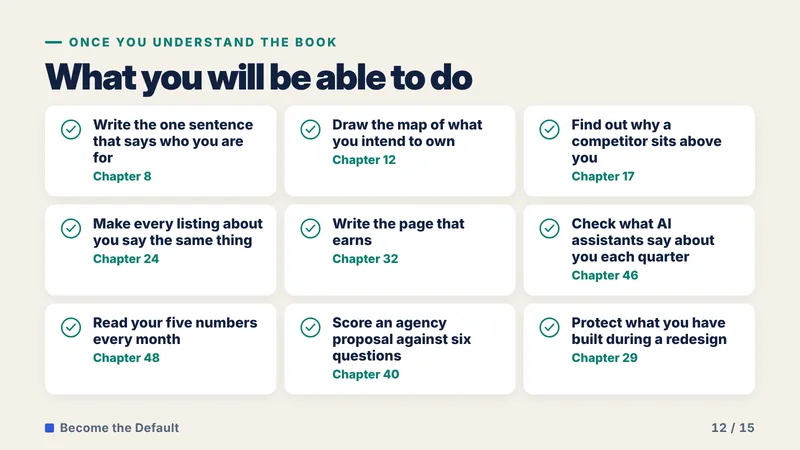
How the 56 chapters fit together, what every chapter hands you and what you can do once you have read it. Swipe, or use the arrows.
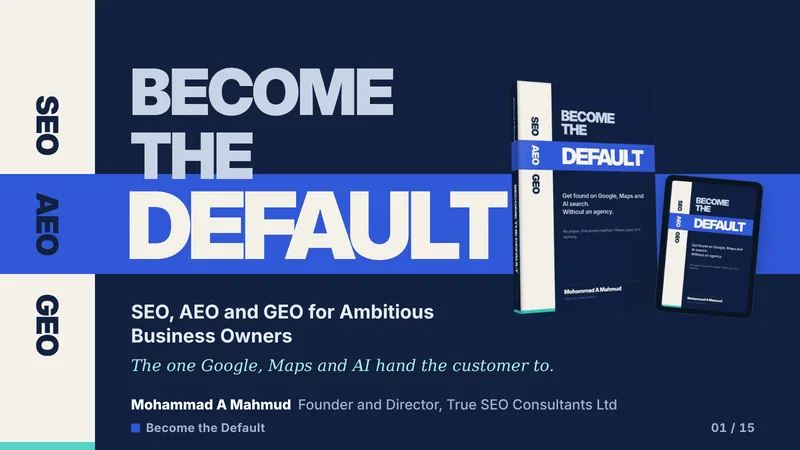
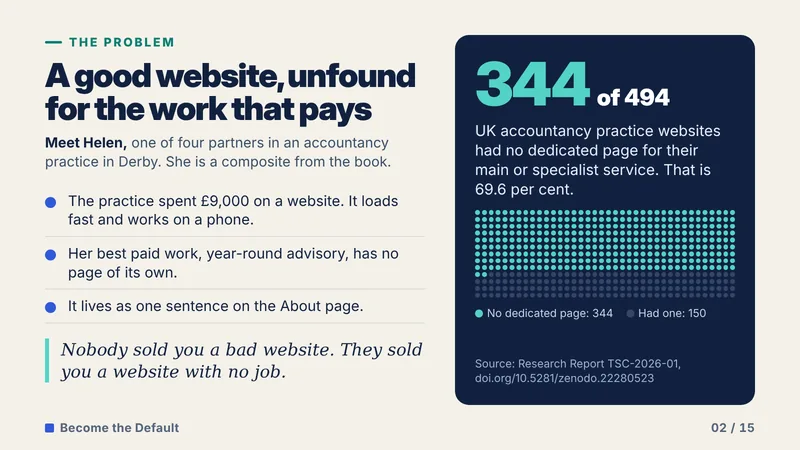

Download the overview as a PDF15 slides, free, no email needed
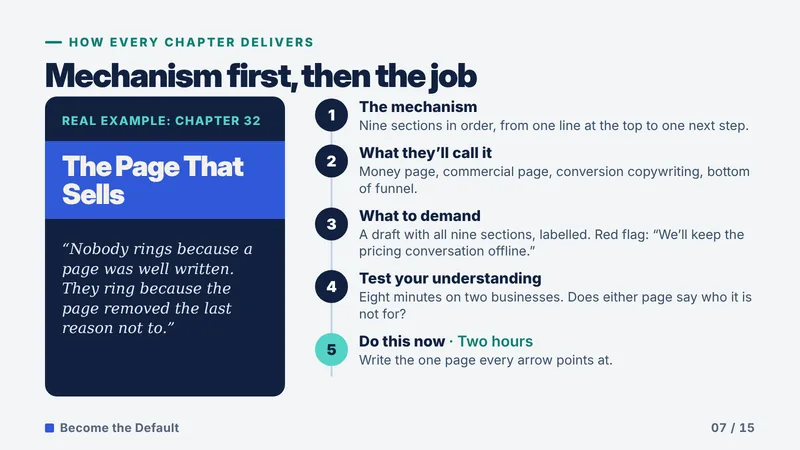
How every chapter ends
Every chapter teaches how the thing works, then hands you three things, so you can do it, delegate it or judge it.
What to demand
The questions to put to your developer, agency or marketing person, in plain words.
Test your understanding
A short exercise on somebody else’s business, because judgement is easier to build when nothing is at stake.
Do this now
The actual job, with the time it takes. The sheets to fill in are at the back of the book.
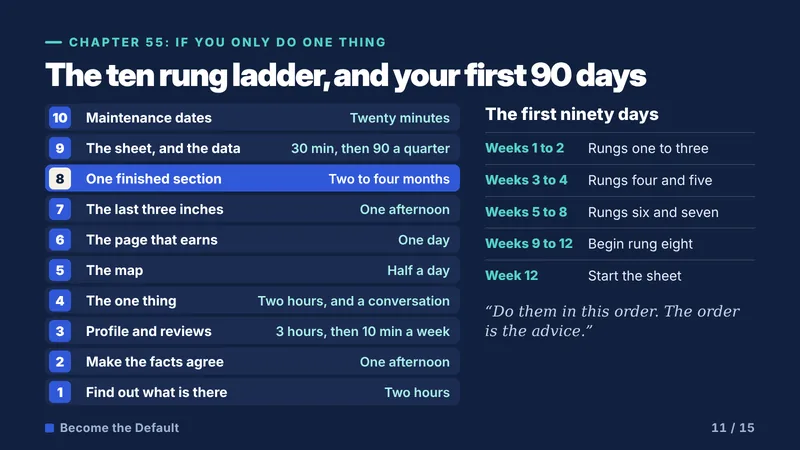
Where to start: the ten rung ladder
Chapter 55 compresses the book into ten steps in order, each with an honest time cost. Start at rung one. It takes two hours.
- Find out what is actually thereClaim Search Console and see what you already appear for.Two hours
- Make your own facts agreeOne facts sheet, pushed to every place the business appears.One afternoon
- Fix your profile and ask for reviewsYour Business Profile, then a review habit that runs itself.Three hours, then 10 minutes a week
- Decide the one thingWhat kind of money you want, and what you want to be known for.Two hours, and a conversation
- Draw the mapEvery page you intend to own, on one sheet of paper.Half a day
- Write the page that earnsThe page for your most profitable service, in nine sections.One day, including your own hour
- Fix the last three inchesTurn more of the visitors you already get into enquiries.One afternoon
- Finish one sectionSix to ten pages on one subject, all the way to the end.Two to four months
- Start the sheet and read your own dataFive numbers a month, and a plan from your own data.Thirty minutes, then 90 a quarter
- Put the maintenance dates inThe diary dates that keep good pages earning.Twenty minutes
The ten prompts for checking what AI assistants say about you
AI assistants now name businesses inside their answers. Chapter 46 gives you ten questions to ask them about your own business, once a quarter, in about an hour, with no tracking tool. Put your own business, trade and town in the brackets.
- The direct oneWhat does
[your business name]do? - The verification oneIs
[your business name]a reputable[your trade]in[your town]? - The shortlist oneWho are the best
[your trade]in[your town]? - The specific service oneWho can help with
[your most profitable service]in[your town]? - The problem oneThe symptom, in the words a customer uses before they know the name of the fix.
- The comparison oneWhat is the difference between
[two things customers confuse]? - The qualification oneWhat should I look for when choosing a
[your trade]? - The follow-up oneAsk question four, then the obvious next question, without starting again.
- The competitor oneTell me about
[the business you most want to be above]. - The hostile oneAre there any problems with
[your business name]?
Chapter 46 adds the rules for running them, a six column scoring sheet and two extra prompts for online shops.
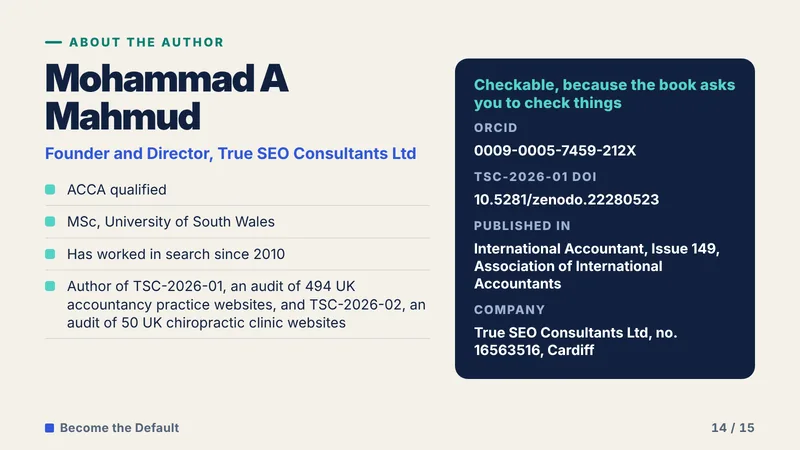
About the author, Mohammad A Mahmud

Mohammad A Mahmud is the founder and director of True SEO Consultants Ltd, a UK search and AI consultancy. He has worked in search since 2010. He spent the first part of his working life as a business manager, is ACCA qualified and holds an MSc from the University of South Wales, so he learned how a business works before he learned anything about search.
He wrote Research Report TSC-2026-01, an audit of 494 UK accountancy practice websites, which the Association of International Accountants published in International Accountant, Issue 149, and on its website. He also wrote TSC-2026-02, an audit of 50 UK chiropractic clinic websites. Both carry registered DOIs. He is strategic SEO consultant to Shopwired, a UK ecommerce platform, and works with owners across the UK through remote digital onboarding and delivery.
The book asks you to check every claim made to you. That applies to its author too.
How Become the Default differs from other SEO books
Most SEO books are written for people who do SEO for a living. This one is written for the owner who pays for it. We compare it with twelve others in our ranked list of SEO books.
Customers, enquiries and fees, not rankings reports and tool screenshots.
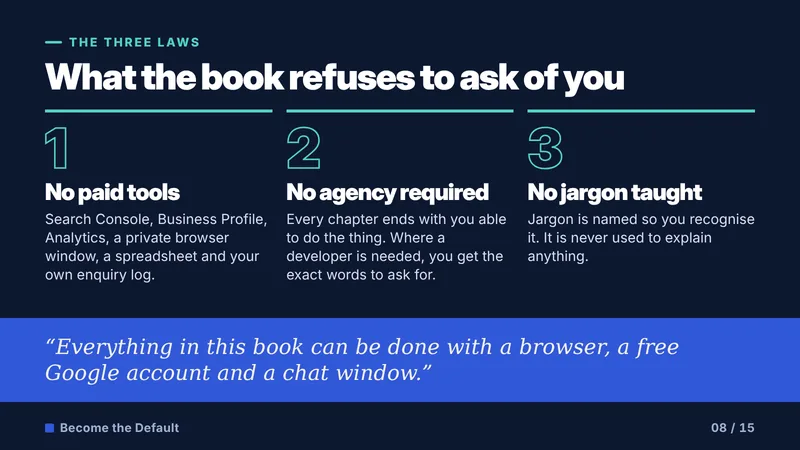
Search Console, your Business Profile, a browser, a spreadsheet and a free chat window.
One method for all three, with AI answers inside the method rather than bolted on.
Each one ends with a job and the time it takes, from ten minutes to two evenings.
Four British businesses followed for two years, with every measured number sourced.
Just want the first steps today? Start with how to get your business on Google, Maps and AI answers.
Reader resources that live here, because they change
The book sends readers to this page for the material that cannot stay current in print.
Frequently asked questions about the book
Is this SEO book for beginners?
Yes. Become the Default assumes no knowledge of search. Technical terms are named only so you can recognise them in a proposal, and every idea is explained in plain English the first time it matters. The words an agency is likely to use are also collected in semantic SEO explained.
Do I need paid SEO tools to use the book?
No. Every method runs on things you already have free: Search Console, your Business Profile, Analytics, a browser, a spreadsheet and a free AI chat window. Chapter 18 covers which tools a business your size might pay for, and why most do not need to.
Does it cover AI search, ChatGPT and Google's AI answers?
Yes. Part Nine, chapters 44 to 47, covers how AI assistants and Google’s AI Overviews decide which business to name, ten prompts for checking what they say about you, and how to use AI tools without putting your name on generic pages. The book describes how assistants choose rather than naming each chatbot, because the products change and the method does not. AI search is not treated as a separate subject.
Is the book only for UK businesses?
No. The examples and the four businesses are British, but nothing in the method depends on the country, so it travels.
How long does it take to read and use?
About one part a week, reading and doing the work as you go. With one afternoon, read chapters 1 and 2, then chapter 55, and do rung one of the ladder. About to sign a contract with an agency? Read Part Seven first.
Are the businesses in the book real?
No. Helen, Priya, Graham, Ruth and every firm in the book are composites built from patterns seen many times, and their figures are illustrations. Every measured number carries a source you can check.
Is the book a sales pitch for True SEO Consultants Ltd?
No. The whole method is in the book, and its last pages say plainly that you do not need the author to do any of it. True SEO Consultants Ltd is the publisher, and the book declares that the company sells search work, including the kind it describes.
Can somebody do the work with me instead?
Yes. True SEO Consultants Ltd does this work alongside business owners through remote digital onboarding and delivery, or trains your own marketer through SEO mentoring. The book is written so you never have to, and it tells you what to demand from whoever you choose.
Where can I buy Become the Default?
On Amazon, as a paperback for £19.99 or a Kindle ebook for £9.99. The first pages are free to read above.
Everything in this book can be done with a browser, a free Google account and a chat window.
Start at rung one. It takes two hours, and the book tells you what to do with them.
Published by True SEO Consultants Ltd, registered in England and Wales, company number 16563516, Startup Stiwdio, University of South Wales, 86-88 Adam Street, Cardiff CF24 2FN. Google is a trademark of Google LLC, and this book is not endorsed by or affiliated with Google in any way. Prefer somebody to do the work with you? True SEO Consultants Ltd works with owners across the UK through remote digital onboarding and delivery. Talk to the team.

56 chapters
11 parts. Tap one to open it.
PART 1Why You Are Invisible6 ch.PART 2Deciding What You Are For6 ch.PART 3Research6 ch.PART 4Identity6 ch.PART 5The Building5 ch.PART 6Writing9 ch.PART 7What It Costs, and What You Are Buying3 ch.PART 8Who Vouches For You2 ch.PART 9The Machines That Answer4 ch.PART 10Knowing Whether It Worked5 ch.PART 11Staying There4 ch.