Published research, 13 October 2026
The 50 UK chiropractic clinic websites we audited on 13 October 2026 most often get three things wrong: treatment claims outside the official list of conditions chiropractors may advertise, no GCC registration number for patients to check, and pages with no summary for Google to show. Each one sits where a new patient decides whether to trust a clinic and book.
A web designer can close most of these gaps cheaply, once, in the site’s template, before the site goes live. Treatment claims are different, because they come down to what each page says, and only the clinic can decide that. Below are how we checked the sites, the 16 biggest findings, what each one costs a clinic in patients, bookings, trust or complaint risk, and a 10 point check you can run on your own website this week.
Published by True SEO Consultants Ltd on 13 October 2026. Author: Mohammad A Mahmud. Sample: 50 clinic websites in ten UK cities. Data collected: 13 October 2026. No clinic, clinician, patient or website is named anywhere in this report.
The 50 site audit in six numbers
Key findings
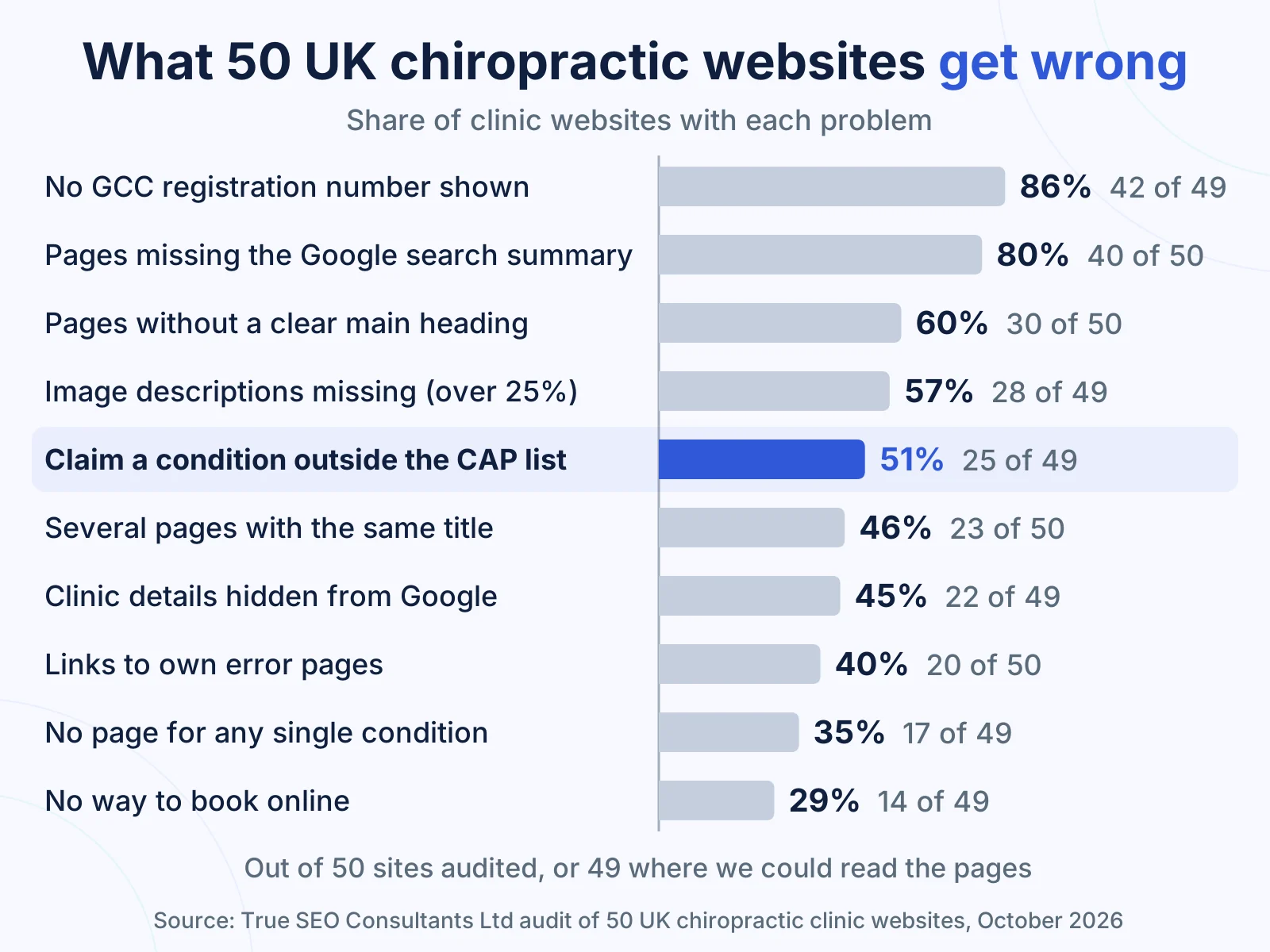
Half the clinic websites we could read in full present a condition outside the official CAP list as treatable, and 42 of 49 show no GCC registration number on any page we checked.
51%
25 of 49 clinic websites present at least one condition outside the official CAP list as something they treat or help.
What it costsA claim the clinic cannot back with evidence can draw a complaint, and a page that has to come down loses the place in Google it had built.
86%
42 of 49 clinic websites show no GCC registration number on any page we checked.
What it costsThat number is the one detail a nervous new patient can look up on the public GCC register before booking.
80%
40 of 50 clinic websites have pages missing the short summary Google shows under a page in search results.
What it costsGoogle writes that summary itself, so the clinic does not choose the words a patient reads before deciding to click.
45%
22 of 49 clinic homepages are missing the behind the scenes business details Google reads: the clinic’s name, address and opening hours.
What it costsGoogle has to guess those facts from the page text instead of reading them straight from the clinic.
35%
17 of 49 clinic websites have no page for any single condition, such as back pain or sciatica.
What it costsA patient searching for sciatica plus their town finds no page that matches, so only the homepage is left to match it.
40%
20 of 50 clinic websites have links on their own pages that lead to error pages.
What it costsA patient who clicks one lands on an error page instead of the treatment page or the booking form.
No site was clean. We checked ten common mistakes on every site we could read in full (the Google search summary, a clear main heading, repeated page titles, links to error pages, behind the scenes business details, the GCC number, condition pages, claims outside the CAP list, a tap to call phone number and online booking), and each of the 49 had at least one, with an average of 4.9.
Why we audited chiropractic websites
We audited chiropractic websites to measure what UK clinics actually publish before we advise any clinic on Google. A chiropractic website has two jobs at once: it has to bring in new patients from Google, and every claim on it has to sit inside the advertising guidance of the Committee of Advertising Practice (CAP) and the standards of the General Chiropractic Council (GCC). True SEO Consultants Ltd works with healthcare clinics, and we wanted evidence, not guesses, about how often those two jobs pull against each other on a real clinic website.
How we chose the 50 clinics and what we checked
We took five clinic websites in each of ten UK cities from web search results for “chiropractor [city]” and “chiropractic clinic [city]”, checked each one against written rules for who could be included, and confirmed every site was live on 13 October 2026.
The ten cities were London, Birmingham, Manchester, Leeds, Bristol, Newcastle upon Tyne, Cardiff, Glasgow, Edinburgh and Belfast. They are simply where we looked. Five sites per city is far too few to compare one city with another, so this report makes no city comparisons.
Which sites qualified
A site qualified as the clinic’s own website, on its own web address, for a chiropractic clinic located in or clearly serving the named city. We left out directories and review sites, pages hosted on a booking platform or a free website builder rather than the clinic’s own address, national chains whose city page sits under a company brand, multi discipline clinics where chiropractic is not a core service, and clinics outside the UK. Four clinics we included sit just outside a city boundary; their websites target that city, so they stayed in.
The first search returned mostly directories and American clinics in towns with the same names, such as Birmingham in Alabama and Manchester in New Hampshire. We threw that search away and reran the same searches in the search tool’s extended mode, which returns clinic websites. Eight cities still did not give us seven eligible UK sites from the two searches. In those cities we ran extra searches adding “UK” or a close wording variant, and we logged every one.
How we audited each site
We audited each clinic with an industry standard website audit tool (Screaming Frog SEO Spider), one at a time, starting at the homepage with the same saved settings and a 15 minute limit for each. The tool follows the links on a website and records every page’s title, headings, Google search summary, errors and redirects. We then read up to 45 working pages on each website for treatment claims, registration details, booking prompts and prices. Each request identified us by name, with a 400 ms pause between pages so no clinic’s website was put under strain.
A second pass read up to 15 home, about, team and contact pages per site for clinician titles and registration numbers: 479 pages in all. We also read the behind the scenes business details on each homepage (the JSON-LD structured data) directly.
The approach follows the method behind our audit of 494 UK accountancy practice websites, Research Report TSC-2026-01: measure only what a site publishes, report totals rather than individual clinics, and throw out any first count that a person reading the page does not support.
How many sites and pages we checked
We ran 54 site audits to finish with 50 usable sites. Three sample sites returned fewer than three web pages and were replaced by reserves in an order fixed before the audit began; one reserve also returned a single page and was passed over for the next.
| What we counted | Number |
|---|---|
| Web addresses checked (all file types) | 10,337 |
| Working web pages found | 4,877 |
| Working pages on a typical site (median) | 42 |
| Pages read for treatment claims and trust details | 1,649 |
| Pages rechecked for the Dr title and registration numbers | 479 |
| Homepages checked for behind the scenes business details | 50 (49 usable) |
Why some figures are out of 50 and others out of 49
Figures from the website audit tool are out of 50 sites, and figures about what the pages say (claims, trust details and business details) are out of 49. One site answered our page reader with an automated security check (an HTTP 202 response), so we could not read its wording. The audit tool still checked it normally, which keeps it in the technical figures. Every finding below says which number it is out of.
How we decided what counts as a treatment claim
A treatment claim counted only after a person had read it in context. We first searched the pages for 11 conditions outside the CAP list (whiplash, frozen shoulder, colic, morning sickness, asthma, ADHD, ear infection, plagiocephaly, fibromyalgia, immune and digestive). Then we read every match we kept, 268 in all, plus the web addresses of the condition pages. Only claims to treat a condition, and published patient testimonials saying treatment worked, count. Unclear cases never count.
Half the clinics present conditions outside the CAP list as treatable
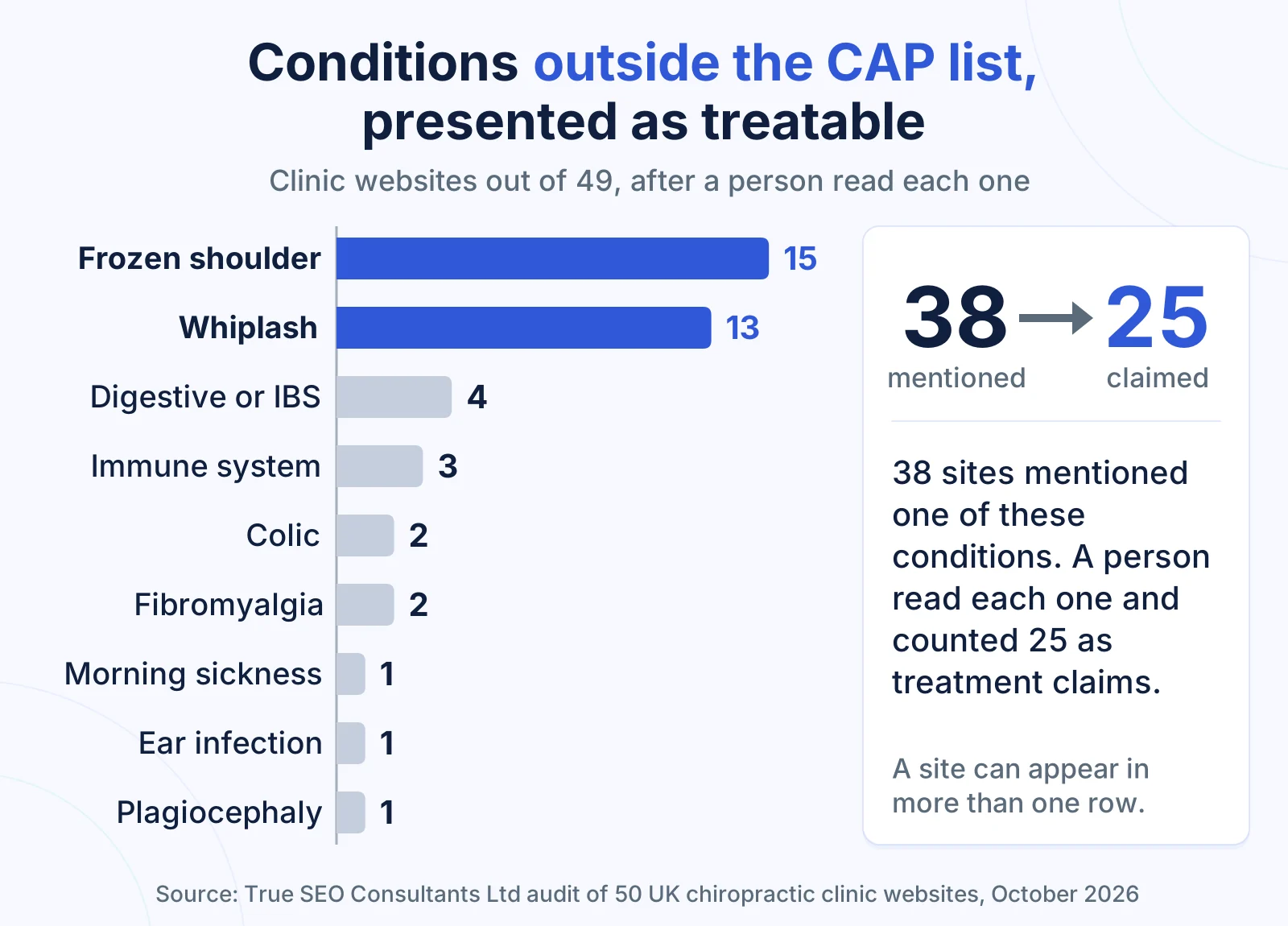
Claims outside the official CAP list appear on 25 of 49 sites (51.0%), and whiplash and frozen shoulder account for most of them: 23 of 49 sites (46.9%) present one or both as something the clinic treats or helps.
The official list comes from CAP AdviceOnline (Health: Chiropractic, updated 1 June 2023). It names 19 conditions a chiropractor may claim to treat, from back pain not arising from injury to the short term management of plantar fasciitis, and any other claim needs evidence the clinic holds itself. Two exclusions are written into the list: neck pain following injury, which means whiplash, and frozen shoulder. The GCC Code of Professional Practice, in force since 1 January 2026, covers advertising under standard C5.
This report describes what the CAP list says and what the sites publish. It does not judge whether any individual site follows the CAP Code or the GCC Code, and nothing in it is legal advice.
Most claims are in the clinic’s own words
The clinic’s own wording makes the claim on 22 of the 25 sites; the other 3 make it only through published patient testimonials saying the treatment worked. Whiplash appears as treated on 13 of 49 sites (26.5%) and frozen shoulder on 15 of 49 (30.6%).
Testimonials are not a safe way around the list. The ASA says claims made in testimonials, including implied claims that a treatment works, must be backed by evidence, so a published review crediting treatment for a condition counts as a claim the clinic has to be able to support.
Conditions specific to babies and pregnancy
Conditions specific to babies or pregnancy appear as treated on 4 of 49 sites (8.2%): colic, morning sickness, ear infection, plagiocephaly (flat head syndrome) and infant digestive issues. CAP AdviceOnline says chiropractors may refer to treating babies, children and pregnant women as groups. References to conditions specific to those groups, such as colic and morning sickness, are unlikely to be acceptable without a body of evidence. We counted only the specific conditions, never a page about caring for one of those groups.
A further 3 of 49 sites (6.1%) present immune or digestive function outside the infant context as something chiropractic treats.
How often each condition came up
The table follows each of the 11 conditions, by number of sites, from the first word search through to the count we report.
| Condition | Sites where the word appeared | Clinic’s own words claim to treat it | Patient testimonial says it worked | Unclear | Mentioned, not claimed | Claim made for another therapy | Counted as a claim |
|---|---|---|---|---|---|---|---|
| Whiplash | 28 | 12 | 1 | 5 | 10 | 0 | 13 |
| Frozen shoulder | 23 | 13 | 2 | 6 | 2 | 0 | 15 |
| Colic | 3 | 2 | 0 | 1 | 0 | 0 | 2 |
| Morning sickness | 2 | 1 | 0 | 0 | 1 | 0 | 1 |
| Asthma | 2 | 0 | 0 | 0 | 1 | 1 | 0 |
| ADHD | 2 | 0 | 0 | 0 | 2 | 0 | 0 |
| Ear infection | 1 | 1 | 0 | 0 | 0 | 0 | 1 |
| Plagiocephaly | 3 | 1 | 0 | 1 | 1 | 0 | 1 |
| Fibromyalgia | 10 | 2 | 0 | 2 | 2 | 4 | 2 |
| Immune | 14 | 3 | 0 | 1 | 9 | 1 | 3 |
| Digestive | 14 | 4 | 0 | 0 | 7 | 3 | 4 |
A site can appear under several conditions, so the last column adds up to more than 25.
Why 38 sites became 25 once a person read them
A person reading each match cut the count from 38 sites to 25, because most matches mention a condition without claiming to treat it. The 13 sites that dropped out mention whiplash, frozen shoulder or the other conditions to explain causes, tell the history of chiropractic, advise a patient to see a GP, quote the accepted list itself, or publish a testimonial that says nothing about results. Others attach the claim to a different service at the same clinic, such as massage, acupuncture, laser therapy or nutrition. Unclear cases stayed out.
A report built on the first count of 38 would have overstated the finding by 13 sites. For a regulated profession, we think that gap is the strongest argument for reading every match before publishing a number. The 25 is still a minimum: we kept up to two matches per condition per site and read at most 45 pages per site, so a claim on page 46 does not appear.
Pages built around whiplash or frozen shoulder
A page whose web address, title, heading or menu label names whiplash or frozen shoulder exists on 11 of 49 sites (22.4%): whiplash on 6 and frozen shoulder on 5. Separately, 6 sites have a slipped disc or disc problem page and 1 has a vertigo page, conditions not named on the CAP list. We left blog articles out of this count.
A dedicated page is the most exposed form of the claim. CAP AdviceOnline names both conditions as outside the list, so a page built around either is the content most open to a complaint through the ASA, or to a concern raised with the GCC. When such a page comes down, the place in Google it earned goes with it.
Two sites quote the exclusion on one page and claim the condition on another
Two sites quote the CAP exclusion wording on one page and present the excluded condition as treated on another. That pattern fits pages written at different times or by different people, one after someone read the guidance and one before, although an audit cannot show which page came first.
The contradiction is the clearest sign in the data that claims are a problem of keeping every page in line, not a problem of knowing the rule. Someone at each clinic had read it, and the website still did not apply it on every page. Our SEO service for chiropractors starts from the accepted list for exactly this reason, so every condition page we plan names a condition the list covers.
The word “cure” is rare as a promise
The word cure works as a promise, or a report of a cure, on 4 of 49 sites (8.2%): 1 in the clinic’s own blog and 3 through published patient testimonials. It appeared on 23 sites in total. Sixteen of those uses were negations, everyday phrases, disclaimers or history, and 3 were unclear.
Claims cover what a site says about treatment. The next findings cover what it says about the people giving that treatment, and how a patient can check them before booking.
Most clinic websites never show a GCC registration number
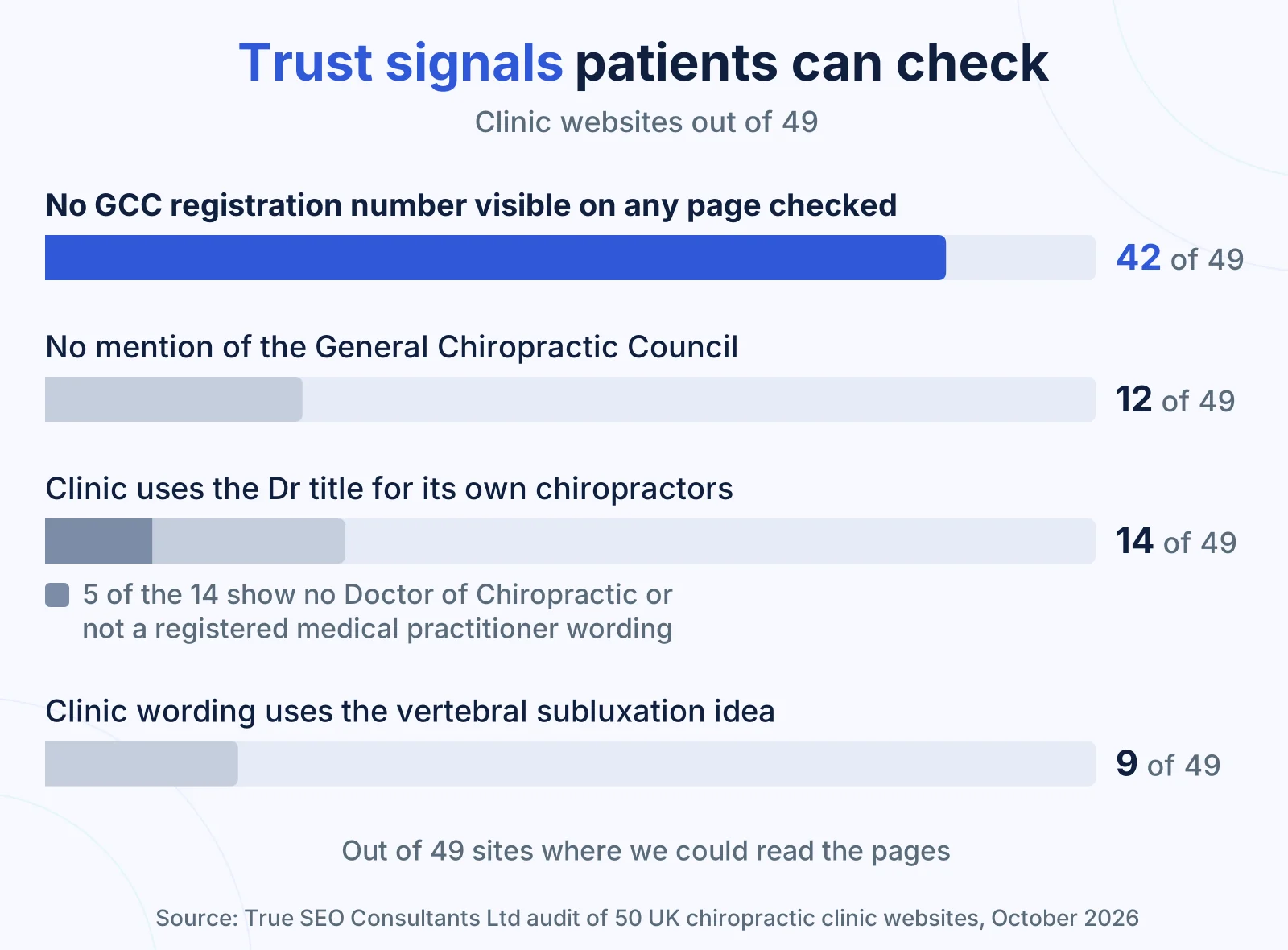
The GCC registration number is the trust detail missing most often: 42 of 49 sites (85.7%) show no GCC registration number on any page we checked, and 12 of 49 (24.5%) never mention the General Chiropractic Council.
The GCC registration number
A GCC registration number appears on only 7 of 49 sites. GCC guidance says registrants may wish to include their registration number on their website. A published number lets a patient check the chiropractor on the public GCC register before booking, and it gives Google and AI assistants a fact they can match across websites.
We searched every page we read for “GCC” or “registration” followed by a four or five digit number, then checked the second pass over home, about, team and contact pages. One apparent match turned out to be a year, and we removed it.
Any mention of the General Chiropractic Council
The General Chiropractic Council goes unmentioned on 12 of 49 sites (24.5%) across every page we read. The GCC register is the public record a patient can use to confirm a chiropractor is registered, so naming the council in the footer, with a pointer to the register, sends patients and Google to that record from every page.
The Dr title
The courtesy title Dr appears with a clinician’s own name in the clinic’s own wording on 14 of 49 sites (28.6%). CAP AdviceOnline and GCC guidance allow the title for a qualified Doctor of Chiropractic where the public wording makes clear the person is not a registered medical practitioner.
Five of those 14 sites show neither Doctor of Chiropractic wording nor a statement that the clinician is not a registered medical practitioner on any page we checked. One of the five carries such a statement on a service page outside the pages we checked, so the statement only reaches patients who happen to open that page.
Patient reviews add a second layer. A further 10 sites show Dr with a clinician’s name only inside quoted patient reviews, which takes the total showing the title in any form to 24 of 49 (49.0%). We report those 10 separately because a patient chose the word, not the clinic. The reviews still sit on the clinic’s own pages, and the same explanatory statement, placed once in the website’s template, covers the title wherever a reader meets it. We left out 5 sites where Dr referred to someone outside the clinic, such as a technique founder, a quoted professor or a web design credit.
The vertebral subluxation concept
The vertebral subluxation concept, the traditional chiropractic idea that misaligned spinal joints cause wider ill health, appears in clinic wording on 9 of 49 sites (18.4%). The word appeared on 14 sites; 5 used it in its medical sense of a partial joint dislocation, in a reference list or in a history article, and we did not count them. The GCC has published guidance on claims made for the vertebral subluxation complex, so wording built on the concept needs checking against that guidance before it appears on condition pages or in advertising.
Website faults that change what patients see in Google
The audit found four common faults across 50 sites: no Google search summary on 40 (80.0%), no clear main heading on 30 (60.0%), repeated page titles on 23 (46.0%) and links to error pages on 20 (40.0%). Missing image descriptions affect 28 of 49 sites we could read.
Pages missing the Google search summary
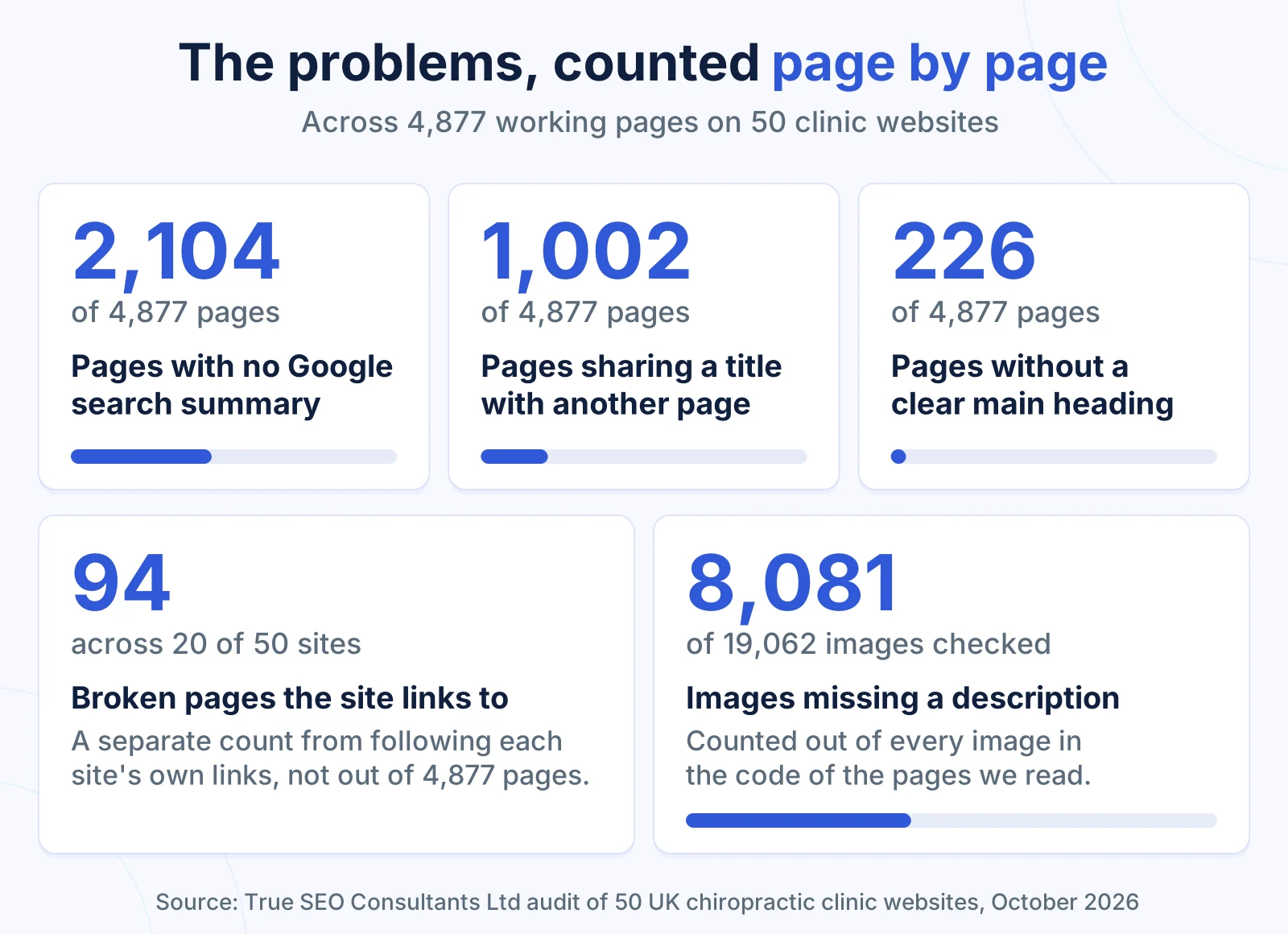
Pages without a meta description, the short summary Google shows under a page in search results, sit on 40 of 50 sites (80.0%). That is 2,104 of 4,877 working web pages, or 43.1%. One large site accounts for 994 of those pages. Leaving it out, the share falls to 1,110 of 3,864 pages (28.7%), and across all 50 sites the typical (median) site is missing it on 30.1% of its pages, which is the fairer figure for an ordinary clinic.
Google Search Central documentation says Google may use the meta description for the search summary when it describes the page better than the page text. A page without one leaves Google to choose the words, and those words are what a patient reads before deciding whether to click on your clinic or the next one in the list.
Pages without a clear main heading
Pages with no main heading (H1) appear on 30 of 50 sites (60.0%): 226 of 4,877 pages, or 4.6%. More than one main heading is almost as common: 26 of 50 sites (52.0%) have pages with two or more, 303 pages in all, 173 of them on a single site.
Google Search Central documentation on title links lists headings such as the H1 among the sources Google uses to write the clickable title in search results. For the patient, the main heading confirms they have landed on the right page. One site in the sample appears to build its pages in the visitor’s browser (all 86 of its pages lack a main heading in the code we audited), so part of this count may reflect text the audit tool could not see.
Several pages showing the same title in Google
Repeated page titles affect 23 of 50 sites (46.0%), where 1,002 pages share a title with another page on the same site; 694 of those pages sit on one site. Google Search Central documentation says the page title is the main source for the clickable title in search results and advises a different title for each page. Repeated titles make pages harder for a patient to tell apart in the results, and more likely to be rewritten by Google.
Links on your own site that lead to error pages
Links to the site’s own error pages (4xx errors, such as page not found) appear on 20 of 50 sites (40.0%), covering 94 broken web addresses. Google Search Central documentation explains that pages returning these errors are not kept in Google’s index. A patient who clicks one sees an error page instead of the treatment or booking page they wanted, and Google spends its visit on pages that cannot appear in search.
Two related findings sit behind this one. Redirects between the site’s own pages appear on 35 of 50 sites (70.0%), and each adds a step before the patient or Google reaches the page. A canonical tag, the line that tells Google which version of a page is the main one, is missing from at least one page on 17 of 50 sites (34.0%). These are routine checks inside our technical and on page SEO work, which finds the broken links, redirects and template gaps an audit exposes and fixes them across the whole template where the platform allows.
Images missing their descriptions
More than a quarter of images lack a description (alt text) on 28 of 49 sites we could read (57.1%). Across the pages we read, 8,081 of 19,062 image tags (42.4%) carry no description. Header and footer images repeat on every page and count each time, and the total includes decorative images that correctly carry an empty description, and tracking pixels. That is why we report the 25% threshold, not “any image missing a description”. Three sites had no image tags in their page code.
Google Search Central image documentation says Google uses alt text, along with computer vision and page content, to understand an image. Screen readers read it aloud to people with sight loss, so a missing description weakens image search and accessibility at the same time.
These faults shape how a page looks in Google once it is found. The local findings below come one step earlier: which local searches a clinic’s pages can match at all.
Gaps that make a clinic harder to find locally
Local search basics are patchy across the sample: nearly half the homepages, 22 of 49 (44.9%), lack the behind the scenes business details Google reads, and 17 of 49 sites (34.7%) have no page for any single condition.
Behind the scenes business details
The behind the scenes business details (LocalBusiness structured data) appear on 27 of 49 homepages, and 17 of 49 use the medical versions, MedicalBusiness or MedicalClinic. Seven of 49 homepages carry no structured data at all, and two carry a block that is broken and cannot be read. We checked homepages only, so inner pages are outside these figures.
Type names matter. Of the 27 homepages with these details, 2 use a business type that schema.org, the shared vocabulary Google reads, does not recognise: “Chiropractic”, which schema.org lists as a system of medicine rather than a business, and “Chiropractor”, which is not among the medical business types schema.org lists. A developer choosing MedicalBusiness or MedicalClinic avoids the problem in one line of the template.
Google Search Central documentation describes LocalBusiness structured data as the way to tell Google a business’s name, address, opening hours and other details. Without it, Google has to work those facts out from the page text.
A page for each condition you treat
No dedicated condition page, such as a page for back pain or sciatica, turned up on 17 of 49 sites (34.7%). The typical (median) site has 5 condition pages (7 among sites that have any), and 20 of 49 have fewer than three. Both figures are capped, because we read up to 45 pages and listed up to 12 condition pages per site.
Google Business Profile Help says local results are based mainly on relevance, distance and prominence, with relevance meaning how well a result matches the search. A site with no page about a condition has only its homepage to match a search such as sciatica plus a town. The CAP accepted list also works as a page plan: it names the conditions a clinic can build pages for, with the note that sciatica takes general references rather than pain reduction claims. Our local SEO service plans those condition and location pages alongside the clinic’s Google Business Profile.
Your town in the homepage title and main heading
The clinic’s city is missing from the homepage title on 7 of 49 sites (14.3%) and from the homepage main heading on 31 of 49 (63.3%). All seven sites missing the city from the title are inside that city. Google Search Central documentation says the page title is the main source of the clickable title in search results, and the town in that title tells a local patient the clinic serves their area before they click.
A page that matches the search still has to turn the visit into an appointment. That is where the last group of findings sits.
Missing booking buttons, prices and tap to call numbers
Booking basics are missing on a sizeable minority of sites: 14 of 49 (28.6%) show no online booking prompt, 12 of 49 (24.5%) show no price, and 8 of 49 (16.3%) have no phone number patients can tap to call from their mobile.
Online booking prompt
A booking prompt is missing from 14 of 49 sites (28.6%). We counted a site as having no prompt when no page we read loaded a booking system (Jane, Cliniko, Nookal, ClinicSense, WriteUpp, Pabau, Setmore or Calendly) and no page used “book online”, “book now” or “online booking” wording. A patient ready to book from their phone outside opening hours cannot do so on those sites, so the booking waits on a call back or a form reply.
Price
No price in pounds appears on any page we read on 12 of 49 sites (24.5%). Cost is one of the questions patients ask before booking, and a site with no price sends that question to a phone call or to a competing clinic’s page that answers it. The website supplies the place for a price; the figure is the clinic’s decision.
A phone number patients can tap
A tap to call phone number (a click to call link) is missing from 8 of 49 sites (16.3%). On a mobile, the link turns the number into a single tap. Without it, the patient has to copy or retype the number, which is one more step between them and a booking.
A shared feature runs through most of the faults reported so far: somebody could have set them once, before the site went live.
Which mistakes a web designer could have fixed before launch
Ten mistakes in this study are build stage decisions: a web designer sets each one once in the site’s template, at almost no cost on a new build, where fixing it after launch means editing page by page.
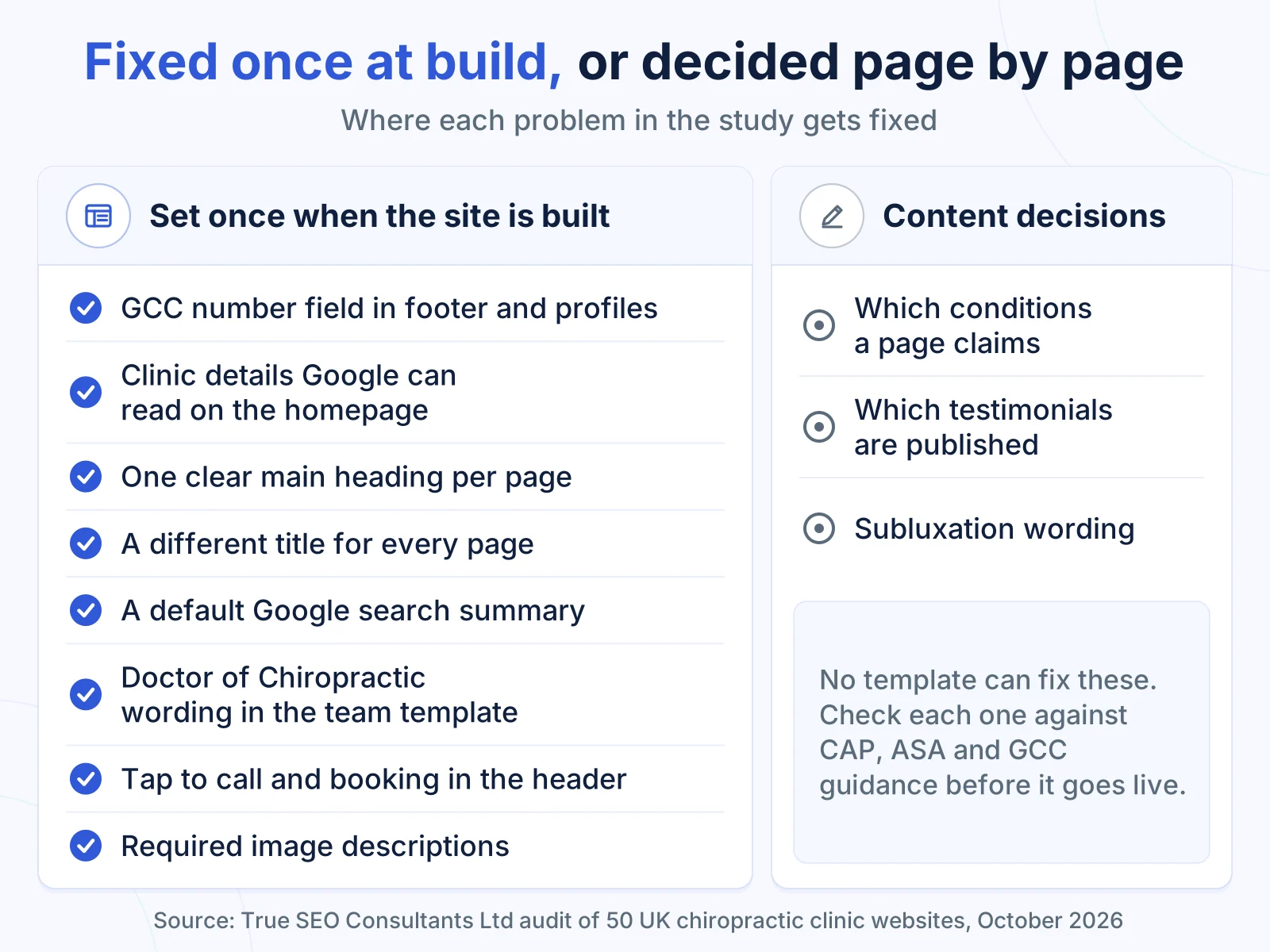
| Mistake | Sites affected | When it gets fixed | What the fix is |
|---|---|---|---|
| No GCC registration number | 42 of 49 (85.7%) | Set once at build | A GCC registration number field in the footer and on each clinician profile |
| No mention of the GCC | 12 of 49 (24.5%) | Set once at build | A GCC mention and register reference in the footer |
| Clinic details hidden from Google | 22 of 49 (44.9%) | Set once at build | Behind the scenes business details on the homepage, using a type Google recognises such as MedicalBusiness or MedicalClinic |
| Pages without a clear main heading | 30 of 50 (60.0%) | Set once at build | One main heading per page, set by the template |
| Several pages with the same title | 23 of 50 (46.0%) | Set once at build | A title pattern that gives every page its own title |
| Pages missing the Google search summary | 40 of 50 (80.0%) | Set at build, then written | A default summary rule in the template, replaced by written summaries on the main pages |
| Dr without explanatory wording | 14 of 49 (28.6%) use Dr in clinic copy | Set once at build | A team page template placing Doctor of Chiropractic wording and the not a registered medical practitioner statement beside every Dr title |
| No tap to call number or booking prompt | 8 of 49 (16.3%) no tap to call; 14 of 49 (28.6%) no booking prompt | Set once at build | A tap to call number and a booking button in the header |
| No page for each condition | 17 of 49 (34.7%) | Set at build, then written | A site structure with one page per accepted condition, planned before the copy |
| Images missing descriptions | 28 of 49 (57.1%) | Set at build, then written | Required description fields for content images |
| Conditions claimed outside the CAP list | 25 of 49 (51.0%) | Content decision | Which conditions a page claims |
| Testimonials saying treatment worked | 3 of 49 (6.1%) claim only through testimonials | Content decision | Which testimonials the clinic publishes |
| Vertebral subluxation concept | 9 of 49 (18.4%) | Content decision | Whether the copy uses the concept |
Three mistakes come down to content decisions that no template can fix: which conditions a page claims, which testimonials the clinic publishes, and whether the copy uses the subluxation concept. A developer can build the condition page structure, but only the clinic, or whoever writes for it, decides what each page says.
The cost difference between the two routes comes from how websites are built. A title pattern, a summary rule or a single main heading in the page template applies to every page the site will ever have. Fixing the same fault after launch means finding and editing every affected page: across this sample, 2,104 pages without a Google search summary and 1,002 pages sharing a title. We have not put hours or prices on either route, because both depend on the platform and the developer.
Two faults sit in between. Links to error pages (20 of 50 sites) build up as content changes after launch, so a good build reduces them but only a regular audit catches them. Prices (12 of 49 sites without one) need a place in the template and a decision from the clinic.
What each mistake costs a clinic
Each mistake costs a clinic in one of five ways: Google reads the page less well, patients do not find the page, patients do not click it, patients do not book, or a complaint takes the page down.
The study measured no Google positions, visitor numbers, enquiries or revenue. It cannot say how much any mistake costs any clinic, and we will not quote a figure. What it can do is name how each mistake works, from the published guidance, and give the clinic a simple sum for its own numbers.
| Mistake | What it puts at risk | Why |
|---|---|---|
| Conditions claimed outside the CAP list | Complaint risk, then being found | CAP AdviceOnline says any other claim needs evidence the clinic holds; a challenged page may have to come down with the place in Google it earned |
| A whiplash or frozen shoulder page | Complaint risk, then being found | CAP AdviceOnline names both outside the list, so the page is the content most open to challenge |
| Dr without explanatory wording | Complaint risk | CAP AdviceOnline and GCC guidance tie the title to wording saying the person is not a registered medical practitioner |
| Vertebral subluxation concept | Complaint risk | The GCC has published guidance on claims made for the vertebral subluxation complex |
| No GCC registration number | Bookings, Google | A patient has no number to check on the GCC register; Google and AI assistants have one less fact to match |
| No mention of the GCC | Bookings, Google | Nothing on the site points patients or Google to the public register |
| No Google search summary | Clicks | Google Search Central: Google chooses the summary when the page supplies none that fits |
| No clear main heading | Clicks, bookings | Google Search Central lists headings among the sources for the clickable title; the patient cannot confirm they are on the right page |
| Several pages with the same title | Clicks | Google Search Central advises a different title for each page; repeats are harder to tell apart and more likely to be rewritten |
| Links to error pages | Google, bookings | Google Search Central: error pages are not kept in Google’s index; the patient lands on an error page |
| Images missing descriptions | Google Search Central: alt text is one of the inputs Google uses to understand an image | |
| Clinic details hidden from Google | Google Search Central: Google has to work out the name, address and hours from the page text | |
| No page for each condition | Being found | Google Business Profile Help: relevance is how well a result matches the search |
| No online booking prompt | Bookings | A patient outside opening hours cannot book without a call back |
| No price | Bookings | The cost question goes to a phone call or to a competing clinic’s page |
| No tap to call number | Bookings | The patient on a phone has to copy or retype the number |
Work out what a mistake could be worth to your clinic
The sum below multiplies two figures only your clinic holds, and it is an illustration, not a finding.
A. Value of one new patient.
Take it from your own records, for example the total fees new patients paid last year divided by the number of new patients.
B. New patient enquiries a month you think one mistake costs you.
This is your own estimate for one mistake, such as the missing booking prompt.
Monthly value at stake
= A x B.
Yearly value at stake
= A x B x 12.
The study supplies no value for either figure, and we have not given a default, because any number we chose would be a guess, not a finding. Run the sum one mistake at a time, not for all of them together: an enquiry lost to a missing tap to call number and one lost to a missing booking prompt may be the same patient.
A 10 point check you can run on your own website
Any clinic can run these ten checks on its own website this week with a browser, a phone and a free website audit tool, and each check matches a finding above.
Compare every condition your site names with the 19 conditions on the CAP accepted list, and search your own pages for whiplash, frozen shoulder, colic and morning sickness.
Read every published testimonial for a statement that treatment fixed a condition outside the list, or for the word cure.
Check that every clinician shown as Dr has Doctor of Chiropractic wording and a not a registered medical practitioner statement on the same page.
Look in your footer and on each clinician profile for the GCC name and the clinician’s registration number.
Ask your web developer to confirm your homepage carries the behind the scenes business details with a type Google recognises, such as MedicalBusiness or MedicalClinic, and to test it in Google’s Rich Results Test.
Run a free website audit tool over your site, or ask your developer to, and list every page missing a Google search summary (meta description).
Sort the same audit for pages with no main heading, more than one, or a title shared with another page.
Filter the audit for links on your own site that lead to error pages, and fix or remove each one.
Test the site on your phone after hours: tap the phone number, find the booking button, and find a price.
Count your condition pages against the accepted conditions you treat, and confirm your town appears in the homepage title and main heading.
Checks 1 to 3 need a careful reader more than a tool, because a word search finds mentions and only a person can tell a claim from a mention. Our healthcare SEO service starts every clinic engagement from the same ten checks, with the claims reading done by hand.
Limitations of the study
This study is indicative, not representative: its figures describe what 50 sites published on one day, not how those sites rank on Google or how many patients they win.
Sample.
A search led sample of 50 sites in ten cities, not a random sample of the GCC register. Many chiropractors work in shared clinics, in towns outside these cities, or without their own website.
Search source.
Results came from a search tool’s web search, not from the Google results a patient sees in each city, and the map and three clinics Google shows at the top of local searches played no part in selection.
Search wording.
Eight cities needed extra or reworded searches, so search position is not strictly comparable between cities.
Selection bias.
Sites that appear in search are likely to be better optimised than the average clinic site, and four sites that blocked automated checks when we confirmed the sample were dropped. The sample probably makes the sector look more polished than it is.
Outcomes.
An audit measures what is published, not what ranks. We measured no Google positions, visitor numbers, enquiries or revenue.
Coverage limits.
We read up to 45 pages per site and listed up to 12 condition pages, so claim counts are minimums and condition page figures are capped.
Match limits.
We kept up to two matches per condition per site for claims, and two per site for the Dr title, so a site may use a claim or the title on pages we did not keep.
Pages built in the browser.
One site may build its content in the visitor’s browser, so its page figures may understate what a visitor sees.
Timing.
Every page was requested once, from one location, on one day.
Excluded site.
One site blocked our page reader with an automated security check, so its claims, trust details and business details are unknown.
Homepage only business details.
The behind the scenes business details figures cover homepages, not inner pages.
Detection rules.
Prices were detected as a pound sign followed by a two or three digit figure, and booking prompts by named booking systems and wording, so a site using an unlisted system or an image of a price list counts as missing.
No compliance judgement.
We report clinics by study ID only and do not judge whether any individual site follows the CAP Code or GCC standards.
We dropped several measures because they did not survive checking: first pass claim matches, first pass Dr counts, detection of the I’m Registered mark, the http to https check, image file sizes, any image missing a description, guarantee and 100% counts as fault measures, Person markup, and every city comparison.
What clinics are getting right
No outcome guarantee appeared on any of the 49 sites we could read in full. The word guarantee appeared on 26 sites, and every use was harmless: terms, warranties and service promises. The figure 100% appeared on 17 sites, and none of those uses was a clear promise of results.
The rest of the data is more balanced than the headline figures suggest. A cure claim in the clinic’s own words appeared on 1 site. Most sites mention the GCC (37 of 49), offer an online booking prompt (35 of 49) and carry a tap to call number (41 of 49). Homepages loaded fast on our single request, with a median of 130 ms; 5 of 49 homepages took over 800 ms.
Our reading of the pattern is that the faults cluster in two places: settings a template made and nobody revisited, and copy written without the accepted list beside it. Both are fixable, and neither points to a careless profession.
Frequently asked questions
Can a chiropractor mention whiplash on a website at all?
A chiropractor can mention whiplash on a website under our counting rule, for example to explain causes or to advise seeing a GP, because what CAP AdviceOnline places outside the accepted list is a claim to treat neck pain following injury. We counted only treatment claims and testimonials saying treatment worked. That is our counting rule, not a ruling, and whether a specific wording is acceptable is a matter for the ASA.
Does a missing Google search summary hurt my clinic’s ranking?
A missing Google search summary (meta description) is a click problem first. Google Search Central documentation describes the meta description as a possible source for the summary under your page, so a page without one leaves Google to choose the words a patient reads before clicking. This study measured no rankings, so we make no claim about position.
Do the behind the scenes business details make a clinic rank higher?
The behind the scenes business details (LocalBusiness schema) do not make a clinic rank on their own, and this study measured no rankings. Google Search Central describes LocalBusiness structured data as a way to tell Google a business’s name, address and opening hours, which saves Google working them out from page text. That makes them a setting worth getting right at build, not a ranking shortcut.
Should every clinician’s GCC number be on the site?
GCC guidance says registrants may wish to include their registration number on their website, so publishing it is an option the GCC describes rather than a rule in the guidance we cite. Only 7 of 49 sites in the sample publish one. A number on each clinician profile gives a nervous new patient something to check on the public register before booking.
How did you choose the 50 clinics?
The sample is five clinic websites in each of ten UK cities, taken from search results for “chiropractor [city]” and “chiropractic clinic [city]” and checked against written rules for who could be included. Every site was confirmed live on 13 October 2026, and reserves replaced sites that could not be audited, in an order fixed in advance.
Can I get my clinic’s site checked?
Yes, through True SEO’s free Chiropractic Website Claim Check, which reads every page of your website against the CAP accepted list, the GCC guidance on the Doctor title and registration number, and the testimonial rules.
You keep the written list whether or not you work with us. Ask for it through our contact page.
Free, no obligation
Get your clinic’s website checked for free
The free Chiropractic Website Claim Check is the quickest way to get your clinic’s website checked against the rules this study measured.
True SEO reads every page of the clinic’s website against the CAP accepted conditions list, the GCC guidance on the Doctor title and registration number, and the testimonial rules. The clinic then receives a written list: which claims are safe, which to reword, and which condition pages the clinic can build.
The check is free, carries no obligation, and the clinic keeps the list. It is the first step of our SEO for chiropractic clinics, which builds condition pages, behind the scenes business details and booking routes inside the same rules this study measured.
True SEO Consultants Ltd works from Startup Stiwdio, University of South Wales, 86-88 Adam Street, Cardiff, CF24 2FN, and serves clinics across the UK through remote digital onboarding and delivery, so a clinic in Glasgow or Bristol gets the same check as one in Cardiff.
How to cite this study
Cite this study as:
True SEO Consultants Ltd (2026). We Audited 50 Chiropractic Websites Across the UK: What Most Clinics Get Wrong. 13 October 2026. https://trueseo.co.uk/case-studies/uk-chiropractic-websites-study/
Author: Mohammad A Mahmud, founder and director of True SEO Consultants Ltd. ORCID 0009-0005-7459-212X. More about Mohammad A Mahmud and his research.
Declared interest: True SEO Consultants Ltd sells SEO services to clinics, including chiropractic clinics, and offers the free claim check described above. Data collected 13 October 2026. Clinics appear in our records by study ID only.