SEO for UK chiropractic clinics
SEO for Chiropractors: More New Patients From Google, Every Claim Within the Rules
SEO for chiropractors is how a UK chiropractic clinic gets found by patients nearby on Google search, on the Google map and in AI answers, with every condition page worded to the CAP accepted list and GCC guidance.
- Free claim check, no obligation
- You keep the written list
- Rolling monthly on Local and Full service SEO
We read every page of your site against the CAP list and the GCC guidance, then send you the list. Nothing to sign.
19
conditions on the CAP accepted list for chiropractors
£399
a month plus VAT, the published starting price for Local SEO, rolling monthly
50
UK chiropractic clinic websites audited for our own study, October 2026
2010
the year our founder started working in search
What is SEO for chiropractors?
SEO for chiropractors is the work of getting a chiropractic clinic into the three places new patients look: the map and three clinics Google shows at the top of local searches, the ordinary Google results for condition and town searches, and AI answers, without a claim the clinic cannot support.
It has three parts. Local visibility comes from the Google Business Profile, the location page and clinic details that match everywhere. Condition visibility comes from one page for each accepted condition the clinic treats. Clinician visibility comes from a profile for every chiropractor, carrying the GCC registration number, so patients, Google and AI assistants can check the person against the public register.
The rulebook is what sets it apart from ordinary clinic marketing. A chiropractor works to a published CAP list of 19 conditions they may claim to treat, and every page has to sit inside it unless the clinic holds its own strong clinical evidence. True SEO Consultants Ltd builds the page plan around that list from the first week. It’s the same compliance first approach that runs through our healthcare SEO service for regulated clinics, applied to chiropractic.
Why do chiropractic clinics lose new patients to rivals on Google?
Chiropractic clinics lose new patients to rivals on Google because a competitor holds a place on the Google map, the clinic’s site runs on a generic template, or its condition pages are written so cautiously, or so loosely, that they answer nothing a patient typed.
Each of these five situations has a fix.
A newer clinic two streets away now sits above you on the Google map.
We check four things first: the primary category on your Google Business Profile, your review flow, whether your clinic details match everywhere, and whether the profile links to a page about your clinic.
Your diary relied on referrals and new referrals have slowed.
Referrals don’t appear in search. A clinic with no condition pages has nothing to show a new patient who types “chiropractor for back pain” and the name of their town.
An agency wrote your condition pages and you aren’t sure they meet ASA rules.
Pages written for keywords, without the CAP list beside them, can drift onto conditions the list leaves out. The free claim check reads every page against the list and tells you what to keep.
Patients mention ChatGPT, but most never say how they found you.
Some patients now ask an AI assistant before they book, and a standard booking form doesn’t record it. Clear, consistent clinic details give an assistant facts it can check.
You paid an agency for a year and can’t tell what it produced.
A report that shows traffic and not bookings leaves you guessing. We report bookings by page.
Missing pages are a measured problem in chiropractic. In our audit of 50 UK chiropractic clinic websites, 17 of 49 sites had no page for any single condition, so a search for sciatica plus a town had only the homepage to match. The fix is one clear page for each accepted condition the clinic treats.
Our own research, October 2026
What we found when we audited 50 chiropractic clinic websites across the UK
We audited 50 chiropractic clinic websites across the UK and found that 25 out of 49 offer to treat a condition outside the official list chiropractors may advertise, and 42 out of 49 show no GCC registration number. Both gaps cost a clinic trust before a patient books, and our free claim check looks for both on your website.
51%
25 out of 49 clinic websites offer to treat at least one condition that is not on the official list chiropractors may advertise (the CAP list).
What it costs the clinicEach of those claims needs the clinic’s own evidence. A complaint can mean taking the page down, and the new patients it brought in go with it.
86%
42 out of 49 clinic websites show no GCC registration number on any page we checked.
What it costs the clinicThat number is the one detail a nervous new patient can look up on the public GCC register before booking.
80%
40 out of 50 clinic websites have pages with no short summary for Google to show under the page in search results.
What it costs the clinicGoogle writes that summary itself, so the clinic does not choose the words a patient reads before deciding to click.
45%
22 out of 49 clinic homepages lack the behind the scenes business details Google reads: clinic name, address and opening hours.
What it costs the clinicGoogle has to work out where the clinic is and when it is open from the page text, the details a patient needs to turn up.
35%
17 out of 49 clinic websites have no page for any single condition, such as back pain or sciatica.
What it costs the clinicWhen a patient searches for sciatica and their town, that clinic has only its homepage to show, up against clinics with a sciatica page.
40%
20 out of 50 clinic websites have links on their own pages that lead to error pages.
What it costs the clinicA patient who clicks to read about treatment or to book lands on an error page in place of the page they wanted.
What this means for your clinic
The free Chiropractic Website Claim Check looks for three of these gaps on your own website and sends you a written list you can hand straight to your web developer.
- Every claim outside the CAP list, quoted back to you. 25 out of 49 clinics we audited had at least one. You get each claim quoted from your pages, with the reason and replacement wording that keeps to the CAP list.
- A GCC number check on every chiropractor’s profile. 42 out of 49 clinics showed no number. You get a note on each profile saying whether the GCC number is there and whether the Dr title is worded correctly.
- The condition pages you can add. 17 out of 49 clinics had no page for any single condition. You get the accepted conditions you treat that have no page yet, so you know which pages to add.
Free, no obligation, nothing to sign. You keep the list.
Method: We audited 50 clinic websites in ten UK cities on 13 October 2026 with an industry standard website audit tool (Screaming Frog), checking every page for technical faults and reading up to 45 pages on each site for treatment claims and registration details. One site blocked our checks, so figures on claims, registration and business details are out of 49. No clinic is named, and we measured what each site shows, not its Google rankings.
What can a chiropractor claim to treat on a website?
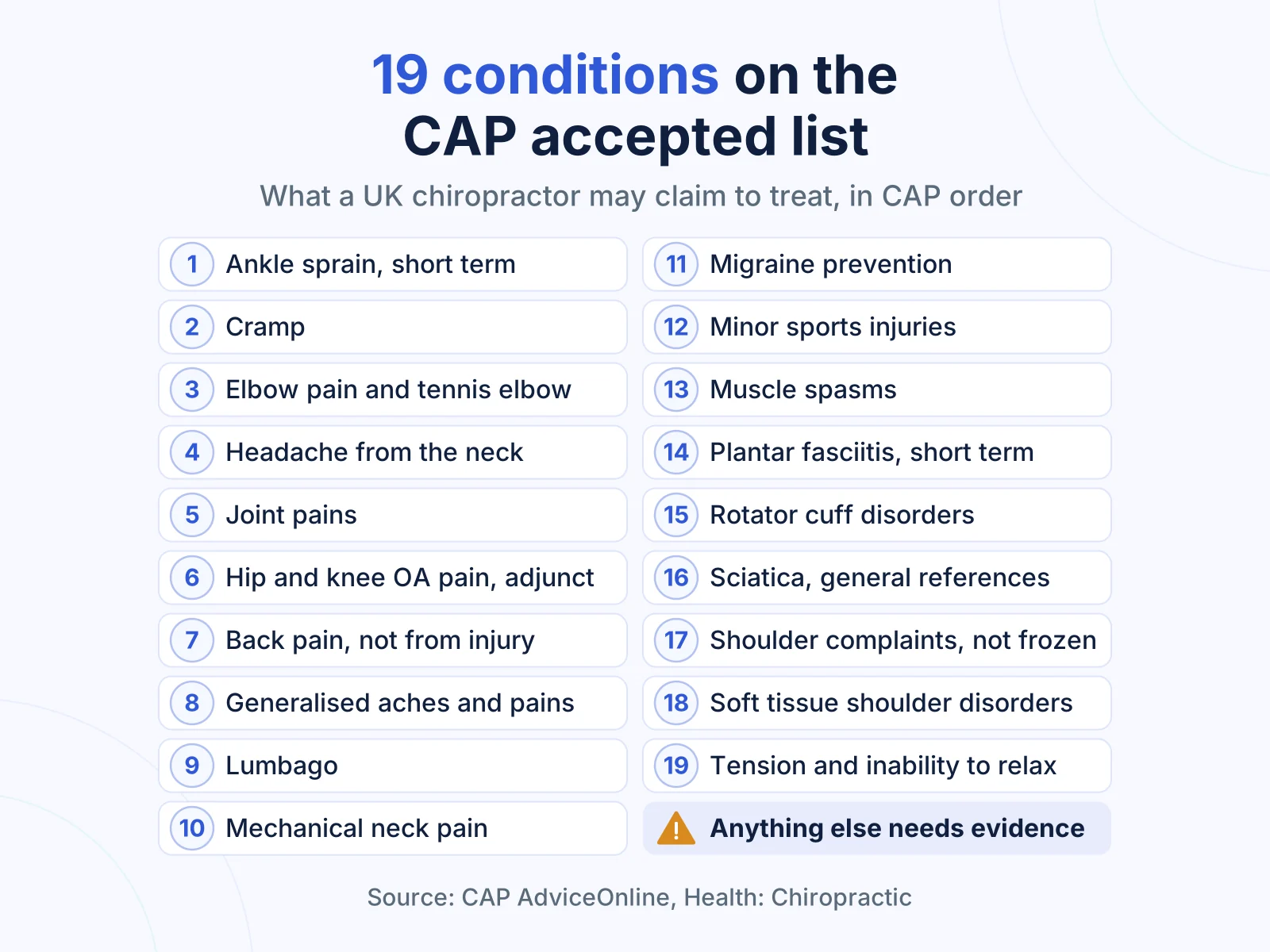
A chiropractor can claim to treat the 19 conditions on the accepted list published by CAP AdviceOnline in Health: Chiropractic, updated 1 June 2023, using the qualifiers CAP attaches to each; any other condition needs strong clinical evidence the clinic holds itself.
The rules cover the clinic website as well as its ads. According to CAP AdviceOnline, the CAP Code has applied since 2011 to marketing on a business’s own website and other online space it controls. The GCC Code of Professional Practice, in force since 1 January 2026, requires in standard C5 that information a chiropractor gives about their services is factual, verifiable and not misleading, and the GCC states that standard C4 covers compliance with the CAP Code.
The qualifiers matter as much as the condition names. Back pain is accepted. Back pain arising from injury or accident is not. The table gives the CAP wording for all 19 entries and what each means when you write the page.
| # | Accepted condition (CAP wording) | What this means for the page |
|---|---|---|
| 1 | Ankle sprain (short term management) | Describe short term management only. Leave out claims about long term recovery. |
| 2 | Cramp | Suits a short page or a clear section on the services page. |
| 3 | Elbow pain and tennis elbow arising from associated musculoskeletal conditions of the back and neck, but not isolated occurrences | Tie the elbow pain to the back or neck in the wording. A page on isolated tennis elbow sits outside the list. |
| 4 | Headache arising from the neck (cervicogenic) | Name the neck as the source. A general headache page goes wider than the list. |
| 5 | Joint pains | Fits a general joint pain page. |
| 6 | Joint pains including hip and knee pain from osteoarthritis, as an adjunct to core OA treatments and exercise | Present chiropractic care alongside core osteoarthritis treatment and exercise, never as a replacement for them. |
| 7 | General, acute and chronic backache, back pain (not arising from injury or accident) | Usually the clinic’s main condition page. Keep injury and accident cases out of the wording. |
| 8 | Generalised aches and pains | Suits a broad section on the services page. |
| 9 | Lumbago | Can carry its own page or sit inside the back pain page. |
| 10 | Mechanical neck pain (not neck pain following injury, i.e. whiplash) | Use the words “mechanical neck pain”. Keep neck pain after an injury off the page. |
| 11 | Migraine prevention | Word the page around prevention, as listed. |
| 12 | Minor sports injuries | Keep the word “minor” in the wording. |
| 13 | Muscle spasms | Suits a short page or a services page entry. |
| 14 | Plantar fasciitis (short term management) | Short term management only, as with ankle sprain. |
| 15 | Rotator cuff injuries, disease or disorders | Can carry its own page inside the shoulder group. |
| 16 | Sciatica (general references, as opposed to pain reduction claims) | Say you see and treat patients with sciatica. Leave out promises to reduce the pain. |
| 17 | Shoulder complaints (dysfunction, disorders and pain, but not frozen shoulder) | A shoulder page works. Frozen shoulder stays off it. |
| 18 | Soft tissue disorders of the shoulder | Sits with the shoulder page. |
| 19 | Tension and inability to relax | Keep to the listed wording. Conditions such as anxiety are not on the list. |
Which conditions need your own evidence?
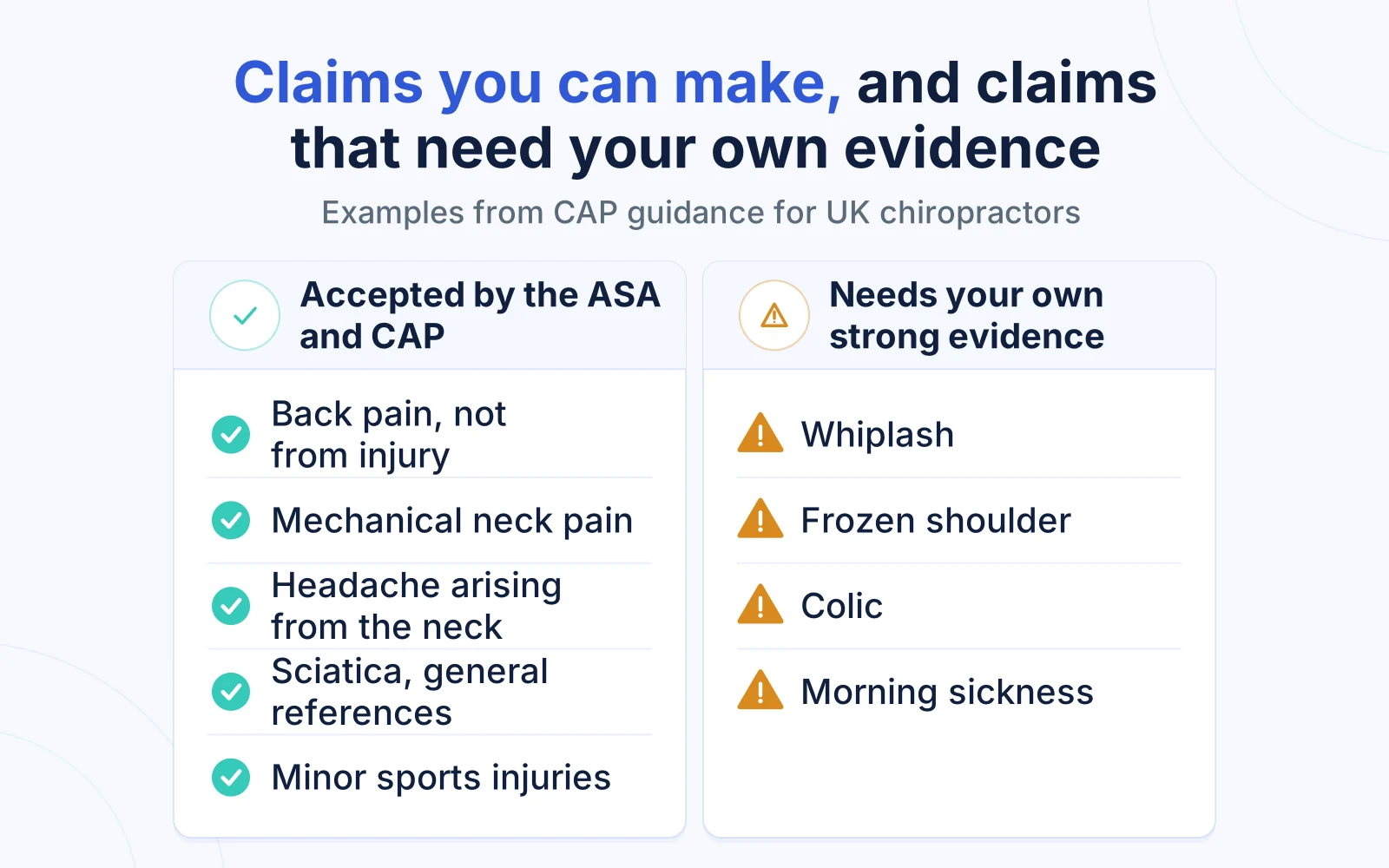
Whiplash, frozen shoulder and conditions specific to babies, children or pregnant women need the clinic’s own strong body of evidence before they appear in a claim, because none of them is on the accepted list.
Whiplash.
The ASA’s 2017 evidence review, summarised in its guidance “Backing up your claims for Chiropractic”, found claims on sciatica and some minor sports injuries supported. It did not find whiplash demonstrated.
Frozen shoulder.
Shoulder complaints are on the list, with frozen shoulder named as the exception.
Conditions specific to babies, children and pregnancy.
CAP accepts references to treating these population groups. Conditions specific to them are unlikely to be acceptable without a strong body of evidence, and CAP gives colic and morning sickness as examples.
Every other condition.
Anything not on the list needs strong clinical evidence held by the clinic before it goes on a page.
A clinic can say it sees babies, children and pregnant women. It should not build a colic page on the strength of the list.
What happens when a claim breaks the rules?
A claim that breaks the rules can lead to an ASA ruling and, separately, to a GCC fitness to practise case, because the GCC Code of Professional Practice makes factual, verifiable advertising that complies with the CAP Code part of a chiropractor’s professional duty.
The GCC has published learnings from a fitness to practise case on unsubstantiated advertising claims. In a case reported by the GCC on 31 October 2023, the ASA upheld a complaint the GCC had made against a former registrant whose leaflet suggested they were a chiropractor and a medical doctor, finding breaches of CAP Code rules 1.7, 3.1, 3.7 and 3.9.
This page is guidance, not legal advice, so check the current CAP and GCC guidance before you publish any claim.
Which pages should a chiropractic website have?
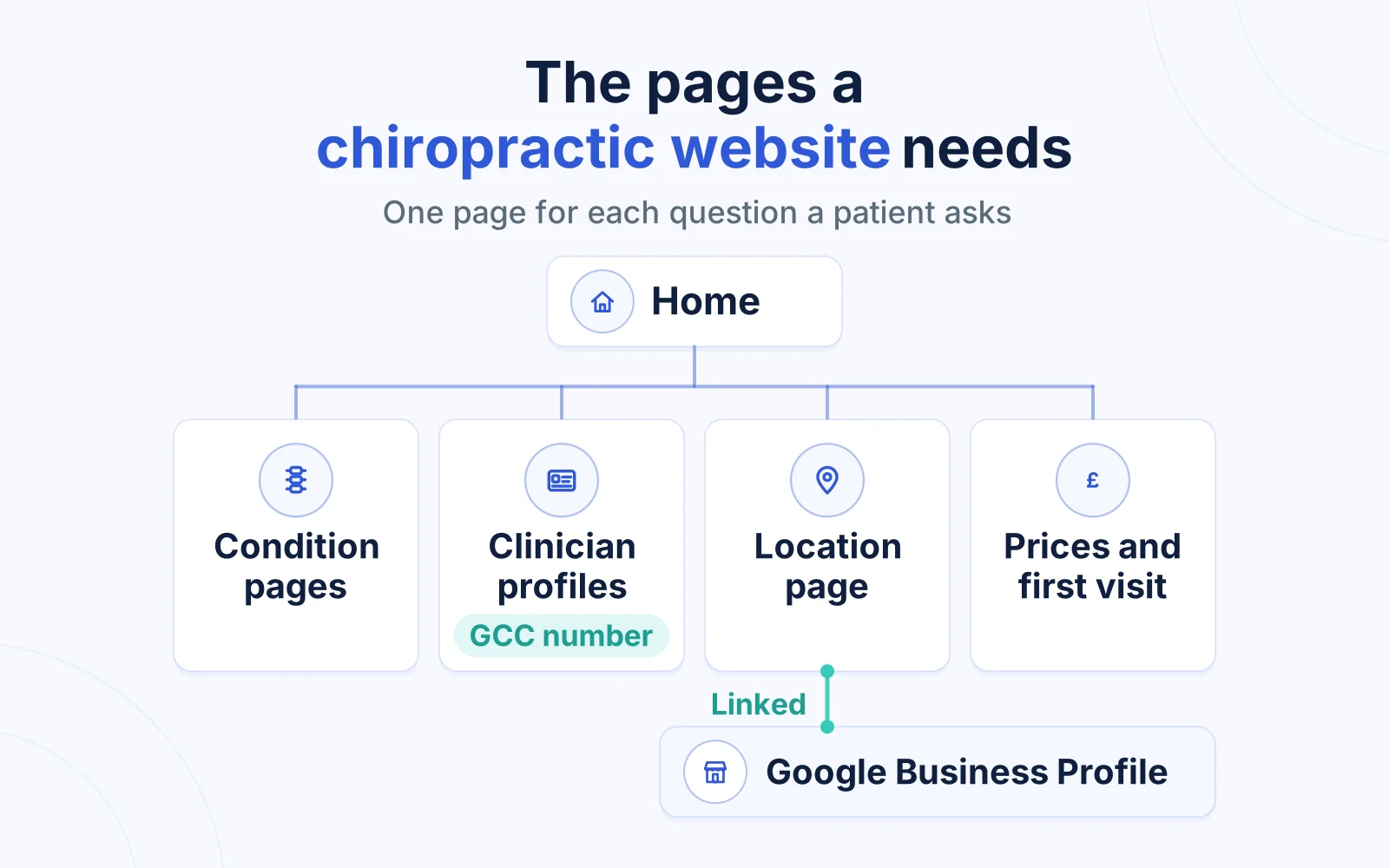
A chiropractic website should have one page for each accepted condition the clinic treats, a profile for every chiropractor, a page for each clinic location, a prices page, a first visit page and a booking route that works on a phone.
| Page | The patient’s question | What goes on it |
|---|---|---|
| Home page | Who are you, and where? | Clinic name, town, the registered chiropractors, a booking button |
| Condition pages | Can a chiropractor help with my sciatica? | The CAP wording, what the first visit involves, the chiropractor who sees these patients |
| Clinician profiles | Who will treat me, and are they registered? | GCC registration number, qualifications, title wording where Dr is used |
| Location page | Is there a chiropractor near me? | Address, map, parking, opening hours |
| Prices page | How much does a chiropractor cost? | A price range for the first visit and for follow up appointments |
| First visit page | What happens at my first appointment? | What the assessment involves, how consent works, what to wear |
| Booking | Can I book now? | A form or booking tool that works on a mobile |
Publish prices. A range for the first visit and for follow up appointments answers the cost search directly and saves a patient a phone call to ask.
Each condition page follows the structure we use for service pages written for answer engines: the answer in the first sentence, then the detail, then the chiropractor who sees these patients. A blog earns its place when it explains an accepted condition in more depth, such as what a first assessment for lumbago involves. Generic posts on posture tips or seasonal wellness don’t answer the searches that bring new patients, so we leave them out.
How do patients search for a chiropractor?
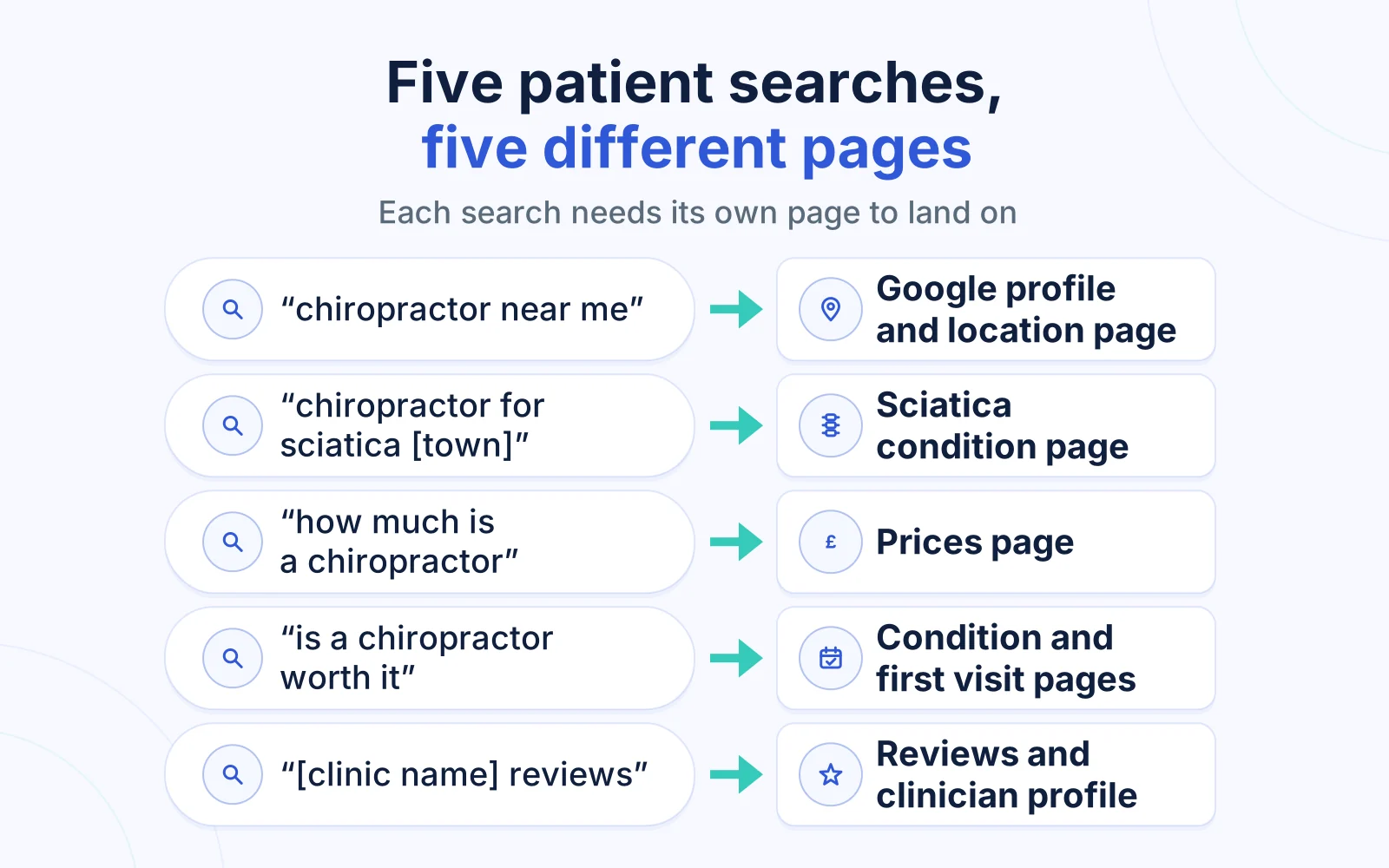
Patients search for a chiropractor in five patterns: by distance, by condition and town, by cost, by whether treatment is worth it, and by the name of a clinic or chiropractor they are checking before they book.
| What they type | What they mean | The page that answers it |
|---|---|---|
| chiropractor near me | Show me a registered clinic I can get to this week | Google Business Profile and the location page |
| chiropractor for sciatica Cardiff | Does a chiropractor see sciatica, and is there one in my town? | The sciatica condition page, with the town named on it |
| how much is a chiropractor | What will the first visit cost me? | The prices page |
| is a chiropractor worth it for back pain | Should I book, or try something else first? | The back pain condition page and the first visit page |
| the clinic’s name followed by “reviews” | Can I trust this clinic and this chiropractor? | Google reviews and the clinician profile |
A patient may run several of these searches before booking. Google says its AI Overviews and AI Mode may do something similar on their behalf, running several related searches for one question, which is what query fan-out describes. A clinic whose pages answer all five has an answer ready at each step.
How does a chiropractic clinic get onto the Google map?
A chiropractic clinic improves its chance of a place in the map and three clinics Google shows at the top of local searches with the right Google Business Profile category, a steady flow of real patient reviews, matching clinic details and a location page.
Google’s Business Profile help says local results are based mainly on relevance, distance and prominence, and that more reviews and positive ratings can help a business’s local ranking. Google also states there is no way to request or pay for a better local ranking.
Here is what we set up for each clinic:
Category and services.
The most specific chiropractor category Google offers as the primary category, with services that match the accepted conditions you treat.
Matching details.
The same clinic name, address and phone number on the website, the profile and directories, including professional association listings where the clinic is a member.
A page to land on.
A link from the profile to a page about that clinic.
Real photos.
The clinic front, the treatment rooms and the team.
A review routine.
A request to every patient after their visit, with a link straight to the review form.
Replies to reviews.
Every review answered, with the same care over claims as the website.
The work sits inside our local SEO service for single site businesses, which puts your clinic in front of patients searching in your town and covers one clinic on the Local SEO plan.
Why do AI assistants name one chiropractor and not another?
AI assistants such as ChatGPT, Gemini, Perplexity, Copilot and Google AI Overviews can only name a chiropractor from what they find, so a clinic whose details match across its website, the GCC register, its Google Business Profile and directories gives them clear facts to repeat.
Nobody outside the companies that build these systems can see exactly how they choose. What a clinic can control is how easy it is to verify. We work to six signals:
The clinician’s name on the website matches the name on the GCC register.
The GCC registration number sits on each clinician profile.
The clinic name, address and phone number match everywhere they appear.
The behind the scenes business details Google reads, such as your clinic name, address, opening hours and chiropractors, are set out in the page code (structured data).
Professional memberships, such as the British Chiropractic Association, the McTimoney Chiropractic Association, the United Chiropractic Association or the Royal College of Chiropractors, are listed where they are true.
Condition pages state accepted claims plainly, so an assistant quoting them repeats something the clinic can support.
Moderate, checkable claims are an advantage here. Our AI search optimisation service applies these six signals across the whole site, so assistants find consistent facts about your clinic wherever they look.
Can a chiropractor use the title Dr, and should the GCC number be on the website?
A chiropractor on the GCC register can use Dr, because registration carries the courtesy title Doctor of Chiropractic, provided the public text makes clear that they are not a registered medical practitioner, according to the GCC and CAP AdviceOnline.
CAP AdviceOnline accepts Dr, DC and DoC in ads where the title is qualified so it does not mislead. The GCC notes that fewer than 25% of UK registrants use the title Dr, so leaving it off is a common choice.
The GCC says registrants may wish to include their registration number on their website, stationery, social media pages and advertising. We put it on every clinician profile, where it does two jobs. It tells a patient the chiropractor is registered. It also gives Google and AI assistants a fact they can check against the public register. The I’m Registered mark is for GCC registrants only, and its use by anyone not on the register is a criminal act.
One profile line can cover both points: the chiropractor’s name, the courtesy title Doctor of Chiropractic, the GCC registration number, and a plain statement that the chiropractor is not a registered medical practitioner.
Can chiropractors use patient testimonials and reviews?
Chiropractors can use patient testimonials and reviews, but the ASA says claims in testimonials need evidence, so a quote describing results for a condition outside the accepted list needs the same evidence as a direct claim by the clinic.
The ASA’s guidance “Avoid getting the ASA’s back up this back care awareness week” says claims in testimonials must be supported by evidence, and that includes implied claims about how well a treatment works. A patient quote about recovering from whiplash, placed on your website, implies the clinic treats whiplash, so it needs the same evidence.
Our testimonial and review rules for every clinic:
Experience quotes first.
Testimonials about the first visit, the explanation, the booking and the time the chiropractor took.
Outcome quotes on the list only.
Quotes about results stay with conditions on the accepted list.
Reviews asked for, never bought.
Every patient gets a review request and nothing in return. Since 6 April 2025 the Digital Markets, Competition and Consumers Act 2024 has banned fake reviews and concealed incentivised reviews, and the CMA’s fake reviews guidance says an incentive is not limited to money: discounts and vouchers count.
Careful replies.
Replies to reviews never repeat a claim the clinic could not make itself.
Should a chiropractor choose SEO or Google Ads?
Google Ads gives a chiropractic clinic visibility from the day a campaign starts and stops when the budget does; SEO builds pages and a profile that keep earning visits without a cost per click.
Both run under the same claim rules, so a condition the website cannot claim cannot go in an ad either.
Our position: start with the pages and the profile. An ad that sends a patient to a weak condition page pays for a click the page then loses. A new clinic, or one filling a second site, can add ads on top once the pages are ready. For a side by side view of the monthly numbers, our guide to what SEO costs in the UK sets out typical price bands.
What does an SEO service for chiropractors include?
An SEO service for chiropractors from True SEO includes eight named deliverables, from the claim check to the monthly bookings report, each built to bring new patients to a clinic while every claim on its site stays within CAP and GCC rules.
The Chiropractic Website Claim Check.
A page by page read of your site against the CAP list, the Dr title guidance and the testimonial rules, delivered as a written list.
The Condition Page Set.
One page for each accepted condition you treat, worded to the CAP qualifiers and written answer first.
Registered Clinician Profiles.
A profile for each chiropractor, with the GCC registration number and the correct title wording.
The Google Map Build.
Google Business Profile category, services, photos and links set up for each clinic.
The Review Request Routine.
A simple process that asks every patient for a Google review, plus reply wording that keeps to the claim rules.
Location, Prices and First Visit Pages.
The three pages that answer “near me”, “how much” and “what happens”.
AI Search Visibility.
Clinic details that match everywhere, the behind the scenes business details Google reads, and clinician names that match the GCC register, so AI assistants have facts to check.
The Bookings Report.
Call tracking on key pages and a monthly report of bookings by page, with traffic second.
Each deliverable removes one reason a patient picks another clinic. Under all eight sits our technical and on-page SEO work: page speed, a booking flow that works on a phone, and pages Google can find and read without errors.
What is in the free Chiropractic Website Claim Check?
The free Chiropractic Website Claim Check is a written review of every page on your website against the CAP accepted conditions list, the GCC guidance on the Doctor title and registration number, and the ASA rules on testimonials, with a list you keep.
True SEO Consultants Ltd sends you five things:
Safe claims.
The wording you can keep as it is.
Claims to reword.
Each one quoted, with the reason and wording that follows the CAP list.
Pages to build.
The accepted conditions you treat that have no page yet.
Clinician check.
Whether each profile carries the GCC number and the right title wording.
Testimonial check.
Quotes and reviews on your site that make a claim.
It’s free. There’s no obligation and nothing to sign. You keep the list whether or not you work with us, and you can hand it straight to your own web developer. We run it free because it shows you how we work before you spend anything.
The claim check is narrower than our full SEO audit service, which also covers technical health, rankings and competitors. For a regulated clinic, the claims come first.
Free for UK chiropractic clinics
Send us your website for a free claim check
Give us your clinic’s website address and we’ll send you the written list, with no obligation.
How much does SEO cost for a chiropractic clinic?
SEO for a chiropractic clinic costs from £399 a month on Local SEO, from £699 a month on Full service SEO and from £1,495 a month on the Niche SEO programme, with every price published and VAT excluded.
Local SEO
From £399 a month
- Rolling monthly.
- Cancel any month, with no notice.
- Suited to single site businesses, including clinics.
Full service SEO
From £699 a month
- Rolling monthly.
- No minimum commitment.
Niche SEO programme
From £1,495 a month
- Six or twelve month term.
- Area exclusivity: one client per niche per area.
- Milestone targets at 3, 6 and 12 months written into the engagement letter.
All prices exclude VAT.
Local SEO fits a single site clinic. The Niche SEO programme suits a clinic that wants its area closed to rivals on the same programme: we take one chiropractic clinic per area, and once that place is taken it isn’t offered to a competitor nearby. True SEO Consultants Ltd also gives a free first month of SEO to a few businesses at a time. It’s at our discretion and confirmed in writing before any work starts.
Nobody can guarantee a Google ranking, and we don’t. What we put in writing is the work and, on the niche programme, the milestone targets. Every plan is set out in full on our SEO packages page.
What happens in the first 90 days?
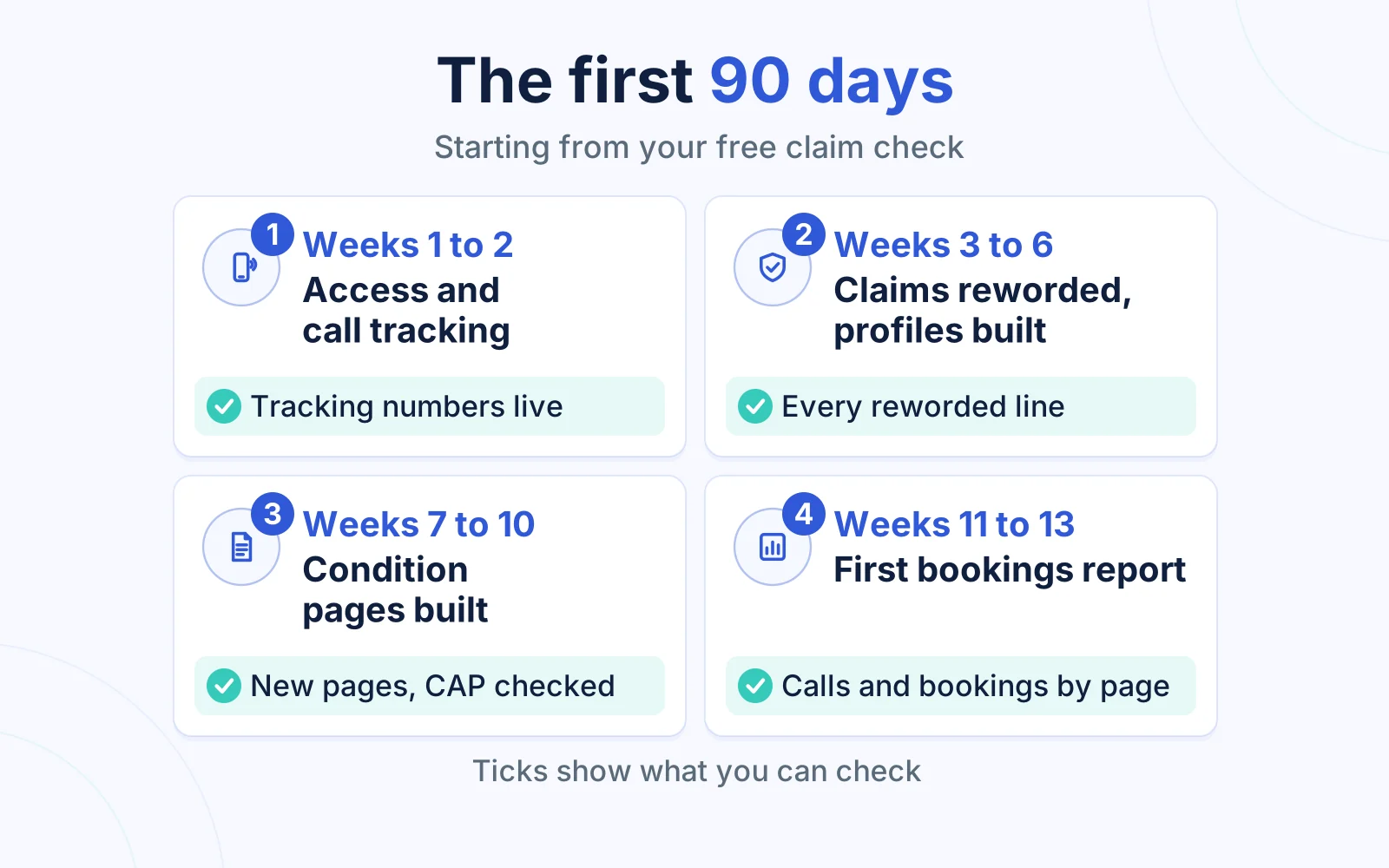
The first 90 days turn the claim check into live pages: weeks 1 to 2 set up access and tracking, weeks 3 to 6 fix claims and profiles, weeks 7 to 10 build new pages, and weeks 11 to 13 bring the first bookings report.
| Weeks | What we do | What you can check |
|---|---|---|
| 1 to 2 | Onboarding, access to your website, Google Business Profile and Search Console, call tracking on key pages | Tracking numbers live on your pages |
| 3 to 6 | Reword the claims on your claim check list, build clinician profiles with GCC numbers, set the profile category and services | Every reworded line, side by side with the old wording |
| 7 to 10 | Build condition pages for the accepted conditions you treat, plus location, prices and first visit pages | New pages live, each one checked against the CAP list |
| 11 to 13 | Review call and booking data, report bookings by page, plan the next quarter | Your first report: calls and bookings by page, and the searches bringing visits |
These are work stages you can see, not ranking promises. Rankings move at a pace no agency controls. For a longer view of the method, our Total Books Accountants case study shows first place across three services after eleven months, built on 358 mapped buying intents. That result came from accountancy, a different regulated profession.
Who is chiropractic SEO for, and who is it not for?
Chiropractic SEO suits a clinic with room in the diary for new self paying patients and a registered chiropractor willing to be named on its clinical pages; it does not suit clinics whose diaries are full or whose patients come mainly through insurers.
It suits:
- Single site clinics that want more self paying patients from their own town.
- Multi site groups opening or filling a new clinic.
- Clinics whose referrals have slowed.
- Clinics unsure whether their condition pages follow the CAP list.
Four kinds of clinic are a poor fit:
- Insurer led clinics, where most new patients arrive through insurer networks.
- Clinics at full capacity with a waiting list. More enquiries won’t help yet.
- Clinics unwilling to name a registered chiropractor on clinical pages. Every condition page we build carries a named, registered chiropractor.
- Clinics looking for a guaranteed ranking.
True SEO Consultants Ltd takes on clinics where the work can pay back: room for new patients, a named chiropractor, and a willingness to keep claims inside the list. A short call confirms whether your clinic is a fit.
How do you measure SEO when patients book by phone?
SEO for a chiropractic clinic is measured in bookings, not traffic: a tracking number on each key page shows which page made the phone ring, and a source question we set up with the clinic records where each new patient came from.
Call tracking per page.
A call from the sciatica page counts against the sciatica page.
Profile actions.
Calls and website clicks from the Google Business Profile, reported each month.
A source question.
We agree a “how did you hear about us” question with the clinic and add it to the booking form or reception script, with search and AI assistants as options.
Search data.
Search Console figures on the searches that bring visits to each page.
A bookings first report.
Each monthly report opens with bookings by page and closes with traffic.
Phone bookings are where most of the value sits for a clinic, so they are where the report starts.
How does SEO work for a multi site chiropractic clinic?
SEO for a multi site chiropractic clinic gives each clinic its own Google Business Profile, location page and clinician profiles, while the condition pages sit once on the main site and link to every clinic that offers them.
One profile per clinic, each with the most specific chiropractor category Google offers as its primary category, and its own address and phone number.
One location page per clinic, linked from that clinic’s profile.
Clinician profiles that state which clinics each chiropractor works at.
One set of condition pages, so two clinics never compete with each other for the same search.
Call tracking per clinic, so each site’s bookings are reported separately.
Opening a second clinic is the moment to set this up, because adding a site to a structure built for one is harder than starting with the right one. We run multi site work through remote digital onboarding and delivery, so clinics in different towns follow the same process and report in the same format.
Why choose True SEO for chiropractic SEO?
True SEO is a Cardiff consultancy that builds clinic websites compliance first, led by two directors with backgrounds in search, finance and business coaching, backed by published research, and working with clients across the UK through remote digital onboarding and delivery.
Mohammad A Mahmud founded the consultancy and has worked in search since 2010. He holds an MSc in applied accounting and trained in the semantic SEO and topical authority method. You can read more on Mohammad A Mahmud’s background in search. Julie Williams, co-director, is a certified business coach with more than thirty years of commercial and finance experience.
True SEO Consultants Ltd is based at Startup Stiwdio, University of South Wales, 86-88 Adam Street, Cardiff, CF24 2FN. Our first published study, Research Report TSC-2026-01, audited 494 UK accountancy practice websites and carries a registered DOI. Our own audit of 50 UK chiropractic clinic websites, published in full, shows where most clinic sites fall short.
The results we can show come from other sectors, led by accountancy, a regulated profession with its own rules on what a firm may say. They prove the method, not a chiropractic result:
Total Books Accountants: first place across three services after eleven months, with 358 buying intents mapped.
A Cardiff local business: 44 first page rankings, nine of them at position one.
One client: from 773 to 2,300 organic visits a month, with 183% visibility growth in a year.
For a chiropractic clinic, the work starts with the claim check.
How to choose an SEO agency for a chiropractic clinic
Choose an agency that words condition pages to the CAP list, tells you who checks clinical content, reports bookings rather than traffic, and publishes its prices and notice terms.
Questions to ask any agency:
- Will you word every condition page to the CAP accepted list?
- Who checks clinical pages before they go live, and does a registered chiropractor approve them?
- Will you report bookings by page?
- What is the notice period, and is it in writing?
Warning signs:
- A guaranteed ranking.
- Condition pages for whiplash, frozen shoulder or colic without the clinic’s own evidence.
- Bought or incentivised reviews.
- Prices you only hear on a sales call.
Frequently asked questions
Can chiropractors say they treat sciatica?
Yes, chiropractors can say they treat sciatica, because sciatica is on the CAP accepted list. The list allows general references to sciatica, as opposed to pain reduction claims, so “we see and treat patients with sciatica” fits the guidance while a promise to reduce sciatic pain does not. The ASA’s 2017 evidence review found claims on sciatica supported.
Can we mention whiplash on our website?
A chiropractor cannot claim to treat whiplash without their own strong body of clinical evidence, because whiplash is not on the CAP accepted list. The ASA’s 2017 evidence review did not find whiplash demonstrated. You can describe mechanical neck pain, which is accepted, but neck pain following an injury such as whiplash sits outside the list.
Can a chiropractor use the title Dr?
Yes. GCC registration gives a chiropractor the courtesy title Doctor of Chiropractic, and Dr can be used when the website makes clear they are not a registered medical practitioner, which the GCC requires. CAP AdviceOnline adds that the title must be qualified so it does not mislead. The GCC notes that fewer than 25% of UK registrants use the title Dr, so leaving it off is a common choice.
Do we need our GCC registration number on the website?
The GCC leaves the choice to you: it says registrants may wish to include their registration number on their website, stationery, social media pages and advertising. We put the number on every clinician profile, where it tells patients the chiropractor is registered and gives Google and AI assistants a fact to check against the public register. The I’m Registered mark is for registrants only.
How long does SEO take for a chiropractic clinic?
SEO for a chiropractic clinic shows its first visible work inside 90 days: reworded claims, clinician profiles, new condition pages and live call tracking. Ranking movement takes longer and depends on your town and your competitors, so we don’t promise a date. On the niche programme, milestone targets at 3, 6 and 12 months go into the engagement letter.
Do you work with chiropractors outside Cardiff?
Yes. True SEO Consultants Ltd works with chiropractic clinics across the UK through remote digital onboarding and delivery, so a clinic in Leeds, Bristol or Glasgow follows the same process as one in Cardiff. The claim check, onboarding, reporting and calls all run online, and you never need to travel to see us.
Will you guarantee rankings?
No. Nobody controls Google’s rankings, so an agency promising a position is promising something outside its control. We commit in writing to the work instead: named deliverables, rolling monthly terms on Local and Full service SEO, and on the niche programme, milestone targets at 3, 6 and 12 months in the engagement letter.
What is in the free Chiropractic Website Claim Check?
The free Chiropractic Website Claim Check is a written list covering every page of your site: the claims that are safe, the claims to reword and why, and the accepted conditions you treat that have no page yet. It also checks clinician profiles for the GCC number and title wording, and testimonials for claims. You keep the list.
Do you work with osteopaths?
Yes, osteopathy clinics are covered by our healthcare SEO work. The ASA and CAP framework for marketing claims applies to osteopaths too, and their regulator is the General Osteopathic Council (GOsC) rather than the GCC. The chiropractic list on this page does not carry over, so osteopath pages are checked against CAP AdviceOnline’s separate guidance, Health: Osteopathy.
Should a chiropractor publish prices?
Yes. A price range for the first visit and for follow up appointments answers the “how much is a chiropractor” search directly, and a patient who already knows the cost can book without phoning to ask. We include a prices page in every chiropractic page set we build, worded as a range rather than a single fixed figure.
Do chiropractors need a blog?
A chiropractor needs condition explainers, not a general wellness blog. Posts that explain an accepted condition in more depth, such as what a first assessment for lumbago involves, support the condition pages and answer follow up questions. Generic posts on posture tips or seasonal wellness don’t answer the searches that bring new patients, so we leave them out.
Find out what your website can claim
The quickest first step is the free Chiropractic Website Claim Check: send us your website address and we’ll send back the claims to keep, the claims to reword and the condition pages you can build, with nothing to sign.
True SEO Consultants Ltd works with chiropractic clinics across the UK from its Cardiff base. Prefer to talk first? Book a free 30 minute strategy call, or ring 0333 240 7747.