Social Media That Backs Up Your Business In Search
Profiles that corroborate who you are, not a feed that fills itself
Social media does not lift your ranking position, and anyone who tells you otherwise is selling a monthly retainer. What it does do is confirm your business exists, trades where you say it does and is called what you say it is called, which is what search engines and AI assistants check before they describe you to anyone.
- We turn most of this work down. Three questions decide whether social is worth funding, and for a good share of businesses the honest answer is a one-off correction pass
- Judged on enquiries, not engagement. Reach, impressions and follower counts are reported because platforms report them, not because they mean anything to you
- It runs inside the SEO programme. Never sold as a separate line item with its own strategy, because two strategies for one business is how a name ends up spelled three ways
- Entity corroboration
- AI answer visibility
- NAP consistency
- Profile audits
- Cardiff and UK wide
Find out whether social is worth funding at all
- Whether your profile details actually agree with your website and Business Profile
- What an AI assistant currently says when asked about your business by name
- Which of the three funding questions your business fails, if any
- An honest answer when the money belongs in content or technical work instead
No charge, no obligation, and you keep the written findings.
Social media and search visibility, in five points
Social profiles are a corroboration layer, not a ranking lever. They give search engines and AI assistants independent sources that agree with your website, which changes how confidently you are described rather than where you appear.
- Social signals are not a ranking factor. Google has said so repeatedly and the correlation people cite runs the other way: pages that do well get shared, not the reverse.
- Corroboration is a real mechanism. An assistant answering a question about your business repeats what it can verify from more than one source. Contradictory details make it hedge, or leave you out.
- Consistency beats volume. One accurate profile that matches your site is worth more than six active ones that disagree about your phone number.
- Most businesses need a correction, not a retainer. A one-off pass across every profile fixes the mechanism. Weekly posting only matters where buyers genuinely check before enquiring.
- It is judged on enquiries. If social work cannot be traced to qualified enquiries within a quarter, it is a brand expense, and it should be described as one.
Not sure whether any of this applies to you?
The free thirty-minute review checks what your profiles currently say, whether they agree with each other, and what an AI assistant answers when asked about your business. If the honest conclusion is that your budget belongs in topical structure or technical work instead, we will say so on the call.
What do social profiles actually do for search and AI visibility?
They act as independent confirmation. Your website claims a name, an address, a phone number and a line of work; a profile on a platform Google already trusts repeats those claims from somewhere you do not control the code, which is what makes the agreement worth something.
What social actually contributes, and where it sits in the chain
Swipe the diagram sideways to see all of it.
Three things happen when the details agree. Search engines have less reason to doubt which business a query refers to, which matters most for firms with a common name or a shared address. AI assistants, which increasingly answer the question before anyone reaches a website, repeat a description they can verify twice rather than hedging. And a person who has found you in search and is now checking whether you are real finds a profile that was updated this year rather than in 2021.
None of that is a ranking mechanism. It is a confidence mechanism, and confidence is what decides whether you are named in an answer or summarised out of it. We cover the answer-engine side of this in more depth on our page about ranking in AI and LLM answers.
Which social platforms actually corroborate a business entity?
The ones search engines crawl, index and already associate with organisations: LinkedIn, YouTube, Facebook and, for some sectors, Instagram. Platforms that block crawling or hide business details behind an app contribute almost nothing to corroboration, however well they perform commercially.
| Platform | What it corroborates | Worth funding activity for |
|---|---|---|
| Company name, sector, location, people and their roles. The strongest single corroboration source for a B2B firm | B2B services, recruitment-sensitive firms, anyone whose buyers check the team | |
| YouTube | Name, description, links and a body of content search can actually read via transcripts | Anything explained better shown than written, and anyone already producing video |
| Name, address, phone, opening hours and category. Still the most consistently indexed local business record after the Business Profile | Local and consumer businesses, particularly with a physical address | |
| Name, category and a link. Limited detail, but well indexed for consumer brands | Consumer, hospitality, retail, anything where the product is visual | |
| X | Name and a link. Crawling has been inconsistent since the API changes, so treat it as optional | Rarely worth funded activity for a small services business |
| TikTok | Very little that machines read. Bio and link only | Only where the audience genuinely is there, and never for corroboration |
The two columns are deliberately separate because they are separate decisions. A platform can be commercially excellent and contribute nothing to how you are described, which is the case for most short-video work. The corroboration argument justifies claiming and correcting a profile. It does not, on its own, justify posting to it every week.
Should you be paying for social media at all?
Three questions decide it. Do buyers check you before enquiring, are your profile details already correct, and do you have something worth saying weekly? Unless all three hold, a funded programme is the wrong purchase and we will say so.
Three questions, and the honest answer at each exit
Swipe the chart sideways to read all of it.
The first exit is the one people argue with. If nobody checks your social profiles before enquiring, posting to them is a cost with no mechanism attached: there is no audience being persuaded and no corroboration being added that a corrected profile would not already provide. Trade suppliers, most professional services outside recruitment and almost every emergency-call business sit here.
The second exit is where most businesses land, and it is the cheapest useful answer in this entire page. Claim what is unclaimed, correct what disagrees, remove what is abandoned, and stop. It takes a day or two and it does not recur.
Only businesses that clear all three questions should be buying ongoing work, and even then it belongs inside the search programme rather than beside it, so the same facts, the same descriptions and the same priorities apply everywhere.
How do social profiles change what search engines and AI assistants say about you?
Through a four-step chain: you publish details, the details agree everywhere, search engines corroborate the entity because independent sources match, and assistants then describe you correctly because they are repeating something they can verify.
The corroboration chain, and the step everybody skips
Swipe the chart sideways to read all of it.
The chain fails in a boringly consistent way. A business rebrands, updates the website, updates the Business Profile, and leaves four social profiles carrying the old trading name and a phone number that was disconnected two years ago. Nothing breaks visibly. What happens instead is that an assistant asked to describe the business produces something vague, or names the old entity, or declines to commit to an address.
That is not a penalty and it will never appear in any report. It is an absence of confidence, and it costs you at exactly the moment a buyer is checking whether you are the firm they were told about. The same logic governs how a business with several branches is understood, which we cover on our page about local and multi-location SEO.
Does posting more improve rankings?
No. Posting frequency has no direct effect on ranking position. It affects how much of what you have already published gets seen, and how current your business looks to somebody checking, which are worth having but are not the same thing.
What social moves, and what it does not
Swipe the chart sideways to read all of it.
It is worth being precise about why, because the myth is durable. Links from social platforms are almost all nofollow or equivalent, so they pass no authority. Engagement metrics are platform-internal and not available to a crawler as a quality signal. And the studies that appear to show a correlation are measuring the obvious: content that performs well in search also gets shared, because more people see it.
What posting genuinely does is distribute. If you have published a good piece of work, social is how the people who would benefit from it find out it exists, which sometimes produces a link from somebody who does pass authority. That is a second-order effect and it depends entirely on the work being worth linking to, which is a content question rather than a social one.
How do you keep a business name, address and phone number consistent across profiles?
By writing the canonical version down once, in one document, and treating every profile as a copy of it. The failure is never that somebody disagrees about the address. It is that nobody has ever written the correct version in one place.
| Field | Where it drifts | What the mismatch does |
|---|---|---|
| Legal and trading name | Old trading name left on profiles after a rebrand or an acquisition | Splits the entity in two, so neither version accumulates confidence |
| Address format | Suite numbers, floor references and abbreviations written differently on each platform | Weakens the match against the Business Profile, which matters most for local results |
| Phone number | An old landline, a tracking number, or a mobile on one profile only | Tracking numbers are the single most common cause, and the most avoidable |
| Category or sector | Chosen quickly at signup and never revisited | Miscategorises the business in exactly the comparison an assistant is making |
| Website link | Points at http, a www variant, or a page that now redirects twice | Wastes the clearest signal you have connecting the profile to the site |
| Description | Written separately on each platform, so the business describes itself three ways | Gives an assistant three candidate descriptions and no reason to prefer any of them |
The audit takes an afternoon and it is the highest-value hour on this page. We check every profile we can find, including the ones nobody remembers creating, list what disagrees, and hand back a single canonical record. Abandoned profiles get claimed and corrected or deleted, because an accurate absent profile is better than an inaccurate live one.
What does social support look like alongside an SEO programme?
A plan with a small number of specific jobs, not a content calendar. Correct the profiles, keep them current, distribute the work the SEO programme is already producing, and report what any of it did to enquiries.
A plan with jobs, rather than a calendar with slots
Swipe the diagram sideways to see all of it.
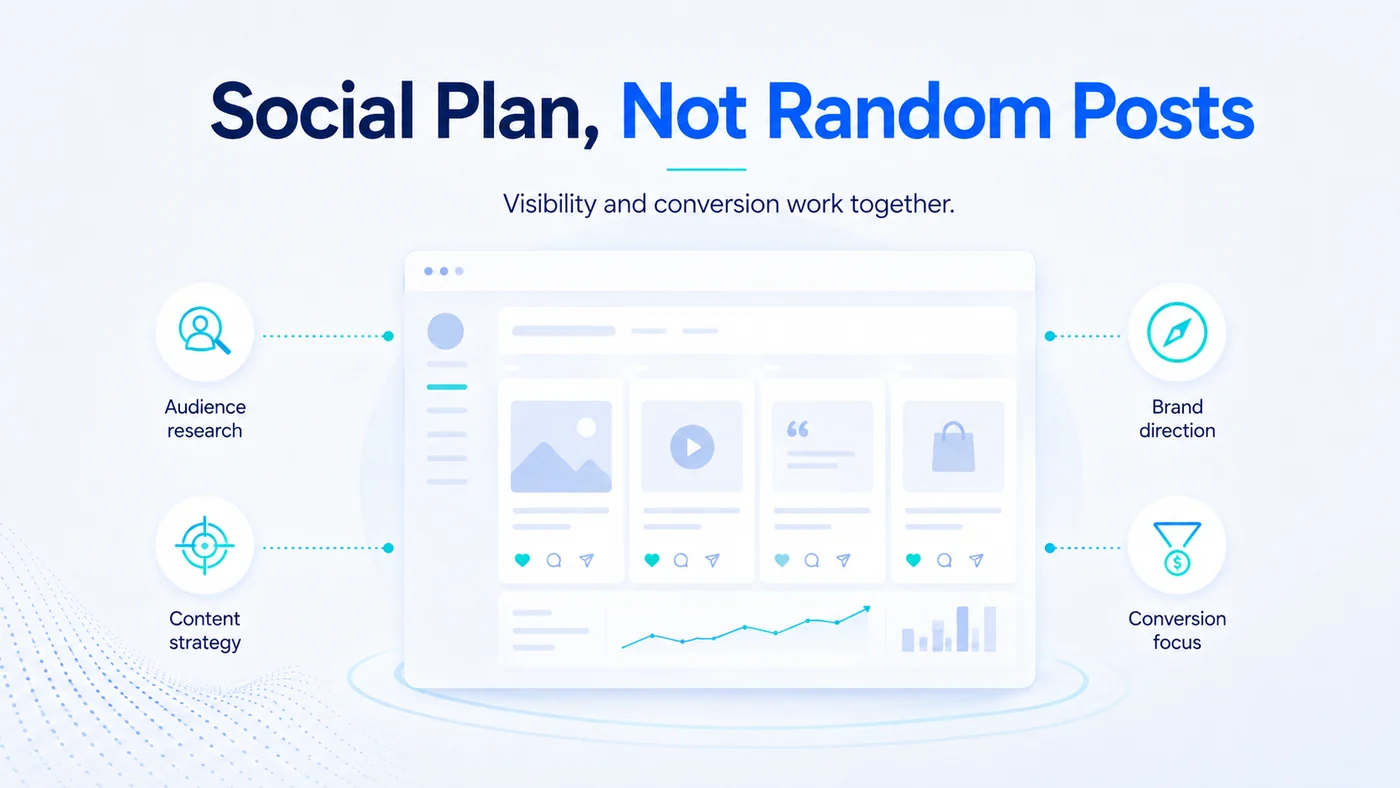
In practice it is four things. The audit and correction pass described above, done once. A quarterly re-check, because platforms change fields and staff change numbers. Distribution of whatever the content programme has published that period, written for the platform rather than pasted into it. And a line in the monthly report showing enquiries attributed to social, next to the ones attributed to organic search, so the two can be compared honestly.
Where the work is genuinely audience-building rather than corroborating, we say so and price it separately, because it is a different job with a different measure. Our page on personal branding SEO covers the case where the person, rather than the company, is the entity people search for.
What does social support cost alongside an SEO programme?
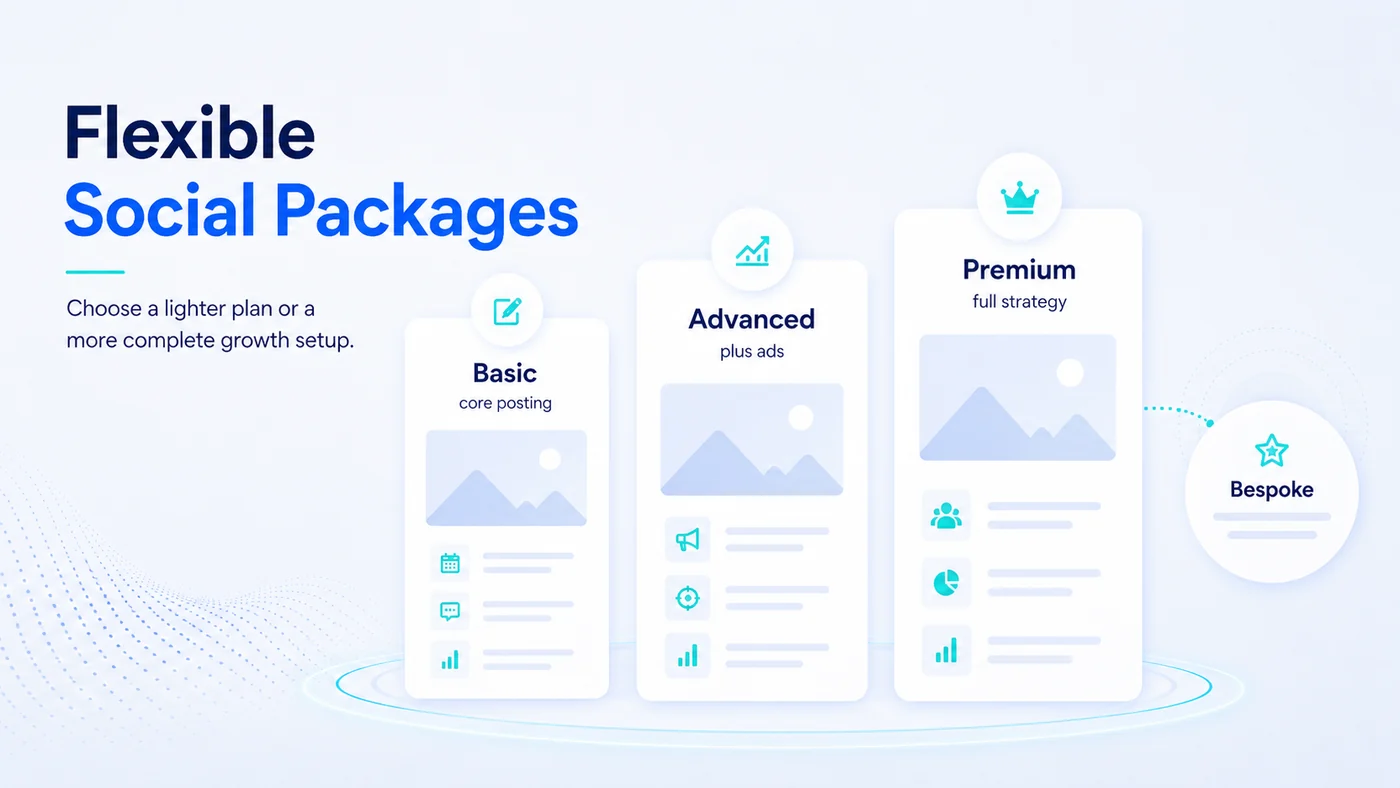
It is scoped after the free review and quoted as a defined piece of work, not billed by the hour and not sold as a standalone retainer. Three things move the number, and none of them is follower count.
Scoped to the work, rather than to a package tier
Swipe the diagram sideways to see all of it.
The first driver is how many profiles exist and how far they have drifted. A business with three profiles that broadly agree is an afternoon. A business with eleven, four of them created by former staff and two carrying an old trading name, is a week, and most of that week is finding them.
The second is whether anything ongoing is required at all. For the majority of businesses reaching the second exit on Chart 1, there is no recurring cost, because the correction pass does not recur. Where ongoing work is genuinely warranted, it is quoted as a defined monthly scope inside the search programme rather than as its own retainer.
The third is whether content is being produced to distribute. Distribution is cheap when a content programme is already running and expensive when social is expected to generate the material itself, which is the point at which most social retainers stop being good value. If cost is the question you actually came here with, our page on what SEO costs in the UK explains how the whole programme is scoped and billed.
How will you know whether any of it worked?
By the measures that connect to money. Qualified enquiries attributed to social, branded search volume, and whether an assistant asked about your business now describes it correctly. Reach and engagement are reported but are not the test.
| Metric | What it really tells you | Use it to decide spend? |
|---|---|---|
| Qualified enquiries from social | How many people arrived through a profile or post and were worth talking to | Yes. This is the test |
| Branded search volume | Whether more people are searching for you by name, which is the slowest and most honest signal there is | Yes, over quarters rather than weeks |
| Correct AI description | Whether assistants now name, locate and categorise you accurately when asked | Yes, as a pass or fail check rather than a trend |
| Profile consistency score | How many of the six fields match across every live profile | Yes, and it should reach 100 per cent and stay there |
| Referral sessions | Traffic arriving from a platform, undercounted because most apps strip the referrer | Weakly. Treat it as a floor, never a total |
| Reach and impressions | How many times a platform chose to show something. Set by its algorithm, not by you | No |
| Followers | How many accounts pressed a button, some years ago, some of them not real | No |
| Engagement rate | Whether the format suited the platform that week | No |
The bottom four rows are the ones that fill most social reports, and there is a reason: they always move, so there is always something to present. The top four are harder to shift and harder to fake, which is precisely why they are the ones worth agreeing before any work starts.
Which businesses is this right for, and which is it wrong for?
It suits businesses that are checked before they are contacted, or that have several profiles saying different things. It is wrong for businesses whose website cannot be found, because social cannot fix a discoverability problem it does not touch.
Strategy first, then the channels that serve it
Swipe the diagram sideways to see all of it.
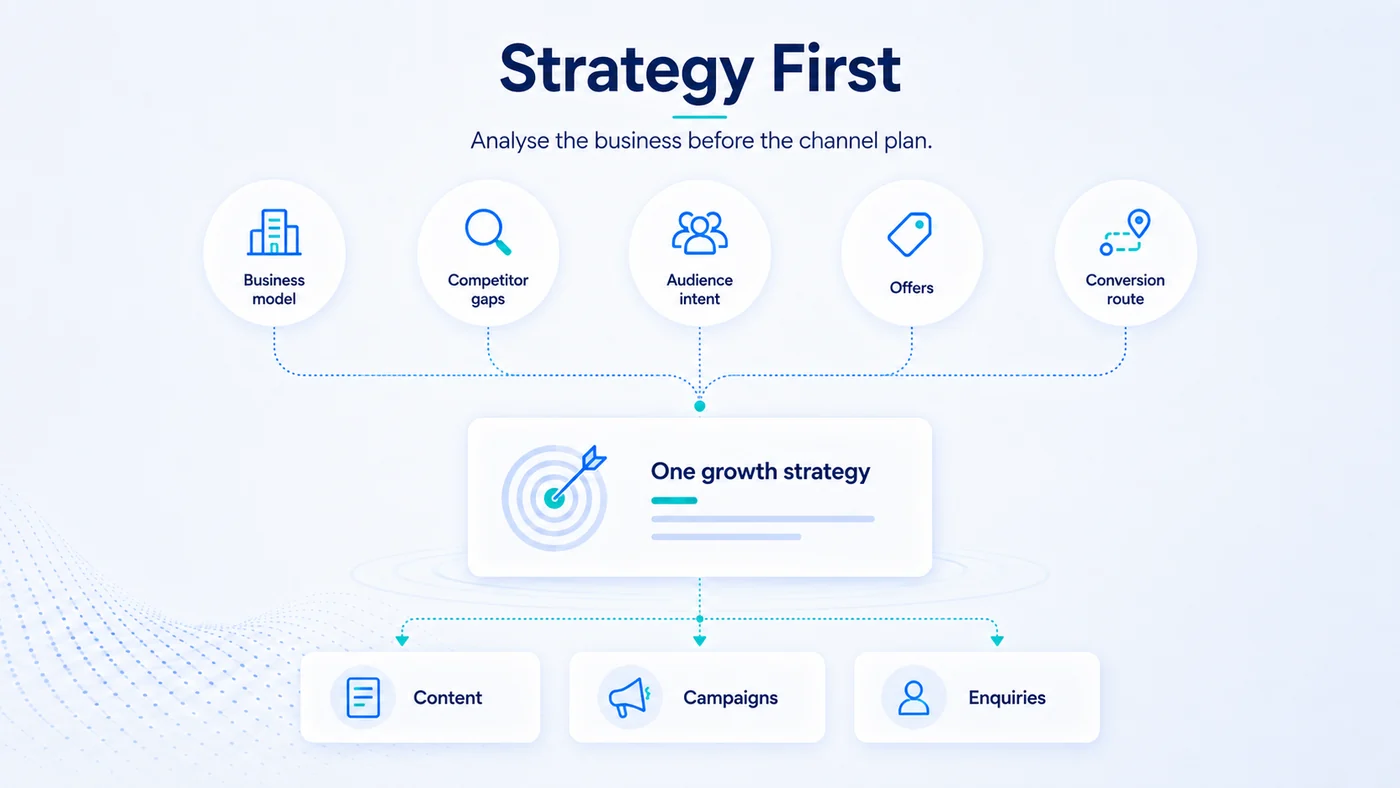
The clearest fit is a firm whose buyers research before they enquire: professional services, healthcare, anything where a person is choosing who to trust with something that matters. Recruitment-sensitive businesses are a close second, because candidates check profiles even when clients do not. Multi-branch businesses are a third, because every extra address is another opportunity for the details to disagree.
The clearest mismatch is a business whose site does not rank for the things it sells. Adding a corroboration layer to a business nobody can find changes nothing, and the money belongs in the search programme until that is fixed. We would rather tell you that on the call than six months into an invoice, and it is the same reasoning we apply on our accountancy SEO work, where LinkedIn genuinely does earn its place and most other platforms do not.
Do you work with businesses in Cardiff and South Wales?
Yes. We are a Cardiff consultancy, and a good share of this work is for businesses across South Wales, with the rest across the UK, delivered remotely.
Local work has one practical advantage here in particular. Profile drift is usually caused by something nobody wrote down: a number that changed when the office moved, a trading name that was only ever half-adopted, a profile created by someone who left. Half an hour in a room with the people who answer the phone surfaces more of that history than any audit tool.
Everything else is identical wherever you are. Our Cardiff SEO work covers the local search side, and the corroboration work described here runs inside whichever programme you are on.
Structure and topical depth
The layer that decides what you can rank for at all.
Semantic SEO and topical authorityFrequently asked questions about social media and search visibility
Are social signals a Google ranking factor?
No. Google has stated repeatedly that likes, shares and follower counts are not used as ranking signals, and the links social platforms produce are almost all nofollow. The correlation people cite runs the other way round: content that already performs well in search gets shared more, not the reverse.
Then why does social media help at all?
Because ranking is not the only thing that decides whether you get the enquiry. Profiles corroborate that your business exists as described, which changes how confidently search engines and AI assistants describe you, and they are what a buyer checks after finding you and before calling.
How many platforms do we actually need?
Fewer than you have. For most businesses the answer is a Business Profile, LinkedIn, and one consumer platform if the audience genuinely uses it. Everything beyond that adds another record to keep accurate, and an inaccurate profile is worse than no profile.
Should we delete profiles we never use?
Claim and correct them first, delete only if they cannot be claimed. An abandoned profile with the right details still corroborates. An abandoned profile with the wrong phone number actively contradicts your website, which is the situation worth spending money to end.
Do you run paid social advertising?
Selectively, and only where it can be judged on cost per qualified enquiry rather than on reach. Paid amplification works best on a programme that is already converting organic traffic, because it multiplies whatever the site currently does with a visitor, including nothing.
Will this get us named when someone asks an AI assistant for a recommendation?
It removes one of the reasons you would be left out. Assistants prefer businesses they can verify from more than one source, so contradictory details make an answer hedge or omit you. Consistency is necessary rather than sufficient, and the rest of the work is on the site itself.
How long before we see anything?
The correction pass produces its effect as soon as profiles are recrawled, typically within a few weeks. Branded search movement takes quarters. If somebody promises you a visible result inside a month, they are describing engagement metrics rather than enquiries.
Can we hand this to someone junior internally?
The posting, often yes, and it is usually better in-house because they know the work. The audit and the canonical record are worth doing properly once, because everything internal posting does afterwards inherits whatever that record says.
What if we decide social is not worth it after all?
Then correct the profiles, leave them accurate and stop. That is a legitimate outcome and it is the one we recommend most often. It costs a day, it does not recur, and it keeps the corroboration benefit without funding activity nobody was reading.
The next step
Find out what search actually says about you
Book a free thirty-minute review. We check what your profiles currently claim, whether they agree with your website and Business Profile, and what an AI assistant answers when asked about your business by name. If the honest conclusion is that social is not where your budget belongs, we will tell you that on the call.