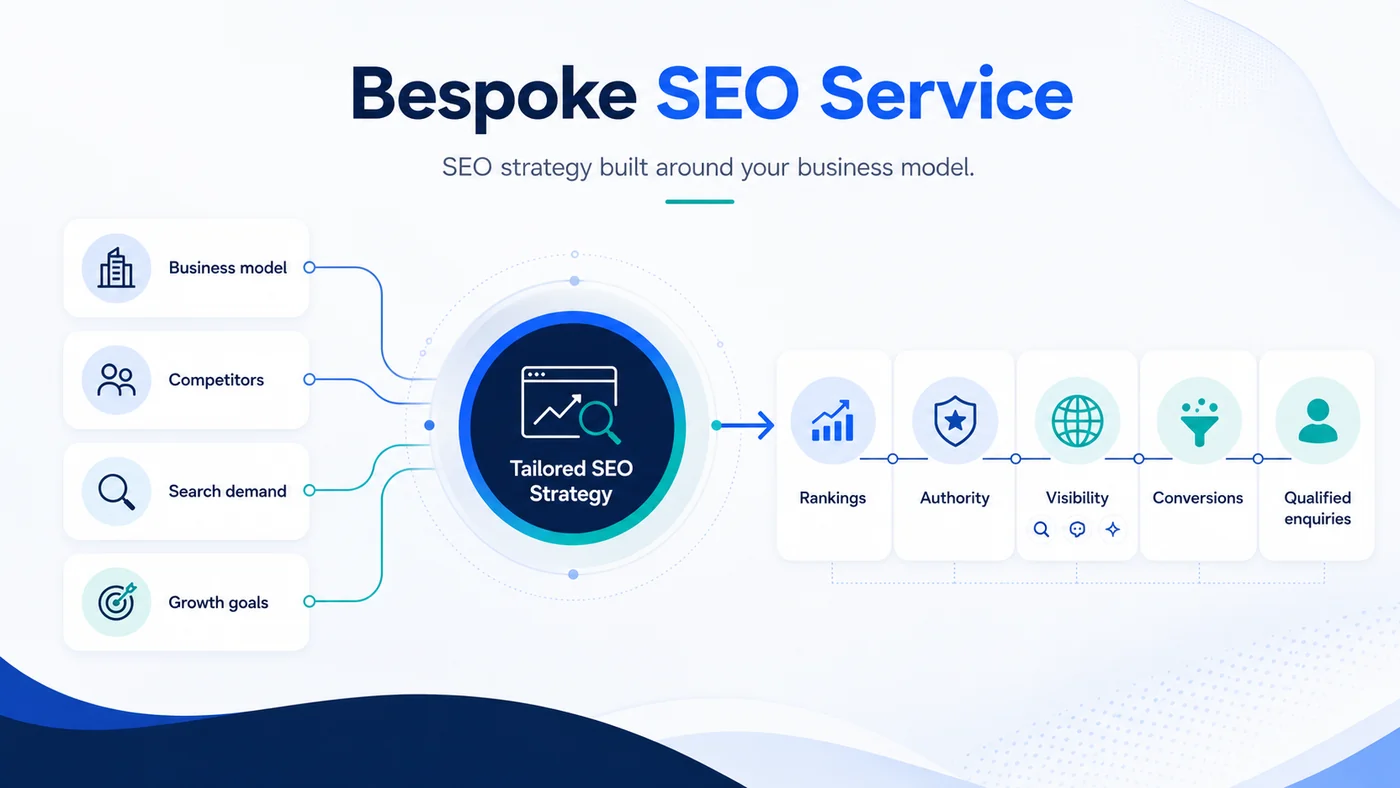
Bespoke SEO built around your business model, not a template
Scope decided after the diagnosis, never before it.
Most SEO proposals arrive with the scope already decided. Four blogs, ten links, a technical fix list, the same shape whether you sell a 300 pound service or a 30,000 pound one. Bespoke SEO reverses that order. We work out what your business needs to rank for, and what your buyers actually do, before anyone agrees what gets built.
- Diagnosis first. Nothing is published before the topical map is agreed.
- Roughly 750 to 3,500 pounds a month for UK bespoke work, driven by market and site size.
- Technical movement in weeks. Commercial ranking movement between month three and month six.
- About a third of our free reviews end with us recommending a fixed package instead.
- Cardiff consultancy, delivering across the United Kingdom and worldwide, fully remote.
- No minimum term
- 30 days notice
- Billed on agreed KPIs
- Free scoping audit
Find out whether you need bespoke at all
- The competitors actually beating you, named, not a generic list
- Which of your pages are competing with each other for one query
- Where the first pound of budget should go, and what it should not go on
- An honest answer on whether a fixed package would serve you better
No charge, no obligation, and you keep the written read either way.
What to know before you buy bespoke SEO
What bespoke SEO is, what a plan contains, how the engagement runs, what it costs and what changes the price, who should build it, when a fixed monthly package is the better buy, and when bespoke is the wrong answer altogether.
Talk it through before you commit to anything. Our free 30-minute review looks at your current position, the competitors actually beating you and where the budget should go first, and you can book a free 30-minute SEO review without a proposal attached.
What is bespoke SEO, and how does it differ from a standard SEO service?
Bespoke SEO is a search programme whose scope is set by your business model rather than by a price tier. A standard service decides the deliverables first and fits your business to them. A bespoke programme diagnoses first, then commits to deliverables that follow from the diagnosis.
Five commercial inputs, one growth direction, four things it briefs
Swipe the diagram sideways to see all of it.
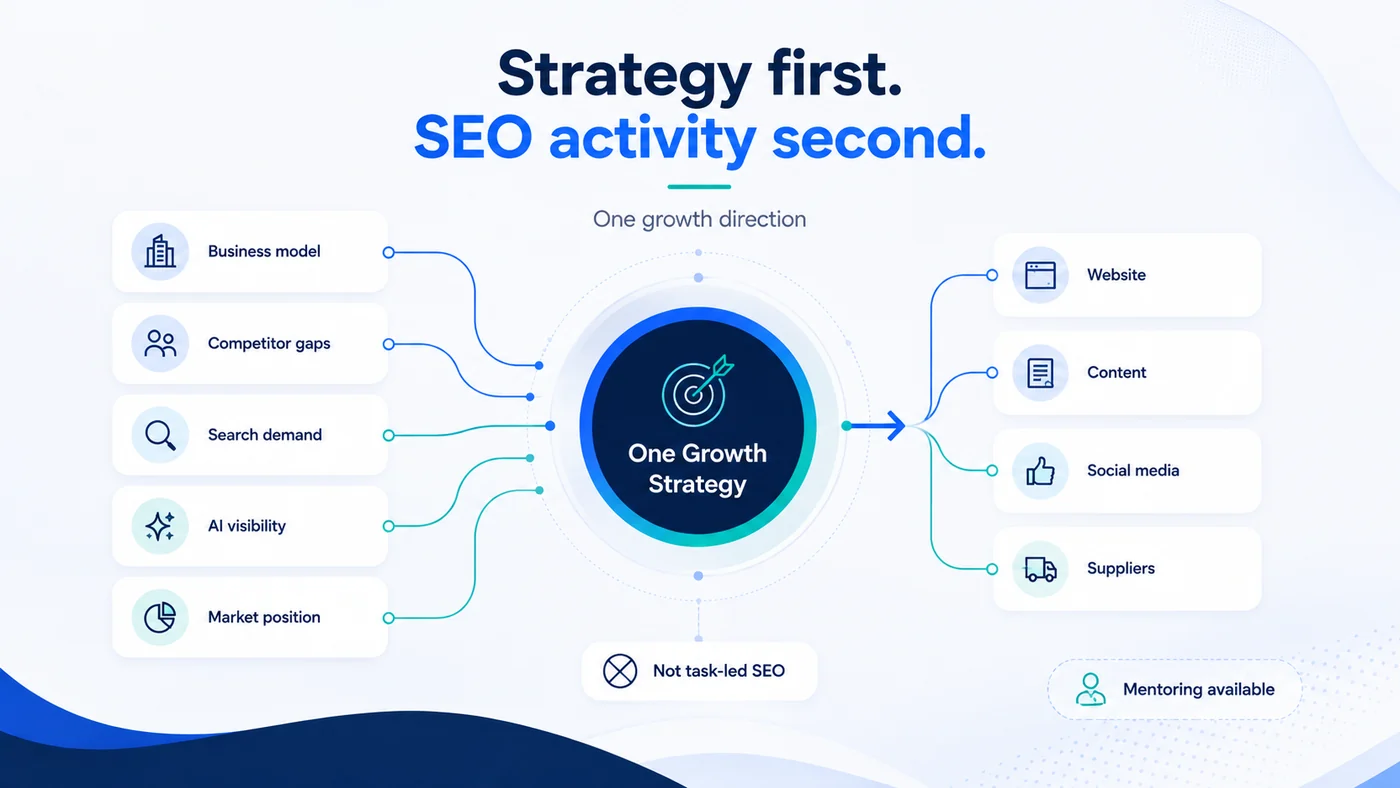
That difference is not about effort or cost. It is about the order of two decisions.
A packaged service answers “what do we do for 800 pounds a month” and then finds work to fill it. A bespoke programme answers “what is stopping this business ranking, and what sequence fixes it fastest” and then prices that answer. Two firms on the same budget can end up with completely different plans. One gets a technical rebuild and a topical map. The other gets nothing technical at all, because the site was clean and the problem was that eleven pages were competing for the same query.
Bespoke optimisation also treats the parts of your business a template cannot see. A firm with a nine-month sales cycle needs content that survives a nine-month consideration period, which means comparison pages, cost pages and evidence rather than top-of-funnel volume. A regulated firm needs claims checked before publication, which changes the writing process and the timeline. A multi-branch operator needs location pages that do not cannibalise each other, which is a structure problem before it is a content problem.
Three things sold as bespoke that are not
- A tiered package with a custom name is not bespoke. Bronze, silver and gold with your logo on the cover is still a tier. Ask what would change in the plan should the audit find something unexpected. When the answer is nothing, the scope was fixed.
- A custom report is not a custom strategy. Plenty of providers personalise the reporting and standardise everything else. The document changes, the work does not.
- An hourly retainer is not a strategy either. Buying hours transfers the planning risk to you. You decide what the hours get spent on, which is the part you were paying an expert to decide.
Bespoke SEO or a fixed monthly package, which one fits your business?
Take a fixed monthly package when your market is settled and you want predictable output for a predictable fee. Take bespoke when your business model, sales cycle or compliance rules mean a standard scope would spend money in the wrong place.
Where a generic plan and a tailored one diverge
Swipe the diagram sideways to see all of it.
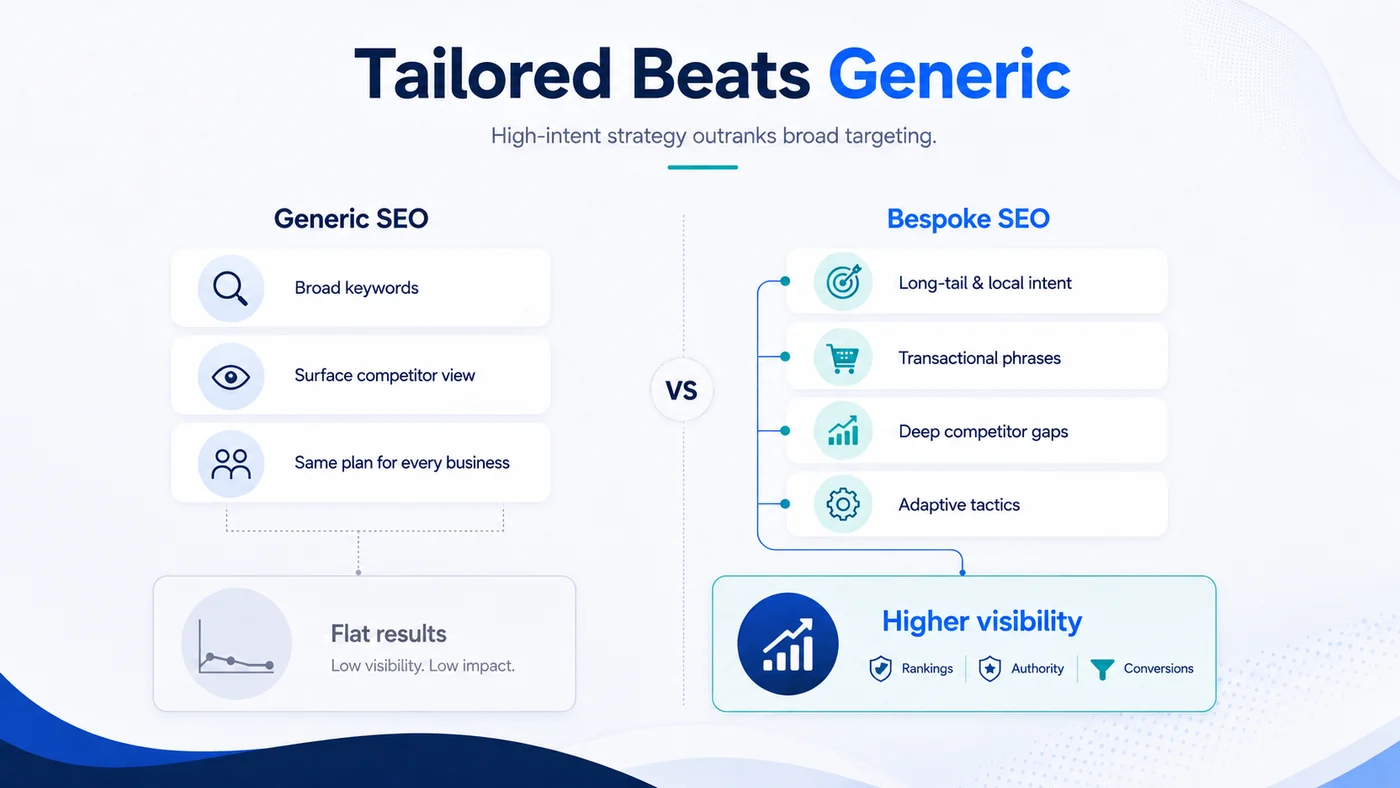
| What you are comparing | Bespoke SEO | Fixed monthly package |
|---|---|---|
| Who sets the scope | The diagnosis, after a free audit | The price tier, before anything is seen |
| Price certainty | Quoted once the scope is agreed, then fixed | Known before you start |
| What happens when the audit finds something unexpected | The plan changes, because the KPI is the target | A change request, a new quote and a delay |
| Reporting | KPIs you set, reviewed on a call | A standard monthly report |
| Minimum term | None, 30 days notice | None, 30 days notice |
| Best fit | Long sales cycles, regulated claims, several locations, contested markets | Settled markets, clean sites, predictable competitors |
Neither is better. They answer different questions, and the honest test is whether you already know what needs doing. A settled market with predictable competitors rarely needs bespoke scoping.
Most businesses that come to us for bespoke work do not need it. Around a third of the free reviews we run end with us recommending the fixed monthly SEO packages instead, because the diagnosis found a clean site in a normal market where steady output is the whole answer. That recommendation costs us the larger engagement and saves you from buying planning you do not need.
What does a bespoke SEO strategy actually contain?
A bespoke SEO strategy contains six components: a topical map, a page build order, a technical repair list, an authority plan, a measurement frame and a review rhythm. Everything else is delivery against those six.
What actually shapes the scope, and what the scope then covers
Swipe the diagram sideways to see all of it.
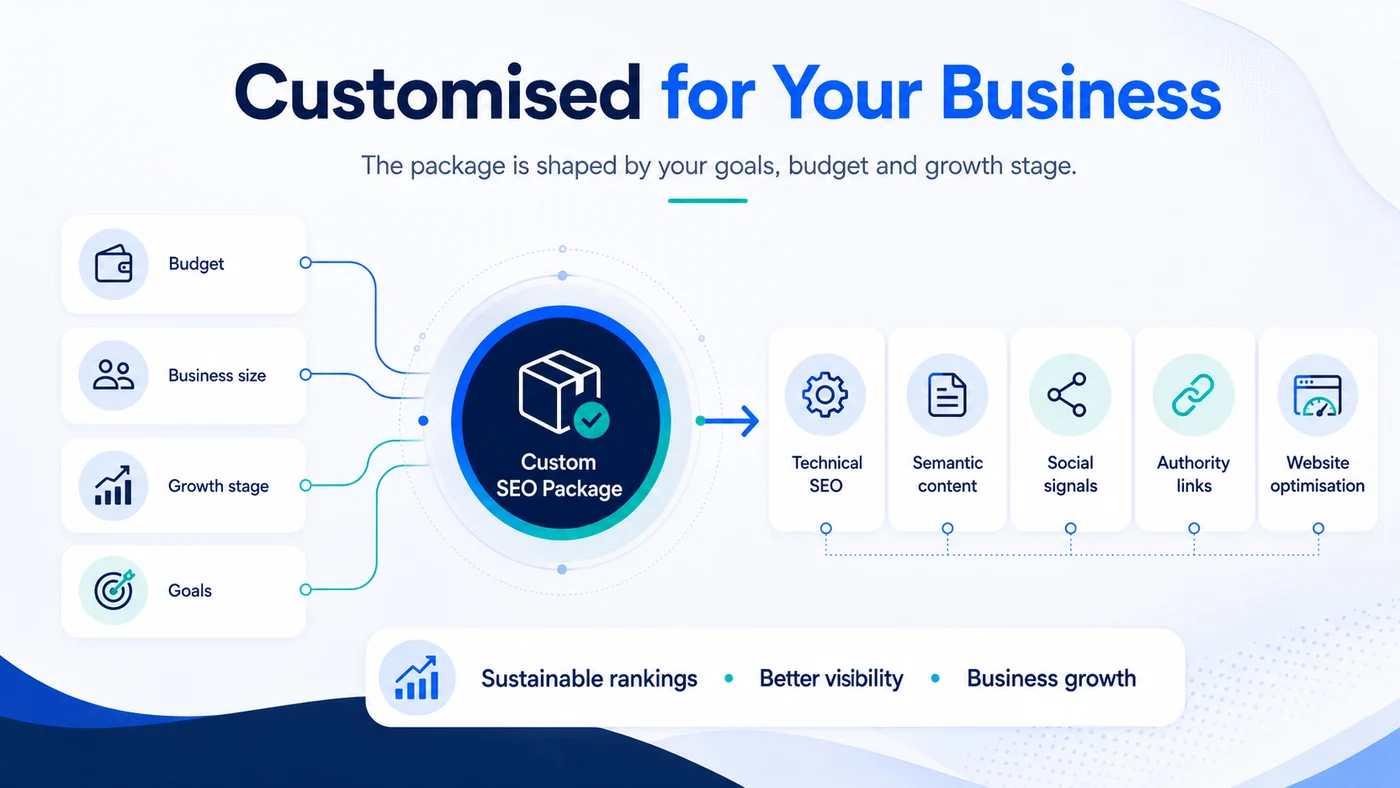
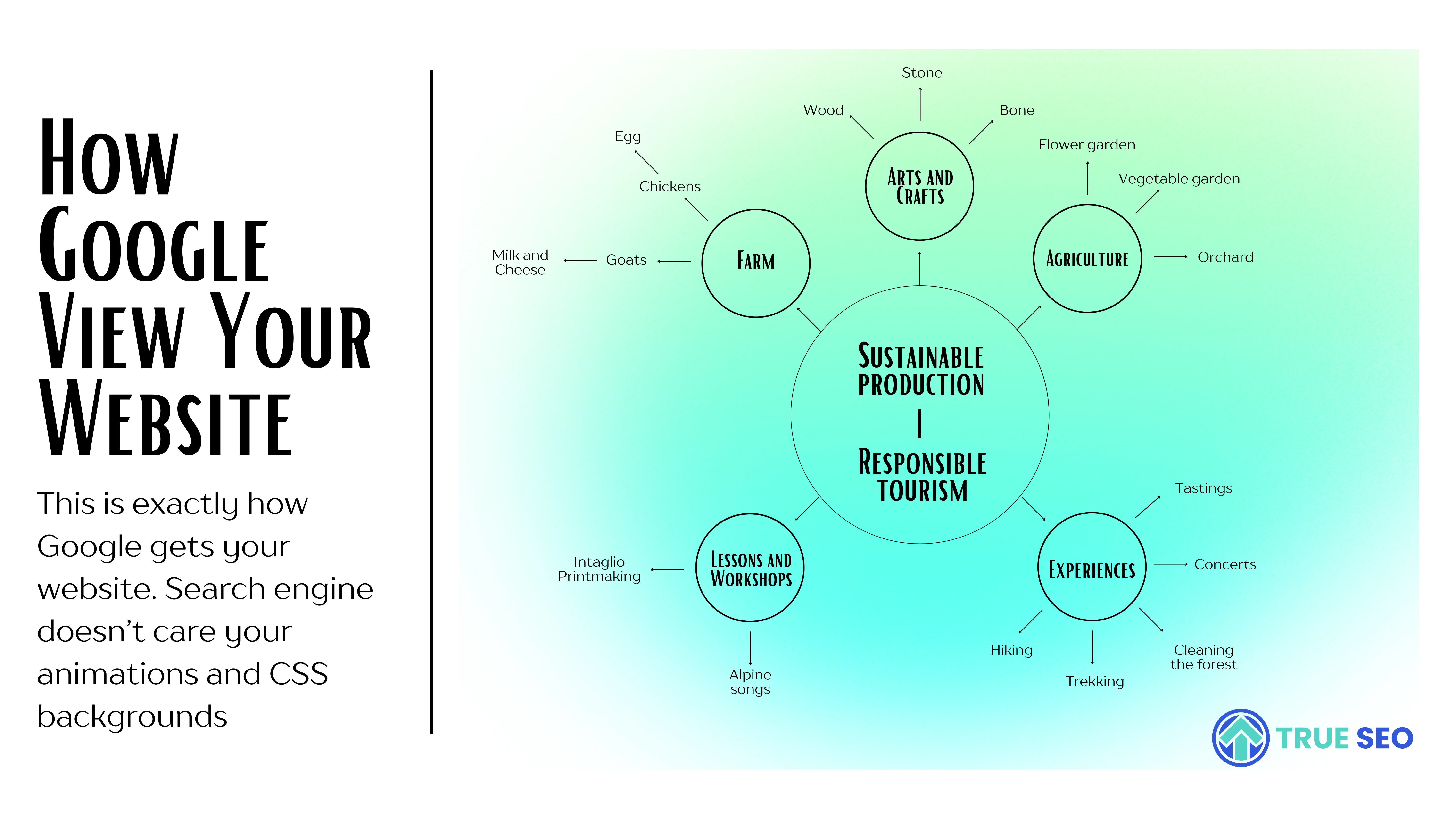
The topical map is the part that decides everything after it. It sets out every subject your business must cover to be treated as a source on your topic rather than a page about it, then orders those subjects by what your buyers search on the way to a decision. Our semantic SEO and topical authority service is the method behind it, and the twelve-step version is written up in the twelve steps behind building a topical map.
| Component | What it contains | What it decides |
|---|---|---|
| Topical map | Every subject your market searches, grouped by entity and ordered by buying stage | What gets built, and in which order |
| Page build order | The sequence of new and rewritten pages, with the query each one owns | Which month each page lands in |
| Technical repair list | Crawl, indexation, speed, structured data and internal linking faults, ranked by the traffic each costs | What has to be fixed before publishing starts |
| Authority plan | Digital PR angles, sector directories, partnership mentions and citable assets | Where earned links come from, and for which pages |
| Measurement frame | The KPIs, where each is read from, and the segmentation applied to Search Console | How you check the work yourself |
| Review rhythm | A monthly call against the KPIs, with the plan revised in the meeting | When the plan is allowed to change |
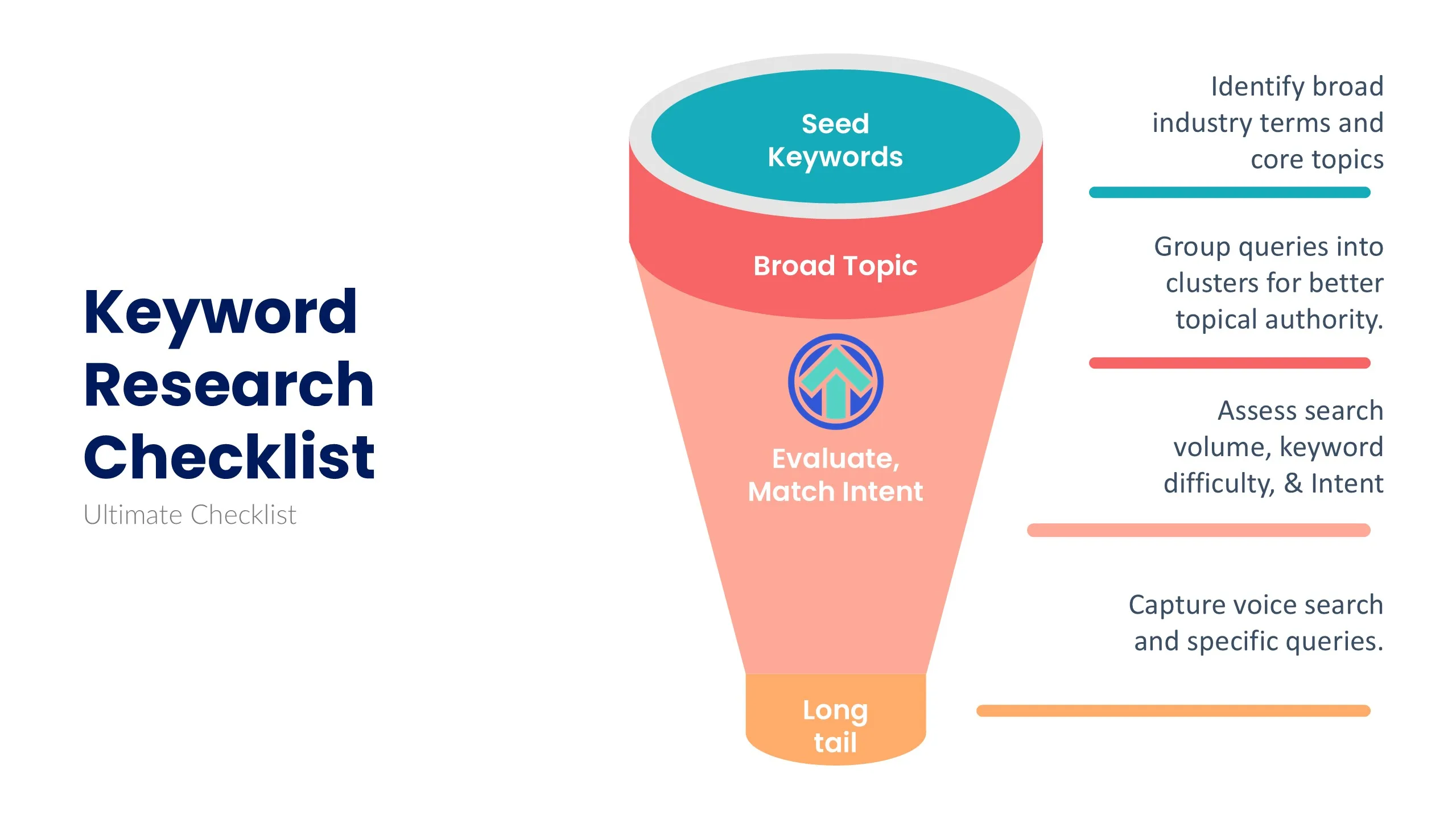
Scope gets decided by query intent, not by volume. A query with 200 searches a month where the searcher is comparing providers is worth more than one with 5,000 where they are still defining the term. The narrowing runs from a broad seed to the specific phrases that carry buying intent, and how query intent decides which pages get built explains why the same keyword can belong to two different pages.
How does a bespoke SEO engagement run, step by step?
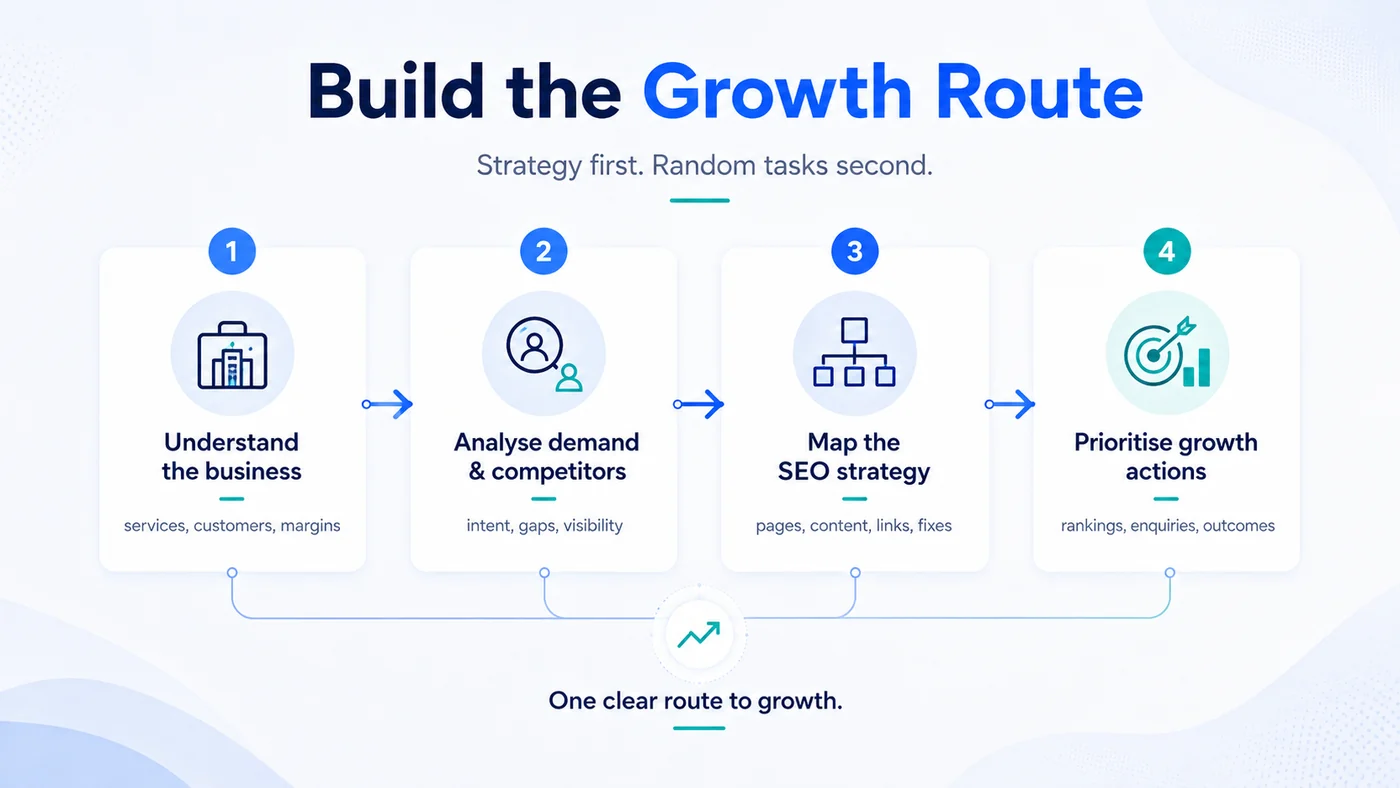
Six stages, from the first call to the monthly review. Nothing gets published before the topical map is agreed, so you always know what is coming, what we are doing and what you end up holding.
The four steps, in the order they have to happen
Swipe the diagram sideways to see all of it.
-
1
Free 30-minute review Day one
What we doWe read your site, your Search Console position and the competitors actually holding your commercial queries, then say plainly whether bespoke or a package fits.
What you doTurn up and answer questions about how you win work. Nothing to prepare, no brief to write.
You end up with: An honest verdict, and a shortlist of what we would look at first. No proposal attached.
-
2
Audit and measurement segmentation Days 2 to 5
What we doA full crawl, then Search Console split by country, device and search appearance, because one average position hides where the impressions really come from.
What you doGrant read access to Search Console and Analytics. That is the only access we need to start.
You end up with: The free audit document, severity-rated, yours to keep whether or not you go ahead.
-
3
Topical map and build order Week 2
What we doEvery subject your market searches, grouped by entity and sequenced by buying stage, with the query each page will own.
What you doTell us which services carry the margin and which enquiries you would rather not receive.
You end up with: The map and the build order, agreed in writing. Nothing gets published before you sign this off.
-
4
Technical repair, then build Month 1 to 3
What we doCrawl, indexation and structure faults first, ranked by the traffic each one costs. Pages second, in the agreed order.
What you doName an approver for published copy. Regulated firms add their compliance step here.
You end up with: A fixed site and pages landing on schedule, each one aimed at a named query.
-
5
Earned authority Month 2 onward
What we doDigital PR, sector citations and assets other sites reference on their own, pointed only at pages the map says deserve them.
What you doApprove the angles, and introduce us to partners or bodies worth citing you.
You end up with: Links you could defend in a manual review, and the coverage that comes with them.
-
6
Monthly KPI review Every month
What we doA call on what moved, what did not and why, with the plan revised in that meeting rather than at the next quarter.
What you doBring your enquiry numbers. You are the only one who knows which leads were worth having.
You end up with: A revised plan, and a decision you renew monthly rather than a contract you have to escape.
The measurement segmentation in stage two matters more than it sounds. Search Console reports one average position across every country, device and search feature, and that single number hides most of what is useful. Splitting it is often the moment a client discovers that their strongest-looking rankings sit in a country they do not sell to.
Every artefact in the right-hand column is yours. The audit, the topical map and the build order leave with you if the engagement ends, which is the practical meaning of a 30-day notice period.
Why does billing on agreed KPIs change what gets done?
When the fee is tied to hours, the incentive is to log tasks. When it is tied to agreed KPIs, the incentive is to fix whatever is actually blocking the outcome, including work that sits outside the original scope.
What happens when the audit finds something nobody expected
Swipe the chart sideways to read all of it.
Month two, under each billing model
That is the whole argument, and it is worth spelling out because it changes the month-three conversation.
Take a real pattern. The plan says publish eight pages. In month two the crawl shows that a migration two years ago left 400 redirect chains, and every one of those eight pages will inherit the problem. On an hourly retainer, fixing that is a change request, a new quote and a delay. On a KPI-based agreement, the fix happens, because the KPI is the ranking rather than the page count.
The KPIs are yours to set. Common ones include qualified enquiries a month, first-page positions on a named query list, map pack visibility across a defined radius, revenue from organic sessions, and share of the queries your named competitors currently own. What matters is that they are countable and that you can check them yourself in Search Console, Analytics or your own CRM, without taking our word for it.
There is no minimum term and notice is 30 days. That is deliberate. An agreement that has to be escaped is an agreement that stopped earning its fee, and locking clients in hides that fact for another eleven months.
What does bespoke SEO cost in the UK, and what changes the price?
Bespoke SEO in the UK generally runs between 750 and 3,500 pounds a month, and the figure is driven by how contested your market is and how large your site is, not by how big your business is. A four-person firm in a fought-over city market often costs more to move than a fifty-person firm in a quiet one.
How a bespoke scope gets decided, and where about a third of reviews end
Swipe the chart sideways to read all of it.
| Price driver | What we look at | Effect on the monthly figure |
|---|---|---|
| Market competition | How many funded competitors hold the commercial queries, and how established they are | The largest single driver. A contested city market can double it |
| Site size and condition | URL count, crawl waste, template debt, migration damage | A large or damaged site front-loads months one to three |
| Number of service lines | How many distinct buying intents the business sells into | Each additional line adds a topical branch to build |
| Locations covered | One trading area against several, and whether there are physical premises | Multi-location work adds structure and profile management |
| Compliance requirements | Whether claims need review before publication | Adds review time rather than production cost |
| Who executes | Whether we deliver, mentor your team, or work alongside your developer | Mentoring costs less than delivery and moves slower |
Two things sit outside that range in both directions. A single defined project, such as a migration or a one-off structural rebuild, is quoted as a fixed price rather than a monthly fee. A national programme across several service lines and locations runs above it. The published UK market bands, and what different agency types charge for the same work, are set out in our guide to what UK agencies actually charge for SEO.
We do not publish a tier list for bespoke work, and the reason is the point of the service. A price attached to a scope decided before the diagnosis is a package. What we can tell you before you spend anything is which band your situation falls into and why, which is what the free review is for. Once the scope is clear you can request a scoped SEO quote with the figures attached to named deliverables.
The scoping itself is free. Our free SEO audit is what produces the evidence the plan is priced against, and you keep the document whether or not you go ahead.
Who should build a bespoke SEO strategy: a freelancer, an agency or a consultancy?
A freelancer sells you hours. An agency sells you a process and an account manager. A consultancy sells you a plan and takes responsibility for the outcome, then decides who executes it. For bespoke work the question is who carries the diagnosis, because that is the part that fails most often.
| What you are buying | Freelancer | Agency | Consultancy |
|---|---|---|---|
| What the fee buys | Hours of one person | A process and account management | A plan and accountability for the outcome |
| Who does the diagnosis | The same person who executes | Often a strategist you never meet again | The person answerable for the result |
| Breadth | Strong in one discipline, thin in the others | Broad, with variable depth per discipline | Broad by design, execution bought in where needed |
| What happens when the plan is wrong | You spot it, or nobody does | A quarterly review, usually | The monthly KPI review is built for it |
| Best fit | A defined task with a known answer | Steady output across many channels | A business whose model breaks a standard scope |
The market rewards the wrong signal here. According to research published by BrightLocal, most businesses choose a search provider on price and review count, neither of which predicts whether the provider can diagnose. A better question at the first call is simple: ask what they would need to see before they could tell you what to do. A provider who answers with a scope before seeing anything has one scope.
True SEO runs as a consultancy. Mohammad A Mahmud is an ACCA-qualified accountant who has worked in search since 2011 and trained in Koray Tugberk Gubur’s semantic method, and Julie Williams is a fractional CFO with more than 30 years in finance. That background is the reason the plans start with commercial questions about margin, sales cycle and lead quality rather than with keyword volume. Where you would rather hold the work in-house, our SEO mentoring and consultancy programme supervises your own team instead of replacing it.
Which businesses need a bespoke SEO strategy?
Businesses need bespoke SEO when something about how they sell breaks the assumptions a standard package makes. That is usually a long sales cycle, a regulated claim set, several locations, or a market where the top results are held by national brands.
Sector shapes the plan, and it is worth being concrete about how. A dental practice and a law firm both need local visibility, but the dental plan weights Google Business Profile completeness and review recency, while the law firm plan weights author credentials and evidence on the page. Same service, different centre of gravity. Luxury and heritage brands invert it again, because volume is the wrong target and a small number of high-intent queries carries the whole commercial case.
What has a bespoke plan actually produced?
Three engagements where the plan was built from the diagnosis rather than a tier, with the figures the clients can verify themselves. Each ran on a different constraint, which is the point of scoping the work.
- Clicks up 60 per cent month on month
- Click-through rate up 70 per cent
- Now ahead of Rightmove on the searches that convert
- Average monthly profit up 75 per cent
- A further 45 per cent from local search
- Tracked keyword coverage up 250 per cent
- Repositioned toward advisory and virtual finance director work
- Google Business Profile drives more than 80 per cent of local visitors
- A sister engagement reached number one for “pharmacy accountants” in about 60 days
None of those plans looked alike. The property business needed location structure and profile work. The ecommerce brand needed category architecture before a word was written. The accountancy practice had a clean site and needed decision-stage coverage it had never built. Same method, three different scopes, which is the argument this whole page makes. There are more in the True SEO case studies.
When is bespoke SEO the wrong answer?
Bespoke SEO is the wrong answer when you already know what needs doing, when the budget is below roughly 500 pounds a month, or when the real constraint is not search at all.
- Your market is settled and your site is clean. A steady publishing rhythm and normal maintenance will do it. Buying planning you do not need is the most common way to waste an SEO budget.
- The budget is small. Below roughly 500 pounds a month the diagnosis eats the delivery. A package, or the DIY route through our niche marketing blueprint, spends the same money better.
- The website cannot convert. Ranking a page that does not turn visitors into enquiries multiplies a problem rather than fixing one. Conversion work comes first, and our optimised web design service handles it.
- You need enquiries this month. Search is a compounding channel. Nothing organic reliably produces leads inside four weeks, and anyone promising it is either buying links or counting impressions.
Saying this on a sales page costs us work. It also saves the eight-month conversation where a client wonders why the retainer has not paid for itself, and that conversation costs more.
Which route fits you: bespoke, a package, or neither yet?
Four questions, about thirty seconds. Nothing is stored and nothing is sent anywhere.
Question 1 of 4
Do you already know what needs doing on your site?
Question 2 of 4
How contested is your market on the queries that matter?
Question 3 of 4
Does anything about how you sell break a standard scope, such as a long sales cycle, compliance sign-off or several locations?
Question 4 of 4
How much of a written search plan do you have for the next six months?
A fixed monthly package is the better buy
Your answers point at a settled market and a reasonably clear picture of the work. Paying for planning you have already done is the most common way to waste a budget. Start with the fixed monthly SEO packages, and move to bespoke only when the market changes.
Start with the free audit, then decide
You are on the line, and the honest answer is that neither of us can tell yet. The free SEO audit settles it: it either finds a structural problem that needs scoping, or it confirms that steady output is the whole answer. It costs nothing either way and the document is yours to keep.
Bespoke is the route that fits
A contested market, a model that breaks a standard scope, and no written plan is exactly the combination a fixed package spends in the wrong place. Book the free 30-minute review, and we will tell you which band the cost falls into before you commit to anything.
How long does bespoke SEO take to work, and what moves first?
Technical and indexation changes move within weeks. Ranking movement on commercial terms usually shows between month three and month six. Enquiry volume follows ranking rather than arriving alongside it.
What moves at each stage, and what you can verify without us
Swipe the chart sideways to read all of it.
| Stage | What moves | Where you check it |
|---|---|---|
| Weeks 1 to 4 | Crawl efficiency, indexation, page speed, structured data validity | Search Console crawl stats and the Rich Results test |
| Weeks 4 to 8 | Impressions on long-tail and question queries as new pages get indexed | Search Console queries report |
| Months 3 to 4 | Average position on secondary commercial queries | Search Console, filtered to your named query list |
| Months 3 to 6 | First-page positions on the head commercial terms | Search Console positions, plus your own manual checks |
| Months 4 to 8 | Enquiry volume and enquiry quality | Your CRM or enquiry inbox, not Analytics alone |
| Month 6 onward | Compounding, as authority earned on one branch lifts the next | The monthly KPI review |
Sequence matters as much as the timeline. Publishing before the technical repair means the new pages inherit whatever is suppressing the old ones, and the usual result is six good pages that nobody can find. Fixing crawl and structure first is slower to show on a report and faster to show in revenue.
Competition changes the numbers, not the order. A Cardiff service business in a market with four real competitors moves through this faster than a national ecommerce brand facing thirty. The stages stay in the same sequence either way.
How is bespoke SEO measured, and what arrives each month?
Measurement is agreed before the work starts, tracked in tools you own, and reviewed on a call rather than emailed as a PDF. You should be able to verify every number yourself.
| KPI | Where it is read from | When it is reviewed |
|---|---|---|
| Qualified enquiries a month | Your CRM or enquiry inbox | Monthly, against the agreed baseline |
| First-page positions on a named query list | Search Console, segmented by country and device | Monthly |
| Map pack visibility across a defined radius | Grid rank checks around the trading address | Monthly, for local and multi-location work |
| Revenue from organic sessions | Analytics, with conversions defined at the start | Monthly, quarterly for long sales cycles |
| Share of competitor queries held | The named competitor query set from the audit | Quarterly |
| Technical health | Crawl stats, indexation coverage, Core Web Vitals | Monthly, and after any release |
The monthly review is a conversation about what moved, what did not and what changes next. Reporting that only shows what improved is marketing, not measurement. Where a KPI has gone the wrong way, the review says so and says why, and the plan changes in that meeting rather than at the next quarter.
How do you know bespoke SEO has paid for itself?
Six numbers answer it, and every one comes from your own systems rather than ours. The decisive one is the payback month: the month your cumulative gross profit from organic passes your cumulative fees.
The payback month, where the return passes the fee
Rankings and sessions are progress indicators, not returns. A programme can double your traffic and lose you money. These are the numbers to hold it to instead.
| The number | How you work it out | Where it comes from | What good looks like |
|---|---|---|---|
| Cost per organic enquiry | Monthly fee divided by organic enquiries that month | Your CRM, and our invoice | Falls every month from about month four, then settles below your paid cost per lead |
| Organic share of new clients | Clients won from organic divided by all new clients | The source field in your CRM | Rising toward a third or more for most service firms |
| Revenue per organic session | Organic revenue divided by organic sessions | Analytics, with conversions defined at the start | Rising even in months when sessions are flat, because intent improved |
| Payback month | The month cumulative gross profit from organic passes cumulative fees | Your own accounts | Month seven to twelve for most service businesses, sooner for ecommerce |
| Assisted pipeline value | Value of deals where organic was the first touch, not the last click | First-touch attribution in your CRM | Consistently larger than last-click reporting suggests |
| Cost of not ranking | Impressions multiplied by a realistic click rate, close rate and average value | Search Console, plus your own close rate | The number that sizes the opportunity before you spend anything |
A worked example of the payback maths
Take a professional services firm paying 1,500 pounds a month, closing one in four enquiries, at an average first-year value of 2,400 pounds and a 60 per cent gross margin. Months one to three produce almost nothing while the technical repair lands, so 4,500 pounds goes out with no return. By month six the programme is adding 12 organic enquiries a month, which is three new clients, 7,200 pounds of revenue and roughly 4,320 pounds of gross profit. Cumulative fees pass 9,000 pounds in month six and cumulative gross profit passes them in month nine. From month ten the programme is paying for itself and the asset keeps compounding, because nothing has to be re-bought the following month.
Run the same maths on paid search and the shape is different rather than worse. Paid buys enquiries from day one and stops the day you stop paying. Organic costs more up front and keeps producing. Most firms we work with should run both, and the ratio is a commercial decision rather than a search one.
Attribution will never be perfect, so do not build the case on last click. A buyer who finds you through an AI summary in March, checks two competitors in April and types your name into Google in May gets recorded as direct traffic. Use first-touch attribution in your CRM, ask new enquiries how they found you, and treat the two together as the honest picture.
We agree which of these six numbers the engagement is judged on before it starts, and they appear in the scoped quote alongside the fee. A programme that cannot name the number it is answerable for is asking you to trust a report.
What do we need from you before the work starts?
Read access to Google Search Console and Google Analytics, an hour of someone who knows how the business actually wins work, and a named person who can approve published copy. Nothing else is required to begin.
- Search Console read access. Without it the plan is guessing at which pages matter. Where you cannot grant it, we still build the plan, and the document says plainly which conclusions are weaker as a result.
- Analytics access. Needed to connect rankings to enquiries rather than to sessions.
- One conversation about commercial reality. Which services carry the margin, which enquiries you would rather not receive, and what a good month looks like in numbers.
- A named approver. Regulated firms need a compliance sign-off step in the workflow, and building it in at the start prevents a queue of unpublished drafts later.
- Access to the site, or to whoever holds it. Technical fixes need either a login or a developer contact. Both work.
Does bespoke SEO cover AI and LLM visibility?
Yes, and it is scoped rather than bolted on. Being named by an AI assistant depends on entity clarity, machine-readable service data and independent corroboration, which are structural jobs the same plan already covers.
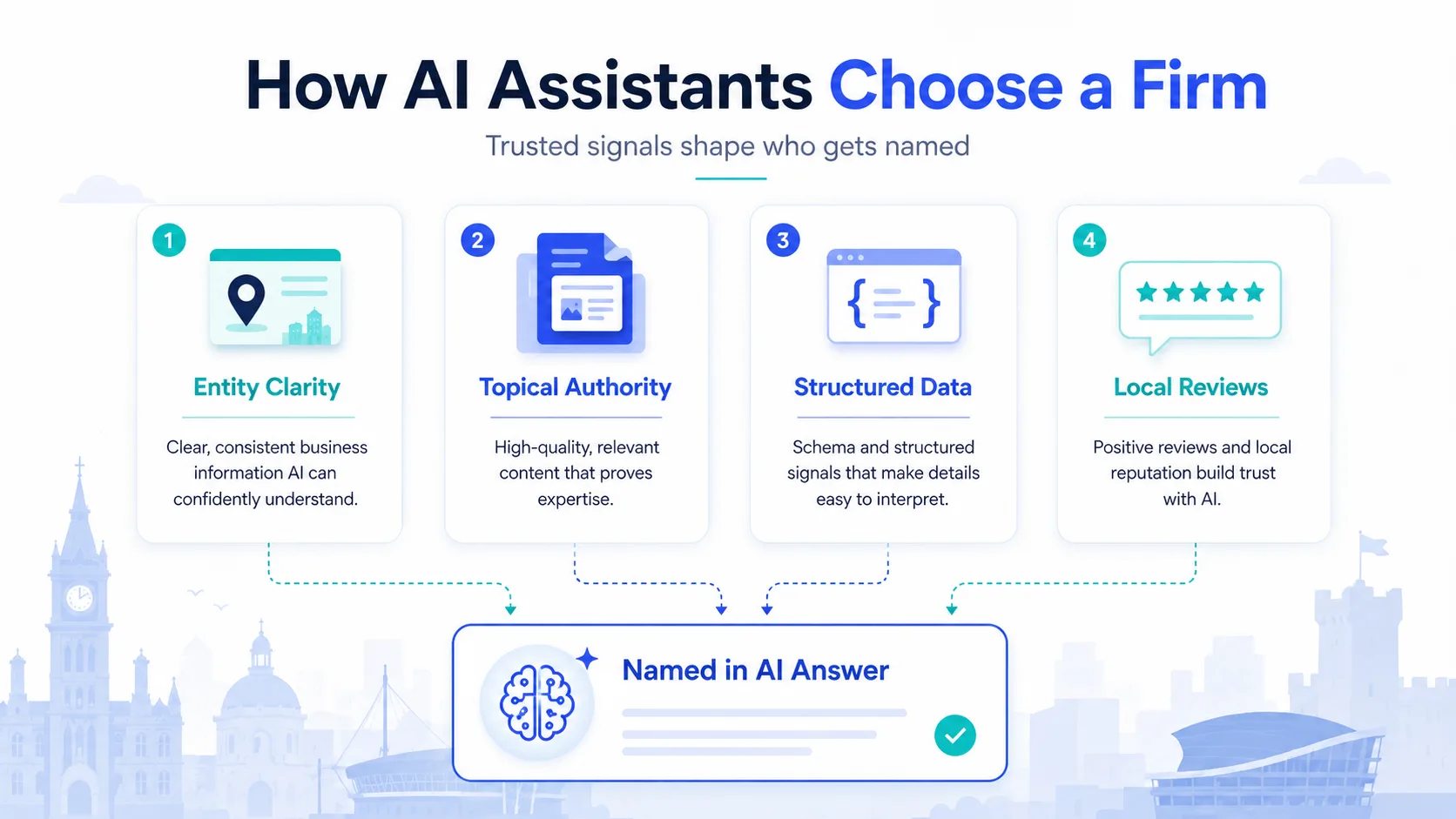
Close to a third of UK Google searches now show an AI summary above the normal results, and more than half of UK adults say they see these summaries regularly. That changes what a plan optimises for. A page that ranks fourth and gets quoted in the summary can outperform a page that ranks first and does not. The work sits in our AI and LLM search visibility service, and on a bespoke engagement it is a section of the topical map rather than a separate purchase.
What actually moves it is unglamorous. Consistent naming, address and description across every profile that mentions you. Service-level structured data instead of one generic business listing. Answers written in the first sentence rather than the fourth paragraph. Third-party sources that agree with your own site.
Is bespoke SEO different for ecommerce and multi-location businesses?
Yes. Ecommerce plans start with crawlability and category structure. Multi-location plans start with preventing your own pages from competing with each other. Both problems are structural, and both are invisible on a keyword report.
An ecommerce catalogue with faceted navigation can generate tens of thousands of crawlable variants of the same twenty products, and the crawl budget goes to filter combinations instead of category pages. Fixing that comes before any content work, and it is the reason our ecommerce SEO work opens with a crawl rather than a keyword list.
Multi-location businesses fail differently. Six near-identical location pages built from one template compete with each other, and Google picks one, usually not the one you wanted. Our multi-location local SEO service treats each location as a distinct entity with its own service emphasis, trading area and proof.
Two examples of how differently the same budget gets spent
A three-branch letting agency came to us with 2,400 organic sessions a month and enquiries concentrated on one branch. The audit found the three location pages sharing 80 per cent of their copy, and Google indexing only one. Rewriting each around its actual trading area, tenant profile and local landmarks, then splitting the Google Business Profile service lists, moved the two suppressed branches into the map pack within eleven weeks. Sessions rose to 3,900 a month, and enquiries spread across all three branches for the first time.
A single-site professional services firm had the opposite problem. The site was technically clean and already carried 60 blog posts, yet it ranked for nothing commercial. The topical map showed the coverage sat almost entirely at the definitional end, explaining what things are, with nothing answering how a provider is chosen. Eleven pages built at the decision end, with internal links pointed at them from the existing 60, tripled enquiries inside five months without a single new blog post being written.
Where the earned parts fit
Authority still has to be earned, and a bespoke plan says how. Digital PR, sector directories, partnership mentions and useful assets other sites cite on their own are the routes we use, and none of them involve buying placements.
The detail sits in our earned link building service, and the technical groundwork underneath all of it belongs to technical and on-page SEO.
Where a bespoke off-page programme is what you are shopping for, the same rule applies as everywhere else on this page. The link plan follows the topical map, because links pointed at pages that do not deserve them waste the authority they carry.
Frequently asked questions about bespoke SEO
Is bespoke SEO white hat and organic?
Yes. Every method used is organic and compliant with Google’s spam policies, which covers earned links, original content, structured data and technical repair. Nothing is bought, spun or exchanged. Google’s own spam policies name link schemes and scaled content abuse as violations, and both carry manual action risk that outlives any short-term gain.
How much does a bespoke SEO audit cost?
Nothing. The audit that scopes a bespoke plan is free and yours to keep, whether or not you proceed. The detail of what it covers sits on our SEO audit service page.
Do you offer bespoke SEO training rather than delivery?
Yes. Where you would rather build the capability in-house, the mentoring route supervises your team through the same method instead of running it for you, and it is covered on our SEO consultancy and mentoring page.
Does bespoke SEO include content writing?
Yes, where the plan calls for it. Content is written to the topical map rather than to a monthly quota, so some months carry four pages and others carry one long comparison page that does more work than four.
Does it include website development?
Not full development, but it includes the technical work that search depends on, covering speed, crawlability, structured data, internal linking and mobile rendering. Where a rebuild is the right answer, we say so and can handle the build separately.
Is there a minimum contract for bespoke SEO?
No. There is no minimum term and notice is 30 days. Continuing is a decision you make monthly against KPIs you set.
How is bespoke SEO different from custom SEO packages?
The words are used interchangeably in the market, and most custom packages are tiers with a flexible name. The test is whether the deliverables were decided before or after the diagnosis. Ours are decided after.
Work with a Cardiff consultancy that plans before it sells
Find out which route fits, before you commit to either
True SEO Consultants Ltd, based at Startup Stiwdio, University of South Wales, 86-88 Adam Street, Cardiff, CF24 2FN, builds bespoke SEO programmes for UK businesses in every sector named on this page, and onboards clients across the United Kingdom and worldwide through a fully remote digital onboarding and delivery process. The diagnosis is the same whether you are in Cardiff, Manchester, Edinburgh or further afield.
Start with the free 30-minute review. You get an honest read on your current position, the competitors actually beating you, and which of the two routes on this page fits your business, with no proposal attached and nothing to cancel.
True SEO Consultants Ltd, Company No. 16563516. Startup Stiwdio, University of South Wales, 86-88 Adam Street, Cardiff, CF24 2FN.