Yes. A chiropractor on the General Chiropractic Council (GCC) register can use Dr as the courtesy title Doctor of Chiropractic, provided the title is qualified in the same statement and the public text makes clear they are not a registered medical practitioner. Former registrants lose the title. The GCC says fewer than 25% of UK registrants use it.
The title is the visible half of the question. The other half is whether a patient can check the person behind it, which comes down to the registration number and a proper profile page for each clinician. This guide covers the exact wording, where it has to appear, the GCC number, the I’m Registered mark and what each clinician profile should show.
Key points
- Only chiropractors currently on the GCC register can use Dr, Doctor of Chiropractic, DC or DoC.
- CAP AdviceOnline, updated 15 July 2026, says Dr should be qualified within the same statement and should not imply a general medical qualification.
- The GCC says a footer explanation alone is unlikely to be enough, and the wording applies to social media and email signatures as well as the website.
- The GCC suggests showing your registration number on your website, stationery and advertising; the I’m Registered mark is for registrants only.
- In our audit of 50 UK chiropractic clinic websites, 42 out of 49 showed no GCC registration number on any page we checked.
Who can use the Dr title as a chiropractor?
The Dr title is open only to chiropractors currently on the GCC register, because registration carries the courtesy title Doctor of Chiropractic, and CAP AdviceOnline accepts Dr, DC and DoC in advertising only where the title is qualified so it does not mislead.
Registration is the condition for the title, and the word chiropractor is protected too. Section 32 of the Chiropractors Act 1994 makes it an offence for a person to describe themselves as a chiropractor, expressly or by implication, unless they are a registered chiropractor. The GCC’s Fitness to Practise Annual Report 2025 records 33 complaints of this kind reviewed and closed during 2025.
The title ends when registration ends. CAP’s advice on the term Dr for chiropractors cites a 2023 ASA ruling on a former registrant whose leaflet still used Dr. The GCC made the complaint, and the ASA upheld it because the person was no longer registered and could no longer use the courtesy title. The GCC reported the ruling on 31 October 2023, with breaches of CAP Code rules 1.7, 3.1, 3.7 and 3.9.
A separate law explains why the wording matters so much. Section 49 of the Medical Act 1983 makes it an offence to wilfully and falsely use titles such as physician, doctor of medicine, surgeon or general practitioner. The GCC states that it is illegal to use the title Dr to suggest you are medically qualified, so every Dr on a chiropractic website needs wording that removes that impression.
What wording must sit beside Dr on a chiropractor’s website?
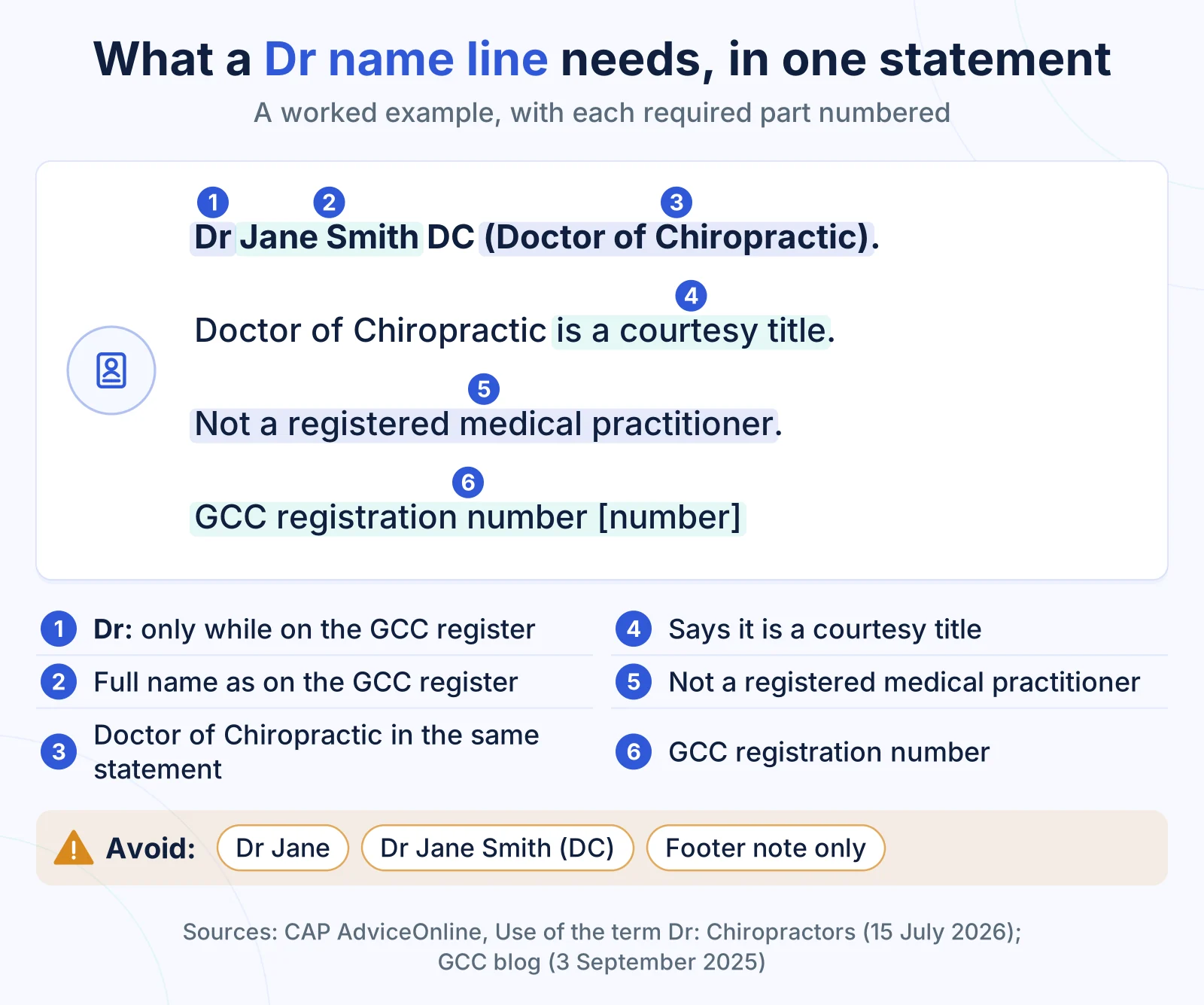
The wording beside Dr must do three things in the same statement: name the courtesy title Doctor of Chiropractic or its approved abbreviation, make clear it is a courtesy title, and state that the chiropractor does not hold a general medical qualification.
CAP AdviceOnline’s guidance on the term Dr for chiropractors, updated 15 July 2026, asks registered chiropractors to qualify Dr or Doctor immediately, within the same statement, with Doctor of Chiropractic, DC or DoC. It also asks them to take care not to imply that they hold a general medical qualification.
The guidance rests on a 2018 ASA ruling against Chiropractic First Group Ltd. The clinic’s “Meet the Team” pages showed its chiropractors as Dr, and the ASA found patients were likely to read that as a general medical qualification. Adding DC after the complaint did not fix it, because consumers were unlikely to know what DC stood for. Details of training and GCC registration elsewhere on the profiles did not fix it either. The ASA found breaches of CAP Code rules 3.1 and 3.9.
The GCC adds three practical points in its September 2025 blog on using the title Doctor of Chiropractic:
- Qualify Dr at first use, then again regularly. Text gets quoted out of context, so qualifying every use is the safest approach.
- Use the surname. Referring to a chiropractor as “Dr” plus a first name makes it hard for a patient to check the register.
- Do not rely on DC or DoC alone to explain Dr. The GCC says these suffixes are not recognised well enough by the public to be used on their own.
The GCC’s own examples show the difference:
| Likely acceptable (GCC examples) | Likely unacceptable, especially at first use (GCC examples) |
|---|---|
| Dr Jane Smith DC (Doctor of Chiropractic) | Dr Jane Smith |
| Dr Jane Smith is a Doctor of Chiropractic | Dr Jane |
| Doctor of Chiropractic, Jane Smith | Dr Jane Smith (DC) |
One way to write a profile line that covers the CAP and GCC points together: “Dr Jane Smith DC (Doctor of Chiropractic). Doctor of Chiropractic is a courtesy title. Dr Smith is a GCC registered chiropractor, not a registered medical practitioner, and does not hold a general medical qualification.”
Where does the Dr wording need to appear?
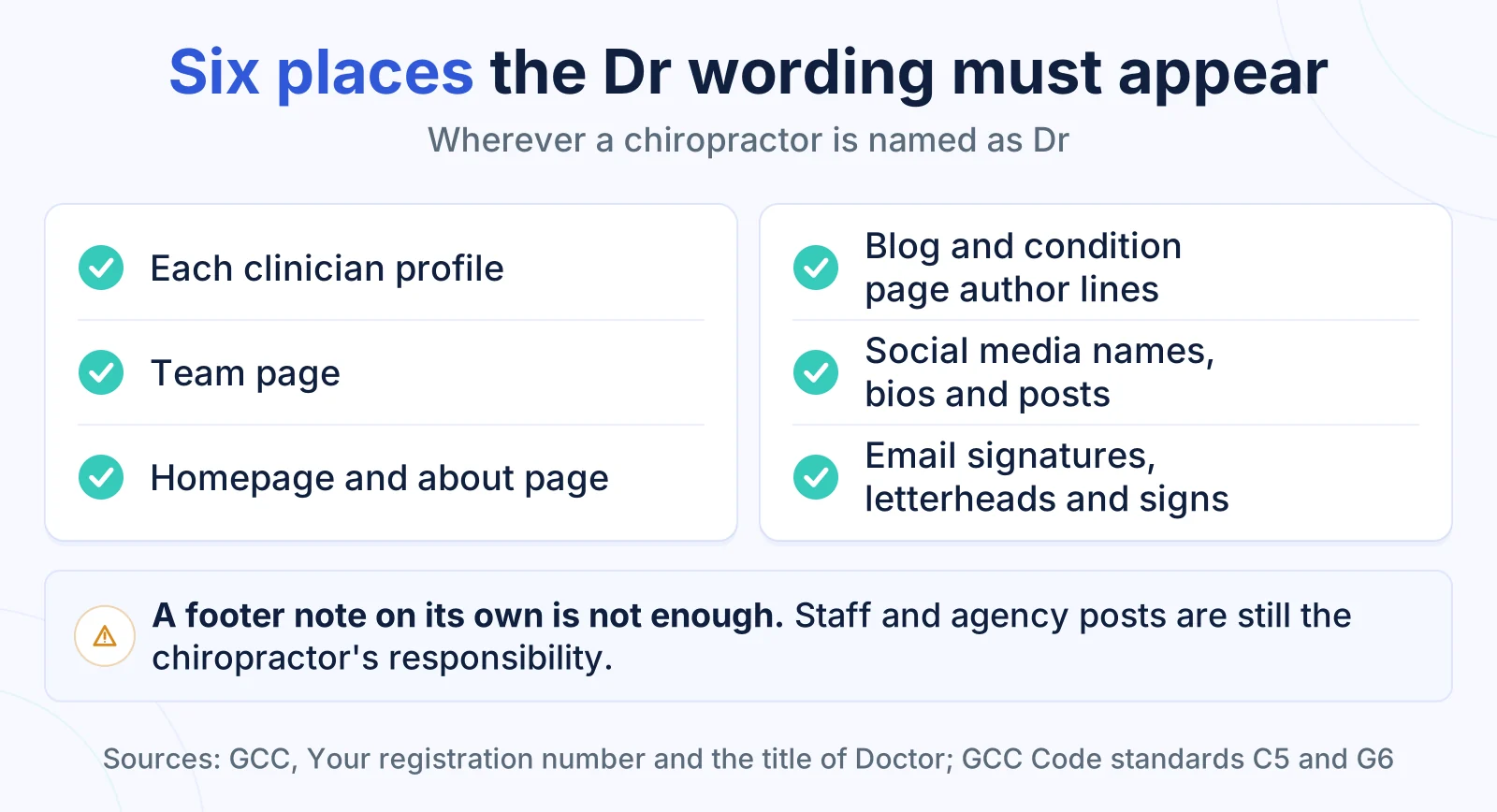
The Dr wording needs to appear everywhere the title is used in public, which the GCC defines as advertising, websites, social media, email signatures, stationery and signage, and the GCC says an explanation in the website footer is not likely to be enough.
On a clinic website, that means the wording sits beside the name wherever the title appears, not in one disclaimer at the bottom of the page:
- Each clinician profile, in the first line under the name.
- The team page, beside each name that carries Dr.
- Homepage and about page introductions that mention a clinician.
- Author lines on blog posts and condition pages.
- Social media usernames, biographies and individual posts.
- Email signatures, sign offs, letterheads and clinic signs.
The person who writes the post does not change who answers for it. The GCC Code of Professional Practice, in force since 1 January 2026, says in standard C5 that where a chiropractor delegates information about their services, “the accountability sits with you”. Standard G6 says the same about communicating online. A post your receptionist or agency writes is still yours.
Patient reviews are a separate case: some patients call their chiropractor “Dr” in a Google review, and that text is theirs, not the clinic’s. Our guide to reviews and testimonials for chiropractors covers what a clinic may republish on its own website.
What can happen when Dr appears without the right wording?
A Dr title used without the right wording can lead to an upheld ASA ruling published under the clinic’s name, a misconduct allegation to the GCC, and, where the title suggests a medical qualification, an offence under section 49 of the Medical Act 1983.
| What happens | Who acts | What can follow | Source |
|---|---|---|---|
| Dr shown without Doctor of Chiropractic in the same statement | ASA, after a complaint | An upheld ruling, and the ad must not appear again in that form | ASA ruling, Chiropractic First Group Ltd, 9 May 2018 |
| Public text does not say the chiropractor is not a registered medical practitioner | GCC | A possible misconduct allegation | GCC, “Your registration number and the title of Doctor” |
| A title suggests a medical qualification | The courts | A fine up to level 5 on the standard scale on summary conviction | Medical Act 1983, section 49 |
| A former registrant keeps using Dr or chiropractor | ASA and GCC | An upheld ruling; describing yourself as a chiropractor while unregistered is an offence | ASA ruling, 13 September 2023; Chiropractors Act 1994, section 32 |
| Someone not on the register uses the I’m Registered mark | GCC | The GCC says this is a criminal act and the person may be prosecuted | GCC, I’m Registered mark guidance |
The same complaint routes apply to treatment claims, which our guide to what chiropractors can claim to treat sets out condition by condition. This is not legal advice. Check the current CAP and GCC guidance before you publish: CAP last updated its advice on the term Dr for chiropractors on 15 July 2026.
Should your clinic use the Dr title at all?
The Dr title is optional for a registered chiropractor, and the GCC says fewer than 25% of UK registrants use it, so writing “chiropractor” or “Doctor of Chiropractic” without Dr is the more common choice across the profession.
| Factor | What the GCC or CAP says | What it means for your website |
|---|---|---|
| Patient view | A 2020 GCC survey found only 18% of patients think chiropractors should be allowed to use the term doctor | Many patients reading Dr will expect a medical doctor, so the qualifying line has real work to do |
| Workload | The GCC notes the title adds administration across social media, websites and advertising | Every new profile, post and signature needs the full wording |
| Scrutiny | The GCC notes the title can bring more public scrutiny | One unqualified Dr on an old page can draw a complaint |
| Consistency | CAP asks for the qualifier in the same statement every time | A team where some use Dr and some do not needs one template that handles both |
Whichever choice each clinician makes, use it the same way on every page and profile. A name that changes from page to page is harder for a patient to match to the register, which is where the registration number comes in.
Should a chiropractor show their GCC registration number on the website?
A GCC registration number on the website is recommended rather than required: the GCC says registrants may wish to include it on business stationery, websites, social media pages and advertising, and its sample shows the council’s name followed by the registration number.
The number does one job no other detail does. A patient can search the GCC register by registration number and get one exact match, where a surname search may return several people. That turns “our experienced team” into a fact the patient can check.
Put the number in two places:
- On each clinician profile, directly under the name and title line, as “Registered with the General Chiropractic Council, registration number” followed by the number.
- In the site footer, listing each chiropractor and their number, so every page carries it.
The GCC says describing yourself as a registered chiropractor is acceptable, though not strictly required, since every practising chiropractor in the UK must be registered. It also says registrants must not use the GCC’s corporate logo, because that could suggest the GCC endorses the practice. The I’m Registered mark exists for that purpose instead.
What is the I’m Registered mark, and who can display it?
The I’m Registered mark is a logo the GCC provides only to registered chiropractors, for their websites and social media, and the GCC states that anyone not on the register who uses it commits a criminal act and may be prosecuted.
What the GCC’s guidance on the mark says:
- Where to get it: registrants download it from the I’m Registered tab in the GCC Portal, which offers four versions.
- How to use it: any version is fine, provided it is clear and unaltered.
- Misuse by a registrant: treated as misconduct, which may be pursued as a fitness to practise matter.
- Misuse by anyone else: the GCC says this is a criminal act.
The British Chiropractic Association tells patients to look for the mark on a chiropractor’s website and marketing materials, so patients may look for it too. The mark belongs to each registrant. In a clinic that also employs massage therapists or other practitioners who are not on the GCC register, place it beside the registered chiropractors rather than across the whole clinic.
What does a patient see when they check the GCC register?
A patient checking the GCC register can search by surname, postcode, registration number, city, county or country, with options to include non practising, removed and suspended chiropractors, and the result shows whether your named clinician is registered.
Three details decide whether that check works for your clinic:
- The name. Use the name exactly as it appears on the register. A profile for “Kate Smith” is harder to confirm when the register holds “Katherine Smith”.
- The surname. “Dr Jane” gives a patient nothing to search, which is one reason the GCC advises against first name only use.
- The number. A registration number search returns one result, so a patient who has it does not need to guess.
The same name should appear on the clinic’s Google listing. Our guide to the Google Business Profile for a chiropractic clinic covers how that profile should present the clinic and its team.
What did our audit of 50 UK chiropractic websites find on titles and registration?
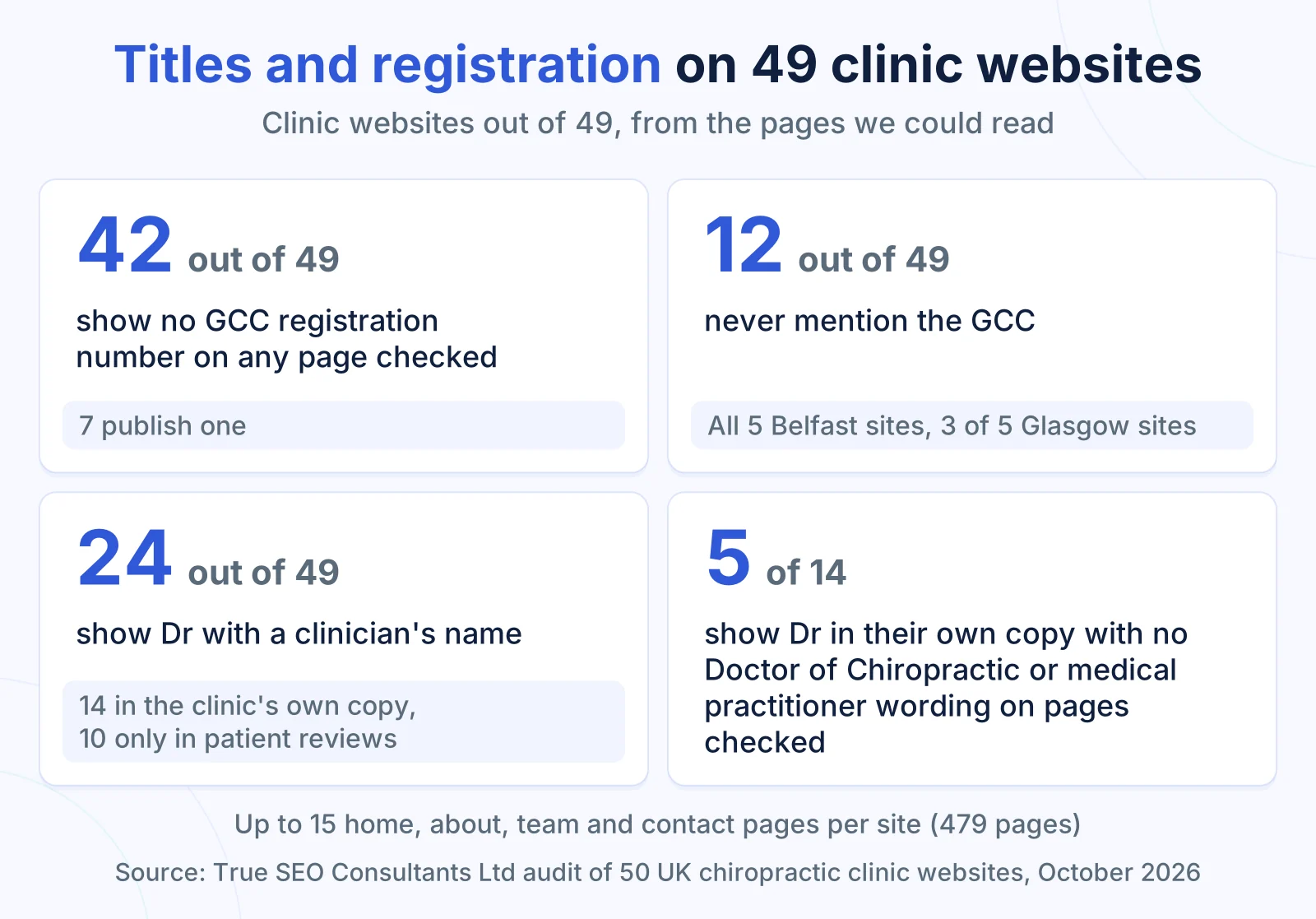
Out of the 49 UK chiropractic clinic websites whose pages we could read, 42 showed no GCC registration number on any page we checked, 12 never mentioned the General Chiropractic Council, and 24 showed Dr beside a clinician’s name somewhere on those pages.
We audited 50 chiropractic clinic websites across the UK on 13 October 2026, five in each of ten cities from London to Belfast. For titles and registration we checked up to 15 home, about, team and contact pages per site, 479 pages in all, and an AI model read each match against written rules. One site blocked our page checks, so these figures are out of 49. The full method is in our audit of 50 UK chiropractic websites, and the full report (Research Report TSC-2026-02) and anonymised data are published with DOI 10.5281/zenodo.23363411.
- 42 out of 49 sites showed no GCC registration number on any page we checked. 7 published one. The number is the one detail a nervous new patient can check before booking.
- 12 out of 49 sites never mentioned the GCC on any page we scanned. That includes all 5 Belfast sites and 3 of the 5 Glasgow sites.
- 24 out of 49 sites showed Dr with a clinician’s name. On 14 of them, Dr appeared in the clinic’s own copy. On the other 10, it appeared only inside quoted patient reviews.
- 5 of those 14 sites showed neither “Doctor of Chiropractic” nor a “not a registered medical practitioner” statement on any page we checked. One of the five carries such a statement on a service page outside the pages we checked.
These figures describe what each site published on the pages we checked. The audit did not measure rankings, traffic or enquiries, and it does not say any site breaks a rule. For a clinic owner, the useful part is how fixable they are: a registration number field and one title line in the profile template cover most of them.
What should a chiropractor’s profile page show?
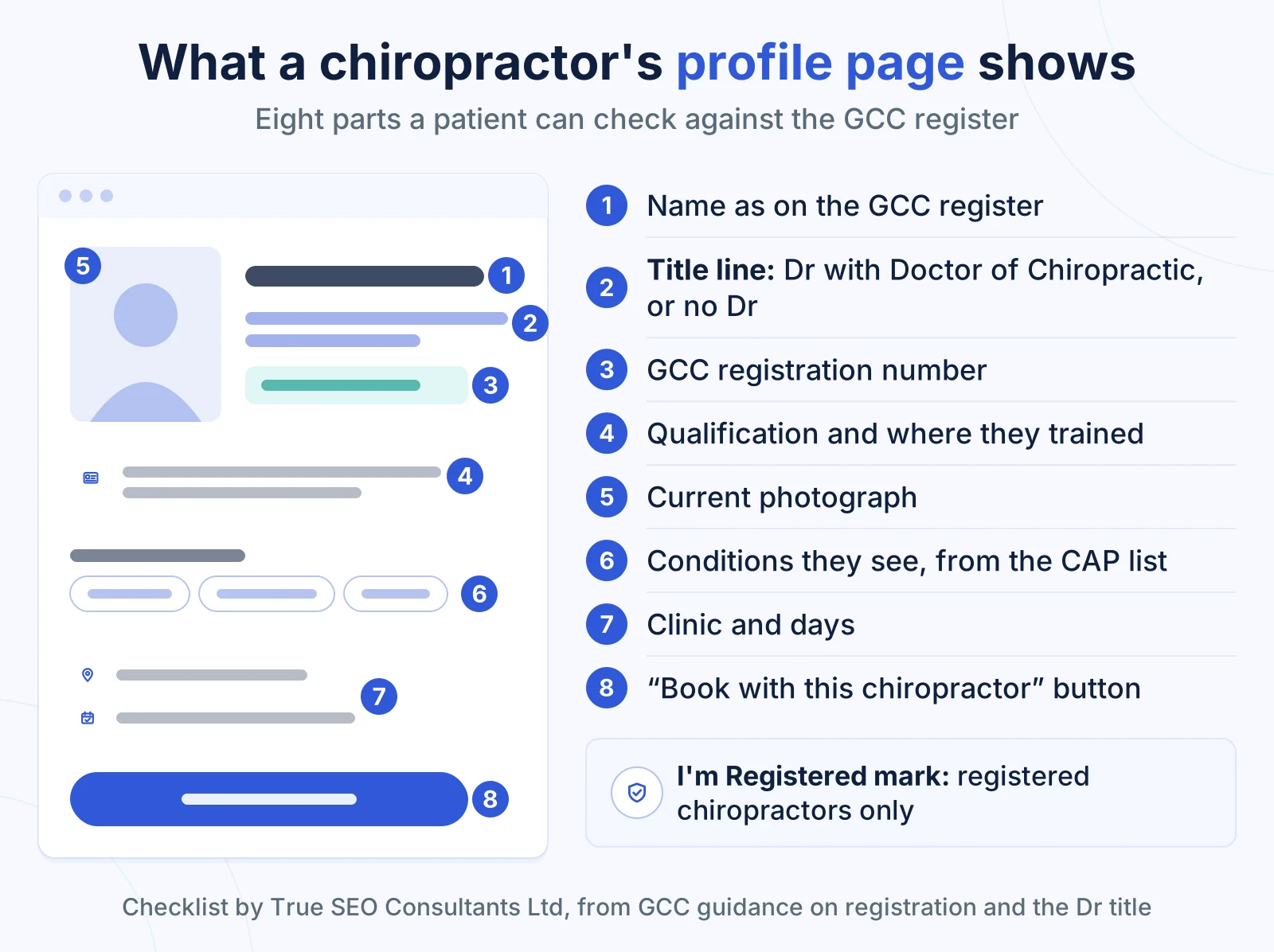
A chiropractor’s profile page should show the clinician’s name exactly as it appears on the GCC register, their registration number, their qualification, the courtesy title wording where Dr is used, a real photograph, the conditions they see and a booking link for that clinician.
| Element | What to show | Why it matters to a patient |
|---|---|---|
| Name | The full name as it appears on the GCC register | The patient can find the same person on the register |
| Registration | “Registered with the General Chiropractic Council, registration number” and the number | One exact match on the register |
| Title line | Dr with Doctor of Chiropractic and the medical practitioner statement, or no Dr at all | The patient knows what kind of practitioner they are booking |
| Qualification | The degree the clinician holds and where they trained, in their own words | The training behind the title is visible |
| Photograph | A current photograph of the clinician | The patient recognises the person at the first appointment |
| Conditions | The conditions they see, worded from the CAP accepted list | The patient can see whether their problem fits |
| Locations and days | Which clinic, and which days | The patient books the right site |
| Booking link | A link that opens that clinician’s diary | The patient books without phoning |
The conditions field is a treatment claim attached to a named person, so it follows the same rules as a condition page. Word it from the list in our guide to the conditions chiropractors can advertise, using the same qualifiers, such as sciatica as a general reference rather than a promise of pain relief.
Give each chiropractor their own profile page at its own web address. A shared team page with one paragraph per person can carry the names and numbers, but a patient who searches a clinician’s name needs a page about that person to land on.
How does Person markup describe a clinician to Google?
Person markup is the behind the scenes description of a clinician that Google and other systems read: a short block of code on the profile page that repeats the visible name, job title, registration number, photograph and clinic, using the schema.org Person vocabulary.
In plain terms, each line of the profile has a matching label in the code:
| What the profile page shows | The label in the code (schema.org) |
|---|---|
| Jane Smith | name |
| Dr, only where the page carries the Doctor of Chiropractic wording | honorificPrefix |
| Chiropractor | jobTitle |
| GCC registration number | identifier |
| The degree she holds | hasCredential |
| The clinic she works at | worksFor |
| Her photograph | image |
| The accepted conditions she sees | knowsAbout |
Two rules keep it safe. First, the code must say what the page says: Google’s guidance on AI features asks site owners to make sure structured data matches the visible text on the page. Second, describe the clinician as a Person with the job title chiropractor. Schema.org defines its Physician type as an individual physician or a physician’s office, so marking up a chiropractor as a Physician puts into code the very impression the courtesy title wording is there to remove.
Markup describes the profile; it does not rank it. Google says no special schema.org markup is needed to appear in AI Overviews or AI Mode. The behind the scenes business details for the clinic itself, its address, hours and locations, belong to the site as a whole, and our guide to chiropractic website condition pages covers that site wide markup and how profiles link to condition and location pages.
Why do named, registered clinicians help Google and AI assistants match a clinic?
Named, registered clinicians help Google and AI assistants match a clinic because each profile adds facts that can be checked elsewhere: a name and registration number on the GCC register, and the same clinic name and address on the Google listing.
Google’s guidance on creating helpful content asks whether it is self-evident who created a page, and says trust is the most important part of its experience, expertise, authoritativeness and trust framework. It gives extra weight to that framework on topics that could significantly affect people’s health. A condition page linked to a named, registered chiropractor answers the “who” question for a health topic.
Google’s guidance on AI features says AI Overviews and AI Mode have no additional requirements beyond normal search: a page must be indexed and eligible to show with a snippet. It also says both may issue multiple related searches across subtopics and data sources to build one answer. A patient asking “is this chiropractor registered?” can be answered from two sources at once, your profile and the GCC register, and those answers agree only when the name and number match.
We make no claim about how ChatGPT, Gemini, Copilot or Perplexity choose between clinics. What a clinic controls is whether its facts are consistent wherever a system looks. Our AI search optimisation service checks those facts across the website, the register, the Google listing and directories, and corrects them at source.
How do you fix the Dr wording on every page in one change?
The Dr wording is fixed on every page in one change by building it into the profile template: one field for the registered name, one for the registration number and one fixed statement that prints beside every Dr title automatically.
- Find every use. Search the website for “Dr” and “Doctor”, then check social media biographies, email signatures and printed materials.
- Decide per clinician. Each chiropractor chooses Dr with the full wording, or no Dr. Record the choice.
- Build the template. Registered name, title line, registration number and the medical practitioner statement become fixed fields on every profile.
- Rewrite the loose mentions. Homepage, about page and blog introductions that name a clinician get the same title line, or drop Dr.
- Recheck on a schedule. Check the template when a chiropractor joins or leaves, and each year when registrants complete their annual retention with the GCC.
Our SEO service for chiropractors builds registered clinician profiles this way, with the GCC number and title wording set once in the template, so every new profile starts correct.
Check your own website
Answer all 8 questions about your own website, then select See my result.
Please answer all 8 questions to see your result.
Your score: 0 out of 16
Your clinicians are hard to check
Patients reading your site have little to match against the GCC register, and any Dr on the site may lack the wording CAP and the GCC expect. Start with the registration numbers and the title line in your profile template, or send us the site for a free claim check.
Your score: 0 out of 16
The basics are there, with gaps
Some profiles carry the right details and some do not, which is common when a team grows one page at a time. Move the name, number and title line into one template so every profile matches.
Your score: 0 out of 16
Your profiles are in good order
Each chiropractor can be checked against the register, and the Dr wording sits where CAP and the GCC expect it. Recheck when someone joins or leaves, and ask us for a free claim check of the condition pages next.
Frequently asked questions
Can a chiropractor who also holds a PhD or a medical degree use Dr?
A chiropractor who also holds a general medical qualification is likely to be able to use Dr, according to CAP, but should not imply that the chiropractic title is itself a medical qualification. For a PhD, CAP’s separate guidance asks for the PhD suffix and advises caution in health advertising, where the safest course is to avoid Dr without a general medical qualification.
Can a new graduate use Doctor of Chiropractic before their GCC registration is confirmed?
No. The courtesy title Doctor of Chiropractic comes with GCC registration, and CAP’s guidance cites an ASA ruling that a person no longer registered could not use it. Until the registration is confirmed, write “chiropractic graduate” or similar, and add the title and registration number to the profile once the GCC confirms the registration.
How should reception staff introduce a chiropractor who uses Dr?
Reception staff should introduce the chiropractor in a way that does not suggest a medical doctor. The ASA’s rules cover advertising, not conversations, but the GCC still advises against misleading patients in person and suggests an introduction that states GCC registration and makes clear the chiropractor is not a medical doctor. Agree one form of words and give it to every member of staff.
Does the I’m Registered mark replace the registration number?
The I’m Registered mark and the registration number do different jobs, so a profile benefits from both. The mark tells a patient the chiropractor says they are registered. The number lets the patient confirm it, because a search of the GCC register by registration number returns one exact entry rather than a list of people with the same surname.
Do old blog posts and social media posts that say Dr need changing?
Old posts that use Dr without the qualifying wording should be updated, because the GCC’s guidance covers individual social media posts as well as usernames and biographies, and text that is still published is still public. Start with the posts and pages patients see most, then work back through older material.