A UK chiropractor can claim to treat the 19 conditions on the ASA’s accepted list (the CAP list), keeping the limit written into each entry, such as “short term management” for ankle sprain. Any other condition, including whiplash and frozen shoulder, needs strong clinical evidence the clinic already holds before the claim appears on its website, leaflets or social media.
The list decides which condition pages a clinic can safely build, which words go in each page title and which patient quotes can sit on the site. A page that has to come down after a complaint takes its place in Google with it. This guide sets out the full list, the wording traps inside it, what our own audit of 49 clinic websites found, and how to reword a claim that goes too far.
Key points
- The accepted list has 19 entries, and the limit written into each entry is part of what a clinic may say.
- Sciatica can be named as a condition you treat. A promise to relieve sciatic pain is a different claim.
- Whiplash and frozen shoulder are written into the list as exclusions.
- Babies, children and pregnant women can be named as patient groups. Conditions specific to them, such as colic, need a strong body of evidence.
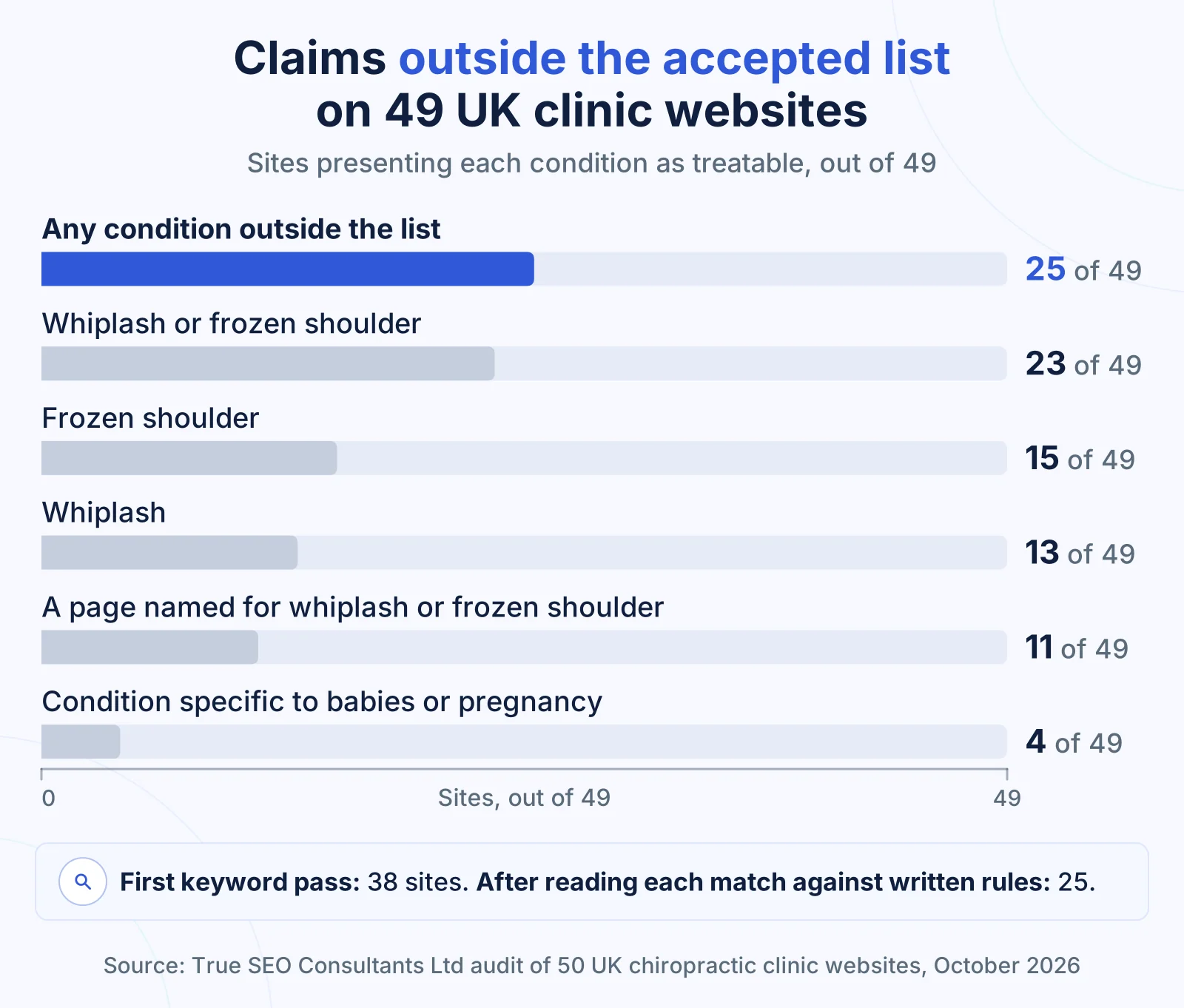
- In our audit, 25 out of 49 UK clinic websites presented at least one condition outside the accepted list as something they treat.
- The rules cover every channel the clinic controls, and the chiropractor stays accountable when an agency writes the copy.
What can chiropractors claim to treat in the UK?
Chiropractors in the UK can claim to treat the 19 conditions that CAP AdviceOnline lists in its Health: Chiropractic advice, dated 1 June 2023, as long as every claim keeps the limit the entry places on it. The ASA and CAP accept these claims without the clinic holding its own evidence.
The third column below is the part a page title or a menu label most often drops. The fourth column shows what that limit rules out.
| # | Condition on the accepted list | Limit written into the entry | What the limit rules out |
|---|---|---|---|
| 1 | Ankle sprain | Short term management | Claims about long term recovery |
| 2 | Cramp | Nothing extra | |
| 3 | Elbow pain and tennis elbow (lateral epicondylitis) | Arising from associated musculoskeletal conditions of the back and neck, but not isolated occurrences | Tennis elbow on its own |
| 4 | Headache arising from the neck (cervicogenic) | The headache arises from the neck | Headaches in general |
| 5 | Joint pains | Nothing extra | |
| 6 | Joint pains including hip and knee pain from osteoarthritis | As an adjunct to core OA treatments and exercise | Chiropractic offered in place of core osteoarthritis care |
| 7 | General, acute and chronic backache, back pain | Not arising from injury or accident | Back pain after a fall or a car accident |
| 8 | Generalised aches and pains | Nothing extra | |
| 9 | Lumbago | Nothing extra | |
| 10 | Mechanical neck pain | As opposed to neck pain following injury, i.e. whiplash | Whiplash and other neck pain after an injury |
| 11 | Migraine prevention | Prevention | Treating a migraine attack once it has started |
| 12 | Minor sports injuries | Minor | Sports injuries of every kind |
| 13 | Muscle spasms | Nothing extra | |
| 14 | Plantar fasciitis | Short term management | Claims about long term recovery |
| 15 | Rotator cuff injuries, disease or disorders | Nothing extra | |
| 16 | Sciatica | General references, as opposed to pain reduction claims | Promises to relieve or reduce sciatic pain |
| 17 | Shoulder complaints (dysfunction, disorders and pain) | But not frozen shoulder | Frozen shoulder |
| 18 | Soft tissue disorders of the shoulder | Nothing extra | |
| 19 | Tension and inability to relax | Nothing extra |
Each row can carry its own page, worded inside its limit. Our guide on how to build and word a condition page covers which pages to build first and what goes on each one.
Why does the ASA keep an accepted list for chiropractors?
The ASA keeps an accepted list for chiropractors because CAP Code rule 12.1 requires health claims to be backed by strong evidence, and the list records the chiropractic claims the ASA and CAP have already accepted as meeting that standard.
The ASA generally treats strong evidence as clinical trials on people. Its article “Backing up your claims for Chiropractic” describes a two year ASA and CAP project on chiropractic. The ASA guidance that came out of it, dated November 2017 and launched with help from the General Chiropractic Council (GCC), reviewed the evidence for four areas of chiropractic advertising:
- Sciatica. The evidence supported claims to treat sciatica.
- Sports injuries. The evidence supported claims for some minor sports injuries, not for every type.
- Whiplash. The evidence did not demonstrate that chiropractic techniques were effective in treating whiplash.
- Babies, children and pregnant women. The ASA found little or no evidence for conditions specific to these groups, such as colic, birth trauma, growing pains or pelvic pain.
The list reflects what that review found, which is why the limits on each entry carry as much weight as the condition names.
Which words in the accepted list change what a clinic can say?
The words that change what a clinic can say are the limits on sciatica, back pain, sports injuries, migraine and the short term entries: a page that keeps the condition name but drops its limit makes a claim the accepted list does not cover.
Sciatica
Sciatica can be named as a condition the clinic treats. The ASA’s guidance says it urges caution around claims that imply chiropractic can help with sciatic pain intensity, and that a claim stating or implying chiropractic will eliminate sciatic pain is likely to mislead.
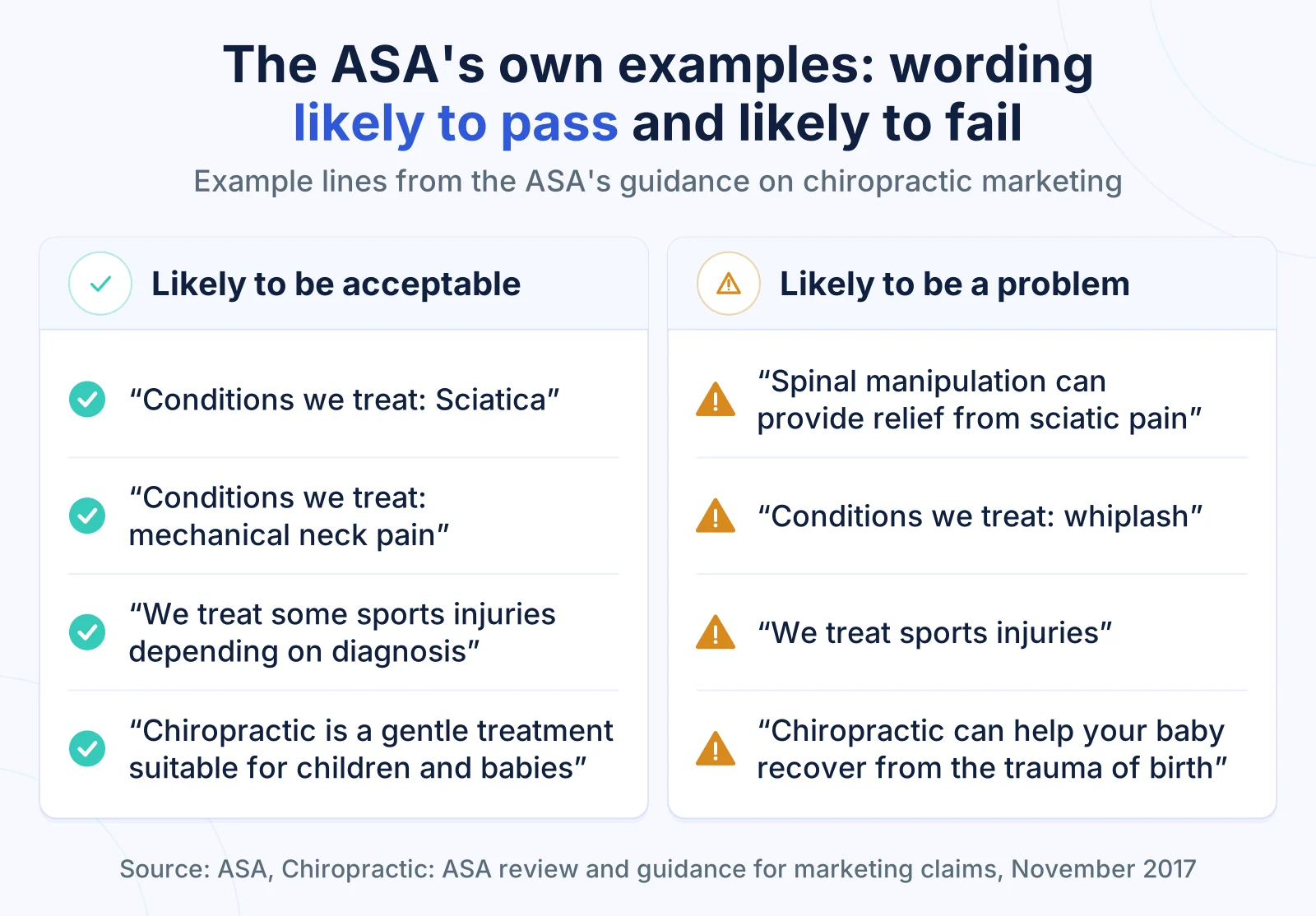
The ASA gives its own examples. “Conditions we treat: Sciatica” is likely to be acceptable, and so is “For patients with sciatica, we use a combination of highly specific manual techniques”. “Spinal manipulation can provide relief from sciatic pain” is not. The difference is one verb: naming the condition is a general reference, while relieving, easing or reducing the pain is a pain reduction claim. The same test applies to the page title and to the short summary Google shows under your page in search results, because a patient reads both before reaching the page.
Back pain after an accident
Back pain is accepted as general, acute and chronic backache or back pain “not arising from injury or accident”. A page titled “Back pain after a car accident” keeps the condition and removes the limit. The accepted version names back pain without tying it to how it started.
Sports injuries
The ASA’s guidance gives “We treat sports injuries” as an example of a claim likely to mislead, because the evidence supported only some minor sports injuries. It gives “We treat some sports injuries depending on diagnosis” as acceptable. A clinic can also name the specific accepted entries a sports patient might need, such as joint pains, headache arising from the neck or ankle sprain in the short term.
Migraine and headaches
Migraine is accepted as migraine prevention. A promise to stop a migraine attack once it has started goes past the entry, in our reading. Headache is accepted only where it arises from the neck, so a general “headache clinic” page goes past entry 4, in our reading.
Ankle sprain, plantar fasciitis, tennis elbow and osteoarthritis
Ankle sprain and plantar fasciitis are both accepted for short term management, so long term recovery claims sit outside them. Tennis elbow is accepted when it arises from associated conditions of the back and neck, not as an isolated problem. Hip and knee pain from osteoarthritis is accepted as an adjunct to core osteoarthritis treatment and exercise, so a page presenting chiropractic as the main treatment goes past the entry.
Can chiropractors treat whiplash, and can they advertise it?
Chiropractors cannot advertise whiplash treatment on the strength of the accepted list, because entry 10 accepts mechanical neck pain “as opposed to neck pain following injury i.e. whiplash”, and the ASA’s 2017 review found the evidence did not show chiropractic was effective for whiplash.
The ASA’s guidance puts the two lines side by side. “Conditions we treat: mechanical neck pain” is acceptable. “Conditions we treat: whiplash” is not. The same guidance says the evidence does not support claims for neck pain arising from other types of injury either, so a page about neck pain after a fall or a sports collision meets the same problem as a whiplash page.
A whiplash claim would need strong clinical evidence held by the clinic, and the ASA’s 2024 guidance for back care awareness week names whiplash as its example of a claim likely to be problematic without it. What a clinic can publish is a mechanical neck pain page and a page on headaches arising from the neck, with neither tied to an accident or an injury.
Can a chiropractor advertise frozen shoulder treatment?
A chiropractor cannot advertise frozen shoulder treatment on the strength of the accepted list, since entry 17 accepts shoulder dysfunction, disorders and pain “but not ‘frozen shoulder’”. The exclusion sits inside the same entry that allows a shoulder page.
Three shoulder claims stay open:
- shoulder complaints, meaning dysfunction, disorders and pain other than frozen shoulder
- rotator cuff injuries, disease or disorders
- soft tissue disorders of the shoulder
A page called “Shoulder pain” can cover all three without naming frozen shoulder. The third exclusion the accepted list names directly covers conditions specific to babies, children and pregnant women.
Can chiropractors say they treat babies, children and pregnant women?
Chiropractors can say they treat babies, children and pregnant women as patient groups, but CAP AdviceOnline says claims about conditions specific to those groups, such as colic or morning sickness, are unlikely to be acceptable unless the clinic holds a strong body of evidence.
The ASA’s guidance gives examples on both sides of that line.
| Likely to be acceptable | Likely to be a problem |
|---|---|
| “Chiropractic is a gentle treatment suitable for children and babies” | Suggesting chiropractic might help a baby’s excessive crying, sometimes known as colic |
| Back pain caused by carrying the extra weight of a baby, which the ASA uses as its own example | “Chiropractic can help your baby recover from the trauma of birth” |
| Descriptions of consultations, techniques and safety that imply no unsupported treatment | Implying that the birth process is inherently traumatic for babies |
| Accurate statements about training the chiropractor has completed | Exaggerating the seriousness of plagiocephaly and brachycephaly (flat head syndrome) |
A pregnancy page can therefore cover back pain. Morning sickness and pelvic pain stay off it. Training claims need the same care: the ASA’s guidance warns against implying training or qualifications in the treatment of babies where that is not the case.
Can a chiropractor make claims about subluxation?
Subluxation claims that present the vertebral subluxation complex as a cause of disease lack support: the GCC’s guidance on the concept, in effect from 1 January 2026, says it is “not supported by any clinical research evidence that would allow claims”.
The same GCC guidance describes the concept as one that “remains a theoretical model”, and standard C5 of the GCC Code requires information about a chiropractor’s services to be factual, verifiable and not misleading. Copy built on subluxation needs checking against that guidance before it appears on a condition page. In our audit, 9 out of 49 clinic websites used the vertebral subluxation concept in their own copy.
How often do UK clinic websites go beyond the accepted list?
UK clinic websites went beyond the accepted list on 25 out of 49 sites in our October 2026 audit of 50 chiropractic clinics: each of those 25 presented at least one condition outside the list as something the clinic treats or helps.
We audited five clinic websites in each of ten UK cities, from London to Belfast, on 13 October 2026. One site blocked our content checks, so every claim figure below is out of 49 sites.
- 25 out of 49 presented a condition outside the accepted list as treated: 22 in the clinic’s own copy, and 3 more only through published patient testimonials.
- 23 out of 49 presented whiplash or frozen shoulder: frozen shoulder on 15 sites and whiplash on 13.
- 11 out of 49 had a page whose web address, title, heading or menu label named whiplash or frozen shoulder.
- 4 out of 49 presented a condition specific to babies or pregnancy, such as colic, as treated.
- 2 sites quoted the list’s exclusion wording on one page and presented the excluded condition on another.
A first keyword pass for 11 terms naming conditions outside the accepted list matched at least one term on 38 of the 49 sites. Reading each match against written rules, a step carried out by an AI model, cut that to 25, because mentions of causes, history, referral advice and the list’s own exclusions did not count, and unclear cases were never counted.
The two conditions claimed most often are the two the accepted list names as exclusions, and each sits beside an accepted entry: mechanical neck pain and shoulder complaints. The pattern suggests a boundary problem rather than clinics disregarding the list. For a clinic, a page named for whiplash or frozen shoulder is the content most exposed to a challenge, and its place in Google goes when the page is withdrawn.
The method, the limits and every count are set out in our audit of 50 UK chiropractic websites. The full report (Research Report TSC-2026-02) and the anonymised data are published with DOI 10.5281/zenodo.23363411. No clinic is named. The audit measured what each website publishes, not rankings, traffic or enquiries, and it does not assess whether any individual site complies with the CAP Code or GCC standards.
Can a chiropractor claim a condition that is not on the accepted list?
A chiropractor can claim a condition that is not on the accepted list only when the clinic already holds strong clinical evidence for that claim, because CAP AdviceOnline says conditions outside the list, or claims beyond its descriptions, need that evidence.
Timing matters as much as quality. The GCC’s guidance on advertising, published in November 2021, says a registrant must be able to prove a claim with evidence held at the time of advertising. Evidence gathered after a complaint arrives does not meet that test.
Patient praise does not fill the gap. The ASA says “testimonials alone are not sufficient substantiation”, so a review crediting chiropractic with fixing an unlisted condition repeats the claim without proving it.
Three practical steps follow from this:
- Build pages for the accepted entries first.
- Keep an evidence file for any other claim, dated before the claim goes live.
- Ask the ASA’s Copy Advice team about a specific line before it runs. The standard service is free, the ASA aims to reply within three to five working days, and its advice is not binding on the ASA.
The GCC’s advertising toolkit puts the default plainly: a claim you are unsure about is a claim to leave out.
Where do the claim rules apply for a chiropractic clinic?
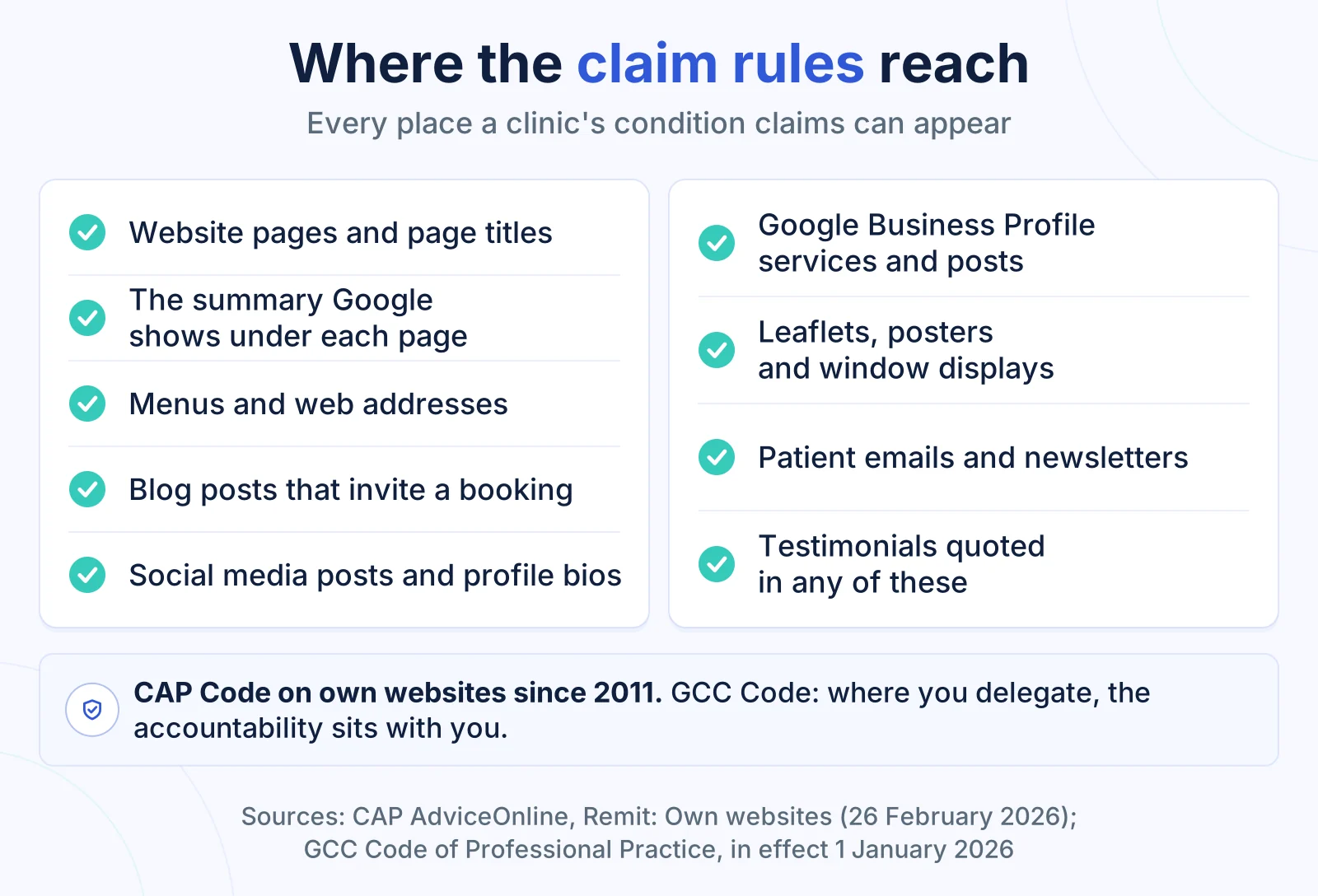
The claim rules apply to every channel a chiropractic clinic controls, from its own website to its Facebook page and Instagram profile, and CAP AdviceOnline says the CAP Code has applied to advertising in that online space since 2011.
We read these channels as one set:
- website pages, including page titles and the short summary Google shows under each page
- menus and web addresses that name a condition
- blog posts that end with an invitation to book
- social media posts, profile bios and pinned posts
- Google Business Profile services, description and posts
- leaflets, posters and window displays
- patient emails and newsletters
Outsourcing the writing does not move the responsibility. CAP AdviceOnline says using a website developer does not stop the ASA treating a site as the clinic’s own. The GCC Code says of information about your services: “Where you delegate this, the accountability sits with you.” The GCC’s toolkit says the same of content produced by PR agencies and content providers.
A Google Business Profile is a third party site where the clinic controls the content, so in our reading it falls within the same rules as the website. Our Google Business Profile guide for chiropractors shows how to write the services list and posts within them.
What about testimonials and reviews?
A testimonial a clinic publishes is a claim the clinic has made, and the ASA says its guidance applies to client testimonials used in marketing, including implied claims about how well a treatment works. What may be published, and how to ask for Google reviews without breaching the rules, is covered in our guide to patient reviews and testimonials for chiropractors.
What happens when a chiropractic advertising claim is challenged?
A challenged chiropractic claim can lead to two separate processes, an ASA investigation under the CAP Code and a GCC fitness to practise investigation, because the GCC Code of Professional Practice makes compliance with the CAP Code part of a chiropractor’s professional duty.
The current GCC Code took effect on 1 January 2026, and to practise in the UK a chiropractor must be registered with the GCC. The GCC’s mapping document states that standard C4 “covers the requirement to comply with the ASA’s CAP Code”. Standard C5 requires information about a chiropractor’s services to be factual, verifiable and not misleading. The earlier Code set the same duty in standard B3.
Two published cases show how each route works.
- GCC route, published 2 October 2024. One chiropractor complained about another’s advertising. The investigation found online claims for conditions outside the accepted list. The registrant removed them promptly from the website and social media, and the Investigating Committee judged the breaches minor, found no case to answer and issued advice. That advice is not on the public register but can be considered if a future complaint is made.
- ASA route, reported by the GCC on 31 October 2023. The GCC complained to the ASA about a former registrant whose leaflet suggested they were a chiropractor and a medical doctor. The ASA ruled that the ad must not run again in its current form, citing CAP Code rules 3.1, 3.7, 3.9 and 1.7.
The first case shows that a rival clinic can start a complaint, and that a prompt correction counted in the registrant’s favour. The second shows the GCC itself refers advertising to the ASA.
The cost to the clinic is wider than the ruling. A withdrawn condition page loses the search visibility it had earned, and the clinic pays twice for the same page: once to write it and once to replace it. That is why the SEO service for chiropractors we offer builds the page plan around the accepted list from the first week. This article summarises published guidance and decisions. This is not legal advice.
How do you reword a risky chiropractic claim?
A risky chiropractic claim is reworded by moving it back inside an accepted entry and its limit, or by replacing a promised result with a plain statement of the condition treated, so the page keeps its subject.
The examples below are illustrative lines written by True SEO, not quotes from any clinic.
| Before | After | Why it changes |
|---|---|---|
| Fast relief from sciatic pain | Conditions we treat: sciatica | Sciatica is accepted as a general reference, not as a pain reduction claim |
| Whiplash treatment after a car accident | Treatment for mechanical neck pain and headaches arising from the neck | Entry 10 excludes neck pain following injury |
| Back pain after a fall? We can help. | We treat general, acute and chronic back pain. | Entry 7 excludes back pain arising from injury or accident |
| Frozen shoulder clinic | Shoulder pain and rotator cuff problems | Entry 17 excludes frozen shoulder; rotator cuff and shoulder pain are accepted |
| We treat sports injuries | We treat some sports injuries depending on diagnosis | The ASA’s own acceptable wording |
| Ends a migraine when it starts | Care aimed at migraine prevention | Entry 11 accepts prevention |
| Tennis elbow clinic | Elbow pain linked to problems in the back and neck | Entry 3 excludes isolated occurrences |
| Settle your baby’s colic | Gentle treatment suitable for babies and children | Patient groups may be named; colic is specific to babies |
Every rewritten line names the condition in plain words and makes no promise about the result. Each one also keeps a search term a patient would use, such as sciatica, back pain or shoulder pain, so the page stays findable.
How do you check a chiropractic website against the accepted list?
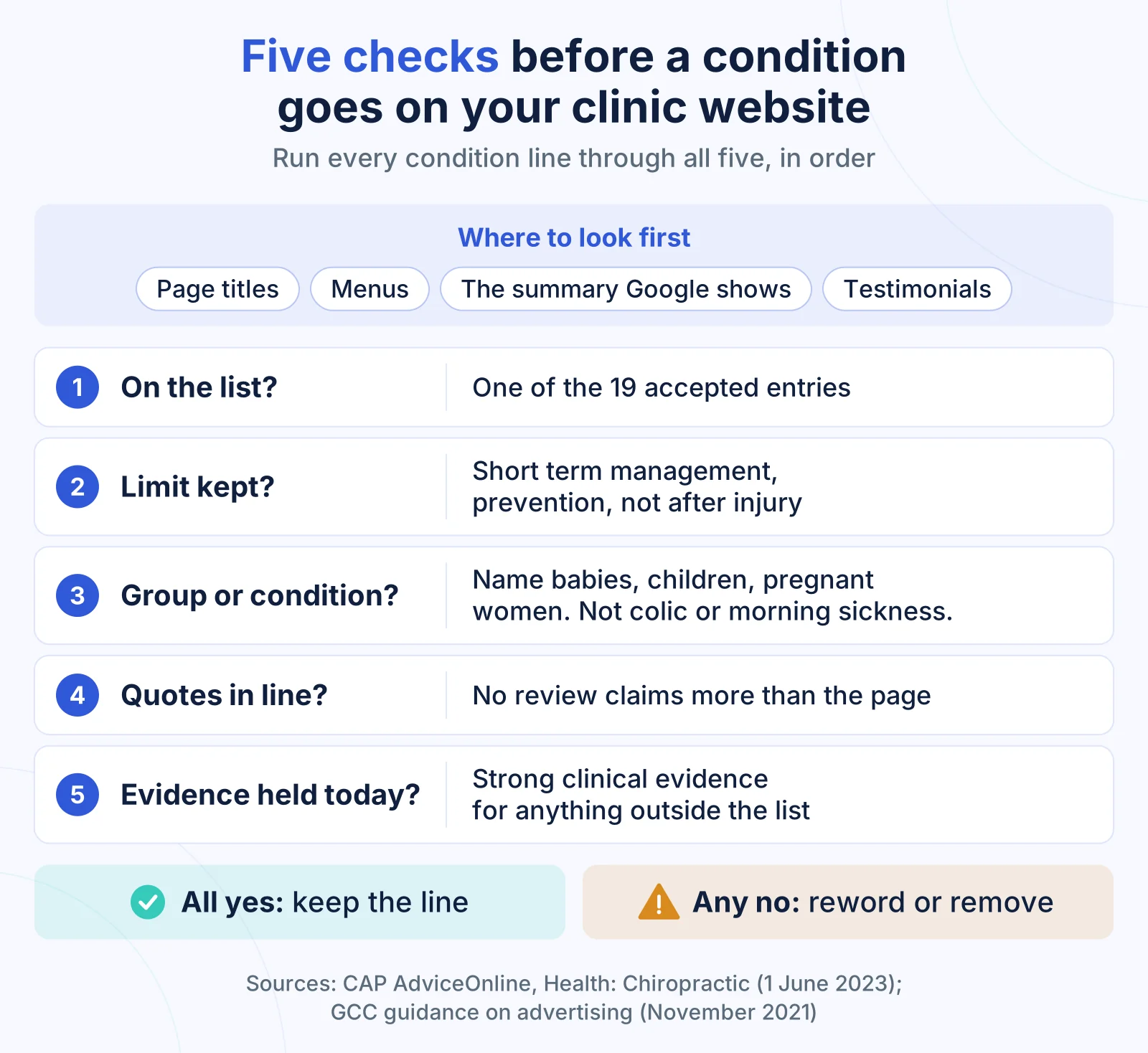
A chiropractic website is checked against the accepted list by finding every place a condition is named, from page titles to patient reviews, and asking five questions of each one before deciding to keep, reword or remove it.
Start with the places patients see first: page titles, menus and the short summary Google shows under each page. Then read headings, body copy, blog posts, your Google Business Profile and the testimonials on the site. For each condition you find, ask:
- Is the condition one of the 19 entries on the accepted list?
- Does the wording keep the entry’s limit, such as short term management or prevention?
- Is the line naming a patient group, or a condition specific to babies, children or pregnancy?
- Does any quote or review on the same page claim more than the page itself does?
- For anything outside the list, does the clinic hold strong clinical evidence today?
A “no” to question 1, 2 or 5, or a condition rather than a group at question 3, marks a line to reword with the patterns above. The Dr title and the GCC registration number follow separate rules, set out in our guide to the Dr title and GCC number for chiropractors.
Check your own website
Answer all 8 questions about your own website, then select See my result.
Please answer all 8 questions to see your result.
Your score: 0 out of 16
Several claims need attention
Your website names conditions or results that go past the accepted list in more than one place. Start with the pages named for an excluded condition, then send us your website for a free claim check so you have the full list in writing.
Your score: 0 out of 16
Mostly inside the list, with gaps
Your main pages follow the accepted list, but limits slip in titles, blogs, testimonials or other channels. A free claim check finds the exact lines and tells you which accepted entry each one can sit inside.
Your score: 0 out of 16
Your claims follow the accepted list
Your pages, channels and testimonials keep to the accepted list and its limits. Use the free claim check as a second read, and ask for the condition pages you could still build.
Frequently asked questions
Does writing “can help” instead of “we treat” change the claim?
The wording “can help” in place of “we treat” does not make an unlisted condition acceptable, because the ASA’s guidance applies to any claim that encourages people to seek treatment. The guidance says chiropractors may claim chiropractic can help with sciatica, yet rejects “Conditions we treat: whiplash”. The condition decides the claim, not the verb, so an unlisted condition needs strong clinical evidence either way.
Can a clinic blog explain what whiplash is?
A clinic blog can explain a condition, its causes and when to see a GP, because the ASA’s guidance applies to claims that encourage people to seek treatment. In our reading, a whiplash article that ends with an invitation to book becomes a treatment claim. Keep explanatory posts free of booking prompts for conditions outside the accepted list.
Does a disclaimer about the accepted list protect a page?
A disclaimer does not protect a page that names an excluded condition as treated, because a disclaimer adds no evidence, and CAP AdviceOnline says claims beyond the accepted list need strong clinical evidence. In our audit, 2 sites quoted the exclusion on one page and presented the excluded condition on another, so check every page that names the condition.
How often should a clinic recheck its claims?
A clinic should recheck its claims whenever new copy goes live and whenever CAP updates its advice. The chiropractic list on CAP AdviceOnline is dated 1 June 2023, and CAP’s separate advice on the Dr title was updated on 15 July 2026. A dated note of each check also shows when the wording was last reviewed.
Does the accepted list apply to chiropractors in Scotland, Wales and Northern Ireland?
The accepted list applies across the UK, because the ASA describes itself as the UK’s independent advertising regulator, and a chiropractor must be registered with the GCC to practise anywhere in the UK. The same 19 entries and the same limits apply to a clinic in Cardiff, Glasgow, Belfast or London, and our audit covered clinics in all four nations.