Web Design And SEO, Planned Together
Structure decided before a page is designed, not retrofitted after launch
Most websites are designed first and optimised afterwards, which is why so many beautiful sites cannot be found. When the structure, the speed and the content plan are decided in the same conversation as the layout, none of it has to be undone later.
- A baseline before anything changes. Indexed pages, positions, enquiries and conversion rate, recorded so the rebuild can be judged
- We will tell you not to rebuild. Two of the four situations we see are fixes, and a rebuild would carry the problem across
- You own everything. The domain, the hosting, the code and the content, from day one and after we stop
- WordPress
- Ecommerce
- Migrations
- Speed and Core Web Vitals
- Cardiff and South Wales
Find out whether you need a rebuild at all
- Whether your pages are actually indexed, checked live rather than assumed
- Where visitors are dropping out, and which of the four drop-offs it is
- Whether the problem is the architecture or three pages that do not convert
- An honest answer when the site is fine and the money belongs elsewhere
No charge, no obligation, and you keep the written findings.
Web design and SEO in five points
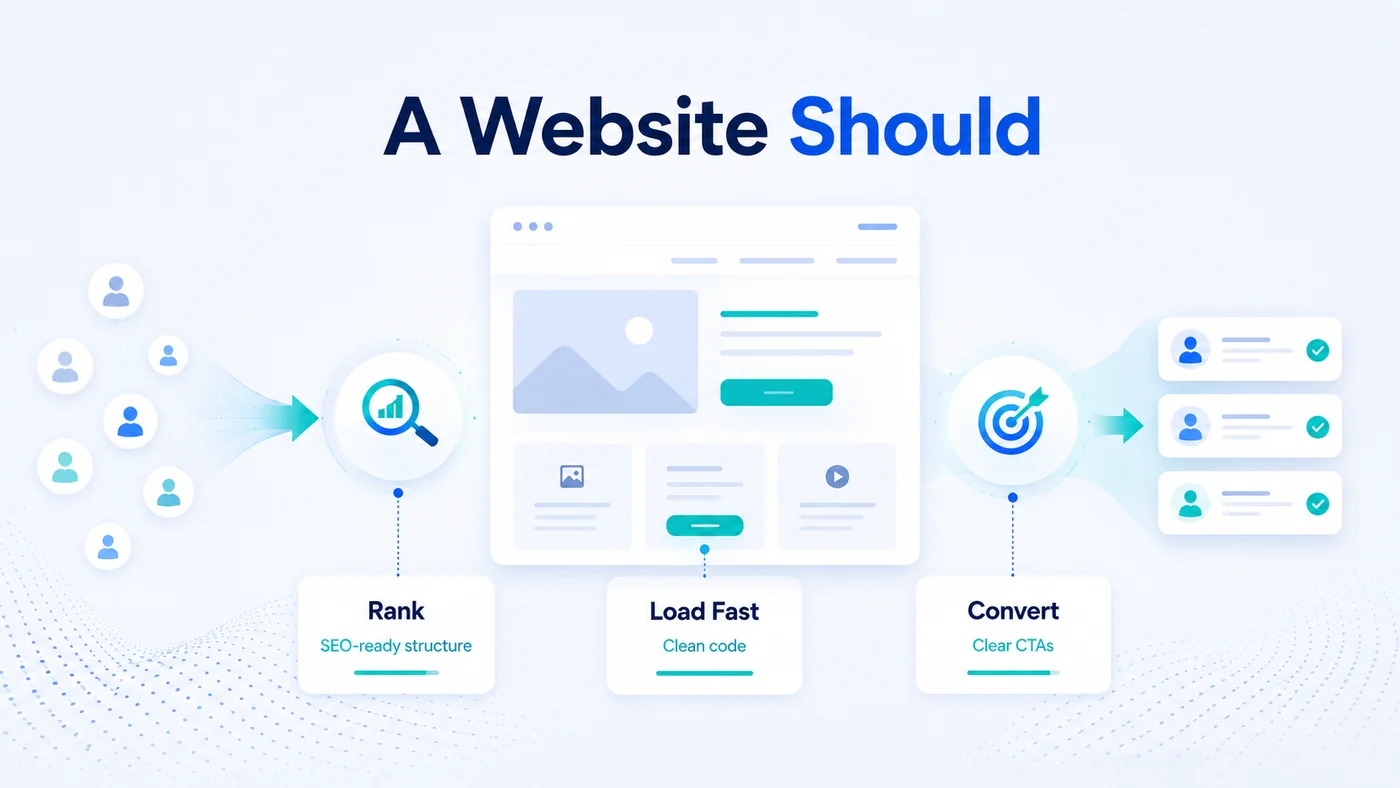
A website has three jobs: be found, load quickly and turn a visitor into an enquiry. Design decides the third. Structure and speed decide the first two, and both are settled before a single screen is drawn.
- The order is the whole argument. Deciding the URL structure, the page inventory and the topic each page owns after the design is finished means rebuilding the design.
- A rebuild is often the wrong purchase. If the site is indexed and fast and only three pages fail to convert, you need those three pages fixed, not forty rebuilt.
- Nothing changes until the baseline is recorded. A rebuild with no before-figures cannot fail, which suits whoever sold it and nobody else.
- Speed is a conversion problem before it is a ranking one. The ranking effect is small and real. The abandonment effect is large and immediate.
- You own it afterwards. Domain, hosting, code, content and analytics, in your accounts, whether or not you keep working with us.
Not sure whether the site is the problem?
The free thirty-minute review checks whether your pages are indexed, where visitors drop out and whether the constraint is the architecture or the copy. If the honest answer is that your site is fine and the budget belongs in technical and on-page work or content instead, we will say so on the call.
What does an SEO-ready website actually mean?
It means the structure, the templates and the content plan were decided from search demand before the design started, so every page has a job, a URL that describes it and a route in from the rest of the site.
The three jobs, and the order they depend on each other in
Swipe the diagram sideways to see all of it.
| Decision | Decided first | Decided after the design |
|---|---|---|
| Page inventory | Comes from what people actually search for | Comes from what fits the navigation the designer drew |
| URL structure | Describes the hierarchy and survives growth | Follows the menu, and breaks when a section is added |
| Templates | One per page type, each with a job | One flexible template used for everything, so nothing is specific |
| Internal links | Planned as routes between related topics | Whatever the nav and footer happen to produce |
| Copy | Written to answer a question completely | Written to fill a box of a fixed length |
| Cost of change | An edit | A rebuild |
The last row is the one that matters commercially. Every item above it is cheap while the site is a wireframe and expensive once it is built. That is the entire case for buying design and search together rather than in sequence, and it is why we plan the topical structure before anyone opens a design tool.
Should you fix the current site or rebuild it?
Rebuild when the architecture or the platform is the constraint. Fix when the site is reachable and fast and the failure is on a handful of pages. Most sites we are asked to rebuild need the second.
Four situations, and the honest answer to each
Swipe the chart sideways to read all of it.
There is a second question underneath the first, and it is about time rather than money. A rebuild takes months, during which nothing improves. A targeted fix takes weeks. If the business needs enquiries this quarter, the fix wins even in cases where the rebuild is eventually right.
Where a rebuild genuinely is the answer, the argument is almost always structural: the URL and template architecture cannot express the topics the business needs to own, or adding a service page requires a developer. Neither is repairable by editing.
What has to be measured before a rebuild starts?
Five things, recorded before anyone touches the design: indexed pages, positions on the queries that matter, enquiries by source, conversion rate per form page, and mobile Core Web Vitals field data.
The baseline, without which nothing afterwards can be judged
Swipe the chart sideways to read all of it.
The fourth line is the one most often missing. Plenty of businesses know their total enquiry count and have no idea which page produced it, which means a rebuild can halve the conversion rate of the one page that was working and nobody will notice for two quarters.
Where tracking does not exist yet, setting it up is the first piece of work, not an afterthought. It is also the cheapest, and it is the only part of a build that keeps paying after the build is finished.
Where is the enquiry actually being lost?
At one of four points: they never arrive, they leave within seconds, they read and stall, or they reach the form and do not send it. Each has a different fix, and only one of them is a redesign.
Four drop-offs, four different fixes
Swipe the chart sideways to read all of it.
The fourth drop-off repays attention out of all proportion to the work involved. Most enquiry forms ask for things the business does not need at first contact: company size, budget band, how you heard about us, a message of at least fifty characters. Every one of those fields exists for someone’s internal convenience and every one of them costs completions.
The test is simple. For each field, ask what you would do differently if it were blank. If the answer is nothing, delete it and ask on the call instead.
Why does website speed matter, and how much?
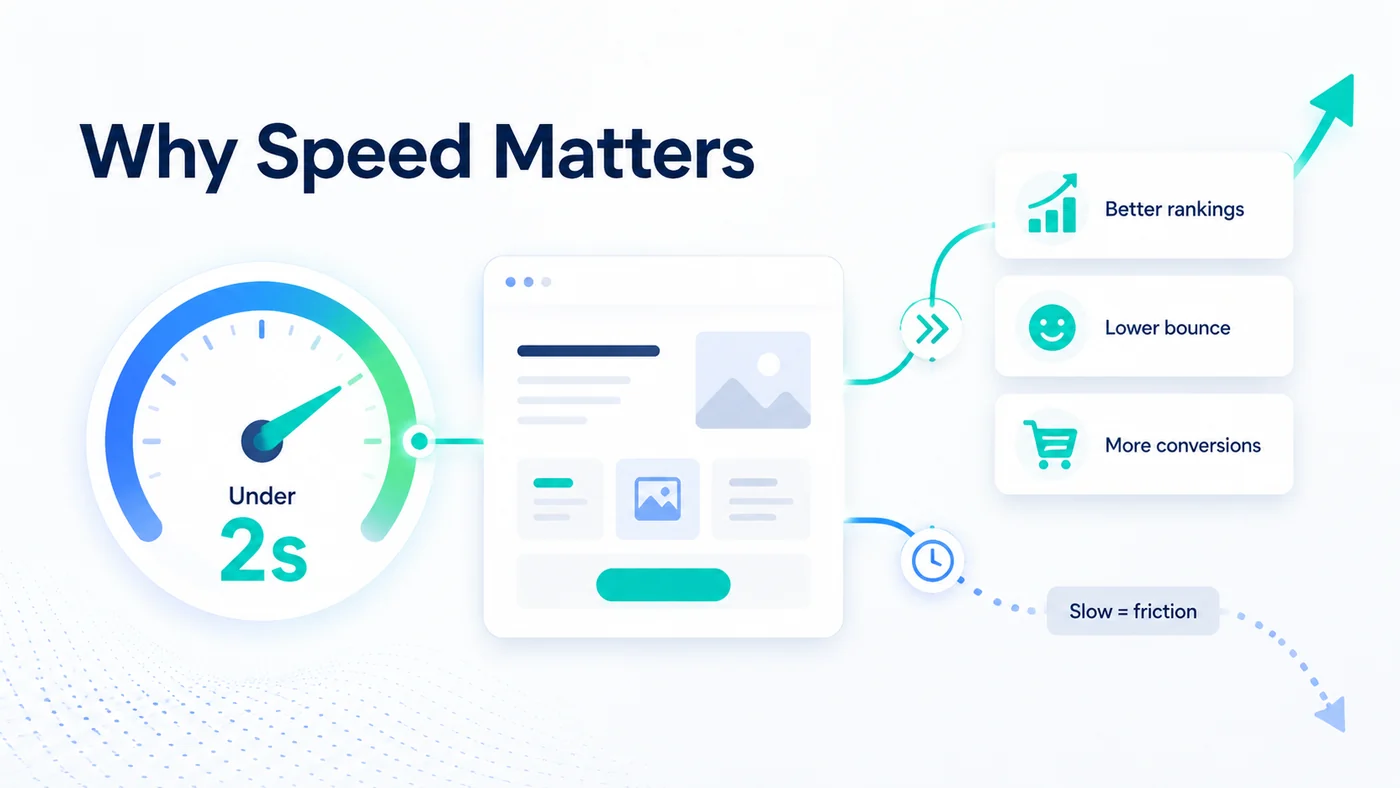
It is a small, real ranking input and a large, immediate conversion one. Treat a failing score as a genuine problem worth fixing, and never as the explanation for a page sitting at position 40.
What slow actually costs, before it costs a ranking
Swipe the diagram sideways to see all of it.
| Cause | How common | Effort to fix | What it changes |
|---|---|---|---|
| Uncompressed images | Almost every site | Hours | Largest single win on most sites, and the cheapest |
| Too many plugins doing too little | Very common on WordPress | Days | Removes render-blocking scripts nobody is using |
| Render-blocking CSS and fonts | Common | Days | Improves first paint, which is what the visitor feels |
| Cheap shared hosting | Common on older sites | A migration | Server response time, which caps everything above it |
| Layout that jumps on load | Common | Hours | Stops mis-taps, which is a conversion problem not a speed one |
| A heavy page builder | Occasional | A rebuild | The only one on this list that justifies starting again |
Note the effort column. Five of the six are fixes measured in hours or days on your existing site, which is another reason a rebuild is so often the wrong purchase. The technical detail behind each of them sits on our technical and on-page SEO page.
What makes a site work properly on a phone?
Readable text without zooming, tap targets big enough to hit, a form that works with a thumb, and a first screen that answers the question the visitor arrived with. Not a desktop layout scaled down.
Mobile-friendly and structured, rather than merely responsive
Swipe the diagram sideways to see all of it.
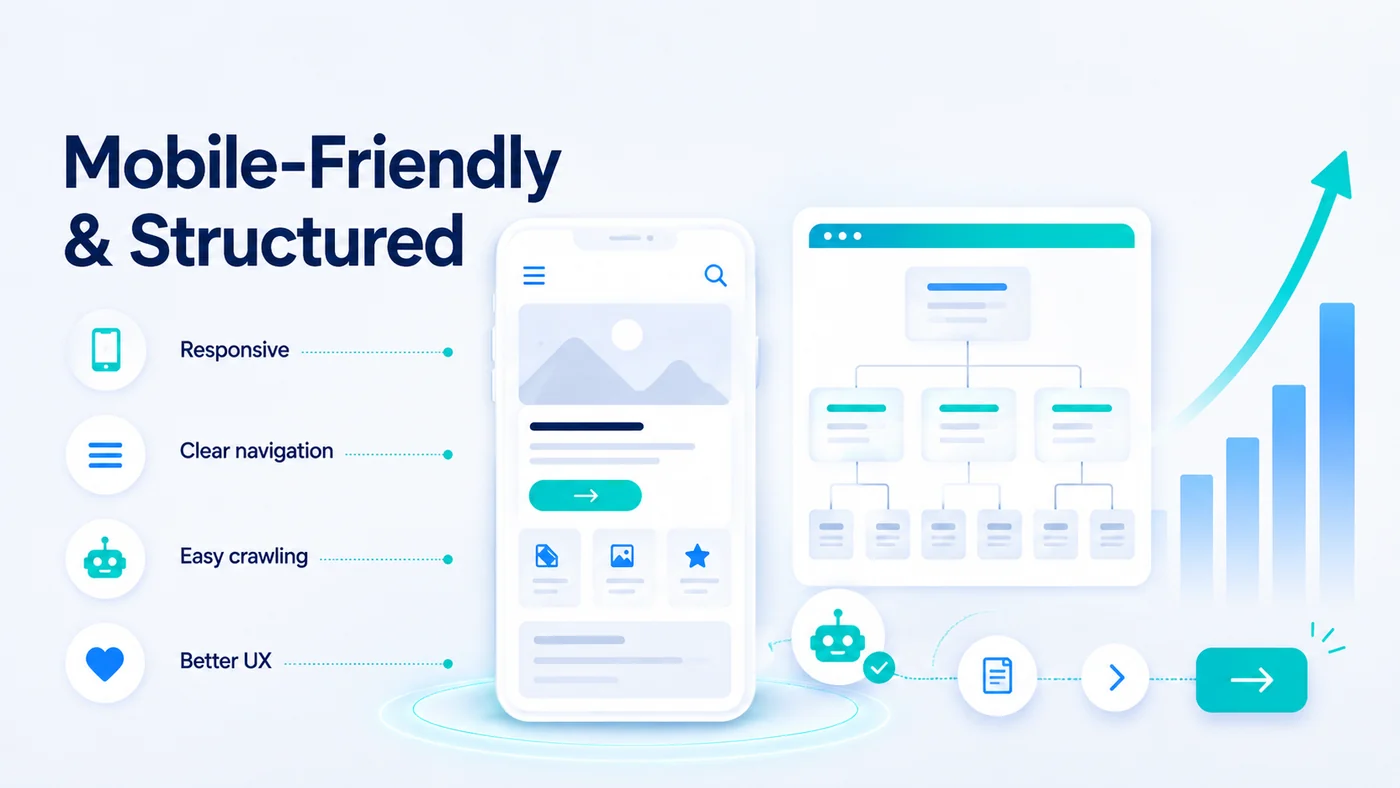
Two things separate a site that merely reflows from one built for a phone. The first screen carries the answer rather than a decorative image, so somebody standing at a bus stop learns what you do without scrolling. And the primary action is reachable with a thumb rather than parked in a header nobody can hit one-handed.
Most sites we review pass Google’s mobile-friendly test and still convert badly on mobile, because passing that test only proves nothing is broken. It does not prove anything was designed.
How do you move a site without losing rankings?
With a URL map written before launch, redirects tested on staging rather than in production, internal links repointed at final destinations, and a fortnight of crawl-data watching afterwards.
Where the move is the whole project rather than one part of a rebuild, it runs as website migration SEO scoped and measured on its own, with the baseline taken before anything changes and the recovery watched after launch.
| Step | What it prevents |
|---|---|
| Every old URL mapped to a new one | Pages quietly disappearing with the links and history they earned |
| 301s tested on staging | Chains, loops and dead ends found by Google before they are found by you |
| Internal links repointed at final URLs | Every internal link hopping through a redirect for the life of the site |
| Sitemap and robots.txt rewritten | The staging noindex reaching production and removing the site from search |
| Analytics and Search Console re-verified | Losing the measurement exactly when you most need to compare |
| Two weeks of crawl watching | Discovering the problem in month two instead of week one |
The fourth row is the commonest single failure in the industry and the most avoidable. A staging noindex is invisible in a browser, breaks nothing a stakeholder would notice, and takes the site out of search within days.
Tell us before the launch date is set rather than after it has slipped. Migration is the one piece of this work with a hard deadline attached, and the pre-flight is worth very little the week after go-live.
Strategy first, design second
The brief is written from evidence rather than preference: what the business sells, who competes, what people search for and where the current site loses them. The visual work starts once those four are settled.
Five inputs, one direction, four things it briefs
Swipe the diagram sideways to see all of it.
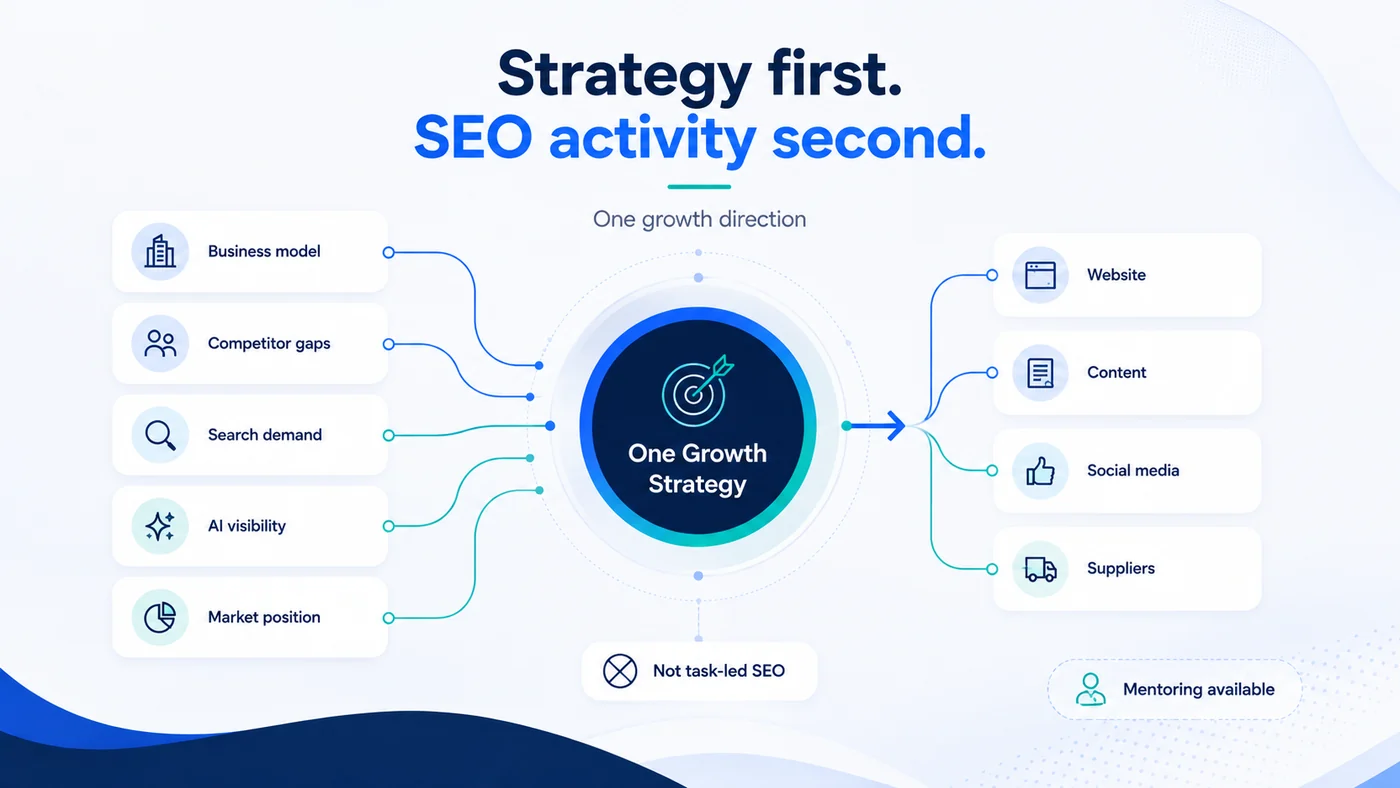
In practice this means the sitemap is agreed before the wireframes, and the wireframes before the visual design. Each stage is signed off in the knowledge of what the next one is for. It is slower at the start and considerably faster in the middle, because nothing has to be revisited once the copy arrives.
What does web design and SEO cost when they are bought together?
Scoped and quoted as a defined piece of work after the free review, not billed by the hour. Four things move the number, and page count is the least important of them.
What actually moves it: how many distinct page types exist, because a template is the unit of work and thirty pages on four templates is four builds, not thirty. Whether content is being written or migrated. Whether the platform is staying or changing. And whether a migration with existing rankings is involved, which adds the pre-flight above.
Buying the two together is normally cheaper than buying them in sequence, for the reason set out at the top of this page: nothing has to be undone. Where it is not cheaper, it is because the site did not need rebuilding, and we would rather establish that on a free call than at the end of a project. Our monthly SEO packages cover the ongoing work after a build, and our guide to what SEO costs in the UK states the market bands without selling a tier.
Who owns the site, the hosting and the content after launch?
You do, all of it, from day one. The domain, the hosting account, the code, the content and the analytics properties are in your name and your billing, whether or not you keep working with us.
This is worth asking every supplier, because the alternative is common and rarely disclosed until you try to leave. Sites built on an agency’s own account, domains registered to the agency, analytics in the agency’s property, hosting billed through the agency at a markup. None of it is illegal and all of it makes leaving expensive.
Our arrangement is deliberately boring. You hold the accounts, we hold access, and access can be revoked in a minute. If you decide to move on, you take a working site and its entire history with you, and no part of the handover requires our cooperation.
Do you work with businesses in Cardiff and South Wales?
Yes. We are a Cardiff consultancy and a good share of our web design and SEO work is for businesses across South Wales, with the rest across the UK and internationally, delivered remotely.
Local work has one practical advantage worth naming: we can sit in a room with the people who actually answer the phone. For a business whose enquiries arrive by telephone, half an hour listening to how those calls open tells you more about what the website should say than a week of keyword research.
Everything else is identical wherever you are. Our Cardiff SEO work covers the local search side, and local and multi-location SEO covers businesses with more than one address.
Built around your model
When the shape of the business decides the shape of the plan.
Bespoke SEO serviceFrequently asked questions about web design and SEO
Will a new website automatically rank better?
No, and assuming it will is how rankings get lost. A new site ranks better only if it fixes something that was holding the old one back. If the old site was indexed and fast, a rebuild changes the design and carries the same search position across, or loses ground if the URLs move without a redirect plan.
How long does a build take?
A small service site is usually six to ten weeks from agreed sitemap to launch, and the variable is almost never the design. It is the content. Builds slip because copy is waiting on someone internal, so we agree who writes what, and by when, before the first wireframe.
Can you work with our existing WordPress site rather than starting again?
Usually, and it is normally the better purchase. Most WordPress sites are fixable: the theme can stay, the plugins can be thinned, the templates can be restructured and the speed problems are almost always images and scripts. We recommend starting again when the architecture or the platform is the constraint, and not otherwise.
Do you write the content, or do we?
Either, and the honest answer is that a mix works best. You know the work and the objections; we know the structure each page has to have and the questions it must finish. Where budget is tight, we brief and you draft, then we edit. Where it is not, we write and you correct the specifics only you know.
Which platform do you recommend?
WordPress for most service businesses, because you can add a page without a developer. Shopify or WooCommerce for a store, chosen on catalogue size and how you handle stock rather than on preference. We will say plainly when your current platform is fine, which it usually is.
What happens to our existing rankings when the site changes?
They are protected by the migration pre-flight above: a full URL map, redirects tested before launch, internal links repointed and a fortnight of watching afterwards. Rankings dip briefly on most migrations while pages are recrawled, and recover within weeks when the mapping is right.
Do you offer hosting?
We will set it up in your name and your billing, and recommend what suits the site, but we do not resell it at a markup. Hosting billed through an agency is one of the quieter ways a supplier makes leaving awkward, and we would rather not have that conversation with you later.
Can you improve conversion without redesigning anything?
Frequently, yes, and it is where we would start. Form fields, the first screen, page speed and the clarity of the offer account for most conversion problems, and all four can be changed on your existing site in days rather than months.
Do you build ecommerce sites?
Yes. Store architecture is a different discipline from a service site, because category structure decides whether thousands of product pages support each other or compete. We cover that on our Shopify and ecommerce SEO and WooCommerce SEO pages.
The next step
Find out whether you need a rebuild
Book a free thirty-minute review. We check whether your pages are indexed, find which of the four drop-offs is costing you enquiries, and tell you honestly whether the answer is a rebuild, a fix, or spending the money somewhere else entirely.