Website Migration SEO, Without The Ranking Drop
A Cardiff consultancy that protects the rankings through a site move, whether we run the migration ourselves or work alongside the developers you already have
Rankings survive a migration when every old address has a deliberate new home and somebody measured the site before anything moved. They fall when neither of those things happened, and the fall is rarely discovered on launch day. It shows up three weeks later, when the enquiries that used to arrive on a Tuesday morning stop arriving, and by then the evidence needed to diagnose it has been overwritten.
- Baseline first, taken from a crawl rather than a sitemap, and frozen before anything moves
- Every old address gets a written decision, made before the build begins rather than reverse engineered from whatever the new site contains
- Checked three times, on paper, against staging, and on the live site within hours of release
- Domain change
- Platform move
- CMS replatform
- Site consolidation
- Redesign and rebuild
- Post migration recovery
A read on your migration before a single redirect is written
- The addresses currently earning your traffic
- The ones most exposed by the structure being proposed
- The questions your developer should be able to answer and usually cannot
Book the free 30 minute review
No charge, and no obligation to book anything afterwards.
You are probably reading this because a move is coming. A new design has been signed off, or the platform is being changed, or the domain is finally becoming the one you actually trade under. The site works now. It brings in enquiries now. Nobody involved in the rebuild is being paid to protect that, and you have noticed.
This page covers what causes rankings to drop during a move, what has to be recorded before anything changes, how every old address gets matched to a new one, what the first few weeks after launch normally look like, and how to tell an ordinary dip from a genuine loss. It also covers the migrations we turn down.
Migration SEO in six points
- Rankings are lost at the mapping stage, not the design stage. Every old address needs a decision, and the decision has to be written down before the build starts.
- A migration with no baseline cannot be judged afterwards. If nobody recorded what ranked before, nobody can prove what changed.
- A short dip is normal. Search engines have to recrawl and reprocess the site, and that takes weeks rather than days.
- The riskiest migrations change two things at once, such as a new platform and a new address structure in the same release.
- A migration is the cheapest chance you will ever get to fix structural problems, because everything is being touched anyway.
- We are answerable for the rankings through the move, not for the launch date.
The free review, in thirty minutes
Bring us the plan and we will tell you where the risk sits before anyone writes a redirect. You get the list of addresses that currently earn your traffic, the ones most exposed by the proposed structure, and the questions your developer should be able to answer but usually cannot.
Our consultancy led approach to search, applied to a site move means the review is the same work we would do on day one of a paid engagement. No charge and no obligation to book anything afterwards.
How does True SEO run a website migration?
Two ways, and the choice is yours rather than ours. We either take the search side of the migration end to end, or we sit alongside the developers and designers you already have and make sure nothing they build costs you a position. Most of our migration work is the second one.
The distinction matters because a lot of businesses assume that bringing in an SEO consultancy means replacing the people building the site. It does not. The build team knows the platform, the design and the deadline. What they are rarely paid to know is which forty of your three hundred pages are carrying the enquiries, and that is the gap the rankings fall through.
We run the migration SEO
We own the baseline, the crawl, the address mapping, the redirect specification, the staging checks and the post launch watch. Your developer implements what the mapping says. You get one document that says what happens to every address on your site, and one person answerable for whether the rankings held.
This suits businesses replatforming, changing domain, or merging sites, where the number of decisions is large enough that somebody needs to own them.
We work with your developers
Your agency or in house team runs the build. We review the proposed address structure before it is built, supply the mapping, test the staging environment, check the live site on release day and watch the recovery afterwards. We work to your release plan rather than asking you to change it.
This suits businesses with a design partner they trust and a rebuild already underway, which is the situation most people are in by the time they start reading about migration risk.
Either way the sequence is the same, and it is the sequence rather than the effort that decides the outcome. The work splits into three stages, and the stage most often skipped is the first one.
| Stage | What we do | What we need from the build team | What goes wrong when it is skipped |
|---|---|---|---|
| Before the build | Crawl the current site, record positions, impressions and the internal link structure, identify the pages producing enquiries, and freeze that as the baseline. Review the proposed address structure while it can still be changed. | The proposed address structure, in draft, before it is built. | Nobody can prove afterwards what the site was earning, so a loss becomes an argument rather than a diagnosis. |
| Before release | Write the address mapping as a document, one decision per old address. Test every old address against the staging site and confirm it resolves in one hop to a live page. Check the staging site is not indexed and the live site is not blocked. | A staging environment we can crawl, and a named person who can implement redirects. | Addresses get missed, redirect chains form, and the staging robots file ships to production. |
| After release | Recheck the full address list on the live site within hours. Submit the new structure for recrawling. Watch positions weekly against the baseline for the first month and separate ordinary reprocessing from genuine faults. | Access to fix what the checks find, quickly, in the first fortnight. | A mapping error that would take an afternoon to fix in week one gets found in month three, by which time the position has been reallocated. |
The launch window is the one thing we ask for that people find unusual. Migrating on a Friday afternoon means any fault runs unattended for three days, and the cost of that is real.
What is included in a migration SEO engagement?
A frozen baseline, a written decision for every old address, a redirect specification your developer can implement without interpreting anything, three rounds of checks, and somebody watching the recovery for the month after release. Nothing on that list is optional and none of it is a report you file away.
The baseline is taken once and then frozen
The checklist is the deliverable, so here it is rather than a summary of it. These are the items we work through, in order, with the point in the project by which each one has to be finished. A migration that has all of these signed off before release is not a risky project. A migration missing the first three is a gamble regardless of how good the new site looks.
| Item | Why it matters | Deadline |
|---|---|---|
| Full crawl of the current site | Sitemaps routinely miss pages that are live and ranking. The crawl is the only complete address list you will get. | Before the build starts |
| Position and impression baseline | Without it, nobody can tell afterwards whether the migration worked or the market moved. | Before the build starts |
| Conversion page list | The pages producing enquiries are frequently not the pages producing traffic, and a rebuild can pass the traffic test while failing the accounts. | Before the build starts |
| Internal link map | Tells you whether a page lost ground because it moved or because it stopped being linked to. | Before the build starts |
| Address structure review | A tidier structure is often a real improvement, but tidiness is not worth a position and the trade has to be made deliberately. | While the structure is still a draft |
| Address mapping document | One decision per old address: move, merge, retire or stay. Built forwards from the old site, never reverse engineered from the new one. | Before the build starts |
| Content parity check | A page can keep its address and still fall, because the copy, headings and links that earned the position were trimmed in the redesign. | On staging |
| Staging redirect test | Every old address tested to confirm it resolves in one hop, not through a chain. | On staging |
| Indexing controls | The staging site must not be indexed and the live site must not be blocked. Both come from the same file and both are copy and paste errors. | On staging and again on release |
| Structured data and analytics carry over | Schema, tracking and goal configuration are commonly rebuilt from scratch and commonly rebuilt wrong. | On staging |
| Live address recheck | The difference between a staging configuration and a production one is where a surprising number of migrations come apart. | Within hours of release |
| Recovery watch against the baseline | Separates ordinary reprocessing from a fault while the fault is still cheap to fix. | Weekly for the first month |
Two of those deserve singling out, because they are the ones businesses are most surprised by. The conversion page list is not something a crawl can produce, since it depends on knowledge you hold and the numbers do not: which enquiries were worth having. And the content parity check exists because holding every address perfectly is not the same as holding every ranking. A rebuild that keeps the addresses and halves the copy has migrated the site and lost the reason it ranked.
Bring us the plan before the address structure is signed off
Thirty minutes, no charge, and you leave with the list of addresses currently earning your traffic and the ones your new structure puts at risk. Book the free review.
Who should be worried about a migration, and who should not?
Worry in proportion to how much of your revenue arrives through search.
A business taking most of its enquiries through referral and repeat custom can move its site with modest risk. A business where organic search is the main route to new customers is moving the thing that feeds it, and should treat the migration as a commercial project rather than a design one.
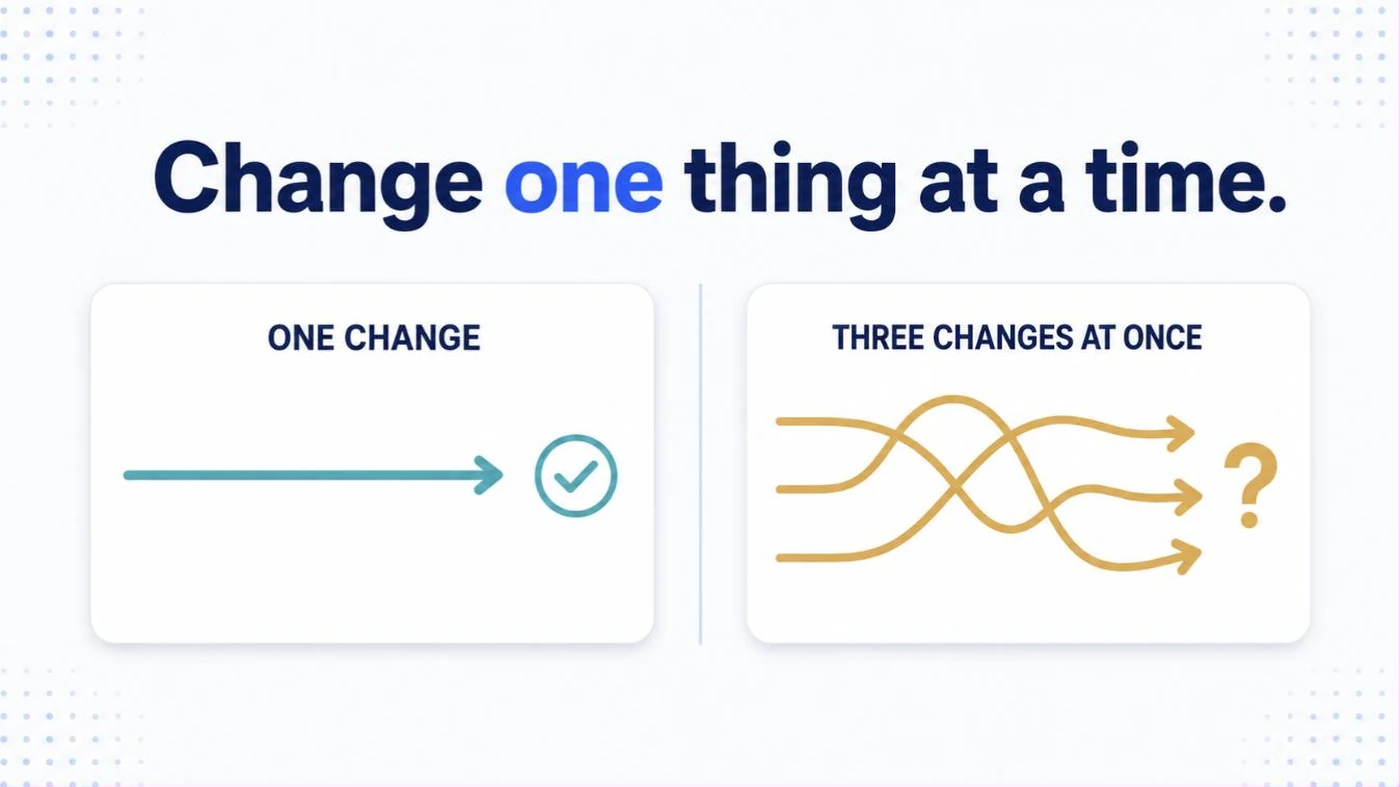
The second factor is how much is changing at once. Changing the look of a site while every address stays identical is close to risk free. Changing the platform, the address structure and the content in a single release means that when something goes wrong, you cannot tell which of the three caused it. That is the situation we are called into most often, usually a fortnight after launch.
Three questions sort most of it. How many of your enquiries began with a search? How many of your addresses are changing? Has anybody written down what currently ranks? A business that can answer all three has a manageable project. A business that cannot answer the third has no way of knowing whether the move worked.
One change is diagnosable, three at once are not
What actually causes rankings to fall during a migration?
Rankings fall because search engines lose the thread between the page that earned the position and the page that replaced it.
Everything else is a variation on that. The commonest cause is an address that quietly stops existing. A page ranked, the rebuild did not include it, and nothing points to where it went. Search engines find an error page where an authority used to be, and the position it held goes to somebody else. This happens most often to old blog posts and to service pages that the new sitemap simply forgot.
The second cause is redirect chains. An address points to a second address, which points to a third. Each hop is technically valid and the reader arrives fine, so nobody notices. Google Search Central guidance on site moves is direct about this: redirect to the final destination rather than through a chain, because long chains can be dropped before the end is reached.
The third is a change of address structure with no thought for what the old structure earned. A tidier set of addresses is often a genuine improvement, but tidiness is not worth a position, and the two goals have to be balanced deliberately rather than one being assumed.
The fourth is the staging site being indexed, or the live site being blocked. Both come from the same file, and both are usually a copy and paste error carried over on release night. It is the single easiest fault to prevent and one of the most damaging to leave running for a week.
The fifth is losing what made the pages rank in the first place. A rebuild that trims copy, drops headings and removes internal links can hold every address perfectly and still fall, because the pages arriving at those addresses no longer answer the question they used to answer. That is where the technical and on page layer beneath a rebuild stops being optional.
Where a migration loses rankings, and where anyone notices
Scroll the figure sideways on a small screen.
What has to be recorded before anything moves?
Everything that currently earns you anything, in a form you can compare against afterwards.
A baseline is the only thing that makes the difference between knowing a migration worked and hoping it did. We record four sets, and each answers a different question later.
The real address list
Taken from a crawl rather than from a sitemap, because sitemaps routinely miss pages that are live and ranking.
Positions and impressions
What each address holds today, so recovery can be judged against a number rather than a memory.
The internal link structure
So we can tell whether a page lost ground because it moved or because it stopped being linked to.
The pages that convert
Frequently not the pages carrying the traffic, and the ones a rebuild is most likely to quietly damage.
That last distinction matters more than most rebuild plans allow for. A page attracting a large share of visits is not necessarily the page producing enquiries, and a rebuild that optimises for the first while quietly damaging the second looks like a success in the traffic report and a failure in the accounts.
The baseline is taken at a fixed point and frozen. Once the old site is gone it cannot be recreated, and a migration argued about without one is just two opinions.
Why the address list comes from a crawl and never from a sitemap
Scroll the figure sideways on a small screen.
How is every old address matched to a new one?
Every old address gets an explicit decision and none is left to a default rule.
That decision is one of four: it moves to a direct equivalent, it merges into a broader page, it is deliberately retired, or it stays exactly where it is. The mapping is built as a document before the build begins, not generated afterwards from whatever the new site happens to contain. Working the other way round is how pages get missed, because you can only map what you remember to look for.
The four decisions, one per old address
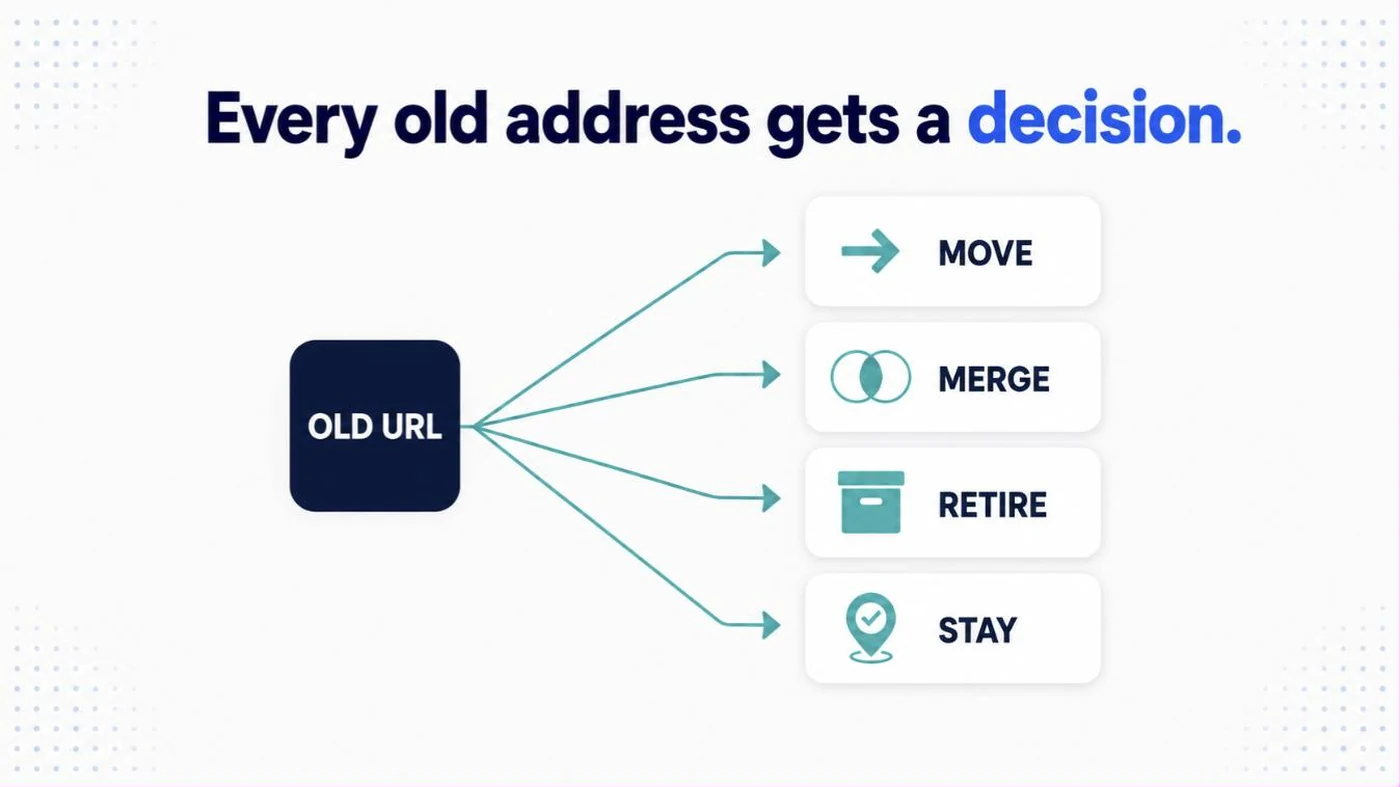
Direct equivalents are simple and cover most of a typical site. Merges need judgement, because pointing five thin pages at one strong page is usually right, and pointing five strong pages at one is throwing away four positions. Retirements are legitimate and underused. A page that ranked for nothing, earned nothing and answered nothing is not worth carrying into a new site out of caution.
We check the mapping three times. Once on paper before the build. Once against the staging site, where every old address is tested to confirm it resolves in one hop to a live page. Once on the live site within hours of release, because the difference between a staging configuration and a production one is where a surprising number of migrations come apart.
Which migrations carry the most risk?
Domain changes carry the most, because everything moves at once and the new address has no history of its own.
A domain change is survivable and often correct, particularly for a rebrand, but it needs the mapping to be complete rather than mostly complete, and it needs the old domain kept and pointing for far longer than most businesses expect.
Platform changes come next. Moving between systems usually forces the address structure to change, because each platform has its own conventions for how a product, a category or an article is addressed. That is the moment a business is most likely to accept a structure it did not choose, simply because the new system produces it by default.
Consolidations are the quiet one. Merging two sites into one, after an acquisition or a rationalisation, means two sets of history competing for the same positions. Done carefully it compounds authority. Done carelessly it halves it.
The lowest risk migration is a redesign that keeps every address. If your project can be scoped that way and still achieve what you want, it usually should be, and we will say so on the call rather than sell you a larger piece of work.
| Migration type | Risk | What is actually exposed | The control that matters most |
|---|---|---|---|
| Domain change | High | Everything moves at once and the new address has no history of its own. | Complete mapping rather than mostly complete, and the old domain kept and pointing for years rather than months. |
| Site consolidation | High | Two sets of history competing for the same positions after an acquisition or a rationalisation. | Deciding which of the two pages on each overlapping topic is the survivor, before either is touched. |
| Platform or CMS change | Medium to high | The address structure usually changes, because the new system has its own conventions for products, categories and articles. | Choosing the structure rather than accepting the one the platform generates by default. |
| Address structure change | Medium | Pages keep their content but lose their identity, and internal links point at addresses that no longer exist. | Rebuilding the internal linking in the same release rather than afterwards. |
| Protocol or subdomain change | Medium | Every address changes even though nothing about the site appears to. | One hop redirects sitewide, and canonical tags updated to match. |
| Redesign with the same addresses | Low | Nothing structural. The exposure is content that gets trimmed in the redesign. | The content parity check, page by page, across the pages that carry the rankings. |
Two rows on that table change what a project should be. A migration sitting only in the bottom row does not need a migration engagement at all: it needs a baseline and a content parity check, and very little else. One sitting in the top two rows with a launch date already fixed usually needs the date moved rather than the mapping compressed, and that is a conversation worth having early, because it gets more expensive every week it is deferred.
What happens to rankings in the first weeks after launch?
Expect movement, and expect it to look worse before it looks better.
Search engines have to discover that the site has changed, recrawl it, and reprocess what they find, and none of that happens in a single pass. A site with a few hundred pages is normally reprocessed within weeks. A large site takes longer, and the pages that get crawled last are usually the deep ones.
A normal pattern is a dip in the first fortnight, partial recovery through weeks three and four, and a return to the previous level within one to three months. Sharper drops that keep falling past the fourth week are not a recrawl pattern, and should be treated as a fault rather than as patience being required.
The distinction we watch is between the whole site softening and specific pages disappearing. A general softening is usually reprocessing. A page that has fallen out entirely while its neighbours are fine is usually a mapping error, and that one is fixable in an afternoon if you find it in week one instead of month three.
This is why we stay attached after launch rather than handing over a document. The value of a migration plan is mostly spent in the fortnight after go live.
Telling an ordinary dip from a genuine fault
Scroll the figure sideways on a small screen.
How long does recovery take, and what counts as recovered?
Recovery means the positions and the enquiries are back where the baseline said they were, and it usually takes one to three months on a well executed move.
Anything still down after that is not recovering, it is a loss that needs diagnosing. We judge recovery on the baseline rather than on the overall traffic line, because a traffic line can hide the thing that matters. Total visits can return to normal while the pages that produced enquiries stay down, replaced by traffic that never converts. That is a failed migration with a healthy looking chart.
The measures are the positions of the addresses that earned money before the move, the enquiries those pages produced, and the proportion of the old address list resolving correctly. The third should be complete within days. The first two take as long as they take.
Can a migration make rankings better rather than just holding them?
Yes, and it is the reason to do the work properly rather than defensively.
A migration is the only moment when every page is being touched anyway, so the marginal cost of fixing structural problems is close to nothing. Three things are worth doing while everything is open. Consolidating pages that compete with each other, which nearly every site over three years old has. Fixing an address structure that grew rather than being designed. Rebuilding the internal linking so the pages you want to rank actually receive links from the rest of the site, rather than every page linking to every other page and none of them signalling anything.
That last one is where most sites have the most to gain, and it connects directly to the semantic structure and topical authority work that decides which of your pages Google treats as the important one. A migration is the cheapest opportunity you will ever have to rebuild that, because the alternative is retrofitting it across a live site page by page.
What does a migration look like on Shopify, WooCommerce, Shopwired or a custom system?
The principles hold everywhere and the practical risks differ by platform.
Knowing which risk belongs to which system is most of the work.
Shopify
Forces its own address conventions for products and collections, so a move onto it almost always changes the structure whether you wanted that or not. The exposure sits with collection pages, which often carry more commercial weight than the products beneath them.
WooCommerce
More flexible, and that flexibility is the risk. The structure can be configured many ways and the configuration chosen at build time is rarely revisited. Attribute and filter pages are the usual problem.
Shopwired
Cleaner structures and smaller catalogues, so mapping is quicker. The attention moves to content written years ago that is quietly carrying the rankings.
Custom systems
Where the surprises live. No documentation of the address rules and no community to ask, so we crawl harder and assume nothing.
Sector shapes the exposure too. An ecommerce catalogue and its category structure has thousands of addresses and the risk is volume. A law firm or an accountancy practice has perhaps sixty pages, and the risk is concentration, because losing three service pages can be most of the pipeline. Healthcare and dental sites carry the added weight of pages that took years to earn trust. A multi location business with branch pages and listings has the added problem of location pages and business listings that all point at addresses about to change.
Two migrations, and what the numbers did
Both moved without permanent loss, and one finished ahead of where it started.
A Cardiff accountancy practice moved from a custom system to WordPress with a new design and about eighty pages. The crawl found one hundred and forty live addresses rather than eighty, because eleven years of blog posts had never appeared in any sitemap. Nineteen of those posts were carrying positions on their own. The mapping covered all one hundred and forty, seventy of the old posts were merged into eight substantial guides with redirects pointing at the merged versions, and traffic dipped by about a fifth in the first three weeks. By week nine it sat around fifteen per cent above the pre migration baseline, because the merged pages ranked better than the fragments they replaced.
A three branch letting agency changed domain during a rebrand and kept its structure identical. The mapping took an afternoon because every address had a direct equivalent. What nearly went wrong was elsewhere: the staging site had been indexed for six weeks before launch, so two versions of the content existed before the real one went live. Removing the staging index and pointing the old domain properly took a fortnight to settle, after which positions returned to baseline within a month. Nothing in the design or the redirect plan caused the problem. A file nobody had looked at did.
What do we need from you and your developer?
Tell us before the launch date is fixed, and give us access to the current site data.
Those two things decide whether this is a controlled project or a rescue. From you we need read access to your search analytics and to whatever records enquiries, plus a sense of which pages actually matter commercially, because that is knowledge the numbers alone do not carry.
From whoever is building the new site we need a staging environment we can crawl, the proposed address structure before it is built rather than after, and a named person who can implement redirects. We work alongside your developer or your agency rather than replacing them, and most of our migration work runs that way. Where the build itself is also ours, it runs through our web design service planned around search from the start.
The one thing we ask for that people find unusual is the launch window. Migrating on a Friday afternoon means any fault runs unattended for three days, and the cost of that is real.
When is a migration the wrong idea entirely?
When the current site is producing enquiries and the reason for moving is that somebody has grown tired of looking at it.
That is not a reason, and a rebuild carries risk that a redesign of the existing pages does not. It is also wrong when the underlying problem is content rather than presentation. A site that does not rank will usually not start ranking because it looks better. If the pages do not answer the questions buyers are asking, a new theme changes nothing, and the money is better spent on the answers.
And it is wrong when nobody can afford the attention afterwards. A migration needs somebody watching for a month. A business heading into its busiest trading period is choosing the worst possible moment, and we will say so.
We turn down migration work on these grounds several times a year. It costs us the project and saves the client more than the project was worth.
Website migration SEO questions we are asked most
Will I definitely lose rankings when I migrate?
No, though you should expect temporary movement. A migration with complete mapping and a proper baseline typically returns to its previous level within one to three months, and often improves on it. Permanent loss is a symptom of missed addresses or lost content, not an inevitable cost of moving.
How long before the new site settles?
One to three months for most sites. Smaller sites are reprocessed faster because there is less to crawl. Large catalogues take longer, and the deepest pages settle last.
Can you work with my existing web designer?
Yes, and that is the usual arrangement. We handle the search side while your designer or agency handles the build. We need the staging environment, the proposed address structure, and someone who can implement redirects.
What if my site has already migrated and the rankings have dropped?
Bring us the old address list if one exists, and we start from what can still be recovered. Recovery is harder without a baseline but far from impossible, because a crawl of the current site plus historical search data usually reconstructs enough to work from.
Do I need to keep the old domain after moving?
Yes, and for longer than most people expect. The redirects have to keep working, which means the old domain has to keep being renewed. Letting it lapse a year later undoes the work.
Is a redesign that keeps the same addresses still a migration?
Technically no, and it is much lower risk. It still needs a baseline and a check that the content carrying the rankings survived the redesign, because pages can lose position without ever changing address.
Why True SEO for a migration
We are answerable for what happens to your rankings, not for the launch date.
That is an unusual position to take and it is the reason the work is scoped the way it is, with the baseline first, the mapping before the build, and somebody watching for the month after release. A design team is measured on delivering the site. Somebody has to be measured on the site still earning what it earned before.
True SEO Consultants Ltd works from Startup Stiwdio, University of South Wales, 86-88 Adam Street, Cardiff, CF24 2FN. We are led by Mohammad A Mahmud, an ACCA qualified accountant who has worked in search since 2011, and Julie Williams, a fractional finance director with more than thirty years behind her. Migrations get treated as commercial risk rather than as a technical exercise, which is what comes of having two accountants running a search consultancy. We work with businesses throughout the UK and onboard clients worldwide through a fully remote digital process, so the site being moved can sit anywhere.
Migration sits inside the wider set of search services this consultancy delivers, and it is usually the moment the rest of them become worth doing.
Book the review before the structure is decided
If a move is coming, the useful moment is now, before the address structure is fixed. We will tell you where the risk sits in your particular plan, what your current site is actually earning, and whether the migration is worth doing at all. Some are not, and we will say so.