Natural Backlinks, Earned Rather Than Bought
Priced on the work that produces coverage, not on the number of links delivered
A link you can buy is a link anyone can buy, which is exactly why it stops counting. Earned coverage is slower, costs more per placement and cannot be promised by the dozen. It is also the only kind that is still working in three years, and the only kind we will sell you.
- Every placement named. The report lists the site, the page, the date and the anchor. No “20 high DA links” with no addresses attached
- No link quotas. We will not agree a monthly number, because a number is a promise that can only be kept by buying
- We will tell you not to buy links yet. A page nobody can reach does not need authority, it needs to be reachable
- Digital PR
- Manual outreach
- Link audits
- Disavow review
- Cardiff and UK wide
Find out whether links are your constraint at all
- What your current profile actually looks like, shape as well as count
- Whether anything in it is likely to be working against you
- Whether authority is the thing holding your pages back, or something cheaper is
- An honest answer when the money belongs in content or technical work instead
No charge, no obligation, and you keep the written findings.
Earned backlinks in five points
A backlink is a vote you cannot cast for yourself. Buying one turns it into a transaction, and a transaction is exactly the pattern search engines are built to discount. Earned coverage is the slow version, and it is the version that holds.
- Links are not the first problem for most sites. If pages are not indexed, or the topic is not covered properly, authority arrives with nowhere to go.
- Quantity is the wrong unit. One link from a page a real audience reads outperforms fifty from a network built for the purpose, and always will.
- The shape of the profile matters more than the count. Anchors, timing, variety of linking sites and which pages receive the links are read together, not separately.
- Nothing is promised by the dozen. Anyone quoting you a monthly link count is describing a purchase, because earned coverage cannot be scheduled.
- Every placement is named. Site, page, date, anchor. If a supplier will not give you that list, there is a reason.
Not sure whether links are what you need?
The free thirty-minute review looks at your current profile, tells you whether anything in it is a risk, and says plainly whether authority is your constraint. If the honest answer is that your budget belongs in topical coverage or technical and on-page work first, we will say so on the call.
What is a natural backlink service, and what are you actually buying?
You are buying the work that produces coverage: research, an asset worth citing, a hand-built target list and individual outreach. You are not buying a number of links, because the number is decided by whether the work was good enough.
Where authority actually sits, and what a snapshot tells you
This is the distinction the whole page rests on. A supplier selling placements has a stock list and a price per unit, and their cost of delivery is the same whether the link helps you or not. A supplier selling earned coverage has a cost of delivery driven by research and rejection, which is why they cannot quote per link and why the good ones do not try.
Practically, an engagement covers four things: a review of what you already have, an asset or two built to be worth citing, outreach done by a person who read the target publication, and a report naming every placement. Where the review finds existing links doing harm, cleaning those up comes before earning new ones.
How is a link actually earned, stage by stage?
In five stages, and only the last one produces a link. Find what people already cite, build the asset, build the target list by hand, pitch it individually, then record every placement that lands.
Five stages, and the two that decide the outcome
The reason campaigns fail is almost never the outreach. It is that the thing being pitched was never worth covering. A guest post offering generic advice competes with everything else in that editor’s inbox; a piece of original data about their sector competes with nothing, because nobody else has it.
That is also why we ask early what you know that nobody else does. Enquiry patterns, pricing shifts, failure rates, seasonal behaviour, anything you can see from inside the business and an outsider cannot. Most firms have three of these and have never thought of them as publishable.
What is the difference between an earned link and a paid placement?
An earned link exists because somebody decided your page was worth citing. A paid placement exists because somebody was paid. The first survives an algorithm update; the second is what an algorithm update is built to find.
| Earned coverage | Paid placement | |
|---|---|---|
| What you are buying | The work: research, an asset, a target list, individual outreach | The link itself, at a unit price, from a stock list |
| Cost per placement | Higher, and it varies, because some pitches are refused | Lower, fixed, and quotable in advance. That predictability is the tell |
| Durability | Holds. The page keeps being read and the link keeps being counted | Devalued at the next spam update, when the pattern is recognised across the network |
| Risk of a manual action | None. Nothing about it breaches the guidelines | Real, and it lands on your site rather than on the seller’s |
Durability is the row that decides the argument. Paid placements do not usually stop working because a person found them; they stop working because a spam update recognises the network they sit in, and every site that bought from it loses the same value on the same day. You cannot appeal that, and you cannot get the money back.
There is a legitimate middle ground worth naming, because pretending otherwise would be dishonest: paid coverage that is properly marked as sponsored. It can be worth buying for the audience it reaches. It just does not pass authority, and it should never be sold to you as if it does.
What is off-page SEO, and where does link building sit inside it?
Off-page SEO is everything that happens away from your own website and still affects how it is understood: links, mentions, reviews, listings and profiles. Link building is the largest part of it and not the whole of it.
| Signal | What it contributes | Where it is usually oversold |
|---|---|---|
| Editorial links | The strongest off-page signal there is. A page vouching for yours, in context | Sold by the unit, when it can only be earned |
| Unlinked brand mentions | Corroborate the business exists and is discussed. Weaker than a link, not nothing | Sold as “brand building” with no measure attached |
| Business listings and citations | Confirm name, address and phone. Matters for local, near-irrelevant nationally | Sold as hundreds of directory submissions |
| Reviews | Influence the map pack and influence humans far more | Sold as bulk review generation, which breaches platform terms |
| Social profiles | Corroborate the entity. No direct ranking effect | Sold as a ranking factor, which it has never been |
| Digital PR coverage | Earns links and mentions together, and reaches buyers directly | Rarely oversold. More often not attempted at all |
The right-hand column is the useful one. Every row on this table is a real signal, and every row has a version of it that is sold in bulk and does nothing. Directory submissions are the clearest example: fifty listings on sites nobody visits do not build authority, they build a footprint that looks exactly like a purchase.
Where off-page work fits in a programme is straightforward. It comes after the site can be crawled and after the pages answer their questions, because it amplifies whatever is already there. Social profiles are covered on our page about social media for search and AI visibility, and listings on our local and multi-location SEO page.
What decides what an earned link campaign costs?
Four things: how competitive the space is, whether you already have something publishable, how narrow the target list is, and whether existing links need cleaning up first. None of them is the number of links.
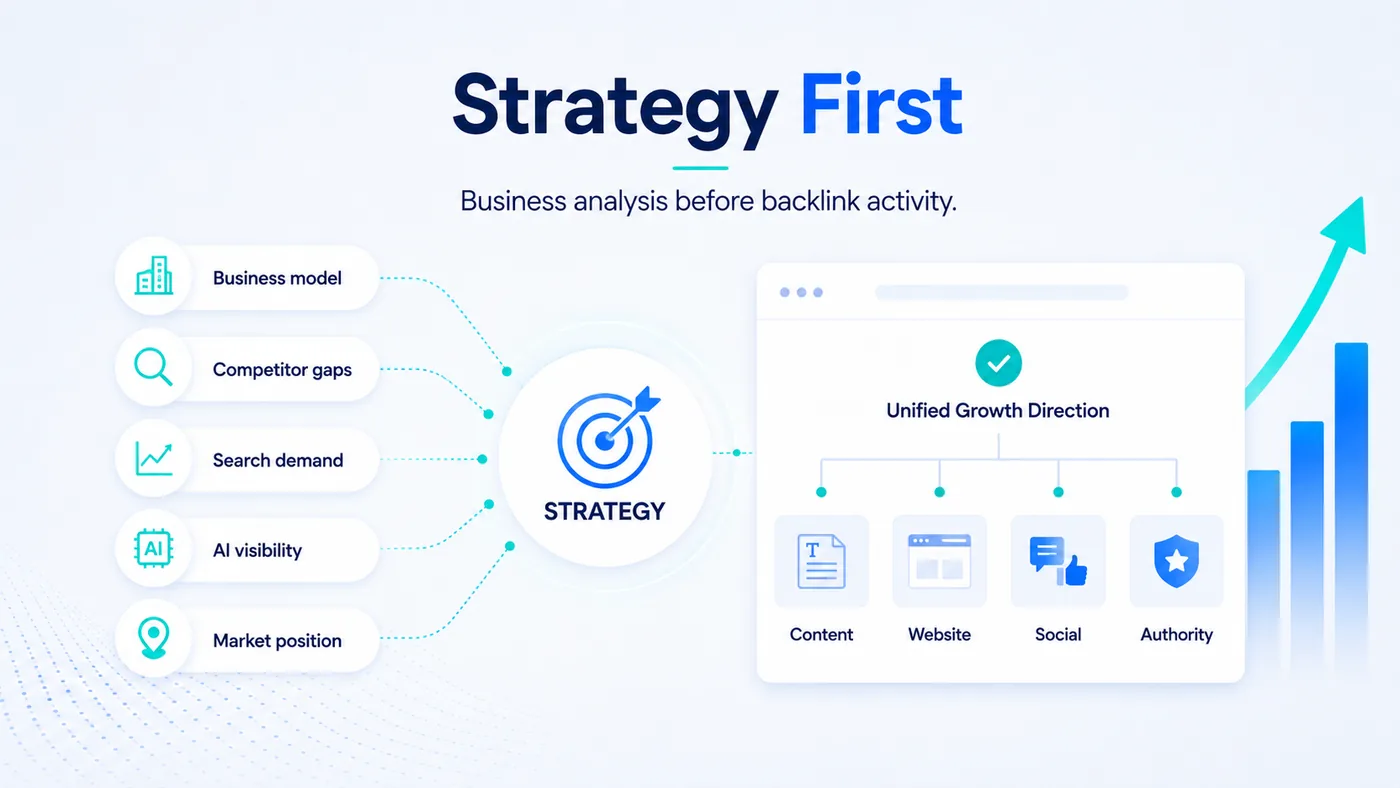
Strategy first, then the assets, then the outreach
Competitiveness sets the floor. Earning coverage in a space where three national brands publish research monthly costs several times what it costs in a regional trade niche where nobody has published anything for two years. That is not a markup, it is the number of pitches required per placement.
Existing material is the biggest single variable. A firm sitting on five years of operational data has an asset already; a firm with nothing but a services page is paying for the research as well as the outreach, and that is roughly double.
Cleanup is the one people forget. Where a previous supplier bought links, the first month is spent working out what is there and what to do about it, and that is time before a single new placement is earned. We quote it separately so you can see it.
We publish the drivers rather than a rate per link, deliberately, because a rate per link is the thing that only a stock-list supplier can quote. If you want the wider market picture rather than ours, our guide to what SEO costs in the UK covers how UK providers price the whole programme.
How many backlinks does a page actually need?
Enough to be credible against the pages currently ranking, which is a different number for every query. For most UK service pages that is a handful of genuine references, not hundreds, and for some it is none at all.
| Situation | What the page usually needs | Where the budget belongs first |
|---|---|---|
| Page is not indexed | Nothing. Links cannot help a page search engines have not stored | Crawl and index diagnosis |
| Page ranks 30 to 60 | Usually nothing. At that distance the gap is coverage, not authority | Answering the question completely |
| Page ranks 11 to 25 | A small number of genuine references, earned over months | Half links, half finishing the content |
| Page ranks 4 to 10 | Authority is often the last gap. This is where a campaign pays back fastest | Links |
| Low-competition local query | Frequently none. Proximity and the Business Profile decide more than authority | Local signals |
| Head term, national, competitive | Sustained coverage over quarters, not a campaign | Links, and a realistic timescale |
The second row is the one that saves people money, and it is the reason we turn work down. A page sitting at position 40 is almost never held there by a lack of links. It is held there because it does not answer the question as completely as the pages above it, and no amount of authority fixes an incomplete answer.
The honest version of this question is therefore not “how many links” but “is authority the binding constraint on this page yet”. Usually it is not, and the campaign that would have been sold is a campaign that would have changed nothing.
What does a natural backlink profile look like for a UK service firm?
Uneven, mostly branded, varied and slightly untidy. Links arrive at irregular intervals from unrelated sites, point at several different pages, and a reasonable share of them are nofollow.
Five signals, read as one shape
The anchor row is worth dwelling on, because it is the most common self-inflicted wound. A genuinely earned profile is dominated by the company name, the bare URL and phrases like “this guide” or “according to”, because that is how people actually write. A profile where a third of the anchors are the exact commercial phrase you want to rank for did not happen naturally, and it does not read as though it did.
Timing is the second tell. Real coverage clusters around whatever caused it and then goes quiet. A steady twenty links a month, every month, describes a subscription rather than a reputation.
Which types of backlinks help, and which ones hurt?
Links help when a real person chose to include them on a page about something related. They hurt when the pattern across many of them is recognisable as something bought, which is a property of the set rather than of any one link.
The helpful ones are unremarkable: a trade publication citing your data, a supplier or client listing you, a local news piece, an industry association page, a genuine partner site, a blogger referencing something you published. None of these can be ordered and most of them arrive because something else happened first.
The harmful ones share a common shape. Private blog networks, sites that exist to sell links, sitewide footer links across unrelated domains, comment and forum links placed at volume, and paid guest posts on publications with no readership. The problem is rarely the individual link; it is that once several of them are present the profile stops looking like a reputation.
Two categories sit in between and cause a lot of unnecessary worry. Scraper sites that copy your content and keep the link are ignored rather than counted against you, and there is nothing to do about them. Old directory listings from a decade ago are usually inert. Neither is worth paying anyone to clean up.
The practical test we apply before pitching anywhere is simple: would this placement be worth having if search engines did not exist? If a real reader might follow it, it is a link worth earning. If the only reason it exists is the crawler, it is not.
How do you find genuine link opportunities?
By looking for people already writing about your subject and finding what they are missing. Not by exporting a competitor’s backlinks and working down the list, which finds you a shopping list rather than an opportunity.
Four sources produce almost everything worth pitching. Journalists and editors currently covering the sector, found by reading rather than by tool. Pages that already cite research in your area, which shows they are willing to cite. Trade bodies, regional press and sector newsletters, which are consistently under-pitched. And your own relationships: suppliers, clients, professional bodies and anyone who has already worked with you and would happily say so.
That last one is the most neglected and the cheapest. Most firms have a dozen genuine relationships that would produce a page mentioning them if anyone asked, and nobody has ever asked. It is not glamorous work and it produces links that are relevant, permanent and free.
Competitor analysis has a place, but a narrow one. It tells you which publications cover your sector and will accept outside contributions. It does not tell you which links caused anyone’s rankings, and treating it as a list to replicate produces exactly the uniform pattern the previous section warns about.
What makes one backlink worth more than another?
Whether a real audience reads the page it sits on, whether that page is about something related to you, and whether the link is there because somebody meant it. Domain scores from third-party tools are a rough proxy for the first and blind to the other two.
What a strong backlink has that a weak one does not
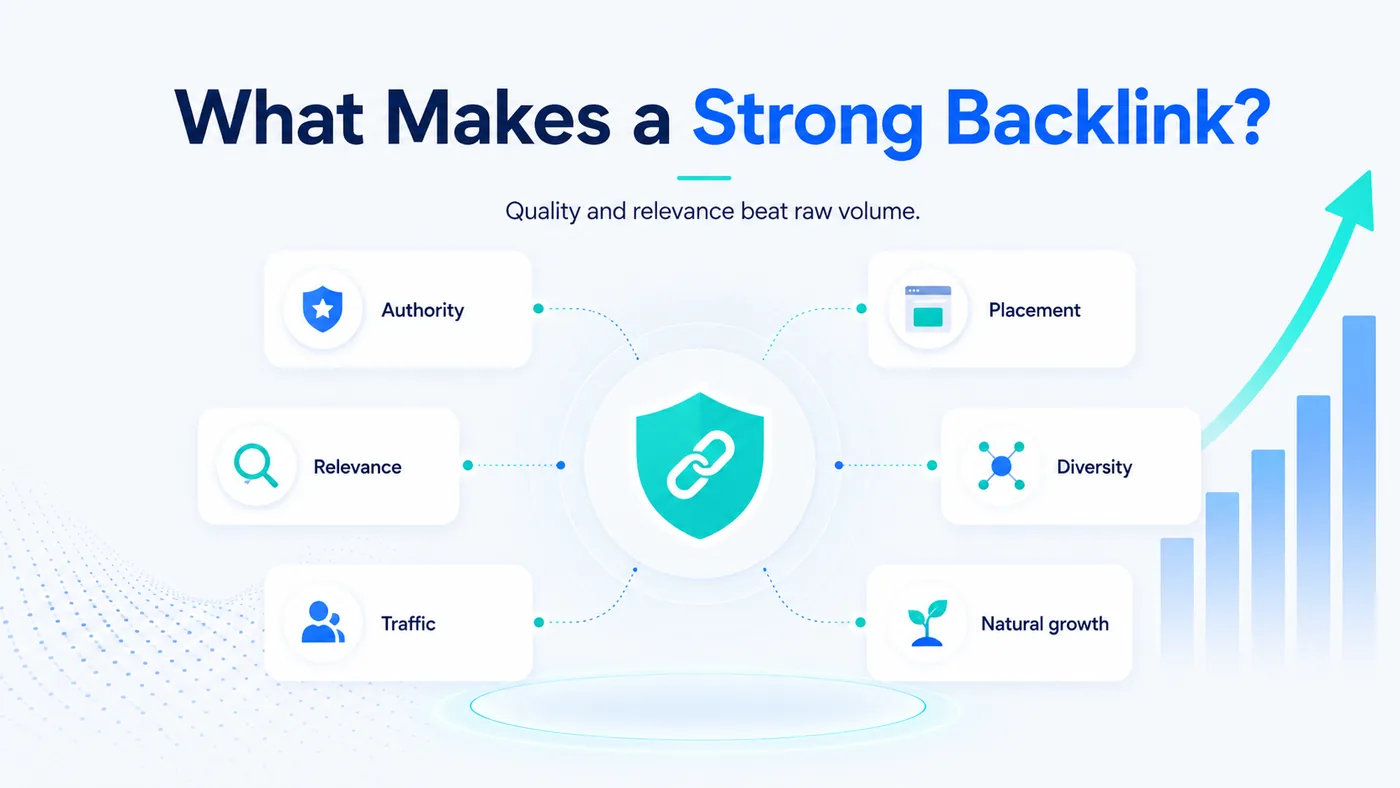
A high domain score on an unrelated site is worth less than a modest score on a publication your buyers actually read. This is unpopular because domain scores are easy to sell and relevance is not, but it is how the value works: a link from a regional business title covering your sector reaches people who might hire you and sits in a context that makes sense.
Placement inside the page matters too. A reference in the body of an article, surrounded by related text, is not the same as a name in a footer list of two hundred, even on an identical domain. When a supplier shows you a domain score and not the page, the page is usually the problem.
What happens if you buy links or a cheap package?
One of four things, in rising order of cost: nothing at all, quiet devaluation, algorithmic suppression, or a manual action. The second is the common one, and it arrives with no alert attached.
Four outcomes, and the one that has no warning attached
People expect a penalty and are surprised when nothing dramatic happens. Manual actions are comparatively rare and, when they do land, at least Search Console tells you. What usually happens instead is that the links are simply not counted, and because rankings did not fall, nothing looks wrong. The business keeps paying a monthly fee for a result that was never going to arrive.
The cheap package is a specific version of this. At the low end of the market the economics only work if links are bulk-produced, which means a network, which means the whole network devalues together. That is not a risk in the sense of a coin toss; it is a scheduled outcome with an unknown date.
If you have already bought links and want to know where you stand, that is exactly what the free review covers. Bring the supplier’s reports if you still have them.
Can a disavow file make things worse?
Yes, easily, and it is the most common self-inflicted damage we see. Disavowing links that were fine removes value you had, and the effect is slow enough that nobody connects the two.
The disavow tool exists for a narrow case: you have a manual action for unnatural links, or you know you paid for links you cannot get removed. Outside that, most sites should never use it. Search engines already ignore what they consider junk, and asking them to ignore more is not the same as asking them to think better of you.
What makes it dangerous is the tooling around it. Third-party audits assign a “toxicity” score to every referring domain, and those scores are guesses generated from crawl signals. Feeding a list produced by one into a disavow file routinely removes genuine coverage: a local directory that actually sends enquiries, a supplier’s site, an old trade association listing.
Our position on it is simple. We review disavow files before touching them, we do not add anything we cannot explain in a sentence, and we do not remove anything that a person would recognise as a real reference. Where a manual action is involved the work changes shape entirely, because removal requests come before disavow and the reconsideration request has to describe both.
How will you know whether the work paid for itself?
By movement on the pages the links point at, then by enquiries. Referring domain counts and third-party authority scores go in the report because you will ask, but they are not the test.
| Measure | What it really tells you | Should it decide spend? |
|---|---|---|
| Position on the linked pages | Whether the authority reached the pages it was aimed at | Yes. This is the first honest signal |
| Qualified enquiries | Whether any of it reached the business | Yes, and it is the only one that settles the argument |
| Referral traffic from placements | Whether the coverage was read as well as published | Yes, and it often arrives before any ranking change |
| Placements earned, named | What was actually delivered, checkable line by line | Yes, as a delivery check rather than a result |
| Referring domains | How many distinct sites link to you. Easy to inflate, hard to interpret | Weakly. Watch the trend, never the number |
| Domain Authority or Domain Rating | A third-party estimate. Not used by any search engine | No |
| Total link count | Mostly how many sitewide footer links somebody has | No |
The lag is worth stating plainly. A placement earned in month two rarely shows in positions before month four, and enquiries follow positions rather than leading them. Anyone reporting a ranking improvement three weeks after a link went live is showing you noise.
Because of that lag, the delivery check matters more in the early months than the outcome check. If the named placements are real, relevant and read, the result is coming. If the report is a count with no addresses, nothing is coming.
Do local and geo-targeted link strategies work?
Yes, and better than most people expect, because the competition for regional coverage is a fraction of the competition for national coverage. A link from a local publication that names your town does two jobs at once.
The mechanism is worth being precise about, because “geo-targeted link building” is sold vaguely. A link from a site that is itself regionally relevant reinforces where you trade, alongside your Business Profile and listings. It is a supporting signal rather than a primary one, and it will not move a map pack ranking on its own.
What it does do is make everything else more credible. A firm claiming to serve Cardiff, with coverage in Welsh business press and a mention from a Cardiff trade body, is corroborated in a way that a firm with a Cardiff address and nothing else is not.
For a multi-location business this gets more interesting and more delicate, because coverage earned in one city should point at that city’s page rather than the homepage. Getting that wrong is one of the ways branches end up competing with each other, which we cover on the local and multi-location SEO page.
Practically, regional outreach is also the easiest place to start. Editors reply, the bar for a story is lower, and a firm with no publishing history can earn its first three or four genuine placements here before attempting anything national.
Which businesses is this right for, and which is it wrong for?
It suits businesses already competing on page one or close to it, and businesses with something publishable that nobody else has. It is wrong for a site that is not fully indexed, and wrong for a page that has not yet answered its question properly.
Natural links against the kind that arrive in bulk
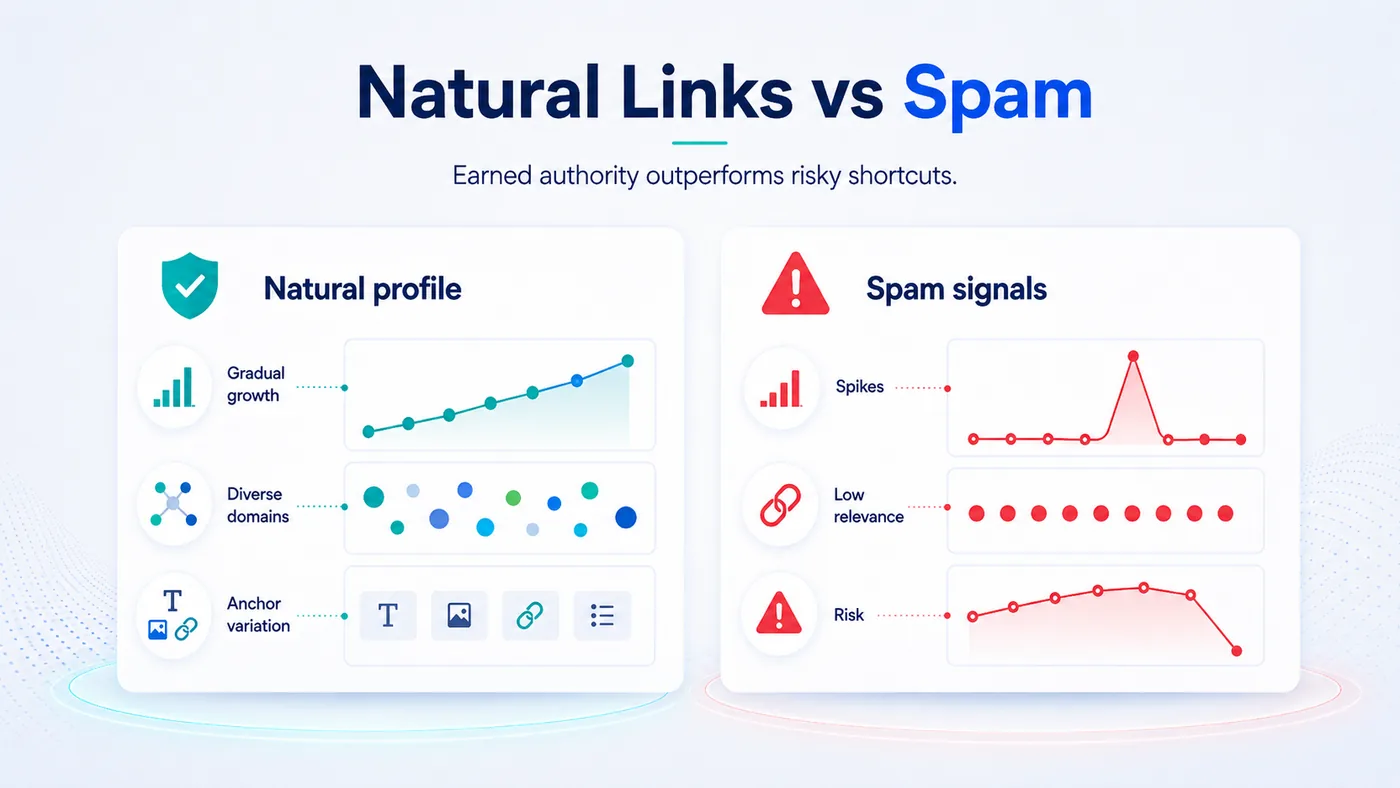
The strongest fit is a firm with operational knowledge worth publishing: a recruiter with placement data, a surveyor with defect frequencies, an accountancy practice with anonymised patterns across a client base. All of that earns coverage without asking anyone for a favour, and it is work we can do properly. Our accountancy SEO work leans on exactly this.
The clearest mismatch is a site with an indexing or coverage problem. Authority pointed at a page search engines cannot reach, or at a page that does not answer the question, changes nothing. That is a technical and on-page job first, and we would rather say that on the call than six months into a retainer.
Do you work with businesses in Cardiff and South Wales?
Yes. We are a Cardiff consultancy, and a good share of this work is for firms across South Wales, with the rest across the UK, delivered remotely.
Regional coverage has a practical advantage for earned links in particular. Welsh trade press, regional business titles and sector associations are approachable, under-pitched and genuinely read by the people who buy from our clients, which is a better combination than a national outlet that will not reply.
Everything else is identical wherever you are. Our Cardiff SEO work covers the local search side, and earned coverage runs inside whichever programme you are on.
Structure and topical depth
The layer that decides what authority can do for you.
Semantic SEO and topical authorityBuilt around your model
When the shape of the business decides the shape of the plan.
Bespoke SEO serviceFrequently asked questions about earned links and backlinks
How many links will we get each month?
We will not agree a number, and you should be wary of anyone who does. A monthly quota can only be met reliably by buying, because earned coverage depends on whether an editor said yes. What we do commit to is the work: the assets built, the outreach done, and every placement named in the report.
Is guest posting still worth doing?
Only where the publication has a real readership and would have accepted the piece on merit. That version is fine and always has been. The version sold at a fixed price per post on a site that exists to sell posts is a paid placement wearing a different name, and it behaves like one.
Do nofollow links do anything?
Yes, though not what people mean by “anything”. They are treated as a hint rather than ignored outright, they bring readers, and a profile with none at all looks manufactured. Coverage in national press is frequently nofollow and is still worth having.
How long before links move anything?
Three to six months for position, longer for enquiries. The page has to be recrawled, the link has to be trusted, and the effect compounds slowly. If your timescale is six weeks, links are the wrong purchase and we will tell you what is not.
Can you get us links from national newspapers?
Sometimes, and never on demand. National coverage follows a story that is genuinely newsworthy, which usually means original data with a national angle. We will tell you honestly whether what you have is that. For most UK service firms, trade and regional coverage is both more achievable and more useful.
What about links our competitors have that we do not?
Worth looking at, with a caveat: a competitor gap analysis tells you where coverage exists in your sector, not which links caused their rankings. We use it to find publications worth pitching, never as a shopping list to replicate.
We were sold links before. Are we in trouble?
Probably not in the dramatic sense, but it is worth checking. Bring whatever the supplier sent you to the free review. Most cases turn out to be the quiet outcome rather than a penalty, and the fix is usually to stop paying and let the profile grow past it rather than to disavow anything.
Do you charge per link?
No. Pricing per link only makes sense for a supplier with a stock list, because it prices the thing rather than the work. We scope the campaign after the free review and quote it as a defined piece of work, with the cleanup separated out where existing links need dealing with.
Can we do the outreach ourselves?
Often, yes, and it works well where the founder is the credible voice. Where clients get stuck is the research and the target list rather than the sending. We are happy to build the asset and the list and let your team do the pitching, and it usually costs less.
The next step
Find out whether authority is your constraint
Book a free thirty-minute review. We look at what your profile actually contains, whether anything in it is working against you, and whether links are the thing holding your pages back. If the honest answer is that they are not, we will tell you where the budget should go instead.