Ecommerce SEO
Category structure, crawl control and margin, in that order
Most online stores do not have a traffic problem. They have a structure problem that looks like a traffic problem. Category pages compete with each other, filters generate thousands of near-identical URLs, and the products that make the margin sit four clicks from anything a search engine considers important.
- Diagnosis before price, in writing, by the end of week three
- Billed against agreed KPIs, no minimum commitment, no notice period
- Shopify, Shopwired, WooCommerce and custom builds, with equal depth
- Category architecture
- Faceted navigation
- Product schema
- Replatforming
- AI visibility
- Margin mapping

Find out how many URLs your store really has
- Crawlable URLs against actual products
- The categories your competitors own
- The one fix that moves revenue first
No charge, no obligation, and nothing to sign.
Key takeaways
- Category pages earn most ecommerce organic revenue. Product pages convert it. Programmes that start with product pages usually stall.
- Faceted navigation is the single most common cause of wasted crawl budget on a UK store, and it is invisible until you look at a log file.
- Platform sets the constraints, not the ceiling. Shopify, Shopwired and WooCommerce each have one structural weakness that shapes the work.
- Replatforming without a URL map costs three to six months of rankings, and the loss is avoidable.
- Expect movement on category terms in three to six months. Expect nothing in week two, and be suspicious of anyone who promises it.
- The entry point is a free 30-minute consultancy and SEO audit with no obligation.
Get the diagnosis before you commit to anything
Our free 30-minute consultancy and SEO audit looks at your category structure, your crawl waste and the queries your competitors own, then tells you which of the three is actually costing you money. There is no charge and nothing to sign.
Who does ecommerce SEO for UK online stores?
We do, as a consultancy: True SEO Consultants Ltd, Cardiff based, working with UK stores from single-brand shops to multi-thousand SKU catalogues.
The distinction between a consultancy and an agency matters more in ecommerce than anywhere else, because ecommerce is the sector where activity is easiest to sell and hardest to connect to revenue. A monthly report showing forty published blog posts tells you nothing about whether the category page for your best-margin range moved from position 14 to position 6. We report on the second thing.
Our founder, Mohammad A Mahmud, is a qualified accountant trained in Koray Tugberk Gubur’s semantic method, and Julie Williams, a fractional finance director of thirty years, reviews the commercial side of every plan. That combination is unusual in search and it shapes how the work runs: we start from your margin by range, not from a keyword list.
We hold a strategic alliance with Shopwired, and we work across Shopify and WooCommerce with equal depth.
Start with a free month, and judge us on orders rather than on rankings
The first month of an ecommerce programme is free. You get the crawl and index audit, the category page plan and the first set of fixes shipped to your store, and you see what it did to orders before anything is billed.
Your first month of SEO, free
Answer three quick questions to claim yours.
Thank you, that is with us.
We will email your onboarding form and payment link, and call within one working day if you would rather talk it through first.
Pick a time that suits you below. We will confirm by email too.
Book your 30 minute meetingWhat does an ecommerce SEO programme cover?
An ecommerce programme runs on four workstreams, and the order matters because each one makes the next cheaper.
| Stage | What happens | Typical duration |
|---|---|---|
| Diagnosis | Crawl, log file review, category and facet audit, competitor gap, margin mapped against query demand | 2 to 3 weeks |
| Structure | Category architecture, internal linking, facet handling, canonical and pagination rules | 4 to 8 weeks |
| Content | Category copy that answers buying questions, product page templates, comparison and buying guides | Ongoing from month 2 |
| Authority | Earned links, entity corroboration, AI and answer-engine visibility | Ongoing from month 3 |
Structure before content is not a preference. Publishing category copy onto an architecture that duplicates itself is paying to strengthen the wrong page. The technical and on-page work that fixes the architecture is the cheapest stage of the programme and the one that decides whether the rest returns anything.
Which platform are you on?
Platform decides your constraints, not your ceiling. Every one of the three we work with most can rank at the top of a competitive UK category, and each has one structural weakness that shapes the first ninety days.
| Platform | Strongest for | The structural weakness | Where to go next |
|---|---|---|---|
| Shopify | Speed to launch, reliable hosting, clean product templates | Forced URL structure with collections and products duplication, and limited control over faceted URLs | Shopify SEO services |
| Shopwired | UK hosting, strong built-in commerce features, straightforward for small teams | A lower ceiling on technical control, so structure has to be planned rather than patched | Shopwired SEO specialists |
| WooCommerce | Total control over URLs, templates and schema | That same control lets plugins generate thousands of crawlable filter URLs unchecked | our WooCommerce SEO consultancy, which names every parameter it constrains |
| Custom or headless | Whatever you built it to do | Nothing is standard, so nothing is assumed. Everything is audited from scratch | Talk to us about a bespoke build |
Stores on Magento, BigCommerce and Squarespace are welcome too. The method does not change; the audit takes a little longer.
How does the first ninety days run?
The first ninety days go diagnosis, then structure, then the first content wave, and you see a written finding at the end of week three.
Week one and two: we crawl the store, read the log files where they are available, map every category and facet URL, and pull twelve months of Search Console data by query and by page. Week three: you get the diagnosis, in writing, with the fixes ordered by what moves revenue first. Weeks four to twelve: we implement, or your developer implements against our specification, and the first category rewrites go live. Nothing waits on a monthly meeting.
You will know inside three weeks whether the problem is technical, structural or editorial. That is the point of buying a consultancy rather than a retainer.
What results should an online store expect?
Expect category terms to move in three to six months, and treat any promise of week-two results as a reason to walk away.
| Store profile | First measurable movement | What moves first |
|---|---|---|
| Under 200 SKUs, low competition | 6 to 10 weeks | Long tail product and buying-guide queries |
| 200 to 2,000 SKUs, competitive niche | 3 to 5 months | Category and sub-category terms |
| Over 2,000 SKUs, faceted catalogue | 4 to 8 months | Crawl efficiency first, then category terms |
| Post-replatform recovery | 2 to 4 months | Restoring what was lost, before any gain |
The proof, from a store we did this for
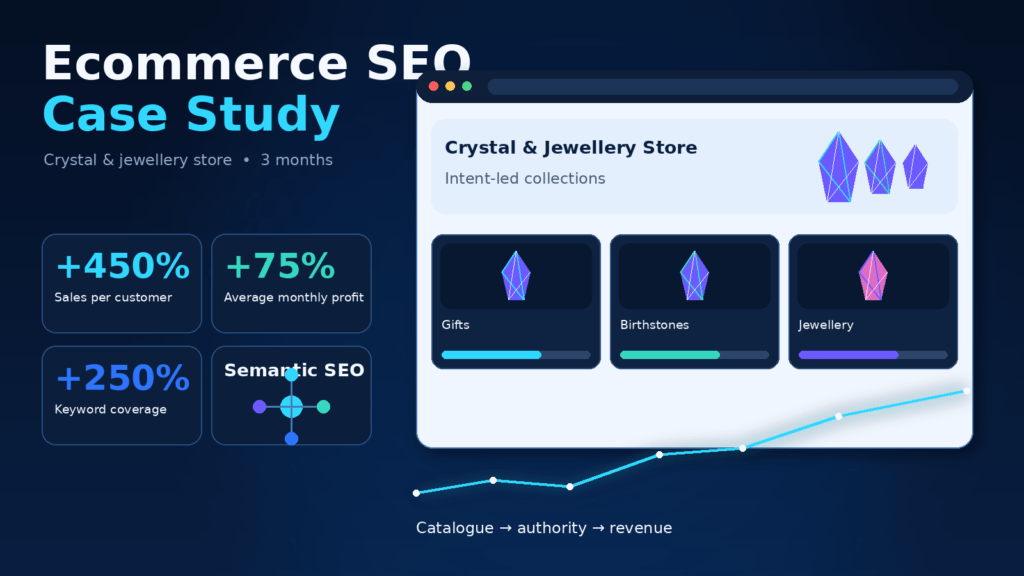
450% higher sales per customer, in three months
An anonymised UK crystal, gemstone and jewellery retailer on Shopwired. We rebuilt the catalogue around a topical map instead of a discount calendar, so the categories answered the questions buyers actually ask before choosing. The client is anonymised at their request; the sector, the platform and the figures are real.
- +450%Average sales per customer
- +250%Tracked keyword coverage
- +75%Average monthly profit
- +45%Added by local SEO
2.35K clicks and 290K impressions across the three-month window, at an average position of 14.5 and climbing. Our fee was 3% of the profit the store made each month, so the engagement only grew when the client’s profit grew.
Two examples show the shape of it. A UK homeware store with 1,400 SKUs came to us with 26,000 crawlable URLs and 900 products, because colour and size filters were generating indexable combinations. Cutting the crawlable set to 2,100 and rebuilding eleven category pages around how shoppers actually search moved six categories from page three to page one within nineteen weeks, and organic revenue rose from £8,400 to £23,700 a month.
A specialist parts retailer had strong product pages and almost no category copy. Its own customers searched by application rather than by part number, so we built application-led category pages and linked them from the existing product set. Organic sessions rose 61% in five months. Average order value on organic rose too, because buyers landed on the range rather than on a single part.
Those two are illustrative. The named results we publish elsewhere, such as Total Books Accountants Ltd going from roughly 200 to about 1,600 organic visits a month, come from other sectors, and we do not dress them up as ecommerce case studies.
What if you sell on Amazon and eBay as well?
Marketplace selling changes the economics of your own site, and the SEO plan should follow the margin rather than the traffic.
A store making 12% on a marketplace sale and 34% on a direct sale is not trying to grow traffic, it is trying to move volume from one channel to another. That changes what we optimise: brand and product-name queries where the marketplace listing currently outranks your own page, comparison content that answers “cheaper direct”, and the trust signals that make somebody buy from a site they have not used before. We map channel margin at the start for exactly this reason.
Two minutes, four questions
Is your problem technical, structural or editorial?
Answer four questions and you will get the workstream to start with, rather than a generic checklist.
1. Are your category pages in Google’s index?
2. How many crawlable URLs does your store have against its product count?
3. Do your category pages carry written copy that answers a buying question?
4. Have you changed platform or URL structure in the last year?
Editorial. Your architecture is sound, so the win is in the category copy
Indexed, stable categories with thin copy is the easiest of the three problems to fix and the one most stores skip. Start by rewriting your top eight categories around the questions buyers ask before choosing, add a comparison table to each, and leave the technical work alone until that is done.
Structural. Your pages exist but the architecture is working against them
Crawl waste and weak internal linking hold back stores that look healthy from the front end. The first job is deciding which facet combinations deserve a URL and which do not, then rebuilding the internal links so category pages accumulate the signals they should.
Technical first. Something is stopping Google reaching your important pages
Missing categories, runaway URL counts or an unrecovered replatform all point the same way: content work will return nothing until the crawl is fixed. Expect the first three weeks to be diagnosis, and expect the fix list to be shorter than you fear.
What is ecommerce SEO, and how is it different from ordinary SEO?
Ecommerce SEO is the work of making a shop’s category, product and buying-guide pages the answer to commercial queries, and it differs from ordinary SEO in one structural way: most of your important pages are generated rather than written.
A service business has fifteen pages, each one written by a person. A store has fifteen categories, four hundred products, and a filter system capable of producing forty thousand URLs that nobody has ever read. Ordinary SEO asks what a page should say. Ecommerce SEO asks first which pages should exist at all.
Why do category pages matter more than product pages?
Category pages carry the commercial query and the internal link equity, so they move revenue in a way individual product pages rarely do.
Somebody searching “waterproof walking boots womens” is not looking for one boot, they are looking for a choice. The page that satisfies that query is a category, filtered and described, not a product. Product pages then convert what the category earns. A store that has spent two years writing product descriptions and left its categories as bare grids has optimised the second half of the journey and skipped the first.
Category pages also sit higher in the internal link graph. Every product links up to its category, so a category accumulates internal signals in a way no single product can. The topical authority work that makes a category rank is the same method we apply to a service cluster, applied to a commercial hierarchy instead.
What does faceted navigation do to your crawl budget?
Faceted navigation multiplies your URL count without adding a single new answer, and on a mid-sized UK store it routinely produces more crawlable URLs than the store has products by a factor of ten or more.
Colour, size, price band, brand and availability filters combine, and the maths runs away fast. Five facets with four values each produce 1,024 combinations of one category. Google crawls what it can reach, so a crawler that spends its allowance on “blue, size 9, under £50, in stock” is not spending it on the category page you need indexed.
The fix is a set of rules rather than a plugin: decide which facet combinations deserve an indexable URL because real demand exists for them, block the rest at the crawl level, and make sure the ones you keep carry unique content. Getting that wrong in either direction costs you. Block too much and you lose long-tail demand that converts. Block too little and the important pages never get crawled often enough to move.
What happens to rankings during a replatform?
A replatform without a URL map costs three to six months of rankings, and almost every case we see was avoidable.
| What breaks | What it costs | What to do before launch |
|---|---|---|
| URL structure changes | Every ranking page 404s or redirects to the homepage | One-to-one redirect map, category by category |
| Category names change | Topical relevance resets | Keep the naming that matches demand, not internal jargon |
| Filter system changes | New crawl traps, old ones still indexed | Facet rules written before build, not after |
| Content dropped in migration | Category copy disappears silently | Content inventory signed off against the old site |
| Schema not rebuilt | Product markup lost, rich results disappear | Schema in the build spec |
The pattern is consistent: the merchant plans the design and the checkout, and nobody owns the URLs. That single gap is the difference between a flat month and a lost quarter.
Should you spend on SEO or on paid ads?
Run both where the margin allows, and treat the question honestly: paid ads buy traffic while you have budget, organic search earns it while the pages stay relevant.
Paid is the right answer on its own in three situations, and we say so on the call. A brand new store with no trading history needs data faster than SEO can deliver it. A seasonal spike, such as a six-week Christmas window, will not wait for a category to rank. A product with a genuinely short life needs immediate volume, because it will be discontinued before a category term matures.
Everywhere else, the arithmetic favours doing the structural work. A store paying £4 a click on a category term it could rank for is renting a position it could own, and the rental cost rises every year. Our guide to what SEO costs in the UK sets out the real bands so you can compare the two properly.
How do AI assistants recommend shops and products?
AI assistants recommend the shop they can identify, corroborate and read, which rewards structured product data and clear entity signals more than keyword density ever did.
Close to a third of UK Google searches now show an AI summary above the normal results, and more than half of UK adults say they see these summaries regularly. For a store, that changes the top of the funnel entirely. “Best waterproof walking boots for wide feet” increasingly returns a synthesised answer naming a handful of retailers and products.
Getting named depends on three things. Complete and accurate product schema, category pages that answer the comparative question in prose rather than only in a grid, and corroboration from sources the assistant already trusts, including reviews that are genuine. UK consumer law has banned fake and concealed incentive reviews since April 2025, with penalties that can reach 10% of worldwide turnover, so the only route left is a real review process. This is the ground our AI and LLM search visibility service covers.
Agency, freelancer or consultancy?
Choose on who carries the diagnosis and who carries the risk, because that is the only difference that shows up in your accounts.
A freelancer is the cheapest option and works well when you already know what needs doing and need hands. An agency gives you capacity and process, and its weakness is that the incentive is to bill activity. A consultancy sells the decision rather than the hours. That suits a store that does not yet know why its traffic stopped growing, and it suits nobody who already has a plan and simply needs it built.
We bill against agreed KPIs, there is no minimum commitment, and you can end the engagement in any month with no notice. That structure exists because it puts the risk on us, which is where it belongs when we are the ones claiming to know what is wrong.
Frequently asked questions
How much does ecommerce SEO cost in the UK?
Cost tracks catalogue size, competition and the state of the site rather than the platform. A 200-SKU store in a light niche and a 5,000-SKU store in a contested one are different pieces of work. Our guide to UK SEO pricing sets out the real bands, and the free audit gives you a figure for your own store.
How long before an online store sees results?
Three to six months on category terms for most stores, six to ten weeks on long-tail product queries for smaller catalogues. Post-replatform recovery runs two to four months before any gain, because the first job is restoring what was lost.
Do you work with WooCommerce stores?
Yes. WooCommerce gives the most control of the three main platforms and, for the same reason, produces the worst crawl waste when plugins are left unchecked. The work starts with bringing the URL set under control.
Can you work with our existing developer?
Yes, and it is often the cheapest route. We write the specification, your developer implements it, and we verify the result. Nothing about the programme requires us to hold the keys.
Do you take on stores that have been penalised?
Yes. Search penalty and algorithmic recovery is part of what we do, and the first step is the same diagnosis, run against the drop rather than the plateau.
Start with the diagnosis
Find out what is actually costing you money, before you spend anything
True SEO Consultants Ltd, based at Startup Stiwdio, University of South Wales, 86-88 Adam Street, Cardiff, CF24 2FN, works with online stores across the UK and onboards clients worldwide through a fully remote digital onboarding and delivery process. Your store can be in Cardiff, Leeds or Lisbon; the crawl, the category audit and the margin map run the same way.
Book a free 30-minute ecommerce audit and we will show you how many crawlable URLs your store really has, which categories your competitors own, and which single fix would move revenue first. No charge, no minimum commitment, and no notice period on any engagement.
This page sits inside the eighteen industries we run search programmes for. Two further reads: how topical authority is built well enough for a category page to hold position one, and why keyword intent decides whether a shopper lands on a category or a product.