Semantic SEO is the practice of building a website around the meaning of a subject: the things in it, the facts about them and the questions people ask. It helps search engines and artificial intelligence (AI) assistants understand your site, trust it and choose it over pages that only repeat keywords.
The method is sound. The vocabulary is the problem. Koray Tuğberk Gübür, who popularised the modern semantic SEO framework, teaches it through terms like source context, central entity, contextual vector and cost of retrieval, and Google adds its own words on top: passage ranking, neural matching, query fan-out. Read them one at a time and they sound like jargon. This guide decodes all 94 of them using one business, a Cardiff boiler firm, so you see every term at work on the same website, the same customers and the same searches. Each one comes with its card, a one-glance visual summary from our Semantic SEO Decoded series, a tag showing where the term comes from, and a box showing the right way and the wrong way to use it. The parts run from the simplest ideas to the most technical, so you can start at Part 1 and read straight down, or jump to any term from the A to Z list.
Key points
- Semantic SEO organises a site around one subject’s things, facts and questions, not around single keywords.
- Koray Tuğberk Gübür’s framework starts with the business itself: what it is, the main thing it is about and what its customers come to do. He calls these source context, central entity and central search intent, and they decide everything after.
- A topical map turns that into a plan of pages: core pages that sell your services, and outer pages, helpful guides that answer questions and point readers to the core pages.
- Google now reads the meaning of words, not just the letters, so clear wording and a clear page structure count for more than repeating a keyword.
- Topical authority is the trust Google gives a site across a whole subject. You earn it by covering the subject fully, publishing steadily and keeping pages easy for Google to process.
- AI search runs on the same foundations: Google says AI Overviews need nothing beyond normal SEO, so clear, well connected pages are the best preparation, though no page is promised a citation.
All 94 terms, A to Z
- A
- AI citations
- AI Overviews
- Answer engine optimisation (AEO)
- Answer passage
- Author entity
- B
- Backlinks
- Brand entity
- Brand mention
- C
- Central entity
- Central search intent
- Co-occurrence
- Comprehensiveness
- Connected entities
- Consensus
- Content configuration
- Content freshness
- Content pruning
- Contextual anchor text
- Contextual bridge
- Contextual domain
- Contextual hierarchy
- Contextual relevance
- Contextual vector
- Contextual vocabulary
- Contextual weight
- Core section
- Cornerstone content
- Cost of retrieval
- D
- Disambiguation
- E
- E-E-A-T
- Entity attributes
- Entity home
- Entity salience
- Experience signal
- F
- Featured snippet
- Follow-up query
- G
- Grounding
- H
- Head and long tail
- Heading structure
- Historical data
- I
- Information density
- Information responsiveness
- Internal PageRank
- K
- Knowledge graph
- Knowledge panel
- M
- Main and supplementary content
- Micro and macro context
- Momentum
- N
- Named entity
- NAP consistency
- Natural language understanding
- Neural matching
- Node documents
- O
- Ontology
- Orphan page
- Outer section
- P
- Passage ranking
- People also ask
- Pillar page
- Predicate
- Q
- Quality nodes
- Query deserves freshness (QDF)
- Query fan-out
- Query network
- Query path
- Query rewriting
- Query semantics
- R
- Re-ranking
- Reasonable surfer
- Related searches
- Representative query
- Root document
- Root query
- S
- Salient terms
- Search intent
- Semantic content brief
- Semantic content network
- Semantic distance
- Semantic SEO
- SERP features
- Source context
- Structured data
- Synonyms and polysemy
- T
- Taxonomy
- Topic silo
- Topical authority
- Topical border
- Topical coverage
- Topical map
- Triple
- U
- Unique information gain
- W
- Word embeddings
- Word sequence
- Z
- Zero-click search
New to semantic SEO? Start with these ten terms. Read them in this order and the other 84 will make sense as you meet them:
- Semantic SEO: the method as a whole.
- Named entity: a specific thing Google can recognise.
- Knowledge graph: where Google keeps facts about those things.
- Search intent: what the person searching wants done.
- Source context: what your business is and how it earns.
- Central entity: the one thing every page comes back to.
- Topical map: the plan of pages before anything is written.
- Core section and outer section: money pages and the guides that feed them.
- Answer passage: the plain answer at the top of each section.
- Topical authority: what a site earns when the plan is done well.
Meet Example Heating, the business behind every example
Example Heating is a fictional Cardiff boiler and central heating company we use as the single worked example for every term in this guide. It is not a client. Picking one business on purpose means you watch the whole framework apply to the same set of pages, people and searches from start to finish.
Here is everything you need to know about it:
| Fact | Example Heating |
|---|---|
| What it does | Boiler installation, boiler repair, annual boiler servicing, central heating installation, power flushing, radiator and smart thermostat fitting, landlord gas safety certificates, emergency breakdown call-outs |
| Who it serves | Homeowners and landlords in Cardiff, Penarth, Barry, Caerphilly and Pontypridd |
| How it earns | New boiler installs are the big jobs; servicing plans and landlord certificates repeat every year; repairs bring the first contact |
| Who does the work | Rhys, the owner and lead engineer, and a small team of Gas Safe registered engineers |
| Brands it fits | Worcester Bosch, Vaillant and Ideal |
| Its website | A homepage, service pages for each job, town pages, and plain-English guides to boiler problems |
One fact about Example Heating is real law, not illustration. Registration with the Gas Safe Register is a legal requirement for anyone carrying out gas work in the UK, under the Gas Safety (Installation and Use) Regulations 1998, according to the government’s Regulated Professions Register. That one fact comes back in Part 9, because customers check it, and trust sits at the centre of Google’s guidance on Experience, Expertise, Authoritativeness and Trustworthiness (E-E-A-T).
A boiler firm works well as the example because its customers search for every reason semantic SEO cares about, which SEOs call search intent. People search to learn (“why is my boiler losing pressure”), to compare (“combi vs system boiler”), to find someone nearby (“boiler repair Cardiff”) and to buy (“new boiler cost Cardiff”). The same pattern applies to an accountancy practice, a solicitor or a dental practice; only the nouns change.
How the 94 terms fit together
The 94 terms describe one system in eleven layers, from how Google understands language to how AI search chooses its sources. In between come how a business defines what it is about, how people search, how a site is planned and written, and how authority flows. Read them in order and each layer depends on the one before.
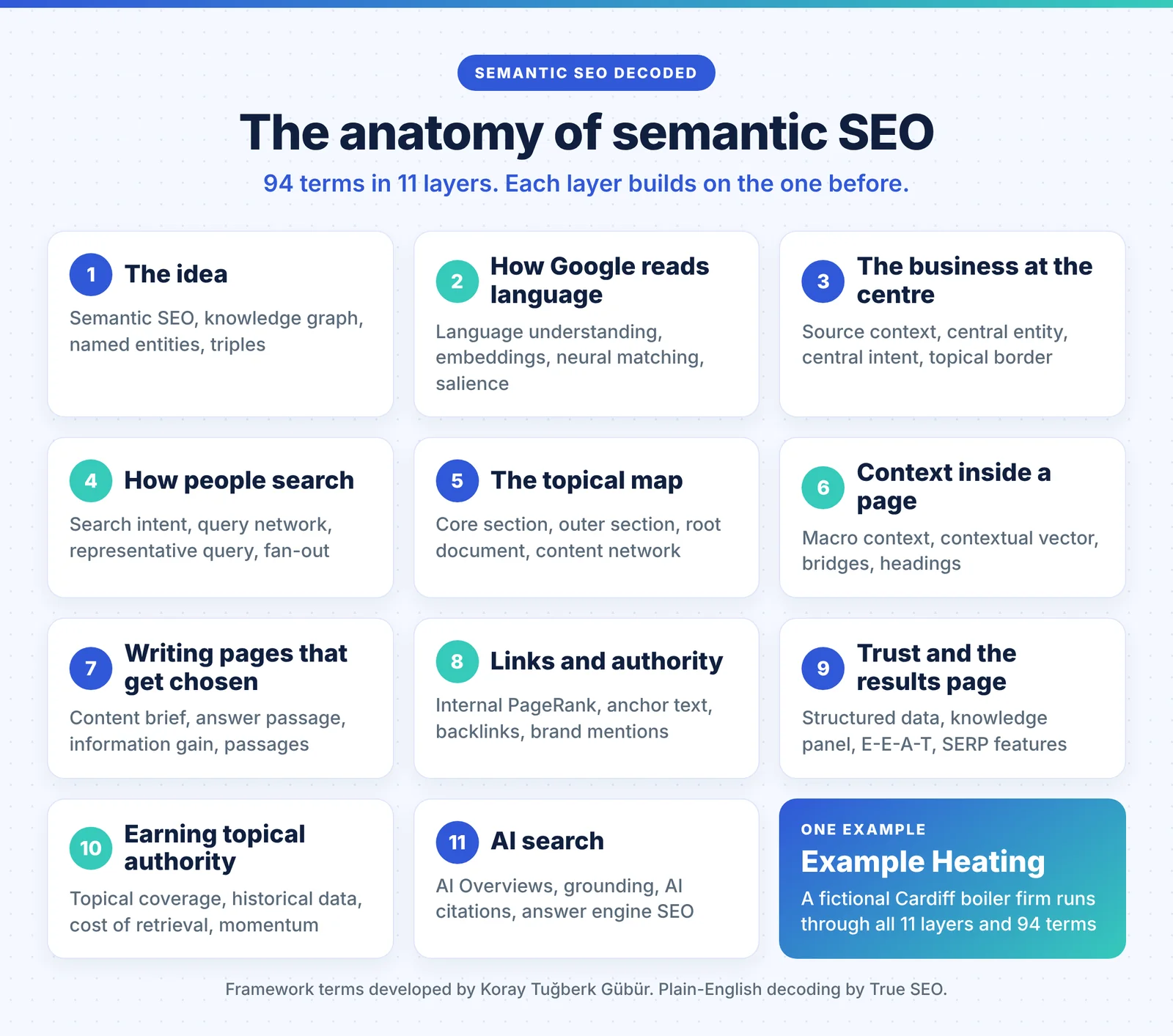
| Layer | What it explains | Example Heating in one line |
|---|---|---|
| 1. The idea | What semantic SEO is: things, facts and how they connect | Example Heating, Cardiff and the boiler are things Google can recognise |
| 2. How Google reads language | How Google turns words into meaning | “Boiler pressure dropping” and “boiler losing pressure” mean the same problem |
| 3. The business at the centre | Who you are, what you sell and what you will not cover | A Gas Safe registered Cardiff heating firm, centred on the boiler |
| 4. How people search | The questions and paths behind every search | From “boiler losing pressure” to a booked repair |
| 5. The topical map | The plan of pages, before anything is written | Service pages for jobs, guides for questions |
| 6. Context inside a page | How one page stays on one clear subject | The repair page talks about repairs, in a sensible order |
| 7. Writing pages that get chosen | How to write answers search engines pick | The answer to “why is my boiler losing pressure” in the first sentence |
| 8. Links and how authority flows | How links pass meaning and importance | Every guide links to the service it supports |
| 9. Trust, data and the results page | How Google checks facts and shows results | Gas Safe registration stated clearly, with matching details everywhere |
| 10. Earning topical authority | How a site becomes the go-to source over time | Steady publishing and pages kept up to date |
| 11. AI search | How AI answers pick their sources | Clear pages that answer early are easier for AI Overviews to use |
Each layer is a part of this guide, and every part opens with the plain answer before the terms inside it.
Part 1 of 11 · about 9 minutes
The idea: what semantic SEO is
Semantic search engine optimisation (SEO) is about meaning: the things a subject involves, the facts about them and how those things connect. This part explains the basic building blocks, from one named thing up to the way a whole field is organised. Every example comes from Example Heating’s boilers, brands and towns.
In 30 seconds
- Semantic SEO builds a website around meaning, not around one repeated phrase.
- Named entities and triples turn plain sentences into facts that machines can recognise.
- A taxonomy sorts topics into parents and children; an ontology adds sideways links.
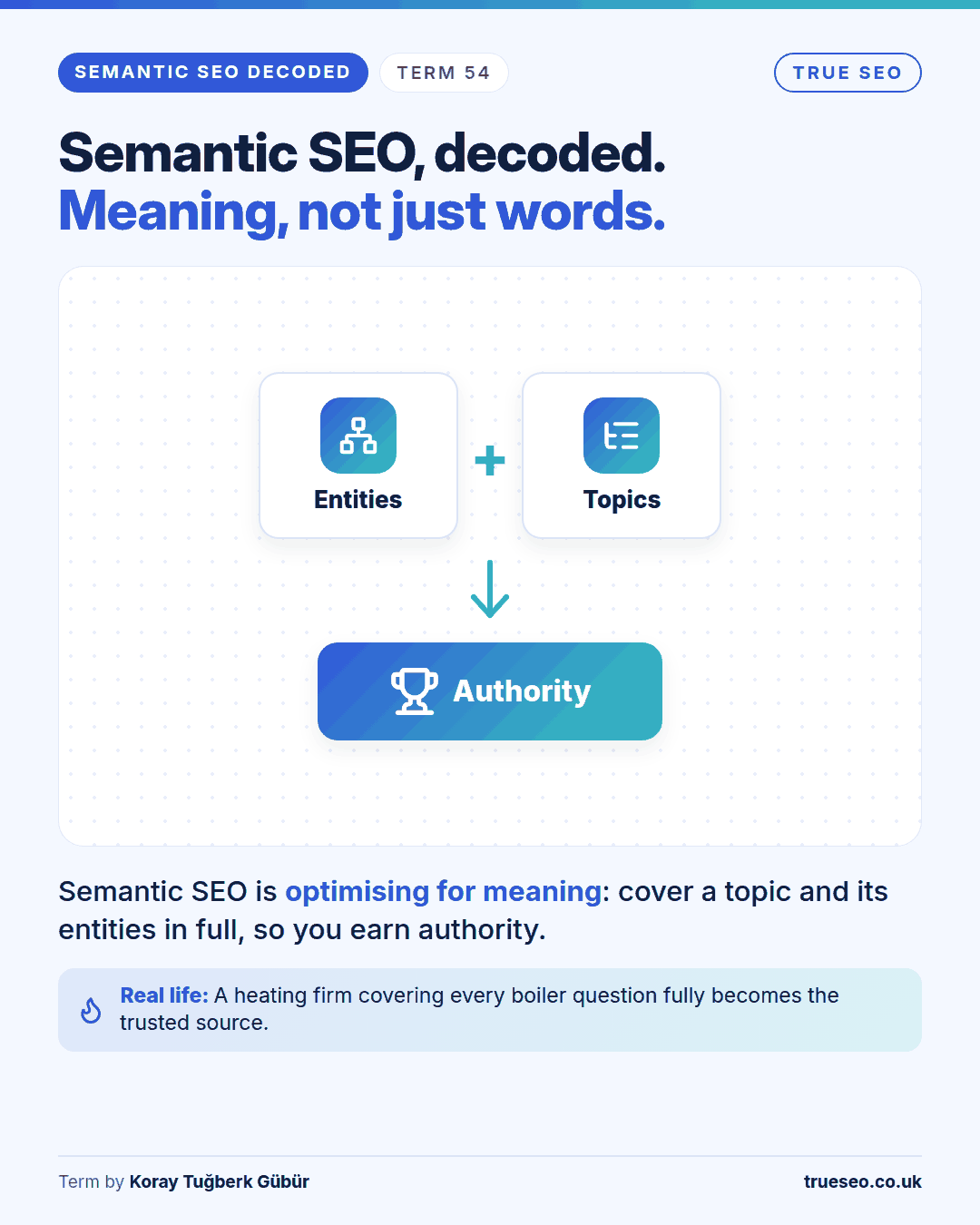
Semantic SEO card. Tap to enlarge
Semantic SEO
Koray framework term
Semantic SEO is the practice of building a website around the meaning of a subject: the things in it, the facts about them and the questions people ask. The terms below name each piece: the things are named entities, the facts are triples, and the description of how they connect is an ontology.
Google now matches the meaning of a search with the meaning of a page. A page that only repeats a phrase gives it little to work with. Koray Tuğberk Gübür popularised the modern framework from 2020. He did not coin the phrase: a 2018 academic paper by Lopezosa, Codina and Caldera-Serrano already used it.
At Example Heating: The old approach is one page that says “boiler repair Cardiff” twenty times. The semantic approach covers what a repair customer needs: common faults, the brands Rhys works on, the towns he covers and what happens next. Each page answers one need and links to the others. That is the method behind our semantic SEO and topical authority service.
Right way
Build one page per customer need: the boiler repair page covers common faults, the brands Rhys works on and the towns he covers, then links to the fault guides.
Wrong way, and why
Writing one ‘boiler repair Cardiff’ page and swapping in close variants such as ‘Cardiff boiler repairs’ every other sentence. Variants of one phrase add no new meaning, and the page still says nothing about faults, brands, towns or what happens next.
Card note: The card’s “so you earn authority” is the goal of semantic SEO, not part of its definition.
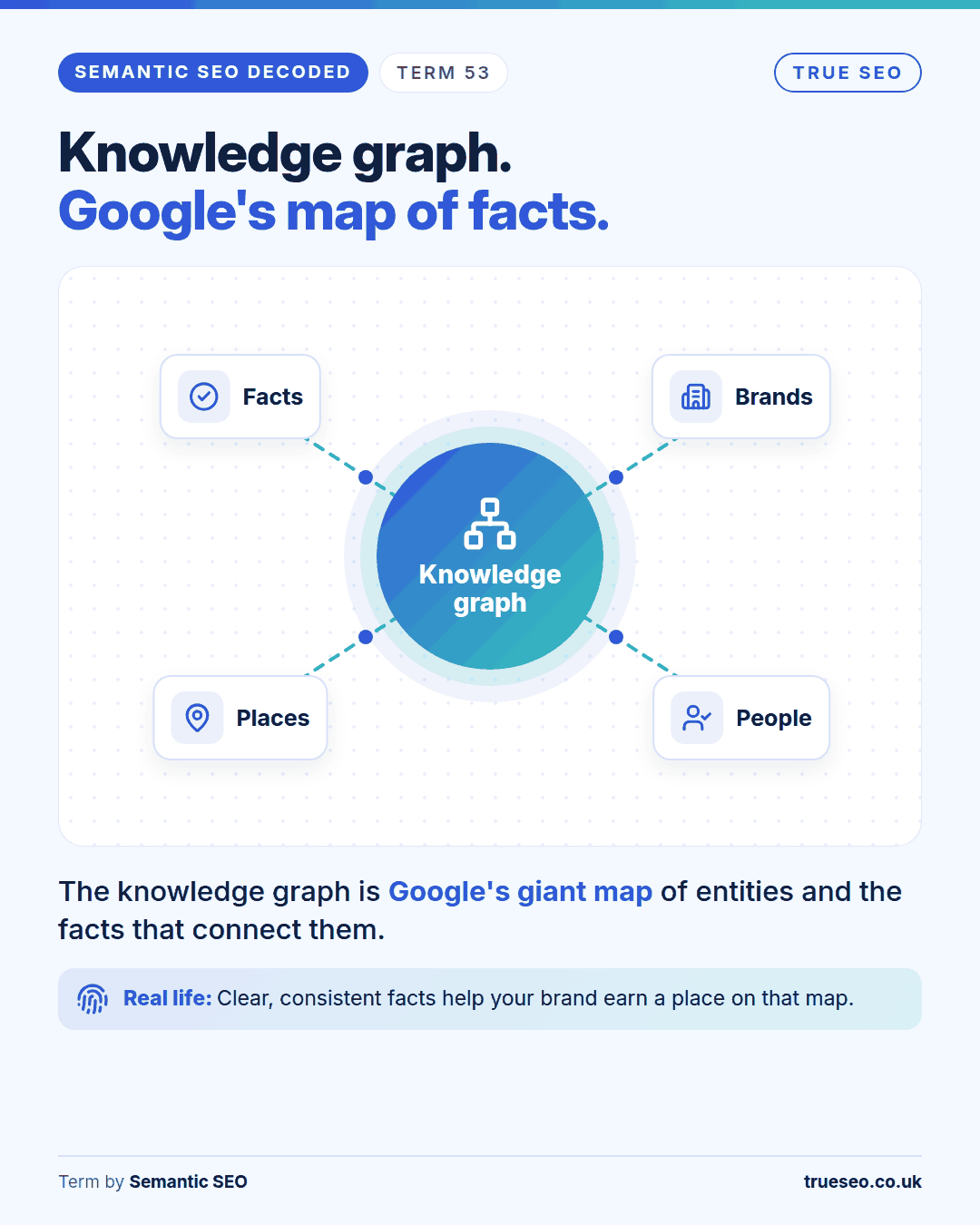
Knowledge graph card. Tap to enlarge
Knowledge graph
Google term
The Knowledge Graph is Google’s database of facts about people, places and things, and the links between them. Google introduced it in May 2012 with the phrase “things, not strings”, meaning real objects rather than strings of letters.
Amit Singhal’s launch post on the Google blog said it held more than 500 million objects and 3.5 billion facts. Google’s Knowledge Panel Help says the facts come from public sources, licensed data and content owners. For a business owner, this is where Google keeps what it believes about your brand, your town and your products. (In lowercase, “knowledge graph” is a general term for any such database.)
At Example Heating: Google already knows that Cardiff is a city in Wales and that Vaillant makes boilers. Whether Example Heating gets an entry of its own is Google’s decision, not Rhys’s. What Rhys controls is how clearly his website states the facts that connect his firm to those known things.
Right way
State plain facts Google can connect to things it already knows: ‘Example Heating is a Cardiff heating firm that fits Worcester Bosch, Vaillant and Ideal boilers.’
Wrong way, and why
Paying an agency that promises to get Example Heating into the Knowledge Graph by next month. Google decides what the Knowledge Graph holds, using public sources, licensed data and content owners, so nobody can sell a guaranteed place in it.
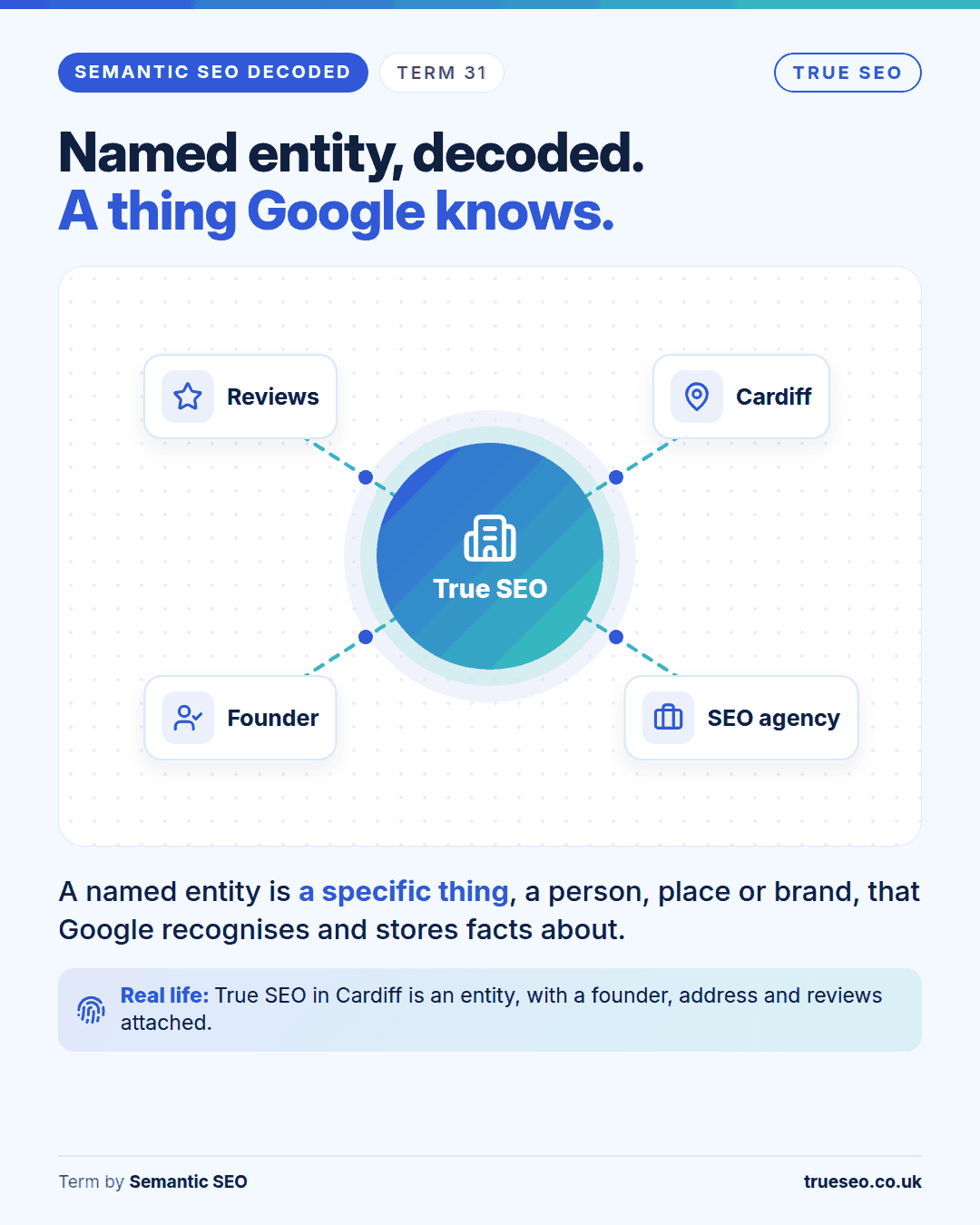
Named entity card. Tap to enlarge
Named entity
Information retrieval term
A named entity is a real-world thing with a proper name, such as a person, a place, an organisation or a product. Software can spot it in a sentence and connect it to what is already known about it.
Named entities tie your text to the real world. “Rhys in Cardiff” contains two, a person and a city, and is far easier to place than “our engineer round here”.
At Example Heating: Rhys’s pages name Rhys, Cardiff, Penarth, Barry, Worcester Bosch, Vaillant, Ideal and the Gas Safe Register. “Boiler” is not a named entity, because it has no proper name, yet it is the central entity of the whole site. Naming towns and brands outright, instead of “local areas” or “leading makes”, gives Google something specific to recognise.
Right way
Name things outright: ‘We service Worcester Bosch, Vaillant and Ideal boilers in Cardiff, Penarth and Barry.’
Wrong way, and why
Writing ‘our engineers cover the surrounding area and work on all major brands’ on the servicing page. Google has no named town or brand to recognise, so the page cannot be tied to Penarth, Barry or Vaillant.
Card note: The card says Google stores facts about each named entity. That simplifies things: many named entities have no entry in Google’s Knowledge Graph.
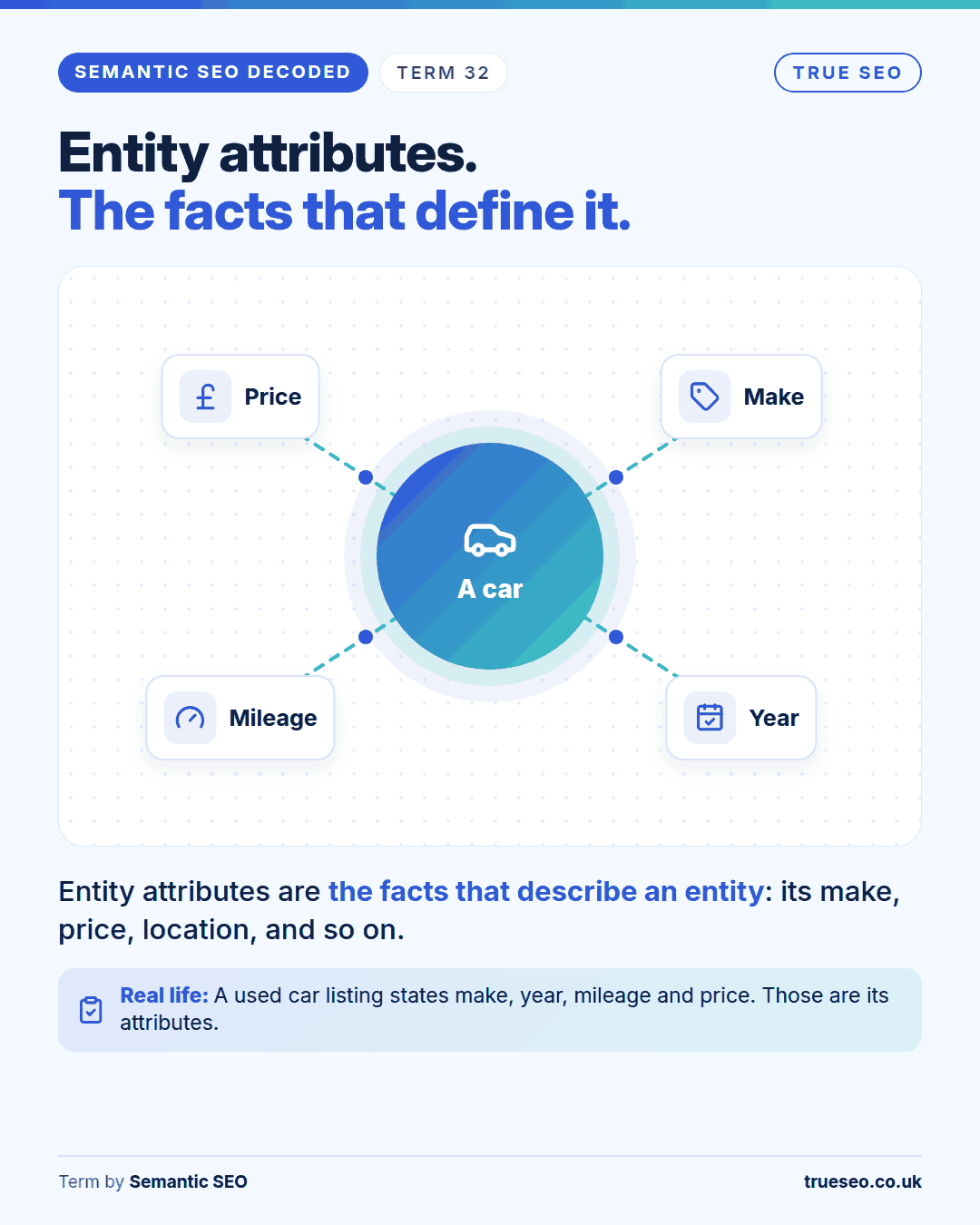
Entity attributes card. Tap to enlarge
Entity attributes
Information retrieval term
Entity attributes are the properties that describe an entity, meaning a specific thing a search engine can recognise. A boiler’s attributes include its brand, its fuel type and its heat output. Each attribute paired with its value makes one fact.
Customers compare things by their attributes. They ask which brand, what size, how long it lasts and what it costs. Pages that cover the attributes people care about answer more of their real questions. The attribute is the property (brand), the value is what fills it (Worcester Bosch), and the two together make the fact.
At Example Heating: Take one combi boiler. Its attributes include brand, fuel type, heat output, warranty length and whether it suits a home with one bathroom or two. Rhys’s installation page states these values for the models he fits. His “combi vs system boiler” guide compares the same attributes side by side, which is how a homeowner thinks about the choice anyway.
Right way
For each combi Rhys fits, the installation page gives the brand, fuel type, heat output, warranty length and whether it suits a home with one bathroom or two.
Wrong way, and why
Describing every boiler on the installation page as ‘efficient, reliable and great value’ with no brand, heat output or warranty length. Those words are opinions, not attributes, so a homeowner comparing two combis learns nothing they can check.
Card note: The card calls attributes “the facts”. Strictly, an attribute is only the property, and it takes its value to make a fact.
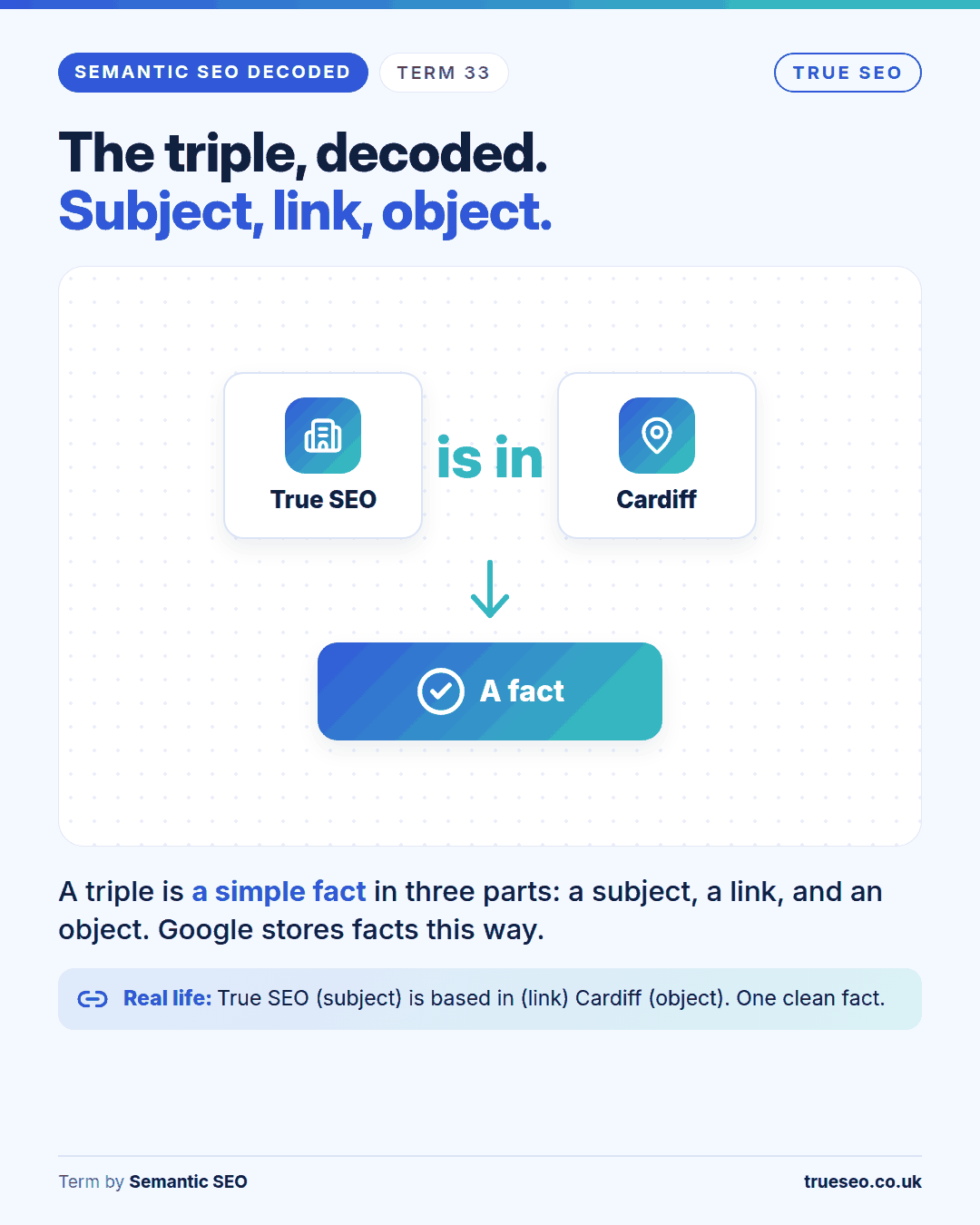
Triple card. Tap to enlarge
Triple
Information retrieval term
A triple is one fact written in three parts. The first part, the subject, is the thing the fact is about. The middle part, the predicate, names the relationship. The last part, the object, is the other thing or value.
A 2014 Google research paper on a project called Knowledge Vault stored facts from the web in this three-part form. Google has not published how its live systems store facts. The practical point: short, factual sentences turn into triples most easily.
At Example Heating: Three facts from Rhys’s site, written as triples:
- (Example Heating, is located in, Cardiff)
- (Example Heating, installs, Worcester Bosch boilers)
- (Rhys, owns, Example Heating)
A sentence such as “Example Heating installs Worcester Bosch boilers across Cardiff” carries a clean triple. “We sort out all sorts of heating bits” carries none.
Right way
Write short factual sentences with a clear subject, relationship and object: ‘Example Heating installs Worcester Bosch boilers across Cardiff.’
Wrong way, and why
Filling the About page with lines such as ‘passionate about delivering heating excellence’. The sentence has no clear subject, relationship or object, so it carries no fact a machine can pull out and store.
Card note: The card’s “Google stores facts this way” is a simplification, because Google has not published how its live systems store facts. The card’s “link” is properly called the predicate.
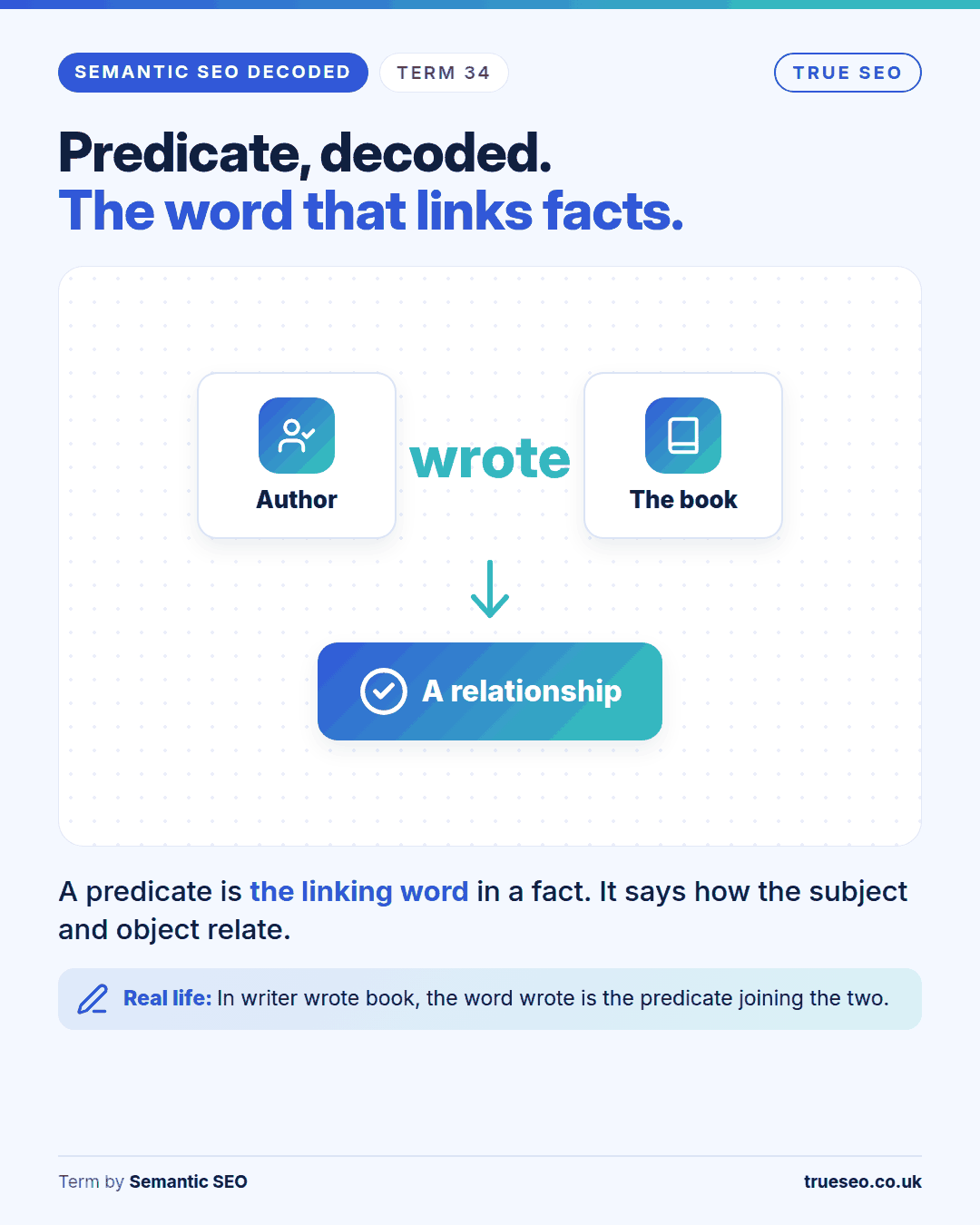
Predicate card. Tap to enlarge
Predicate
Information retrieval term
A predicate is the middle part of a triple: the words that say how two things are related. In “Example Heating services Vaillant boilers”, the predicate is “services”. It tells a machine how the two things connect, rather than just that they appear together.
Two sentences can share every noun and still mean different things. “Example Heating services boilers” and “Example Heating sells boilers” describe two different businesses. Only the predicate changes. Structured data is the code that labels facts for search engines. It often uses a property name as the predicate, such as brand or areaServed, rather than a verb. This is not the school grammar meaning of predicate, which is the whole verb part of a sentence.
At Example Heating: Rhys’s town pages use plain predicates. Example Heating “covers” Penarth, “is registered with” the Gas Safe Register and “fits” smart thermostats. Vague phrasing such as “we’re around Penarth too” leaves the relationship unclear to a reader and to a machine.
Right way
Pick the exact verb for each relationship: Example Heating ‘covers’ Penarth, ‘is registered with’ the Gas Safe Register and ‘services’ Vaillant boilers.
Wrong way, and why
Using ‘deals with’ for everything, as in ‘we deal with Vaillant boilers and landlord certificates’. It leaves open whether Rhys sells, fits, repairs or services them, and each of those describes a different business.
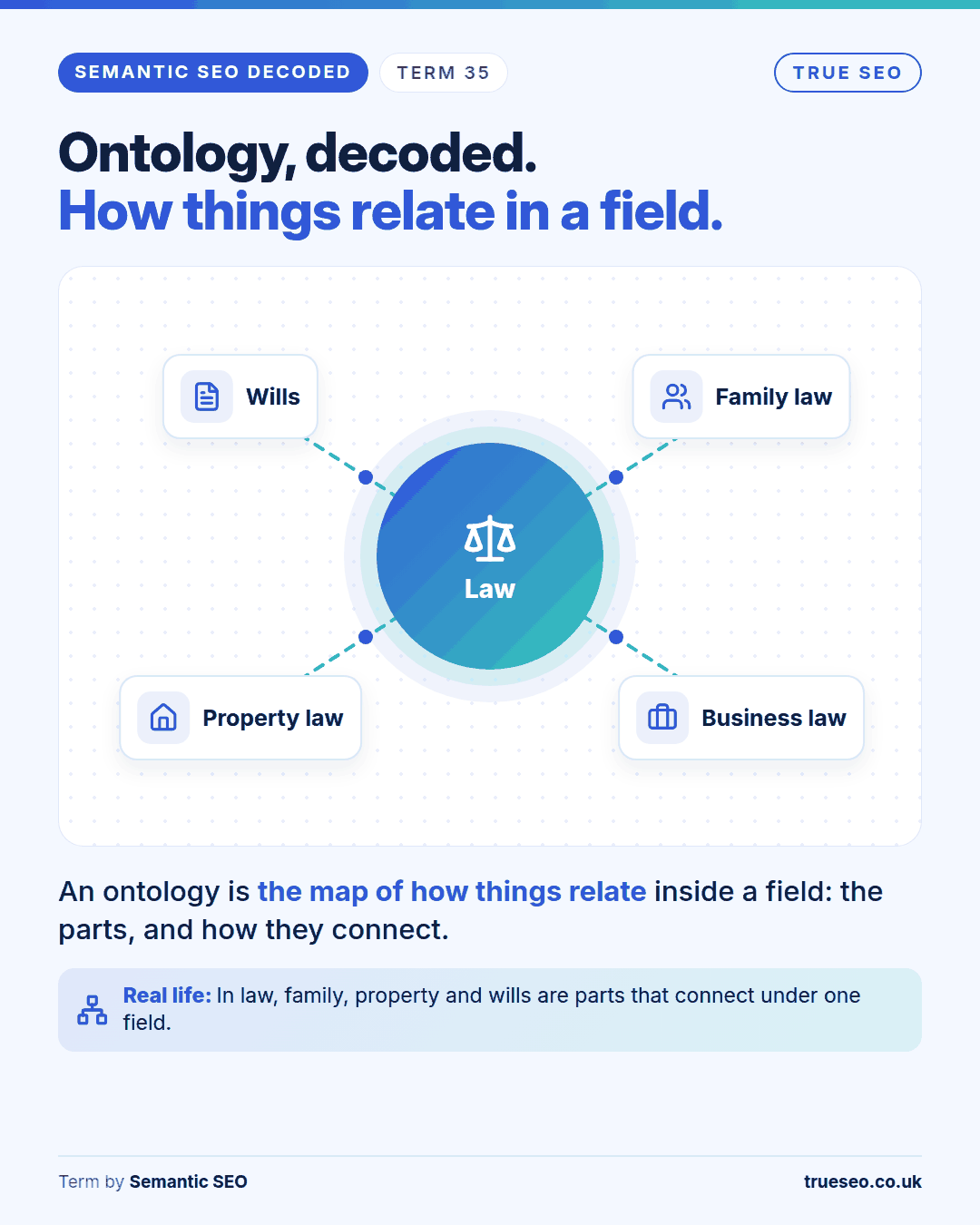
Ontology card. Tap to enlarge
Ontology
Information retrieval term
An ontology is a formal description of a field: the kinds of things in it, their properties and how they relate. It states, for example, that a boiler has a fuel type and that a Gas Safe engineer services it.
An ontology goes wider than a hierarchy. It also records sideways relationships, such as “a boiler needs a gas supply”. These tell you which topics belong together and which pages should link. Wikipedia’s entry on ontology notes that people often wrongly treat it as the same thing as a taxonomy.
At Example Heating: Rhys’s field has a small ontology. A boiler heats water for radiators and taps. Air trapped in a radiator leaves it cold at the top. Sludge builds up in a system, and a power flush clears it. Landlords need gas safety certificates. Each relationship suggests a link: the power flush guide explains sludge and points to the power flushing page.
Taxonomy
Sorts topics into parents and children: home heating, then boilers, then combi boilers.
Ontology
Adds sideways links: sludge builds up in a system, and a power flush clears it.
Right way
Turn each relationship into a link: the ‘what does a power flush do’ guide explains that sludge builds up in a system and points to the power flushing page.
Wrong way, and why
Linking the power flush guide only to the homepage and a ‘related posts’ widget sorted by date. The real relationship, sludge cleared by a power flush, never becomes a link, so readers and Google miss how the two pages connect.
Taxonomy card. Tap to enlarge
Taxonomy
Information retrieval term
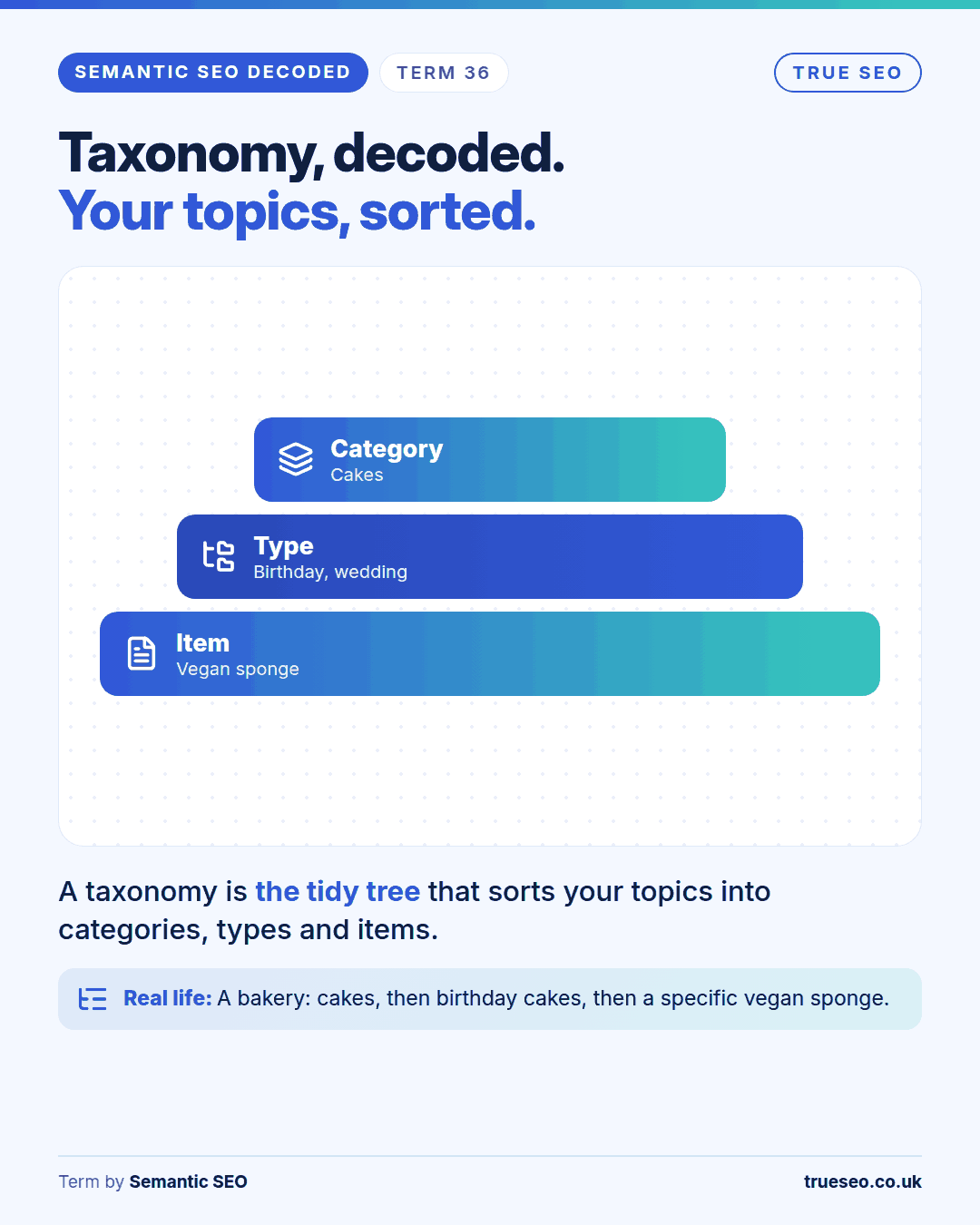
A taxonomy is a way of sorting things into a hierarchy of parent and child categories, so every item has one clear place. “Heating systems, then boilers, then combi boilers” is a simple taxonomy.
A clear hierarchy helps people find pages and helps search engines see how topics relate. It also shows gaps: an empty category is a topic you have not covered. In WordPress, “taxonomy” means categories and tags. In semantic SEO, it means the hierarchy of ideas behind the site.
At Example Heating: Rhys’s taxonomy runs from home heating down to boilers, radiators and controls. Under boilers sit the types (combi, system and regular), the brands (Worcester Bosch, Vaillant and Ideal) and the jobs (installation, repair and servicing). This hierarchy shapes his menus and guides, the first step in building a topical map.
Right way
Give every page one clear parent: home heating, then boilers, then combi boilers, with installation, repair and servicing sitting under boilers in the menu.
Wrong way, and why
Tagging one combi guide with ‘boilers’, ‘heating’, ‘combi’, ‘tips’, ‘news’ and ‘Cardiff’ in WordPress. The guide lands in six places with no clear parent, and thin tag pages pile up without covering one new topic.
These building blocks only matter because Google learned to read meaning instead of matching letters, and the short history that follows shows how that happened.
From strings to things: how Google learned meaning
Google moved from matching words to understanding meaning in steps, over about twelve years. Each step below explains why some of the terms in this guide exist, so it helps to see them in order.
| Year | What Google launched | What changed for websites | Terms it explains |
|---|---|---|---|
| 2012 | Knowledge Graph | Google began storing facts about real things, which it called “things, not strings” (Amit Singhal, Google blog, May 2012) | Knowledge graph, named entity |
| 2013 | Hummingbird | A rebuilt algorithm that matches the meaning of a query with the meaning of a page, rather than its words alone (reported by CNBC, September 2013) | Query semantics |
| 2015 | RankBrain | Helps Google understand how words relate to real-world concepts (Pandu Nayak, Google blog, February 2022) | Word embeddings |
| 2018 | Neural matching | Reads whole queries and whole pages as broader concepts so they can be matched (same Google post) | Neural matching |
| 2019 | BERT | Understands how combinations of words carry meaning and intent (same Google post) | Natural language understanding |
| 2021 | MUM | Understands language across 75 languages and works with text and images; Google says it is used for specialised tasks, not ranking (same Google post) | Synonyms and polysemy |
| 2024 | AI Overviews reach the UK | AI written answers appear above the usual results for many UK searches (PA Media, August 2024) | AI Overviews |
For Example Heating, this history explains a simple everyday fact. In 2010 a page usually needed words close to “boiler repair Cardiff” to show up. Today Google can show Rhys’s repair page to someone who typed “boiler keeps cutting out, need someone today” because it understands that both searches mean the same job. Part 2 explains, one term at a time, how Google makes that match.
Part 2 of 11 · about 13 minutes
How Google reads language
Google reads language by working out what words mean in context, not by matching them letter for letter. The eleven terms in this part explain how it does that. They cover how words become numbers, how Google picks the right sense of a word and how it decides what a page is mainly about. Each one is at work whenever someone types a boiler problem into Google and finds Example Heating.
In 30 seconds
- Google matches the meaning of a search, so customers need not type the “right” keyword.
- Words become lists of numbers, so machines can measure how close two meanings are.
- Make each page clearly about one main thing, named in its title and headings.
Natural language understanding card. Tap to enlarge
Natural language understanding
Information retrieval term
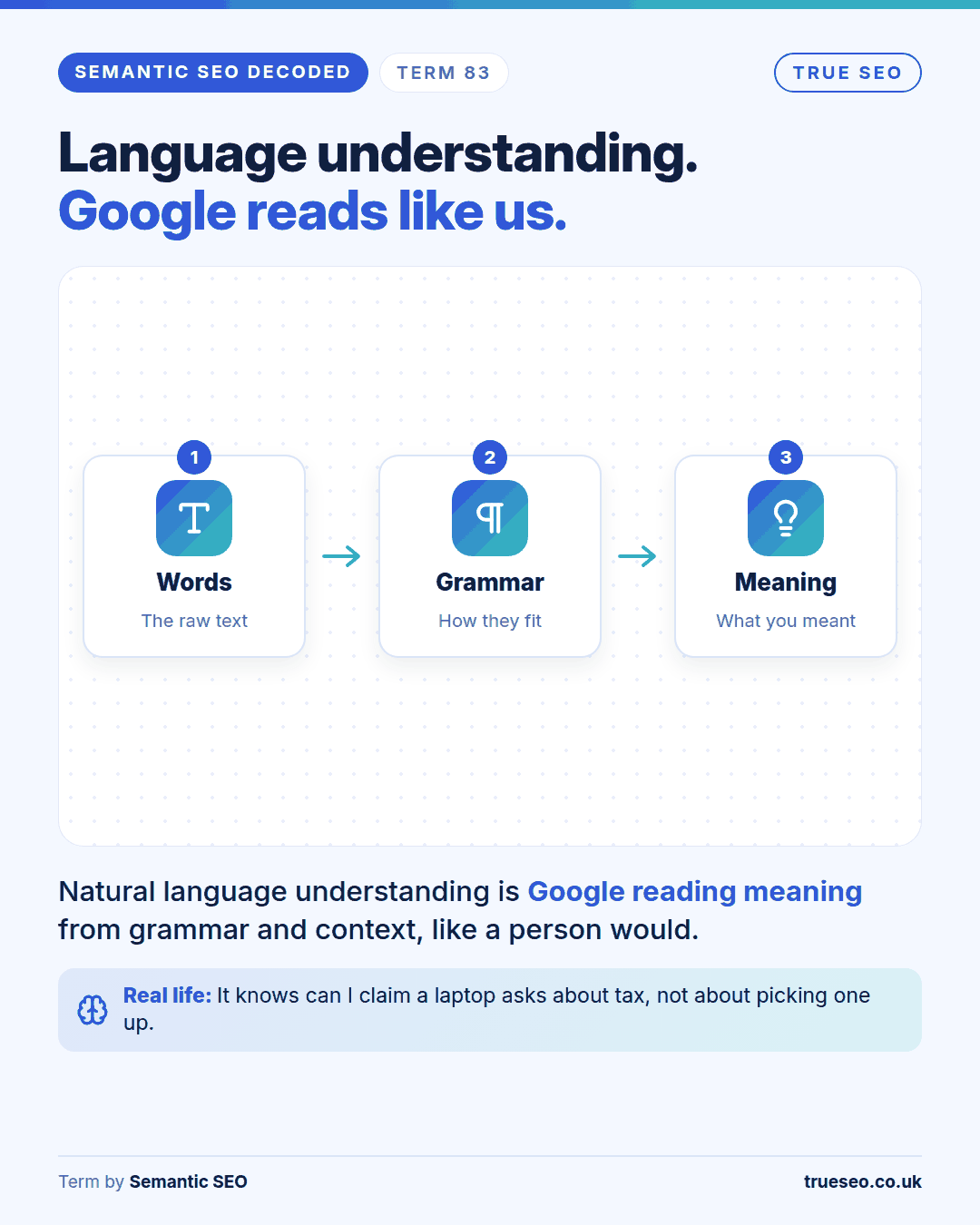
Natural language understanding is the part of computer science that teaches machines to work out what a piece of text means. It uses the words, the grammar and the surrounding context, rather than matching the exact letters someone typed.
It is one branch of natural language processing (NLP), the wider field of software that handles human language. Working out what a sentence means is often called semantic analysis. Your customers no longer need to type the “right” keyword. Your pages need to answer what people mean, not repeat what they type. Google reads meaning far better than keyword matching did, but not as well as a person. In 2019, Google’s own blog said language understanding remains an ongoing challenge.
At Example Heating: On a cold Sunday night, a family in Barry types “boiler on but radiators cold”. The word “repair” is not in it. Google still reads it as a fault, not a wish to buy a new boiler. A guide to the likely causes, pointing to Rhys’s emergency repair page, fits that search.
Right way
Answer what people mean: a guide to why a boiler runs while the radiators stay cold, pointing to the emergency repair page, fits the Barry family’s search.
Wrong way, and why
Building a page titled ‘Boiler On But Radiators Cold Repair Barry’ that repeats the exact search in every heading. Google reads the meaning, so copying the words adds nothing, and the page still has to explain the likely causes.
Card note: The card says Google reads meaning the way a person does. That overstates it.
Word embeddings card. Tap to enlarge
Word embeddings
Information retrieval term
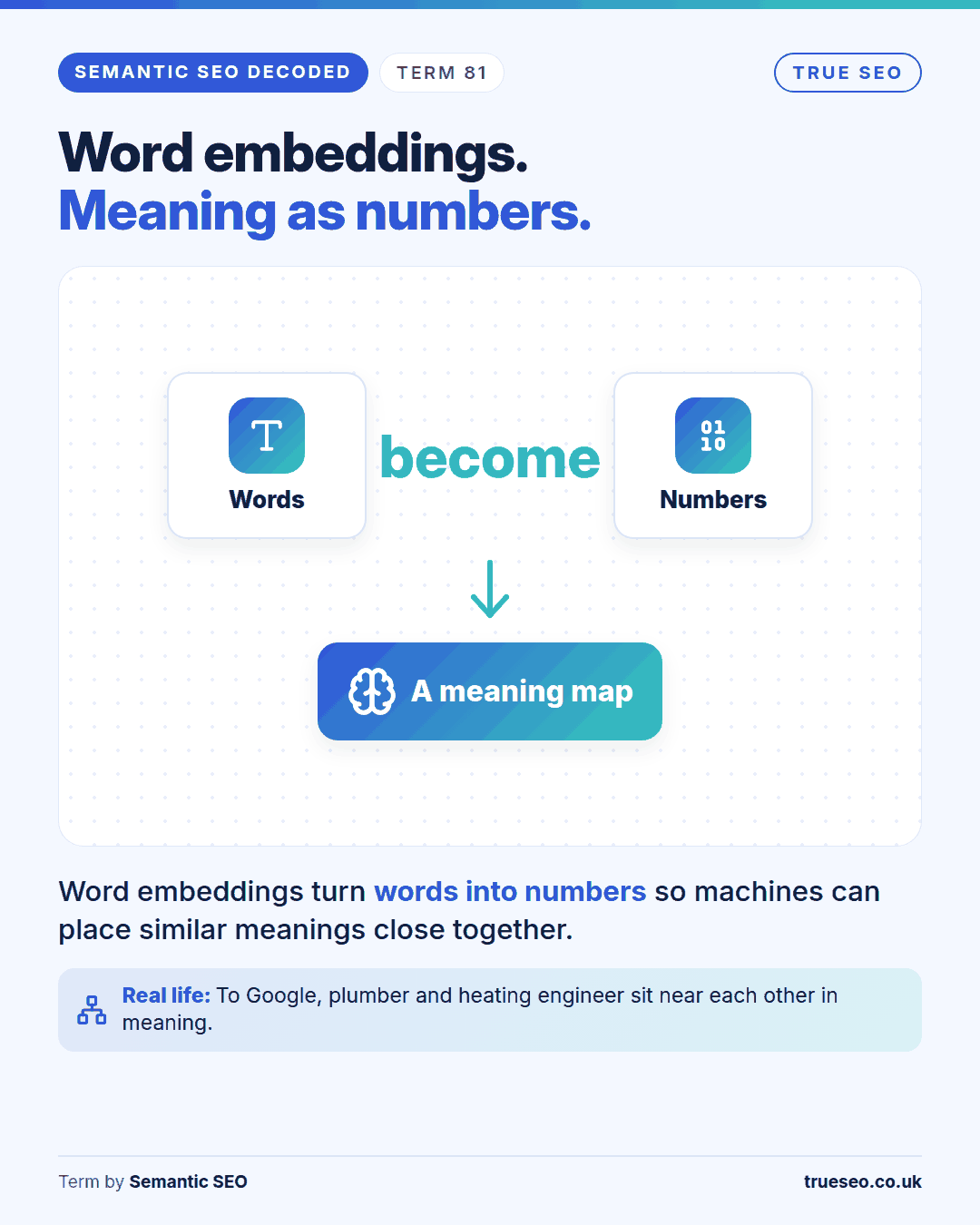
Word embeddings are lists of numbers, called vectors, that stand for words. A computer learns them by reading huge amounts of text. Words used in similar sentences end up with similar numbers, so the machine can measure how close two meanings are.
Wikipedia’s entry on the technique says a Google team led by Tomas Mikolov made it popular in 2013 with a tool called word2vec. Modern search goes further and turns whole searches and whole passages of text into numbers.
The practical result: a machine can see that two pages cover the same thing even when the wording differs. Writing naturally about your subject matters more than repeating one phrase.
At Example Heating: “Combi”, “boiler” and “hot water” appear in the same kinds of sentences across the web, so their numbers end up close. “Boiler” and “biscuits” do not. Rhys writes “the combi stopped giving hot water”. A system using embeddings can connect that sentence to a search for “boiler no hot water”.
- 1Rhys writes about his combi
- 2Software turns the words into numbers
- 3“Combi” sits close to “boiler”
- 4Page can match “boiler no hot water”
Right way
Write naturally about the subject: Rhys writes ‘the combi stopped giving hot water’, and a system using embeddings can still connect it to a search for ‘boiler no hot water’.
Wrong way, and why
Rewriting ‘the combi stopped giving hot water’ as ‘boiler no hot water Cardiff boiler repair’ so it matches the search word for word. The meanings were already close in number terms, and the rewrite only makes the guide harder to read.
Neural matching card. Tap to enlarge
Neural matching
Google term
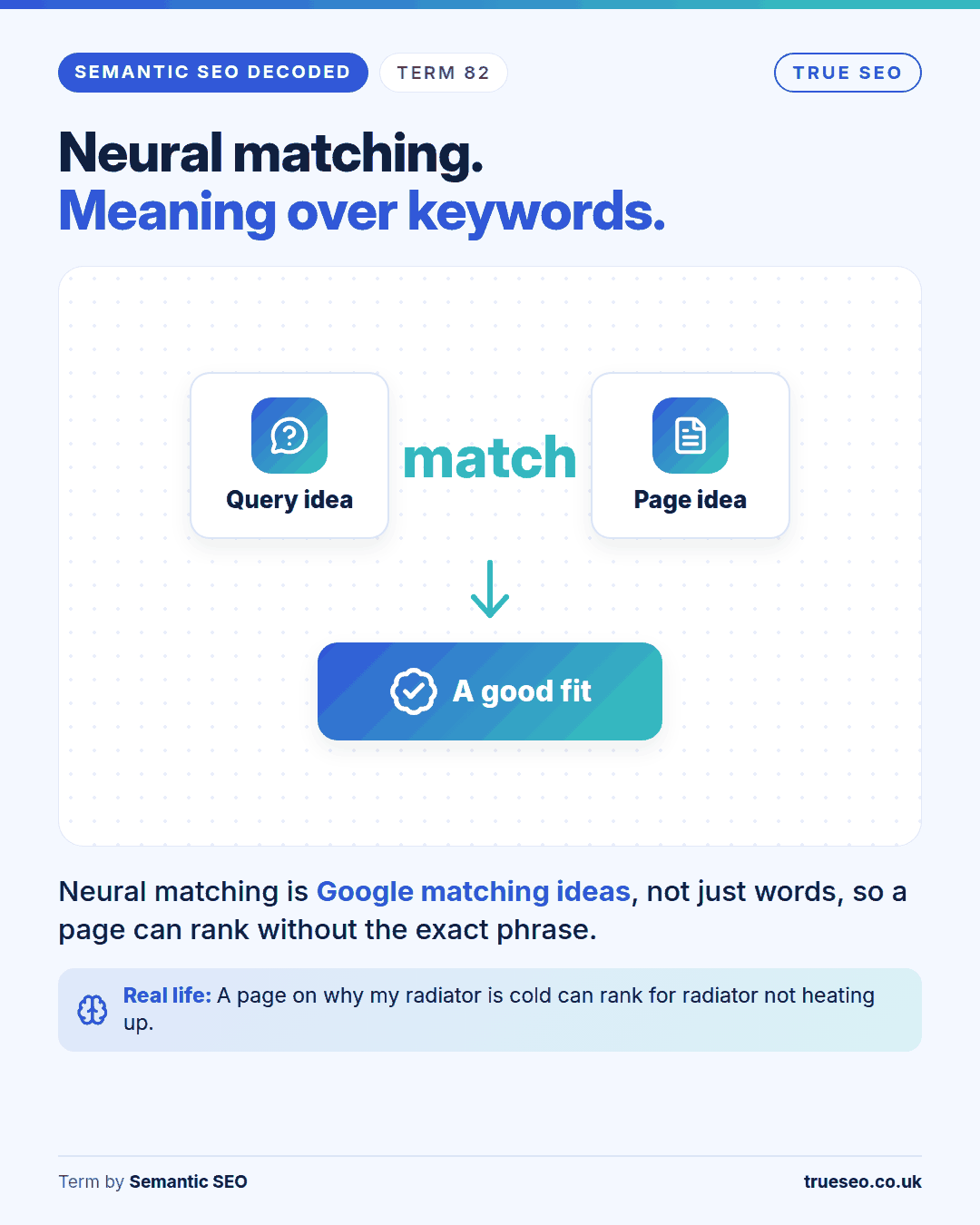
Neural matching is an AI system Google added to Search in 2018. It compares the ideas behind a search with the ideas behind a page. A page can then be relevant to a search even when it lacks the exact words.
Google’s guide to its ranking systems says neural matching understands representations of concepts in queries and pages. In plain words, it matches meaning, using number lists of the kind described under word embeddings.
In practice, a page can be found for searches you never wrote down. It does not mean the page will rank. A relevant page still competes with every other relevant page on quality, links and trust.
At Example Heating: Rhys’s guide is called “Radiator cold at the top”. A tenant in Pontypridd searches “top of my radiator isn’t warm”. Few words match, yet neural matching can treat the guide as relevant, because both describe the same problem.
Right way
Name the problem in plain words and solve it: ‘Radiator cold at the top’ explains trapped air, so it can match ‘top of my radiator isn’t warm’.
Wrong way, and why
Telling Rhys that neural matching means the radiator guide will now rank for every way tenants describe a cold radiator. Matching only makes the page relevant. It still competes with other relevant pages on quality, links and trust.
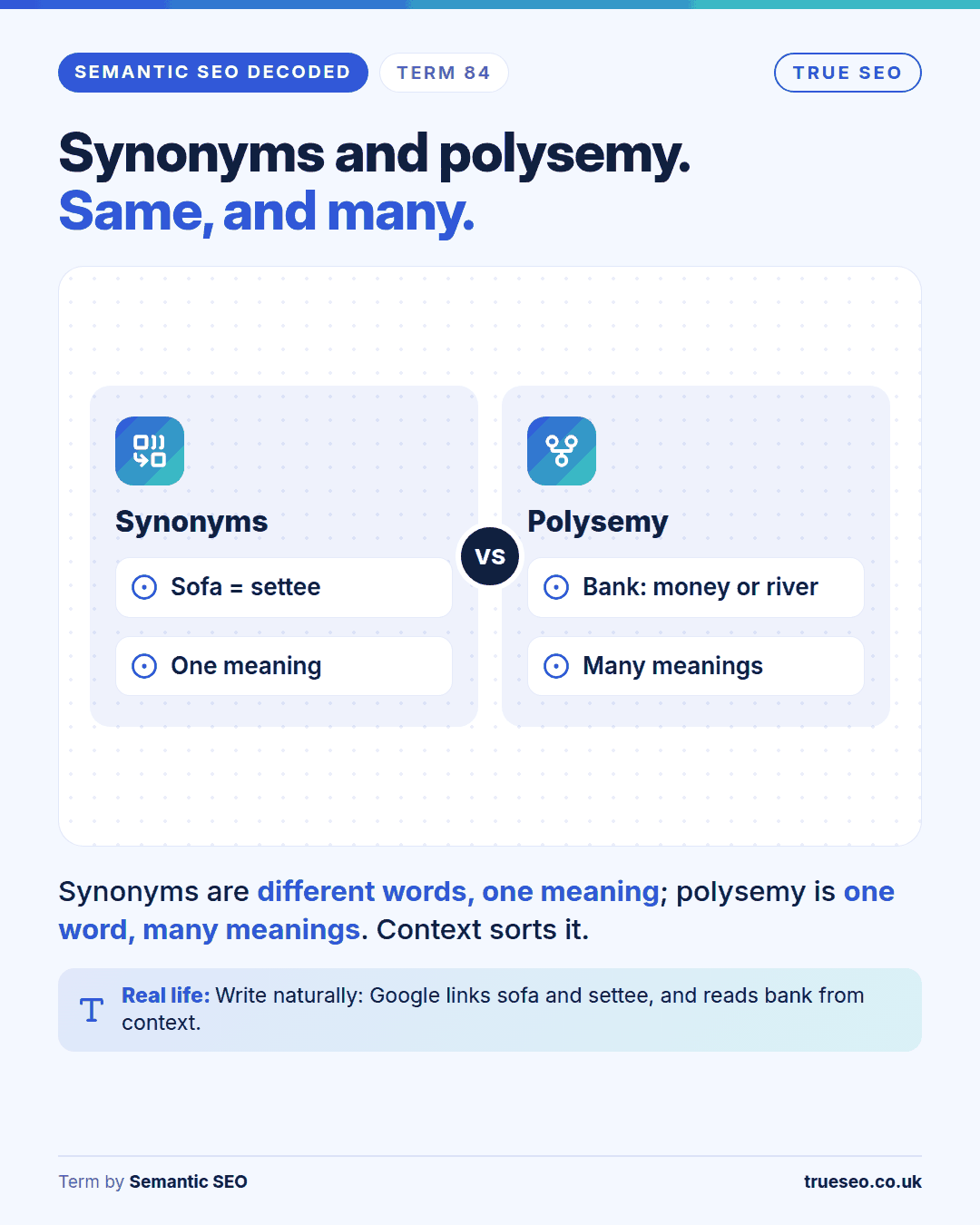
Synonyms and polysemy card. Tap to enlarge
Synonyms and polysemy
Information retrieval term
Synonyms and polysemy are two ways that words and meanings fail to line up one to one. Synonyms are different words with the same meaning. Polysemy is one word with several related meanings. Search systems use the surrounding words to pick the intended meaning.
Google’s Search Help says a result might not contain your exact words because it has related terms instead. For an owner, that means one page per service, not one page per wording.
At Example Heating: “Combi boiler” and “combination boiler” are synonyms, so one page covers both. “Radiator” shows polysemy. It can mean the part that cools a car engine or the panel that heats a room. Both senses involve giving off heat, so they are related. Words such as “bleed” tell Google which one Rhys means.
Right way
Keep one page per service: the combi page covers ‘combi boiler’ and ‘combination boiler’, and the radiator guide uses ‘bleed’ and ‘valve’ so the heating sense is clear.
Wrong way, and why
Publishing /combi-boiler-installation/ and /combination-boiler-installation/ with near-identical text. Google already treats the two words as the same thing, so the pages split Rhys’s effort and give customers two copies of one service.
Common mistake: treating every word with two meanings as polysemy. “Bank”, for money or a river, has two unrelated meanings, so Wikipedia’s entry on polysemy treats it as a homonym instead.
Card note: The card uses “bank” as its example of polysemy. That word is a homonym, not polysemy.
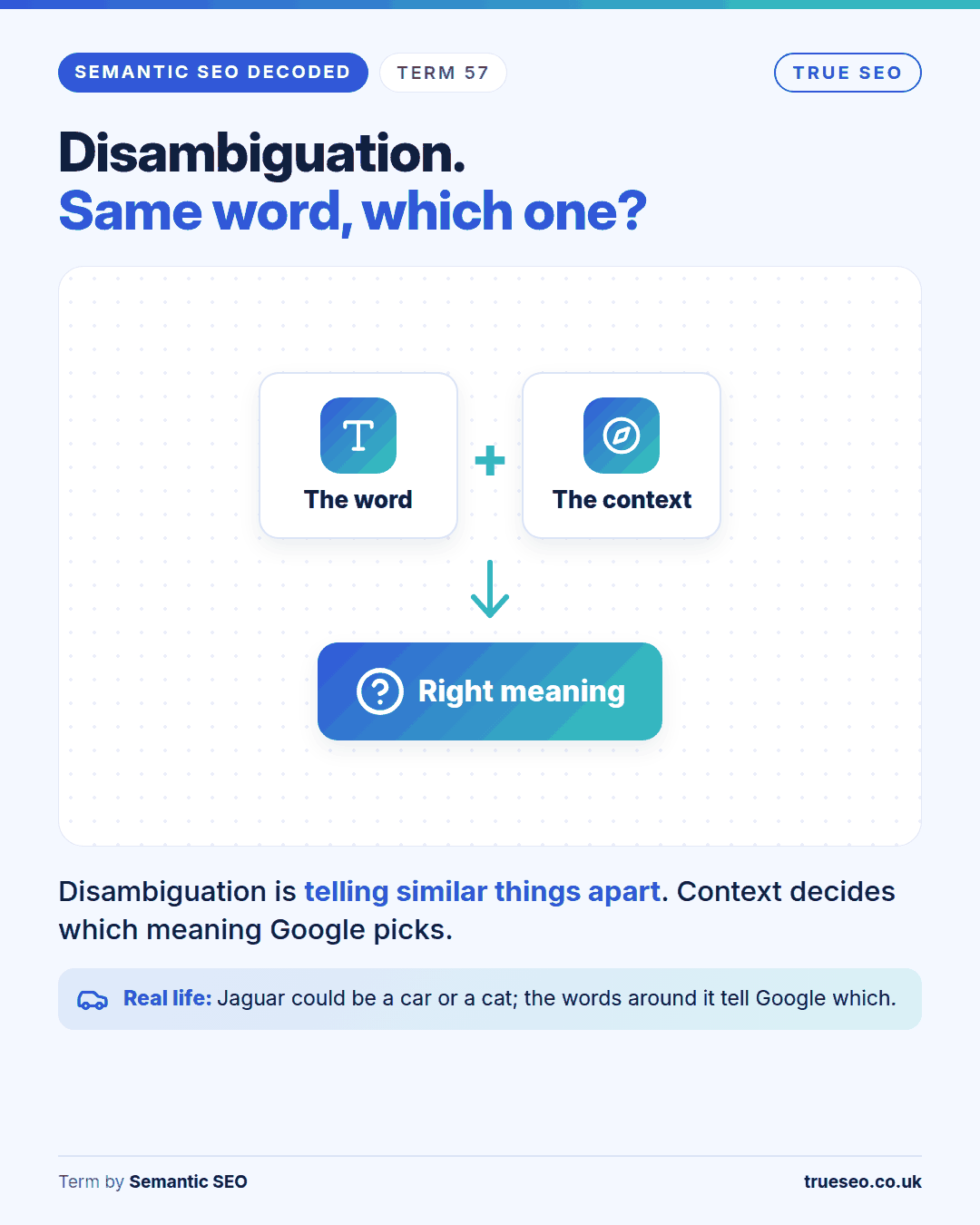
Disambiguation card. Tap to enlarge
Disambiguation
Information retrieval term
Disambiguation is the process of working out which meaning of a word or name is intended, using the words around it. For search, the most important kind links a mention to the right named entity, such as a brand, a person or a place.
Koray Tuğberk Gübür calls that kind “disambiguation of the entity” in his topical authority article on Holistic SEO & Digital. The risk for a business sits in short, common words. A brand name that is also an everyday word needs clear context every time.
At Example Heating: “Ideal” is a boiler brand and also an everyday adjective. A sentence about “the Ideal Logic combi”, with “boiler” and “warranty” nearby, points to the brand. “Service” is another one. On Rhys’s site it means the annual boiler service, so his servicing page talks about flue checks and gas pressure, not customer service.
Right way
Give short brand names their context: ‘the Ideal Logic combi’ sits beside ‘boiler’ and ‘warranty’, and the servicing page talks about flue checks and gas pressure.
Wrong way, and why
A homepage heading reading ‘Ideal Service for Every Home’. ‘Ideal’ could be the brand or the adjective, and ‘service’ could mean customer service, so neither Google nor a reader can tell that Rhys services Ideal boilers.
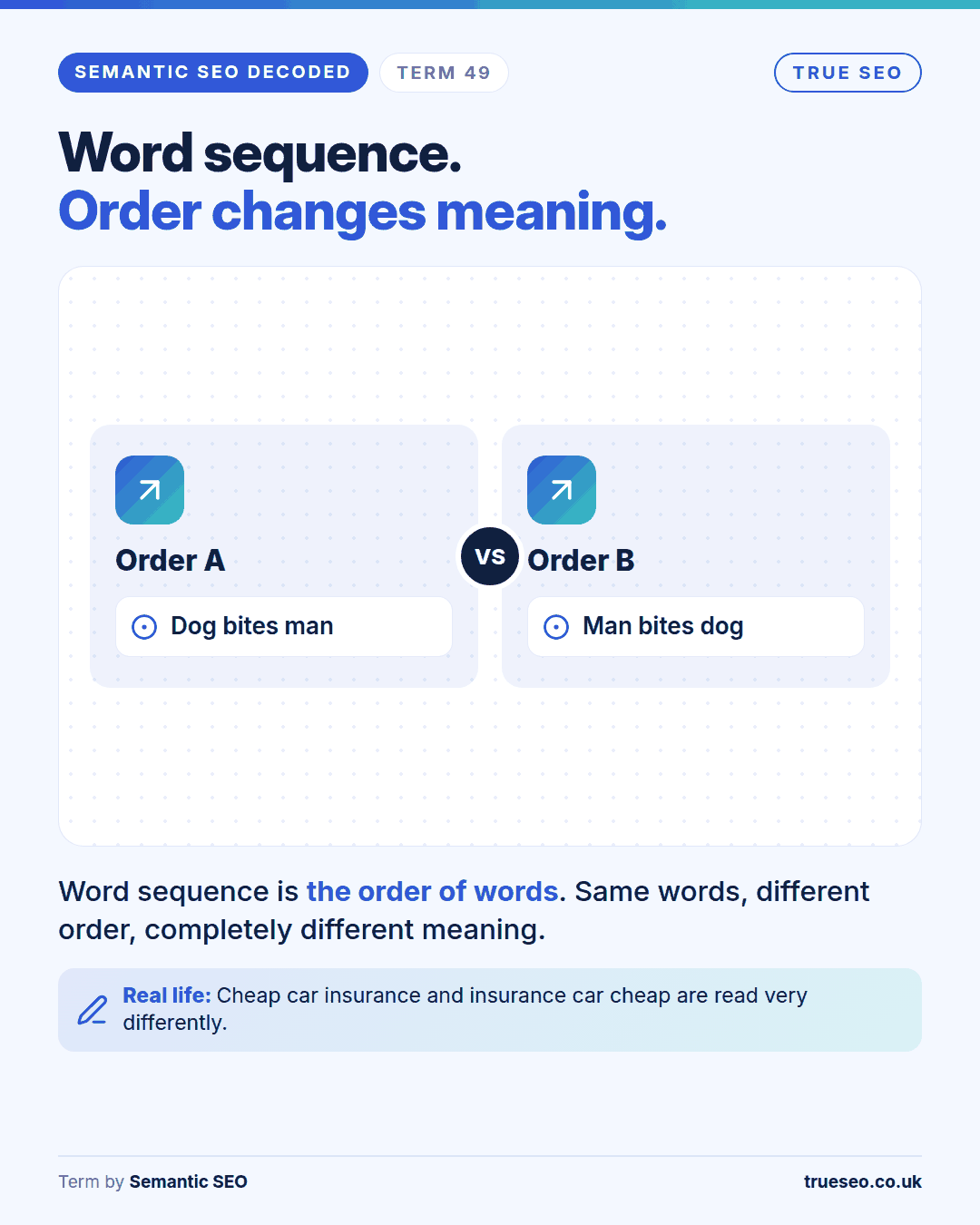
Word sequence card. Tap to enlarge
Word sequence
Information retrieval term
Word sequence is the order in which words appear in a search or a sentence. Modern language models, software trained on huge amounts of text, read each word together with its neighbours. A small word, or a change of order, can change the meaning Google takes from the text.
Google’s best-known example came in 2019 with BERT (Bidirectional Encoder Representations from Transformers), a language model that reads words in both directions. Pandu Nayak wrote on Google’s blog that, for “2019 brazil traveler to usa need a visa”, older systems missed the word “to”. They showed results about Americans going to Brazil. BERT understood a Brazilian was travelling to the US.
At Example Heating: “Hot water but no heating” and “heating but no hot water” use the same words. They describe two different faults, so Rhys’s repair guide answers each under its own heading.
Right way
Give each word order its own answer: ‘Hot water but no heating’ and ‘Heating but no hot water’ sit under separate headings in the repair guide.
Wrong way, and why
Merging both faults under one heading, ‘No heating or hot water problems’, because the words are the same. The order changes the fault, so a reader with hot taps but cold radiators reads advice for the wrong problem.
Card note: The card’s car insurance example is weak, because Google probably reads both orders as the same request. The visa search makes the point better.
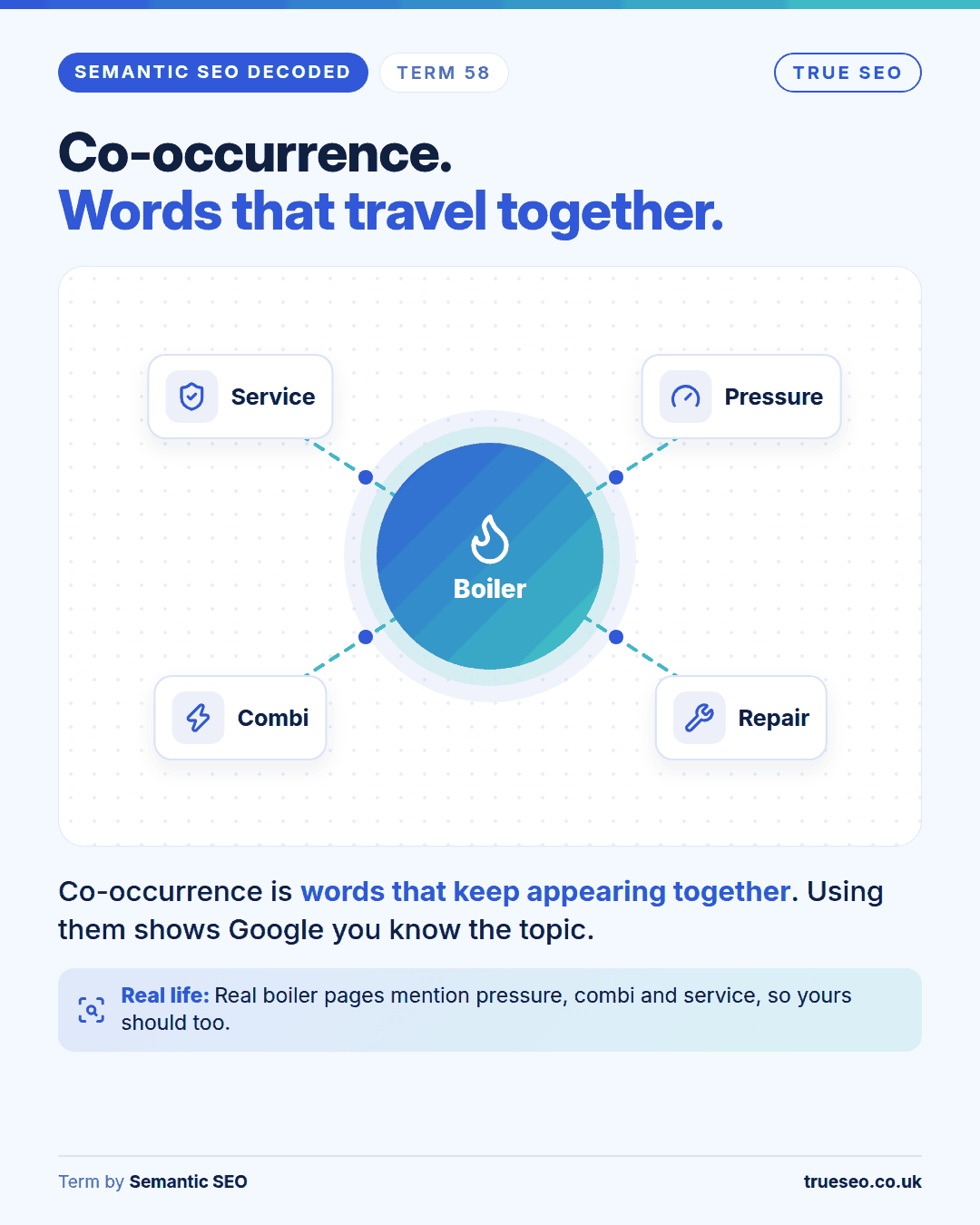
Co-occurrence card. Tap to enlarge
Co-occurrence
Information retrieval term
Co-occurrence is when two or more words or names appear near each other in text more often than chance would explain. Language researchers count these pairings, and computer systems use them to work out which words belong to the same topic.
This explains why a page written by someone who knows the trade reads differently from one built around a keyword. Real knowledge brings the right neighbouring words with it.
At Example Heating: Across the web, “boiler” keeps appearing near “pressure”, “combi”, “service” and “repair”. Rhys’s boiler repair page uses those words because a repair conversation needs them. Customers describing a fault on the phone use the same ones.
Right way
Let the trade words arrive with the explanation: the boiler repair page mentions pressure, combi, service and repair because describing a real fault needs them.
Wrong way, and why
Pasting a block of ‘boiler pressure combi service repair Cardiff’ at the foot of the repair page to show topic knowledge. That is keyword stuffing, which Google’s spam policies warn against, and customers can see it is padding.
Card note: The card says using these words shows Google you know the topic. That is an inference from how the statistics work, not something Google has said.
Semantic distance card. Tap to enlarge
Semantic distance
Information retrieval term
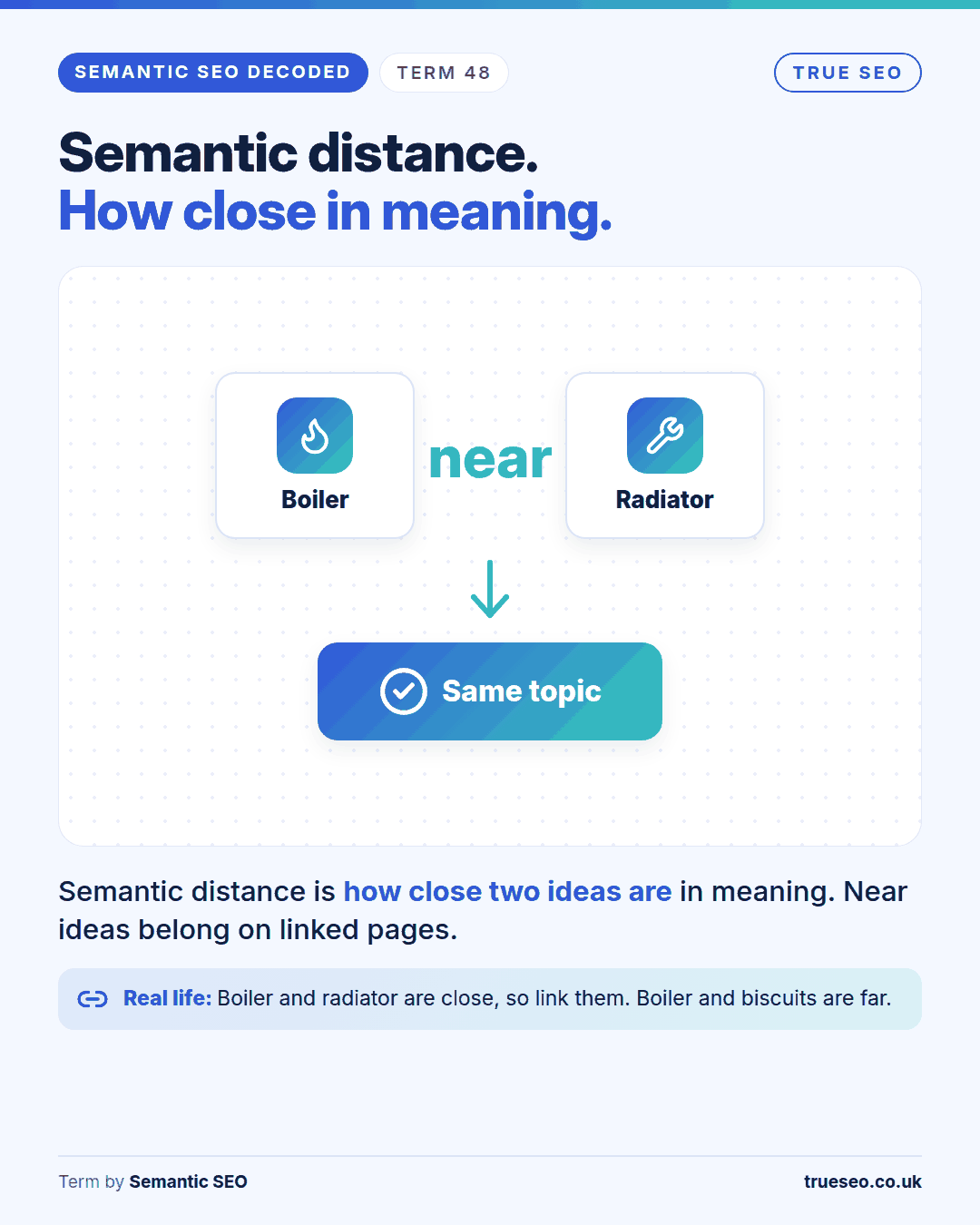
Semantic distance is a measure of how far apart two words or ideas are in meaning. A small distance means the meanings are close. Computers calculate it from sources such as word embeddings, word databases and how often words appear together.
Koray writes that “Semantic Similarity means the closeness and relevance between two words”, in his lexical semantics study on Holistic SEO & Digital. Researchers split that idea in two: similarity and relatedness. Similar things can stand in for each other; related things share a subject.
So what? Distance tells you which ideas can share a page and which need a page of their own. You make that call when you plan a topical map for your site.
At Example Heating: A combi boiler and a system boiler are similar, so one comparison guide covers both. A boiler and a radiator are related but not similar, so they get separate pages that link to each other.
Similar
A combi boiler and a system boiler can stand in for each other, so one comparison guide covers both.
Related
A boiler and a radiator share a subject but cannot replace each other. Each gets its own page, and the two link.
Right way
Match pages to distance: one ‘combi vs system boiler’ guide covers two similar boilers, while the boiler and radiator pages stay separate and link to each other.
Wrong way, and why
Folding radiators into the boiler installation page because both are heating, so one page tries to sell new boilers and explain cold radiators at once. Related is not similar: each topic needs its own page, joined by a link.
Card note: The card’s advice to link near ideas comes from SEO practice, not from the definition.
Salient terms card. Tap to enlarge
Salient terms
Google term
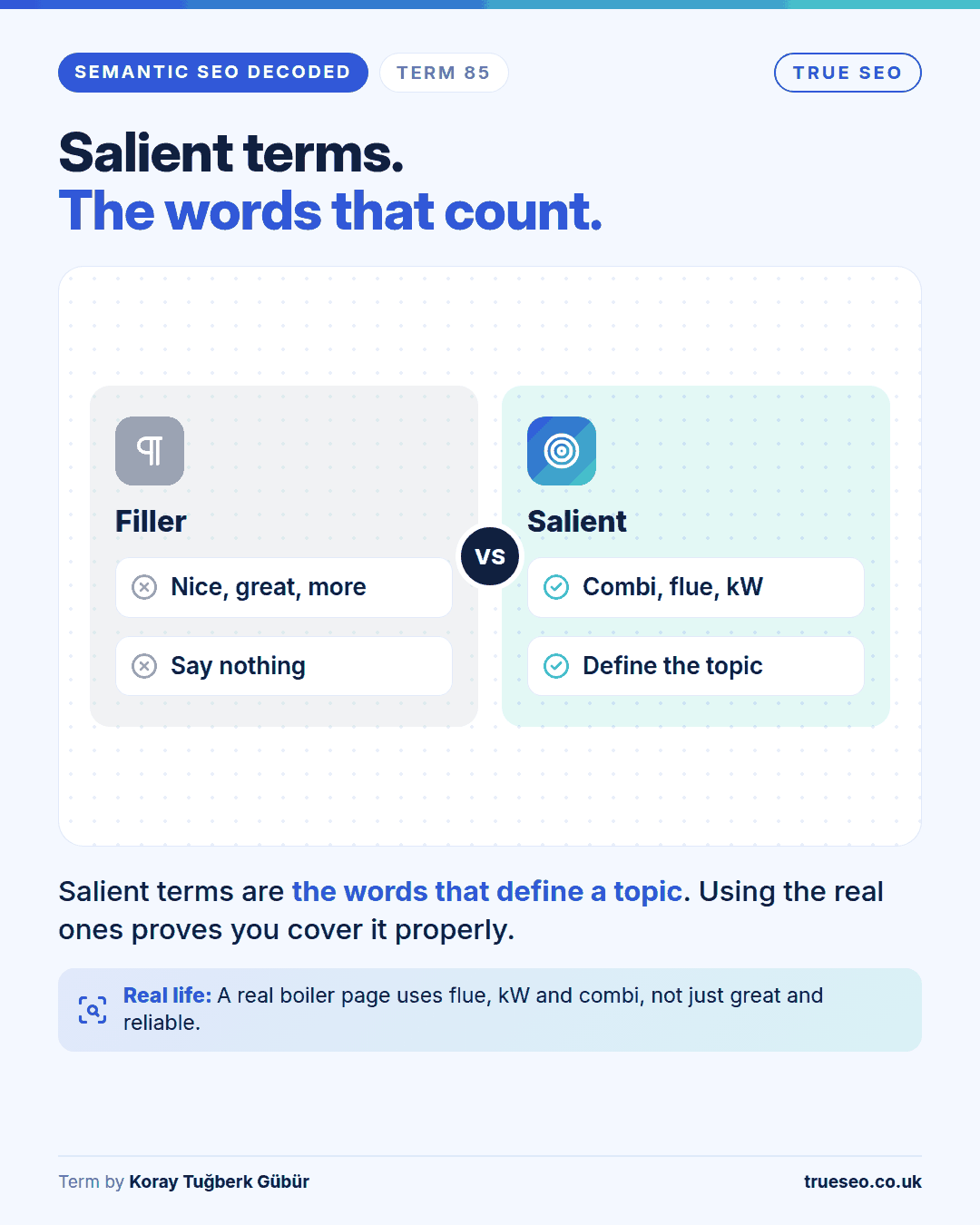
Salient terms are the words and phrases that carry the most weight in describing what a search or a page is about. “Salient” simply means standing out. Leaked Google documents describe a score for how much each term matters as a description.
Evidence in the US Department of Justice’s case against Google describes a system called Query-Based Salient Terms. It predicts the terms a relevant page is expected to contain. Google’s Content Warehouse documents, leaked in 2024, include a salience score for terms. Leaked documents show that an idea exists, not how much weight Google gives it today.
At Example Heating: On the boiler installation page, “combi”, “flue” and “kW output” are salient, because they say what the page is about. “Great”, “reliable” and “affordable” are not. They describe nothing specific.
Right way
Use the words that say what the page is about: the boiler installation page names ‘combi’, ‘flue’ and ‘kW output’ rather than leaning on ‘great’ or ‘reliable’.
Wrong way, and why
Copying every term a content tool suggests into the installation page and calling the topic covered. Nobody outside Google can prove a term list shows full coverage, and the leaked salience score shows an idea exists, not its weight today.
Card note: The card says the real terms prove you cover a topic properly, and it credits Koray. We found no Koray definition of the term.
Contextual vocabulary card. Tap to enlarge
Contextual vocabulary
SEO industry term
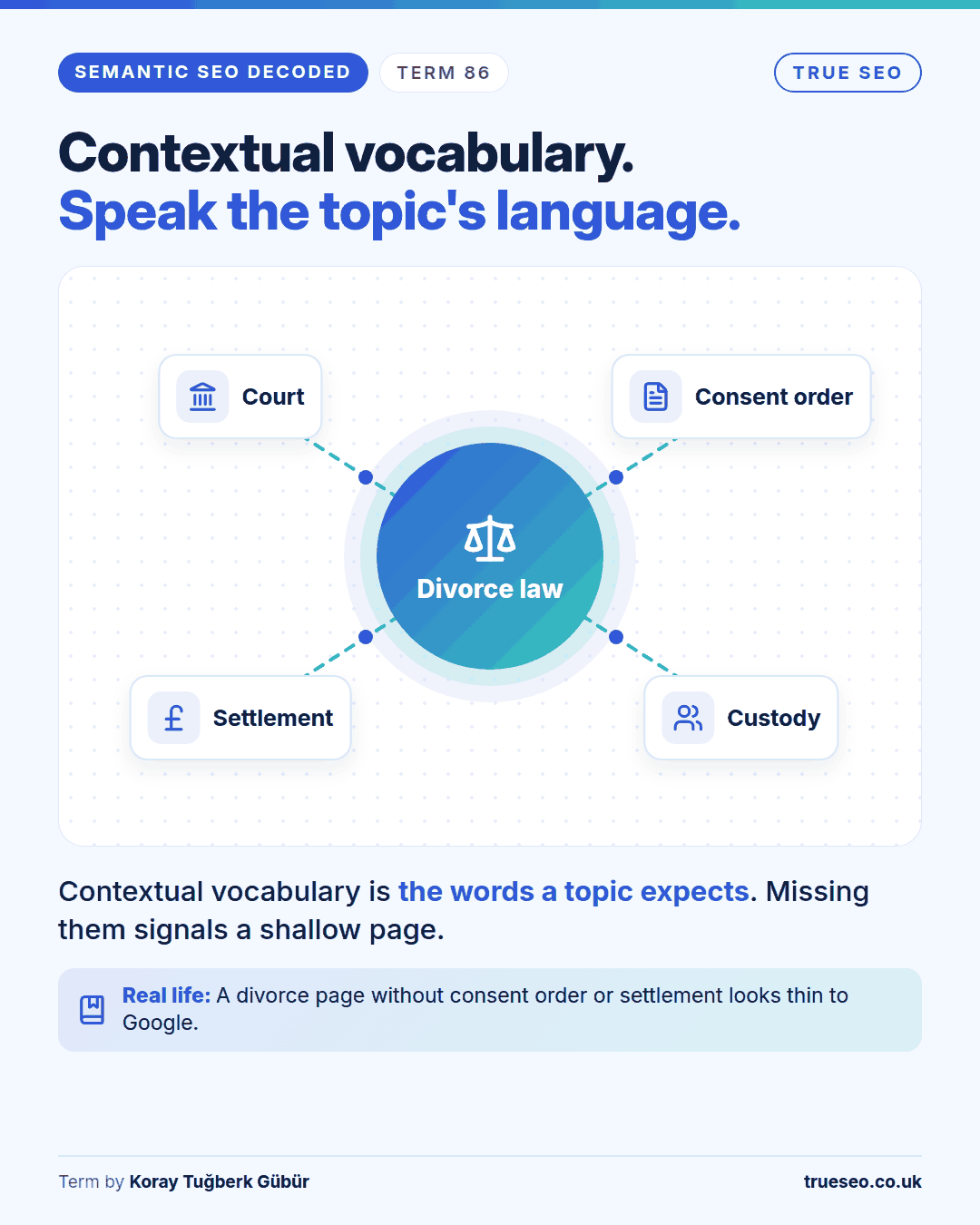
Contextual vocabulary is the wider set of words, names and phrases that naturally turn up when someone who knows a subject writes about it. It overlaps with salient terms but goes further, covering the whole working language of a topic.
A page missing those words can read as shallow to people and to search systems.
We could not find “contextual vocabulary” in Koray’s published articles. His verified terms nearby are topical coverage and contextual anchor text. We treat this one as a plain-English label from SEO practice.
At Example Heating: A real boiler repair page mentions the flue (the pipe that carries fumes outside). It also names the heat exchanger, the condensate pipe and the pressure gauge. Rhys uses these words because his engineers handle these parts every day. A repair page that names none of them reads as if nobody involved has opened a boiler.
Right way
Write with the working words of the trade: the boiler repair page names the flue, heat exchanger, condensate pipe and pressure gauge, and explains the flue in plain words.
Wrong way, and why
Hiring a writer who has never seen a boiler, who fills the repair page with ‘heating issues’, ‘technical problems’ and ‘expert solutions’. The page never names a single part, so it reads as shallow to customers and to search systems.
Card note: The card credits Koray with this term, but we could not find it in his published articles.
Entity salience card. Tap to enlarge
Entity salience
Information retrieval term
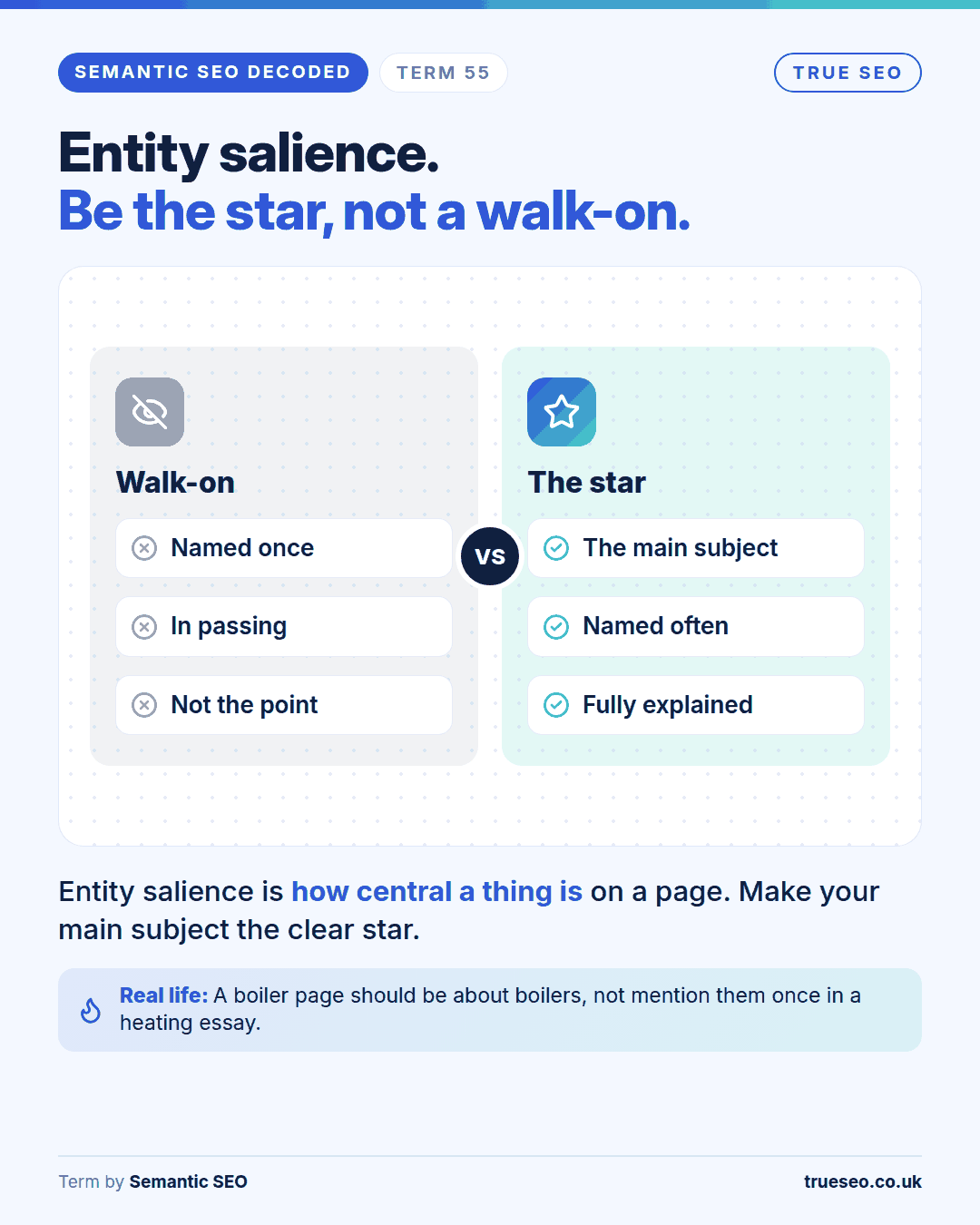
Entity salience is a score for how central a named entity, such as a brand, product or place, is to a whole page. A high score means that thing is the page’s main subject. A low score means it is mentioned in passing.
Google’s Cloud Natural Language tool, a paid product for developers, scores salience from 0 to 1. Microsoft researchers were scoring it in 2013, before that tool existed. The Cloud score is a handy check, but Google has not confirmed that Search uses it to rank pages.
The lesson is plain: make each page clearly about one main thing. Our on-page SEO service checks this page by page.
At Example Heating: The boiler servicing page names the boiler in its title, first sentence and headings. It then explains what a service checks. A winter article that mentions boilers once, between blankets and draught excluders, gives the boiler low salience.
High salience
The boiler servicing page names the boiler in its title, first sentence and headings.
Low salience
A winter article mentions boilers once, between blankets and draught excluders.
Right way
Make one thing the clear subject: the boiler servicing page names the boiler in its title, first sentence and headings, then explains what a service checks.
Wrong way, and why
Opening the servicing page with three paragraphs about the team, the vans and a winter energy tip before the word ‘boiler’ appears. The boiler becomes a passing mention, and readers wait too long to learn what the page offers.
Google can now read meaning well. It still needs to know which meaning your website is about. So Part 3 starts with the business at the centre: its source context and its central entity.
Part 3 of 11 · about 11 minutes
The business at the centre
This part explains how a business defines itself before it writes a single page. That means what it is, what it is about and where its subject stops. For Example Heating, these terms turn “a Cardiff boiler firm” into simple rules that every page has to follow.
In 30 seconds
- Source context says what the business is, who it serves and how it earns.
- The central entity is the one thing every page keeps returning to.
- A topical border marks which topics belong on the site and which stay off it.
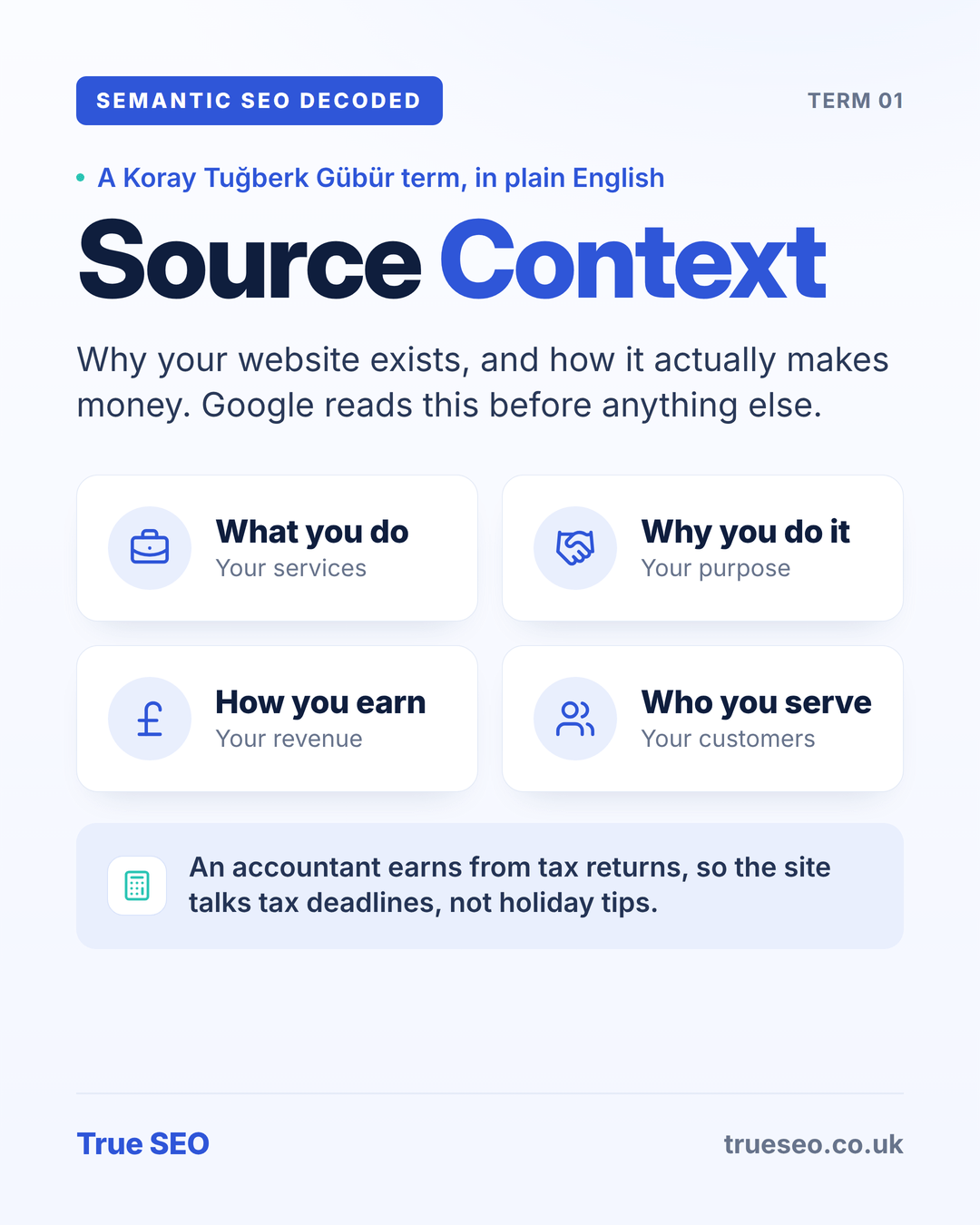
Source context card. Tap to enlarge
Source context
Koray framework term
Source context is the identity and purpose of a website as a source: what the business is, who it serves and how it earns its money. It decides which topics fit the site and how it should write about them.
Koray Tuğberk Gübür puts it simply on Medium: “The source context defines what the website represents.” He argues that Google uses it to classify the whole site. A boiler manufacturer and a local installer both write about boilers, but for different reasons and readers.
At Example Heating: Rhys’s source context fits in one line: a Gas Safe registered Cardiff heating firm that earns from installing, repairing and servicing boilers for homeowners and landlords. That line already rules topics in and out. A guide to bleeding radiators fits. A review of electric cars does not, however popular the subject.
Right way
Write the one-line source context first and test every idea against it: a guide to bleeding radiators fits a Gas Safe registered Cardiff heating firm serving homeowners and landlords.
Wrong way, and why
Describing the business as ‘a home services company’ so the blog can cover cleaning tips, mortgage advice and garden ideas. That line rules nothing out, so the site stops reading as a heating firm and every topic looks equally fair.
Card note: The card says Google reads source context “before anything else”. We found no source for that, so treat it as the first thing you decide, not the first thing Google reads.
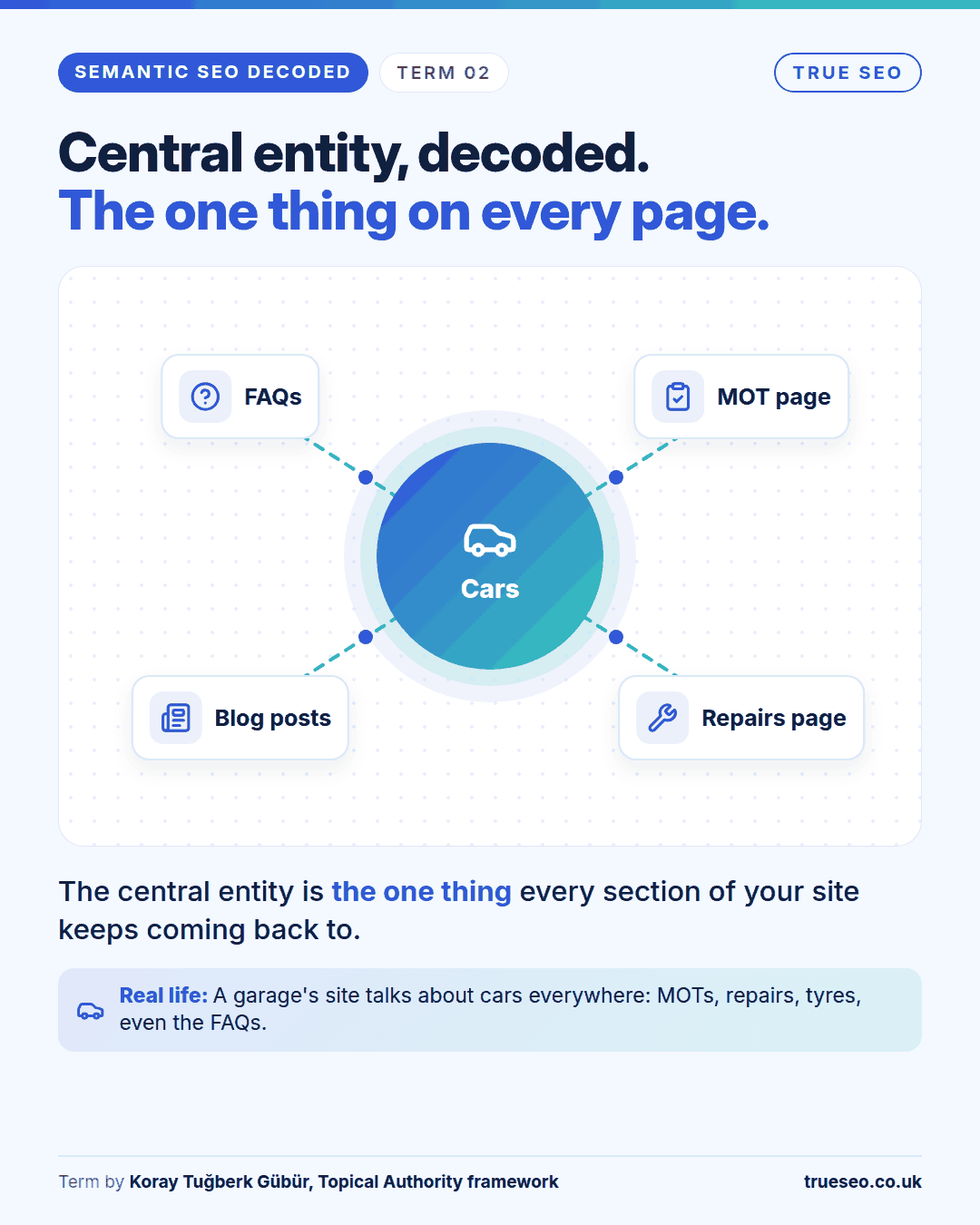
Central entity card. Tap to enlarge
Central entity
Koray framework term
Central entity is the main thing a website is about. It is an entity, meaning a specific thing Google can recognise, and it appears on every page and in every section. Every service page and every guide comes back to it.
A clear central entity holds a site together. Each new page adds to what the site says about one thing, instead of spreading thin across many. A popular myth says the central entity must be your brand. Koray means the subject the whole site keeps returning to, not the business name.
At Example Heating: The central entity is the boiler, along with the heating system it runs. Installation, repair, servicing, power flushing and landlord certificates are all jobs done to or around a boiler. The guides follow the same thread: why a boiler loses pressure, how long a boiler lasts, combi or system. The name “Example Heating” matters too, but it is the brand entity, not the central one.
Right way
Bring every page back to the boiler: installation, repair, servicing, power flushing and landlord certificates are all jobs done to or around it.
Wrong way, and why
Making ‘Example Heating’ the central entity and writing pages such as ‘Example Heating news’ and ‘Why choose Example Heating’. Customers search for boiler problems, not the firm’s name, and the name belongs to the brand entity, not the site’s main subject.
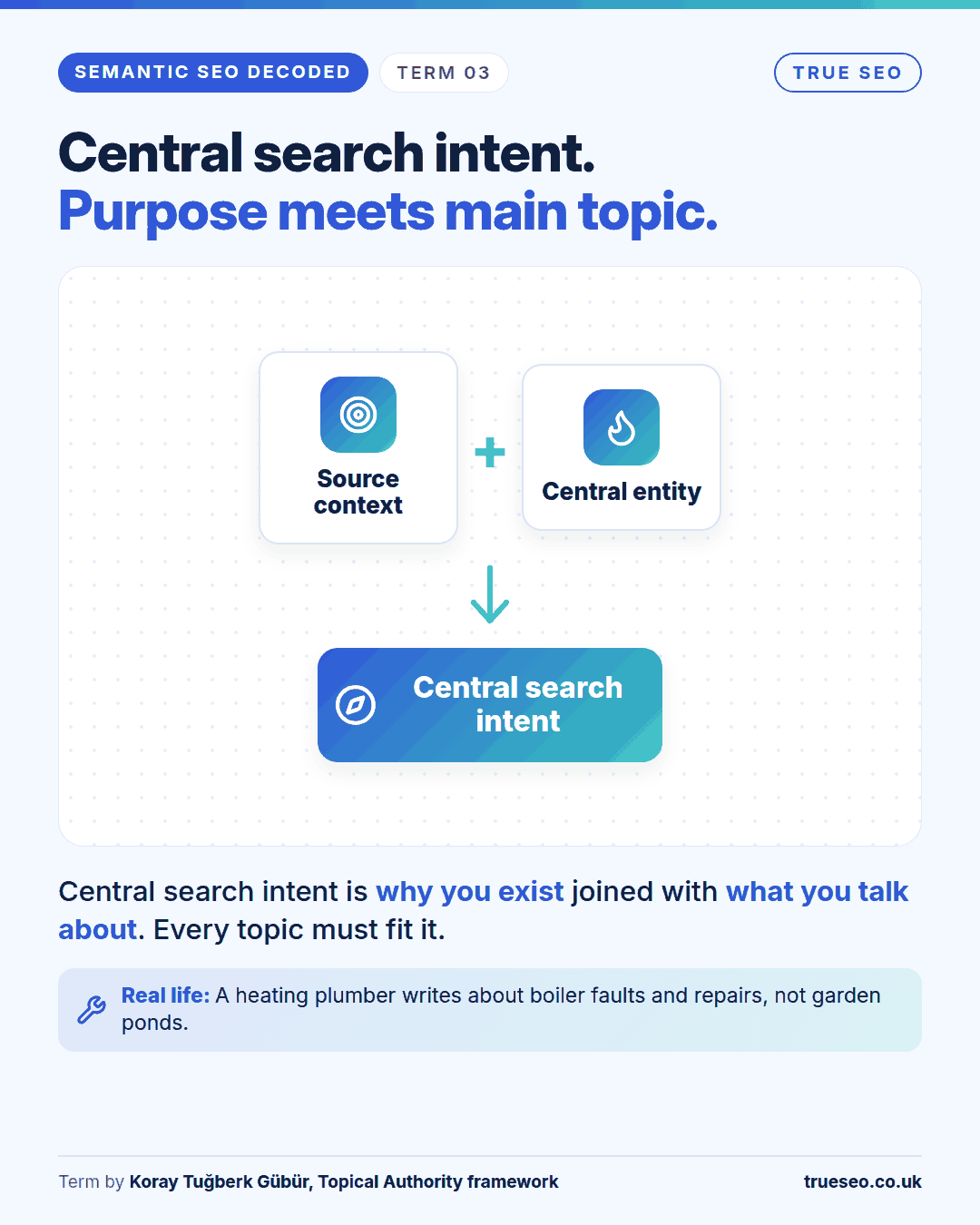
Central search intent card. Tap to enlarge
Central search intent
Koray framework term
Central search intent is the main action a website helps people take around its central entity. Glossaries of Koray’s framework describe it as the result of joining the source context with the central entity. Every topic on the site has to fit it.
It gives you a test for every page idea: a topic either helps people take that action or it does not. Koray frames the result as an action, a verb, not a label. It also differs from search intent, the goal behind one search covered in Part 4, because it governs the whole site.
At Example Heating: Rhys’s central search intent is to choose, fix and look after a boiler in Cardiff. “Combi vs system boiler” helps people choose. “Why is my boiler losing pressure” helps them fix. “How often should a boiler be serviced” helps them look after it. A post about garden decking helps with none of these, so it never gets written.
Right way
Test each idea against ‘choose, fix and look after a boiler in Cardiff’: ‘Combi vs system boiler’ helps people choose, so it gets written.
Wrong way, and why
Publishing ‘How to cut your energy bills this winter’, full of loft insulation and draught tips, because it is seasonal. It helps nobody choose, fix or look after a boiler, so it pulls the site away from the action it exists for.
Card note: The card puts it as “why you exist joined with what you talk about”. That matches, though Koray frames the result as an action rather than a label.
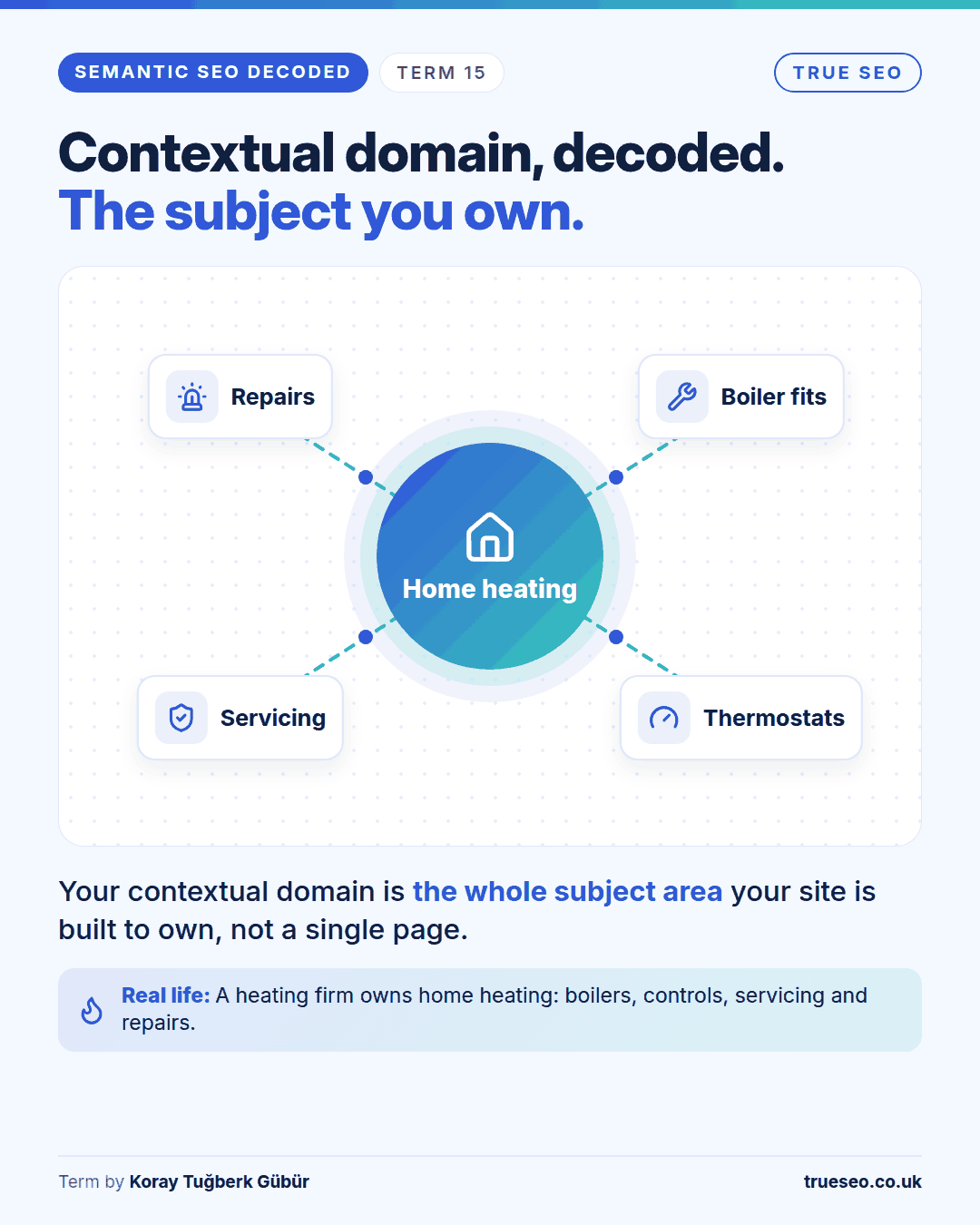
Contextual domain card. Tap to enlarge
Contextual domain
Koray framework term
Contextual domain is a subject area defined by three things: a concept, a topic and a context qualifier. The qualifier is the angle, audience or place that frames the topic. The same topic seen from a different context forms a different contextual domain.
Koray’s own definition is short: “A contextual domain consists of a concept, topic, and context qualifier” (topicalauthority.digital). For a business, the qualifier is the useful part, because it decides who you write for and from what angle.
At Example Heating: Home heating is the broad subject. Home heating for Cardiff homeowners and landlords is closer to Rhys’s contextual domain, because it adds an audience and a place. The qualifier changes the pages. A landlord wants gas safety certificates and their duties to tenants. A homeowner wants running costs and advice on when to replace an old boiler.
Qualifier: landlords
Pages on gas safety certificates and a landlord’s duties to tenants.
Qualifier: homeowners
Pages on running costs and when to replace an old boiler.
Right way
Add the qualifier to the topic: home heating for Cardiff homeowners and landlords, so landlords get gas safety certificate pages and homeowners get running costs and replacement advice.
Wrong way, and why
Writing every page for ‘anyone with a boiler’, so one guide mixes advice for landlords, commercial kitchens and homeowners in Scotland. Without a qualifier the angle drifts, and no single reader finds the page written for them.
Card note: The card simplifies this to “the whole subject area your site is built to own”. That description is closer to a different Koray term, knowledge domain, meaning the wider set of concepts and topics in a field.
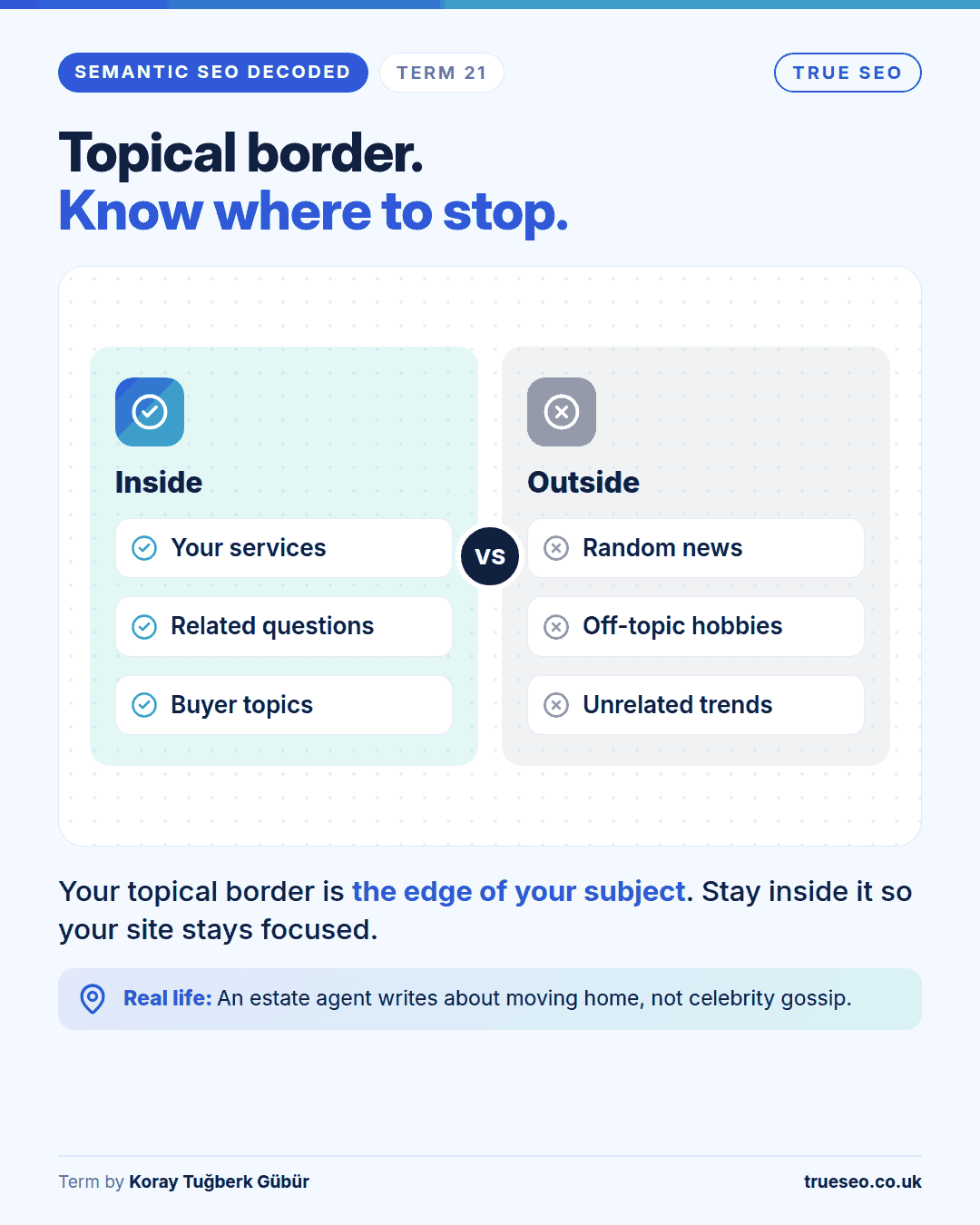
Topical border card. Tap to enlarge
Topical border
Koray framework term
Topical border is the edge of the subject a website should cover. It separates the topics that belong to its source context and main subject from the topics that do not. Staying inside it keeps the site focused.
Each page outside the border spreads the site’s attention without adding to what it is known for. Koray links topical borders to nouns, meaning the things a site covers. The edge of one page’s angle is a separate idea, which he calls a contextual border. A clear border also saves money, because you stop paying for pages your customers never needed.
At Example Heating: Rhys’s border is home heating and hot water. Inside sit boilers, radiators, controls, servicing, gas safety and landlord duties. Outside sit kitchen fitting, roofing and electrical rewires, even when customers ask about them on a visit. Respecting that line is part of how topical authority builds over time.
Right way
Hold the line at home heating and hot water: radiators, controls, servicing and landlord duties get pages, while kitchen fitting, roofing and electrical rewires do not.
Wrong way, and why
Adding a /bathroom-renovation-cardiff/ page because customers keep asking about it during installs. It sits outside home heating and hot water, so it spreads the site’s attention and costs money without adding to what Example Heating is known for.
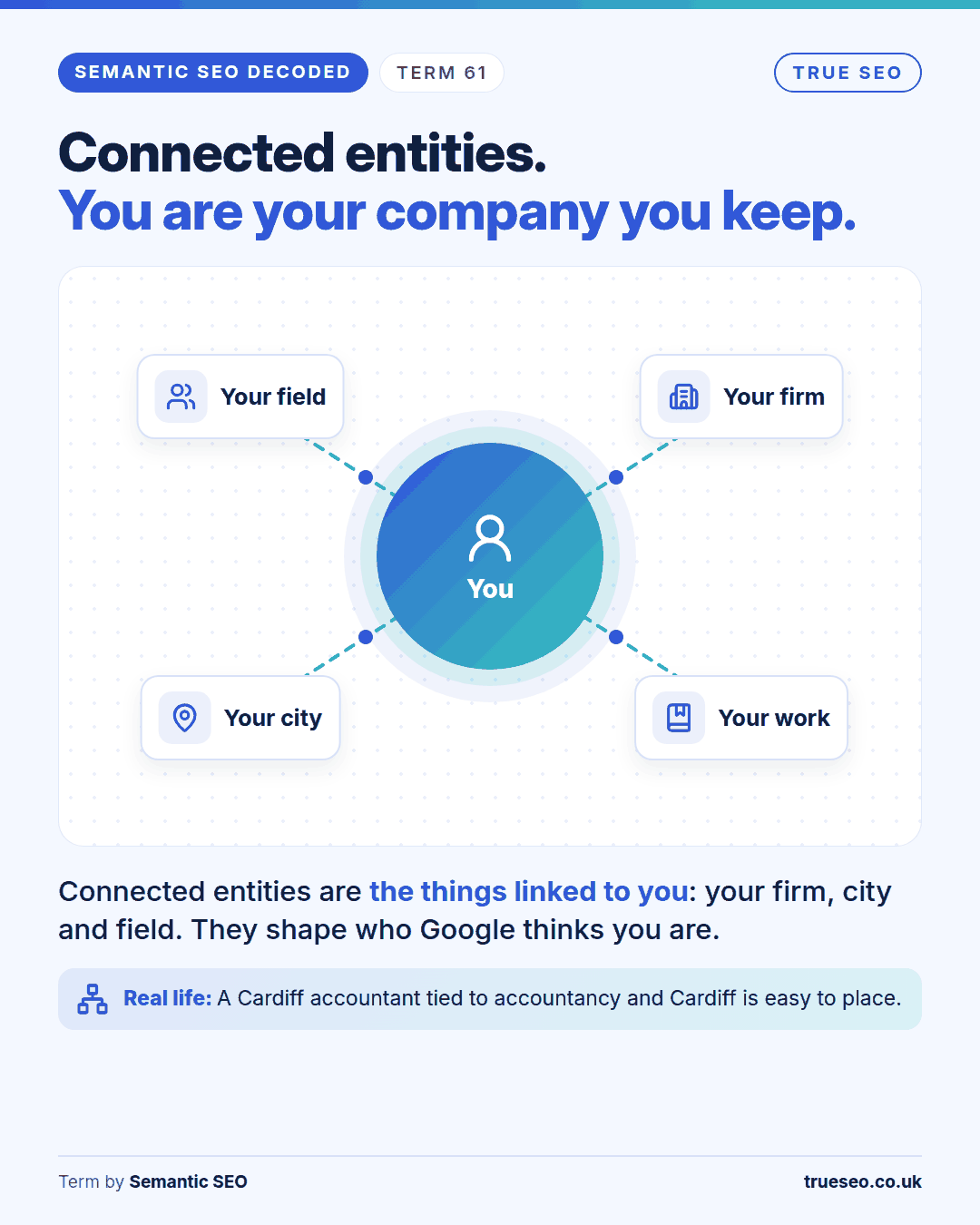
Connected entities card. Tap to enlarge
Connected entities
SEO industry term
Connected entities are the people, places, organisations and ideas linked to an entity through stated relationships. Examples are who owns it, where it is and what field it works in. Together they help define what that entity is.
A business is understood partly through what it is connected to. The idea rests on the relationships between things that Google described when it launched its Knowledge Graph. Koray writes about “entity connections”, but connected entities is general practice vocabulary, not a Google term. For an owner, the lesson is to state each relationship plainly and the same way every time.
At Example Heating: Example Heating’s connected entities include Rhys (owner) and Cardiff (base). Penarth, Barry, Caerphilly and Pontypridd are the areas it serves. Its engineers are on the Gas Safe Register, and it fits Worcester Bosch, Vaillant and Ideal boilers. Each one appears on the site in a plain sentence. Together they tell Google this is a Cardiff heating firm, not a boiler maker or a national price comparison site.
Right way
State each link in a plain sentence: ‘Rhys owns Example Heating’, ‘Example Heating is based in Cardiff’ and ‘it fits Worcester Bosch, Vaillant and Ideal boilers’.
Wrong way, and why
Naming the owner ‘Rhys’ on the About page and ‘our MD’ elsewhere, and showing the service towns only inside a map image. Relationships stated differently, or hidden in a picture, are hard for Google to join up into facts about the firm.
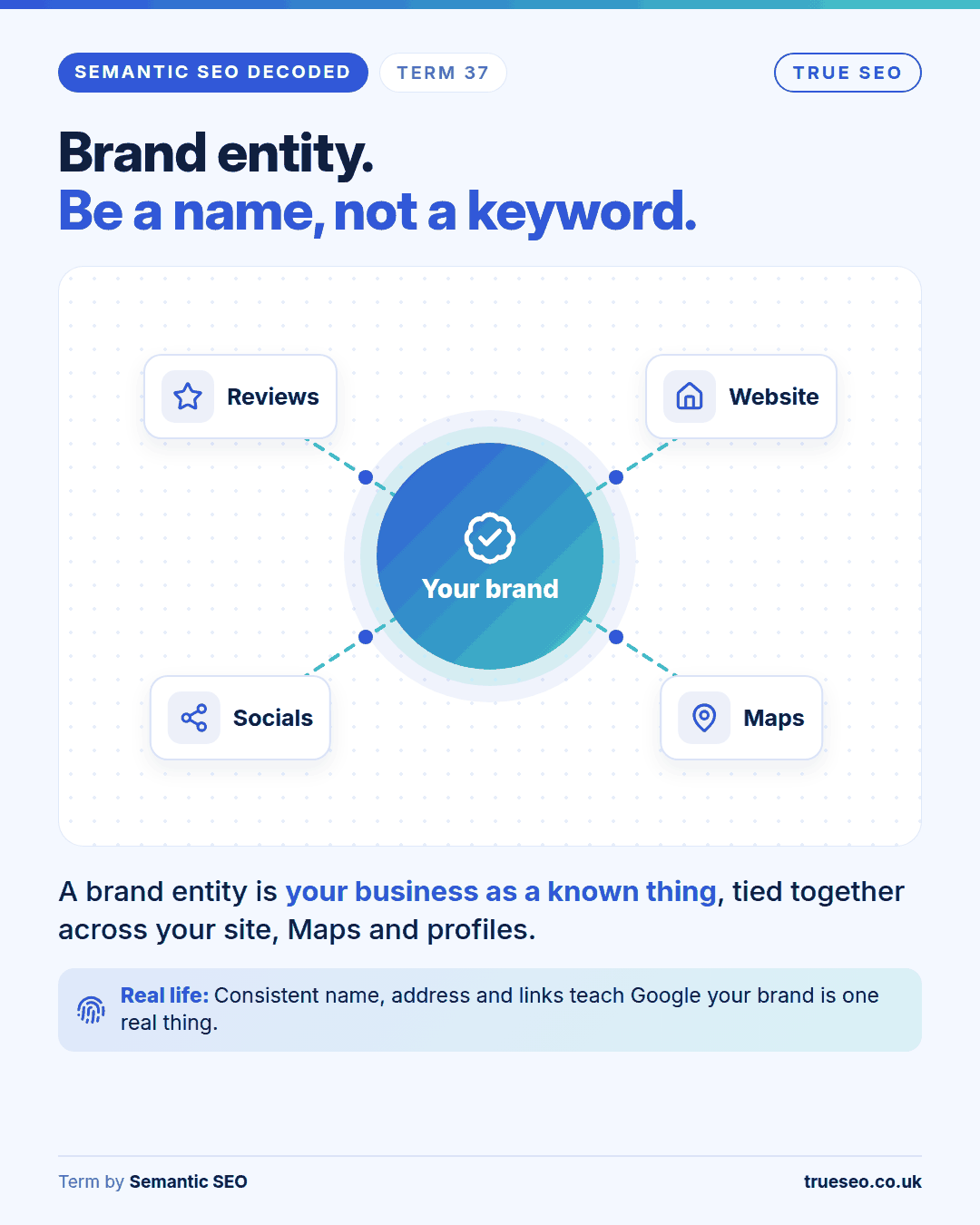
Brand entity card. Tap to enlarge
Brand entity
SEO industry term
A brand entity is a business that a search engine recognises as one distinct real-world thing. Facts such as its name, location, website and profiles are tied together. The business is then understood as a business, not just a string of words.
Brand entity is practitioner vocabulary; Google itself talks about entities in its Knowledge Graph. You cannot register for entity status or switch it on. Google’s systems decide from information across the open web. What you control is consistency: the same name and details everywhere your business appears.
At Example Heating: Rhys makes sure “Example Heating” reads the same everywhere, with the same address and phone number. That covers his website, every directory listing and his Google Business Profile, the free listing that puts a business on Google Maps. A NAP consistency check, meaning name, address and phone, catches any mismatch. That care is a routine part of local search work for trades. It helps Google treat the firm as one business rather than several similar names.
Right way
Keep ‘Example Heating’ identical everywhere: the same name, address and phone number on the website, every directory listing and the Google Business Profile.
Wrong way, and why
Listing the firm as ‘Example Heating Ltd’ on one directory, ‘Example Heating and Gas’ on another and with an old mobile number on Facebook. Google may see several similar businesses instead of one, and a NAP check would flag every mismatch.
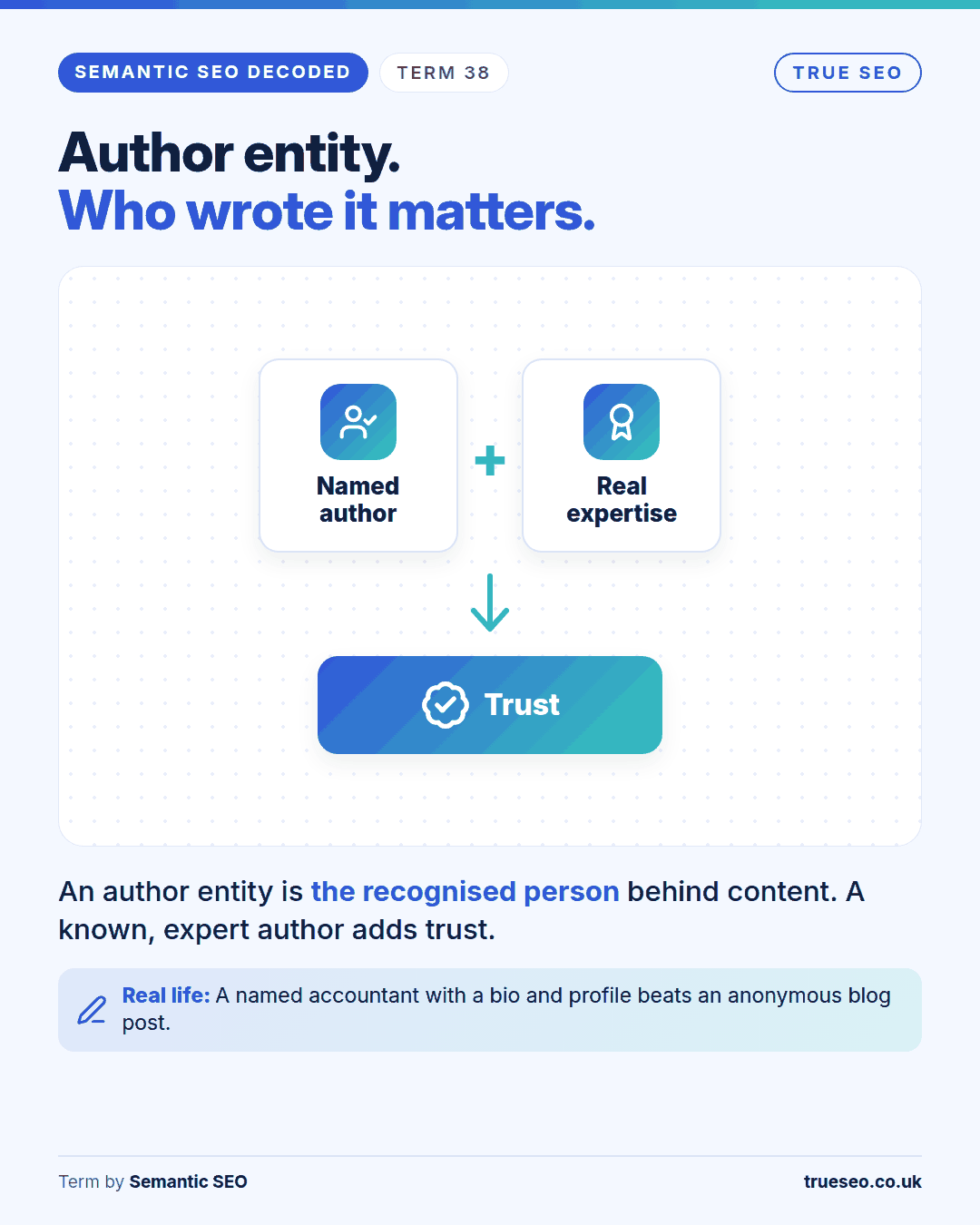
Author entity card. Tap to enlarge
Author entity
SEO industry term
An author entity is a named person that search engines can identify as the creator of content and connect to facts about their experience and expertise. It answers a reader’s simple question: who wrote this, and why should I trust them?
Google’s guidance on helpful content asks: “Is it self-evident to your visitors who authored your content?” The same guidance describes Experience, Expertise, Authoritativeness and Trustworthiness (E-E-A-T) and says trust is the most important of the four. Google describes no author score, so treat a clear byline as evidence for readers, not a ranking switch.
At Example Heating: Rhys writes the fault guides himself. Each carries his name, his role as owner and lead engineer and his Gas Safe registration, with a link to a short bio. A tenant reading the radiator guide can see the advice comes from the engineer who would turn up. Our own author page for this guide follows the same pattern.
Right way
Put a real person on each guide: Rhys’s name, his role as owner and lead engineer and his Gas Safe registration, linked to a short bio.
Wrong way, and why
Signing every fault guide ‘By Admin’ or ‘The Example Heating Team’. A tenant cannot tell who wrote the advice or whether they have ever opened a boiler, and Google’s guidance asks whether authorship is self-evident to visitors.
Card note: The card says a known author “adds trust”. Google describes no author score, so that trust comes from readers.
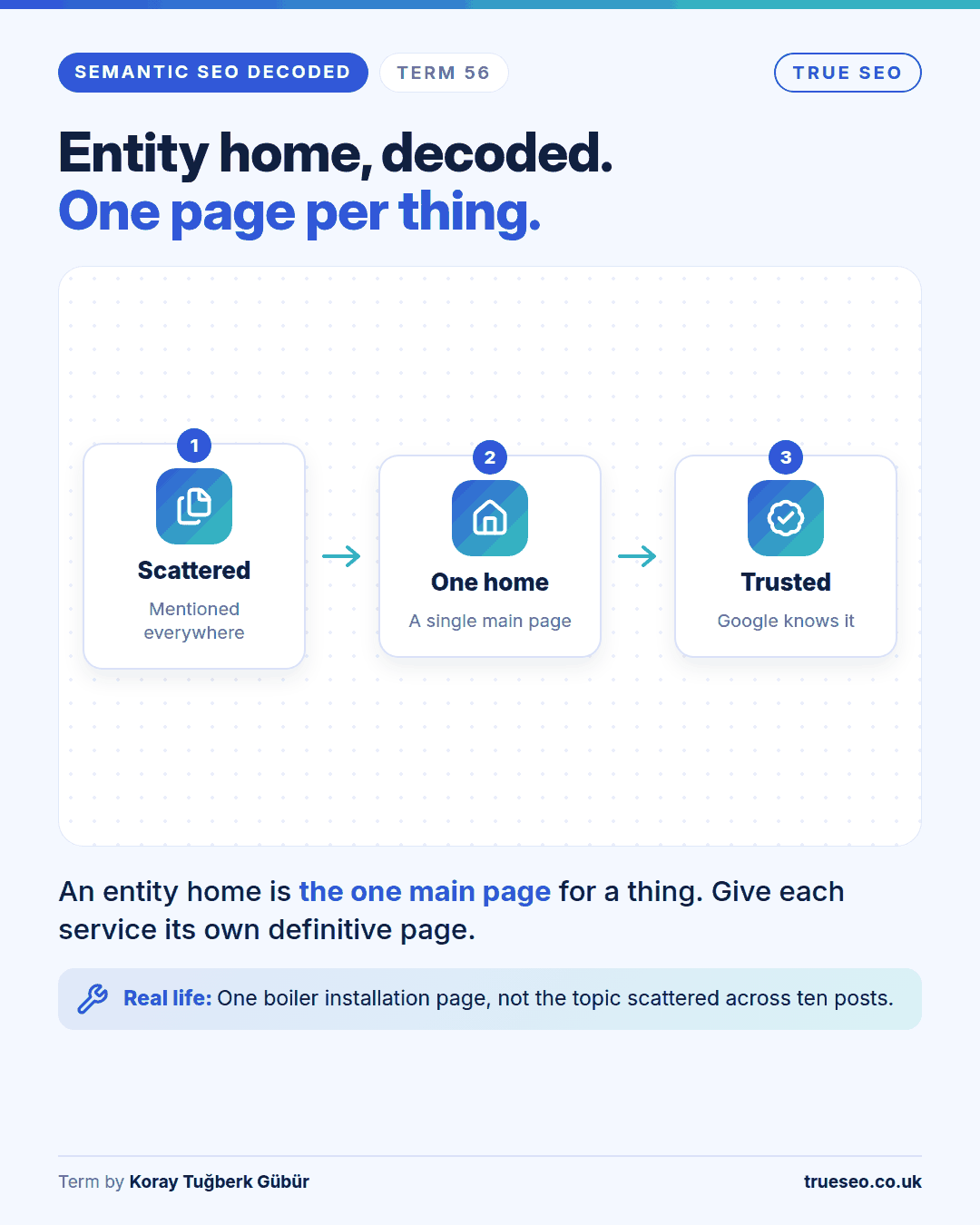
Entity home card. Tap to enlarge
Entity home
SEO industry term
An entity home is the one page, controlled by the entity itself, that search engines use as the main reference for facts about a person or organisation. For a business, it is usually the About page or the homepage.
The term was named and popularised by Jason Barnard of Kalicube, who described it in Search Engine Journal in June 2021. An entity home is the identity page for the brand or the person.
At Example Heating: Example Heating’s entity home is its About page (or homepage). It states who Rhys is, that the engineers are Gas Safe registered, the area covered around Cardiff and the services offered. It links to the firm’s profiles, and they link back. Rhys’s own bio page does the same job for him as a person.
Right way
Make the About page the reference: it states who Rhys is, the Gas Safe registration, the area around Cardiff and the services, and links to profiles that link back.
Wrong way, and why
Spreading the firm’s facts across a Facebook About tab, a directory profile and a page footer, with no single page on the site that states them all. Search engines then have no page the firm controls to treat as the main reference.
Card note: The card credits Koray, but the term is Jason Barnard’s. Its advice, “give each service its own definitive page”, is sound site planning, but it is a different idea.
With its identity and its border settled, the business can turn to how its customers actually search, which is what Part 4 covers.
Part 4 of 11 · about 15 minutes
How people search
This part explains how people search. It covers the goals behind a search, how searches connect and how Google and artificial intelligence (AI) tools reshape them. SEOs call a search a query, which is why so many terms here use that word. Together they tell you which pages to build and how they should link. For Example Heating, they follow real customer moments, from a pressure gauge dropping to a booked repair.
In 30 seconds
- Every search has a goal behind it, and a page must answer that goal.
- Searches come in connected groups, so plan pages for the group, not one phrase.
- Google rewrites and splits searches, so the meaning you cover matters more than exact words.
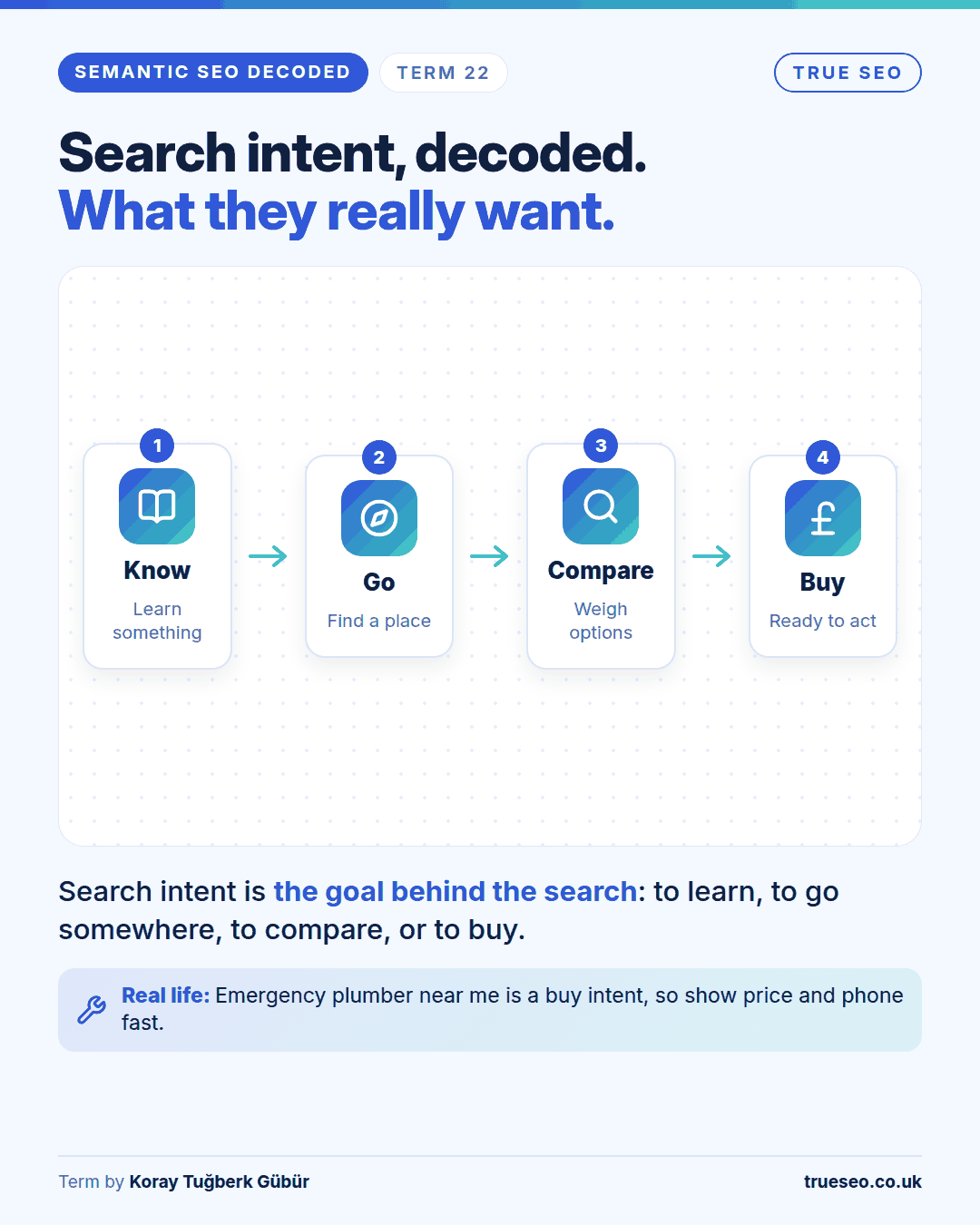
Search intent card. Tap to enlarge
Search intent
Information retrieval term
Search intent is the goal behind a search: what the person wants to learn, find or do when they type it. The same boiler can sit behind very different goals, from fixing a fault to buying a new one.
A page that answers the wrong goal rarely gets chosen. The idea comes from information retrieval, the study of how computers find documents, and from everyday SEO practice. A key source is Andrei Broder’s 2002 paper “A Taxonomy of Web Search”. The industry uses four types. Google’s Search Quality Rater Guidelines, the handbook for the people who check its results, use their own labels.
At Example Heating: Rhys’s customers’ searches under the industry’s four types:
- Informational: “why is my boiler losing pressure”
- Navigational: “Example Heating Cardiff”
- Commercial: “combi vs system boiler”
- Transactional: “book boiler service Cardiff”
And under Google’s rater labels:
- Know: “how long does a boiler last” (Know Simple when one short answer will do, such as “how often should a boiler be serviced”)
- Do: “book a landlord gas safety certificate”
- Website: “Example Heating website”
- Visit-in-person: a place to go, such as “heating showroom Cardiff” (most of Rhys’s customers want him to come to them)
Our guide to keyword intent types has more examples.
Right way
Match each page to one goal. “Book boiler service Cardiff” lands on /boiler-servicing/ with a way to book, and “why is my boiler losing pressure” lands on a guide that explains the causes.
Wrong way, and why
Pointing “why is my boiler losing pressure” at a sales page that opens with “Book your repair today” and a price list. The searcher wanted to understand the fault first, so the page misses their goal and they go back to the results.
Card note: The card’s footer credits Koray, but the idea is older.
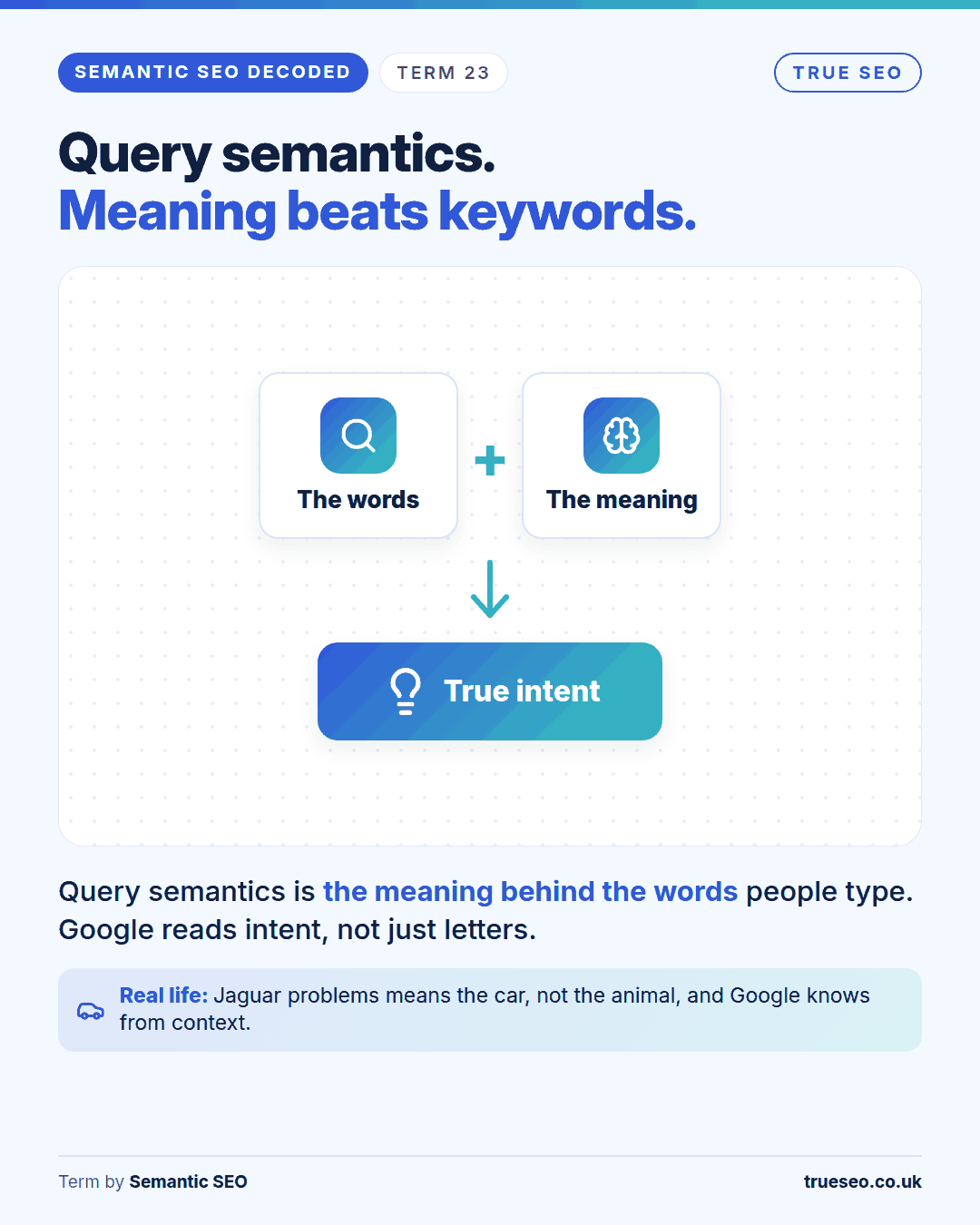
Query semantics card. Tap to enlarge
Query semantics
Information retrieval term
Query semantics is the meaning a search engine reads from a search beyond its literal words. It uses word order, context and the things named in the search, so results match what the person means rather than the exact letters they typed.
People rarely type the words your page uses. Google’s visa example under word sequence shows how much one small word can change. Query semantics applies that kind of reading to the whole search. Pages written in plain, specific language are easier to match with the meaning behind a search.
At Example Heating: A customer types “boiler flashing a red light”. None of those words is “boiler repair”, yet the meaning is clear: the boiler has stopped because of a fault. Rhys’s repair guide describes that symptom in the customer’s own words. That lets it match the search, even without the exact phrase.
Right way
Describe faults in the customer’s own words. The repair guide says “boiler flashing a red light” and explains what it means, so it matches searches that never use the phrase “boiler repair”.
Wrong way, and why
Repeating “boiler repair Cardiff” in every paragraph and never naming the symptoms people type, such as a red light or no hot water. Search engines read meaning, so a page stuffed with one phrase still misses the real problem.
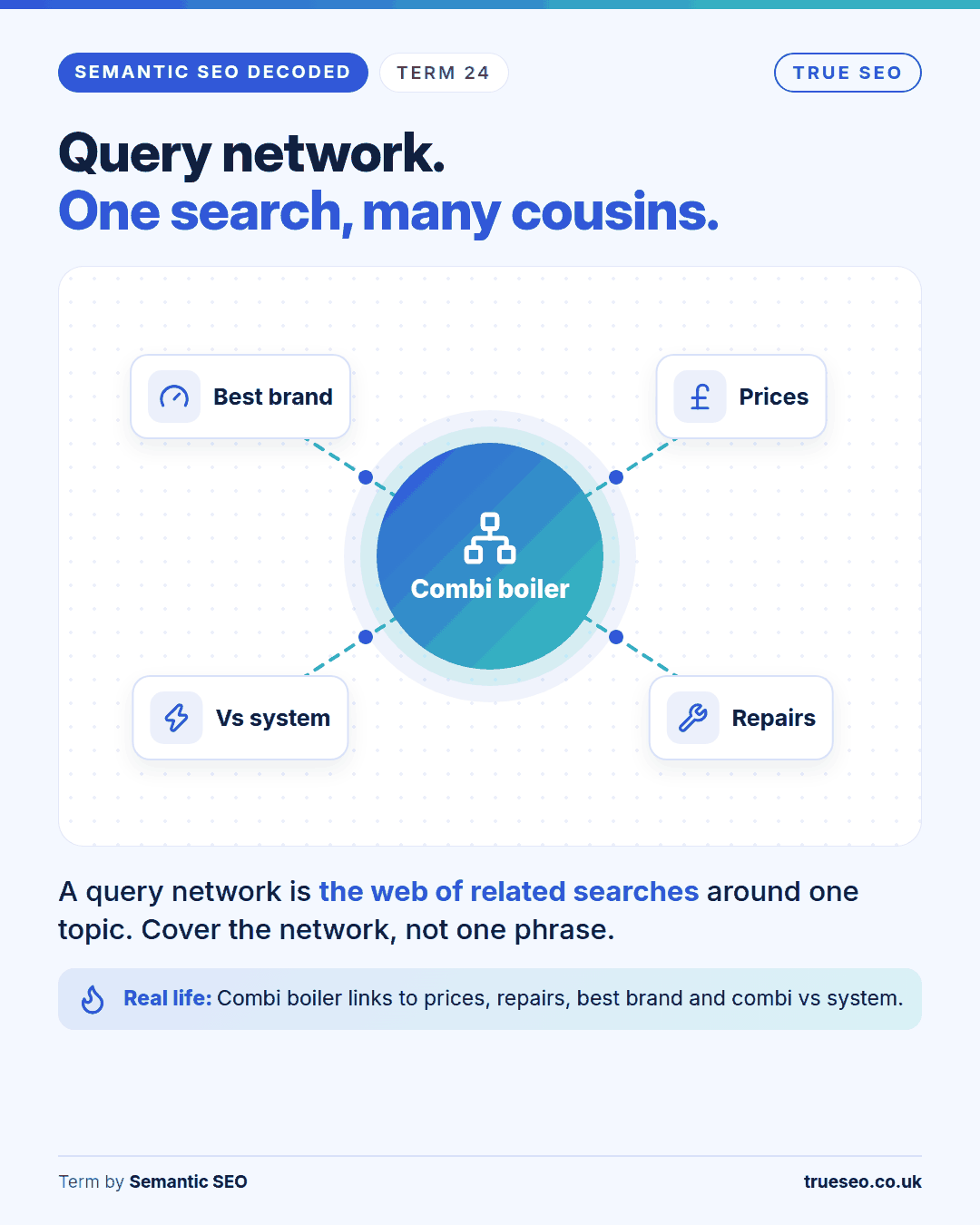
Query network card. Tap to enlarge
Query network
Koray framework term
Query network is the connected group of related searches around one topic. It is built from the topic, the contexts people search it in and the many ways they phrase it. A site needs to satisfy the group as a whole, not one phrase.
Koray Tuğberk Gübür popularised the phrase in SEO. In an OnCrawl article, he writes that search engines judge quality for a query or a whole network of queries. Ranking for one phrase while ignoring the searches around it leaves gaps a competitor can fill. The practical step is to list the whole network before you plan any pages.
At Example Heating: Around boiler servicing, the network might include “boiler service Cardiff” and “how often should a boiler be serviced”. It might also include “what happens during a boiler service” and “landlord gas safety certificate”. These are illustrations, not measured searches. Rhys’s servicing page and its supporting guides aim to cover the group together. A keyword research checklist helps make sure nothing obvious is missed.
Right way
List the whole group first: “boiler service Cardiff”, “how often should a boiler be serviced”, “what happens during a boiler service” and “landlord gas safety certificate”. Then plan the servicing page and its guides together.
Wrong way, and why
Building /boiler-servicing/ around “boiler service Cardiff” alone and ignoring the questions around it, such as how often a service is needed. A competitor who answers the whole group fills those gaps and looks like the stronger source.
Root query card. Tap to enlarge
Root query
SEO industry term
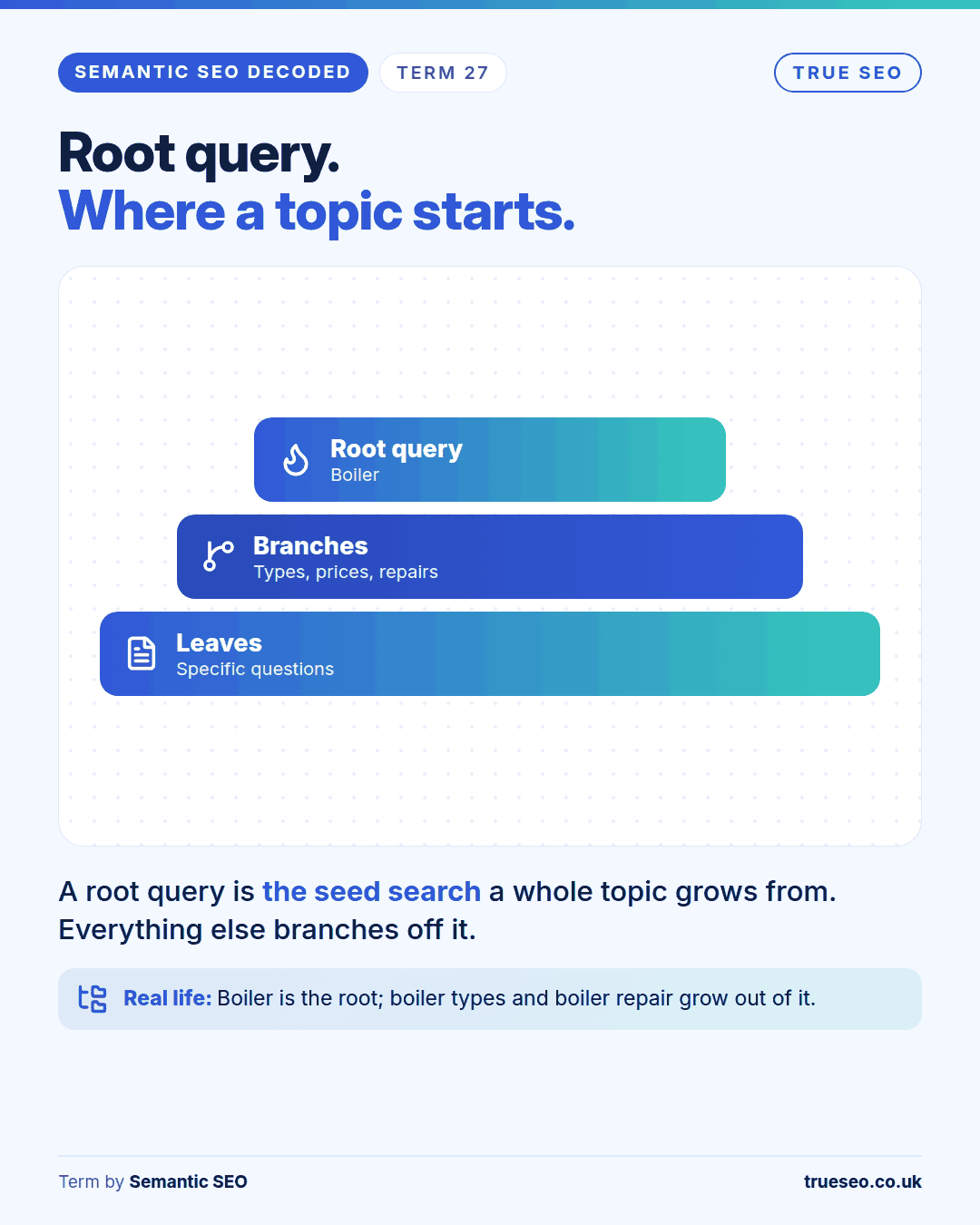
Root query is the broadest search for a topic, usually the name of the main thing on its own. Longer and more specific searches branch out from it. It overlaps with the familiar ideas of a seed keyword or a head term.
The root query tells you where your subject starts, and everything you plan should connect back to it. We found no published definition of this term from Koray, so we treat it as general SEO vocabulary.
At Example Heating: Rhys’s root query is “boiler”. From it branch “boiler repair”, “new boiler cost Cardiff”, “boiler losing pressure”, “boiler service” and many other variations. Few people book a job straight from the single word “boiler”. Most searches that end in a booking still build on it, which is why the boiler is also his central entity.
Right way
Start the plan from “boiler” and connect every branch back to it, so repair, servicing, installation cost and pressure faults all lead up to the boiler pages.
Wrong way, and why
Choosing “plumber Cardiff” as the root query because it sounds like the trade. It describes a different job, so the plan drifts towards taps and bathrooms instead of the boiler that most booking searches build on.
Representative query card. Tap to enlarge
Representative query
Google term
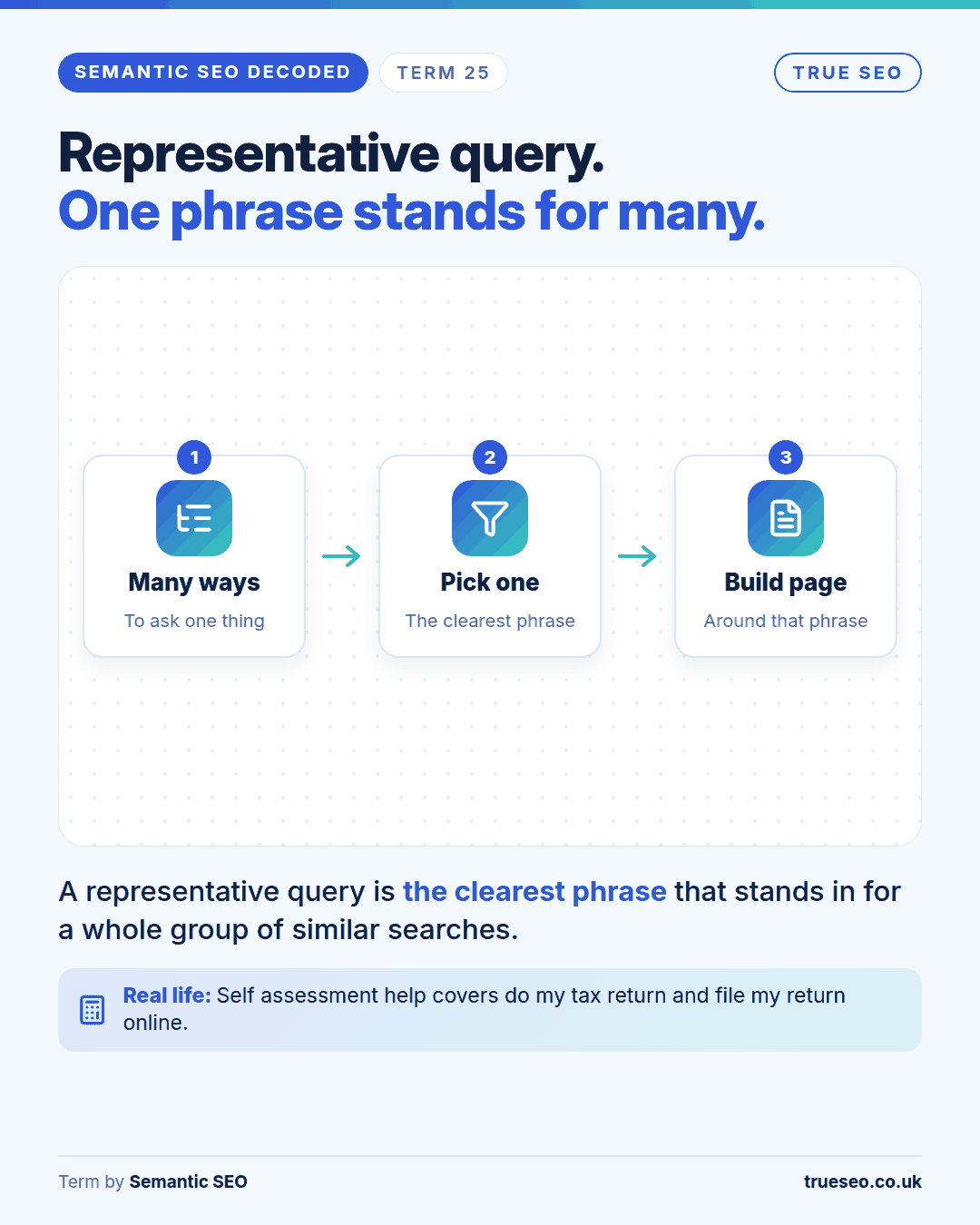
A representative query is one search chosen to stand for a whole group of similar searches that share the same meaning and intent. One page can then serve the whole group, instead of one page for each wording.
The phrase comes from a Google patent on grouping similar searches (US 8,775,409, dating from 2009), which describes choosing a representative query for each group. Koray’s framework later adopted it. For a business owner, it stops a common waste: separate pages for searches that mean the same thing.
At Example Heating: The search “new boiler cost Cardiff” is the representative query for a group of similar searches. The group includes “how much is a new boiler in Cardiff” and “boiler replacement price Cardiff”. All three want the same answer, so Rhys answers them in one guide, which links to his installation page. Three near-identical pages would only compete with each other.
- 1People type three similar searches
- 2Group them under “new boiler cost Cardiff”
- 3One guide answers the whole group
- 4Guide links to the installation page
Right way
Group “how much is a new boiler in Cardiff” and “boiler replacement price Cardiff” under “new boiler cost Cardiff”, then answer all three in one cost guide that links to /boiler-installation/.
Wrong way, and why
Publishing /new-boiler-cost-cardiff/, /how-much-is-a-new-boiler-cardiff/ and /boiler-replacement-price-cardiff/ as three separate pages. They answer the same question, so they compete with each other and none becomes the clear page to choose.
Query path card. Tap to enlarge
Query path
Koray framework term
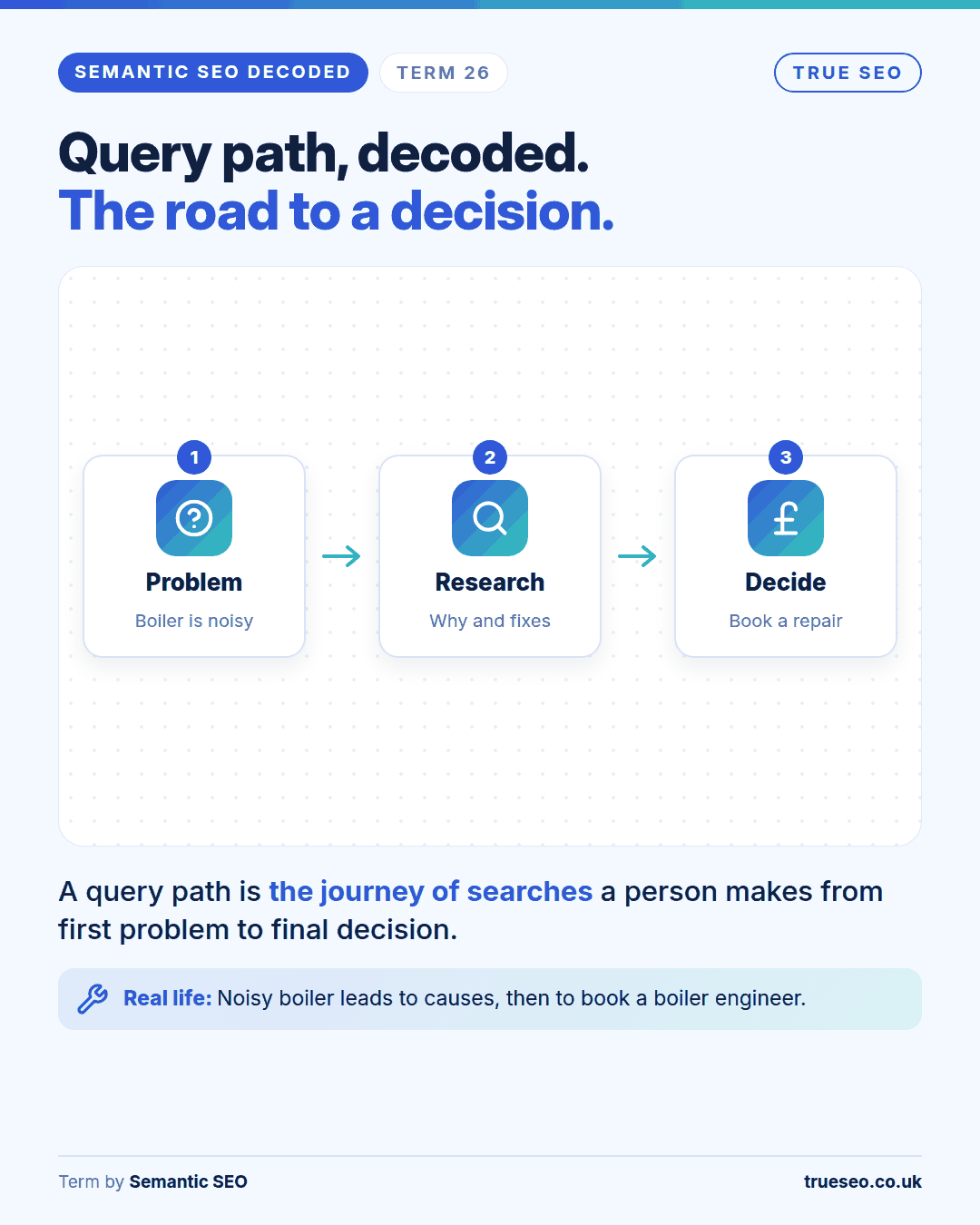
Query path is the sequence of related searches a person makes, each one following from the last. It shows how a need develops, which helps search engines predict the next step and helps you put your pages in a sensible order.
Koray puts it plainly on Holistic SEO: “A sequential query can have a query path”. The idea comes from research on search sessions and Google patents; Koray popularised the label in SEO. A query path does not have to end in a purchase.
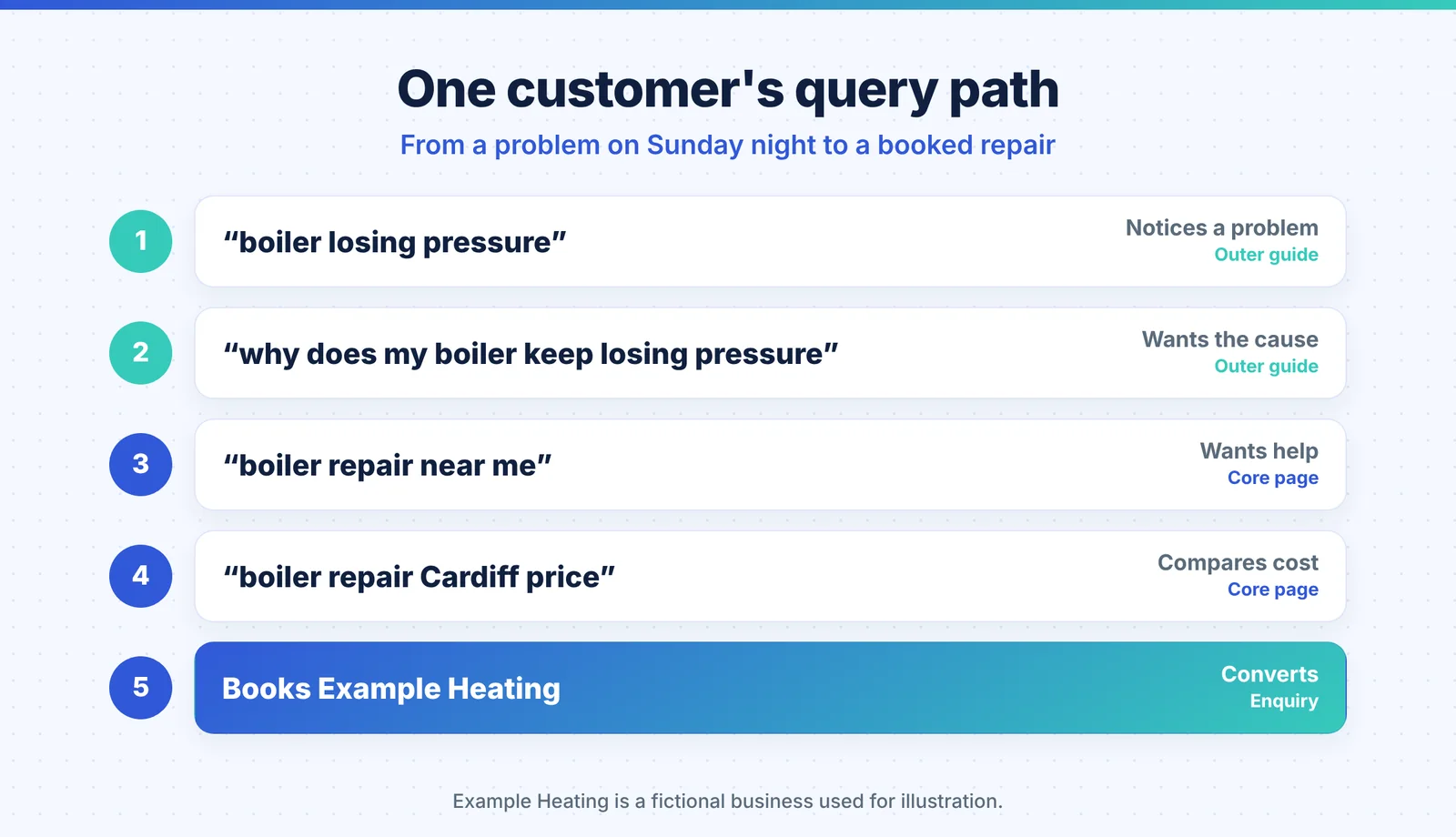
At Example Heating: One winter evening, a homeowner sees the pressure gauge drop. They search “boiler losing pressure”, then “why does my boiler keep losing pressure”. Both land on a helpful guide in Rhys’s outer section. It explains common causes and when to call an engineer. Next come “boiler repair near me” and “boiler repair Cardiff price”, answered by his core repair page. Step five is the booking with Example Heating.
Right way
Order the pages along the path. The “boiler losing pressure” guide explains causes, then links to the core repair page, which answers “boiler repair Cardiff price” and leads to booking.
Wrong way, and why
Ending the “boiler losing pressure” guide with no link onwards, or with a link to a post about smart thermostats. The reader’s next step is a repair, so the path breaks and they look for an engineer elsewhere.
Card note: The card’s “from first problem to final decision” fits Rhys’s customers, but it only describes paths that end in a purchase.
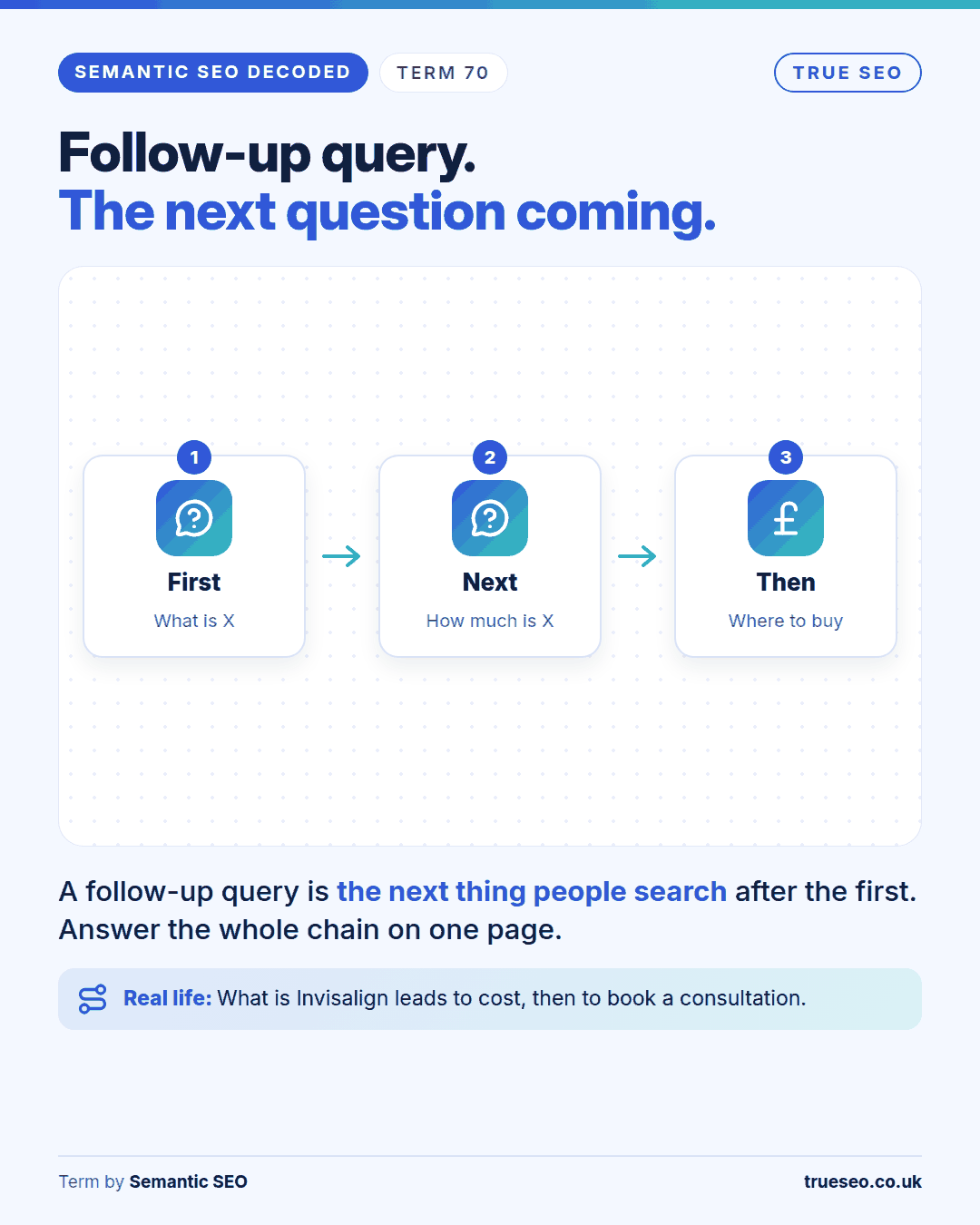
Follow-up query card. Tap to enlarge
Follow-up query
Information retrieval term
A follow-up query is the next search or question a person asks after their first one, in the same session or conversation. It narrows, extends or acts on the first need, such as moving from a problem to a price.
Follow-up queries show what people want next. Google’s May 2025 post on AI Mode, its chat-style search, describes going deeper “through follow-up questions”. A fault guide and a priced service page serve different goals, so they usually work better as separate pages joined by a clear link.
At Example Heating: After “combi vs system boiler”, a common next question is who can fit one and what it costs. Rhys does not squeeze installation prices into the comparison guide. He ends it with a short section on choosing an installer and a link to his boiler installation page, which answers the follow-up properly.
Right way
End the “combi vs system boiler” guide with a short section on choosing an installer and a link to /boiler-installation/, where cost and fitting questions get a full answer.
Wrong way, and why
Adding a full installation price table and booking form to the bottom of the comparison guide. The page then tries to serve two different goals at once, and both answers come out thin.
Card note: The card’s advice to “answer the whole chain on one page” is too simple. Pages with different goals usually work better apart, joined by a link.
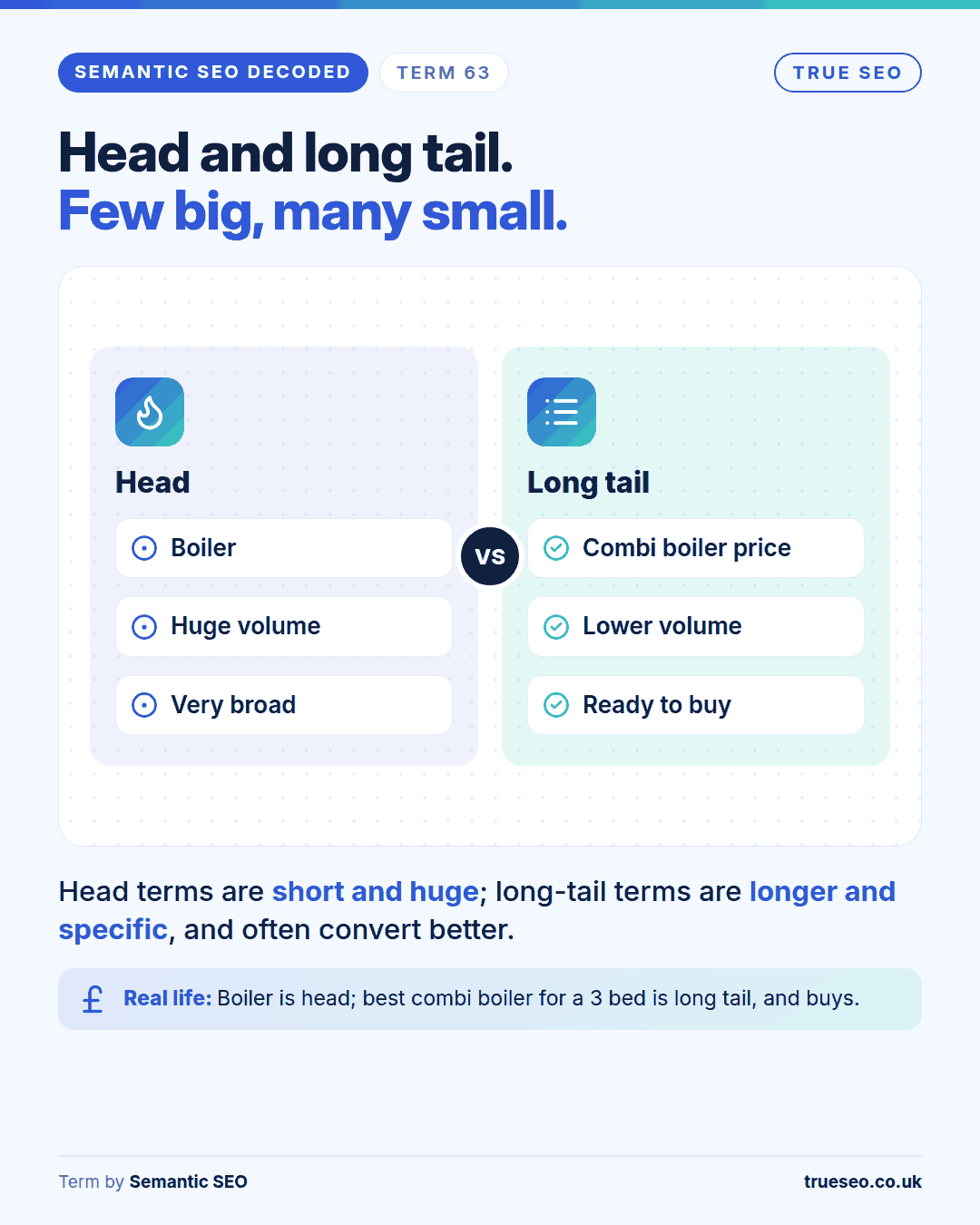
Head and long tail card. Tap to enlarge
Head and long tail
SEO industry term
Head and long tail describe two kinds of search. Head terms are short, broad searches that many people type. Long-tail terms are longer, more specific searches that fewer people type each, but there are a great many of them.
The split borrows the “long tail” idea Chris Anderson popularised in Wired in October 2004. UK figures show the shape: “semantic seo” gets about 90 searches a month, “how to do semantic seo” about 10 (DataForSEO, October 2026).
At Example Heating: The single word “boiler” is Rhys’s head term. A search such as “why does my combi boiler take so long to give hot water” is long tail. Specific searches describe a real situation, so they are easier to answer exactly. His guides are written for them, because no single page can answer everything behind “boiler”.
Right way
Write guides for exact situations, such as “why does my combi boiler take so long to give hot water”, and answer that one situation in full.
Wrong way, and why
Aiming the homepage at “boiler” alone and skipping the specific questions. The head term covers many different needs, so no single page answers them all, and the precise searches go to sites that wrote for them.
Card note: The card adds that long-tail terms “often convert better”. We found no published study showing this.
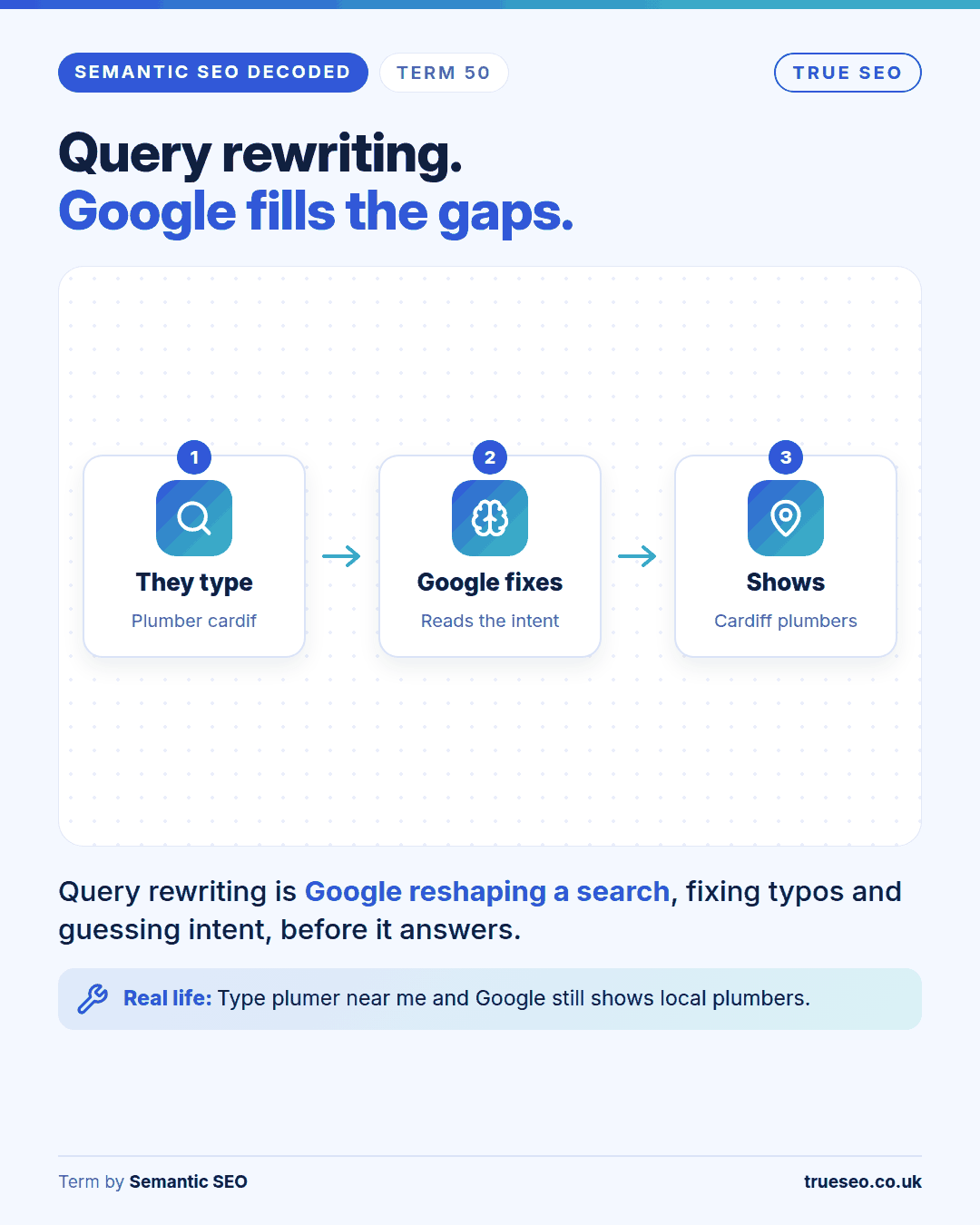
Query rewriting card. Tap to enlarge
Query rewriting
Information retrieval term
Query rewriting is the step where a search engine turns the words someone typed into one or more alternative versions. It may fix spelling, add synonyms or add context, so it can find more relevant results.
The exact words you target therefore matter less than the meaning you cover. Query rewriting is a standard information retrieval technique used by many search engines. One well-known patent on it, filed in 2006, belongs to Yahoo, not Google. Rewriting produces variants of the search, not a guess about the person.
At Example Heating: A homeowner in a hurry types “combi boiler sevice cardif”. Search engines correct the spelling, and they may also treat “combi” and “combination boiler” as the same thing, the synonyms from Part 2. Rhys does not need a page for every misspelling or synonym. One clear servicing page, written in plain words, covers the variants.
- 1Typed: “combi boiler sevice cardif”
- 2Spelling fixed: “combi boiler service Cardiff”
- 3Synonym may be added: “combination boiler”
- 4Results can include his servicing page
Right way
Write one clear servicing page in plain words, and let search engines handle the spelling fixes and synonyms such as “combi” and “combination boiler”.
Wrong way, and why
Creating /combi-boiler-sevice-cardif/ and /combination-boiler-service-cardiff/ to catch misspellings and synonyms. Search engines already correct and widen the search, so these pages only add duplicates and look careless to readers.
Card note: The card says Google is “guessing intent”. That is loose, because rewriting produces variants of the search.
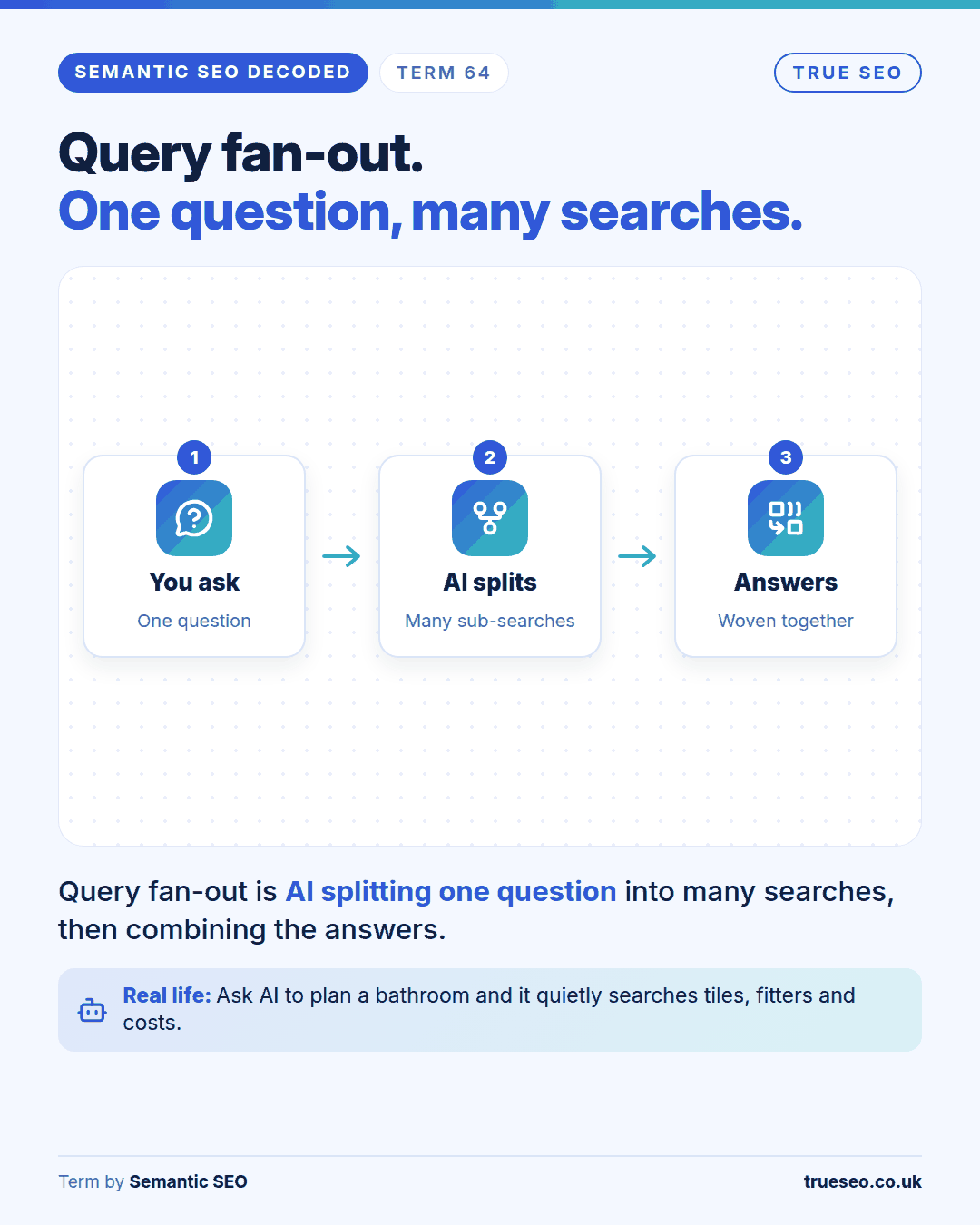
Query fan-out card. Tap to enlarge
Query fan-out
Google term
Query fan-out is the technique Google’s AI search features use to split one question into smaller subtopics. They run several related searches across those subtopics, then combine what they find into one answer.
Google announced it for AI Mode at Google I/O on 20 May 2025, in a blog post by Elizabeth Reid. Google Search Central says its AI features, including AI Overviews, may use it, “issuing multiple related searches across subtopics and data sources”. So a page can be drawn into an answer for covering one subtopic well.
At Example Heating: Someone asks “is it worth replacing a 15-year-old boiler?”. The answer might draw on separate searches about boiler lifespan, new boiler cost in Cardiff and efficiency. Nobody outside Google can see which searches actually run, so this is an illustration. Rhys’s guides on lifespan and cost each cover one subtopic. Our guide to query fan-out for SEO goes further.
- 1“Is it worth replacing a 15-year-old boiler?”
- 2Split into lifespan, cost and efficiency
- 3A separate search for each part
- 4One answer built from the results
Right way
Give each subtopic its own clear answer. The lifespan guide covers how long a boiler lasts and the cost guide covers new boiler cost in Cardiff, so either can be drawn into an answer.
Wrong way, and why
Writing one vague post called “Everything about boilers” that gives lifespan, cost and efficiency a line each. Fan-out searches look for a strong answer on each subtopic, and one shallow line per subtopic gives them little to use.
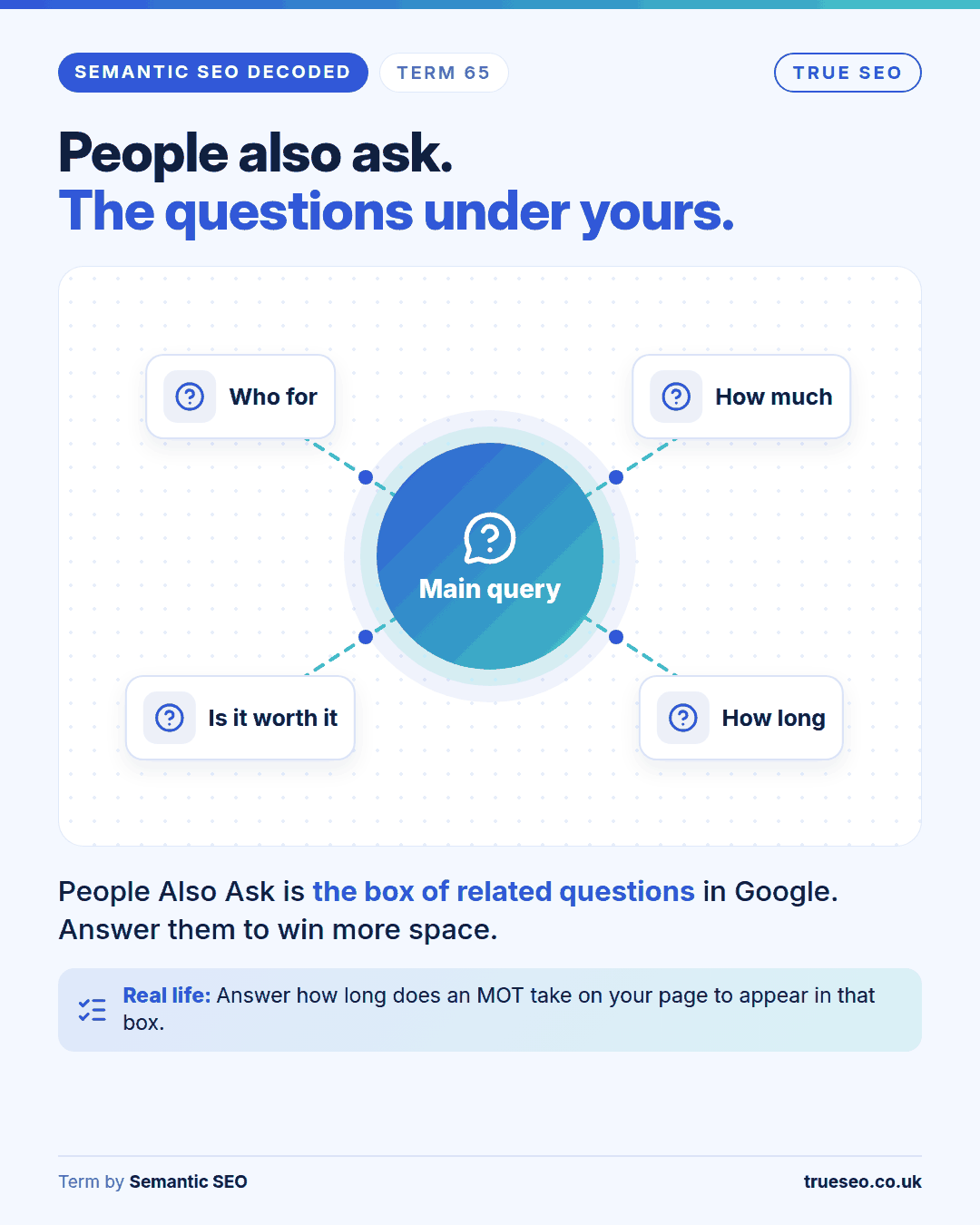
People also ask card. Tap to enlarge
People also ask
Google term
People also ask is the Google results feature that shows a group of questions related to the search. Google’s own documentation calls it the related questions group. Each question opens to show a short answer and the page it came from.
The box shows the questions real searchers ask, which makes it a useful research source. On google.co.uk, the box for “semantic seo” includes “Can you give me an example of semantic search?” (checked 29 October 2026). Google publishes no rules for which pages it picks.
At Example Heating: A search about combi boilers might bring up “What is the downside of a combi boiler?” or “Is a combi boiler better than a system boiler?” These show the format, not the live results. Rhys answers questions like these in his guides, with the short answer first under a matching heading.
Right way
Put a question heading such as “What is the downside of a combi boiler?” in the guide, and answer it in the first one or two sentences beneath it.
Wrong way, and why
Pasting every People also ask question into one FAQ block at the foot of /boiler-installation/ with one-line answers. The questions lose their context on a sales page, and Google publishes no rule promising a place in the box for it.
Card note: The card says to “answer them to win more space”. That is a tactic, not a guarantee.
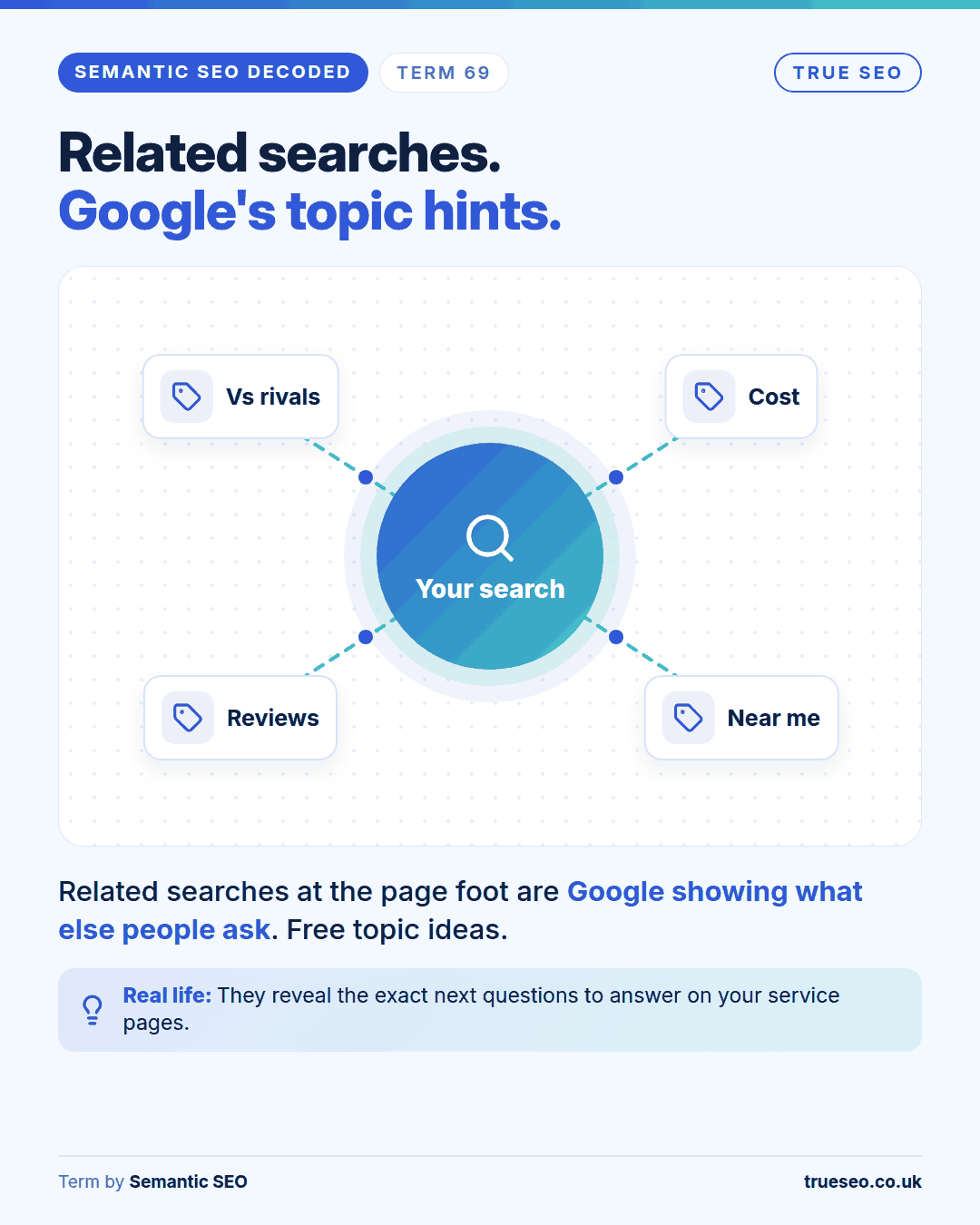
Related searches card. Tap to enlarge
Related searches
Google term
Related searches is the Google results feature that lists other searches people have made that relate to the current one. It helps searchers widen or narrow what they are looking for, and it often appears near the foot of the results.
Related searches are searches, not questions. Google’s documentation does not fix them to one position on the page either. They are a good source of topic ideas, but a list of related searches is not a topical map.
At Example Heating: A search for “boiler service Cardiff” might show related searches. Examples could be “boiler service cost”, “gas safety certificate Cardiff” or “boiler service near me”. These illustrate the format rather than report the live page. Each one hints at a page or section Rhys may need, and each still has to pass his topical border check before he writes anything.
Right way
Treat related searches as ideas and test each one against the topical border. “Gas safety certificate Cardiff” passes, because it fits the landlord certificate page.
Wrong way, and why
Writing a separate post for each related search shown, such as “boiler service near me” beside the servicing page. Related searches are hints, not a plan, so the site gains thin pages that repeat /boiler-servicing/ instead of improving it.
Card note: The card describes it as “what else people ask”, but that describes People also ask.
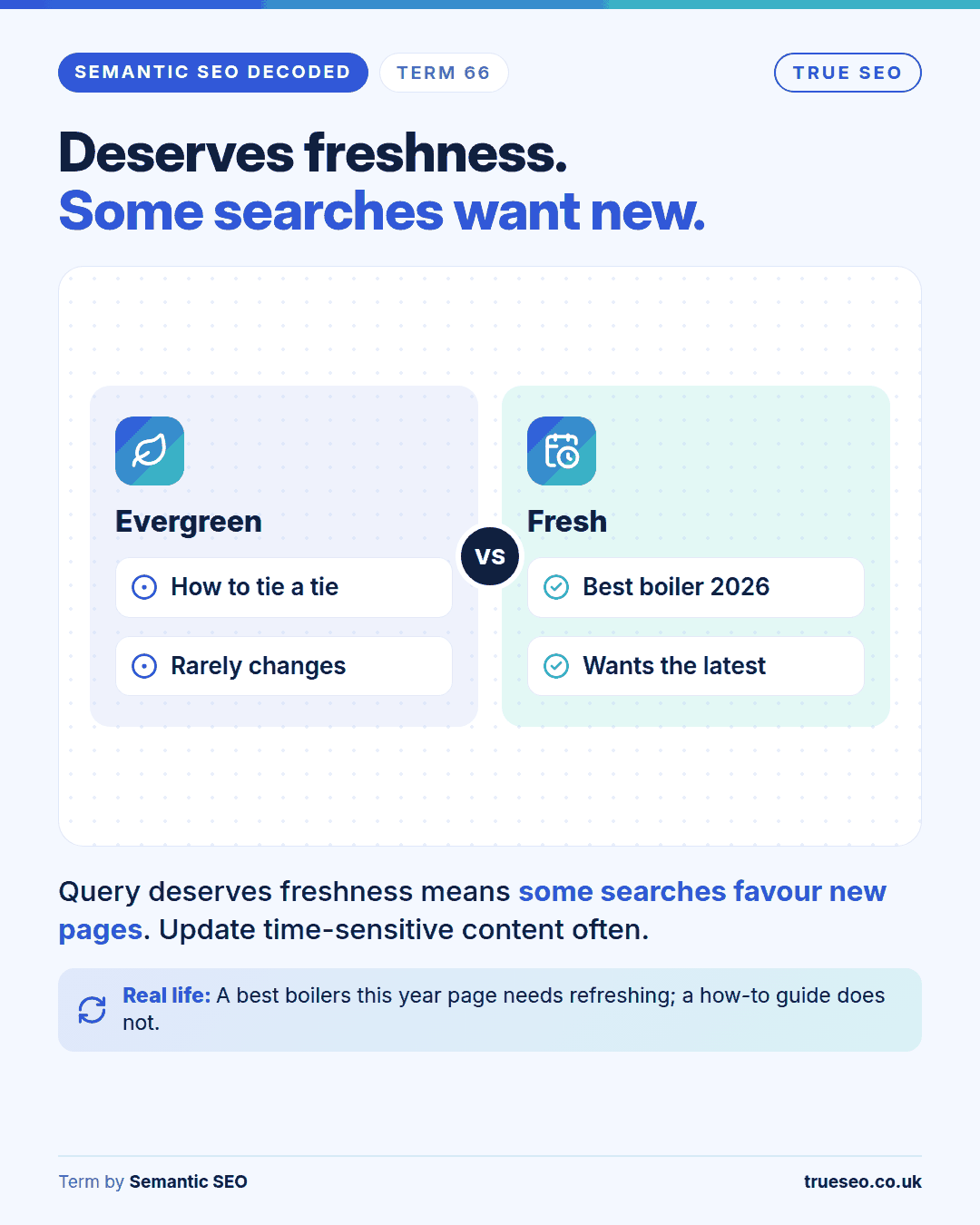
Deserves freshness card. Tap to enlarge
Query deserves freshness (QDF)
Google term
Query deserves freshness (QDF) is Google’s idea that some searches should show newer pages, because people expect recent information. Searches where freshness matters less can keep showing older pages that still answer well.
Google’s Amit Singhal described the idea in a New York Times article, “Google Keeps Tweaking Its Search Engine”, in June 2007. Google now calls these its freshness systems, “designed to show fresher content for queries where it would be expected”.
At Example Heating: A search for “best boiler 2026” needs a current page. Rhys updates his guide to choosing a new boiler when models change. The answer to “how does a combi boiler work” barely changes, so that guide can stay as it is.
Right way
Update the guide to choosing a new boiler when models change, so “best boiler 2026” gets a current page, and leave “how does a combi boiler work” as it is.
Wrong way, and why
Changing the date on “how does a combi boiler work” every month without changing a word. That answer does not need freshness, the reader gets nothing new, and Google’s guidance on helpful content warns against date changes with no real update.
Card note: The card shortens the name and says to update time-sensitive content often. That is fair, but only for searches that need it.
How customers search tells you which pages you need, and Part 5 shows how to plan all of them as one topical map.
Part 5 of 11 · about 12 minutes
The topical map
A topical map turns the business from Part 3 and the searches from Part 4 into a list of pages. The terms in this part name the pieces of that plan. They are the money pages, the helpful guides, the hub that ties them together and the links between them. For Example Heating, this is the point where the website gets its shape.
In 30 seconds
- A topical map plans every page before any page is written.
- Core pages sell; outer guides answer questions and point readers to core pages.
- Pages link by meaning, so each guide and service page supports the others.
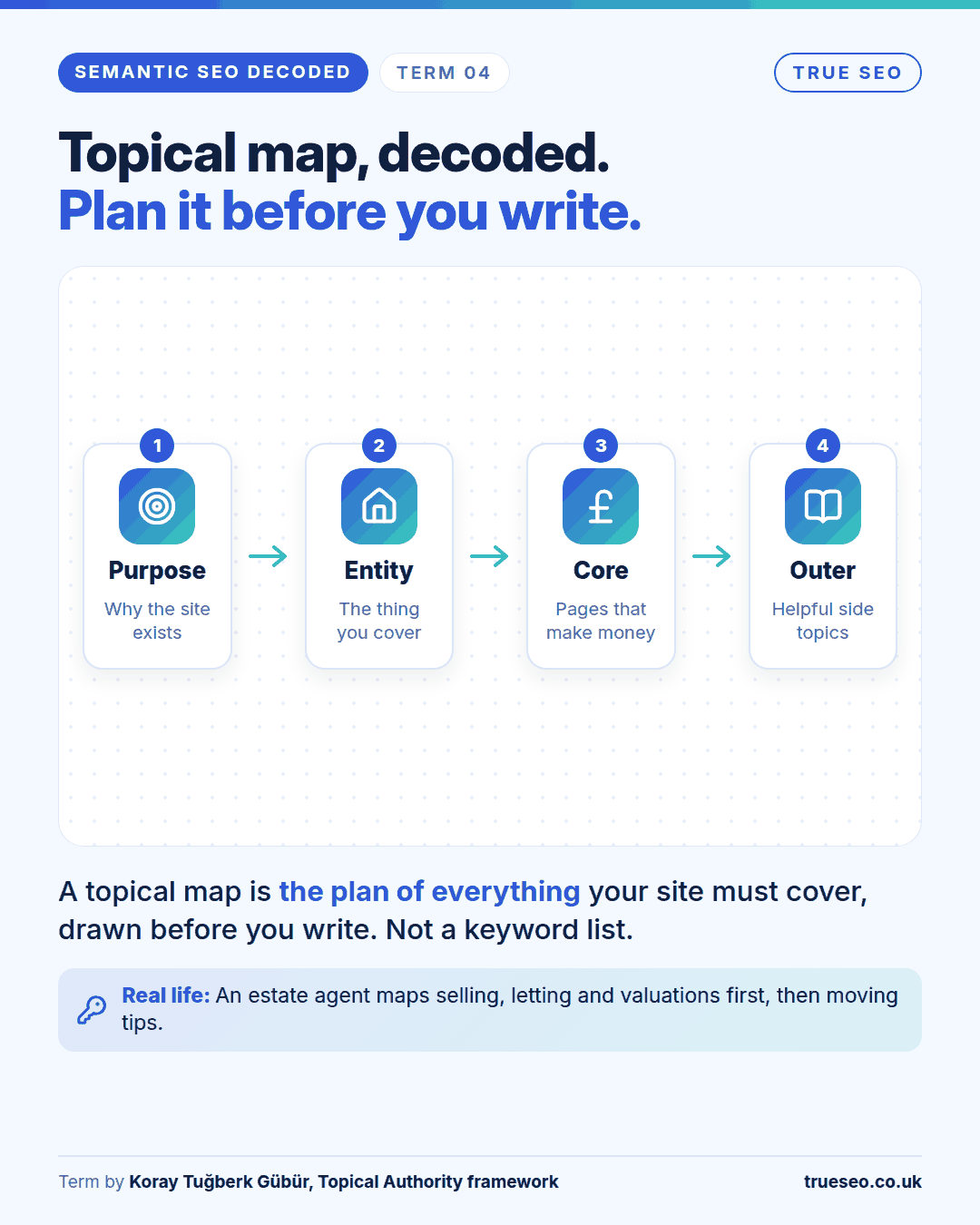
Topical map card. Tap to enlarge
Topical map
Koray framework term
A topical map is the planned structure of every topic, thing and connection a website needs to cover, drawn up before any page is written. It starts from the business itself, its source context and central entity, not from a keyword list.
Koray Tuğberk Gübür made the phrase common in SEO. He wrote on Medium in June 2024 that “creating a topical map is not merely listing keywords or entities”. Without a map, a site grows one random post at a time, and posts end up competing for the same search.
At Example Heating: Boiler installation, repair, servicing and landlord certificates become money pages. Questions such as “why is my boiler losing pressure” and “combi vs system boiler” become guides that point to them. Every row is in the full map near the end of this guide, and our step-by-step topical map guide shows how to draw your own.
Right way
Start from what Rhys sells. Installation, repair, servicing and landlord certificates become money pages, and questions such as “combi vs system boiler” become guides that link to them.
Wrong way, and why
Adding “electric car charger installation Cardiff” to the map because a keyword tool shows search volume. Rhys does not fit chargers, so the page sits outside his topical border, supports no service page and blurs what the site is about.
Common mistake: calling an AI tool’s list of 20 subtopics a topical map. Koray rejected that shortcut on Medium in February 2024.
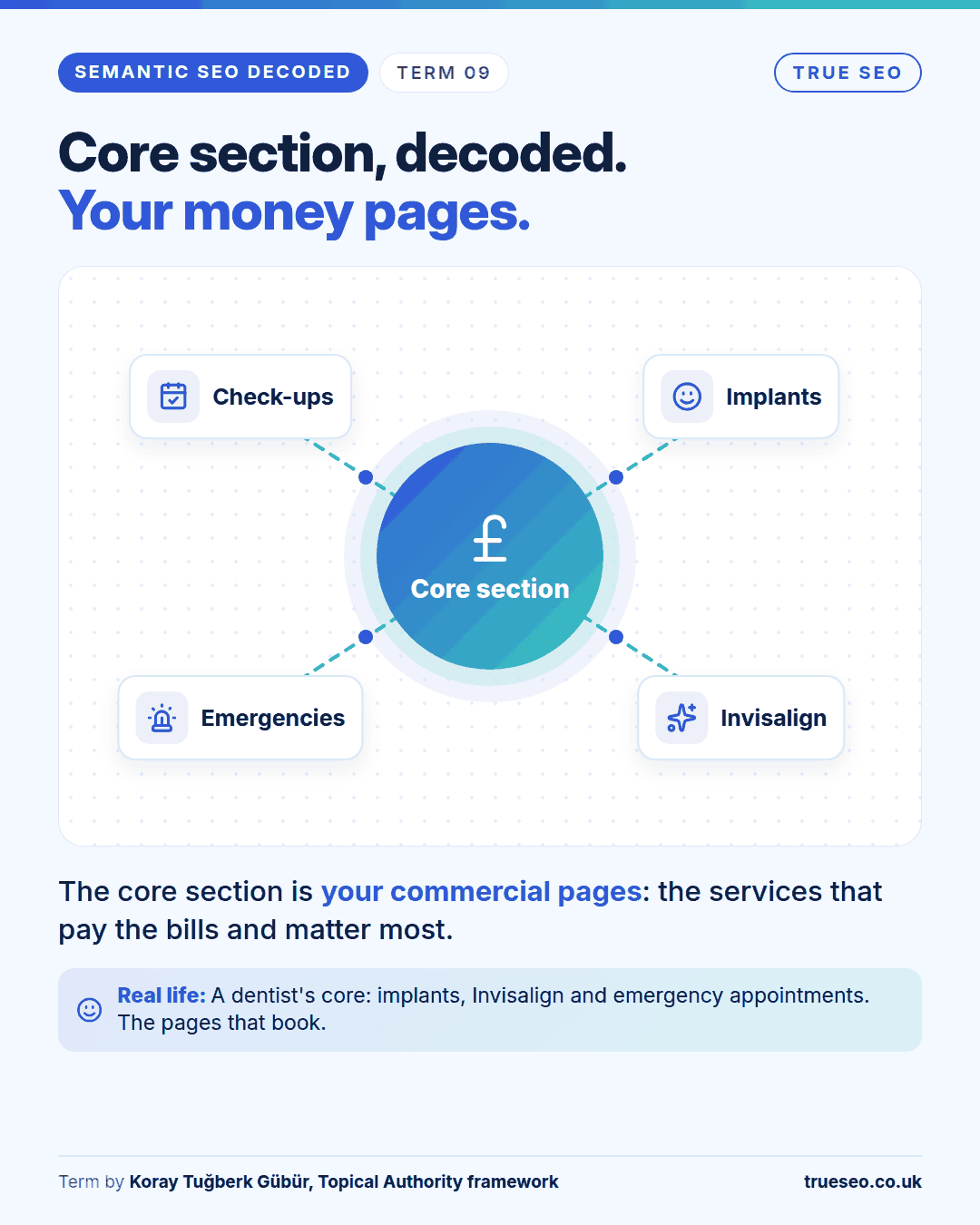
Core section card. Tap to enlarge
Core section
Koray framework term
The core section is the part of a topical map built around what the business sells. It holds the commercial pages, meaning pages for people ready to hire or buy, for the most important sides of the central entity.
These pages bring in the enquiries, so they get the strongest place in the site. Koray describes the core section’s job as gathering ranking signals onto the pages that make money. Ranking signals are the evidence Google uses to choose a page, such as links pointing to it and the way searchers respond to it. Every other page in the map exists partly to support these.
At Example Heating: The core section is /boiler-installation/, /boiler-repair/, /boiler-servicing/, /central-heating/, /landlord-gas-safety-certificate/ and /emergency-boiler-repair/. Town pages such as /boiler-installation-penarth/ belong here too, because they sell the same job in a named place. A landlord in Barry who needs a certificate should land on a core page, not on a blog post.
Right way
Put the pages that sell in the core: /boiler-installation/, /boiler-repair/, /landlord-gas-safety-certificate/ and town pages such as /boiler-installation-penarth/, each built for someone ready to book.
Wrong way, and why
Letting the blog post “how long does a boiler last” act as the main installation page while /boiler-installation/ stays a thin page with a phone number. Ranking signals then gather on a guide, and people ready to buy land where they cannot book.
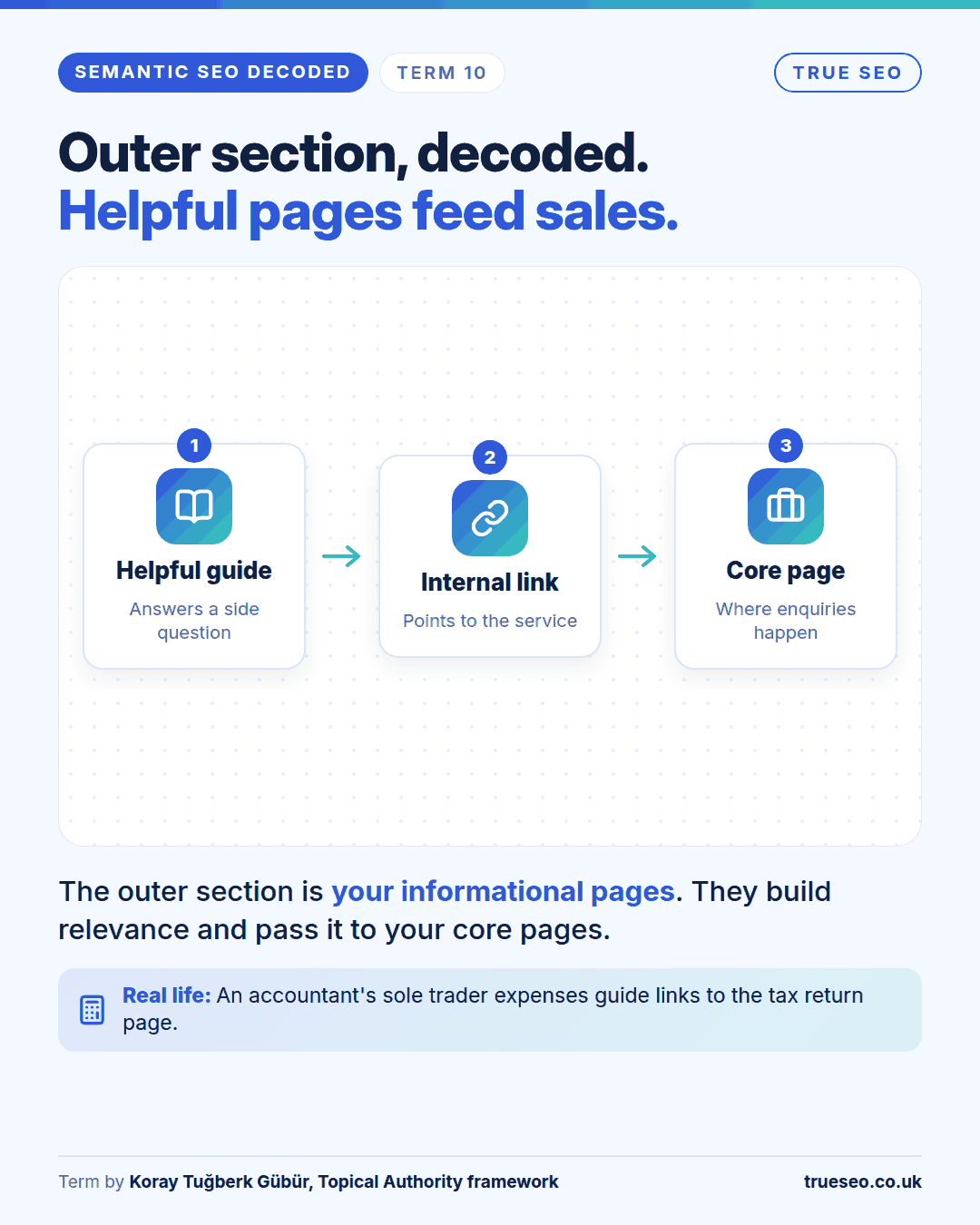
Outer section card. Tap to enlarge
Outer section
Koray framework term
The outer section is the part of a topical map that covers the smaller details and side questions about the central entity. Its pages are mostly informational, meaning they answer questions rather than sell, and each one points readers towards a core page.
Koray gives outer pages a specific job. On Medium in November 2025, he wrote that the outer section targets searches needing stronger historical data. That is the record of impressions and clicks that Google builds over time. An impression is one time a page is shown in results. That record then supports the core pages.
At Example Heating: “Radiator cold at the top” and “what does a power flush do” are outer guides. A homeowner in Caerphilly with a radiator cold at the top learns it probably needs bleeding. A link then takes them to the central heating page.
Core section
Pages that sell, such as /boiler-repair/ and /landlord-gas-safety-certificate/.
Outer section
Guides that answer questions, such as “radiator cold at the top”, each linking to a core page.
Right way
Write “radiator cold at the top” as an outer guide that explains bleeding the radiator, then link the reader in Caerphilly on to the central heating page.
Wrong way, and why
Publishing “radiator cold at the top” with no link to the central heating page. The reader may fix the radiator or learn they need an engineer, but has no route to Rhys’s service, so the guide supports no core page.
Common mistake: treating outer pages as filler. Each guide must stay inside the topical border; a post on kitchen fitting would not help Rhys.
Card note: The card says outer pages build relevance. Koray’s own description of their job is more specific.
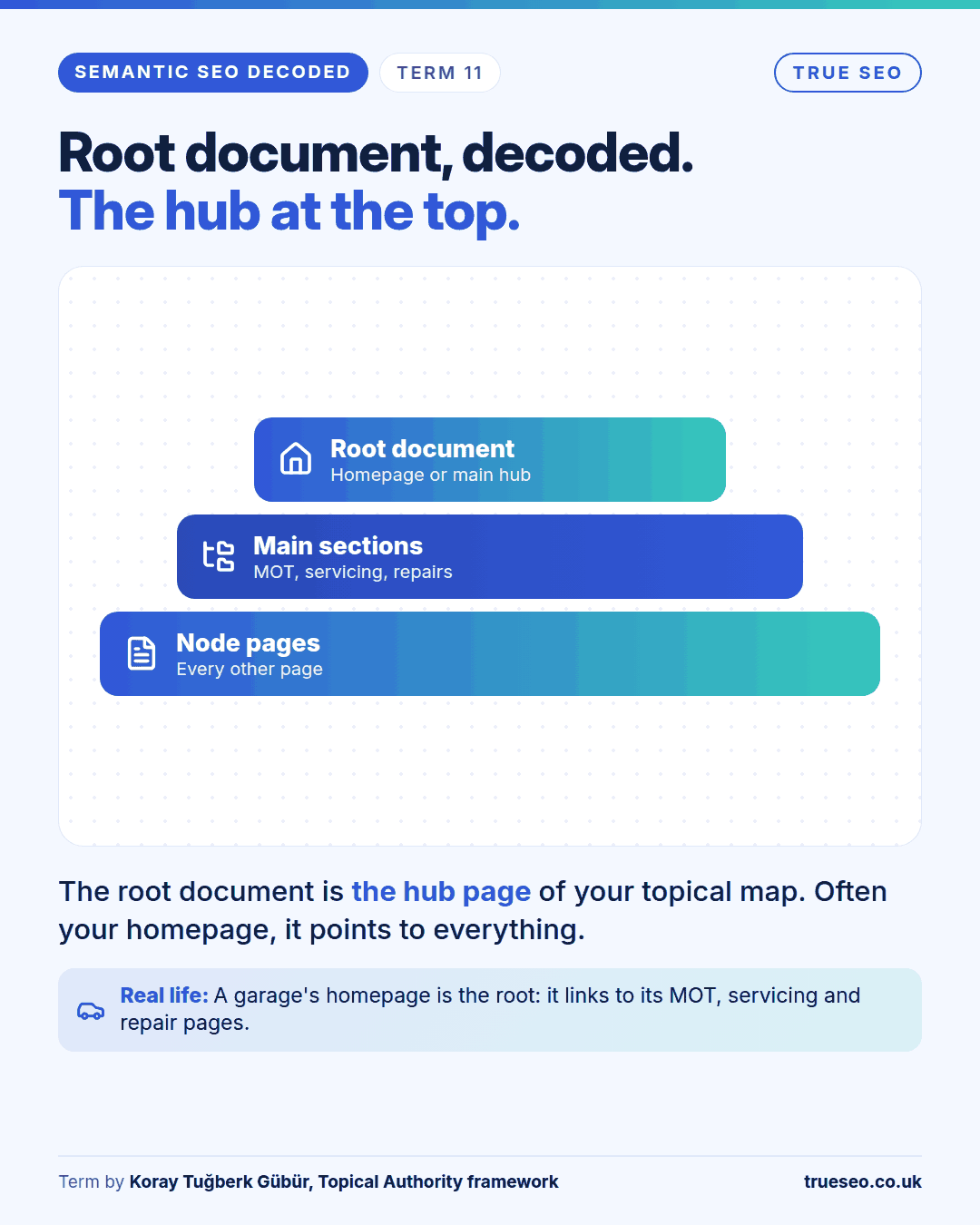
Root document card. Tap to enlarge
Root document
Koray framework term
A root document is the main hub page of a topical map. It carries the broadest heading in the map and links out to the main sections below it. It is often the homepage, though a large site can have a separate hub for each map.
We have not found a definition of this term in Koray’s own writing. It appears in glossaries written by his students, so treat this as the working meaning used in his framework. The practical point is simple. One page sits at the top and makes it obvious what the site covers and where each section lives.
At Example Heating: The homepage is the root document. Its main heading names a Gas Safe registered boiler and heating firm in Cardiff. It links to every core service page and to the best guides. A visitor, or Google, can reach any part of the site within one or two clicks from there.
- 1Root document: the homepage
- 2Node document: /boiler-repair/
- 3Node document: boiler losing pressure guide
Right way
Make the homepage the hub. Its main heading names a Gas Safe registered boiler and heating firm in Cardiff, and it links to every core service page and the best guides.
Wrong way, and why
A homepage headed “Welcome to our website” with a photo slider and the services buried three menus deep. Neither visitors nor Google can tell from the top page what the site covers or where each section lives.
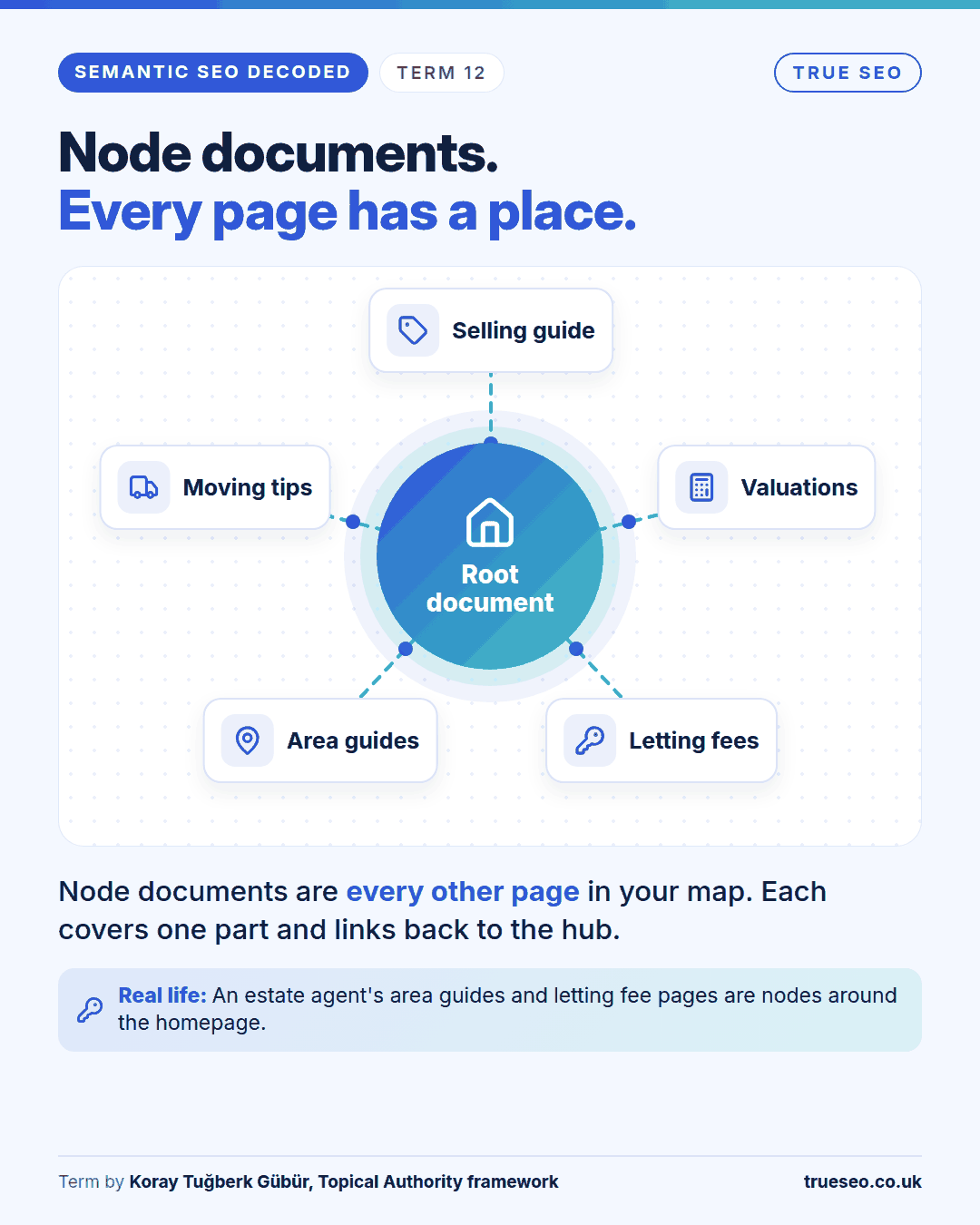
Node documents card. Tap to enlarge
Node documents
Koray framework term
Node documents are the individual pages that make up a topical map, apart from the root document. Each one covers one part of the topic. It connects to the hub and to related pages through internal links, meaning links from one page of your site to another.
“Node” comes from graph theory, the maths of networks. A node is a single point, and the lines between points are called edges. Koray used this language in an OnCrawl case study in January 2022, where he described which node connects to which edge and with what information. The phrase “node document” comes mainly from his students’ glossaries, so we keep the definition plain: every page has a place and a job.
At Example Heating: The power flushing page is a node. So is the “what does a power flush do” guide. They link to each other because they share a customer: someone whose radiators stay cold at the bottom because of sludge.
Right way
Give every page one job and link pages that share a customer. The power flushing page and the “what does a power flush do” guide link to each other.
Wrong way, and why
Publishing a post called “Our vans have a new look” with no clear topic and no links in or out. It has no place in the map and no job for a customer, so nothing ties it to the boiler pages.
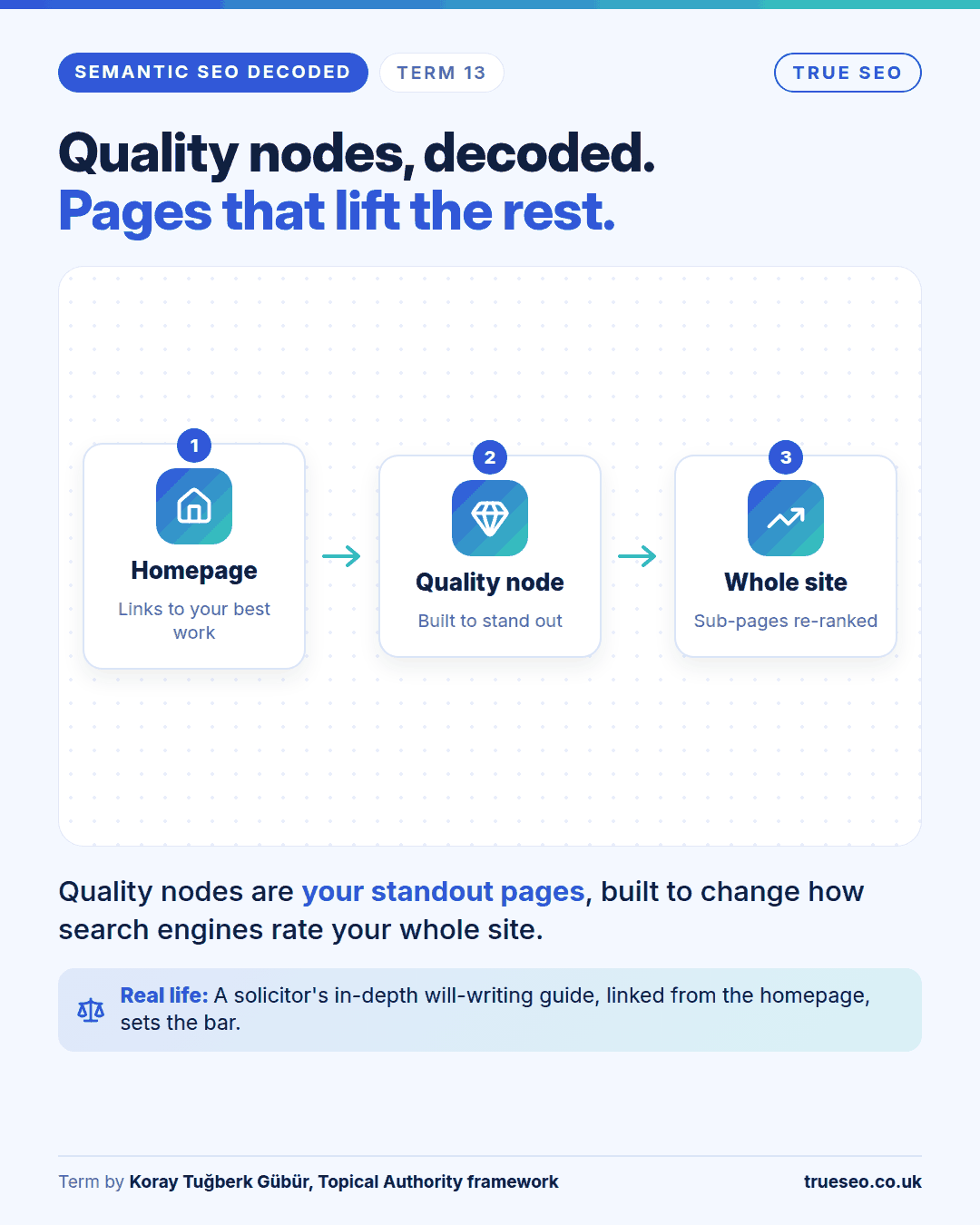
Quality nodes card. Tap to enlarge
Quality nodes
Koray framework term
Quality nodes are pages built to a clearly higher standard than the rest of a site and then given a prominent place in it. Koray says a quality node can change how a search engine judges the whole website, beyond that one page.
Search engines judge a site partly by its best work. In a Medium case study in March 2024, Koray advised linking every quality node from the homepage. A quality node is chosen on purpose. It is not simply the longest page on the site.
At Example Heating: “How much does a new boiler cost?” is a strong candidate. It answers the question every installation customer asks first. Rhys can explain what changes the price: the boiler type, the size of the home and moving the boiler to a new spot. The brand matters too, such as Worcester Bosch, Vaillant or Ideal. Linked from the homepage, it sets the standard for every other guide.
Right way
Choose “How much does a new boiler cost?” on purpose, explain what changes the price, from boiler type to brands such as Worcester Bosch, and link it from the homepage.
Wrong way, and why
Picking the longest page on the site, a long post on the history of central heating, as the flagship and linking it from the homepage. Length is not quality, and that post answers no question a paying customer asks.
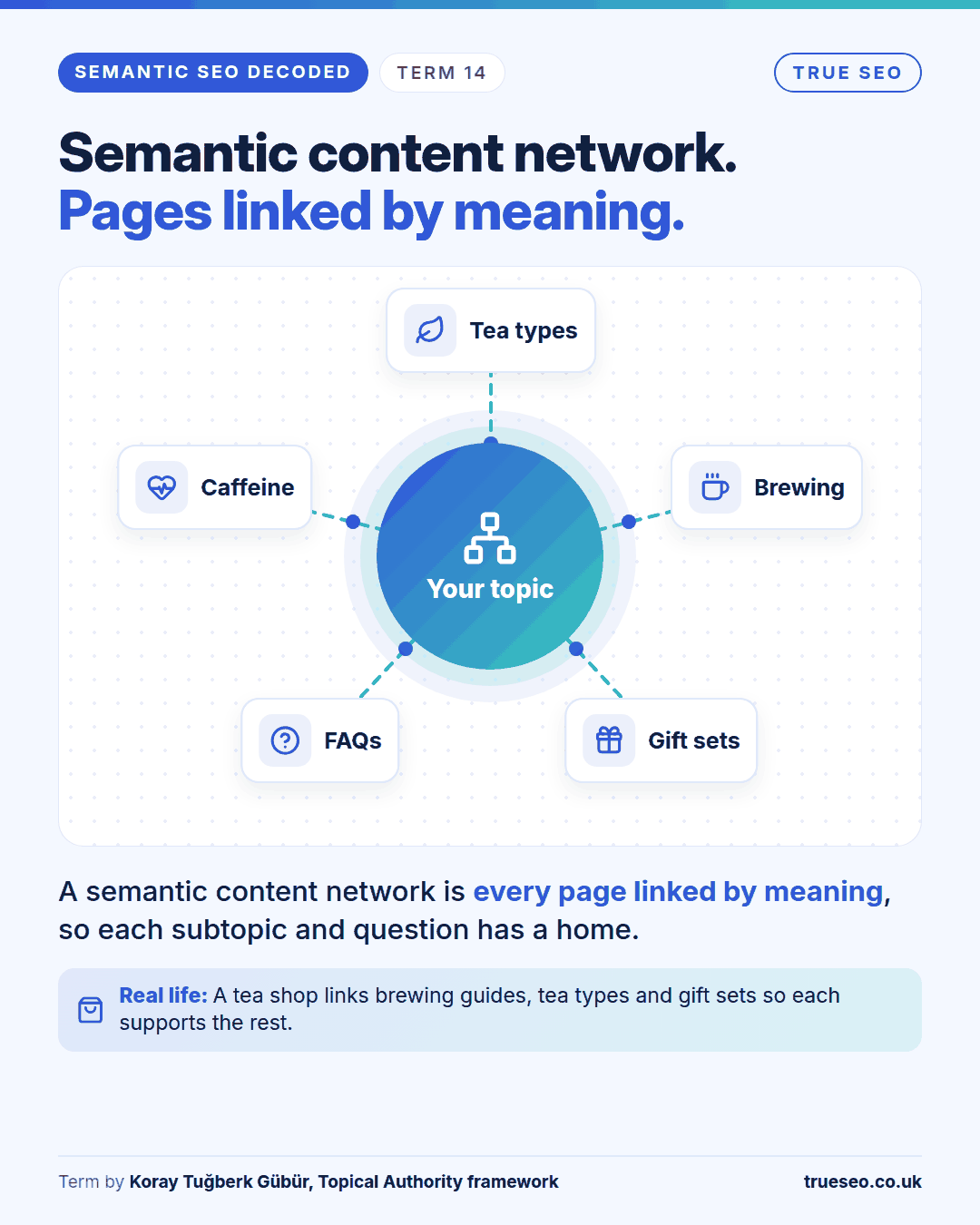
Semantic content network card. Tap to enlarge
Semantic content network
Koray framework term
A semantic content network is a set of pages linked by meaning, so every subtopic and question about the central entity has its own home. Koray calls it the written and visual form of a semantic network, meaning a diagram of things and how they relate.
The links between related pages show Google how the topic fits together. Koray also warns that weak pages can pull the whole network down, so every page has to earn its place. Planning and building this network is the main work in our topical authority and content network projects.
At Example Heating: Every outer guide links to the core page it supports. Every core page links back to the guides that answer its customers’ questions. In practice, a reader can move from a question to the service that fixes it in one click.
- 1Guide: radiator cold at the top
- 2Links to the central heating page
- 3Central heating page links back to guide
Right way
Link both ways. The “radiator cold at the top” guide links to the central heating page, and the central heating page links back to the guide.
Wrong way, and why
Keeping thin posts such as “5 reasons to love winter” in the network beside the boiler guides. Koray warns that weak pages can pull the whole network down, and these posts answer no question about boilers or heating.
Common mistake: treating it as a topic cluster with a new name. A cluster is usually built from keyword groups. A semantic content network is built from the entity and its attributes, meaning its facts and features.
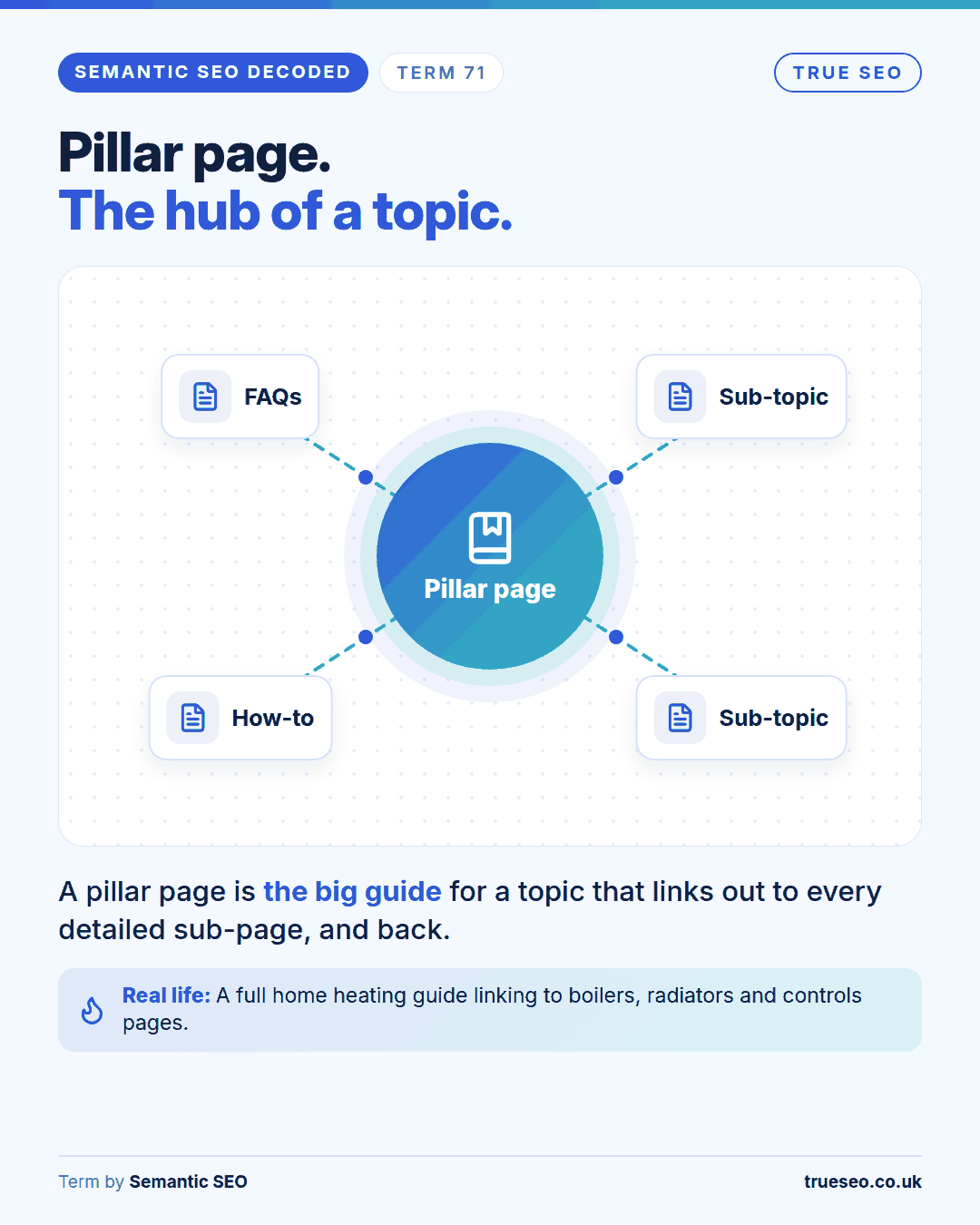
Pillar page card. Tap to enlarge
Pillar page
SEO industry term
A pillar page is one broad, in-depth page covering a whole topic, which links out to more detailed pages on each subtopic. Those detailed pages, often called cluster pages, link back to it, so the group reads as one connected resource.
The term comes from HubSpot’s topic cluster model, not from Koray. It is useful vocabulary, but it sorts pages by how broad they are. Koray’s map sorts them by purpose instead: core section pages sell, and outer section pages answer questions and feed the core. HubSpot’s own help page notes that building topic clusters in its tool does not directly affect SEO.
At Example Heating: A “complete guide to home heating” pillar would link out to boilers, radiators and controls. It might attract readers, but nobody books an engineer from it. In Koray’s map, the money sits on /boiler-installation/ and /boiler-repair/, and the guides point there.
Right way
Keep the money on /boiler-installation/ and /boiler-repair/, and let the guides point there, instead of building the site around one broad page.
Wrong way, and why
Making a “complete guide to home heating” pillar the site’s main target, with the service pages tucked beneath it. It may attract readers, but nobody books an engineer from it, so the effort goes into a page that does not sell.
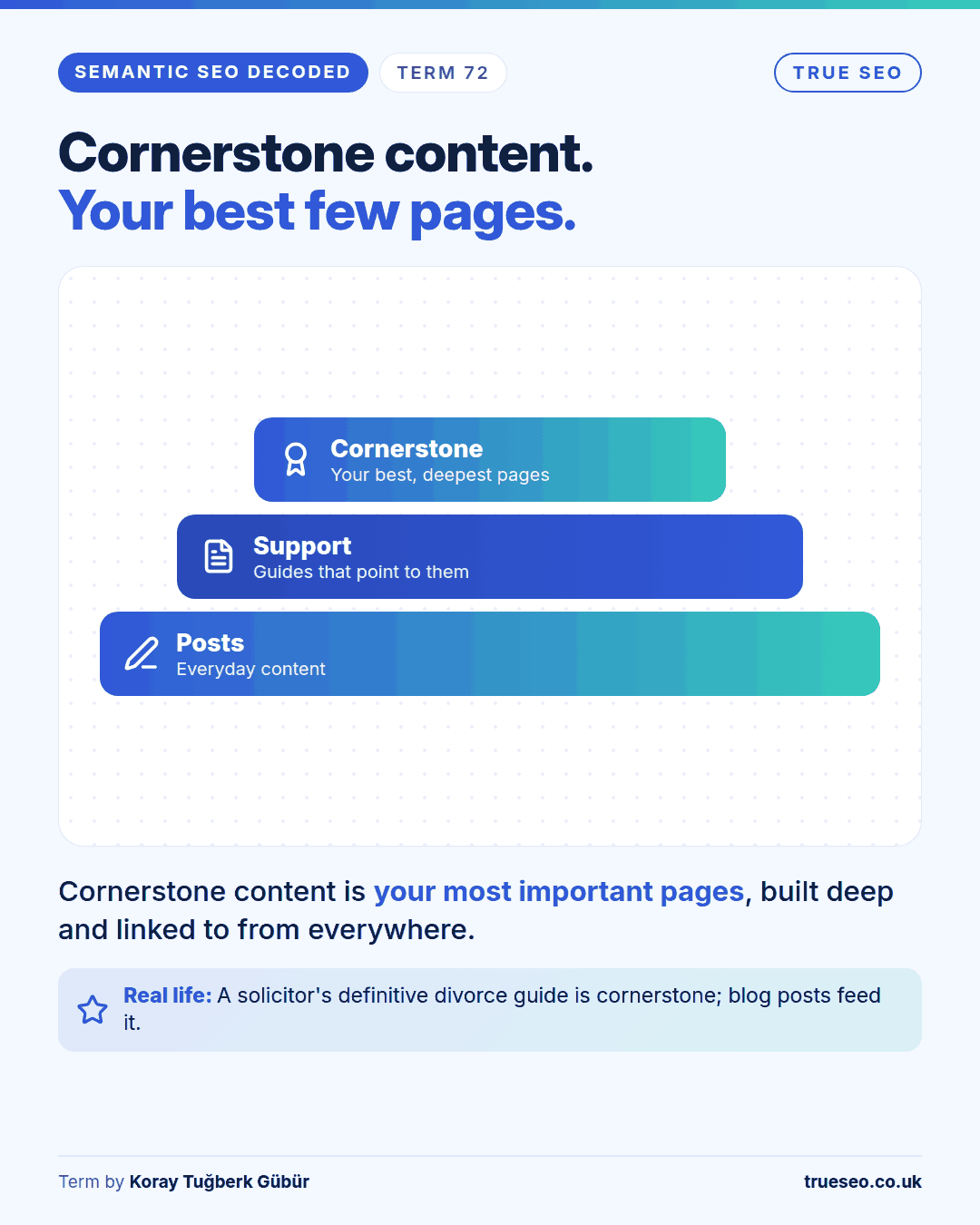
Cornerstone content card. Tap to enlarge
Cornerstone content
SEO industry term
Cornerstone content is the small set of a site’s best and most important pages, the ones it most wants to rank. They are kept long, useful and up to date, and related posts on the site link back to them.
The term comes from Yoast, the WordPress SEO plugin, which describes cornerstone content as your best and most important articles. Koray uses the word “cornerstones” in a different sense: for the core questions and answers of a topic, not for a set of flagship pages. Both ideas are useful. They simply mean different things.
At Example Heating: Rhys might mark the boiler installation page and the new boiler cost guide as cornerstone content in Yoast. The plugin then reminds him to link newer posts to them. That habit supports the same aim as Koray’s quality nodes: a few strong pages that the rest of the site points to.
Right way
Mark /boiler-installation/ and the new boiler cost guide as cornerstone content in Yoast, then link newer posts to them when the plugin reminds him.
Wrong way, and why
Ticking the cornerstone box on almost every post, including “Meet our new apprentice”. Cornerstone means the few most important pages, so marking everything leaves nothing standing out and spreads the links thin.
Card note: The card’s footer credits Koray, which is not right. The term comes from Yoast.
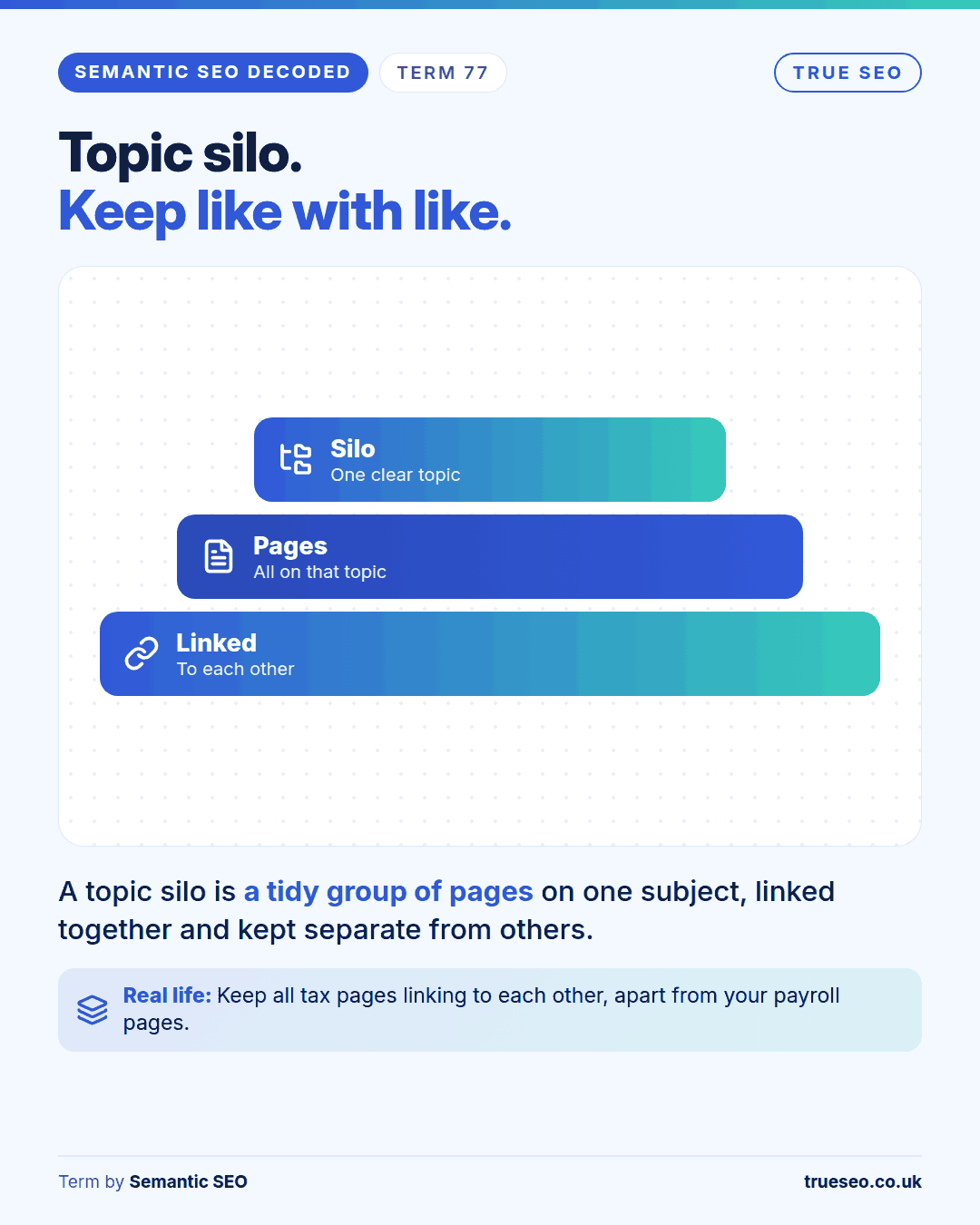
Topic silo card. Tap to enlarge
Topic silo
SEO industry term
A topic silo is a way of arranging a site so that pages on one subject sit together, through folders, internal links or both. A strict silo also limits links between unrelated groups, so each group’s theme stays clear.
Siloing is usually credited to Bruce Clay, whose agency still describes it as grouping related pages together. It differs from Koray’s approach in one important way. A silo walls groups off. A semantic content network links related pages across sections wherever the meaning connects them. The clickable words of each link, called anchor text, describe the page it points to.
At Example Heating: The “how long does a boiler last” guide sits with the installation pages. A strict silo would stop it linking to the repair page. Yet a reader whose old boiler keeps breaking down may want a repair first, and that reader needs both pages.
Right way
Group the installation pages together, but still let “how long does a boiler last” link to /boiler-repair/ for the reader whose old boiler keeps breaking down.
Wrong way, and why
Setting a strict rule that installation pages never link to repair pages. The reader with a failing old boiler then cannot reach the repair page, even though the two topics are closely connected by meaning.
A map decides which pages exist and how they connect. Part 6 moves inside a single page to look at how its context is set and kept on track.
Part 6 of 11 · about 10 minutes
Context inside a page
Context is what a page is about and the angle it takes on that subject. The terms in this part explain how one page sets its main topic, orders its headings and joins up with its neighbours. When this is done well, readers and Google can tell what the page is for. At Example Heating, context is the difference between a radiator guide that stays on cold radiators and one that starts covering other subjects.
In 30 seconds
- Each page has one main topic, its macro context, plus smaller supporting topics.
- Headings should keep one angle from the main heading to the last.
- A short bridging section explains why a link to the next page makes sense.
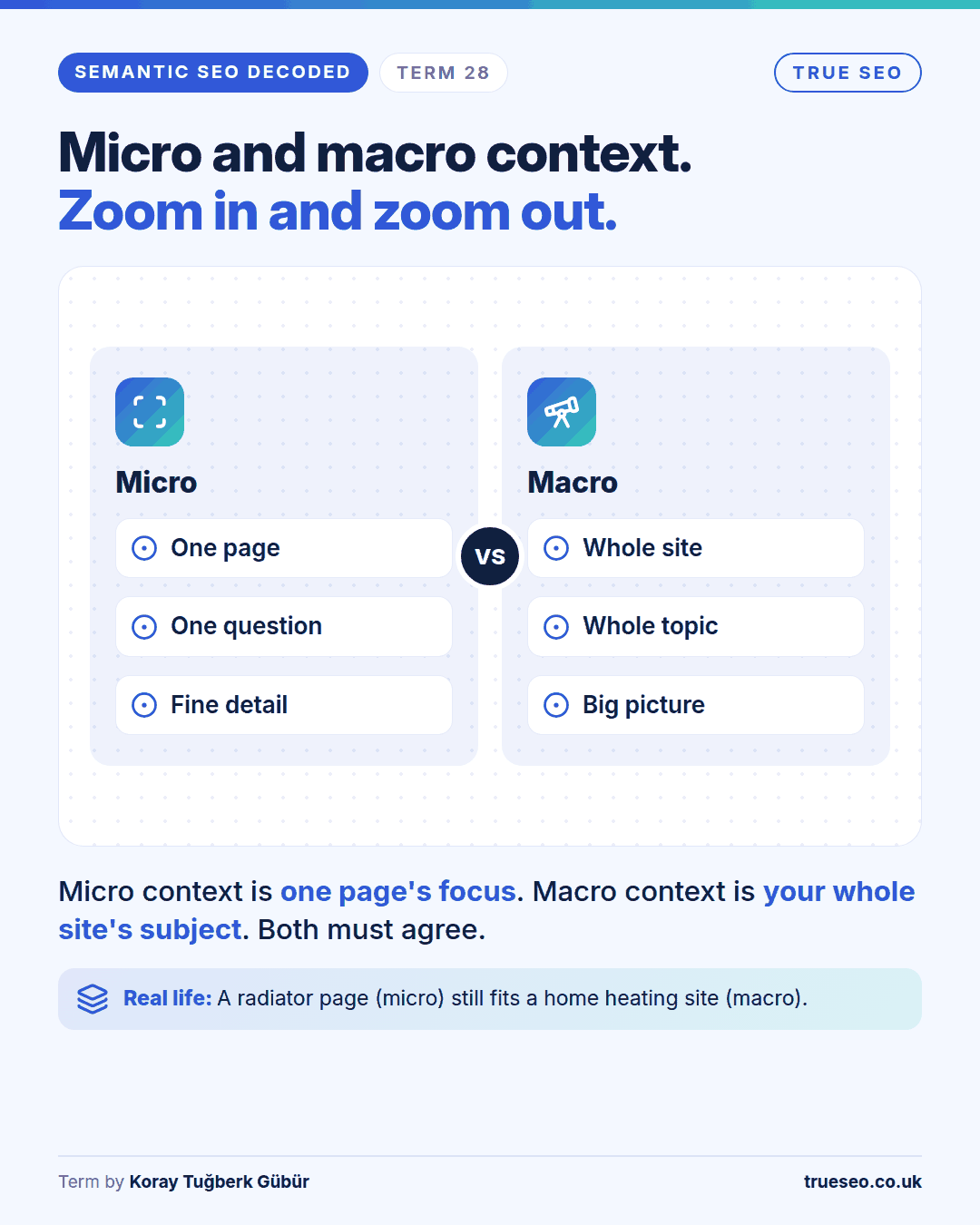
Micro and macro context card. Tap to enlarge
Micro and macro context
Koray framework term
Macro context is the single main topic of one web page, set by its title, main heading and main content. Micro contexts are the smaller supporting topics inside that same page, and each adds a detail to the main topic.
Koray states the rule plainly. “Include a single macro context for every web page,” he wrote on OnCrawl in July 2022. In Koray’s usage both live inside one page. The site-wide ideas are the source context and the central entity.
At Example Heating: The “radiator cold at the top” guide has one macro context: radiators that stay cold at the top. Its micro contexts are the sections on bleeding a radiator and on when to call an engineer. Another section explains why a cold patch at the bottom is different, because it often points to sludge.
Macro context (one per page)
Radiators that stay cold at the top: the single main topic of the guide.
Micro contexts (several)
Bleeding a radiator, a cold patch at the bottom, and when to call an engineer.
Right way
Give the “radiator cold at the top” guide one main topic, with sections on bleeding a radiator and calling an engineer that each add a detail to it.
Wrong way, and why
Making the same guide cover cold radiators and the whole process of choosing a new boiler. That is two macro contexts on one page, which usually means one deserves its own page, and readers lose track of what the guide is for.
Card note: The card has the two the wrong way round: it calls micro context one page’s focus and macro context the whole site’s subject.
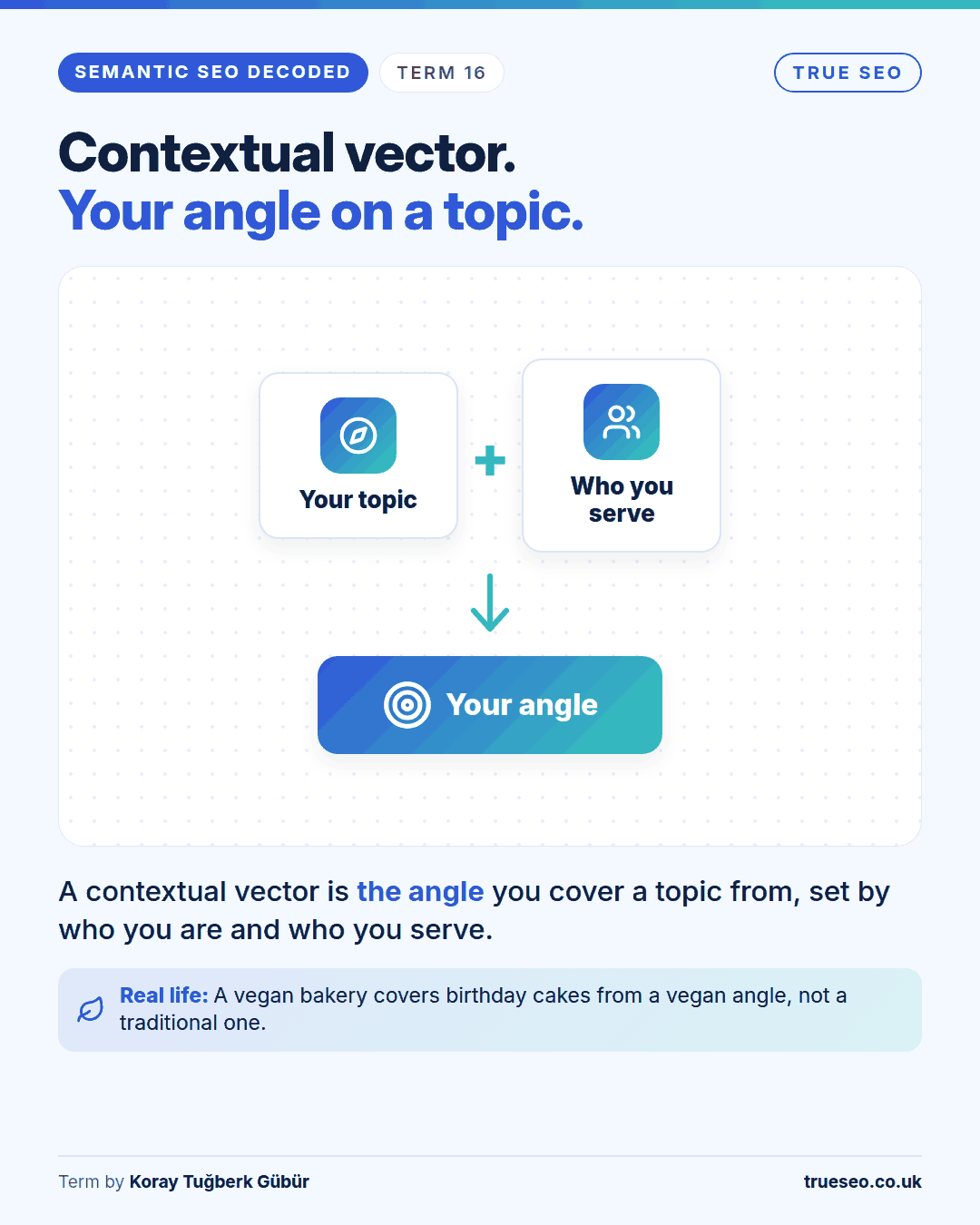
Contextual vector card. Tap to enlarge
Contextual vector
Koray framework term
A contextual vector is the direction a page takes through its topic, shown by the order of its headings from the first to the last. A good one keeps every section moving towards the same purpose, so the page holds one angle from start to finish.
“Vector” here means direction. In 2022 Koray turned the idea into a working rule on OnCrawl: “Create a proper context vector from H1 to the last heading of the document.” The H1 is the page’s main heading. The vector is about heading flow on one page.
At Example Heating: The boiler servicing page has four headings, in the order shown below. Each heading moves the reader closer to booking. A heading on the history of the combi boiler would move the page away from that purpose.
- 1What a service includes
- 2How often to book
- 3What the engineer checks
- 4How to book
Right way
Order the servicing page’s headings so each one moves towards booking: what a service includes, how often to book, what the engineer checks, then how to book.
Wrong way, and why
Ending the servicing page with the H2 “Our team’s charity bike ride”. The last heading pulls the page away from booking, so the direction set from the H1 breaks just before the reader acts.
Card note: The card says the angle is set by who you are and who you serve. That part describes source context, not the vector.
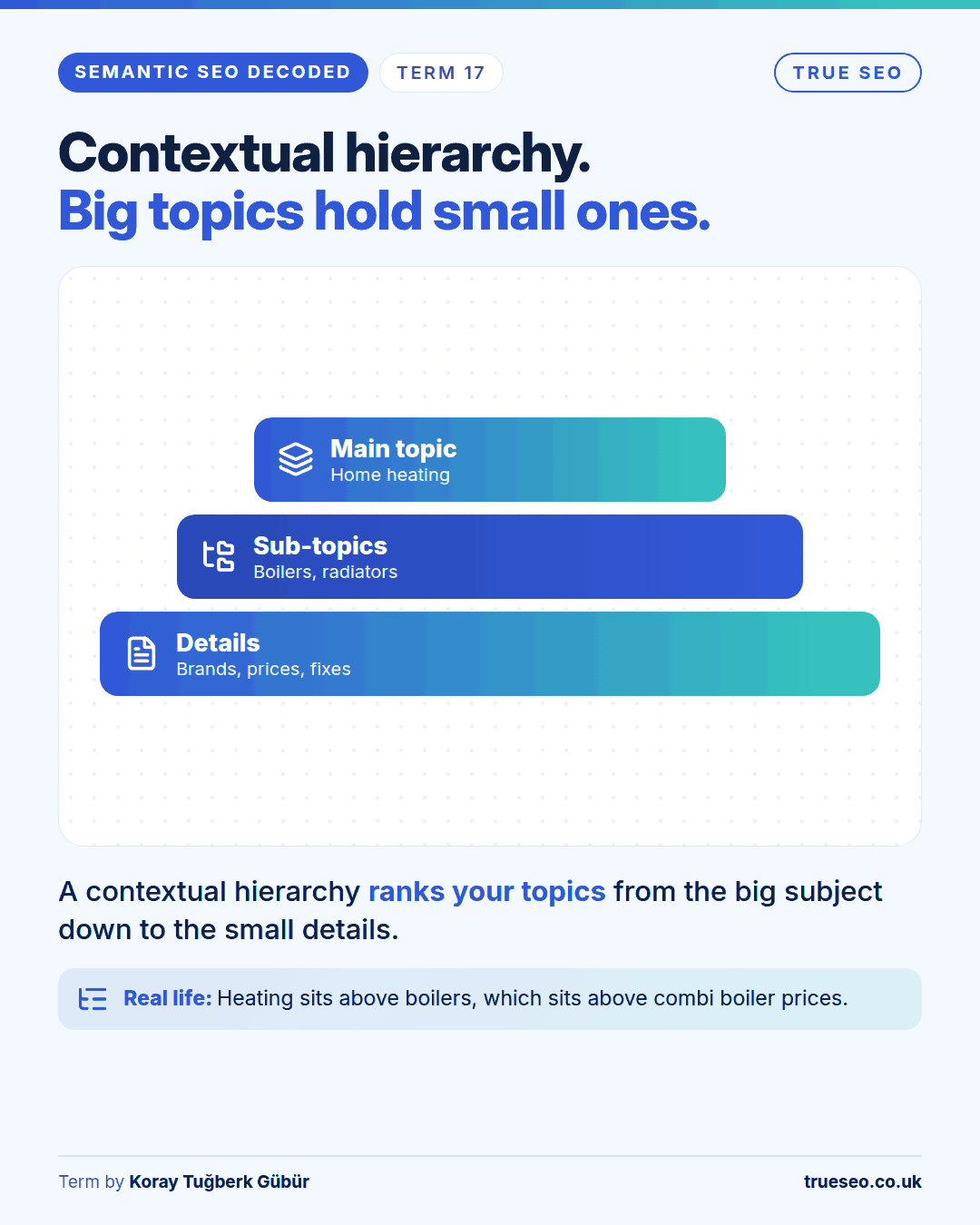
Contextual hierarchy card. Tap to enlarge
Contextual hierarchy
Koray framework term
Contextual hierarchy is the order of topics on a site or a page, from the main subject down to the small details. It decides which topic sits above which, and how much space each one gets. Koray also calls it conceptual hierarchy.
Readers and Google both use that order to work out what matters most. It shows up in three places: the heading levels on a page, the folder structure of web addresses, and how much coverage each topic receives. When the order is clear, a small detail is never mistaken for the main subject.
At Example Heating: Home heating sits at the top. Boilers sit below it, then boiler repair, then single faults such as low pressure. On the repair page, “Common boiler faults” is a main section and “Boiler losing pressure” is a subsection under it, never the other way round.
Right way
On /boiler-repair/, make “Common boiler faults” an H2 and “Boiler losing pressure” an H3 beneath it, so the detail sits under the main subject.
Wrong way, and why
Making “Boiler losing pressure” the H1 of /boiler-repair/ and squeezing “Boiler repair” into a small subsection. One fault then reads as the page’s main subject, and the wider repair service seems minor.
Contextual relevance card. Tap to enlarge
Contextual relevance
Information retrieval term
Contextual relevance is how well a page meets the real need behind a search, in the situation the searcher is in. It is judged by meaning, the things a page mentions and the words around them, rather than by exact word matches alone.
Relevance has been a central idea in information retrieval, the science of finding the right documents, for decades. Koray uses the phrase often, but he did not coin it. A page can contain every keyword and still miss what the person wanted.
At Example Heating: Someone searching “boiler repair Cardiff price” wants to know what a repair is likely to involve and how to book one locally. A page about the history of boiler design might use the same words and help nobody. The repair page is relevant because it answers the price question and shows how to book.
Right way
Answer what a “boiler repair Cardiff price” searcher needs: what a repair is likely to involve, what affects the price and how to book locally.
Wrong way, and why
A page titled “Boiler repair Cardiff prices” that repeats those words and then tells the company’s founding story. It holds every keyword yet says nothing about a repair or a price, so it fails the need behind the search.
Card note: The card’s footer credits the term to Koray, which goes too far.
Contextual weight card. Tap to enlarge
Contextual weight
SEO industry term
Contextual weight is how much importance a site gives one topic compared with its other topics. It shows in how deeply the topic is covered, how prominently it appears and how many internal links point to it.
We could not find “contextual weight” defined in Koray’s own writing. SEOs use the phrase informally. The idea fits inside contextual hierarchy, which Koray does define: the hierarchy sets the order, and the weight is how much coverage each level receives. Weight should follow what the business earns from.
At Example Heating: New boiler installs are Rhys’s big-ticket jobs, so installation gets the most depth. It has a core page, town pages, a cost guide and a combi vs system guide. Smart thermostat fitting matters, but it gets one section, not five pages. A site that gave thermostats more weight than boilers would blur what Example Heating actually does.
Right way
Give installation the most depth, with a core page, town pages, a cost guide and a combi vs system guide, while smart thermostat fitting gets one section.
Wrong way, and why
Writing eight posts about power flushing and one short page on boiler installation. The site then signals that power flushing matters most, although new boiler installs are Rhys’s big-ticket jobs, so what Example Heating does becomes blurred.
Card note: The card’s footer credits the term to Koray, which his own writing does not support.
Contextual bridge card. Tap to enlarge
Contextual bridge
Koray framework term
A contextual bridge is the connecting content between two different topics on a site. It is usually a sentence or a short section that joins one subject to the next. It lets the reader and Google follow the move.
A link is one form of bridge, but the bridge is the content that makes the link make sense. Koray wrote in January 2023 about adjusting the bridges between commercial and informational pages with the right anchor text. Commercial pages sell, informational pages answer questions, and anchor text is the clickable words in a link. A link with no bridging sentence around it gives the reader no reason to click.
At Example Heating: The “why is my boiler losing pressure” guide ends with a short section on when a pressure drop needs an engineer. Signs include a visible leak, a faulty valve, or pressure that falls again soon after topping up. That section is the bridge. Inside it sits a link to the repair page with the words “boiler repair in Cardiff”.
- 1Guide: why is my boiler losing pressure
- 2Bridge: when to call an engineer
- 3Link: “boiler repair in Cardiff”
- 4Rhys’s boiler repair page
Right way
End the “why is my boiler losing pressure” guide with a short section on when a pressure drop needs an engineer, and place the link “boiler repair in Cardiff” inside it.
Wrong way, and why
Dropping a bare line, “Need help? Our services”, at the foot of the pressure guide with no sentence explaining the move. The reader gets no reason to follow it, and the link text says nothing about the repair page.
Card note: The card calls it a link. That describes only one form of bridge.
Main and supplementary content card. Tap to enlarge
Main and supplementary content
Google term
Main content is the part of a page that directly helps it do its job. Supplementary content improves the visit without directly serving that job. Both terms come from Google’s Search Quality Rater Guidelines, the handbook Google gives the people who assess its search results.
The guidelines treat adverts as a separate third category, not as supplementary content. Koray refers to this split and organises his own pages into macro and micro context, but he did not create these terms. For a business owner the lesson is simple: lead with the main content and keep the extras from crowding it.
At Example Heating: On /boiler-repair/, the explanation of the repair service, the faults covered and how to book is the main content. The box of related guides is supplementary. Any paid advert on the page would be a third thing, and it should never push the repair details down.
Right way
Lead /boiler-repair/ with the repair service, the faults covered and how to book, and keep the box of related guides below that.
Wrong way, and why
Opening /boiler-repair/ with a large banner advert for a boiler cover plan and a carousel of related guides, pushing the repair details down the screen. The extras crowd out the job the page exists to do.
Card note: The card’s graphic lists adverts among the extras, which the guidelines do not do.
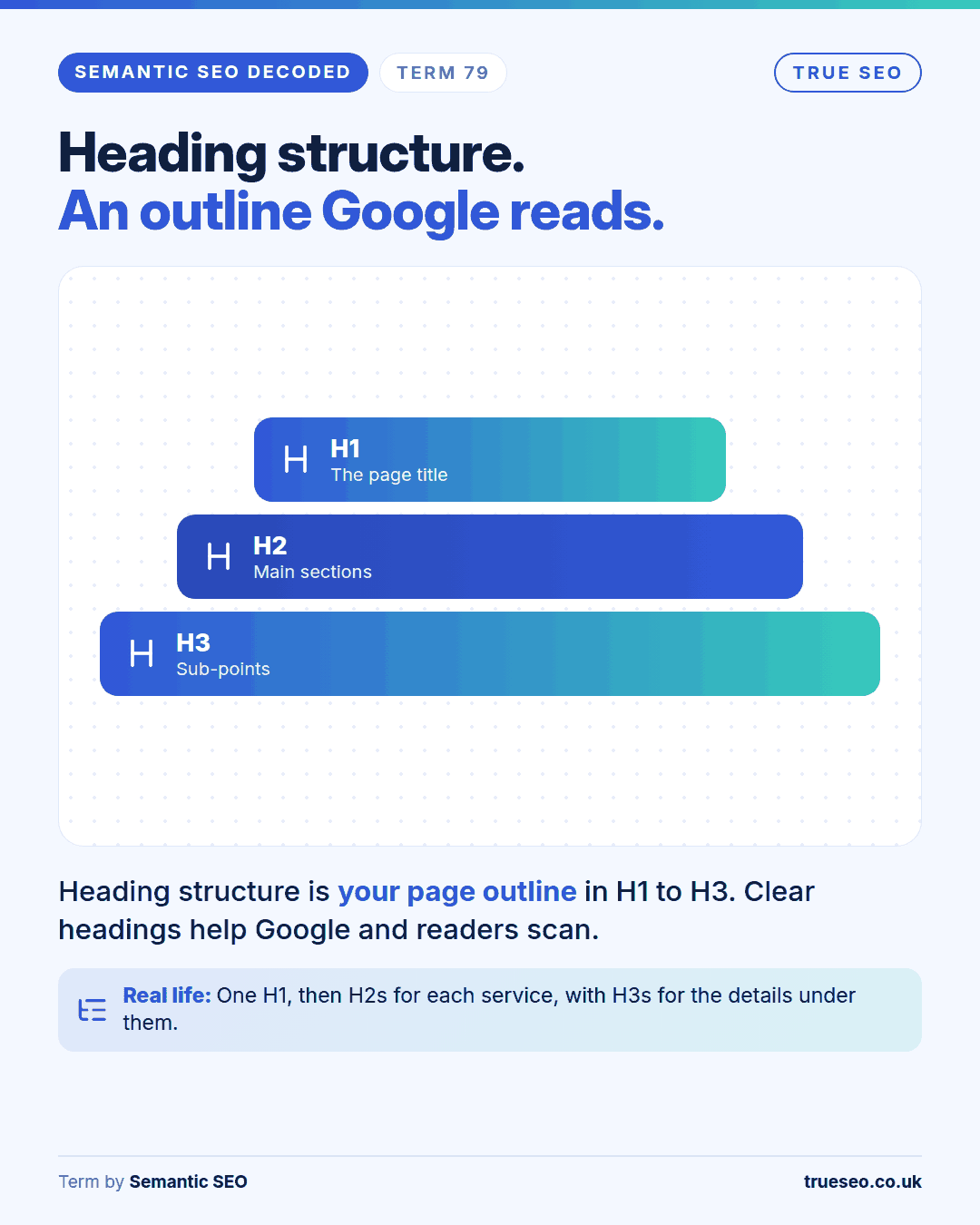
Heading structure card. Tap to enlarge
Heading structure
SEO industry term
Heading structure is the order of headings on a page: one main heading, the H1, then H2 sections and H3 subsections inside them. It outlines the page so readers, screen readers and search engines can see how the parts relate.
Google’s SEO Starter Guide says headings in a sensible order help screen readers, the software that reads pages aloud. It also says using them out of order does not matter for Search, and there is no ideal number of them. So the gain is clarity and access, not a direct ranking reward. The same applies to semantic HTML, meaning tags such as article and section that label the parts of a page. We found no Google source saying they change rankings. Koray’s method weighs headings more heavily, because the heading flow carries the contextual vector. It is a routine check in on-page SEO for service pages.
At Example Heating: The “how often should a boiler be serviced” guide has one H1 asking that question. Its H2s cover the yearly rule of thumb, landlord duties and warranty conditions. A landlord reading on a phone can jump straight to the landlord section.
Right way
Use one H1 asking how often a boiler should be serviced, then H2s for the yearly rule, landlord duties and warranty conditions, so a landlord can jump to their section.
Wrong way, and why
Styling ordinary paragraphs in large bold text so they look like headings, with no real H2 or H3 tags. Screen readers then cannot list the sections, and a landlord on a phone has no outline to jump through.
With the context of each page settled, Part 7 turns to what goes inside each section. It shows how to write pages that readers and Google choose over the rest.
Part 7 of 11 · about 12 minutes
Writing pages that get chosen
Writing pages that get chosen means planning each page and putting the answer first, in the right format. It also means filling the page with facts that are true, new and complete. Part 6 showed how a page holds its context. These ten terms cover the writing itself. They run from the brief Rhys starts with to the featured snippet, the boxed answer Google sometimes lifts from a finished page. None of them guarantees a ranking, but together they make a page easier for Google to understand and choose.
In 30 seconds
- Plan each page with a brief: what the searcher wants, which questions, which facts.
- Put the answer straight after the question, in the format that suits it.
- Add facts that are true, new and complete; Google decides which passage to show.
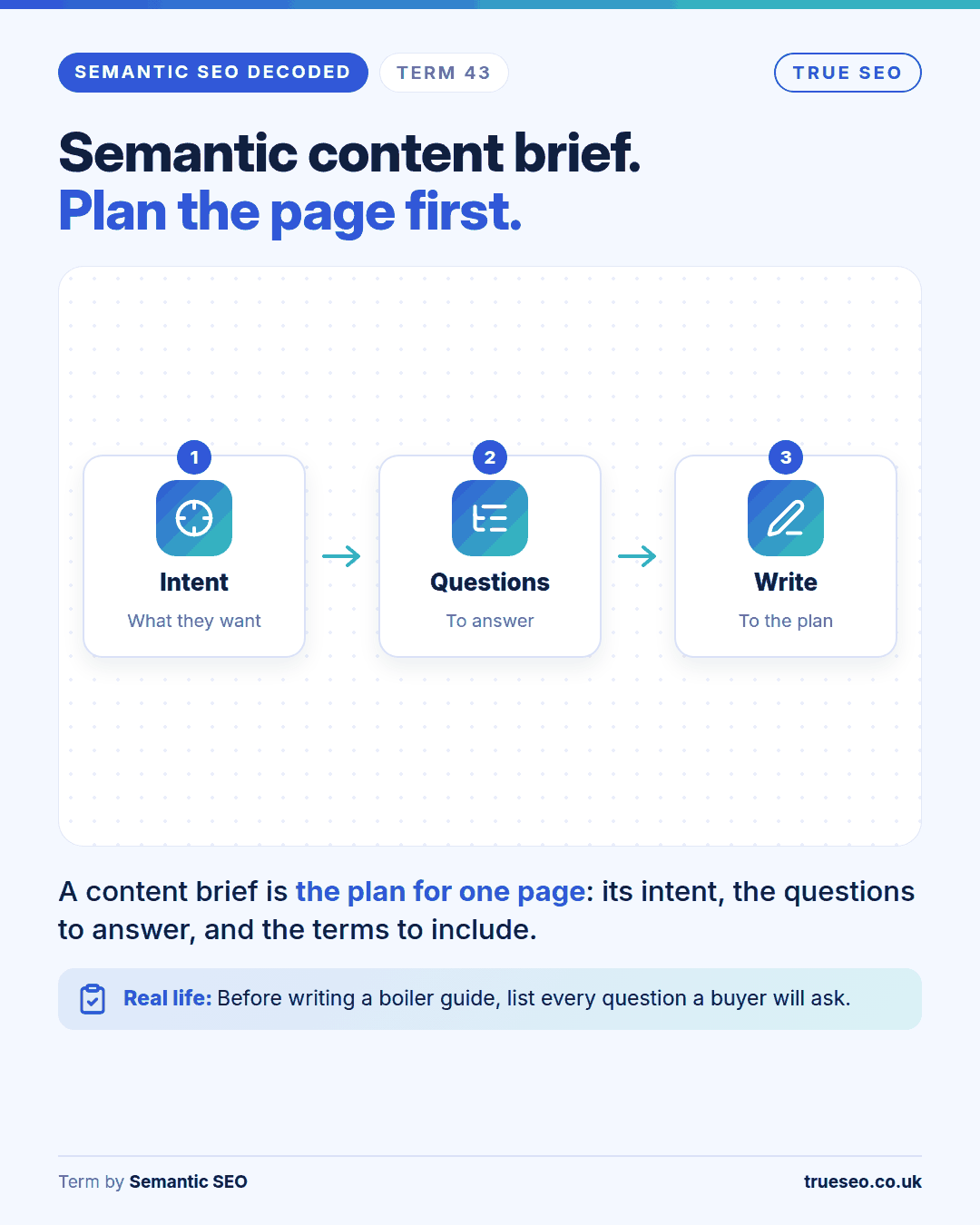
Semantic content brief card. Tap to enlarge
Semantic content brief
SEO industry term
A semantic content brief is the written plan for one page, made before anyone writes it. It sets the page’s search intent, the questions it must answer and in which order, and the things and facts it must cover.
Koray’s framework relies on briefs, but we did not find him coining this exact phrase. A brief costs less than a rewrite. It makes sure the page fits its place in the topical map.
At Example Heating: The brief for “Why is my boiler losing pressure?” sets the intent as fixing a fault. It lists the questions in order. What pressure is normal? Why does it drop? What can a homeowner safely check, and when should they call an engineer? It names the parts to cover, such as the filling loop, and ends with the link to the repair page. Teams can learn to write briefs like this through one-to-one SEO mentoring.
Right way
Before writing “Why is my boiler losing pressure?”, Rhys’s brief fixes the intent (fix a fault), lists the questions in order, names the filling loop and ends with a link to /boiler-repair/.
Wrong way, and why
A brief that only says “1,500 words, keyword: boiler pressure, use it 12 times”. It names no intent, no questions and no facts, so the writer guesses and the page drifts from its place in the topical map.
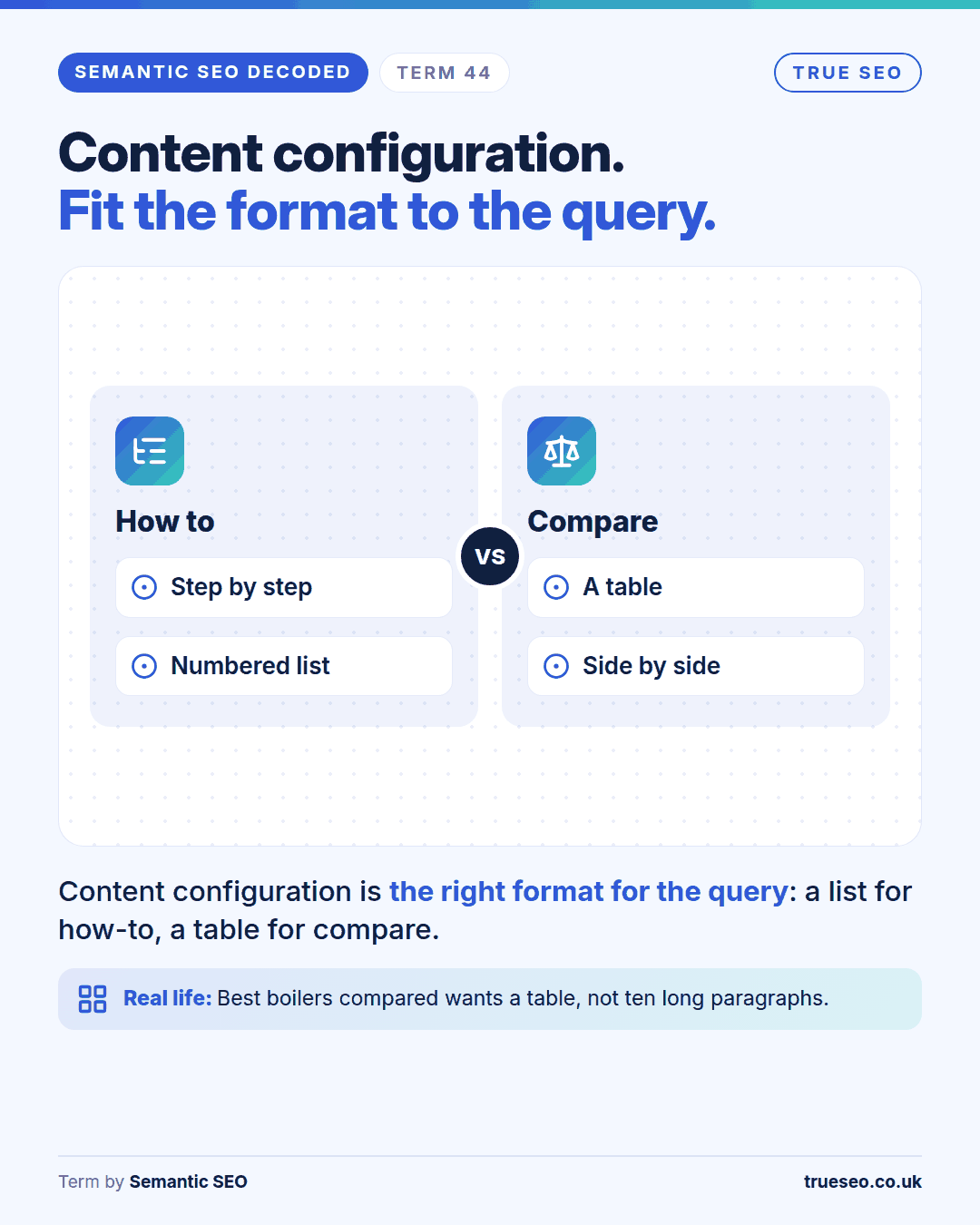
Content configuration card. Tap to enlarge
Content configuration
SEO industry term
Content configuration is choosing the right format for each answer on a page. A numbered list suits steps, a table suits comparisons, and a short definition suits a “what is” question. The format follows the type of question asked.
Koray writes about “using semantic Content Formats for every semantic question type” in his topical authority article on Holistic SEO & Digital. We did not find the phrase “content configuration” in his articles, so we tag it as industry vocabulary. Google does not require a list or a table for any kind of search.
The right format saves your reader effort.
At Example Heating: “Combi vs system boiler” gets a table. It compares the space each boiler needs, how each supplies hot water and the size of home each suits. “How to bleed a radiator”, inside the cold radiator guide, gets numbered steps. “What does a power flush do?” opens with a two-sentence definition.
Right way
“Combi vs system boiler” gets a table comparing space, hot water supply and home size. “How to bleed a radiator” gets numbered steps. “What does a power flush do?” opens with a two-sentence definition.
Wrong way, and why
Writing the combi vs system comparison as six long paragraphs, or turning “what does a power flush do” into a ten-bullet list. The format does not match the question, so the reader has to build the comparison or the definition alone.
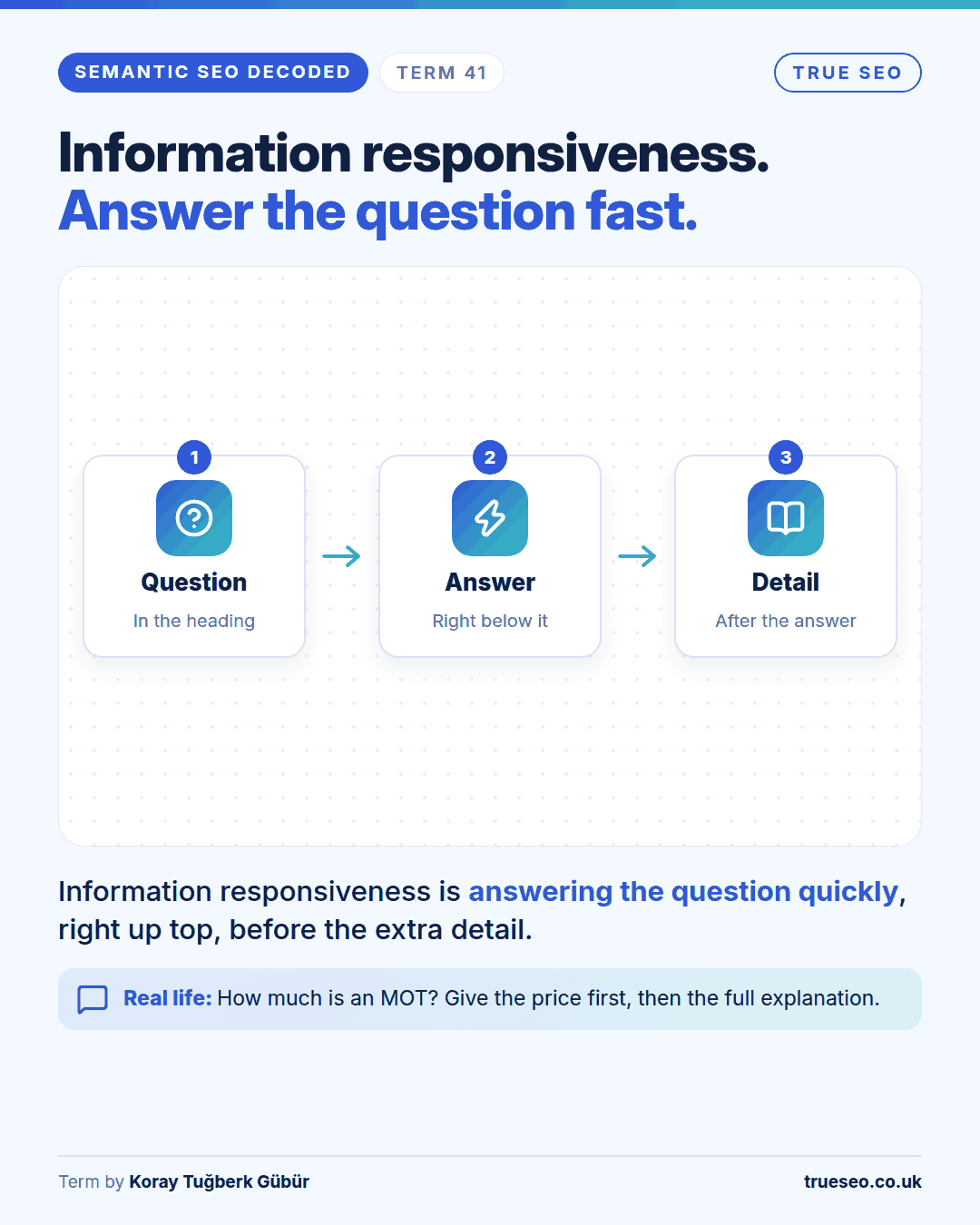
Information responsiveness card. Tap to enlarge
Information responsiveness
Koray framework term
Information responsiveness is how directly a page responds to the need behind a search. In practice, writers apply it by giving the answer straight after the question and adding the supporting detail only after that.
Koray Tuğberk Gübür named the term in his January 2023 topical map case study on Holistic SEO & Digital. He said he would explain it later, and we have not found his full published definition.
A reader with a problem decides quickly whether a page will help. Make them scroll past company history and many will leave.
At Example Heating: The losing pressure guide opens with the answer. The usual causes are a leak somewhere in the system, a faulty pressure relief valve or a problem with the expansion vessel. Then come the safe checks, the photos, and the point where a homeowner should book a repair. A slower version would open with the firm’s history and make the reader scroll down for the causes.
- 1Reader asks: why is pressure dropping?
- 2Answer first: the three usual causes
- 3Then the safe checks and photos
- 4Then when to book a repair
Right way
The losing pressure guide names the usual causes in its first lines: a leak, a faulty pressure relief valve or an expansion vessel problem. The safe checks and when to book come after.
Wrong way, and why
Opening the losing pressure guide with three paragraphs about the firm’s story and how boilers work. The reader came for the causes, has to scroll past all of it to find them, and may leave first.
Card note: The card’s reading, answer the question fast, is how practitioners apply it, not Koray’s verified wording.
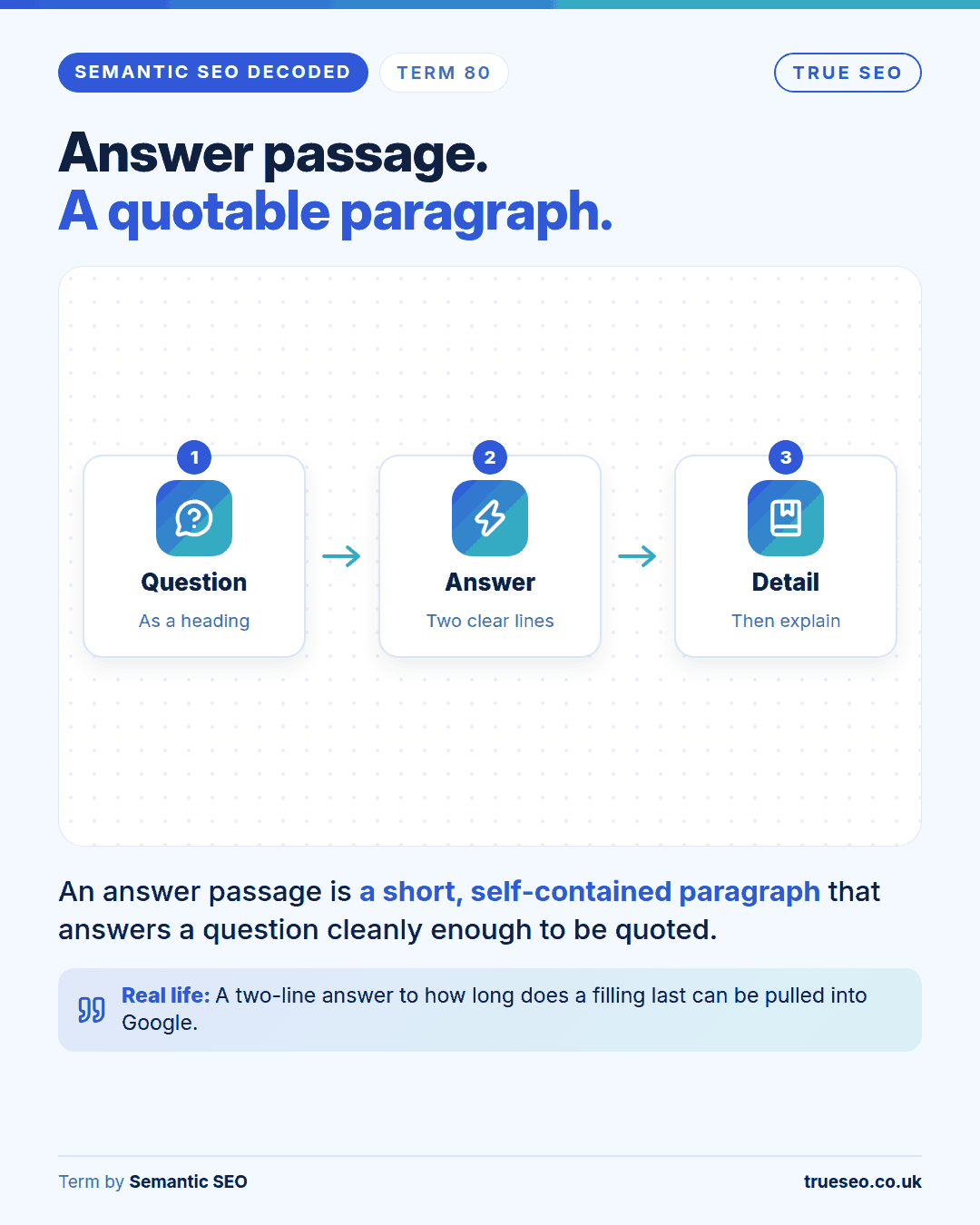
Answer passage card. Tap to enlarge
Answer passage
Google term
An answer passage is a short section of a page that directly answers a question. Google’s patent “Scoring candidate answer passages”, published in 2018, describes picking and scoring such passages to show as the answer to a question search.
A patent shows that Google worked out a method, not that Google uses it today in that form. Koray draws on this patent in his topical authority writing.
Write each answer passage so it makes sense on its own, without the paragraphs around it. No page is promised a quote.
At Example Heating: Under the heading “How often should a boiler be serviced?”, Rhys writes a short answer. “Once a year. The Health and Safety Executive (HSE) says gas appliances should be serviced at least once a year. Landlords must arrange a gas safety check every 12 months.” The detail on what a service includes follows below. We explain the same approach in writing service pages for answer engines.
Right way
Under “How often should a boiler be serviced?”, the first words are “Once a year”, backed by the HSE guidance. The passage still makes sense when read on its own.
Wrong way, and why
Answering that heading with “As we mentioned above, it depends on the factors covered earlier.” The passage leans on the paragraphs around it, so read alone it answers nothing and gives Google no clean answer to lift.
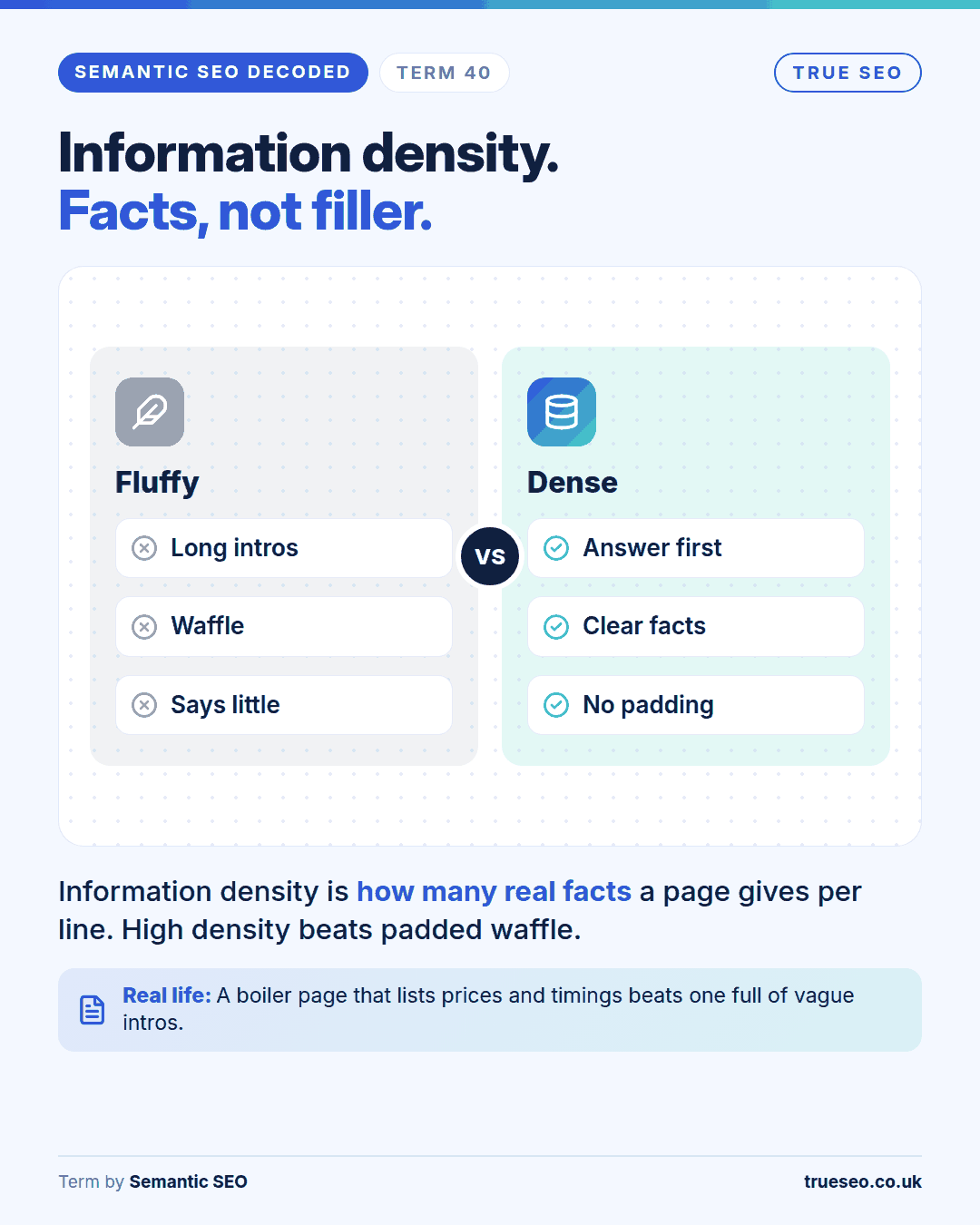
Information density card. Tap to enlarge
Information density
SEO industry term
Information density is how much real, useful information a page carries for its length. A page that states clear facts in few words is dense. A page padded with filler to reach a word count is thin.
It is not a Google metric, and it is not keyword density. Google’s guidance on helpful content says Google has no preferred word count. Length should come from what the reader needs.
So what? Padding costs your reader time and costs you their trust. A customer with a broken boiler wants facts fast.
At Example Heating: A thin servicing page opens with a long paragraph about winter. A dense one lists what the service includes in its first lines: the flue check, gas pressure test, seals and safety devices. Our guide to humanising AI-written drafts shows how to cut that kind of filler.
Thin servicing page
Opens with a long paragraph about winter. The reader scrolls to find what the service covers.
Dense servicing page
Lists the flue check, gas pressure test, seals and safety devices in its first lines.
Right way
The servicing page lists the flue check, gas pressure test, seals and safety devices in its first lines, and stops once the reader has what they need.
Wrong way, and why
Stretching the servicing page to 2,000 words because a tool said competitors average that length, with lines such as “boilers are an important part of every home”. Google has no preferred word count, and the filler costs the reader time.
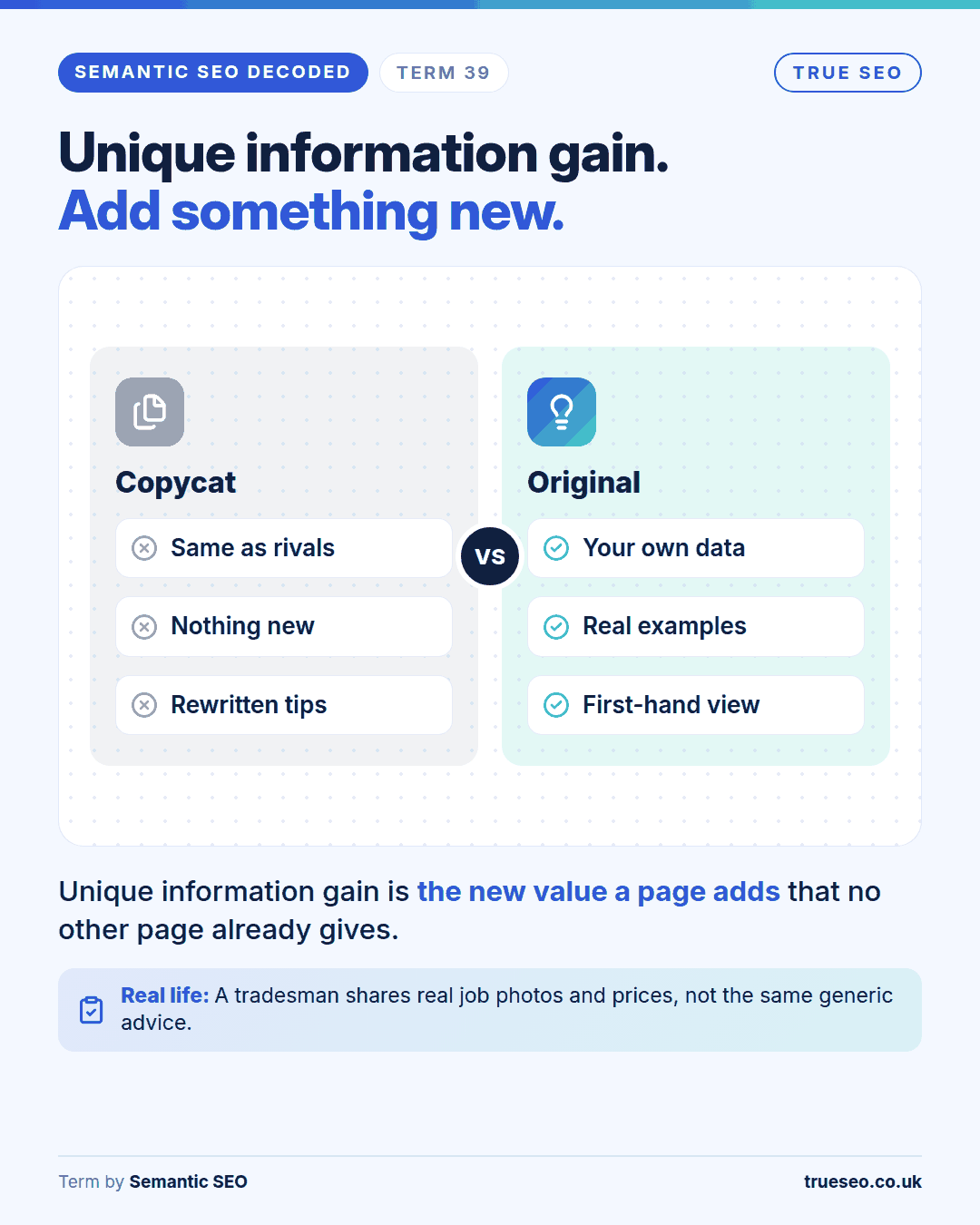
Unique information gain card. Tap to enlarge
Unique information gain
Google term
Unique information gain is the new information a page offers beyond what a reader has already seen on a topic. Google patented a way to score this, to help decide which page to show that person next.
The patent is “Contextual estimation of link information gain”, filed by Google in 2018 and granted in the US in 2022 and 2024. Its score is measured against the pages one user has already viewed, not against every page on the web. The word “unique” is an SEO addition. A patent proves Google filed the method, not that Google uses it to rank pages.
At Example Heating: Most “how long does a boiler last” pages repeat the same general advice. Rhys adds what his engineers see on real jobs. He shows photos of a corroded heat exchanger, the faults they meet in older boilers, and when a repair stops making sense. Checking what competitor pages already say shows where that gap is.
- 1Pages this reader has already seen
- 2Compare Rhys’s page with those pages
- 3The new detail is the gain
Right way
The “how long does a boiler last” guide adds what Rhys’s engineers see on real jobs: photos of a corroded heat exchanger, faults in older boilers and when repair stops making sense.
Wrong way, and why
Rewording the top five “how long does a boiler last” pages into one article with an AI tool. Every fact is one the reader has already seen on those pages, so the new page adds no information gain.
Card note: The card suggests the score is measured against every page on the web, which the patent does not say.
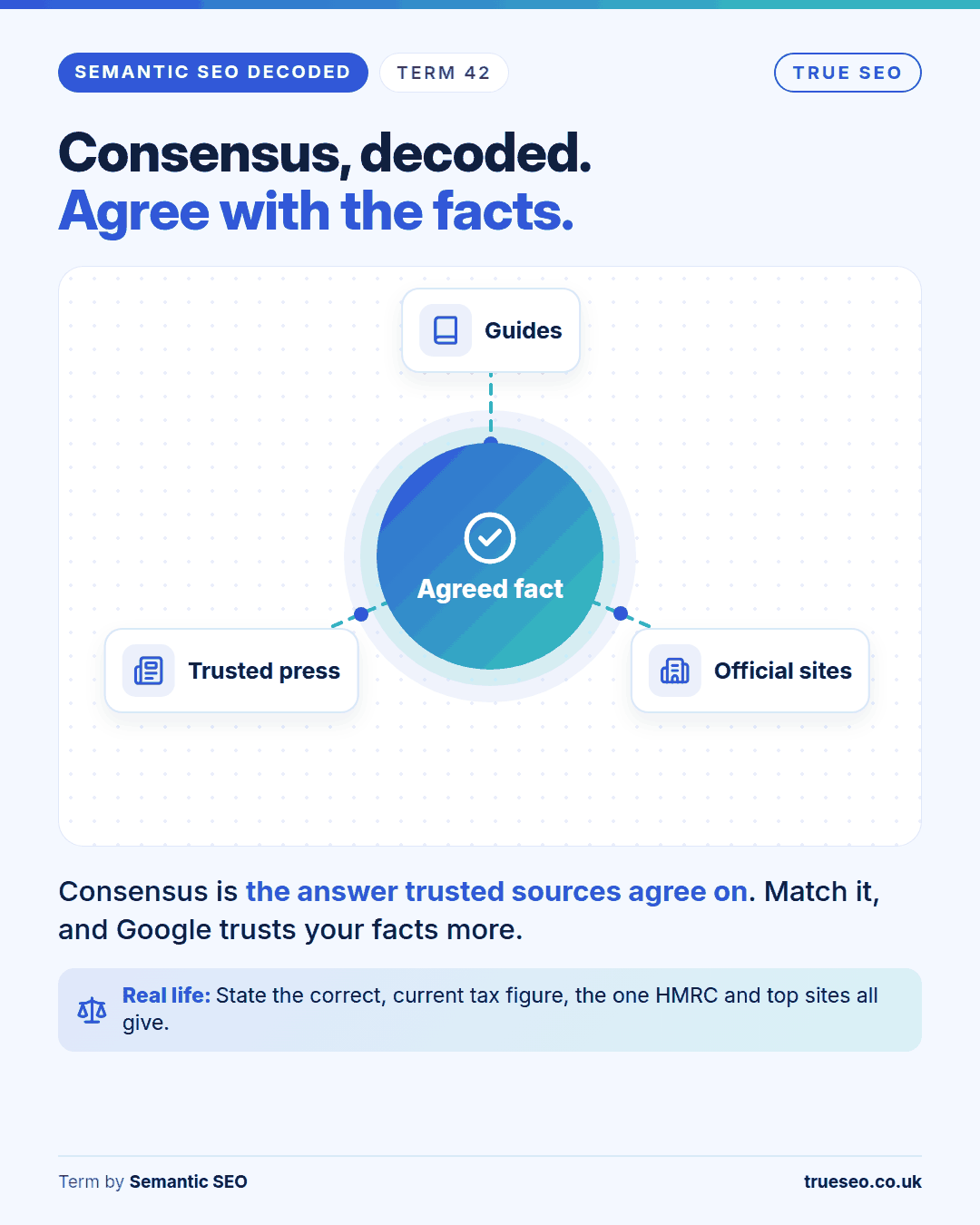
Consensus card. Tap to enlarge
Consensus
Google term
Consensus is the answer that experts and trusted sources agree on for a factual question. Google’s Search Quality Rater Guidelines ask raters to check whether content matches well-established expert consensus, especially on topics that affect health, money or safety.
Raters are people who check the quality of Google’s results. Their ratings help Google test its systems; they do not rank pages directly. Koray uses the word too. “Consensus or groundedness helps search engine systems give Safe Answers”, he wrote in his entity identity study on Holistic SEO & Digital.
At Example Heating: Rhys’s landlord certificate page matches the settled fact. The Health and Safety Executive says landlords must arrange a gas safety check every 12 months. Some questions have no consensus, such as which boiler brand is best. There, Rhys gives his engineers’ view and says plainly that it is a view.
Right way
The landlord certificate page states the settled fact: the HSE says landlords must arrange a gas safety check every 12 months. On “which boiler brand is best”, Rhys labels his answer as his engineers’ view.
Wrong way, and why
Telling landlords “every two years is fine for newer boilers” because a forum post said so. It contradicts the HSE’s 12-month rule, and raters are asked to check safety topics against expert consensus.
Card note: The card’s claim that Google trusts your facts more overstates it, because raters do not rank pages directly.
Comprehensiveness card. Tap to enlarge
Comprehensiveness
SEO industry term
Comprehensiveness is how completely a page or site covers a topic. A complete page answers the questions a searcher would reasonably have. They do not need to search again somewhere else to finish the task.
Google’s own helpful content questions ask whether a page describes its topic completely, and whether readers leave feeling they need to search again. It is a general quality word. Koray’s framework uses topical coverage and contextual coverage for the idea, and he points out that the two differ.
Complete does not mean long. Google says it has no preferred word count.
At Example Heating: The new boiler cost guide covers what drives the price, fitting time, the warranty and running costs. A homeowner in Penarth can finish reading and book a survey without opening another tab. Pages of this kind, across a whole subject, are what topical authority is built from.
Right way
The new boiler cost guide covers what drives the price, fitting time, the warranty and running costs. A homeowner in Penarth can book a survey without opening another tab.
Wrong way, and why
A “new boiler cost Cardiff” page that says “prices vary, call us for a quote” and stops. The searcher still does not know what affects the price, so they go back to Google and search again.
Card note: The card credits Koray, but this is a general quality word, not one of his terms.
Passage ranking card. Tap to enlarge
Passage ranking
Google term
Passage ranking is a Google AI system that picks out individual sections, or passages, of a page. It uses them to judge how relevant the whole page is to a search. It went live for US English searches on 10 February 2021.
Google first called it passage indexing, then changed the name. Pages are still indexed, meaning stored in Google’s search index, as whole pages. The page is what ranks. The passage helps Google see that the page answers the search. When Google announced it in October 2020, it expected it to affect about 7% of searches worldwide.
At Example Heating: Rhys’s guide “How long does a boiler last?” has a section headed “Signs your boiler needs replacing”. Someone searching “signs my boiler is dying” may be shown the guide. That one section answers them, even though the page as a whole is about lifespan.
- 1Search: signs my boiler is dying
- 2Google picks out the signs section
- 3The whole lifespan guide is shown
Right way
The lifespan guide has a clear section headed “Signs your boiler needs replacing”, so a search for “signs my boiler is dying” can be matched to that part of the page.
Wrong way, and why
Splitting the lifespan guide into ten tiny pages, one per sign, in the belief that Google ranks passages on their own. The page is still what ranks, so ten thin pages each carry less than one complete guide.
Card note: The card’s “one section can win” simplifies this, because the page is what ranks.
Featured snippet card. Tap to enlarge
Featured snippet
Google term
A featured snippet is a Google result where the text answer comes first and the page link follows, reversing the normal layout. Google’s systems choose it automatically when they judge that a page’s text answers the search well.
Google’s featured snippets documentation says it does not give an exact minimum length, and you cannot mark up a page to become one. Your only control is to opt out. One way is a nosnippet tag, a line of code that tells Google not to show a snippet from the page.
No page can be built to win the box. You can make the answer passage clear and let Google decide.
At Example Heating: The power flush guide puts “What does a power flush do?” in a heading. The next sentence answers it: a power flush pumps water and a cleaning solution through the heating system to clear sludge. Google may show that as a featured snippet, or may not.
Right way
The power flush guide asks “What does a power flush do?” in a heading and answers it in the very next sentence, then leaves the choice to Google.
Wrong way, and why
Installing a “featured snippet” plugin on the power flush page to force the box. Google says no markup can make a page a featured snippet; the only control it gives is opting out, for example with nosnippet.
Card note: The card’s 40 to 55 words is an industry rule of thumb, not a Google rule.
A chosen page still depends on the pages around it, so Part 8 follows the links that carry authority between pages.
Part 8 of 11 · about 7 minutes
Links and how authority flows
Links are how pages point to each other, and Google follows them to find pages and to judge which ones matter. This part starts with the links inside Example Heating’s own website, then moves to the links and mentions it earns from other sites. Good pages from Part 7 still need links before Google can find them and tell which ones count most.
In 30 seconds
- Internal links share importance between your own pages, so link most to the pages that matter.
- Link wording inside a relevant sentence tells readers and Google where the link leads.
- Links from other sites help Google find pages; mentions help it recognise your business.
Internal PageRank card. Tap to enlarge
Internal PageRank
SEO industry term
Internal PageRank is the share of importance that passes between pages of the same website through its internal links. PageRank itself is Google’s original method of judging how important a page is from the links pointing to it.
Google’s guide to its ranking systems says PageRank was a core system at launch and is still one today. Google publishes no internal PageRank score and names no ideal number of links per page. You control which pages your site points to most.
At Example Heating: The homepage usually earns the most links from other websites, so it has the most to pass on. A menu link from the homepage sends some of that to /boiler-installation/, the page that wins the big jobs. Guides such as “how long does a boiler last” link there too.
- 1Other websites link to the homepage
- 2Homepage menu links to /boiler-installation/
- 3Installation page gets a share
Right way
The homepage menu links to /boiler-installation/, the page that wins the big jobs, and guides such as “how long does a boiler last” link there too.
Wrong way, and why
Linking every page to every other page through a footer of 80 links, so nothing stands out. The site then gives Google no sign that /boiler-installation/ matters more than the cookie policy page.
Contextual anchor text card. Tap to enlarge
Contextual anchor text
SEO industry term
Contextual anchor text is the clickable wording of a link, placed inside a relevant sentence, that describes the page it points to. Readers and Google know where it leads before clicking.
Google’s link best practices say good anchor text is “descriptive, reasonably concise, and relevant”. Google flags generic wording such as “read more”. Koray’s framework connects pages “within a Semantic Content Network with contextual anchor texts”, he wrote on Holistic SEO & Digital. That is the semantic content network, a linked set of pages on one topic.
At Example Heating: The guide “how long does a boiler last” ends with: “When repairs stop making sense, see what a new boiler installation in Cardiff involves.” The words “new boiler installation in Cardiff” link to the installation page. The weak version says “find out more”.
Right way
Inside a sentence about repairs that stop making sense, the words “new boiler installation in Cardiff” link to the installation page. Links to the repair page vary, such as “our Cardiff repair engineers”.
Wrong way, and why
Using the exact phrase “boiler installation Cardiff” on every link to the installation page, from every guide. It reads as forced in most sentences, and the tenth identical link tells readers nothing new.
Reasonable surfer card. Tap to enlarge
Reasonable surfer
Google term
The reasonable surfer is a model from a Google patent that weights each link by how likely a real visitor is to click it. A prominent link in the main text gets more weight than one in a footer.
It refines the original PageRank “random surfer”, which treated every link as equally likely to be clicked. The patent is US 7,716,225, “Ranking documents based on user behavior and/or feature data”, filed in 2004 and granted in 2010. It mentions features such as footer or sidebar placement. A patent shows Google had the idea. It does not prove Google uses it today.
At Example Heating: The guide “radiator cold at the top” links to the central heating page inside the paragraph about the fix. A reader with a cold radiator is likely to click it there, far more than in a row of footer links.
Link in the main text
Sits in the paragraph about the fix, where a reader with a cold radiator is likely to click. More weight.
Link in the footer
Sits in a row of footer links that readers are less likely to click. Less weight.
Right way
The “radiator cold at the top” guide links to the central heating page inside the paragraph about the fix, where a reader with a cold radiator is most likely to click.
Wrong way, and why
Putting every link to the service pages in a footer block titled “Useful links” and none in the guide text. Under the reasonable surfer model those footer links carry less weight, because few readers click them.
Card note: The card’s word “hidden” means links in low-prominence spots, such as a footer. It does not mean hidden text, which Google’s spam policies forbid.
Orphan page card. Tap to enlarge
Orphan page
SEO industry term
An orphan page is a page on your website that no other page on the same site links to. Visitors and crawlers (programs that follow links for search engines) reach it only through a sitemap, an outside link or its address.
Google’s link best practices say every page you care about should have a link from at least one other page on your site. A sitemap, the file listing your pages for search engines, helps Google find an orphan. It gives no anchor text or context. “Orphan page” is audit vocabulary; Google’s own documents don’t use it.
At Example Heating: Rhys publishes /boiler-installation-penarth/ and forgets to link to it. No menu item or other page mentions it. Penarth homeowners rarely land on it, and Google gets no clue how it fits. The fix is two links: one from the main installation page, one from the homepage’s list of towns. A crawl in an SEO audit finds pages like this.
Right way
When /boiler-installation-penarth/ goes live, Rhys links to it from the main installation page and from the homepage’s list of towns.
Wrong way, and why
Publishing /boiler-installation-penarth/ and only adding it to the XML sitemap. The sitemap helps Google find it, but no page links to it, so it gets no anchor text, no context and few visitors.
Backlinks card. Tap to enlarge
Backlinks
SEO industry term
Backlinks are links on other websites that point to pages on your site. Google follows them to discover pages, and its documentation says it uses links as a signal when working out how relevant a page is.
Google says “links”, not “backlinks”. Its spam policies class links made “primarily for the purpose of manipulating search rankings” as link spam. Koray describes topical authority as “a factual methodology to improve the rankings of a website without backlinks”, writing on Holistic SEO & Digital. Part 10 covers topical authority in full.
At Example Heating: Suppose a Cardiff news site covers a cold snap and links to Rhys’s guide on boilers losing pressure. That link sits on a relevant local page, in a sentence about the same problem. A batch of paid links from unrelated directories is a different thing, and the spam policies cover them.
Right way
A Cardiff news story about a cold snap links to Rhys’s guide on boilers losing pressure, in a sentence about the same problem.
Wrong way, and why
Buying a package of “200 high-authority backlinks” from unrelated directories and overseas blogs. Google’s spam policies class links made mainly to manipulate rankings as link spam, so the money buys risk, not relevance.
Card note: The card calls backlinks votes; Google’s plainer word is signal.
Brand mention card. Tap to enlarge
Brand mention
SEO industry term
A brand mention is your business name appearing on another website, article or platform, with or without a link. It helps people and search systems recognise the business and connect it with its subject and its area.
A Google patent, US 8,682,892 (“Ranking search results”, granted in 2014), describes an “implied link”: a reference to a site without a clickable link. That shows Google has described the idea. It does not confirm unlinked mentions count in rankings today, and Google has not said they do.
At Example Heating: The local paper quotes Rhys in a story about landlords and gas safety checks. It names Example Heating with no link. Readers now know the name, and the firm appears next to Cardiff, landlords and gas safety. That supports its brand entity, the business as a thing Google can recognise.
Right way
The local paper quotes Rhys on landlords and gas safety checks and names Example Heating, so the firm appears next to Cardiff, landlords and gas safety even without a link.
Wrong way, and why
Emailing every site that names Example Heating to demand a link, and treating mentions without one as worthless. A plain mention still helps people and search systems recognise the business and connect it with its subject.
Card note: The card says a mention “still counts”; the safer reading is that it helps recognition.
Links and mentions show that others point to Example Heating, so Part 9 turns to the facts and trust evidence people see before they click.
Part 9 of 11 · about 8 minutes
Trust, data and the results page
This part explains how a business states its facts clearly, proves it can be trusted, and appears on Google’s results page. For Example Heating, that means code that describes its pages and contact details that match everywhere. It also means visible proof of real work and the boxes Google shows around the usual list of results.
In 30 seconds
- Code called structured data states a page’s facts; each fact must also show on the page.
- Keep your name, address and phone identical everywhere, and show proof of real work.
- Google’s results page has boxes beyond the links, and many searches end without a click.
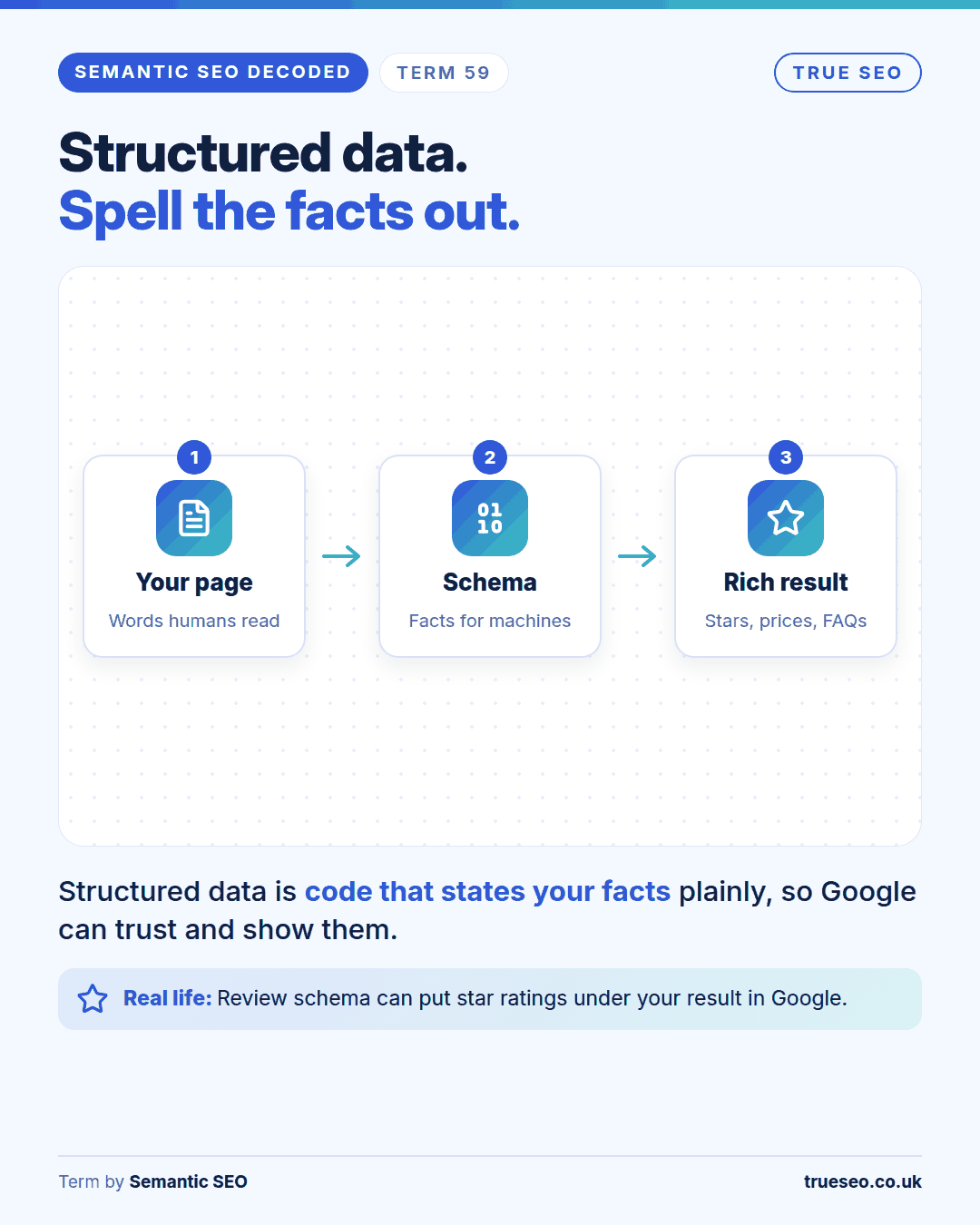
Structured data card. Tap to enlarge
Structured data
Google term
Structured data is code added to a page that states its facts in a standard format, such as the business name. It usually uses Schema.org, a shared set of labels that the major search engines read.
Google’s introduction calls it “a standardized format for providing information about a page”. Done correctly, it can make a page eligible for rich results, meaning results with extra details. Eligible is not guaranteed. In August 2023 Google limited FAQ rich results to “well-known, authoritative government and health websites”. Since 7 May 2026, Google’s documentation says they no longer appear in Search at all.
At Example Heating: The boiler servicing page can carry markup naming the business, its Cardiff service area and the service. Every fact in the code must also be visible on the page. Our guide to schema markup for accountancy websites applies the same rule.
What visitors read
The servicing page says Example Heating services boilers across Cardiff.
What the code states
Business name: Example Heating. Service: boiler servicing. Area served: Cardiff.
Right way
The servicing page’s markup names Example Heating, boiler servicing and the Cardiff service area, and every one of those facts also appears in the visible text.
Wrong way, and why
Adding FAQ markup to every service page in the hope of rich results. Google limited FAQ rich results to government and health sites in August 2023, and since 7 May 2026 says they no longer appear at all.
Card note: The card’s “trust” is not Google’s word: structured data describes the page.
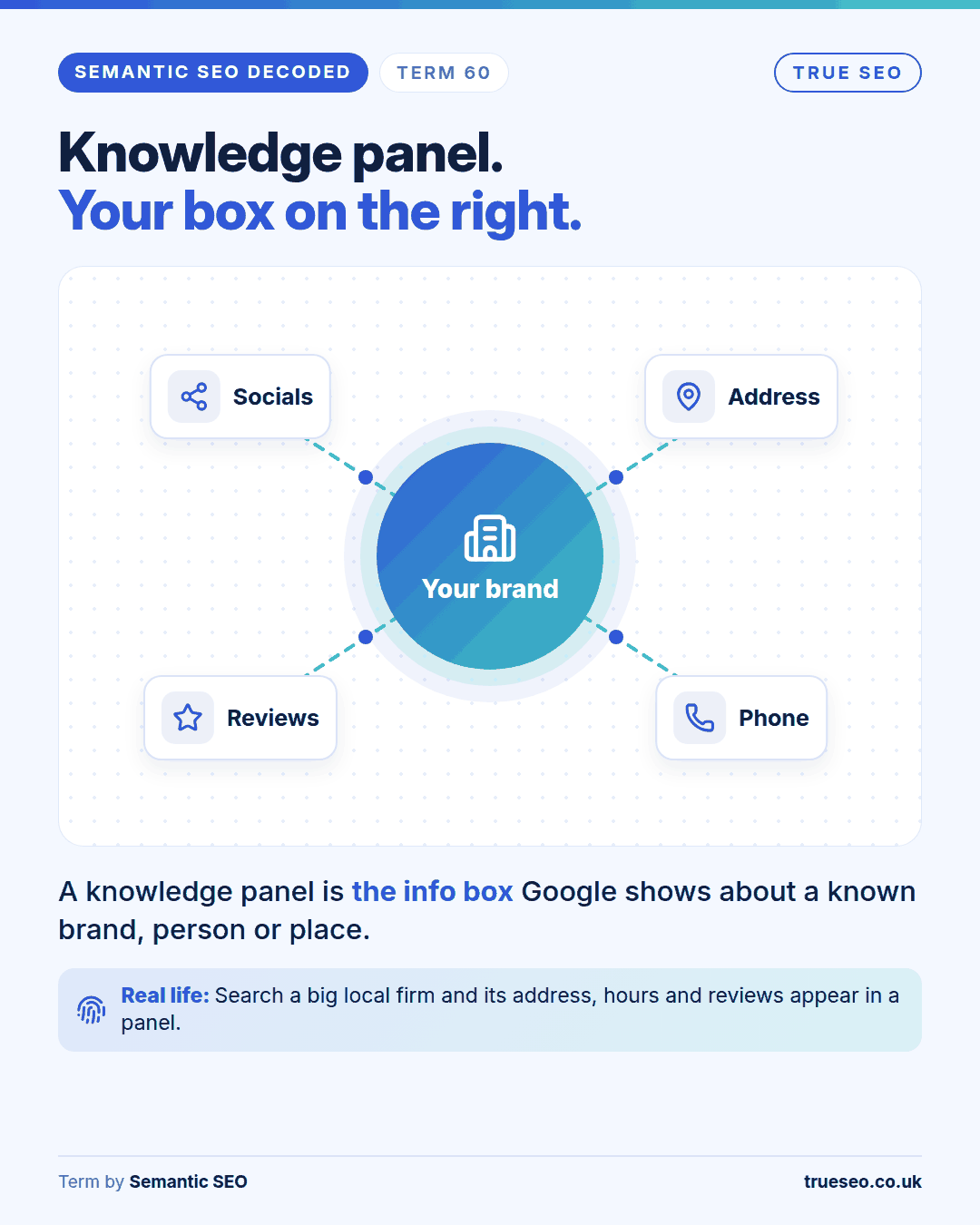
Knowledge panel card. Tap to enlarge
Knowledge panel
Google term
A knowledge panel is the information box Google shows for a well-known entity, meaning a specific thing it recognises, such as a person, organisation or place. Google builds it automatically from facts gathered across the web.
Google’s Knowledge Panel Help says knowledge panels are “automatically generated”. You can’t create one with code. The entity’s official representative, such as the company itself, can claim the panel and suggest edits.
At Example Heating: A search for Worcester Bosch may show a panel about the manufacturer. A small Cardiff firm is unlikely to have one. Local customers usually see a different box for Rhys’s firm: the map listing with phone number, hours and directions. That normally comes from a Google Business Profile, which the owner sets up and manages separately. The panel and the listing both depend on accurate facts, which is the next term.
Knowledge panel
A box for a well-known entity, such as Worcester Bosch. Google builds it automatically.
Map listing
A box for a local firm, such as Example Heating. It usually comes from a Google Business Profile the owner manages.
Right way
Rhys keeps the firm’s Google Business Profile accurate, because that drives the map listing with phone number, hours and directions that local customers actually see.
Wrong way, and why
Paying an agency to “create a knowledge panel” for Example Heating with schema code. Google’s Knowledge Panel Help says panels are automatically generated, nobody can create one with code, and a small local firm is unlikely to get one.
Card note: The card’s local example (address, hours, reviews) describes the map listing more than a knowledge panel.
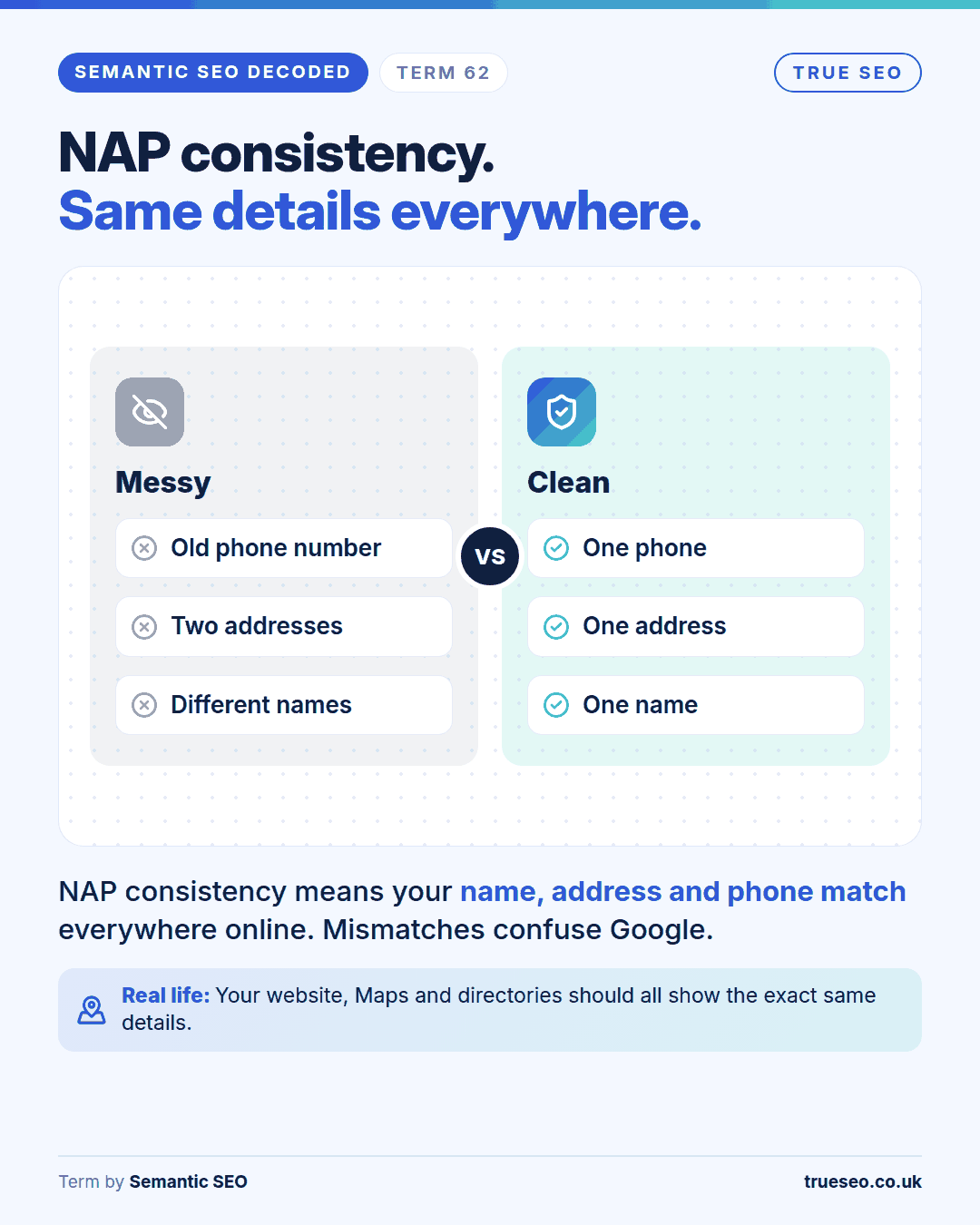
NAP consistency card. Tap to enlarge
NAP consistency
SEO industry term
NAP consistency means your business name, address and phone number (NAP) read exactly the same on your website, Google Business Profile, directories and social profiles. It is a habit from local SEO, the work of appearing in searches for your area.
Google’s Business Profile guidelines ask for your “real-world name, as used consistently on your storefront”, and an accurate address or service area. A plain reason to fix mismatches: customers ring the wrong number.
At Example Heating: The name reads “Example Heating” in the footer, the contact page, the Business Profile and every directory. Never “Example Heating Ltd” in one place and “Example Heating and Gas” in another. The phone number is identical everywhere too. The firm works in customers’ homes, so Google’s guidelines let it show a service area instead of an address. Our work on local SEO for service-area businesses follows the same rule.
Right way
The footer, contact page, Business Profile and every directory say “Example Heating” with the same phone number, and the profile shows a service area instead of an address.
Wrong way, and why
Listing “Example Heating Ltd” with an old mobile number on one directory and “Example Heating and Gas” with the office line on another. Customers ring the wrong number and may wonder which firm is the real one.
Card note: The card says mismatches confuse Google; Google hasn’t published that.
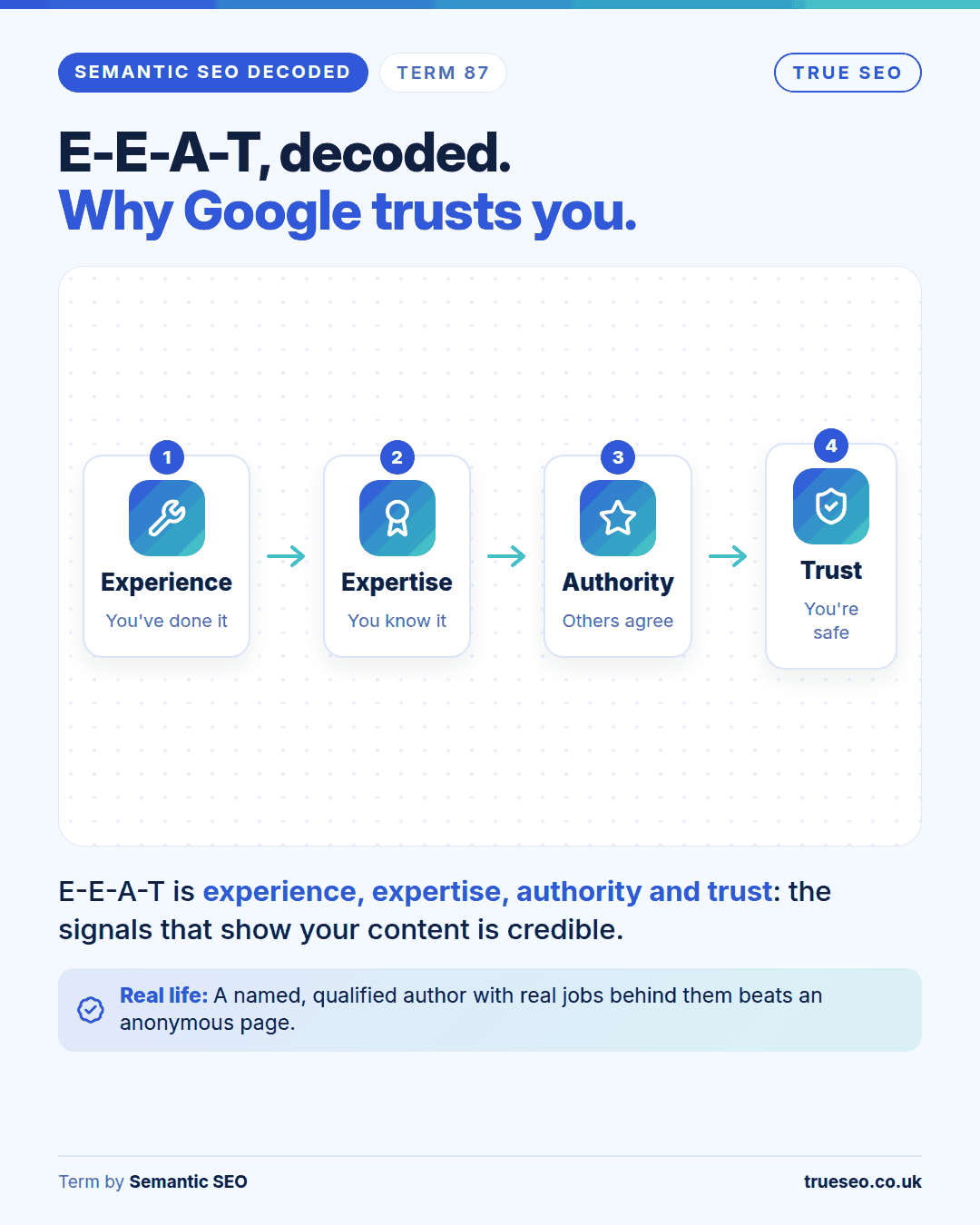
E-E-A-T card. Tap to enlarge
E-E-A-T
Google term
E-E-A-T stands for Experience, Expertise, Authoritativeness and Trustworthiness (the guidelines often shorten the last one to Trust). These are the qualities Google’s Search Quality Rater Guidelines ask human reviewers to look for when judging whether a page can be relied on.
The guidelines say: “The most important member at the center of the E-E-A-T family is Trust.” Experience was added in December 2022. Raters judge quality; they don’t change rankings. Google says “E-E-A-T itself isn’t a specific ranking factor”, though its systems use a mix of factors that line up with it.
At Example Heating: Trust starts with the legal fact we flagged at the start of this guide. Anyone doing gas work in the UK must be Gas Safe registered, under the Gas Safety (Installation and Use) Regulations 1998. Rhys’s pages state that the firm’s engineers are registered and tell readers how to check the register. Each guide names Rhys as its author, which builds his author entity.
Right way
Rhys’s pages state that the firm’s engineers are Gas Safe registered, explain how readers can check the register, and name Rhys as the author of each guide.
Wrong way, and why
Putting a stock photo and the byline “Our Heating Expert” on every guide, with no name and no way to check registration. Readers cannot verify who wrote it, so Trust, the part the guidelines call most important, is missing.
Card note: The card says “authority” and “signals”. Google’s word is authoritativeness.
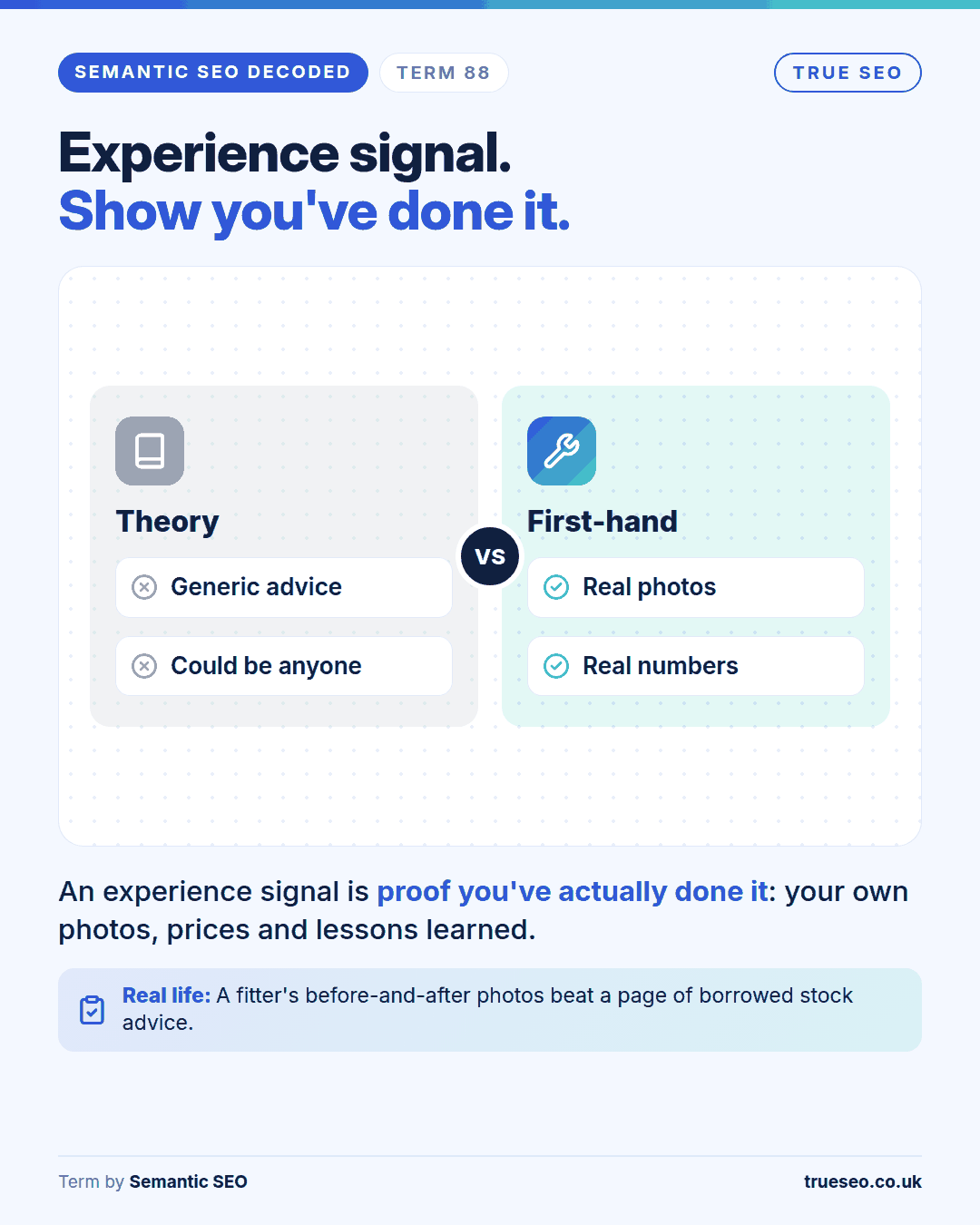
Experience signal card. Tap to enlarge
Experience signal
SEO industry term
An experience signal is visible proof that the person behind a page has done what they write about. Their own photos, real job details, tested advice and lessons learned all count. It supports the Experience part of E-E-A-T.
Google’s Search Quality Rater Guidelines ask whether a creator has “the necessary first-hand or life experience for the topic”. “Signal” is industry shorthand; Google names no single experience ranking factor. For customers, first-hand detail separates a real tradesperson from generic advice.
At Example Heating: The guide “what does a power flush do” shows Rhys’s own before-and-after photos of a radiator flush. He explains what he checks first on a cold radiator and the mistake he sees most often.
Right way
The power flush guide shows Rhys’s own before-and-after photos of a radiator flush and explains what he checks first on a cold radiator.
Wrong way, and why
Illustrating the power flush guide with stock images of a smiling plumber and writing “in our experience” with no detail behind it. The words claim experience, but nothing on the page proves Rhys has done the job.
Card note: The card also lists prices among its examples. Those count only when they are real; a page should never show made-up figures.
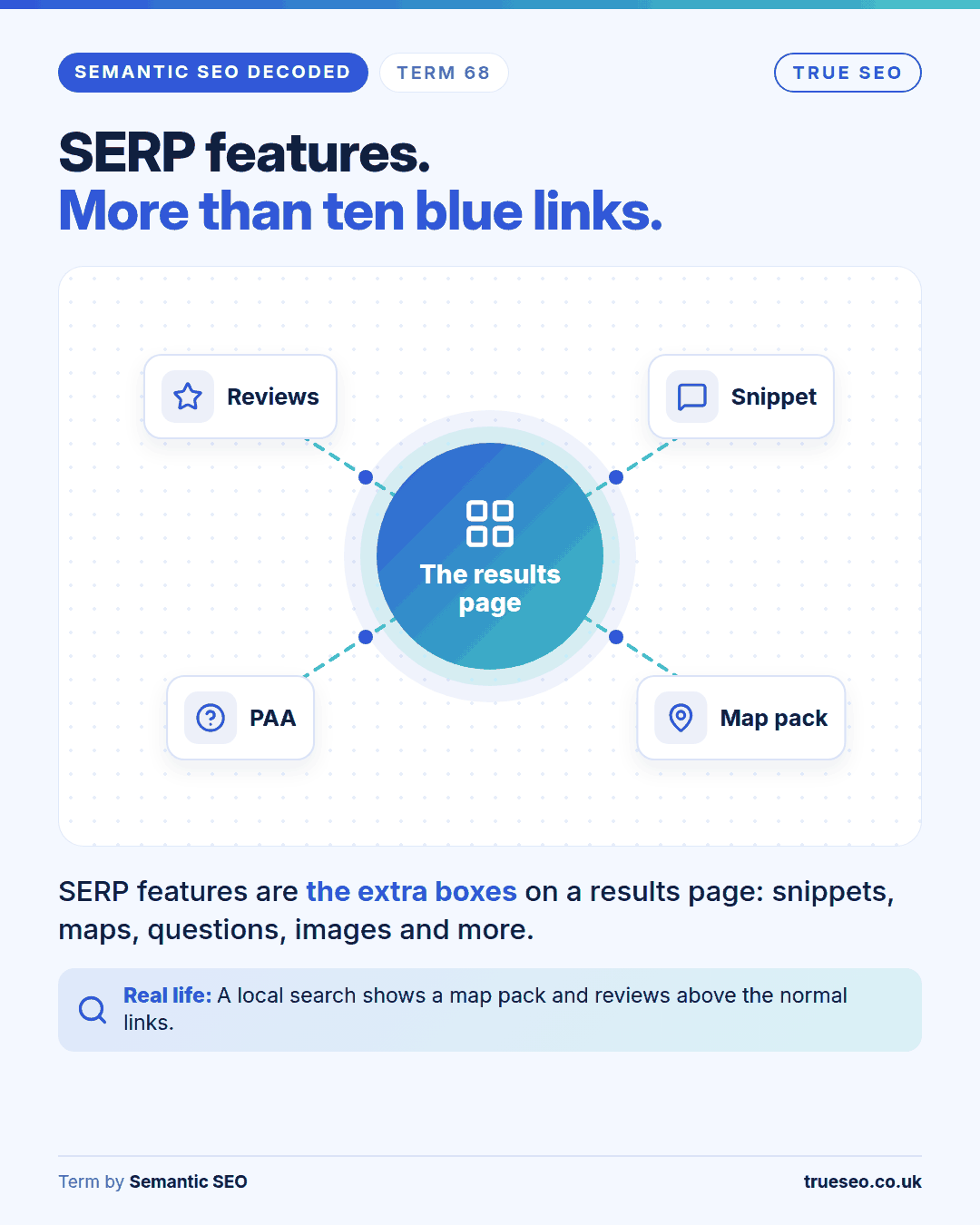
SERP features card. Tap to enlarge
SERP features
SEO industry term
SERP features are the parts of a search engine results page (SERP) beyond the plain list of links. They include featured snippets, local map results, People also ask boxes, knowledge panels, videos and AI Overviews.
“SERP features” is industry vocabulary. Google’s documentation calls them visual elements, “the building blocks of the Google Search results page”. The features on a page show what kind of answer Google offers for that search. That tells you what shape your page should take, the idea behind reading the intent behind a keyword.
At Example Heating: Search “boiler repair Cardiff” and the local pack, the map of nearby firms, sits near the top. That is where Example Heating’s Business Profile competes. Search “combi vs system boiler” and a People also ask box often appears. Rhys’s guide answers those questions in short passages, the format a featured snippet draws from.
Right way
Before writing, Rhys checks the results page. “Boiler repair Cardiff” shows a local pack, so the Business Profile matters. “Combi vs system boiler” shows People also ask, so the guide answers in short passages.
Wrong way, and why
Writing a 3,000-word blog post to rank for “boiler repair Cardiff” without looking at the results page. That search shows a map of nearby firms near the top, so a long post is the wrong shape for it.
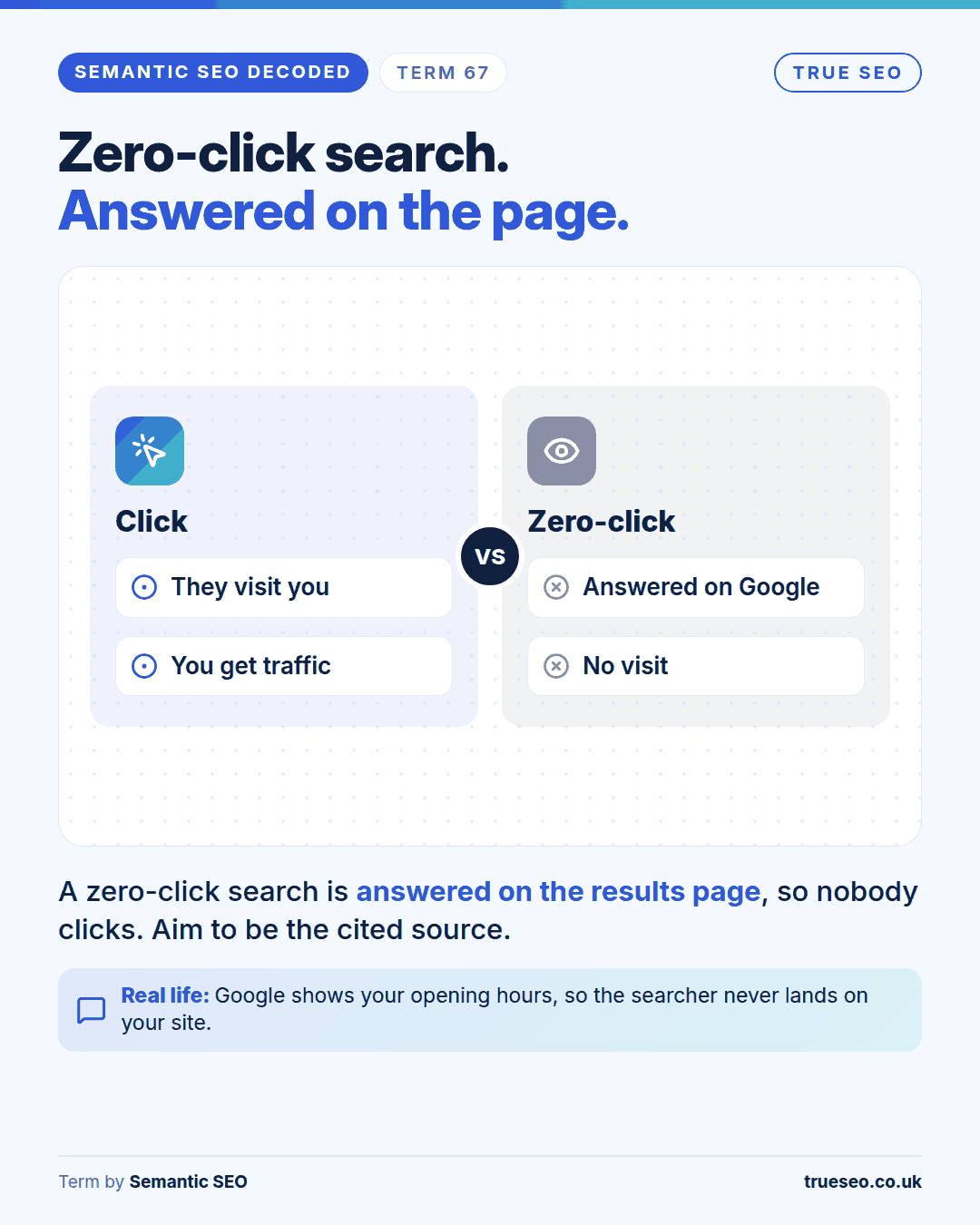
Zero-click search card. Tap to enlarge
Zero-click search
SEO industry term
A zero-click search is a search that ends without the person clicking any result. The results page answered them with a snippet, a map, a phone number or an AI summary, or they searched again.
The SparkToro and Datos 2024 zero-click study, reported by Search Engine Land, looked at Google searches across every kind of query. About 58.5% in the US and 59.7% in the EU ended without a click. So a page can be seen without being visited. Being the source the results page draws on still matters.
At Example Heating: That figure covers all searches, not local trades, so it says nothing specific about Rhys’s firm. A zero-click search can still bring work. A landlord whose tenant has no heating searches “emergency boiler repair Cardiff”, sees Example Heating in the map results and taps the phone number. No website visit happens, but the call does.
Right way
The firm’s map listing shows the phone number, so a landlord searching “emergency boiler repair Cardiff” can tap and call without visiting the website.
Wrong way, and why
Judging /emergency-boiler-repair/ only by website visits and dropping it because traffic looks low. Calls that came straight from the map listing never appear as clicks, so the report misses the work they brought in.
These terms each cover one page or listing, so Part 10 shows how that work, repeated across a topic over time, earns topical authority.
Part 10 of 11 · about 9 minutes
How topical authority is earned and kept
Topical authority is the trust a search engine gives a site across a whole subject. It is earned through complete coverage and a long record of useful pages. Part 9 covered the signals Google reads on single pages and results pages. This part explains how they add up over months and how a site keeps that trust. For Example Heating, it is the difference between one page that ranks and a site Google treats as a source on boilers.
In 30 seconds
- Topical authority is trust across a whole subject, built over time, never bought.
- It comes from covering the subject fully and a long record of useful pages.
- Publish at a steady pace, keep facts current, and improve or merge weak pages.
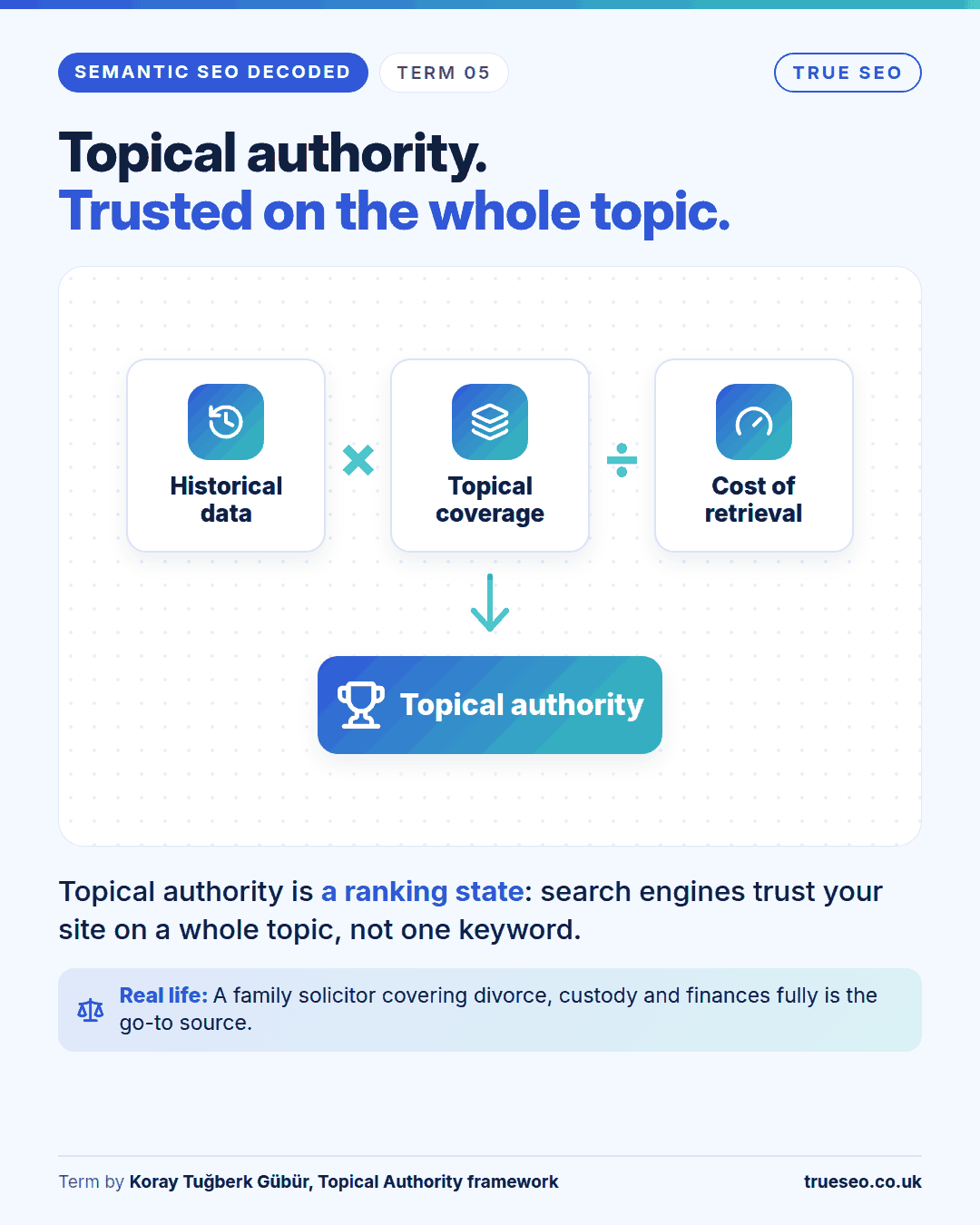
Topical authority card. Tap to enlarge
Topical authority
Koray framework term
Topical authority is the trust a search engine gives a website across a whole subject. Its pages can then rank for many related searches, not just one keyword. It is a state a site reaches over time, not a score you can buy.
“Topical Authority is a positive ranking state,” Koray wrote on Holistic SEO & Digital in January 2023. His published formula, in an OnCrawl article from February 2021, is topical coverage multiplied by historical data. In plain words: how fully you cover the subject, times the record Google has built of how your pages perform. Both terms are explained just below. He says the idea grew from lowering Google’s cost of retrieval. Our longer guide to topical authority goes further.
At Example Heating: Topical authority would mean Google trusting the site on boiler questions in general: faults, boiler types, servicing and landlord rules. A new guide on a boiler fault would then start with that trust behind it, instead of starting from nothing.
Right way
Rhys builds trust across boiler questions as a whole: faults, boiler types, servicing and landlord rules. Each new fault guide then starts with that trust behind it.
Wrong way, and why
Buying an “authority boost” link package and calling the result topical authority. Topical authority is a state earned on one subject over time, not a score you can buy, and the links say nothing about boilers.
Card note: The card divides the formula by cost of retrieval. That later version circulates widely in SEO, but his 2021 OnCrawl formula has only the two parts above.
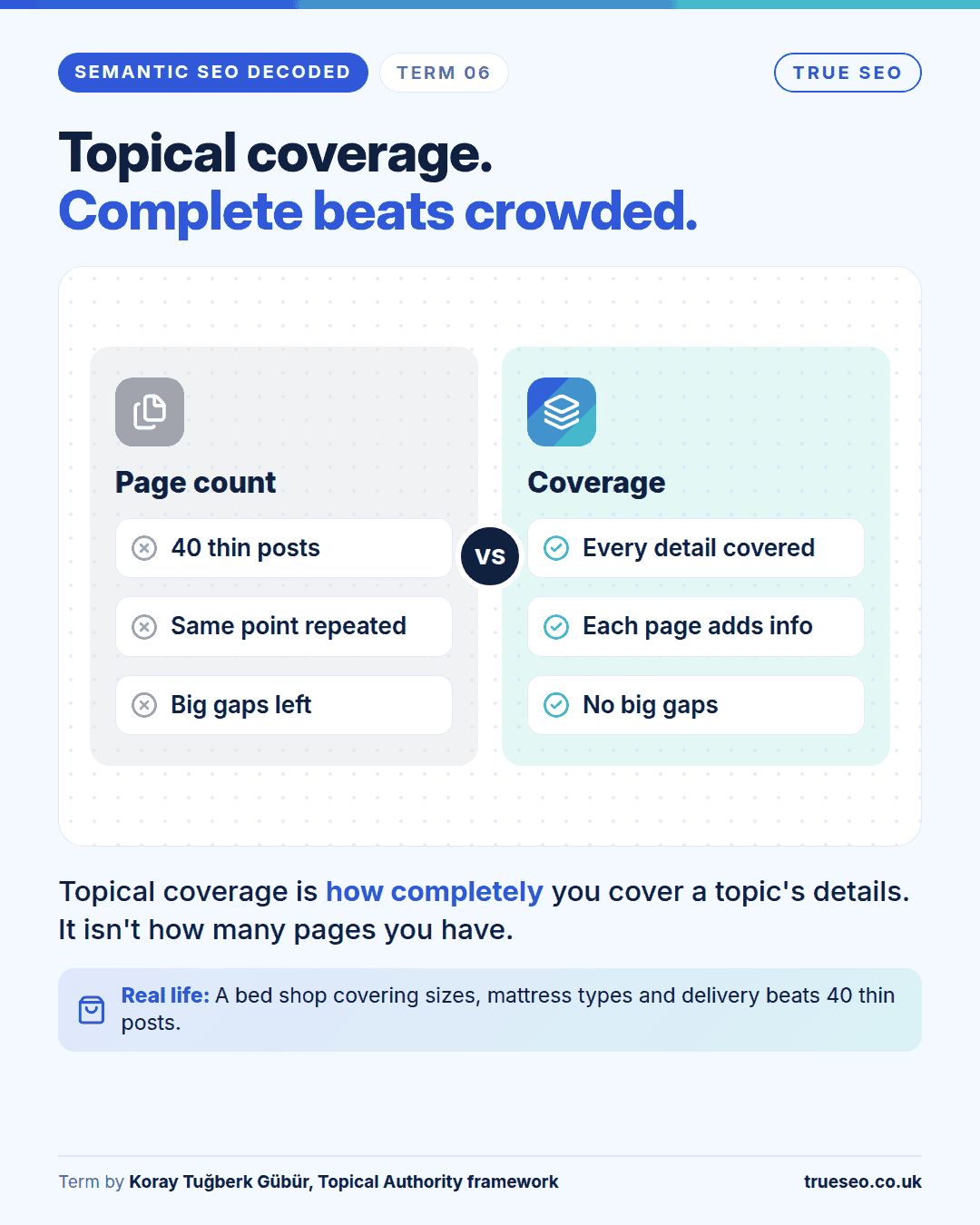
Topical coverage card. Tap to enlarge
Topical coverage
Koray framework term
Topical coverage is how completely a website covers a subject: its things, their facts and features, and the questions that connect them. It is judged by how complete and connected the information is, not by how many pages the site has.
Koray describes a topic as a graph, a web of connected things, and coverage as how well a site covers that graph (OnCrawl, February 2021). It is one half of his topical authority formula. More pages only help when each one covers a part the site was missing.
At Example Heating: Good coverage means the site answers what customers actually ask: faults, boiler types, servicing, power flushing, controls, gas safety and landlord duties. Thirty town pages that repeat the same text with a new town name add pages, not coverage.
Right way
The site answers what customers actually ask across the subject: faults, boiler types, servicing, power flushing, controls, gas safety and landlord duties.
Wrong way, and why
Counting posts as coverage, so the plan adds ten more posts on boiler pressure. They repeat a part the site already covers and will not fill the gap on landlord duties.
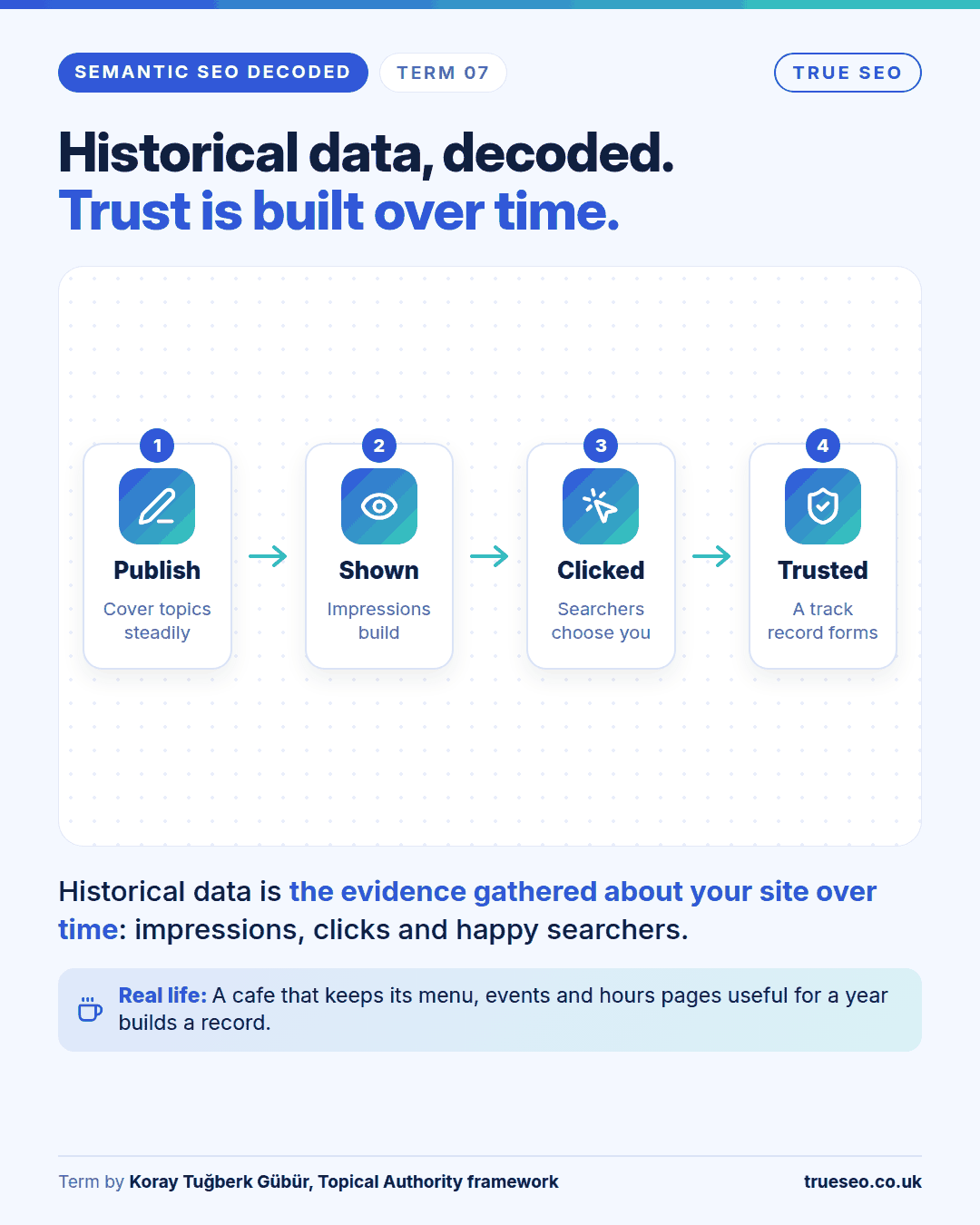
Historical data card. Tap to enlarge
Historical data
Google term
Historical data is the record a search engine builds about a page or a site over time. It covers how long the site has dealt with a topic, how often its pages appear in results and how searchers respond to them.
The name comes from a Google patent first filed in 2003, titled “Information retrieval based on historical data”. Koray uses it as the second half of his topical authority formula. The record includes impressions (the times a page is shown in results), clicks and signs that searchers found what they needed.
At Example Heating: Historical data cannot be rushed. Each month the guides appear for boiler searches, get clicked, and either solve the problem or send the searcher back to the results. A year of useful pages builds a record. A site launched last week has none, however good its pages are.
- 1A guide appears for a boiler search
- 2Searchers click it or skip it
- 3They stay, or go back to results
- 4Month by month, the record grows
Right way
Rhys publishes useful guides month after month, and each one builds a record of impressions, clicks and searchers who find what they need.
Wrong way, and why
Launching a new domain with 100 pages and expecting it to rank like an established site within weeks. Historical data cannot be rushed, so the new site starts with no record, however good its pages are.
Card note: The card credits the term to Koray; Google named it, and Koray built on it.
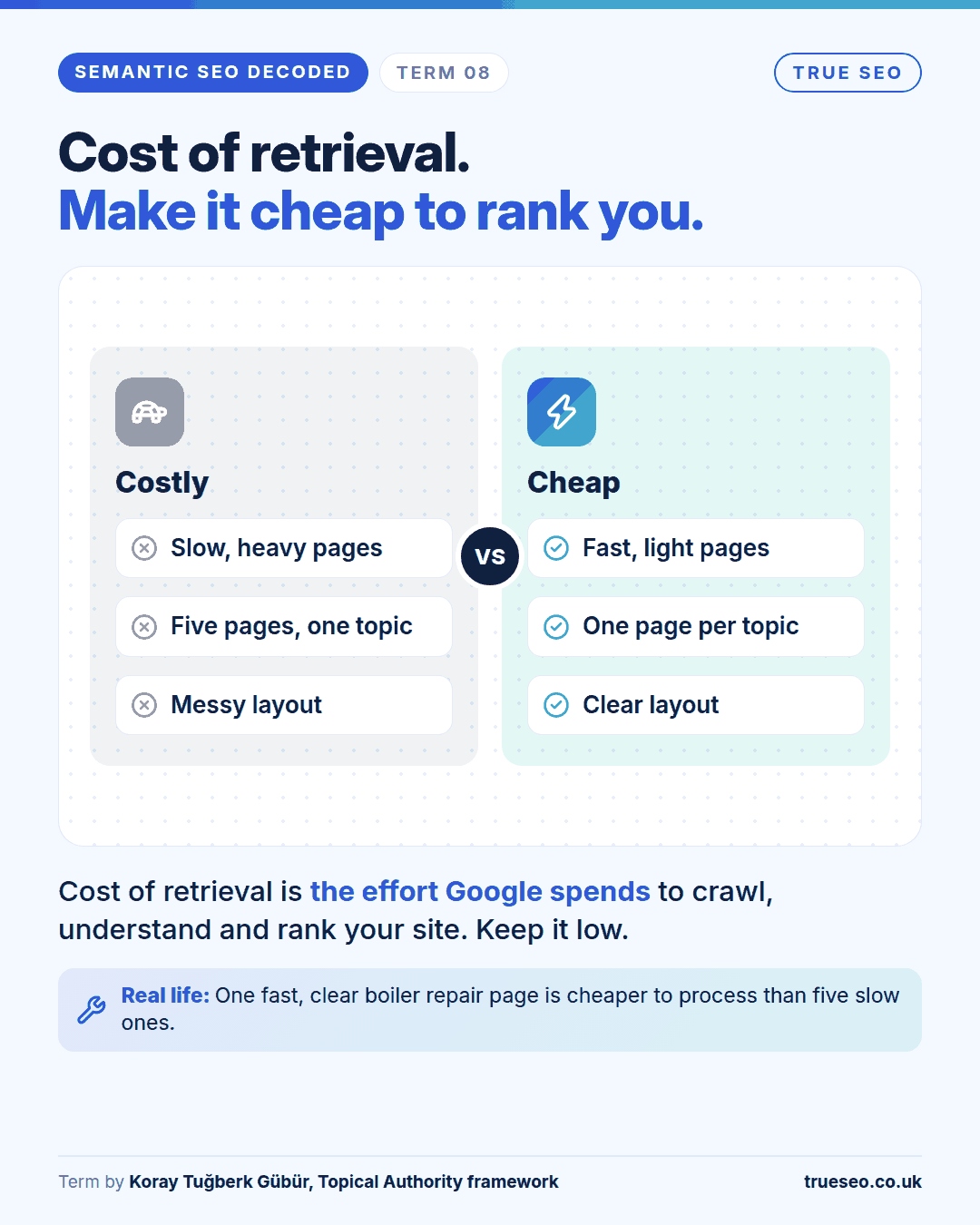
Cost of retrieval card. Tap to enlarge
Cost of retrieval
Koray framework term
Cost of retrieval is the effort a search engine spends to crawl a site, understand its pages and choose which one to show. Crawling means a search engine’s software visiting and reading pages. Koray’s advice is to keep that effort low.
In a 2023 presentation, Koray said topical authority grew from the idea of lowering this cost. His own course site names duplicate content and needless web addresses as things that raise it. A clean, fast, well organised site gives Google less work and fewer wrong choices to make.
At Example Heating: Rhys keeps the cost low with fast pages, clear headings and one page per job. Each town page carries its own local detail rather than a copy of the Cardiff page with the town name swapped. One clear boiler repair page is cheaper to process than five thin ones aimed at the same search. Speed and duplicate pages are the kind of problems technical SEO fixes deal with.
- 1Crawl: read Rhys’s boiler repair pages
- 2Understand: what each page answers
- 3Choose: the one page to show
Right way
One clear /boiler-repair/ page, fast pages, clear headings and town pages with their own local detail keep the effort Google spends on the site low.
Wrong way, and why
Creating /boiler-repair-cardiff/, /cardiff-boiler-repair/ and /boiler-repairs-in-cardiff/ for the same search. Google has to crawl and compare three near-copies and choose between them, which raises the cost and gives it a wrong choice to make.
Momentum card. Tap to enlarge
Momentum
Koray framework term
Momentum is the speed and regularity with which a site publishes new pages and updates existing ones on its topic. In Koray’s framework it multiplies the effect of topical coverage: the same coverage counts for more when it arrives at a steady pace.
Koray set this out in a Medium article in November 2025, where he defined momentum as the speed of publishing and updating. Momentum is not the short trial ranking Google gives a new page before it settles. Koray calls that trial period initial ranking and treats it as a separate idea, covered under re-ranking.
At Example Heating: Rhys picks a rhythm he can keep, such as two new guides and one refreshed page each month. Twenty guides in one week and then nothing for a year gives Google a burst, not a pattern. A steady pace also means new pages keep arriving while older ones are still being judged.
Right way
Rhys keeps a rhythm he can sustain: two new guides and one refreshed page each month.
Wrong way, and why
Publishing twenty guides in launch week to “get momentum”, then nothing for a year. Google sees a burst, not a pattern, and the publishing stops while the first pages are still being judged.
Card note: The card describes initial ranking, the short trial period for a new page, rather than momentum.
Re-ranking card. Tap to enlarge
Re-ranking
Information retrieval term
Re-ranking is the stage where a search engine takes a first, quick list of results and reorders it using deeper checks. Those checks look at relevance, quality and how searchers respond, then move better pages up and weaker ones down.
Two-stage ranking, a fast first pass followed by a slower and more careful one, is standard practice in information retrieval. Koray builds on it. He treats initial ranking and re-ranking as two separate phases, and he says re-ranking relies on historical data. That is why a new page’s first position often changes. It is a starting point for testing, not a verdict.
At Example Heating: A new guide on a boiler that makes a banging noise first appears somewhere in the results for that search. Over the following weeks, Google gathers signals such as whether people find what they need or go back to try another result. The guide’s later position reflects those signals, not the first guess.
- 1Banging noise guide first appears
- 2A quick first guess at position
- 3Searchers find answers or go back
- 4Position moves up or down
Right way
Rhys publishes the banging noise guide, then waits several weeks before judging its position, while Google gathers signals on whether searchers find what they need.
Wrong way, and why
Rewriting the banging noise guide three days after launch because it first appeared on page three. That first position is a quick guess before re-ranking, so the rewrite judges the page before the signals have come in.
Content pruning card. Tap to enlarge
Content pruning
SEO industry term
Content pruning is reviewing a site’s weak or out-of-date pages, then improving them, merging them or removing them. A merged page usually gets a 301 redirect, a permanent forward from the old web address to the new one.
In August 2023, Search Engine Land reported a comment from Google’s Danny Sullivan. Deleting older content does not by itself make Google see a site as better, he said. At most, it may help crawling on a very large site. Google’s helpful content guidance also lists removing lots of older content to seem fresh as a warning sign. Prune for readers.
At Example Heating: Suppose Rhys has three short posts that each answer “how often should a boiler be serviced”. Merging them into one guide, with redirects from the old addresses, gives readers one clear answer. A page-by-page SEO audit finds overlaps of this kind. Deleting an older radiator guide that still helps people would gain nothing.
Right way
Rhys merges three short posts on “how often should a boiler be serviced” into one guide, with 301 redirects from the old addresses.
Wrong way, and why
Deleting every post older than two years, including a radiator guide people still use, to look fresh. Google’s Danny Sullivan said deleting older content does not by itself make a site look better, and Google lists it as a warning sign.
Card note: The card’s example says merging thin posts can lift the whole site. Google has not said that.
Content freshness card. Tap to enlarge
Content freshness
SEO industry term
Content freshness is how current a page’s information is. It is kept by updating the facts, figures, prices and guidance on the page when they change, not by changing the date at the top.
Freshness matters more for some searches than others. Google’s guide to its ranking systems says its freshness systems show newer content where searchers would expect it, which is the idea behind deserves freshness. Google’s helpful content guidance also treats changing page dates just to look fresh as a warning sign.
At Example Heating: Rhys updates a page when something real changes. That might be new guidance from the Gas Safe Register or the Health and Safety Executive (HSE). It might be a new boiler range from Worcester Bosch, Vaillant or Ideal, or a change to a grant scheme. The landlord certificate page needs the most care. The HSE says landlords must have the gas appliances they provide safety checked every year, so stale advice there could mislead a landlord.
Right way
Rhys updates the landlord certificate page when HSE or Gas Safe Register guidance changes, and updates boiler pages when Worcester Bosch, Vaillant or Ideal bring out a new range.
Wrong way, and why
Changing “Last updated” on the landlord certificate page every month while the advice underneath stays the same. Google’s helpful content guidance treats changing dates just to look fresh as a warning sign, and stale advice still misleads landlords.
Everything in this part also shapes which pages AI systems trust enough to quote, which is where Part 11 picks up.
Part 11 of 11 · about 5 minutes
AI search
AI search is where Google and other artificial intelligence (AI) assistants write an answer themselves and link to the pages they used. The four terms in this part show that AI search runs on the same foundations as the rest of this guide. Those foundations are clear pages, known entities and full coverage of a topic. Example Heating needs no separate AI plan, only the earlier work done well.
In 30 seconds
- AI answers are written from real pages the system looks up, then linked as sources.
- Google sets no extra requirements for AI Overviews beyond normal indexing and snippets.
- Clear answers and consistent facts make a page easier to cite; nothing guarantees a citation.
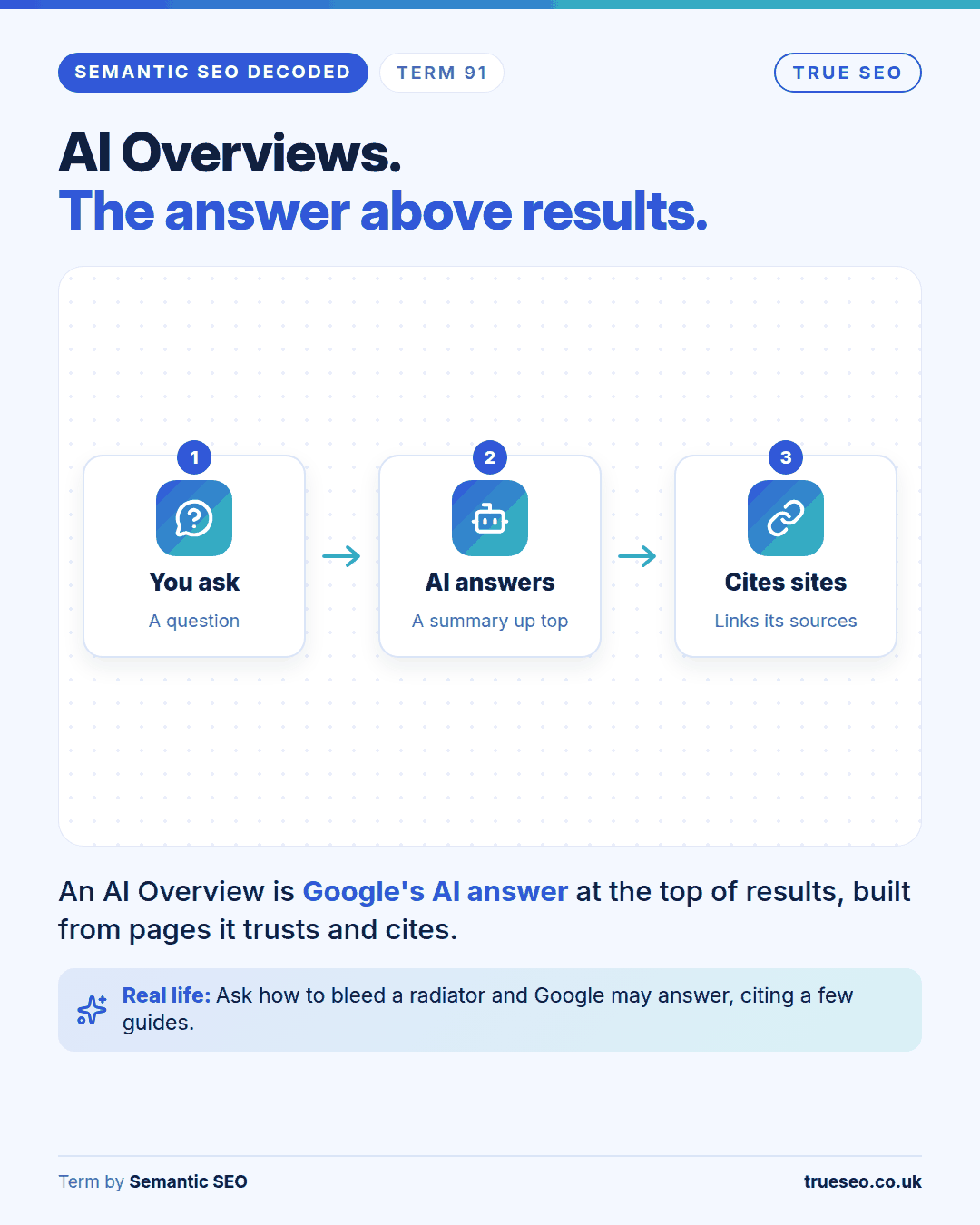
AI Overviews card. Tap to enlarge
AI Overviews
Google term
AI Overviews are the AI-written summaries Google shows at the top of some search results. They give the gist of an answer with links to supporting web pages, using a version of Gemini, Google’s AI model, customised for Search.
Google launched them to everyone in the US in May 2024. They appear only when Google’s systems judge them “additive”, meaning useful beyond the normal results. Google states: “There are no additional requirements to appear in AI Overviews or AI Mode”. A page only needs to be indexed and eligible to show a snippet. Google can also use query fan-out, splitting one question into several searches.
At Example Heating: Someone in Barry searches “radiator cold at the top”. An AI Overview explains that trapped air needs bleeding out and links to a few guides. To be eligible, Rhys’s guide must be indexed and able to show a snippet. A plain answer near the top makes it easier to use. How we approach AI Overviews covers the rest.
Right way
Rhys’s “radiator cold at the top” guide is indexed, can show a snippet, and explains near the top that trapped air needs bleeding out.
Wrong way, and why
Adding a nosnippet tag to the radiator guide to stop AI from using it, then wondering why AI Overviews never link it. Google requires a page to be indexed and eligible to show a snippet, so the tag rules it out.
Card note: The card’s “pages it trusts” oversimplifies the rule.
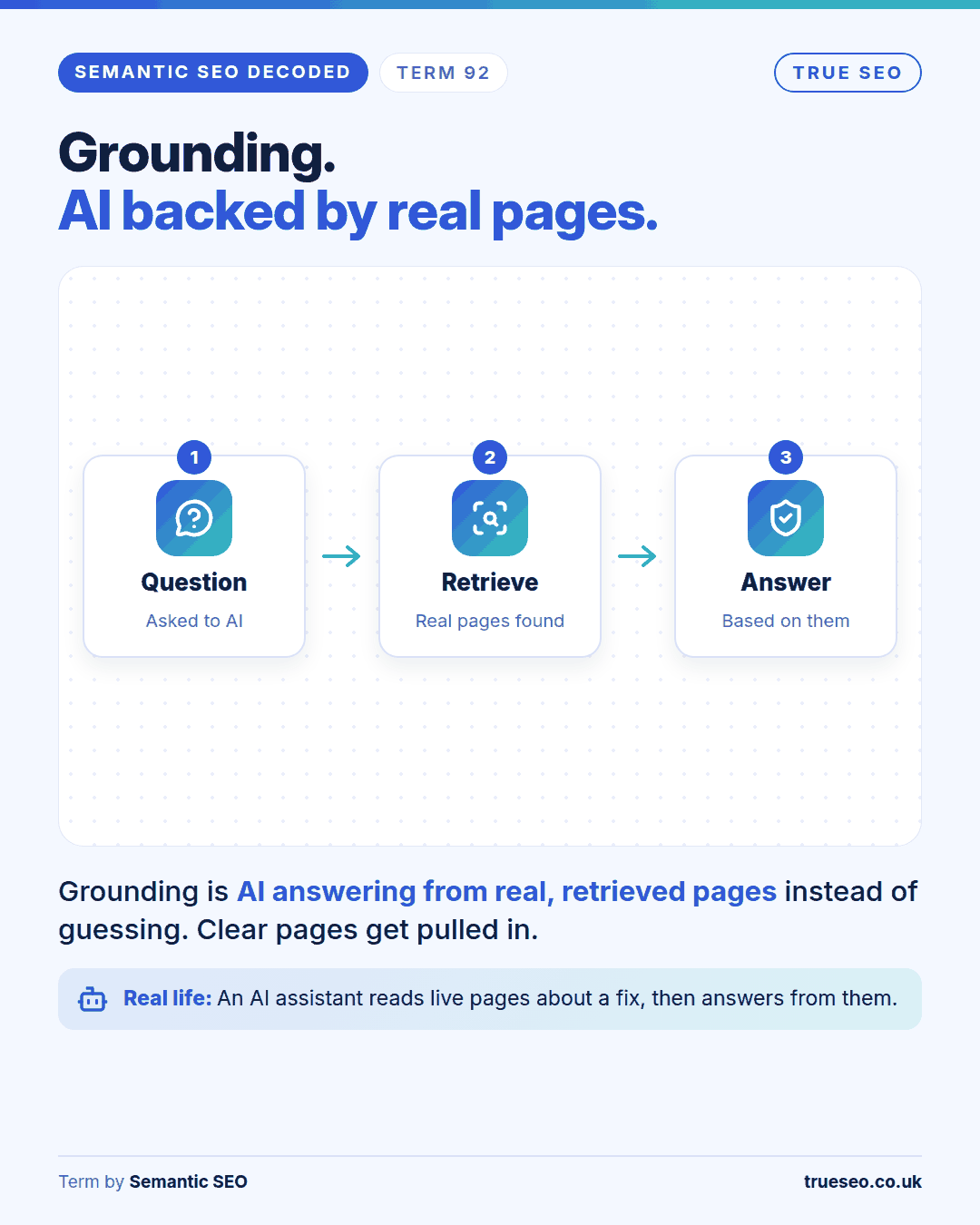
Grounding card. Tap to enlarge
Grounding
Google term
Grounding is the step where an AI model ties its answer to real sources it has looked up, such as search results or documents. The model then relies on more than its training. A common way to do this is retrieval-augmented generation (RAG). The system first finds relevant documents, often with semantic search, which matches meaning rather than exact words. It then writes its answer from them.
Google Cloud’s documentation describes grounding as a way to “Connect model output to verifiable data sources, reducing hallucinations”. A hallucination is a confident answer that is false. The term is used in Google’s AI products and across AI research. Grounding reduces errors; it does not remove them.
At Example Heating: Someone asks an AI assistant how often a boiler should be serviced. A grounded assistant searches, reads the pages it finds, then answers from them. Rhys’s servicing guide is easier to use as a source when its first sentence gives the answer.
- 1Question: how often to service a boiler?
- 2Assistant searches and reads pages
- 3Answers from those pages
Right way
Rhys’s servicing guide gives the answer in its first sentence, so a grounded assistant that searches and reads pages can take “once a year” straight from it.
Wrong way, and why
Writing the servicing guide for an AI that will remember it from training, with the answer buried in paragraph six. A grounded assistant looks pages up when the question comes in, so a buried answer is harder to use.
Card note: The card says clear pages get pulled in. That is a sensible tactic, not a documented rule.
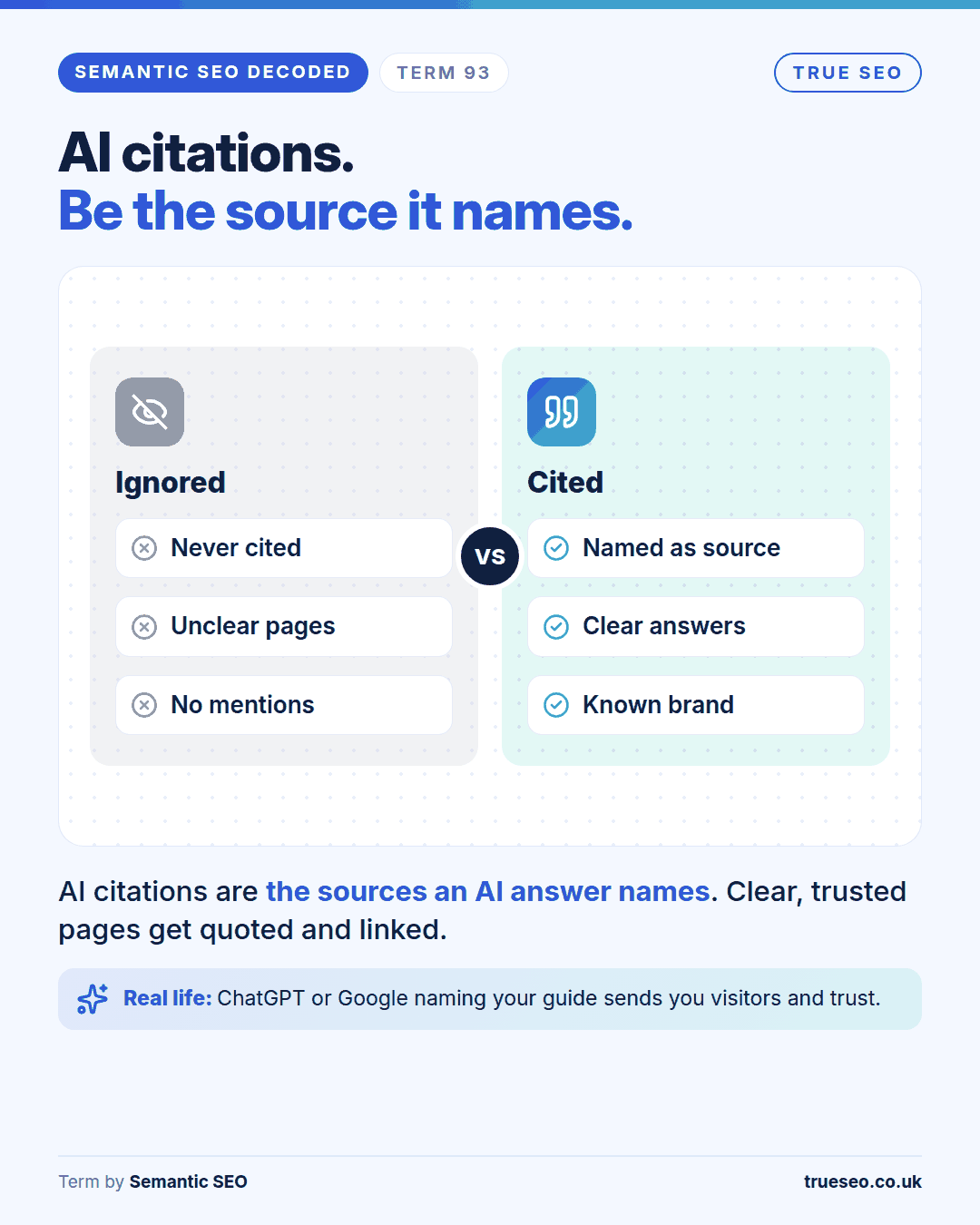
AI citations card. Tap to enlarge
AI citations
SEO industry term
AI citations are the links or named sources an AI answer shows to back up what it says. Google’s AI Overviews and AI Mode, ChatGPT and other assistants attach them so readers can check the source.
Google’s own phrase is “links to supporting websites”. A citation shows your page to the reader but guarantees no click. Ahrefs has measured how many pages cited in AI Overviews also rank in the top 10. Its July 2025 study found about 76%. Its March 2026 study of 863,000 results pages found about 38%. Ranking in the top 10 does not guarantee a citation.
At Example Heating: Rhys can’t choose to be cited. He can make each page worth citing: one clear answer per question, his name on the guides, and the same firm facts everywhere. Answering the smaller questions inside a big one gives more ways to match, as our query fan-out guide explains. In practice, his guide could rank on page one and not be cited, or be cited without ranking there.
Ranking
Rhys’s guide is listed in Google’s results. The searcher sees the link and may click.
AI citation
An AI answer links Rhys’s guide as a source. The reader sees it but may not click.
Right way
Each guide gives one clear answer per question, names Rhys as author and states the same firm facts as every other page, which makes it easier to cite.
Wrong way, and why
Telling Rhys “the guide ranks third, so AI Overviews will cite it”. Ahrefs’ March 2026 study found only about 38% of pages cited in AI Overviews also ranked in the top 10, so ranking guarantees no citation.
Card note: The card’s “clear, trusted pages get quoted” describes better odds, not a promise.
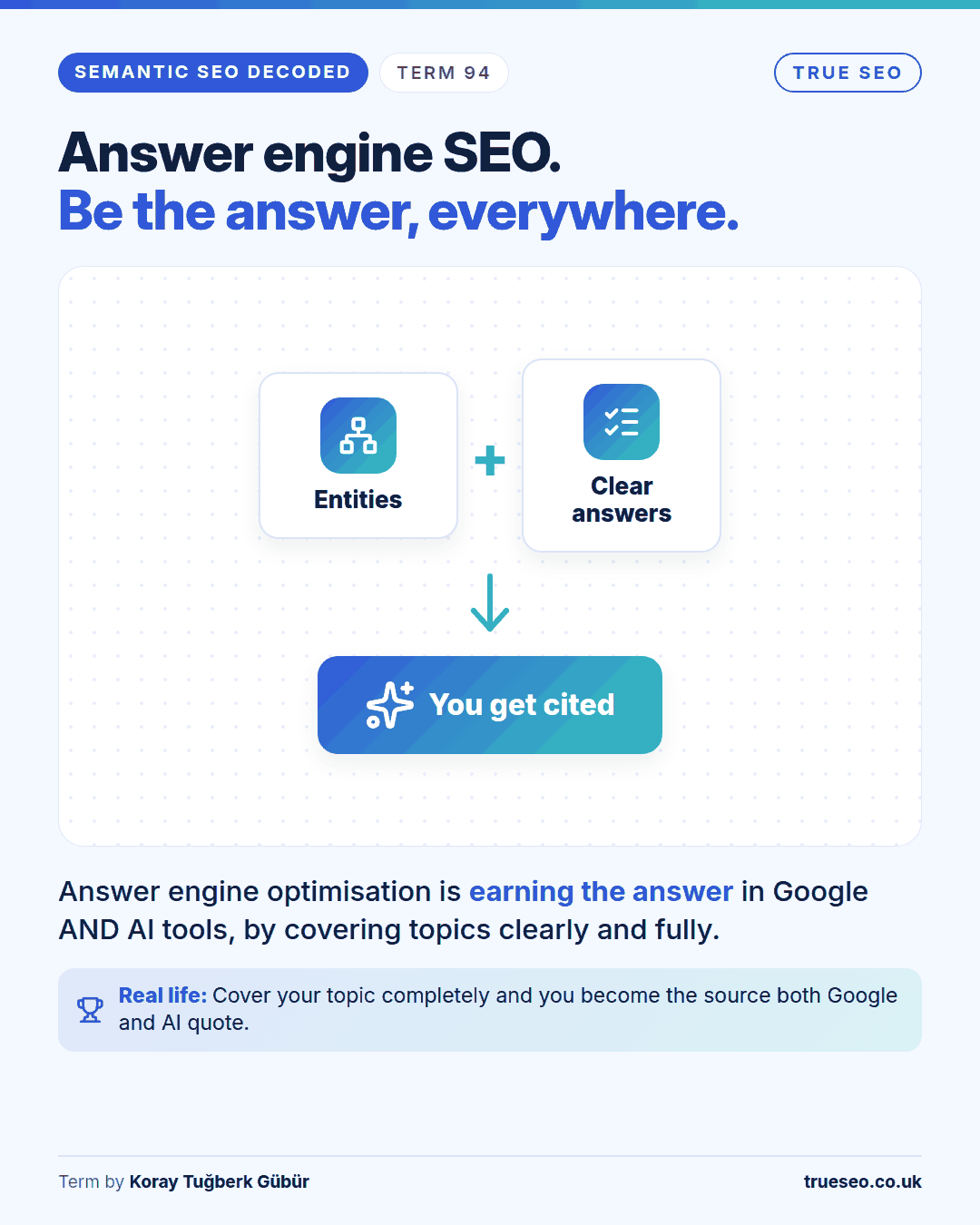
Answer engine SEO card. Tap to enlarge
Answer engine optimisation (AEO)
SEO industry term
Answer engine optimisation (AEO) is shaping content and business facts so search engines and AI assistants can lift them out as a direct answer. It covers featured snippets, voice answers, AI Overviews and chatbot replies.
AEO is industry vocabulary, and so is generative engine optimisation (GEO), a newer label for similar work aimed at AI-written answers. Jason Barnard of Kalicube says he coined it in 2017; that is his own claim. Koray’s framework supplies the groundwork, starting with source context. As quoted under AI Overviews, Google sets no extra requirements for its AI features. So AEO is good SEO with clear answers and clear entities.
At Example Heating: The landlord certificate page says what the certificate covers in its first sentence. Brand facts match everywhere, and the guides cover each step of the query path. Rhys then checks which AI answers mention the firm and fills the gaps, as our AI search optimisation service does.
Right way
The landlord certificate page says what the certificate covers in its first sentence, brand facts match everywhere, and Rhys checks which AI answers mention the firm.
Wrong way, and why
Hiring a separate “AEO agency” to rewrite every page into chatbot question blocks, apart from the SEO work. Google sets no extra requirements for its AI features, so running the two apart doubles the effort on the same pages.
Card note: The card’s title says “Answer engine SEO” and its footer credits Koray, but the term is not his.
AI search rewards the same foundations as everything before it, so the next section puts them together: Example Heating’s full topical map.
Example Heating’s topical map, start to finish
Example Heating’s topical map is the full plan of its website: one homepage, a core section of money pages, an outer section of helpful guides, and the links that tie them together. Here is the whole map in one table, so you can see the plan from Part 5 with every page in place.
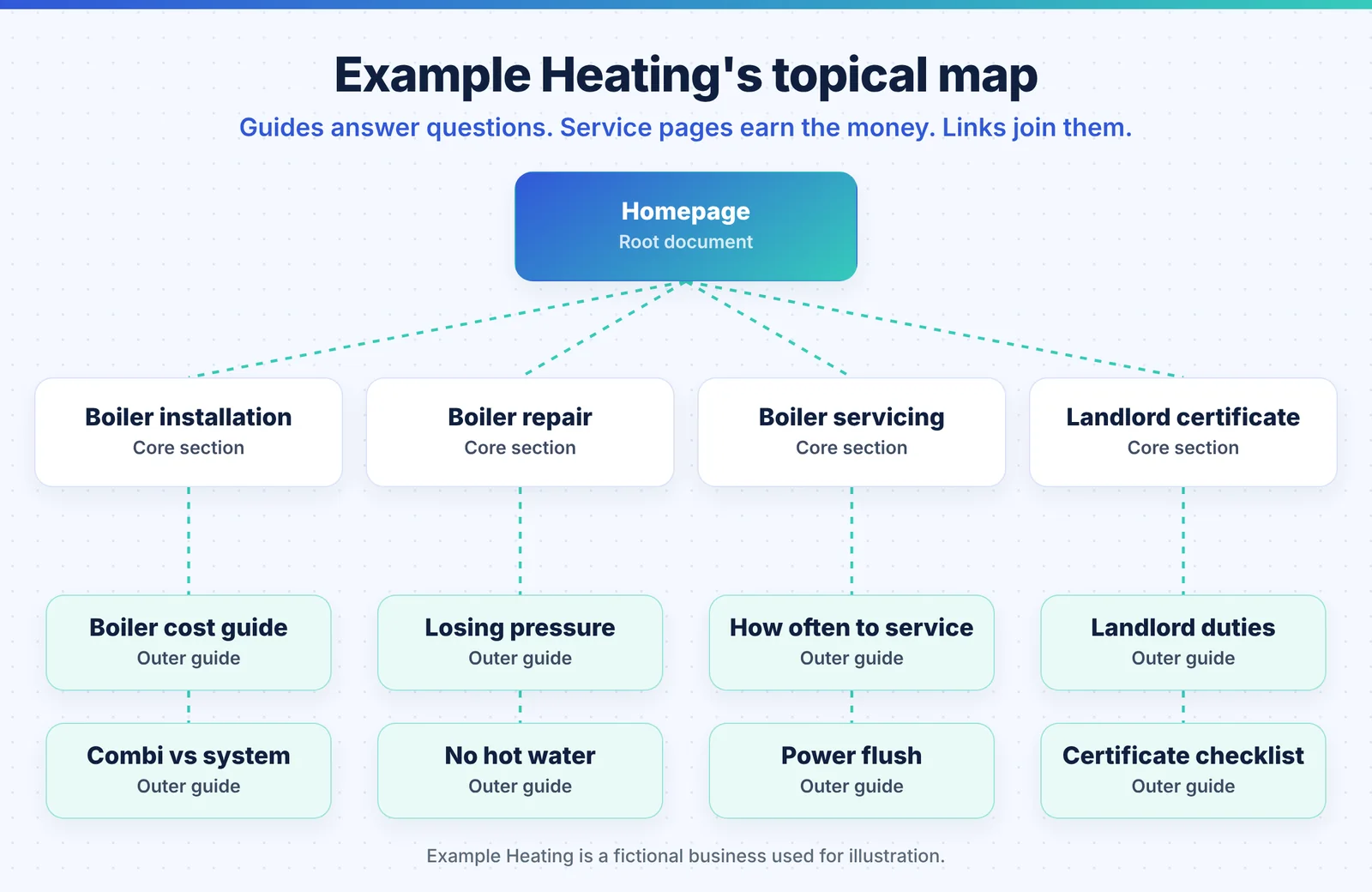
| Page | Section | Main search it answers | Links to |
|---|---|---|---|
| Homepage | Root document | boiler engineer Cardiff | Every core page and the best guides |
| Boiler installation | Core | new boiler installation Cardiff | Boiler cost guide, combi vs system guide, town pages |
| Boiler repair | Core | boiler repair Cardiff | Losing pressure guide, no hot water guide, emergency page |
| Boiler servicing | Core | boiler service Cardiff | How often to service guide, landlord certificate page |
| Central heating installation | Core | central heating installation Cardiff | Radiator guide, power flush page |
| Power flushing | Core | power flush Cardiff | What does a power flush do guide |
| Landlord gas safety certificate | Core | landlord gas safety certificate Cardiff | Servicing page, landlord duties guide |
| Emergency boiler repair | Core | emergency boiler repair Cardiff | Repair page, no heating checks guide |
| Boiler installation Penarth (and other towns) | Core | new boiler Penarth | Installation page |
| How much does a new boiler cost? | Outer | new boiler cost Cardiff | Installation page |
| Combi vs system boiler | Outer | combi vs system boiler | Installation page |
| Why is my boiler losing pressure? | Outer | boiler losing pressure | Repair page |
| How often should a boiler be serviced? | Outer | how often should a boiler be serviced | Servicing page |
| What does a power flush do? | Outer | what does a power flush do | Power flushing page |
| Radiator cold at the top | Outer | radiator cold at the top | Central heating page |
| How long does a boiler last? | Outer | how long does a boiler last | Installation page |
| Landlord gas safety: what the law requires | Outer | landlord gas safety rules | Certificate page |
Every outer guide links to the one core page it supports, every core page links back to the guides that answer its customers’ questions, and the homepage points to all of them. That is a semantic content network in miniature.
Three semantic SEO myths worth dropping
The three myths that waste most time are LSI keywords, keyword density and the idea that schema markup alone makes a site semantic. Each one sounds technical, so it is easy to believe. Clearing them out first keeps your effort on pages like the ones in the map above.
Myth 1: you need LSI keywords. LSI stands for latent semantic indexing, a document retrieval method from the late 1980s. The idea that Google ranks pages by “LSI keywords” is an SEO myth. Google’s John Mueller put it plainly on Twitter in July 2019: “There’s no such thing as LSI keywords”. Several pages that rank for semantic SEO still recommend them, and so does the UK AI Overview for “semantic seo” at the time we checked (29 October 2026). What those tools actually produce is a list of related words, which many guides call semantic keywords. Related words are useful, but for a different reason: they show which entity attributes and contextual vocabulary a complete page on the topic would naturally use. Example Heating’s servicing page mentions flue checks, gas pressure and the benefit to the boiler warranty because a real service covers those things, not because a tool listed them.
Myth 2: there is a perfect keyword density. Google’s spam policies name keyword stuffing, meaning loading a page with the same words to manipulate rankings. They say it can lower a site’s rankings or remove it from results. Example Heating’s boiler repair page should use the words a repair customer expects, such as pressure, pilot light and error code, because they belong there, not because a percentage says so.
Myth 3: adding schema makes a site semantic. Structured data, the code that labels a page’s facts for search engines, describes facts that are already on the page. Google’s own guidelines say structured data must be a true representation of the page content and must not mark up content readers cannot see. Schema cannot make a thin page useful.
How to start semantic SEO on your own website
Start with the business, not with keywords: write down your source context, choose your central entity, then plan pages before you write any. These eight steps follow the order of this guide.
- Write your source context in one sentence. Say what you do, for whom, where and how you earn. Example Heating’s sentence is in Part 3.
- Name your central entity and your topical border. Your central entity is the one thing every page comes back to. Your topical border marks the topics you will leave out.
- Collect the real searches. Use Google Search Console (Google’s free report on the searches your site already appears for), the People Also Ask boxes and related searches to list how your customers ask, from first problem to booking.
- Group searches into representative queries. Give each real need one page, rather than one page per wording.
- Draw the topical map. Core pages for what you sell, outer guides for what customers ask, and the links between them.
- Write every page answer first. The plain answer in the first sentence under every heading, then the detail, in the format the question wants.
- Link with meaning. Each guide links to the service it supports with words that describe the target.
- Publish steadily and keep pages current. A rhythm you can keep, with prices, rules and dates updated when they change.
Prefer to learn these steps with an experienced hand beside you? Our one to one SEO mentoring works through them on your own website, with you or your in-house team.
Quick check: how semantic is your website?
Eight questions about your own website. Answer honestly; nobody sees your answers, and the result points you to the part of this guide that will help most.
Answer all 8 questions about your own website, then select See my result.
Please answer all 8 questions to see your result.
Your score: 0 out of 16
Your site is still built around single keywords
Start with Part 3 of this guide. Write your source context and choose your central entity first, because every other step depends on those two decisions.
Your score: 0 out of 16
The foundations are there, the map is not
You know what your business is about. The next gain comes from a written topical map and links that join each guide to the service it supports. Parts 5 and 8 cover both.
Your score: 0 out of 16
You are already working semantically
The next gains come from depth and upkeep: information gain, steady publishing and keeping facts current. Parts 7 and 10 cover those, and an experienced mentor reviewing your map can show what is still missing.
How to tell whether semantic SEO is working
Semantic SEO is working when more of your pages show up for more of the questions in your topic, and when those visits turn into enquiries. You measure it in Google Search Console, which is free, rather than by checking one keyword.
Five checks, in the order we look at them:
- Queries per page. A query is a search someone types. In Search Console’s Performance report, open a page and count how many different searches it appears for. A topically strong page answers dozens of wordings, not one.
- Impressions across the whole topic. Impressions are the times your pages are shown in results. Filter queries that contain your central entity (“boiler” for Example Heating) and watch the total over three to six months.
- Pages with impressions. New guides should start appearing for searches within weeks of publishing. A guide with no impressions after two months is often not indexed or not matching a real search, so check both.
- Average position for the core pages. You want to see the money pages climb as the outer guides around them fill in.
- Enquiries from organic search. Calls, form fills and bookings are the point. Track them in Google Analytics or your booking system.
For Example Heating, check again three months after publishing the boiler problem guides. A good sign would be the repair page appearing for more fault searches (“boiler pressure dropping”, “boiler won’t fire up”), and more repair calls from people who first landed on a guide.
You don’t need expensive tools to start. Search Console, the People Also Ask boxes, the related searches on Google’s results page and a spreadsheet cover everything in this guide. Paid keyword tools help you find wordings faster; they don’t replace the thinking in Parts 3 to 5.
Frequently asked questions
Can you give me an example of semantic search?
Yes. Type “boiler keeps losing pressure, what do I do” into Google and the results include pages that never use that exact sentence. Google understands that “losing pressure”, “pressure dropping” and “pressure gauge below 1 bar” describe the same problem, and it matches the meaning, not the string. That is semantic search: matching what you mean rather than the exact words you typed.
What is the difference between semantic SEO and traditional SEO?
Traditional SEO picks a keyword and builds one page to rank for it. Semantic SEO starts with the business and its subject, plans every page the subject needs, and connects them so the whole site covers the topic. Example Heating could write one page for “boiler repair Cardiff” the traditional way. The semantic way adds the fault guides, the brand pages and the town pages that make the repair page the obvious answer.
Is SEO dead now that AI answers questions?
No. AI answers are built from web pages, so the pages still have to exist, be found and be trusted. Google’s AI Overviews link to the pages they draw on. The work changes shape: clear answers, well organised topics and real expertise matter more, and thin pages written for one keyword matter less. That shift is what semantic SEO was built for, which is why Part 11 of this guide covers AI search.
Do I need a topical map before I write anything?
You need the plan, not a perfect document. A one-page list of your core services, the questions customers ask about each, and how they link together is a topical map. Writing without one tends to produce random posts that compete with each other. Example Heating’s map fits on a single table, the one shown earlier in this guide. Our guide on how to create a topical map walks through it step by step.
How long does semantic SEO take to work?
Expect months, not weeks. New pages usually start showing in Search Console within weeks of being indexed, but rankings for competitive commercial searches build over several months as the topic fills in. Google’s own SEO Starter Guide says some changes take effect in a few hours and others can take several months. Publishing steadily matters more than publishing a lot at once.
Who is Koray Tuğberk Gübür?
Koray Tuğberk Gübür is a Turkish SEO and the founder of Holistic SEO & Digital. He developed the topical authority framework and named many of the terms in this guide, including source context, central entity, contextual vector and cost of retrieval. He publishes his method through his YouTube channel, Holistic SEO & Digital and articles on OnCrawl and Search Engine Land, and runs a topical authority course.
Is entity SEO the same as semantic SEO?
Entity SEO is one part of semantic SEO. It focuses on helping Google recognise the specific things on your site, such as your brand, your people, your services and your location, and connect them to facts it already knows. Semantic SEO includes that and adds the topic plan, the content and the internal links. Example Heating doing entity SEO would make sure Google knows “Example Heating” is a Cardiff heating firm with Gas Safe engineers. Doing semantic SEO, it would also build every page a boiler customer needs.
Does semantic SEO help local SEO and voice search?
Yes, because both depend on Google understanding meaning. Local searches are full of different wordings for the same need (“emergency plumber”, “boiler engineer near me”, “no heating Penarth”), and spoken questions are longer and more conversational than typed ones. A site that answers the real questions in plain sentences, with its location and services stated clearly, is easier to match to both. Example Heating’s town pages and fault guides do exactly that.
Credit: Koray Tuğberk Gübür
Twenty-four of the 94 terms in this guide, the ones tagged Koray framework term, come from Koray Tuğberk Gübür, founder of Holistic SEO & Digital, and his topical authority framework. We decoded these terms from his public teaching: his YouTube channel, Holistic SEO & Digital, his topical authority course at topicalauthority.digital, and his articles on OnCrawl and Search Engine Land. Mohammad A Mahmud, who wrote this guide, trained in his method. The worked example, the plain-English explanations and the cards are True SEO’s own interpretation. Koray has not reviewed or endorsed this guide, and any mistakes in it are ours. Where a term comes from Google, from computer science or from the wider SEO industry, the tag under its card says so.
True SEO Consultants Ltd is a semantic SEO and AI search consultancy based at Startup Stiwdio, University of South Wales, 86-88 Adam Street, Cardiff, CF24 2FN. We work with businesses across the UK remotely, from first call to monthly reporting. This framework is how we plan every client site, from the source context sentence to the last internal link.
Tap anywhere or press Esc to close