Schema markup tells a machine what your firm is, so it stops guessing.
For an accountancy practice the useful set is small. An AccountingService node with your regulator, address and telephone number, a Person node for each named accountant, a Service node for each thing you sell, and an FAQPage node where you already answer questions. That is most of the value, and most practices have none of it.
- 131 of 494 practices publish no structured data at all
- 86 more publish some, but no local business markup
- Four types cover almost all of the value
- Checking what you have takes ten minutes and costs nothing
- AccountingService
- Person
- Service
- FAQPage
- JSON-LD
- Rich Results Test
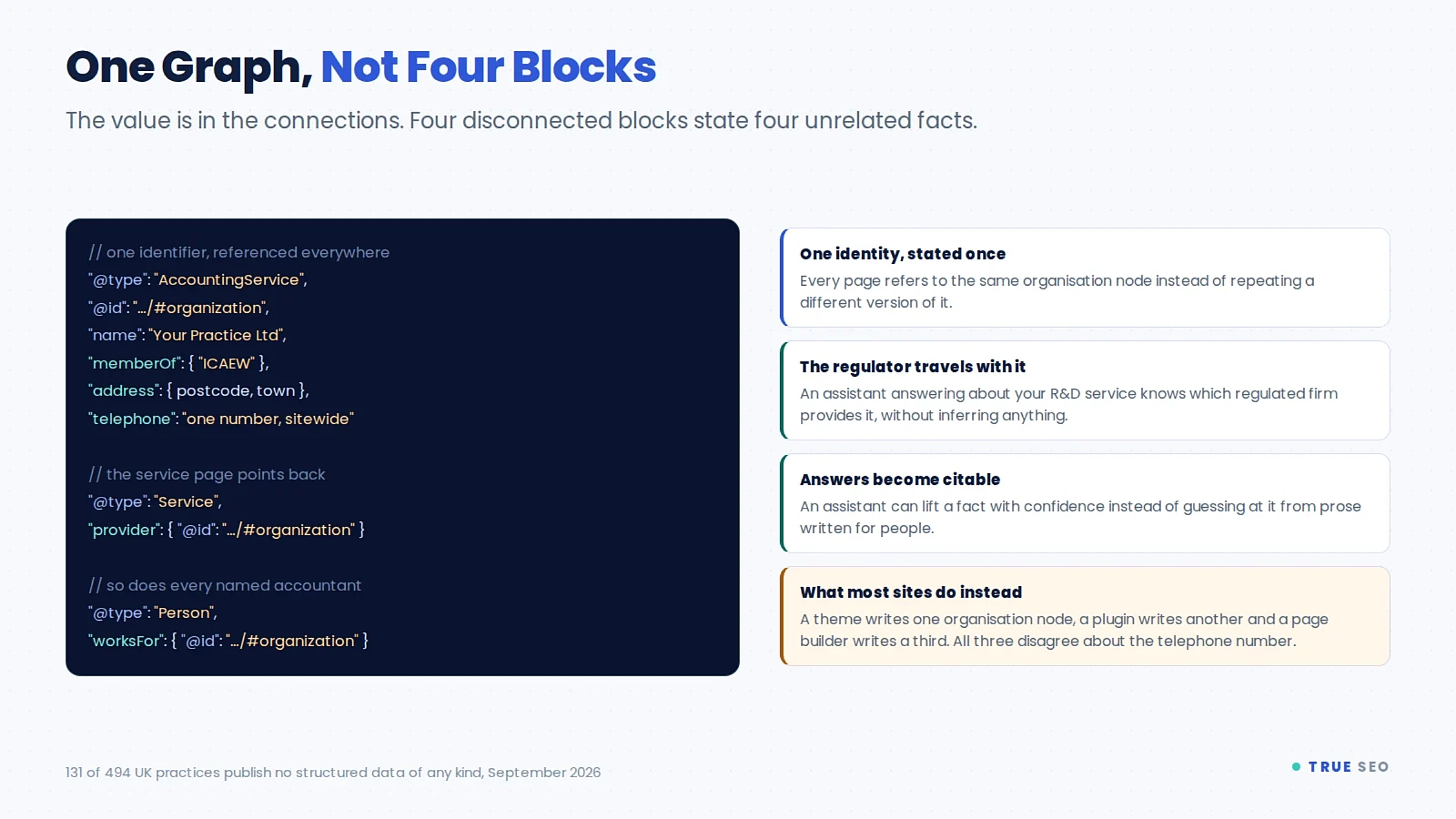
One graph, not four blocks. The value is in the connections. Four disconnected blocks state four unrelated facts.
Key takeaways
Seven things worth knowing before anybody installs another plugin.
- NotA ranking factorIt is not decoration eitherStructured data is how an engine reads your identity without inferring it, and inference is where an answer goes wrong or goes to a competitor.
- 131Of 494 firmsMore than a quarter publish none at allEverything about the organisation has to be read out of prose. That includes your location, your regulator and what you sell.
- 4TypesFour types cover almost all the valueAccountingService, Person, Service and FAQPage. Everything else on an accountancy site is optional.
- RuleGoogle’s own wordsThe markup must match the page“Don’t mark up content that is not visible to readers of the page.” FAQ markup with no FAQ on the page is the commonest breach we find.
- 60.9%No regulator statedYour regulator belongs in both layersThree practices in five never state it anywhere, so the fact separating you from an unregulated bookkeeper is missing from the text and the markup.
- 10%Maximum penaltyReview markup is the one to be careful withSelf-serving reviews are not eligible for rich results, and UK law has banned fake and incentivised reviews since April 2025, with penalties reaching 10 per cent of worldwide turnover.
- 10 minTo checkValidation is free and fastThe Rich Results Test and the Schema Markup Validator both tell you what an engine actually reads, which is not always what your plugin thinks it wrote.
Have it written as one graph, not eight blocks
Our SEO for accountants service writes the markup as one connected graph, so your organisation, your people, your services and your answers all point at each other and an assistant can follow them.
What is schema markup, and what does it do for an accountancy firm?
Schema markup is a block of structured data, usually written as JSON-LD in the head of the page, that states facts about the page in a format built for machines.
Your address, your regulator, the service the page describes, the questions it answers. The reason it matters more now than it did five years ago is that a growing share of searches never produce a list of links. Close to a third of UK Google searches show an AI summary above the normal results, and more than half of UK adults say they see these summaries regularly.
An assistant building one of those answers assembles it from structured data, directories, registers, reviews and third-party mentions, and it prefers sources where those agree with each other. A page with no structured data gives it nothing to lift, so it has to infer your location, your service area and your credentials from sentences written for people.
That is the practical difference for a practice. Not a ranking boost, but eligibility to be quoted. Our study of 494 UK accountancy practice websites found 131 firms publishing no structured data of any kind, so more than a quarter of the sector is invisible to that process.
What schema types does an accountancy website need?
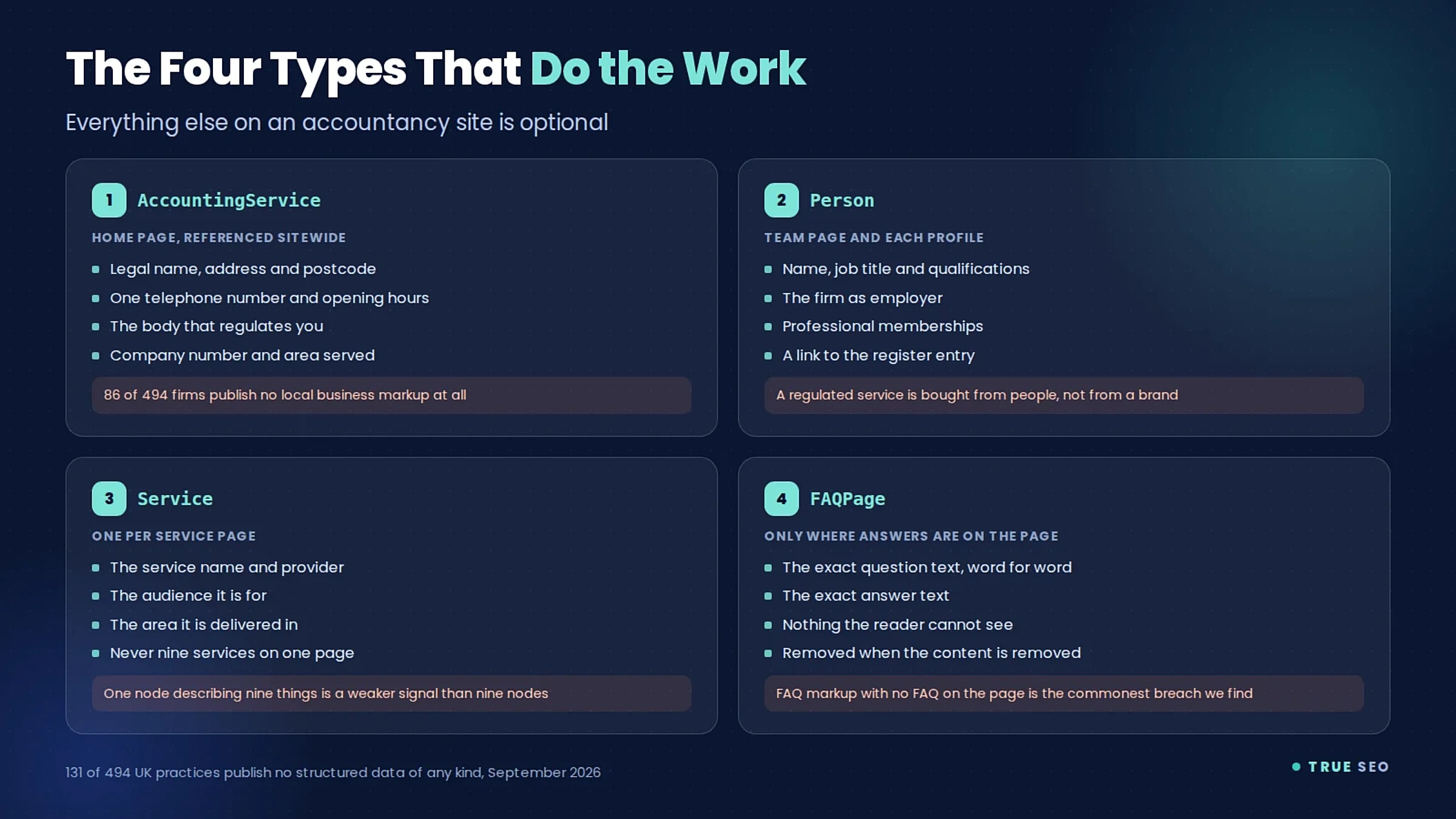
Four types cover almost all of the value, and they should be written as one connected graph rather than four separate blocks.
| Type | Where it goes | What it has to carry |
|---|---|---|
| AccountingService, or Organization where there is no public office | Home page, referenced sitewide | Legal name, address, postcode, telephone, opening hours, area served, company number, the body that regulates you |
| Person | The team page and each profile | Name, job title, qualifications, the firm as employer, professional memberships, and a link to the register entry where one exists |
| Service | Each service page, one per page | The service name, the provider, the audience and the area served. Never a list of every service on one page |
| FAQPage | Any page that already answers questions | The exact question and answer text that appears on the page, word for word |
Three things sit outside that list and are worth knowing about. BreadcrumbList is cheap, helps a search engine understand the hierarchy, and most themes generate it already. Article or BlogPosting belongs on your guides and blog posts, with a real author rather than the firm name. Review and AggregateRating are the ones to leave alone on your own site, for the reasons below.
How the four types fit together
The value comes from the connections, not from the blocks. A graph where the Service node names the Organization as its provider, the Organization names its regulator, and the Person nodes name the Organization as employer, tells a machine one coherent story.
// one identifier, referenced everywhere
"@type": "AccountingService",
"@id":   ".../#organization",
"memberOf": { "ICAEW" },
"telephone": "one number, sitewide"
// the service page points back
"@type": "Service",
"provider": { "@id": ".../#organization" }
// so does every named accountant
"@type": "Person",
"worksFor": { "@id": ".../#organization" }
In practice that means giving each node a stable identifier and referring to it from the others rather than repeating the details. An assistant following those references can answer a question about your research and development service and know, without inferring anything, which regulated firm provides it and where.
That is also why a plugin’s default output is usually thin rather than wrong. It generates the blocks. It does not know that your practice is regulated by ICAEW, that two partners hold a specific qualification, or that the page it is describing is about one service rather than nine.
What has to be in your organisation markup
Everything a stranger would want to know before instructing you, and every item of it should also be visible on the page.
Who and where you are
Legal name, address with postcode, one telephone number, email and opening hours.
What makes you a regulated firm
The professional body that regulates you, your company number, professional indemnity cover, and your anti-money-laundering supervisor.
The trust block is where the sector fails. Across the 494 firms, 60.9 per cent never state which body regulates them anywhere on the site, 7.5 per cent say they hold professional indemnity cover, and two of the 494, 0.4 per cent, name an anti-money-laundering supervisor. Every one of those is a fact you can evidence from your own records, and every one is permitted by both institutes, which we worked through in what the ICAEW and ACCA codes actually allow a practice to publish.
The coverage block is the area you serve and, if you have more than one office, one node per office rather than a single blended entry. That is the same structural point we made about the pages themselves in why one page cannot serve three towns.
The rules Google applies to all of it
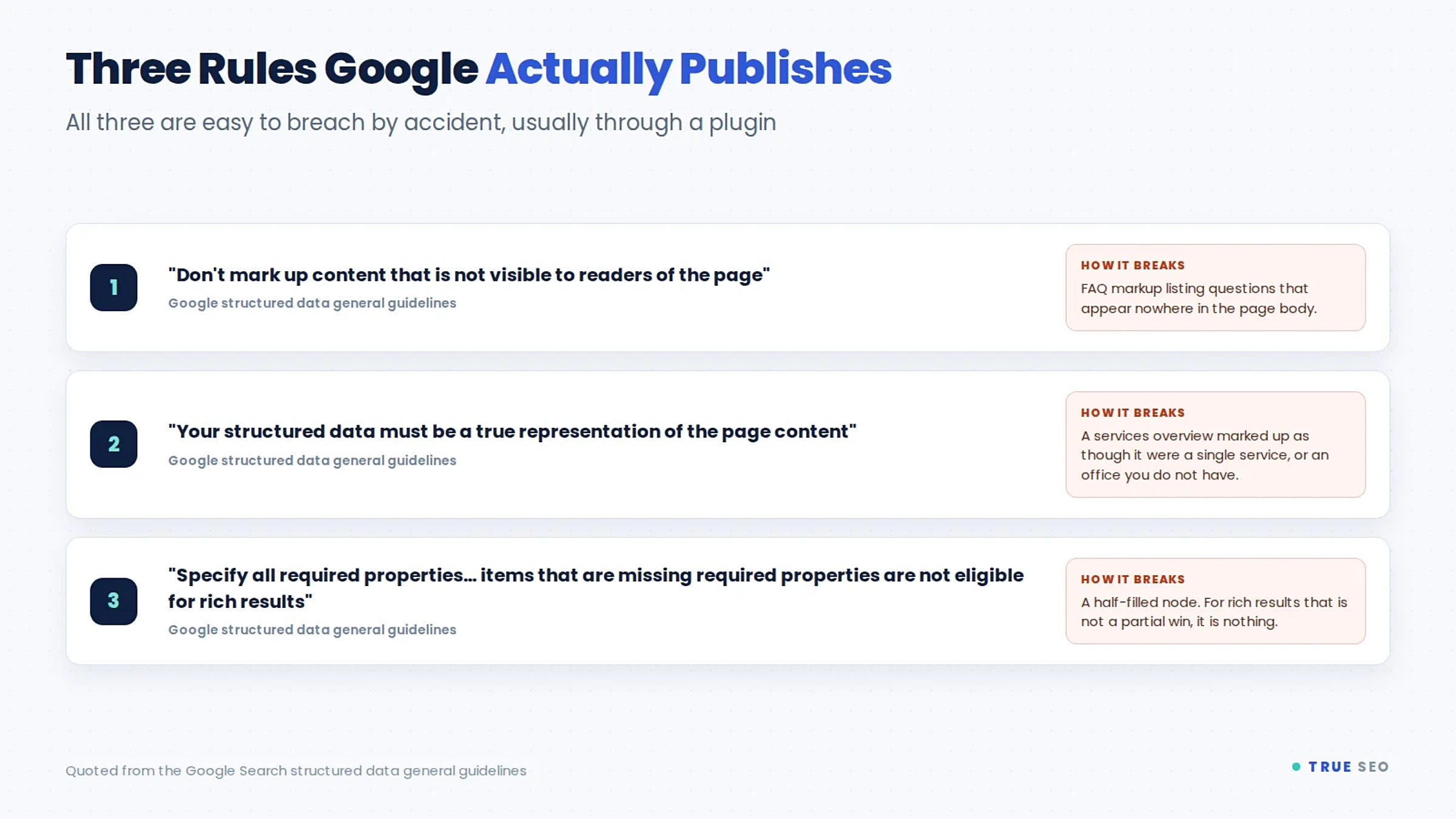
Three rules, all published, all easy to breach by accident.
- 1
“Don’t mark up content that is not visible to readers of the page”
Google structured data general guidelinesHow it breaks: FAQ markup listing questions that appear nowhere in the page body, usually arriving with a plugin rather than a decision. - 2
“Your structured data must be a true representation of the page content”
Google structured data general guidelinesHow it breaks: a services overview marked up as though it were a single service, or an office you do not have. - 3
“Specify all required properties… items that are missing required properties are not eligible for rich results”
Google structured data general guidelinesHow it breaks: a half-filled node. For rich results that is not a partial win, it is nothing.
Where practices get it wrong
Six patterns account for most of what we find, and none of them require bad intent.
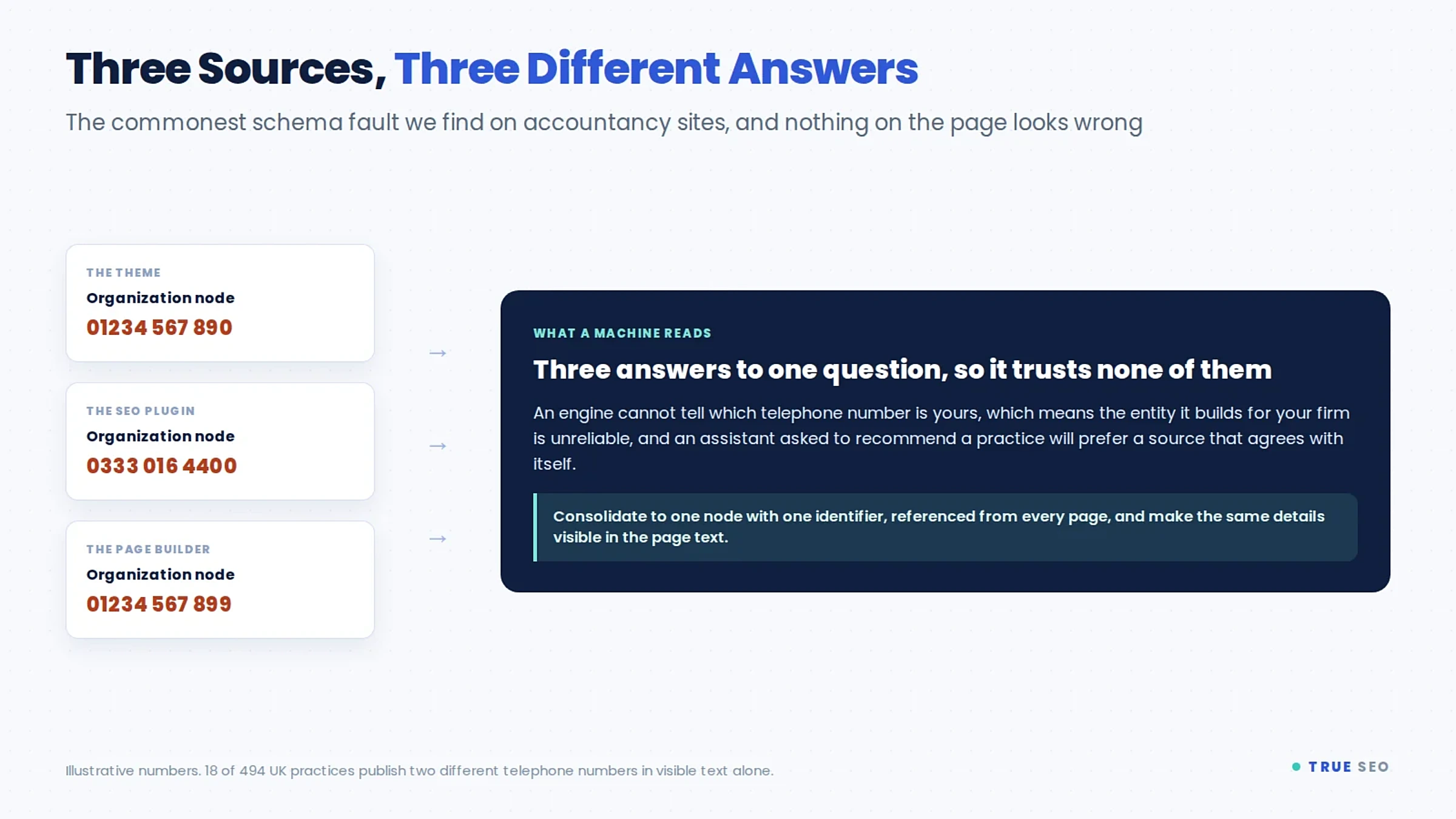
- Duplicate organisation nodesThe theme writes one, the SEO plugin writes another, a page builder writes a third, and they disagree about the telephone number. An engine reading three different answers to the same question trusts none of them.
- FAQ markup with no FAQ on the pageA plugin field was filled in and the content was never added, or the content was removed and the markup stayed.
- Service markup listing every service on one pageOne page describing nine services is one node describing nine things, which is a weaker signal than nine pages with nine nodes, and it is why the advisory work you want never surfaces.
- Self-serving review markupReviews collected and displayed on your own site are not eligible for rich results, and since April 2025 UK consumer law has banned fake reviews and concealed incentives outright, with penalties that can reach 10 per cent of worldwide turnover.
- Markup on the wrong pageGoogle’s guidance is to put the structured data on the page that it describes, so the Service node belongs on the service page rather than bundled into the home page graph.
- Stale markupA node carrying an old address, a departed partner or a superseded price is worse than no node, because it is a machine-readable statement that is untrue.
How to check what your site actually declares
Two tools, ten minutes, no cost.
- The Rich Results TestTells you which rich result types Google can detect on a URL and what is missing from each. That is the commercial question: is this eligible for anything.
- The Schema Markup ValidatorRun by Schema.org, it reports everything present regardless of whether Google uses it, which is the diagnostic question: what does this page actually declare.
- Search Console, over timeThe Enhancements reports show the same information week by week, so a fault arriving with a plugin update appears there before anybody notices the rich result has gone.
Run both validators on your home page, one service page and one blog post, then read the output against your own site. The two things worth looking for first are duplicate organisation nodes with conflicting details, and FAQ or review markup describing content that is not on the page.
Does schema markup improve rankings?
Not directly, and any supplier telling you otherwise is selling. Structured data does not make a page rank higher for a query it already ranks for.
What it does is change what the result looks like and whether the page is eligible for anything beyond a plain link, and that changes the click-through at the same position. It also changes whether an assistant can lift a fact from your page with confidence, which is a different and growing channel.
For an accountancy practice the honest framing is this. Markup will not rescue a page nobody wants to read. It will make a good page eligible for treatments a competitor’s good page is already getting, and it will make your identity readable to the systems now assembling answers on your behalf. If your firm is not ranking at all, the cause is usually further up the order, which we set out in the diagnostic sequence for a practice that is not appearing in search.
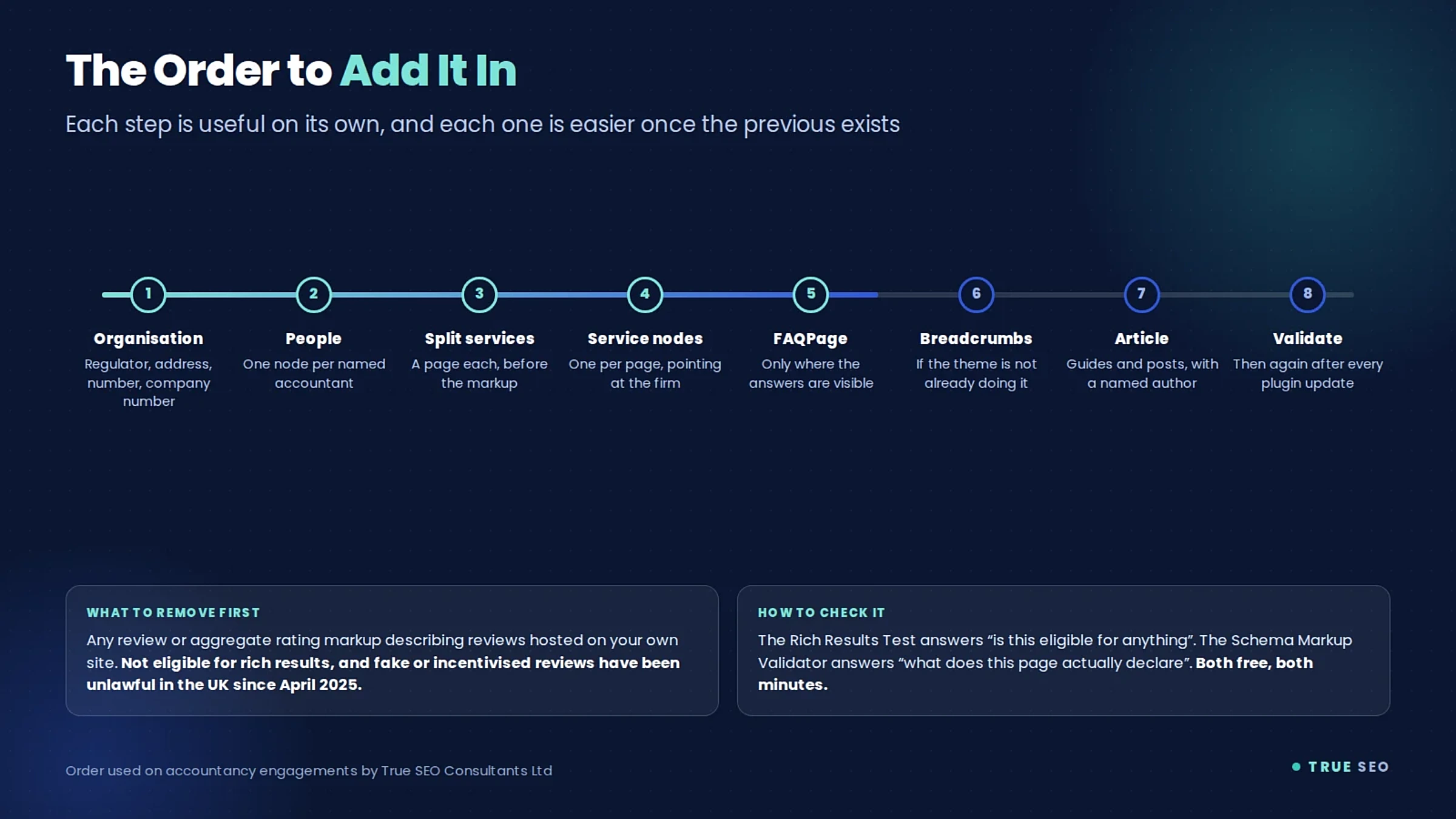
The order to add it in
Each step is useful on its own, and each one is easier once the previous one exists.
- Write the organisation node firstWith the regulator, the address, the telephone number and the company number, and make every one of those facts visible on the page as well.
- Add a Person node for each named accountantWith qualifications and the professional body.
- Split the services page into a page per serviceDo this before writing any Service markup, because the markup describes a page.
- Add one Service node per pageEach pointing back at the organisation node as its provider.
- Add FAQPage markup only where the questions are on the pageWord for word, the same text a reader sees.
- Add BreadcrumbList if your theme is not already producing itCheap, and most themes do it already.
- Add Article markup to guides and blog postsWith a named author rather than the firm name.
- Remove review and aggregate rating markup from your own domainThen validate, and set a reminder to re-validate after any plugin or theme update.
Two practices, and what the markup changed
Neither change moved a ranking. Both changed what a machine could say about the firm.
A practice had a plugin generating an Organization node on every page, a theme generating a second one, and a page builder adding a third on the contact page. All three carried a different telephone number, one of which had not been in use for two years. Nothing on the site looked wrong to a visitor.
Consolidating to one node with one identifier, and adding the regulator and the company number, was a morning’s work. It was the first time the site had told a machine one consistent thing about the firm.
A single-office practice had strong service pages and nothing beyond what the theme produced. Adding a Service node per page, each referring to one organisation node carrying the regulator and the professional indemnity statement, did not move any ranking.
What changed was that an assistant asked to recommend a firm for its specialism started returning the practice with the correct regulator attached, which it had previously got wrong.
Get your first month of SEO free
Answer five questions and we will tell you what your site currently declares to a machine, which for most practices is less than they expect.
First month free · a few places at a time
Your first month of SEO, free
Answer three quick questions to claim yours.
Thank you, that is with us.
We will email your onboarding form and payment link, and call within one working day if you would rather talk it through first.
Pick a time that suits you below. We will confirm by email too.
Frequently asked questions
Do I need schema markup on an accountancy website
Yes, if you want machines to read your identity rather than infer it. A quarter of UK practices publish none, which means their location, regulator and services are being guessed at by the systems now assembling search and AI answers.
Which schema type should an accountancy firm use
AccountingService for a practice with a public office, or Organization where there is no office a client would visit, plus Person for each named accountant, Service for each service page and FAQPage where questions are genuinely answered on the page.
Does schema markup help with rankings
Not on its own. It changes eligibility for rich results and how readable your identity is to an AI assistant, which affects click-through and citation rather than position.
Can I add review markup to my own website
Reviews you collect and display yourself are not eligible for rich results, and UK consumer law has banned fake and incentivised reviews since April 2025. Collect reviews on the platforms that host them and leave your own domain unmarked.
Will my SEO plugin do this for me
Partly. A plugin generates the blocks but does not know your regulator, your qualifications or which single service a page is about, and it is a common source of duplicate organisation nodes that contradict each other.
How do I know whether my markup is working
Run the Rich Results Test and the Schema Markup Validator on a few URLs, then watch the Enhancements reports in Search Console over time. Both are free and both take minutes.
Where this leaves your practice
The part of your website that speaks to machines currently says nothing
That was not a decision anybody took. It is what a theme and a plugin produce when nobody tells them what the firm is, which is why the fix is usually a morning rather than a project.
True SEO Consultants Ltd, based at Startup Stiwdio, University of South Wales, 86-88 Adam Street, Cardiff, CF24 2FN, works with accountancy practices across the UK and onboards firms worldwide through a fully remote digital onboarding and delivery process. We write the graph once, connect it properly, and hand you the validation output so you can see what changed.