A place name on its own is not a subject.
Location pages fail when they carry nothing that is true only of that town. A page headed “Accountants in Newport” that repeats the Cardiff page with one word changed is a page about your firm with a place name typed into it, and a search engine has no reason to rank it above the version you already published.
- Google names pages targeted at specific regions or cities in its doorway policy
- Scaled content abuse applies no matter how it’s created
- 17.4% of 494 UK practices publish no local business markup
- Fewer pages, written properly, beat more pages written to a template
- Doorway abuse
- Scaled content abuse
- Service-area pages
- LocalBusiness markup
- Map pack
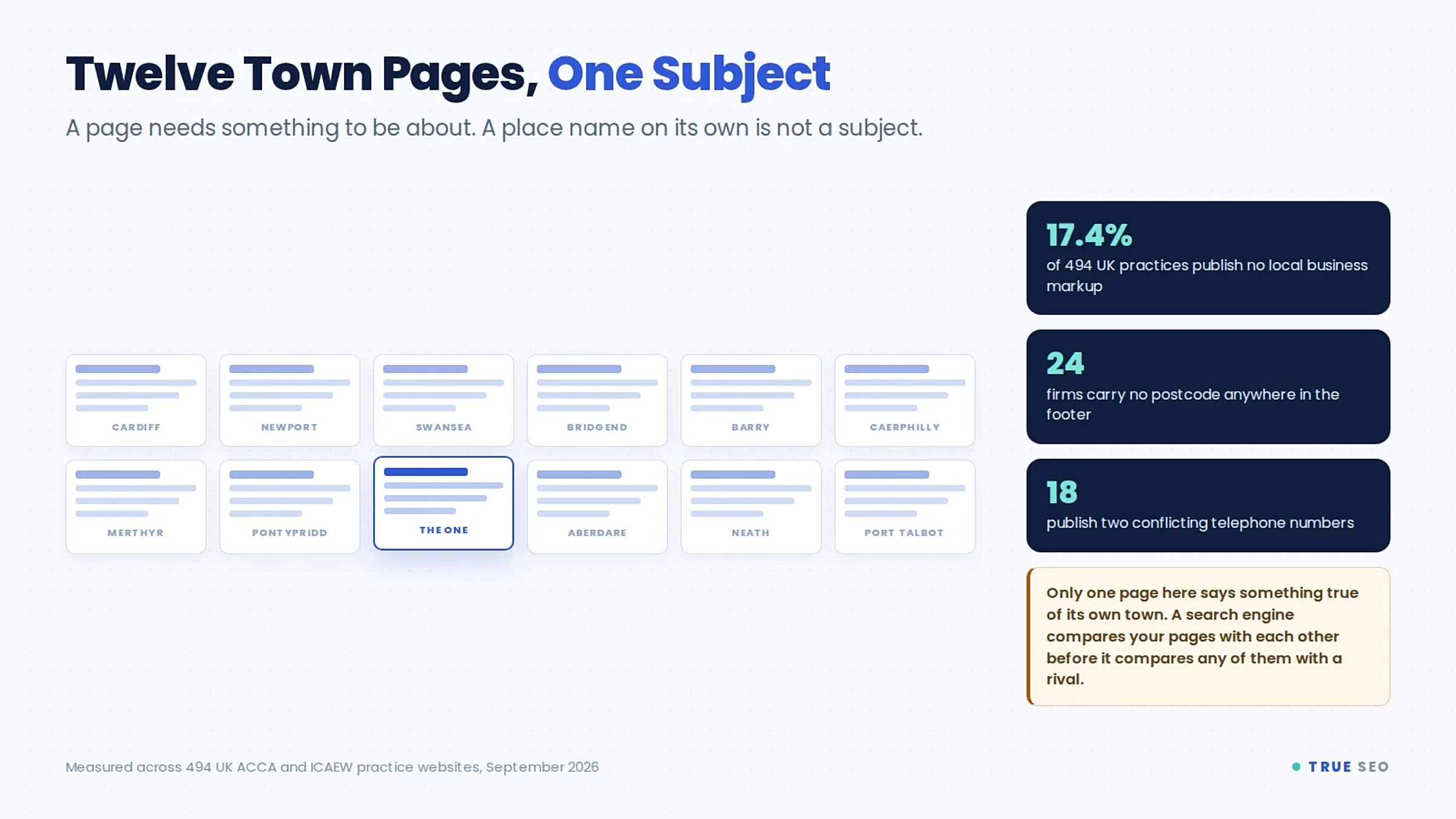
Twelve pages, one subject. A search engine compares your pages with each other before it compares any of them with a rival.
Key takeaways
Seven findings a practice owner can act on before the next agency proposal arrives.
- 1The mechanismLocation pages fail on uniqueness, not on effortWhere the only difference between two pages is the town name, you have published the same page twice.
- PolicyGoogle’s own wordingThe test is written downDoorway abuse names “pages targeted at specific regions or cities that funnel users to one page”. That is the standard multi-town build.
- 2ndPolicyA town-swap template is now covered twiceScaled content abuse covers unoriginal content produced at volume, no matter how it’s created.
- 3Ranking inputsThe website is one input of threeLocal results weigh proximity, prominence and relevance. A better page cannot outrank a better-established profile on its own.
- 17.4%No local markupThe foundation is usually missing86 of 494 firms publish no local business markup and 131 publish no structured data at all. The pages sit on nothing.
- 1–5Right numberFewer pages, written properlyOne page per place you can say something true and specific about. For most practices that is a smaller number than the one they were sold.
- NicheBetter termA specialism beats a town adjective“Accountant in Bridgend” is contested by every practice in Bridgend. “Construction accountant in Bridgend” is contested by almost nobody.
Start with the pages you already have
Our SEO for accountants service audits the location pages a practice already has and decides, page by page, whether each one can earn its position or should be consolidated into one that can. That usually removes pages rather than adding them, which is not what most firms expect to hear from an SEO consultancy.
Why do accountancy location pages fail?
They fail because they answer a query the firm invented rather than one anybody types.
A practice decides it wants to be visible in six towns, so it publishes six pages. Nobody checks whether people in those towns search that way, whether the practice can say anything about those towns, or whether the pages will end up competing with the service page that was already ranking. Four faults do nearly all the damage, and they usually travel together.
- UniquenessSearch engines compare your Newport page with your Cardiff page before they compare either with a competitor. Where the two are ninety per cent identical, one is redundant by definition, and the engine picks which one to keep rather than ranking both.
- EmptinessFiller about the town’s history, its transport links and its business community reads as padding because it is padding. None of it tells a business owner in that town anything about instructing your firm.
- DilutionSix thin town pages take internal links, crawl attention and topical signals away from the service page that was doing the work. The practice ends up with seven pages that half-rank instead of one that ranks.
- No way to actA visitor who reaches the Newport page and decides to move accountants finds the same generic contact form as everywhere else, with no named person, no local number and nothing that says this office wants their work.
Most practices did not choose this. The pages arrived as a deliverable, twelve of them, written to a template because a template was what the budget bought. Nobody set out to publish something thin. It is what happens when the brief is “cover these towns” rather than “say something about each town that is worth reading”.
What is a doorway page, in Google’s own words?
A doorway page is a page created to catch a search rather than to serve a reader, and Google states the test plainly.
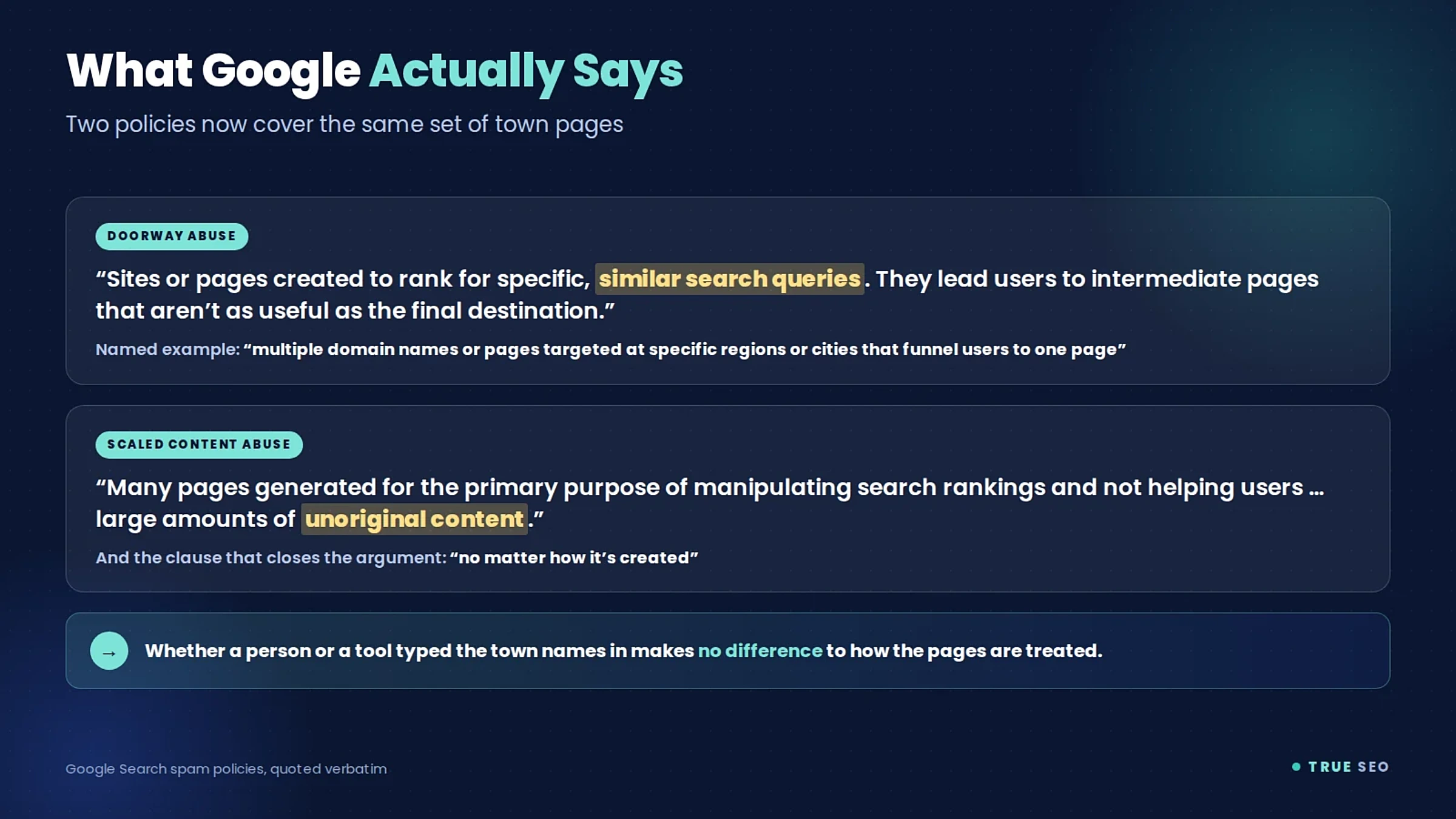
“Doorway abuse is when sites or pages are created to rank for specific, similar search queries. They lead users to intermediate pages that aren’t as useful as the final destination.”
Named example: “multiple domain names or pages targeted at specific regions or cities that funnel users to one page”
Google Search spam policies
The examples matter more than the definition, because one of them describes the standard multi-town build almost exactly. Google also names “creating substantially similar pages that are closer to search results than a clearly defined, browseable hierarchy”.
Read that against a set of town pages whose only job is to push the reader to the same contact form. The pages exist to be entered from search. They add nothing between the search and the destination. That is the pattern the policy names.
Nothing in this makes local pages forbidden. A page for an office people can walk into, staffed by named people, describing work done for clients in that area, is not an intermediate page. It is the destination.
Does a town-swap template count as scaled content abuse?
Yes, on the plain wording. Google defines scaled content abuse as when “many pages are generated for the primary purpose of manipulating search rankings and not helping users”, and describes the practice as “creating large amounts of unoriginal content that provides little to no value to users, no matter how it’s created”.
That last clause closed the argument most agencies used to make. It no longer matters whether a person wrote the thirty city pages or a model did. The policy is about the output, not the method. Thirty pages generated from one template with the town name substituted are thirty unoriginal pages, however they were produced.
Worth knowing before the next proposal. An offer of forty location pages is an offer to publish thirty-nine near-duplicates, and the person selling it is unlikely to put it that way.
How do you tell a doorway page from a legitimate local landing page?
Three questions settle it, and they can be answered about any page in about a minute.
- Is anything on it true only here?A named person at that office. A local telephone number. Sectors that cluster in this town and not the next one. Work you have actually done nearby.Yes, it can rank hereNo, it is a template
- Can the visitor finish something?Booking a meeting at that office, calling the number that rings that desk, downloading the guide that suits the local trade base.Yes, it is a destinationNo, it is an intermediate page
- Would it exist without search engines?A practice with a real office in Newport would publish a Newport page anyway, because clients need to know where to go.Yes, keep it and improve itNo, nothing will make it true
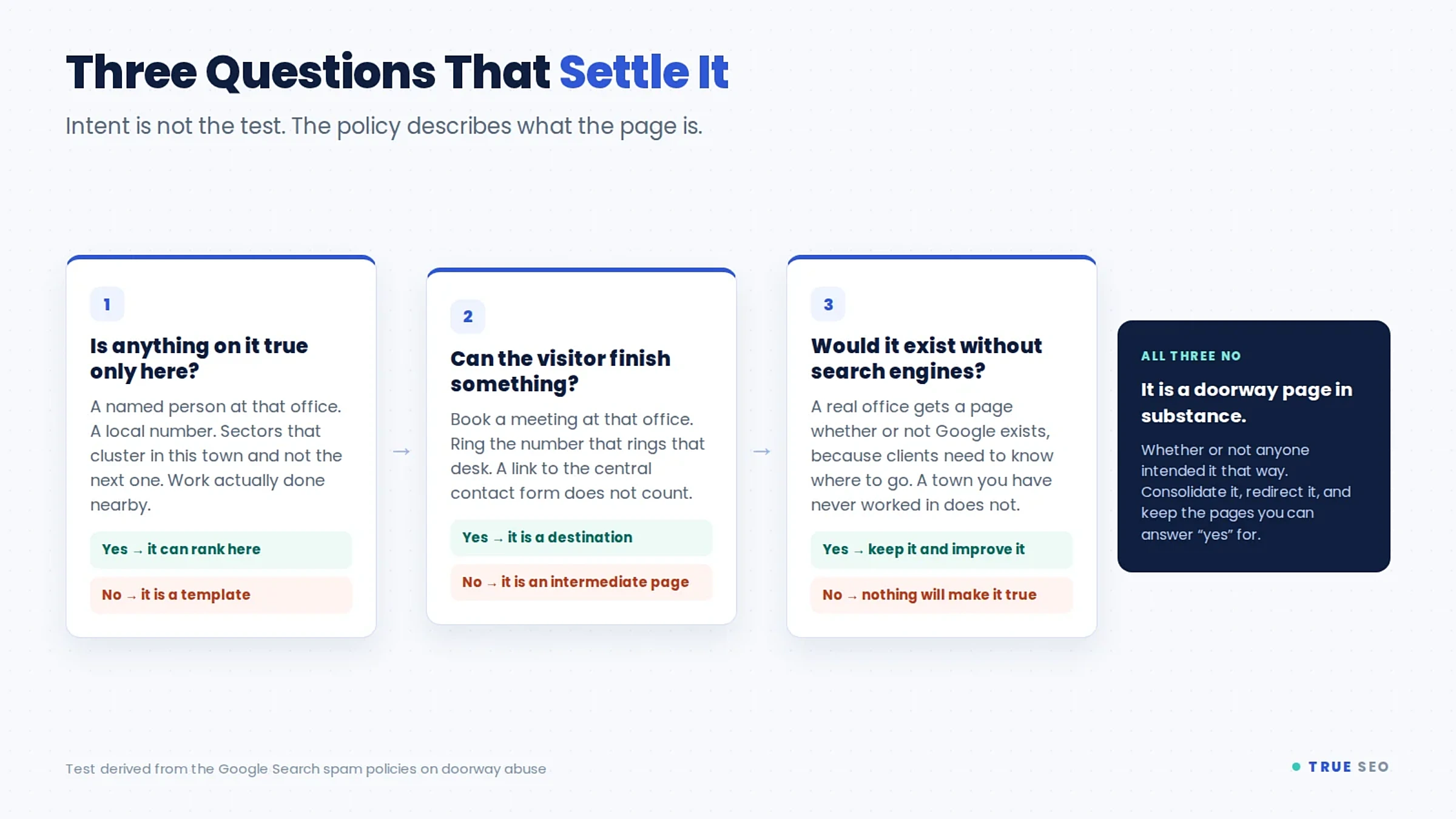
Any page failing all three is a doorway page in substance, whether or not anyone intended it that way.
Why does a competitor with a worse website outrank us locally?
Because the website is one of three inputs, and it is not the heaviest.
Local results weigh proximity to the searcher, prominence of the business and relevance to the query, and a Google Business Profile carries the first two more directly than any page you can write. That is why a practice with an ordinary site, a complete profile, a local number, forty reviews naming real services and a correct address across the directories beats a practice with a better site and a half-finished profile. The better page cannot compensate for a missing entity.
It also explains why the same search produces different results for two people in the same county. Local rankings shift with the searcher’s position, so a business owner in Aberdare and one in Bridgend can type the same phrase and see different firms, and both results are real. A rank tracker reading from one fixed point cannot see that, which is why a report showing position three for a town term is not evidence that anyone in that town is finding you.
What has to be on an accountancy location page before it can rank?
Six things, and a page missing more than two will struggle regardless of how well it is written.
| What the page needs | Why it counts | What usually goes wrong |
|---|---|---|
| The address and postcode in text, not in an image | Search engines and answer engines read text; neither reads a picture of your footer | 24 firms have none |
| Local business or accounting service markup | States your location, hours and service area in a format built to be read by machines | 17.4% publish none |
| One telephone number, the same everywhere | A second number sends part of your enquiries to a desk nobody answers | 18 publish two |
| Named people at that office | A regulated service is bought from people; a page with no names is a brochure | Team pages sit centrally and location pages never name anyone |
| The sectors that office actually serves | The only content on the page that cannot be copied to the next town | The section is filled with the town’s history instead |
| A way to act from that page | A visitor deciding to move accountants will not go hunting for a form | A single link to the central contact page |
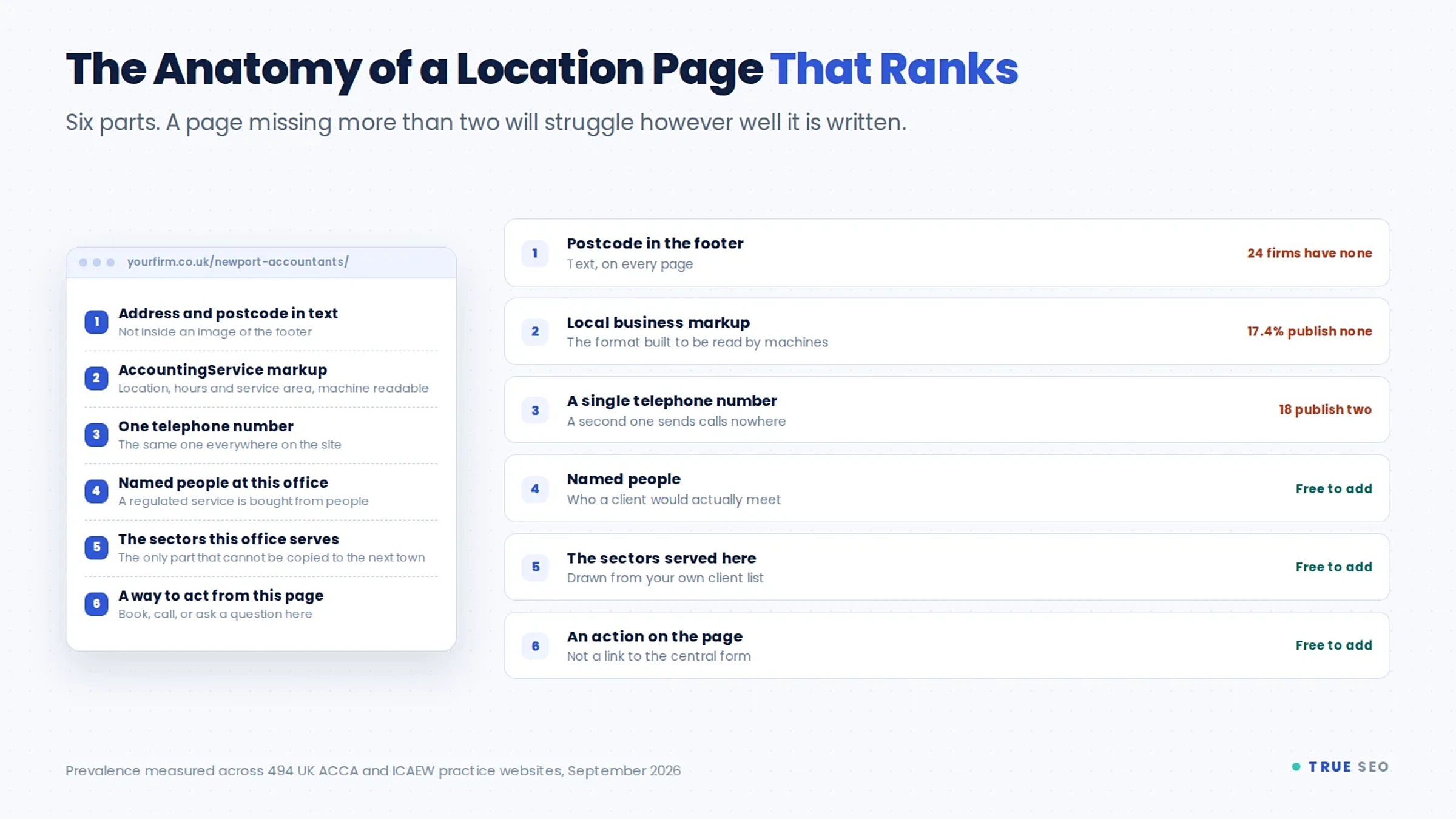
Those figures come from our own study of UK practice websites. The full research across 494 ACCA and ICAEW practice websites measured thirty-six faults in one pass, and the contact-detail group turned out to be the most tightly linked of all of them.
Why do the contact details go wrong together?
They go wrong together because they are one job nobody was given, not five separate mistakes.
In the 494-firm dataset, missing local business markup, an untappable telephone number, conflicting telephone numbers, an absent footer postcode and a missing contact page all associate strongly with one another once site size is controlled, with common odds ratios between 4.3 and 56.5.
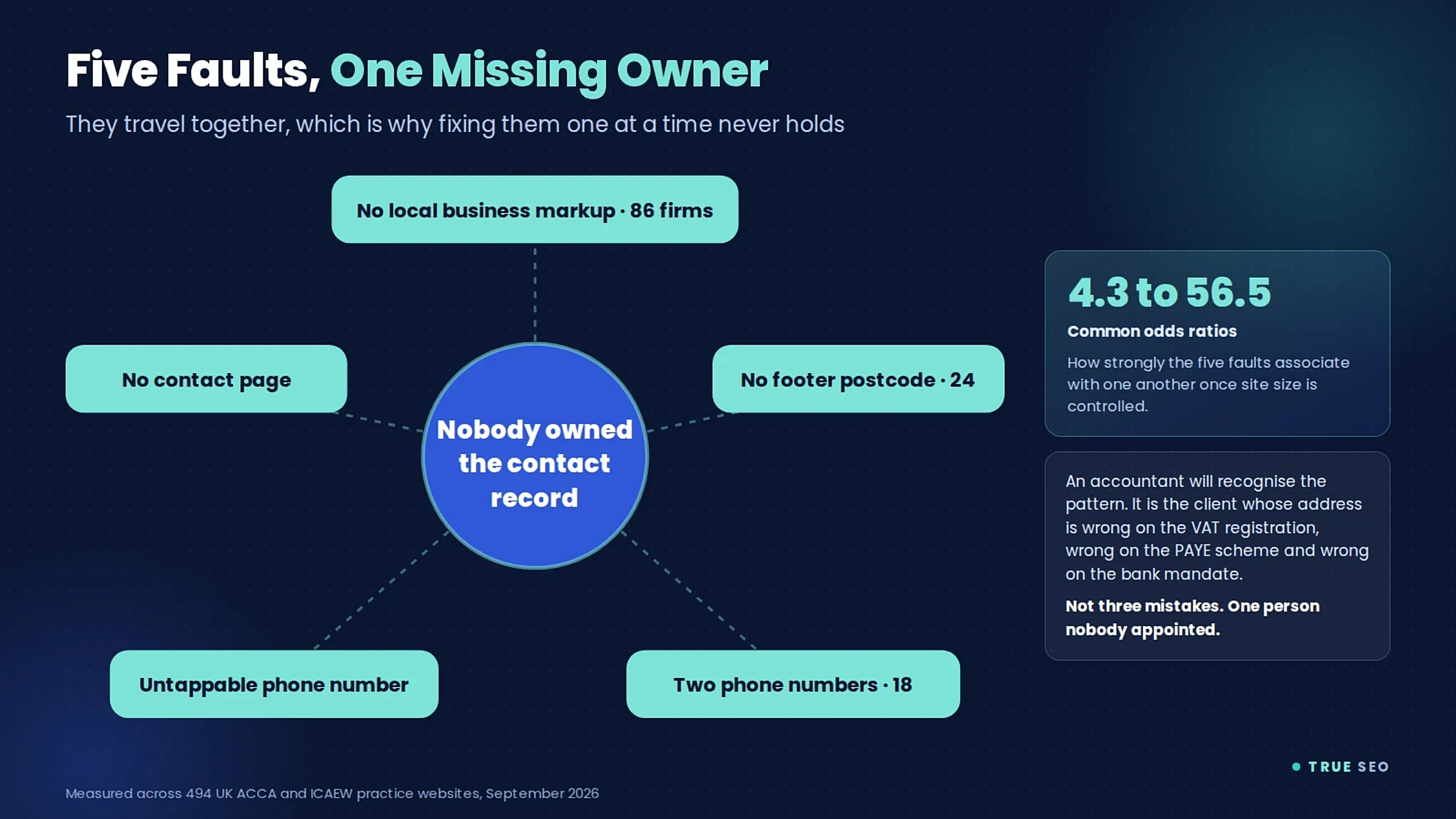
An accountant will recognise the pattern immediately. It is the client whose address is wrong on the VAT registration, wrong on the PAYE scheme and wrong on the bank mandate. The practical consequence is that fixing these one at a time never holds. Write the firm’s name, address, postcode and telephone number once, in one place, and make every page and every directory take it from there.
Office page or service-area page: which do you need?
An office people can visit gets an office page with an address. A town you serve without premises gets a service-area page, and it does not get an address, because inventing one is worse than having none.
The difference is not cosmetic. An office page can carry local business markup with a street address, can support a Google Business Profile at that location and can compete in the map pack. A service-area page can do none of those things. It competes in the normal results only, and it wins on the strength of what it says rather than on where you are.
That constraint is useful, because it forces the honest version. A service-area page for a town forty minutes away should say what the firm actually does for clients there: remote onboarding, quarterly meetings by video, an annual visit, whatever the truth is. Read against ICAEW and ACCA wording, that is also the safer version. We set out what the two codes permit and prohibit in the marketing rules both institutes apply to what a practice publishes, and an implied office you do not have is misleading by implication under both.
Can you rank in a town where you have no office?
Yes in the organic results, and no in the map pack. The map pack draws on Google Business Profiles, and a profile needs a real address or a declared service area, so a town with no premises will not put you on the map.
The organic results are open. They rank pages, not businesses, and a page that answers a question better than the local firms can win the position. The route is almost always a specialism rather than a place. A page on VAT for hospitality businesses will pick up searchers in twenty towns, including towns where you have no presence at all, because the person searching cares more about the specialism than about the postcode. That is a better use of the same effort than a service-area page for each town.
How many location pages should a practice have?
One for each place you can write something true and specific about. For a single-office practice that is usually one page. For a three-office practice it is three. It is almost never twelve.
The counting rule is simple. Write the list of towns, then next to each one write the sentence you could publish about it that you could not publish about the others. Where the sentence does not come, the page does not get built. Nobody ever regretted having four good location pages instead of fourteen weak ones.
Practices with two to five offices need one further thing: an internal linking shape that stops the pages competing. Each office page links up to the service page and across to the other offices, and the service page links down to all of them. Nothing links sideways at random. That gives search engines a clear hierarchy to read instead of a flat set of near-identical siblings.
Why does a specialism beat a town name for accountants?
Because a specialism is a claim you can substantiate and a town is a claim everyone in it makes.
Every practice in Bridgend is entitled to say it is an accountant in Bridgend. Very few can say they act for eleven construction subcontractors and understand the domestic reverse charge, and that sentence is worth more because it is rarer and because it self-qualifies the reader.
This holds across every professional category True SEO works in. Solicitors get shortlisted on named practice areas before location enters the decision. Financial advisers win on the client type they specialise in. Healthcare providers and dental practices are the exception, because a patient genuinely is choosing by distance, and there the map pack and review volume decide far more than the page does. Letting and estate agents sit somewhere between the two, since branch-level pages are genuinely necessary when one office cannot cover four towns.
For accountancy the arithmetic is not close. We worked through it with real niches in the case for a named specialism over a town name in a crowded professional category, and the pattern repeats: the narrower term has less competition, higher intent and a shorter path to a first-page position.
The channel most location pages are invisible to
How AI assistants choose which local firm to name
They name the firm whose identity is clearest across the open web, not the one ranking highest. An assistant assembles its answer from structured data, directories, reviews, professional registers and third-party mentions, and it prefers sources where those agree with each other.
- Entity clarity
Your name, address, telephone number, categories and services agree everywhere a machine can read them.
- Corroboration
Directories, registers and reviews say the same thing about you as your own site does.
- Something to lift
A page with no structured data leaves the assistant inferring your location from prose, and inference is where an answer goes elsewhere.
In the 494-firm study, 131 practices published no structured data of any kind, so more than a quarter of the sector is invisible to that process. Close to a third of UK Google searches now show an AI summary above the normal results, and more than half of UK adults say they see these summaries regularly. This channel is already live.
Which structured data to add, and the order to add it in, is set out in the schema markup an accountancy website actually needs. If the pages themselves are not appearing at all, start instead with the diagnostic order for a practice that is not ranking.
Two practices, and what changed
Both were solving the same problem. One had too few pages doing the work of three towns; the other had too many doing the work of none.
A practice with offices in Pontypridd, Merthyr Tydfil and Aberdare ran one combined location page and ranked in none of the three towns. Every office shared a single address block and one telephone number, so nothing on the site told a search engine that separate places existed.
Splitting the page in three, each with its own number, its own named staff and the sectors that office actually serves, gave the practice something to rank on in each town for the first time. The three pages that replaced the combined one totalled fewer words than the original and did considerably more work.
A single-office practice near Bristol had commissioned fourteen town pages from a previous supplier and was paying to keep them. Twelve carried the same 600 words with the place name changed, no local numbers and no named people. Two, written after the firm had won a run of work in one sector, described actual client situations.
The two ranked and the twelve did not. Consolidating the twelve into one honest service-area page and redirecting the rest removed 8,000 words of near-duplicate text from the site and left the practice with three location pages that each said something.
What do you do with the location pages you already have?
Sort them into three piles, and be quicker to consolidate than to improve.
The instinct is to fix everything, and it is usually the wrong instinct, because improving a page that should not exist costs more than removing it.
- ImproveThe office is real and the page is simply thin. Add the named people, the local number, the sectors, the markup and a way to act, and it becomes a page that can rank.
- Consolidate and redirectSeveral pages cover places you serve from one office. One honest service-area page, with 301 redirects from the others, keeps whatever authority they had and stops them competing.
- Noindex or removeThe page covers a town you have never worked in. There is nothing to write that would make it true, and leaving it in place is the version the policies describe.
One thing to avoid. Deleting pages without redirecting them throws away any links they had earned and leaves a run of 404s for search engines to crawl. Redirect to the closest genuinely relevant page, which is usually the service page rather than the home page.
How do you know whether a location page is working?
Three measures, and a rank tracker is not one of them.
- Non-branded impressions and clicks for that townIn Search Console, filtered to the United Kingdom. A page showing for the town term and getting no clicks has a title and description problem rather than a ranking problem.
- Map pack impressions and callsInside the Google Business Profile for that office, not from a third-party estimate.
- Every enquiry logged against its sourceAttribution beats any dashboard, and it is the only measure that survives a change in how rankings are reported.
Getting the page found and getting it to convert are different jobs. A location page that ranks and produces nothing is usually missing the same things a service page missing enquiries is missing, and we set those out in turning accountancy website traffic into actual enquiries.
Get your first month of SEO free
Answer five questions and we will tell you which of your location pages can be made to earn their position, and which are costing you attention they will never repay.
First month free · a few places at a time
Your first month of SEO, free
Answer three quick questions to claim yours.
Thank you, that is with us.
We will email your onboarding form and payment link, and call within one working day if you would rather talk it through first.
Pick a time that suits you below. We will confirm by email too.
Frequently asked questions
Are location pages bad for SEO
No. Pages built for places you genuinely serve, carrying information true only of that place, are legitimate and useful. Google’s spam policies target pages “created to rank for specific, similar search queries” that funnel users to one destination, which describes template pages rather than local pages as a category.
How many location pages should an accountancy firm have
One for each place you can say something specific and true about, which for most practices is between one and five. The number is set by what you can write, not by the number of towns you would like to appear in.
Is changing the town name on a page duplicate content
It falls under scaled content abuse rather than duplicate content, and Google’s wording covers “creating large amounts of unoriginal content that provides little to no value to users, no matter how it’s created”. Whether a person or a tool produced the pages makes no difference to how they are treated.
Can I rank for a town where I have no office
In the organic results yes, in the map pack no. The map pack needs a real address or a declared service area. A specialism page will usually reach more of the right people in that town than a geographic page will.
Should each of our offices have its own page
Yes, with its own telephone number, its own named staff and the sectors that office serves. Offices sharing one page give a search engine no way to tell the locations apart, which is why practices in that position often rank in none of their towns.
What should I do with the town pages an old agency built
Improve the ones covering real offices, consolidate the rest into one service-area page with 301 redirects, and noindex anything covering a town you have never worked in. Do not delete without redirecting.
Where this leaves your practice
The pages are not failing because the writing is poor
They are failing because a page needs something to be about, and a place name on its own is not a subject. Every practice we look at has more to say about the towns it works in than its website currently says, and most of it is sitting in the client list rather than on the page.
True SEO Consultants Ltd, based at Startup Stiwdio, University of South Wales, 86-88 Adam Street, Cardiff, CF24 2FN, works with accountancy practices across the UK and onboards firms worldwide through a fully remote digital onboarding and delivery process. We plan location coverage around what a practice can actually claim in each place, which usually means fewer pages doing more.