There is no page on your site about the work you want to be found for.
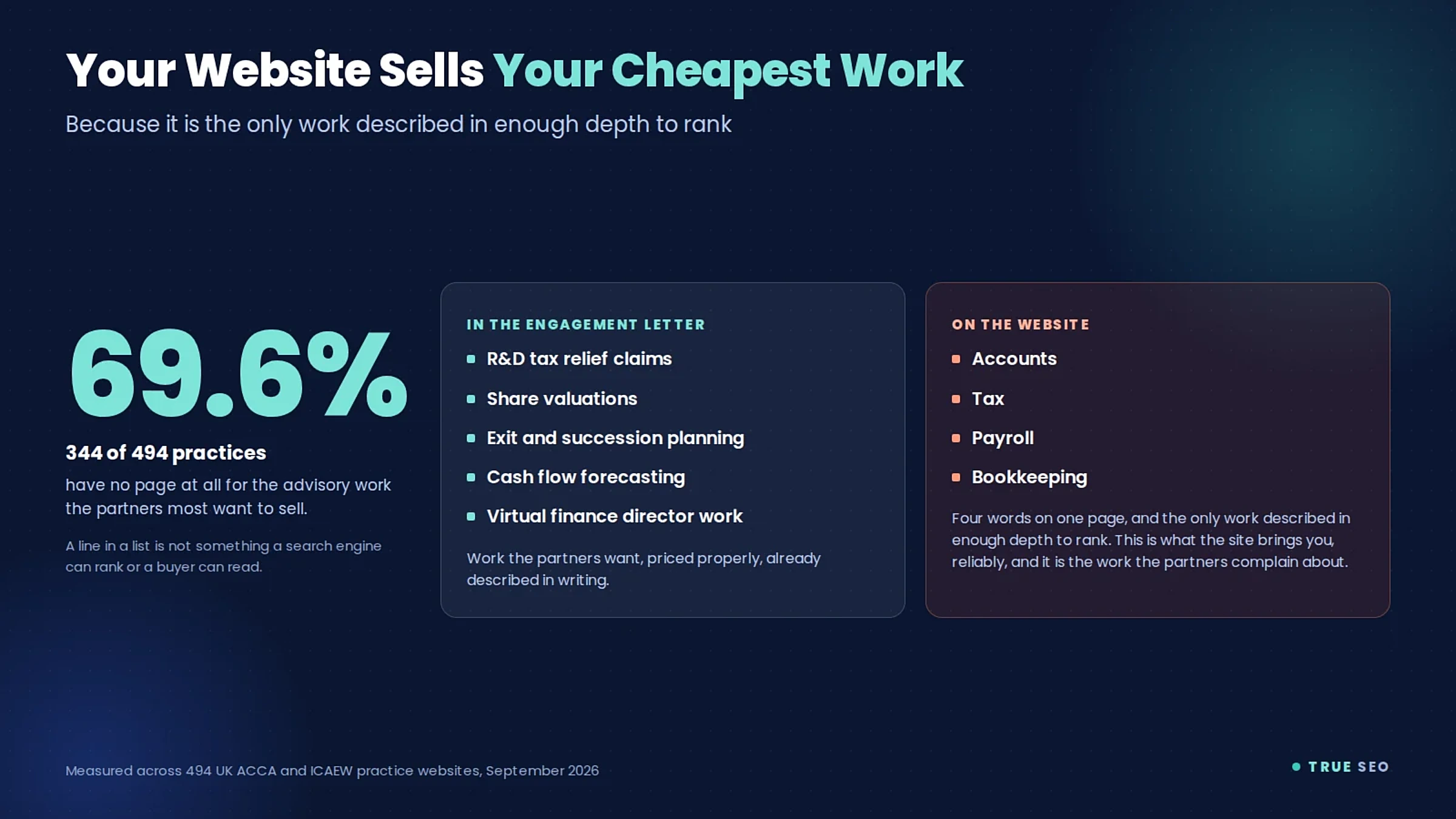
That is the first thing to check and it is the commonest answer by a distance. Across 494 UK accountancy practice websites we measured in September 2026, 344 firms have no page for the advisory work they most want to sell. It exists as a line in a list, and a line in a list is not something a search engine can rank or a buyer can read.
- 69.6% have no page for the work they most want
- 0 to 55% missing sitemaps, decided by the platform
- 50.8% run no analytics, so nobody can see any of it
- Small sites fail by omission, large ones by neglect
- Indexation
- Click-through
- Cannibalisation
- Freshness
- Map pack
- AI search
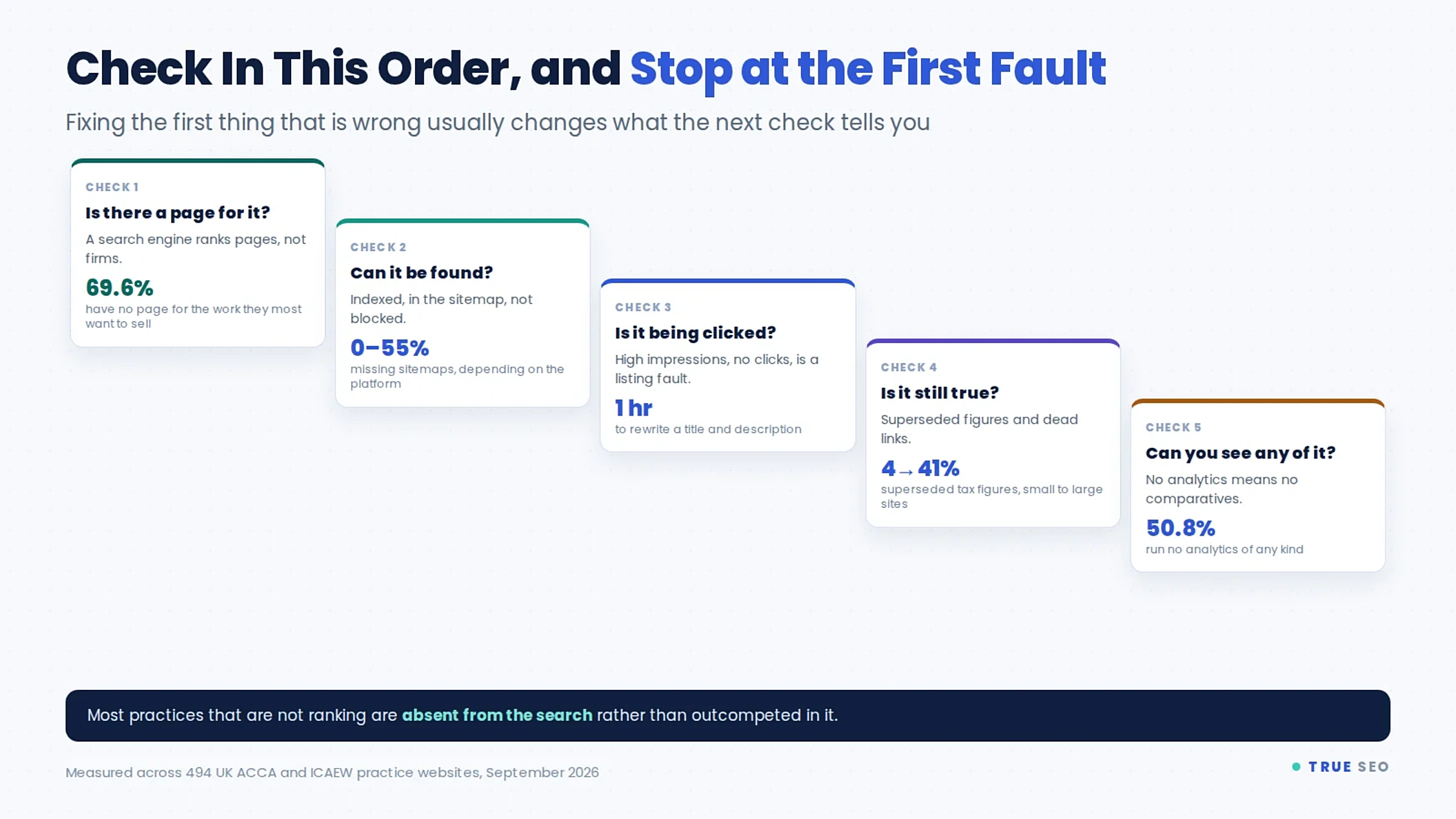
Check in order and stop at the first fault. Fixing the first thing that is wrong usually changes what the next check tells you.
Key takeaways
Most practice owners arrive at this question after months of quiet. The site looks fine, somebody is doing SEO or somebody was, and nothing obviously broke.
- 1stWhere to lookStart with the page, not the tacticsWhere nothing on your site is about the service, no amount of technical work will produce a ranking for it.
- 0–55%Missing sitemapsCheck it can be found before anything elseMissing sitemaps run at 0 per cent on one platform and 55 per cent on hand-built sites. Your platform decided this, not your developer.
- 1 hrTo fixRanking and being clicked are different failuresA page at position eight with no clicks has a title and description problem. The cheapest fix in SEO, and often the one nobody has done.
- 50.8%No analyticsHalf of practices cannot see any of this251 of 494 firms run no analytics of any kind, so every decision becomes a matter of taste and the loudest opinion wins.
- 4→41%By site sizeSmall and large sites fail differentlySuperseded tax figures rise from 4 to 41 per cent and broken links from 12 to 51. The wrong remedy costs a practice a year.
- 60.9%No regulator statedTrust signals are a ranking input hereThree practices in five never say who regulates them, which is the one thing separating you from an unregulated bookkeeper.
- 0Stated positionsGoogle is not the only place this happensNot one of the 494 firms has taken a position on AI crawlers, so 494 positions were taken for them by whichever platform they bought.
Get the actual cause named, not a list of everything
Our SEO for accountants service runs this diagnosis in the order below and gives you the specific reason your firm is not ranking, with the evidence attached, rather than a list of everything that could theoretically be improved.
First check
Is there a page about the thing you want to rank for?
A search engine ranks pages rather than firms, so where no page on your site is about research and development claims, nothing about your site can rank for research and development claims, whatever the firm’s real standing in that work.
- What the letters say
Share valuations, exit planning, R&D claims and forecasting, priced properly and already described in writing.
- What the site says
Accounts, tax, payroll and bookkeeping, in four words on one page.
- What follows
You are found for the work you would rather do less of, because it is the only work described in enough depth to rank.
The fix is a page per service you actually want, written to be read by a buyer. Not a paragraph on a combined page, but a page with its own URL, its own title, and enough detail that somebody could instruct you from it.
Second: can the page be found at all?
Publishing a page and having it indexed are two different events, and a page no search engine has crawled cannot rank for anything.
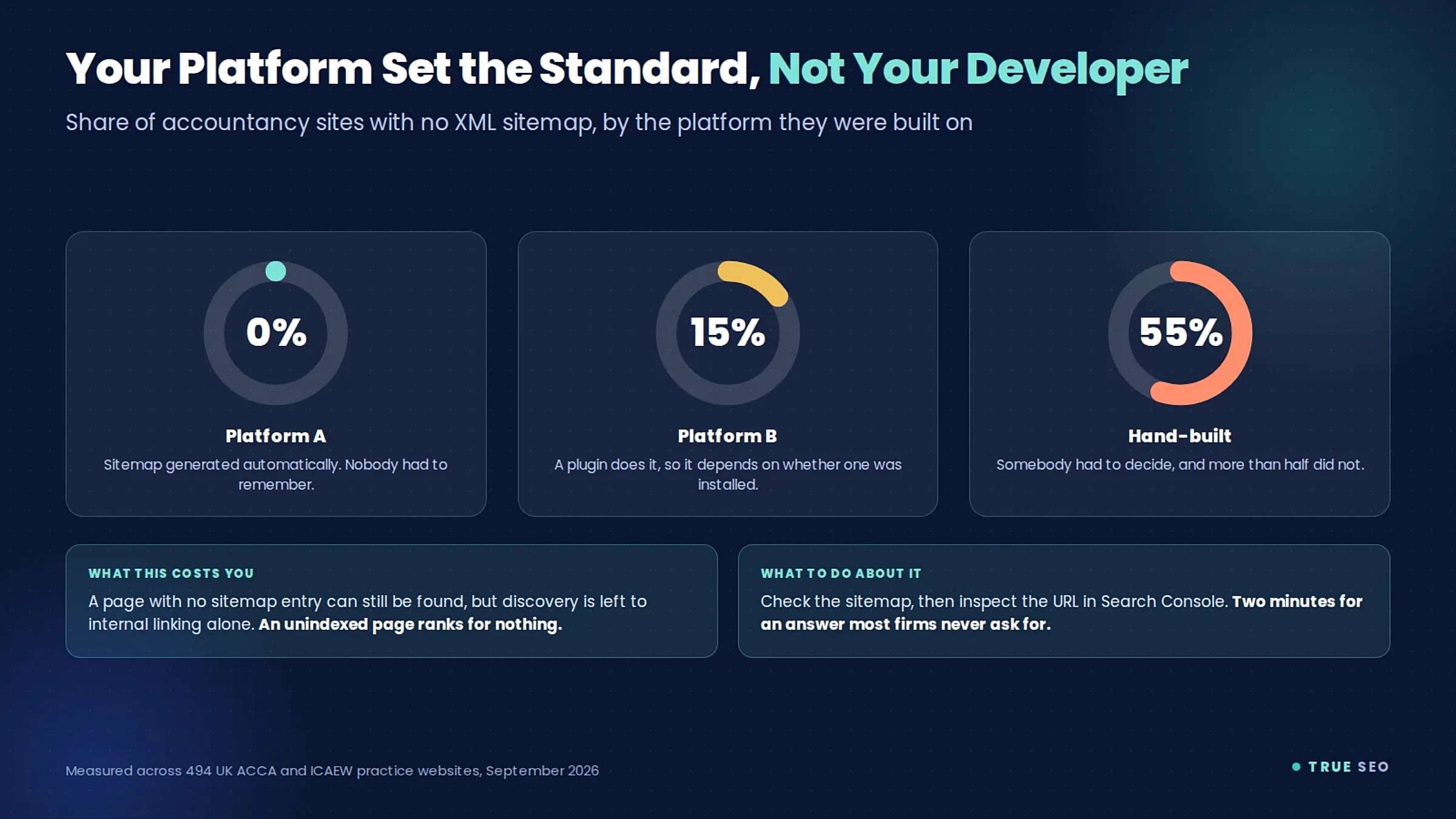
- Start with your sitemapMissing sitemaps ran at 0 per cent on one platform in our sample, 15 per cent on another and 55 per cent on hand-built sites. You may be paying a supplier for hygiene the platform either supplies free or never supplies at all.
- Search for your own pageType the exact page title into Google with your domain. Nothing there means the page is not indexed, and everything else you were about to try is premature.
- Check Search ConsoleThe URL inspection tool tells you whether the page is indexed, when it was last crawled and whether anything is blocking it. Two minutes for an answer most firms never ask for.
Third: are you ranking, but not being clicked?
A page can rank and still bring nothing, which is the failure most often misdiagnosed as a ranking problem, and it is why Search Console reports impressions and clicks as separate columns.
Where a page has hundreds of impressions and almost no clicks, the position is fine and the listing is not. The title says “Services | Firm Name” instead of naming the work. The description is missing, so Google writes its own from the first paragraph. The page ranks and nobody chooses it.
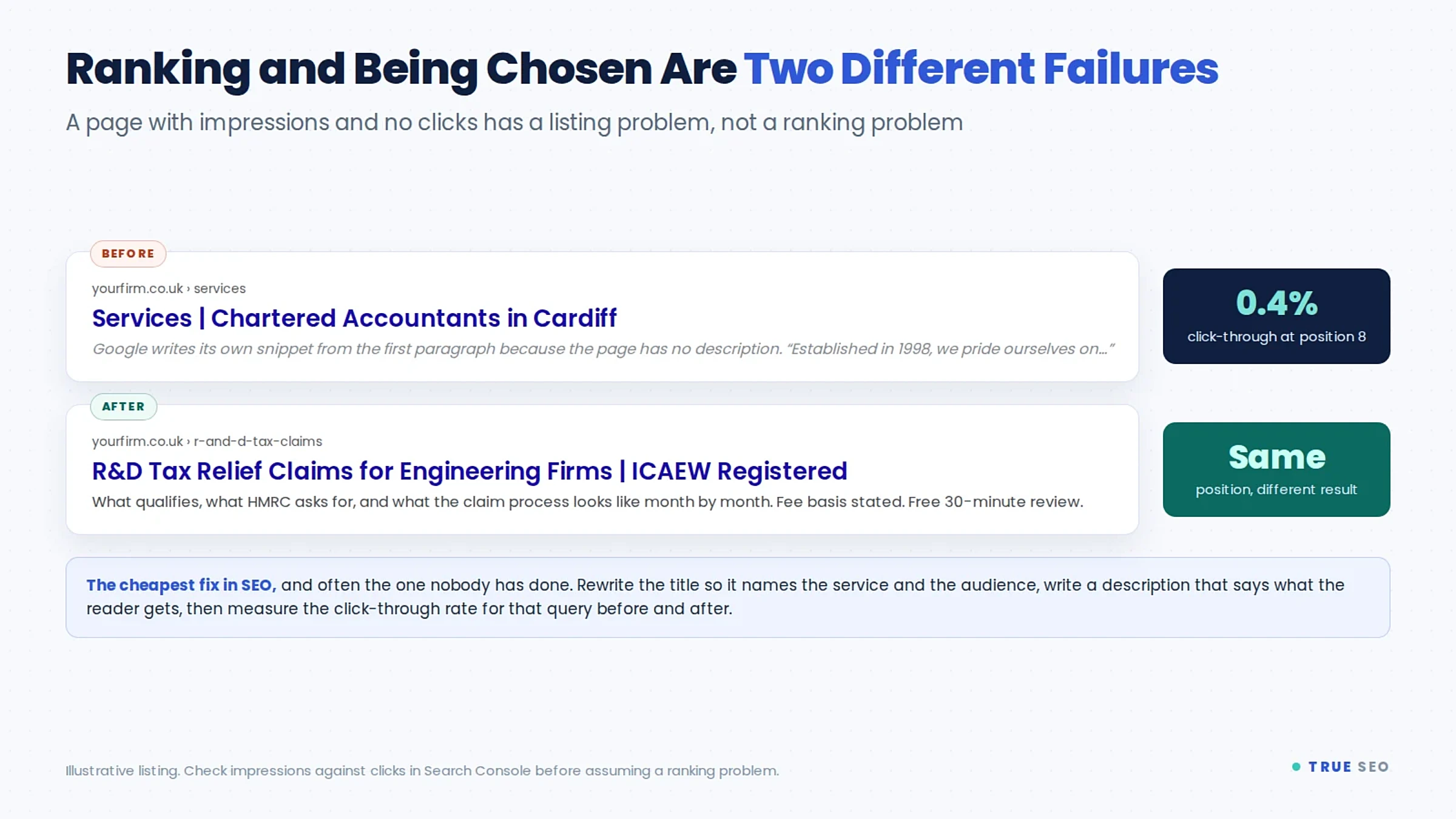
Rewrite the title so it names the service and the audience, write a description that says what the reader gets, and measure the click-through rate for that query before and after.
Fourth: are you ranking for the wrong thing?
Ranking for terms nobody buys from is a common and expensive state, and two versions of it turn up repeatedly on accountancy sites.
The page ranks for a reading query, not a buying one
A page about the VAT registration threshold collects people checking the number, not people looking for an accountant.
Several of your pages target the same term
The engine has to choose between your own pages and may not choose the one you sell from. On our own site a review found 1,203 queries landing on two or more pages before consolidation started.
We worked through how to spot and close that kind of overlap in choosing the terms an accountancy practice should actually target. Both faults are visible in the Search Console pages report if anybody looks: filter to a query and see how many of your URLs appear against it. More than one is a problem to solve rather than a coincidence.
Fifth: is the content still true?
Out-of-date content is a ranking problem for accountancy in a way it is not for most sectors, because the subject changes every year and a reader can date your page at a glance.
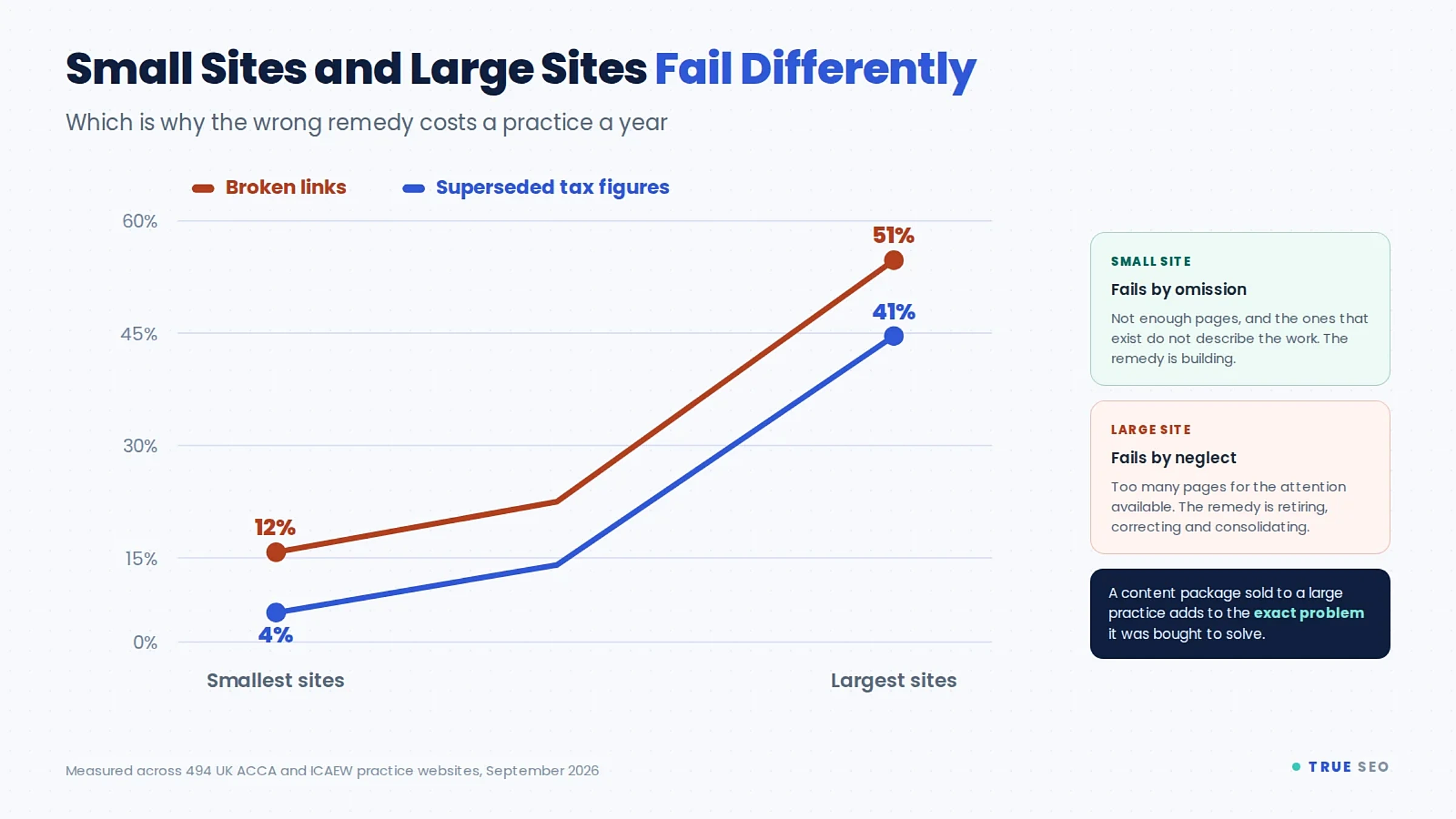
Fails by omission
Not enough pages, and the ones that exist do not describe the work. The remedy is building.
Fails by neglect
Too many pages for the attention available. The remedy is retiring, correcting and consolidating.
A second cost that only shows up in AI search. An assistant that finds a superseded rate on your resource page has no way to know it was true in 2023. It either repeats the wrong figure with your name attached or it stops using your site as a source, and neither outcome appears in a ranking report.
Sixth: are the trust signals there?
For a regulated firm the trust signals are content rather than decoration, and their absence is a genuine ranking and citation problem rather than a presentational one.
Three practices in five in our sample never state which body regulates them. The letterhead carries it, the engagement letter carries it and the window carries it. The website does not, which means the single fact that separates you from an unregulated bookkeeper is missing at the moment somebody is deciding.
The same gap runs through the rest of the trust layer. A minority say they hold professional indemnity cover. Two of 494 UK accountancy practice websites, 0.4 per cent, name an anti-money-laundering supervisor. Named people with qualifications and dates are patchy. Every one of those is a plain fact the firm can evidence from its own records, and every one is permitted by both institutes without qualification, which we set out in what the ICAEW and ACCA codes actually allow a practice to publish.
Seventh: can you see what is actually happening?
Half of practices are working blind, which is why the same wrong answers keep getting bought.
Across the 494 firms, 251 run no analytics of any kind, so there are no comparatives, no notes and no record of what changed when. Without measurement, every decision about the website becomes a matter of taste, and the partner who dislikes the homepage image gets the homepage image changed while nobody knows whether the pages that produce enquiries were touched at all.
- Search Console, filtered properlyUnited Kingdom only, non-branded queries only. Branded traffic tells you nothing about whether the SEO works.
- Analytics with a goal on the enquiry formSessions without a conversion event are a vanity number.
- A written log of every change, with its dateSo that a movement in three months can be attributed to something rather than argued about.
Is it the website or the Google Business Profile?
Local visibility and organic visibility run on two different systems, and the fix for one does nothing at all for the other.
The map pack ranks a Google Business Profile on proximity, prominence and relevance. The blue links rank a web page on what it says and who links to it. A practice can sit at the top of the map pack and be invisible in the normal results, or the reverse, and the two states have entirely different causes.
That distinction decides where your money should go, because a practice with a complete profile, a local number and reviews naming real services but nothing written about the work needs content, while a practice with strong service pages and a half-finished profile needs the listing sorted first. We looked at the geographic half of this in detail in why the town pages practices build so rarely rank.
Is it Google at all, or is it AI search?
An increasing share of this question is not about Google’s ten blue links any more.
Close to a third of UK Google searches now show an AI summary above the normal results, and more than half of UK adults say they see these summaries regularly. The mechanism is different and so is the diagnosis. An assistant assembles its answer from structured data, directories, professional registers, reviews and third-party mentions, and prefers sources where those agree. A firm with no structured data leaves the assistant inferring everything from prose, and inference is where an answer goes to somebody else. What to add, and in what order, is set out in the schema markup an accountancy website actually needs.
Almost nobody has answered the AI crawler question. Eighty-eight of the 494 firms publish an llms.txt file, running at 100 per cent on two platforms and 0 per cent on three others, which is a platform default rather than 88 decisions. Not one practice in the sample has expressed a position on AI crawlers, so 494 positions were taken for them by whoever built the site.
Is a competitor doing something you are not?
Usually yes, and it is rarely what the partners assume.
The competitor ranking above you is not typically spending more. They have a page about a thing you have not written about, and often it is narrower than anything on your site.
Read the page that holds the position you want. Where it names a sector, a client type, a piece of legislation or a software platform, that page is competing on a subject rather than on the word “accountant”, and it can be beaten by a better page on the same subject. Where it is a generic services page from a large firm, the competition is authority rather than content, and the sensible response is to compete somewhere narrower instead of somewhere harder.
The measure that matters here is not their domain authority score, which is a third-party estimate rather than anything Google publishes. It is whether they have covered an intent you have left uncovered, because that is the gap you can close this quarter.
Is it a penalty, or is the site simply weak?
A penalty is rare and it is visible. Search Console reports manual actions under Security and Manual Actions, and if nothing appears there, nobody at Google has taken action against your site by hand.
A sudden sitewide fall with no manual action almost always means an algorithm update rather than a punishment, and the response is the diagnosis above rather than a recovery service. Where a fall follows a migration, a redesign or a platform change, the cause is usually mechanical: redirects that were never mapped, pages that lost their content in the move, or a staging site left indexable.
The distinction is worth holding onto because “penalty” is a word used to sell urgency. Most practices asking this question have not been penalised. They have a site that never earned the position in the first place, and the honest version of that is easier to fix than a penalty would be.
How long should ranking take?
Longer than a package promises and shorter than the sceptics say, and the honest answer depends on which of the causes above applies to you.
A missing title and description can change click-through within days of being recrawled. A new service page competing in a thin niche can reach the first page in weeks; one of our own accountancy clients reached number one for a niche practice term and the first page within about sixty days, because the term carried clear intent and little competition. A contested term in a city takes months and sometimes does not come at all, which is why the specialism route usually beats the geographic one.
Anybody offering a timescale before they have told you which cause applies is guessing, and the guess is a sales tool rather than a forecast.
Two practices, and what the diagnosis found
One had too little on the site, the other had too much. Both had been buying the same remedy.
A practice in the Midlands had been paying for monthly SEO for fourteen months and had moved nowhere. The reports showed work: blog posts published, keywords tracked, technical fixes applied. What the reports never showed was that the firm’s cloud accounting and outsourced finance work, the two services the partners actually wanted, had no page on the site at all.
Fourteen months of content had been written around the compliance pages that already ranked. Two new service pages produced more movement within a couple of months than the previous year of work had, because they were the first pages on the site about the thing being searched for.
A larger firm was in the opposite position, with forty of its ninety-one pages carrying figures from at least two tax years earlier and a run of broken links to guidance that had moved. Nothing needed writing.
The work was retiring twenty-two pages, correcting the figures on eleven, redirecting the broken links and consolidating four near-duplicate service pages into two. The site got smaller and its non-branded impressions went up, which is the outcome nobody sells because it does not look like a project.
The order to check in
Work down this list and stop at the first thing that is wrong, because fixing it usually changes what the next check tells you.
- Confirm a page exists for the service you want to rank forA search engine ranks pages, not firms.
- Confirm that page is indexedUsing Search Console rather than assumption.
- Compare impressions with clicksFix the title and description where impressions are high and clicks are not.
- Check whether more than one of your pages targets the same queryFilter the pages report to that query and count the URLs.
- Check every figure and date on the pages that matterFix them or retire them. A superseded rate is worse than no page.
- Check the regulator, the credentials and the named people are stated in textNot in an image, and not only on the about page.
- Check the Google Business Profile separately from the websiteThey are two systems with two sets of inputs.
- Ask an AI assistant to recommend a firm like yoursThen read what it used to build the answer.
- Confirm analytics and Search Console are recordingSo the next change can be measured rather than argued about.
Get your first month of SEO free
Answer five questions and we will tell you which of these causes is the one costing your practice enquiries, and what it would take to clear it.
First month free · a few places at a time
Your first month of SEO, free
Answer three quick questions to claim yours.
Thank you, that is with us.
We will email your onboarding form and payment link, and call within one working day if you would rather talk it through first.
Pick a time that suits you below. We will confirm by email too.
Frequently asked questions
Why is my accountancy firm not showing up on Google at all
Because the page is either not indexed or does not exist. Search for the exact page title with your domain, then check the URL in Search Console. A page that has never been crawled cannot rank, and a service that has no page cannot rank whatever the firm does.
How long does SEO take for an accountancy practice
It depends on which cause applies. Title and description fixes can move click-through in days. A new service page in a thin niche can reach the first page in weeks. A contested city term takes months. Any timescale offered before the cause is identified is a guess.
Why do I rank but get no enquiries
Usually because the ranking page answers a reading question rather than a buying one, or because the page ranks and the listing does not attract the click. Check impressions against clicks first, then check what the ranking query actually means.
Does my Google Business Profile affect my website rankings
Not directly. The map pack and the organic results are separate systems with separate inputs. A firm can lead one and be invisible in the other, and each needs its own diagnosis.
Should I publish more blog posts to rank better
Only where the posts answer intents your site does not cover. More posts on a large site with out-of-date pages usually makes the problem worse, because attention is already spread too thin. Fix the pages that exist before adding to them.
How do I know if I have been penalised rather than just outranked
A manual action appears in Search Console under Security and Manual Actions, and it is rare. A sudden sitewide fall with no manual action usually means an algorithm update, and the response is the same diagnosis: check what the pages say and whether they are still true.
Where this leaves your practice
Most firms that are not ranking are absent from the search rather than beaten in it
Nothing on the site is about the work they want, or the page that is about it cannot be found, or nobody has looked at the numbers that would show either. All three are cheaper to fix than the thing most practices are sold instead.
True SEO Consultants Ltd, based at Startup Stiwdio, University of South Wales, 86-88 Adam Street, Cardiff, CF24 2FN, works with accountancy practices across the UK and onboards firms worldwide through a fully remote digital onboarding and delivery process. We start every engagement with this diagnosis, in this order, and we tell you which cause applies to you before anybody discusses a plan.