SEO and PPC Management, Billed To Cut Your Spend
One Cardiff consultancy running both, paid on the outcome rather than a share of your budget
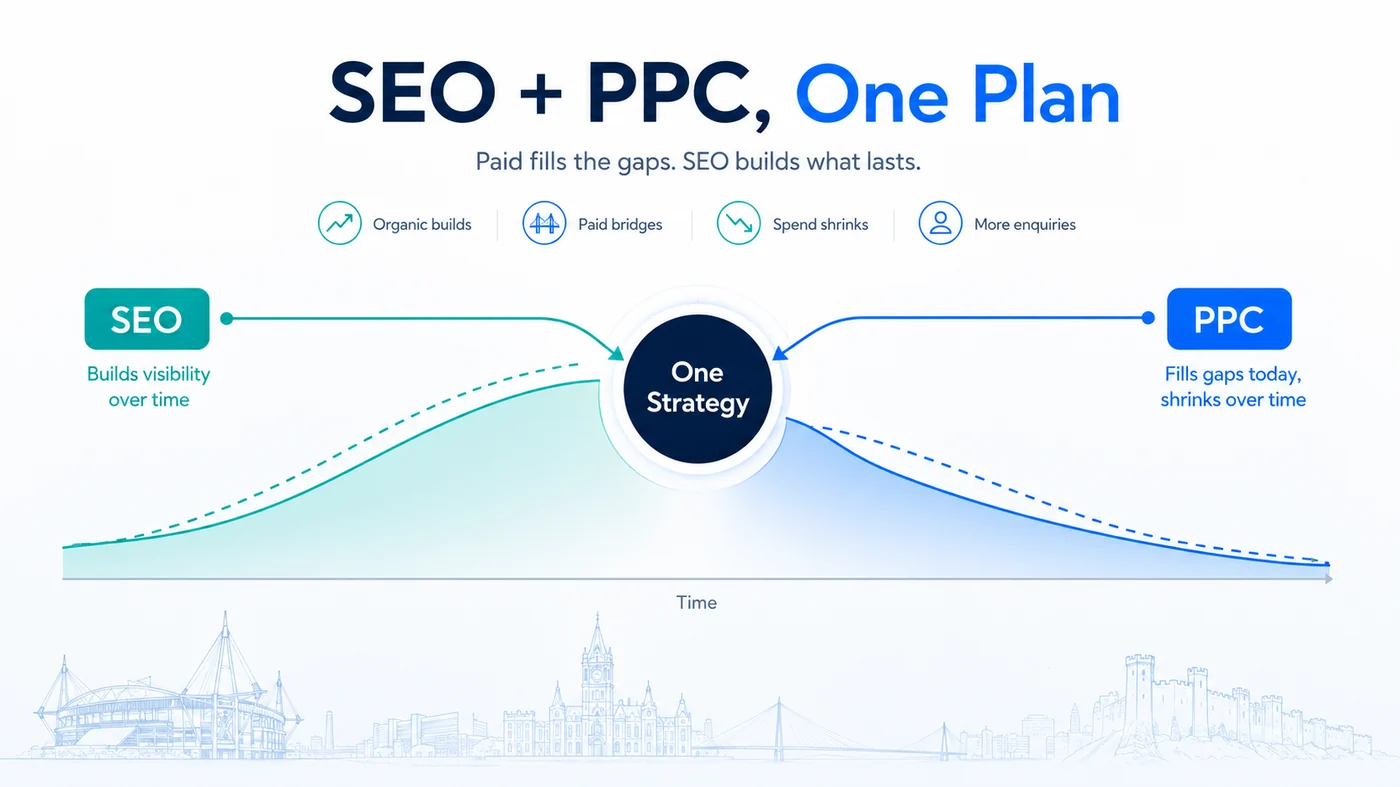
Paid search should buy the positions organic has not reached yet, and stop buying the ones it already holds. Almost nobody searches for a PPC agency and an SEO agency separately. We run both, from one plan, and we are paid on the outcome rather than on a share of what you spend with Google.
- Never a percentage of media spend, so recommending less never costs us anything
- Your media spend is never marked up and sits in your own advertising account
- One query list, reviewed monthly, deciding where each search is won and what stops being bought
- Google Ads
- Paid search strategy
- Query overlap analysis
- Conversion tracking
- Call tracking
- Budget reduction
See what your ads are buying that you already rank for
- The overlap between your paid list and your organic positions
- What is being counted as a conversion, and whether it means anything
- The queries worth moving the budget to instead
No charge, no obligation, and no new spend required to act on it.
Key takeaways
- Organic builds slowly and keeps working after you stop paying. Paid works immediately and stops the day the card is declined. The plan uses each one for what it is good at.
- Paid bridges the gap while pages mature. That is a temporary job on most queries, not a permanent budget line.
- The paid spend should shrink as organic arrives. A paid budget that has not moved in a year has not been managed.
- The supplier’s billing model decides what they recommend. A percentage of spend rewards spending more, whatever anyone says at the review.
- More enquiries, not more clicks, is the point. Google Ads reports conversions. Your CRM reports clients, and where the two disagree the CRM wins.
- The entry point is a free 30 minute review, and on an existing account the most useful thing in it is the overlap between what you pay for and what you already rank for.
Find the overlap before you change a single bid
Our free 30 minute consultancy and SEO audit puts your paid keyword list beside your organic positions and shows you which clicks you are buying twice. It costs nothing, it requires no new spend, and it is usually the fastest saving available.
What does SEO and PPC management together actually mean?
It means one plan decides where each query is won, and paid search covers the positions organic cannot reach yet, with the split reviewed every month.
The three lists every query on your account belongs to
Swipe the chart sideways to read the labels on a phone.
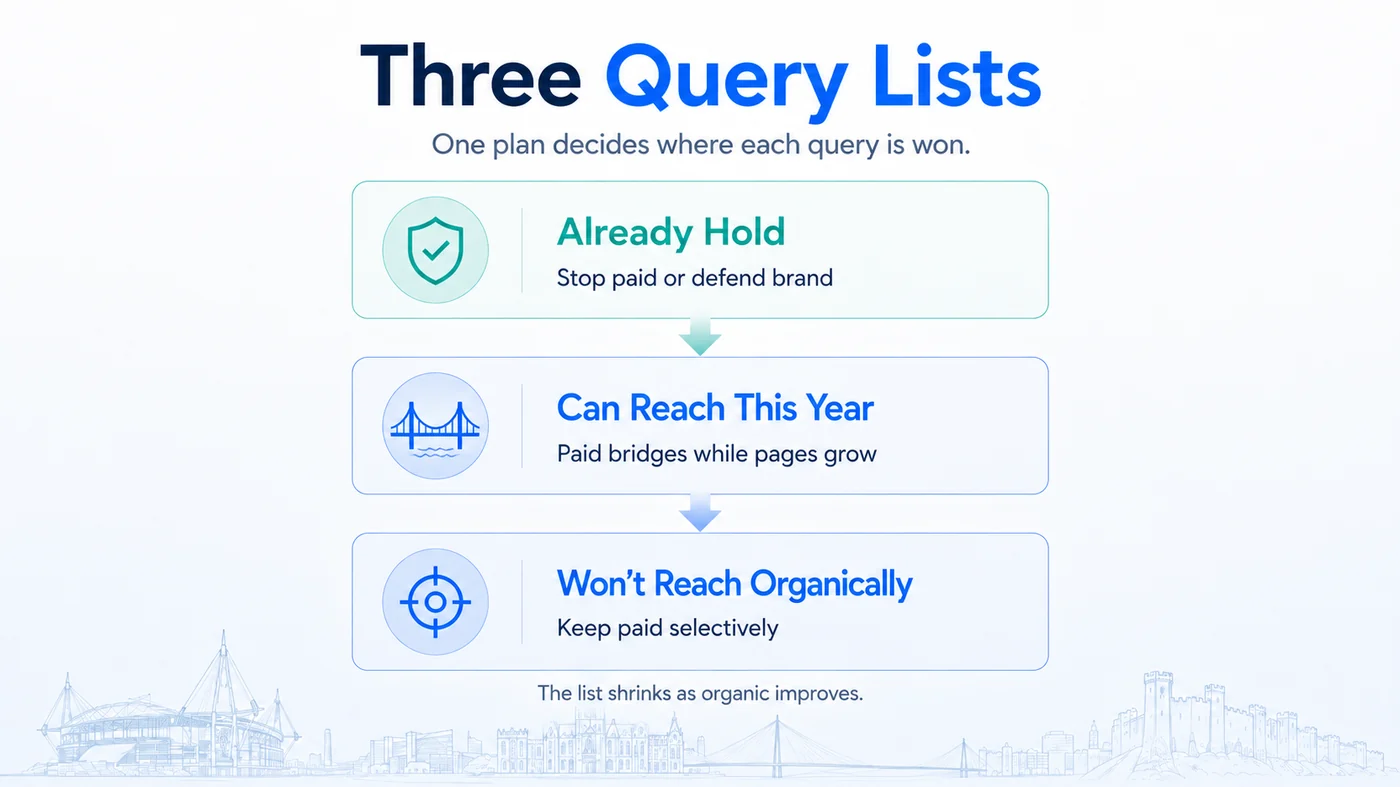
In practice that produces three lists.
Queries organic already holds. Paid stops bidding on these, or bids defensively only where a competitor is running against your brand.
Queries organic can realistically reach this year. Paid covers them while the pages mature, then steps back as positions arrive. This is the list that shrinks, and the shrinking is the point.
Queries organic will not reach. High competition, low relevance to the topical map, or seasonal spikes that arrive faster than a page can rank. Paid keeps these permanently or seasonally.
Most accounts we look at have never had that third list written down, so the spend never reduces. It cannot, because nobody has defined what would justify reducing it. Deciding which list a query belongs on is a question about the topical map rather than about bidding, which is why the same person has to own both.
Is this performance marketing, or is it paid search management?
Performance marketing is the wider discipline, and paid search management is one part of how we deliver it.
The difference decides who you should hire. Paid search management answers to an advertising account, so the reporting stops at bids, keywords and quality scores. Performance marketing answers to a commercial outcome, which means what a customer costs to acquire and whether that cost is falling. We run both from one query list, because separating them is exactly how an agency ends up reporting a healthy account while your enquiries stay flat.
Most performance marketing agencies sell you channels. We sell the arithmetic underneath them, which is the same position we take on SEO consultancy for in house teams and brands. It is also why this work is billed on agreed KPIs and never on a percentage of your spend. A percentage fee pays us more when your costs go up, and that is the wrong incentive to put between a business and its advertising budget.
Why does the return on ad spend in your dashboard not match your bank statement?
Because each advertising platform counts the same sale, so their totals add up to more revenue than you actually banked.
Google Ads counts a conversion it believes it influenced. Meta counts that same conversion inside its own attribution window. Neither platform is lying and neither knows about the other, so a business running two channels sees a combined return that never appeared in the accounts. Add a third channel and the gap widens again.
Blended return is the figure nobody can inflate. Take all revenue in the period, divide it by all advertising spend in the period, and you have one number with no attribution windows and no modelled conversions in it. It reconciles against your bank statement. We report the platform figures because they tell you which lever to pull, and we report the blended figure because it tells you whether pulling them worked.
What does a customer cost you to acquire, and when does that money come back?
Acquisition cost is your total spend divided by the customers it won, and payback is how many months of that customer spending it takes to earn the cost back.
Those two numbers decide whether advertising is an investment or a leak, and most accounts we inherit cannot produce either one. The reporting stops at clicks and cost per click, which tells you what the auction charged and nothing at all about what the business gained.
Payback is the number a board asks for. A business that recovers its acquisition cost inside ninety days can spend aggressively, because the money comes back within the quarter. A business sitting on a fourteen month payback is funding its own growth out of working capital, and usually has no idea. The ratio between what a customer is worth over their lifetime and what they cost to win sets the ceiling on what you can afford to bid, and it is the first thing we calculate.
Why does the same budget buy fewer sales than it did last year?
Because more money is chasing the same auctions every quarter, while your creative and your audience both wear out underneath that pressure.
UK digital advertising reached 40.5 billion pounds in 2025, up 10 per cent on the year before, according to the IAB UK Digital Adspend study conducted with Oliver Wyman. Search took 17.9 billion of that and social took 11.5 billion, with social alone growing 21 per cent in a single year. The Advertising Association and WARC Expenditure Report puts total UK media investment at 46.7 billion pounds for 2025 and forecasts 49.8 billion for 2026. More competitors are bidding every quarter, and the auction price reflects it.
Three causes drive the rise and each is diagnosed differently. Auction pressure shows as a higher cost per click on keywords you have not touched. Creative fatigue shows as a falling click rate on unchanged ads. Audience saturation shows as rising frequency and falling conversion on the same targeting. Telling them apart is the difference between rewriting one advert and rebuilding a list.
Scaling sharpens all three. Efficient spend and maximum spend are different numbers, and the gap between them is where most accounts quietly break. A budget that doubles does not buy twice the customers, because the second half of the money reaches people who were further away from buying in the first place.
How is the budget split between your fee and the media spend?
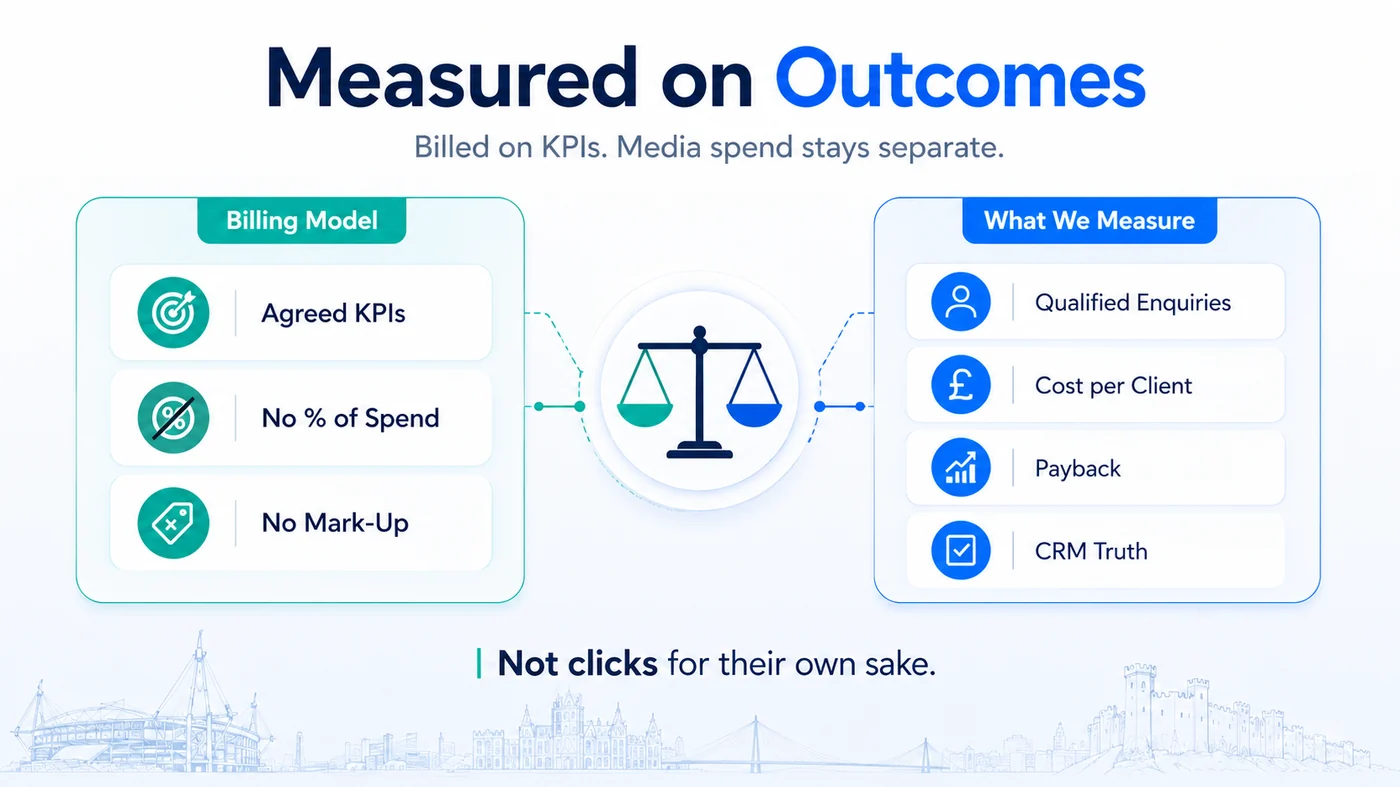
The fee and the media spend are separate lines, the media spend is never marked up, and the fee does not rise when the spend does.
What we are paid on, set against what we report on
Swipe the chart sideways to read the labels on a phone.
That last part matters more than it sounds. The standard agency model charges a percentage of media spend, usually somewhere between ten and twenty per cent. It is a clean model with one structural flaw: the supplier’s income falls every time they recommend spending less. No amount of integrity fully removes that pressure, and you should assume it is there in every account run that way.
| Percentage of media spend | Billed against agreed KPIs | |
|---|---|---|
| What the supplier is paid on | How much you spend with Google | The outcomes you agreed at the start |
| If spend halves | The supplier’s income halves | The fee is unchanged |
| Pressure on the recommendation | Structural, and it points one way | None either way |
| Who benefits when organic takes a position | Nobody, so it tends not to get noticed | You do, immediately, and it is in the monthly review |
| Media spend mark-up | Common, and not always disclosed | None. It is billed to you directly by the platform |
We bill against the KPIs you set. If the right answer this month is to cut the ad budget in half because organic has taken the positions, our fee is unchanged and we will say so. That is the whole reason for the billing model, and it is the same principle behind the rest of our bespoke work.
When should you run paid search alongside SEO?
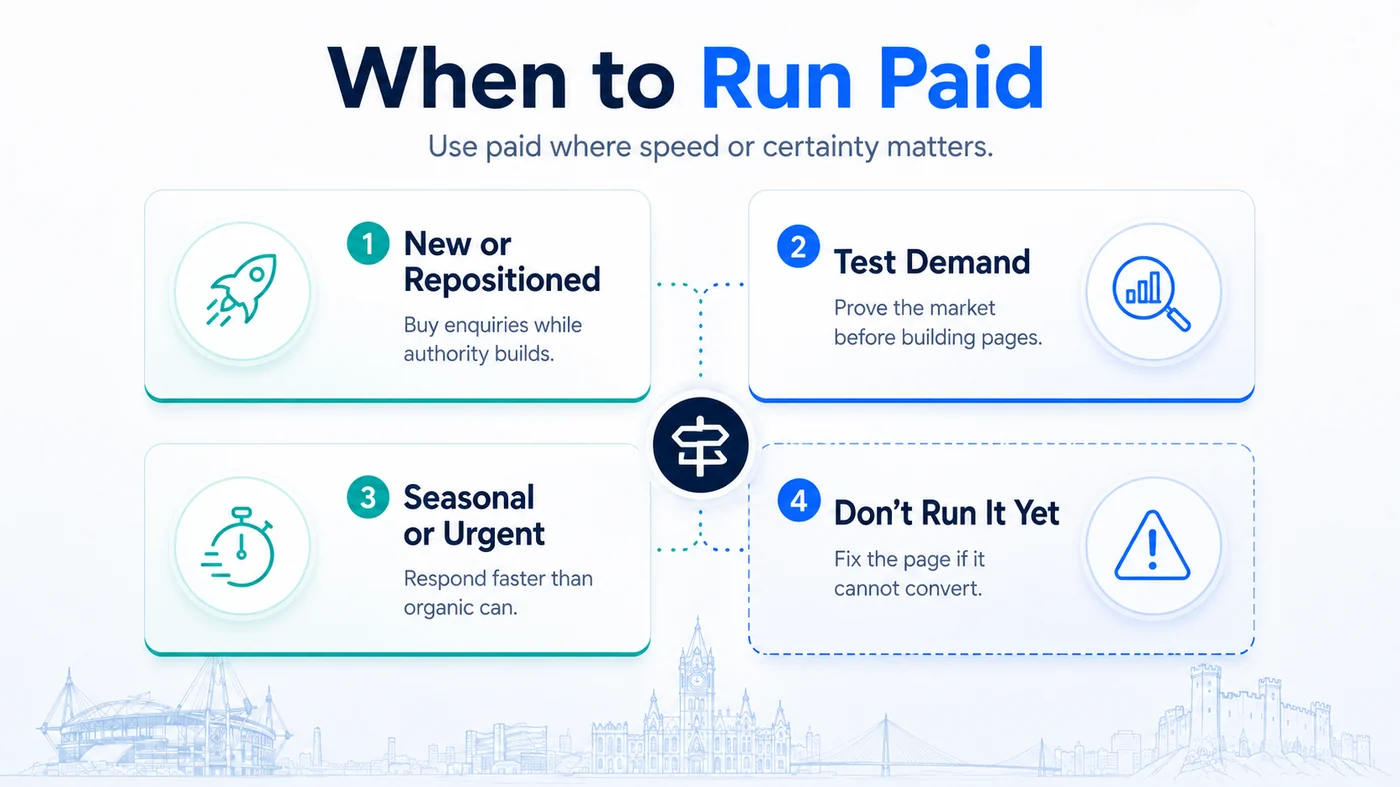
Run paid when the revenue cannot wait for organic, when you need to test demand before committing to pages, or when a position is genuinely out of organic reach.
Three cases where paid earns its place, and the one where it does not
Swipe the chart sideways to read the labels on a phone.
Three situations where it is clearly right:
You are new, or newly repositioned. Organic authority compounds and that takes months. Paid buys enquiries while the topical authority work builds underneath it.
You need evidence before you build. Twenty pages is an expensive way to discover a market does not convert. A short paid test on the same queries answers it in weeks, and the answer shapes the map.
The calendar does not care about your rankings. A January deadline, a seasonal peak, a product launch. Organic does not respond to urgency. Paid does.
And one where it is clearly wrong: when the site cannot convert. Paid traffic into a page that does not convert is the fastest way to lose money in marketing. Fix the page first.
How much do SEO and PPC cost together?
There are three numbers, not one: the search fee, the paid management fee and the media spend. Mixing them into a single figure is how budgets get misjudged.
We do not publish rates, and that is a policy rather than an evasion. What a programme costs depends on what the diagnosis finds, and a number quoted before anyone has read your crawl is a guess wearing a suit. What we will set out plainly is the shape of the decision, because that part is the same for everyone.
| The line | What it pays for | What it should do over a year |
|---|---|---|
| Search fee | The structural work: the map, the pages, the technical faults, the entity | Broadly steady, because the work compounds rather than repeats |
| Paid management fee | Running the account against the query lists and the monthly review | Falls as the paid list shrinks and there is less account to manage |
| Media spend | The clicks themselves, billed to you by the platform | Should fall, because organic is taking positions off the paid list |
The media spend is a variable, not a fee. It should rise when it is buying incremental enquiries and fall when organic has taken the position. Treating it as a fixed monthly commitment is the single commonest budgeting error we see, because it removes the only lever that should be moving.
The split is not fixed either. A business with no organic authority and an urgent revenue need starts weighted toward paid. Twelve months later, if the work has gone properly, the same total budget should be weighted toward search, because the free clicks have arrived and the paid list has shrunk. A supplier whose paid budget has not moved in a year has not been managing it.
The fee should be judged against outcomes, not against either. Ours is set against the KPIs you agree. For the wider picture on what search work costs in the UK and what moves the price, our guide on SEO cost in the UK covers the bands.
What do we need before we can run paid for you?
Access to the ad account, a working definition of a conversion, call tracking if your enquiries come by phone, and your numbers on client value.
Access. Google Ads with admin rights, plus Analytics and Search Console. We do not rebuild an account before reading its history, because the history contains the answer.
A real conversion. If enquiries are not currently being counted, this is the first fix and it happens before any spend changes.
Call tracking, in service sectors. Set up so it does not disturb your citations, which is a detail that gets missed and costs local visibility.
Your numbers. What a client is worth in gross profit, and roughly what proportion of enquiries close. Without these, nothing can be judged and every review becomes an argument about clicks.
We are a Cardiff consultancy, based at Startup Stiwdio, University of South Wales, 86 to 88 Adam Street, CF24 2FN, working across Cardiff, Newport, Swansea and the rest of South Wales, as well as UK wide.
Which sectors get the most from paid alongside search?
Sectors with a high client value, a defined season or a compliance ceiling on how fast organic can move.
- Accountancy practices before a filing deadline, where the window is fixed and the client value justifies the cost per enquiry. The organic side of that is our SEO for accountants work, and the queries “ppc management for accountants” and “ppc for accountants” both appear in our own Search Console data, currently ranking nowhere.
- Healthcare and legal, where advertising rules constrain the claims a page may make and paid needs the same compliance review as the content.
- Ecommerce, where paid can prove a category converts before the category work is committed to.
- Multi-location businesses, where one town has organic coverage and another has none, so the paid map is uneven by design. The structural side is local and multi-location SEO.
How is paid search measured here?
On cost per client and payback, using your CRM as the source, not on impressions, clicks or a platform-reported conversion count.
Google Ads will tell you it produced conversions. Your CRM will tell you whether any of them became clients. When those two disagree, and they usually do, the CRM is right. Our reporting starts from your source field and works backwards, which is also how our SEO audit service approaches organic.
A worked example on wasted spend
Take an account spending £2,000 a month, where thirty per cent of clicks land on queries the site already ranks in the top three for organically. That is £600 a month buying clicks that were largely available for free, or £7,200 over a year.
Move that £600 to queries sitting at organic position 20 and beyond, where there is no free click to be had, and the same budget starts buying incremental enquiries rather than replacing existing ones. Nothing about the total spend changed. What changed was which list it was buying from.
The figures here are illustrative and used to show the method. Your version of that sum comes out of your own account in the first review.
How do you know when to switch paid spend off?
You switch it off query by query, when organic reaches a position where the incremental click is no longer worth buying, and you check it monthly rather than annually.
What happens to the bid at each organic position band
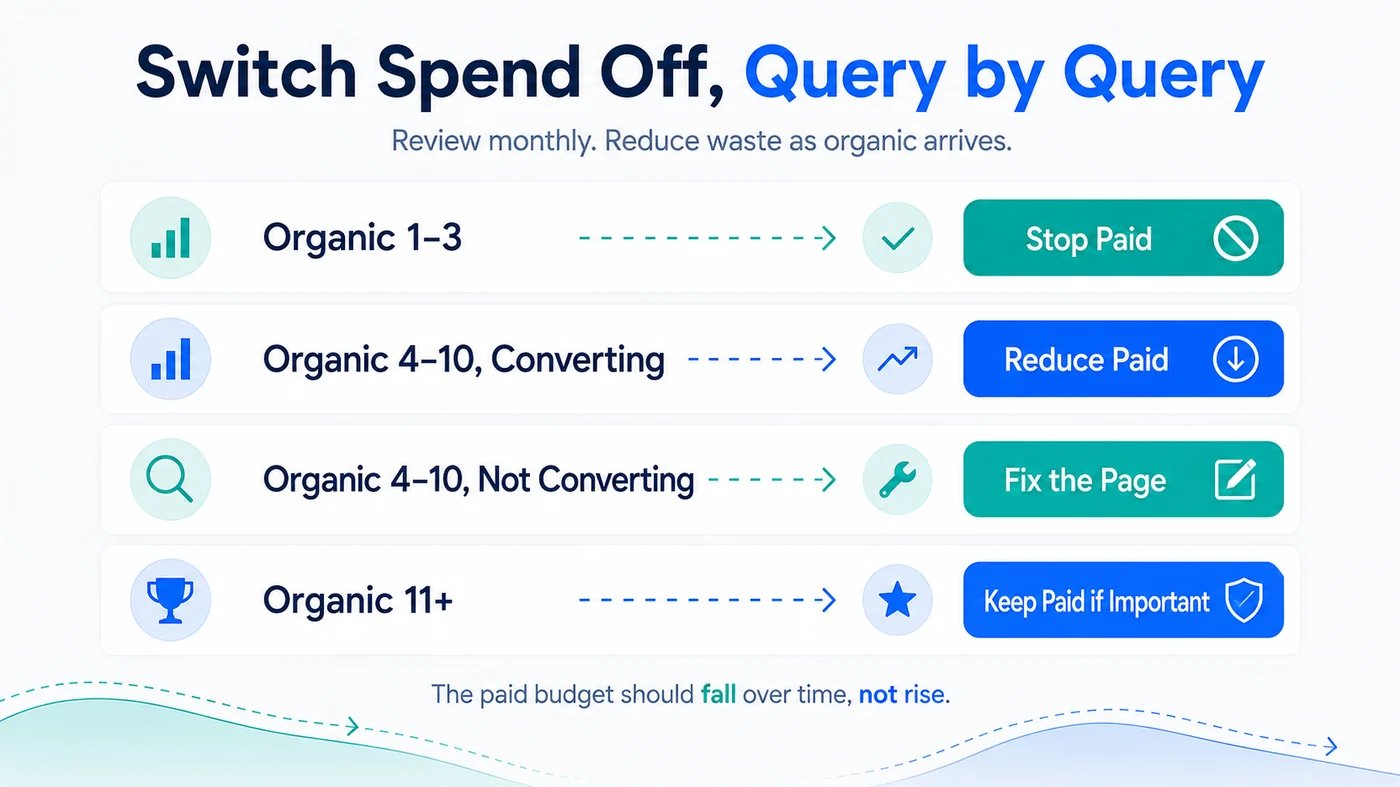
Swipe the chart sideways to read the labels on a phone.
The test we apply on each query:
| Signal | What it means |
|---|---|
| Organic position 1 to 3, and the SERP is not crowded above it | Stop paid, keep brand defence only |
| Organic 4 to 10, converting | Reduce paid, hold a low bid, review monthly |
| Organic 4 to 10, not converting | The page is the problem, not the position. Fix the page |
| Organic 11 or worse, query is commercially important | Keep paid, and prioritise the page in the map |
| Organic 11 or worse, query is not in the topical map | Question whether it should be bought at all |
That table is the deliverable most paid accounts have never had. It is also the reason our paid budgets tend to fall over a year rather than rise.
Should you bid on terms you already rank for?
Usually no. Occasionally yes, and the exceptions are specific enough to name.
Bidding on a query where you already hold a strong organic position mostly buys a click you were going to get anyway. The three cases where it still earns its place:
- A competitor is bidding on your brand. Defensive brand bidding is cheap and it stops someone else intercepting buyers who were already looking for you.
- The organic result is below the fold on mobile. A strong desktop position can sit under a map pack, an ad block and a set of AI answers on a phone. Check what the SERP actually looks like on a handset before assuming the position is doing the work.
- The page ranking is the wrong page. Your blog ranks, your service page converts. Paid can route the buyer to the page that sells while the organic problem gets fixed.
Outside those, we would rather move the budget to the second list.
Does paid search affect organic rankings?
No. Buying ads does not lift organic positions, and Google has been consistent about that for years. Anyone who tells you otherwise is selling something.
What paid does affect is your data, and that is genuinely useful. A paid campaign returns conversion data per query in weeks, where organic would take months to produce the same evidence. Used properly, the ad account becomes a research instrument for the content plan rather than just a cost line.
There is one indirect effect worth knowing. If paid drives more branded search over time, and branded search is one of the signals that correlates with organic performance, then there is a slow second-order relationship. That is a long way from “ads improve rankings”, and we would not put it in a proposal.
What does a badly run Google Ads account look like?
It looks busy. Lots of campaigns, broad match everywhere, no negative keyword list worth the name, and conversions counted at a stage that does not mean anything.
Six things we check first when we take one over:
- What is being counted as a conversion. A page view, a scroll depth or a phone number click is not an enquiry. Accounts optimised toward soft conversions spend efficiently toward nothing.
- Whether call tracking exists. In service sectors most enquiries are phone calls. An account that cannot see them is optimising on a fraction of the truth.
- The search terms report against the keyword list. Broad match with a thin negative list is the commonest way money leaves an account without anyone noticing.
- Whether brand and non-brand are separated. Blended together, brand’s high conversion rate hides how badly non-brand is doing.
- Landing page mismatch. Ads pointing at a homepage rather than at the page that answers the query.
- Overlap with organic. The first list from earlier in this page. Almost nobody has it.
Can you run paid without doing the SEO?
Yes, but we will tell you where the ceiling is, and in most cases the ceiling arrives faster than people expect.
Paid alone is a valid choice in two situations. If you are testing a market before committing to anything, a short paid run answers the question cheaply. And if your business is genuinely seasonal, with a few weeks that matter and forty-odd that do not, permanent organic investment may not be the right shape.
The ceiling is arithmetic. Paid costs the same on the last day as on the first. Organic costs more at the start and less later, and it keeps working when you stop paying. A business that runs paid only is renting its entire visibility, and the rent never comes down. That is a defensible decision if you make it knowingly. It is an expensive accident if nobody told you.
What we will not do is take a paid retainer while watching a site fail for structural reasons we could see in week one. We will say so, put it in writing, and let you decide. Where the structural work is the real answer, it sits on our SEO consultancy service.
What about paid channels other than Google?
Google search first, because it is where buying intent already exists. Everything else has to argue its way in with evidence.
Paid social works where the sector genuinely buys through it and fails expensively where it does not. Display and remarketing are usually a retention tool rather than an acquisition one. We will recommend them where your data supports it and recommend against them where it does not, which in professional services is more often than agencies tend to admit.
The test is the same in every case: can we trace an enquiry back to it, and does the cost per client clear the value of a client. If the answer to the first question is no, the second cannot be answered and the channel does not get budget. Where paid social is the right answer, our social media marketing work is the organic half of the same picture.
How does paid search sit alongside AI answers?
Paid buys placement in a results page that is getting smaller. That is not a reason to abandon it, but it changes what the money is buying and it is worth understanding before the next budget round.
As AI Overviews and assistant answers take more of the screen, the organic blue link and the ad compete for a smaller visible area on the same query. Two things follow.
First, the mobile SERP check stops being optional. A position that looks strong in a report may sit below an AI answer, a map pack and an ad block on a phone. Look at the actual handset result for your top twenty commercial queries before deciding what paid needs to cover.
Second, being named inside the answer is a separate job from ranking under it. Paid cannot buy it. It is earned through entity clarity, structured data and topical coverage, which is the work on our AI and LLM SEO page. Where a query is increasingly answered rather than listed, budget shifted from paid to that work usually earns more over a year.
SEO and PPC management questions we are asked most
Do you take over an existing Google Ads account, or build a new one?
We take over the existing one wherever it is salvageable, because the account history carries conversion data and quality signals that a new account starts without. A rebuild only makes sense where the structure is so tangled that untangling it costs more than starting again, and we will show you the reasoning rather than simply asserting it.
Is there a minimum media spend to work with you?
There is no fixed minimum, but there is a practical floor. Below a certain volume of clicks a month the account cannot produce enough conversion data to be optimised, and you are paying management fees on guesswork. If your budget sits under that floor we will say so and point the money at pages instead, because that is where it will do more.
How quickly does paid search start producing enquiries?
Clicks arrive the day it goes live. Enquiries you can judge take longer, usually four to six weeks, because the account needs enough conversion data before the early numbers mean anything. Anyone reading results off the first fortnight is reading noise.
Do you run Microsoft Ads and Bing as well as Google?
Yes, where the data supports it. In some professional service sectors Bing carries an older and better qualified audience at a lower cost per click, and the campaign structure imports across with little extra work. In others it produces almost nothing. We test rather than assume, and we do not add a channel just to have one more line on the report.
Can you review our current account before we commit to anything?
That is exactly what the free thirty minutes is for on an existing account. Read access is enough. You get the overlap between your paid keywords and your organic positions, a read on what is being counted as a conversion, and the queries worth moving budget to. None of it requires you to continue.
Does the paid work stop if we pause the search programme?
It can run on, but it stops improving in the way it should. The paid list only shrinks because organic keeps taking positions off it. Pause the search work and the paid budget freezes at whatever it is, permanently, which is the outcome the whole approach exists to avoid.
Already running ads?
Start by finding out what they are actually buying
The first thirty minutes cost nothing, and for an existing account the most useful thing we can do in them is show you the overlap between what you are paying for and what you already rank for.
Most people are surprised by that number. Occasionally it is small and the account is in good shape, in which case we will tell you that and you have lost nothing. More often it is the fastest saving available, and it requires no new spend at all.
Read how the wider programme fits together on our services page and our consultancy service.