An audit of your practice should return between about twelve and twenty findings that matter, and most of them will be commercial rather than technical. The pages you have not built. The service you sell most profitably and cannot be found for. The statement of who regulates you that no visitor can locate. The page explaining how a client changes accountant, which almost no practice has and yours probably does not.
A tool will find none of those, and a report that leads with image compression and heading levels has audited a website rather than your practice.
Key Takeaways
- We audited 494 UK accountancy practice websites and published the results, so the findings on this page are measured rather than typical.
- 69.6% of practices had no page for the highest value service they sell. That single finding outranks every technical item in a normal report.
- 92.5% offered a free consultation with no way to book one.
- 38 of the first 53 findings in our own study were artefacts of site size and were not real faults. An uncontrolled audit produces a list like that and calls it work.
- The right order for you to fix in is commercial, then trust, then local, then technical. Tools report the reverse.
- You have to supply four things before an audit starts, and one run without them is guesswork with a template around it.
- An AI assistant can read a page and cannot audit a site, because it never sees the pages that do not exist, and that is the finding that matters most.
- An audit is a decision document for your next quarter. Anything you cannot act on in that quarter does not belong in it.
SEO audit for practices
Been handed a report you cannot act on?
Send it over and we will tell you which findings are real, which are artefacts of site size, and which three to do first. Our own audit is free and there is no paid tier behind it.
Our own research, openly licensed
The catalogue this page is built on, including what we ruled out and why.
- 494practice websites audited and published
- 38 of 53first pass findings that were not real
- 36controlled findings in the final catalogue
What should an SEO audit of an accountancy practice find?
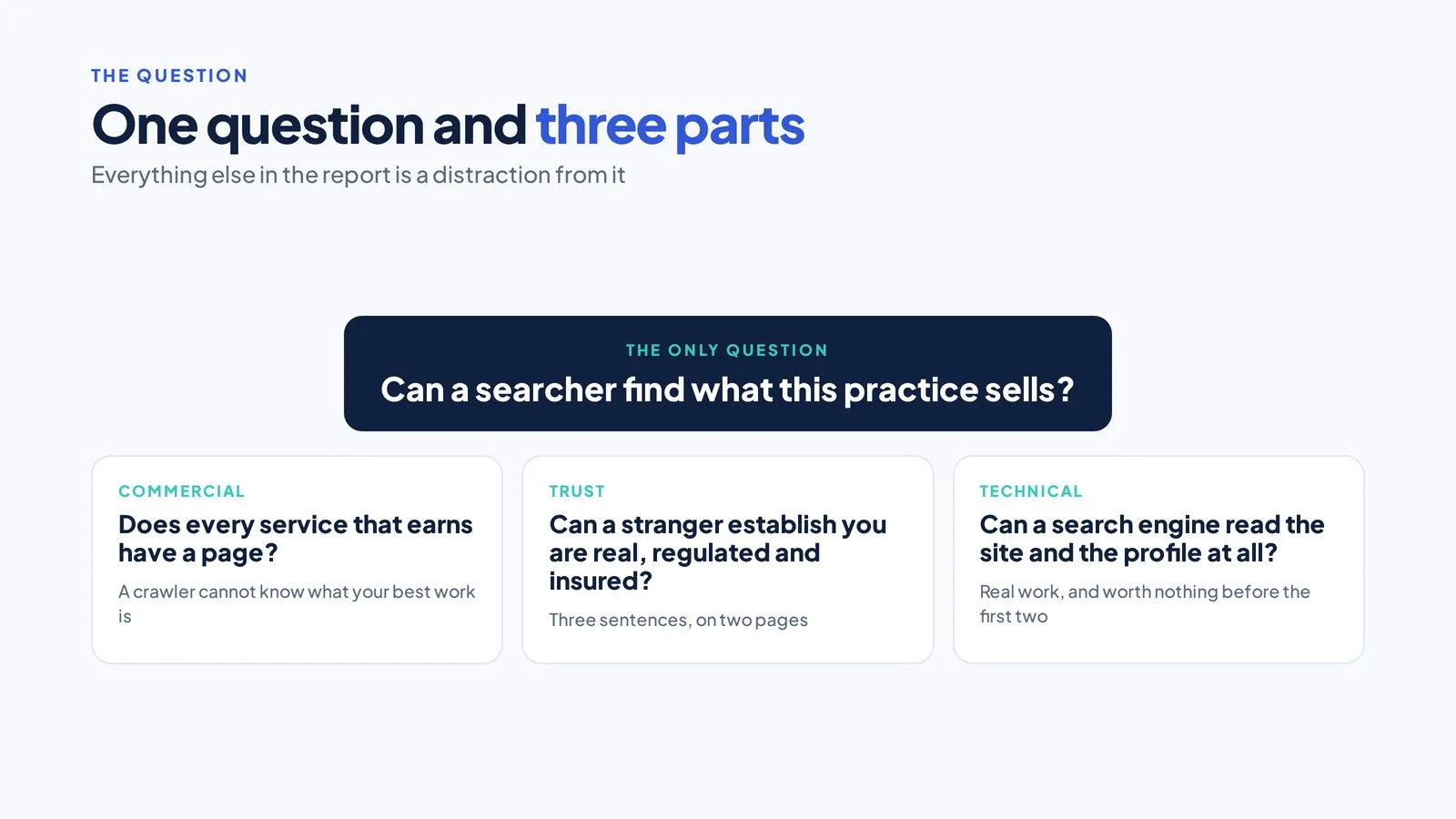
An audit of your practice should find the gap between what you sell and what a searcher can locate. That is the question, and everything the report contains is either an answer to it or a distraction from it.
Three things sit inside that. Whether every service you earn from has a page a search can land on. Whether a stranger reading that page can establish your practice is real, regulated and insured. And whether your site and the profile behind it are readable enough for a search engine to show either one.
A report ordered that way survives a partners’ meeting. A report ordered by tool severity is a list of technical items with the business question missing, and partners are right to leave those in a drawer.
The general anatomy of an audit, including what gets checked in each discipline and how findings are rated, is set out on our SEO audit service page. This page is about what that process returns when the site belongs to an accountancy practice.
What does an audit of a practice actually return?
An audit of a practice returns the same small set of findings again and again, and we can put a number on that because we audited 494 UK accountancy practice websites and published the results as Research Report TSC-2026-01. Read each figure below against your own site as you go.
The commercial findings come back heaviest. 69.6% of practices had no page for the highest value service they sell. 45.1% named no client type at all. 87.2% published no price figure of any kind. Over 80% had no case study or testimonial page. 92.5% advertised a free consultation with no way to book one. 98.0% had no page explaining how a client changes accountant.
The trust findings come back almost as heavily. 39.1% stated who regulates the practice. 7.5% mentioned professional indemnity insurance. 0.4% named their anti money laundering supervisor. 28.5% ran third party tags with no consent mechanism at all.
The mobile findings are smaller in count and sharper in effect. 8.5% never marked the telephone number as a telephone link, so on a phone the number cannot be dialled. 8.7% had no identifiable call to action on the home page at mobile width. 4.7% had the main call to action covered by a fixed overlay. 2.6% published no telephone number anywhere.
Set against what each one costs, the ranking is not close. The prevalence column comes from the study. The last column is our own estimate of the work, not a measured figure.
| Finding | Prevalence across 494 sites | What it costs the practice | Our rough estimate |
|---|---|---|---|
| No page for the highest value service | 69.6% | The work you most want is not competed for at all | Half a day per page |
| No page on changing accountant | 98.0% | The most common prospect question goes unanswered | An afternoon |
| No way to book the advertised consultation | 92.5% | Every visitor who decided to act has nowhere to go | An hour |
| No price figure published | 87.2% | Unqualified enquiries in, qualified ones lost | An hour |
| No case study or testimonial page | over 80% | Nothing a competitor cannot copy | A day per study |
| No client type named | 45.1% | The site reads as a general practice to everyone | An afternoon |
| Regulator not stated | 60.9% do not state it | A stranger cannot verify the practice | Ten minutes |
| Telephone number not a tap link | 8.5% | On a phone the number cannot be dialled | Ten minutes |
| Call to action covered on mobile | 4.7% | The decided visitor is blocked at the last step | Half an hour |
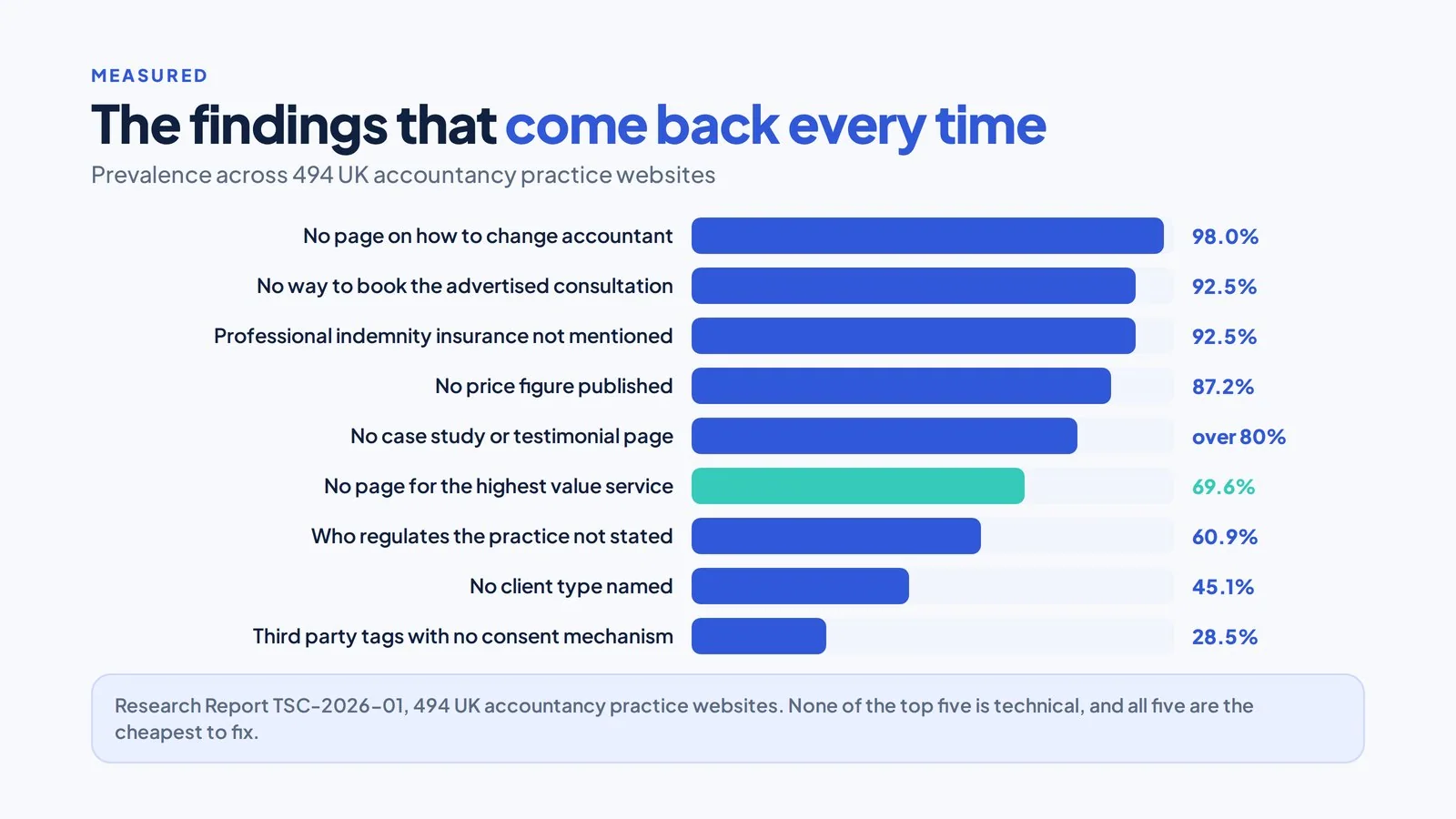
Read those together and a pattern shows: the faults that cost a practice the most money are the cheapest ones to fix, and none of them is technical.
Which findings matter most for a practice, and in what order?
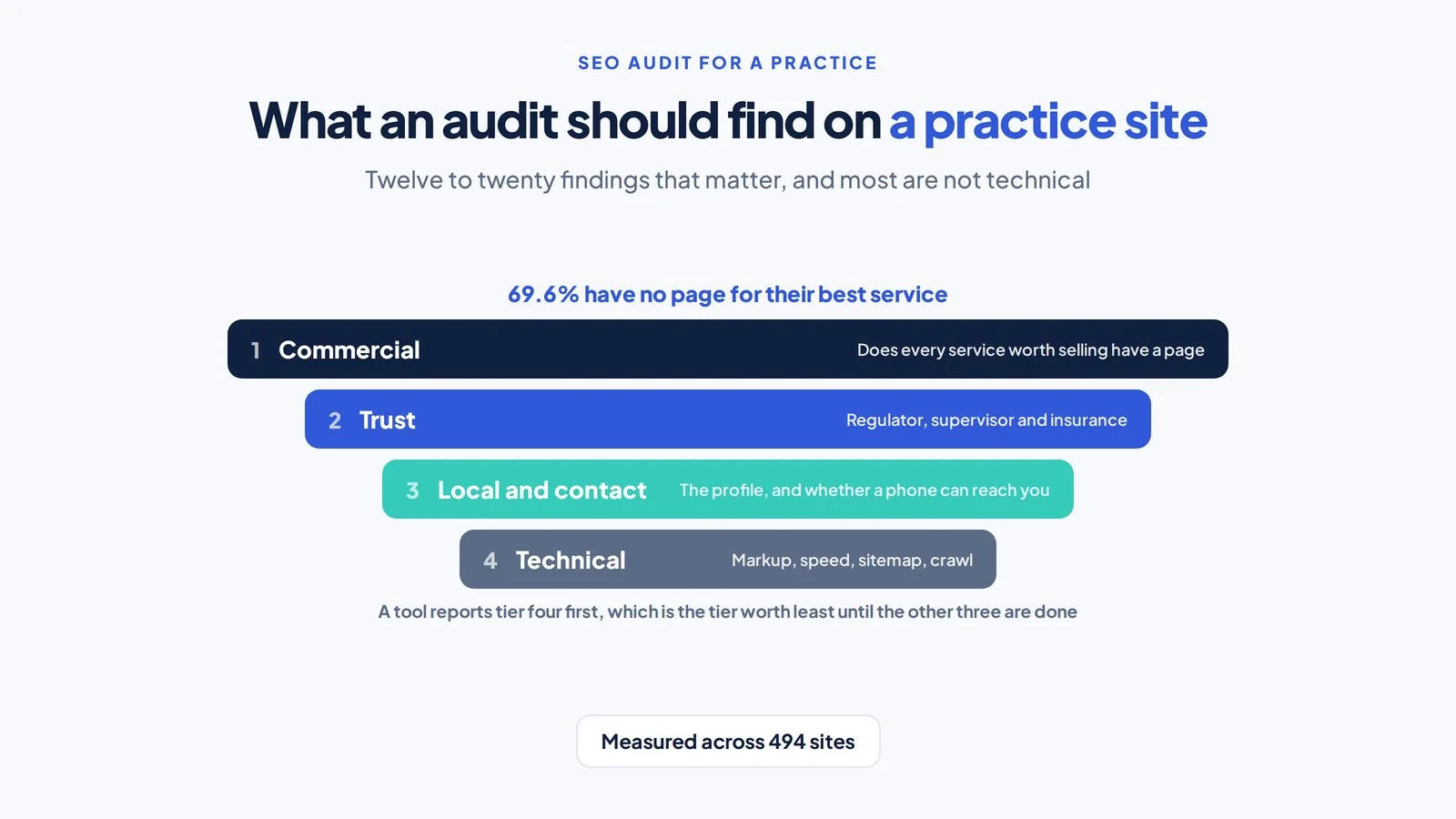
Fix in four tiers, and the order is not negotiable, because each tier makes your next one worth more.
Tier one is commercial. Does every service worth selling have a page. With no page for your highest value service you are not competing for that work at all, so no amount of technical repair changes the outcome. This is the tier 69.6% of practices fail.
Tier two is trust. Can a stranger establish who you are, who regulates you and who supervises you. Three sentences, on two pages, and it changes how every other page on your site reads.
Tier three is local and contact. Does your profile exist, is it correct, and can somebody on a phone actually reach your reception. The mobile faults above live here, and each one is a fix measured in minutes.
Tier four is technical. Markup, speed, sitemap, crawl budget, heading structure. Real work, worth doing, and worth nothing before tiers one to three are done. What belongs in the markup for a practice specifically is set out in schema markup for accountancy websites.
A report arriving in the opposite order is not wrong about the findings. It is wrong about the sequence, and working down it from the top costs you a quarter on the tier that mattered least.
Why do most audits report findings that are not real?
Audits report findings that are not real because nobody controls for site size, and a bigger site generates more of everything including false positives.
We know the scale of it because it happened to us. Our first pass across the 494 sites produced 53 findings. 38 of them were artefacts of site size rather than real faults, and they disappeared when tested against a smaller site. The final catalogue carries 36 findings, and 20 of those are specification items with prevalence running from 0.6% to 39.1%.
More than seven in ten of our initial findings would have sent somebody to work on nothing. Take that as the measured cost of acting on an uncontrolled audit, on our own data rather than on somebody else’s estimate.
The test is simple enough to apply to any report you are handed. For each finding, ask whether it would still appear on a site a fifth of the size. A crawler reporting 400 pages with a duplicate meta description on a site with 40 real pages has found a template, not 400 faults. A report showing thousands of items has almost always skipped this step, and you cannot tell which items survived it without asking.
Accountancy SEO
An audit is the start of the quarter, not the end of it
The findings only matter if somebody builds the pages afterwards, in the order that makes each one worth more than the last.
Ask any auditor two questions. What did you rule out, and why. Anybody who has done the work has an answer ready, because ruling things out is most of the work. Ruling things in is the other half, and there are six findings a crawler cannot rule in at all.
Which findings will a generic audit not look for?
A generic audit will not look for the six findings that cost you the most, because none of them is a website fault in the usual sense.
The missing high value service page. A crawler cannot know your best work is research and development claims, so it cannot report that no page exists for it. Only somebody who has asked you can.
The unnamed client type. 45.1% of practices named nobody they serve. A tool reads that page as fine, because it has content, headings and a title.
The unbookable consultation. 92.5% advertised something a visitor could not take up. Every link on the page works, so nothing is reported.
The missing switching page. 98.0% had nothing explaining how a client moves practices, which is the single most common thing a prospect wants to know and the least commonly answered.
The absent price position. 87.2% published nothing. A tool has no opinion about that.
The superseded tax figure. A practice publishing last year’s threshold has a credibility problem that no crawler flags, and it was measurably more common on some platforms than others: a quarter of WordPress practice sites against 7% of hand built ones and 13% of those on Wix.
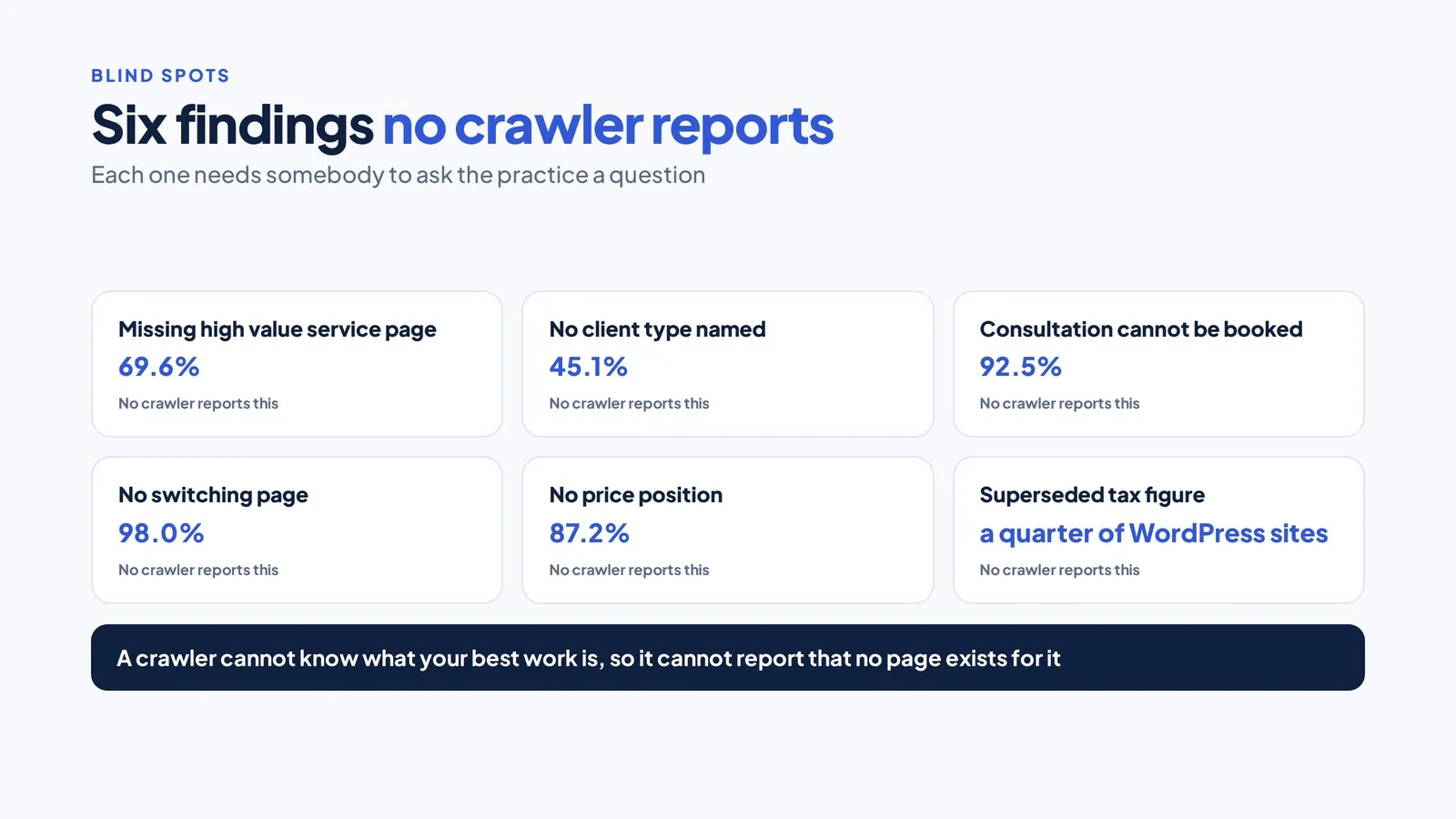
Each of the six needs somebody to ask you a question. That is the difference between an audit and an export, and it means the audit cannot start until you have answered a few questions yourself.
What does an audit need from the practice before it starts?
An audit needs four things from you, and one run without them is a template with your domain name typed into it.
Your fee bands, or at least your services ranked by what they earn. Without this, nobody can tell which missing page matters to you.
The services you most want more of, which is often not the services you do most of. An audit built on volume audits the practice you have rather than the one you are trying to build.
The client types you actually serve, named. Not sectors you would accept, sectors you have worked in and could write about credibly tomorrow.
Read access to your analytics and your Search Console, or an export from both. An audit written without seeing what your site already earns impressions for is guessing at your starting position.
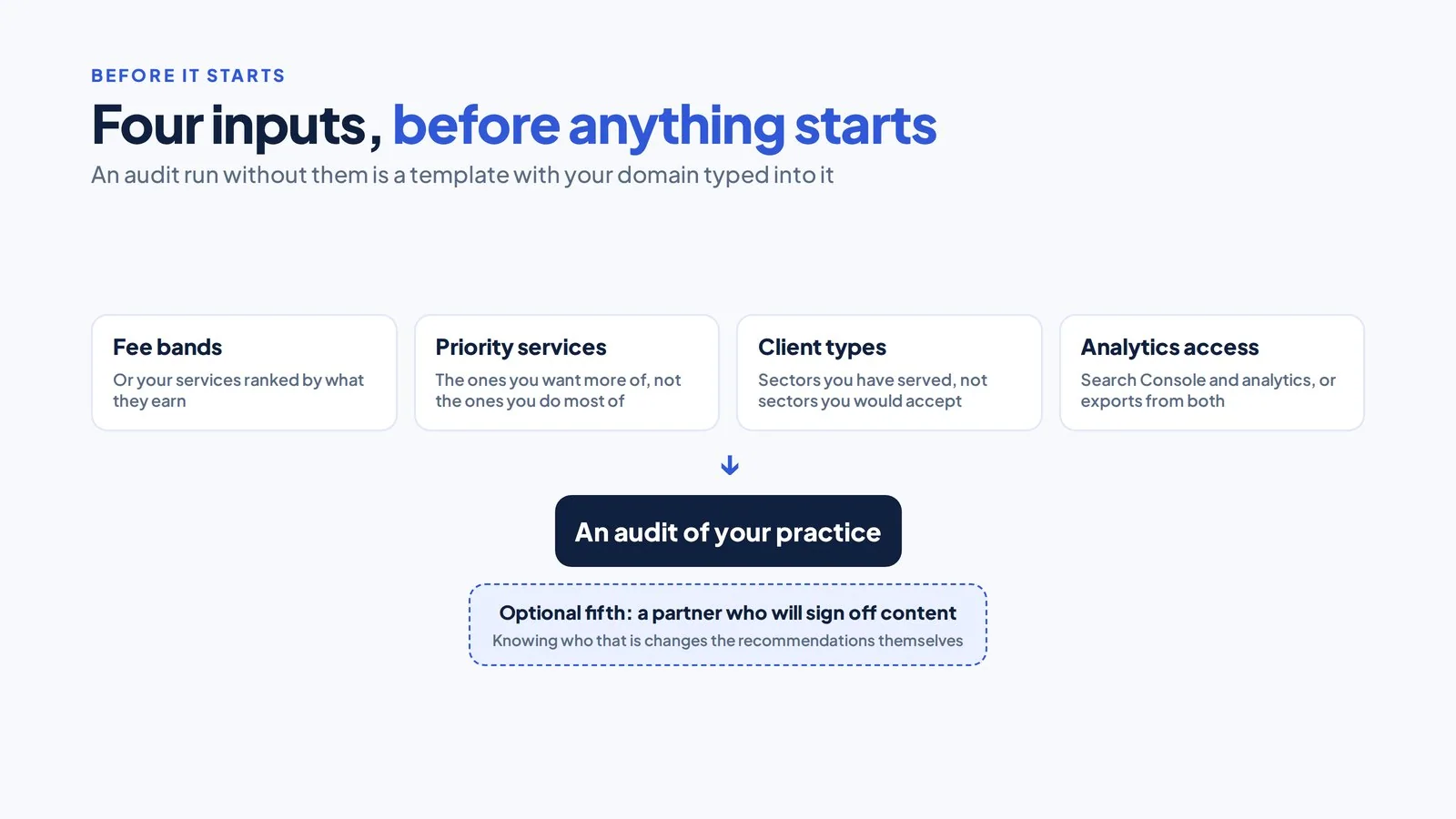
Add a fifth if you can manage it: a partner who will sign off content. Most audit recommendations for a regulated practice die at the point somebody has to approve a sentence, and knowing who that is in your firm changes the recommendations themselves.
How do you tell an audit from a tool export?
Tell them apart on five things, and the first one settles it on its own.
An audit answers a question about your business. An export answers a question about your HTML. A report whose first page is about crawl errors has told you what it measured rather than what it found.
An audit ranks findings by what they cost you. An export ranks by tool severity, which is a technical judgement made without knowing what you sell.
An audit says what to ignore. A list with nothing ruled out has not been read by anybody.
An audit names the owner of each fix. Somebody in your practice, your developer, or the agency, with a rough time cost against each. A finding with no owner does not get done.
An audit is short enough to act on. A list you can work through in a quarter beats one of hundreds of items that produces paralysis, and paralysis is the usual outcome of a long report. A list that size is also roughly four weeks of work, which is worth planning before the report arrives rather than after.
What happens in the four weeks after the report lands?
Four weeks is enough to clear most of what an audit finds on your site, and the sequence matters more than the hours you put in.
Week one goes on tier two, because it is the cheapest week you have. Write the regulator, the supervisor and the insurance into your about page and your footer. Put a real booking route behind the free consultation, which 92.5% of practices advertise without one. Fix the telephone link so the number dials when a client taps it.
Week two goes on your highest value service page, written properly rather than assembled. One page, one service, the question a client would type answered in the first sentence.
Week three goes on your switching page and your named client types, an afternoon each, and almost nobody has either.
Week four goes on the profile and the local signals, and on setting up the measurement you will judge the next quarter against. The profile side of that week is covered in local SEO for accountants.
Technical work starts in month two, once you have something worth crawling efficiently. The page by page detail behind weeks two and three is worked through in accountancy practice website SEO.
Who should each finding be assigned to?
Assign anything that is words to somebody in the practice, and anything that is code to whoever maintains the site. An audit that leaves every finding unassigned is the reason most reports go unread twice.
Words covers most of what matters. The regulator statement, the insurance sentence, the supervisor, the client types, the service page copy, the switching page, the price position, the booking route. Every one of those is a partner or your practice manager with an afternoon, and every one sits in tiers one to three.
Code covers markup, redirects, site speed, sitemap configuration, canonical handling and anything involving the theme. Those go to whoever maintains your site, with the finding written so they can act on it without interpreting it.
Insist on the split, because anybody quoting to write three sentences about your professional indemnity insurance is quoting to do something your practice manager can do faster, and an audit that does not say so is not being straight with you. Who ends up doing the technical half, and on what terms, is a separate decision and a separate conversation.
| Finding | Who does it | Our rough estimate |
|---|---|---|
| Regulator, supervisor and insurance in text | Practice manager | Ten minutes |
| Named client types on the about page | A partner | An afternoon |
| Booking route behind the consultation offer | Practice manager | An hour |
| Price position published | A partner | An hour, plus a decision |
| Highest value service page written | A partner, or a writer briefed by one | Half a day |
| Switching page written | A partner | An afternoon |
| Telephone number made tappable | Developer | Ten minutes |
| Structured data describing the practice | Developer | Half a day |
| Redirects after a rebuild | Developer | Half a day to two days |
| Sitemap and crawl configuration | Developer | An hour |
What does an audit find on a multi office or multi partner practice?
With more than one office you get three findings a sole practice never does, and all three come from the same root: the same content existing in more than one place.
Duplicate location content is the first and the most common. Two office pages built from one template, differing by a place name, compete with each other for the same search and neither wins. The audit should say which one to keep, what the other has to say instead to survive, and which one gets the redirect. 39.1% of the sites we audited carried duplicate titles somewhere, and a cloned office page is one of the ways a site ends up in that group.
A split profile estate is the second. Two offices mean two Google Business Profiles, and an audit should say whether the second one has been set up deliberately or cloned from the first. How each profile should then be configured is a local SEO decision rather than an audit finding.
Partner page dilution is the third and it is the most avoidable. A firm with six partners often publishes six near identical biographies, each with the same paragraph about the firm and one line that differs. Each one is a page with almost nothing unique on it, which is the exact profile a search engine discounts. One differentiated biography per partner, naming a real specialism, is worth more than six that read as a staff directory. All three of those are things an audit can find. Four other things it cannot, and they are worth knowing before you read anybody’s report.
Can ChatGPT or an AI assistant run an SEO audit for your practice?
It can read a page and tell you what is wrong with it, and it cannot audit a site. The distinction is not about quality of output. An assistant works from what you paste into it, so it sees the pages you already suspected and never sees the pages that do not exist, which is the finding that matters most on a practice website. Our study of 494 UK practice sites found 69.6% had no page for the service they most wanted to sell. No tool that reads your existing pages can find a page that was never written.
Three things an assistant does well enough to be worth using. It will rewrite a weak title or heading against a target query and usually improve it. It will read a page and tell you which question it fails to answer in its first sentence. It will explain a crawler’s finding in plain language when the tool that produced it will not.
Three things it cannot do, and the third is the expensive one.
- It cannot crawl. Broken links, redirect chains, orphaned pages, duplicate titles across a site and anything requiring the whole URL set are outside what a chat window can see.
- It cannot see your demand. Which queries your practice already earns impressions on, and at what position, comes from Search Console and nowhere else.
- It cannot separate a real finding from an artefact. This is where an audit is actually won or lost, and 38 of the first 53 findings in our study were artefacts of site size rather than faults. An assistant handed a list of findings will explain all 53 helpfully and rank none of them.
Use one as a second reader on a page you are already working on. A practice that uses one as the audit gets a tidy document, acts on the wrong fifteen items, and still has no page for the service it wanted to sell.
What can an audit not tell you?
An audit cannot tell you four things, and a report claiming otherwise is claiming something nobody can deliver.
It cannot tell you where you will rank. A finding describes a gap between your site and the requirement. Closing it changes your position relative to competitors who are also moving, on an algorithm nobody outside Google has seen. Any report carrying a predicted position is carrying a guess with a decimal point on it.
It cannot tell you how long each fix takes to show. Some findings move within days once corrected, such as a category on a profile or a title that never matched its page. Others, such as anything to do with how well known the practice is, take quarters. A report that puts a single timescale across the whole list has averaged two things that are not comparable.
It cannot tell you why a competitor is above you. It can tell you what they have that you do not, which is a different statement and a more useful one. The reason sits inside a ranking system, and the honest version is always about the gap rather than the cause.
It cannot tell you whether the work will pay. That depends on what a client is worth to your practice and how many of them you can take, which is arithmetic the practice owns. Our piece on what SEO costs an accountancy practice works that calculation through properly.
A report that stays inside those four limits reads as less impressive and is worth considerably more, because every line in it is something somebody can act on.
How often does a practice need this, and how do you know it worked?
You need a full audit once, then a review annually, and a check after any site rebuild. Rebuilds are where most of the damage happens, because a new site routinely loses the pages the old one earned from and nobody in the practice notices for two quarters.
Judge whether it worked on three things, in order.
Impressions on the queries your new pages target come first, and they are readable in weeks to a few months, because they only require the page to be indexed and shown.
Enquiries with a source attached come second, and they only exist if whoever answers your phone asks every caller how they found you. Without that question you cannot evaluate the audit at all.
Positions come third and last. They move slowly, they move for reasons outside the audit, and reading them first is how you conclude that a correct piece of work did nothing.
Set your baseline before anything changes. An audit with no recorded starting position cannot be judged, and a provider who did not record one is asking you to trust them rather than measure them.
Self-check quiz
What would an audit find on your site today?
Eight questions you can answer from your own site in ten minutes. Open it in another tab before you start.
Question 1 of 8Your most profitable service has:
Question 2 of 8Who regulates your practice is stated:
Question 3 of 8Your free consultation offer:
Question 4 of 8A page explaining how a client changes accountant:
Question 5 of 8Your telephone number on a phone:
Question 6 of 8Client types you serve are:
Question 7 of 8Any page carrying a tax rate or threshold:
Question 8 of 8The last report you were given:
Show the answer key
- Your most profitable service has: Its own page, written to the search. 69.6% of the practices we audited had no page for their highest value service.
- Who regulates your practice is stated: In text on the about page and the footer. 39.1% of practice sites state this at all.
- Your free consultation offer: Has a booking route on the page. 92.5% advertise one with no way to book it.
- A page explaining how a client changes accountant: Yes, covering clearance and records. 98.0% of practice sites have nothing.
- Your telephone number on a phone: Dials when tapped. 8.5% never mark the number as a telephone link.
- Client types you serve are: Named, with a page each for the main ones. 45.1% of practices name nobody they serve.
- Any page carrying a tax rate or threshold: Has a review date and is current. A quarter of WordPress practice sites were publishing a superseded figure.
- The last report you were given: Ruled findings out and said why. A list with nothing ruled out has not been read by anybody.
Frequently asked questions
What makes an audit of a practice take longer than expected?
The four inputs, almost always. The technical scanning is quick. What takes the time is ruling findings out, and that cannot start until somebody in the practice has ranked the services by what they earn and named the client types.
Is a free audit worth having?
It depends entirely on whether a person looked at it. A crawler export with a covering note is useful for spotting a broken technical item and cannot find any of the six commercial faults above, because those need somebody to ask you a question. Ours is free, has no paid tier behind it and is run by a person, which is why it starts with what you sell rather than with a scan.
Can we just run the tools ourselves?
You can, and you should, for the technical tier. The tools are good at what they measure. What they cannot do is tell you your most profitable service has no page, which is the finding that outranks everything else they will report.
What does an audit find on a practice with only eight pages?
It finds missing pages rather than broken ones, in almost every case. A small practice site fails tier one and passes tier four, because there is not enough of it to break. The useful output on a site that size is a page plan, and you can draft one yourself from the tier list above in an afternoon.
What if the audit says to rebuild the site?
Ask what specifically cannot be fixed on your current site, and ask for it in writing. A rebuild is occasionally the right answer and it is also the most expensive recommendation anybody can make you, so it deserves a stronger justification than a general statement about the platform.
Should we act on every finding?
No. A report that has not ruled anything out has not been read properly. Act on the findings that are real, that sit in tiers one to three, and that you can finish in a quarter. Park the rest and re-test them next year.
Where the audit sits in the rest of the work
Treat the audit as the document that decides your next quarter, not as a health check. Come out of one knowing which three pages to build, which three sentences to publish and which single technical item actually matters and you have something to work from. Come out holding two hundred ranked items and you have a list.
True SEO Consultants Ltd works from Startup Stiwdio at the University of South Wales, 86-88 Adam Street, Cardiff, CF24 2FN, and delivers UK wide through remote digital onboarding and delivery. Mohammad A Mahmud completed the ACCA professional examinations and holds an MSc in Applied Accounting from the University of South Wales, and Julie Williams is a fractional finance director and certified business coach, which is why our audit starts with the fee ledger rather than with the crawl. We bill on KPIs, not hours, with milestones in writing, and we published the research this page is built on: Research Report TSC-2026-01, our audit of 494 accountancy practice websites, catalogue of 36 controlled findings, DOI registered and openly licensed.
We start with the fee ledger, not the crawl
Bring your service list ranked by what it earns and we will tell you on the call which pages are missing and what that is costing.
Book my free strategy callRead the website checklist