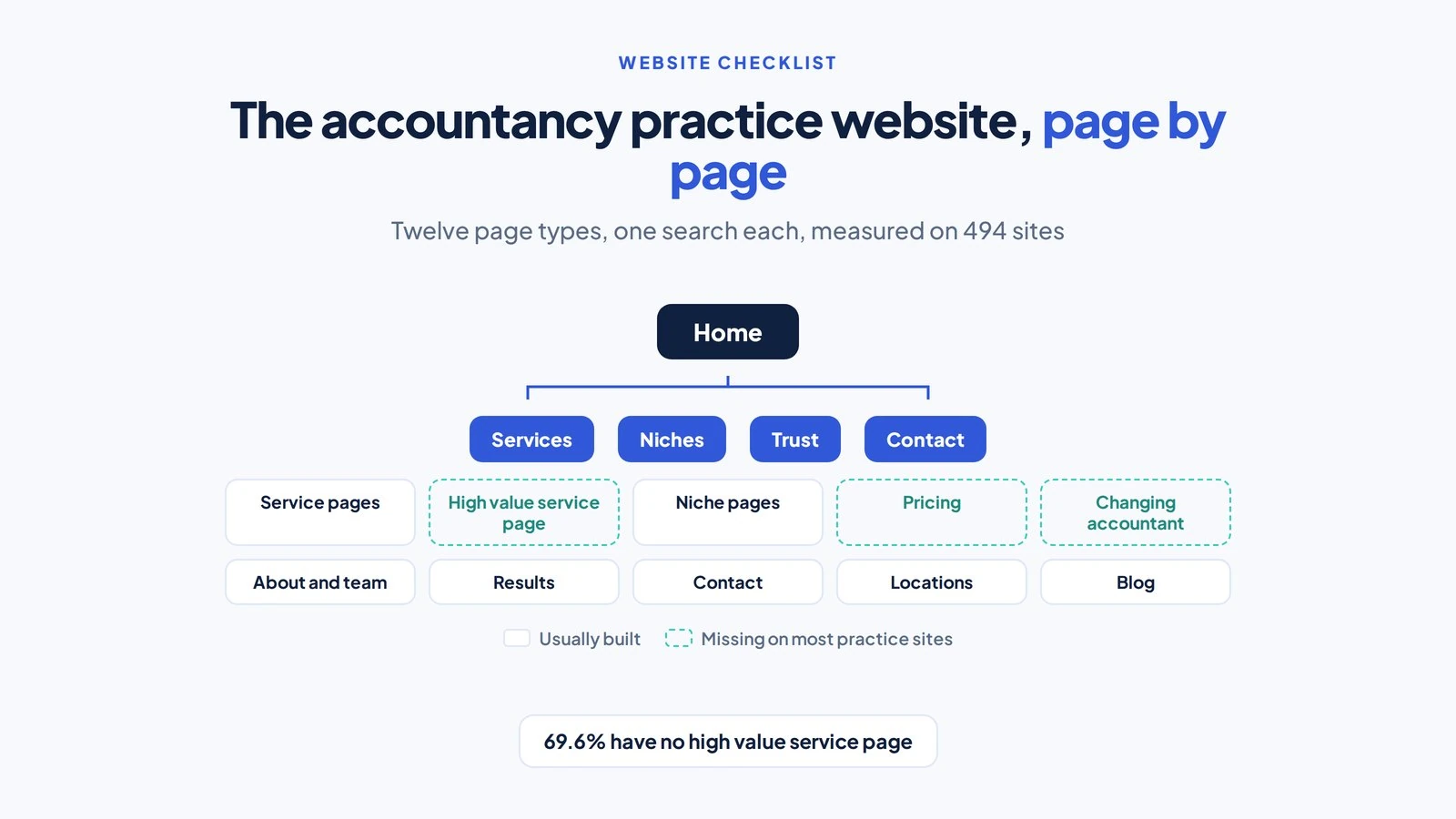
Accountancy website SEO is the work of making sure every service a practice sells has a page, that each page answers one search, and that a crawler and a reader can both get what they need from it. Most practice websites fail the first test rather than the third. Our audit of 494 UK accountancy practice websites found 344 of them, 69.6%, had no page at all for the service the partners most wanted to sell.
A website cannot rank for a search it does not answer. Everything below is the page inventory that answers the searches your practice depends on, with the query each page owns and the evidence for why it matters.
Key Takeaways
- Your website needs about twelve page types, and each one should own a different search.
- The most valuable page is usually the one that does not exist: 69.6% of the 494 practices we audited had no page for their highest value service.
- 87.2% publish no price figure of any kind, which leaves the visitor unable to self qualify.
- 92.5% advertise a free consultation with no way to book it.
- 98.0% have no page explaining how a client changes accountant, which is the main objection in the sector.
- Only 39.1% state who regulates them, and 0.4% name their anti money laundering supervisor.
- Fix in this order: pages that do not exist, then pages that cannot be found, then pages that cannot convert.
- An assistant answers from pages a search index already found, so a practice with no page for a service is absent from the AI answer for the same reason it is absent from the results.
- Run your own audit with a control, because 38 of the first 53 findings in our study were artefacts of site size rather than real faults.
Page plan first
Want to know which pages your practice is missing?
We list every service you sell against every page you have, and the gap is usually the most valuable thing on the report.
Measured across the sector
Every figure in this checklist comes from Research Report TSC-2026-01 or from our own Search Console.
- 494UK practice websites audited in our published study
- 69.6%have no page for their highest value service
- 2,110impressions on accountant website searches
What is accountancy website SEO, and which pages does it cover?
Accountancy website SEO covers the structure, content and technical condition of every page a prospective client might land on, from your home page down to a single niche page. The work splits into three questions asked of each page: does it exist, can it be found, and does it convert.
Order matters. A page that does not exist cannot be optimised, a page that cannot be found cannot convert, and a page that converts badly is a cheaper problem than either. Most practice websites are diagnosed in the wrong order, which is why so many of them get a technical audit when what they needed was four more pages.
The commercial version of this work, including how it fits with local search and content, is SEO for accountants. What follows is the page specification.
Which pages does a practice website need, and which query does each one own?
Your website needs twelve page types, and each one should own a different search. Build two pages for the same search and you split the signals, so neither of them ranks.
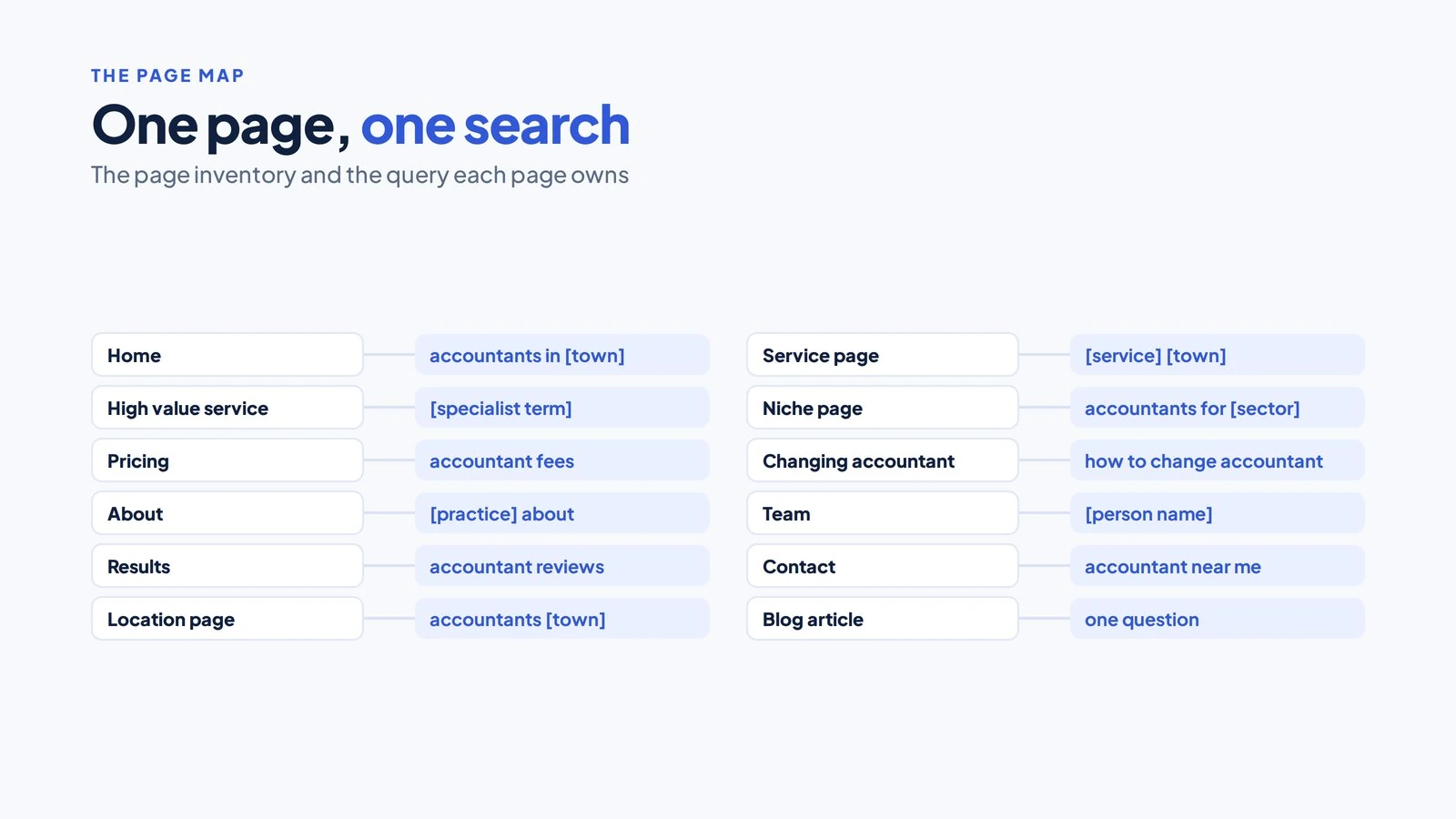
| Page | The search it owns | What it must contain |
|---|---|---|
| Home | Practice name, and accountants plus your town | Who you serve, what you do, where, and one way to act |
| Service page, one per service | Service plus town, service plus client type | Scope, who it suits, what happens next, price or price logic |
| High value service page | The advisory or specialist term partners want to sell | The same, plus proof and a qualifying step |
| Client type or niche page | Accountants for plus a trade or sector | The sector’s own vocabulary, its problems, named proof |
| Pricing | Accountant fees, how much does an accountant cost | A figure, a band or the method by which a fee is set |
| Changing accountant | How to change accountant, switching accountants | The process, the timing, who contacts whom, the cost |
| About | Practice name plus about, who runs plus practice name | People, credentials, regulator, history, location |
| Team | Named person searches | Role, qualifications, sector focus, contact route |
| Case studies or results | Accountant reviews, accountant for plus sector | Named or anonymised outcomes, dates, what was done |
| Contact | Practice name plus contact, accountant near me | Address, tappable phone, short form, map, hours |
| Location page, where justified | Accountants plus each town served | Local proof, local clients, a reason to exist |
| Blog article | One question per article | A direct answer, then the detail, then a route onward |
Twelve types does not mean twelve pages. With six services and three niches you are already at eighteen pages before a single article, once the eight fixed pages and the high value service page are counted. What matters is that no two of your pages chase the same search.
The home page: what belongs above the fold
Your home page has to answer three questions in the first screen: what you do, who you do it for, and what happens next. A home page opening with a welcome message and a stock photograph answers none of them.
Four elements earn their place above your fold. The heading should name the service and the place. One sentence names the client types you serve, and one primary action, usually booking a call, follows it. The fourth is a trust marker such as your regulator or professional body, because somebody deciding whether to hand over their year end records and their payroll is looking for a reason to keep reading.
Our study measured what happens at the other end of that. 43 of 494 practice websites, 8.7%, had no identifiable call to action on the home page at mobile width, and 23 more had their main action covered by a fixed overlay such as a consent banner. On those sites your mobile visitor arrives and finds nothing to do.
The home page names who you serve. Catching the search a client actually types is a different job, and it belongs one level down.
Service pages: one service, one page, one query
Each of your services gets its own page, written to the search a client would actually type. A single services page listing eight offerings ranks for none of them, because a search engine reading it cannot tell which of the eight it is about.
Four things belong on every one of your service pages:
- The scope, in plain terms. What the engagement letter covers, what it does not, and what a typical year looks like from their side.
- Who it suits. Turnover band, sector, stage, whether they run payroll. A reader who cannot place themselves on your page leaves it.
- What happens next. The first meeting, the records you need from them, how long onboarding takes and who they will deal with.
- The price, or the logic behind the price. More on that below.
The structural rule matters as much as the content. Compliance and advisory are different products bought by different people at different moments, and putting them on one page forces you to speak to two readers at once. Split them, then link your compliance page to your advisory page, because the client who came in for a year end and a payroll run is the advisory client eighteen months later.
The page 69.6% of practices do not have
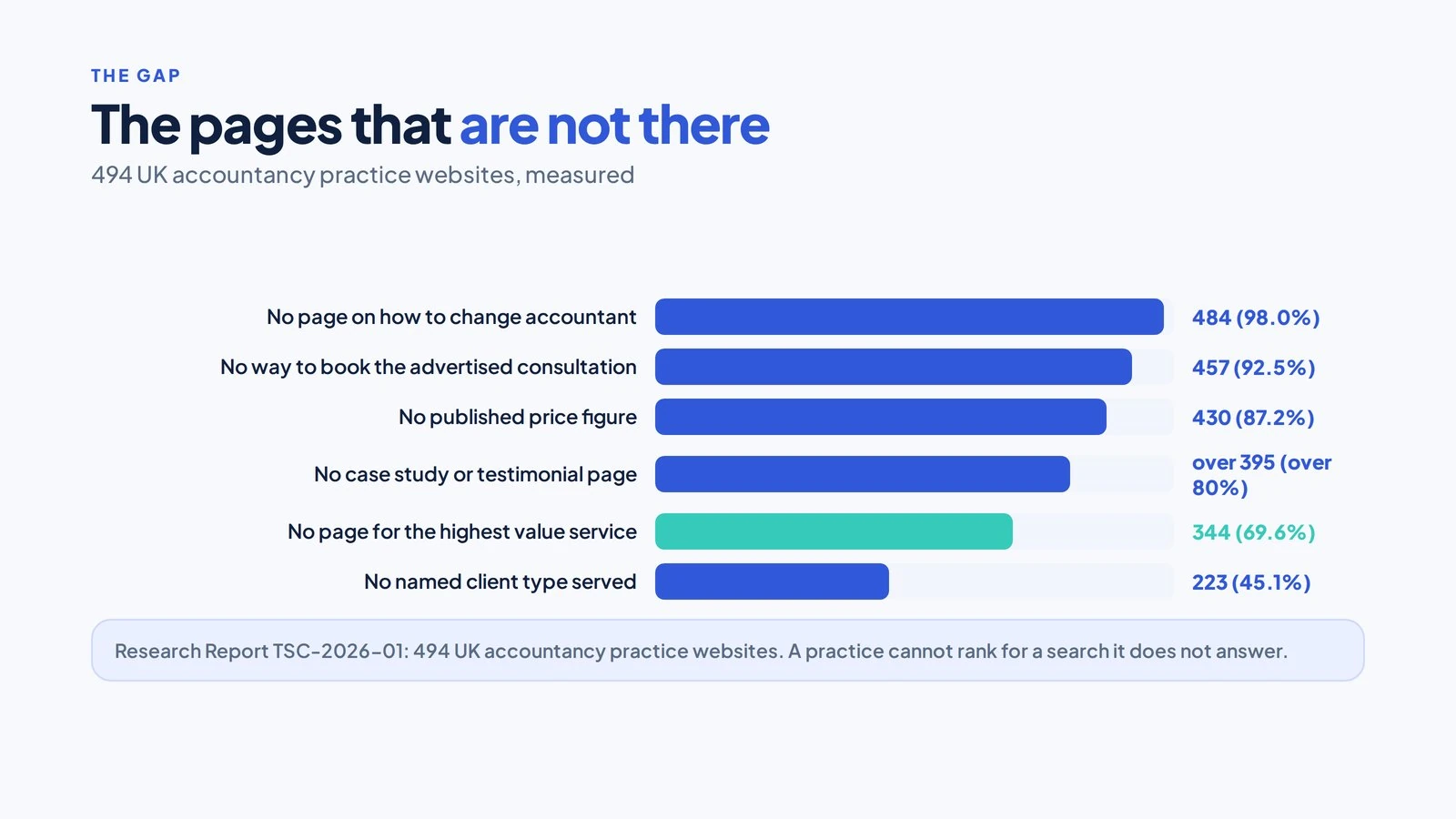
The missing page is nearly always the one for your highest value service. 344 of the 494 practices we audited had no page for the work their partners most wanted to sell, which makes it the single most common commercial fault in the sector.
Three causes produced it, and the study records all three. Service lists get written from your internal task list rather than from what your client searches for. Advisory work has historically been won by referral, so nobody thought it needed a page. And a page can only be retrieved for a query it answers, so with no page for R&D claims you are absent from every search for R&D claims, however strong your domain is.
Your fix is a page, not a paragraph. A paragraph inside a services list cannot rank for a search, cannot be quoted by an answer engine, and cannot carry the proof a high value buyer needs before making contact. Write the page, give it a target query, link it from your home page and from the compliance service it sits above, and it can start earning impressions inside a quarter. Without the page it earns none, ever.
The full set of measured faults, with counts and method, sits in the 494 practice website study.
Client type and niche pages: who you serve, named
A niche page names a client type and speaks its language, and it converts better than a service page because your reader recognises themselves in the first line. 223 of the 494 practices we audited, 45.1%, named no client type at all, which leaves a searcher nothing to match themselves against.
Three things make a niche page work rather than read as a template with a word swapped.
- The sector’s own vocabulary. A pharmacy owner searches for NHS reimbursement and stock valuation, not for management accounts.
- The sector’s actual problems. When their year end falls, what their cash cycle does in the quiet months, which reliefs apply and which they keep missing.
- Proof from that sector. One named or anonymised client, one outcome, one date.
Choose niches your partners can serve rather than the ones with the most attractive search volume. We keep a running view of where the room is in niche opportunities for accountants.
The pricing page: what to publish when you cannot publish a number
Publish a figure, a band, or the method by which you set your fee. 430 of the 494 practices we audited, 87.2%, published no price figure of any kind, which leaves every visitor unable to work out whether the practice is for them.
Four formats all work, in descending order of usefulness to your reader:
- A fixed price. Self assessment from a named figure, payroll per employee per month.
- A band with the variables named. Year end accounts from one figure to another, depending on turnover, transaction volume and whether bookkeeping is included.
- A worked example. A described business, its circumstances, the fee it pays.
- The method. How you price, what moves your number, and how long a quote takes to come back after the first meeting.
Publishing the method is your minimum, and it costs nothing competitively because a competitor already knows roughly what you charge. Your visitor does not, and your visitor is the one leaving.
The page that answers the objection 98% of practices leave standing
The page explaining how a client changes accountant is missing from 484 of the 494 websites we audited, which is 98.0%. It answers the single largest objection in your sector, and almost nobody in your sector has written it.
Six questions belong on it: whether their current accountant has to be told, who writes to whom, what professional clearance means, what happens to the records and the bookkeeping file, how long the change takes, and whether anything is lost part way through a year end. All six have straightforward answers, and a prospect who reads yours has crossed the obstacle that was keeping them where they are.
Write it once and it keeps working. It also earns you links and citations, because it answers a question asked constantly and answered rarely.
A prospect who has crossed that obstacle has one question left before they pick up the phone, and it is about whether you are safe to hand their figures to.
About, team and the trust signals a regulated sector needs
About, team and trust pages exist to answer one question: is this practice safe to hand my figures to. Trust signals carry more weight here than in most sectors, because your visitor is deciding whether to give a stranger their bank feeds, their payroll and their year end. The measured position across 494 sites is thin.
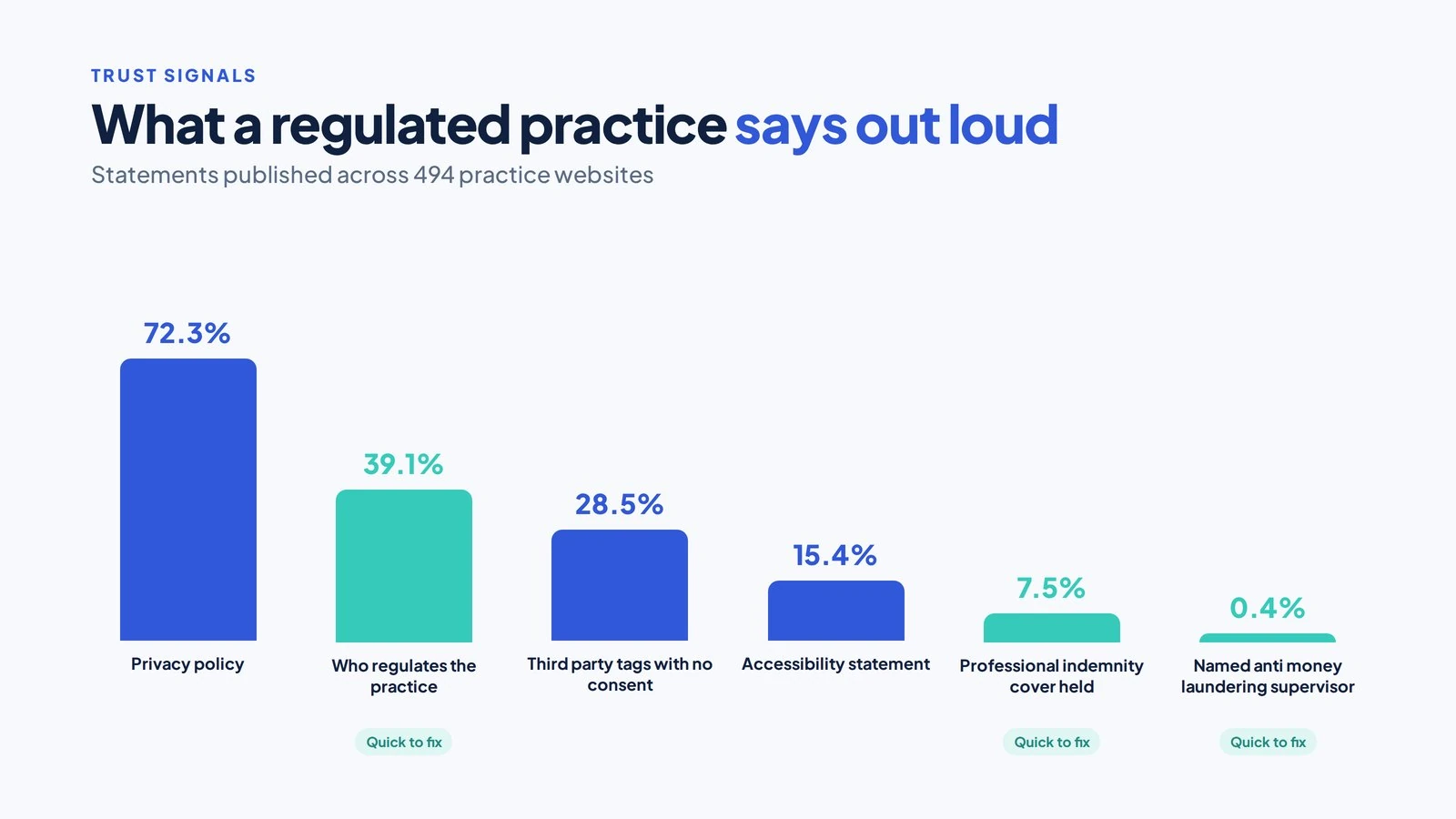
| Statement | Firms | Share |
|---|---|---|
| Who regulates the practice | 193 | 39.1% |
| Professional indemnity insurance held | 37 | 7.5% |
| Named anti money laundering supervisor | 2 | 0.4% |
| Privacy policy | 357 | 72.3% |
| Accessibility statement | 76 | 15.4% |
| Third party tags with no consent mechanism | 141 | 28.5% |
Three of those are quick to fix and change how your page reads. Name your regulator in the footer and on your about page. State that professional indemnity cover is held. Name your anti money laundering supervisor. Two of the 494 practices we audited did, and every supervised practice has one to name.
Those six are statements about the practice. The people behind them are a separate signal, and they carry weight of their own.
Team pages deserve more attention than they get. A named person with a qualification, a sector focus and a direct contact route is a page that can rank for their name, and a business owner searches for the partner they are about to sit opposite.
Having decided you are safe, they then have to be able to reach you, which is where more practices lose the enquiry than lose the argument.
The contact page and the enquiry form
Your contact page needs a full address, a tappable telephone number, a short form and your opening hours. 27 of the 494 practices had no dedicated contact page at all, which removes the page a decided prospect goes looking for when they want to reach reception rather than fill in a form.
Keep the form to three fields: name, email, and one line on what they need. Every field beyond that is a reason to abandon it, and 41 of the 494 practices we audited were asking for enough to lose the enquiry. The measured mobile faults are set out in full further down, because they are easier to read against each other than one at a time.
A related finding sits behind them. 457 of the 494 practices, 92.5%, advertised a free consultation with no way to book it. The offer is real, the mechanism is missing, and the visitor who was ready to act has to invent their own route in. What to do about form design and enquiry flow in detail is covered in conversion for accountancy practices.
Everything above sits on one site for one practice. Two page types decide how much further it reaches, and the first of them is the one most often built for the wrong reason.
Location pages: the rule, and when not to build them
Build a location page only where you have something real to say about that place. A page whose only local content is the town name repeated eleven times will not rank, and twenty of them dilute the pages that would have.
The test is whether you can write four things: clients you serve there, a reason they chose you over the firm on their own high street, something specific about doing business in that area, and a route to a named person at your practice. Write those for three towns and build three pages. Write them for none and name the towns inside your main service pages instead. We set out why the thin version fails in why accountancy location pages fail.
What the blog is for on a practice site
Your blog exists to answer the questions that sit around your services and to pass authority into the pages that sell them. That is its whole job on a practice site, and judging it on traffic misses the point.
Three rules keep it useful. One question per article, answered in the first two sentences. Every article links into the commercial page it supports, because that is how an article strengthens the page that earns. And publish nothing you would not defend in a partners’ meeting, because a superseded tax rate or an old allowance sitting on one of your posts is a visible competence problem in the one sector where it is least forgivable. Our study found practices publishing superseded tax figures at rates of 7% to 25% depending on platform. The strategy side is covered in accounting blog SEO strategy.
How internal links should run between these pages
Links run from your informational pages into your commercial pages, and from child pages up to their parent. That direction concentrates authority on the pages that earn you money rather than spreading it evenly across the site.
Four rules cover almost every case on your site:
- Every article links to the service page it supports, once, from inside the relevant section rather than from the first paragraph.
- Every niche page links up to the service page above it, and the service page links down to its niches.
- The home page links to the pages you most want to rank, not to everything.
- Anchor text describes the target, uses wording that appears on the target page, and is not repeated more than three times across one article.
One more rule saves you rework. Link a new page from the older pages that already mention its subject, on the day it goes live. A page with no inbound internal links is one a crawler reaches last and a reader never reaches at all.
Links decide which of your pages gets weight. What that page then says in its title and its headings decides which search it gets the weight for.
Audit with a control
Get the findings that are real, not the ones the tool found
A standalone audit separates genuine faults from artefacts of site size and hands over the page plan, whoever builds it.
Titles, headings and the queries they have to match
Your title and your H1 should say the same thing, and both should carry the search the page is written for. 39.1% of the practice websites in our study carried duplicate titles, which means several pages telling a search engine they are about the same thing.
Headings do more work than a style choice. Our own accountancy page shows it: Google treats the answer first H2 anchors on that page as separate targets, ranking them in the low teens in their own right. A heading phrased as the question a client asks, with the answer in the sentence directly beneath it, is retrievable on its own.
Three practical rules follow. Write your headings as questions or as attribute statements, not as labels. Put the answer in the first sentence under the heading, not in your third paragraph. And keep one subject per heading, because a section covering two things ranks for neither.
Headings decide what a reader takes from a page once they are on it. Whether they arrive at all is decided by the markup, the sitemap and the speed of the page.
The technical layer: markup, sitemap, speed and analytics
The technical layer makes your pages readable, and your site needs four things from it: valid markup describing the business, an XML sitemap, pages that load quickly on a phone, and analytics that record what happens.
Markup is where you gain ground cheaply, because most of your competitors have none. A LocalBusiness or AccountingService entry with your address, hours, telephone and regulator, plus Person entries for your team with their qualifications, gives a search engine machine readable facts rather than inferences. The detail is in schema markup for accountancy websites.
Speed matters most on mobile and least in a report. Aim for pages that show their main content quickly on a mid range phone on a normal connection, and treat any score as a proxy rather than a target. Crawl and indexation sit alongside both, and a page nobody can crawl is a page nobody can rank.
What breaks on mobile, measured across 494 sites
Mobile faults cost you enquiries your site had already earned, and they are invisible from your desktop. Six of them appeared repeatedly across the panel.
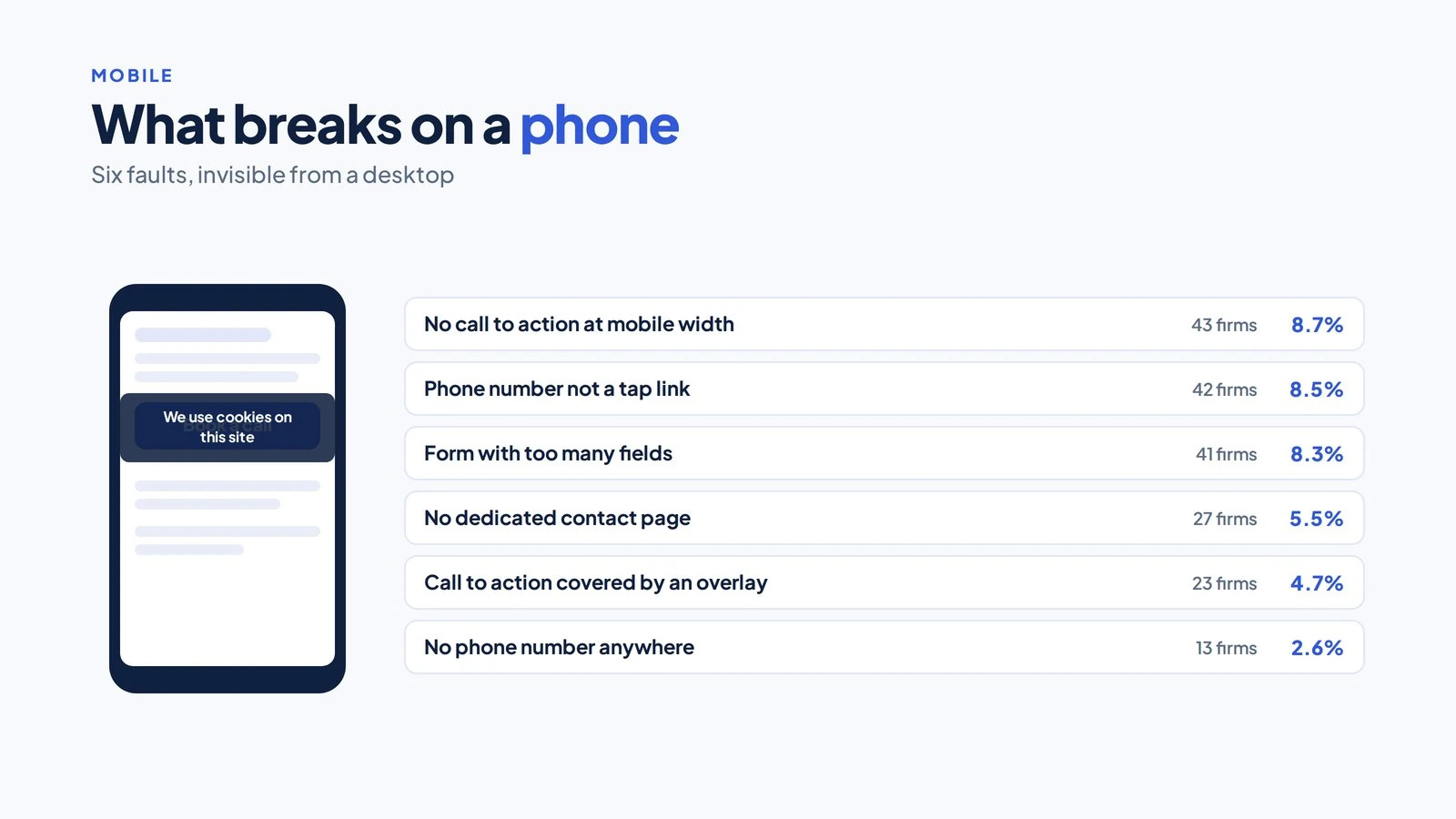
| Fault | Firms | Share | What happens |
|---|---|---|---|
| No identifiable call to action at mobile width | 43 | 8.7% | Mobile traffic arrives and finds nothing to do |
| Telephone number not marked as a telephone link | 42 | 8.5% | The number cannot be dialled by tapping |
| Enquiry form with too many fields | 41 | 8.3% | The visitor abandons partway through |
| No dedicated contact page | 27 | 5.5% | The page a decided prospect looks for is absent |
| Main call to action covered by a fixed overlay | 23 | 4.7% | The consent banner sits on the enquiry button |
| No telephone number published anywhere | 13 | 2.6% | Referrals told to ring you cannot |
Check all six on a real phone rather than in your browser’s device preview, because that is how a business owner reaches you: standing in a warehouse, sitting in a van, or in the ten minutes after a call with their current accountant. The overlay fault in particular only appears on a device with a real consent banner and a real viewport.
Does your platform change any of this?
Your platform changes which faults are likely, not which pages you need. Our study recorded markedly different fault profiles across the three common builds.
| Finding | WordPress | Hand built | Wix |
|---|---|---|---|
| No page for the highest value service | 60% | 75% | 95% |
| No XML sitemap | 15% | 55% | 0% |
| No structured data | 15% | 45% | 5% |
| No analytics | 43% | 58% | 79% |
| Publishes a superseded tax figure | 25% | 7% | 13% |
| Copyright year out of date | 19% | 14% | 45% |
Two readings follow. Hand built sites carry the most technical debt, because nothing is maintained by a platform. Hosted builders handle the plumbing and leave the commercial gaps wide open, which is why the Wix column shows almost no sitemap problems and the worst missing page figure in the study. Neither platform is the reason you are not ranking, and both can be fixed.
Does the website still matter when clients ask an assistant instead of searching?
It matters more, because an assistant has nothing to answer from except pages somebody wrote. A business owner who asks an assistant for an accountant gets a reply assembled out of pages a search index already found, so a practice with no page for the service being asked about is absent from the answer for the same reason it was absent from the results: the page does not exist. The checklist above is the input list.
Three pages on this inventory do most of that work, and they are not the ones most practices would guess. The service page carries the direct answer to what the service is and who it is for. The client type or niche page carries the situation, which is the form an assistant question usually takes. The pricing page carries the figure or the honest explanation of why there is not one, and a page that answers a money question is quoted far more often than one that avoids it.
Two properties decide whether a page can be used at all. The answer has to sit in the first sentence under its heading, before the context, because an assistant lifts a passage rather than reading the section. And the practice, the service and the town have to be named in the text rather than implied by the header and the footer, because a quoted passage arrives stripped of everything around it.
Nothing here is a separate project and nothing here is an extra line on a quote. Every item in this section is already somewhere in the page inventory above, done to a standard that a machine reading one paragraph in isolation can still make sense of.
What to fix first, in order
Fix in three tiers, and do not start at the bottom. Most audits hand you a technical list when the pages you need do not exist yet.
Tier one, pages that do not exist. The high value service page, the changing accountant page, the pricing page and any niche page you can write properly. Nothing else on this list produces more, and the raw material for all four is already in your heads rather than in a tool.
Tier two, pages that cannot be found. Duplicate titles, missing sitemap, pages with no inbound internal links, headings that describe nothing, missing markup.
Tier three, pages that cannot convert. The mobile faults, your form length, the missing contact route, the booking mechanism for a consultation you already advertise.
Work through that order and your first movement comes from tier one, because those are searches you were not competing for at all.
How to audit your own site in an afternoon, without acting on the wrong findings
Auditing your own site takes an afternoon and needs a control, because an uncontrolled audit hands you findings that are artefacts of site size rather than real faults. In our own study, 38 of the first 53 findings across the panel turned out to be artefacts, which is the measured cost of acting on an audit nobody validated.
Six checks cover most of it:
- List every service on your engagement letter, then find the page for each. Missing pages are tier one.
- Search your own titles. Two pages with the same title is a duplicate to resolve.
- Open the site on a real phone. Check the six mobile faults above.
- Ask somebody outside the practice to find your fee logic in thirty seconds. Time them, and watch where they look first.
- Search for your practice name plus your town and look at what appears, including the map pack and any directory above you.
- Check your own Search Console for queries where you have impressions and no clicks. Those are pages ranking for a search they cannot answer.
Every finding needs one more test before you act on it: would it still be a fault on a site half the size? A finding that disappears under that test is an artefact. A standalone SEO audit applies that control formally and hands over the page plan. Run the six checks this week, in order. Take the list to your next partners’ meeting rather than to a developer.
Quiz: score your practice website page by page
Self-check quiz
Score your practice website, page by page
Eight checks on the pages that matter most. Open your own site in another tab and answer from what you see.
Question 1 of 8The service your partners most want to sell:
Question 2 of 8Your pricing information is:
Question 3 of 8A visitor wanting to change accountant finds:
Question 4 of 8Your free consultation can be booked:
Question 5 of 8Your regulator and anti money laundering supervisor are:
Question 6 of 8On a real phone, your main call to action is:
Question 7 of 8Two pages on your site with the same title:
Question 8 of 8Your articles link:
Show the answer key
- The service your partners most want to sell: Has its own page written to one search. 69.6% of the 494 practices we audited were in the third state.
- Your pricing information is: A figure or a band with the variables named. 87.2% publish nothing, so any figure is a differentiator.
- A visitor wanting to change accountant finds: A page explaining the whole process. 98.0% of practice sites leave the sector’s main objection unanswered.
- Your free consultation can be booked: From a button on the page, in one step. 92.5% advertise the offer and provide no way to take it.
- Your regulator and anti money laundering supervisor are: Both named on the site. 39.1% name the regulator and 0.4% name the supervisor.
- On a real phone, your main call to action is: Visible and tappable immediately. 8.7% have no mobile call to action and 4.7% have it covered by an overlay.
- Two pages on your site with the same title: None. Duplicate titles appeared on 39.1% of the sites we audited.
- Your articles link: Into the service page each one supports. Authority runs upward from articles into the pages that sell.
Frequently asked questions
How many pages should an accountancy practice website have?
One per service, one per niche you can serve properly, plus the eight fixed pages in the inventory above. Six services and three niches lands around eighteen pages before any articles, and that is a normal figure rather than a large one.
Should an accountancy website publish prices?
Publish something, even where a fixed price is impossible. A band with the variables named, or a worked example, lets a visitor decide whether the practice is for them. 87.2% of the practices we audited published nothing at all, so a figure of any kind is a differentiator.
Does an accountancy website need a blog?
Yes, but for authority rather than traffic. Articles answer the questions around your services and link into the pages that sell them. A blog that never links into a commercial page is doing half the job.
What is the single most valuable page to add?
The page for the service your partners most want to sell, where it does not already exist. Our study found 69.6% of practices in exactly that position, and the page is usually the one carrying the highest fee.
How do I know if my site has a technical problem or a content problem?
Count the services you sell and the pages you have for them. A gap there is a content problem and no amount of technical work fixes it. Where every service has a page and none of them appear in search, the problem is technical. The fuller diagnosis runs through why an accountancy firm is not ranking.
Do we need a separate page for every town we serve?
No. Build a location page only where you can write four things about that place: clients served, why they chose you, something specific about the area, and a named contact. Otherwise name the towns inside your service pages.
Does the website matter if most of our clients come from referral?
Yes, because a referred prospect checks the website before calling. The pages that matter most for a referral are the team page, the trust statements and the route to book a conversation, and the last of those is missing on 92.5% of practice sites.
Where the website sits in the rest of accountancy SEO
Your website is the asset everything else points at. A Google Business Profile, a professional body directory listing, a published article and an answer engine citation all send a business owner to one of your pages, and the page either answers their search or does not. Fixing the profile while the page is missing moves your problem rather than solving it. Start at tier one and build the page that is not there.
True SEO Consultants Ltd works from Startup Stiwdio at the University of South Wales, 86-88 Adam Street, Cardiff, CF24 2FN, and delivers UK wide through remote digital onboarding and delivery. Mohammad A Mahmud completed the ACCA professional examinations and holds an MSc in Applied Accounting from the University of South Wales, and Julie Williams is a fractional finance director and certified business coach, which is why this checklist starts from your commercial structure rather than from a crawler report. We bill that work on KPIs, not hours, with milestones in writing at three, six and twelve months. Research Report TSC-2026-01 audited 494 UK accountancy practice websites and is published in full under a Creative Commons licence. The full programme that turns this checklist into published pages is set out in what an accountancy SEO programme includes. Start at tier one. Open your service list, find the first service with no page behind it, and write that page this month.
We will tell you which page to build next
Bring your service list and your site, and we name the missing pages in order of what each one is worth to the practice.
Book my free strategy callSee the method behind it