Google algorithm updates are changes to the systems Google uses to rank search results. Core updates reassess quality across the web several times a year, and spam updates enforce Google's spam policies. Since Florida in 2003, most major updates have priced out a cheap ranking shortcut.
Key takeaways
- Core updates reassess quality several times a year. Spam updates enforce Google's spam policies.
- Most major updates priced out one cheap shortcut, from bought links to mass-produced AI content. Hummingbird and BERT instead moved Google closer to meaning.
- Google does not penalise AI use. It acts against pages produced at scale mainly to manipulate rankings, however they were made.
- Core updates have had a median rollout of 14.5 days since November 2021. The longest, March 2024, took 45.
- A manual action shows as a message in Search Console. A core update drop comes with no message.
- First-hand content, earned links, a clear subject and accurate business details have survived every update so far.
What this guide covers
- What is a Google algorithm update?
- How often does Google update its algorithm?
- Google before Panda: PageRank, keyword stuffing and the first updates (2003 to 2010)
- Panda, Penguin and Hummingbird (2011 to 2014): quality, links and meaning
- RankBrain, mobile first indexing and BERT (2015 to 2019)
- Page experience, product reviews and helpful content (2020 to 2023)
- March 2024 to now: spam policies, core updates and AI search
- Every ranking update on Google's Search Status Dashboard since November 2021
- The Google update journey: 18 updates, one takeaway each
- Why Google keeps releasing updates: each one made a shortcut expensive
- Does Google penalise AI generated content?
- Why an LLM is the weakest author and the strongest assistant
- How to tell whether a Google update hit your site
- How to recover from a core update, a spam update or a manual action
- What recovery looks like: two illustrative scenarios
- What survives every Google update
- What updates have meant for UK sectors
- When is the next Google core update?
- How update-proof is your site?
- Frequently asked questions
What is a Google algorithm update?
A Google algorithm update is a change to the automated systems that rank pages for a search. Google announces only the ones it judges noticeable.
Core update
Broad change to how core ranking systems assess pages. Aimed at no particular site. You can drop without breaking a rule, and no single fix exists.
How you find outSearch Status Dashboard entry; Google says several times a year
ExampleMarch 2024 core update, 45 days
Spam update
Sharpens automated detection of spam policy breaches, such as link spam, using SpamBrain, Google's machine learning spam detection system
How you find outSearch Status Dashboard entry
ExampleSeptember 2026 spam update
Named ranking system
A system with one job, often later folded into core
How you find outGoogle's ranking systems guide
ExampleHelpful content system, part of core since March 2024
Targeted update
Changes ranking for one content type or surface
How you find outSearch Status Dashboard entry
ExampleProduct reviews updates; February 2026 Discover update
Smaller core updates
Continual small changes between the big ones
How you find outNot announced; documented since 9 December 2025
ExampleNone named, by design
Manual action
Not an update: a person at Google acts against one site for a policy breach
How you find outMessage in the Manual actions report in Search Console
Example"Thin content with little or no added value"
Google's ranking systems guide lists Panda, Penguin, Hummingbird and the helpful content system as retired, with their work now inside core ranking.
How often does Google update its algorithm?
Google updates its ranking systems continually and announces about eight updates a year. Its core updates documentation says core updates happen several times a year. The Search Status Dashboard logged 41 ranking updates and incidents from November 2021 to October 2026, including 16 core updates and 11 spam updates.
By year: 10 entries in 2022, 10 in 2023, 8 in 2024, 4 in 2025 and 7 so far in 2026. The dashboard starts in November 2021, so it misses the June and July 2021 core updates.
41
ranking updates and incidents on Google's dashboard, Nov 2021 to Oct 2026
16
confirmed core updates in that period
14.5 days
median rollout of a core update
45 days
longest core update on record (March 2024)
Rollout length says nothing about damage. Core updates since November 2021 ran from just over 6 days (December 2024) to 45 (March 2024), and both 2026 ones took about 12. Spam updates have a median of about 7 days.
Google announces confirmed updates on the Search Status Dashboard and on Search Central. Tracker tools such as Semrush Sensor report volatility on days with no dashboard entry. Treat that as a prompt to check your own data. It confirms no update.
What is the latest Google algorithm update?
The latest was the September 2026 spam update, which finished on 8 October. On 3 November 2026 the Search Status Dashboard showed no ranking incident in progress.
- Open the Search Status Dashboard and find the Ranking row.
- Read the status. "No incidents" means nothing announced is rolling out.
- Convert to UK time. The dashboard uses US Pacific time, normally eight hours behind the UK, so an update logged at 5pm Pacific usually began at 1am UK time the next day.
- Note recent start and finish dates beside your traffic report.
The dashboard lists only announced updates. A change with no entry can still be a smaller core update or a cause on your own site.
Part 1
The keyword era2003 to 2010
Google before Panda: PageRank, keyword stuffing and the first updates (2003 to 2010)
Search before the named updates ranked pages on repeated words and inbound links, both cheap to fake. Florida and Jagger, industry names, were widely read as strikes on those shortcuts. Bigdaddy crawled sites with traded links less, and Caffeine (2010) let shallow content spread faster.
In 30 seconds
- PageRank counted a link as a vote, which made links the first ranking signal worth faking.
- Florida (2003) and Jagger (2005) were named by a forum owner; Google never published what either targeted.
- Bigdaddy (2006) could crawl sites with paid or swapped links less, six years before Penguin.
- Caffeine (2010) indexed the web faster, and thin pages reached searchers faster too.
How PageRank made links the first shortcut
PageRank scored a page by the links pointing to it, counting each link as a vote. Google's history page says Backrub, the first engine from Larry Page and Sergey Brin, already ranked by links. Their 1998 paper also weighted anchor text, the clickable words in a link.
Google was founded in 1998. Its history page says August, but the incorporation papers were filed in September. Its ranking systems guide still names PageRank as a core system used at launch.
Keyword stuffing (repeating a search phrase in text and titles) and link trading (swapping or buying links) grew out of that design. Link trading lifted PageRank without anyone choosing to cite you.
Florida
November 2003
Florida was a November 2003 ranking upheaval that Google never named or explained; Brett Tabke of WebmasterWorld named it. Affiliate and keyword-targeted sites were hit hardest. A page built around one repeated phrase is still at risk.
LostAffiliate networks and commercial pages built around target keywords
WonNot documented; Google never published details
Jagger
October to November 2005, in three phases
Jagger was a link-related update rolled out in three phases in late 2005 and confirmed by Google engineer Matt Cutts. Hidden text and links, which Cutts asked people to report, still carry risk and no benefit on older sites.
LostNot specified by Google; reports tied it to backlinks
WonNo winners documented
Bigdaddy
December 2005 to 29 March 2006
Bigdaddy upgraded Google's crawling and parts of indexing, fully live by 29 March 2006. Matt Cutts said sites with many reciprocal, bought or sold links could be crawled less, so paid links have carried risk for twenty years.
LostSites with many reciprocal, bought or sold links
WonSites with clean addresses, as canonical handling improved
Vince
Early 2009
Vince was a small 2009 change, named after the Google engineer who built it, that gave trust more weight on generic searches. Matt Cutts denied a brand push. A smaller firm wins on specific, local searches.
LostLower-trust sites on broad generic terms (industry reading)
WonBig brands, as the industry saw it
Caffeine
8 June 2010
Caffeine, completed on 8 June 2010, indexed pages continuously and gave "50 percent fresher results", Google said. Search Engine Land noted that shallow content gained visibility too. Cheap AI pages at scale repeat that pattern.
LostNo one directly; it was not a penalty
WonNew and frequently updated pages, which reached results sooner
The keyword era still shows up on UK business sites. Footer links swapped among a web designer's clients, or "accountant Cardiff" in every heading, are habits Google has discounted for well over a decade.
Priced outSwapped or bought links, with repeated keywords widely seen as a target too
RewardedPages that describe themselves plainly and links someone chose to give
Part 2
Quality and links2011 to 2014
Panda, Penguin and Hummingbird (2011 to 2014): quality, links and meaning
Panda, Penguin and Hummingbird reshaped Google Search from 2011 to 2014. Panda demoted thin and copied pages, and Penguin demoted link schemes. Hummingbird helped Google read whole queries for meaning.
In 30 seconds
- Panda (February 2011) hit content farms, affected 11.8% of US queries and now sits inside Google's core ranking systems.
- Penguin (April 2012) targeted link schemes and keyword stuffing across 3.1% of English queries; real time since 2016.
- Exact match domain and Payday Loan closed narrower shortcuts; Pigeon and HTTPS followed in 2014.
- The Knowledge Graph and Hummingbird moved Google from matching words towards meaning.
Panda
24 February 2011 (US); all English-language users in April 2011
Panda demoted low-quality sites, hitting 11.8% of US queries at launch. Google's ranking systems guide says it "became part of our core ranking systems in 2015", confirmed to the press in January 2016. Near-identical town pages remain its target.
LostContent farms and shallow, copied or ad-heavy sites
WonSites with original content and information such as research
Freshness
3 November 2011
The Freshness update showed more recent results for time-sensitive searches, and TechCrunch reported it touched about 35% of searches. It matters where answers change, such as a tax deadline.
LostStale pages on searches about recent events
WonRecent pages, where the query needed them
Penguin
24 April 2012; real time from 23 September 2016
Penguin was Google's April 2012 webspam algorithm against link schemes and keyword stuffing. Since joining the core on 23 September 2016 it devalues spam rather than demoting whole sites (Google, as reported), so bought links mostly stop counting.
LostSites ranking on bought, swapped or manufactured links
WonSites whose links were earned
Details of Penguin's real time refresh and devaluing come from Google's 2016 statement as quoted in press reports, including Econsultancy.
Knowledge Graph
16 May 2012
The Knowledge Graph, launched on 16 May 2012 under the line "things, not strings", modelled real-world things and how they relate. State your name, address, people and services the same way everywhere so Google can join them into one entity.
LostNone; it was not a ranking update
WonNot a ranking change; it changed what Google understood
Exact match domain
Late September 2012 (27 or 28 September; sources differ)
The exact match domain update reduced low-quality domains that spell out the search phrase, such as a service plus a town; Matt Cutts said it affected 0.6% of English-US queries. A keyword domain earns nothing beyond what its pages deserve.
LostThin sites ranking mainly on a matching web address
WonSites ranking on what their pages offered
Payday Loan
11 June 2013 (US time); phased over one to two months
The Payday Loan update, announced by Matt Cutts, targeted very spammy searches such as payday loans and pornography, affecting about 0.3% of US queries. Our view: firms in spam-heavy sectors such as short-term lending need clean tactics.
LostSpam sites on searches such as payday loans
WonNo winners documented
Hummingbird
In use from August 2013; announced 26 September 2013
Hummingbird was a major rewrite of Google's ranking systems that helped it read whole questions for meaning. Answering the question behind a search now counts for more than repeating its words, the idea semantic SEO builds on after Hummingbird.
LostNo clear losers; it was a rewrite
WonPages that answer the question behind a search
Pigeon
24 July 2014 (US English only at launch)
Pigeon was a July 2014 local search update that tied local rankings more closely to web search signals. Google said it had no internal name, so Search Engine Land called it Pigeon. A thin website now weakens a good listing.
LostNot documented by Google
WonListings backed by the signals that rank websites
HTTPS as a ranking signal
August 2014
HTTPS became what Google called a lightweight ranking signal in August 2014; TechCrunch reported it affected fewer than 1% of global queries. Treat HTTPS, the padlock in a browser, as a basic requirement; no site wins on it alone.
LostLittle; Google kept the signal light
WonSecure sites, at the margin
This era explains most of what still goes wrong on older UK sites. A law firm with fifty near-identical location pages, or a shop still carrying links from a 2012 directory package, relies on a shortcut Google stopped rewarding over a decade ago.
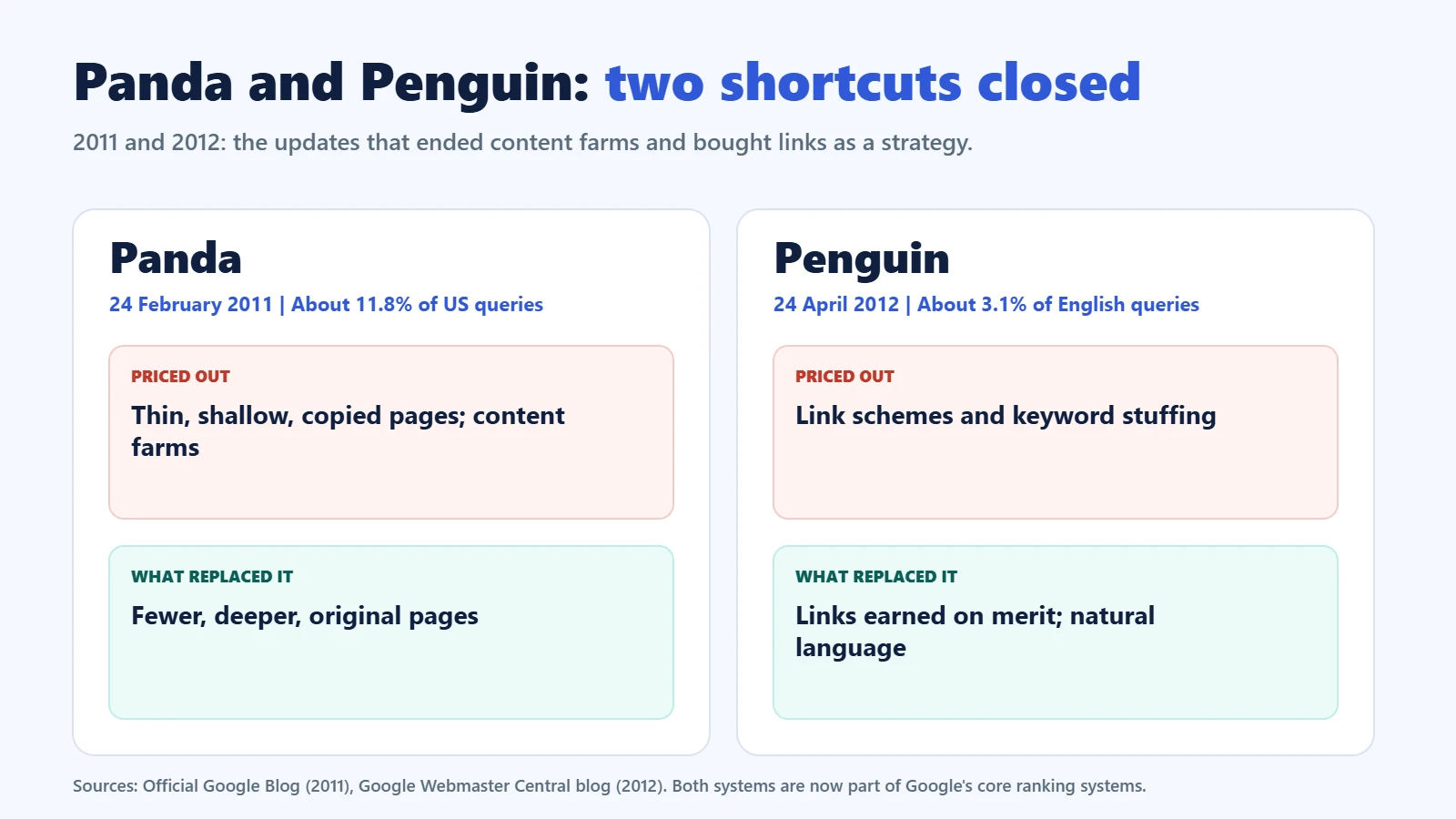
Priced outContent farms, bought links, keyword domains and stuffed pages
RewardedOriginal, useful pages, earned links and content Google could read for meaning
Part 3
Machine learning and mobile2015 to 2019
RankBrain, mobile first indexing and BERT (2015 to 2019)
RankBrain, mobile first indexing and BERT defined Google Search from 2015 to 2019. Machine learning read searches for meaning, and the mobile page became the one Google judged.
In 30 seconds
- The mobile-friendly update (2015) and mobile first indexing (2016 to 2023) made your phone site the one Google judges.
- RankBrain (2015) and BERT (2019) used machine learning to read what a search means, not only its words.
- Fred (2017) and the Speed Update (2018) priced out thin, ad-heavy and very slow pages.
- The August 2018 core update, which the industry nicknamed Medic, came with Google's advice that no quick fix exists.
Mobile-friendly update
21 April 2015 (announced in February 2015)
The mobile-friendly update favoured pages that work on phones, in mobile results only, from 21 April 2015, page by page. Search Engine Journal judged the losses modest; mobile first indexing was the lasting change.
LostPages hard to use on a phone
WonPages that worked on a small screen
RankBrain
Launched in 2015; revealed 26 October 2015
RankBrain, launched in 2015 to relate words to concepts, was the first deep learning system Google used in Search. Google's Greg Corrado revealed it to Bloomberg in October 2015. Exact-match phrasing lost value, so write in your customers' words.
LostPages relying on the exact words of a search
WonPages that answer what the searcher meant
Fred
Early March 2017 (sources give 7 and 8 March)
Fred is the industry's name for an early March 2017 update that hit thin, ad-heavy pages, many on affiliate sites; Google never named it. A comparison page with three thin paragraphs and six ad blocks is still its target.
LostThin affiliate sites and pages crowded with ads
WonPages built to help the reader first
Mobile first indexing
Tested from 4 November 2016; complete 31 October 2023
Under mobile first indexing, Google indexes and ranks the mobile version of your site; wider rollout was announced on 26 March 2018. A phone layout that hides your service pages shows Google a thinner site than laptop visitors see.
LostSites whose mobile version hid content or failed
WonSites that serve the same content on every screen
Speed Update
Announced January 2018; rolled out 9 July 2018
The Speed Update made page speed a mobile ranking factor from 9 July 2018. Google said only the slowest pages would be affected. Fix pages that are painfully slow on a phone and leave quick ones alone.
LostThe slowest pages, in mobile results
WonLittle change for pages of ordinary speed
August 2018 broad core update
From 1 August 2018; complete about a week later
The August 2018 broad core update was nicknamed Medic by the industry, and Google said dropped pages had no fix. YMYL ("Your Money or Your Life") pages need a named author with credentials and a regulator registration.
LostNot stated; the nickname points at health sites
WonPages previously under-rewarded, in Google's words as reported
BERT
25 October 2019
BERT, a language model, joined Google Search on 25 October 2019; Pandu Nayak wrote it would help with about one in ten English searches in the US. Write the way customers talk, with the answer near the top.
LostNo clear losers; it was an understanding upgrade
WonPages that answer questions the way people ask them
A Cardiff accountancy practice with a fast mobile site and named, qualified authors had little to fix. One with a desktop-only site and unsigned template posts failed three tests at once.
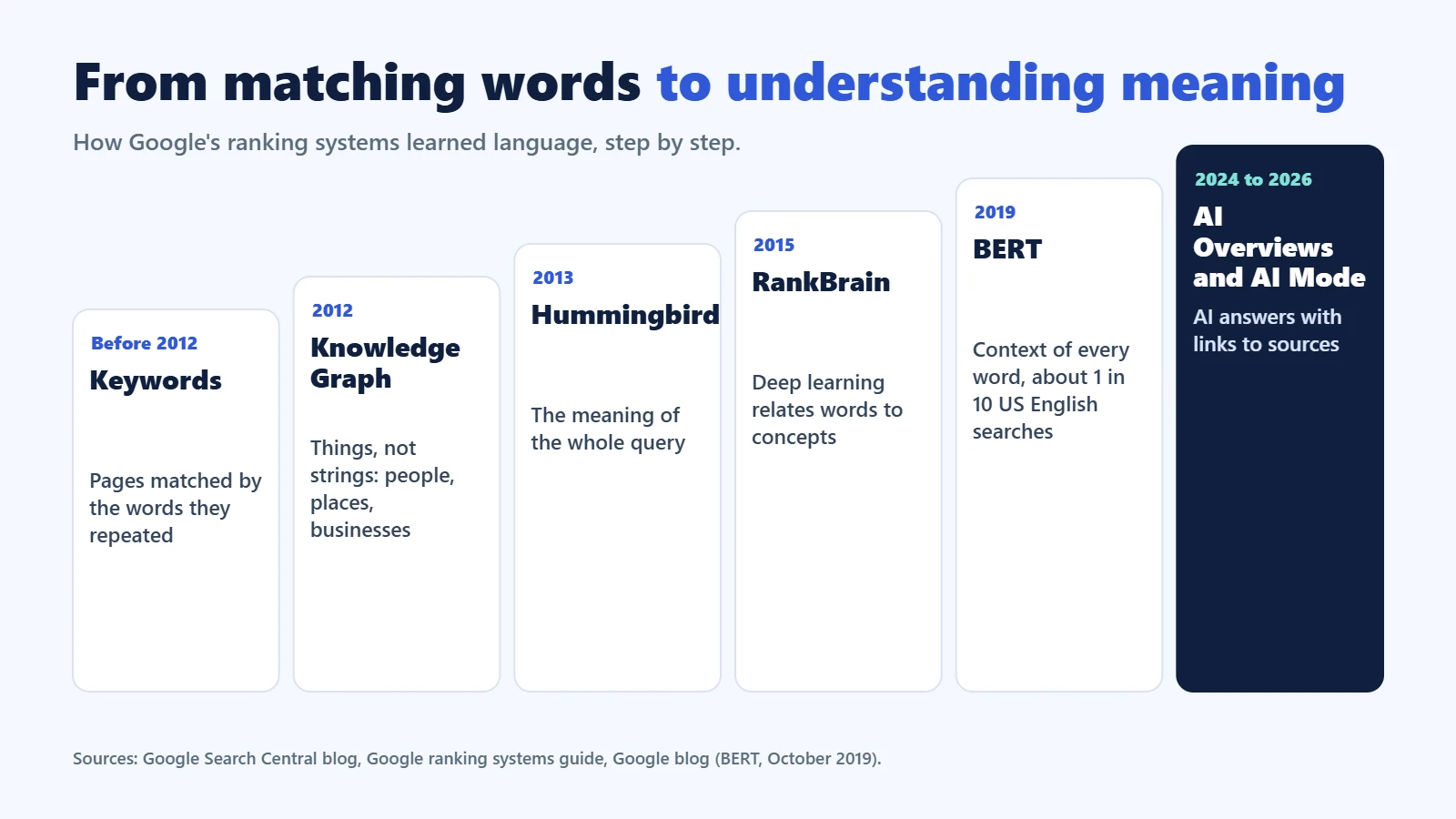
Priced outDesktop-only sites, very slow pages, thin ad-led pages and exact-match phrasing
RewardedFast mobile pages written for meaning, with visible expertise on money, health and legal topics
Part 4
Experience and helpfulness2020 to 2023
Page experience, product reviews and helpful content (2020 to 2023)
Google's 2020 to 2023 updates asked whether a page served its reader. Core Web Vitals measured how pages felt to use, and the helpful content update demoted content written mainly to rank.
In 30 seconds
- Page experience (2021) added Core Web Vitals, though Google says no single page experience signal exists.
- Passage ranking and MUM (2021) improved understanding; Google says MUM is not used for general ranking.
- Product reviews updates (2021 to 2023) raised the bar for reviews, then ran as reviews updates.
- The helpful content update (2022 to 2023) targeted search-first content and joined the core in March 2024.
Passage ranking
Announced 15 October 2020; live for US English 10 February 2021
Passage ranking lets Google rank one passage of a long page for a narrow question; Prabhakar Raghavan said it would improve 7% of searches across all languages. Put each answer in a self-contained paragraph under an honest heading.
LostNo clear losers
WonLong pages that clearly answer a narrow question
Product reviews updates
April 2021 to November 2023
The product reviews updates targeted review content from April 2021, with five more rounds to February 2023; the April and November 2023 rounds dropped "product" from the name. Our reading: the test is first-hand evidence, such as your own photos.
LostReviews adding little to the product listing our reading
WonReviews showing the writer used the product our reading
MUM
18 May 2021
Google introduced MUM on 18 May 2021 and called it 1,000 times more powerful than BERT. Its ranking systems guide says MUM is "not currently used for general ranking in Search", so ignore pitches to optimise for it.
LostNobody; it is not a general ranking system
WonSpecific features, such as vaccine information
Page experience and Core Web Vitals
Mobile 15 June to about 2 September 2021; desktop February 2022
The page experience update added Core Web Vitals to ranking. Google's page experience documentation says "There is no single signal". Our technical SEO work on Core Web Vitals and page speed starts with enquiry pages and stops once they pass.
LostSlow or jumpy pages, at the margin
WonLittle for pages already in good shape
Link spam updates
26 July to 24 August 2021; 14 December 2022 (29 days)
The link spam updates trained Google's systems to spot and ignore manipulative links; the December 2022 round used SpamBrain, Google's machine learning spam detector. Paid links now mostly buy nothing, so earn links with material worth citing.
LostSites ranking on bought or manufactured links
WonSites with links given by choice
Helpful content update
25 August 2022, 5 December 2022 and 14 September 2023
The helpful content update demoted content made mainly to rank. Danny Sullivan announced it on 18 August 2022, and after three runs it joined Google's core ranking systems in March 2024. Improvements now show through core updates.
LostSites with large volumes of search-first content
WonContent written by people, for people
This era's tests still decide rankings. A letting agency with 40 area guides written to a keyword list fails the helpful content test, however fast its pages load.
Priced outContent written to rank, thin reviews and paid links
RewardedPages written for people by people who know the subject, on sites that are easy to use
Part 5
Spam policies and AI search2024 to 2026
March 2024 to now: spam policies, core updates and AI search
The March 2024 core update opened Google's current era and added three spam policies. In May 2026 Google clarified that its spam policies apply to AI answers.
In 30 seconds
- March 2024 brought the longest core update on the dashboard (45 days) and three new spam policies.
- Google expected 40% less low-quality, unoriginal content in results and reported 45%.
- AI Overviews began rolling out in the UK on 15 August 2024, and AI Mode from 28 July 2025.
- 2026 brought two core updates of about 12 days each, four spam updates and a Discover-only update.
March 2024 core update and new spam policies
5 March to 19 April 2024 (45 days)
The March 2024 core update ran for 45 days and arrived with three new spam policies. Scaled content abuse applies however pages are made, so a hundred AI-written town pages and a hundred from a content mill fail alike.
LostScaled content, repurposed expired domains and borrowed reputation
WonOriginal content made for people
Site reputation abuse enforcement
From 5 May 2024; clarified 19 November 2024
Site reputation abuse enforcement began on 5 May 2024 with manual actions only. Google's current wording asks whether the host gave sufficient input, editorial oversight or contribution. A paid "partner guide" on a respected local news site risks the host.
LostHosts renting out site sections, and the renters
WonPublishers who edit what appears under their name
AI Overviews
US 14 May 2024; UK 15 August 2024
AI Overviews are AI-written summaries above the results, with source links. In our work, cited pages give a plain answer near the top, the standard our AI search optimisation for AI Overviews and AI Mode builds to.
LostClicks on searches the summary answers our reading
WonPages cited as sources
AI Mode
US 20 May 2025; UK from 28 July 2025
AI Mode is a conversational mode in Google Search that gives AI-written answers with links and takes follow-up questions. It began rolling out in the UK on 28 July 2025, so treat AI answers as normal Google in Britain.
LostNothing directly; it is a separate mode
WonSites already strong in Search
2025 core updates and the unannounced ones
March, June and December 2025; documentation note added 9 December 2025
Google ran three announced core updates in 2025. On 9 December 2025 its core updates documentation added that smaller, unannounced core updates run continually and can lift an improved site, so don't save changes for an announcement.
LostVaries; core updates do not target named sites
WonSites that improved between updates
2026 updates so far
5 February to 8 October 2026
Google has logged seven ranking entries in 2026: a Discover-only update, two core updates of about 12 days each and four spam updates. Wait at least a full week after completion before comparing Search Console data, Google advises.
LostSpam tactics and pages judged weaker
WonRelevant, satisfying content (Google's stated aim, March 2026)
Spam policies apply to AI answers
15 May 2026
On 15 May 2026 Google clarified that its spam policies apply to generative AI responses in Search. Its guide to generative AI features, published that day, says you need no llms.txt file, content chunking or special schema.
LostTactics built to force a way into AI answers
WonSources that earn citations by being useful
Is AI search a Google update?
No. AI Overviews and AI Mode are search features, and Google sets no extra requirements beyond those for ordinary Search. None of the 41 dashboard entries since November 2021 is an AI feature launch.
A fall in clicks since AI Overviews arrived is no penalty; results look different. Be the cited source and give people a reason to visit, such as prices or a person to call.
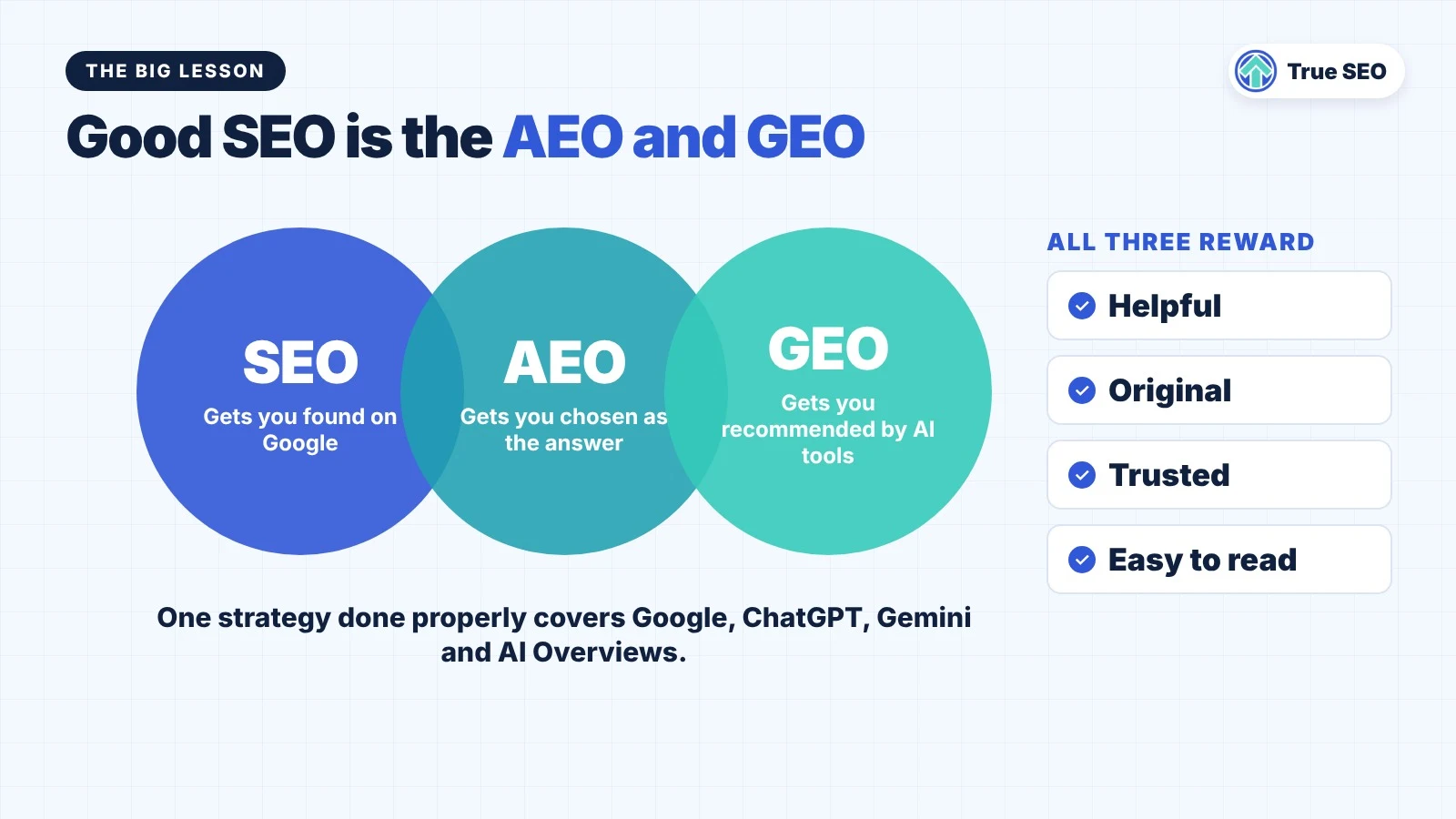
Answer engine optimisation (AEO) and generative engine optimisation (GEO) reward the same pages as SEO. A page that ranks, answers plainly and comes from a trusted source is the page AI answers quote.
An accountancy firm publishing 200 near-identical AI-written "tax tips for [town]" pages fits the scaled content abuse definition. We advise 20 checked guides signed by a qualified accountant instead.
Priced outContent made at scale, borrowed reputation and repurposed expired domains, whoever or whatever produced them
RewardedOriginal, checked content from a source with a real reason to be trusted
Every ranking update on Google's Search Status Dashboard since November 2021
Google confirmed 41 ranking updates and incidents on its Search Status Dashboard between November 2021 and October 2026. They comprise 16 core updates, 11 spam updates, 7 reviews updates, 3 helpful content updates, 2 ranking issues, 1 page experience update and 1 Discover update.
11
spam updates on the dashboard since November 2021
4
spam updates in 2026 so far, the most in any year on the dashboard
12 days
average 2026 core update, the shortest yearly average
29 days
the December 2022 link spam update, the longest spam update listed
The dashboard starts in November 2021, so the June and July 2021 core updates are missing.
Show all 41 dashboard entries, newest first
| Update | Started (US Pacific) | Duration | Type |
|---|---|---|---|
| September 2026 spam update | 24 Sep 2026 | 13 days 16 hours | Spam |
| August 2026 spam update | 18 Aug 2026 | 2 days 16 hours | Spam |
| June 2026 spam update | 24 Jun 2026 | 2 days 1 hour | Spam |
| May 2026 core update | 21 May 2026 | 11 days 21 hours | Core |
| March 2026 core update | 27 Mar 2026 | 12 days 4 hours | Core |
| March 2026 spam update | 24 Mar 2026 | 19 hours 30 minutes | Spam |
| February 2026 Discover update | 5 Feb 2026 | 21 days 17 hours | Discover |
| December 2025 core update | 11 Dec 2025 | 18 days 2 hours | Core |
| August 2025 spam update | 26 Aug 2025 | 26 days 15 hours | Spam |
| June 2025 core update | 30 Jun 2025 | 16 days 18 hours | Core |
| March 2025 core update | 13 Mar 2025 | 13 days 21 hours | Core |
| December 2024 spam update | 19 Dec 2024 | 7 days 2 hours | Spam |
| December 2024 core update | 12 Dec 2024 | 6 days 4 hours | Core |
| November 2024 core update | 11 Nov 2024 | 23 days 13 hours | Core |
| Ranking is experiencing an ongoing issue | 15 Aug 2024 | 4 days 11 hours | Ranking issue |
| August 2024 core update | 15 Aug 2024 | 19 days 4 hours | Core |
| June 2024 spam update | 20 Jun 2024 | 7 days 1 hour | Spam |
| March 2024 spam update | 5 Mar 2024 | 14 days 21 hours | Spam |
| March 2024 core update | 5 Mar 2024 | 45 days | Core |
| November 2023 reviews update | 8 Nov 2023 | 29 days | Reviews |
| November 2023 core update | 2 Nov 2023 | 25 days 21 hours | Core |
| Ranking is experiencing an ongoing issue | 5 Oct 2023 | 26 days | Ranking issue |
| October 2023 core update | 5 Oct 2023 | 13 days 23 hours | Core |
| October 2023 spam update | 4 Oct 2023 | 15 days 12 hours | Spam |
| September 2023 helpful content update | 14 Sep 2023 | 13 days 11 hours | Helpful content |
| August 2023 core update | 22 Aug 2023 | 16 days 3 hours | Core |
| April 2023 reviews update | 12 Apr 2023 | 13 days 2 hours | Reviews |
| March 2023 core update | 15 Mar 2023 | 13 days 7 hours | Core |
| February 2023 product reviews update | 21 Feb 2023 | 14 days | Reviews |
| December 2022 link spam update | 14 Dec 2022 | 29 days | Spam |
| December 2022 helpful content update | 5 Dec 2022 | 38 days | Helpful content |
| October 2022 spam update | 19 Oct 2022 | 2 days | Spam |
| September 2022 product reviews update | 20 Sep 2022 | 6 days | Reviews |
| September 2022 core update | 12 Sep 2022 | 14 days | Core |
| August 2022 helpful content update | 25 Aug 2022 | 15 days | Helpful content |
| July 2022 product reviews update | 27 Jul 2022 | 6 days | Reviews |
| May 2022 core update | 25 May 2022 | 15 days | Core |
| March 2022 product reviews update | 23 Mar 2022 | 14 days | Reviews |
| Page experience update for desktop | 22 Feb 2022 | 9 days | Page experience |
| December 2021 product reviews update | 1 Dec 2021 | 20 days | Reviews |
| November 2021 core update | 17 Nov 2021 | 13 days | Core |
Dashboard times are US Pacific time, 8 hours behind the UK for most of the year. The full record is in Google's Search Status Dashboard incident history.
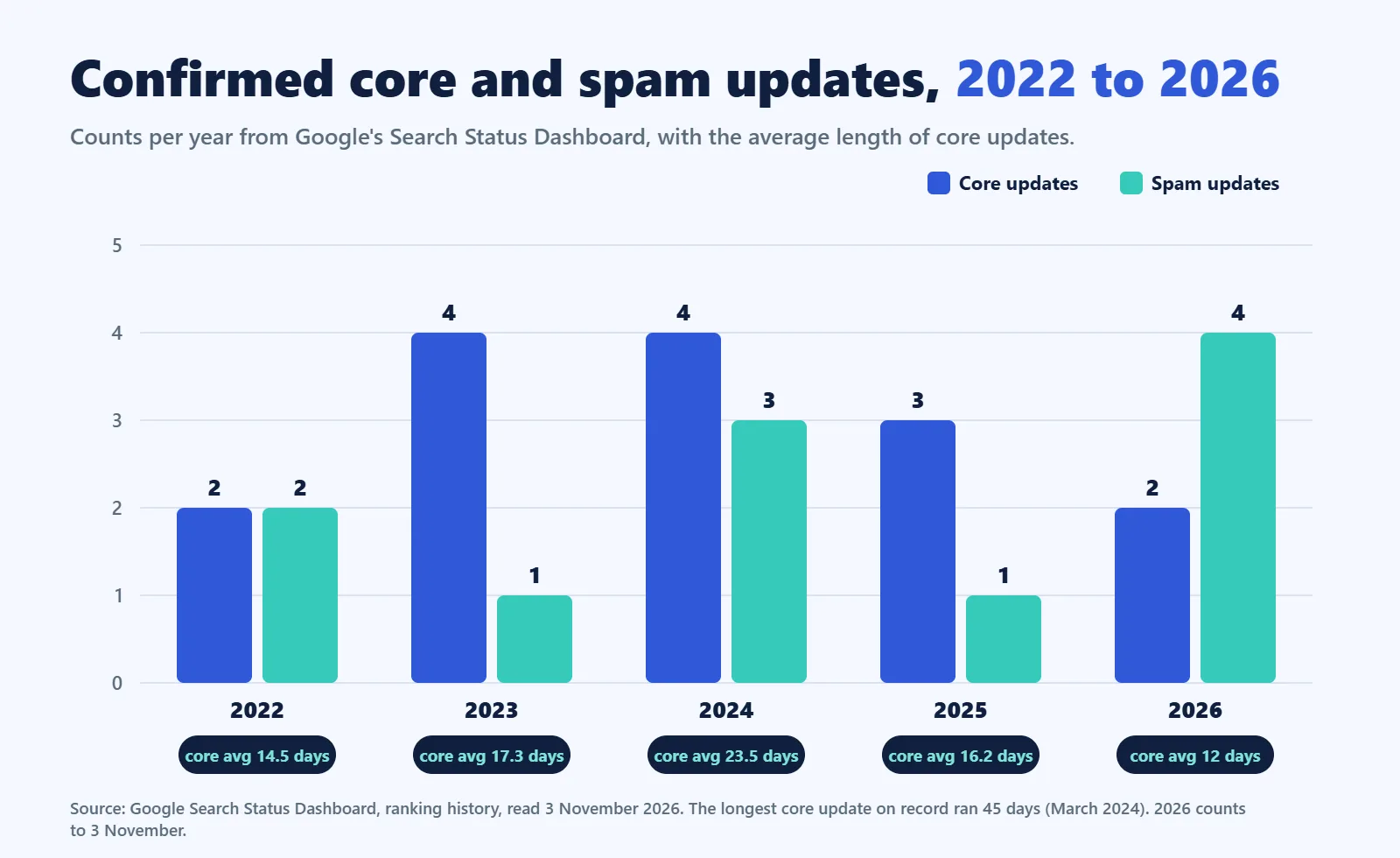
Core updates have got shorter since 2024. Their yearly average rose from 14.5 days in 2022 to 23.5 in 2024, then fell to 16.2 in 2025 and 12.0 in 2026. Spam updates show no steady direction. Our breakdown of the March 2025 core update traces one from start to finish.
The Google update journey: 18 updates, one takeaway each
The Google update journey runs from keyword matching in 2003 to AI answers in 2026, and at each stop the next update prices out the last shortcut. The timeline shows what each major update wanted.
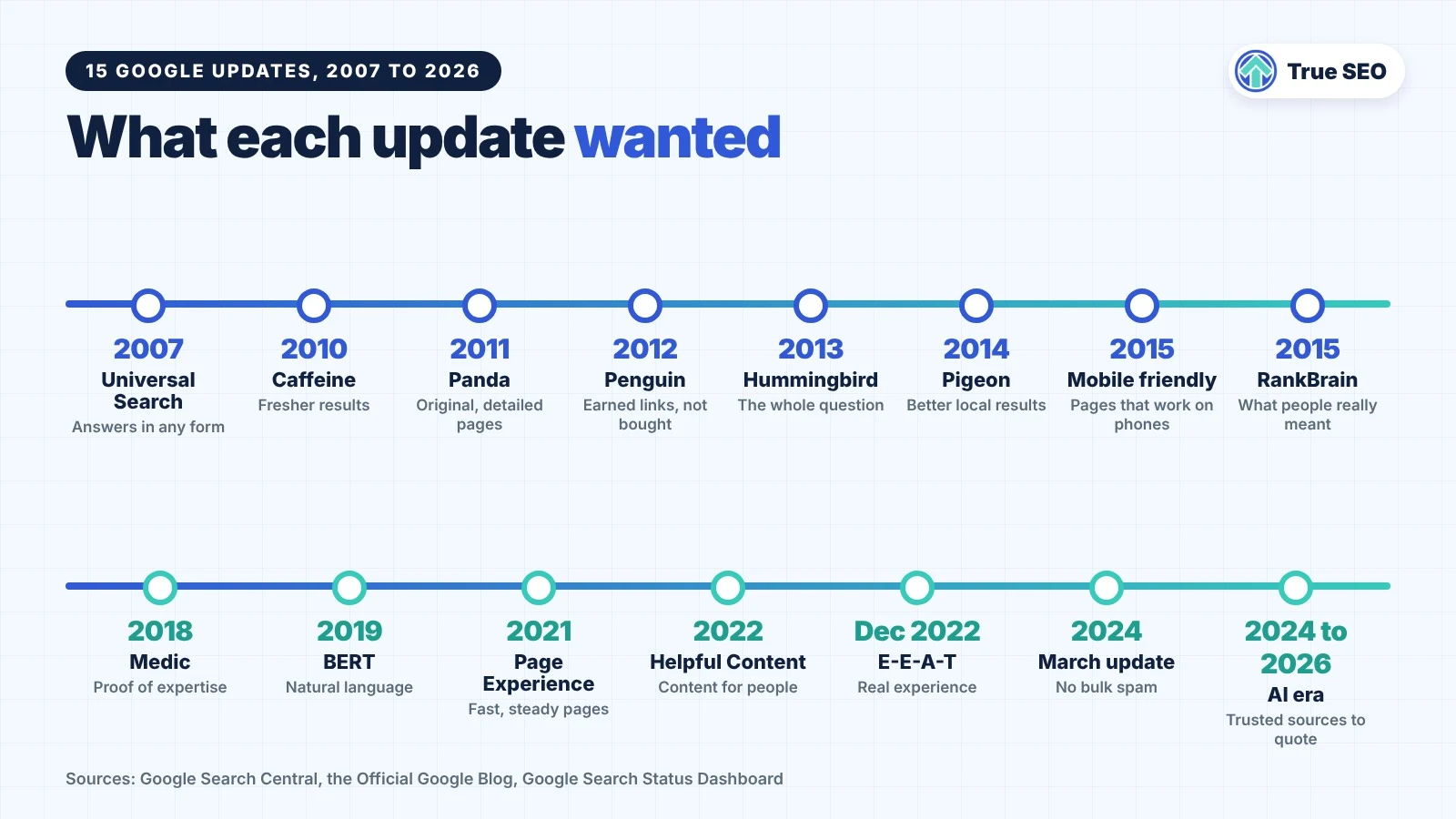
Each update changed the losing tactic. The winning one stayed the same: original, trusted pages written for the searcher.
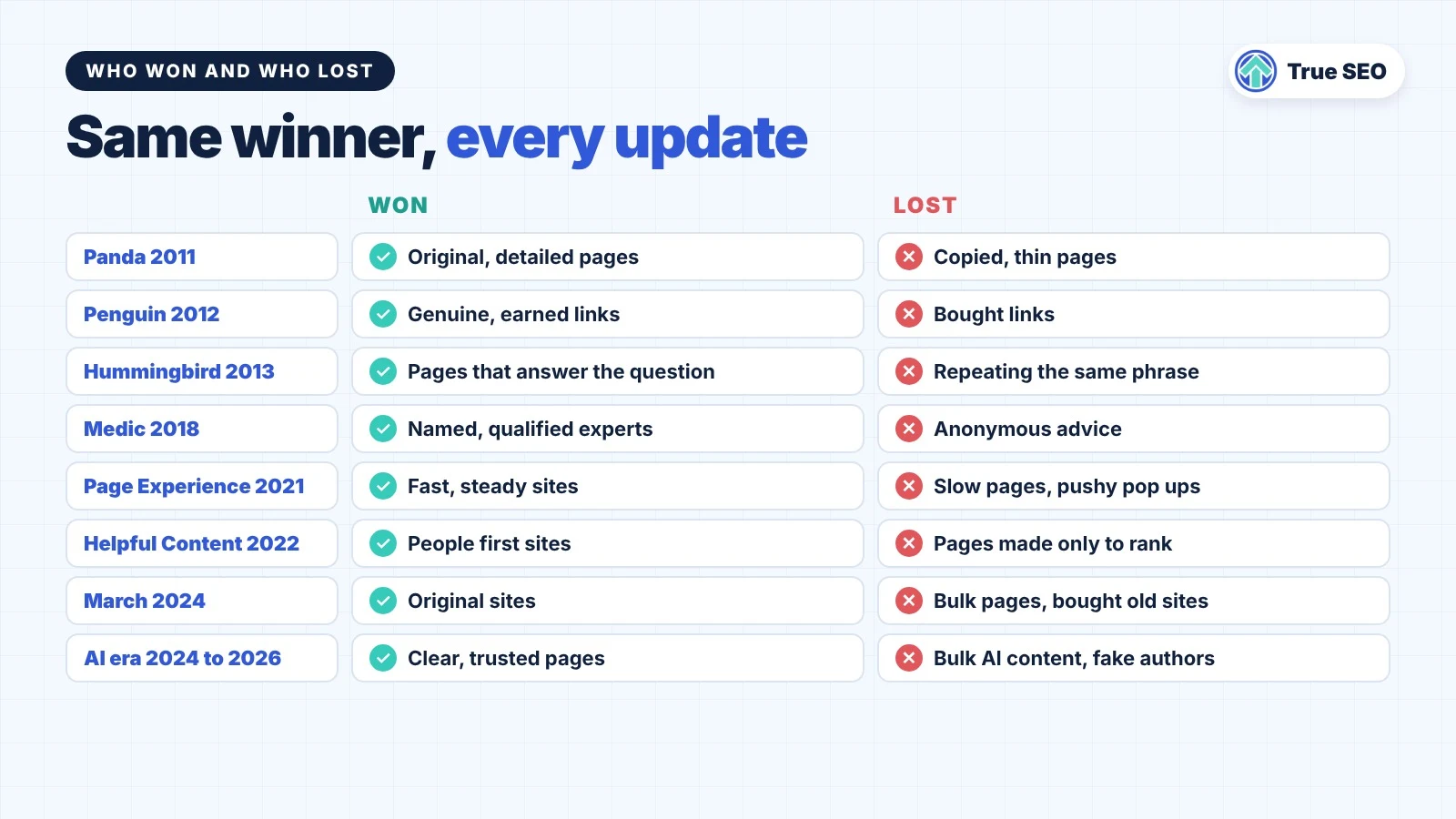
The table lists all 18 stops with one do and one don't.
Read the 18 stops as text
| Update | What changed | Do | Don't |
|---|---|---|---|
| 1. Florida* (2003) | Keyword-heavy commercial pages dropped. Google never said why. | Write for the question the reader is asking. | Repeat a keyword to look relevant. |
| 2. Bigdaddy (2005 to 2006) | Sites with many paid or swapped links could be crawled less. | Earn links from sites your customers read. | Swap or buy links to climb. |
| 3. Caffeine (2010) | A faster, fresher index. Shallow pages spread quickly, until Panda. | Keep your important pages current. | Publish thin pages because they index fast. |
| 4. Panda (2011) | Thin and copied pages lost ground. 11.8% of US queries affected. | Publish fewer, deeper, original pages. | Spin many shallow pages on one topic. |
| 5. Penguin (2012) | Link schemes and keyword stuffing. About 3.1% of English queries. | Win links with work worth citing. | Use link networks or paid links. |
| 6. Knowledge Graph (2012) | Things, not strings: Google began to read entities. | Make your business one clear, consistent entity. | Describe yourself differently across the web. |
| 7. Hummingbird (2013) | Google read the meaning of the whole query. | Answer the full question on one strong page. | Build a page for every keyword variation. |
| 8. Pigeon* (2014) | Local results moved closer to normal web ranking. | Strengthen the website behind your local listing. | Treat the map listing as separate from your site. |
| 9. Mobile friendly update (2015) | Mobile usability became a ranking signal, page by page. | Make every page easy to use on a phone. | Ship layouts that only work on desktop. |
| 10. RankBrain (2015) | The first deep learning system Google used in Search. | Write the way your customers speak. | Chase exact match phrasing. |
| 11. Medic* (Aug 2018 core update) | Health and money sites moved most, by industry reading. Google said there was no fix. | Show who wrote it and why they are qualified. | Give advice without credentials or sources. |
| 12. BERT (2019) | Context of every word. About 1 in 10 US English searches. | Use clear, plain sentences. | Write for keyword density. |
| 13. Page experience (2021) | Core Web Vitals arrived. Google says there is no single page experience signal. | Fix real problems that slow or block visitors. | Chase perfect scores ahead of content. |
| 14. Product reviews updates (2021 to 2023) | Review pages were reassessed. Our reading: first hand testing beat rewritten specs. | Show your own testing, photos and numbers. | Rewrite the manufacturer's description. |
| 15. Helpful content (2022 to 2023) | Content made for search engines rather than people lost out. | Write for the people you want as customers. | Cover topics only because they get searches. |
| 16. March core update and spam policies (2024) | Scaled content abuse became a named policy. Google reported 45% less low quality, unoriginal content. | Publish only pages that help a reader. | Mass produce pages by any method. |
| 17. AI Overviews and AI Mode (2024 to 2025) | AI answers began rolling out in the UK in August 2024 and July 2025. | Give clear answers with sources near the top. | Bury the answer under filler. |
| 18. Spam rules cover AI answers (2026) | Google's spam policies apply to generative AI responses in Search. | Use AI for research and checked drafts. | Publish unedited AI drafts at volume. |
Florida, Pigeon and Medic (marked *) are industry names that Google did not give. The dos and don'ts are True SEO Consultants Ltd guidance.
Why Google keeps releasing updates: each one made a shortcut expensive
Google releases updates to keep spam out, reassess quality and understand language better. Each major spam or quality update made one cheap ranking shortcut expensive. Unedited AI content at volume is the shortcut that is cheap today.
The understanding updates punished no shortcut and raised the value of meaning: the Knowledge Graph in May 2012, Hummingbird (which Google dates to August 2013) and BERT in October 2019, which helped Google understand one in ten US English searches better.
Six shortcuts have been priced out. A seventh is already covered by Google's policies.
| Shortcut | When it worked | Update that priced it out | What replaced it |
|---|---|---|---|
| Keyword stuffing | Early search, from 1998 to the early 2010s | Penguin on 24 April 2012, which Google said acted on keyword stuffing; Florida in November 2003, an industry name Google never explained, is widely seen as an earlier blow | Natural writing that answers the whole question |
| Reciprocal and paid links | From 1998, when PageRank measured a page's importance by its links, to 2012 | Bigdaddy, 2005 to 2006 (Google engineer Matt Cutts said sites with many reciprocal or bought links could be crawled less), Penguin in April 2012, then Penguin 4.0 in real time from 23 September 2016 | Links earned from relevant sites |
| Content farms and thin pages | Up to 2011, helped by faster indexing after Caffeine in June 2010 | Panda, 24 February 2011, affecting 11.8% of queries in the US | Fewer, deeper, original pages |
| Exact match domains | Up to 2012 | EMD update, late September 2012, affecting 0.6% of US English queries | Brand names and relevance; Google still runs a system so these domains don't get too much credit |
| Writing for search engines rather than people | Up to 2022 | Helpful content update from 25 August 2022; the system became part of Google's core ranking systems in March 2024 | People first content written from real knowledge |
| Scaled pages made by any method | Up to 2024 | March 2024 core update and the scaled content abuse policy; Google expected 40% less low quality, unoriginal content and reported 45% | Fewer pages, each with original value |
| Unedited AI drafts at volume | 2023 to now | Already covered by the scaled content abuse policy and quality systems | Original, checked, first hand content |
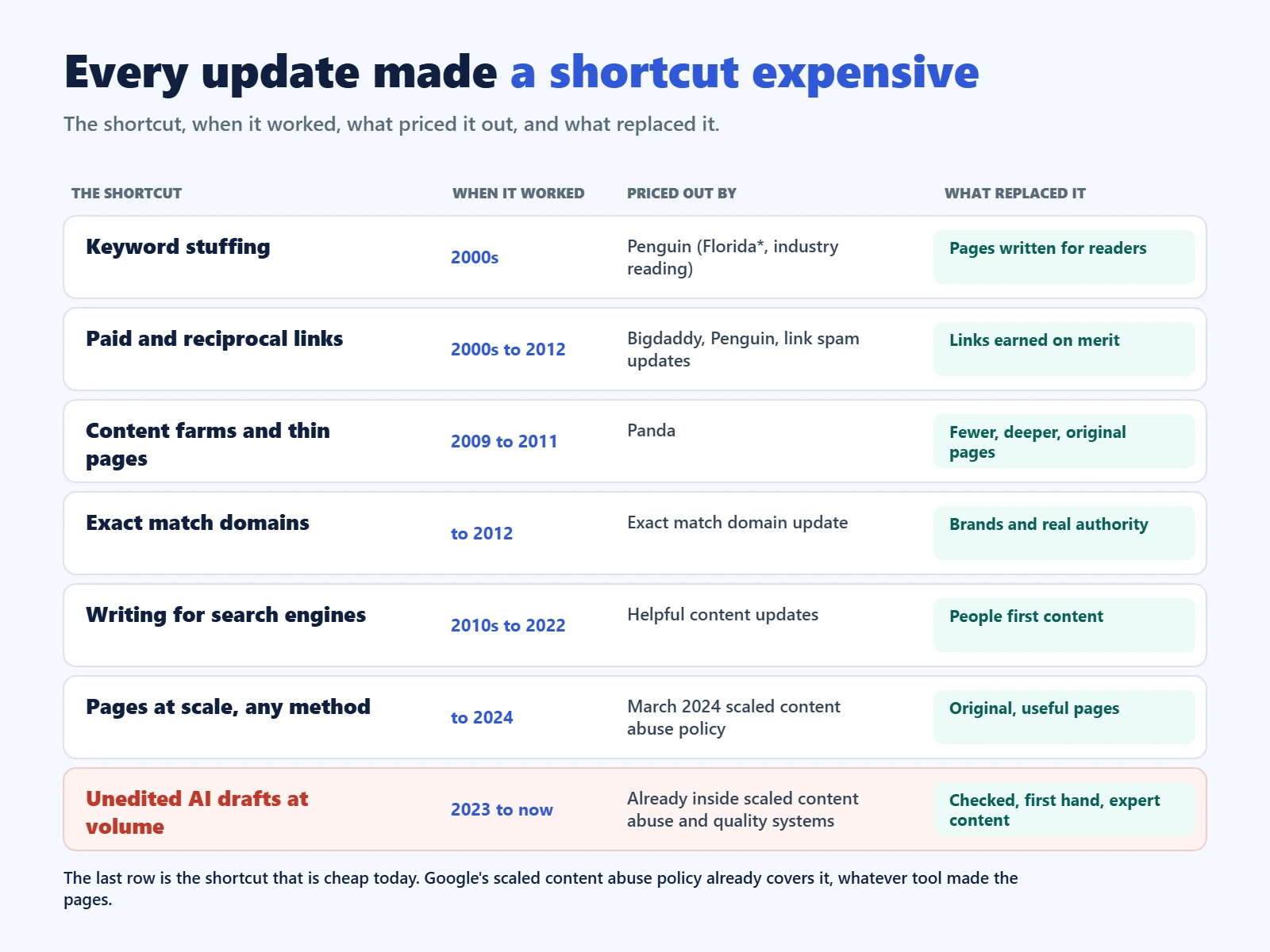
Caffeine and Panda are the clearest precedent. Google completed Caffeine, a new indexing system, on 8 June 2010 and said it gave 50 percent fresher results; Search Engine Land later linked the spread of shallow content to it. Panda followed on 24 February 2011.
Generative AI cut the cost of a passable draft to minutes. This time the policy came first: scaled content abuse has covered pages made at scale by any method since March 2024. John Mueller of Google said in an October 2026 interview, reported by Search Engine Roundtable, that "at some point the systems catch" these tricks.
Our position at True SEO Consultants Ltd: the businesses that lost little at each step built for people and for meaning, so they had nothing to undo. We build client sites around topical authority built on meaning rather than page count for that reason.
Does Google penalise AI generated content?
Google does not penalise content because AI helped make it. Its test, set in February 2023 and repeated in October 2026, is quality and purpose, and it acts against content made mainly to manipulate rankings at scale.
The 8 February 2023 Search Central post by Danny Sullivan and Chris Nelson set the baseline: Google rewards high quality content "however it is produced". No statement since has reversed it.
April 2022
John Mueller said content from AI writing tools was then against the webmaster guidelines. The 2023 guidance replaced this view.
Search Central SEO office hours, reported by Search Engine Journal
8 February 2023
Google said it rewards quality however content is made, and that automation used mainly to manipulate rankings is spam. Quality is judged through E-E-A-T (experience, expertise, authoritativeness and trustworthiness).
Google Search Central blog
10 August 2023
Danny Sullivan, Google's Search Liaison, said human oversight matters when AI is used to create content.
Post on X, reported by Search Engine Roundtable
5 March 2024
March 2024 core update and new spam policies. Scaled content abuse now covers pages made at scale by automation, people or both. Google expected 40% less low quality, unoriginal content in results.
Google's The Keyword blog; Search Status Dashboard
26 April 2024
Google reported the result: 45% less low quality, unoriginal content. The core update finished on 19 April after 45 days. The helpful content system had become part of core ranking that March.
The Keyword blog; Search Status Dashboard; Google's ranking systems guide
11 September 2025
Current rater guidelines: scaled pages get the Lowest rating however they were made, and generative AI use alone does not decide a page's rating.
Search Quality Rater Guidelines
14 April 2026
Google said spam reports from the public may now be used to take manual action.
Search Central documentation updates log
15 May 2026
Google clarified that its spam policies apply to generative AI responses in Google Search, and published a guide to optimising for its generative AI features.
Search Central documentation updates log
1 October 2026
Generative AI guidance updated with rater guideline material: useful for research and structure, generative models do not retrieve facts, fact check every output. Rater scores do not directly influence ranking.
Google's generative AI content guidance
Read Google's guidance on using generative AI content before you brief a writer or a tool. It asks for hand checks on titles, meta descriptions, structured data and alt text too.
What scaled content abuse means
Scaled content abuse is publishing many pages mainly to manipulate search rankings, with little or no value to readers. Google's spam policies, last updated on 28 August 2026, say this applies "no matter how it's created".
Google's spam policies list five examples, and only one names generative AI. The March 2024 announcement said the policy applies "whether automation, humans or a combination are involved". Google told Glenn Gabe of GSQi in June 2025 that its policies do not strictly define AI translated content as spam.
The spam policies say breaches are found by automated systems and by human review, and human review can end in a manual action reported in Search Console. Gabe reported in April 2026 that the /us/ section of nationaltoday.com, more than 850,000 AI generated local news pages, received a scaled content abuse manual action and left the index. Google did not confirm the case publicly.
Do quality raters decide rankings?
No, not directly. Google's generative AI documentation states that quality rater ratings do not directly influence ranking. We read the rater guidelines as a description of the pages Google wants to rank.
The September 2025 edition gives scaled pages the Lowest rating however they were made (section 4.6.5). Section 4.6.6 does the same where all or almost all of the main content is copied, paraphrased, auto or AI generated, or reposted with little effort, originality or added value. It adds that "the use of Generative AI tools alone does not determine" a page's effort or quality rating.
A Search Engine Journal article on 27 July 2026 suggested Google may now treat AI content as thin content. That is industry speculation, based on one Reddit post and a speculative post on X. Google's documentation log for July 2026 contains nothing on thin or AI content.
Can Google detect AI content, and does it matter?
It matters little, because detection is not Google's test. Its policies judge purpose and value, and a human written page made mainly to manipulate rankings fails the same test.
Three widely cited studies each used a different AI detector (Ahrefs its own, Semrush GPTZero, Graphite Surfer's) and reached different conclusions. A detector score says nothing about accuracy or value, so spend the time on the fact check.
Shopping is the exception. Google Merchant Center requires AI generated product images to carry IPTC Digital Source Type metadata inside the image file. Ordinary websites are encouraged, not required, to add it.
Should you label AI content?
Label AI use where a reader would reasonably ask how the page was made, with a sentence rather than an AI byline. Google's February 2023 post suggested an AI author byline is probably not the best way to disclose. Its helpful content guidance, last updated on 5 October 2026, asks whether AI use is obvious to visitors and why AI was useful.
For a business blog, name the author and their credentials, and add a line on how AI helped, for example with research or a first outline. Never invent a persona: section 4.5.3 of the rater guidelines lists AI generated images and deceptive creator descriptions as signs of a fake owner or creator profile.
Four myths about Google and AI content
All four myths below fail against Google's own documents.
- Google bans AI content. It has rewarded quality however content is produced since February 2023.
- AI detectors decide rankings. Google's test is purpose and value.
- Adding a human byline fixes it. Scaled, low value pages breach the policy whoever is named.
- More pages always means more traffic. Google's helpful content guidance lists extensive automation across many topics as a warning sign.
Why an LLM is the weakest author and the strongest assistant
A large language model (LLM) is the weakest author for a business blog because it predicts the common answer and has no experience. It is the strongest assistant for research, outlining and first drafts. Google's October 2026 guidance calls generative AI particularly useful for researching a topic and structuring original content.
AI as the author
- Writes the whole post from a one line prompt
- Supplies facts from its training data, unchecked
- Repeats the common answer any competitor can generate
- Lacks a client, a case or a test to draw on
- Publishes at volume because each page costs minutes
- Puts a person's name on text that person never checked
AI as the research and productivity assistant
- Finds sources and questions for an expert to read
- Turns research into an outline the expert approves
- Drafts sections under a brief the expert wrote
- Lists every claim so a person can check it against its source
- Speeds up repurposing, such as summaries and video scripts
- Leaves first hand detail and final judgement to a person
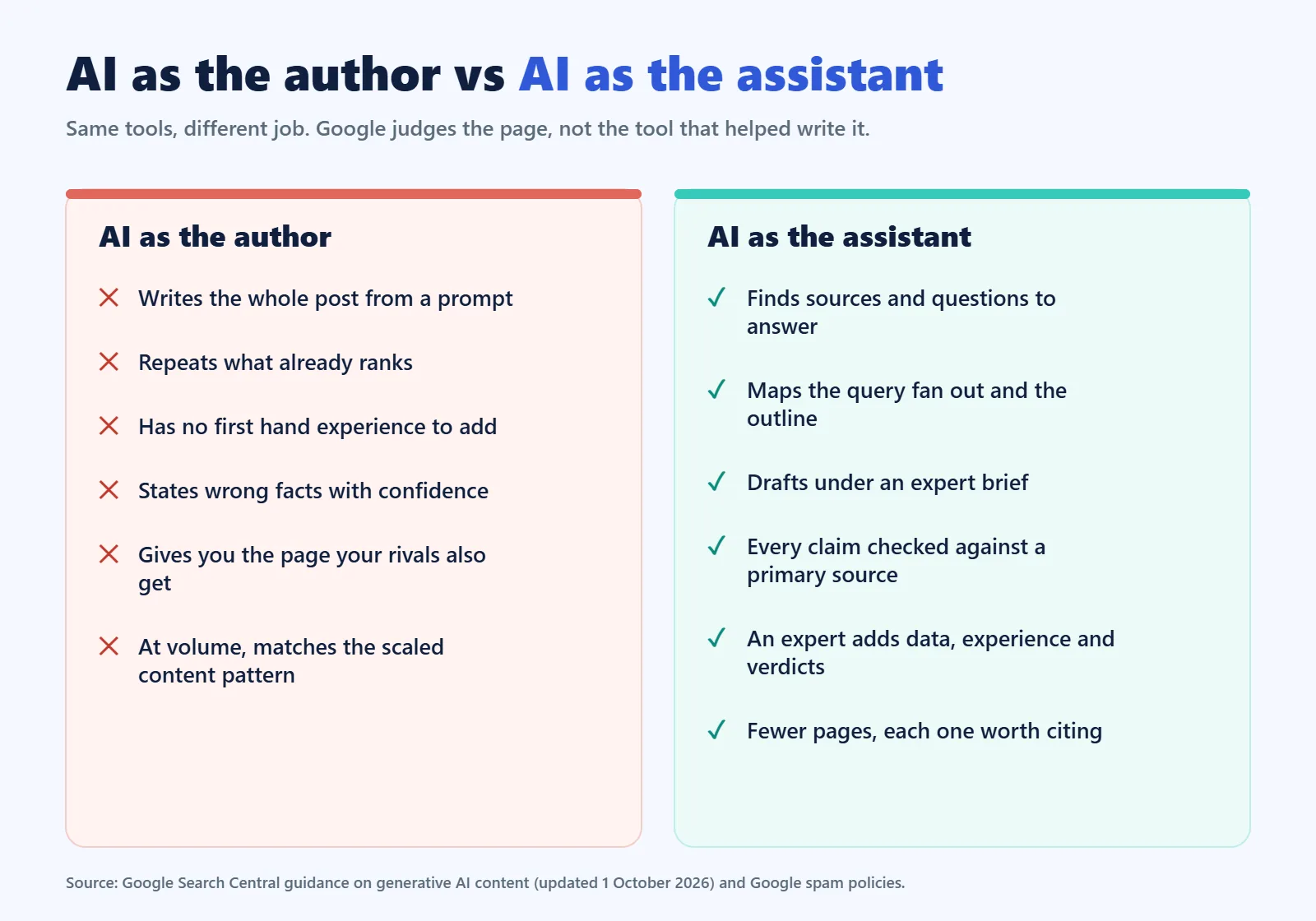
Five mechanisms explain why the author role fails.
- Consensus with no information gain. An unaided model predicts the common answer. Google's May 2026 guide to its generative AI features separates commodity content, "based on common knowledge, which could originate from anyone", from unique expert or experienced takes. Information gain, the new facts or angles a page adds, has to come from outside the model.
- No first hand experience. The model has never filed a VAT return. Experience is the first E in E-E-A-T, and it comes from a person who was there.
- Confident errors. Google states that "generative models don't retrieve facts" and tells publishers to fact check all AI output. A 2023 study in Scientific Reports checked 636 citations in ChatGPT written literature reviews and found 55% fabricated from GPT-3.5 and 18% from GPT-4. Those were older models, so read the figures as proof of the failure mode, not as today's rate.
- Sameness across users. A 2024 study in Science Advances by Doshi and Hauser found that AI ideas made individual stories more creative, while the AI assisted stories ended up more similar to each other than stories written by people alone.
- The scale pattern. Cheap drafts invite volume, and volume without value is the definition of scaled content abuse. John Mueller wrote on Bluesky in August 2025, as a personal view rather than policy, that using LLMs to build out a topic cluster is "just building up liability".
- 1Research and source finding
- 2Query fan out and outline
- 3First draft under an expert brief
- 4Fact check against primary sources
- 5Expert edit and first hand detail
- 6Edit for voice and publish
True SEO Consultants Ltd uses AI for research, structure and drafting, and this guide was made that way. AI helped gather Google's documents, map the query fan out (the sub questions a search system breaks one query into) and draft sections. A person checked every date, figure and quote against its source and added what we see in client work.
Industry studies disagree on how AI content ranks. The three below are secondary sources, each with its own detector and page set, and none proves cause.
- Ahrefs, July 2025, about 600,000 ranking pages: 86.5% contained some AI content, 4.6% were purely AI, and the correlation between AI share and rank was 0.011, effectively none.
- Semrush, April 2026, 42,000 blog pages: position one was human written 80.5% of the time. Its page gives 9% and 10% for purely AI content in the top spot, so roughly one in ten.
- Graphite, October 2025, 31,493 keywords: 86% of ranking articles were human written, and only 7% of number one results were AI.
They agree that pure AI pages are a small share of what ranks and rarely take first place. In Ahrefs' data, mixed human and AI content was the norm among ranking pages, which fits the assistant model. In Semrush's survey of 224 SEOs, 64% use a human led, AI assisted workflow and only 19% say AI improves quality.
Scaled AI pages are one of several causes of a ranking drop. The next section separates them.
How to tell whether a Google update hit your site
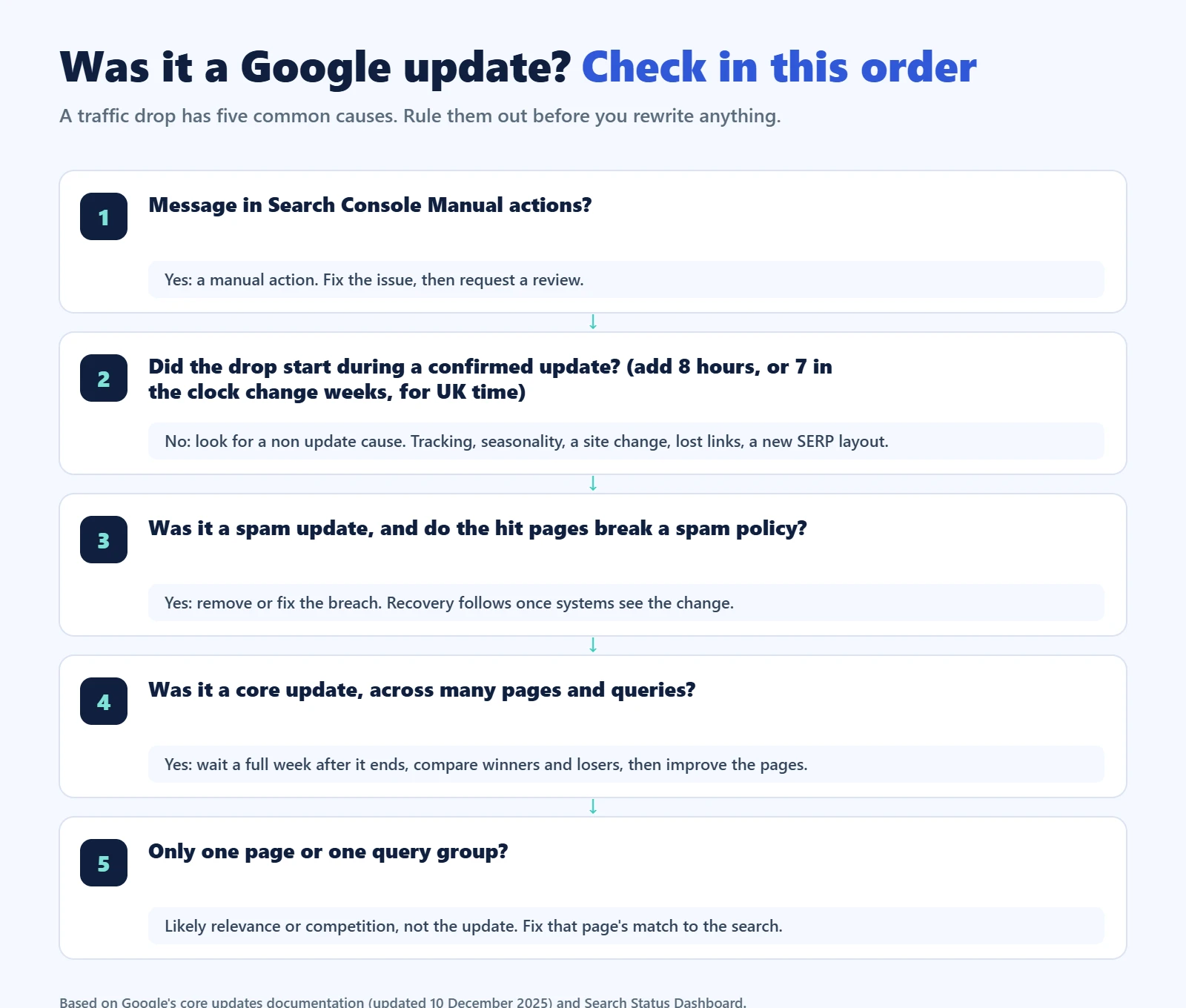
A Google update hit your site when your drop starts inside a dated update window, spreads in the pattern that update type causes, and has no simpler explanation such as broken tracking or a seasonal dip. Search Console and the Search Status Dashboard cover all three checks for free.
A drop blamed on an update is the call we get most. Just as often the cause is a broken tracking tag, a redirect lost in a redesign or an AI Overview above the first link. Check in this order.
- Line up the dates in UK time. Convert the update's start and completion times from US Pacific time and find the first day your clicks fell. A drop that began two weeks before the update started was not caused by it.
- Wait a full week after the update completes. Google's core updates documentation asks for this before you analyse the change. A mid-rollout reading often reverses.
- Compare like with like. In the Performance report, compare equal periods before and after with matching days of the week, then the same weeks last year. A UK accountancy site that falls in early February and recovers in May is often seeing the self-assessment deadline.
- Go to page level, then query level. Sort the Pages tab by change in clicks to see whether the loss is site-wide or in one folder, such as /blog/. Then check the Queries tab.
- Check Manual actions and Security issues. A manual action always arrives as a message in Search Console, so an empty report rules it out in ten seconds.
- Search the queries you lost. Note what the pages now above you have that yours don't, such as first-hand detail or a named expert.
Match the pattern you see to its likely cause.
| What you see | Most likely cause | How to confirm | What to do first |
|---|---|---|---|
| Broad drop across many pages and queries, starting during a core update | Core update: Google reassessed quality and relevance across the web | Drop begins inside the dashboard window in UK time; losses spread across the site; Manual actions report empty | Wait a week after completion, then review the whole site against Google's helpful content questions, not one page |
| Drop on one set of pages with scaled or thin content, during a spam update | Spam systems devaluing pages that breach a policy such as scaled content abuse | Losses cluster in one template or folder, for example 80 near-identical town pages; timing matches a spam update | Merge, rewrite or remove the set, and stop producing more of it |
| Message in the Manual actions report | Manual action by a reviewer at Google | The report names the issue, such as "Thin content with little or no added value", and lists affected pages | Fix every instance across the site, then request a review |
| Drop on one page or one query group only | A competitor overtook you, the search intent shifted, or your page changed | Only a few URLs or queries lost clicks; the new top results answer differently or are fresher | Compare your page with the one that now ranks and fix the specific gap |
| Drop with no update running | Tracking change, seasonality, site migration, lost links, a robots or noindex mistake, or a SERP layout change such as AI Overviews | Analytics down but Search Console clicks flat means tracking; year-on-year shape means seasonality; Page indexing report shows excluded URLs; impressions steady but clicks down means the results page changed | Fix the technical cause before touching content |
| Traffic up during an update | The update rewarded your pages, or a competitor lost ground | Same date and page checks as a drop | Change nothing in a hurry; note what the winning pages have in common and do more of it |
In our client work, the fifth row explains more UK traffic drops than any update does. Google began rolling out AI Overviews to UK users on 15 August 2024, the same day the August 2024 core update started, according to Google's announcement and its Search Status Dashboard. A site that kept its positions but lost clicks may have been seeing a changed results page. Our guide to getting cited in AI Overviews instead of buried by them covers that case.
How to recover from a core update, a spam update or a manual action
During a core update, do nothing to the site; after it, wait at least a full week, judge the size of the drop, then improve the site as a whole. Google's core updates documentation says gains can take several months and may only appear at the next core update.
Rushing is the costliest mistake we see: rewrite fifty pages mid-rollout and you cannot tell which change did what.
Google's guidance makes three points: core updates don't target specific sites or pages, so there is no single breach to fix; small drops need no drastic action; and deleting content is a last resort.
A spam update or a manual action has a breach to remove. For a manual action, fix every example the report names, then request a review from the same report. For a spam update, remove the tactic, such as scaled pages, doorway pages or link buying. Google has said since its 2021 link spam update that it nullifies, or ignores, spammy links, so removing old bought links mostly cleans the record.
Follow this order after a core update:
- Freeze changes during the rollout. Log the start and finish in UK time.
- Wait a full week after completion. Then compare before and after in Search Console.
- Size the drop. A few positions lost on a handful of queries is normal movement. A broad fall across your main service pages is the signal to act.
- Assess the whole site. Score your top 20 pages against Google's helpful content questions: who created the content, how, and why.
- Improve before you delete. Add first-hand detail, named authors and evidence. Merge near-duplicates and redirect the rest. Remove only what has no reader value.
- Give it months. Since 9 December 2025, Google's documentation says smaller, unannounced core updates can lift improved sites between the named ones.
The audit from True SEO Consultants Ltd matches your Search Console data against every dashboard update, names the likely cause and orders the fixes so revenue is protected first. A written diagnosis from our SEO audit service tells you what to do on Monday.
Paying for help is worth it when the drop is broad, hits the pages that bring enquiries, or stays unexplained after the six checks above.
What recovery looks like: two illustrative scenarios
Recovery looks like these two scenarios, built from patterns we see. They are illustrations with no figures, not client results.
Scenario 1: thin AI location pages
An accountancy practice publishes an AI drafted page for every nearby town, with only the place name changed. A core update and a spam update roll out together, and the site loses ground on its main service pages as well as the town pages. The Manual actions report is empty, so the drop is algorithmic.
The practice keeps pages only for areas where it has clients, each with detail no model could invent, such as a named contact. The rest redirect to the nearest strong page, and service pages gain named, qualified authors. Recovery shows over months and across core updates.
Scenario 2: spec-sheet product reviews
An online shop builds its buying guides from manufacturer specs and other sites' reviews. A reviews update rolls out, and guide traffic falls while product pages hold steady.
The shop tests the products itself and cuts the guides to the few it can back with its own test data. In our reading, the review pages that held up had first-hand evidence like this in common.
What survives every Google update
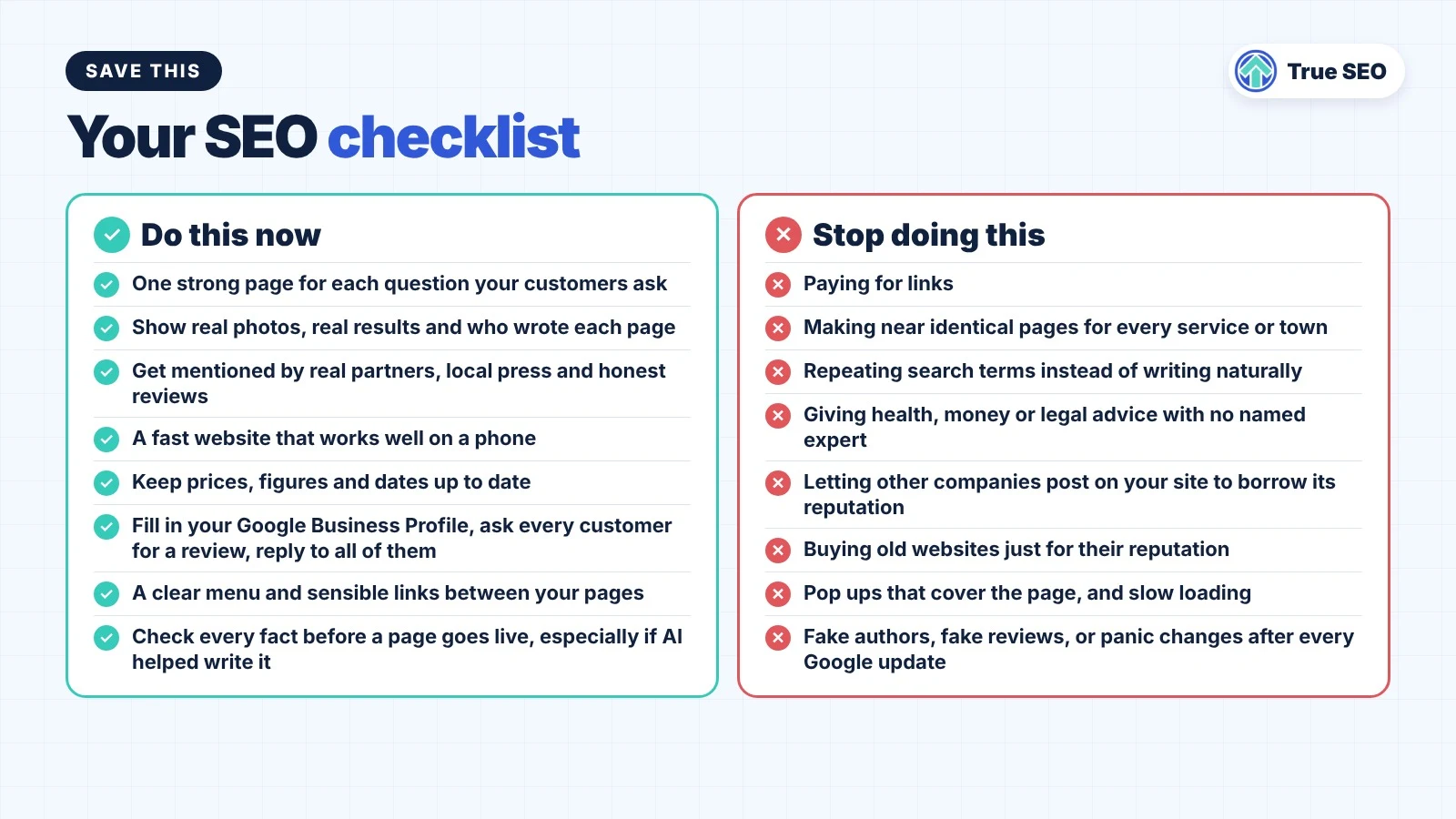
What survives every Google update is the work the shortcuts imitated. Each principle below has outlasted at least one update that removed its shortcut version.
- Original, first-hand content. Panda, launched on 24 February 2011, demoted sites that copied others and rewarded original research. After the March 2024 core update, Google reported 45% less low-quality, unoriginal content in results.
- Earned links. Penguin, from 24 April 2012, targeted link schemes and keyword stuffing on about 3.1% of English queries. Links from clients, suppliers, local press and professional bodies have never been the target.
- A clear subject built on real entities. The Knowledge Graph in 2012, Hummingbird in 2013 (touching about 90% of searches, by press reports) and BERT in 2019 raised the value of pages that say plainly who they are for, what they offer and where.
- Fast, usable pages on a phone. The 2015 mobile-friendly update, the 2018 Speed Update and the 2021 page experience update aimed at this. Google says there is no single page experience signal and chasing perfect scores may not be worth the time. Our position: fix what's broken or slow, then stop.
- People-first purpose. Google's helpful content guidance expects a page to exist to help people. The early March 2017 update the industry called "Fred" hit thin, ad-heavy, revenue-first sites.
- Consistent, accurate facts. Your address, services, prices and credentials should read the same everywhere a person or a machine might check them.
- Depth in one subject. Google's helpful content self-assessment lists "extensive automation to produce content on many topics" as a warning sign.
- Real, accountable authors. The rater guidelines treat AI-generated images and invented creator descriptions as signs of fake profiles.
The semantic SEO and topical authority programme at True SEO Consultants Ltd builds these principles into one clear subject map, with pages that each answer a real question with first-hand detail.
What updates have meant for UK sectors
In our experience, Google updates hit regulated sectors hardest, because their pages deal with money, health or legal rights. Google's rater guidelines call these YMYL ("Your Money or Your Life") topics and hold them to a higher bar for trust. We work with firms in each of these sectors across the UK through remote digital onboarding and delivery.
Accountants and financial firms
Accountancy advice is YMYL, so core updates judge it on trust as much as relevance. The cheapest trust signals take a reader a minute to verify: ICAEW or ACCA membership linked to the public register, the Companies House number and registered address, and named qualified staff.
Thin "accountant in [town]" pages are the sector's most common scaled content risk. Our SEO for accountancy practices built around those trust signals starts from the same list.
Solicitors
Legal advice is YMYL, and a solicitor's site has a trust signal most sectors lack: the firm's SRA number and regulatory status. Show them beyond the footer, with named solicitors and their practice areas. Our SEO for law firms built on SRA trust signals starts there.
Healthcare and dental
Health content gets the strictest YMYL reading. Name the clinician who wrote or reviewed each clinical page, and the date, as our healthcare SEO with named clinical reviewers does.
Ecommerce
Ecommerce felt the product reviews updates most, from April 2021 to the reviews updates of April and November 2023. In our reading, pages with first-hand testing held up and rewritten manufacturer specs did not. Thousands of auto-written product descriptions match the first example in Google's scaled content abuse policy: generative AI producing many pages without adding value. Our ecommerce SEO built on first-hand product testing avoids both risks.
Letting agents and local trades
Pigeon, in July 2014, tied local results more closely to ordinary web ranking signals, so a letting agent's or plumber's website quality now feeds its map visibility. Match your Google Business Profile categories, service areas, photos and reviews to the website. Two hundred town pages with swapped place names are this sector's scaled content risk. Good local SEO ties your website to your Google Business Profile instead.
When is the next Google core update?
Google publishes no schedule for core updates, and none is announced as of 3 November 2026. Its dashboard does show a pattern: a March core update in each year from 2023 to 2026, and a November or December core update in 2021, 2023, 2024 and 2025.
Spring and early summer updates also appear, in May 2022, June 2025 and May 2026; the last core update ran from 21 May to 2 June 2026. Don't time your work to the pattern.
A site built on the eight principles above has nothing to prepare. A site leaning on a shortcut should fix it now.
Keep track with four habits:
- Check the Search Status Dashboard weekly. It logs every announced ranking update.
- Follow the Search Central blog. Google posts guidance there for major core updates and policy changes.
- Read Search Console monthly. Check the Performance, Manual actions and Page indexing reports.
- Mark update dates in your reporting. Note each start and finish date, in UK time, beside your traffic figures.
How update-proof is your site?
Eight questions score your site against the eight principles above.
Answer all 8 questions about your own website, then select See my score.
Please answer all 8 questions to see your score.
Your score: 0 out of 16
Exposed to the next update
Your site leans on at least one shortcut Google has already priced out. Find out which one before the next update finds it for you.
Your score: 0 out of 16
A solid base with thin spots
The foundations are there, but gaps in depth, authorship or consistency leave pages exposed. Build one clear subject map and close those gaps.
Your score: 0 out of 16
Built to last
Your site follows the principles that have survived every update. Keep your team doing it as AI tools and search change around you.
Frequently asked questions
Does Google penalise AI generated content?
No, not for the method alone. Google said in February 2023 that it rewards quality content however it is produced, and its rater guidelines state that using generative AI tools does not by itself decide a page's quality rating. What Google acts against is content mass-produced mainly to rank, and that rule applies whether a person or a model wrote it.
How long does a core update take to roll out?
About two weeks is typical. Core updates logged on Google's Search Status Dashboard since November 2021 have run from just over 6 days to 45 days, with a median of 14.5, and the two in 2026 each took about 12 days.
Can a site recover from a core update?
Yes, a site can recover, though rarely within weeks. Google's documentation says improvements can take several months to register and may only show at the next core update, while the smaller, unannounced core updates it now runs can lift an improved site sooner.
What happened to the helpful content update?
It no longer exists as a separate update. Google ran three helpful content updates, in August 2022, December 2022 and September 2023, then made the helpful content system part of its core ranking systems in March 2024. Recovering from "the HCU" now means recovering from a core update.
Was my site hit by a manual action or an update?
Open the Manual actions report in Search Console: a manual action always appears there as a message naming the issue. An empty report means your drop is algorithmic, from a core update, a spam update or a cause on your own site.
Do Google updates affect all websites equally?
No. Each update touches some query types far more than others: Google said Panda affected 11.8% of US queries at launch, while the 2013 update the industry called "Payday Loan" affected about 0.3% of US queries and around 4% in Turkish. Your exposure depends on your sector, your queries and how your pages are built.
Can Google detect AI content?
Google's guidance doesn't say it ranks pages by detecting AI text. It judges quality and purpose instead. Industry studies using AI detectors disagree on how much AI is in ranking pages, but all three we cite find pure AI pages rarely reach position one, and none of them proves cause.
How do I keep track of Google updates?
Google's Search Status Dashboard is the record of every announced ranking update, with start and completion times in US Pacific time. Pair it with the Search Central blog for guidance and your own Search Console reports for the effect on your site.
What was the Google Panda update?
Panda was the February 2011 update that demoted thin, copied and low-value pages, especially content farms. It launched in the US on 24 February 2011, reached all English-language users that April, and was confirmed as part of the core algorithm in January 2016 (Google's own guide dates the change to 2015).
What is scaled content abuse?
Scaled content abuse is Google's name for publishing many pages mainly to manipulate rankings, with little value to readers. Google added it to its spam policies in March 2024, and only one of the five examples in the policy mentions generative AI; the others cover scraping, stitching content together, spreading pages across several sites to hide the scale, and keyword pages that make no sense to a reader.
Every update in this guide tests whether a page exists to help a person or to game a ranking. Sites that passed lost little each time, from Panda in 2011 to 2026, and AI content now faces the same test. True SEO Consultants Ltd works from Startup Stiwdio, University of South Wales, 86-88 Adam Street, Cardiff, CF24 2FN, and serves businesses across the UK through remote digital onboarding and delivery.
Watch the video 8 min 35 s
Tap anywhere or press Esc to close