SEO Mentoring And Coaching, One To One
Taught on your own website by a consultancy led by a qualified accountant and a certified business coach
SEO mentoring is a consultant teaching you to run your own search programme on your own website, session by session, instead of running it for you and handing you a report. You do the work. We decide the order, check the method and correct it before it costs you a quarter.
- Your site is the syllabus. Nothing is taught until the audit has found what is actually holding your pages back
- Billed per session or as a fixed programme, never by the hour, because the work sits in the fortnight between calls
- Built to end. A handover plan exists from session one and leaving is a success condition, not a churn event
- One to one
- Team programmes
- Remote or in Cardiff
- UK and international

Three things you leave with
- A written topical map of your subject, with the reasoning attached rather than the output alone
- The four or five decisions that are currently costing your site rankings, in the order they should be fixed
- A measurement definition you agreed at the start, so next year’s report means the same as this year’s
No obligation. We will tell you when mentoring is the wrong purchase.
SEO mentoring in five points
Mentoring transfers the method. A retainer transfers the workload. Which one you need depends entirely on who will still be doing the work in six months.
- Every programme starts with a diagnosis, not a curriculum. You are not taught SEO in general. You are taught the specific decisions your own site is currently getting wrong.
- Sessions are working sessions. Your Search Console, your analytics and your CMS are open. There are no slide decks.
- The fortnight between sessions is the programme. Sessions set the block and correct the method; the movement is produced by you in between.
- The people teaching it are unusually qualified for search. A Chartered Certified Accountant and a Certified Business Coach, which is why the commercial advice does not stop at keyword lists.
- It is designed to make itself unnecessary. The handover ladder is agreed in session one and you climb it on evidence, not on a calendar.
Not sure whether you need mentoring at all?
Book the free thirty-minute call. We look at your site before we speak, and you will leave the call knowing whether mentoring, training, consultancy or straight delivery actually fits, including when the honest answer is none of them.
What is SEO mentoring, and how does it differ from hiring an agency?
SEO mentoring is guided practice: a consultant works through your own site with you, sets the priority order with you, and holds you to it between sessions. An agency does the work and reports on it. A mentor watches you do the work and corrects it.
The distinction matters more than it sounds, because the two arrangements leave you in completely different positions at the end. After two years of a retainer, your rankings belong to the retainer. Stop paying and the publishing stops, the technical fixes stop, and the only person who understands why the site is structured the way it is has just been offboarded. After two years of mentoring, the capability is inside your business. That is either exactly what you want or completely the wrong purchase, and there is no middle ground.
Most people arrive here from one of two directions. Either they have already paid an agency for a year, seen movement they cannot explain, and want to understand what they are buying. Or they have someone in-house who is competent, willing and one conversation short of being effective. Both are mentoring problems. Neither is solved by more delivery.
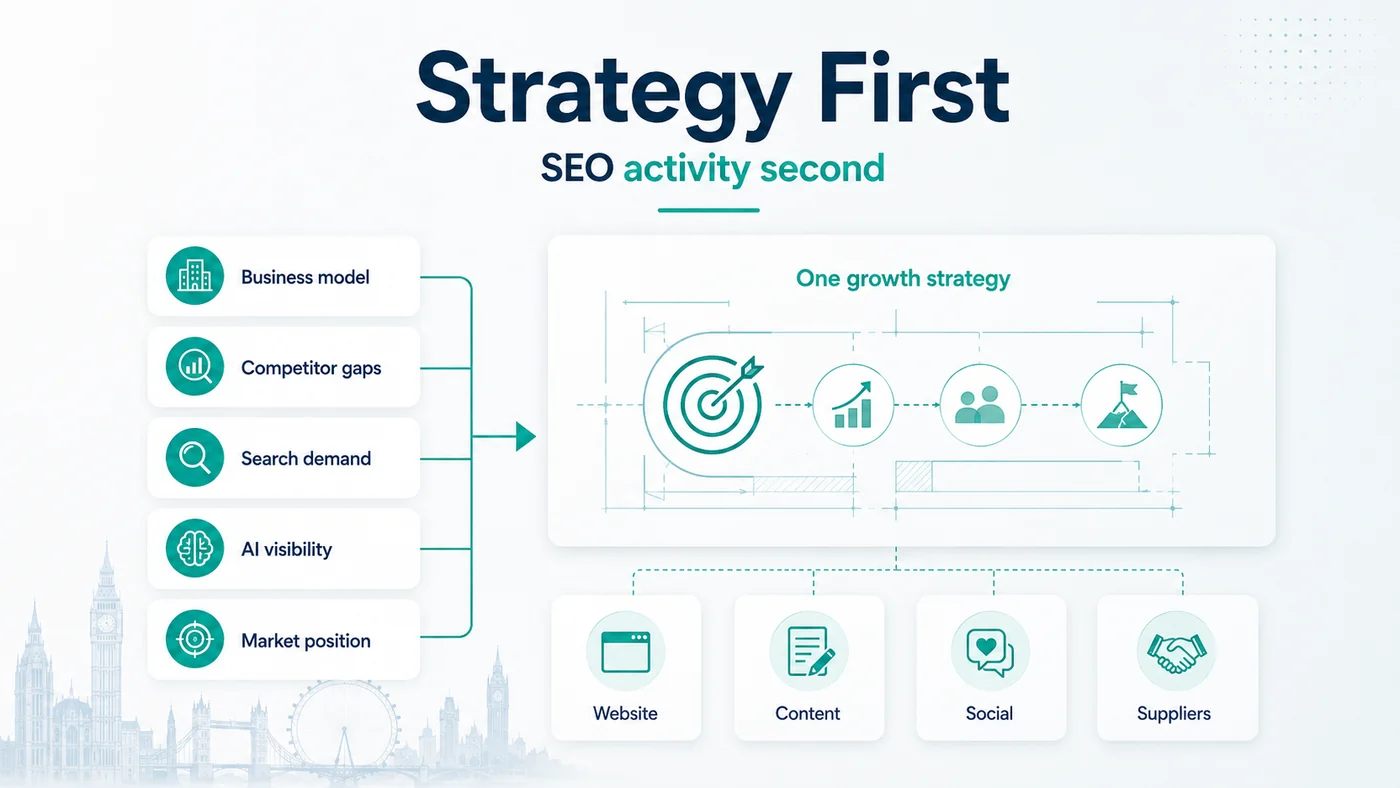
Strategy first, SEO activity second
We do not open by quoting a number of blog posts, a number of pages or a number of links. That is a task list dressed as a strategy, and it is why so many businesses can describe what their SEO supplier does without being able to explain what any of it is for.
The first working session takes five commercial inputs, being your business model, the gaps in what competitors have covered, real search demand, how visible you currently are inside AI answers, and where you sit in your market, and produces a single growth direction from them. Everything downstream follows that one direction: what the website says, what gets written, what the social channels repeat, and what any outside supplier is briefed to do. When those four things point at one target rather than four, the compounding starts.
Five commercial inputs, one growth strategy, four things it directs
Swipe the diagram sideways to see all of it.
Is this mentoring, training or consultancy, and which do you need?
Ask one question and the answer falls out: who will still be doing this work in six months? If it is you, buy mentoring. If it is a team you already employ, buy training. If it is somebody else entirely and you only need the direction to be right, buy consultancy.
The three get confused because all of them involve an expert, a meeting and a document. What separates them is where the work lands afterwards.
Mentoring is one to one and site-specific. The syllabus is your website. Between sessions you do the work and it either moves or it does not, and the next session starts from that evidence.
Training is a group, a curriculum and a fixed scope. It suits a marketing team of three or four who need the same shared vocabulary and a repeatable process. Nobody’s individual site is the case study, so it scales better and personalises worse.
Consultancy is direction without delivery and without teaching. You get the diagnosis, the priority order and the specification, and your own people or your agency execute against it. Our SEO consultancy for in-house teams and brands is built for that shape.
Which of the four you should actually buy
Swipe the chart sideways to read all of it.
| Mentoring | Training | Consultancy | Delivery retainer | |
|---|---|---|---|---|
| Who does the work | You, corrected | Your team, to a shared process | You or your agency, to our spec | Us |
| Group size | One person | Three to six | Whoever owns the decision | Not applicable |
| What you are buying | Judgement, applied to your site | A repeatable method | Direction and priority order | Output and time |
| What is left afterwards | Capability inside the business | A process the team can run | A specification and a map | Rankings, and a dependency |
| Best when | You are the person who will do it | The headcount already exists | Delivery exists but direction does not | Time is scarcer than budget |
| Billing shape | Per session or fixed programme | Fixed programme | Scoped engagement | Monthly |
Plenty of businesses buy two of these at once. A common combination is consultancy at the top to fix the direction and mentoring underneath it, so the owner can tell whether the direction is being followed rather than taking it on trust. If your answer turns out to be straight delivery, our monthly SEO packages and bespoke SEO service cover that side.
Who mentors you, and what qualifies them?
Two people run the mentoring, and between them they hold a Chartered Certified Accountant’s qualification and a business coaching certification. That is not a combination the search industry produces very often.
Mohammad A Mahmud
Director and Lead Consultant. Fifteen years in search, more than twenty international brands across luxury and ecommerce, and semantic SEO training taken directly from Koray Tuğberk Gübür. He is also an ACCA member and a Chartered Certified Accountant in the UK, which is why advice given to accountancy practices, consultancies and law firms tends to survive contact with how those businesses actually bill.
Read Mohammad’s profileJulie Williams
Co-Founder, Director and a Certified Business Coach with thirty years of commercial experience and a published book behind her. She supervises the coaching side of every programme. That is the part most SEO mentoring skips, and it is usually the part that decides whether an owner changes what they do on a Tuesday morning or simply agrees with the plan and carries on as before.
Meet the wider teamThe reason to say all of this out loud is not credentials for their own sake. It is that mentoring is a teaching relationship, and teaching is a separate skill from doing. An excellent practitioner who cannot explain their own reasoning makes a poor mentor, and you can be several thousand pounds into a programme before that becomes obvious.
So ask any prospective mentor, including us, three things: what they rank for themselves, whether they will show you a topical map they built, and who supervises the commercial advice sitting underneath the search advice. The answers separate mentors from practitioners faster than any credential list.
How does a mentoring programme actually run?
Four stages, repeated: audit to find the gaps, plan to set the priority order, mentor to guide the work, review to measure what moved. The fourth stage feeds the next round of the first, which is what makes it a programme rather than a course.
Audit, plan, mentor, review, and then round again
Swipe the diagram sideways to see all of it.
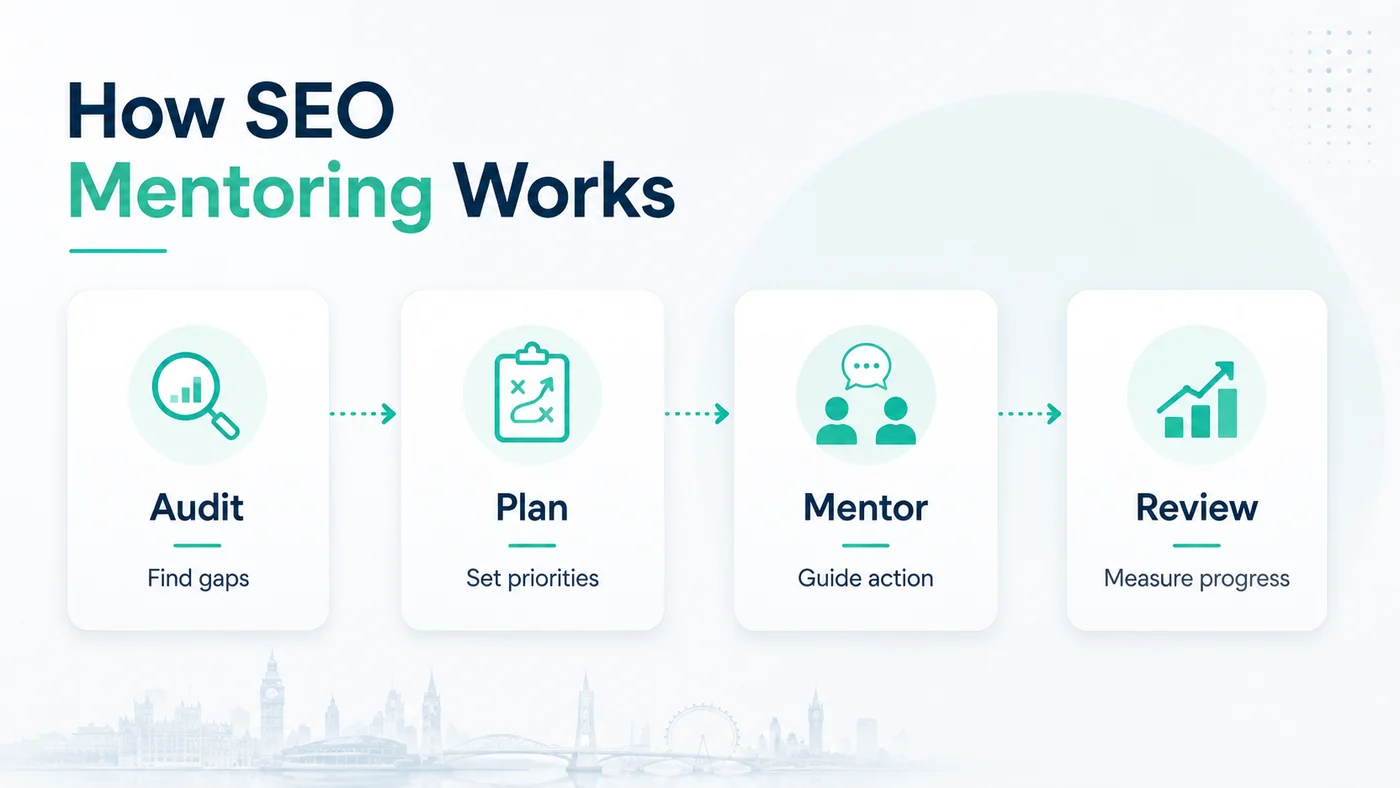
Audit: nothing is taught until the site has been looked at
We run the same four-layer diagnosis used in our SEO audit service. Can search engines reach and index it. Is it structured so that meaning is legible. Does the content cover the subject completely. Does any of it convert. You get the findings in priority order with the evidence attached, not a score out of a hundred.
Plan: the findings become a sequence
This matters more than the findings themselves, because almost every stalled SEO programme is working on real problems in the wrong order. Fixing thin content on a site that is not being crawled properly is effort spent on a page nobody will read. The plan is the part of mentoring that is hardest to get from a course, because sequencing depends on your particular site rather than on general principles.
Mentor: working sessions, not slide decks
Sessions run against that sequence with your Search Console, your analytics and your CMS open. You bring the work you did, we look at it together, and the next block is set. If something you built is wrong, you find out in the session rather than in a report three months later.
Review: three failures that look identical on a graph
Every fourth session is a measurement session against the indicators agreed at the start. When something has not moved, we establish which of three things happened: the work was not done, the work was done wrongly, or the work was correct and has simply not had time yet. Those three produce the same flat line and need completely different responses, and guessing between them is how programmes quietly waste a quarter.
What does SEO mentoring cover?
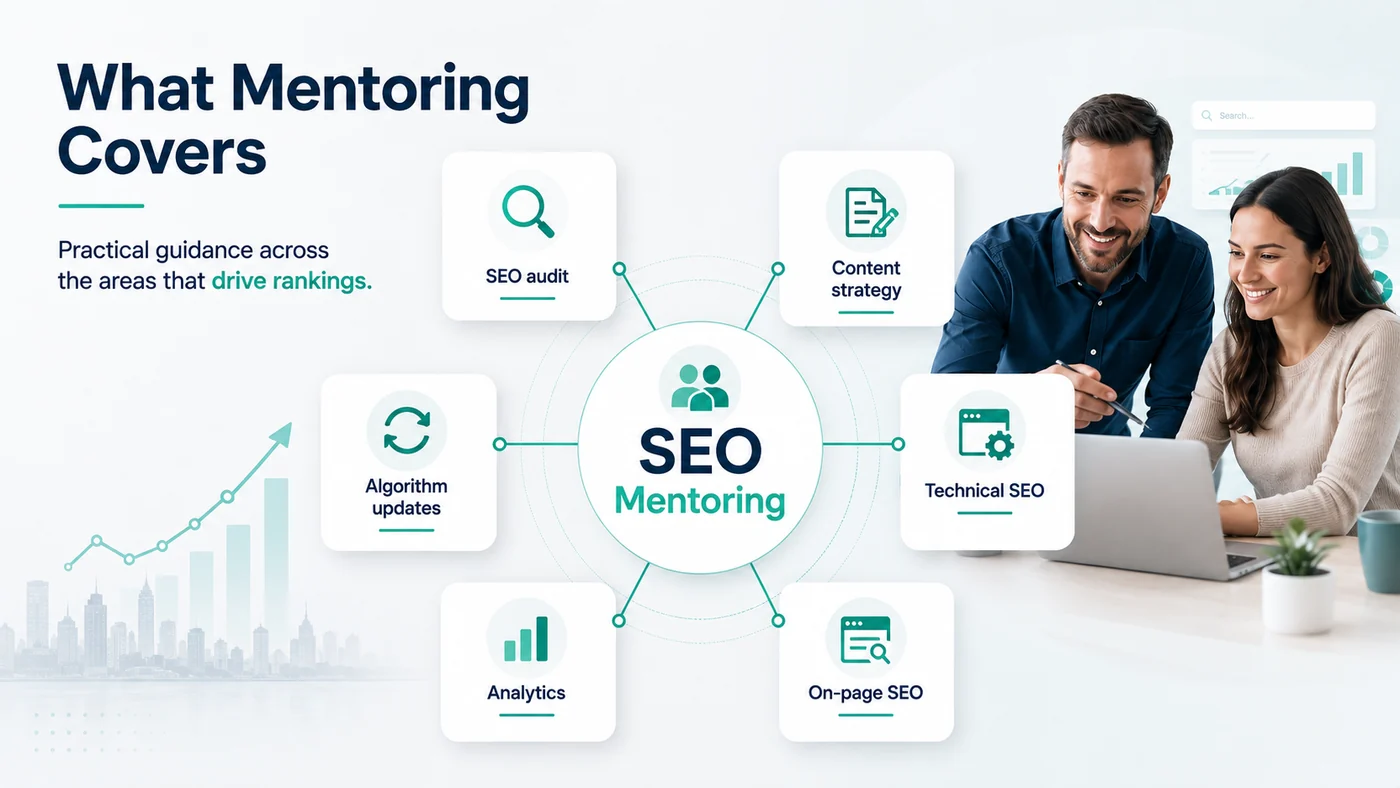
Six working areas: the audit, content strategy, technical SEO, on-page SEO, analytics, and adapting when Google changes. Each one is taught against your own site and your own data rather than in the abstract.
The six areas a mentoring programme moves through
Swipe the diagram sideways to see all of it.
| Area | What happens in the session | What you do between sessions |
|---|---|---|
| SEO audit | We read the crawl and the Search Console data with you and name the layer that is failing | Fix the access problems first, because nothing below them can be measured |
| Content strategy | We build the topical map together and you learn why each page exists before it is written | Write or brief the next tier of pages against the map, not against a keyword list |
| Technical SEO | We turn the findings into a specification your developer can act on without interpreting it | Get the specification implemented and verify it rather than assuming it shipped |
| On-page SEO | We work through two or three of your pages line by line so the pattern is visible | Apply the same pattern to the rest, and bring the ones you were unsure about |
| Analytics | We agree the definitions and build the views, so a number means one thing all year | Read the numbers weekly and bring anything that moved without an obvious cause |
| Algorithm updates | We work out what a change means for a business like yours, not for the industry | Hold your nerve, and change nothing for a fortnight unless we agreed to |
The depth in each area follows what your audit found. A ten-year-old ecommerce site with four thousand products and a category structure nobody has revisited since launch will spend most of its programme on architecture and internal linking. A five-year-old consultancy site with twelve pages will spend most of its programme on semantic SEO and topical authority, because the ceiling there is coverage rather than technical health.
Two areas come up on almost every programme regardless of sector. The first is technical and on-page SEO, because there is nearly always something quietly stopping pages being indexed or understood. The second is earned coverage, which we teach through our link building approach as outreach and assets rather than as buying placements, since the alternative is a liability you will pay for later. Where AI answers matter to your market, we cover that through the same method we use on ranking inside AI and LLM results.
What do you work on between sessions?
The between-session block is the programme. Sessions set the block, check the last one and correct the method; the ranking movement is produced in the fortnight in between, by you.
Each block is deliberately small enough to finish. Three or four items, each with a definition of done that does not depend on rankings, because rankings are too slow and too noisy to steer by fortnightly. “Every category page has a unique introduction that names the entity” is a finishable item. “Improve the category pages” is not.
The fortnightly cycle, and the two different ways it breaks
Swipe the chart sideways to read all of it.
Mentoring that never surfaces the second case is not mentoring, it is accountability, and you can get accountability from a calendar reminder. The value of a mentor is being told that the work you completed correctly was the wrong work.
You also get asynchronous cover between sessions for the thing that cannot wait: a developer about to ship something that would break indexing, a sudden ranking fall, or a supplier proposing something that will cause a problem in nine months.
Who is SEO mentoring for?
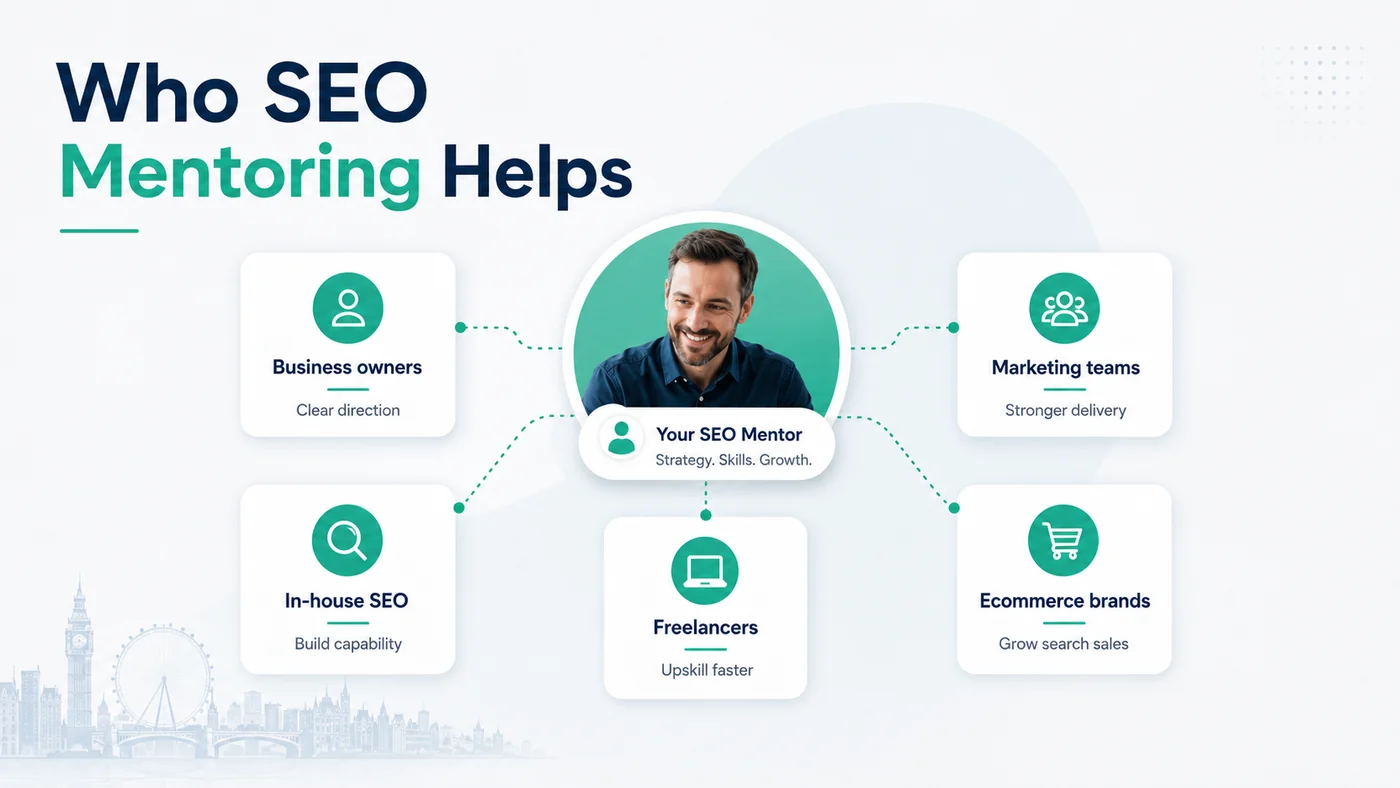
Five kinds of reader take five different things from the same programme: owners get direction, in-house SEOs get capability, freelancers get faster progression, marketing teams get stronger delivery, and ecommerce brands get search revenue.
Five readers, one programme, five different things taken away
Swipe the diagram sideways to see all of it.
Business owners
Usually paying an agency without being able to evaluate it. Mentoring gives you enough working knowledge to tell a good invoice from a bad one, which frequently pays for itself before any ranking moves.
In-house SEO staff
Often the only search person in the building, with nobody senior to check their reasoning. Mentoring supplies the missing colleague. Progress is fastest here, because the access and the time already exist.
Freelancers and consultants
Use it to move up-market. Learning entity-based structure and topical mapping properly is the difference between charging for pages and charging for outcomes.
Marketing teams
Use it to stop wasting their own output. Most teams already publish enough; the loss is that the publishing is not organised around anything, so forty articles compete with each other instead of stacking.
Ecommerce brands
Their problem is structural, and structure is the kind of thing that is far cheaper to learn once than to buy repeatedly for every new category.
Agencies reselling search
We mentor delivery teams on method. If you resell under your own brand, our white label SEO, AEO and GEO service covers the work itself.
Regulated sectors get particular attention, because the compliance layer changes what can be published and therefore what the content plan is allowed to say. Accountancy and financial advice sit under conduct rules that shape claim language, and our SEO for accountants work is where that knowledge is deepest. A mentor who does not know those boundaries will hand you a plan you cannot use.
Bring one real problem to the first call
The free thirty-minute call works best when it is about something specific: a page that will not rank, a migration you are nervous about, or an agency proposal you want a second opinion on. You will get a straight answer whether or not you go on to buy anything.
What does SEO mentoring cost, and how is it billed?
Mentoring is billed per session or as a fixed monthly programme, not by the hour. Hourly billing prices the call, and the call is the cheapest part of the arrangement; the preparation, the diagnosis and the between-session review are where the work actually sits.
| Shape | What it includes | Who it suits | How it is billed | Commitment |
|---|---|---|---|---|
| Single scoped session | One defined question, prepared for in advance, with a written recommendation afterwards | Anyone with a specific decision waiting on it | Per session | None |
| One to one programme | Audit, topical map, fortnightly working sessions, async cover, quarterly measurement review | Owners and single in-house SEOs who will do the work themselves | Fixed monthly, for a stated number of sessions | Ends on the agreed date, nothing rolls over |
| Team programme | The same, delivered to three to six people with role-specific tracks and a shared specification | Marketing teams and agency delivery teams | Fixed programme fee for a defined scope | Ends on the agreed date, nothing rolls over |
The figure depends on three things and we will not pretend otherwise: how large and how broken the site is, how many people are being mentored, and whether you want the plan handed over or supervised while you execute it. A single-site owner and a five-person marketing team are different amounts of work, and quoting one headline number that fits neither is how this industry earned the reputation it has.
What you can rely on is the shape. The session-based option has no minimum term. Programme options are quoted for a defined number of sessions against a stated scope, so you know when the commitment ends before it starts, and nothing renews automatically.
For what search work costs across the UK market generally, our guide to what SEO costs in the UK states the market rates without selling a tier, and our monthly SEO packages state ours for delivery rather than mentoring. Book the free thirty-minute call and you will leave with a scope and a number for your own situation.
Can you book a single paid consultation rather than a programme?
Yes. A single scoped session is a legitimate purchase and often the right first one, particularly when there is a specific decision waiting on it.
The sessions that work best on their own have a defined question. Whether to consolidate or expand a set of pages that are competing with each other. Whether a planned migration will cost you rankings and what would prevent that. Whether an agency proposal is worth what it asks. How to structure a new site before anything is built. You leave with a written recommendation you can act on without booking anything else.
The sessions that work least well on their own are the open-ended ones. “Look at my site and tell me what to do” produces a list too long to act on and too general to prioritise, which is exactly the problem the audit-then-plan sequence exists to solve. If that is your question, the programme is the honest answer, and we will say so on the free call rather than after you have paid for a session.
How do you hand over an SEO programme to an in-house team?
By building the handover into the programme from the first session rather than treating it as an exit. The transfer runs in four rungs, and you climb each one on evidence rather than on elapsed time.
The handover ladder, and the condition that has to be met before each climb
Swipe the chart sideways to read all of it.
A team moves off supervised execution when it produces two consecutive blocks that need no correction, not when a number of weeks has passed. That single rule is the difference between a handover and an abandonment.
Some businesses stop entirely at rung four. Others keep the quarterly review, which is the cheapest thing we sell and the one most likely to catch a problem while it is still small. Either is a good outcome. A programme that cannot end is a retainer wearing a different name.
How do you measure whether the mentoring worked?
By capability first and search performance second, because capability moves first and predicts the rest. If the team is making better decisions unprompted by session six, the rankings follow. If they are not, no amount of ranking movement in month three will hold.
| What we measure | When it typically moves | What it tells you |
|---|---|---|
| Work needing no correction | Session four to six | The method has transferred. This is the leading indicator and the one worth watching. |
| Pages crawled and indexed | Days to three weeks | The access layer is fixed. Nothing below it can be judged until this is clean. |
| Impressions on worked pages | Three to eight weeks | Google has re-understood the page. Positions have not necessarily followed yet. |
| Positions on money queries | Two to three quarters | The topical structure is being credited. This is the slow one and it is normal. |
| Enquiries arriving through search | One to two quarters after positions | The commercial result. Everything above it is a proxy for this. |
| Local map pack visibility | Two to six weeks | Local signals are landing, if local search matters to your market. |
Rankings on their own are the worst available measure and the most commonly quoted. They move for reasons that have nothing to do with you, they vary by location and device, and averaging them across a site hides the only movement that matters. We track the queries the business actually earns money from, the impressions on the pages we have worked on, and the enquiries that arrive through search.
The measurement definitions are agreed in the first session and not changed afterwards, which sounds bureaucratic until you have watched a report improve because somebody quietly altered what counted as a conversion. Where local visibility matters, we measure it through the same method used in our local and multi-location SEO work.
Two businesses we mentored, and what changed
Total Books Accountants in Cardiff came to us after their Google rankings fell. The work rebuilt the site around a defined specialism rather than a general accountancy offer, and their local visibility recovered and then improved on where it had been. The lesson that transferred was narrowness: a practice that tries to rank for everything an accountant does ends up ranking for none of it.
RX Virtual Finance was the opposite situation, a brand-new business in the virtual finance niche with no site and no history. Because the structure was decided before anything was published, semantic SEO was applied from the first page rather than retrofitted afterwards. The business now holds more than a hundred keywords on page one, a number of them in first position. Starting correctly is enormously cheaper than correcting later, and it is the one real advantage a new business has over an established competitor.
Both are accountancy-adjacent, which is not a coincidence. Sector knowledge is what lets a mentor tell you which of your competitors’ pages are actually working rather than merely present, and our SEO for accountants work is where ours runs deepest.
How do you choose an SEO mentor?
Ask what they rank for themselves, ask to see a topical map they have built, and ask who supervises their commercial advice. A mentor who can only show you client screenshots is showing you somebody else’s work.
Those three questions do more filtering than any credential list. The first tests whether they can do it in a market where there is no client to blame. The second tests whether they think structurally or tactically, because a topical map is impossible to fake and instantly legible to anyone who has built one. The third tests whether the business advice sitting underneath the search advice has any grounding, since a mentor will inevitably end up commenting on your pricing, your positioning and your service mix.
Four more things are worth checking. Whether they specialise in anything, because regulated sectors change what can be published and a mentor who does not know the boundaries will hand you a content plan you cannot use. Whether the sessions are practical, run against your own site with the tools open, rather than theoretical. Whether they are current, which you can test by asking what the last significant change in search meant for a business like yours. And whether they will only teach methods that comply with search engine guidelines, because a mentor who teaches you shortcuts has handed you a liability and taken no share of it.
Reviews and referrals help, but weight them by specificity. “Great to work with” tells you nothing. “Explained why our category pages were competing with each other and showed us how to fix it” tells you a great deal.
Can you learn SEO without a mentor?
Yes, and a determined self-learner with a live site to practise on will get most of the way there. What a mentor changes is the speed, and the cost of the mistakes, rather than whether it is possible at all.
Start at the source. Google’s own Search Essentials, its SEO starter guide and the Search Console help documentation are free, authoritative and considerably more accurate than most secondary commentary about them. The Search Central blog is where changes are actually announced, rather than where they are speculated about.
Then read widely but sceptically. Moz, Ahrefs, Search Engine Journal and Semrush all publish useful material, and Koray Tuğberk Gübür’s writing is the best available public source on semantic and entity-based work. Structured courses from Google Digital Garage, the Ahrefs and Semrush academies and HubSpot cover the fundamentals properly and cost nothing.
Then practise on something real. A test site you own teaches more in a month than a year of reading, because search only responds to published work. Analyse the sites already ranking for your terms rather than guessing at why they rank, and join communities where working practitioners argue with each other rather than agree.
The honest limit of self-teaching is prioritisation. Everything published about SEO is written for a generic site, and you have a specific one. Knowing thirty techniques does not tell you which two of them your site needs this quarter, and that gap is the entire reason mentoring exists. If you want the reading route, our guide to gaining topical authority in twelve steps is the closest thing we publish to a free syllabus.
Why True SEO
True SEO Consultants Ltd is a Cardiff-based SEO consultancy working with businesses across the UK and internationally. We build search programmes around meaning rather than keyword lists, and we are as willing to teach the method as to run it. Every engagement is led by a named senior consultant, and you get that name before you commit to anything.
Built around your model
When the shape of the business decides the shape of the plan.
Bespoke SEO serviceFrequently asked questions about SEO mentoring
How long does a typical mentoring programme run?
Most run between three and six months. Shorter than three months rarely allows a full audit, plan, execute and review cycle to complete. Longer than six usually means the handover was not planned properly at the start. Some clients continue with a quarterly review once the programme ends.
Do I need to already know SEO to be mentored?
No, but you do need to be the person who will do the work. Mentoring assumes access to your own site, your Search Console and your analytics, plus a few hours a fortnight to act on what was agreed. Complete beginners do well. Unavailable people do not, regardless of how much they already know.
Can you mentor a whole team rather than one person?
Yes. Team programmes work best at three to six people with clearly separate roles, so the content lead, the developer and whoever owns reporting each leave with their own part of the process rather than a shared summary of all of it.
Do you offer SEO training in Cardiff, or is everything remote?
Both. Sessions run remotely by default, which is what most clients prefer, and in-person sessions are available in Cardiff and across South Wales. The material is identical either way. Our Cardiff SEO work covers the delivery side locally.
What tools will I need?
Google Search Console and Google Analytics, both free, are enough to start and enough for most of the programme. A crawler and a keyword tool become useful in the second half. We will not push you to buy software before you have a use for it.
Do you mentor businesses outside the UK?
Yes. Sessions run digitally and are scheduled in your time zone. The method does not change. The competitive analysis and the search demand data do.
What happens if I want to stop part-way through?
Session-based mentoring has no minimum term, so you simply stop booking. Programme engagements are quoted for a defined number of sessions, and unused sessions are discussed rather than forfeited. You keep every document produced up to that point, including the topical map.
Is mentoring cheaper than hiring an agency?
Usually over a two-year horizon, rarely in the first quarter. Mentoring costs less per month and more of your own time, and it leaves an asset inside your business that a retainer does not. If your time is the scarce resource rather than your budget, a retainer is the more honest purchase and we will say so.
Can you mentor us and deliver at the same time?
Yes, and it is a common arrangement. We take the technically difficult work while your team runs content and on-page under supervision, with the delivery share reducing as capability builds. It is the fastest route for a team that needs results now and independence later.
The next step
Book a free thirty-minute call
We look at your site before we speak. You will leave the call knowing which of mentoring, training, consultancy or straight delivery actually fits your situation, including when the honest answer is none of them.