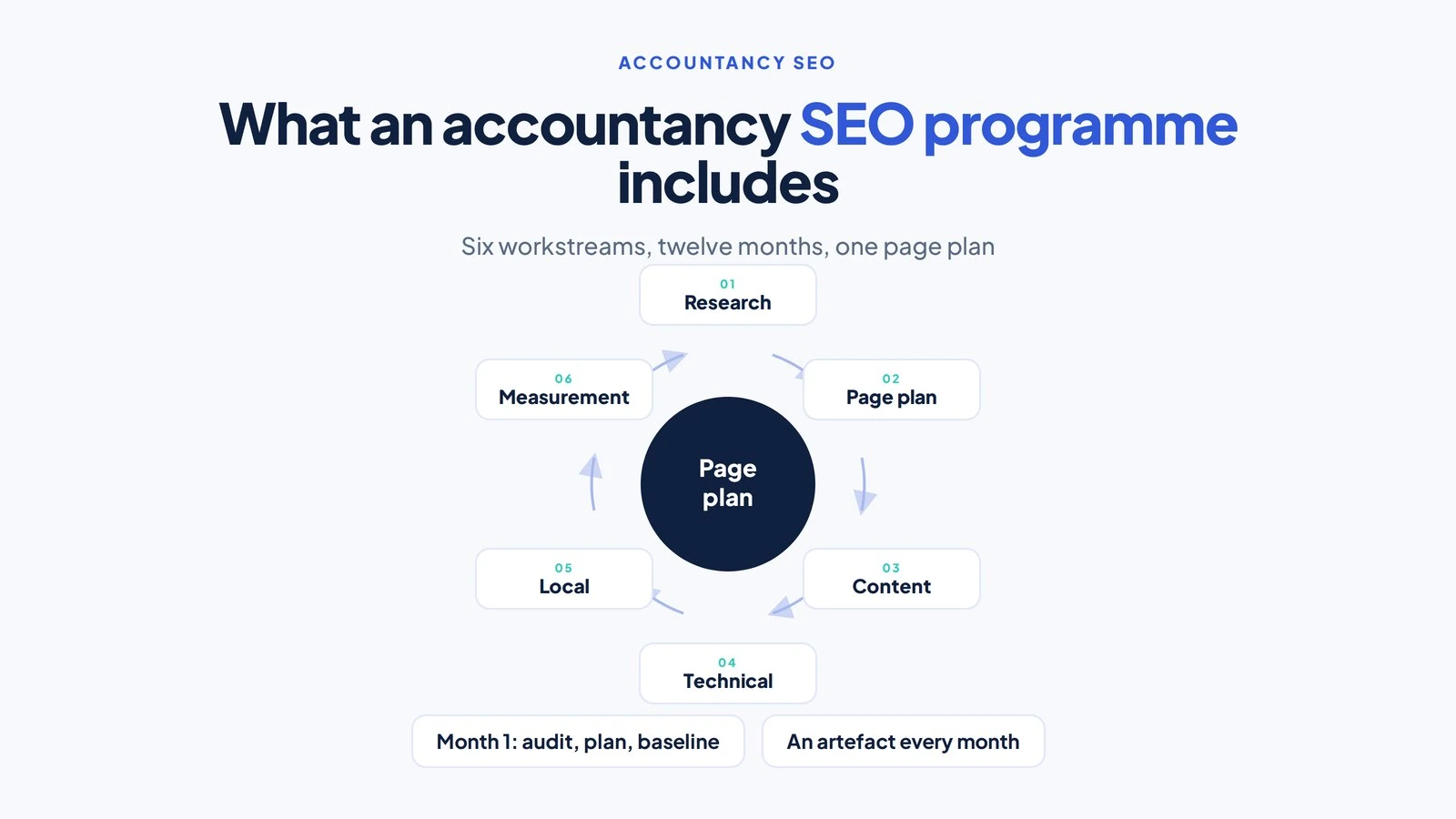
SEO for accountants includes six workstreams: research into what your market searches for, a page plan built from that research, writing and publishing those pages, the technical and markup work that lets search engines read them, the local and profile work that puts the practice on the map, and monthly measurement against agreed targets. A programme runs all six in a fixed order. A task list runs whichever one fits the hours.
The difference matters because you are usually sold the second and told to expect the first. Our own Search Console data across 322 accountancy queries shows 113,472 impressions and five clicks at a weighted position of 53.6. Visibility on that scale earns nothing, and no amount of task work moves it, because the pages the searches want do not exist yet.
Key Takeaways
- An accountancy SEO programme runs six workstreams in a fixed order, starting with research and ending with measurement against agreed targets.
- Month one produces an audit, a page plan and a baseline. Nothing gets written before those three exist.
- The practice supplies four things: fee ranges, the services partners want more of, the client types you serve, and sign off on claims.
- You should receive a named artefact every month, not a traffic chart.
- Six items sit outside almost every fee: hosting, design, paid ads, tools, legal copy and the partner time the programme needs.
- Our research across 494 UK practice websites found 69.6% have no page for the service they most want to sell, which is what a real first month finds.
- Publication order runs backwards from the filing calendar, so January demand is served by pages written the previous autumn.
- Answer engines are covered by the same six workstreams, at a higher standard, and no provider can guarantee a mention in an AI answer.
- Enquiry change takes longer than ranking change, and both should be agreed in writing before the first invoice.
Accountancy SEO programme
Want to see the page plan for your practice?
We run the audit and the page plan first, so you can read what would be built before you commit to a month of work.
Measured, not claimed
Two named client results and one published research report behind the method.
- 494UK practice websites in our published study
- 773 to 2,300monthly organic visits, Total Books Accountants
- 60 daysto page one, RX Virtual Finance
What does SEO for accountants include?
SEO for an accountancy practice includes research, a page plan, content production, technical work, local visibility and measurement. Those six sit in dependency order, so the research decides the page plan, the page plan decides what gets written, and the technical work makes what gets written readable.
A programme differs from a task list in one way that shows up on the invoice. A programme commits to an outcome at a date and fills the hours needed to reach it. A task list commits to hours and fills them with whatever is next on the board. You rarely see the difference until month four, when the task list has produced twelve blog posts and no page for the advisory work your partners wanted to sell.
The work below is what SEO for accountants covers when it is run as a programme.
What are the six workstreams in an accountancy SEO programme?
The six workstreams are research, page planning, content production, technical and markup, local and profile, and measurement. Each one produces something the next one needs, which is why the order is fixed.
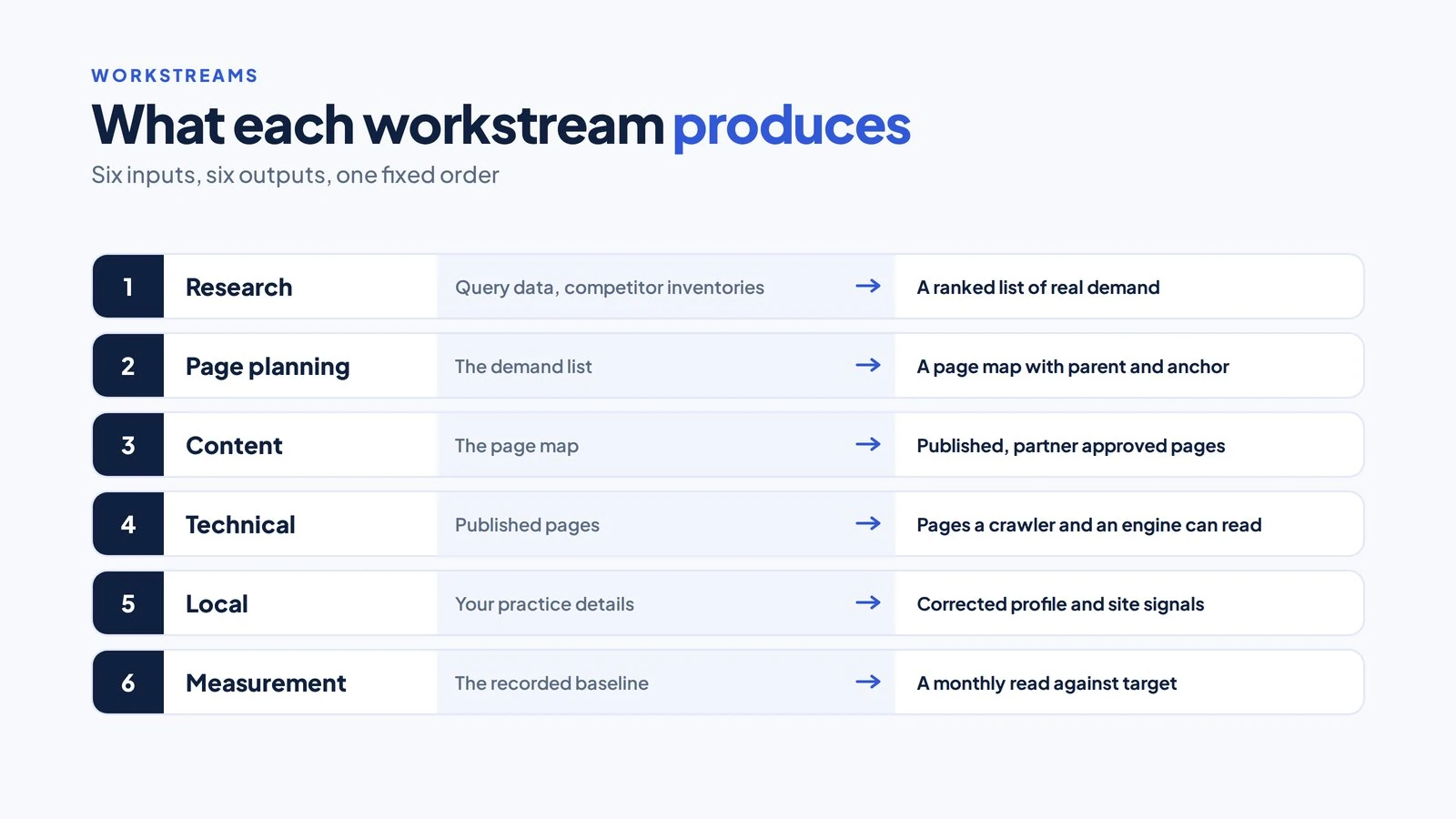
Research. Query data, competitor page inventories and the questions partners hear on calls. Output is a ranked list of what your market searches for and which of those searches your site can realistically win.
Page planning. Every query in that list gets a home on your site: its own page, a section on an existing page, a table row or a frequently asked question. Output is a page map with a parent, a target query and an anchor for every row.
Content production. Writing, review and publication. Your copy goes through a partner review before it goes live, because a claim about tax treatment or a regulated service has to be defensible.
Technical and markup. Titles, headings, internal links, structured data, page speed, sitemap and analytics. Output is a site a crawler can read and an answer engine can quote from.
Local and profile. Your Google Business Profile, the address and phone signals on your site, your categories, your reviews and the catchment you actually serve.
Measurement. A baseline recorded before anything changes, then a monthly read against it. Without it, nobody in month six can say what the work moved.
What happens in month one, and what does your practice have to supply?
Month one gives you three things and publishes nothing: a technical and content audit, a page plan, and a recorded baseline. Publishing before those exist means writing pages you will later have to move.
The audit reads your site the way a crawler does and records what is missing rather than what is wrong. Our research across 494 UK accountancy practice websites found that 69.6% have no page for the service they most want to sell, 87.2% publish no price figure of any kind, and 98.0% have no page explaining how a client changes accountant. Most first months on a practice site find two of those three. The full set of measured faults sits in the 494 practice website study.
Four things have to come from you, and the programme stalls without them.
| What you supply | Why it is needed | When |
|---|---|---|
| Fee ranges by service, even as bands | Decides which services justify their own page and which share one | Week 1 |
| The three services partners want more of | Sets the commercial order of the page plan | Week 1 |
| The client types you already serve well | Becomes the niche and client type pages, and the proof behind them | Week 2 |
| A named partner who signs off claims | Every regulated statement needs an owner before publication | Week 2 |
The baseline is the step that gets skipped, and the one that matters most in month six. Record the query positions, the impression counts, the enquiry volume and the source split on the day before the first change. Six months later that record is the only thing that settles what the work did for you.
What gets built in months two and three?
Months two and three build the commercial core of the page plan: the service pages, the high value service page the practice is missing, and the client type pages that let a searcher recognise themselves. Blog content waits, because a post linking to a service page you have not built yet has nothing to point at.
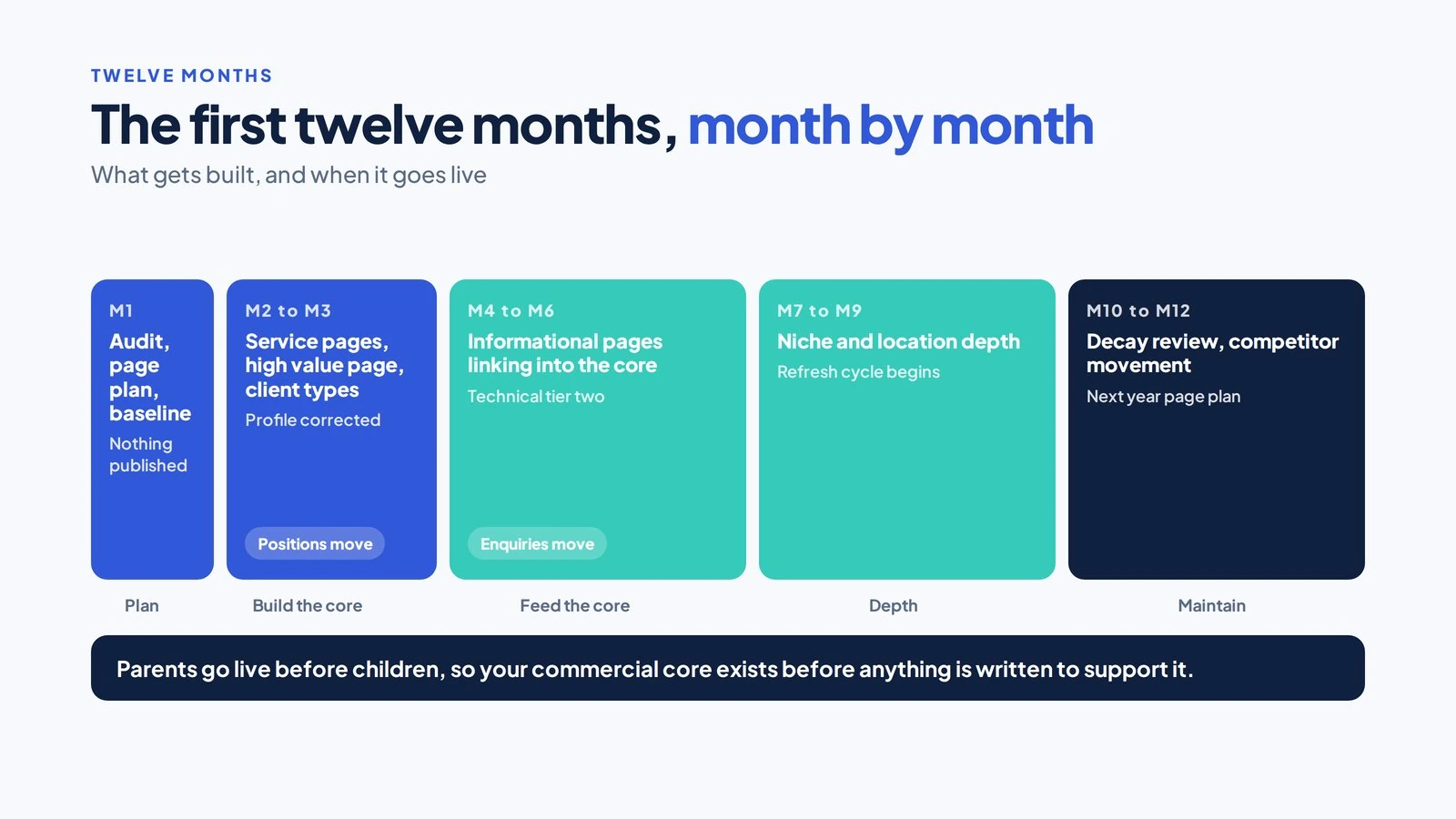
A typical pair of months on a single office practice gives you four to six pages, each written to one query, each reviewed by one of your partners, each linked from your home page and from any existing page that mentions the service. The count matters less than the order. Parents go live before children, so your advisory hub exists before the four advisory sub-pages pointing at it.
Two things run alongside. The technical faults found in your audit get fixed in priority order, starting with anything that stops a page being crawled or read. Your Google Business Profile gets corrected, because a profile with the wrong primary category loses map pack visibility that no amount of website work replaces.
What goes on each of those pages is a specification rather than a preference, and it varies by page type. Your home page carries different work from a service page, and a client type page carries different work again. We set out the whole inventory, page by page, in the accountancy website checklist.
What happens from month four onwards?
From month four the programme moves from building the core to feeding it. Informational pages answer the questions that sit around each service, and every one of them links into the commercial page it supports. That is how an article strengthens the page that earns, and the reason a practice blog written without a page plan earns you nothing.
The monthly rhythm settles into four repeating jobs: publish the next batch from the page plan, refresh whatever the data says has decayed, fix the next tier of technical findings, and re-read the baseline. Query positions move first, usually inside a quarter on mid competition terms. Enquiry volume moves later, because a searcher who finds you in month four may not change accountant until their year end.
Total Books Accountants went from 773 to 2,300 monthly organic visits. The work behind those figures is written up in the Total Books case study.
How does the programme fit around the accountancy year?
The programme runs on lead time rather than on the calendar month, because a page has to be live and indexed well before the search it answers reaches its peak. January demand is served by pages published the previous autumn. A page written in January for January is a page written for next January.
The dates that set the lead time are fixed and public. GOV.UK gives 5 October as the deadline to tell HMRC a return is needed, 31 October for a paper self assessment return, 31 January for the online return and the payment itself, and 31 July for the second payment on account. Those four dates set the shape of the compliance year for almost every practice, and the publication order in your page plan is built backwards from them.
What this changes inside the programme is sequence, not scope. A page plan built in month one is ordered so the pages serving the next deadline are written first, even where another page scores higher on demand. A practice starting in May publishes its self assessment pages ahead of its payroll pages, because the first has a date attached and the second does not.
Two stretches of the year work against the programme rather than with it, and both are predictable enough to plan around. The weeks before 31 January are when a practice has the least partner time available to review copy and the greatest need for the pages to already exist, so the sign off load belongs in the quieter months by design. The weeks straight after 31 January are the best in the whole year for the research and planning steps, because partners are reachable and the season just finished has produced a list of the enquiries the practice could not serve.
Deadline linked searches are a keyword category in their own right, with a shape that differs from service and location terms, and the category is set out in our guide to keywords for accountants.
What do you actually receive each month?
You should receive a named artefact every month, not a screenshot of a dashboard. An artefact is something that still exists when the contract ends: a document, a page, a spreadsheet, a corrected profile.
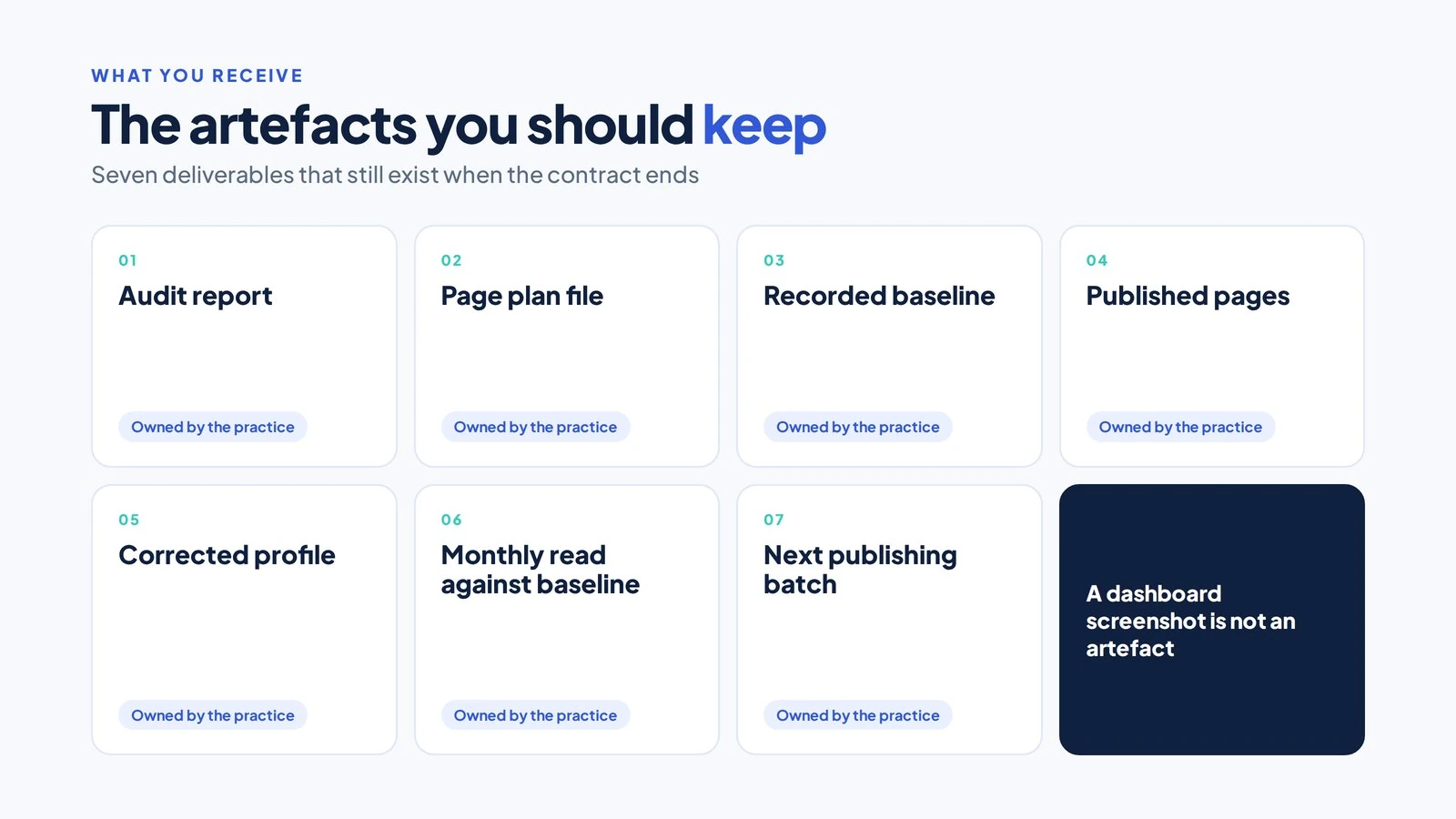
| Month | Artefact | Who owns it afterwards |
|---|---|---|
| 1 | Audit report, page plan, recorded baseline | The practice |
| 1 onwards | Published pages, drafted and partner approved | The practice |
| 2 | Corrected Google Business Profile and site location signals | The practice |
| Monthly | Position and impression read against baseline, with commentary | The practice |
| Monthly | Next month’s publishing batch, named and dated | The practice |
| Quarterly | Competitor movement and page decay review | The practice |
| On exit | Everything above, plus account access and the page plan file | The practice |
Ownership belongs in the contract. A provider who keeps your page plan, your analytics property or your Google Business Profile in their own name is holding an asset that belongs to you.
The monthly read is the artefact you will scrutinise least and should scrutinise most. A useful one names your queries, states the position on each against your baseline figure, states the impression count, and says in a sentence what caused the movement. A chart that begins on the contract start date hides whatever was already happening, which is why the baseline is recorded before the first change rather than after it.
Quarterly work is different in kind. Competitor movement and page decay both need a longer window to read, and both produce decisions rather than numbers: which pages to refresh, which to merge, which to leave. A practice that never receives a decay review finds out a year or two later, usually by accident, that a run of its published pages has quietly stopped earning impressions.
Artefacts only turn up where somebody is named as responsible for producing them.
Who does the work: the consultant, the writer, the developer and you?
Four roles carry the work, and you want the split agreed before the first invoice rather than after the first missed deadline.
The consultant owns research, the page plan, technical direction and measurement. The writer owns drafts, and in a regulated sector the writer works from partner supplied fact, never from inference. A developer implements anything the site’s platform will not allow through the content editor. You own the facts, the sign off and the decision on what to sell.
Partner time is the input that gets left out of the plan. On a single office practice, a review call and copy approval takes about two hours a month. Below that, drafts either sit in a queue or go live carrying a claim nobody checked.
Start with the audit
Find out which of the six workstreams your practice is missing
A standalone audit gives you the findings, the page plan and the baseline, whoever runs the work afterwards.
What is not included in an SEO programme, and who covers it?
Six things sit outside almost every accountancy SEO fee. Ask about them before you sign rather than in month three, when the answer costs something.
- Hosting and domain costs. You pay these directly and should hold the accounts.
- Website design and rebuilds. A programme fixes pages. Rebuilding the site is separate work with a separate fee.
- Paid advertising. Google Ads spend and management sit outside an organic programme, whoever runs them.
- Third party tool licences. Call tracking, review platforms and booking systems are your subscriptions.
- Legal and regulatory copy. Privacy policies, terms and engagement letters come from your own advisers.
- Partner time. Review, approval and the occasional interview. Costed in hours, not invoiced, and still a real cost.
Two more are worth naming because they get assumed in. Translation and Welsh language versions are separate scopes. Photography and video production are separate scopes.
Asking what is excluded also tells you how the fee was built. A provider who can name the exclusions has costed the work. A provider who says everything is included has either priced defensively or has not thought about it, and both show up later. The fee question itself, including what each band buys and what should never appear in a price, sits in what SEO costs an accountancy practice.
How do you tell a real programme from a list of tasks?
Five tests separate the two, and you can run all five on a proposal before you sign it.
- Does it name an outcome at a date? A programme commits to a position, an impression band or a page count by a month. A task list commits to hours.
- Does it start with an audit and a baseline? Work that begins with publishing has skipped the two things that make month six readable.
- Is there a page plan you can read? Ask to see the row for one service, with its target query, its parent and its anchor. A task list has no such row.
- Is the audit controlled? Our own study found that 38 of the first 53 findings on a panel of practice sites were artefacts of site size rather than real faults. A provider who cannot say how they separate the two will bill you for both.
- Does it say who owns what at the end? Ownership of your page plan, your analytics and your profile should be in writing.
The questions to ask an SEO agency go further on the procurement side, including what to ask about proof.
Those five tests judge a proposal. Whether to buy one at all turns on a different number, which is what the same work costs you to run yourself.
Which of the six can your practice run itself?
Four of the six can be run in house by somebody competent, and two are hard to buy back once they go wrong. Technical work, local and profile, content production and measurement all transfer to a capable marketing person with a checklist.
Research and page planning are the two that do not. Both set everything downstream, so a page plan built on the wrong queries costs you twice: once for the pages, and again for moving them. That is also why they are the two workstreams a provider should be able to show you a sample of before you sign.
The hour cost of running all six yourself, and how it sets against a monthly fee, is worked through in the accountancy SEO cost breakdown.
Should the practice run this in house, or buy it?
Buy it where your constraint is expertise, and run it in house where your constraint is only time and somebody already has the expertise. The split above is the honest test: a practice with a marketing person who understands query research can run four of the six workstreams and buy the other two.
Three arrangements work, and one does not. A full programme with a provider works. A provider on research, page planning and technical work, with your own people writing, works well in a regulated sector because your partner is closest to the fact. An in house lead buying a quarterly audit works where your volume is low. What fails is the arrangement where nobody owns the page plan, which is what happens when a web designer is asked to do SEO alongside design work.
Your choice of provider is a separate decision from your choice of model, and it turns on whether you need sector knowledge or method. We work through both sides in specialist or generalist SEO for an accountancy firm.
How long before an accountancy practice sees a change in enquiries?
Position change typically starts inside one quarter on mid competition terms, and enquiry change follows one to two quarters behind it. The gap exists because an accountancy buying decision is slow. A business owner who finds your advisory page in October may not act until their year end.
RX Virtual Finance reached the first page for pharmacy accountants inside about 60 days, on a niche term with a defined market. A head term such as accountants plus a large city takes considerably longer and needs more pages behind it. Get both timings written into your agreement rather than assumed, with a review point where either side can stop.
What should be measured, and what should be ignored?
Measure positions on your named queries, impressions on those queries, enquiries by source, and the count of pages that exist for the services you sell. Ignore domain authority scores, keyword counts with no page behind them, and any chart that starts on the day the contract began.
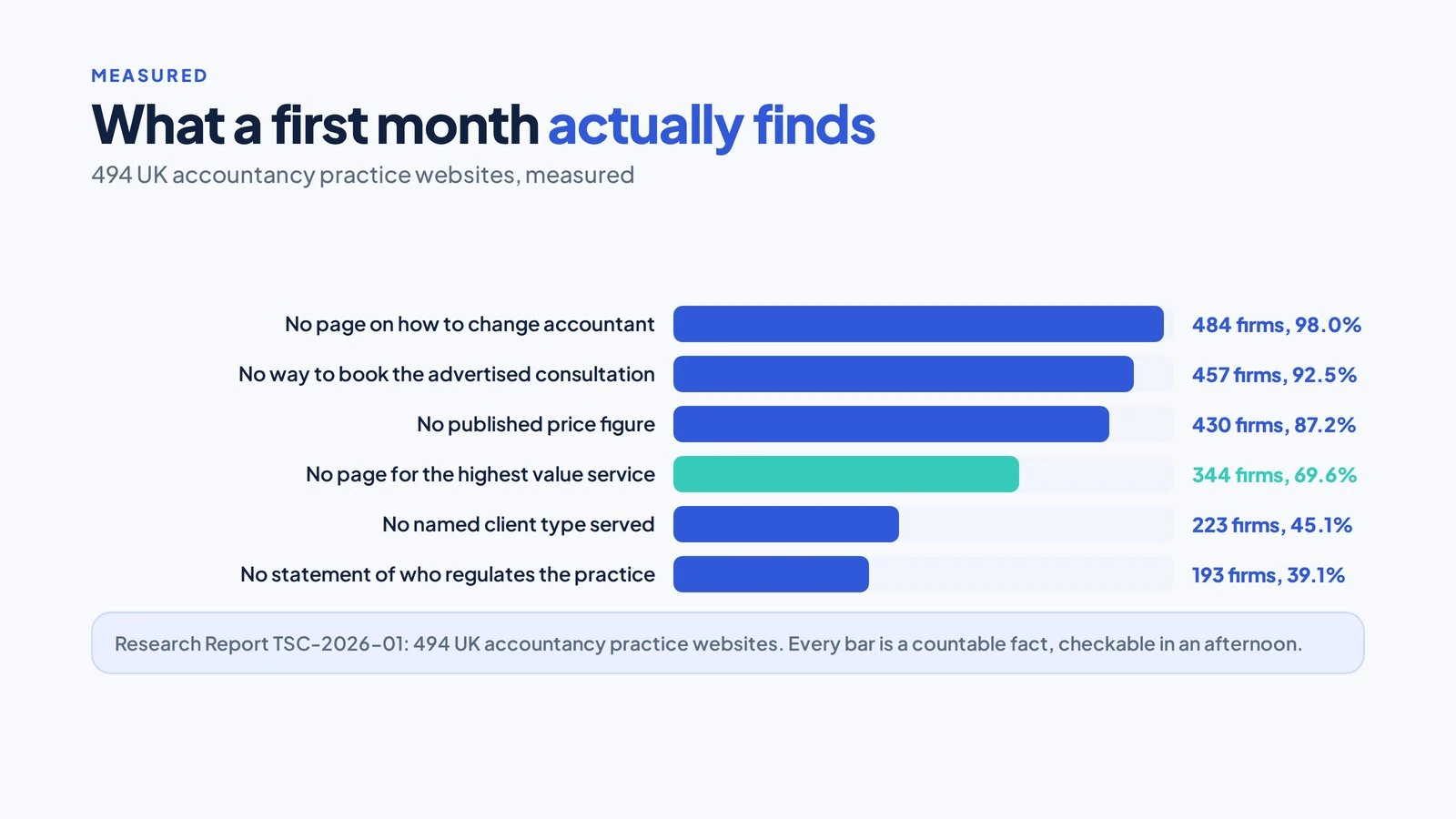
The page count measure is the one that rarely appears on a report and the one our research argues hardest for. Across 494 UK practice websites, 344 had no page for their highest value service, 430 published no price figure, and 457 advertised a free consultation with no way to book it. Every one of those is a countable fact about a website, checkable in an afternoon, and none of them appears on a standard SEO report.
Enquiries by source is the second measure worth insisting on, and the one most practices cannot produce on day one. Splitting your enquiries into organic search, map pack, referral, direct and paid needs your form and your phone both tagged, which takes an afternoon to set up and is almost never done before a programme starts. Without it, month nine becomes a conversation about whether your new clients would have arrived anyway.
Three measures deserve less attention than they get. Domain authority scores are third party estimates that no search engine uses. Keyword counts without a page behind them measure a tool’s vocabulary rather than your visibility. Average position across a whole site averages your strongest and weakest pages into a number that moves for reasons you cannot act on.
Does an accountancy SEO programme cover AI search and answer engines?
Yes, through the same six workstreams rather than a separate service or a separate fee. An answer engine builds its reply by quoting passages from pages it has already retrieved, so the page plan decides whether a passage about your service exists at all, the answer first heading structure decides whether that passage can be lifted without the paragraph around it, and the markup decides whether the engine can tell which firm, which service and which town the page belongs to. Nothing is added to the six. The standard the existing work is held to goes up.
The question format is what changes for a practice. A business owner asking an assistant for an accountant types a sentence rather than two words, and the assistant answers from pages that already carry an answer in a sentence. A section that opens with background and reaches its point in the fourth paragraph gets skipped, whatever position the page holds in the blue links. Answer first is the one property that serves both surfaces at once, which is why it sits in the content workstream rather than in a separate line item.
Our own site shows the mechanism working. Google treats the answer first H2 anchors on our accountancy page as separate passage targets and ranks them in their own right between positions 11.5 and 12, which is one page earning several entry points instead of one. An answer engine selects a passage on the same property.
Demand for this is measurable, and the only recent consumer figure is not a British one. The BrightLocal Local Consumer Review Survey 2026, a sample of 1,002 adults in the United States, found 45% now use ChatGPT and similar tools for local recommendations, against 6% a year earlier. No equivalent UK figure for accountancy buyers has been published. A provider quoting you one should be asked for the sample before you believe it.
Three checks tell you whether a provider is doing this work or naming it in a proposal.
- Ask how many of your existing pages answer a question in their first sentence. A provider doing the work has the count. A provider who has not looked gives you a description of answer engines instead.
- Ask what the practice is called in your markup, and whether the name, the services and the address agree across the website, the Google Business Profile and the Companies House record. Disagreement between those three is the commonest reason an engine will not name a firm whose pages it has already read.
- Ask for one question the practice should own, and the page that answers it today. An adjacent blog post offered in place of a page means the page plan has not been built yet.
The method behind that work, and what it looks like outside the accountancy sector, is set out in ranking on AI and LLM search.
No provider controls whether an assistant names your practice, and a guaranteed mention is the clearest signal to end the conversation. What a programme controls is whether a quotable answer about your service exists on a page a machine can read, which is the only input anyone has. Visibility on the old surface and visibility on the new one come out of the same six workstreams, so the arrival of answer engines changed the standard of the work rather than its shape.
What changes when the practice is regulated?
Regulation changes your review step, not the workstreams. Every claim about service, outcome or specialism goes through a named partner before publication, and comparative claims about other firms stay out of your copy entirely.
Seven bodies stand behind that review. Professional Conduct in Relation to Taxation, in the edition effective 1 October 2025, is produced jointly by the AAT, ACCA, ATT, CIOT, ICAEW, ICAS and STEP, and it sets five fundamental principles: integrity, objectivity, professional competence and due care, confidentiality, and professional behaviour. A programme does not interpret any of that on your behalf. It is built so the partner who does interpret it sees every claim before publication, and sees it early enough to change the claim rather than pull the page.
The cost of this is time, and it is the item most often left out of a regulated proposal. A review step adds roughly a working week to each publication cycle on a practice where one partner signs off, more where two have to agree. Three decisions in month one keep that week from becoming three.
- Name the partner who signs off, in the plan, with a named deputy for the weeks they are in a filing season or on leave.
- Agree that claims are reviewed as a list rather than inside a full draft. A partner asked to read 2,000 words to check four sentences is the step that stalls, every time.
- Agree what happens when a claim is refused, and make the answer publication without the claim rather than a page held back. A page waiting on one sentence is the commonest way a regulated programme loses a month.
The ICAEW Code of Ethics sets the professional behaviour standard governing how a practice presents itself, and the ICAEW marketing helpsheet covers advertising conduct directly. We wrote up that detail, including what a practice can and cannot say about results, in the marketing rules for ICAEW and ACCA firms.
Confidentiality is the principle that reaches furthest into the work. A client result you cannot name is a result you cannot publish, which removes the case study most providers reach for first and puts the weight on published research, on figures your client has agreed in writing to release, and on the measurable facts of your own website. That is why the measurement step above counts pages that exist rather than testimonials collected.
Quiz: is your provider running a programme or a task list?
Self-check quiz
Is your provider running a programme or a task list?
Eight questions about the work you are paying for. Answer from what you have actually received.
Question 1 of 8Your proposal commits to:
Question 2 of 8Before anything was published, you received:
Question 3 of 8Ask to see the page plan row for one service. You get:
Question 4 of 8Your practice has supplied:
Question 5 of 8Each month you receive:
Question 6 of 8Your Google Business Profile and analytics are:
Question 7 of 8Asked how they separate real faults from artefacts of site size, your provider:
Question 8 of 8The service your partners most want to sell:
Show the answer key
- Your proposal commits to: A named outcome at a named month. An outcome at a date is the single clearest marker of a programme.
- Before anything was published, you received: An audit, a page plan and a recorded baseline. Without a baseline, month six is an argument rather than a report.
- Ask to see the page plan row for one service. You get: Target query, parent page and anchor. A row with a parent and an anchor is what makes pages support each other.
- Your practice has supplied: Fee bands, priority services, client types and a sign off partner. The commercial order of the page plan cannot be set without those four.
- Each month you receive: A named artefact you still own afterwards. An artefact survives a change of provider, a dashboard does not.
- Your Google Business Profile and analytics are: In the practice’s name. Those are the practice’s own assets and belong in the contract.
- Asked how they separate real faults from artefacts of site size, your provider: Explains their control. 38 of the first 53 findings in our own study were not real faults.
- The service your partners most want to sell: Has its own page, written to one query. 69.6% of the 494 practices we audited were in the third state.
Frequently asked questions
Does an accountancy SEO programme include Google Business Profile work?
Yes. The local and profile workstream covers the Google Business Profile, its categories, the address and phone signals on the site, and the review process. A practice that ranks organically and is absent from the map pack is losing the searches with the highest intent.
Does it include link building?
Earned links are part of the work, bought link packages are not. A practice earns links through published research, local relationships, professional body listings and client work worth citing. A provider selling a fixed number of links a month is selling something else.
Does an SEO programme include building the website?
No. A programme works on the site you have, fixes what it can reach and specifies what it cannot. A rebuild is a separate scope with a separate fee, and the page plan from month one should inform it.
Can a programme be paused?
Yes, and a monthly rolling agreement makes it straightforward. Pausing costs momentum rather than progress, because published pages keep ranking. The parts that decay first are the profile activity and the refresh cycle.
What is a reasonable contract length for an accountancy practice?
Rolling monthly with an agreed review point at three and six months. A twelve month lock in makes sense only where the provider is funding work up front, and even then the milestones should be in writing.
What happens to the work if we change provider?
Everything listed in the artefact table should transfer, including the page plan file, the audit, the baseline and access to the analytics property and the Google Business Profile. Agree that in the contract rather than at the point of leaving.
Can an AI tool run the audit step instead of a consultant?
It produces the list and not the order. An AI tool reads a site and returns findings, which is the cheap half of an audit. The expensive half is deciding which findings are real for a practice of your size and which are artefacts of the template every site on that platform shares, and our study of 494 practice websites found 38 of the first 53 findings were the second kind. A tool that cannot tell the two apart hands you 53 jobs where 15 of them matter.
Where an accountancy SEO programme sits in the rest of the work
An SEO programme is the delivery mechanism for a page plan, and your page plan decides whether you are findable for the work you want to sell. Everything else follows from that. Three questions sit alongside it, and each has its own answer elsewhere on this site: what belongs on every page of your website, what the work should cost you, and who should run it. Start with whichever of the three is blocking you.
True SEO Consultants Ltd works from Startup Stiwdio at the University of South Wales, 86-88 Adam Street, Cardiff, CF24 2FN, and delivers UK wide through remote digital onboarding and delivery. Mohammad A Mahmud completed the ACCA professional examinations and holds an MSc in Applied Accounting from the University of South Wales, and Julie Williams is a fractional finance director and certified business coach, which is why our accountancy work starts from your own commercial structure rather than from a keyword tool. We bill that work on KPIs, not hours, with milestones in writing at three, six and twelve months.
We publish our own research rather than relying on borrowed statistics. Research Report TSC-2026-01 audited 494 UK accountancy practice websites and is published in full under a Creative Commons licence, with the findings that shaped the audit step above. The method behind the page plan itself is set out in semantic SEO and topical authority.
Bring your quote and we will read it with you
We look at the proposal on your desk, name what is missing from it and tell you what a month of real work would produce.
Book my free strategy callSee the method behind it