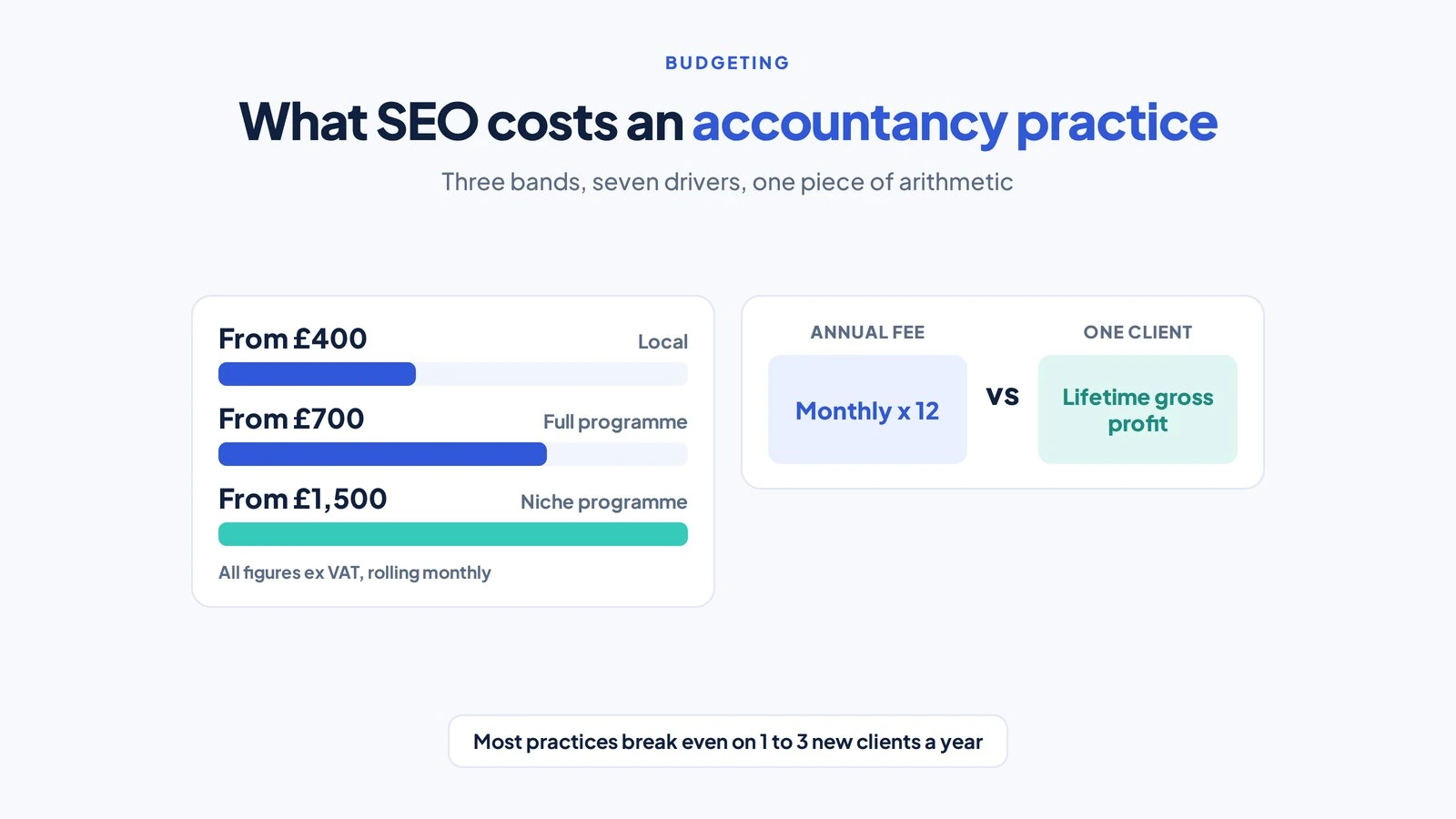
SEO for a UK accountancy practice costs from £399 a month for local work on a single office practice, from £699 a month for a full programme, and from £1,495 a month for a niche programme competing nationally. Those are our own published figures, they are all ex VAT, and they all assume a rolling monthly arrangement rather than a long contract.
Those bands describe the market we work in rather than the whole market. What matters more than the number is what sits behind it, because two quotes at the same monthly figure will buy you completely different amounts of work.
Key Takeaways
- Expect from £399 a month for local work, from £699 for a full programme and from £1,495 for a niche programme, all ex VAT.
- The Ahrefs survey of 439 providers, published December 2023 and updated August 2024, found an average retainer of 2,917 US dollars a month, with 501 to 1,000 US dollars the most common band. Those are US figures and they skew high against UK small practice pricing.
- Seven things move the number, and only two of them are about the size of your practice.
- Work out your payback from your own average fee and your own retention, not from a provider’s case study.
- Three things should never appear in an SEO price: a ranking guarantee, a fixed monthly link count, and SEO bundled invisibly into a website build.
- The cheapest end buys you reporting rather than work, and the cost arrives later as pages you have to rebuild.
- UK providers publishing a figure for accountancy work sit between roughly £400 and £8,000 a month, and the spread is scope rather than quality.
- A separate AI search line on a quote is the first item to question, because answer first pages and clean markup are what a competent programme already produces.
- A fixed price piece beats a retainer where you need a plan rather than delivery.
Accountancy SEO
Want the band that fits your practice?
Tell us your catchment, your services and the state of your site and we will say which band the work sits in, before any proposal.
Arithmetic, not claims
The payback maths runs on your own numbers, and the research behind it is published.
- 1 to 3new clients a year to break even
- 87.2%of 494 practices publish no price
- 773 to 2,300monthly organic visits, Total Books Accountants
How much does SEO cost for an accountancy practice?
You pay from £399 a month for local visibility work and from £699 a month for a full programme. A niche programme competing on a national service line starts at £1,495 a month, and regulated sector work at £750, because the review cycle is longer. All four figures are ex VAT.
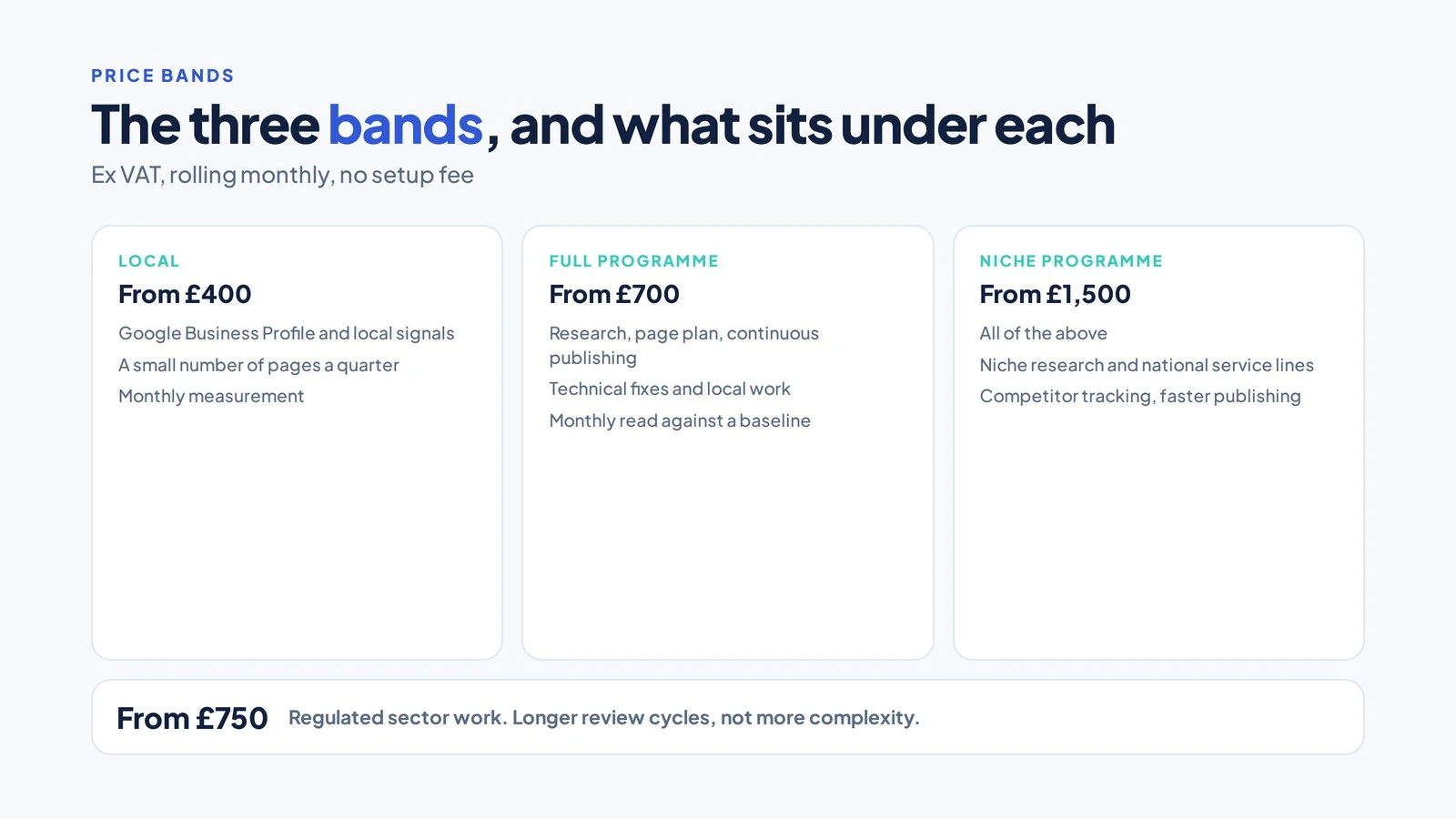
Three things sit behind every one of those figures, and all three need checking before you compare anything: whether the quote is ex VAT, whether it is rolling monthly or a fixed term, and whether there is a setup fee. A low monthly figure with a large setup charge is a different proposition from the same figure without one.
How we structure this for practices, including the milestones we put in writing, sits on our accountancy page. What follows is your arithmetic rather than our price list.
What do the published pricing surveys actually say?
The surveys put the most common monthly retainer between 501 and 1,000 US dollars, with an average of 2,917 US dollars pulled up by enterprise work. That comes from Ahrefs, which polled 439 SEO service providers and published the results in December 2023 with an update in August 2024. The same survey found an average hourly rate of 111 US dollars and a most common project fee between 2,501 and 5,000 US dollars.
Read those figures with two corrections. They are US dollars from a global provider panel, so they run high against UK small practice pricing. And an average across 439 providers includes enterprise work, which pulls the mean well above the median you would ever see. The most common band is the more useful of the two, because it describes what a small buyer is actually quoted rather than what the market averages to.
What no survey captures is scope. A provider charging at the bottom of a band and a provider charging at the top may both be telling you the truth about their price while describing entirely different work.
Treat a published band from a US panel as context rather than as a benchmark to hold your quote against. The panel is global and the enterprise end of it has no bearing on a single office practice in a market town.
What do UK providers publish as a price for accountancy SEO?
UK providers who publish a figure for accountancy work put it between roughly £400 and £8,000 a month, and almost all of that spread is scope rather than quality. The published bands are worth reading before you take a quote, because a number quoted in isolation gives you nothing to place it against.
Three published UK sources carry figures, all read in October 2026 and all liable to change. Whitehat SEO publishes £1,000 to £2,000 a month for small practices, £2,000 to £5,000 for mid sized firms and £5,000 to £8,000 for multi office and audit practices, and separately prices the delivery route rather than the firm, at £500 to £1,500 a month for a freelancer and £3,000 to £8,000 for an agency. AccountingStack publishes £800 to £3,000 a month for agency retainers and £500 to £1,500 for a one off technical audit. Our own published prices sit lower than both, from £399 a month for local work and from £699 for full service, because the work is billed on agreed KPIs rather than on a headcount estimate.
Read a published band as a description of what that provider sells, not of what your practice needs. A band is set by the provider’s cost of delivery, which is their staffing model, their location and how many clients one person carries. None of those three facts is about you.
Place yourself by shape rather than by turnover. A sole practitioner in one town with two or three services competes with a handful of local firms and a directory, and the work is a profile, a small page set and patience. A two to four partner practice selling advisory alongside compliance needs a page for each service worth selling and a niche page or two, which is where the fee rises. A multi office or audit practice carries several catchments, several profiles and a review burden, and that is the only shape where the top of the published range is a sensible starting point.
The reason the published ranges overlap so heavily is that nobody publishing them knows your starting condition. A practice with a healthy site and missing pages, and a practice with the same missing pages on a site that cannot be crawled properly, are quoted the same band and receive very different amounts of progress for it.
What are the four ways a UK practice gets charged?
Four models cover almost every proposal you will receive, and each one suits a different situation.
Monthly retainer. The standard arrangement. You pay a fixed monthly fee for an agreed scope. It suits ongoing work where pages are published continuously, and your risk is scope drift in both directions.
Fixed price project. A defined deliverable with a defined fee: an audit, a topical map, a migration, a set of pages. It suits you where you need a specific thing done rather than a continuing relationship.
Hourly. Billed time. It suits consultancy and advice where the output is a decision rather than an artefact, and it suits delivery work badly, because nobody can price the outcome and the incentive runs the wrong way.
Performance or pay on results. A fee tied to rankings, traffic or leads. It sounds attractive when you are used to charging for work rather than outcomes, and it usually means the provider controls the definition of the result. Read that definition very carefully before you agree to it.
A retainer suits delivery and a fixed price project suits you where you need a plan, which covers most situations. Hourly works for consultancy and mentoring, and that is a different purchase.
What drives the number up or down for a practice?
Seven things move your fee, and only two of them are about how big your practice is.
| Driver | Moves the fee up when | Moves the fee down when |
|---|---|---|
| Competition in the catchment | Major city, dozens of firms, directories above you | Smaller town, few competing practices |
| Number of services to cover | Six or more service lines, each needing its own page | Two or three, usually year end, payroll and bookkeeping |
| Niches being targeted | Several sectors, each needing its own vocabulary and proof | One niche or none |
| Starting condition of the site | Pages missing, technical debt, no markup, slow | Healthy site, pages exist, platform maintained |
| Number of offices or catchments | Multiple locations, profiles and area pages | One office, one catchment |
| Regulatory review burden | Every claim waits on partner sign off, longer cycles | Lighter review, faster publication |
| Content production volume | Provider writes everything | The practice supplies drafts or subject matter |
Two of those are worth acting on before you ask for a quote. Fixing obvious site faults lowers your starting condition cost. And deciding internally which services actually matter shortens the scope, because a page plan covering everything you do is always more expensive than one covering what you want to sell.
One driver works the other way and you are unlikely to be using it. Supplying your own drafts, even rough ones, moves the largest single cost inside the fee. A partner who can dictate 400 words of accurate subject matter on R&D claims between two client calls has removed the most expensive and slowest part of producing that page, and your provider’s job becomes structure, query targeting and editing rather than research and writing from nothing.
Monthly packages
Rolling monthly, no notice period, no setup fee
Our small business packages run month to month with milestones in writing at three, six and twelve months.
What does a fee at each band buy in a month?
Each band buys you a different amount of the same six workstreams rather than a different kind of work. The table describes outcomes rather than task lists.
| Band, ex VAT | Typically covers | Typically does not cover |
|---|---|---|
| From £399 | Google Business Profile, local signals on the site, a small number of pages a quarter, monthly measurement | Deep technical work, niche research, national service lines |
| From £699 | Research, a page plan, continuous publishing, technical fixes, local work, monthly measurement against a baseline | Multi location profile management, heavy migration work |
| From £1,495 | All of the above plus niche research, national service line coverage, competitor tracking and faster publishing | Paid advertising, website rebuilds, video production |
The scope detail behind each of those, including what you should receive every month and what sits outside any fee, is in what an accountancy SEO programme includes.
Does optimising for AI search cost extra?
No, where the provider’s method already produces pages that answer in their first sentence and markup that names the practice properly, because those are the only inputs an answer engine has and a competent programme produces them anyway. Yes, where a provider has put AEO, GEO or AI search on the quote as its own line, and that line is the one to question first.
Put one question to any quote carrying a separate AI line. Ask what that line produces that the content line and the technical line do not already produce. A clear answer names an artefact you will receive. An unclear answer names a surface, usually ChatGPT or AI Overviews, and describes visibility on it without saying what will be made.
Real additional cost does exist, and it sits in one place. Pages written before answer first was the standard have to be rewritten to lead with the answer, and rewriting fifteen existing pages is content work that takes content hours and should be priced as content work on your quote. A provider charging a premium for the same hours because the output now serves an assistant is charging you for the name.
Two things nobody can price, because nobody controls them. No provider decides whether an assistant names your practice, and no provider can guarantee a mention, so a fee attached to one belongs in the same category as a fee attached to a specific ranking position. The method behind the work, and what it does and does not promise, is set out in ranking on AI and LLM search.
What does the cheapest end deliver, and what does it cost you later?
The cheapest end of the market gives you reporting rather than work, and the cost turns up a year or two later as pages you have to rebuild. A monthly fee below the local band pays for a tool licence, an automated report and an hour of someone’s time, and an hour a month cannot move your website.
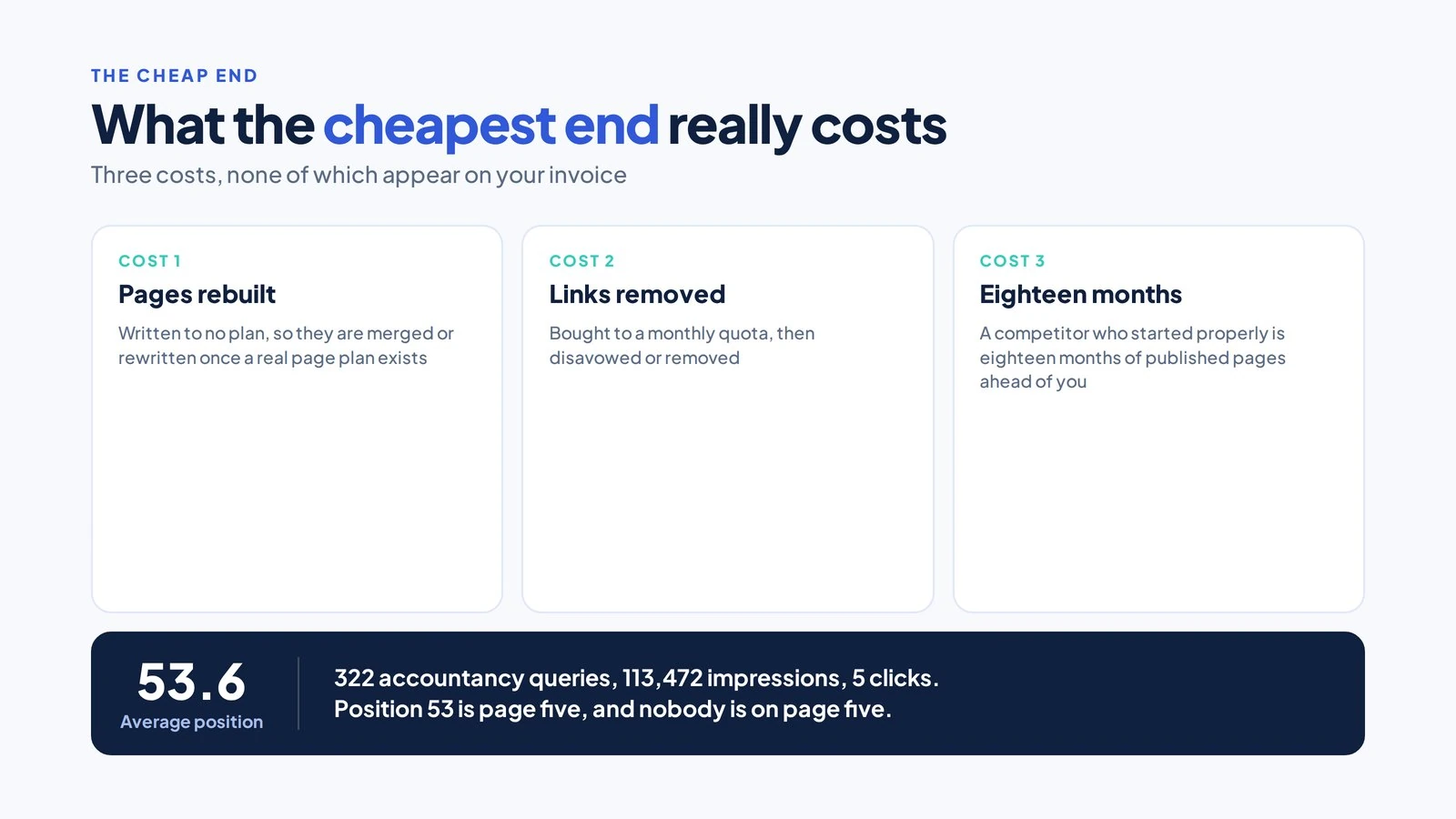
Three costs follow, and none of them appears on your invoice, which is why they never reach a partners’ meeting. Pages written to no plan have to be merged or rewritten once a real page plan exists. Links bought in bulk have to be disavowed or removed. The third and largest is the time, because a competitor who started properly is a year or two of published pages ahead of you by the point you notice.
Our own data shows you what visibility without work looks like at scale. Across 322 accountancy queries our pages earned 113,472 impressions and five clicks at a weighted position of 53.6, which is a practice being seen and never chosen. Position 53.6 is the sixth page of results, and nobody reaches the sixth page.
Avoiding that outcome is worth something specific to your practice, and the figure is one you can work out in five minutes.
How do you work out what SEO is worth to your practice?
Work it out from your own average client fee and your own retention, because a provider’s case study tells you nothing about your economics. The arithmetic takes you five minutes and settles most budget arguments.
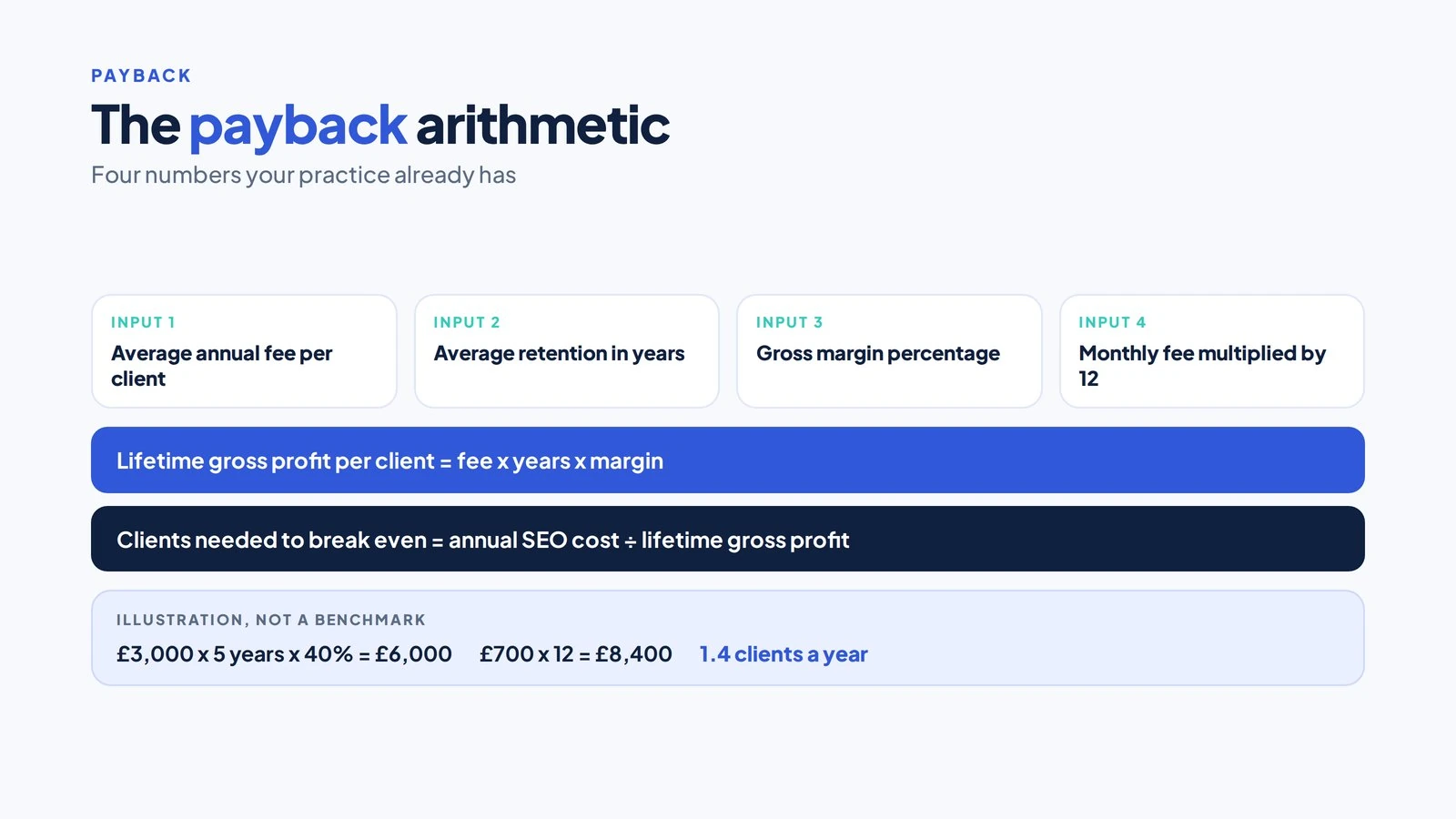
Four numbers, and you already have all four:
- Your average annual fee per client, across the kind of client you want more of rather than across every name on the fee ledger.
- Your average retention in years. Pull the fee ledger, count the clients whose first year end you did five years ago, and see how many are still on the list.
- Your gross margin on that work, as a percentage, after the time your team actually books to it.
- The monthly fee you are considering, multiplied by twelve.
Multiply the first three for the lifetime gross profit of one new client, then divide your annual SEO cost by it. What you get is the number of new clients a year the work has to produce to break even. On the fee bands above and a typical practice fee, that number lands in low single figures, and seeing it written down is usually what changes the conversation.
Here is a worked illustration, and every figure in it is an example rather than a benchmark. A practice with a £3,000 average annual fee, a five year average retention and a 40% gross margin earns £6,000 of lifetime gross profit per client. Against a £699 monthly fee, or £8,388 a year, the work needs 1.4 new clients a year to break even.
What is one accountancy client worth, and how many pay for the fee?
One year end client usually pays for several months of your fee. That makes the honest question not whether SEO is worth it, but whether this particular provider will bring you the clients, and the second question gets far less scrutiny than the first.
Two adjustments make your arithmetic more realistic. Count only the clients you would not otherwise have won, which means excluding anyone who searched your practice name after a referral from an existing client. And count the second order value, because a client who arrives for a year end and a payroll run, then buys advisory work two years later, is worth considerably more to you than their first fee note.
Total Books Accountants went from 773 to 2,300 monthly organic visits through this kind of work. We publish the traffic figures rather than a revenue claim, because the revenue is the client’s to state, not ours.
That arithmetic sets the fee against doing nothing. The fairer comparison is against doing the work yourself, and most practices have never costed that. The detail sits in the Total Books case study.
What does the work already cost you internally?
Running the same work inside your practice costs 20 to 31 hours a month at the start and around 12 once your core pages exist. Priced at a partner or manager rate, that is frequently more than the external fee, and it is the side of the comparison that rarely gets written down.
| Who does it | Monthly hours, first three months | Monthly hours, steady state |
|---|---|---|
| Partner or practice manager time on research and decisions | 6 to 10 | 3 |
| Writing and review | 8 to 12 | 6 |
| Technical, markup and profile work | 4 to 7 | 2 |
| Measurement and reporting | 2 | 1 |
Two caveats keep this honest. The hours only convert to money where that time would otherwise be chargeable, and in many practices it would not. And an in house arrangement carries no learning cost once the expertise exists, which is a real advantage for you over the medium term.
The hidden cost in the internal route is attention rather than time. Research and page planning need uninterrupted thinking, and they are the first things off the list in the fortnight before the self assessment deadline. Practices that run their own SEO well have somebody whose job it explicitly is, usually the practice manager, rather than a partner doing it between client work.
What should never appear in an SEO price?
Three things should never appear in your SEO price, and each one tells you something about the provider offering it.
A ranking guarantee. Nobody controls a search engine’s results, and a guarantee is either meaningless or attached to a term nobody searches for. Milestones are different and worth having in writing, because a provider can commit to work delivered and to a review point with you.
A fixed number of links a month. Links bought to a monthly quota come from the places that sell them, which is the pattern search engines look for. Earned links do not arrive on a schedule, so a provider promising you ten a month has told you where they get them.
SEO bundled invisibly into a website build. A line saying the site is built SEO friendly describes competent construction, not a service. Pay for a website assuming SEO is included and you usually discover at month six that nobody was doing any.
Two more are worth questioning rather than refusing. A setup fee is reasonable where real work happens in month one, and unreasonable where it is an entry charge. A twelve month tie in is reasonable where the provider funds work up front, and otherwise it protects them rather than you.
Knowing what to refuse still leaves two proposals on the desk that both look acceptable.
How do you compare two quotes that look the same?
Compare scope, not price. The fastest way is to ask both providers the same five questions and compare their answers rather than their proposals.
| Ask both providers | A strong answer | A weak answer |
|---|---|---|
| How many pages will be published in the first quarter, and who writes them? | A number, a named writer and how much partner time it needs | It depends on the content strategy |
| Show me one row of the page plan you would build | Target query, owning page, parent, anchor | A keyword list |
| What happens in month one, before anything is published? | Audit, page plan, recorded baseline | Onboarding and setup |
| Who owns the page plan, analytics and profile at the end? | The practice, in writing | Not addressed |
| What would you refuse to publish on our site? | Something specific | Whatever you want |
The general UK price context, across all sectors rather than accountancy alone, sits in what SEO costs in the UK.
When is a fixed price piece better than a monthly fee?
A fixed price piece is better where you need a plan rather than delivery, or where somebody in house will do the work once they know what to do. Three situations qualify.
A practice with a marketing person who can write and publish needs the research and the page plan rather than the production. A practice about to rebuild its website needs the page plan before the build rather than after it, because retrofitting a page structure costs more than specifying it. And a practice that has been burned by a retainer often wants one defined deliverable before committing to anything ongoing.
Two fixed price pieces cover most of that need: a topical map setting out every page your site should have with its query, parent and anchor, and a keyword and competitor analysis showing you where the demand and the gaps are. Both sit in our marketplace at £500 each, ex VAT.
Those two fixed prices are ours, and so are the monthly ones below. We publish all of them for the same reason the pricing section above argues you should.
What we charge, and why it is billed on KPIs rather than hours
Our published prices run from £399 a month for local SEO, £699 for full service, £1,495 for a niche programme and £750 for regulated sector work. All figures are ex VAT and all are rolling monthly with no notice period and no setup fee. Milestones go in writing at three, six and twelve months.
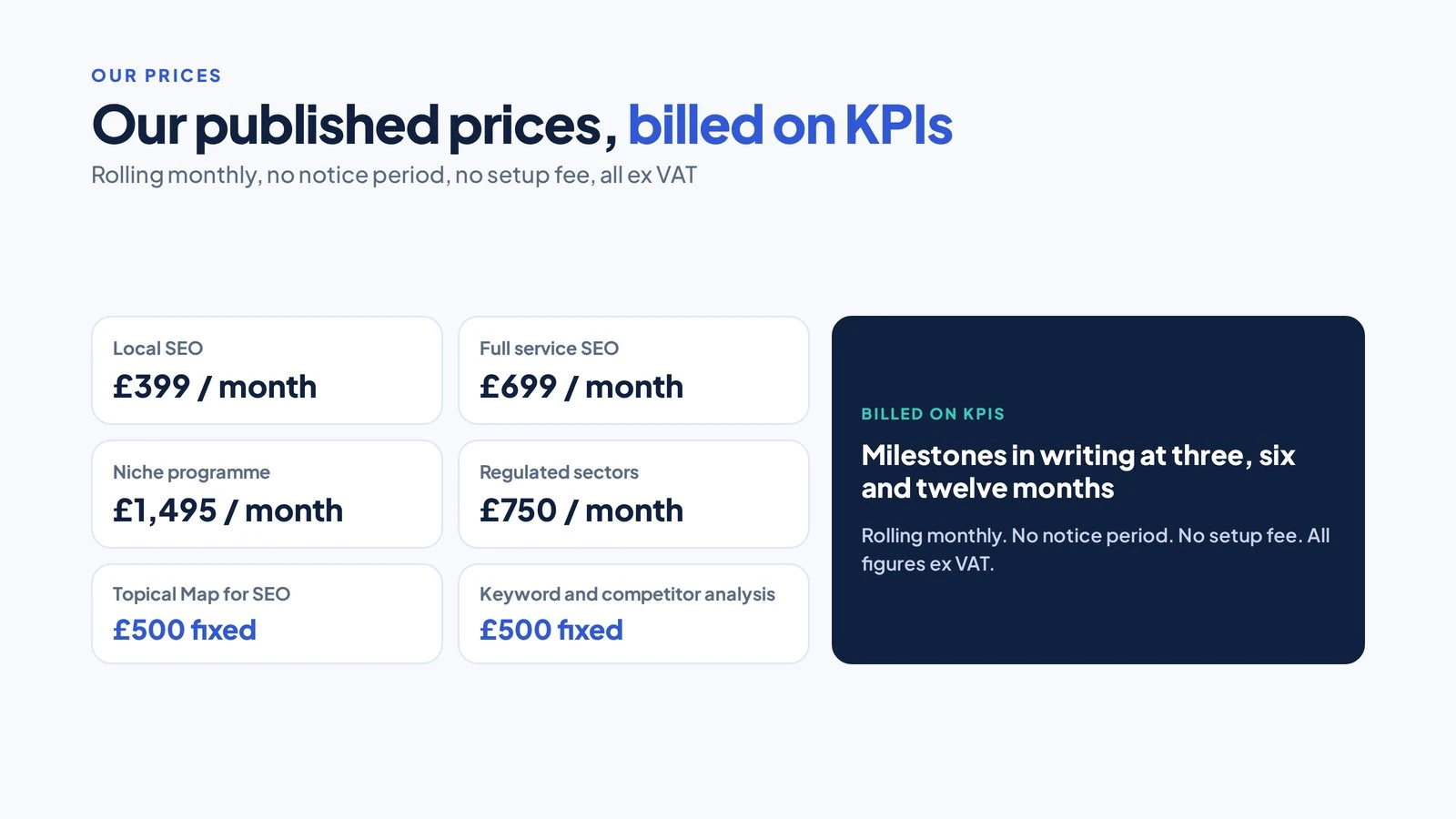
Billing on KPIs rather than hours changes the incentive. An hourly arrangement rewards time spent, and buying hours you have no way to tell a slow month from a difficult one. A milestone arrangement puts the risk of an inefficient month on us, which is where it belongs, and it gives you something concrete to hold a review against. Run the payback maths on your own figures before you accept any quote, ours included. Take your average fee, your retention and your margin into the next partners’ meeting and work out the break even number there. The monthly package structure sits on our small business package page.
Quiz: what should your practice budget?
Self-check quiz
What should your practice budget?
Eight questions about your catchment, your services and your site. Answer for the practice as it is now.
Question 1 of 8Your catchment is:
Question 2 of 8Services needing their own page:
Question 3 of 8Niches you want to be found for:
Question 4 of 8Your website today is:
Question 5 of 8Offices and catchments:
Question 6 of 8Claims on your site go through:
Question 7 of 8Content the practice can supply:
Question 8 of 8Your average annual fee per client is:
Show the answer key
- Your catchment is: A major city with dozens of firms. Competition in the catchment is the single largest driver of the fee.
- Services needing their own page: Six or more. Each service line needs a page written to its own search.
- Niches you want to be found for: Three or more. Each niche needs its own vocabulary, its own proof and its own pages.
- Your website today is: Missing pages, slow, no markup. Starting condition decides how much of year one is repair rather than growth.
- Offices and catchments: Three or more. Each location needs its own profile, its own pages and its own measurement.
- Claims on your site go through: Full partner sign off every time. Review cycles lengthen production, which is why regulated work costs more.
- Content the practice can supply: Nothing, the provider writes everything. Production volume is the driver a practice can most easily move.
- Your average annual fee per client is: Under £1,000. A higher average fee lowers the number of clients the work has to produce to pay for itself.
Frequently asked questions
Is SEO worth it for a small accountancy practice?
Usually yes, because the break even point is low. A practice needing one to three new year end clients to cover the fee is in a different position from a retailer needing hundreds of sales. Run the arithmetic on your own fee ledger and your own retention before deciding.
How long before SEO pays for itself for an accountancy practice?
Position movement typically starts inside a quarter and enquiry movement one to two quarters behind it, so the fee is usually covered over a period measured in quarters rather than months. A practice with no pages at all takes longer, because the pages have to exist before anything else can happen.
Should an accountancy practice pay for SEO or for Google Ads?
Both answer different questions. Ads buy visibility immediately and stop when the spend stops. SEO builds pages that keep earning, and takes months to start. A practice that needs enquiries before the next self assessment deadline should look at ads, and a practice building a position over several year ends should look at SEO.
Is a cheap SEO package ever worth trying?
Yes, where it is honest about scope. A package at the bottom of the local band, ex VAT, that says plainly it covers the profile, local signals and a few pages a quarter is a reasonable purchase for a small practice. The same fee claiming to cover everything is selling you a report.
Do we need to pay more because we are regulated?
Slightly, and the reason is review cycles rather than complexity. Every claim waits on partner sign off, drafts come back marked up more often, and publication is slower. Our regulated sector work starts at £750 a month ex VAT for that reason.
Can we start small and increase the fee later?
Yes, and that is a sensible route for a practice testing a provider. Start with the local band or a fixed price plan, set a review point at three months, and increase the scope once you have seen what the provider produces.
What should we budget for the first year in total?
Twelve months of the band that fits your situation, plus a contingency for the pages that turn out to be missing. A practice that has never published a price page, a changing accountant page or a high value service page needs more production in year one than in year two, and that is the line most budgets get wrong.
Where the fee sits against everything else the practice spends
Compare your SEO fee with the cost of client acquisition rather than with other marketing line items. Set it against what a referral arrangement, a professional body directory listing or a month of advertising costs you, and against the value of one client across five year ends. Judged that way it is a decision about how many clients you want to be able to take on, not a line in a marketing budget.
True SEO Consultants Ltd works from Startup Stiwdio at the University of South Wales, 86-88 Adam Street, Cardiff, CF24 2FN, and delivers UK wide through remote digital onboarding and delivery. Mohammad A Mahmud completed the ACCA professional examinations and holds an MSc in Applied Accounting from the University of South Wales, and Julie Williams is a fractional finance director and certified business coach, which is why we are comfortable putting the payback arithmetic in front of a partner rather than around it. We bill that work on KPIs, not hours, with milestones in writing at three, six and twelve months, and we publish our own research rather than relying on borrowed statistics. Research Report TSC-2026-01, our audit of 494 UK accountancy practice websites, found 87.2% of practices publishing no price of their own, and the 494 website study sets out the rest.
We will run the payback maths with you
Bring your average fee and your retention and we work out on the call how many clients the work has to produce, before anyone quotes you anything.
Book my free strategy callRead the accountancy research