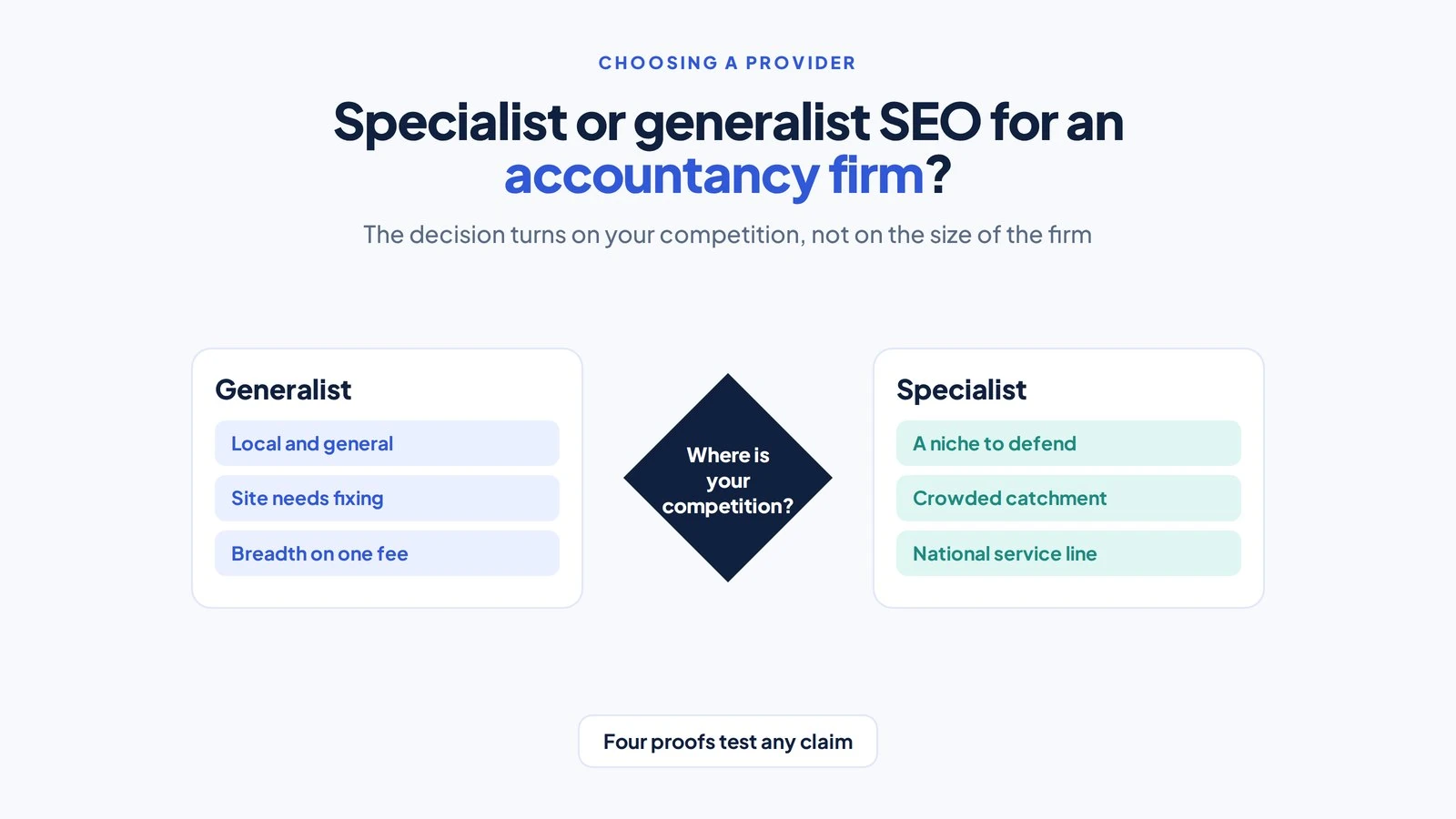
Hire a specialist when your practice has a niche worth defending or sits in a crowded catchment, and hire a generalist when you are local, general and buying your first year of SEO. The distinction is not about quality. A good generalist beats a weak specialist on any measure a partner cares about, and the word specialist is unregulated, so it proves nothing on its own.
What decides it is where your competition sits. A general practice in a town with four competitors has a local visibility problem that any competent provider can solve for you. A practice selling R&D claims or cloud migration into a national market has a topical coverage problem, and that needs somebody who already knows what those buyers search for.
Key Takeaways
- Specialist is an unregulated word. Three different things get called specialism, and only one of them is about your sector.
- A generalist is the right call for a local, general practice buying its first year of SEO.
- A specialist earns the difference where the practice has a niche, a crowded catchment or a national service line.
- Provider selection queries account for 25,477 impressions in our own accountancy data, so your buyers are researching this question too.
- Four proofs test a specialism claim in one email, and all four can be answered in a day by anyone who really has it.
- Sector knowledge shortens the research phase. It does not replace method, and a specialist with no method produces good copy in the wrong structure.
- AI search moves one row of the comparison toward the specialist, because answering a situational question requires knowing which situations exist in your market.
- A local agency buys you a meeting, not local SEO, and the specialist you want is unlikely to be in your town.
- Switching provider costs less than it looks, as long as the page plan, analytics and profile are in the practice’s name.
Accountancy SEO
Not sure which your practice needs?
Send us the two quotes on your desk and we will tell you what each one is missing, whether or not you use us.
Measured, not claimed
One published research report and one named niche result behind the argument.
- 25,477impressions on provider selection searches
- 60 daysto page one, RX Virtual Finance
- 494UK practice websites in our published study
Should an accountancy firm hire a specialist or a generalist SEO agency?
An accountancy firm should hire a specialist where it competes on a niche or in a crowded catchment, and a generalist where it is local, general and starting out. Your decision turns on the shape of your competition rather than the size of your firm.
Both routes fail the same way. A provider of either type who starts by publishing content, rather than by working out which pages you are missing, produces activity and no visibility. Our Search Console data across the accountancy market shows what that looks like at scale: 322 queries, 113,472 impressions and five clicks at a weighted position of 53.6. Those impressions are real, and the pages behind them are answering the wrong searches.
The commercial version of this decision, including how we scope SEO for accountants, sits on our accountancy page. What follows is your version.
What does specialist mean in accountancy SEO?
Specialist describes three different things in this market, and you are rarely told which one you are being offered.
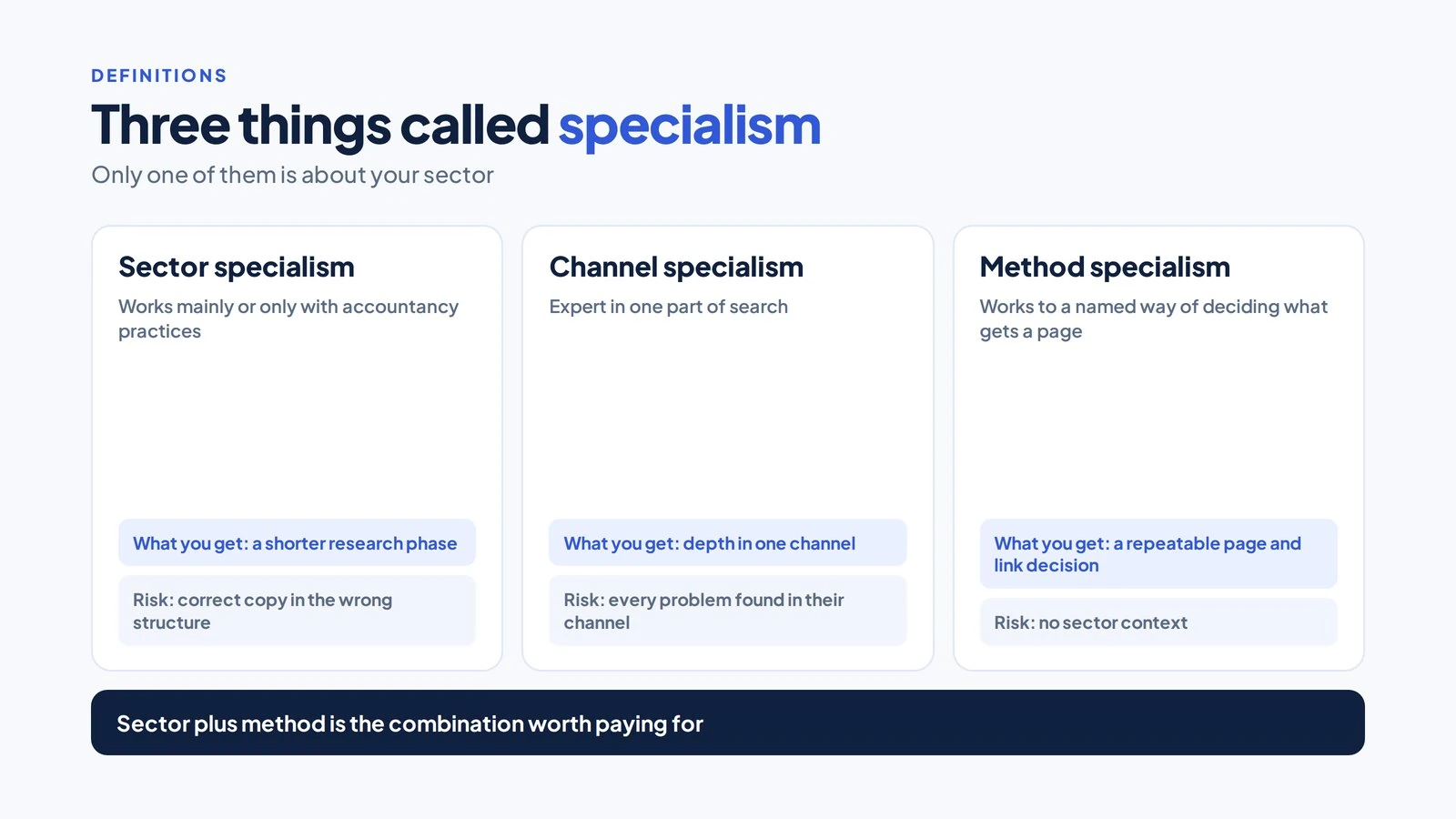
Sector specialism. The provider works mainly or only with accountancy practices. What you get is a shorter research phase, because they already know that advisory buyers and compliance buyers search differently, and that the phrase you use internally is rarely the phrase your client types.
Channel specialism. The provider is expert in one channel: local search, technical work, digital PR, answer engines. Useful where you already know your problem. Expensive where you do not, because a channel expert will find a problem in their own channel.
Method specialism. The provider works to a named method regardless of sector, such as semantic search and topical authority. What you get is a repeatable way of deciding which pages exist and how they link, which transfers across sectors.
Sector and method together is the combination worth paying for. Sector alone gives you copy that sounds right on a site that still has no page for your highest value service. Method alone gives you a correct structure filled with content written by somebody who has never sat in a practice.
What does a generalist agency do well for a practice?
A generalist does the mechanical work well, and most of a first year is mechanical. Technical faults, site speed, title and heading structure, internal linking, Google Business Profile setup, review generation and basic measurement are the same disciplines in every sector, and a competent generalist runs them faster and cheaper than a boutique.
Three more points sit in a generalist’s favour and rarely get said out loud. They carry more capacity, so your page backlog clears quicker. They have seen more platforms, which matters where your site is built on something unusual. And they have no incentive to talk you into a niche you do not want, which a sector agency sometimes does because niching is the lever they know.
Cost is the other thing a generalist brings, and it changes what a first year can cover. The same monthly fee that buys a narrow scope from a boutique often buys you site health, local visibility and a modest publishing cadence from a generalist, and where you have no pages at all that breadth is worth more than depth in any single area.
Where does a generalist cost an accountancy practice time?
A generalist costs you time in the research phase and in the review phase, and both show up as delay rather than as a visible error. The research delay comes from learning your market. The review delay comes from drafts your partners have to send back.
Four things come up repeatedly.
- Compliance and advisory are different products with different buyers. Copy that treats them as one service list gives you one page where you needed two.
- The claim rules are tighter than in most sectors. The ICAEW Code of Ethics sets a professional behaviour standard, and a draft carrying a competitive claim will not survive your partner review.
- The buying cycle follows the tax and year end calendar. Content published in the wrong month reaches your buyer after they have decided.
- Niche selection is a commercial decision, not a keyword decision. Picking the niche with the best search volume, rather than the one your partners can actually serve, wins you traffic you cannot convert.
None of those is a reason to reject a generalist. They are the four things to brief in, in writing, before the work starts.
Two of the four are cheap to fix and two are not. Your calendar and your compliance boundary can be handed over in a single document that takes an hour to write and saves months. The product distinction and the niche decision cannot, because both are commercial judgements about what your partners want to sell, and nobody outside your practice can make them. Hand over the first two, keep the second two, and a generalist engagement behaves much more like a specialist one.
What a practice can and cannot say about its own results is set out in the marketing rules for ICAEW and ACCA firms, and it is the first thing to hand a new provider.
Whichever type you choose, the shape of the work itself does not change. The six workstreams, the month one audit and the artefacts you should receive are set out in what an accountancy SEO programme includes.
What does change is who gets found for the searches your buyers are already running, and those searches say more about this decision than either agency will.
Who are your buyers actually searching for?
Your buyers search for provider types as much as for services, and the volume behind those searches is substantial. In our own accountancy query set, 64 queries carrying 25,477 impressions are provider selection searches: agency, company, services, expert, consultant. That is 22.5% of the whole accountancy subset.
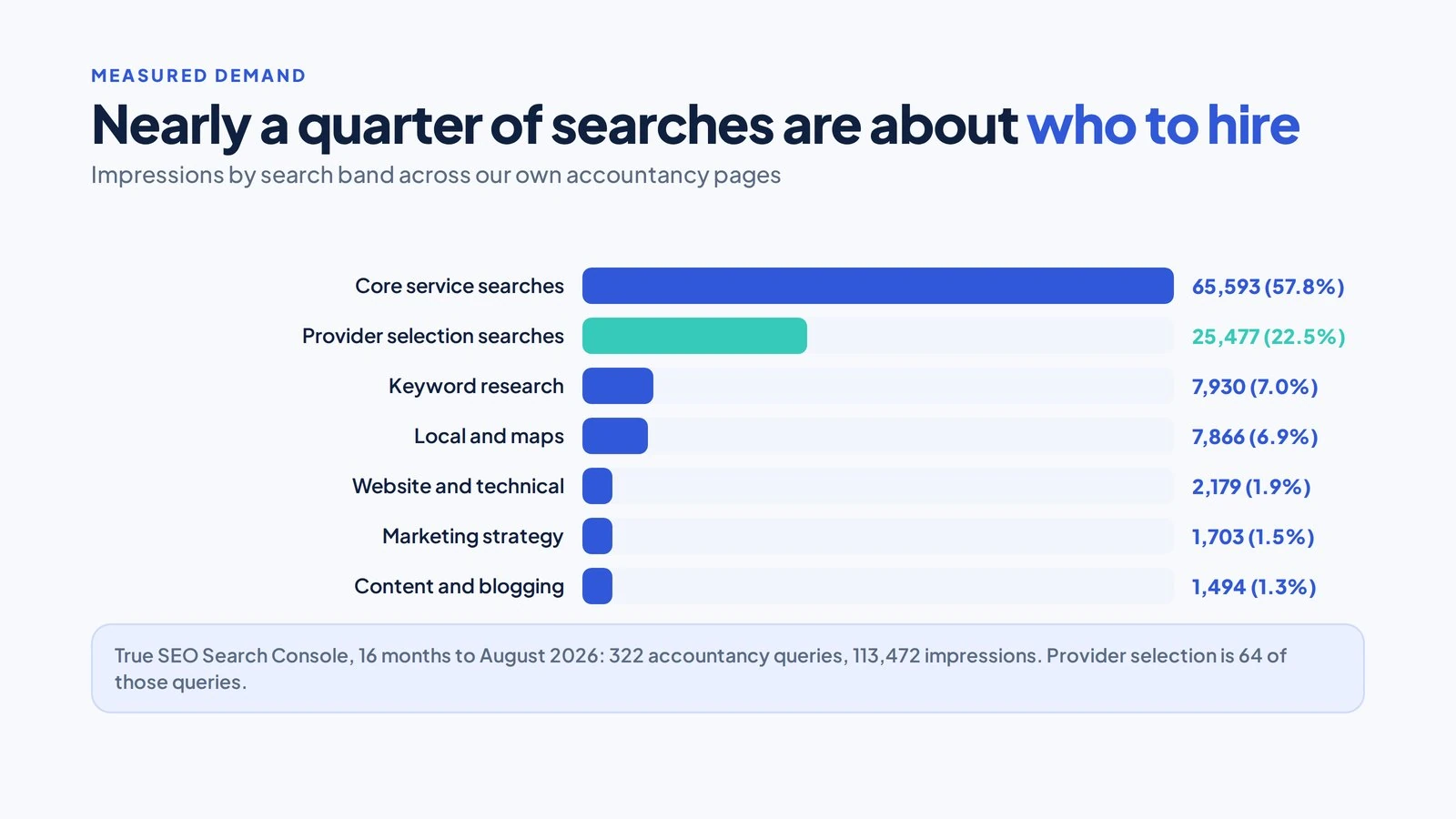
Two readings follow. The first is about your own market, because business owners looking for an accountant search the same way, adding words such as specialist, for, and the thing they need help with, which is part of why a niche page tends to convert better than a general service page. The second is about your provider: a firm that cannot rank for its own provider terms is demonstrating the problem it claims to solve.
How do the two compare on the things a partner cares about?
The comparison below is our own reading of the trade-offs after sitting on both sides of these conversations, and it assumes a competent provider in both columns.
| What you are buying | Sector specialist | Competent generalist |
|---|---|---|
| Time to a usable page plan | Days, from existing market knowledge | Two to four weeks of research first |
| Copy that survives partner review | Usually first draft | Usually second or third draft |
| Understanding of advisory versus compliance buyers | Built in | Briefed in, with your time |
| Technical and site speed work | Adequate to strong | Usually strong |
| Capacity to clear a page backlog | Limited | Higher |
| Google Business Profile and review work | Adequate to strong | Usually strong |
| Risk of a claim that breaches conduct rules | Lower | Higher without a written brief |
| Willingness to say your niche idea will not work | Higher | Lower |
| Fee | Higher per month | Lower per month |
| Transferability of the method to a second office or service line | Depends on whether they have a method | Depends on the same thing |
The final row is the one that separates providers more than the specialist label does. Ask both of them to describe how they decide that a query deserves its own page. A provider with an answer has a method. A provider without one is improvising, whatever sector they say they work in.
Read the table as a set of trade-offs rather than a ranking. Rows one to three favour the specialist and rows four to six favour the generalist, and you can shift rows one to three yourself by writing a proper brief. Rows seven and eight are the ones that resist a brief, because both are about judgement under pressure: what a provider will refuse to publish, and whether they will tell you that a favoured idea will not work.
Does AI search change the specialist or generalist decision?
It changes what you test a provider on, not which type you should pick. An answer engine quotes passages from pages it has already retrieved, so sector knowledge still decides whether the right page exists and technical competence still decides whether a machine can read it. Both columns of the table above survive the change intact.
One row does move, and it moves toward the specialist. A business owner asking an assistant for an accountant types a situation rather than a service: an accountant for a dental practice taking on a second site, or for a contractor coming out of IR35. Writing the page that answers a sentence like that requires knowing which situations exist in your market, which is sector knowledge rather than search knowledge. A generalist can be briefed into it, and the brief is longer than most practices expect to write.
Two new questions belong in your provider conversation. Ask what the provider’s own pages are retrieved for when an assistant is asked about their service, and ask them to show you the question and the answer rather than describe the capability. Then ask the same about a client in your sector.
Treat the result as a signal rather than a measurement. Assistants answer differently between accounts and between runs, so one absence proves nothing and a consistent absence across several attempts is worth raising. A provider who presents a single screenshot as evidence of AI visibility is doing the same thing a provider does with a single ranking screenshot.
The underlying question most partners are actually asking is whether search is being phased out. It is not. The surface changed and the input did not, because an assistant has nothing to quote from except pages somebody wrote and a search index that found them. Our own method for that work is set out in ranking on AI and LLM search.
When is a generalist the right choice for your practice?
A generalist is the right choice for you in four situations, and none of them is a compromise.
- Your practice is general and local. One office, mixed client base, a catchment of one town or borough. The work is local visibility and site health, and those are generalist strengths.
- Your site is broken. A slow, badly structured or unindexed site needs fixing before any sector insight has anything to act on.
- Your budget covers one provider and you need breadth. A generalist covering search, profile and site health at a lower fee beats a specialist covering a third of it.
- There is an existing relationship that works. A provider who already builds and maintains the site, answers the phone and understands the practice has value that a cold specialist has to earn from scratch.
Brief them properly and the gap narrows quickly. Hand over the four things in the section above, name a partner for sign off, and most of that sector delay disappears.
When is a specialist the right choice?
A specialist is the right choice where you are competing on something other than proximity. Three situations qualify.
You have a niche. Pharmacy accountants, contractor accountants, dental practices, hospitality, creative agencies, landlords. RX Virtual Finance now ranks number one for pharmacy accountants and reached the first page inside about 60 days, on a defined market with pages written to what that market searches for rather than to a general service list.
Your catchment is crowded. A practice in a major city competes with firms that have been publishing for a decade and with directories that outrank both of you. Winning there needs coverage depth, not a tidier home page.
Your service line is national. R&D claims, cloud migration, virtual finance director work and international tax are bought on expertise rather than on postcode, and the searches behind them are specific enough that generic copy never surfaces.
One caution applies to all three. A niche is only worth building pages for where the searches behind it carry demand you can actually serve, and the two do not always coincide. We keep a running view of which accountancy niches have room in niche opportunities for accountants, and the test is always whether your partners can do the work rather than whether the query looks attractive.
Niche first
Find out whether your niche is worth defending
We check whether the searches behind a niche carry enough demand to justify pages before anyone writes one.
How do you test a specialism claim in one email?
Four proofs test a claim, and anyone who really has the specialism can answer all four for you inside a day.
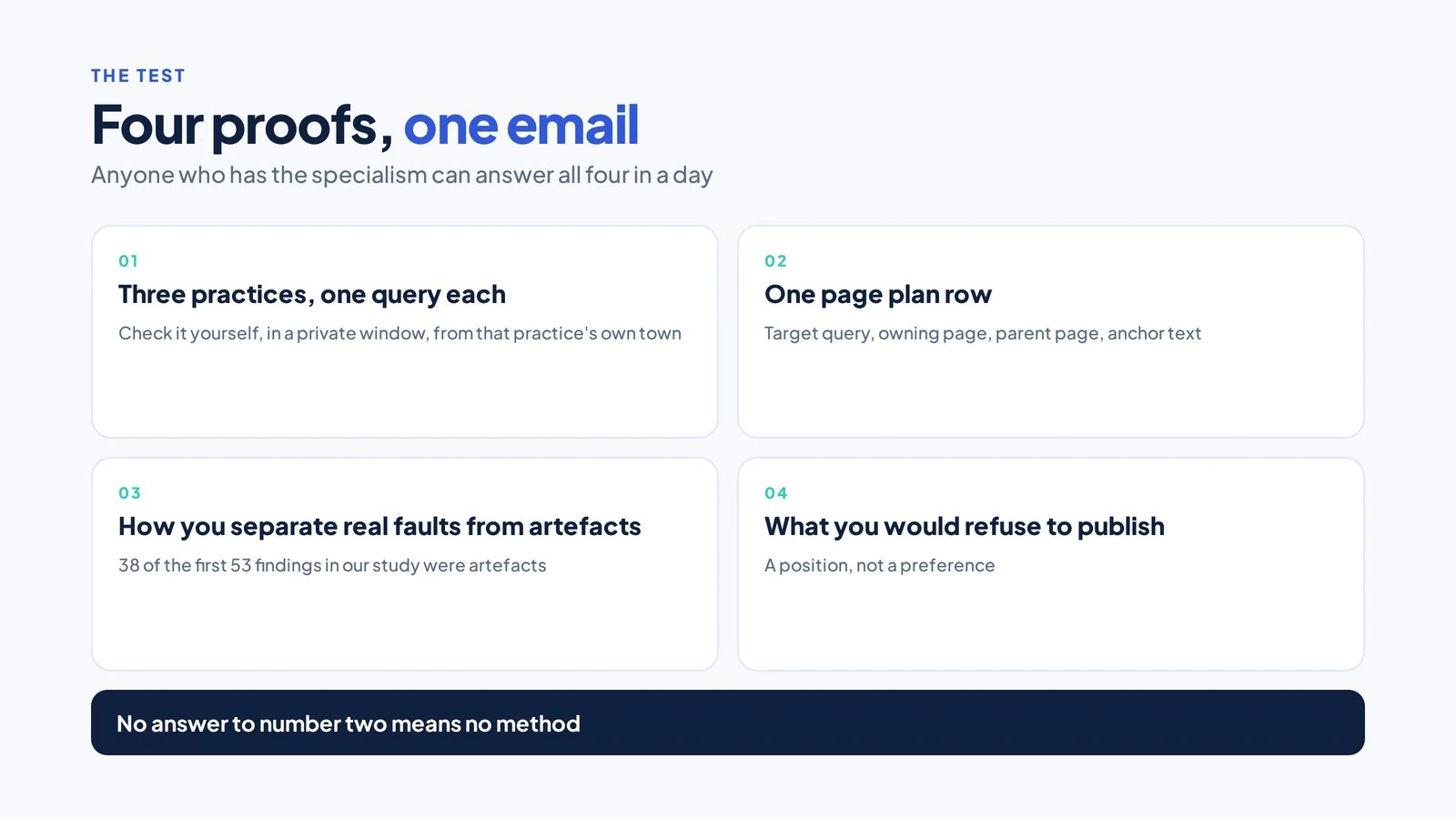
- Name three accountancy practices you have worked with and one query each now ranks for. Then check the query yourself, in a private window, from that practice’s own town. A claim that cannot survive that check is a claim about ambition.
- Show me one page plan row. Target query, the page that owns it, its parent page, the anchor text used to link them. Anyone working to a method has hundreds of these. Anyone without a method has none.
- Tell me how you separate a real fault from an artefact of site size. Our own study found that 38 of the first 53 findings across a panel of practice websites were artefacts rather than real faults. A provider who bills for an uncontrolled audit is billing you for noise.
- Tell me what you would refuse to publish on my site. A provider who names something, a claim they will not make, a tactic they will not use, has a position. A provider who says they will do whatever you want has none.
The full procurement question set, including what to ask about reporting and contracts, sits in the questions to ask an SEO agency.
What do the first thirty days tell you about the choice you made?
Thirty days is long enough to judge a provider’s judgement and far too short to judge their results. Nothing in your rankings, your traffic or your enquiry count means anything yet, and a provider presenting movement in any of the three at day thirty is presenting noise. What is visible by then is how they think, and that is the thing you were actually buying.
Three behaviours say you chose well. They asked which services your partners want more of before they asked for access to anything. They refused something, whether a claim, a page idea or a target you suggested. They referred to one of your existing pages by name, which means they read the site rather than ran it through a tool.
Three say otherwise. The first deliverable is a keyword list. The audit findings could have been written about any website on your platform, with nothing in them that is true of an accountancy practice in particular. A content calendar arrives for approval before a page plan exists, which is the clearest sign that hours are being filled rather than a plan being executed.
What month one should actually produce, as a set of named artefacts rather than as behaviour, is set out in the month by month programme breakdown. Read this section as the judgement test and that one as the delivery test.
The timing is not accidental. A rolling monthly agreement makes day thirty the cheapest point at which to leave, and it is also the first point at which you have enough evidence to decide. A provider who has asked for twelve months up front has removed that moment from your calendar, which is worth noticing while you still have the choice.
What does the difference in fee actually buy?
The difference buys you research time you do not have to fund, and a shorter route to your first page that converts. Whether it is worth the gap depends on how long your own team can spend teaching a provider your market.
Three practical tests. Count the hours your partners would spend briefing a generalist over six months and price them at your own chargeable rate. Count the months of delay before your first commercial page goes live in each case. Then set both against the fee difference over a year. With partner time to spare you will usually find the generalist cheaper in total, and with none you rarely will.
What your fee should never turn on is the label. The detail of what each band buys, and what should never appear in an SEO price at all, is in what SEO costs an accountancy practice.
Both columns so far assume you are buying from an agency. Three other arrangements exist, and they do not all hold up equally.
Is a freelancer, an in house hire or your web designer a third option?
A freelancer is a real third option and an in house hire becomes one above a certain size. Your web designer is not. Each fails or succeeds for a different reason.
Freelancers work well where you need one discipline done properly and have somebody coordinating. The risk is capacity, not skill. One person covering research, writing, technical work and reporting will drop one of the four, and it is usually reporting.
An in house hire makes sense above a certain size, roughly where you have several offices or service lines and enough work to fill a role. Below that, your hire spends half their week on tasks a tool or a contractor does faster.
Whichever of the four you pick, the question that follows it is what happens when you want to change your mind.
A web designer doing SEO alongside design work is the arrangement we see break down most often. Design and search compete for the same decisions about page structure, and search loses, because the visible output of design is a page somebody approves and the visible output of search is a change nobody sees for three months.
What happens to the work when you switch provider?
Switching costs less than it looks, as long as three things are in your own name: the page plan, the analytics property and the Google Business Profile. Published pages keep ranking through a change of provider, because they belong to your site rather than to the agency.
Ask for five things at your handover: the page plan file, the audit and its findings, the recorded baseline, admin access to analytics and the profile, and the list of what was in progress. On a single office practice, two weeks of overlap usually covers it. What does break is momentum on profile activity and on the refresh cycle, and both restart within a month.
One thing to check before you sign anywhere new. Confirm that content written during the engagement is your property and that nothing will be removed at the end. It is rare, and it is easier to settle in the contract than afterwards.
The other risk in a switch is a new provider who wants to start again. A rebuild of a page plan that was working resets the clock for no gain, and the tell is a proposal that begins with a fresh audit and a fresh strategy without reading what already exists. Ask a prospective provider what they would keep. A useful answer names something of yours.
Switching assumes the provider is yours to leave. Whether they are only yours is the question practices ask last, and it is the one that decides whether your page plan is being written for you or against you.
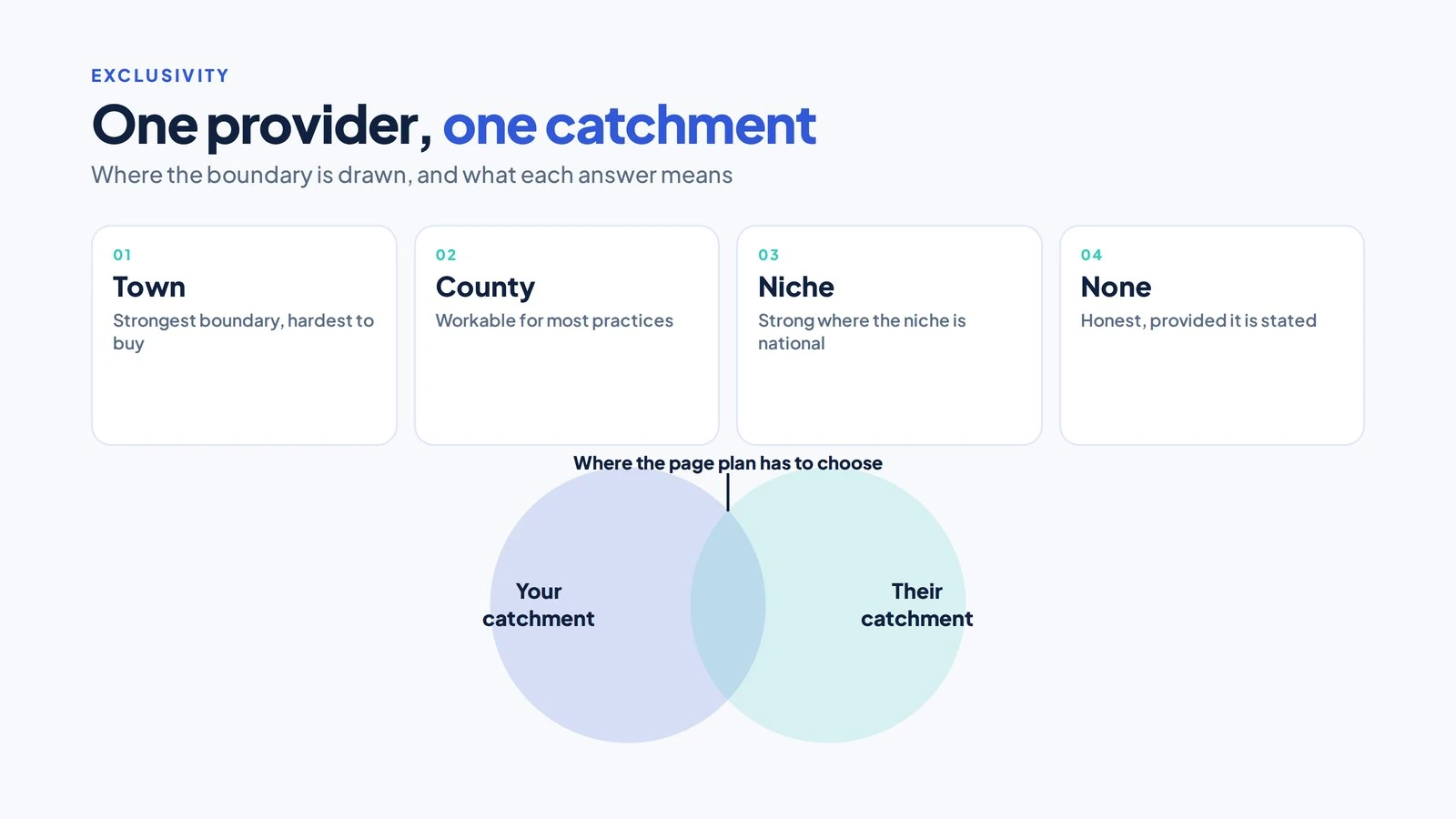
How many practices should one provider carry in one town?
One, in any catchment where the practices compete for the same searches. A provider working for you and for a firm down the road is choosing between you every time a page is planned, whether or not they say so.
The question to ask is not whether they offer exclusivity but how they define the boundary. Town, county, niche or nothing are all defensible answers, and the fourth is honest as long as they say it. Get the answer in writing, and get it before you sign rather than when a competitor’s page appears above yours.
Does the SEO agency need to be local to your practice?
No, and the question usually stands in for a better one. Google shows a block of nearby agencies for provider searches of this kind, so plenty of practices are asking it, and the thing they actually want is someone who understands their catchment rather than someone who has an office in it.
Being local buys you three things. A meeting you can walk to, a provider who knows the town well enough to recognise the names in it, and the comfort of a face. The third one matters more than people admit, and a partner who will only work with someone they have met in person has a legitimate reason to prefer local, provided the method still holds up.
Being local does not buy you local SEO. The work that makes your practice visible in your own town happens on your website, in your Google Business Profile and in the pages that answer searches with your town in them. None of it is performed from a nearby desk, and a provider two hundred miles away does it with the same tools. The detail of that work sits in local SEO for accountants.
The better question is who already knows your catchment. Ask any provider, local or not, what currently appears above you for your main service term in your town, and expect names rather than a promise to find out. A provider anywhere in the country can answer that in an afternoon. A local provider who cannot has an address in your town and no knowledge of it.
One practical point sits underneath all of this. A specialist in accountancy SEO is unlikely to be local to you, because there are few of them and they work nationally, so a practice that insists on both is usually choosing a local generalist without having made that decision deliberately. Make it deliberately.
Quiz: specialist, generalist or neither yet?
Self-check quiz
Specialist, generalist or neither yet?
Eight questions about your practice and your competition. Answer for the practice as it is today.
Question 1 of 8Your practice serves:
Question 2 of 8Your catchment holds:
Question 3 of 8Your website is:
Question 4 of 8Partner time available for briefing and review is:
Question 5 of 8Your highest value service is:
Question 6 of 8Your current provider, asked for one page plan row, would:
Question 7 of 8Your practice has:
Question 8 of 8Asked what they would refuse to publish, a provider who says:
Show the answer key
- Your practice serves: A defined niche or sector. A defined niche is the strongest single reason to pay for sector knowledge.
- Your catchment holds: Dozens of competing firms and directories. A crowded catchment is won on coverage depth rather than on a tidier home page.
- Your website is: Fast, indexed and structured. A broken site needs fixing before any sector insight has anything to act on.
- Partner time available for briefing and review is: Under an hour a month. The fee gap buys research time you would otherwise fund with partner hours.
- Your highest value service is: Sold nationally on expertise. National service lines are bought on expertise, and generic copy never surfaces for them.
- Your current provider, asked for one page plan row, would: Have no provider to ask. A provider who already sends the row has a method and is worth keeping.
- Your practice has: Two or more offices or service lines. Multiple catchments introduce duplication and profile problems that need deliberate handling.
- Asked what they would refuse to publish, a provider who says: Names something specific. A provider with no position has nothing to protect you from.
Frequently asked questions
Does a specialist SEO agency charge more than a generalist?
Usually yes, and the gap is narrower than the marketing suggests. What you are paying for is research time already spent rather than a higher hourly rate, so the difference tends to show in the first three months and shrink after that.
Is sector experience more important than method?
Method matters more, and the two together matter most. Sector knowledge shortens the research phase. Method decides which pages exist, how they link and what gets published when, and a provider without one produces good copy in the wrong structure.
What about a specialist in a different sector?
A provider with a strong method in a neighbouring professional service, such as law firms or financial advisers, transfers well. The buying behaviour, the regulatory caution and the trust signals are close enough that most of the learning carries across.
Our practice has no niche yet. Which do we need?
Start with whoever can get the site healthy and the profile right, then take the niche decision separately. Choosing a niche is a commercial decision about what the partners want to serve, and it belongs with the partners rather than with a keyword tool.
How do we check a claimed case study is real?
Run the query yourself from the client’s own town, in a private window, and look at the page that ranks. Then ask for the client’s name and permission to call them. A provider who has real results has clients who will take the call.
Can we start with a generalist and move to a specialist later?
Yes, and that sequence works well. A first year of technical and local work with a generalist, then a specialist to build topical depth once the foundations are sound, is a common and sensible path.
Does the answer change for a multi office practice?
Yes. Multiple offices introduce catchment, duplication and profile problems that need deliberate handling, and that is closer to specialist territory even where the practice is general. Our multi location optimisation work covers the mechanics.
Where the provider decision sits in the rest of the work
Your provider decision is smaller than it feels, because the work itself is the same in either case: find out what your market searches for, build the pages that answer it, make them readable, and measure against a baseline. What changes between a specialist and a generalist is how much of your own time funds the first step. Start by asking both for one page plan row, because that single answer separates them faster than anything else here.
True SEO Consultants Ltd works from Startup Stiwdio at the University of South Wales, 86-88 Adam Street, Cardiff, CF24 2FN, and delivers UK wide through remote digital onboarding and delivery. Mohammad A Mahmud completed the ACCA professional examinations and holds an MSc in Applied Accounting from the University of South Wales, and Julie Williams is a fractional finance director and certified business coach, which is the combination behind our accountancy work. We bill that work on KPIs, not hours, with milestones in writing at three, six and twelve months, and we will tell you when the answer is not us. Research Report TSC-2026-01, our audit of 494 UK practice websites, is published in full under a Creative Commons licence and sits behind the 494 website study.
Bring both quotes and we will read them with you
We name what each proposal is missing, tell you which type of provider your practice actually needs, and say so even when the answer is not us.
Book my free strategy callSee the method behind it