You can publish almost anything you can prove.
Neither institute bans marketing, and neither bans comparison. ICAEW prohibits exaggerated claims and unsubstantiated comparisons. ACCA permits any factual statement whose truth you can justify. The restriction is narrower than the caution it produces, and the caution is what is costing your practice enquiries.
- ACCA members may advertise “in any way they think fit”
- ICAEW bans the unsubstantiated comparison, not the comparison
- Free consultations and percentage discounts are expressly permitted
- 60.9% of 494 UK practices never state who regulates them
- ICAEW R115.2
- ICAEW R115.3
- ACCA section B13
- In force 1 July 2026
- UK practices
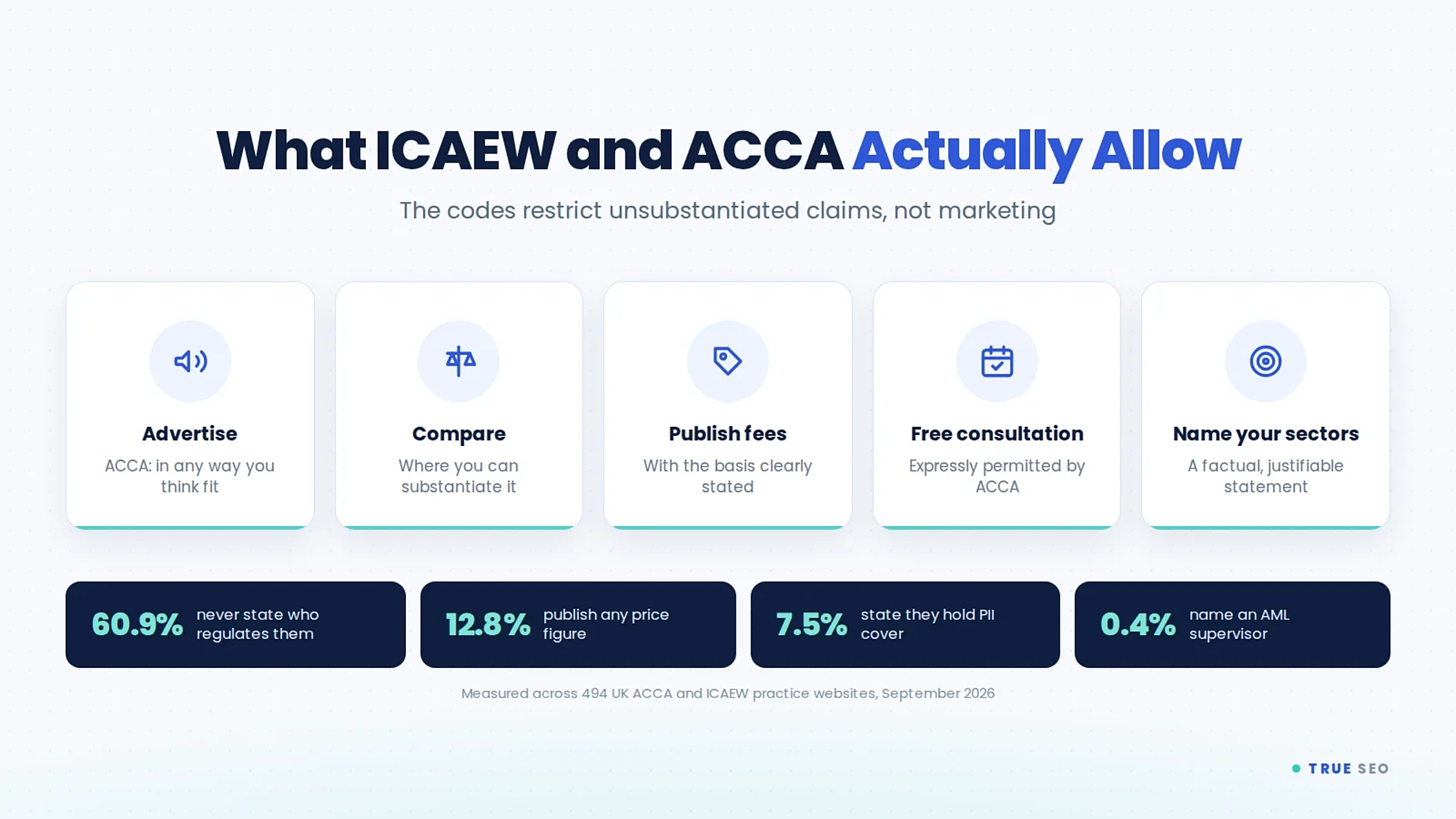
Both codes permit far more than firms use. Prevalence measured across 494 UK ACCA and ICAEW practice websites, September 2026.
Key takeaways
Six findings a practice owner can act on this week, each drawn from the operative wording of the two codes rather than from custom.
- R115.2The hingeThe rule is about substantiation, not silenceICAEW prohibits “exaggerated claims” and “disparaging references or unsubstantiated comparisons to the work of others”. A substantiated comparison is not caught by that wording.
- AnyACCA positionACCA is more permissive than most members thinkMembers may advertise in any way they think fit, and material may contain any factual statement the truth of which a member is able to justify.
- 0Rules against itFree consultations and discounts are allowedACCA names percentage discounts and free consultations as permitted promotions. Firms decline to run them for commercial reasons, not regulatory ones.
- 12.8%Publish a priceFees have one specific ruleWhere you mention fees, the basis of calculation should be clearly stated. That is a disclosure requirement, not a ban on publishing prices.
- R115.3OutreachBoth codes ban harassment, not approachThe prohibition bites on volume and persistence. Approaching a prospective client is not itself a breach under either code.
- 60.9%Never state a regulatorYour website is where this bites hardestAcross 494 UK practices we measured, three in five never say which body regulates them. No rule prevented that. It was simply never written.
The ICAEW Code changed on 1 July 2026. If your marketing policy predates that date, it is written against a superseded edition. Re-reading it is a half-hour job that removes a whole category of guesswork.
What the two codes actually say
ICAEW and ACCA arrive at the same destination by different routes, and neither route is closed.
Most practice owners are not held back by the rules. They are held back by a belief about the rules that nobody has checked since they qualified. The table below sets the operative wording side by side, so you can see the boundary rather than infer it.
| Question | ICAEW Code of Ethics 2026 | ACCA, obtaining professional work |
|---|---|---|
| Can you advertise | Yes, subject to professional behaviour under Section 115 | Yes, members may advertise “in any way they think fit” |
| What may you claim | Nothing exaggerated about services, qualifications or experience | “Any factual statement the truth of which a member is able to justify” |
| Can you compare | Yes, provided the comparison is not disparaging or unsubstantiated | Yes, provided it is not misleading and not unflattering |
| Fees | Governed by the general professional behaviour principle | Where mentioned, “the basis on which those fees are calculated should be clearly stated” |
| Discounts and free offers | Not prohibited | Percentage discounts and free consultations expressly permitted |
| Outreach | Never “to such an extent, as to amount to harassment” (R115.3) | Should not amount to harassment of the recipient |
| If unsure | “Encouraged to consult with the relevant professional body” (115.2 A1) | Consult ACCA |
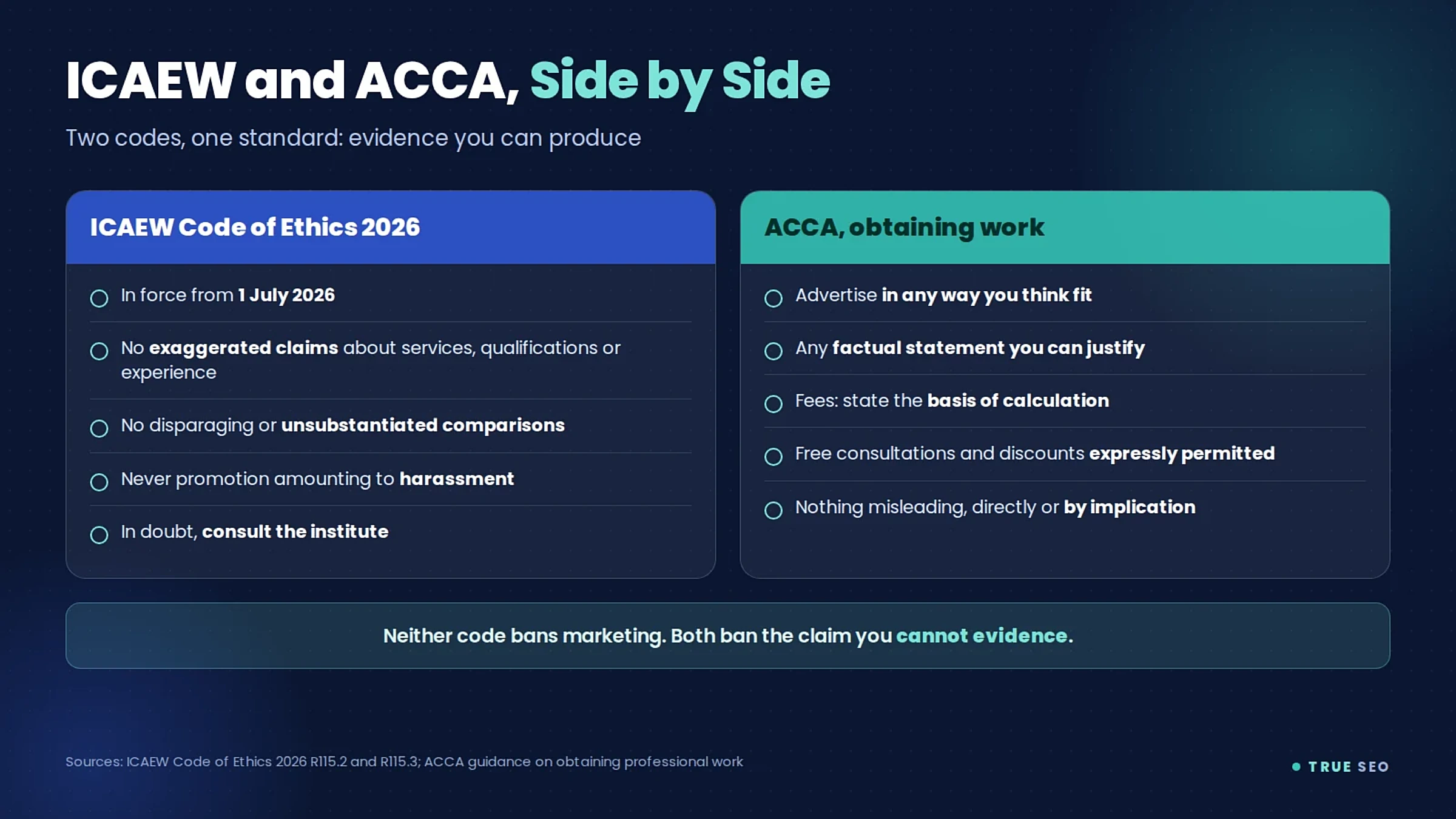
Two things follow from reading them together. The prohibitions are about the quality of the evidence behind a claim, not the boldness of the claim. And the only hard content rule either body applies to a specific marketing element is the one about the basis of fee calculation.
The word that does all the work
“Unsubstantiated” is the hinge of ICAEW R115.2, and it is routinely read as though it says “prohibited”.
“Disparaging references or unsubstantiated comparisons to the work of others.”
ICAEW Code of Ethics 2026, R115.2
Read it slowly. A comparison is caught when it disparages, or when you cannot substantiate it. A comparison you can evidence, phrased without contempt for the other firm, is not what the sentence describes.
“The leading accountancy firm in the region.”
Exaggerated, and nobody measures regional leadership.
“We publish our fee basis and our turnaround times.”
A factual statement, evidenced from your own files.
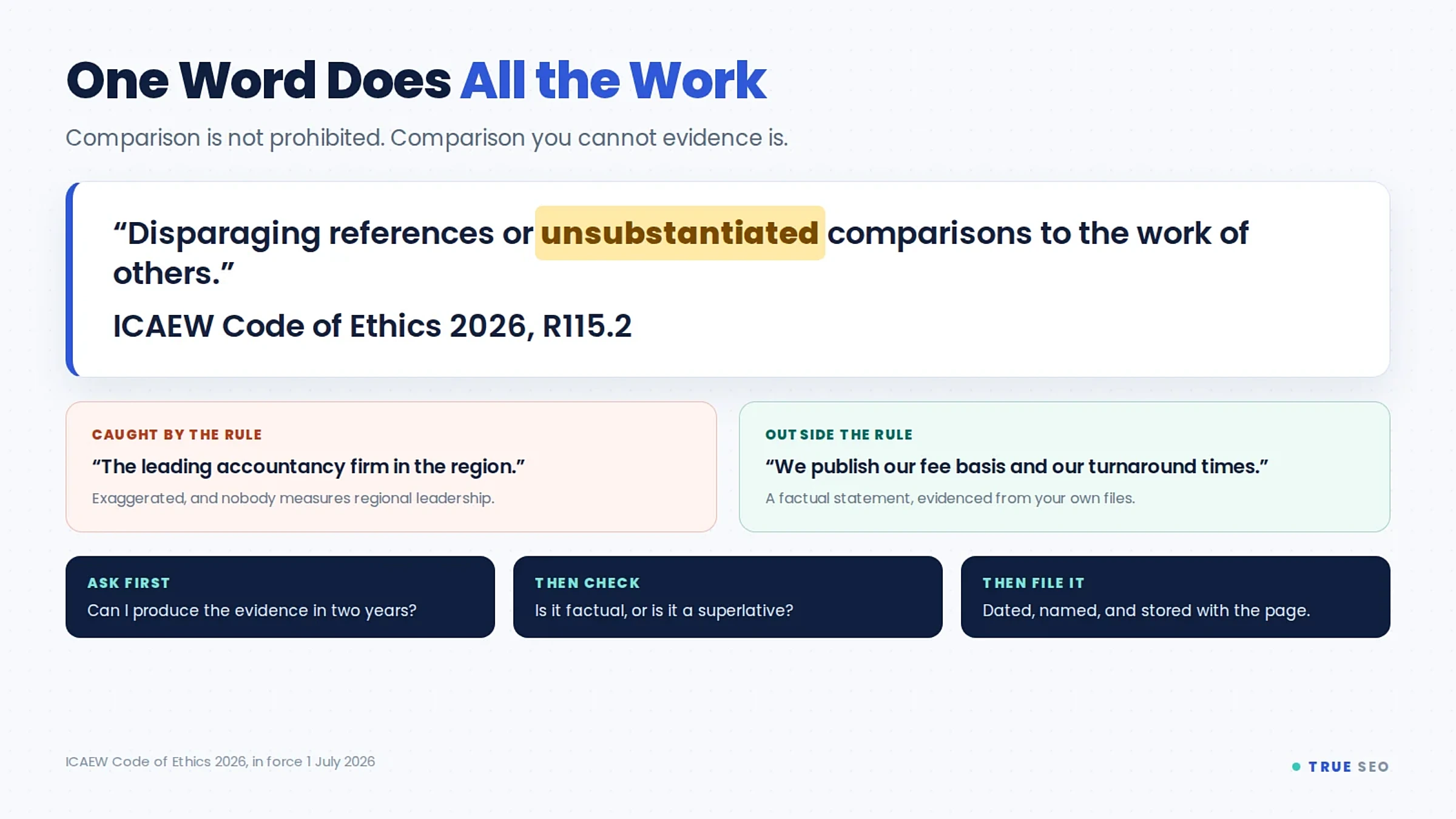
ACCA reaches the same place from the other direction. It permits any factual statement whose truth you can justify, and separately forbids unflattering references to others. The test is the same in substance: have the evidence, and do not sneer.
Both codes are therefore evidence rules. A practice that keeps records of what it does and measures its own outcomes has a wider marketing licence than one that does not, because substantiation is available to it and not to the other.
What you are free to publish
Everything below is a factual statement a practice can normally justify from its own records, which is the standard both codes apply.
| What you can publish | What substantiates it |
|---|---|
| The sectors and client types you serve | Your own client list |
| Your qualifications, your regulator and your supervisory body | Your practising certificate and register entry |
| That you hold professional indemnity insurance | Your policy schedule |
| Named individuals, their qualifications and their experience | Personnel records |
| Turnaround times and service standards you actually meet | Your own workflow data |
| A fee, a fee range or a from-figure, with the basis stated | Your engagement letters |
| Case studies and client outcomes, with consent | The client file and written consent |
| A free consultation or an introductory discount | Expressly permitted by ACCA |
| Comparisons you can evidence and phrase neutrally | Whatever the evidence is |
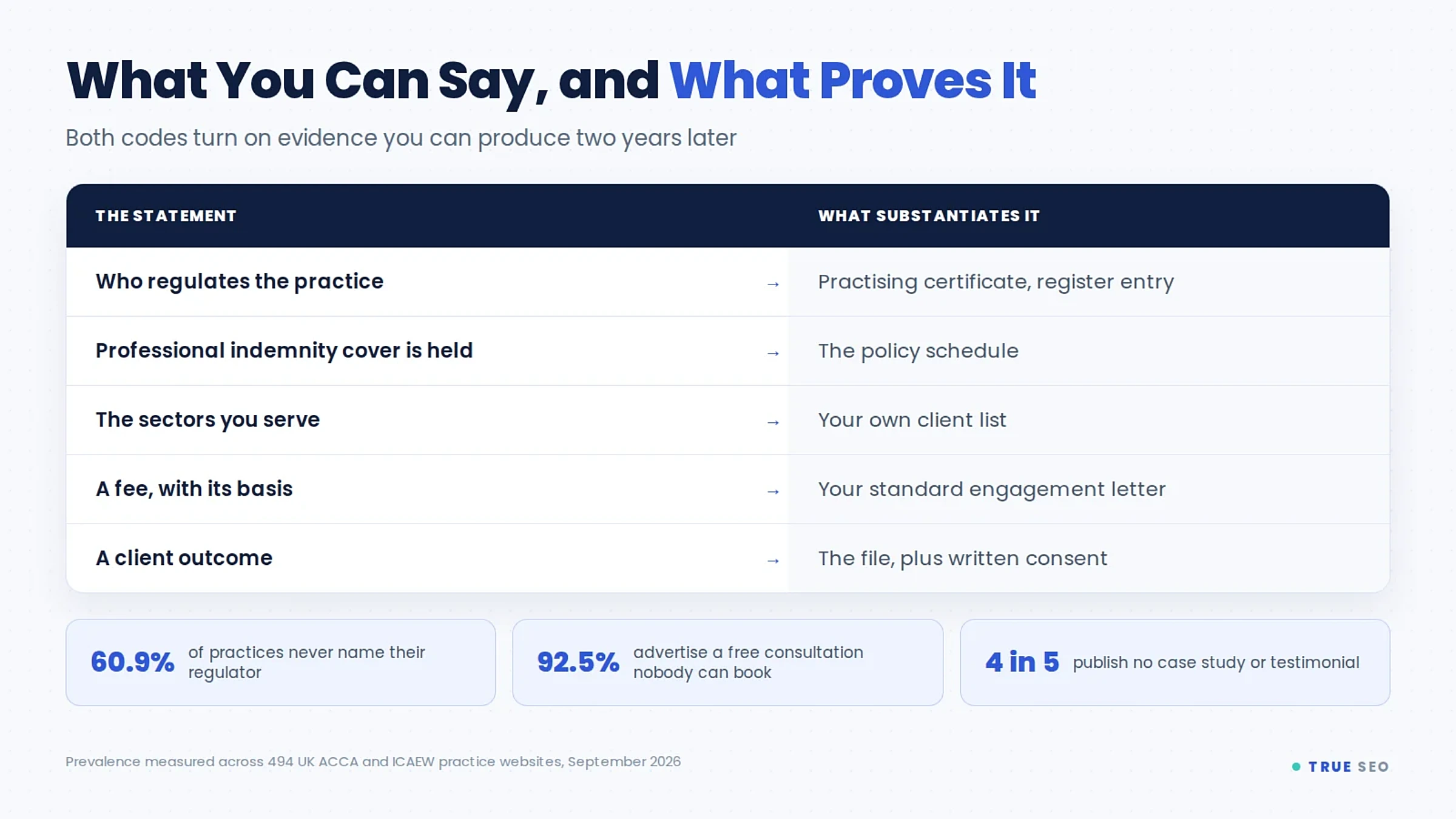
Client work needs consent before it becomes marketing, and confidentiality survives the end of an engagement. That is a separate obligation from the advertising rules, and it is the one most likely to catch a firm out, because a case study written from a live file is an easier mistake to make than an exaggerated claim.
What you cannot publish
The prohibited set is short, and none of it is anything a careful firm wants to say anyway.
- Do not exaggerate“The best accountants in Cardiff” is caught. “Award-winning” is caught unless you won an award and can name it.
- Do not disparageNaming a competitor to criticise their work is caught by both codes. So is the softer version, where the firm is not named but the description makes them identifiable.
- Do not compare without evidence“Cheaper than the high street firms” needs a basis. “Faster than the average practice” needs a measured average.
- Do not mislead by implicationBoth codes catch implication as well as direct statement. A page arranged so a reader concludes you hold a specialism you do not hold is misleading even where no sentence is untrue.
- Do not harassVolume and persistence turn permitted outreach into a breach. Neither code sets a number, which means the judgement is yours and it should be recorded.
Fees are the one place with a specific rule
Where your promotional material mentions fees, ACCA requires that the basis on which those fees are calculated is clearly stated. That is the whole of the requirement.
It does not stop you publishing a price. It also explains the commonest fee-page failure, which is a from-figure with nothing attached to it. A bare monthly figure says nothing about what is included, what triggers a higher number, or which entity type it applies to, and a reader cannot self-qualify against it.
The same figure becomes both compliant and persuasive the moment it carries its basis: the entity type, the turnover band, and the list of what the fee covers. Your engagement letters already contain that wording, which is the point. The basis is not something you have to invent for the website. It is something you have to copy across from a document you have already written.
- 12.8%of 494 UK practices publish any price figure at all
- 5.7%have a pricing page of any kind
- 1disclosure rule, and it is already written in your engagement letter
The rule is not what is stopping the other 87 per cent. Our research across 494 UK accountancy websites measured how rarely these permitted statements appear, and how consistently the firms that do publish them stand out in search and in AI answers.
Outreach, and where the line actually sits
Both codes prohibit harassment rather than approach, and neither defines the threshold.
That leaves the boundary to be drawn by you, which is uncomfortable but is not the same as prohibition. What the codes settle is narrower: approaching a prospective client is not itself a breach, and doing it repeatedly after they have not responded moves towards being one.
One thing sits outside your institute entirely. Electronic marketing to individuals is governed by UK data protection and electronic communications law rather than by ICAEW or ACCA, and the two sets of obligations do not overlap neatly. A B2B email to a corporate subscriber sits in a different position from an email to a sole trader. Take that part to somebody qualified to answer it, and keep the record of the advice.
What this means for your website
The permitted statements are the ones most practice websites leave out
Across 494 UK accountancy practices we audited in September 2026, three in five never state which body regulates them. Every one of the statements below is a plain fact the firm can substantiate from its own records, and every one is permitted by both codes without qualification.
Two of 494 UK accountancy practice websites, 0.4 per cent, name an anti-money-laundering supervisor. No rule produced that. The rule permits all of it.
- The regulatory reading
The constraint on your marketing is real but narrow, and it sits on evidence rather than on ambition.
- The commercial reading
What is costing you enquiries is that the permitted, substantiated, differentiating statements were never put on the page.
- The search reading
Search engines and AI assistants can only repeat what they can read. Unstated trust signals cannot be cited by either.
Nobody wrote these statements into the specification when the site was built, and the developer had no reason to ask. That is the practical finding for a practice owner, and it is the gap our SEO for accountants service is built around: stating the trust and regulatory signals in the places search engines and AI assistants read them, and building the advisory pages the practice never got round to.
Three things follow from that, and each one has its own page. If your firm is not appearing at all, work through the diagnostic order for a practice that is not ranking before changing anything. If the pages you built for nearby towns produce nothing, the reason is usually what a location page has to contain before it can rank. And if you want the regulator and the credentials read by a machine as well as a reader, that is the schema markup an accountancy website actually needs.
Two practices, and the decision each one made
Both decisions were made against the same wording. Only the evidence available to each firm differed.
They had carried the same website for six years and believed their institute prevented them from saying anything competitive. The partners went through the engagement-letter pack and pulled out only statements they could evidence from their own files: the body that regulates them, the fact that professional indemnity cover is held, the four sectors that make up most of the client list, and the fee basis already written into their standard letter.
Nothing on the new page was a claim. Every line was a fact with a document behind it. None of it required a single judgement call under either code, and none of it had been on the site the week before.
They wanted to describe themselves as the region’s leading specialist in research and development claims. That is an exaggerated claim under ICAEW R115.2 and it could not be substantiated, because nobody measures regional leadership in R&D work.
What the firm could substantiate was the number of claims it had prepared in the previous three years, the sectors those clients traded in, and the fact that two partners hold a specific qualification. The countable version went on the page. It is a weaker sentence and a stronger claim, because it survives a challenge and the original would not have.
Who signs it off, and what to keep
Put one named person in charge of marketing sign-off and give them a file. Both codes turn on substantiation, and substantiation you cannot produce two years later is not substantiation.
- Evidence for every published claimDated, and filed where the next person can find it.
- Written client consentFor every case study and every testimonial, kept with the copy it supports.
- The basis of calculation behind every published feeCopied from the engagement letter rather than invented for the website.
- A note of your reasoning on comparisonsWhat you judged to be fair, and what you relied on when you judged it.
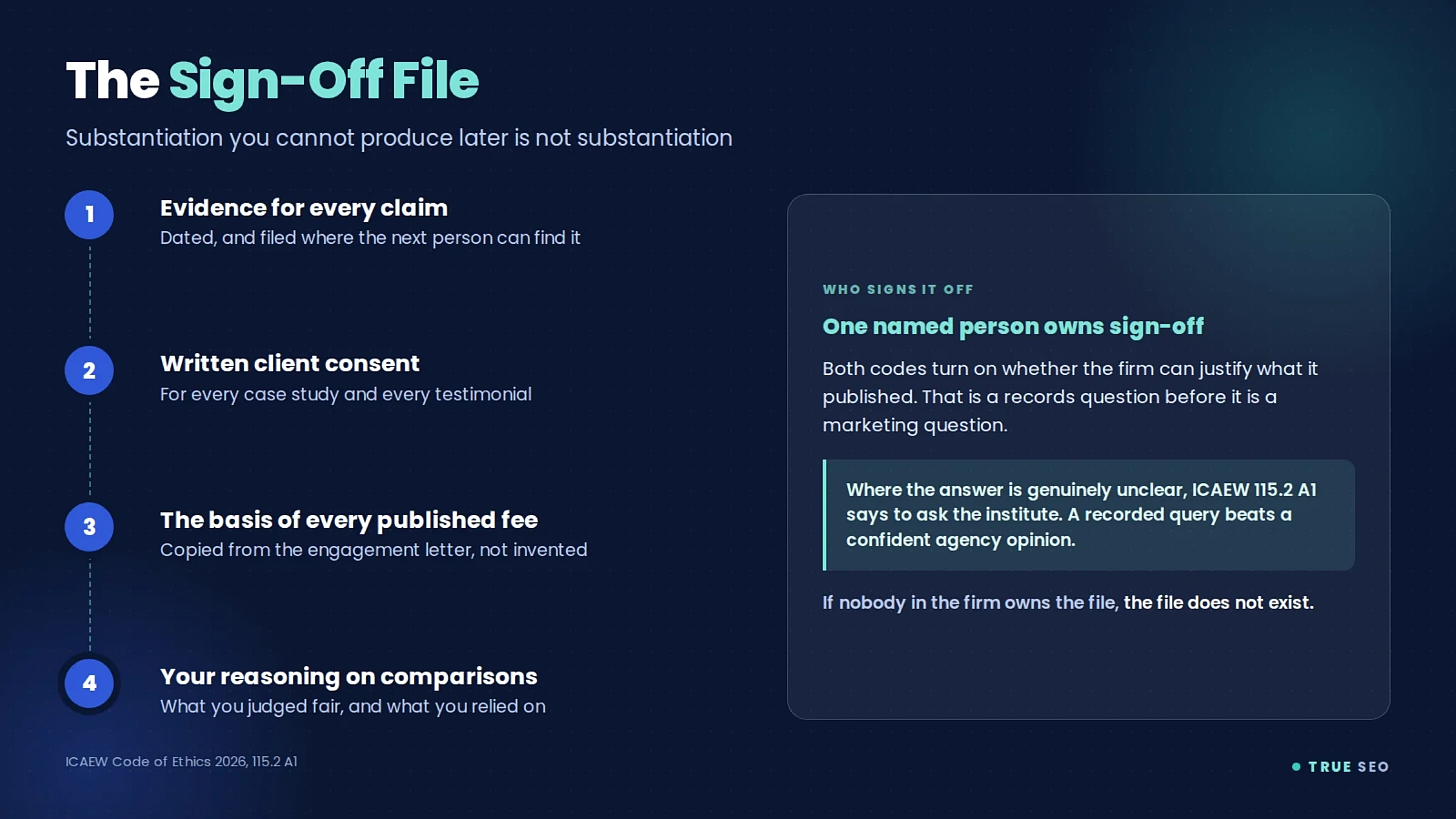
Where the answer is genuinely unclear, ICAEW’s own guidance at 115.2 A1 is to ask them. That is not a fudge on our part. It is what the Code says to do, and a recorded query to your institute is a better answer than a confident one from your marketing agency.
Get your first month of SEO free
Answer five questions and we will tell you which permitted, substantiated statements are missing from your practice website, and what they are worth in search and in AI answers.
First month free · a few places at a time
Your first month of SEO, free
Answer three quick questions to claim yours.
Thank you, that is with us.
We will email your onboarding form and payment link, and call within one working day if you would rather talk it through first.
Pick a time that suits you below. We will confirm by email too.
Frequently asked questions
Can UK accountants advertise at all
Yes. Neither ICAEW nor ACCA restricts advertising as such. ACCA states that members may advertise in any way they think fit, and ICAEW governs marketing through the professional behaviour principle rather than a prohibition. The limits are on exaggeration, disparagement and unsubstantiated comparison.
Can an accountancy firm compare itself to another firm
Yes, where the comparison is substantiated and not disparaging. ICAEW R115.2 prohibits “disparaging references or unsubstantiated comparisons to the work of others”, which leaves an evidenced, neutrally phrased comparison outside the prohibition. ACCA permits fee comparisons that are not misleading.
Can we publish our prices
Yes. Where fees are mentioned, ACCA requires the basis on which they are calculated to be clearly stated. Publishing a price with its basis is compliant, and it is what a from-figure on its own fails to do.
Can we offer a free first consultation or a discount
Yes. ACCA expressly names free consultations and percentage discounts on existing fees as permitted promotions.
Do the rules stop us using client case studies
No, but confidentiality does unless you have consent. Get written consent, keep it, and anonymise where consent is not available. An anonymised case study is still evidence.
Has anything changed recently
Yes. The ICAEW Code of Ethics 2026 applies from 1 July 2026. Any internal marketing policy written against an earlier edition should be re-read against the current one.
Where this leaves your practice
The rules were never the reason your website produces so few enquiries
The reason is that the substantiated, permitted, genuinely differentiating statements about your practice are sitting in your engagement letters and your practising certificate rather than on your pages.
True SEO Consultants Ltd, based at Startup Stiwdio, University of South Wales, 86-88 Adam Street, Cardiff, CF24 2FN, works with accountancy practices across the UK and onboards firms worldwide through a fully remote digital onboarding and delivery process. We plan visibility around what a regulated practice is actually permitted to say, which is considerably more than most firms are saying.
This page explains published professional guidance and is not legal advice. Where a judgement is finely balanced, ICAEW 115.2 A1 directs members to consult their institute.