A serviced office provider that ranked nothing, now holding the searches that produce viewings.
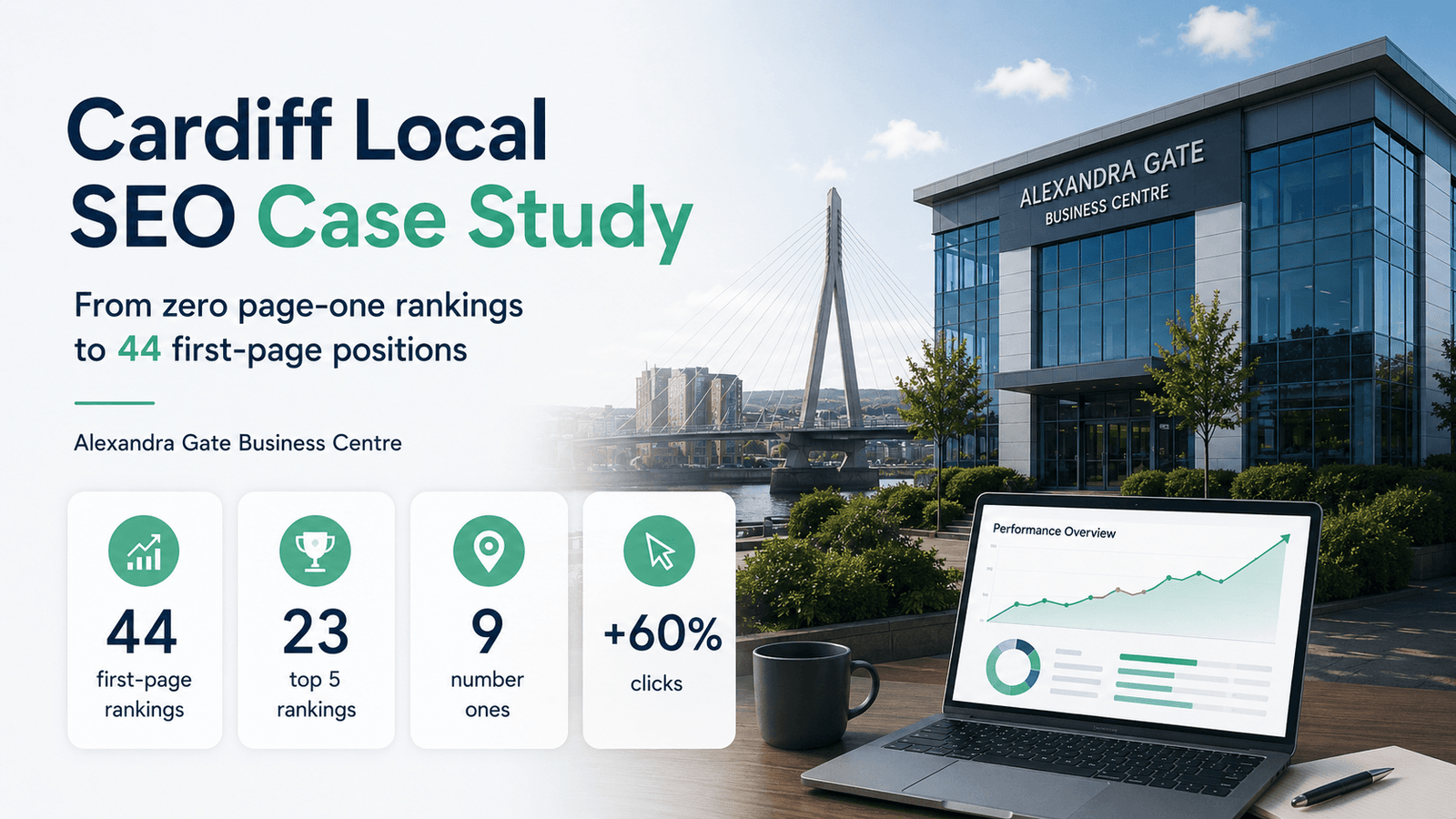
Alexandra Gate Business Centre went from zero page-one keywords to 44 first-page Cardiff rankings, 23 of them in the top five and 9 at position one. The target we wrote into the proposal was ten first-page keywords in six to nine months. The result beat it by more than four times.
- 9 searches at position one, including free parking, two-person and thirty-person office searches in Cardiff
- Clicks up 60% month on month with click-through rate up 70% on flat impressions, which means better matched pages rather than more demand
- Ahead of Rightmove and the national portals on the specific searches people use when they are close to booking a viewing
- Website rebuild
- Proximity signals
- Google Business Profile
- Topical clusters
- Local schema
- Welsh-language gap
The free review, in 30 minutes
Find out which local searches you are losing, and to whom
- The qualified local searches your competitors are taking from you
- Your website and Google Business Profile read together, not separately
- An honest answer on whether your site needs rebuilding or optimising
No minimum term. Cancel any month, no notice.
Key takeaways
- Alexandra Gate went from zero page-one keywords to 44 first-page Cardiff rankings, 23 in the top five and 9 at position one.
- The target agreed at proposal stage was ten first-page keywords in six to nine months. The result beat it by a factor of more than four.
- Clicks rose 60% month on month and click-through rate rose 70% on flat impressions, which means better matched pages rather than a lucky spike in demand.
- The site now outranks Rightmove and the national office portals on the specific searches people use when they are close to booking a viewing.
- The website rebuild came first. Local SEO on a slow, duplicated, thin site would have been money wasted.
- The search foundation is built and holding, so the account is being handed to a specialist firm for social and paid distribution across listing platforms.
Alexandra Gate Business Centre is a serviced office provider on Ffordd Pengam in Cardiff. When they came to us their website ranked nothing on page one or page two of Google, took around 98 visitors a month, and had lost ground after a Google core update. This case study publishes with their consent. The rankings, the traffic and the starting position are real and quoted directly from the audit and the monthly reports. Commercial terms have been left out.
Local search rewards the business that answers the question a buyer asks the moment before they pick up the phone. Our local and multi-location SEO service builds those answers into the site and the Google Business Profile together, so a nearby buyer finds you rather than a national directory. You can walk through your own local search picture on a free 30-minute call, and we will look at your site, your profile and the three competitors taking your enquiries.
The results: what the numbers actually show
Alexandra Gate moved from no page-one presence at all to owning the Cardiff searches that produce viewings.
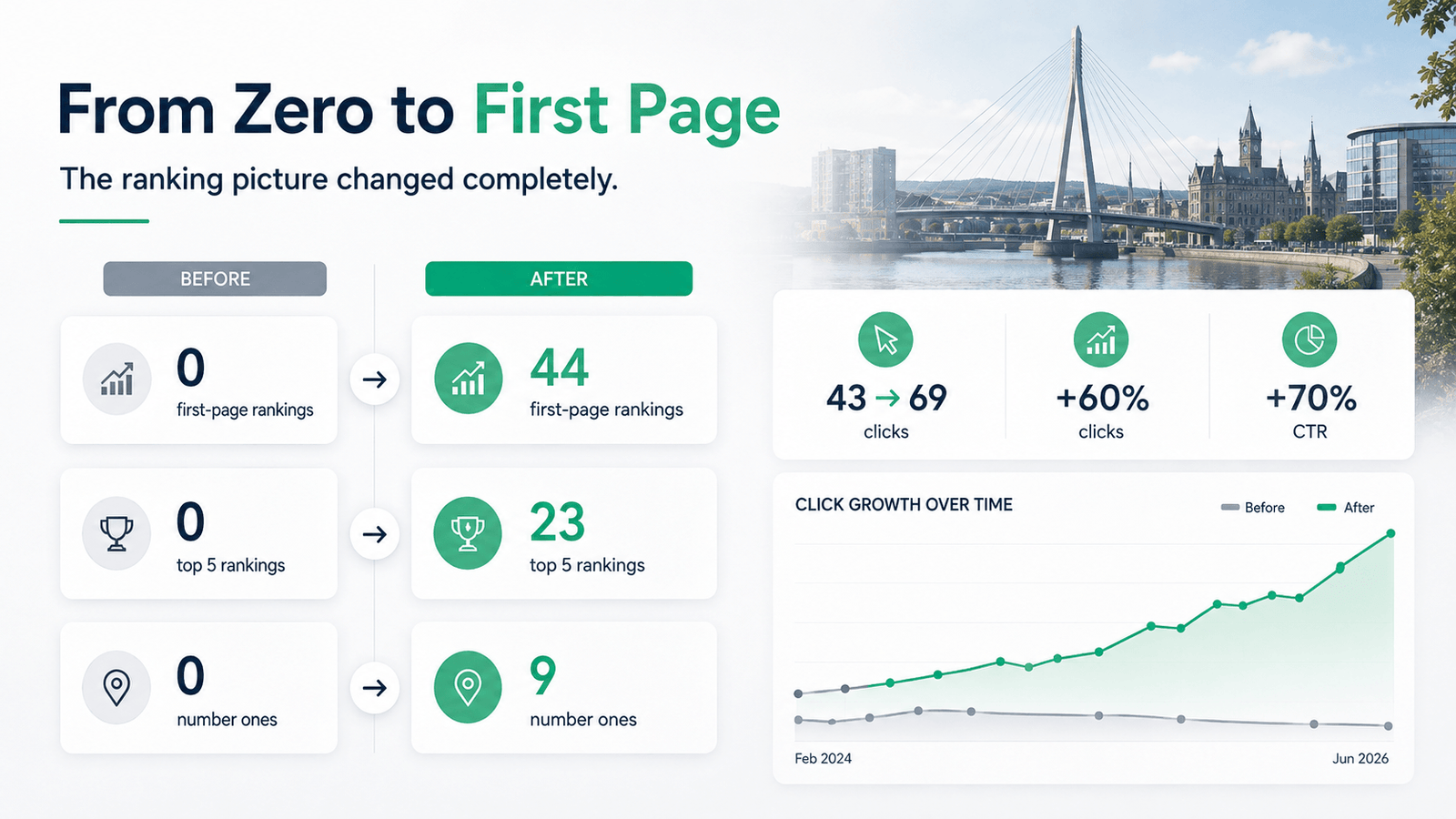
The audit that opened the engagement recorded no keywords ranking on Google’s first or second page, with the site’s terms sitting on pages three, four and five. The July 2026 report records the position below.
| Measure | At audit | July 2026 |
|---|---|---|
| First-page Cardiff rankings | 0 | 44 |
| Rankings in the top five | 0 | 23 |
| Rankings at position one | 0 | 9 |
| Positions inside the top 15 | 0 | 57 |
| Monthly organic clicks | Not tracked, roughly 98 site visitors a month in total | 69 in July against 43 in June, up 60% |
| Click-through rate | Not tracked | 0.39% in July against 0.23% in June, up 70% |
| Average position across the query set | Pages three to five | 23.9, improved from 25.7 in May |
Two of those rows matter more than the rest. Impressions stayed level between June and July while clicks rose 60%, which means the same audience saw the site and more of them chose it. That is what rewritten titles and better matched landing pages do, and it is a cleaner signal of quality than a traffic number that moves because demand moved.
The nine searches at position one
| Search term | Page that ranks | Cluster |
|---|---|---|
| office for sole trader cardiff | Virtual office page | Virtual office |
| office space cardiff with free parking | Home page | Offices |
| serviced office for 2 person cardiff | Two person office page | Office by size |
| serviced office for 30 person cardiff | 30 person office page | Office by size |
| serviced offices cardiff free parking | Home page | Offices |
| virtual office address vs po box | Virtual office vs PO box guide | Virtual office |
| what does a meeting room hire include cardiff | Meeting room hire guide | Meeting rooms |
| what is a virtual office uk what do you get | Virtual office explained guide | Virtual office |
| what should all inclusive office rent include | All-inclusive rent guide | Cost and contract |
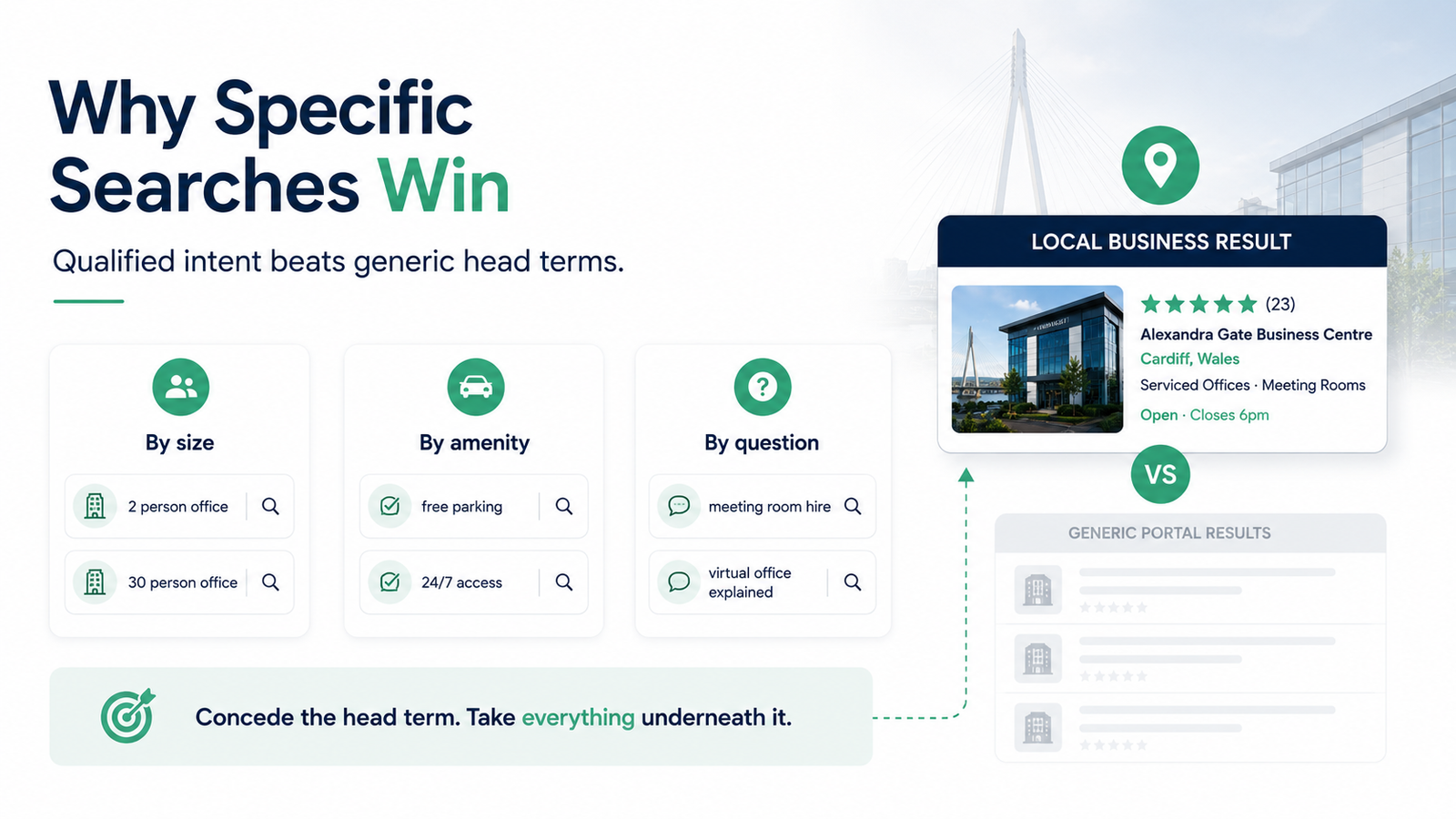
Look at what is missing from that list. Not one of those nine is the phrase “office space cardiff”. The generic head term still belongs to the national portals. Every position we hold is a search with an amenity, a headcount or a question attached, and every one of those is a person much closer to booking.
In the client’s own words
What Alexandra Gate said, publicly and unprompted
We recently used Mohammad to update our website and optimise our google ranking etc. This is still work in progress, but his results are excellent. Our views are up, and our placement is much higher on google, the enquiries have increased, and the cost was a lot less than we have been quoted elsewhere. I would highly recommend TrueSEO.
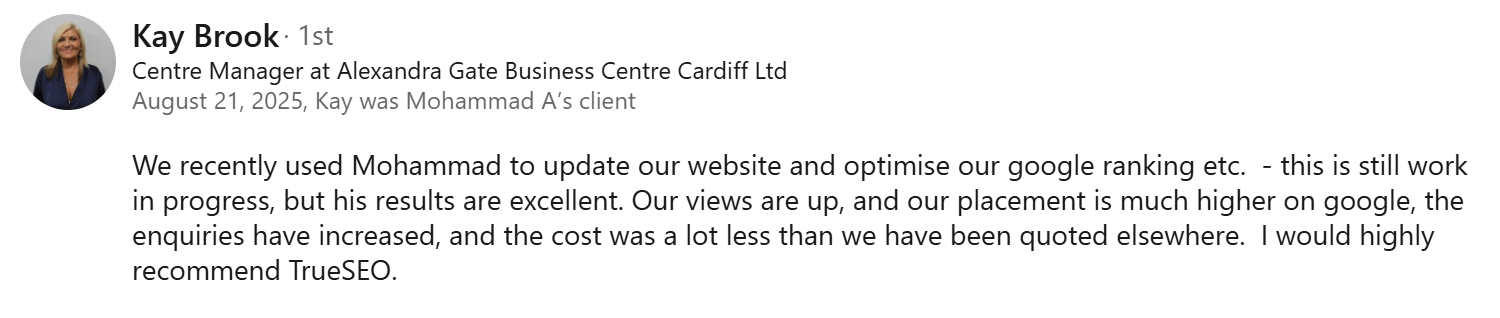
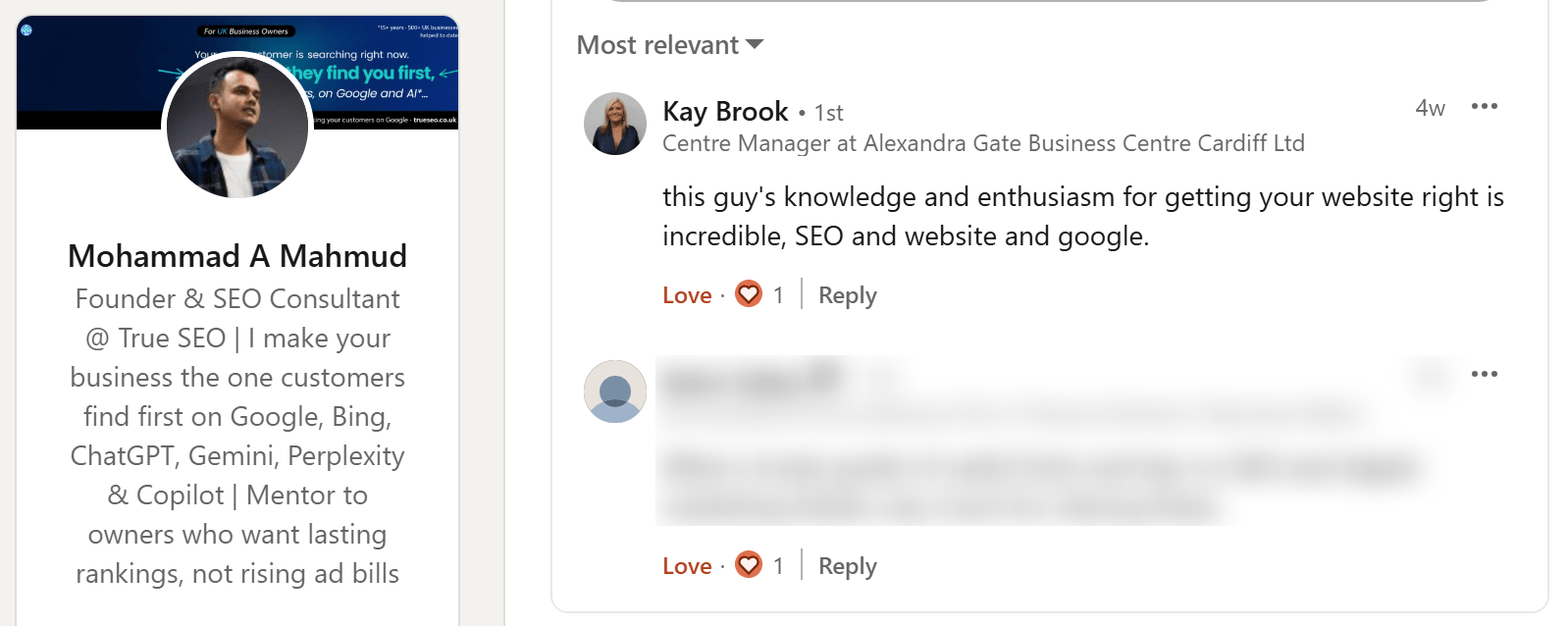
The line worth pulling out is “the enquiries have increased”. Rankings are the mechanism. Enquiries are the outcome, and they moved first.
Where the site started: slow, duplicated and invisible
The website was the constraint, not the marketing. The audit found nine problems and every one of them was blocking the others.
| What the audit found | Why it mattered |
|---|---|
| Loading speed below Google’s threshold | Two nearby Cardiff operators were scoring in the nineties on the same test. Alexandra Gate was not close. |
| Images at 82% of total page size, in outdated formats | The single biggest cause of the speed problem, and the cheapest to fix. |
| Failing Core Web Vitals, poor mobile layout | Local search is overwhelmingly a mobile behaviour, so a desktop-only layout loses the visit before the content is read. |
| Broken sitemap causing duplicate indexing | The same content indexed several times, producing keyword cannibalisation where the site competed against itself. |
| Thin pages with no research behind them | Pages that drain authority rather than earn it. |
| Illogical heading structure | Nothing told Google what any page was actually about. |
| No schema markup | Room capacity, amenities and location were invisible as structured facts. |
| No local optimisation at all | No proximity signals, no location content, no profile work. |
| Ground lost after the May 2024 core update | The domain had stopped behaving like a brand, and was no longer pulling its own name reliably. |
That last point deserves an honest word. A core update is not a penalty. Google’s own Search Central documentation is clear that core updates are broad reassessments of quality rather than actions taken against a site, and that recovery comes from improving the site rather than from removing something. A site with 82% of its weight in unoptimised images, duplicate indexing and thin pages was always going to be reassessed downward. The fix was the same as the fix for everything else on the list.
Poor photography was the other constraint, and worth naming because it is common in this sector. A serviced office is sold on how a room feels. The original site had few usable images, and those it had were heavy and undescribed. We rebuilt around what was available, compressed and converted everything, and wrote real alt text so the images at least carried meaning while better photography was arranged.
Step one: the website had to be rebuilt before any SEO began
Local SEO on a broken website is money wasted, and we said so before quoting for anything ongoing.
The rebuild ran to a fixed scope and took about six weeks. It covered structure, speed and meaning:
- Restructure and merge. Unnecessary and duplicate pages were merged into their parents, so one page is indexed once. Keyword cannibalisation stopped at source.
- A landing page set that matches how people buy. Home, about, contact, physical offices, virtual office, blog and a Cardiff location page. No page exists that does not answer a search.
- Speed and images. Every image compressed and converted to WebP, unused JavaScript stripped, CSS and HTML optimised, LCP brought down.
- Sitemap repair. A clean sitemap so crawling is efficient and indexing is singular.
- Titles, headings and descriptions. Rewritten across every landing page with keywords placed naturally, and a heading hierarchy a machine can follow.
- Schema markup. Structured data so room capacity, amenities and location are readable rather than inferred.
- Conversion mechanics. Enquiry forms placed at several points and a tour booking route, because ranking a page that cannot convert is a wasted position.
- Internal linking. Contextual links that connect the landing pages into a topic rather than a list.
This is our optimised web design service, which builds the site and its search foundation as one job rather than handing an SEO team something that has to be undone first. The technical half of the work sits inside our technical and on-page SEO service and it is the part most local businesses skip.
Step two: the local layer
Local ranking is decided by three things, and Google says so plainly in its own guidance: relevance, distance and prominence. Distance is fixed. Relevance and prominence are the work.
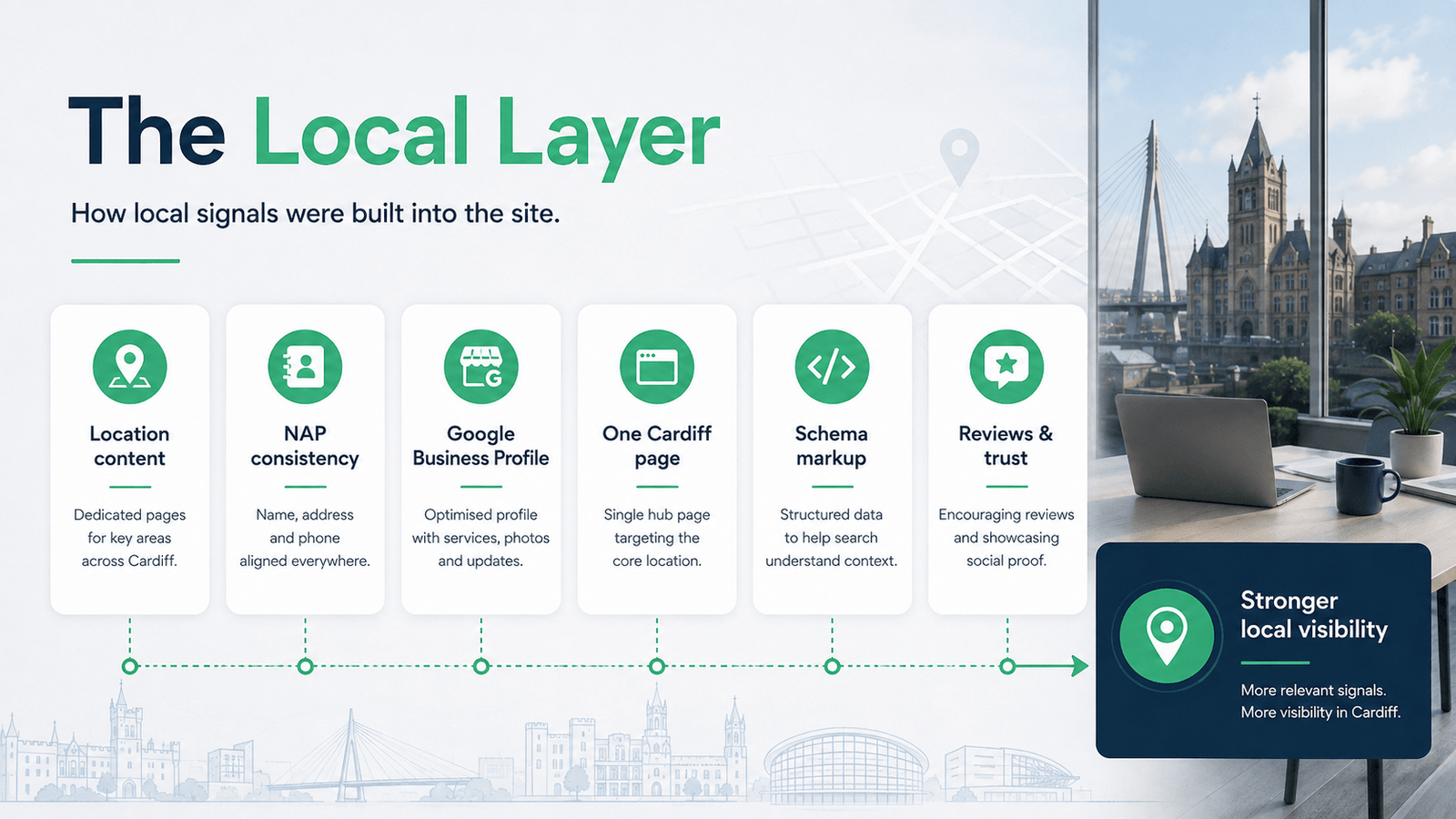
Proximity signals in the content. We connected location-based queries into the page copy rather than bolting a city name onto a title. Ffordd Pengam, Pengam Green, east Cardiff and the CF24 postcode all appear where they belong, because a page that mentions the actual street and district reads as local rather than as a page targeting a city.
Name, address and phone consistency. Alexandra Gate Business Centre, 2 Alexandra Gate, Ffordd Pengam, Cardiff CF24 2SA. That exact string, formatted identically, everywhere it appears. Inconsistent address data is the quietest and most common local ranking problem there is, because a search engine reconciling three versions of a business treats none of them as certain.
Google Business Profile. Categories set properly, services listed individually rather than lumped together, real photographs of the rooms, and regular posts. Profile work only started once the website errors were resolved.
A location page with a job. One Cardiff page, written to answer Cardiff-specific questions, rather than a set of thin doorway pages for every district in south Wales.
The result shows up in searches like “office space pengam green cardiff” at position two and “serviced offices cf24” at position six. Those are people searching by district and postcode, which is as close to a local buying signal as search gets.
One layer sits above all of this now. Close to a third of UK Google searches show an AI summary above the normal results, and more than half of adults say they see these summaries regularly, so a local business increasingly needs to be the source an assistant names rather than a link a searcher scrolls to. We have written about what that shift looks like on the ground in our piece on why Cardiff businesses are being found through AI answers before they are found in the map pack.
Step three: the content programme that answered the pre-booking questions
In July we published 21 articles in one release, roughly 62,500 words, on a domain that previously leaned on sixteen older posts.
It was the largest single content release the business had ever made. The articles were not written to keyword volume. They were written to the questions people type in the days before they book a viewing, sorted into four clusters:
- Cost and contract, six articles covering what a serviced office actually costs per month, serviced against managed against coworking, how to negotiate a deal, deposit and notice terms, flexible against traditional contracts, and what free parking does to the real cost.
- Offices and location, seven articles covering what a business centre provides that a landlord will not, how to upsize mid-term, how fast a move can happen, city centre against out-of-centre, what 24/7 access really means, a viewing checklist, and small office against coworking desk.
- Meeting and training rooms, three articles covering what a hire includes, training room against meeting room, and what a stated capacity really means.
- Virtual office and business address, five articles covering mail handling, choosing a package by business stage, call answering, home address against business mailbox, and why a UK address builds trust for online-first firms.
Every article carries a route to a booking page rather than sitting as a standalone read. Average length is just under 3,000 words and the longest, the viewing checklist, runs to 4,200.
The model was proven before it was scaled. Four guides written earlier already held position one on the questions they answer, which is why the twenty-one new pieces were built on the same pattern. This is the semantic SEO and topical-authority programme applied to a local service business, and the sequence behind it is set out in our walkthrough of the steps that take a site from scattered pages to recognised topical authority.
One honest note on timing. Search engines were still processing that release when the July report was written, so the position gains from it land in August and September rather than in the July figures. The 60% click rise happened before the new content had earned its rankings.
Why a single Cardiff business now beats the national portals
Rightmove, FreeOfficeFinder, TheOfficeProviders and EasyOffices sit above Alexandra Gate on the broad phrases. They are weak on the specific ones, and the specific ones are where the money is.
The pattern in the ranking data is consistent and it is the single most useful thing in this case study.
Searches with a number attached perform best. Two person, three person, six person and thirty person office searches all rank on page one, three of them in the top three. Somebody typing a headcount has already decided they need an office and is now sizing it. A national portal cannot write a page about a specific two-person room in Cardiff. The business that owns the room can.
Amenity beats generic. Free parking, 24/7 access, meeting room access and EV charging all rank, while the broad “office space cardiff” phrases stay with the portals. Free on-site parking is the thing that separates an out-of-centre Cardiff business centre from a city centre operator, and two of the nine position-one rankings are parking searches.
Written guides win their question outright. The meeting room hire guide, the all-inclusive rent guide, the PO box comparison and the virtual office explainer each hold position one. A directory listing cannot answer a question. An article can.
That is the whole strategy in three lines. Concede the head term. Take everything underneath it.
Score your own local search position in two minutes
Answer five questions about your business. You get a specific recommendation at the end, not a grade.
Question 1 of 5
How does your site score in Google’s PageSpeed Insights test on mobile?
Question 2 of 5
Is your name, address and phone number formatted identically everywhere online?
Question 3 of 5
Do you have pages targeting the qualified searches rather than the head term?
Question 4 of 5
When did you last update your Google Business Profile?
Question 5 of 5
Do you have content answering the questions people ask before they buy?
Your foundations hold. Spend on qualified coverage, not on fixes.
Your site and your profile are in good order, so a rebuild would waste your money. Your gain sits in the searches your competitors ignore: the amenity you can claim and they cannot, the sizes and specifics buyers type, and the three questions people ask you on the phone every week. Write those, route them at your enquiry page, and expect movement in six to twelve weeks.
Fix the profile and the address data first. They are free and they move fastest.
You have gaps in prominence rather than in relevance. Get your name, address and phone number identical across every listing, then rebuild the profile properly with individual services, real photographs and regular posts. Both cost nothing but time, and both feed the ranking factor you can actually influence. Content comes after that.
Do not buy local SEO yet. Fix the website first.
Buying local SEO now would be the wrong purchase, and we would tell you so on the call. A slow site with no qualified pages and a neglected profile cannot hold a ranking anybody wins for it. Start with a crawl audit, settle whether the site needs rebuilding or optimising, and only then spend on local. That order costs less and it is exactly what Alexandra Gate did.
Answer the first question to begin, or skip it and request a written SEO quote.
How to rank a local business: twelve things that actually work
Google weighs three things in local results, and knowing which of the three you can actually move saves a lot of wasted effort.
| Ranking factor | What it means | What you can do about it |
|---|---|---|
| Relevance | How well your business matches what was searched | Everything. Content, categories, services, structured data and the questions you answer. |
| Distance | How far you are from the searcher or the searched location | Nothing. Do not waste budget fighting geography. Target the districts you can genuinely serve. |
| Prominence | How well known and well referenced your business is | A great deal. Reviews, citations, consistent data, links, and a site that earns its own name. |
The twelve items below are drawn from this project and from the local work we run elsewhere. They are ordered roughly by return on effort.
- Fix the website before you spend a penny on local SEO. A slow, duplicated, thin site cannot hold a ranking you buy for it. Speed, single indexing and a logical heading structure come first, always.
- Concede the head term and take the qualified searches. You will not outrank a national directory for “plumber cardiff” or “office space cardiff”. You will outrank it for “emergency plumber cardiff sunday” and “serviced office for 2 person cardiff”, and those searches convert several times better. Sorting your query list this way is a job of intent rather than volume, and our guide to how keyword intent decides which page should rank for which stage of a local search sets out the method.
- Attach numbers to your service pages. Headcount, capacity, dimensions, quantity, duration. A page named for a specific size beats a page named for a category, because the person typing a number has already decided to buy.
- Lead with the amenity that separates you. Free parking, late opening, EV charging, disabled access, on-site staff. Whatever your nearest competitor cannot claim is your strongest local search asset. Two of Alexandra Gate’s nine number ones are parking searches.
- Make your name, address and phone number identical everywhere. Website, Google Business Profile, directories, social profiles, invoices. One string, one format. This is dull and it works.
- Use the street, the district and the postcode, not just the city. City-level targeting puts you in a fight with every business in the city. District and postcode targeting puts you in a much smaller fight, and it is where nearby buyers actually search.
- Treat your Google Business Profile as a page, not a listing. Correct primary category, every service listed individually, real photographs of the actual premises, opening hours kept accurate, and posts published regularly. Do this after the website is fixed, not before.
- Answer the question people ask the day before they buy. Not “our services” but “what does a meeting room hire include”, “what should all-inclusive rent cover”, “how fast can I move in”. These questions have low volume and enormous intent, and directories cannot answer them.
- Add local structured data. LocalBusiness markup with the address, decimal geo coordinates, opening hours, area served and the services you offer. It turns facts a human reads into facts a machine can act on.
- Collect reviews properly, and stay legal. UK consumer law banned fake and concealed-incentive reviews from April 2025, with penalties that can reach 10% of worldwide turnover and active enforcement from mid-2025. Ask real customers, at the right moment, and never incentivise without disclosing it.
- Optimise for mobile as the primary case. Local search is a phone behaviour. Around 95% of UK adults are online and spending on average about four and a half hours a day there, and a local buyer standing in a car park is not going to wait for a heavy homepage.
- Link your guides at your booking page, not at each other. Content that circles itself entertains. Content that funnels converts. Every one of the twenty-one Alexandra Gate articles routes to a page where a viewing can be booked.
The gap almost nobody in Wales is filling
Searches using “caerdydd” rather than “cardiff” produced 17,056 impressions across the year for Alexandra Gate and precisely zero clicks.
The phrase “serviced offices to rent in caerdydd” alone accounts for 3,939 of those, sitting at position 21. No page on the site used the Welsh place name anywhere.
The 2021 Census recorded close to 18% of people in Wales aged three and over as able to speak Welsh, and the Welsh Government has a stated target of a million speakers by 2050. Second-language search in Wales is real demand with almost no competition, and a single well-built page would face an empty field.
Every Welsh business should check this. Filter your Search Console query report for the Welsh form of your town and see what is sitting there earning impressions and no clicks. It took us one filter to find nearly seventeen thousand impressions nobody was serving.
Where the next growth sits, and why we are handing over
Three gaps remain and each has a different fix, but the next stage of growth for this business is not search.
Fourteen virtual office and business address searches sit between positions 9 and 15, which is the cheapest band to move because the ranking already exists. Meeting room, boardroom and training room searches are the widest gap on the site, on a business that has a modern boardroom and rooms taking up to 25 people. And the Welsh-language field is still empty.
The search foundation is built and it is holding. The next stage is social distribution and paid promotion across listing platforms like Rightmove, and that is a different specialism from ours. We do search, semantic structure and AI visibility. We are not a paid media agency and we do not pretend to be, so the account is being handed to a firm that does that work properly.
Saying what you are not good at is not a weakness in a case study. A client who is handed to the right specialist at the right moment is a client who keeps recommending you, which is exactly what happened here.
This applies to any local business with a physical catchment
The method is not specific to serviced offices. It is specific to businesses whose customers search with a place attached.
Dentists use it to own “emergency dentist” and treatment-plus-location searches while directories keep the generic term, and our local SEO for dentists work runs the identical structure. Letting and estate agents use it to take tenant-finding searches from the portals, exactly as Lets Rent Bristol now does with first-position terms for its core tenant searches. Hotels use amenity and proximity targeting for the same reason a business centre does. Accountancy practices use it for town-level and niche-level searches, which is how Total Books Accountants in Cardiff grew from roughly 200 to about 1,600 organic visits a month with an optimised Google Business Profile driving more than 80% of local visitors. Solicitors, healthcare providers, garages and trades all share the pattern.
A worked example from outside Cardiff shows the shape. A three-branch independent veterinary practice came to us ranking nowhere outside its own brand name, taking 40 organic enquiries a month across all three sites. It had one page per branch and nothing else. We built out-of-hours, species and treatment content per catchment, rebuilt the profiles, and fixed a duplicate-address problem across four directories. Eight months later the practice was taking 145 organic enquiries a month, and the out-of-hours pages alone produced a third of them.
The programme behind these rankings
Our local SEO service builds the website signals and the Google Business Profile as one job, so a nearby buyer finds your page rather than a directory listing of your competitors.
Frequently asked questions
How long does local SEO take to work?
Expect movement in six to twelve weeks and a settled position picture in six to nine months, on a site with no technical problems. Alexandra Gate needed a six-week rebuild first, because local SEO on a broken site produces nothing. Their enquiries had increased within months of the rebuild and the full ranking picture arrived across the following year.
Can a small local business really outrank Rightmove or a national directory?
Yes, on the searches that matter. Directories win broad phrases because they have thousands of pages and heavy authority. They lose specific ones, because they cannot write a page about your actual room, your actual parking or your actual opening hours. Alexandra Gate beats the portals on the searches people use when they are close to booking.
Do I need a new website, or can you optimise the one I have?
It depends on what the audit finds. A site with sound speed, clean indexing and a sensible structure can be optimised in place. A site failing Core Web Vitals with duplicate indexing, thin pages and images at 82% of page weight needs rebuilding first, and paying for ongoing SEO before that is fixed wastes the money.
Does a Google Business Profile matter more than the website?
They work together and neither substitutes for the other. Google’s own guidance weighs relevance, distance and prominence, and your website is a large part of both relevance and prominence. Optimise the profile after the site, because a profile pointing at a broken site inherits its problems.
Can you recover a site that lost rankings after a core update?
Usually, and the route is the same as building a good site in the first place. Core updates reassess quality rather than punish a specific act, so recovery comes from fixing speed, structure, duplication and thin content rather than from finding something to remove. Alexandra Gate lost ground after the May 2024 update and now holds 44 first-page Cardiff rankings.
Where to go next
Own your local searches
The programme that took a Pengam Green business centre past the national portals. Local and multi-location SEO.
Rebuild the site properly
Website and search foundation built as one job, so nothing has to be undone later. Optimised web design.
Working in Cardiff?
How we work with businesses across the city and south Wales. Our Cardiff SEO agency page.
True SEO Consultants Ltd, based at Startup Stiwdio, University of South Wales, 86-88 Adam Street, Cardiff, CF24 2FN, works with local businesses across Cardiff and south Wales, clients throughout the UK, and onboards worldwide through a fully remote digital onboarding and delivery process. Alexandra Gate sits about fifteen minutes from our studio, which helped, but nothing in this project required it.
We told Alexandra Gate not to buy ongoing SEO until the website was fixed, and we have told them we are the wrong firm for their next stage. That is the same advice we would give you.
Start here
Bring your website and your profile. We will tell you which one is costing you enquiries.
Thirty minutes, no charge, no obligation. Bring the two competitors who keep appearing above you and we will show you which of the qualified searches they are taking from you, and what it would take to get them back.