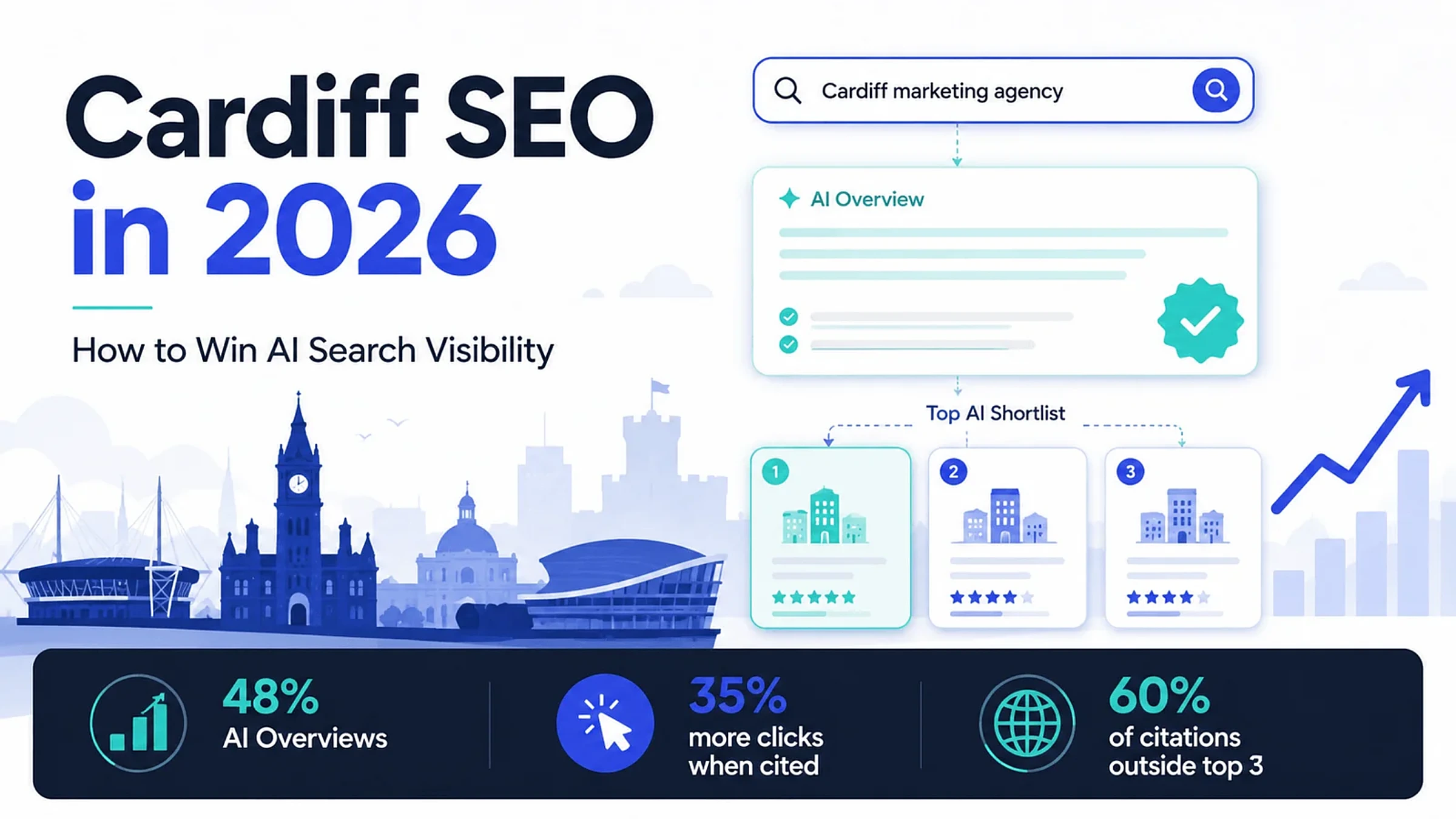
⚡In an AI answer there is no page two. Three firms get named, the rest are not there.
A Cardiff business gets named by AI search when its identity is consistent enough across the open web for an assistant to verify it twice, and its pages answer the exact question asked in sentences a model can lift whole. Adverts do not feed assistants. Neither, on their own, do rankings.
That is a different job from ranking, and most Cardiff websites have never been built for it.
This guide covers what being named means, which Welsh and Cardiff sources an assistant reads before it answers, whether you need a Cardiff address, and how to check where you stand today without paying anyone.
Key takeaways
- Being named inside an answer and ranking below one are separate outcomes with separate causes.
- Assistants verify a business against several independent sources before they will name it.
- Local corroboration in Cardiff comes from a short, checkable list of Welsh and UK sources.
- A Cardiff address decides the map pack, not whether an assistant names you in an answer.
- You can test your own visibility in about twenty minutes, with no tools and no budget.
- Clicks from AI answers are rare even when you are cited, so the value is the naming itself.
Want the check run properly, across the prompts your buyers actually use? Our AI and LLM search optimisation service rebuilds the entity layer that decides whether an assistant will name you, and the first thirty minutes cost nothing.
What does being named by AI search actually mean?
Being named means the assistant writes your business into its answer as a recommendation. Being cited means it links you as a source. Ranking means you appear in a list below the answer. They are three different outcomes, and Cardiff businesses routinely chase the third while their competitors quietly take the first.
| Outcome | What the buyer sees | What it takes | What it is worth |
|---|---|---|---|
| Named | Your business recommended inside the written answer | A verified entity plus corroboration | The enquiry, often without a click |
| Cited | A source link beside or beneath the answer | An extractable answer on a crawlable page | Low traffic, high trust |
| Ranked | A blue link under the answer box | Conventional content and links | Falling clicks where an answer appears |
The distinction matters commercially, because the traffic behaves differently. Pew Research Center’s analysis of 68,879 Google searches by 900 US adults in March 2025 found that people clicked a result on 8% of visits where an AI summary appeared, against 15% where none did. More striking for anyone hoping citation solves the problem: only 1% of those visits produced a click on a source inside the summary itself.
Read straight, that changes the goal. Citation is not a traffic strategy. Being named is a reputation strategy, and the enquiry arrives later, by phone or by a direct search for your name.
How does a Cardiff business get named by AI search?
By making one consistent entity out of its Cardiff address, category and credentials, then getting that same description onto the Welsh directories, press and profiles an assistant reads when someone asks for a firm in Cardiff.
Three conditions have to hold together. Miss one and the assistant hedges, names a competitor, or answers in generalities. Before an assistant answers, it often splits the question into several searches, which is why covering the sub-queries behind a buyer question matters.
One identity, stated the same way everywhere
Your legal name, trading name, address, phone number, categories and services have to agree across your own site, your Google Business Profile, Companies House, your professional body and every directory that lists you. A model that finds two versions of you does not pick the better one. It drops the ambiguous entity and names something it is sure about.
Corroboration from sources you do not control
An assistant will not stake an answer on your own marketing. It looks for the same facts stated somewhere else, which is why a regulator listing, a chamber of commerce entry or local press coverage carries weight your homepage cannot.
Answers it can lift without editing
A model quotes complete sentences. A page that opens a section with a direct answer, in plain words, gets used. A page that spends three paragraphs building to the point gets skipped, however good the third paragraph is.
That last one is where most Cardiff sites lose. The information is on the page. It is just not in a shape a machine can take.
Which Cardiff and Welsh sources does an AI assistant read?
Assistants read a short and surprisingly checkable list: your Google Business Profile, Companies House, your regulator or professional body, the established UK directories, Welsh and Cardiff business bodies, and local press. Each one either confirms your entity or contradicts it.
| Source | What it corroborates | Why it matters in Cardiff |
|---|---|---|
| Google Business Profile | Address, category, hours, reviews | The listing every other source gets checked against |
| Companies House | Legal name, registered address, directors, incorporation date | Statutory, so it outranks your own wording |
| Your regulator or professional body | That you are qualified to do what you claim | Decisive in accountancy, law and dentistry |
| Business Wales and Welsh business bodies | That you trade in Wales, not merely serve it | Distinguishes a Cardiff firm from a national one with a Cardiff page |
| Cardiff chambers and networks | Local, human corroboration | The signal a national directory cannot supply |
| Local and trade press | Named people, named work | Turns a company into an entity with a history |
| Bing Places and Apple Business Connect | Address and category, again | Feeds Copilot and Siri, which are not Google |
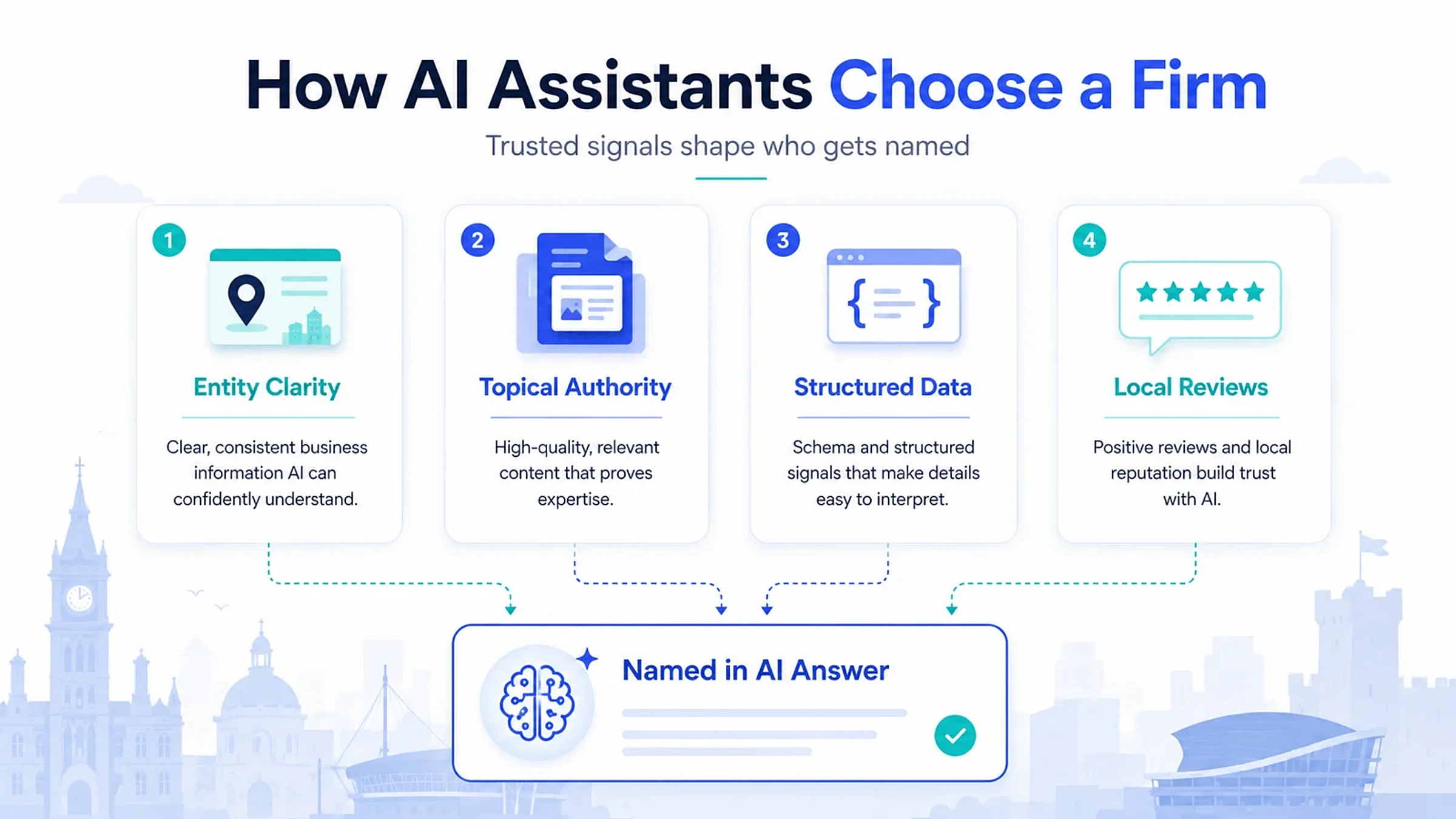
The practical move is dull and effective. Pick one exact string for your name, address and phone, publish it in schema on your own site, then correct every source above to match it character for character. One stale suite number on a directory nobody remembers signing up to is enough to make an assistant hedge.
Getting that corroboration layer right is the same work as building the topical authority an AI Overview is likely to cite, because both depend on a site covering its subject completely rather than repeating a phrase.
Do you need a Cardiff address to be named for a Cardiff question?
No, not for the written answer. Assistants answer a Cardiff question from content and corroboration, so a firm with no Cardiff office can be named if its material is the clearest on the subject. A verifiable Cardiff address is what decides the Google map pack, which is a separate surface with separate rules.
True SEO Consultants Ltd, Startup Stiwdio, University of South Wales, 86-88 Adam Street, Cardiff, CF24 2FN. Registered in England and Wales, number 16563516.
Covered in person:
- Cardiff
- Newport
- Swansea
- Caerphilly
- Bridgend
- Merthyr Tydfil
- Penarth
- Pontypridd
- Barry
- Cwmbran
- Rest of the UK, remotely
That single distinction settles most of the argument about service area businesses. It also explains why a Bristol or London firm can appear in an assistant’s Cardiff answer while never showing on the map, and why a Cardiff firm with a perfect profile can be missing from the answer entirely.
An address still helps the written answer indirectly. It gives you access to Welsh and Cardiff corroboration a remote firm cannot easily earn: the chamber entry, the local press mention, the reviews that name a Cardiff district.
There is a second reason to write your coverage down rather than draw it. A map on its own carries no text a crawler or an assistant can read, so the places you actually serve have to appear as words somewhere on the page. Ours are listed above. Write yours the same way, at district level where it matters, because “South Wales” tells an assistant far less than the ten towns it contains.
The same principle applies to the districts inside the city. A buyer asking about Cathays, Roath, Canton, Llanishen or Cardiff Bay is asking a narrower question than “Cardiff”, and a page that never names those districts cannot be the answer to it. This is the cheapest unclaimed ground on most Cardiff sites.
The commercial side of local visibility, the map pack and the profile work, sits with SEO for Cardiff businesses and our local and multi-location SEO programme. This page stays on the naming problem.
What stops a Cardiff business being named?
Four faults account for most of it, and none of them is about writing quality.
Contradiction
Two addresses, two trading names, a phone number that changed three years ago on half the web. The model cannot resolve which is true, so it names a firm it can resolve.
Invisibility to a parser
Services stated only inside an image, a homepage that never says what the business does in plain text, prices in a PDF. A human reads it fine. A machine gets nothing.
Buried answers
The question is answered, on the page, in the fourth paragraph, after the context. Models take the opening sentence of a section. Move the answer up and the same content starts getting used.
Unverifiable claims
A results figure with no source, no date and no method reads as marketing to a model, and an assistant will not repeat a fact it cannot attach to anything. A smaller, checkable claim beats a bigger, unsupported one, because only the checkable one can be repeated.
There is a fifth that is not your fault. Thin, mass-produced pages published to cover keywords actively weaken the entity, which is the argument in why pages drafted entirely by AI rarely earn the citation back. Volume is not the lever here.
How do you check whether AI names your Cardiff business today?
Run the prompts a real buyer would use, from a Cardiff connection, and write down what comes back. It takes about twenty minutes and costs nothing.
The twenty-minute self-check
- Write ten prompts a buyer would actually type. Not your keywords. Full questions: “who is a good accountant in Cardiff for a small limited company”, “best family solicitor near Cardiff city centre”, “recommend a letting agent in Cardiff Bay”.
- Run each one in at least three places. ChatGPT, Google AI Overviews and Gemini answer differently, and Copilot leans on Bing rather than Google. One platform is not a test.
- Record who gets named, not just whether you do. The competitor list is the useful half. It tells you which firms the assistant trusts and, usually, where that trust came from.
- Ask the assistant why. “What sources are you drawing on for that answer?” often returns the directories and pages doing the work.
- Repeat it monthly, on the same prompts. These answers move. A single snapshot tells you nothing about direction.
Two results are worth acting on immediately. An assistant that names you but describes you wrongly means you have a corroboration problem and a wrong fact is loose on the web. An assistant that names nobody local and answers in generalities means the whole Cardiff category is unclaimed, which is the best position on this page to find yourself in.
Two-minute self-check
Would an assistant name your Cardiff firm today? Five questions.
1. Do your name, address and phone details match across your site, Google and Companies House?
2. Does each service page open with a direct answer in plain text?
3. Can a machine read what you sell without opening an image or a PDF?
4. Does an independent source confirm what you claim about yourself?
5. Have you actually run the prompt test on your own firm?
Your next move
Rather skip the questions?
What does the 2026 data show about AI answers and clicks?
It shows answers spreading, clicks falling, and ranking mattering less than it used to for whether you appear inside the answer.
| Finding | Figure | Source |
|---|---|---|
| US Google searches ending without a click, January to April 2026 | 68.01%, up from 60.45% in 2024 | SparkToro with Datos, on Similarweb panel data |
| Clicks on a result with an AI summary, against without | 8% against 15% of visits | Pew Research Center, 900 US adults, March 2025 |
| Clicks on a source cited inside an AI summary | 1% of visits | Pew Research Center, same study |
| Growth in AI Overview coverage, February 2025 to February 2026 | Up 58%, now on close to half of tracked queries | BrightEdge |
| AI Overview citations from pages ranking in the organic top ten | 38%, down from 76% | Ahrefs |
| Clicks per impression, cited against uncited pages on AI Overview results | About 120% more, though still 38% behind results with no AI Overview | Seer Interactive, 5.47 million queries across 53 brands |
Two of those deserve reading twice. Ahrefs finding that only 38% of citations now come from top-ten pages, down from 76%, is the opening for a smaller Cardiff firm: a page that answers the question better can be quoted without outranking anyone. And Seer’s figure cuts both ways, because being cited roughly doubles clicks per impression against not being cited, while an AI Overview appearing at all still costs you against a plain results page.
Close to a third of UK Google searches now show an AI summary above the normal results, and more than half of UK adults say they see these summaries regularly. The direction is not in question.
Which Cardiff sectors does AI search decide first?
The regulated professions, because their buyers research before they ring, and Cardiff has an unusual concentration of exactly those. Invest Cardiff reports 53,000 people employed in financial and professional services in the city, with finance and insurance alone accounting for 11.7% of local output.
- Accountancy practices face the sharpest version. A buyer asking an assistant whether they need an accountant for self assessment is being handed a shortlist before any firm knows the question was asked, and there are roughly 30,000 accountancy and audit firms in the UK, most describing themselves identically.
- Law firms see it in employment, family and conveyancing questions, where the problem gets researched with an assistant long before a solicitor is called.
- Dental and healthcare practices field treatment questions constantly, and a clear structured answer on a single treatment is often what decides whether a clinic is named.
- Letting and estate agents get pulled into “where should I rent in Cardiff” style questions that lean heavily on reviews and location data, and it remains the softest large market in the city.
- Hotels and hospitality appear in destination answers built almost entirely from third-party corroboration, which is why a property with thin site content and strong reviews can outperform the reverse.
Our SEO for accountants work starts from the niche for exactly this reason. Across all five sectors the pattern holds: reviews that name the service and the area do more work than reviews that say “great service”. The mechanics are in how recent, specific reviews feed the local entity signals AI answers lean on. Since April 2025, fake and concealed-incentive reviews have been banned under UK consumer law, with penalties reaching ten per cent of worldwide turnover, so the only route left is asking properly and often.
Worked illustration, not a named client case
Ranked seventh, never named, and rank was not the cause
The figures below are representative of a pattern we see rather than a record of one account. A Cardiff accountancy practice sat around position seven for its main city term and picked up steady traffic, yet no assistant ever named it. Its services existed only inside a homepage graphic, its Google profile listed it as a business consultant, and its Companies House address and website footer disagreed. Correcting the category, restating one address everywhere, rewriting each service page to open with a direct answer, and restarting a genuine review habit moved it into assistant answers for three of its services inside a quarter. Nothing about that work required outranking anybody.
This is the work True SEO Consultants Ltd runs as a service: entity clarity, answer-first content, structured data and a live review habit, built so assistants name your Cardiff firm rather than skip it.
Frequently asked questions
How does a Cardiff business get named by AI search?
By making one consistent entity out of its Cardiff address, category and credentials, then getting that same description onto the Welsh directories, press and profiles an assistant reads when someone asks for a firm in Cardiff. Adverts and rankings do not feed assistants directly.
Do you need a Cardiff address to be named by an AI assistant?
No. The written answer is decided by content and corroboration, so a firm without a Cardiff office can still be named. A verifiable Cardiff address decides the Google map pack, which is a separate surface with separate rules.
Is being cited by an AI answer the same as being named in one?
No. Cited means the assistant links you as a source. Named means it recommends you inside the answer. Pew Research Center found only 1% of visits involving an AI summary produced a click on a cited source, so naming carries the commercial value.
How do you check whether ChatGPT or Gemini mentions your Cardiff business?
Write ten questions a buyer would actually type, run each in ChatGPT, Google AI Overviews and Gemini from a Cardiff connection, record who gets named, and ask the assistant which sources it used. Repeat monthly on the same prompts, because the answers move.
How long does it take to start appearing in AI answers?
Entity corrections such as categories, addresses and structured data can register within weeks. Corroboration from directories, professional bodies and press takes longer, so a realistic window is one to two quarters rather than years.
Where this leaves a Cardiff business
The firms that get named in Cardiff will not be the ones repeating a phrase the most times. They will be the ones a machine can identify, verify against an independent source, and quote without editing. That is buildable, and the sector data suggests most Cardiff competitors have not started.
True SEO Consultants Ltd works from Startup Stiwdio, University of South Wales, 86-88 Adam Street, Cardiff, CF24 2FN, under company number 16563516. We work with businesses across the UK from that Cardiff base, and we onboard clients worldwide through a fully remote digital onboarding and delivery process, so the work described here applies whether you trade in Cathays, Penarth or Manchester. The method is topical authority, technical SEO and entity work, never bought links.
Curious which prompts name your competitors and not you? Our AI and LLM search work starts with exactly that audit. If cost is the question you came with, our guide to what UK SEO actually costs answers it properly, and the people behind the consultancy are on the about page.
Featured services
Where True SEO Consultants Ltd takes this work next for a Cardiff business.
AI and LLM SEO
Get named and cited by ChatGPT, Gemini, Perplexity and AI Overviews.
Explore the AI search programmeSemantic SEO and Topical Authority
Cover a subject so completely that search engines treat you as the source.
Build topical authorityTechnical and On-Page SEO
Schema, speed and structure that make a site easy for a machine to read.
Make your site machine-legibleCardiff SEO
The local strategy built for the density and rivalry of the Welsh capital.
See the Cardiff consultancy workLocal and Multi-Location SEO
Win the map pack and the local answers buyers near you actually see.
Compete in every postcodeProductised offer
Topical Map for SEO
Want the plan without a retainer? True SEO Consultants Ltd builds the full set of pages and questions your Cardiff site needs to cover so assistants read it as the authority. A one-off deliverable you can hand to any writer.
Cardiff, UK wide, worldwide remote
Be the Cardiff firm an assistant names, not the one it cannot identify
The first thirty minutes cost nothing, and you leave with the prompts your buyers use, the firms currently named instead of you, and the three fixes worth doing first.