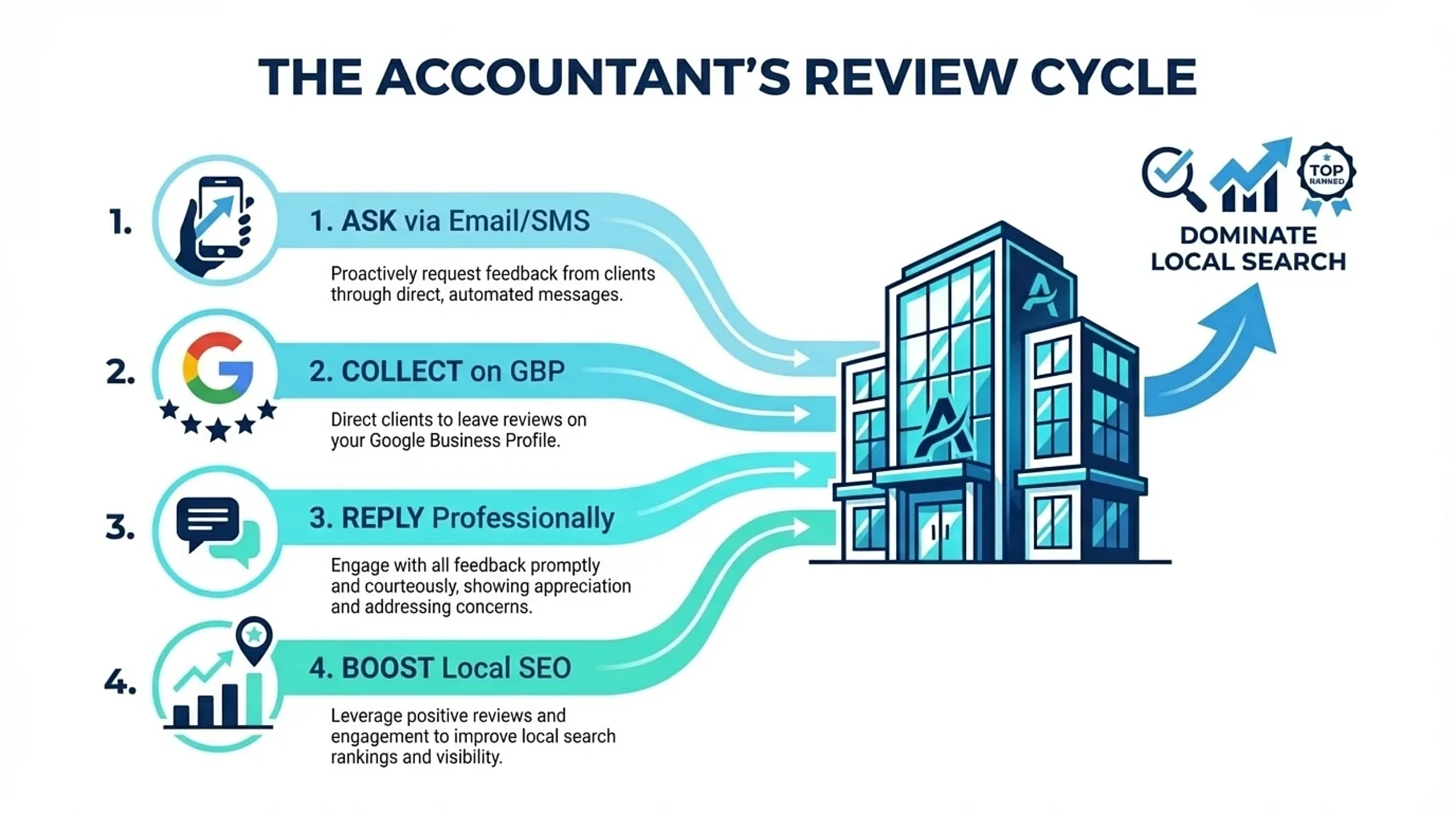
Most accountants we work with are quietly brilliant at the job and almost invisible in public. The return gets filed. The VAT mess gets cleaned up. The year-end lands without drama, and then nothing. No review, no public proof, nothing for the next nervous business owner to find when they go looking. Meanwhile the firm two streets over has forty recent reviews and is fielding the enquiries that should have been yours.
That gap is fixable, and fixing it does more than tidy your reputation. Recent, specific reviews get you trusted before anyone reads a word of your website. They feed how high you sit in local search. And they increasingly decide whether an AI assistant bothers to name you when someone asks it to recommend an accountant. So this guide starts where you actually want to start, with how to get more reviews, then works through everything around that answer: what a strong review looks like, how to reply so the replies pull their own weight in search, and how the whole lot plugs into your local visibility. We run SEO for accountants as our main sector, so all of it is written for practice principals, fractional finance directors and independent accountants.
Key takeaways
- Ask at the moment of value. The day a return is filed, a year-end is signed off or an HMRC problem is solved is when a client is most willing to write a review.
- Remove every bit of friction. One direct Google review link, a QR code on invoices and in the office, and a link in your email signature beat any clever campaign.
- Automate the request. Trigger it off job completion through your practice software or CRM so it goes out every time, not just when someone remembers.
- Never pay for reviews or screen them. Incentivised and hidden reviews have been illegal in the UK since April 2025, and filtering to only-happy clients breaks Google’s rules.
- Reply to everything, with substance. Google reads your replies as content, so a response that names the service and your area helps you rank and helps AI search cite you.
- Recency and detail beat volume. Ten specific, recent reviews out-pull fifty old one-liners.
- Reuse your best reviews. Put service-matched testimonials on the right service pages, location pages and proposals.
Reading this and realising your profile has gone quiet? In a free 30-minute call we will pull up your Google Business Profile with you, find the gaps, and hand you the three fixes that move the needle first.
Get my free 30-minute review checkWhy reviews decide which accountant a client picks
Accounting is a trust purchase, which is exactly why reviews carry more weight here than they do for almost any local business. Nobody hands over their tax affairs, payroll or company accounts on a whim. They check first. A public record of other clients vouching for you is the quickest way to settle the nerves a prospect arrives with.
And the checking never stops now. Roughly 95% of UK adults are online, spending something like four and a half hours a day there. So by the time someone types “accountant near me” or “pharmacy accountant Cardiff”, they have usually half-decided already. Your Google Business Profile is what they hit first, and it either backs up that half-decision or quietly ends it. Star rating, how many reviews, how recent the last one is, whether you bothered to reply: all of it registers before they ever reach your homepage.
There is a newer reason to care. Close to a third of UK Google searches now show an AI summary above the normal results, and more than half of adults say they see those summaries regularly. AI search builds its answers from sources it already trusts, and a deep, genuine review profile is one of those trust signals. Reviews no longer just win the click. They help decide whether you make the answer at all.
The chain from there is short. More trust, more clicks. More clicks, more enquiries. Better enquiries, the kind of long-term advisory clients you actually want to keep. One Cardiff firm we worked with went from around 20 online enquiries a month to over 100 after we rebuilt their visibility and trust signals together. Reviews were part of that engine, not a bolt-on.
How to get more Google reviews for your accountancy firm
You get more reviews by asking every satisfied client at the moment a job finishes, making it take ten seconds, and automating the request so it goes out the same way every time. That is the whole formula. Everything below is just how to run it well.
Ask when the client feels the value
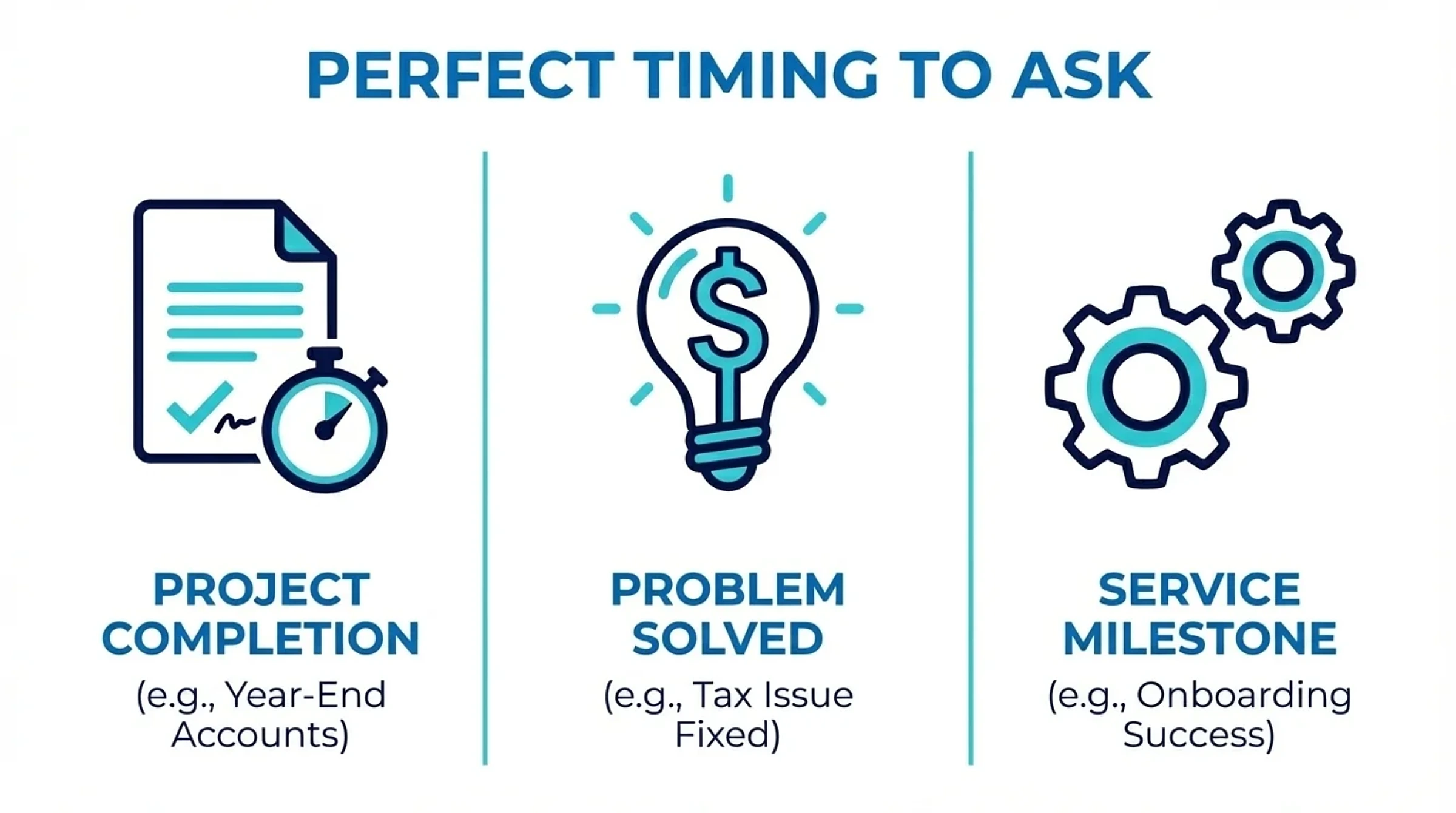
Timing does most of the work. A request that lands the day you file a return, sign off a year-end, complete a VAT registration or rescue a payroll run catches the client while the relief or satisfaction is still fresh. Problem-solving moments are the strongest of all. The business owner whose HMRC penalty letter you just dealt with will write you a far better review than one you catch on a flat Tuesday in March, because the feeling is real and recent.
Relationship milestones give you structured reasons to ask without it feeling random: the three-month check-in, the first anniversary, a smooth renewal. Whatever the trigger, lead with the client’s benefit. “Honest reviews help other business owners find an accountant they can trust” reframes the ask as something useful rather than a favour. Then ask with a straight face. You did real work. Asking for feedback on it is not begging.
Make leaving a review effortless
Every extra step costs you reviews. The fix is to put a single, direct link in front of the client wherever they already are.
Generate your Google review link once and reuse it everywhere. Drop it into your email signature so it rides on every message you send. Put a QR code on your invoices, on a small card on the meeting-room desk, and on the thank-you page people see after submitting an enquiry form. A client who can scan a code while they wait for their coffee will leave a review. A client who has to go and find your listing later usually will not. Keep the path to one tap.
Use more than one channel
A single method gets a single slice of your clients. Email is the workhorse, since it fits how you already talk to people, and a short thank-you with one link the day a job completes does most of the lifting. Text works for warmer relationships and tends to get acted on faster. For your higher-value clients, a quick verbal ask at the end of a positive call, followed by the link while the goodwill is warm, converts better than anything automated. Portal prompts and project-close messages catch people at exactly the right point. And the in-person ask at a handover still beats the lot, because it is hard to say no to someone you trust sitting across the table.
The review-request email that gets a click
Keep it short, keep it personal, ask for one thing. A polished marketing email performs worse here than three plain sentences from a person the client already deals with.
Use a human subject line. “A quick favour” or “Thank you for working with us” beats anything that smells like a campaign. Open by naming the actual work you just did, so the message reads as a continuation of your relationship rather than a blast. Then one direct review link and one line on why it helps. No menu of options. No three-paragraph wind-up. Busy clients tap the thing that takes ten seconds and ignore the thing that looks like effort.
Automate the ask so it happens whether you remember or not
The firms with the strongest review profiles are rarely the ones with the best intentions. They are the ones who took the decision out of human memory. January is when you have the most happy clients and the least time to ask them, so the request has to fire on its own.
Build the ask into your job-completion workflow. The moment a return is marked filed or an onboarding is closed, a templated email or text goes out, with one polite chase a few days later if there is no response. Most practice-management and CRM systems can do this on a trigger, and there are tools built purely for review collection that slot in alongside them. Set it once and it runs in the background while you work. It is the foundation of the review system covered at the end of this guide.
Do not configure the system to ask only the clients you expect to praise you, and never screen feedback before it reaches Google. That is review gating, and it breaks Google’s policies. Ask everyone who had a genuine result, let the profile tell the truth, and fix the service problems that produce the occasional low score rather than hiding from them.
Reviews only appear as stars in search when the markup supports them. Schema markup for accountancy websites covers where review, aggregate rating and organisation data belong, and the mistakes that get rich results withdrawn once Google looks closely.
What makes a good accountancy review, and why specifics matter
A good review names the job, names the result, and sounds like a real person. “Great service, highly recommend” reassures nobody and tells Google nothing. The reviews that win you the next client are specific.
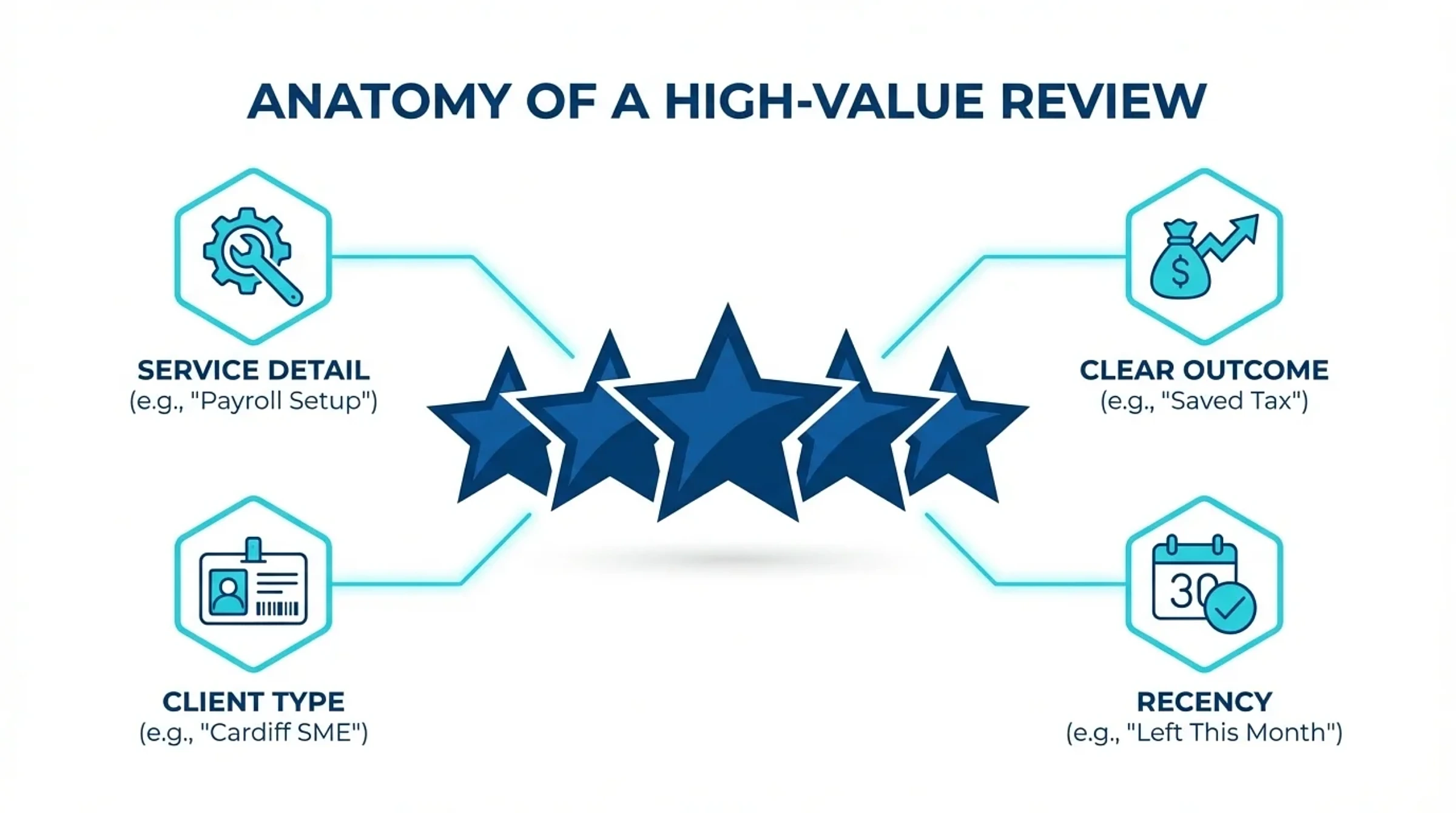
Service detail does the heavy lifting. A self-assessment sorted at the last minute. A payroll setup that finally runs clean. A VAT registration handled without stress. Year-end accounts delivered early for once. Each gives the reader something concrete to recognise, and each quietly feeds your search relevance, because clients writing naturally use the exact terms prospects type. That overlap between review language and the keywords accountancy clients actually search is free relevance you cannot buy.
Outcome detail makes it persuasive. “Saved me a fortune on corporation tax” or “I finally understand my own numbers” lands harder than any adjective. Client type and place add the last layer. A review from a landlord, a pharmacy owner, an IR35 contractor or a startup founder in your city tells a similar reader: this firm gets people like me.
The strongest review we have ever earned came from the principal of a pharmacy-accounting practice we ranked to the top of Google. He named the timeframe, the number of keywords, the AI-search wins and the return, all in his own words.
That is the template. Not because it flatters us, but because it is impossible to fake and easy for the next pharmacy owner to believe.
How many Google reviews does your firm actually need?
Enough to look established next to the firms a prospect is comparing you with. There is no universal number, because the benchmark is local and sector-specific. A village sole practitioner and a multi-office practice chasing national fractional-FD work need very different profiles, so the honest answer comes from looking at who you actually compete against and matching them.
In that crowd, a thin or stale profile reads as “not really active”, whatever the reality is. Two things matter more than the raw total. Recency, because fifteen reviews with fresh activity beat thirty that all date from two years ago. And quality, because ten detailed, service-specific reviews from real clients out-persuade fifty one-line “great service” comments. Aim for a steady trickle you can keep up, not one heroic month followed by silence. A natural, even flow of reviews also looks more credible to Google than a sudden spike, which is one more reason to automate the ask rather than run occasional drives.
Why recency and quality, not volume, move your local rankings
Fresh, detailed, relevant reviews influence local search far more than a big number does. Google reads a review profile as a live signal of whether a business is active, genuine and trusted right now, and recency and substance are how it judges that.
Recency works on two fronts. A prospect feels uneasy when your newest review is eighteen months old, and a profile that keeps gaining recent, specific feedback simply reads as a healthier business. Quality works through relevance. When clients mention payroll, bookkeeping, VAT, self-assessment or company accounts in their own words, and reference a real place like Cardiff or South Wales, your profile fills up with the exact terms and entities that tie you to your sector and your patch. That is the same principle behind semantic SEO and topical authority: genuine, specific, connected signals tell search engines what you do and who you serve.
The flip side is a warning. A profile packed with near-identical, oddly worded, suspiciously similar reviews looks manipulated to people and platforms alike, and given the current enforcement climate that is a risk, not a shortcut. Real reviews are uneven, specific and human. Keep them that way.
How to reply to reviews, and why your replies rank too
Reply to every review, quickly and professionally, because your replies are read as carefully as the reviews. A live profile with thoughtful responses signals a managed, attentive firm. A wall of unanswered reviews, good or bad, signals the opposite.
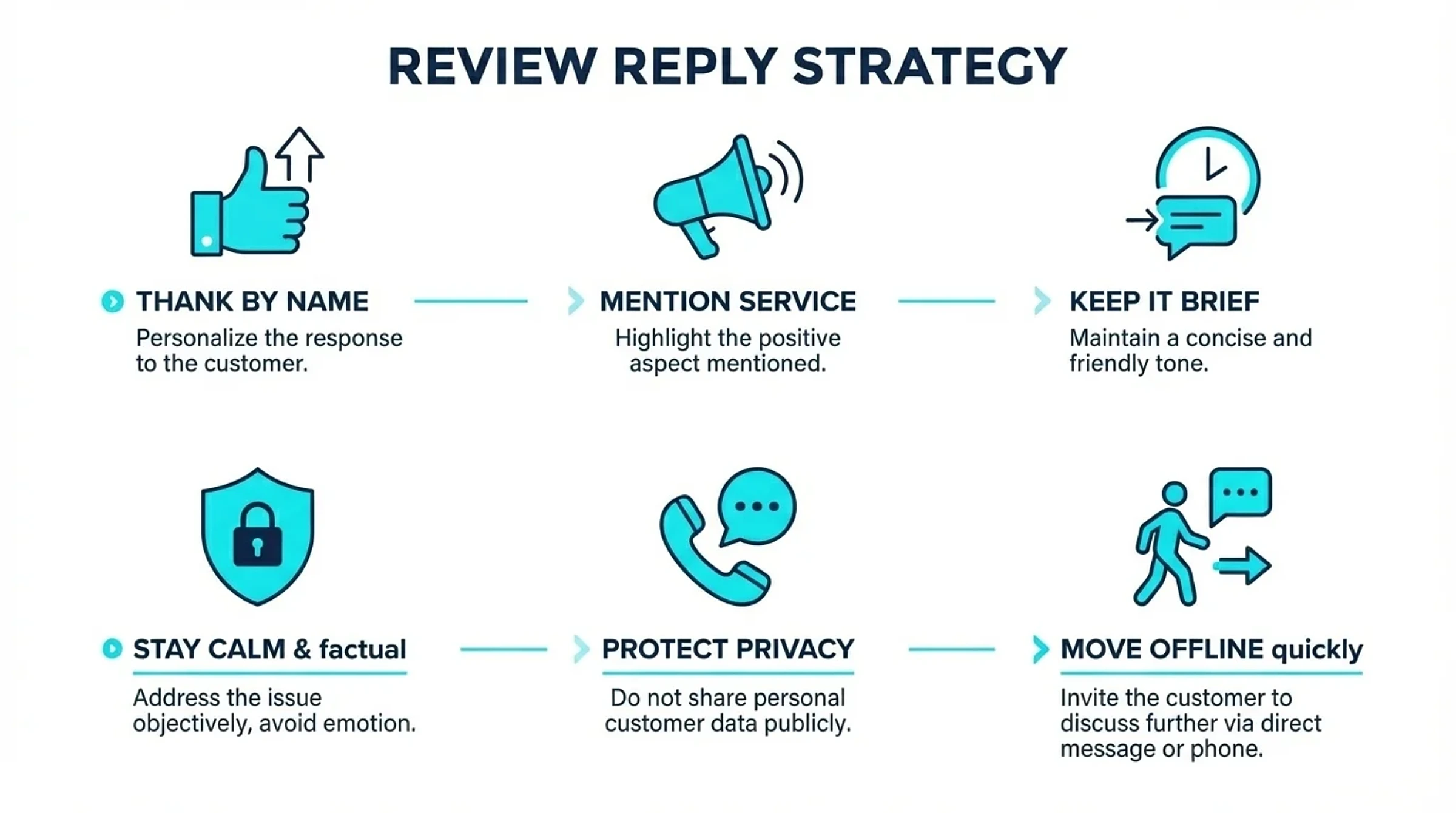
Google reads your replies, not just the reviews, and treats the words in them as content. When you respond to a client and mention “self-assessment”, “fractional finance director” or “Cardiff” because they fit, you are adding relevant terms to your own profile that help it match those searches. That same plain, on-topic text is the kind of language AI Overviews and tools like ChatGPT lean on when they decide which firm to cite.
So a good reply does double duty: it reassures the next human reader and it strengthens the signals that get you found. Write like a person, never like a keyword machine, but know that a thoughtful reply naming the actual work is quietly earning its place.
Speed counts as well. Reply within a couple of days while the review is fresh. A profile that answers promptly looks managed, and a steady drip of recent replies is itself an activity signal Google notices. Letting reviews sit untouched for months tells everyone the firm has stopped paying attention.
Replying to positive reviews
Thank the client, reference the specific work they mentioned, keep it warm but measured. “Thanks for trusting us with the practice payroll, glad it is running smoothly now” beats a generic “thank you for your kind words”, because it is clearly written to a real person about a real job, and it carries the service term. Skip the sales pitch. Brief, specific and genuine is the register that suits an accountancy firm.
Replying to negative reviews
Stay calm, stay short, and never argue in public. Accountancy runs on confidential financial information, so a reply must never expose client details, figures or circumstances, even to defend yourself. Acknowledge the frustration, hold off on admitting fault until you have checked the facts, and invite the person to continue the conversation directly. Prospective clients judge you on how you behave under pressure far more than on the one-star itself. Measured restraint protects your reputation better than winning the argument ever could. Then deal with the underlying cause, because the best negative-review strategy is fixing the thing that caused it.
Handling fake or unfair reviews
Check the facts against your own records first, then report a clearly false or abusive review to the platform. Reporting does not guarantee removal, but it is the right first move. While it stays visible, a short, professional note that you cannot match the review to any client and would welcome direct contact is usually the safest public response. One caution worth repeating: you cannot simply hide or suppress genuine negative reviews, because doing so is now a banned practice in its own right. Report what is actually fake. Answer what is real.
Should accountants pay for or incentivise reviews?
No. Do not pay for reviews, and do not offer fee discounts, vouchers or freebies in exchange for them. Beyond the obvious hit to credibility, this is now a legal matter in the UK, and a firm that advises clients on compliance is the last one that should get it wrong.
Since April 2025, fake and concealed-incentive reviews are banned outright under UK consumer law. Submitting fake reviews, commissioning them, hiding genuine negative ones, or rewarding a review without clearly disclosing the incentive are all treated as automatically unfair, with penalties that can reach 10% of worldwide turnover. The regulator moved from guidance to active enforcement in mid-2025 and has been working through businesses whose review practices do not hold up.
The honest route is also the stronger one. Good timing, a clear link and a polite, well-framed ask earn plenty of reviews when the work has genuinely been good. Encourage your team to ask consistently as part of client care, by all means. What you cannot do is buy the result. Better systems beat gimmicks every time, and they keep your firm off a regulator’s list.
Where else to collect reviews, and how to reuse the best ones
Google comes first, but a complete strategy spreads proof across a few trusted places and reuses your best reviews wherever a prospect makes a decision. Your Google Business Profile sits at the centre of local intent, so it takes priority. Around it, LinkedIn recommendations carry real weight for fractional FDs and advisory-led practices, while Facebook, professional-body profiles and accounting-software partner pages help where your audience already spends time.
The bigger win is reuse. One strong review can work on your homepage, on a service page, inside a proposal and in an enquiry follow-up. Match the review to the intent: a bookkeeping testimonial on the bookkeeping page, a self-assessment one beside your tax content, a fractional-FD review on the advisory page. Service-matched proof converts better, because the visitor sees evidence tied to the exact need already in their head. You can fold the same testimonials into your accounting blog content and your local SEO pages, so trust you earned once keeps working across the whole site.
How reviews feed your Google and AI search visibility
Reviews lift visibility before the click, during the click, and now inside AI answers. In the local pack, a profile with a stronger rating and fresher reviews stands out, and searchers comparing three nearby firms tend to pick the one that looks safest and most active. On brand searches, where someone who heard your name at a networking event looks you up, a solid profile turns curiosity into a call.
The AI layer is where this is heading. Assistants and AI Overviews assemble answers from sources they trust, and they look for agreement across several places before naming a brand. A consistent, genuine review presence is part of that corroboration, alongside everything else that marks you as a recognised entity, including the language in your review replies. Helping accountancy clients earn that kind of citation is exactly why we treat reviews as part of getting found in AI Overviews and voice search, not as a separate vanity exercise.
Every win prompts the next ask, so the engine compounds month after month.
Not sure how your reviews and local visibility stack up against the firm down the road? Spend 30 minutes with us, free, and we will show you exactly where you stand and the gap worth closing first.
Compare your visibility, freeThe local SEO signals that sit around your review profile
Reviews are one signal among several, and they work best when the rest of your local SEO is in order. A glowing profile attached to a thin, slow website still leaks enquiries, so the review programme has to sit inside a wider structure.
Your Google Business Profile needs the basics done properly: accurate categories, real services, current hours, genuine photos, and regular posts that show the firm is alive. Your website needs local landing pages with real substance rather than swapped place names, clean internal linking and local schema. Citations need to stay consistent, so your name, address and phone number match everywhere they appear. Local relevance grows when recognised local organisations, chambers, business networks and partners reference you. Total Books Accountants in Cardiff, one of the firms we have worked with, ended up with their optimised Google Business Profile driving more than 80% of their local visitors once these pieces lined up. Reviews carried part of that. Only part.
If you want all of this wired together properly for an accountancy practice, that is the job our accountancy SEO service is built to do.
Building a review system that runs without you
The firms that win at reviews treat it as a system, not a memory test. Goodwill alone never produces a steady profile, because the busiest weeks are exactly the weeks everyone forgets to ask. A simple operating system fixes that, and it is mostly the automation from earlier given a process to live in.
Define your trigger points first: filed returns, completed year-ends, finished payroll setups, solved HMRC problems, successful VAT registrations. Give one person clear ownership, a partner, account manager or admin lead, so the process survives a busy January. Prepare the templates once, the email, the text, the direct link and the reply templates for positive and negative feedback, so nobody is writing from scratch under pressure. Then track the basics monthly: requests sent, reviews received, replies posted, and which services keep coming up.
A light rhythm keeps it alive. First week, spot the recently happy clients. Second week, send the requests. Third week, manage the replies. Fourth week, fold fresh testimonials into your service and location pages. None of it is complicated. The discipline is the point.
That discipline matters more in a market this size. The UK’s 5.7 million SMEs compare providers constantly, and the accountancy firms that stay visible and credible are the ones treating reviews as part of the client journey rather than an afterthought. Both of our directors come from inside finance, which is why we build this the way an accountant would. Mohammad is an ACCA-qualified accountant who has worked in practice. Julie is a fractional CFO and certified business coach. You can read more about Mohammad and Julie’s background if you want to know who you would be working with.
Frequently asked questions
How do I get more Google reviews for my accountancy firm?
Ask every satisfied client the moment a job completes, make it effortless with a single direct review link, and use more than one channel. A short email or text the day you file a return, a quick verbal ask at the end of a positive call, and a portal prompt at project close together produce far more reviews than waiting for clients to think of it themselves. Then automate the request so it fires off job completion every time.
Is it against the rules to offer clients something for a review?
Yes, if the incentive is hidden. Since April 2025, rewarding reviews without clearly disclosing the incentive, paying for reviews, and hiding genuine negative ones are all banned under UK consumer law, with serious penalties. Stick to a genuine, well-timed, polite request after good work. It earns plenty of reviews and keeps your firm fully compliant.
Do my replies to reviews actually help my SEO?
Yes. Google reads owner responses as content, so a reply that naturally mentions the service and your area adds relevant terms to your profile and helps it match those searches. That same text feeds the language AI Overviews and assistants use when deciding which firm to cite. Reply like a human, reference the real work, and never stuff keywords.
How should I respond to a bad review without breaching client confidentiality?
Stay calm and brief, acknowledge the frustration without admitting fault before you have the facts, and never mention any client details, figures or specifics in public. Invite the person to continue the conversation directly so you can resolve it offline. Prospects judge your professionalism by the tone of the reply far more than by the complaint itself.
How many reviews do I need to compete locally?
Enough to look established next to the firms a prospect is comparing you with, which depends entirely on your area and niche. Look at your direct competitors, then aim to match their volume while beating them on recency and detail. A steady flow of specific, current reviews beats a larger pile of old, vague ones every time.
If your firm does excellent work but disappears at the moment of choice, reviews are usually the fastest fix, and they sit at the heart of what we do as an accountancy SEO consultancy in Cardiff and across the UK.

True SEO is a Cardiff-based semantic SEO consultancy, led by an ACCA-qualified accountant and a fractional CFO. We work with accountancy firms right across the UK from our Cardiff base, and onboard clients worldwide through a fully remote, digital process, turning search visibility into real enquiries through topical authority, technical SEO and AI-search readiness, never bought links.
Table of Contents
- Key takeaways
- Why reviews decide which accountant a client picks
- How to get more Google reviews for your accountancy firm
- What makes a good accountancy review, and why specifics matter
- How many Google reviews does your firm actually need?
- Why recency and quality, not volume, move your local rankings
- How to reply to reviews, and why your replies rank too
- Should accountants pay for or incentivise reviews?
- Where else to collect reviews, and how to reuse the best ones
- How reviews feed your Google and AI search visibility
- The local SEO signals that sit around your review profile
- Building a review system that runs without you
- Frequently asked questions