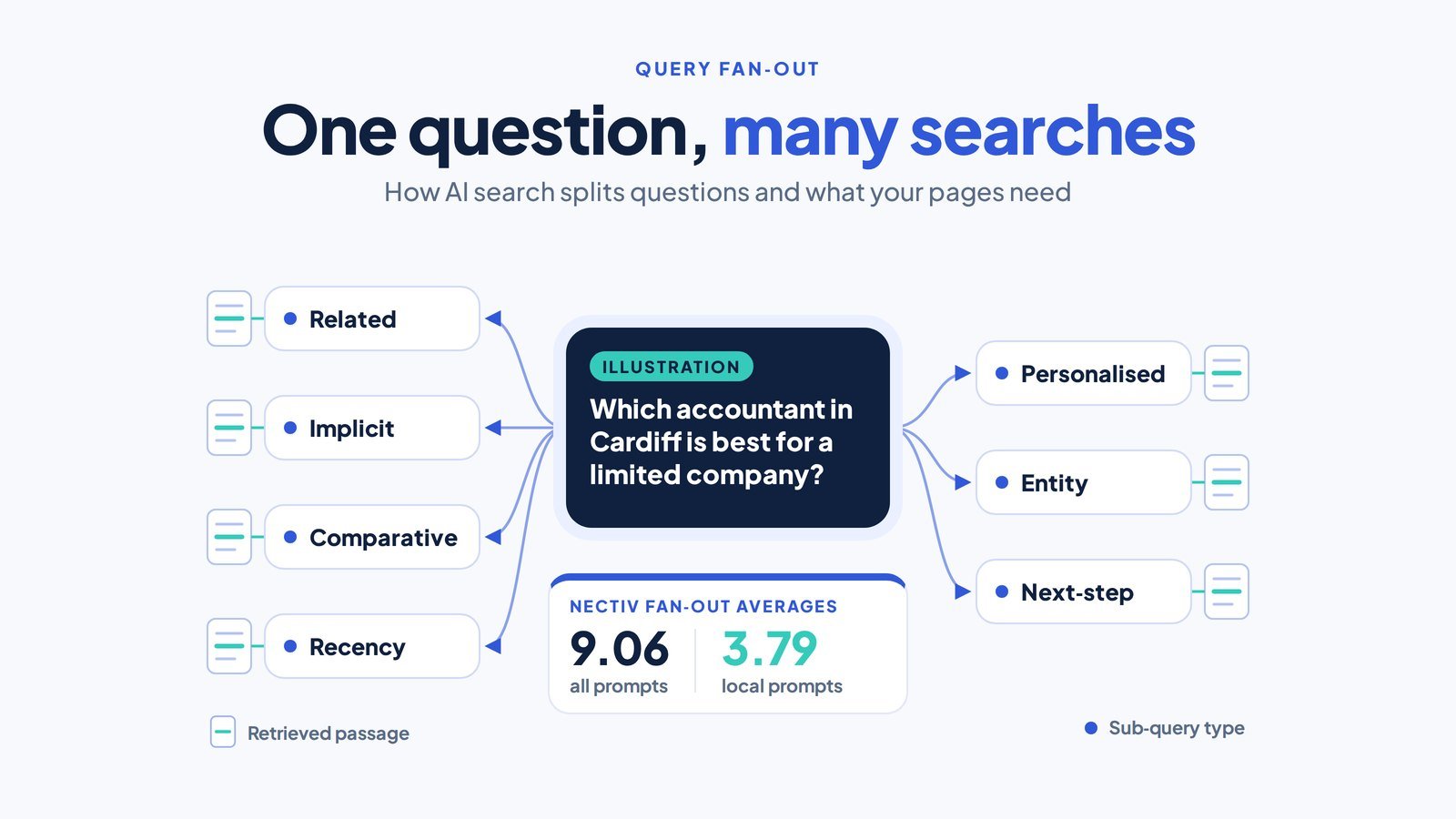
Query fan-out is the technique AI search systems such as Google AI Mode and ChatGPT search use to split one question into several related searches, run them at the same time and build one answer from the pages those searches retrieve. Your page becomes a candidate when it ranks for one of those hidden sub-queries and answers it in a passage. The job is to predict the sub-queries behind your buyer’s question and decide which page, section, table row or FAQ answers each one.
That’s why your page can rank for the question you care about and still be missing from the AI answer, which can draw on searches your page never targeted: the cost, the comparison, this year’s rules. You’ll hear advice to add schema, llms.txt or a page for every AI query. Google says none of those is required, and one can breach its spam policy. This guide shows how fan-out works, what Google rules out and how to map sub-queries, with a scored example.
Key Takeaways
- Query fan-out turns one question into many concurrent searches; Google says AI Overviews “may use” it.
- Nectiv’s API studies measured 9.06 Google fan-out queries per prompt (3.79 for local prompts) and 7.61 for ChatGPT in 2026.
- Your page must be indexed and snippet eligible, and Google retrieves supporting pages with its core ranking systems.
- Google says AI search needs no special schema, chunking or llms.txt, and fan-out content made to manipulate AI answers breaches its spam policy.
- The fix is topical coverage: you map each sub-query to a page, section, table row or FAQ.
- In our illustrative Cardiff accountant example, 20 sub-queries needed one new page to lift coverage from 22.5% to 90%.
- Search Console shows no fan-out queries; Bing Webmaster Tools grounding queries come closest.
AI and LLM search visibility
Find the sub-queries your pages miss
Our AI and LLM search service maps the fan-out behind your buyers’ questions and fixes the pages that should answer it.
Our own search evidence
Search Console figures for trueseo.co.uk, 16 months to 6 August 2026.
- 20.9average position for our 13-plus word queries
- 1.0our position for “best llm seo agency”
- 200+UK clients across about 18 sectors
What is query fan-out?
Query fan-out is a set of related searches that an AI system generates from your question, runs together and combines into one answer. Google’s July 2026 Search Central guide to generative AI features defines fan-out queries as “A set of concurrent, related queries generated by the model to request more information and fetch additional relevant search results to address the user’s query.” Its example turns “how to fix a lawn that’s full of weeds” into searches such as “best herbicides for lawns” and “remove weeds without chemicals”.
Each fan-out query is a narrower question the user never typed, and the answer draws on the pages that rank for each, so your page for the buyer’s question is one candidate among several. True SEO’s AI and LLM search visibility service maps the sub-queries behind your buyers’ questions and rebuilds the pages that should answer them, so your site can be retrieved for the searches AI Mode and ChatGPT run.
Where does the term “query fan-out” come from?
Google named the technique: Robby Stein, VP of Product for Google Search, wrote on 5 March 2025 that AI Mode “uses a ‘query fan-out’ technique, issuing multiple related searches concurrently across subtopics and multiple data sources”. OpenAI says ChatGPT search “typically rewrites your query into one or more targeted queries”, Microsoft reports “grounding queries” and Google’s patents speak of “query variants”.
How does query fan-out work, step by step?
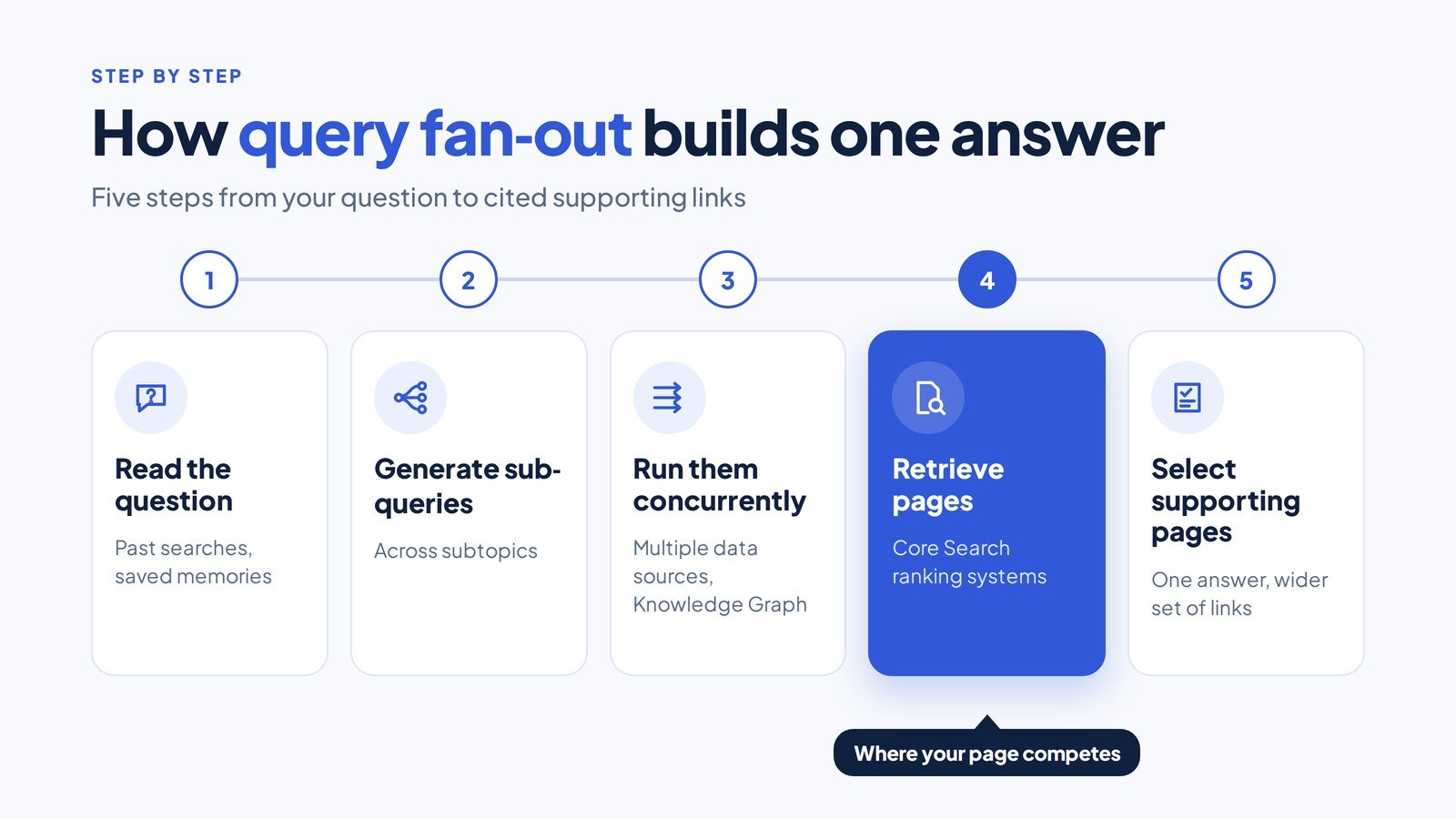
Query fan-out runs in five steps, from reading the question to writing one answer with links.
- Read the question, with any context held, such as past searches in Google or saved memories in ChatGPT.
- Generate sub-queries across subtopics.
- Run them concurrently across “multiple data sources”, which Robby Stein said include the Knowledge Graph and shopping data.
- Retrieve pages by “relying on our core Search ranking systems”, in Google’s definition of retrieval-augmented generation.
- Select supporting pages and write one answer with links.
Step 4 is where your site enters or misses the answer, because retrieval uses the same ranking systems as ordinary search. Google gives breadth as the reason for the extra searches: Search Central says its models “identify more supporting web pages” and show “a wider and more diverse set of helpful links” than a classic web search, which answers one typed query with one ranked list.
What do Google’s patents describe?
Three Google patents describe methods close to fan-out, and none proves what runs in AI Mode today. US11663201B2, on generating query variants and granted 30 May 2023, lists eight variant types: equivalent, follow-up, generalisation, canonicalisation, language translation, entailment, specification and clarification. US20240289407A1, still an application, retrieves documents for “synthetic queries”, and US12158907B1, granted 3 December 2024, generates themes from returned documents. WO2024064249A1 gets cited too, but it describes building “a synthetic training dataset” for retrieval models, and Google Patents lists it as ceased.
What types of sub-queries does fan-out create?
Fan-out creates seven practical types of sub-query, and six sit close to a variant type in Google’s query variants patent.
| Sub-query type | Nearest patent variant | UK example |
|---|---|---|
| Related | Equivalent | tax accountant Cardiff |
| Implicit | Entailment | should a sole trader become a limited company |
| Comparative | None exact | fixed fee vs hourly solicitor UK |
| Recency | Specification | dividend tax rates 2026/27 |
| Personalised | Language translation, specification | family dentist near Roath |
| Entity expansion | Canonicalisation | ICAEW chartered accountants Cardiff |
| Next-step | Follow-up (closest) | book emergency dentist Cardiff |
These types sit on top of ordinary search intent: the intent types that decide what each sub-query wants from a page still apply, and fan-out multiplies how many of them one prompt triggers.
What do fan-out queries look like?
Fan-out queries are long and often carry a year, a review term or a brand name. Nectiv’s December 2025 study of Google fan-outs through the Gemini API found 6.7 words per query on average, and its most common terms were years (6.26%), “reviews” (2.14%), “vs” (1.41%), “free” (1.05%) and “top” (1.05%). Seer Interactive found years in 21.3% of Gemini 3 fan-out queries and brand names in 26.4%. On your site, these searches look for dated facts, reviews, comparison tables and named entities.
How many searches does one question trigger?
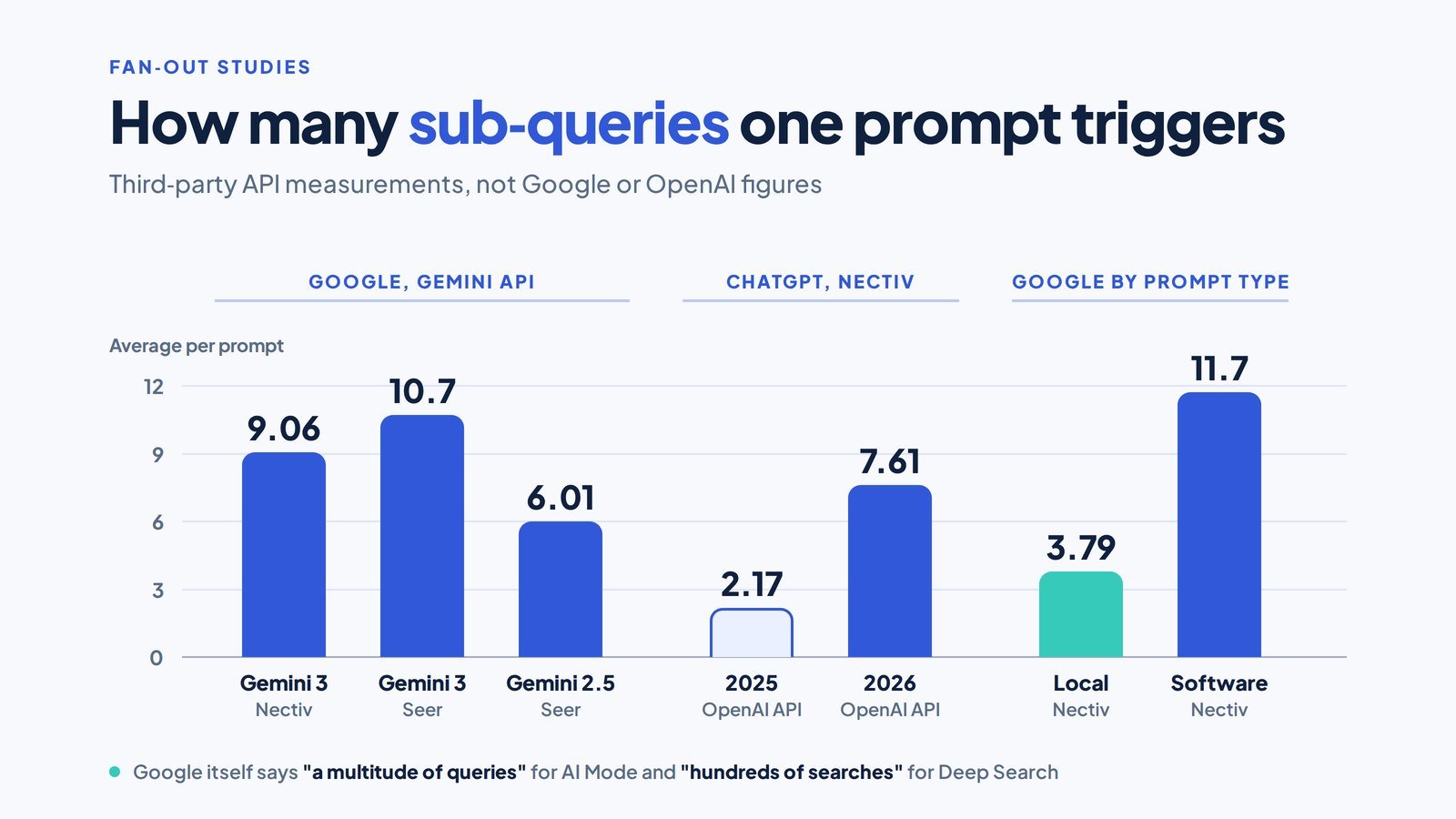
One question triggers anything from a handful of searches to hundreds. Google says AI Mode issues “a multitude of queries” and Deep Search “can issue hundreds of searches”. Nectiv measured 9.06 fan-out queries per prompt on Gemini 3 in December 2025, with 59% between 5 and 11 and a maximum of 28. Seer Interactive measured 10.7 across 501 prompts, up from 6.01 on Gemini 2.5. Nectiv’s August 2026 study found ChatGPT rising from 2.17 per prompt in 2025 to 7.61 in 2026. Published counts differ by study, model and date: these are third-party API measurements, not Google or OpenAI figures, and consumer apps can differ.
Why do local business questions fan out less?
Local questions fan out less than software questions: Nectiv’s Google study put local prompts at 3.79 fan-out queries against 11.7 for software. Our inference: for a local firm, each sub-query you cover is a bigger share of a shorter answer. Google’s July 2026 guide names Google Business Profiles as a way to help services appear in AI responses, so your profile belongs in the plan. We looked at which sources AI tools read before naming a Cardiff business separately.
Is query fan-out the same as query expansion, rewriting or keyword clustering?
Query fan-out is query expansion done by the AI system at search time, which makes it different from keyword clustering, a job you do on your own site. OpenAI calls its version rewriting, and Koray Tugberk Gubur describes query augmentation paths as the process Google’s patents call query fan-out. Clustering groups known keywords with measured volume; fan-out queries vary by prompt and user, and Seer Interactive found 95% of the Gemini fan-out queries it collected had zero global search volume. They’re as long as long-tail keywords, but you can’t target them one at a time.
How do Google, ChatGPT, Copilot and Perplexity split a question?
Each platform splits your buyer’s question its own way, and each vendor documents only part of the process.
| Platform | Vendor’s term | Personal context documented | Site owner report |
|---|---|---|---|
| Google AI Mode | “query fan-out” | Past-search suggestions announced | Search Console, no fan-out queries |
| Google AI Overviews | “may use” fan-out | Not documented | Search Console, no fan-out queries |
| Google Deep Search | “hundreds of searches” | Not documented | Not documented |
| ChatGPT search | “one or more targeted queries” | Saved memories, approximate location | None published |
| Microsoft Copilot | “grounding queries” | Not documented | Bing Webmaster Tools AI Performance |
| Perplexity Pro Search | “multiple searches across the web” | Not documented | None published |
Google hedges in one document and not another. Search Central says AI Overviews and AI Mode “may use” fan-out, while the AI Mode help page says AI Mode divides “your question into subtopics”.
Why does ChatGPT search inside business websites?
ChatGPT runs site: searches to check a business’s own pages for specifics. Nectiv’s August 2026 study found that “ChatGPT performs a ‘site:’ search in 64% of all fan-out queries”. Our inference: the model checks the official source, so your pages need services, prices, locations, credentials and dates in plain text.
Does personalisation change the sub-queries?
Personalisation changes the sub-queries, so no single fan-out list exists for a question. Google announced past-search suggestions for AI Mode at I/O 2025, and OpenAI says ChatGPT “may use relevant saved memories when rewriting a search query”. Lazarina Stoy at iPullRank reported that different users get different expansions of the same question. You need a pool of likely sub-queries, not one captured run.
Why can a page outside the top 10 still be cited in an AI answer?
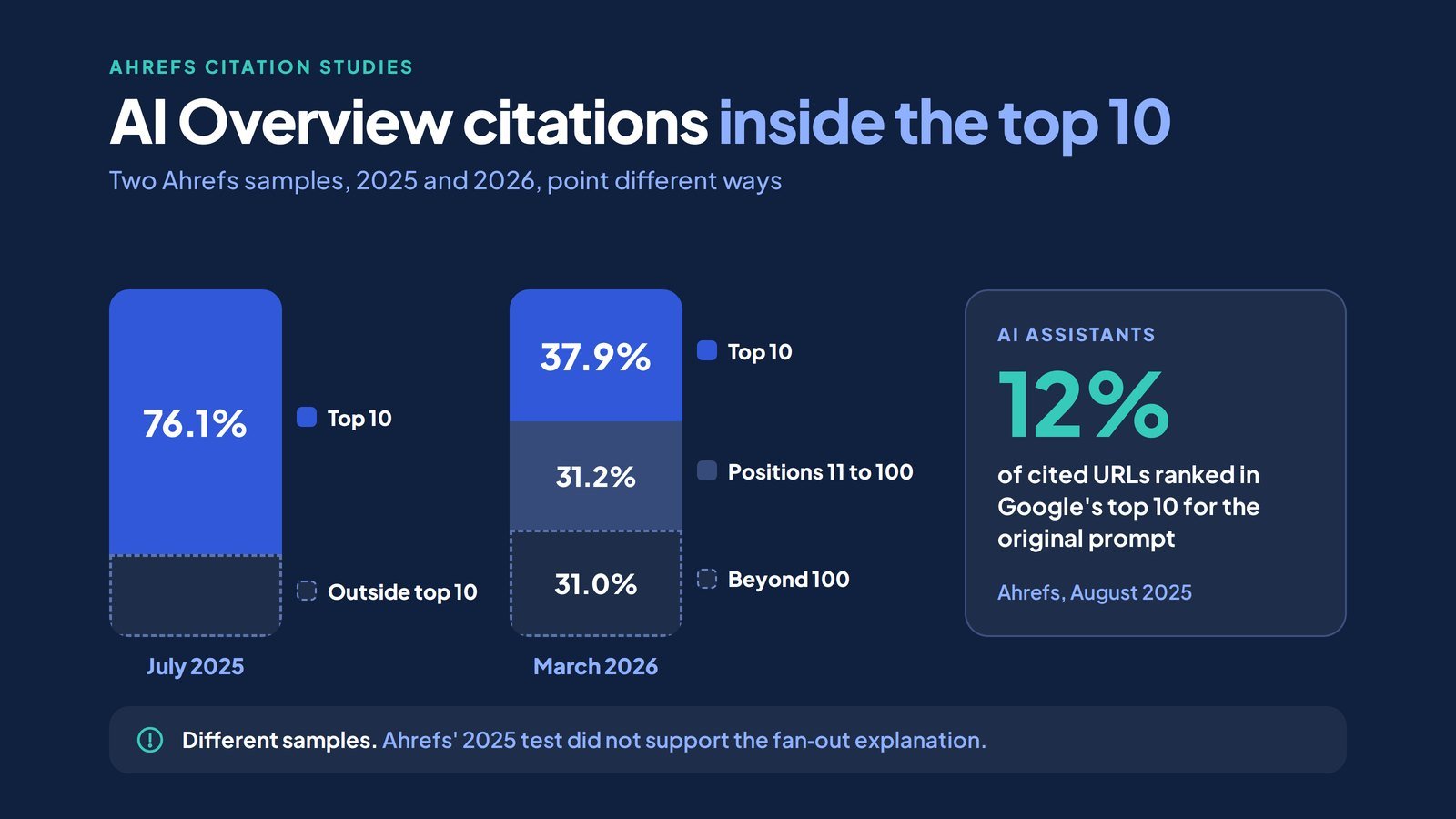
A page outside the top 10 can be cited because the answer draws on searches other than the one typed, though the evidence is mixed. Ahrefs found 76.10% of AI Overview citations ranked in the top 10 in July 2025 and 37.9% in its March 2026 update, with 31.2% in positions 11 to 100 and 31.0% beyond, and offered fan-out as a possible cause. Its August 2025 study found 12% of URLs cited by AI assistants ranked in Google’s top 10 for the original prompt. Against that, Ahrefs’ July 2025 test found cited pages beyond the top 10 ranked for fewer and shorter queries, which doesn’t support the fan-out explanation, and the studies used different samples. Our reading: ranking your page for the original query is no longer enough on its own.
Does ranking still matter?
Ranking still matters, because retrieval runs on Google’s ranking systems. Google says a supporting link “must be indexed and eligible to be shown in Google Search with a snippet”. Surfer’s study of 173,902 URLs, last updated 9 September 2026, found 51.2% of AI Overview citations that ranked organically did so for the main query and at least one Gemini fan-out query, against 19.6% for the main query alone, a correlation rather than proof. Our reading: your target moves from one query to its sub-queries.
What does fan-out mean for clicks?
AI answers bring you fewer clicks per search. Pew Research Center found users clicked a traditional result in 8% of visits with an AI summary against 15% without, across 68,879 searches by 900 US adults in March 2025. Ahrefs linked AI Overviews to a 58% lower average click-through rate for the top-ranking page across 300,000 keywords, a correlation. Google says those clicks “are higher quality”. Your pages lose the cost, comparison and date sub-queries to directories, publishers and competitors when they answer only the head question.
What does Google say you don’t need to do for fan-out?
Google says appearing in AI Overviews and AI Mode needs no special optimisation. Search Central says there are “no additional requirements to appear in AI Overviews or AI Mode”, and the July 2026 guide calls optimising for generative AI search “still SEO”.
- Chunking: “There’s no requirement to break your content into tiny pieces for AI to better understand it.” Sub-question headings are page structure, not chunking.
- Schema: “Structured data isn’t required for generative AI search.” Ahrefs compared 1,885 pages that added schema with 4,000 controls in a May 2026 study and found “no major uplift in citations on any platform”. Keep your schema for rich results.
- llms.txt: you don’t need “AI text files”, because “Google Search itself doesn’t use them”. That covers Google only.
- Special writing: “You don’t need to write in a specific way just for generative AI search.”
Is it against Google’s rules to create a page for every fan-out query?
A page for every fan-out query breaks Google’s rules when the pages exist to manipulate rankings or AI answers. Google’s July 2026 guide says: “While it might be tempting to create separate content for every possible variation of how people might search (for example, by focusing on other queries that people have asked, or fan-out queries), doing so primarily to manipulate rankings or generative AI responses in Google Search violates Google’s scaled content abuse spam policy.”
We don’t build a page per sub-query, and we don’t sell markup as the fix. The answer to fan-out is topical coverage organised by a topical map and Query Deserves a Page decisions, so every sub-query you find gets the smallest asset that answers it well.
How do you map the fan-out behind your buyer’s question?
You map fan-out by building a pool of 15 to 25 likely sub-queries for your money question and assigning each one to a page, section, table row or FAQ.
Step 1: predict the sub-query pool without paid tools
- Write the question as your buyer would ask an assistant, with their situation and location.
- Run it through the seven sub-query types.
- Add long queries from your Search Console and grounding queries from your Bing Webmaster Tools.
- Add autocomplete and People Also Ask wording.
- Ask it in AI Mode and ChatGPT, and log the searches you can see and the pages cited.
- Treat simulator output as ideas for you to test, not captured data.
Step 2: decide page, section, table row or FAQ
A sub-query earns its own page on your site only when it passes a Query Deserves a Page test. The concept comes from Koray Tugberk Gubur’s framework, and our working rule is three of four: high demand, different entities, low similarity to your existing pages and a repeating pattern.
| Sub-query pattern | Answer asset | Example |
|---|---|---|
| New entities, real demand, repeating pattern | Own page | sole trader vs limited company guide |
| Same entity, different attribute | H2 or H3 section | conveyancing timescale on the conveyancing page |
| Options compared on shared criteria | Comparison table | fixed fee vs hourly on the fees page |
| Dated or numeric fact | Table row with the period stated | tax year row in a facts panel |
| Single-fact follow-up | FAQ | do you work with sole traders |
| Reviews, listings, credentials | Off-site asset | Business Profile, professional directory |
Our semantic SEO and topical authority programme plans that coverage across your whole site, so every sub-query is assigned before you write a word, billed on KPIs, not hours.
Step 3: consolidate or split into a cluster
Keep sub-queries on one page when they share entities and intent, and split them only when the QDP test passes, because two of your pages answering one sub-query compete and dilute your ranking signals. A topical map fixes which queries get a page and which get a section before you write.
How should a page answer each sub-query?
Your page answers a sub-query when your heading states the sub-question, your first sentence answers it with the entity named, and the next sentences give values such as cost, time and date. Answer-first formatting for AI Overviews and voice search follows the same pattern. Each type needs its own treatment:
- Comparative: a table with named options, criteria rows, pros and cons, and a verdict per use case.
- Recency: the tax year or policy date on every time-bound fact, plus a last-reviewed date that reflects a real review.
- Implicit: cost, eligibility, numbered steps, timescale and risk, drawn from your buyer’s situation.
- Entity: your name, services, credentials and prices, identical across your site, Business Profile and directories. Google warns that “seeking inauthentic ‘mentions’ across the web isn’t as helpful as it might seem.”
- Location and profile: your service areas, address, remote service and sectors in plain text.
Check the technical conditions before any of this. Google requires your pages to be indexed and snippet eligible, and snippet controls such as nosnippet and noindex limit what it shows. OpenAI says sites opted out of OAI-SearchBot “will not be shown in ChatGPT search answers”, so check your robots.txt. Our technical and on-page SEO service checks indexing, snippet controls and crawler access before content work starts.
How do you score a page’s fan-out coverage?
Score each sub-query 0, 1 or 2: 0 when nothing you control answers it, 1 when your page mentions it without answering it, and 2 when a passage, row or FAQ answers it directly. Your coverage is the total divided by twice the number of sub-queries, reported by type so you can see the weak types.
What does a fan-out map look like for a UK buyer question?
In our illustration, a generic Cardiff accountancy services page scored 9 of 40 for the question below, and a mapped rebuild reached 36 of 40 with one new page.
Illustration of the method. These sub-queries are a plausible pool built from Google’s published variant types and the query patterns in third-party fan-out studies. They are not a captured output from AI Mode or ChatGPT, and a single run would issue fewer: Nectiv measured an average of 3.79 fan-out queries for local prompts.
The buyer asks: “Which accountant in Cardiff is best for a limited company? I’m a sole trader thinking of switching.” The hypothetical firm has a services page, a contact page and a Google Business Profile. We chose accountancy because Mohammad A Mahmud is ACCA qualified and wrote Research Report TSC-2026-01, an audit of 494 UK ACCA and ICAEW practice websites. Our SEO for accountants service builds this coverage into accountancy websites, so you answer the switching, tax and fee questions your buyers ask.
| # | Sub-query (illustrative) | Type | Answer asset | Before | After |
|---|---|---|---|---|---|
| 1 | accountants for limited companies in Cardiff | Related | Existing service page | 2 | 2 |
| 2 | best rated small business accountants Cardiff reviews | Related | Reviews section, Business Profile | 1 | 2 |
| 3 | should a sole trader switch to a limited company | Implicit | New guide (passes 3 of 4) | 0 | 2 |
| 4 | at what profit is a limited company worth it UK | Implicit | Section in the guide | 0 | 2 |
| 5 | how to change from sole trader to limited company | Implicit | Steps section in the guide | 0 | 2 |
| 6 | what does an accountant do when you incorporate | Implicit | Service page section | 0 | 1 |
| 7 | sole trader vs limited company tax 2026/27 | Comparative | Comparison table with tax year | 1 | 2 |
| 8 | fixed monthly fee vs hourly accountant UK | Comparative | Row on the fees table | 0 | 2 |
| 9 | online accountant vs local accountant Cardiff | Comparative | Section with criteria table | 0 | 2 |
| 10 | dividend tax rates 2026/27 | Recency | Row in a dated facts panel | 0 | 2 |
| 11 | Making Tax Digital for Income Tax sole traders 2026 | Recency | FAQ, dates checked on GOV.UK | 0 | 1 |
| 12 | corporation tax small profits rate 2026 | Recency | Row in the facts panel | 0 | 2 |
| 13 | limited company accountant near Cardiff Bay | Personalised | Address sentence, Business Profile | 2 | 2 |
| 14 | limited company accountant for construction subcontractors | Personalised | Sector section (fails demand test) | 1 | 2 |
| 15 | ICAEW chartered accountants Cardiff | Entity | Credentials section, directory listing | 0 | 2 |
| 16 | the practice’s name plus reviews | Entity | Consistent review profiles | 1 | 1 |
| 17 | incorporation relief section 162 sole trader | Entity | Plain-English FAQ | 0 | 2 |
| 18 | cyfrifydd cwmni cyfyngedig Caerdydd | Personalised | Welsh section, if served in Welsh | 0 | 1 |
| 19 | limited company accountant monthly fee Cardiff | Next-step | Fees table with from-prices | 1 | 2 |
| 20 | book a free consultation accountant Cardiff | Next-step | Booking call to action | 0 | 2 |
| Sub-query type | Sub-queries | Before | After |
|---|---|---|---|
| Related | 2 | 3/4 (75%) | 4/4 (100%) |
| Implicit | 4 | 0/8 (0%) | 7/8 (88%) |
| Comparative | 3 | 1/6 (17%) | 6/6 (100%) |
| Recency | 3 | 0/6 (0%) | 5/6 (83%) |
| Personalised | 3 | 3/6 (50%) | 5/6 (83%) |
| Entity expansion | 3 | 1/6 (17%) | 5/6 (83%) |
| Next-step | 2 | 1/4 (25%) | 4/4 (100%) |
| Total | 20 | 9/40 (22.5%) | 36/40 (90%) |
The generic page scored on related and location sub-queries and zero on every implicit and recency one. Rows 16 and 18 stay at 1, because reviews aren’t fully in the firm’s control and a Welsh section belongs only where the firm serves in Welsh. Scores measure coverage, not citations: a covered sub-query still has to rank.
Semantic SEO and topical authority
Cover every sub-query without thin pages
Our programme builds the topical map and page decisions behind coverage like the 90% example, billed on KPIs, not hours.
Where does fan-out coverage matter most across sectors?
Fan-out coverage matters most where your buyers compare options, check dates and verify credentials. Accountants get tax-year and professional body sub-queries, law firms get fee comparisons and dentists get NHS versus private questions. Hotels get review sub-queries, Shopify and WooCommerce stores get “vs” and “reviews”, and letting agents get fee questions.
Illustrative example: a conveyancing firm. An invented Bristol firm planned 18 new question pages, and its 18 sub-queries scored 8 of 36 (22%). One got its own page; the rest became sections, table rows, FAQs and profile updates. Coverage rose to 31 of 36 (86%) with one page published instead of 18.
Illustrative example: an online shoe shop. An invented Shopify store selling trail shoes had no comparisons, and its 22 sub-queries for “best waterproof trail shoes for wide feet UK” scored 10 of 44 (23%). A 12-model comparison table, a sizing FAQ and 2026 season labels took it to 38 of 44 (86%).
Can you see fan-out queries in Google Search Console?
You can’t see fan-out queries in your Search Console, and Google hasn’t said it reports them as queries. John Mueller said AI Overviews and AI Mode data sit “in the general performance report”, as Search Engine Roundtable reported on 6 August 2026. The generative AI performance report, which Google says reached all websites worldwide by 31 August 2026, though not every property has it, shows impressions by page, country, date and device, with no queries and no clicks.
What are the “my location is united kingdom.” queries?
The “my location” strings are machine-style queries with no confirmed source. Our own Search Console data for the 16 months to 6 August 2026 holds strings ending “my location is united kingdom.”, with 391 impressions across 102 query and page rows. A single-site study by Sanbi.ai, covering 265 queries over 24 hours, attributes machine-style strings like these to AI assistants, AI visibility tools and research agents that search Google. Google hasn’t documented them, so we don’t call them AI Mode fan-out queries.
Where can you see the queries an AI used?
Bing Webmaster Tools shows you the queries Microsoft’s AI used to retrieve your pages. Its AI Performance report, launched in public preview on 10 February 2026, lists grounding queries, “the key phrases the AI used when retrieving content that was referenced in AI-generated answers”, for Copilot, Bing AI summaries and select partners.
What does our own Search Console data show about long, conversational queries?
Our own data shows trueseo.co.uk ranking far better on long conversational queries. Over the 16 months to 6 August 2026, queries of 13 or more words averaged position 20.9, against 52.2 for one- and two-word queries, and “best llm seo agency” sits at position 1.0.
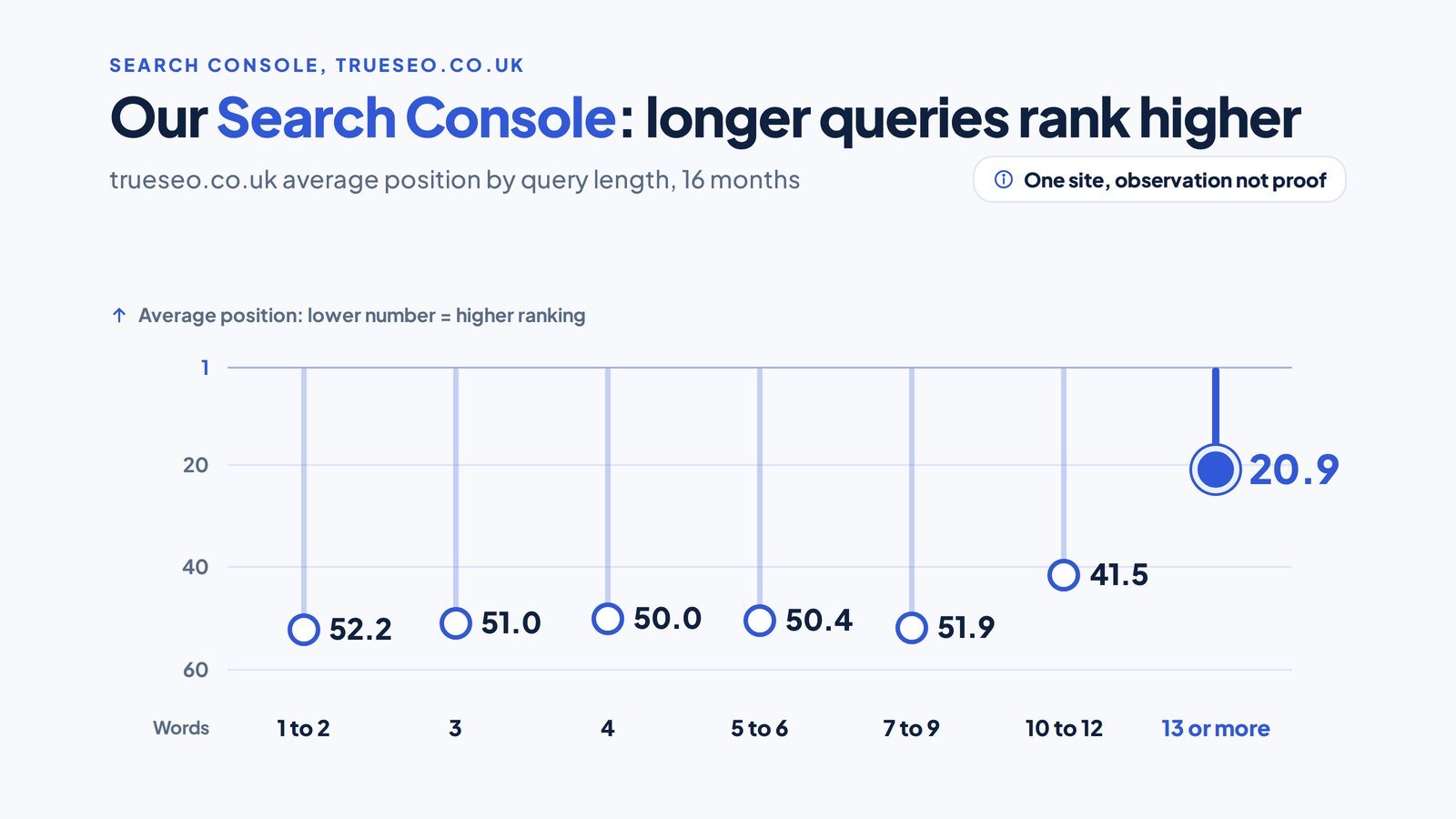
Treat that as an observation about one site, not proof of fan-out: long queries face fewer competing pages, averages aren’t weighted evenly across bands, and some long queries are machine-generated. It fits fan-out queries averaging 6.7 words in the Nectiv and Seer Interactive studies, and no more.
We classed 1,281 queries as assistant-phrased, worded the way people prompt an assistant, and they earned 51,374 impressions and 47 clicks, a click-through rate of 0.091%, against 0.012% for non-branded queries sitewide. One family explains most of those clicks: “all seo agency in cardiff” and its variants, 20 queries with 4,368 impressions, produced 45 of the 47 clicks. Without it, the other 1,261 queries earned 2 clicks from 47,006 impressions, about 0.004%.
Are fan-out tools and simulators accurate?
Fan-out tools help you build a pool, but their output isn’t evidence of what AI search runs. Simulators generate plausible sub-queries from a model, and extractors read the queries an API returns. Lily Ray notes the API “is clean and repeatable”, while the interface method “may be closer to what real users actually get”. Use tools to widen your pool, then check it against what AI Mode and ChatGPT cite for your question.
Does optimising for fan-out work, and how long does it take?
No controlled test yet shows that fan-out optimisation works. The only published test we found, Semrush’s from 26 September 2025, updated four articles for 10 to 20 fan-out queries each with no control group. Citations went from two to five in a month, while share of voice fell from 23.4% to 20.0% and brand mentions from 18 to 10, during a platform-wide drop in ChatGPT citations. No reliable timeframe exists, because your pages must be recrawled and rank for the sub-queries first. Our method rests on how Google says retrieval works, and we tell clients that.
What mistakes do people make with query fan-out?
The mistake that costs most is publishing a page for every sub-query. The others:
- Treating simulator output as captured data.
- Confusing fan-out with keyword clustering.
- Adding schema or llms.txt as the fix.
- Chasing only sub-queries with search volume.
- Changing “updated” dates without changing content.
- Letting off-site profiles contradict the website.
- Blocking OAI-SearchBot by accident.
Self-check quiz
Would your page survive a fan-out?
Pick one money page and one buyer question, then answer eight questions.
Question 1 of 8Have you written down the full question a buyer would ask an assistant, with their situation and location?
Question 2 of 8Can you list at least 10 likely sub-queries across implicit, comparative, recency and entity types?
Question 3 of 8Does your page answer the unasked questions: cost, eligibility, steps and timescale?
Question 4 of 8Are comparisons shown in a table with named options and criteria?
Question 5 of 8Are time-sensitive facts labelled with the period they apply to and a real review date?
Question 6 of 8Do your name, services, credentials, locations and prices match across your site, Google Business Profile and directories?
Question 7 of 8Is the page indexed, eligible for a snippet and open to OAI-SearchBot?
Question 8 of 8When a sub-query needs an answer, what do you usually do?
Show the answer key
- Have you written down the full question a buyer would ask an assistant, with their situation and location? Yes, word for word. Fan-out starts from the full question, so the pool is only as good as the question.
- Can you list at least 10 likely sub-queries across implicit, comparative, recency and entity types? Yes. Nectiv measured 9.06 Google fan-out queries per prompt on average, so a short list misses most of them.
- Does your page answer the unasked questions: cost, eligibility, steps and timescale? Each in its own section. A mention scores 1; a passage that answers the sub-query scores 2.
- Are comparisons shown in a table with named options and criteria? Yes. “vs” terms recur in fan-out queries, and a table answers them row by row.
- Are time-sensitive facts labelled with the period they apply to and a real review date? Yes. Years were the most common term in Nectiv’s fan-out study, at 6.26%.
- Do your name, services, credentials, locations and prices match across your site, Google Business Profile and directories? Match everywhere. Seer Interactive found brand names in 26.4% of fan-out queries.
- Is the page indexed, eligible for a snippet and open to OAI-SearchBot? Checked all three. Google needs indexing and snippet eligibility, and OpenAI excludes sites opted out of OAI-SearchBot.
- When a sub-query needs an answer, what do you usually do? Decide page, section, table row or FAQ. Google’s July 2026 guide says separate content for fan-out queries made to manipulate AI answers violates its scaled content abuse policy.
Should you map fan-out yourself or get help?
Map fan-out yourself for one money question and one or two pages, and get help for several services, locations or a regulated practice, where page decisions, entity consistency and technical eligibility interact. A provider you hire should deliver a sourced sub-query pool, a QDP decision per sub-query, coverage scores before and after, an entity consistency audit, a snippet and OAI-SearchBot check, a grounding query review and a plain statement of what can’t be measured.
Frequently asked questions
Is Google AI Mode available in the UK?
You can use Google AI Mode in the UK. Google Search Help lists the United Kingdom among its supported countries.
What is Google Deep Search?
Deep Search is Google’s research mode that runs fan-out at a larger scale: it “can issue hundreds of searches”, and it launched in July 2025 for US Google AI Pro and AI Ultra subscribers in Labs.
Does fan-out use sources other than web pages?
Fan-out draws on more than your web pages. Google said in March 2025 that AI Mode uses the Knowledge Graph and shopping data, and Ahrefs found YouTube made up 5.6% of AI Overview citations in March 2026.
Why do AI answers change from one day to the next?
AI answers change partly because the sub-queries change. Seer Interactive found 1% overlap among fan-out queries in its dataset, and personalisation varies them by user. That link is our reasoning, not a measured finding.
Do AI Overviews make people use Google more?
Google says AI Overviews increase Google usage in its biggest markets. Elizabeth Reid wrote in May 2025 that they were “driving over 10% increase in usage of Google for the types of queries that show AI Overviews” in the US and India.
Does query fan-out search in other languages?
Google’s query variants patent includes a language translation type, so a sub-query can be in another language. A UK firm serving clients in Welsh should answer Welsh-language sub-queries in a Welsh section.
What should you do about query fan-out now?
Map the sub-queries behind your most valuable buyer question, score the page that should answer them and fill the gaps before you add pages. True SEO Consultants Ltd works with 200+ UK clients across about 18 sectors from Startup Stiwdio, University of South Wales, 86-88 Adam Street, Cardiff, CF24 2FN, and delivers across the UK through remote digital onboarding and delivery. Mohammad A Mahmud is ACCA qualified and trained in Koray Tugberk Gubur’s semantic SEO method, Julie Williams has 30+ years as a finance director, and we bill on KPIs, not hours.
Book a free 30-minute strategy call with that question, and we’ll show you the sub-queries your page misses.
Bring one buyer question and one page
We’ll show you the sub-queries your page misses and which ones deserve a page, a section or a table row.
Book my free strategy callExplore AI and LLM visibility