Chiropractors can use patient testimonials in the UK when each one is genuine, published with the patient’s permission, backed by documentary evidence and contact details, and free of any claim the clinic could not make itself. Once published, a testimonial’s claims need the same evidence as the clinic’s own advertising, according to the ASA.
Four sets of rules meet on every review a clinic asks for, publishes or answers: the CAP Code enforced by the Advertising Standards Authority (ASA), the General Chiropractic Council (GCC) Code of Professional Practice, the Digital Markets, Competition and Consumers Act 2024, and Google’s own review policies. This guide takes each in the order a clinic meets it, from the testimonial page to the reply box, and it uses findings from our own audit of 50 UK clinic websites.
Key points
- A testimonial needs the patient’s permission, documentary evidence that it is genuine and the patient’s contact details on file (CAP Code rules 3.47 and 3.50).
- A patient’s sentence about whiplash or colic becomes the clinic’s claim once published, and testimonials alone do not count as evidence for it.
- Since 6 April 2025 the DMCC Act 2024 has listed fake reviews and concealed incentivised reviews as unfair in all circumstances, and the CMA can fine up to 10% of global turnover.
- Google prohibits incentives for reviews, asking only happy patients, and pressuring patients to review while they are on the premises.
- A public reply never confirms that the reviewer is a patient, because the GCC Code requires confidentiality online as well as in the clinic.
- In our audit, 3 of the 4 sites with a clear problem use of the word “cure” showed it through published patient testimonials.
What makes a patient testimonial acceptable under the CAP Code?
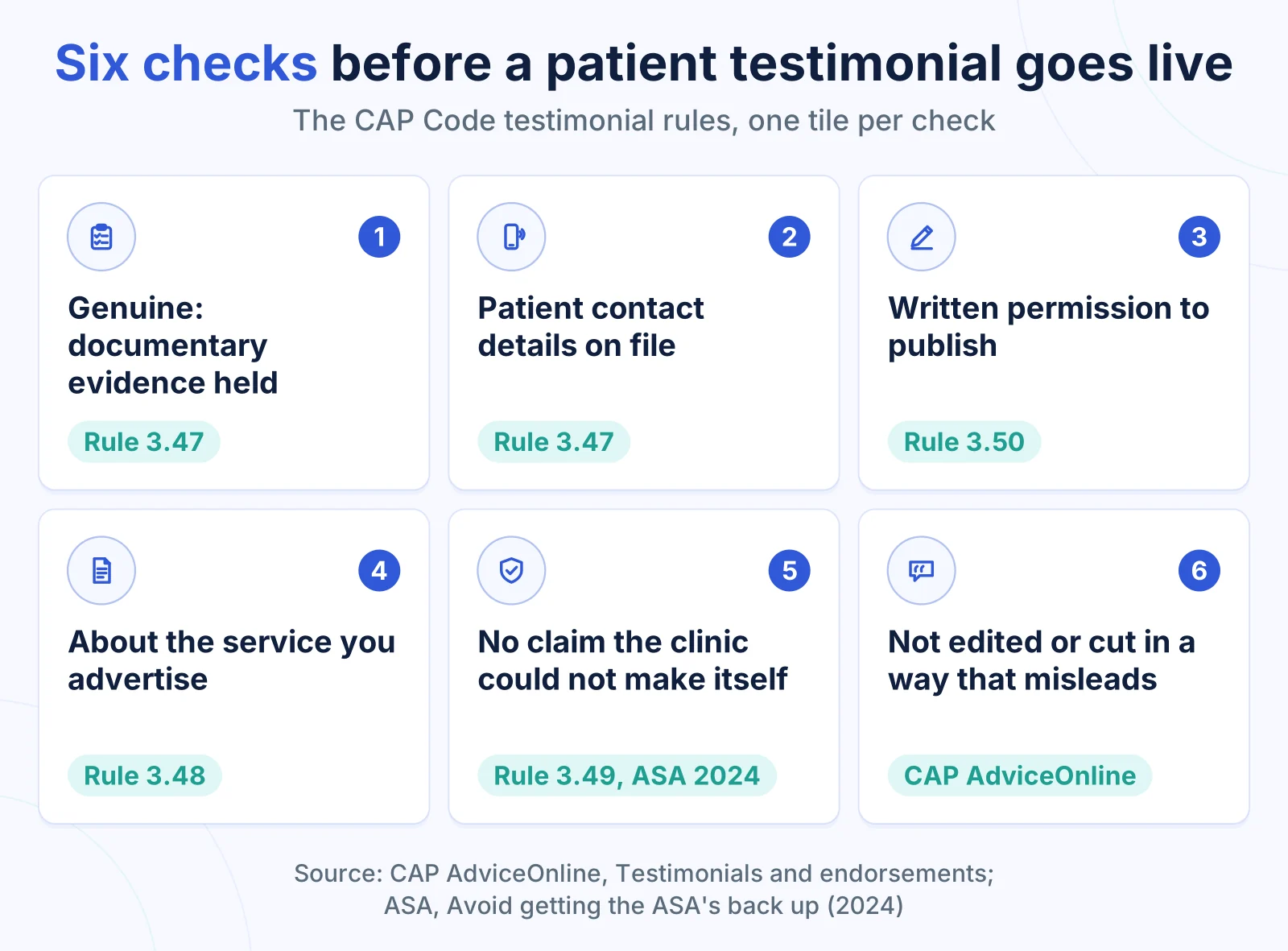
A patient testimonial is acceptable under the CAP Code when it is genuine, relates to the service advertised, appears with the patient’s permission and contains no claim likely to mislead, with documentary evidence and the patient’s contact details held on file.
CAP AdviceOnline sets out the testimonial rules one by one:
- Rule 3.47: the clinic must hold documentary evidence that the testimonial is genuine, and contact details for the person who gave it.
- Rule 3.48: the testimonial must relate to the service being advertised.
- Rule 3.49: claims inside a testimonial must not mislead.
- Rule 3.50: a testimonial must not appear without permission.
CAP adds that testimonials should not be taken out of context or edited in a way that misleads. On evidence, CAP says signed and dated proof is not the only form the ASA is likely to accept, but an email from an unverifiable address, such as a free webmail account, would not be acceptable by itself. Keeping the patient’s message with the date it arrived, matched to the contact details in the clinic’s own patient records, makes the testimonial easier to show as genuine.
The GCC adds a professional layer on top. Standard C5 of the GCC Code of Professional Practice, in force from 1 January 2026, requires that information about your services is factual, verifiable and does not mislead, and the GCC’s mapping document places the duty to keep up with the CAP Code under standard C4. In a 2023 news item the GCC said a review may be considered advertising, and that registrants are accountable for promotional content on sites they own or control, regardless of who wrote it. The GCC’s social media toolkit (December 2021) asks for full written consent before a testimonial is posted and suggests letting the patient see the wording first.
A testimonial file for each quote a clinic publishes holds six things:
- The patient’s original wording, exactly as received.
- The date it was received.
- The patient’s written permission to publish it, and where.
- The patient’s contact details.
- Every place the quote now appears: website page, social post, leaflet or Google post.
- The date someone last read it against the CAP list of accepted conditions.
Permission and a tidy file make a testimonial genuine. They do not make what it says acceptable, and that second test is where most problems sit.
When does a patient testimonial become the clinic’s own claim?
A patient testimonial becomes the clinic’s own claim the moment the clinic publishes it, so the clinic needs the same evidence for a patient’s sentence about curing whiplash as it would need for its own advert saying it treats whiplash.
The ASA’s 2024 guidance for back care awareness week, “Avoid getting the ASA’s back up”, says claims in testimonials must be supported by sufficient evidence, and that this includes implied claims where the testimonial could be understood as an efficacy claim. The ASA accepts that a testimonial may be a genuinely held opinion, but says a view likely to be read as an objective claim should not be included unless the marketer holds evidence. The same guidance adds that testimonials alone are not sufficient substantiation, which closes the usual defence: a clinic cannot use ten patients saying it worked as proof that it works.
The CAP list of conditions a chiropractor may advertise without holding further evidence is fixed at 19 entries, and whiplash and frozen shoulder both sit outside it. Conditions specific to babies, children or pregnant women, such as colic, morning sickness or pelvic pain in pregnancy, need a strong body of evidence according to the ASA. We set out the full list of conditions chiropractors can advertise in a separate guide, so this page applies it only to testimonials.
| What the patient wrote | What it claims once the clinic publishes it | Decision |
|---|---|---|
| “Friendly team, and everything was explained before treatment.” | Experience of the clinic only. No efficacy claim. | Publish, with permission and evidence on file |
| “My lower back pain has eased since I started.” | General back pain not arising from injury, which the CAP list accepts | Publish, with permission and evidence on file |
| “They helped with my sciatica.” | A general reference to sciatica, which the list accepts | Publish, with permission and evidence on file |
| “My sciatica pain went from 8 out of 10 to 2.” | A pain reduction claim, which the list does not accept for sciatica | Keep as private feedback |
| “Cured my whiplash after the car accident.” | A cure claim on a condition outside the list | Keep as private feedback |
| “Sorted my frozen shoulder in three sessions.” | A result on a condition outside the list | Keep as private feedback |
| “Our baby’s colic stopped after two visits.” | A condition specific to babies | Keep as private feedback |
Trimming a testimonial down to its experience sentences is possible only where the shorter version still reflects what the patient said, because CAP rules out editing that misleads. Where cutting the claim changes the meaning, the testimonial stays in the private feedback file. Keeping it there costs the clinic nothing: the patient’s words still tell the team what went well.
Where do the testimonial rules apply: website, social media and Google posts?
The testimonial rules apply wherever the clinic publishes or adopts a patient’s words: its own website, its social media accounts and any other online space it controls, which in our reading includes the posts it writes on its Google Business Profile.
CAP AdviceOnline says the CAP Code has applied since 2011 to advertising on a company’s own website and in other non paid for space online under its control, naming a brand’s X feed, Facebook page and Instagram profile as examples. A patient’s own Google review is different. CAP’s guidance on social media treats reviews written by private individuals as user generated content, outside the clinic’s marketing until the clinic “adopts and incorporates” it. CAP says adopting can include retweeting, commenting on or even liking a user’s post.
Three everyday actions can bring a patient’s review inside the CAP Code:
- Quoting it on the homepage or in a reviews feed on the website.
- Sharing it as a social media post or a Google Business Profile post.
- Replying in a way that agrees with a claim it makes.
Placement matters as well. A testimonial about sciatica sitting under the sciatica section of the site reads as support for that page’s own wording, which is one reason we keep condition pages worded inside the rules separate from any patient quote that goes further than they do. CAP also warns that a moderation policy which removes negative content, or a site that publishes only positive reviews, can mislead. Consumer law takes the same view of filtered review feeds.
What did our audit find about testimonials on UK chiropractic websites?
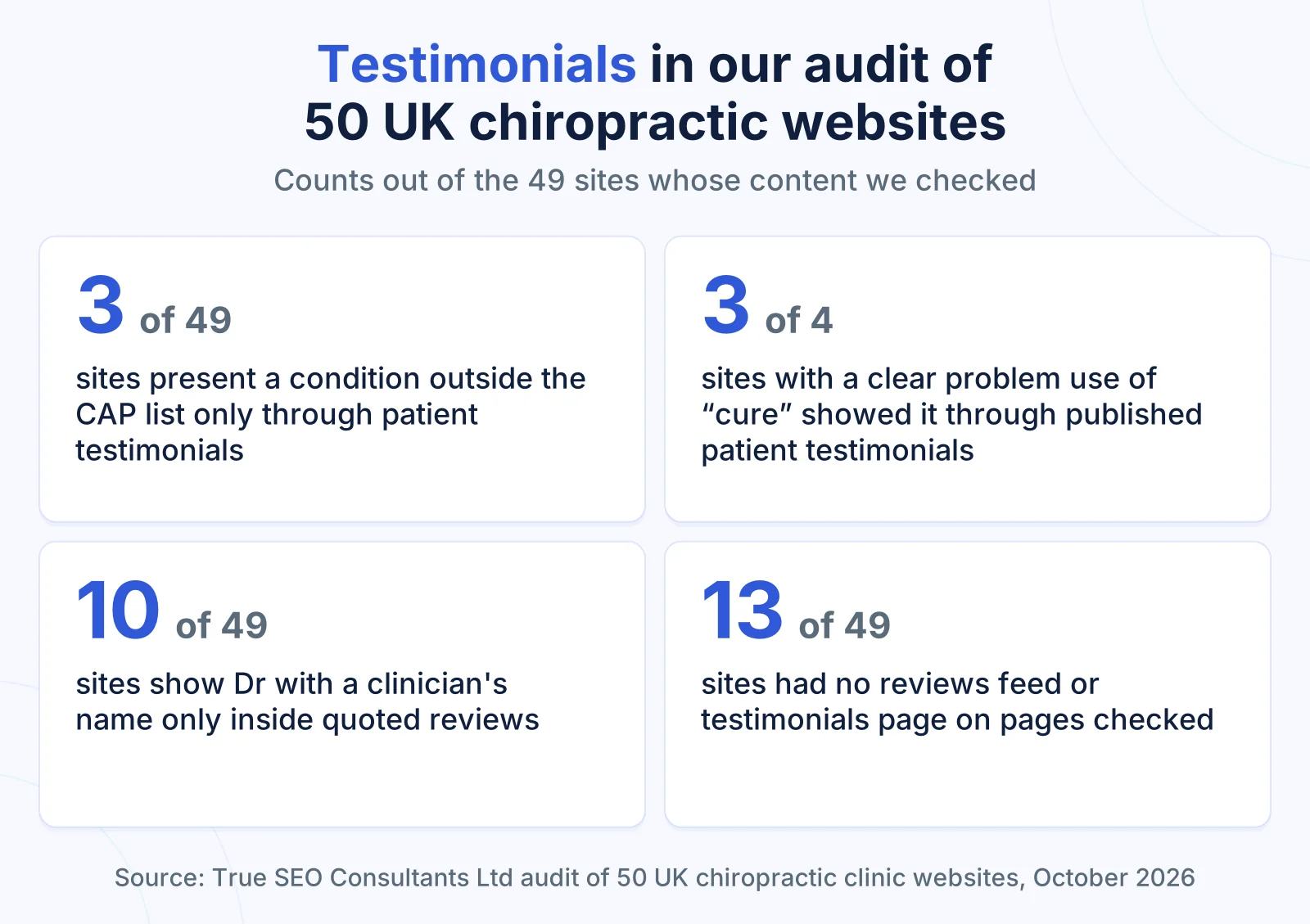
Our audit found that published patient testimonials hold some of the riskiest wording on UK chiropractic websites: 3 of 49 sites presented a condition outside the CAP list only through testimonials, and on 3 of the 4 sites with a clear problem use of “cure”, the word came through testimonials.
We audited 50 chiropractic clinic websites across the UK on 13 October 2026, five clinics in each of ten cities, and checked the content of 49 of them (one site blocked our content checks). These are the four findings that matter for testimonials:
- 3 out of 49 sites present a condition outside the CAP list only through a published patient testimonial that implies the treatment worked. In each case the condition was whiplash or frozen shoulder. A clinic checking its own service pages would not find these claims, because they sit in the patients’ words.
- 4 out of 49 sites use the word “cure” in a clear problem way, promising or reporting a cure: 1 in the clinic’s own blog copy and 3 through published patient testimonials. The word appeared on 23 sites in total, and most of those uses were negations, idioms or disclaimers.
- 10 out of 49 sites show “Dr” with a clinician’s name only inside quoted patient reviews. The clinic did not write the title, but the page still displays it.
- 13 out of 49 sites had no reviews feed (widget) and no testimonials page on the pages we checked. A patient comparing clinics on those sites sees no patient voice at all before booking.
For context, 25 out of 49 sites present at least one condition outside the CAP list somewhere on the site, so the testimonial route is a small share of a wider pattern. The claim counts are lower bounds: we checked up to 45 pages per site, an AI model classified each match against written rules, and unclear cases were never counted. The audit measured what clinics publish. It did not measure rankings, traffic or enquiries, and it does not assess whether any individual site meets the CAP Code or GCC standards.
The method, the full findings and the limits are on the page for our audit of 50 UK chiropractic websites. The full report (Research Report TSC-2026-02) and the anonymised data are published with DOI 10.5281/zenodo.23363411.
What does the DMCC Act 2024 say about fake and incentivised reviews?
The Digital Markets, Competition and Consumers Act 2024 lists fake consumer reviews, and consumer reviews that conceal the fact they were incentivised, among the commercial practices considered unfair in all circumstances, and those provisions came into force on 6 April 2025.
The CAP Code governs what a published review says; this Act governs how a clinic obtains and displays reviews in the first place. This section describes what the Act and the CMA’s guidance say. This is not legal advice.
Schedule 20, paragraph 13 of the Act covers three things a clinic can touch:
- Submitting or commissioning a fake review, or a review that conceals it was incentivised. The Act defines a fake review as one that purports to be, but is not, based on a person’s genuine experience. A review conceals an incentive where someone was commissioned to write it and that fact is not made apparent.
- Publishing reviews in a misleading way, which covers how a clinic displays them.
- Publishing reviews without reasonable and proportionate steps to prevent and remove fake, concealed incentivised or misleading review information.
The Competition and Markets Authority’s fake reviews guidance (CMA208, April 2025) fills in the detail. It says commissioning is not limited to money: its examples include discounts, vouchers and products given free of charge, and a trader asking a member of staff to write a review. A free session or money off the next visit is the kind of benefit those examples describe. The guidance treats suppressing genuine negative reviews as problematic, and describes cherry picking as including “encouraging just those who are satisfied to leave reviews”. It also says that hiding a reviewer’s financial interest, such as being an employee, may be misleading, and that even a small trader publishing only its own customers’ reviews must take proportionate steps where those reviews pose a risk. A reviews feed on a clinic website is one way of publishing reviews.
The CMA says a prize draw entry is unlikely to amount to commissioning under the Act. Google’s policy is a separate rule: it prohibits offering incentives such as payment, discounts, or free goods or services in exchange for a review, and that list is open ended, so we advise clinics to offer nothing at all. The CMA can now fine a company that infringes consumer protection law up to 10% of its global turnover, according to its March 2026 announcement of five investigations into reviews.
| Practice | DMCC Act and CMA guidance | Google’s review policy |
|---|---|---|
| Staff or family posting reviews as patients | A review not based on genuine experience is fake; hiding an employee’s interest may mislead (CMA 4.6) | Prohibits content based on a conflict of interest, including current or former employment |
| A free session or discount in return for a review | Commissioning includes discounts, vouchers and free products (CMA 2.10) | Prohibits incentives such as payment, discounts and free services |
| Entry into a prize draw for reviewers | Unlikely to amount to commissioning (CMA, footnote 8) | Incentive list is open ended; we advise against it |
| Asking only patients who seem happy | Described as cherry picking (CMA 4.5) | Prohibits selectively soliciting positive reviews |
| A website reviews feed set to five stars only | Cherry picking and misleading publication (CMA 4.5; Schedule 20, paragraph 13) | Not a Google matter, but CAP warns it can mislead |
| A refund offered only if a review comes down | Listed as a contingent dispute offer to avoid (CMA 4.4) | Prohibits incentives to revise or remove a negative review |
How should a chiropractor ask patients for Google reviews?
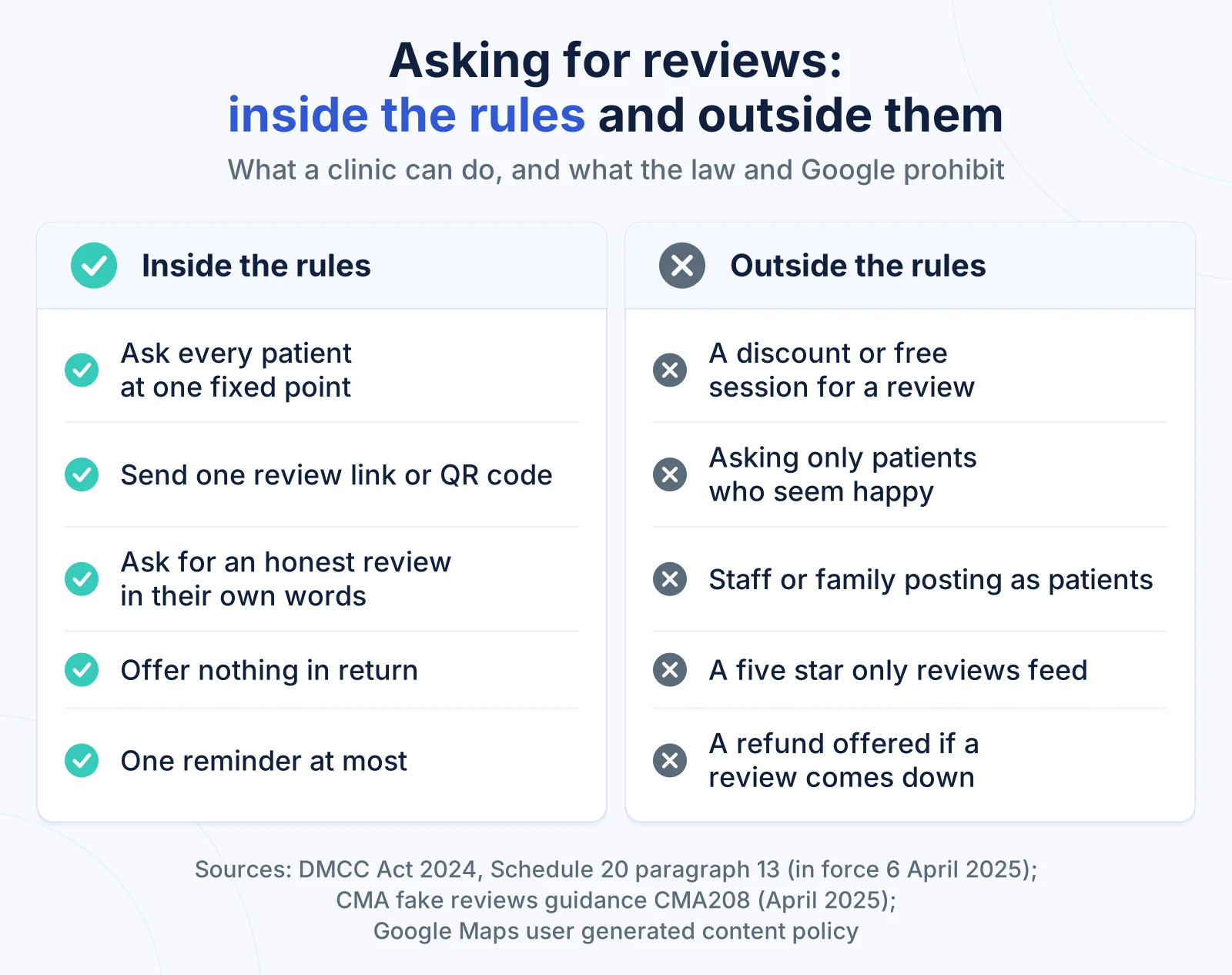
A chiropractor should ask every patient for a Google review in the same way, at the same point in their care, with one direct link and nothing offered in return, because Google’s policy prohibits both incentives and selectively soliciting positive reviews.
Google’s Maps user generated content policy also says businesses should not require or pressure customers to leave reviews while they are on the premises. Google Business Profile Help says a business can ask customers to visit a Google review link or scan a QR code. A request process that fits both:
- Pick one trigger point. Choose a fixed moment, such as the end of a first course of care, and ask every patient who reaches it.
- Send one short message. Email or text the direct review link from the clinic’s Business Profile.
- Ask for honesty, not stars. Suggest no rating, no wording and no condition to mention.
- Remove any satisfaction filter. A form that sends happy patients to Google and unhappy ones to a private inbox is the selective soliciting Google prohibits.
- Let patients review at home. Hand a card with the QR code at the desk in place of a tablet to fill in while they wait.
- Send one reminder at most. Then stop.
A request message that keeps to the rules:
Thank you for visiting [clinic name]. We ask every patient for feedback, and you can leave an honest Google review here: [review link]. Leaving a review is optional and makes no difference to your care.
The message names no treatment and no body part. A text reading “How is your back now?” on a lock screen tells anyone holding the phone why the patient attends a clinic, which is the same confidentiality point covered in the next section.
Review count and rating also feed into where a clinic appears on Google Maps, which Google describes as based mainly on relevance, distance and popularity, and our Google Business Profile guide for chiropractic clinics covers that side.
How do you reply to a review without breaching patient confidentiality?
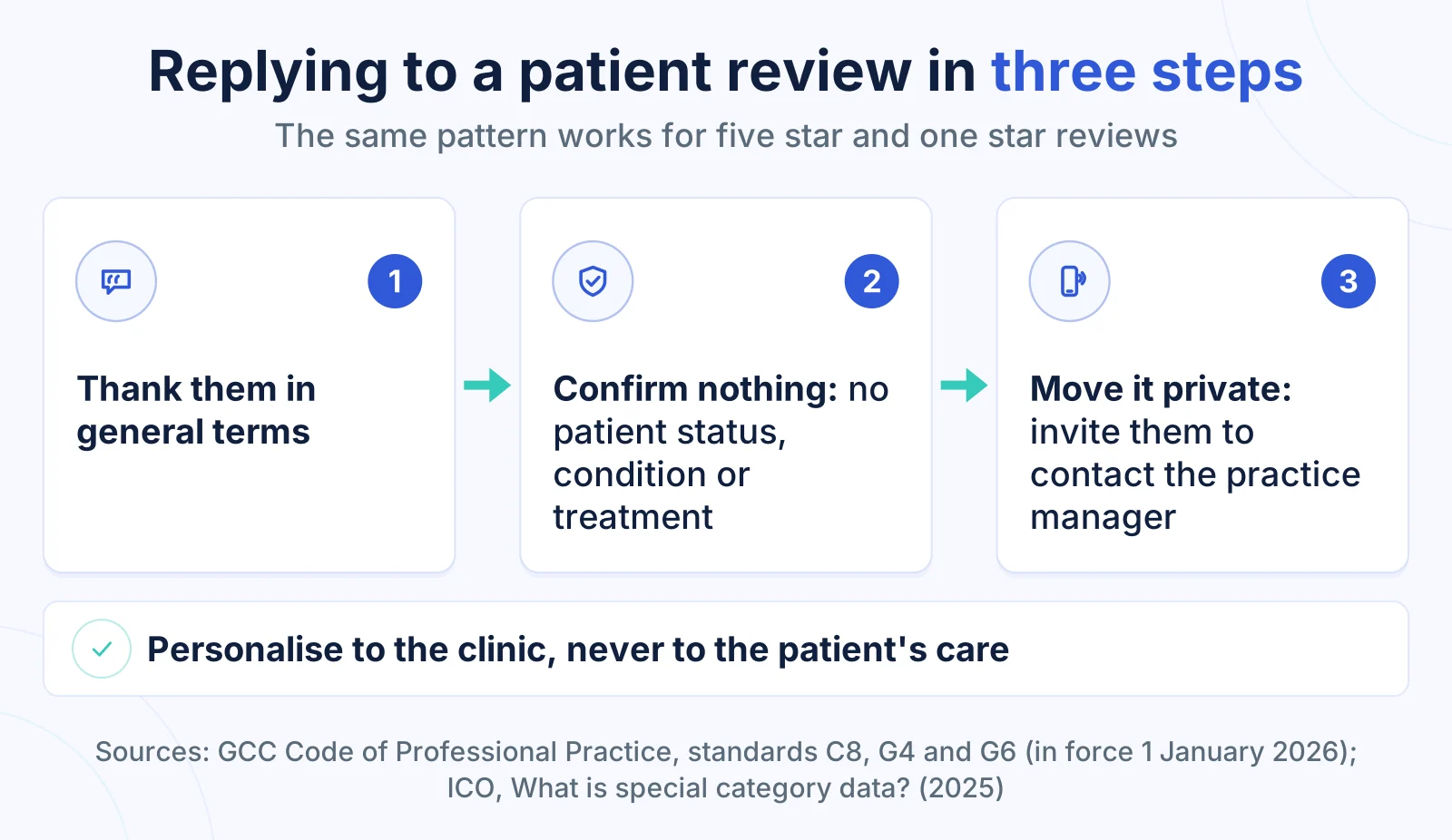
A clinic replies to a review without breaching patient confidentiality by thanking the reviewer in general terms and never confirming that they are a patient, naming a condition or describing treatment, even when the reviewer has already shared those details publicly.
Three standards in the GCC Code of Professional Practice apply to a reply. Standard C8 requires chiropractors to respect confidential information about the patient and preserve their dignity at all times, including online. Standard G4 says information is shared only with the patient’s consent, unless another lawful basis applies. Standard G6 asks chiropractors communicating online, including through user generated content, to do so responsibly.
Data protection points the same way. The ICO says data concerning health includes information about the provision of health care that reveals someone’s health status, and gives an osteopath clinic’s appointment list as an example from which health data could reasonably be inferred. A reply saying “glad the sessions helped” confirms the reviewer attends a clinic for treatment. We treat a public review as the patient’s own disclosure, never as consent for the clinic to add to it.
A reply also carries an advertising risk. CAP says commenting on a user’s post can count as adopting it, so a reply agreeing that treatment fixed a condition outside the accepted list turns the patient’s claim into the clinic’s. Google’s Business Profile Help suggests replies that are short, polite and personalised. For a clinic, personalise the reply to the clinic (the team, the reception, the way first visits run) and never to the patient’s care.
The three replies below are illustrative, written to show the pattern.
Example 1: a five star review that names an injury
Review: “Five stars. Sorted my neck after my car accident, can’t thank the team enough.”
Reply: “Thank you for taking the time to leave a review. We’ll pass your thanks on to the whole team.”
The reply leaves out the neck, the accident and any treatment, and it does not confirm the reviewer attended. Neck pain following injury sits outside the accepted list, so agreeing with the review would also adopt the claim.
Example 2: a short review with no detail
Review: “Great clinic, friendly reception.”
Reply: “Thank you for the kind words. Our reception team will be pleased to hear it.”
Example 3: a one star review about a charge
Review: “Charged me for an appointment I cancelled by phone. Avoid.”
Reply: “We’re sorry to read this. We can’t discuss anyone’s appointments or account in a public reply, but we would like to look into it. Please call or email the clinic and ask for the practice manager.”
How should a clinic handle a negative review?
A clinic handles a negative review by replying once, briefly and politely, without confirming any patient details, then inviting the reviewer to contact the practice privately and dealing with the matter through the clinic’s normal complaints process.
Guidance for doctors from Medical Protection, the indemnity provider, sets the order: read the whole review, check the records, speak to the staff involved, then reply. Management in Practice, drawing on advice from a Medical Protection case manager, recommends keeping the complaint record in a separate file from the patient’s clinical record and saving screenshots, because reviews can be edited or removed. A patient whose concern is resolved can be asked whether they would update the review, though they have no obligation to, and Google’s policy prohibits any incentive to revise or remove a review.
The reply itself is worth posting. A 2024 experiment published in the Journal of Medical Internet Research found that a physician’s response decreased the influence of negative reviews on whether people chose that physician. Who posts the reply matters too: in a case described by the GCC in 2023, a registrant’s unprofessional reply to a Google review was removed swiftly and the Investigating Committee found no case to answer, and the GCC reminded registrants that anyone with access to their online profiles must be appropriate and trustworthy.
Three responses make a negative review worse:
- A conditional offer. The CMA’s fake reviews guidance lists making dispute resolution contingent on the consumer not leaving a negative review as something traders should not do.
- Hiding genuine negative reviews. That includes a website reviews feed filtered to five stars, which the CMA describes as cherry picking.
- Reporting a genuine review as fake. Google’s flagging tools are for reviews that break its content policies, and Management in Practice notes that platforms rarely take down subjective opinions.
What does a monthly testimonial and review routine look like?
A monthly testimonial and review routine is a short fixed checklist run by one named person: send review requests at one trigger point, reply to every new review, file testimonial permissions, and read every published testimonial against the CAP accepted list.
| Task | How often | Owner |
|---|---|---|
| Send the review request to every patient who reached the trigger point | Weekly | Practice manager |
| Reply to every new review using the clinic’s agreed reply patterns | Within two working days | Clinic director or practice manager |
| File each testimonial the clinic wants to use: original wording, date, written permission and contact details | As received | Practice manager |
| Read the testimonials page, website reviews feed, social posts and Google posts against the CAP accepted list | Monthly | Clinic director |
| Check who holds the logins for the Business Profile and social accounts | Quarterly | Clinic director |
| Record requests sent, reviews received and replies posted | Monthly | Practice manager |
The two working day reply window is our recommendation, not a rule from Google or the GCC. One named owner keeps the routine running through busy months. Setting up this routine, with reply wording that keeps to the claim rules, is part of our SEO service for chiropractors, which starts from the claim check.
Check your own website
Answer all 8 questions about your own website, then select See my result.
Please answer all 8 questions to see your result.
Your score: 0 out of 16
Your testimonials need attention first
Several of your answers point to quotes or reviews that could carry claims or confidentiality risks you have not seen yet. Start with the free claim check, which reads every testimonial on your site against the CAP list.
Your score: 0 out of 16
Good habits with gaps
You have parts of a sound process, but one or two areas, often the testimonial file or the review feed, are left to chance. Fix the lowest scoring answer first, then ask us to check the published quotes.
Your score: 0 out of 16
A well run review process
Your testimonials and reviews follow the rules on permission, requests and replies. A yearly read against the CAP list keeps it that way, and the claim check gives you a second pair of eyes.
Frequently asked questions
Can we copy Google reviews onto the clinic website?
A clinic can quote Google reviews on its website, and CAP says rule 3.50 allows some exceptions to the permission requirement for quotes from a published source. The clinic still needs evidence that each quote is genuine and accurate, any claim in it counts as the clinic’s own, and showing only five star reviews as though they were typical can mislead.
Can staff, friends or family review the clinic?
Staff, friends and family should not review the clinic as if they were patients. Google’s policy prohibits content based on a conflict of interest, including current or former employment, and the CMA’s guidance says hiding that a reviewer is an employee may be misleading. A review not based on genuine experience is a fake review under the DMCC Act.
Can a chiropractor publish a testimonial with initials only?
A chiropractor can publish a testimonial with initials or a first name, provided the clinic holds the full record behind it. CAP rule 3.47 asks for documentary evidence and contact details whatever name appears on the page, and the GCC’s social media toolkit asks for the patient’s full written consent before anything is posted.
A patient called our chiropractor “Dr” in a review. Can we publish it?
A review using “Dr” is safest on a page that also states the clinician is a Doctor of Chiropractic and not a registered medical practitioner, because the quote becomes the clinic’s own content. CAP’s July 2026 guidance asks chiropractors to take care not to imply a general medical qualification, and our guide to the Dr title and GCC number on a clinic website shows the wording.
Why do some guides say chiropractors cannot use testimonials at all?
Guides saying chiropractors cannot use testimonials usually describe Australian rules, which often appear in UK search results. The Chiropractic Board of Australia says section 133 of its National Law bars testimonials about clinical care in advertising. UK chiropractors work under the CAP Code and the GCC Code, which allow testimonials within the rules on this page.
Does the ASA regulate the Google reviews patients write?
The ASA treats reviews written by private individuals as user generated content, outside its remit until the clinic adopts it. CAP says a business adopts content by quoting, sharing or even commenting on it, so the clinic’s own use of a review, including an agreeing reply, is what brings it inside the CAP Code.