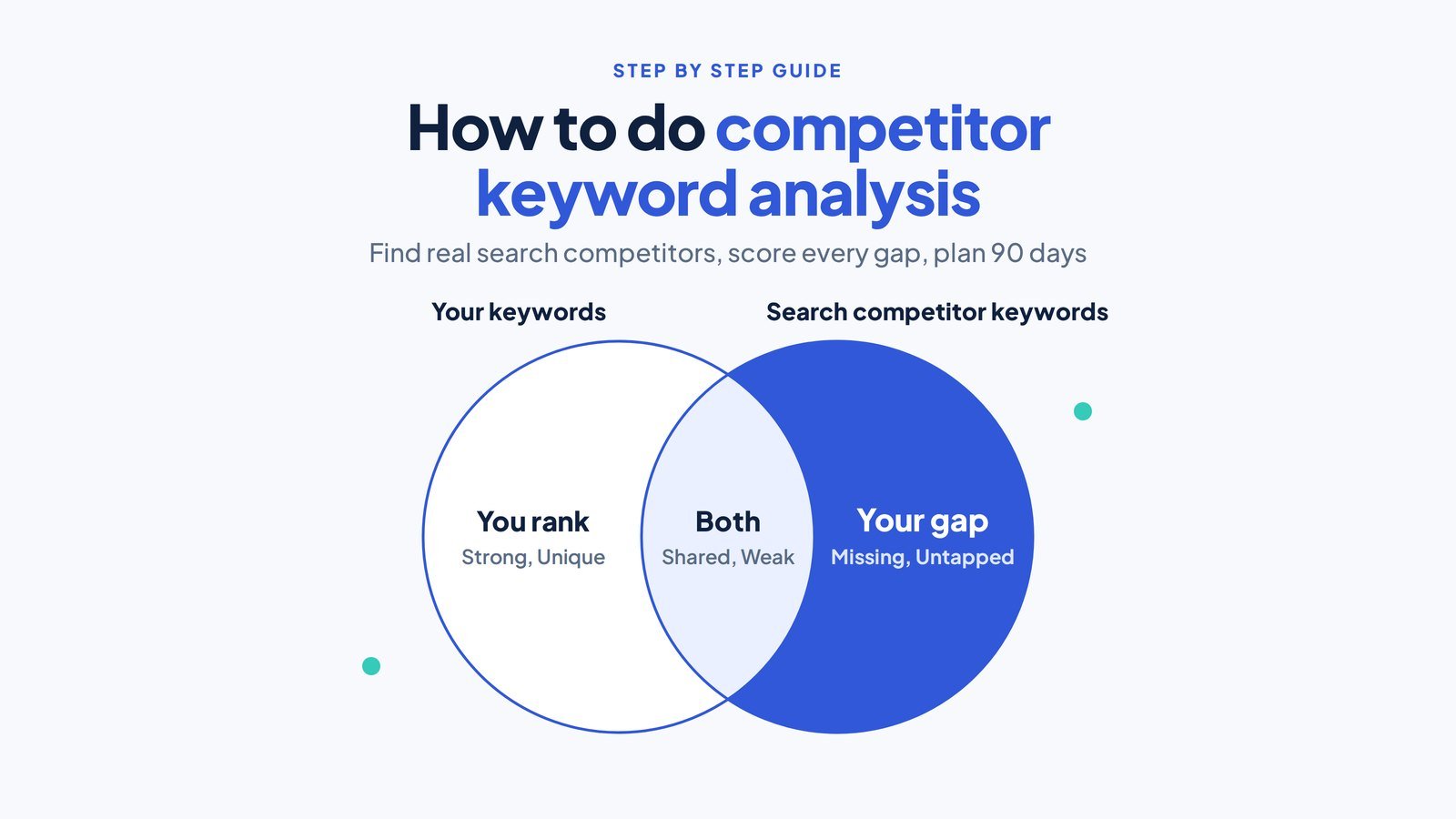
Competitor keyword analysis is the process of finding the websites that rank for the searches your customers make, comparing their keywords and topics with yours, and ranking every gap by the clicks it could win and how winnable it is. It answers the question that matters when a site you’ve never heard of outranks you: why? A tool export of thousands of keywords rarely answers it, because nothing in it says which page to build.
Below is our method in the order we run it, ending with a worked Bristol letting agency example.
Key Takeaways
- Analyse search competitors, the domains that fill your money results, before business rivals.
- Treat a site in your top 10 for at least 3 of 12 sampled keywords as a search competitor.
- Ignore portals on listing searches and national publishers on low-value terms, even when they outrank you.
- Use Google Search Console for your own positions and a keyword gap tool for theirs.
- Score gaps on click gain, business value, winnability and effort, not on search volume.
- Measure your share of voice and AI citation share at the start, so you can prove the gap is closing.
Done-for-you analysis
Get your competitor gap table without the tool bills
Our Keyword Research and Competitor Analysis maps your competitor keyword gap, their top-performing pages and the search intent behind each keyword, for a fixed £500 ex VAT.
Proof behind the method
We bill on KPIs, not hours, and show the numbers behind every plan.
- 200+UK clients across around 18 sectors
- 44first-page rankings in one Cardiff case study
- 494practice websites audited for Research Report TSC-2026-01
How do you do competitor keyword analysis?
You do competitor keyword analysis in seven steps, from naming your real search competitors to turning the highest-scoring gaps into pages.
- Sample 10 to 20 of your money keywords and record every domain in the top 10.
- Keep the domains that pass your overlap test and drop the ones to ignore.
- Export each competitor’s ranking keywords for the United Kingdom.
- Compare them with your Search Console positions and label each gap.
- Read the competitor’s ranking page against Google’s published ranking factors.
- Score each of your gaps on click gain, value, winnability and effort.
- Map the top scores to pages and set a 90-day plan.
Our done-for-you Keyword Research and Competitor Analysis runs that research for a fixed £500 (ex VAT) and hands you a competitor gap analysis, their top-performing pages, SERP feature analysis and search intent matching, so you can act without learning three tools.
How is competitor keyword analysis different from ordinary keyword research?
Competitor keyword analysis starts from the pages that already win, while ordinary keyword research starts from your own seed topics, so a rival’s rankings show proven demand and the winning page format without trial and error. Ahrefs found in its 2017 “also rank for” study that the average number one page also ranks in the top 10 for nearly 1,000 other relevant keywords, so one strong competitor page teaches you a whole group of searches. Our checklist that takes keyword research from seed topic to tracked ranking covers the groundwork on volume and difficulty.
What is the difference between a business competitor and a search competitor?
A business competitor sells what you sell, while a search competitor is any site that occupies the results you want, whatever it sells. Portals, publishers, directories and software vendors all become search competitors when they fill your money results.
We ran this test on ourselves. Our own Search Console data for the 16 months to 6 August 2026 shows 5,655 impressions and zero clicks on this topic’s queries, such as “keyword research and competitor analysis” (1,134 impressions), at an average position of 64. Our business rivals are UK SEO agencies. The pages we found ranking for those queries were how-to guides, most of them from SEO software vendors, and our only ranking page was a product page, which is a page-type gap.
Why do your search competitors change from page to page?
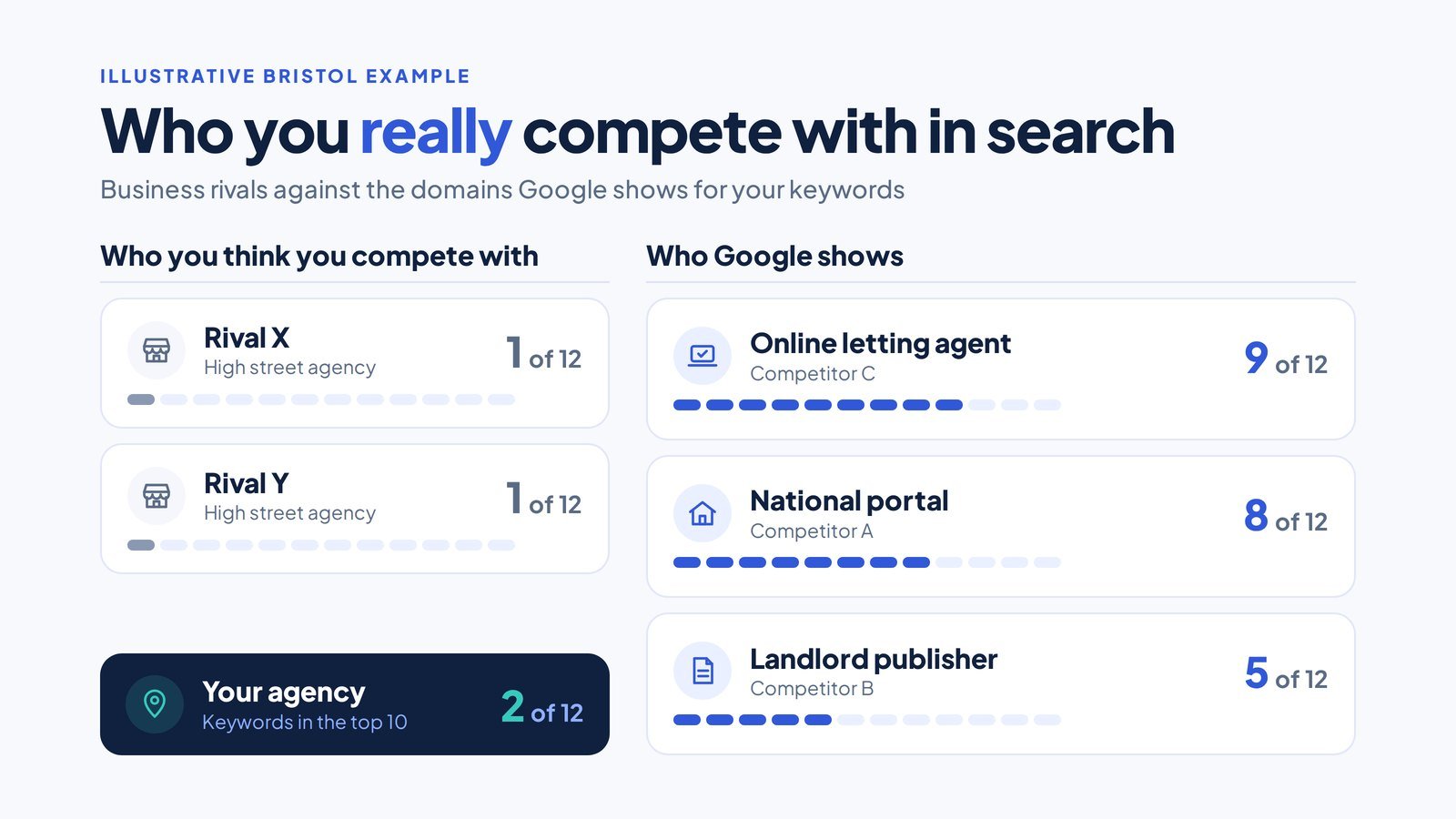
Your search competitors change from page to page because Google ranks each URL against the intent of a query. For a letting agency, the fees guide competes with landlord publishers and the service page with portals, so build a competitor set for each of your page types. Siteimprove’s SEO glossary also notes that competitors differ by topic.
Which competitors should you ignore?
Ignore competitors whose ranking pages you can’t match in type or purpose: portals on listing searches, national publishers on terms that bring a local business little work, sites serving a different audience, and sites from other countries. We explain why letting agents sit below the national property portals, and similar reasoning tends to apply to marketplaces in ecommerce.
How do you find your real search competitors?
You find your real search competitors by checking who ranks for your money keywords, then confirming the pattern with tool reports and Search Console:
- Manual SERP sampling: search 10 to 20 money keywords in a private window with your location set, and note every top 10 domain.
- Tool competitor reports: Semrush’s Organic Rankings Competitors report scores a Competition Level from keyword counts and shared keywords, and Ahrefs’ Organic competitors report lists sites in the top 10 for your target’s highest-traffic keywords.
- Search Console queries: check who sits above you on queries you already get impressions for.
How do you prove a site is a search competitor?
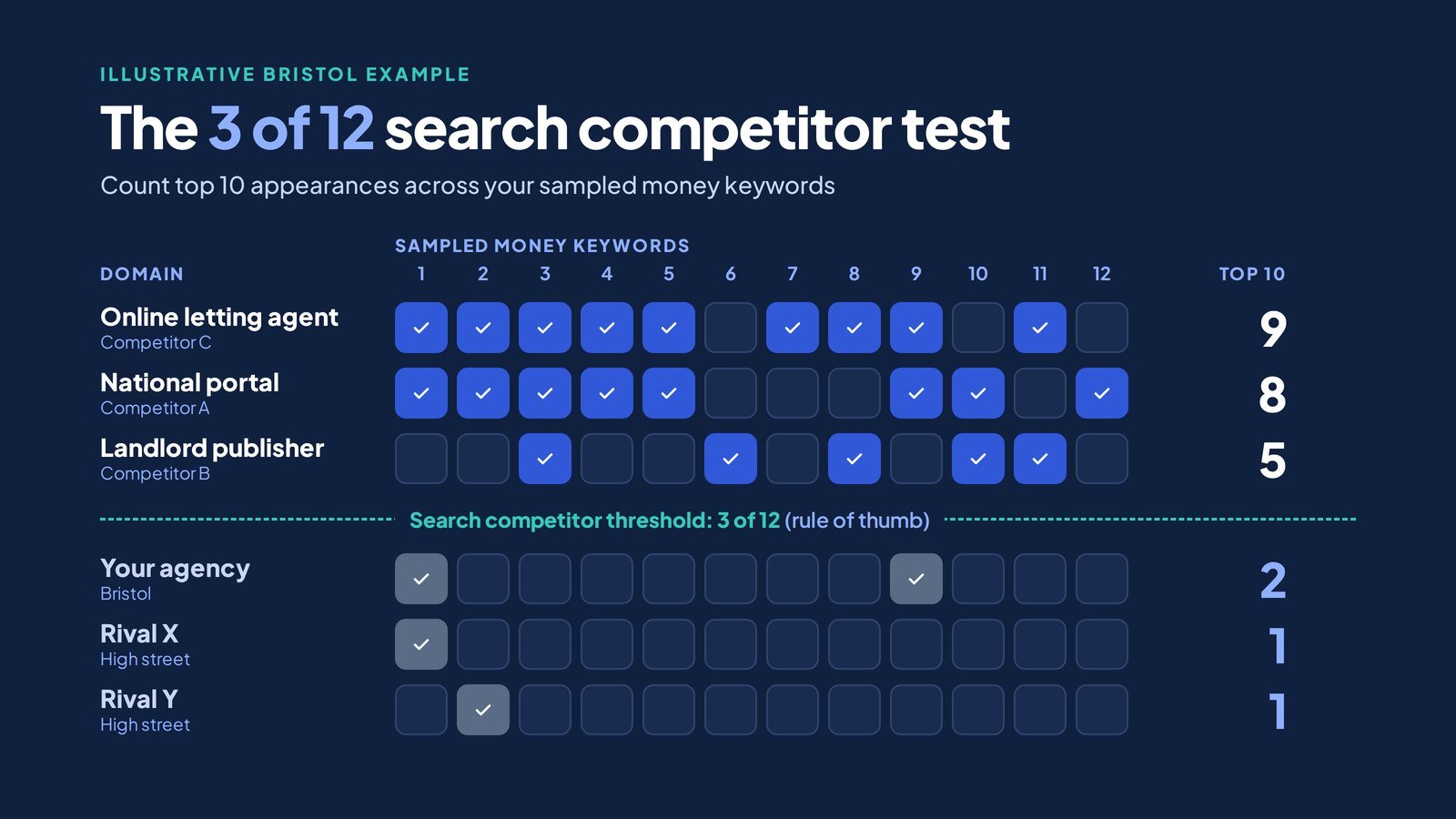
You prove it with an overlap test: count how many sampled keywords each domain ranks in the top 10 for, and treat any domain above a threshold as a search competitor. We use 3 of 12, a rule of thumb rather than a Google rule. A rival in 1 of 12 results is one to watch. A portal in 8 is one to study.
How many competitors should you analyse?
Analyse three to five search competitors per page type. Fewer shows one site’s habits rather than a pattern, and more tends to add duplicate keywords. Tool limits sit close to that range: Semrush’s Keyword Gap compares your domain with up to four competitors, and Ahrefs’ Content Gap accepts up to 10.
How do you find the keywords a competitor ranks for?
You find a competitor’s keywords by pulling an organic keyword report for their domain, filtered to the United Kingdom and positions 1 to 20, then checking their top pages by estimated traffic to see which page types earn it.
Can you do competitor keyword analysis for free?
Yes, you can do competitor keyword analysis for free with Search Console, manual SERP checks and Google Keyword Planner, provided you accept smaller samples. Run site: searches on a competitor’s domain and read their sitemap to see their page types. Enter their URL in Keyword Planner’s “Start with a website” option, which Google calls free and which needs billing details in a Google Ads account. Ahrefs Webmaster Tools shows the keywords bringing traffic to your verified site.
How do you use Google Search Console as your baseline?
Google Search Console gives you first-party figures for the “our position” column. Search Console Help defines average position as the average position of the topmost result from your site, and we sort queries into three bands:
- Positions 4 to 20: improve your matching page with an answer-first section for the exact phrase.
- Positions beyond 20: rewrite, because your page usually answers a different question.
- No impressions where a competitor ranks: plan a new page.
Search Console hides some of your queries for privacy, as Search Engine Land reported from Google’s help documentation. An Ahrefs study reported by Search Engine Roundtable in 2022 found about 46% of query data hidden across 146,741 websites.
Which paid tool features run a keyword gap?
Paid keyword gap features, such as Semrush Keyword Gap, Ahrefs Content Gap and Similarweb’s keyword gap feature, compare your domain with several competitors in one screen. Pick one and keep using it, because each labels and estimates keywords its own way.
| Step | Free route | Paid route | Watch for |
|---|---|---|---|
| Find competitors | Manual SERP sample | Semrush Organic Rankings; Ahrefs Organic competitors | Shared keywords, not services |
| List their keywords | site: searches; Keyword Planner | Organic keyword reports | UK database, top 20 |
| Compare gaps | Spreadsheet of SERP checks | Semrush Keyword Gap; Ahrefs Content Gap; Similarweb keyword gap | Labels differ by tool |
| Your positions | Search Console; Ahrefs Webmaster Tools | Rank tracking | Hidden queries |
| Paid keywords | Keyword Planner bid ranges | Semrush Keyword Gap (paid); SpyFu | Ad spend isn’t profit |
| AI citations | Manual prompt set | Semrush AI Visibility Toolkit; Ahrefs Brand Radar | Log date and surface |
Should you study a competitor’s paid (PPC) keywords?
Yes, study a competitor’s paid keywords as a signal of commercial value, not as a list to copy. Semrush’s Keyword Gap can compare paid keywords, the searches where a domain’s Google Ads appear in the top eight positions, and SpyFu and Similarweb report paid search data too. Keyword Planner’s top of page bid ranges show what advertisers have historically paid for a click. A keyword rivals keep bidding on probably brings them enquiries, but ad spend doesn’t prove profit. Keyword Planner’s Competition column counts advertisers relative to all keywords, so it says nothing about how hard the organic results are.
How accurate is competitor keyword data from SEO tools?
Competitor keyword data from SEO tools is directional, not exact, because each tool estimates rankings and traffic from its own database. Check live results before you commit a page to a keyword.
What is a keyword gap, and how is it different from a content gap?
A keyword gap is a query where a competitor ranks and you don’t, or ranks above you, while a content gap is a topic, section or page type a competitor has and you lack. One content gap on your site often explains dozens of keyword gaps. A SERP feature gap covers features a competitor holds and you don’t, such as a featured snippet, a map pack place or an AI Overview citation.
Semrush’s Keyword Gap sorts keywords into six categories, and the table below puts its documented labels into plain English with an action for each.
| Category | What it means | What to do next |
|---|---|---|
| Missing | Every competitor in your set ranks and you don’t | Create a page once the intent matches what you sell |
| Untapped | At least one competitor ranks and you don’t | Create a page or section, or skip |
| Weak | You rank, but below the competitors that rank | Improve the existing page |
| Shared | Every site in the set ranks | Track and defend |
| Strong | You outrank every competitor | Defend and keep current |
| Unique | Only you rank | Keep and check it converts |
How do you run a keyword gap analysis step by step?
You run a keyword gap analysis by entering your domain and three to five search competitors, setting the database to the United Kingdom and competitor positions to the top 20, then exporting the Missing, Weak and Untapped rows. Remove branded terms, other regions and services you don’t offer. Tag each of your rows with its intent and ranking page type, and replace the tool’s estimate of your position with your Search Console figure.
How do you run a content gap analysis against competitors?
You run a content gap analysis by comparing page types and sections rather than single keywords. List a competitor’s ranking URLs by folder, such as /fees/ or /guides/, and note the page types you lack. Then put one ranking page’s H2s next to yours, and missing sections such as a fee table or an FAQ show up at once. Turning those gaps into a full plan is what a topical map built from your source context does.
Why does a competitor rank above you?
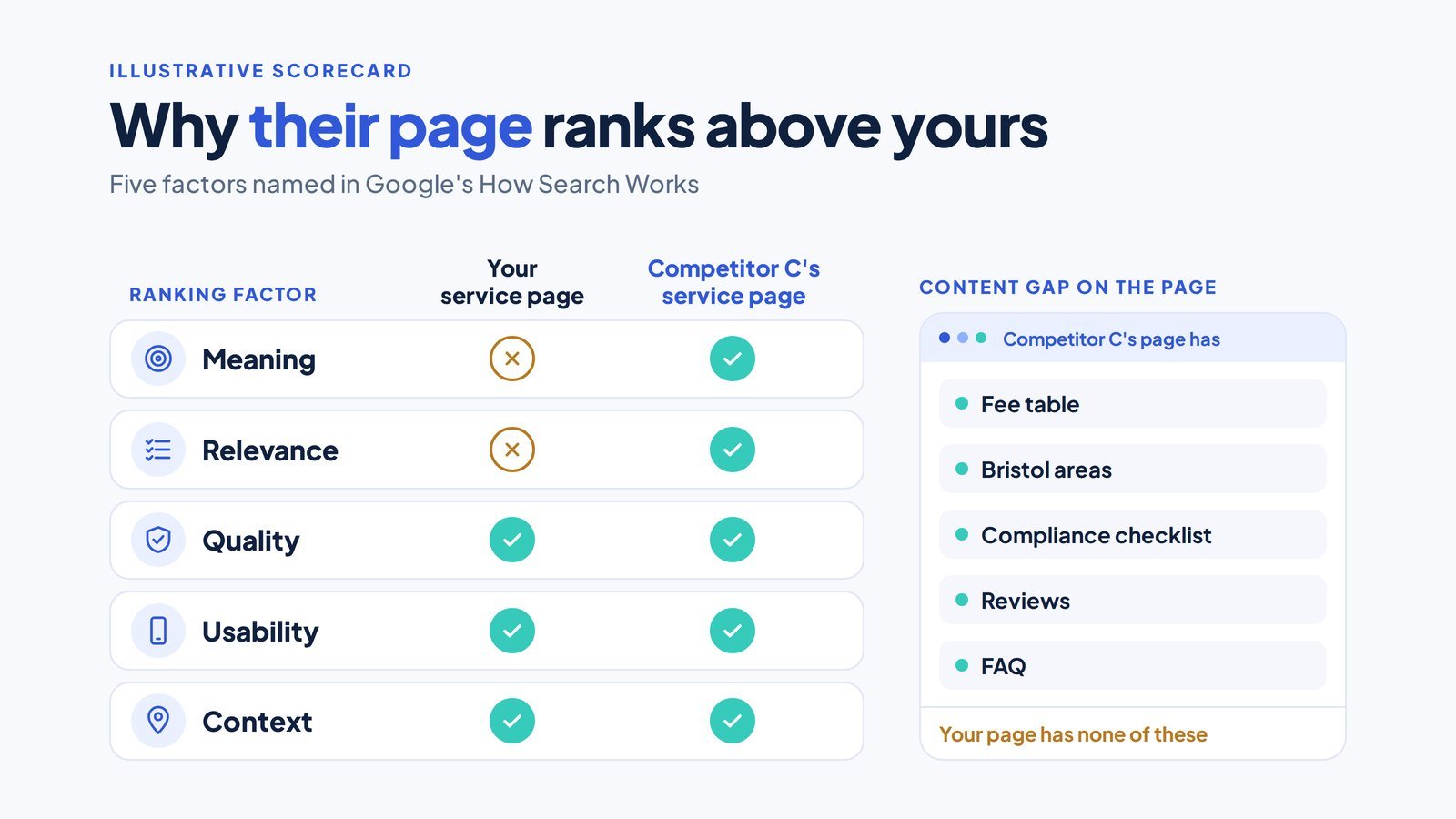
A competitor ranks above you because their page performs better on the factors Google says it weighs for that query: meaning, relevance, quality, usability and context. Google’s How Search Works pages add that “the weight applied to each factor varies depending on the nature of your query”, so no single factor, links included, explains every win. The query “competitors rank” earned 353 impressions in our own Search Console data over those 16 months.
- Meaning: check whether their page type fits the intent behind the query better than yours.
- Relevance: check how fully they cover the query and the subtopics you skip.
- Quality: check signals of expertise, authoritativeness and trustworthiness, such as authors, proof and links.
- Usability: check speed, mobile layout and how quickly the answer appears.
- Context: check results from the town you serve, since Google uses location.
How do you analyse a competitor’s ranking page?
You analyse a competitor’s ranking page with a fixed checklist: page type, title and H1 match, H2 coverage, entities named, proof and data, freshness, internal links and referring domains, and SERP features held.
Does the search intent behind a competitor’s keyword matter?
Yes, search intent decides whether a competitor’s keyword is worth copying at all. The same words can return listings for one query and advice guides for another, and only a page of the ranking type gives you a chance. We cover the types in how keyword intent decides which page should rank.
How do zero-click searches and AI Overviews change the value of a keyword gap?
Zero-click searches and AI Overviews reduce the clicks a ranking can earn, so an informational gap keyword is worth less to you than its volume suggests. SparkToro’s 2024 study of Datos clickstream panel data found 58.5% of US and 59.7% of EU Google searches ended with zero clicks. Pew Research Center tracked the browsing of 900 US adults in March 2025 and found users clicked a traditional result in 8% of visits with an AI summary, against 15% without. Ahrefs reported in February 2026 that an AI Overview correlates with a 58% lower average desktop click-through rate for the top-ranking page, across 300,000 keywords.
None of those studies reports a UK figure, and Ahrefs reports a correlation, so we treat them as direction and cut your winnability score for a keyword by a point when an AI Overview appears.
Which competitors do AI answers cite for your topic?
AI answers can cite a different competitor set from the one you see in Google’s top 10, including directories, review sites and publishers. Turn 10 to 20 money keywords into buyer questions, such as “which letting agents in Bristol manage HMOs?”, and run each in ChatGPT, Gemini, Perplexity, Google AI Overviews and AI Mode. Log every business named and source cited. Add conversational variants too: our own Search Console data shows 391 impressions across 102 query and page rows ending “my location is united kingdom.”, queries that look like AI Mode fan-out. Those answers draw on several searches per question, which our guide to how query fan-out splits one question into many explains.
How do you measure an AI citation gap against competitors?
You measure an AI citation gap as citation share: prompts where a domain is cited or named, divided by total prompts, so a rival named in 9 of your 12 prompts holds 75%. Semrush’s AI Visibility Toolkit can automate the count for you, defining share of voice as the percentage of mentions your brand receives in AI answers compared with competitors, and Ahrefs Brand Radar tracks AI Share of Voice across platforms including AI Overviews, ChatGPT and Perplexity. Our AI and LLM SEO service for getting your business named in AI answers then works on the pages and sources assistants read.
How do you calculate share of voice in SEO?
Share of voice in SEO is your estimated share of the clicks available across a fixed keyword set: add each keyword’s monthly searches multiplied by the click-through rate for your position, then divide by the set’s total monthly searches. We use First Page Sage’s curve, updated May 2025, which puts position one at 39.8% and position ten at 1.6%. Backlinko’s study, first published in 2019, puts position one at 27.6%, so share of voice compares domains and baselines rather than forecasting real clicks. Track yours monthly with the same keywords, competitors and curve. Share of voice shows where you stand, and the priority score decides what you fix first.
How do you prioritise competitor keywords?
You prioritise competitor keywords by removing the ones not worth chasing, then scoring the rest. The exclusion gate removes listings and portal results, searches from people who aren’t your buyer, and national publisher results with no local purpose.
Priority score = estimated monthly click gain × business value (1 to 3) × winnability (1 to 3) ÷ effort (1 to improve a page, 2 to create one).
Click gain is monthly searches multiplied by the CTR at a realistic target position, minus the clicks you already get. Winnability favours specific queries: in our own Search Console data, queries of 13 words or more averaged position 20.9, against about 50 to 52 for one to nine words. Ahrefs reports that keywords under 10 searches a month make up almost 93% of its US database, so we hunt the long tail first.
Should you pick low keyword difficulty scores as quick wins?
Low keyword difficulty scores help you shortlist quick wins, but each score is a tool’s estimate, not a measurement. Ahrefs says its Keyword Difficulty estimates how hard page one would be, mainly from links to the top 10 pages, that it doesn’t account for your own site, and that the same keyword scores quite differently across tools. Semrush’s KD% draws on referring domains, the authority of ranking domains and SERP qualities. Our quick wins are low-difficulty gaps where you already rank between 4 and 20, checked against the live results.
Should you improve an existing page or create a new one?
Improve an existing page when it already ranks between 4 and 20 for the keyword or a close variant, and create a new page when nothing on your site matches the page type the results reward. Check your own site first, because two of your pages chasing one query can split the signals.
Illustrative example. A two-partner accountancy practice ranked between 8 and 19 for 14 queries, earning 41 clicks from 6,200 impressions in a quarter. Both pages above it carried a fees section, industries served and an FAQ. The practice added all three to its existing page, and within 90 days 9 of the 14 queries sat in the top five, with 176 clicks the following quarter.
How do you turn a keyword gap into a content plan?
You turn a keyword gap into a content plan by grouping scored rows into pages, one per intent cluster, ordered by combined score, each with an action, a publish window and a number you’ll measure. Match the page to the intent: guides for informational questions, comparison or fee pages for commercial research, and service or product pages for transactional searches. A plan past a dozen pages needs structure, and our semantic SEO and topical authority service turns that content gap into a mapped network of pages that support each other instead of competing.
Skip the spreadsheet work
Your competitor gap and content plan, done for you
We map your competitor keyword gap, their top-performing pages, SERP features and search intent, then plan the content to close the gap, for a fixed £500 ex VAT.
How does competitor keyword analysis change for local businesses and sectors?
Competitor keyword analysis changes by location and by sector.
How does competitor keyword analysis work for local SEO?
Local competitor keyword analysis works from the town you serve, because the results your buyers see change by location and the map pack adds a second competitor set to log separately. First Page Sage puts position one CTR at 23.7% when a local pack appears, against 39.8% overall.
What do search competitors look like in each sector?
Your search competitor types vary by sector. Accountants can lose cost searches to software vendors and comparison publishers. Our founder Mohammad A Mahmud audited 494 UK ACCA and ICAEW practice websites for Research Report TSC-2026-01. Law firms often face legal directories, dentists NHS pages and booking platforms, hotels online travel agencies, and tree surgeons directories. Shopify, WooCommerce and ShopWired stores run into marketplaces, which leaves buying guides as the usual winnable gap.
Illustrative example. A WooCommerce garden furniture store named two independent retailers as competitors, but its 15-keyword sample showed a marketplace in the top 10 for 13 and the named rivals twice between them. The store dropped 6 marketplace listing keywords and built three buying guides. Six months later the guides ranked top 10 for 8 of the 9 kept keywords, and organic sessions rose from 1,900 to 2,650 a month.
What does competitor keyword analysis look like in practice?
Competitor keyword analysis in practice produces a competitor set, a gap table, a share of voice baseline and a scored plan, shown here for an independent Bristol letting agency. The example is illustrative: the business is fictional and the volumes and positions are invented, not real Bristol data. The agency has a service page, a property management page and a “rent my property” page, but no fees, valuation or landlord guide pages.
Who are the agency’s real search competitors?
The agency’s real search competitors are a national property portal, a landlord advice publisher and an online letting agent, not the two high street rivals the owner named. The online agent reached the top 10 for 9 of 12 sampled keywords, the portal 8 and the publisher 5, while each rival managed 1.
What does the gap table show?
The gap table shows three pages to improve, five new pages to create and three keywords to park or ignore.
| Keyword | Monthly searches | Our position | A (portal) | B (publisher) | C (online agent) | Intent | Gap type | Action |
|---|---|---|---|---|---|---|---|---|
| letting agents bristol | 1,300 | 9 | 1 | Not ranking | 5 | Commercial, local | Weak | Improve service page |
| property management bristol | 590 | 14 | 3 | Not ranking | 6 | Commercial, local | Weak | Improve management page |
| how much do letting agents charge | 2,400 | Not ranking | 4 | 2 | 1 | Commercial research | Missing | Create fees guide |
| rental valuation bristol | 210 | 11 | 5 | Not ranking | 2 | Transactional | Weak | Create valuation page |
| landlord fees bristol | 170 | Not ranking | 7 | Not ranking | 3 | Commercial, local | Untapped | Target in fees guide |
| hmo licence bristol | 480 | Not ranking | Not ranking | 1 | Not ranking | Local research | Untapped | Create HMO guide |
| guaranteed rent bristol | 140 | Not ranking | Not ranking | Not ranking | 3 | Commercial, local | Untapped | Create only if offered |
| tenant find only service | 390 | Not ranking | Not ranking | 5 | 1 | Commercial | Untapped | Create tenant find page |
| rent my property bristol | 90 | 6 | 2 | Not ranking | 4 | Transactional | Weak | Improve landing page |
| best areas to rent in bristol | 880 | 18 | 2 | 6 | Not ranking | Tenant research | Weak | Park |
| landlord legal requirements uk | 1,600 | Not ranking | 12 | 2 | 8 | National research | Missing | Ignore |
| property to rent bristol | 9,900 | 34 | 1 | Not ranking | Not ranking | Listings | Weak | Ignore |
“Rental valuation bristol” is Weak, yet needs a new page, because competitors rank with dedicated valuation pages. The content gap shows on the service page too: Competitor C’s version carries a fee table, Bristol areas, a compliance checklist, reviews and an FAQ, and the agency’s has none.
What share of voice does each domain hold?
The national portal holds the largest share of voice across all 12 keywords, an estimated 26.9%, against 0.2% for the agency. The agency’s position 9 for “letting agents bristol” earns 1,300 × 1.9%, about 25 clicks, and position 6 for “rent my property bristol” adds about 4, for 29 estimated clicks from 18,150 monthly searches.
| Domain | Top 10 appearances (of 12) | Est. monthly clicks, all 12 | Share of voice, all 12 | Share of voice, 10 kept |
|---|---|---|---|---|
| Competitor A (national portal) | 8 | 4,888 | 26.9% | 14.2% |
| Competitor C (online letting agent) | 9 | 1,314 | 7.2% | 19.2% |
| Competitor B (landlord publisher) | 5 | 998 | 5.5% | 10.5% |
| Rival X (high street) | 1 | 39 | 0.2% | 0.6% |
| The agency | 2 | 29 | 0.2% | 0.4% |
| Rival Y (high street) | 1 | 11 | 0.1% | 0.2% |
The last column matters more. About 3,940 of the portal’s clicks come from “property to rent bristol”, an excluded keyword, so across the 10 kept keywords the online agent leads with 19.2%.
Which gaps score highest?
“Letting agents bristol” scores highest at 972, because moving from position 9 to 3 adds an estimated 108 clicks a month to a page that already exists. The fees guide has the largest click gain, 122, but ranks third because it needs a new page and competitors already hold positions 1 and 2.
| Rank | Keyword | Target position | Click gain | Value | Winnability | Effort | Score | Page action |
|---|---|---|---|---|---|---|---|---|
| 1 | letting agents bristol | 3 | 108 | 3 | 3 | 1 | 972 | Improve service page |
| 2 | property management bristol | 4 | 42 | 3 | 3 | 1 | 378 | Improve management page |
| 3 | how much do letting agents charge | 5 | 122 | 3 | 2 | 2 | 366 | New fees guide |
| 4 | rental valuation bristol | 3 | 21 | 3 | 3 | 2 | 95 | New valuation page |
| 5 | hmo licence bristol | 4 | 35 | 2 | 2 | 2 | 70 | New HMO guide |
| 6 | guaranteed rent bristol | 3 | 14 | 3 | 3 | 2 | 63 | New page if offered |
| 7 | tenant find only service | 5 | 20 | 3 | 2 | 2 | 60 | New tenant find page |
| 8 | rent my property bristol | 3 | 5 | 3 | 3 | 1 | 45 | Improve landing page |
| 9 | best areas to rent in bristol | 6 | 39 | 1 | 2 | 2 | 39 | Later, low value |
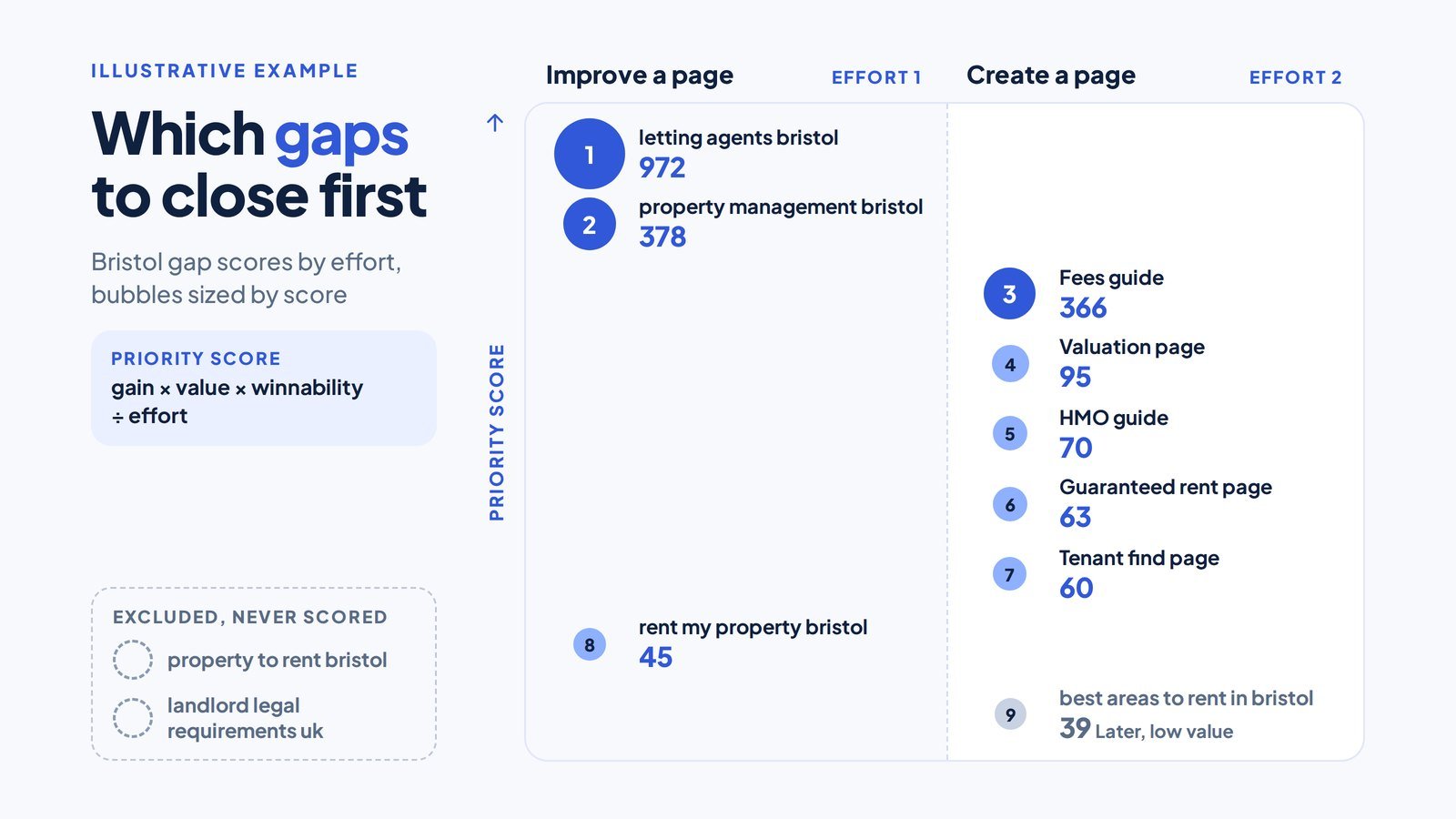
What does the 90-day plan look like?
The 90-day plan improves existing pages first, publishes new pages in score order, and measures again at day 90.
- Days 1 to 30: add the missing sections to the service, property management and “rent my property” pages.
- Days 31 to 60: publish the fees guide, which also targets “landlord fees bristol”, and the valuation page.
- Days 61 to 90: publish the tenant find page and HMO guide, decide on guaranteed rent, then recalculate share of voice and AI citation share.
In this illustration, 12 AI prompts name the portal and online agent most often and never the agency, a zero baseline for day 90.
Self-check quiz
Is this site a real search competitor?
Sort eight sites the way we would for a Bristol letting agency.
Question 1 of 8A high street agency two streets away ranks top 10 for 1 of your 12 money keywords.
Question 2 of 8A national portal ranks first for “property to rent bristol” and top 10 for 8 of your 12 keywords.
Question 3 of 8An online letting agent with no Bristol office ranks top 10 for 9 of your 12 keywords.
Question 4 of 8A landlord advice publisher ranks second for “landlord legal requirements uk”, a keyword with little value to a local agency.
Question 5 of 8A software vendor’s blog ranks top 3 for “how much do letting agents charge”.
Question 6 of 8An agency in Manchester sells the same service but never appears in Bristol results.
Question 7 of 8A directory that ChatGPT cites for Bristol letting agents ranks outside Google’s top 10.
Question 8 of 8Your own blog post ranks 14 for the same keyword as your service page.
Show the answer key
- A high street agency two streets away ranks top 10 for 1 of your 12 money keywords. Business rival only. One appearance in 12 sits below the 3 of 12 overlap threshold, so watch it but don’t study it.
- A national portal ranks first for “property to rent bristol” and top 10 for 8 of your 12 keywords. Search competitor, but ignore its listings searches. It passes the overlap test, yet its listings searches go behind the exclusion gate.
- An online letting agent with no Bristol office ranks top 10 for 9 of your 12 keywords. Search competitor. It sells your service and fills your results, so it is the first competitor to study.
- A landlord advice publisher ranks second for “landlord legal requirements uk”, a keyword with little value to a local agency. Ignore for this keyword. A national informational result with no local purpose fails the exclusion gate.
- A software vendor’s blog ranks top 3 for “how much do letting agents charge”. Search competitor for your fees guide. Competitors are set page by page, and this one holds the result your fees guide needs.
- An agency in Manchester sells the same service but never appears in Bristol results. Business rival only. Selling the same service is not enough; it has to appear in your results to count.
- A directory that ChatGPT cites for Bristol letting agents ranks outside Google’s top 10. Search competitor in AI answers. Your AI competitor set can differ from Google’s, so log it in the prompt test.
- Your own blog post ranks 14 for the same keyword as your service page. A cannibalisation check, not a competitor. Two of your pages chasing one query can split the signals, so merge or re-point.
How often should you repeat competitor keyword analysis?
Repeat a full competitor keyword analysis each quarter, when you launch a service or location, and after a Google core update, with a lighter share of voice and AI citation check each month. That’s our practice, not an industry standard.
How long does it take to see results from closing a keyword gap?
Closing a keyword gap takes weeks to months in our experience: pages already ranking between 4 and 20 tend to move first, and new pages start with no ranking history. Our client results show the pace: RX Virtual Finance reached the first page within about 60 days and ranks number one for “pharmacy accountants”, Total Books Accountants in Cardiff grew from about 200 to about 1,600 organic visits a month, and our Cardiff local SEO case study recorded 44 first-page rankings. Each came from a full programme of work.
What mistakes do people make in competitor keyword analysis?
The most expensive mistake in competitor keyword analysis is studying business rivals instead of the search competitors that hold your results. Watch for six more:
- Copying keywords without checking search intent.
- Chasing portal or national publisher results.
- Ignoring AI Overviews when valuing a keyword.
- Treating tool traffic estimates as fact.
- Running the analysis once.
- Handing over keywords with no page mapped to each row.
Ahrefs found in 2023 that 96.55% of pages in its index get no Google traffic, so a keyword on a list guarantees nothing without a better page. Every row in our gap tables carries an action and a target page, and we won’t sign off an analysis that doesn’t.
Should you do competitor keyword analysis yourself or pay for it?
Do competitor keyword analysis yourself when you have one location, a few pages and time to learn the tools, and pay for it when you run several services or locations, or need AI citation tracking and page-level diagnosis. A five-branch firm has five local competitor sets to track.
What should a professional competitor keyword analysis include?
A professional competitor keyword analysis should give you a competitor set with overlap counts and a gap table with an action on every row. It should add share of voice and AI citation baselines, a scored 90-day plan and a list of exclusions. Our free SEO audit with a competitor benchmark names two or three of your competitors and the gap against each, so you can see whether a full analysis is worth it.
Frequently asked questions about competitor keyword analysis
What is keyword competition analysis?
Keyword competition analysis judges how hard a keyword is for you to rank for, from the authority, page types and SERP features of the pages already ranking.
Are keyword research and competitor analysis the same thing?
No, keyword research and competitor analysis are two halves of one job. Research finds what your buyers search for, and competitor analysis shows who already wins those searches.
What is a good share of voice?
A good share of voice is one that beats your last measurement and closes on the search competitor directly above you. It depends on your keyword set, so compare the same keywords, competitors and CTR curve each time.
What is a striking-distance keyword?
A striking-distance keyword is one you already rank for just below the top results, and we use positions 4 to 20, close enough that improving the existing page can lift it to the top of page one.
Why do I get impressions but no clicks on competitor keywords?
You get impressions without clicks when your page ranks too low to be seen or doesn’t match what the searcher wanted. Our own product page, averaging position 64 against how-to guides, showed both problems at once.
Is there a competitor keyword analysis template?
Yes, the gap table in the worked example works as a template: keyword, monthly searches, your position, each competitor’s position, intent, gap type and action. Add the click gain, value, winnability, effort and score columns from the priority table, and every row ends with a page to build or improve.
Where should you start with competitor keyword analysis?
Start with 12 of your money keywords and an overlap count, because that first count shows who your search competitors are before you spend anything on tools.
We’re True SEO Consultants Ltd, a semantic SEO consultancy at Startup Stiwdio, University of South Wales, 86-88 Adam Street, Cardiff, CF24 2FN. Our founders come from inside finance: Mohammad A Mahmud is ACCA qualified and has worked in search since 2011, and Julie Williams is a fractional finance director with more than 30 years’ experience. We serve more than 200 UK clients across around 18 sectors through remote digital onboarding and delivery, and bill monthly work on KPIs, not hours, with Local SEO from £399 a month and full service SEO from £699 a month, ex VAT.
Run your overlap count today, then book the free strategy call below and we’ll turn your gap into a plan.
Turn your competitor gap into a monthly plan
Book a free 30-minute call and we’ll show you who your search competitors are and which gaps to close first, with monthly work billed on KPIs, not hours.
Book my free 30-minute callSee how topical coverage works