Because the portals are better at that specific job than any single agency can be, and the gap is structural rather than a matter of effort. They hold more listings, more pages, more links and more freshness on property searches than one agency will ever accumulate. The useful conclusion is not to fight harder. It is to stop competing where you cannot win and start competing where portals barely appear.
That sounds like a concession, and it is. It is also the most profitable thing an agency can be told about search, because the searches the portals do not contest are the searches that produce instructions.
The four advantages you cannot close
- Inventory. A portal lists the market. You list your share of it. On a search for property in a town, the page covering everything is more useful than the page covering a fraction, and search engines are right about that.
- Freshness. Portal pages change many times a day as stock moves. A single agency’s pages change when its own stock moves, which is far less often.
- Links and brand demand. Decades of advertising mean people search portal names directly. That authority flows into every property page they publish.
- Behaviour. Searchers who click through generally find what they wanted and do not come back for another result. That pattern is self-reinforcing.
None of these are addressable by a better title tag. An agency that spends a year trying to outrank a portal on “flats to rent in [town]” will have spent a year losing.
The search, and who wins it
How do you decide which searches to compete on?
Ask three questions in order: is the search about a property or about the agency, does a page exist that answers it, and is the answer local enough that a national publisher cannot write it. Answer those honestly and the content plan writes itself.
Three questions, and where they land
| What is typed | Who wins | Why | What you should do |
|---|---|---|---|
| Property in a town or postcode | Portal | Whole-market inventory, refreshed hourly, with national brand demand behind it. | Concede it. Keep listing on the portals, because that is distribution and it works. |
| A specific street or development | Portal, carrying your listing | Same reasons, and the portal page usually carries your own property anyway. | Concede the ranking, but make sure the listing links back properly. |
| Letting agent fees in a town | The agency | No portal explains what an individual firm charges, and publishing it is already required. | Write the fee page properly. It is the highest-value page most agencies never write. |
| Service comparison, managed against let only | The agency | A decision about the service, not about a property. | One page per service level rather than one combined services page. |
| Licensing and rules in a borough | The agency, comfortably | Set by the council and different a mile away. No national publisher covers every authority. | Write it for your patch. This is the most durable content an agency can hold. |
| The agency name plus reviews | The agency, unless it is neglected | Definitionally the most relevant result for its own name. | Own that results page, including any portal agent profile sitting above it. |
What the portals do not publish
This is the part agencies overlook, and it is substantial. Portals are built for property seekers, so almost everything aimed at the person who owns the property is missing or generic.
- Fees and service scope. A portal cannot tell a landlord what an agency’s management fee includes.
- Local licensing and enforcement. Set by the local authority and genuinely different a mile away. A national publisher cannot cover every council properly.
- What changed and what it means here. National rule changes have local consequences, and the reading that matters is the one written from inside the patch.
- The agency itself. Who works there, which parts of the market they specialise in, how they handle problems. This is the substance a landlord is actually assessing.
- Area knowledge with a point of view. Not a demographic summary, but which streets let quickly, what tenants ask about, where the parking is impossible.
Every item on that list is a search somebody makes; on none of them is a portal a serious competitor. That is also why a rule change is an opportunity rather than a chore: the national coverage arrives within days, and the version explaining what it means in one borough never arrives at all.
Does the property feed cause problems of its own?
Often, and they are invisible until somebody crawls the site. A feed generates pages at machine speed, and the decisions it makes about them, or fails to make, are the most common technical problem on an agency website.
| What the feed does | What it causes | The fix |
|---|---|---|
| Publishes the same description the portal carries | Your page and the portal page say the same thing, and the portal wins. | Add something the feed cannot: the area context, the branch, the letting terms in your own words. |
| Deletes a listing the moment it lets | Every link and signal that property earned disappears, repeatedly, forever. | Set a rule: keep and mark as let, or redirect to the branch or area page. |
| Creates a page for every filter combination | Thousands of near-identical pages competing with each other and with the real ones. | Decide which filtered views deserve to exist and stop the rest being indexed. |
| Owns the page templates entirely | Nothing can be added, and titles and descriptions repeat across the site. | Check what the platform actually allows before assuming. Most allow more than agencies use. |
| Puts the material information inside an image | Data a landlord and a machine both need is unreadable to one of them. | Publish it as text. Anything inside an image is invisible to retrieval. |
Three valid outcomes, and one common mistake
Should you list on the portals at all?
Yes, almost certainly, and this is where the argument is often taken too far. Portals are the tenant and buyer distribution channel and they work. Leaving them to make a point about independence usually costs more than it saves, particularly for an agency without an established local brand.
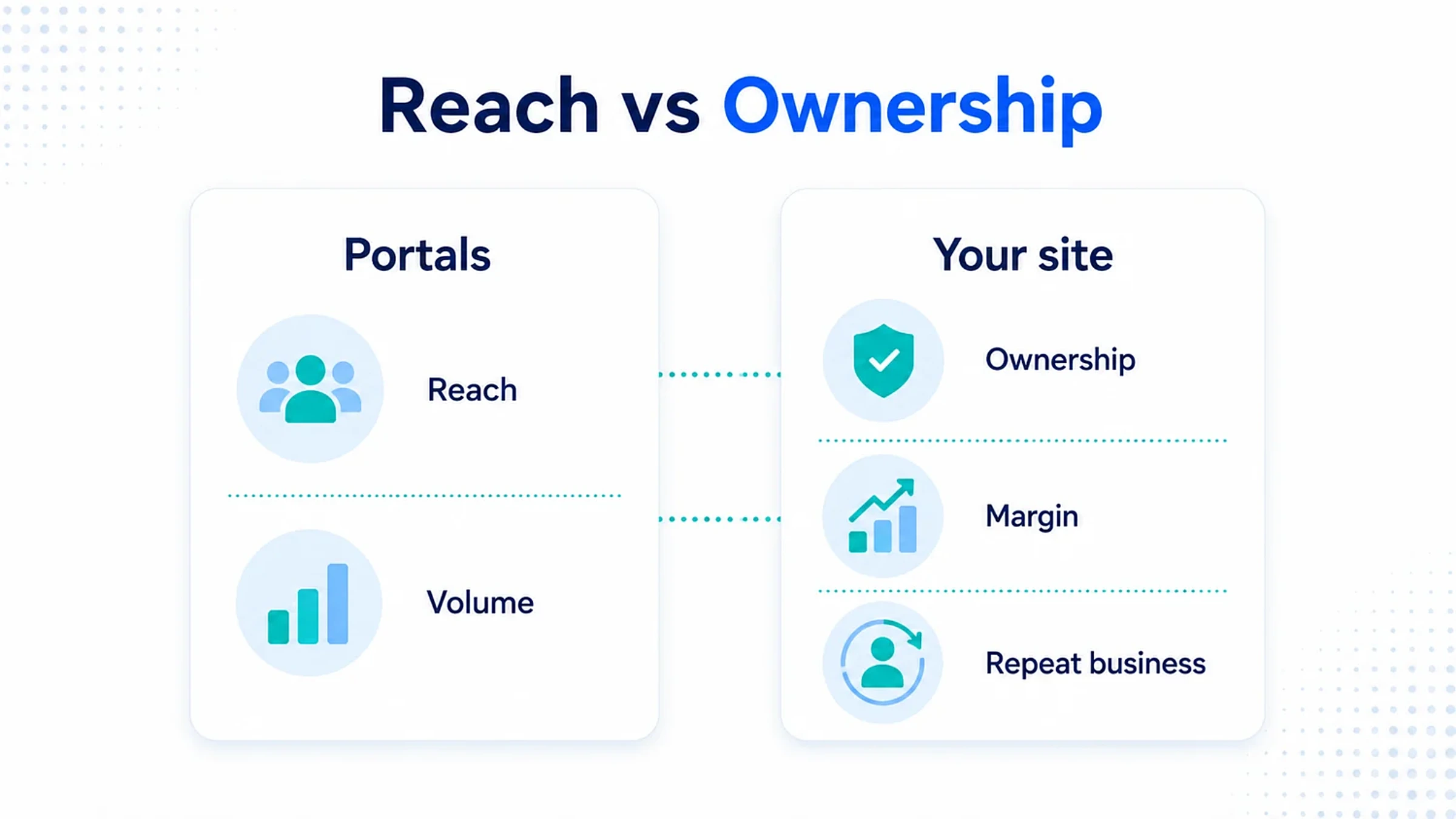
The mistake is not using them. It is treating distribution as if it were marketing; the conclusion that follows, that enquiries arriving means there is no acquisition problem, is the expensive part. Portal enquiries are about properties you already have; they do nothing to bring in the next landlord.
A reasonable position: keep the listings, stop measuring the website against them, and judge it on the half of the business the portals never touch.
The question that does deserve thought is what happens when a portal starts selling services to landlords directly, which several have moved toward. An agency whose only relationship with a landlord runs through a platform is exposed to that platform’s strategy; one with its own visibility on the fee, service and licensing questions is not, which is the strategic case for this work rather than the tactical one.
Do links from the portals help your rankings?
Very little, and not in the way agencies hope. An agency profile on a portal is worth completing because people read it and because it surfaces on a name search, but it belongs in the brand results picture rather than in a link-building plan.
The more useful question is whether the portal profile is outranking your own site for your own agency name. That happens more often than agencies realise, and it matters because a landlord at the final stage of choosing is searching exactly that. Where a portal profile sits above the agency’s own website on its own name, the fix is on the agency’s side: a stronger, more specific page about the agency, complete profile data everywhere, and the reviews and redress information the searcher is actually looking for.
How that fits the rest of the work is set out on letting agent and property management SEO, and the branch-level detail on local and multi-location SEO.
The one property search you should win
Your own brand. When somebody searches the agency name, plus a property, plus a street being marketed, everything on that results page should be yours. Portals will appear there too, carrying your listings, and that is fine. What matters is that the first result and the knowledge panel are under your control.
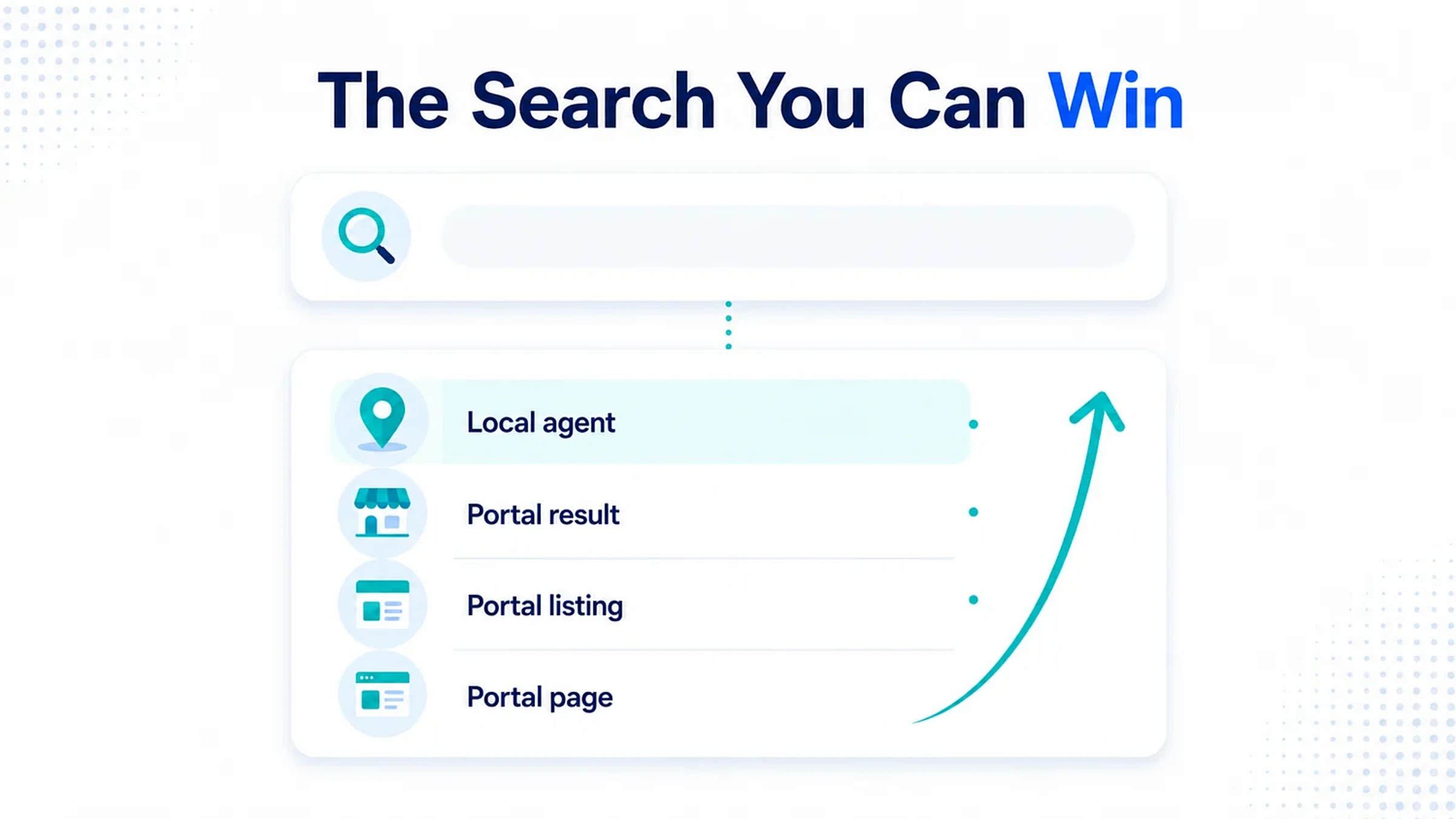
Brand search is also the only property-adjacent search where the inventory disadvantage disappears, because on its own name an agency is definitionally the most relevant result. Agencies lose it surprisingly often, usually to a portal’s agent profile page.
It is also the last search a landlord makes before they ring, which is stage five of the sequence. Everything else on this page is about getting onto the shortlist. This one is about not falling off it at the final gate.
Start free, on the searches the portals barely enter
The first month costs nothing. It goes on separating the searches no agency can win from the ones a portal never enters, so the effort lands where it can return something.
What the free month covers
- The searches where portals genuinely outrank an independent agency, separated from the ones they barely contest
- The brand results page, including any portal agent profile currently sitting above it
- The landlord-side content plan, which is the half of the market the portals do not serve

First month free · a few places at a time
Your first month of SEO, free
Answer three quick questions to claim yours.
Thank you, that is with us.
We will email your onboarding form and payment link, and call within one working day if you would rather talk it through first.
Pick a time that suits you below. We will confirm by email too.
Answer the four questions and the reply separates the searches worth contesting from the ones already lost. The terms of the free month sit with the form.
Common questions
Could a large agency group outrank a portal?
Occasionally, on specific searches, with a national footprint and years of investment. For a regional or independent agency it is not a realistic target and pursuing it consumes the budget that would have won the landlord side. Even where a group does compete, it does so on brand and volume rather than on better pages, which is not a route open to smaller firms.
Does listing on portals hurt our own rankings?
No. Listings appearing on a portal do not suppress your own site, and the duplication involved is normal syndication that search engines handle routinely. The competition is for attention rather than a penalty. What does hurt is having no content beyond the feed, because then there is genuinely nothing to rank apart from pages that duplicate a portal’s.
Our property pages say exactly what the portal says. Is that a problem?
It is not a penalty, but it does mean your page has no reason to be preferred. The portal carries the same words with far more authority behind them, so it wins by default. The fix is not rewriting every listing by hand, which no agency has time for. It is adding the layer the feed cannot supply: the area context, the branch handling it, the letting terms in your own words, and a link to the town page that gives the property a home when it lets.
What should happen to a listing page when the property lets?
Keep it and mark it clearly as let, or redirect it to the branch or area page. Both preserve whatever the page earned while the property was marketed. Deleting it is the option that costs you something, and it is what many feeds do by default. Check which rule your platform applies, because it is usually configurable and almost nobody checks.
What about the newer portal alternatives?
The commercial argument between them is real but it is a distribution decision, not a search one. From a search perspective they change nothing about this page: whichever portals an agency uses, they serve property seekers rather than landlords, and acquisition still has to come from somewhere else. Decide on cost and lead quality, then build the landlord side regardless of the answer.
Where should we spend the effort instead?
In rough order of return: the fee and service pages a landlord searches before contacting anyone, a genuinely distinct page for each town instructions come from, local licensing and rules content, your Google Business Profile per branch, and your brand results page. None of those compete with a portal, and all of them compete with the agency down the road, which is the competitor that actually takes your instructions.
More on winning landlord instructions
- What landlords search before they change letting agentThe five stages a landlord moves through before they ever ring an agency, and the four of them that are questions rather than shopping.
- Does Propertymark or RICS membership help an agency rank?Accreditation is not a ranking factor. What it is instead, and why a logo in the footer does none of the work the words would do.
- What the Renters’ Rights Act changed about how landlords choose an agentThe reforms commenced on 1 May 2026. What changed, how landlord searching shifted with it, and which pages are now describing a regime that has gone.
- One Google Business Profile per branch, or one per agency?Why a single profile cannot cover a patch, what makes a branch listing eligible, and the mistakes that quietly cost multi-branch agencies the map pack.