Not directly. No accreditation is a ranking factor, and any supplier telling you Propertymark membership will move your positions is guessing. What it does do is give search engines and AI assistants something verifiable to attach to your business, and give a cautious landlord a reason to choose you over the cheaper quote. Both of those are worth having. Neither happens automatically.
The gap between those two sentences is where most member agencies lose the value they are already paying for. The subscription is bought, the certificate is framed, the logo goes in the footer, and nothing else happens. This page is about the “nothing else”.
Why the honest answer is more useful than the marketing one
Google has never published a ranking factor called “trade body membership”, and it isn’t plausible that one exists. Search engines cannot verify most memberships at scale, they change without notice, and the incentive to fake them would be enormous.
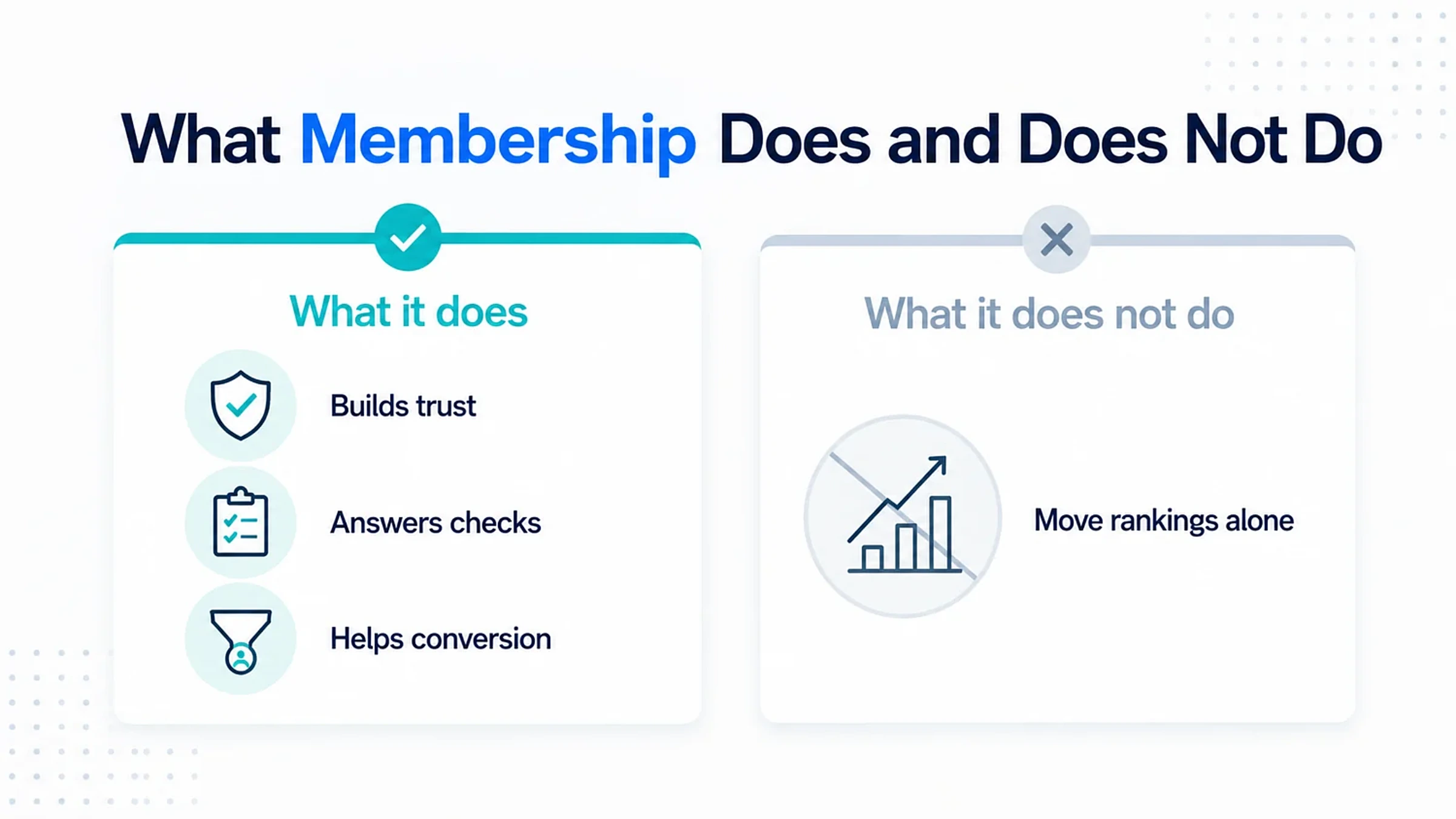
What search engines can do is build a picture of an entity: a business with a name, an address, a set of services, some corroborating mentions elsewhere, and some claims that either check out or do not. Membership contributes to that picture in the same way a Companies House record or a professional directory listing does. It is one strand in an entity, not a lever.
That distinction matters commercially, because it changes what an agency should do with the membership. If it were a ranking factor, displaying the logo would be enough. Because it is an entity signal, the logo is close to useless and the words are what count.
What does an accreditation claim have to look like to count?
Readable, checkable and corroborated, in that order. A claim a machine cannot read is not one at all; a claim it cannot test is weak; the version confirmed by the scheme’s own register is what firmly attaches to a business.
Four states, and only the last one does any work
Moving from state one to state four is an afternoon of work on a page the agency already needed. It is one of the few jobs in search that is finished when you finish it, rather than something to maintain forever.
What most member agencies do, and why it does nothing
The usual implementation is a row of badges in the footer, rendered as images, with no text, no link and no explanation. To a person that is mild reassurance; to a machine it is decorative.
What you display, and what a machine takes from it
- An image is not a claim. A logo with no alt text and no surrounding text says nothing that can be read, extracted or quoted.
- Footers carry little weight. Sitewide furniture is treated as furniture. A claim that matters belongs in the body of a page about it.
- Nothing links back. Where a scheme publishes a member directory, a link in both directions is corroboration. One-way logos are not.
- The membership number is missing. The one detail that makes the claim checkable is almost always the detail left off.
What to do instead
Treat accreditation as content rather than as a badge. That means a page, or at minimum a substantial section, that a landlord and a machine can both read.

- State it in text. The body’s name, the membership number, and the date joined or last assessed.
- Explain what it means for the landlord. The obligations it puts on the agency, the protection it gives them, and the consequences of falling short. Most landlords have no idea, and the explanation is more persuasive than the badge.
- Distinguish membership from accreditation. If you are a member rather than an assessed or approved firm, say member. The difference is public and easily checked, and overclaiming is the one genuinely damaging option.
- Mark it up. Stated in structured data, the affiliation can be read by search engines and quoted by assistants. Shown as an image, it cannot.
- Cover the things that sit alongside it. Your redress scheme and, where you hold client money, your client money protection scheme are already required to be stated. Put them in the same place and the page becomes the trust page for the whole agency.
Which trust signals does a landlord actually check first?
The two that are required of you, before the one you pay a subscription for. Redress scheme membership and client money protection are what a careful landlord looks for, because they answer the question of what happens if something goes wrong.
What a landlord checks, in the order they check it
| What it is | Required of you? | What a landlord wants from it | Where it should be stated |
|---|---|---|---|
| Redress scheme | Yes. Letting agents must belong to an approved scheme and state it. | Somewhere independent to go if the agency will not resolve a complaint. | In text on your trust page and in your website footer, with the scheme named in full. |
| Client money protection | Yes in England, where the agency holds client money. | Confidence that rent and deposits are covered if the agency fails. | The same page, with the scheme named and the membership current. |
| Deposit protection scheme | Yes, for deposits taken on assured tenancies. | Proof the deposit is registered where the law requires. | Named on the trust page and on the tenancy information pages tenants read. |
| Trade body membership | No. Voluntary, and it carries obligations of its own. | A signal that the agency chose to be held to a standard. | In text with the membership number, the date, and what it obliges you to do. |
| Software and portal partner badges | No. | Nothing. They are supplier marketing. | Nowhere near the trust page, where they dilute the four items above. |
Publishing that table honestly does more for a cautious landlord than any accreditation logo, and it is the same page the stage five name check lands on when they search your agency by name.
Which structured data should carry the claim?
The agency’s own organisation markup, not a bolt-on. Accreditations, memberships and schemes belong as properties of the business entity, alongside the address, the service area and the contact route, so an assistant reading the page finds them attached to the right thing.
| Where | What belongs there | What does not |
|---|---|---|
| The agency, sitewide | Legal name, address, contact route, opening hours, service area, memberships and schemes. | Marketing adjectives, and any claim that is not stated in the visible copy as well. |
| Each branch | The branch as its own location, with its own address, phone and hours. | A branch record for an address you do not occupy. |
| Each service page | The service, described, with the area it is offered in. | Prices you have not agreed to publish, or figures that contradict the visible page. |
| Each question you answer | The question and the answer, matching the visible text word for word. | Questions that do not appear on the page, which is a common and avoidable penalty risk. |
The rule underneath all four rows is the same: structured data describes what is already on the page. It is a translation, not an addition, and anything that appears only in the markup is the kind of shortcut that gets a site into trouble.
Where the real ranking benefit comes from
Indirectly, and through people rather than algorithms. A landlord comparing three agencies who finds one that explains its obligations clearly is more likely to choose it, more likely to mention it, and more likely to leave a review. Those behaviours do influence visibility, and they are the mechanism by which trust content earns positions.
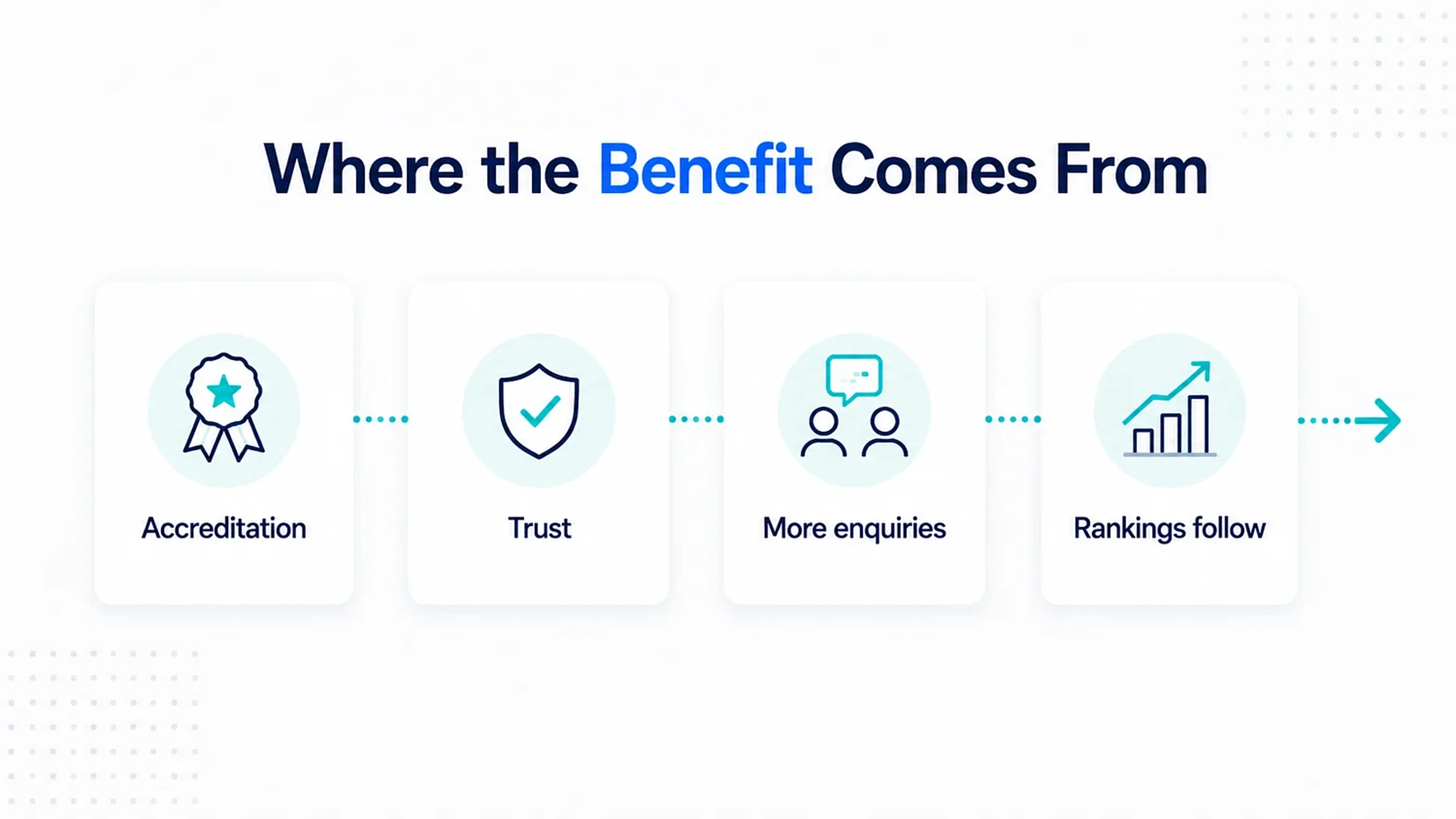
There is also a growing AI dimension. When an assistant is asked to recommend a letting agent in a town, it assembles an answer from sources it can parse and attribute. An agency whose accreditations, address, service area and scheme memberships are stated in plain text is quotable. One whose equivalent information exists only as logos is not.
The mechanics of that are set out on the ranking in AI and LLM answers page, and how it fits a lettings or management business is covered on SEO for letting agents and property management.
Do links from the schemes and directories help?
Some do, and the ones that do are the ones nobody bothers to claim. A link from a scheme’s own member register is corroboration a machine can follow, and it costs an email rather than an outreach campaign.
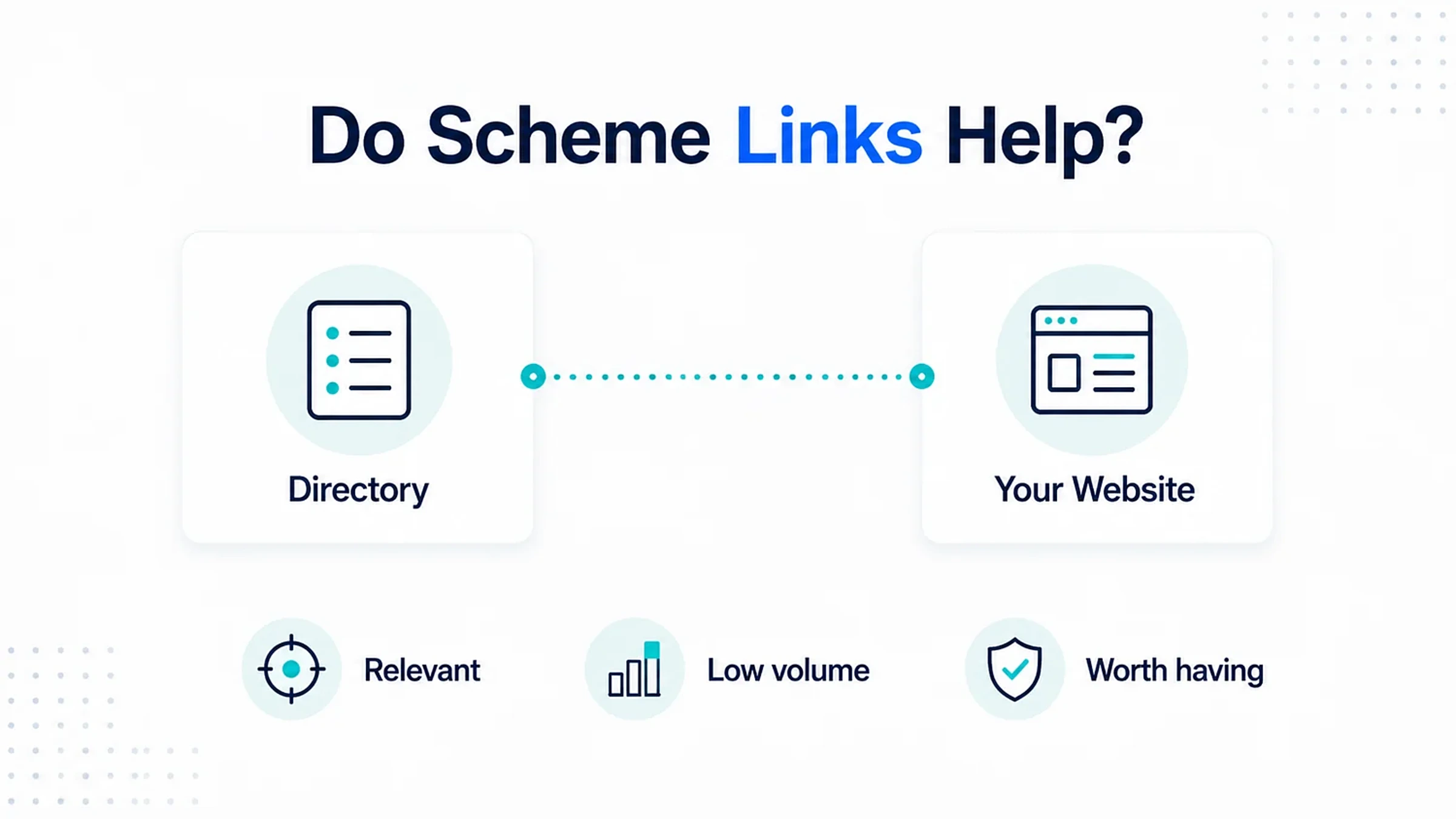
Directory links fall into three groups. The schemes and bodies an agency already belongs to are the first and the easiest win, because the entry exists and usually just needs completing and pointing at the right page. Local business directories and the council or chamber listings for the towns covered are the second, and they matter more for a local agency than for almost any other kind of business. Everything else, including paid link lists dressed up as directories, is the third group and is worth neither the time nor the money.
Portal profiles sit oddly across those groups. An agency page on a portal is worth completing and keeping accurate because people read it, and because a portal profile outranking your own site for your agency name is a real and common problem. Judge it as a piece of your brand results page rather than as a link, which is the same argument that applies to the portals generally.
Start free, and judge it on whether your accreditations become quotable
The first month costs nothing. It goes on the trust material: what your site currently says about accreditation, redress and client money, and how much of it a landlord or an assistant can actually read.
What the free month covers
- Where your accreditations appear today, and whether any of it exists as text rather than as an image
- A trust page outline that carries redress, client money protection and membership in one place
- The structured data an assistant needs before it will quote the claim instead of skipping it

First month free · a few places at a time
Your first month of SEO, free
Answer three quick questions to claim yours.
Thank you, that is with us.
We will email your onboarding form and payment link, and call within one working day if you would rather talk it through first.
Pick a time that suits you below. We will confirm by email too.
Answer the four questions and the reply starts with what your site says today about accreditation, redress and client money. The terms of the free month sit with the form.
Common questions
Is Propertymark membership worth the cost for SEO alone?
No, and it would be a poor reason to join. Join because of what the scheme requires of the business and what it signals to landlords. The search benefit is real but indirect, and it only materialises if you write about the membership properly rather than displaying a badge. If the membership is already paid for, the writing costs nothing extra and is where the return actually is.
We are a property management company rather than a high-street letting agent. Does this apply?
It applies more strongly. A committee or a portfolio landlord choosing a managing agent checks redress and client money protection before it reads a single case study, because it is handing over other people’s money. The vocabulary differs, in that management searches bring in block managers and national managing agents alongside local lettings firms, but the trust stack and the order it is checked in are the same.
Does the certificate on the office wall do anything online?
Only if the same claim exists as text somewhere a crawler can reach. A photograph of a certificate is an image, and the wording inside an image is not read as a claim about your business. Photograph it by all means, because it reassures a visitor who is already on the page, but write the scheme name, the membership number and the date beside it. The photograph is for the person; the sentence is for everything else.
Does it help to link to our entry in the member directory?
Yes, in both directions where the scheme allows it. A link from your page to your directory entry, and from the entry back to your site, is corroboration a machine can follow. It is one of the few genuinely useful links an agency can obtain without any outreach at all, and most member firms never claim it.
We are members of several schemes. Should we list them all?
List the ones that mean something to a landlord and explain each in a sentence. A long unexplained list reads as padding and dilutes the ones that matter. Redress and client money protection come first because they are required and because they answer a real worry. Trade body membership comes next. Software partner badges and similar are not trust signals and belong nowhere near this page.
What if we lose the accreditation later?
Remove the claim promptly and everywhere, including the structured data. A stale accreditation claim is worse than never having made one: it is checkable, it will eventually be checked, and it undermines every other claim on the site. Put a note in whoever’s calendar handles renewals so the website is updated at the same time as the membership.
More on winning landlord instructions
- What landlords search before they change letting agentThe five stages a landlord moves through before they ever ring an agency, and the four of them that are questions rather than shopping.
- What the Renters’ Rights Act changed about how landlords choose an agentThe reforms commenced on 1 May 2026. What changed, how landlord searching shifted with it, and which pages are now describing a regime that has gone.
- One Google Business Profile per branch, or one per agency?Why a single profile cannot cover a patch, what makes a branch listing eligible, and the mistakes that quietly cost multi-branch agencies the map pack.
- Why agents rank below Rightmove and ZooplaThe four advantages the portals hold that no agency can close, and the searches where they barely turn up at all.