The main tenancy reforms in the Renters’ Rights Act 2025 commenced on 1 May 2026. Fixed-term and shorthold assured tenancies were abolished for private assured tenancies, section 21 evictions went with them, and every affected tenancy became an assured periodic one. Four months on, the landlords who lived through that transition are behaving differently in search, and a good many of them are quietly reassessing their agent.
This page is about the second half of that sentence. The legal change has been written about everywhere; what has been written about far less is how it moved landlord search behaviour, and what an agency should publish now that the questions have changed.
What actually changed on 1 May 2026
The commencement regulations brought Chapter 1 of Part 1 into force for private assured tenancies, along with discrimination protections, restrictions on rental bidding, strengthened rent repayment orders and wider enforcement powers for local housing authorities. Extensive transitional provisions cover rent increases, existing notices and legacy tenancies.
Before and after, for private assured tenancies
For a landlord the practical effect is simple to state and unsettling to absorb: the route out of a tenancy that most of them understood no longer exists, and the replacement is a set of grounds that have to be established rather than a notice that can be served.
This is a description of what changed, not legal advice. Anyone facing a specific possession question needs a solicitor, and an agency page that says so keeps its credibility.
How landlord searching changed
Three shifts are visible in how landlords now look for information, and each one is an opportunity for an agency that writes about it.
Three shifts, and the page each one needs
- From notice periods to grounds. The old searches were about timescales; the new ones are about whether a situation fits a ground at all, which is a harder question and a longer read.
- From process to exposure. Landlords are asking what they are now liable for rather than how to complete a step. Anxiety-shaped queries behave differently: they favour thorough pages over short ones.
- From confidence to reassessment. Complexity moves self-managing landlords toward agents, and moves agent-managed landlords toward asking whether their agent is on top of it. Both movements start with a search.
That third movement is the one worth planning around. It is the clearest example of the pattern set out in what landlords search before they change letting agent: a rule change triggers the exposure check, and the agency that answered the exposure question is the one on the shortlist two months later.
Does the vocabulary differ in Wales?
Substantially, and it has done since 2022. Wales moved to occupation contracts and contract holders under the Renting Homes (Wales) Act 2016, so a Welsh landlord searches different words from an English one, and an agency operating in Wales that publishes English terminology is answering the wrong query set.
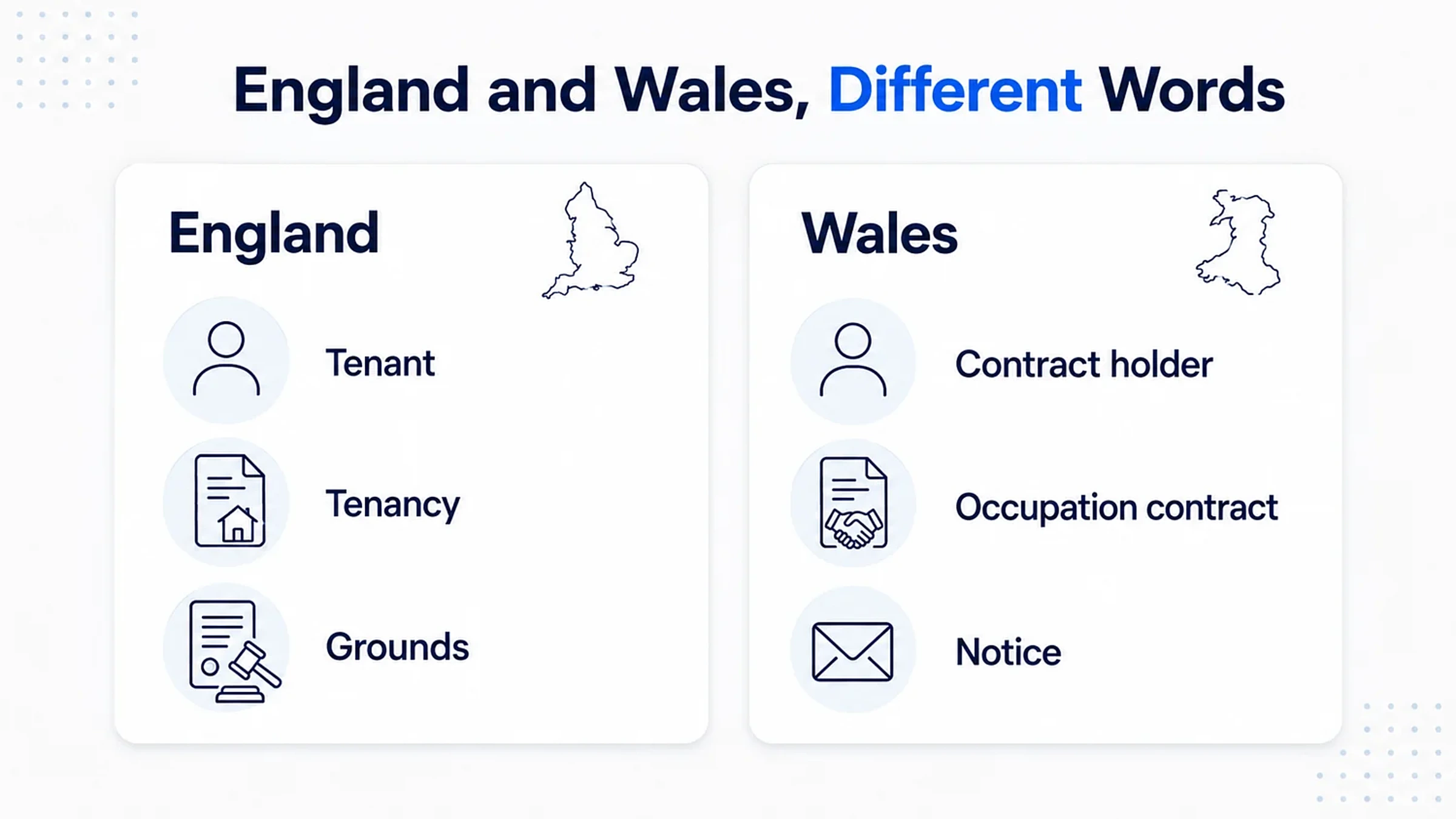
| In England | In Wales | What it means for your pages |
|---|---|---|
| Tenant | Contract holder | Two different search terms for the same person. A Welsh agency needs the Welsh word in its headings, not only in the body. |
| Tenancy | Occupation contract | Every page that explains the agreement needs the Welsh term, because that is what a landlord in Cardiff or Newport types. |
| Assured shorthold tenancy, now abolished | Standard occupation contract | The reform timelines differ between the two nations, so a single page covering both without distinguishing them will be wrong for one of its readers. |
| Landlord | Landlord | Unchanged, which is why landlord-side queries are the common ground between the two markets. |
| Rent Smart Wales registration | Rent Smart Wales registration | A Welsh-specific compliance requirement with no English equivalent, and a search an English-focused competitor will not answer. |
For an agency operating on either side of the border, this is one of the cheapest ways to be genuinely more useful than a national publisher. The terminology split is public, stable and easy to write correctly, and almost nobody bothers.
Why most agency content is now wrong, and how to audit it
Anything written before May that describes assured shorthold tenancies as the norm, or section 21 as an available route, is describing a regime that no longer applies. A landlord spots it within a paragraph, and the damage is worse than having written nothing; it suggests the agency hasn’t kept up.
Four passes, in this order
Auditing your own site is a short job, and worth doing before you publish anything new.
| Page | What is usually wrong | Priority |
|---|---|---|
| Tenancy agreement and “what is an AST” pages | Describes a tenancy type that no longer exists for new private lettings. | First. Most likely to be wrong, most likely to be read by somebody about to act. |
| Landlord guides and “ending a tenancy” pages | Explains section 21 as a live route, with notice periods attached. | First. This is the page that damages credibility fastest. |
| Fees and service pages | Usually fine on the law, but silent on what the agency now handles that it did not before. | Second. A commercial opportunity rather than a correction. |
| Local licensing pages | Often missing entirely, which is the bigger problem. | Second. This is the durable half of the work. |
| Blog posts from before May | Correct when written, wrong now, and still indexed. | Third. Update and date them rather than deleting them. |
Do not silently rewrite history. Where a page described the old position, saying what changed and when is more useful to a landlord than pretending the old text never existed, and it is the version an assistant can quote accurately.
What should an agency publish about the new grounds?
What changed in practice, who it affects, and where the boundary of your advice sits. Describing how the process now works is operator knowledge and entirely within your competence. Telling a landlord whether their particular facts establish a ground is legal advice, and it is where agencies get into difficulty.
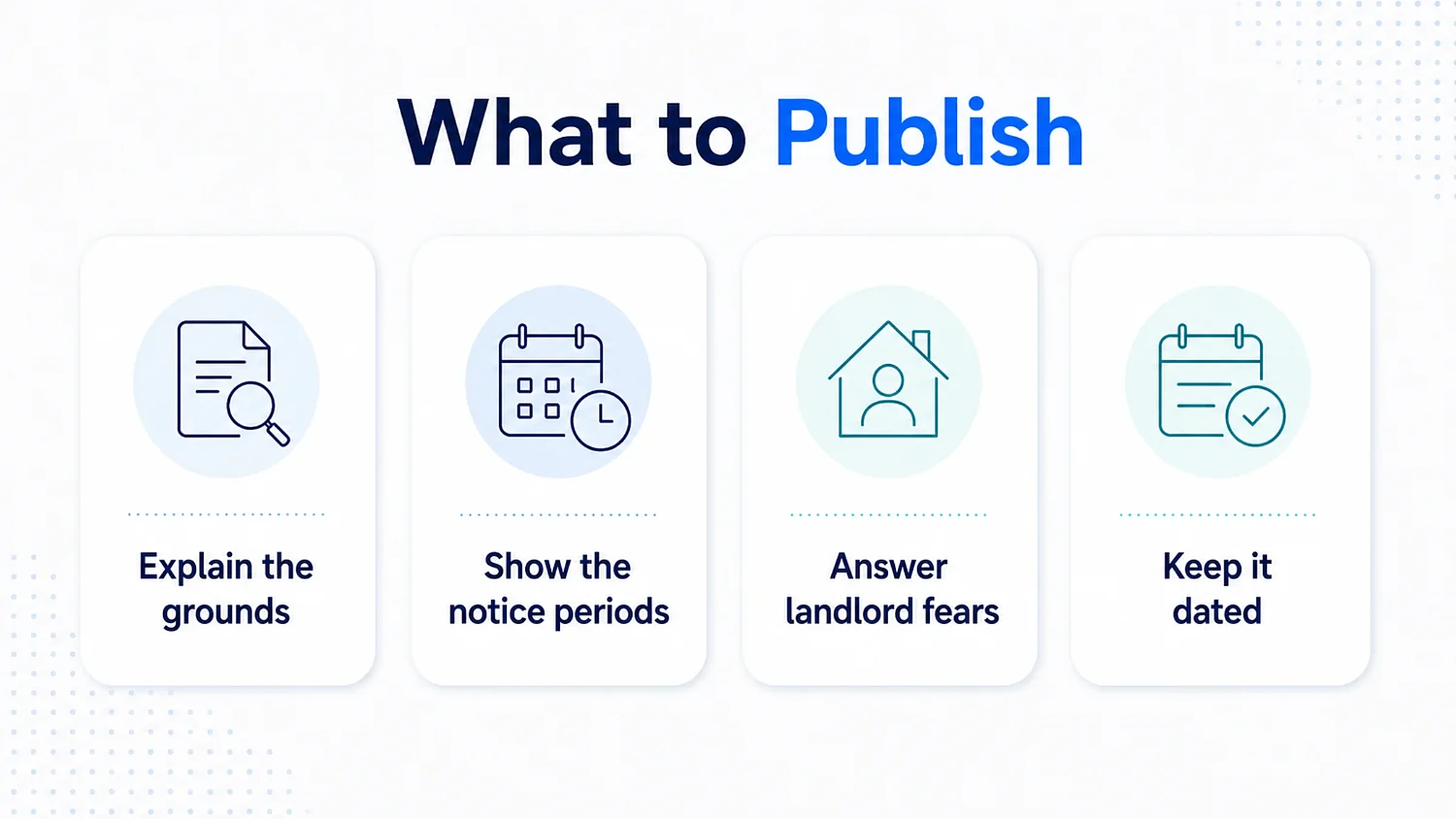
The distinction is easy to hold once it is written down, and stating it on the page makes the rest of the content more credible rather than less. A landlord who reads “here is what changed, and here is the point where you need a solicitor” trusts the first half more, not less.
In practice that gives an agency four things worth writing, none of which requires a legal qualification. The first is a plain description of the change itself, dated, in the words a landlord would use. The second covers a tenancy already running, because the transitional provisions confuse people most. The third sets out what the agency now does differently, which is a service question rather than a legal one and is the page most likely to produce an enquiry. The fourth is the local layer: how the council is enforcing, where the licensing position stands, and what that means for a landlord in that borough specifically.
Write those four and you have covered the question more completely than almost any competing agency page, without once straying into advice you are not qualified to give.
Has this changed what landlords want from an agent?
It has raised the value of competence relative to price. When the rules were simple, an agent was largely a convenience and the fee was the main variable. With a more complex regime and greater enforcement exposure, landlords are more willing to pay for an agency that visibly knows what it is doing.
That is a genuine shift in the market and it favours the agencies that can demonstrate it. The difficulty is that competence is invisible until somebody has already instructed you, unless you publish something that shows it. Content is how that competence becomes visible before anyone speaks to you, and it is the reason the rules pages matter commercially rather than only as a compliance chore.
It also changes who is in play. A self-managing landlord who was comfortable under the old regime may not be comfortable now, and the moment they stop being comfortable is a searchable moment. An agent-managed landlord whose agency has said nothing about the change is asking a question they were not asking last year. Both movements are quiet, both happen in a search box, and both are decided months before anyone picks up a phone.
The window, and why it closes
Right now very few agency websites have credible content on the new regime, and landlords are actively looking. That gap will close, because it always does: within a year the better agencies and every national portal will have covered it.

What doesn’t close is the local layer. Licensing schemes, local authority enforcement approaches and the practical experience of letting in a specific town are things a national publisher cannot write. Pair the national rule change with what it means in your own patch and you have something durable rather than something timely.
That is the same argument that decides the whole portal question. A national platform will cover the national change quickly and cover the borough never, which is where an agency can beat a portal outright. How the whole programme fits together is set out on SEO for letting agents and property management.
Your first month is free, spent on the rules content landlords are searching now
The first month costs nothing. It goes on the audit this page describes, plus the local layer that outlasts the news cycle, so the work is still earning next year rather than next month.
What the free month covers
- Every page on your site still describing shorthold tenancies or section 21 as current
- The landlord questions your patch has started asking since May, and which of them you answer
- A local layer to pair with the national change, so the content is durable rather than timely

First month free · a few places at a time
Your first month of SEO, free
Answer three quick questions to claim yours.
Thank you, that is with us.
We will email your onboarding form and payment link, and call within one working day if you would rather talk it through first.
Pick a time that suits you below. We will confirm by email too.
Answer the four questions and the reply starts with the pages still written for the old regime. The terms of the free month sit with the form.
Common questions
When exactly did the main reforms take effect?
1 May 2026, under the second commencement regulations. That date brought Chapter 1 of Part 1 into force for private assured tenancies rather than social housing ones, abolishing the fixed-term and shorthold varieties along with section 21 evictions, alongside discrimination and rental bidding provisions and strengthened enforcement powers. Transitional provisions deal with rent increases, existing notices and legacy tenancies.
Should an agency publish guidance on possession grounds?
You can describe how the process works in practice and what changed, which is what landlords are searching for. What you shouldn’t do is advise on whether a specific set of facts establishes a ground, because that is legal advice and it is where agencies get into difficulty. State the boundary on the page. Readers respect it, and it makes the rest of the content more credible rather than less.
Does any of this apply in Wales?
Wales has been running its own regime since the Renting Homes (Wales) Act 2016 took effect, with occupation contracts and contract holders in place of tenancies and tenants, plus Rent Smart Wales registration. The vocabulary a Welsh landlord searches is therefore different, and a page written entirely in English terminology will miss it. For an agency working either side of the border, publishing both correctly is one of the easiest ways to be more useful than a national competitor.
Has this changed what landlords want from an agent?
It has raised the value of competence relative to price. When the rules were simple, an agent was largely a convenience and the fee was the main variable. With a more complex regime and greater enforcement exposure, landlords are more willing to pay for an agency that visibly knows what it is doing. Content is how that competence becomes visible before anyone speaks to you.
What should we do with blog posts written before the change?
Update them and date them rather than deleting them. A post that was correct when written and is wrong now still holds whatever links and history it earned, and deleting it throws that away along with the chance to explain what changed. Add a visible last-reviewed date, correct the substance, and where the old position is worth recording, say what it was and when it ended. That version is more useful to a landlord and more quotable by an assistant than a silent rewrite.
Is it too late to write about this now?
No. Most agency sites still have nothing, and the searches are running now rather than in a burst around commencement. What has passed is the chance to be first. What remains is the chance to be the most useful locally, which is the more durable position anyway because it is the part national publishers cannot copy.
More on winning landlord instructions
- What landlords search before they change letting agentThe five stages a landlord moves through before they ever ring an agency, and the four of them that are questions rather than shopping.
- Does Propertymark or RICS membership help an agency rank?Accreditation is not a ranking factor. What it is instead, and why a logo in the footer does none of the work the words would do.
- One Google Business Profile per branch, or one per agency?Why a single profile cannot cover a patch, what makes a branch listing eligible, and the mistakes that quietly cost multi-branch agencies the map pack.
- Why agents rank below Rightmove and ZooplaThe four advantages the portals hold that no agency can close, and the searches where they barely turn up at all.