Local SEO services for UK businesses, single-site and multi-location
Map pack, local organic and the AI answer above both, run as one programme.
Local SEO makes a business visible for searches where Google decides the answer depends on where the searcher is. We run it for single-site businesses that need one area to work, and for multi-location firms that need eight areas to work without competing with each other.
- Grid reporting, not one city-centre position, because rank changes street by street
- Cardiff and South Wales in person, the rest of the UK remotely, same programme either way
- Billed against agreed KPIs, no minimum term, thirty days’ notice
- Map pack
- Google Business Profile
- Citations and NAP
- Location pages
- Geo-targeting
- Grid reporting
The free review, in 30 minutes
You leave the call knowing three things
- Where you actually rank across a real postcode grid, not at one point
- Which local signals are working against you, in priority order
- Whether local or national work will move your numbers first
No obligation, and we will tell you if local SEO is the wrong spend for you.
What is local SEO, and how does it differ from national SEO?
Local SEO wins queries where Google decides the answer depends on where you are. National SEO wins queries where it does not. The first needs an address, a profile and consistent citations. The second needs topical depth across a whole subject.
Local search and national search are decided differently
Swipe the diagram sideways to see all of it.
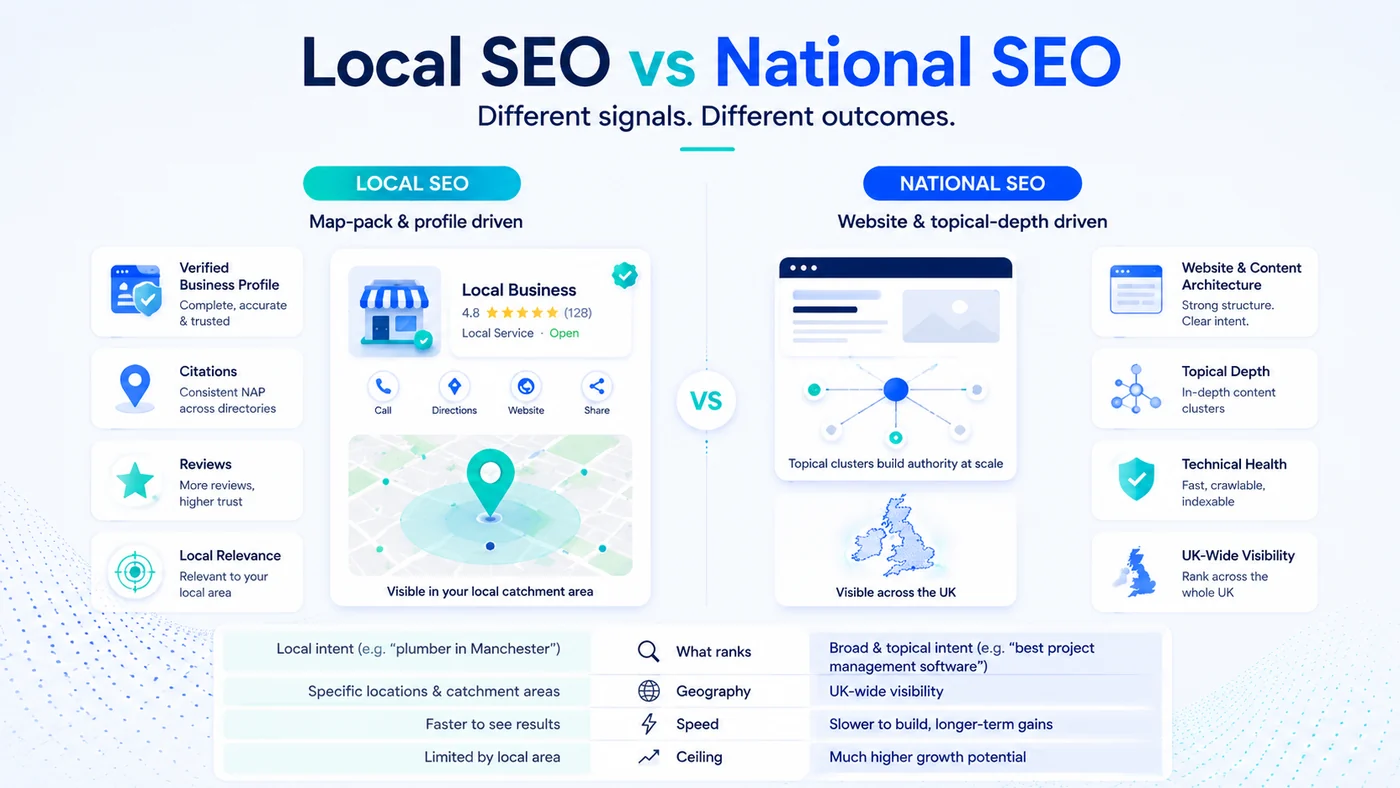
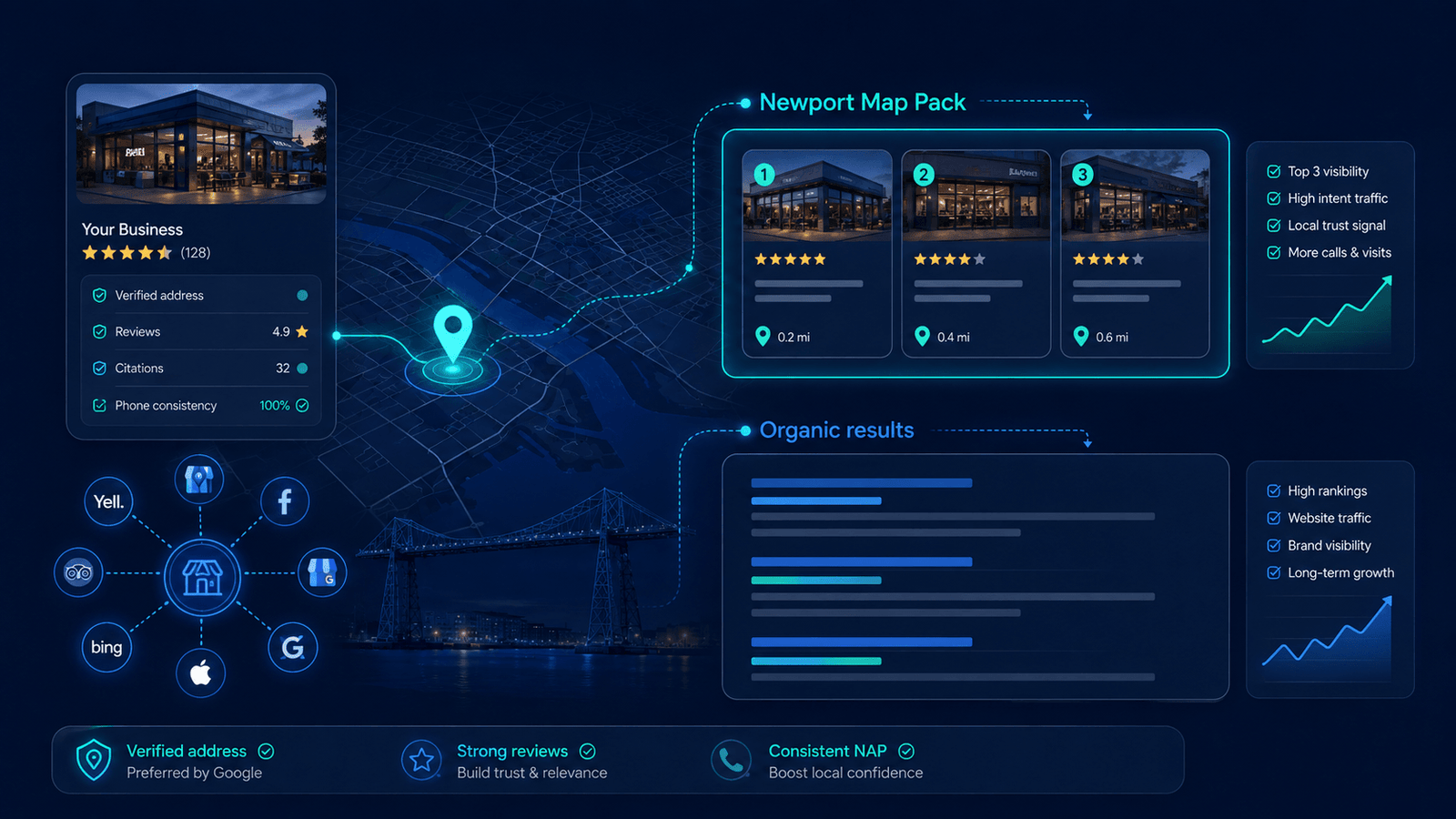
The practical difference is which index you are competing in. The map pack ranks a Google Business Profile. The organic results rank a web page. They run on separate signals, which is why a business can hold one and lose the other on the same search.
| Local SEO | National SEO | |
|---|---|---|
| What ranks | Your Google Business Profile and location pages | Your website’s topical coverage |
| Decided by | Proximity, prominence, relevance | Content depth, technical health, earned links |
| Core assets | Profile, citations, reviews, area content | Topical map, service pages, digital PR |
| Geography | Matters more than anything you control | Almost irrelevant |
| Speed | Weeks to a few months | Two to three quarters |
| Ceiling | The catchment your address earns | The whole UK market |
| Fails when | Details disagree across the web | Coverage is thin against competitors |
Most firms need both, weighted differently. A dental practice lives in the first column. A B2B software firm selling UK-wide lives in the second. A multi-branch letting agency needs both running at once, which is where it gets difficult.
What does a UK local SEO service include?
A complete UK local SEO service covers profile management, citation consistency, review generation, location content, local technical markup and grid-based reporting. Anything missing from those six is a gap that shows up later.
The six parts, and the order they have to happen in
Swipe the diagram sideways to see all of it.
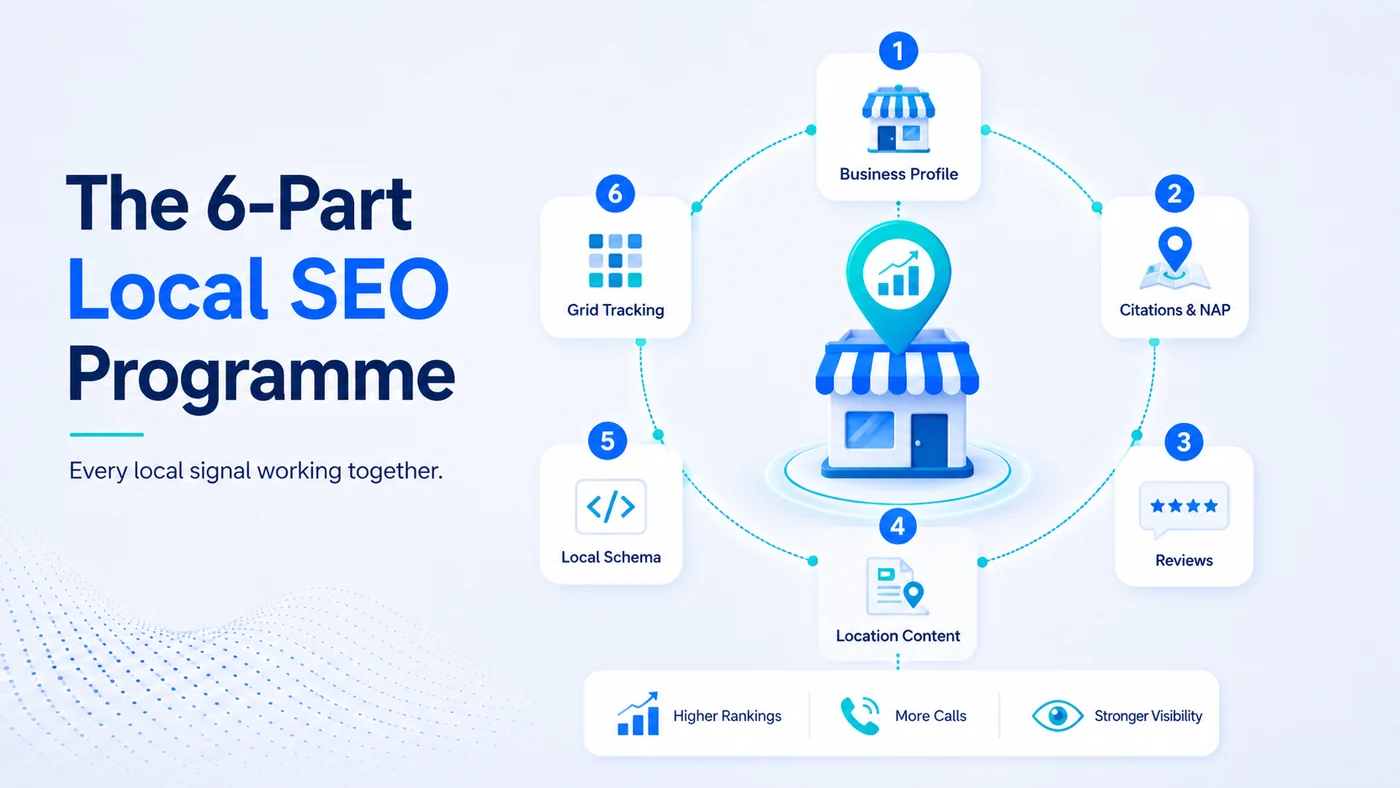
| Component | What it does | How it is measured |
|---|---|---|
| Google Business Profile management | Categories, services, attributes, photos, posts, questions | Discovery impressions, profile actions |
| Citation consistency | One exact name, address and phone across every UK directory | Number of matched and corrected listings |
| Review programme | Request sequence, reply drafting, complaint handling | Review velocity, recency, reply rate |
| Location content | Service and area pages built on real demand | Rankings by area, entrances by page |
| Local technical markup | LocalBusiness schema, service areas, embedded map | Rich result eligibility, entity clarity |
| Grid rank tracking | Positions measured across a postcode grid | Coverage across the grid, not one point |
Two of those are where most campaigns are won or lost, and neither is the technical one. Categories decide which pack you compete in at all. Citation consistency decides whether Google is confident enough to show you.
We run all six as one programme rather than as a checklist, because they feed each other. Profile signals lift local organic rankings through entity confidence, and strong area content gives Google more reason to trust the profile.
Not sure which of the six is holding you back? The free review measures your map pack position across a real postcode grid and names the local signals working against you, in priority order.
Do you need a local SEO company or a national one?
You need local when a map pack listing would win the enquiry, and national when the buyer never checks where you are. Most professional firms need one page of each, run by the same consultant.
The wrong choice is expensive in both directions.
Buying national when the problem is local
A single-site business paying for a national content programme funds topical depth it cannot convert, because its buyers are choosing on proximity and reviews rather than on how completely the site covers a subject.
Buying local when the problem is national
A UK-wide business buying local SEO because it is cheaper ends up with an immaculate profile in one town and no visibility in the market it actually sells to.
The test is simple. Ask where your last ten enquiries came from geographically. If they cluster within thirty minutes of your door, you are a local business whatever your ambitions. If they are scattered across the country, local work will not move your numbers.
What is geo-targeted SEO, and how does it differ from local SEO?
Geo-targeted SEO is the broader discipline of making content rank in specific places, whether or not you have an address there. Local SEO is the subset that depends on a verified location and a Google Business Profile.
The distinction matters commercially, because it decides what is possible for you.
Local SEO needs a verifiable address
An address in the area, or a declared service area. Without one there is no map pack listing, and the pack is where most proximity-driven enquiries start.
Geo-targeted SEO does not
A firm with one office in Cardiff can rank organically for Manchester queries by building content that actually serves Manchester buyers. It will not appear on the map there, and it should not pretend to.
That gap is why “we will get you ranking in twelve cities” is usually either a misunderstanding or a misrepresentation. Twelve cities of organic visibility is achievable with real content. Twelve map packs without twelve addresses is not.
Where geo-targeting earns its keep is service-area businesses: trades, mobile services, consultancies and anyone who travels to the client. The address anchors one point, and the content earns the radius.
How does local SEO work for a single-site business?
For a single site, local SEO is profile depth plus service content, in that order. There is no location-page architecture to build, so the whole budget goes into being the most complete answer in one catchment.
The single-site sequence
- Verify and correct the profile. Primary category first, because it decides which pack you appear in at all. Secondary categories only where the service is really delivered.
- Fix every citation to one exact string. Name, address and phone identical across your site, Companies House, your professional body and the directories Google reads.
- Publish one page per service, not one page per keyword. Each answering the questions buyers actually ask about that service.
- Start a review habit that does not stop. Recency outperforms volume, and replies are a visible quality signal.
- Earn the radius with content. Area and service content is what lets a business in one district appear for searches in the next one.
Step five is the one single-site businesses skip, and it is the one that expands a catchment. Proximity gives you a small circle. Content is how you get seen outside it.
ⓘThe current URL of this page says multi-location, which has always undersold what we do. Most of our local work is single-site.
How does local SEO work for a multi-location business?
For multiple locations, the work becomes architectural: one profile per location, one page per location, one consistent entity across all of them, and a reporting structure that shows each area separately.
Where single-site and multi-location work diverge
Swipe the diagram sideways to see all of it.
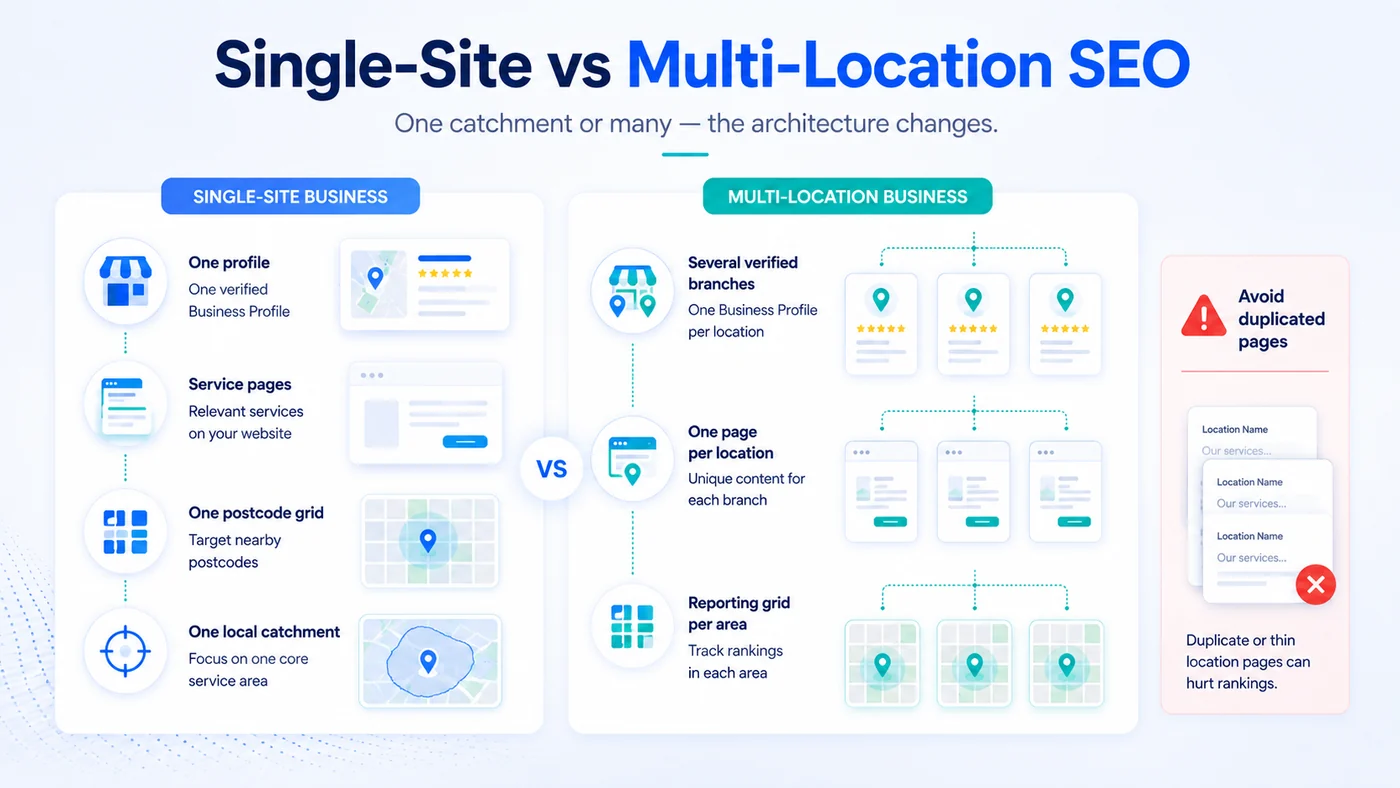
| Single site | Multi-location | |
|---|---|---|
| Profiles | One | One per verified location, each managed separately |
| Pages | Service pages | A page per location, plus service pages above them |
| Biggest risk | Thin content | Locations competing with each other |
| Citations | One NAP string | One per location, each internally consistent |
| Reviews | One flow | Per-location flows, because pack ranking is per-profile |
| Reporting | One grid | A grid per area, plus a roll-up |
| What scales badly | Nothing much | Duplicated location pages with the town name swapped |
The failure mode is nearly always the same: eight location pages written from one template with the place name changed. Google treats them as duplication, picks one, and the other seven collect impressions nobody clicks.
A location page earns its place when it says something true of that branch and no other: the team there, the areas it actually covers, the services that branch offers, parking, transport, local partnerships. If you cannot write two hundred distinct words about a branch, that branch does not need a page. It needs a section.
How do you stop your own locations competing with each other?
Give each location page a distinct primary query, distinct content and a clear internal link hierarchy, then check in Search Console which URL Google actually returns for each area query.
Should this location page exist at all?
Swipe the chart sideways to read all of it.
Self-competition is the most common fault in multi-site SEO and the hardest for an owner to spot, because every page looks fine on its own. Three checks find it.
Search Console, filtered by query, grouped by page
If two of your URLs both appear for “dentist in Kingswood”, Google is undecided and you are splitting the signal between them.
A site search for the town name
If four pages mention Kingswood prominently, three of them are diluting the fourth rather than supporting it.
The template test
Open two location pages side by side. If swapping the town names would produce two believable pages, they are duplicates with different labels.
The fix is usually consolidation rather than more content. Fewer, properly distinct location pages outperform more thin ones, every time.
What are the local SEO ranking signals?
Local rankings run on proximity, prominence and relevance. Proximity is the searcher’s distance from your address, prominence is how well known and corroborated your business is, and relevance is how well your profile and content match what was asked.
Proximity, prominence and relevance, and why one ranking number is meaningless
Swipe the diagram sideways to see all of it.
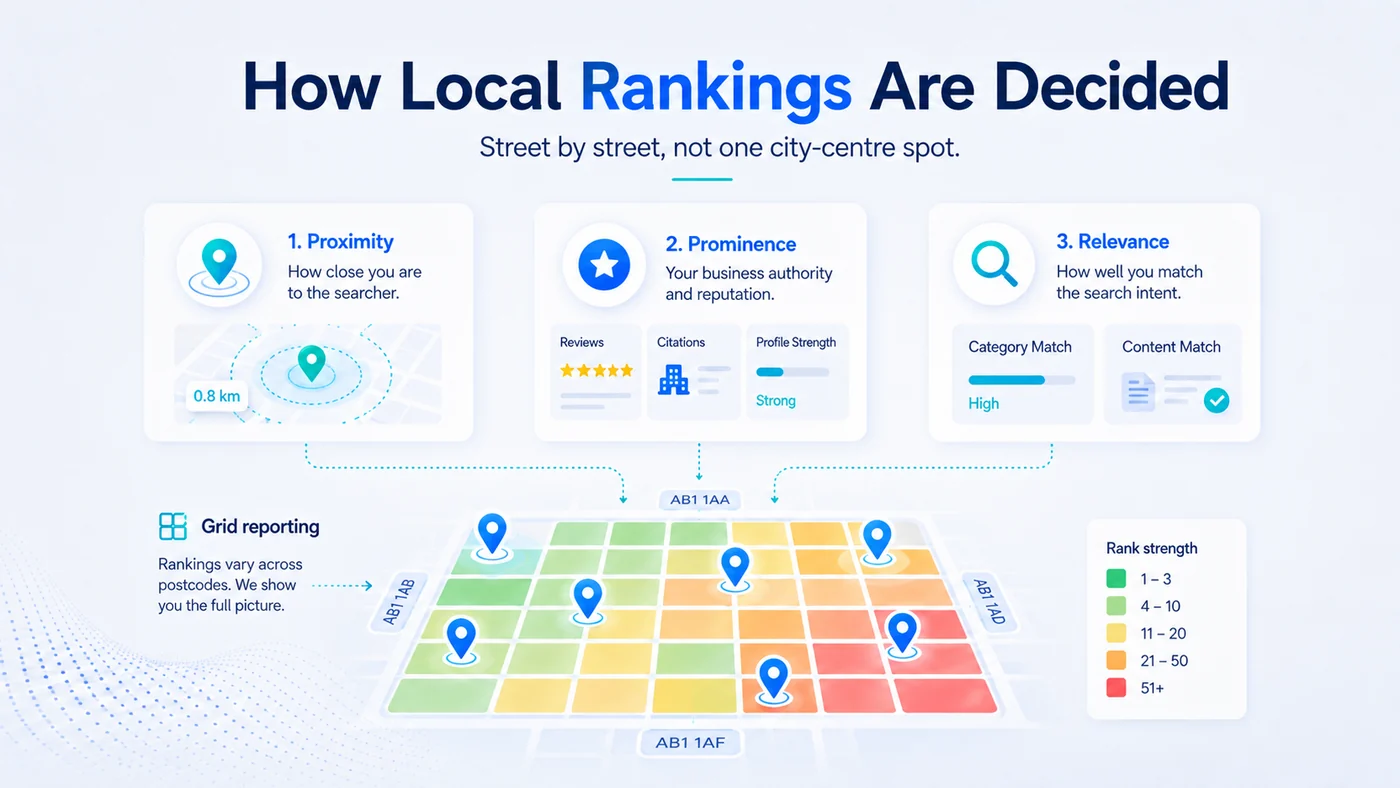
| Signal | What it covers | How much control you have |
|---|---|---|
| Proximity to searcher | Distance between the searcher and your verified address | None, and it moves rank more than anything else |
| Primary category | The single field that decides which pack you compete in | Full, and it is the cheapest fix available |
| Secondary categories | Additional services you really deliver | Full |
| Review count and recency | Volume, freshness and reply rate | High, through a request habit |
| Review content | Whether reviews name the service and the area | Partial, through how you ask |
| Citation consistency | Name, address and phone matching everywhere | Full, and it is unglamorous work |
| Profile completeness | Services, attributes, photos, hours, questions | Full |
| On-page local signals | LocalBusiness markup, area content, embedded map | Full |
| Behavioural signals | Clicks, calls, direction requests from the listing | Indirect, through better copy and photos |
| Website authority | The organic strength behind the profile | Slow, but it compounds |
The column that surprises owners is the third one. The single most powerful factor is the one nobody controls, which is why campaigns that chase proximity fail and campaigns that build prominence and relevance work.
How do you set up a Google Business Profile properly?
Verify at the trading address, choose one precise primary category, add every service as its own entry, set accurate hours, upload real premises photos, and answer your own most common questions in the questions tab.
The order matters. A profile rebuilt before verification gets rebuilt again afterwards.
- Verify first. Everything downstream depends on it.
- Pick the primary category precisely. A firm listed as a business consultant when it is an accountancy practice competes in the wrong pack entirely, and no amount of content fixes that.
- Add services individually. The services section is read. An empty one leaves Google guessing from your category alone.
- Use real photographs of the real premises. Stock imagery of an office nobody works in helps nothing.
- Seed the questions tab yourself. Answering your own top five questions is permitted, useful, and almost nobody does it.
- Set service areas truthfully. Overstated coverage dilutes the signal rather than extending it.
On review incentives. Since April 2025, fake and concealed-incentive reviews have been banned under UK consumer law, with penalties that can reach ten per cent of worldwide turnover. The only route left is asking properly, at the right moment, and asking often.
How do you fix inconsistent name, address and phone listings across UK directories?
Fix the source first. Pick one exact name, address and phone string, publish it in schema on your own site, then correct every directory to match it character for character.
Working outward from your own site is what makes the clean-up stick. Correcting directories while your own contact page still disagrees just reintroduces the conflict.
| Source | Priority | Why it matters |
|---|---|---|
| Your own contact page and schema | First | The version everything else is compared against |
| Google Business Profile | First | The listing every other citation is checked against |
| Companies House | High | Statutory, so it outranks your own wording |
| Bing Places | High | Feeds Copilot and several AI assistants |
| Apple Business Connect | High | Drives Apple Maps and Siri results |
| Your professional body or regulator | High | Corroborates the entity, decisive in regulated sectors |
| Yell and Thomson Local | Medium | Long-standing UK directories Google still crawls |
| Local chambers and networks | Medium | Regional corroboration a national directory cannot give |
| Sector directories | Medium | Varies by industry, high value where buyers use them |
One inconsistent suite number, or an old phone number surviving on a directory nobody remembers signing up to, is enough to make Google hedge. This is the least interesting work in local SEO and among the highest returning.
Three questions, and we will tell you where you actually stand
Answer three questions and we will come back with where you rank across a real postcode grid, which local signals are working against you, and whether local SEO is the right place for your budget at all.
Your first month of SEO, free
Answer three quick questions to claim yours.
Thank you, that is with us.
We will email your onboarding form and payment link, and call within one working day if you would rather talk it through first.
Pick a time that suits you below. We will confirm by email too.
Book your 30 minute meetingWhat is included in a UK local SEO package?
A UK local SEO package should cover the six components above, with the scope set by how many areas you need to rank in rather than by how many tasks are listed.
Packages sold by task count reward busywork. A report listing forty completed actions tells you nothing about whether the pack position moved. Scope is what actually changes the price, and it is worth knowing which lever you are pulling.
| Scope driver | One area | Two or three areas | Four or more |
|---|---|---|---|
| Profiles managed | One | One per location | One per location, with a roll-up |
| Location pages | None needed | One per area | One per area, plus a hub above them |
| Citation sets | One | One per location | One per location, audited quarterly |
| Review flows | One | One per location | Per location, with per-branch reporting |
| Reporting | One postcode grid | A grid per area | Grids plus a comparison view |
| Where it usually fails | Thin service content | Locations competing | Templated pages with the town swapped |
What to hold any UK local SEO proposal against:
- One named person who plans the work and who you speak to in month four.
- Grid reporting, not a single city-centre position, because rank varies across a catchment.
- Ownership of everything from day one: profiles, accounts, content and data in your name.
- A stated measure agreed before the work starts, with a review date in writing.
- No minimum term, or a term you understand the cost of leaving.
We publish market context rather than a package list on this page. For what UK providers actually charge, including how local pricing differs from national, see what SEO costs in the UK.
Which industries does local SEO work hardest for?
Local SEO returns most where the buyer needs proximity and compares two or three providers before contacting any. That describes most professional services, healthcare, trades and hospitality.
| Sector | Why local SEO matters here | Where we cover it |
|---|---|---|
| Dental practices | Treatment plus area terms, heavy review dependence | Local SEO for dentists |
| Healthcare providers | Proximity decides most appointments | Healthcare SEO |
| Accountancy practices | Local trust plus niche specialism | SEO for accountants |
| Law firms | Practice area plus area, high value per client | Law firm SEO |
| Financial advisers | Regulated, relationship-led, locally chosen | SEO for financial advisers |
| Automotive and garages | Service plus area, map pack decides the enquiry | Automotive SEO |
| Hotels and hospitality | Destination and proximity queries | Hotel SEO |
| Ecommerce with stores | Click and collect, stock by location | Ecommerce SEO |
| Salons, trades and mobile services | Pure proximity, low competition, fast returns | Covered by this service directly |
The last row is worth naming. Salons, trades and mobile services are among the most winnable local markets in the UK, because competitors rarely do the citation and review work properly. SEO for tree surgeons is the worked example of that, because a tree surgery firm covers eight towns from one address. Returns arrive faster there than anywhere else on this list.
Which locations does True SEO cover?
We cover Cardiff and South Wales in person and the rest of the UK remotely, with the same programme either way. The in-person radius matters for owners who want a face across a table rather than a monthly call.
Which intent belongs here, and which belongs on a city page
Swipe the chart sideways to read all of it.
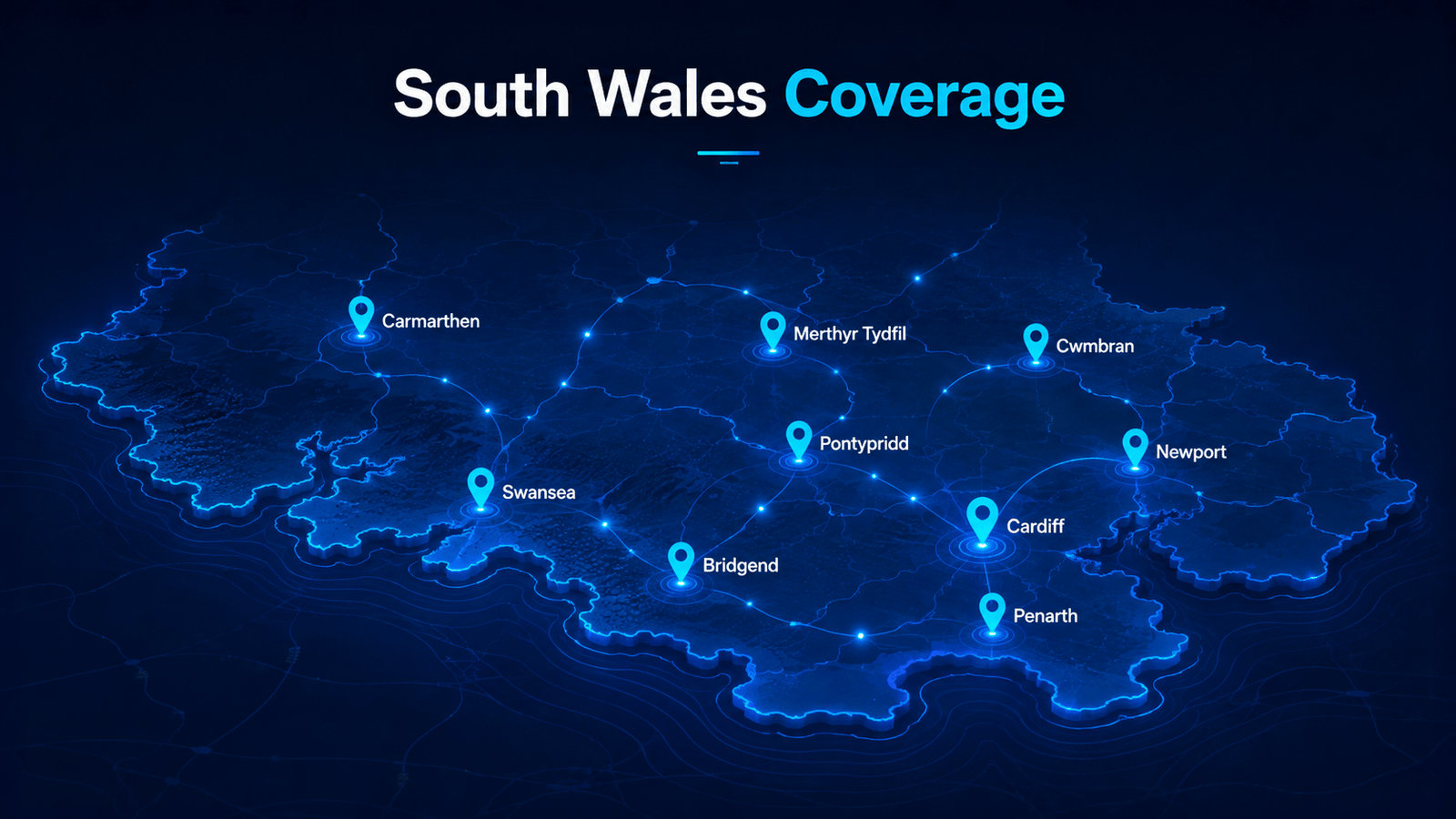
Cardiff
Our base and our deepest market. The city-level detail is on our SEO agency in Cardiff page.
South Wales, in person
Newport, Swansea, Caerphilly, Bridgend, Merthyr Tydfil, Penarth, Pontypridd, Barry and Cwmbran.
The rest of the UK, and beyond
From Bristol and Birmingham to Manchester, Edinburgh and London, through remote digital onboarding and delivery. International clients onboard the same way.
Organic rankings do not depend on your agency’s postcode. A Cardiff consultancy can and does rank businesses in Manchester. The one thing that does need a local address is your own Google Business Profile, and that belongs to you rather than to us.
How do you measure whether local SEO is working?
Track three things in order: discovery impressions in Google Business Profile, non-branded clicks in Search Console filtered to the United Kingdom, and enquiries logged against source. Rankings alone prove nothing.
What you can move, and what you cannot
Swipe the chart sideways to read all of it.
Discovery impressions
Whether the profile is being shown for searches that are not your own name. A flat discovery line with a rising branded line means your marketing is working and your local SEO is not.
Non-branded UK clicks
Branded searches flatter every report they appear in, and a position that produces nothing in your target country is not a ranking you can spend against.
Logged enquiries
The only measure that converts to money. Direction requests, calls from the listing and form fills all count, and none of them appear in a ranking report.
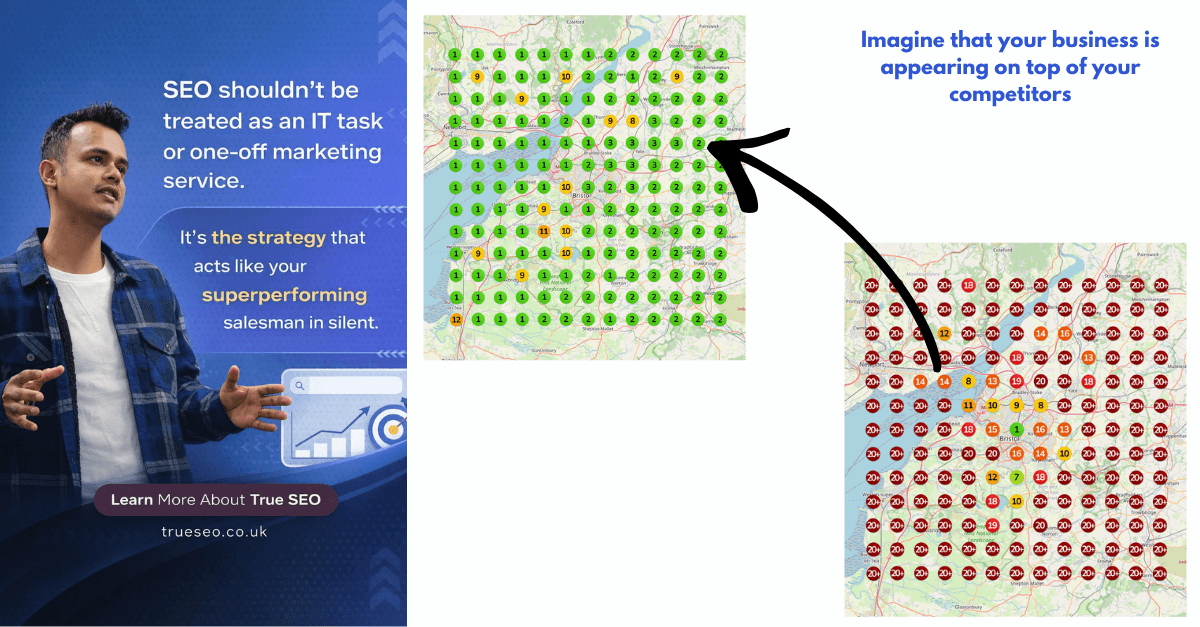
Grid reporting sits underneath all three. A single city-centre position hides the fact that you are first in one district and twelfth two miles away, which is the actual shape of local rank.
How long does local SEO take?
Profile and citation work usually moves the map pack within four to eight weeks. Competitive local organic positions take between three and nine months depending on the market.
Local is the fastest-moving SEO discipline, because Google recrawls profile data quickly and category or citation corrections register within weeks rather than quarters. That makes it the right first investment for most local businesses.
What takes longer is the organic half: the service and area content that expands a catchment beyond what proximity gives you. That accumulates on a normal SEO timeline.
Two-minute local readiness check
Is local SEO the right next spend for your business? Five questions.
1. Where did your last ten enquiries come from geographically?
2. Is your Google Business Profile verified, with the right primary category?
3. How many areas do you need to rank in?
4. Do your name, address and phone details match everywhere online?
5. When did your profile last get a new review?
Your next move
Rather skip the questions?
When does a business not need local SEO?
When your buyers never choose on proximity, when you are already at capacity from referral, or when your website cannot convert the traffic it already has. In all three cases local SEO spend arrives too early.
A B2B firm selling nationally on expertise does not need a map pack listing. A trades business booked out for four months does not need more enquiries; it needs better-priced ones. A business whose site takes six seconds to load and offers no clear enquiry route will not benefit from more visitors arriving at it.
None of that is a reason never to invest. It is a reason to invest in the right order, and we will say so on the call rather than sell you a programme that cannot work yet.
Frequently asked questions
What is local SEO?
Local SEO makes a business visible for searches where Google decides the answer depends on where the searcher is, covering the map pack, local organic results and the AI answers above both. It runs on proximity, prominence and relevance rather than on the content depth national SEO needs.
What is the difference between local SEO and geo-targeted SEO?
Local SEO depends on a verified address and a Google Business Profile. Geo-targeted SEO is the broader work of ranking content in specific places whether or not you have an address there. You can rank organically in a city with no office; you cannot appear in its map pack without a verifiable location.
Do you need a physical address for local SEO?
For the map pack, yes: Google needs a verifiable address or a declared service area. For local organic results, no. A business with no address in a city can still rank a page there on content alone.
How do you do SEO for multiple locations without the pages competing?
Give each location page a distinct primary query and properly distinct content, keep one profile per verified location, and check in Search Console which URL Google returns for each area query. Fewer distinct location pages outperform more templated ones.
How long does local SEO take to work in the UK?
Map pack movement usually shows within four to eight weeks because profile and citation signals update quickly. Competitive local organic positions take between three and nine months depending on the market.
Is local SEO worth it for a single-site business?
Usually yes, and often more than for multi-site firms, because the whole budget goes into one catchment. Single-site local SEO is the most common work we do, despite what this page’s URL suggests.
True SEO Consultants Ltd works from Startup Stiwdio, University of South Wales, 86-88 Adam Street, Cardiff, CF24 2FN, under company number 16563516. We cover Cardiff and South Wales in person, work with businesses across the UK from that base, and onboard clients worldwide through a fully remote digital onboarding and delivery process. We bill against agreed KPIs rather than hours, with no minimum term and thirty days’ notice.
Cardiff and South Wales in person, UK wide remotely
Work with a consultancy that runs both halves
The consultancy is led by Mohammad A Mahmud, who has worked in search since 2010 and trained in Koray Tugberk Gubur’s semantic method, with co-director Julie Williams, a fractional CFO who reviews every strategy against margin rather than traffic. The first thirty minutes cost nothing, and you leave with your map pack position measured across a real postcode grid and the local signals working against you named in priority order.