

 CRO for Accountants
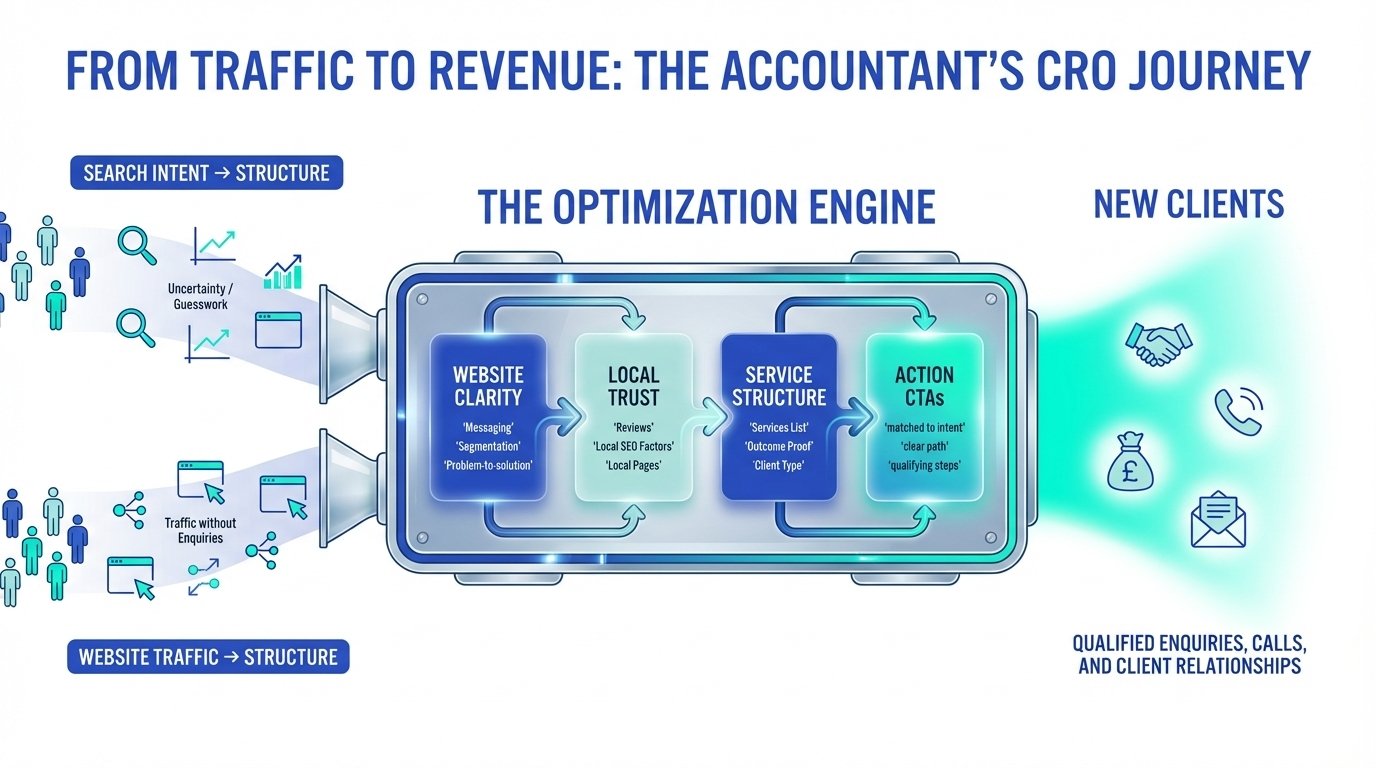
Conversion rate optimisation turns more of the right website visitors into enquiries, calls and qualified opportunities, and for accountants it works best when the strategies, the tools and the measurement all point the same way. Most firms chase more traffic when the faster win sits in the traffic they already have. CRO for accountants starts with website clarity, trust signals, service-page structure and calls to action that match what the visitor is actually ready to do. Discovery calls then sit inside the funnel as the bridge for higher-value or consultative work, where a prospect needs context before they commit. This guide covers what CRO means for an accountancy practice, the core strategies, where to begin on the site, how to use discovery calls and client lifecycle thinking, which CRO tools earn their place, which KPIs to track and how to track them, and a four-month plan to put it all in motion. We are True SEO Consultants Ltd, a Cardiff semantic SEO consultancy that helps accountants across the UK connect search intent, site structure and local trust so the website does more than attract visits. It turns them into revenue.
- Treat CRO as a commercial growth system, not a design tweak, because better conversion structure lifts enquiries without a matching rise in traffic.
- Work the six strategy pillars together: clarity, intent-matched CTAs, discovery-call bridges, trust signals, conversion-ready forms and mobile, and proper measurement.
- Use discovery calls as the conversion bridge for advisory, CFO and virtual finance director work, where buyers need a conversation first.
- Apply client lifecycle thinking, since owners search by problem, goal or frustration long before they search by service label.
- Use the right tools, such as Google Analytics 4, Microsoft Clarity, call tracking and Google Business Profile insights, to see what visitors actually do.
- Track enquiry rate, booked-call rate, cost per lead and lead-to-client rate rather than page views, and set them up so each number is reliable.
- Place trust signals such as reviews, named team members and clear process near the point where you ask for action.
Free 30-minute consultation
Want to know where your current site leaks enquiries? Book a free 30-minute consultation with us at True SEO and we will review the journey from visit to client.
Book your free site reviewWhat conversion rate optimisation means for accountants
Commercial intent sits at the centre. More visits alone do not produce more clients, and the structure that turns visibility into meetings is what separates a busy website from a profitable one.
Buyer confidence drives nearly every accountancy decision. Tax work, bookkeeping, payroll, advisory support and growth planning all rest on trust, so a site that explains the offer plainly, proves it and makes the next step easy will out-convert one that only lists services. Typical professional-services websites convert a low single-digit percentage of visitors into enquiries, which means small structural gains compound fast. A business owner who lands on a page and instantly thinks “this firm works with companies like mine” is far likelier to enquire than one left guessing what the practice actually does. Strong SEO for accountants brings the right visitor to the door, and CRO decides whether that visitor walks through it.
The service that solves it
Specialist SEO and conversion-focused websites built for UK accountancy firms.
Why CRO matters more than chasing traffic
CRO matters because accountancy buyers compare several firms before they make contact, so a better-converting site wins more value from the visits it already earns. The UK has roughly 30,000 accountancy and audit firms in a market worth close to 40 billion pounds, so almost every search a prospect runs returns several credible options. Gartner’s research into B2B buying found that buyers spend only around 17% of their decision time with potential suppliers, with the rest given to independent research and comparison. That pattern shows up clearly in accountancy, where a director quietly weighs three or four practices before a single phone rings.
Acquisition costs money, time or both. SEO takes work, paid ads take budget, and referrals take years of relationships, so every visitor becomes more valuable when the site converts a higher share of them. Lead quality climbs too. Clearer messaging and a light qualification step pull in more suitable enquiries instead of more noise. One firm may take 500 visits a month and still struggle for leads, while another with half the traffic books more calls because the next step is simply easier to take. That makes conversion one of the most efficient growth levers an accountancy website has, and it is why we look at the funnel before we recommend chasing more rankings.
The core CRO strategies for accountants
The core CRO strategies for accountants each tackle a different reason a prospect hesitates, and they only work properly as a set. A visitor leaves when they cannot tell the firm is relevant, when they do not trust it yet, when they cannot find the right next step, when the form or the phone screen makes acting a chore, or when the firm has no idea which of those things is failing. Fix one and ignore the rest, and the leak simply moves.
Six strategies cover those gaps, and the rest of this guide takes each in turn:
- Clarify the message so the right visitor sees relevance within seconds, on the homepage and on every service page.
- Match each call to action to buyer readiness rather than forcing one generic enquiry on everyone.
- Bridge higher-value services with a discovery call, since advisory work needs a conversation before commitment.
- Bring trust signals forward, because proof near the point of action is what makes the next step feel safe.
- Build forms and mobile for conversion, so acting is quick on any device.
- Measure with the right tools and KPIs, so you can see what converts and prove what improves.
Each strategy is straightforward on its own. The advantage comes from running them together, which is how a site stops leaking at one stage only to lose the visitor at the next.
Where CRO should start on an accountant’s website
CRO should start on the website, because the website is where search intent meets a commercial decision, and its structure usually decides whether the visitor moves forward or leaves. Check homepage clarity first, then service relevance, then navigation, internal linking, trust signals, page speed, mobile usability and calls to action. A weak structure wastes even strong organic traffic.
Message-to-market fit matters most at this stage. A practice serving landlords, contractors, startups, ecommerce brands and established limited companies needs clear segmentation so each visitor finds the right path quickly. A startup founder should not have to dig through generic service menus to learn whether the firm understands startup problems. The real question is never whether the site looks good in isolation. The real question is whether it lets the right buyer take the right next step.
How to optimise the homepage for conversion
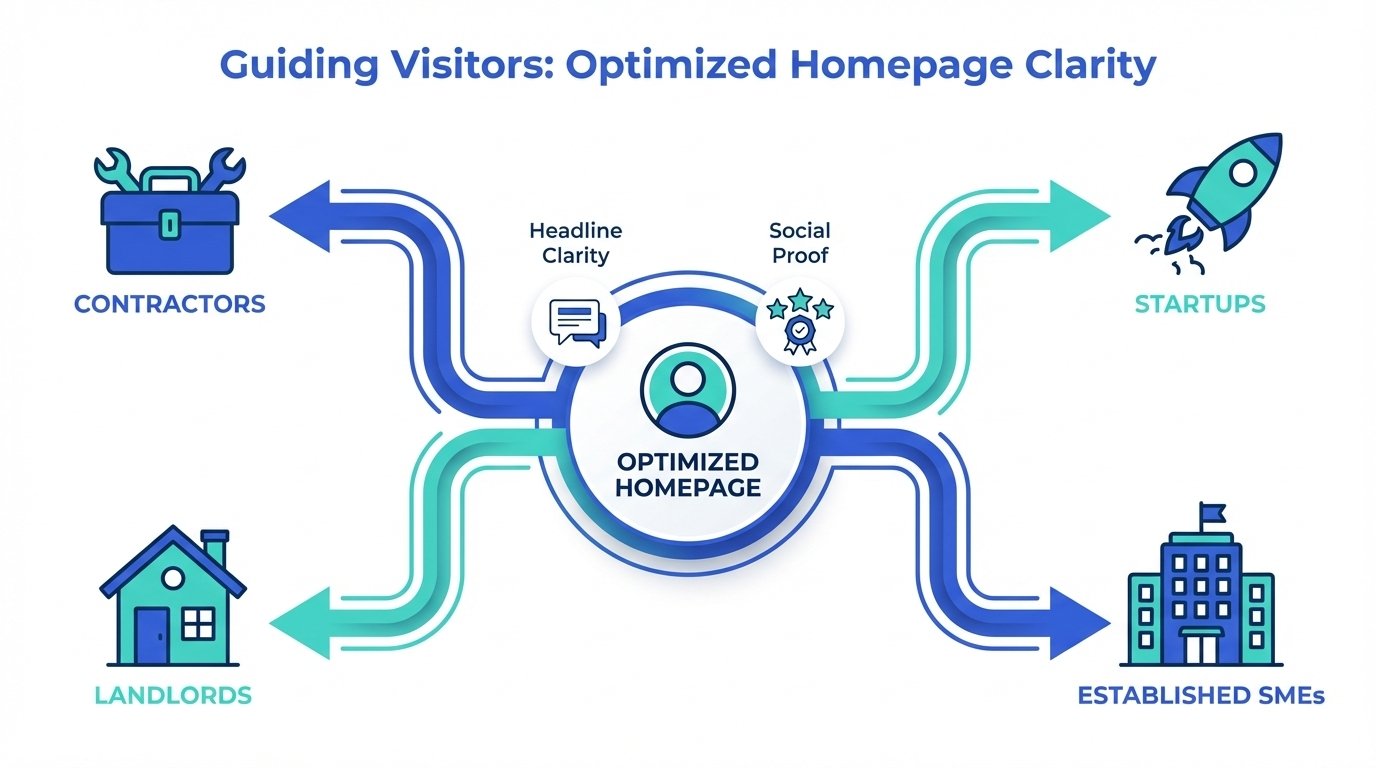
A homepage should tell the right visitor the firm is relevant within seconds, so it needs headline clarity, audience segmentation and visible trust above all. Lead with what the firm does, who it helps and why that matters, because broad taglines that sound polished say very little. Then give visitors clear routes by client type, so contractors, startups, landlords and growth-stage SMEs each see a relevant entry point without scrolling past unrelated blocks. Reviews, accreditations, years of experience and sector fit should appear high enough on the page to cut hesitation before the visitor even reaches a service.
Consider a two-partner Cardiff practice that took roughly 600 organic visits a month yet booked only four or five calls from the site. The homepage opened with a generic “trusted local accountants” line and a single contact form. We rewrote the hero to name three core client types, added a short reviews strip near the top and gave each audience its own route. Bookings from the homepage rose to around fourteen a month within a quarter, on the same traffic. Nothing changed about the visitors. Only the clarity did.
How service pages should be structured for conversion
Service pages should answer the buyer’s question, remove doubt and guide action, so they need to sell the next step rather than only describe the service. Open with an accurate headline that states exactly what the service is and who it helps, since a vague heading slows the decision. Follow a problem-to-solution shape: name the pain, give the service response, show the likely result, then point to the next action. Spread trust proof through the page with testimonials, sector-specific outcomes and clear process detail, and repeat the call to action so the visitor never has to scroll back to find it. A company director reading about outsourced finance support should finish the page knowing whether the next move is a quote, a call or a guide, not still wondering.
What stops accountant websites from converting
Accountant websites usually fail to convert because they are vague, generic or passive, and visitors leave when the page does not answer the real buying question fast enough. Weak messaging is the common fault. Many sites describe themselves as trusted, experienced and professional without saying who the service is for, what problem it solves or why the firm is different, and general claims rarely create urgency.
Poor page structure compounds it. Visitors land on a service page with no strong headline, no trust proof and no guidance on what happens next, and a page like that may rank while it barely converts. Misaligned calls to action add friction on top. Someone researching a cash-flow problem is not ready to request a quote, yet may happily book a short discovery call or download a practical guide. Nielsen Norman Group’s usability research shows people scan rather than read and give most of their attention to the top of the page, so a buried benefit or a single hard-sell button at the foot of a long page loses the visitor before the message lands.
Which calls to action work best for accountants
The best calls to action for accountants are clear, low-friction and matched to buyer intent, because not every visitor is ready for the same step. Discovery-call CTAs suit advisory, strategic and higher-value services. Proposal CTAs suit more defined work where intent is already strong. Resource CTAs suit earlier-stage visitors who need reassurance before contact. A time-pressed small business owner responds to a simple, concrete next step far better than to a vague corporate button.
Wording carries real weight. Phrases such as “Book a discovery call”, “Speak to an accountant” and “Get advice on your next step” beat “Learn more” or “Submit”, which tell the visitor nothing about what happens. Page context should pick the CTA. A visitor reading about self-assessment support may want a direct enquiry, while a visitor reading about business value or finance strategy responds better to a discovery call because the need is consultative and harder to scope from copy alone.
Why discovery calls are the bridge in accountant CRO
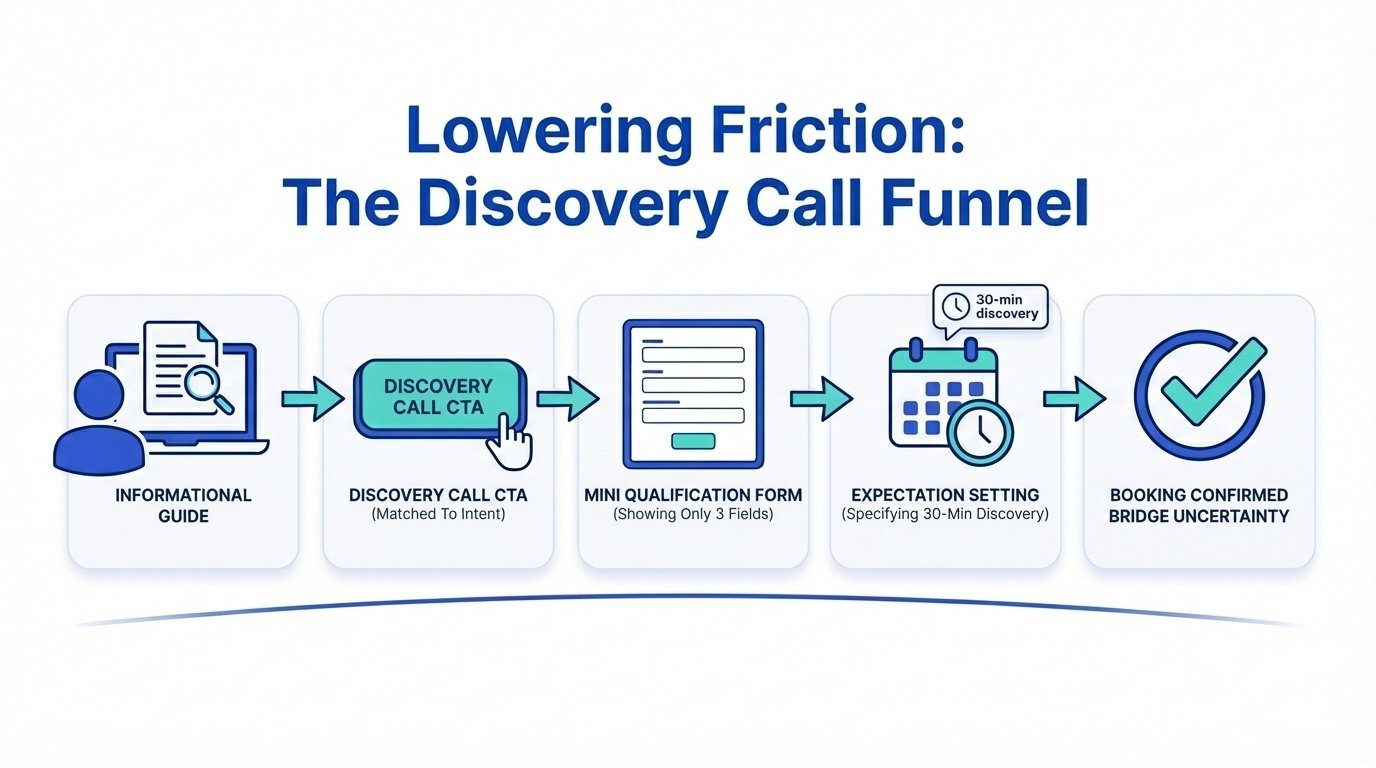
Discovery calls are important because they close the gap between website interest and commercial engagement, and many accountancy services need a conversation before the buyer feels ready to commit. Advisory work, CFO support, virtual finance director services, tax planning, business valuation and cash-flow strategy all benefit, because the value only becomes obvious once someone understands the business. A founder unsure whether they need bookkeeping help or broader financial guidance often only sees the real answer after fifteen minutes on a call.
Trust builds fastest in live conversation. A well-run call lets the accountant understand the business, frame the issue in plain language and explain the next step, which moves the prospect forward faster than another page of copy. The call also works structurally as the main CTA on consultative pages, the secondary CTA on informational content, and the link between early search intent and service-specific buying intent.
How the discovery-call funnel should flow
A discovery-call funnel should move the visitor from interest to qualification with as little friction as possible, so simplicity beats complexity every time. Make the page-to-call flow obvious first: the visitor should know what the call is for, how long it takes, who it suits and what happens afterwards, because unclear call pages kill bookings. Qualify lightly with a short form asking business type, service interest and current challenge, which lifts lead quality without stalling momentum. The Baymard Institute’s form research found that many online forms request more than they need and that trimming fields raises completion, a finding that applies directly to accountancy booking pages. Set expectations before the booking completes, since a single line such as “a 30-minute call to understand your business and recommend the next step” reassures more than generic scheduling language.
What a good discovery-call page should include
A good discovery-call page should sell the meeting, not just display a calendar, so it needs a clear purpose, an audience-fit statement and plain process detail. State whether the call is for advice, assessment, service fit, pricing direction or next-step planning. Say who it suits, whether that is limited company directors, growth-stage SMEs, landlords or founders with finance challenges, because a clear fit statement cuts irrelevant bookings. Add the length, the format, the likely outcomes and anything to prepare, since the more a visitor knows, the less they hesitate. Most owners booking a call quietly want to know whether the session will genuinely help or turn into a sales pitch, so answer that on the page.
Why client lifecycle thinking lifts conversion
Client lifecycle thinking lifts CRO because business owners search differently at each stage of growth, and intent shifts as the company changes. Early-stage businesses search for setup help, bookkeeping basics, tax registration and simple compliance. Growth-stage businesses search for cash-flow improvement, management reporting, margin gains and funding readiness. Mature businesses search for exit planning, valuation support and strategic finance input. A startup founder and an exit-focused owner may both want “better finance support”, yet the route into conversion looks completely different for each.
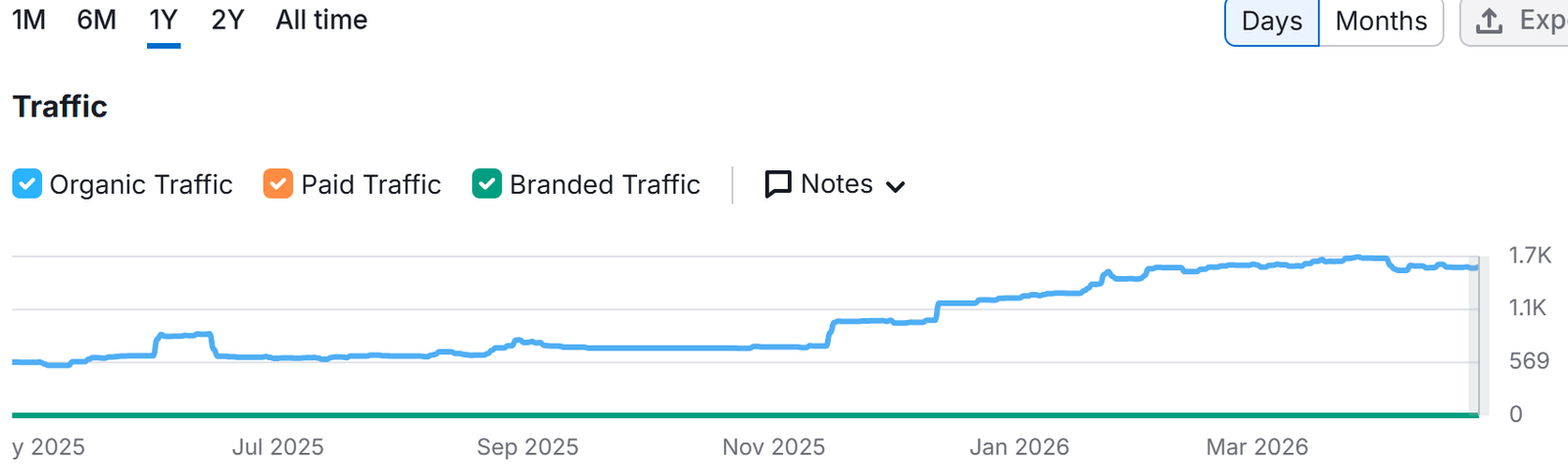
Websites convert better when they recognise those stages. A visitor researching a growth problem rarely knows that virtual finance director support is the answer, so a strong funnel introduces the right service instead of waiting for the user to search the exact label. Our work with Total Books Accountants in Cardiff shows the effect: the practice grew from roughly 200 to about 1,600 organic visits a month and repositioned toward advisory and virtual finance director work, with an optimised Google Business Profile now driving more than 80% of its local visitors. Higher-value services almost always sit behind a broader business problem, which is why lifecycle thinking matters so much for firms that want to sell advisory rather than compliance.
Why buyers rarely search the service name first
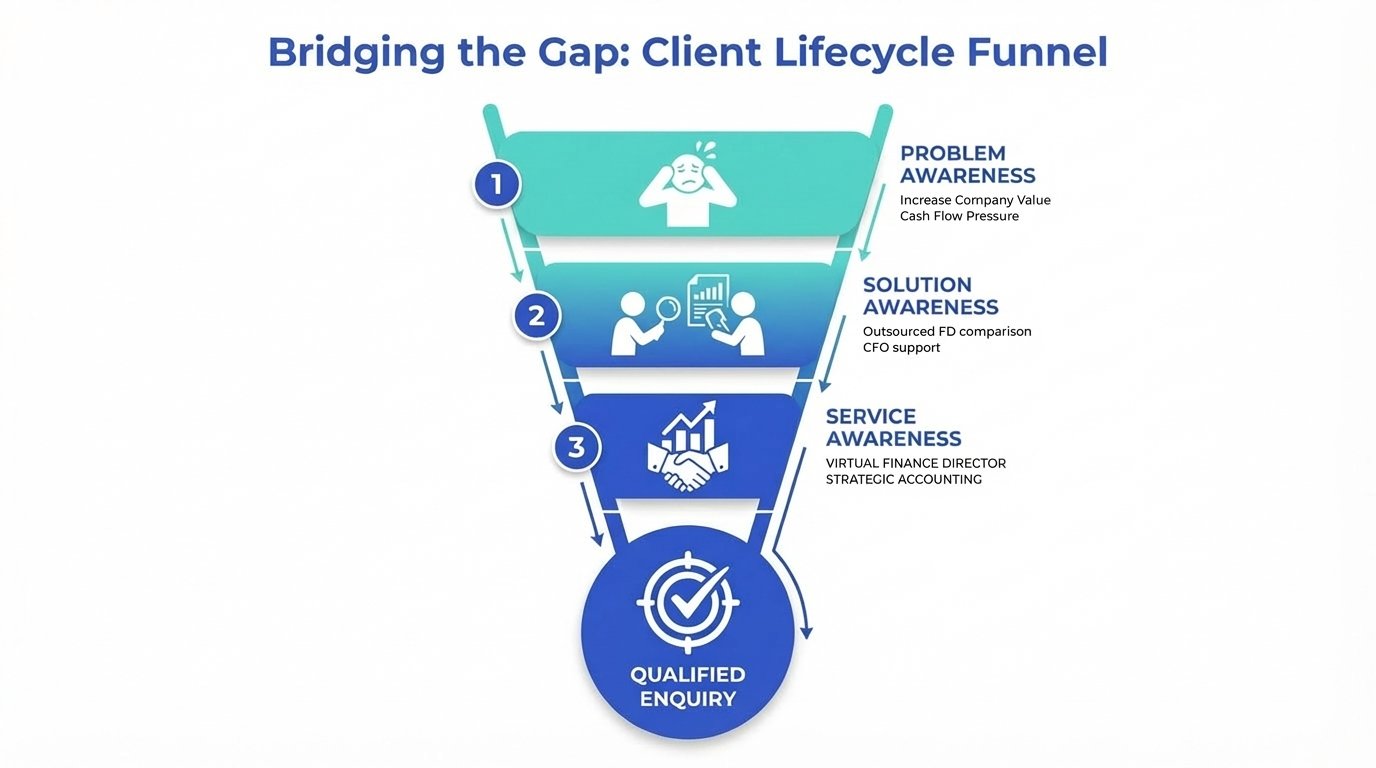
Buyers rarely search the service name first because most prospects search by problem, goal or frustration, and the service label arrives late in the journey. An owner searches for how to increase company value, improve margin, reduce cash-flow pressure, prepare for investment or build stronger reporting long before they search for “virtual finance director”, “outsourced CFO” or “strategic finance support”. Many know the business is underperforming financially without any idea that outsourced finance director support is the fix.
Search behaviour follows awareness in three stages. Problem-aware buyers know what hurts, solution-aware buyers know what kind of help might fit, and service-aware buyers know the exact service they want. CRO improves when the website supports all three, so site structure should connect informational searches to commercial service pages. Understanding these stages is the heart of keyword intent, and it is why a strong article or guide can capture the visitor first while a well-built funnel introduces the service as the logical next step.
A worked example of hidden virtual finance director demand
Virtual finance director demand hides inside broader commercial searches, because the intent shows up as a business objective rather than a service title. A director searches for how to increase company value before a sale, how to prepare a business for investment or how to improve monthly reporting, and each query points toward strategic finance support even when the visitor does not know the label.
Take a Bristol accountancy firm that ranked an article on improving company value before sale, pulling around 900 readers a month with almost no enquiries because the page simply ended. We added a mid-article line explaining how advisory support raises value, linked it to the firm’s virtual finance director service page and closed with a discovery-call offer rather than a generic “contact us”. Within two months the page produced eleven qualified discovery calls a month from the same readership. The traffic was already there. The bridge was missing.
How informational content should feed conversion
Informational content should move the visitor toward the next useful step, because blog traffic only earns its keep when the page creates a path forward. Match intent first: a page about increasing company value should speak to owner goals, profitability and reporting worries, since a generic CTA at the foot will underperform. Add a mid-content transition that mentions, without hard selling, how advisory support helps firms lift value, which plants the commercial bridge while the reader is still engaged. Choose the end CTA with care, because a discovery-call offer, a diagnostic guide or a relevant service link beats a broad “contact us” on an informational page. A reader who has just learned something useful stays engaged when the next step feels like part of the same journey rather than a sudden jump into a sales pitch. Treating blog posts this way is the core of a proper accounting blog SEO strategy, where content and commercial pages work as one system.
How to build funnels around search intent
Accountants should build funnels around the way prospects actually search, so search intent shapes the first landing page, the next page and the eventual call to action. Put problem-aware content at the top: articles, checklists and insight pages that capture users searching for outcomes, challenges or warnings, written to educate and segment rather than oversell. Place solution-aware pages in the middle, where comparison pages, service explainers and business-stage pages help the visitor understand what kind of support fits. Keep service-aware pages near the bottom, where service pages, case studies, FAQ pages and booking pages turn the user into a call or enquiry.
The middle of the funnel is where curiosity becomes commercial interest, so reassurance and clarity carry the most weight. Comparison content works hard here, since a page setting out outsourced finance director versus in-house, or bookkeeping versus management reporting, frames the decision for the buyer. Case studies do similar work by showing who the service helps and what result it creates, and the kind of problem-led searches mapped out in our guide to keywords for accountants reveal exactly which comparisons and questions to build pages around. Lead magnets fit where the topic suits them, so a business health checklist, a reporting template or a valuation-readiness guide can capture details from a visitor who is interested but not yet ready to book.
Which CRO tools should accountants use
The CRO tools accountants need do four jobs: show what visitors do, test changes, attribute enquiries to their source, and read local performance. None of them is expensive, and several are free, so the barrier is knowing which number each one moves rather than the budget.
Behaviour and analytics tools come first. Google Analytics 4 records the actions that matter, such as form submissions, call-button taps and resource downloads, and shows which pages drive them. Google Search Console reveals which queries land on which pages, so you can see whether problem-aware searches reach the right content. Heatmap and session-recording tools then show the why behind the numbers, and Microsoft Clarity does this for free while Hotjar offers similar features, both letting you watch where visitors click, how far they scroll and where they give up.
Form and testing tools refine the detail. Form analytics expose the exact field where a booking form is abandoned, which matters because trimming a single awkward field can lift completion. A/B testing tools let you compare two headlines or two CTAs and keep the winner rather than guessing. Call tracking closes a gap most accountancy firms miss, since tools such as those that swap a dynamic phone number attribute calls to the page and source that produced them, so a phone enquiry is no longer invisible in the data. Google Tag Manager wires these events together without a developer, and Google Business Profile insights report local actions such as calls, direction requests and website clicks. Tools only matter once you know which numbers they should move, which is where KPIs come in.
Why trust signals decide accountancy conversions
Trust signals decide accountancy conversions because buyers rarely commit on promise alone, and proof is what makes the next step feel safe. Reviews come first, since client feedback cuts uncertainty and feeds local visibility at the same time. BrightLocal’s Local Consumer Review Survey reports that the overwhelming majority of people read online reviews before choosing a local business, and accountancy is no exception when someone is handing over their books. Case studies, accreditations, years of experience and clear sector fit then help the buyer judge credibility quickly.
Team visibility adds another layer. A named founder, visible team members and clear specialist roles make a firm feel real and accountable, while hidden businesses convert worse because nobody knows who they are dealing with.
UK consumer law tightened here in April 2025, when fake and concealed-incentive reviews were banned with penalties that can reach 10% of worldwide turnover, so genuine, well-placed proof matters more than ever.
Placement counts as much as content: a prospect comparing three firms may read only one or two sections before deciding who feels safest, so social proof belongs close to the point where you ask for action, not buried in the footer. A representative firm we rebuilt around stronger visibility and trust signals moved from roughly 20 online enquiries a month to over 100, largely by bringing proof forward and making the next step obvious.
How to optimise forms and mobile for conversion
Forms and mobile decide a surprising share of accountancy conversions, so both need to be optimised for clarity, speed and fit. Keep field counts tight, because name, email, business name, a phone number where relevant and one short problem question are usually enough, and extra fields earn their place only when they genuinely improve lead quality. Give the form context, since a visitor completes it more readily when it explains what happens next, and improve the button so “Book discovery call” or “Request advice” replaces the empty “Submit”.
Mobile experience carries equal weight, because many owners first judge a firm on a phone between meetings. Google’s research found that more than half of mobile visits are abandoned when a page takes longer than three seconds to load, so speed protects both organic and referral traffic before a word is read. Layout clarity matters next: buttons, forms, trust badges and contact details all need to work on a small screen without pinching or scrolling past walls of text. Key actions should appear early on mobile, and navigation should let a phone user reach services, reviews and contact options without digging through complicated menus. Much of this lives in the build itself, which is why our optimised web design service puts speed, trust placement and conversion structure in from the start rather than bolting them on later.
How CRO and local SEO work together
CRO and local SEO work together because local visibility only pays off when the profile and the website convert the visitor afterwards, and rankings alone never close the loop. A Google Business Profile should support conversion with strong reviews, accurate service information, correct categories, current contact details and regular activity. Website landing pages then continue the trust-building with matching service and location relevance.
Local intent pages deserve real thought rather than thin duplication. A Cardiff page, a Bristol page or a London page should not only target rankings. Each should persuade the visitor that the firm fits that area and that service need, with local proof and a clear next step. The pages convert far better when reviews, profile strength, location relevance and CTA strategy all reinforce one another, which is exactly how we approach local and multi-location SEO for accountancy practices that serve more than one town.
2-minute self-check
Is your accountancy website turning visitors into enquiries?
When a visitor lands on your homepage, can they tell within seconds who you help?
Do your service pages offer a next step matched to the buyer’s stage?
Is there a clear discovery-call route for advisory or finance-director work?
Do your articles and guides lead readers toward a relevant service or call?
Are reviews and named team members visible near where you ask for action?
Do you track enquiry and booked-call rates with proper tools, not just visits?
Answer the questions above for a tailored recommendation, or skip straight to a chat.
Which CRO KPIs accountants should track
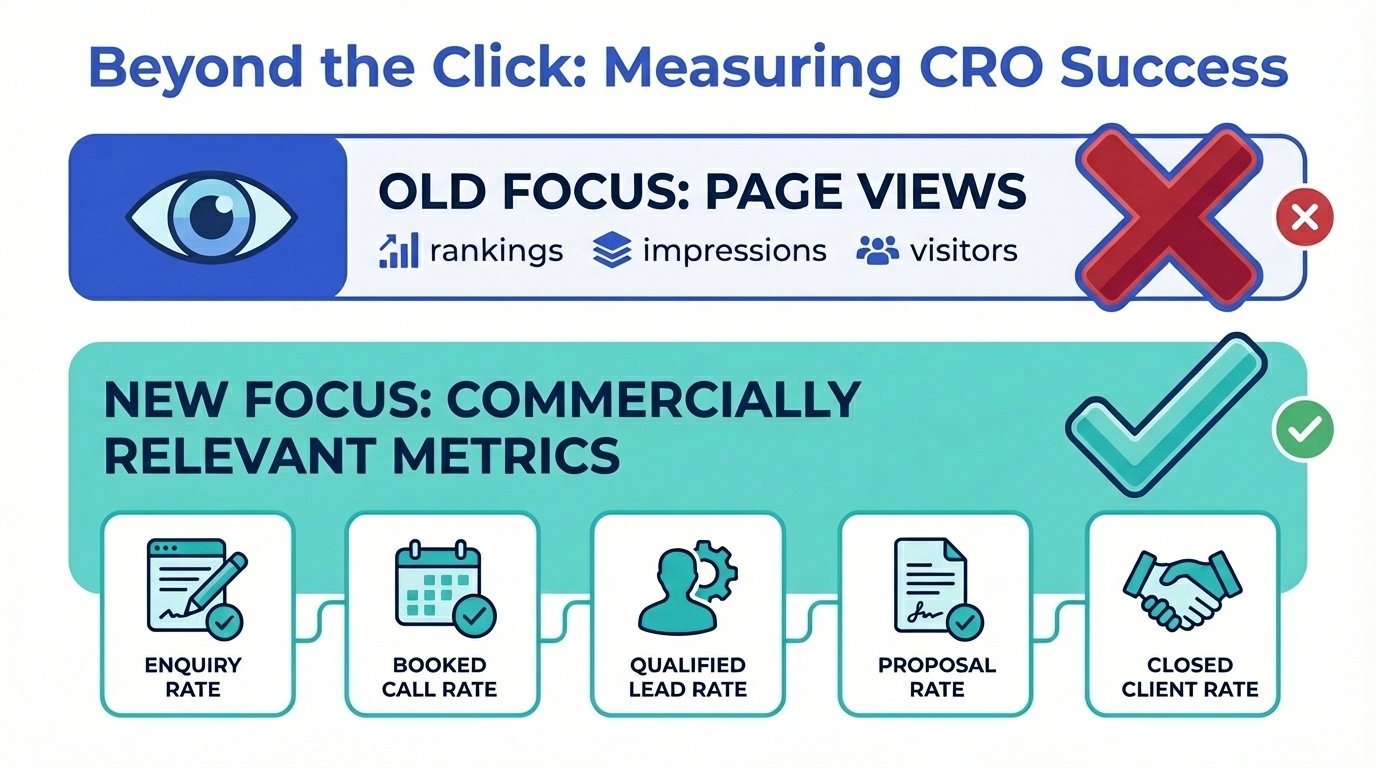
The CRO KPIs accountants should track are enquiry rate, booked-call rate, cost per lead, lead-to-client rate and assisted conversions, because page views never show whether the website works commercially. Each answers a different question, and together they tell you where the funnel works and where it leaks.
Enquiry rate and booked-call rate measure the headline job: the share of visitors who contact you and the share who book a call. Form-completion rate and form-abandonment rate sit underneath those, showing whether the form itself is the blocker. Cost per lead ties effort to money, dividing what a channel costs by the leads it produces, so you can compare organic, referral and paid fairly. Lead-to-client rate, the share of enquiries that become paying clients, guards against the trap of chasing more leads that never close. Assisted conversions credit the blog and guide pages that influence a decision without being the final click, which stops good informational content from looking worthless. Local actions from a Google Business Profile, such as calls and website clicks, complete the picture for firms that rely on nearby clients. Knowing the KPIs is half the work. Reading them reliably is the other half.
How to track your CRO KPIs
Track your CRO KPIs by defining the actions that count, recording them as events, attributing them to a source, and reviewing them on a fixed cadence. Skip any of those steps and the numbers mislead rather than guide.
Define the conversions first, naming every action worth money, such as a booked call, a submitted enquiry, a downloaded guide or a clicked phone number. Record them next as conversion events in Google Analytics 4, wired up through Google Tag Manager so you avoid developer time. Attribute calls with call tracking, since a phone enquiry that lands nowhere in the data hides the value of the pages that drive it. Connect enquiries to your CRM after that, so lead-to-client rate becomes visible rather than guessed. Review the data on a monthly cadence, starting with a baseline so every later figure means something, and read it at page level and source level so you can see which content and which channel actually convert. Set up this way, the productised audits and topical maps in the True SEO marketplace give a clear, measurable starting point for firms that prefer a one-off deliverable over a retainer.
A practical four-month CRO plan for an accountancy firm
A practical CRO plan should run in order, starting with website clarity, moving into funnel design, then into proof, then into testing, because the right sequence makes every later improvement easier to manage.
- Month one, the audit. Homepage clarity, service-page structure, CTA placement, trust signals, navigation, form friction and mobile performance all get reviewed first, alongside setting up the tracking so a baseline exists.
- Month two, the funnel. Discovery-call pages, service-page CTA logic, informational-content pathways and lead-magnet routes get planned and improved.
- Month three, trust and proof. Reviews, case studies, testimonials, process detail and team credibility get built around the key conversion pages.
- Month four and beyond, testing. CTA wording, form length, call-page messaging and internal linking paths improve as the KPIs grow clearer.
The order keeps the work calm and the gains measurable, which is how a firm compounds conversion month after month rather than guessing.
Frequently asked questions
What is a good conversion rate for an accountancy website?
A good conversion rate depends on traffic quality and the action measured, though many professional-services sites convert a low single-digit percentage of visitors into enquiries. The useful number is your own baseline, because a firm that lifts its enquiry rate from 2% to 4% has doubled its leads on the same traffic.
Should accountants improve CRO or get more traffic first?
Improve CRO first when the site already attracts visitors but few enquiries, because better conversion lifts results without the cost of more acquisition. Chasing traffic before fixing a leaky funnel simply sends more visitors to a page that already fails to convert them.
What CRO tools do accountants actually need?
Accountants need a small, mostly free toolkit: Google Analytics 4 for conversions, Google Search Console for query data, Microsoft Clarity or Hotjar for heatmaps and recordings, call tracking for phone enquiries, and Google Business Profile insights for local actions. The point is not the number of tools but knowing which KPI each one moves.
Which CRO KPI matters most for accountants?
Lead-to-client rate matters most over time, because a flood of enquiries means little if few become paying clients. Track enquiry rate and booked-call rate to see whether the site converts, then watch lead-to-client rate to confirm the leads are the right ones.
Why use a discovery call instead of a contact form?
A discovery call suits higher-value advisory, CFO and virtual finance director work because the buyer needs context before committing, and a live conversation builds trust faster than copy. A contact form still works well for defined, lower-consideration services such as self-assessment support.
Does CRO help accountants appear in AI search results?
Clear, well-structured pages that answer real buyer questions help both conversion and AI visibility, because the same clarity that persuades a human also helps AI assistants quote the page. Close to a third of UK Google searches now show an AI summary above the normal results, so structured, trustworthy content earns visibility in newer search journeys too.
Turn your traffic into clients
The strongest rule in accountant CRO is simple: guide each visitor to the right next step based on real buyer intent instead of forcing everyone into the same action. Commercial structure beats surface design every time, because a site that names the right problem, introduces the right solution, proves the right trust signals and offers the right CTA will out-perform a prettier site with weaker strategy. We come at this from inside finance as well as SEO, which is why we build CRO around how accountancy buyers actually decide.
True SEO Consultants Ltd helps accountants across Cardiff and the UK connect search intent, service pages, discovery calls, lifecycle content and local trust into one commercial system. If your website earns visits but too few enquiries, book a free 30-minute consultation and we will show you where the journey leaks and how to fix it.
True SEO Consultants Ltd
A Cardiff semantic SEO consultancy led by an ACCA-qualified accountant and a fractional CFO, helping accountancy firms across the UK, and worldwide through fully remote onboarding, turn search visibility into booked enquiries.
Table of Contents
- What conversion rate optimisation means for accountants
- Why CRO matters more than chasing traffic
- The core CRO strategies for accountants
- Where CRO should start on an accountant's website
- What stops accountant websites from converting
- Which calls to action work best for accountants
- Why discovery calls are the bridge in accountant CRO
- Why client lifecycle thinking lifts conversion
- How informational content should feed conversion
- How to build funnels around search intent
- Which CRO tools should accountants use
- Why trust signals decide accountancy conversions
- How to optimise forms and mobile for conversion
- How CRO and local SEO work together
- Which CRO KPIs accountants should track
- How to track your CRO KPIs
- A practical four-month CRO plan for an accountancy firm
- Frequently asked questions
- Turn your traffic into clients
