

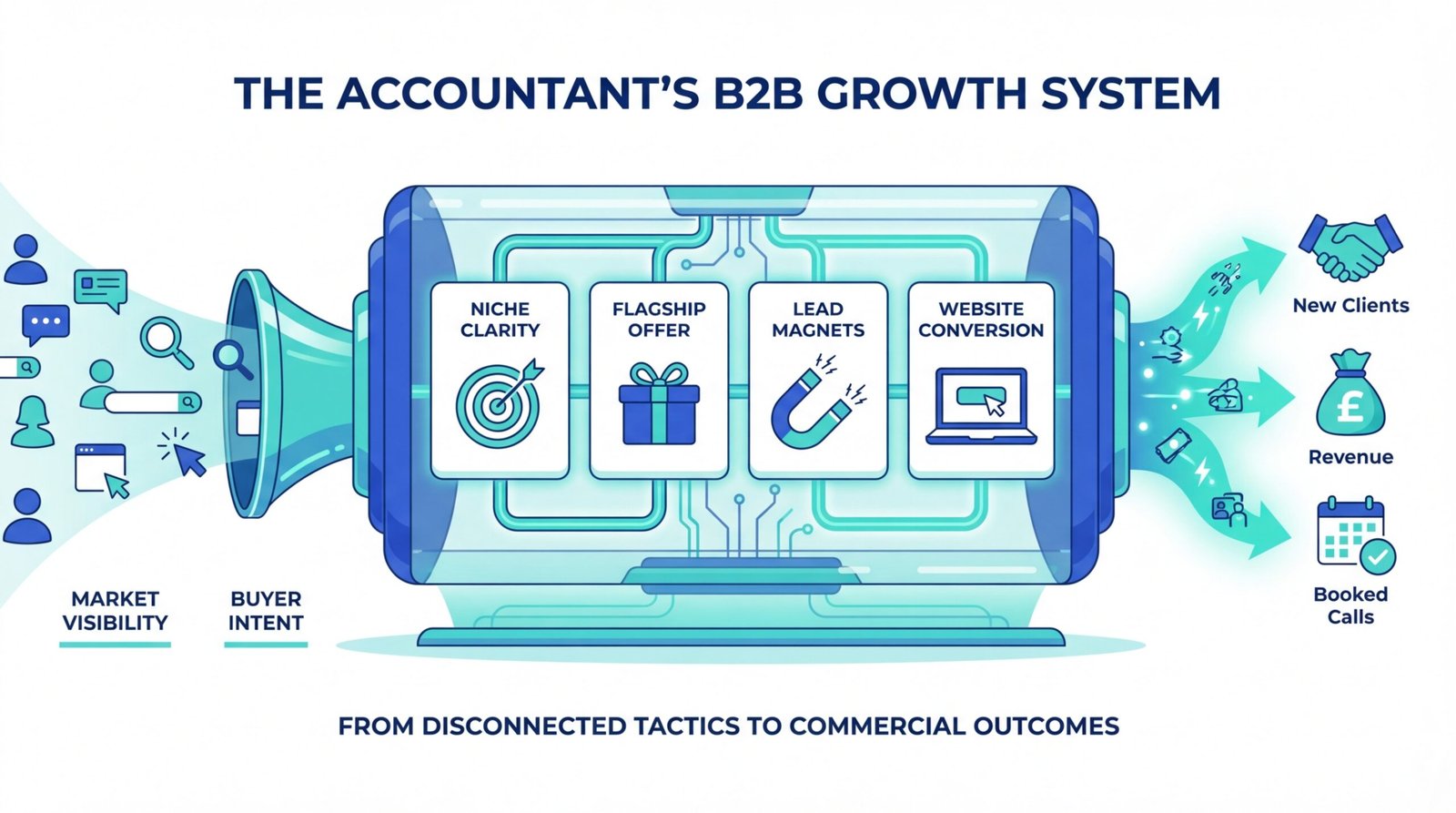
A marketing strategy for accountants is a connected B2B system that uses niche positioning, a clearly packaged flagship offer, lead magnets, content, SEO, paid media and a converting website to turn business decision-makers into qualified enquiries. Most accountancy firms do not lose enquiries because their service is weak. They lose enquiries because the marketing runs as a set of disconnected tactics, with no clear buyer, no single commercial route, and no proof at the moment the director is actually deciding. A joined-up strategy fixes that, and it is the same approach we use at True SEO Consultants Ltd when we help accountancy firms across Cardiff and the wider UK move from sporadic activity to a system that produces predictable, better-fit work.
This guide answers the full question a practice owner is really asking: how the strategy should be built, why B2B thinking changes everything, how to pick a niche, how to design a flagship offer, what lead magnets to use, which channels to run, which tools and budgets are realistic, how to measure results properly, the AI-search angle that most firms still ignore, the marketing rules ACCA and ICAEW firms must respect, and what a sensible 90-day plan looks like.
Key takeaways
The seven decisions that move accountancy marketing
- Treat marketing as one connected system, not a list of channels.
- Position around a clear niche, audience, problem and outcome.
- Anchor the firm’s commercial story to a single flagship offer.
- Use lead magnets to capture interest before a buyer is ready to enquire.
- Pick channels by where decision-makers actually research, including AI search.
- Track lead quality and proposal-to-close, not just traffic and impressions.
- Respect ACCA, ICAEW and UK reviews-law rules in every campaign.
Want the gaps mapped before you commit to anything?
We run a free 30-minute SEO and marketing consultation for accountancy firms that want a clear, honest view of what to fix first. No pitch, no obligation, just the next two or three highest-leverage moves for your practice.
Book your free 30-minute consultationWhat a marketing strategy means for an accountancy firm
A marketing strategy for an accountancy firm is a written decision about who you serve, what specific problem you solve, how you package it, where you show up, and how you turn attention into qualified discovery calls. It is not a content calendar, and it is not a list of channels. It is the commercial logic that makes those things work.
A useful strategy answers four questions in order. Who is the ideal client. What business pressure are they really paying to remove. What does the firm offer that proves it can remove it. How does a prospect move from first impression to signed engagement. When those four are clear, every channel becomes easier to brief, easier to measure, and easier to fix.
This matters more for accountancy than for most sectors. The UK has roughly 30,000 accountancy and audit firms and a market worth close to 40 billion pounds, so the directory is crowded and most firms sound the same. Differentiation, not extra activity, is what wins.
Why B2B thinking changes the plan
Accountancy marketing is B2B because the buyer is usually a director, founder, partner, finance lead or owner-manager making a considered commercial decision. The marketing has to behave like B2B marketing, not like a high-street advert.
B2B buyers research for weeks, sometimes months, before they enquire. According to Gartner’s B2B buying research, a typical buying group now spends only about 17% of the purchase journey meeting potential suppliers, and most of that time is spent self-researching across digital sources. For an accountancy firm that means the website, the LinkedIn posts, the case studies and the AI search results are doing the selling long before the discovery call. If those touchpoints are weak, the call never gets booked.
A second consequence is that B2B buyers want commercial language. A director responds to phrases like working capital, margin, reporting clarity, funding readiness and company value far more than to “trusted, professional service”. The closer the firm’s words sit to the director’s daily pressure, the warmer the enquiry.
The connected B2B marketing system
Niche positioning is the foundation, not a nice-to-have
Niche positioning means choosing a specific audience the firm is famous for serving, and writing every piece of marketing as if that audience is the only audience. It is the single biggest lever in accountancy marketing because it lifts trust, content relevance and referral clarity at the same time.
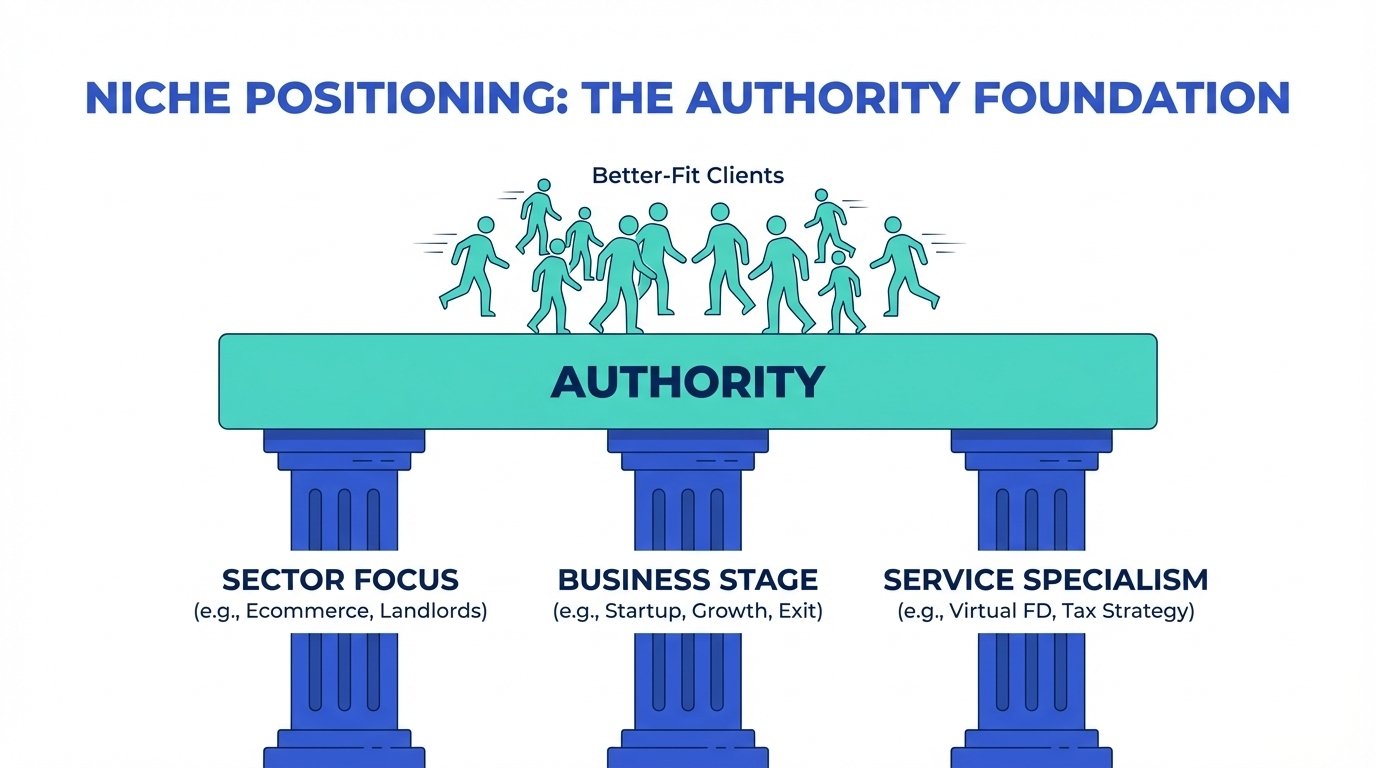
A useful niche usually combines three things: a sector you already understand (contractors, ecommerce brands, dental practices, agencies, landlords, healthcare providers, SaaS founders), a recurring problem inside that sector, and a service mix with room for advisory work, not just compliance. The HMRC count of self-employed and small companies, around 5.7 million UK SMEs employing close to 16.9 million people, gives plenty of viable sub-niches to choose from.
How to choose your niche
Choose a niche by looking at the clients who already pay you well, stay longest, refer most often, and ask for advisory work. That pattern is more reliable than picking a sector that simply sounds attractive. We also recommend testing four filters before committing:
- Demand: is there enough volume of these businesses in your service area?
- Margin: do they buy advisory, not only year-end accounts?
- Content fuel: do they ask enough recurring questions to support 12 months of content?
- Defensibility: can you genuinely claim better expertise than a generalist?
Our niche marketing SEO blueprint for accountants goes deeper on the selection method we use with firms in this position.
Why generic positioning quietly costs you money
Generic positioning weakens results because directors cannot remember a firm that sounds like ten others. Phrases such as “trusted accountants”, “tailored advice” or “professional support” describe almost every firm in the UK and persuade no one. Specific positioning works because it sounds experienced. A page titled “Accountants for UK Shopify brands turning over £500k to £5m” tells the buyer everything in one line. “Friendly local accountants” tells them nothing.
The flagship offer that does the heavy lifting
A flagship offer is one clearly named, clearly scoped, clearly priced piece of work that becomes the firm’s commercial centre of gravity. Every channel, lead magnet and discovery call points at it, which is what makes the whole system feel coherent.
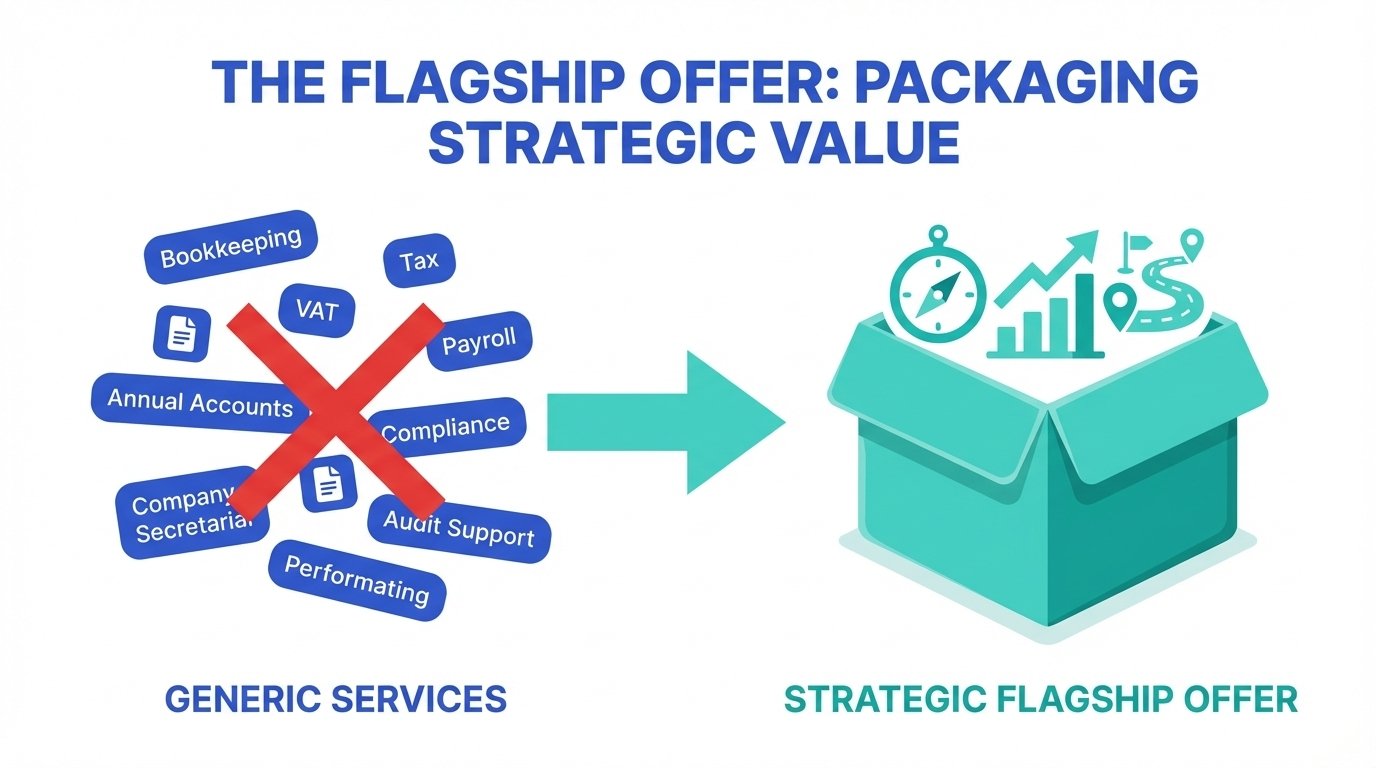
The flagship is usually a higher-value advisory product, not a compliance line. Common formats include a 90-day finance and reporting review, a quarterly virtual finance director programme, a “value-builder” advisory retainer aimed at exit-ready founders, or a fixed-price tax-planning package for directors. The shape matters less than the clarity. Buyers must understand what they get, what they pay, what changes for their business, and what the first step is.
Building the flagship in four moves
Build the flagship by working backwards from the outcome the best clients buy you for. The sequence we use with accountancy firms is:
- Problem: name the single business pressure it removes (cash visibility, reporting clarity, tax leakage, exit value).
- Outcome: state the commercial result in plain language (a monthly board pack the director trusts, a 12-month rolling forecast, an EBITDA improvement plan).
- Process: show the stages (diagnostic, 90-day plan, monthly cadence) so the buyer can picture the work.
- Price and fit: publish a price range and a “this is for you if…” statement so weak-fit leads disqualify themselves.
A worked illustration helps. A two-partner Cardiff accountancy firm that previously sold ad-hoc advisory at £150 an hour repackaged the same work as a “90-Day Finance Clarity Review” at £4,500. Within six months the firm had closed nine of those reviews, six of which converted to a £950-a-month advisory retainer. The work was almost identical. The packaging is what made it sellable in marketing.
The service that wins these clients
We make accountancy firms the obvious choice on Google and in AI search, niche by niche, with topical authority that compounds.
Lead magnets: catching the people who are not ready yet
A lead magnet is a useful, downloadable asset that solves a small piece of the buyer’s problem in exchange for an email. Lead magnets matter because most B2B accountancy buyers will not book a call on first contact, and an email subscriber is more recoverable than an anonymous visitor.
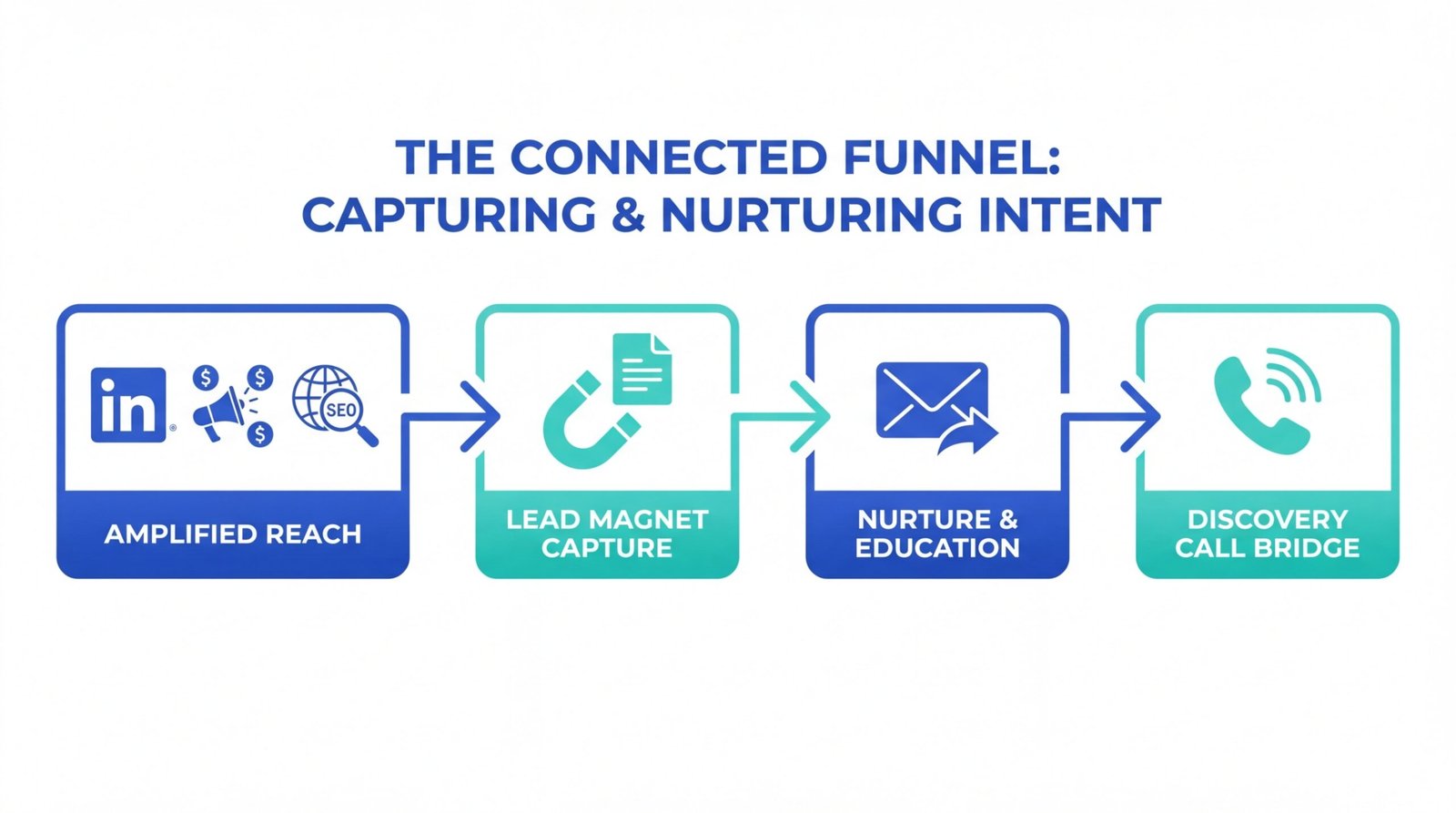
Strong topics for accountancy lead magnets stay narrow and operational. Examples that consistently perform:
- Cash flow assets: 13-week cash flow planner, late-payment recovery checklist, dividend vs salary calculator.
- Tax assets: director’s tax-planning checklist, R&D claim readiness scorecard, self-assessment prep pack.
- Growth assets: company-value scorecard, management-reporting maturity quiz, funding-readiness checklist.
- Operational assets: bookkeeping clean-up guide, payroll onboarding checklist, Xero or QuickBooks setup pack.
Connect every lead magnet to the flagship
Every lead magnet should map to the flagship offer it warms up. A cash flow planner feeds an outsourced finance director conversation. A company-value scorecard feeds an exit-readiness advisory retainer. A tax-planning checklist feeds a director tax package. Without that connection, the firm collects emails it never converts.
The channels accountants should actually run
The right channels are the ones your buyer uses to research, compare and reassure. For most accountancy firms in 2026 the working set is search (organic and AI), LinkedIn, email, selective paid media, and Google Business Profile.
Search and SEO
Search is still the largest single source of qualified accountancy enquiries because directors type their problems into Google before they ask anyone. Earning visibility on the queries that map to your flagship is the highest-ROI channel for most firms. The honest route is topical authority: covering the niche so completely that Google treats your site as the expert on it. Our wider SEO for accountants work is built around that method, and it pairs naturally with a content cluster around the flagship offer.
LinkedIn is the strongest social network for B2B accountancy because the buyers are already there. LinkedIn’s own audience figures put UK users above 39 million as of 2025, with finance, professional services and ownership roles heavily represented. Two to four useful posts a week from a named partner, written as commentary rather than corporate updates, beats daily volume from a brand page. Our full LinkedIn marketing guide for accountants covers the lead-generation system in depth.
Email keeps lead magnets working. According to Litmus’s State of Email report, email marketing continues to return roughly £36 for every £1 spent across B2B and B2C sectors combined. For accountancy, the value is less about ROI and more about being remembered through a six- to nine-month decision cycle.
Paid media
Paid media works best when it amplifies a proven offer or a proven lead magnet, not as a way to “test the market”. Google Search ads on high-intent terms (“accountant for ecommerce”, “R&D tax claim specialist”) and LinkedIn lead-gen ads to a flagship landing page are the two formats most accountancy firms should start with. Cold awareness ads usually fail because they ask buyers to make a decision they were not ready to make.
Local presence
Local search still drives a meaningful share of enquiries even for firms with national reach. Google’s own data shows that “near me” searches have remained one of the fastest-growing query patterns for years. A complete Google Business Profile, real reviews collected lawfully, and locally relevant pages all support the rest of the system, and our work on local and multi-location SEO covers the technical side.
The AI search angle most firms are missing
AI search has changed how directors find accountants, and ignoring it costs visibility. Close to a third of UK Google searches now show an AI summary above the normal results, and more than half of UK adults say they see these summaries regularly. Tools like ChatGPT, Perplexity, Google’s AI Mode and Microsoft Copilot are increasingly the first stop, not the last.
The bit most firms miss
Your firm has to be the brand AI assistants cite when a director asks them “who are the best accountants for SaaS founders in the UK”. Pages built only for keyword ranking will not earn those citations. Pages built for entities, structured FAQs and topical depth do.
The implication for accountancy marketing is simple. Your firm has to be the brand AI assistants cite when a director asks them “who are the best accountants for SaaS founders in the UK”. That requires content built for answer engines: clear entity definitions, structured FAQs, named authors with verifiable credentials, consistent information across the web, and topical depth rather than thin pages. AI search optimisation is now a non-optional part of any serious accountancy marketing plan.
The marketing tools a modern accountancy firm needs
Marketing tools fall into six jobs: a website, a CRM, email and automation, analytics, scheduling, and social publishing. You do not need expensive enterprise software to run a strong marketing system. You need a small, well-connected stack.
A typical, realistic stack for a UK accountancy firm:
- Website: WordPress with a fast theme, or a maintained Webflow build.
- CRM: HubSpot Starter, Pipedrive or Capsule, depending on team size.
- Email and automation: Mailchimp, MailerLite or ActiveCampaign for nurture sequences.
- Analytics: Google Analytics 4, Google Search Console, plus Microsoft Clarity for free session recordings.
- Booking and discovery calls: Calendly, TidyCal or HubSpot’s meetings tool.
- Social publishing: Buffer or Metricool for LinkedIn scheduling and basic reporting.
- AI visibility tracking: tools such as Otterly, Profound or Peec.ai that monitor how often your firm is cited in AI answers.
The single most useful integration is CRM-to-website. When a lead magnet, contact form and discovery-call booking all land in the same CRM with the source attached, attribution stops being guesswork.
What a sensible marketing budget looks like
Accountancy marketing budgets vary widely, but Federation of Small Businesses figures and the IPA’s Bellwether report both put average SME marketing spend at roughly 5% to 10% of revenue, with professional-service firms usually at the lower end. For a £750,000-turnover practice, that points to a working range of roughly £37,500 to £75,000 a year across all marketing costs.
A realistic split for a mid-sized UK accountancy firm running the strategy in this guide:
- Strategy, SEO and content: 40% to 50% of budget. This is where compounding value sits.
- Paid media: 15% to 25%, weighted towards lead-magnet and retargeting campaigns.
- Tools and software: 10% to 15%.
- Design and website improvements: 10% to 15%.
- Events, partnerships and PR: the remainder.
Firms with no in-house marketer typically spend a further £2,000 to £6,000 a month on fractional or agency support, depending on scope. We work both ways with accountancy clients, as a mentor for in-house teams and as a hands-on partner where there is no internal capacity, and the right answer depends entirely on the firm’s stage.
In-house, outsourced or hybrid: which model fits
The in-house vs outsourced question matters because the wrong model wastes budget for a year before anyone notices. The honest answer depends on revenue, growth ambition and existing skills.
- Fully in-house: usually viable above roughly £1.5m revenue, when a full-time marketer plus freelancers can be afforded and managed.
- Fully outsourced: best for firms below £750k revenue or those without internal marketing skills, where a specialist agency can move faster than the firm could alone.
- Hybrid (most common, most effective): an internal owner, often a partner or operations lead, who runs day-to-day execution while an outside specialist sets strategy, drives SEO, and trains the team. This is the model most growth-stage accountancy firms settle on.
Whichever model you pick, the strategy itself should not change. Channels, tools and proof points stay the same. Only the delivery moves.
Self-assessment
How strong is your accountancy marketing system today?
1. How clearly defined is your firm’s niche or ideal client?
2. Do you have a single, clearly packaged flagship offer?
3. Are you capturing leads before they are ready to enquire?
4. Is your firm visible in AI search answers?
5. Are you tracking lead quality and proposal-to-close, not just clicks?
6. Are your channels working as one connected system, or separately?
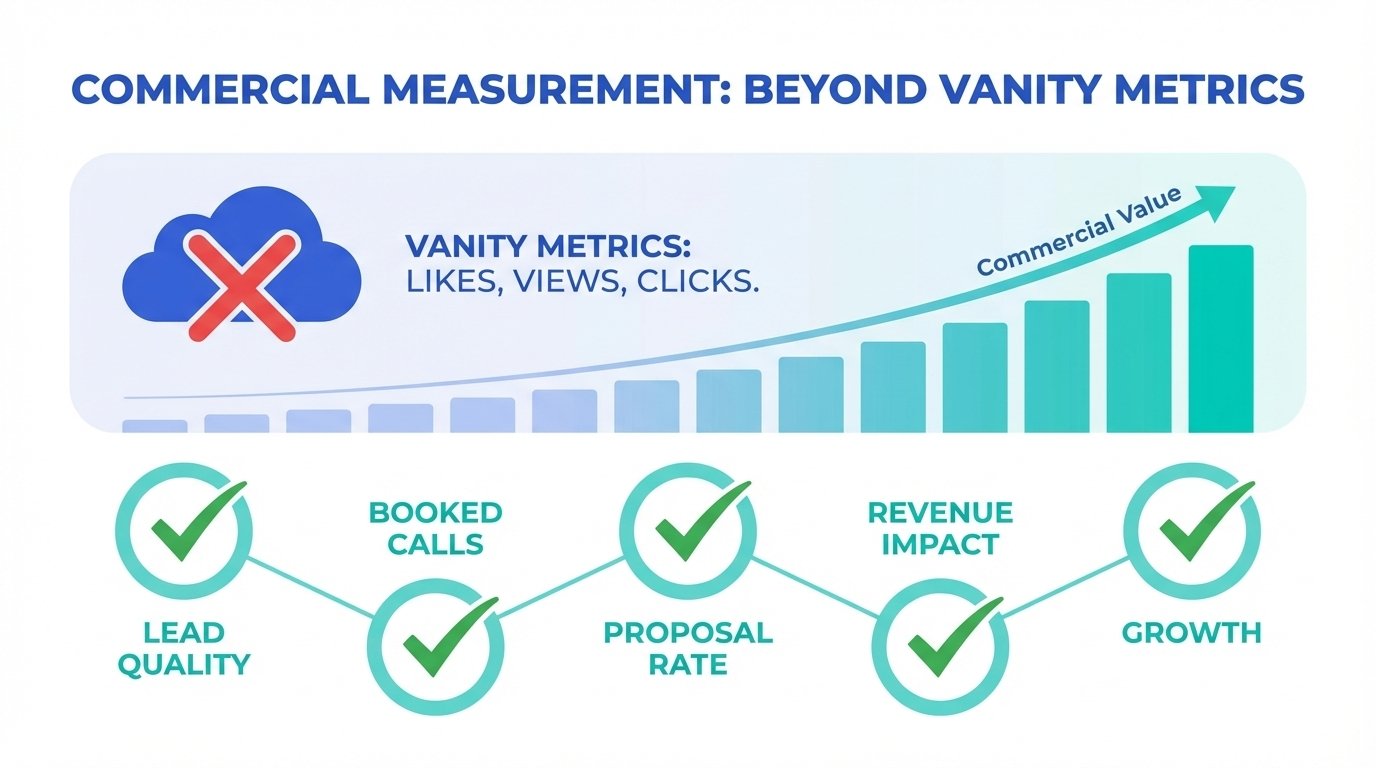
How to measure marketing properly
Measure marketing on the numbers that actually predict revenue: lead quality, discovery-call show-up rate, proposal-to-close rate, average client value and 12-month retention. Traffic and impressions are diagnostic, not decisive.
The metrics every accountancy firm should track, and the tool that owns each one:
- Organic traffic and rankings: Google Search Console and Ahrefs or Semrush.
- AI search citations: Otterly, Profound or Peec.ai.
- Lead magnet downloads: your email platform’s report, tagged by source.
- Discovery-call bookings: Calendly or HubSpot meetings.
- Source attribution: CRM (HubSpot, Pipedrive) with UTM tagging on every campaign link.
- Proposal-to-close rate: CRM pipeline stages.
- Client lifetime value: practice management software (Xero Practice Manager, Karbon, Senta).
Review the numbers monthly, not weekly. B2B accountancy cycles are too long for weekly volatility to mean anything.
The mistakes that quietly kill accountancy marketing
The most damaging mistakes are not dramatic. They are slow leaks the firm tolerates for months.
The recurring patterns we see when auditing accountancy firms include: trying to serve every sector at once, publishing content with no relationship to the flagship offer, collecting emails that never receive a follow-up sequence, running paid ads to a generic homepage instead of a flagship landing page, ignoring Google Business Profile, treating LinkedIn as a noticeboard rather than a conversation, measuring impressions instead of enquiries, and changing strategy every six months before the previous one had time to compound.
A second illustration. A four-partner UK firm with strong technical expertise was spending around £2,800 a month on Google Ads pointing at a homepage that listed eleven services. Conversion rate sat under 1%. We rebuilt the strategy around a single niche, contractors and personal-service companies, built a dedicated flagship landing page, and routed the same ad spend to it. Within four months conversion rate moved above 4%, monthly enquiries roughly tripled, and the average client value rose by about 35% because the niche allowed higher pricing. The budget did not change. The strategy did.
Worked example, by the numbers
Same ad spend, different strategy: a four-partner UK firm in four months
The marketing rules accountants must respect
Accountancy marketing sits inside three rule sets, and breaking them is expensive.
The first is the ACCA Code of Ethics and Conduct, which requires that marketing communications be honest, truthful, and not bring the profession into disrepute. The second is the ICAEW’s similar provisions for chartered firms, which prohibit misleading claims, unverifiable comparisons, and inappropriate solicitation. The third is general UK advertising law under the CAP Code, enforced by the Advertising Standards Authority, plus the Digital Markets, Competition and Consumers Act.
UK reviews law (in force April 2025)
Fake and concealed-incentive reviews are banned, with penalties that can reach 10% of worldwide turnover. Strip any “leave us a 5-star review for a voucher” campaign immediately, and make sure every Google review is genuine and unincentivised.
The reviews rule deserves special attention. Fake and concealed-incentive reviews are now banned under UK consumer law, with penalties that can reach 10% of worldwide turnover, and active enforcement began in mid-2025. For accountancy firms that means every Google review must be genuine, unincentivised, and clearly disclosed if any incentive was offered at all. Strip every “leave us a 5-star review for a £10 voucher” campaign immediately if one still exists.
A practical 90-day plan to put this in place
A 90-day plan turns the strategy into a working system without trying to do everything at once. The sequence matters: foundations first, then capture, then amplification.
- Days 1 to 30: define the niche and the flagshipDefine the niche, write the ideal-client profile, draft the flagship offer, rewrite the homepage and primary service pages around the niche, set up Google Analytics 4, Search Console, the CRM, and a single email platform.
- Days 31 to 60: build the capture engineBuild one strong lead magnet that maps to the flagship, write the four-email nurture sequence that follows it, publish three to five deep articles on the niche’s biggest questions, complete Google Business Profile, and start a LinkedIn cadence of two posts a week from a named partner.
- Days 61 to 90: amplify and measureLayer paid traffic onto the lead magnet, add retargeting for website visitors, publish the first client case study, and put a monthly reporting rhythm in place so you measure lead quality and proposal close rates, not just clicks. Review at day 90 and double down on whichever channel produced the best-fit work.
Frequently asked questions
How long does it take for accountancy marketing to produce enquiries?
Most firms see initial movement in lead magnet downloads and LinkedIn engagement within 30 to 60 days, with meaningful organic search and AI-search visibility building over six to twelve months. Paid media can produce qualified enquiries within the first month if the offer and landing page are strong.
Should an accountancy firm have a separate website per niche?
In most cases, no. A single, well-structured site with a clear primary niche and supporting sector pages performs better than multiple thin sites that split authority. Separate sites only make sense when a sub-brand has genuinely different services, a different team and a different long-term commercial strategy.
How much should an accountancy firm spend on marketing?
A working range is 5% to 10% of revenue for growth-stage practices, weighted towards SEO, content and strategy rather than paid ads. Firms below £500k revenue often spend less in absolute terms but a higher percentage, because the foundations cost the same to build regardless of firm size.
Do accountants still need a blog in 2026?
Yes, but only if the blog is built as a topical authority cluster around the flagship offer rather than a stream of generic posts. The right content strategy for an accountancy blog is what makes the difference between a blog that compounds and a blog that wastes time.
What is the single highest-ROI marketing activity for a small accountancy firm?
For most firms below £2m revenue, it is building topical authority on the niche through SEO, paired with a single flagship offer and a Google Business Profile that collects real reviews. That combination produces compounding inbound enquiries at a lower cost per acquisition than paid media over a 12-month horizon.
Where this leaves you
Accountancy marketing in 2026 rewards firms that pick a niche, package a flagship offer, build genuine topical authority on the website, earn AI-search citations, respect the rules, and measure the things that actually predict revenue. Most of the lift comes from joining up work the firm is already doing, not from adding more activity.
True SEO Consultants Ltd works with accountancy firms across Cardiff and the UK to build exactly that system, founded and led by an ACCA-qualified practitioner and a fractional CFO with more than 30 years’ experience, so the strategy is informed by the inside of the profession, not just the outside. If you want to see where your firm stands today and what the highest-leverage next move is, book a free consultation and we will map the gaps with you.
Built for accountancy firms, by people who came from inside the profession
Cardiff-rooted, UK-wide, onboarding clients worldwide through a fully remote process.
We are True SEO Consultants Ltd, a semantic SEO consultancy led by Mohammad A Mahmud, an ACCA-qualified accountant who has worked in SEO since 2011, and Julie Williams, a fractional CFO with more than 30 years’ experience. We build topical authority, not bought links, and we engage as a mentor or hands-on partner depending on what your firm needs.
Table of Contents
- What a marketing strategy means for an accountancy firm
- Why B2B thinking changes the plan
- Niche positioning is the foundation, not a nice-to-have
- The flagship offer that does the heavy lifting
- Lead magnets: catching the people who are not ready yet
- The channels accountants should actually run
- The AI search angle most firms are missing
- The marketing tools a modern accountancy firm needs
- What a sensible marketing budget looks like
- In-house, outsourced or hybrid: which model fits
- How to measure marketing properly
- The mistakes that quietly kill accountancy marketing
- The marketing rules accountants must respect
- A practical 90-day plan to put this in place
- Frequently asked questions
- Where this leaves you
