

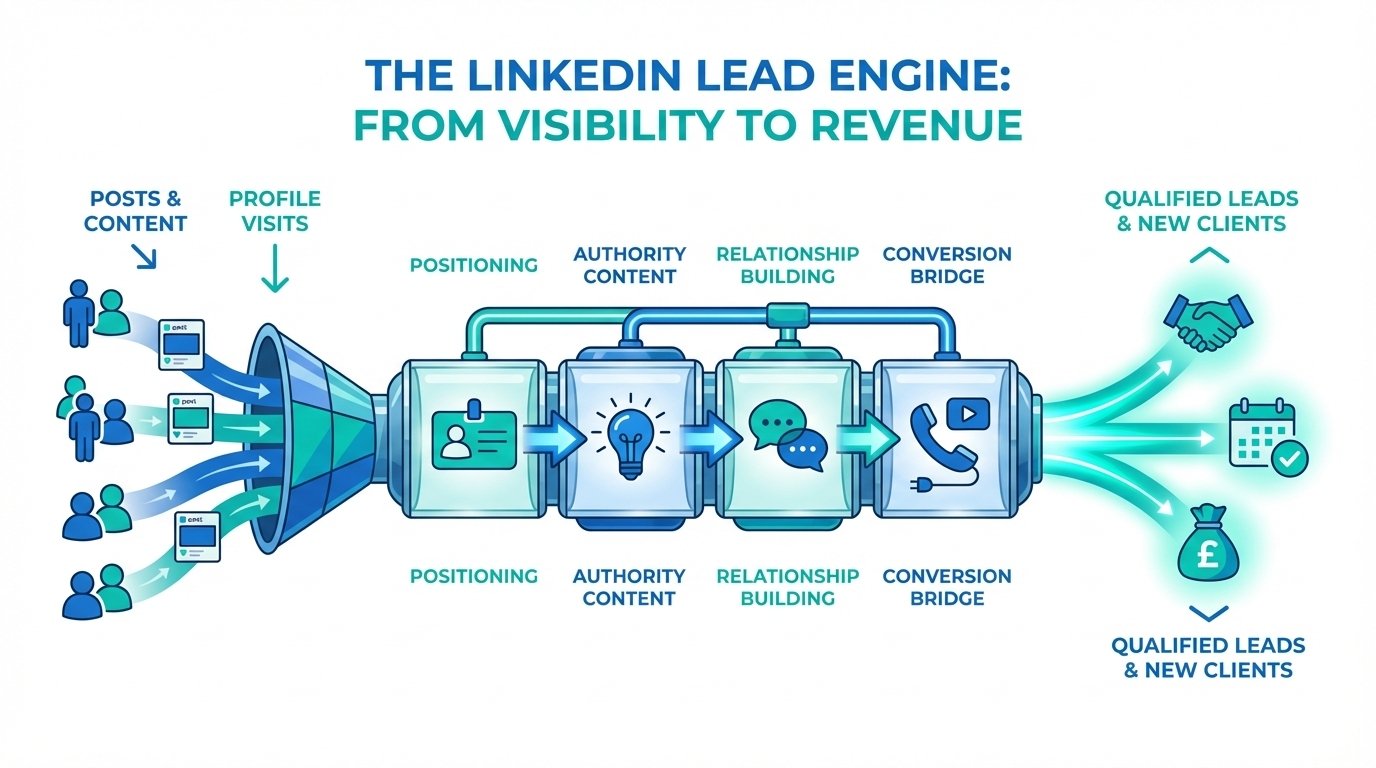
LinkedIn becomes a lead source for accountants when the firm stops treating it as a noticeboard and starts treating it as a positioning, publishing and conversation system aimed at one defined audience. The firms winning enquiries do five things in sequence: sharpen the profile around a specific buyer, publish problem-led content on a steady rhythm, build conversations through comments and warm messages, capture interest with a lead magnet or discovery call, and track the numbers that map to fee income.
Most accountancy firms post tax deadlines, season’s greetings and the occasional hiring update, then wonder why nothing happens. This guide covers the full territory: what LinkedIn marketing for accountants means, why it works, how to set up your profile and choose your niche, what to post and how often, which tools to use, the metrics that prove it’s working and how to track each one, the compliance points partners often miss, how it connects to AI search and your wider website strategy, the most expensive mistakes, what it costs in time and money, and a month-by-month plan you can start tomorrow. Read it as one piece, then come back to the sections you need.
Key takeaways
- LinkedIn works for accountants when positioning, content, conversation and conversion are built as one system, not four hobbies.
- Personal profiles out-perform company pages on reach by a wide margin, so the founder or partner should lead, with the company page playing support.
- A specific niche (ecommerce founders, dental practices, contractors, owner-managed property businesses) lifts every other number on the platform.
- Two to four posts a week sustained for six months beats daily posting for three weeks every time.
- The metrics that matter are profile views, qualified connection growth, lead magnet downloads, booked discovery calls and attributed fee income, not likes.
- ICAEW and ACCA conduct rules, plus UK GDPR and PECR, apply to LinkedIn content and outreach in ways most accountants underestimate.
- LinkedIn now feeds AI search, so visible expertise on the platform helps your firm get cited by ChatGPT, Google’s AI Overviews and Perplexity.
Want help turning this into a working system for your firm?
We’ll map your LinkedIn, website and AI-search visibility together in 30 minutes, no obligation.
What LinkedIn marketing for accountants actually means
LinkedIn marketing for accountants is the deliberate use of the platform to build authority, attract a defined buyer, and move that buyer toward a discovery call, a lead magnet or a website enquiry. It sits at the trust-building end of the marketing funnel, and it works alongside, not instead of, SEO for accountants and a strong website.
The platform is unusual. LinkedIn carries close to 38 million UK members according to LinkedIn’s own published audience data, and a large share of those members are directors, founders, finance managers and professional advisers, the exact people accountancy firms sell to. That density of decision-makers is why B2B services see disproportionate value here compared with consumer platforms.
There are three jobs the platform should do for an accountancy firm. The first is repeated visibility in front of the right people, so the firm name and the partner’s face become familiar before any conversation starts. The second is public proof of expertise, which is harder to fake than on a website and easier to verify than a brochure. The third is a low-friction route into a conversation, whether that’s a comment, a connection, a message or a booked call. Strip away any LinkedIn activity that doesn’t serve one of those three jobs.
This matters because accountancy buying is slow and trust-led. Gartner’s B2B buying research finds the typical purchase decision involves six to ten people and stretches across many months, with most of the journey happening before any supplier is contacted. LinkedIn is where most of that hidden journey now plays out for professional services, so being visible there changes who reaches your contact page.
The five-step LinkedIn lead system
Why LinkedIn works for accountants (and where it doesn’t)
LinkedIn works for accountancy firms because the platform combines three things that rarely sit together: a professional context where business problems are openly discussed, a search and feed system that rewards consistent expertise, and a direct route to message decision-makers without a gatekeeper. According to the Edelman-LinkedIn B2B Thought Leadership Impact Report, a clear majority of senior decision-makers say thought leadership content directly leads them to research a supplier they hadn’t considered, and a smaller but still significant share say it leads them to make a purchase.
It also works because trust is the main constraint in accountancy. The UK has roughly 30,000 accountancy and audit firms in a market worth close to 40 billion pounds, and the differentiator between firms at fee-paying level is rarely technical skill. It’s whether the buyer feels safe handing the work over. LinkedIn lets a buyer watch a partner think, comment, react to news and explain ideas over weeks before any sales conversation, which shortens the trust-building time considerably.
Where LinkedIn does not work: high-volume, low-fee compliance services aimed at micro-businesses who don’t use the platform. A sole trader looking for a fifty-pound self-assessment via Google is not on LinkedIn comparing partners. When your fee mix is mostly that work, LinkedIn is the wrong primary channel, and Google search plus a tightly built local presence will earn more per hour of effort. Pick the channel that matches your client.
How to position your profile so the right buyers notice
Profile positioning has to be done before any content goes out, because content with no positioning behind it goes unnoticed in the feed. Three elements do most of the work: the headline, the banner, and the first two lines of the About section.
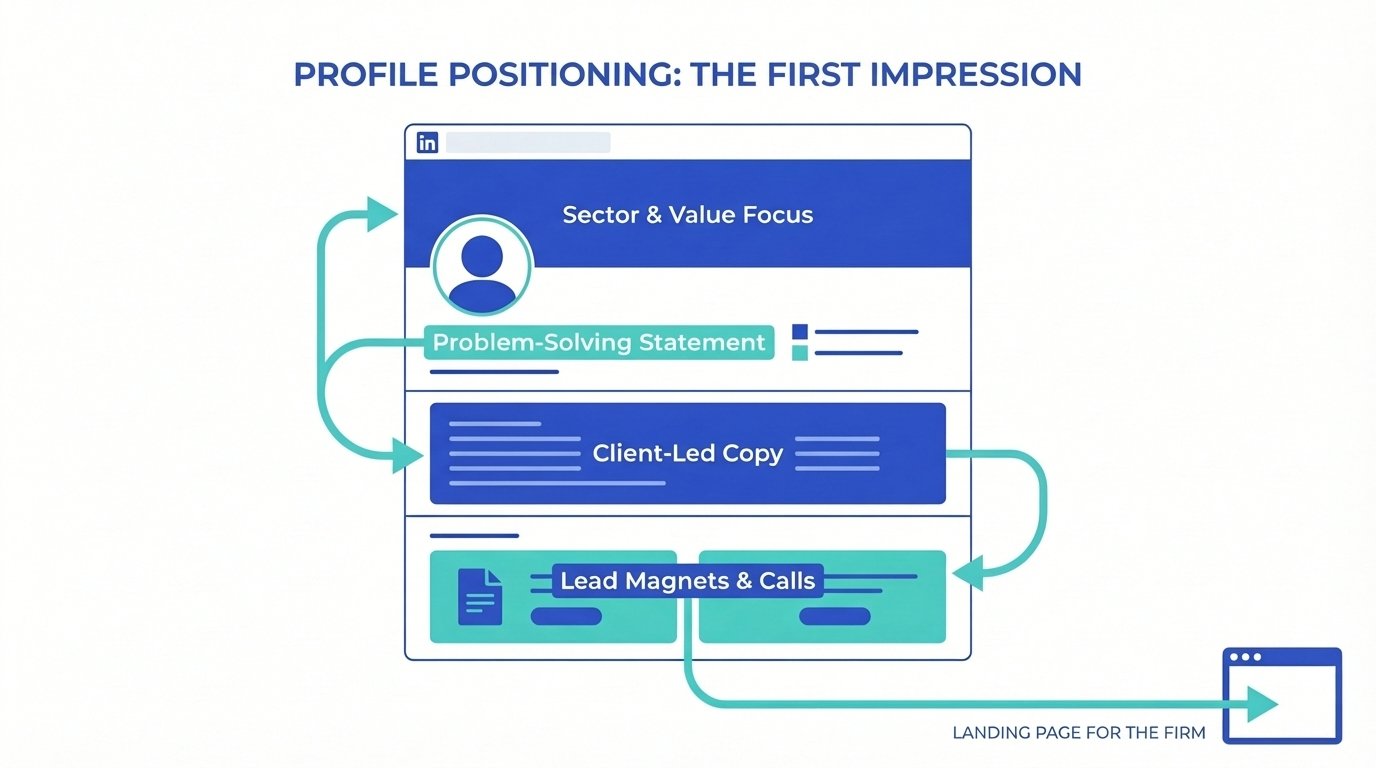
The headline is the line that follows your name in every feed, every search result, every message preview and every comment. “Accountant at Smith & Co” tells a viewer nothing about who you help or why. “Helping Cardiff ecommerce founders keep more profit and sleep better at month-end” tells a viewer exactly who should keep reading. Headlines have a 220-character limit; use 120 to 180 of them with the buyer and the outcome inside.
The banner is prime real estate most firms waste on a stock photo of a city skyline. Use it for one specific message: who you help, the sector or service focus, and a single call to action (“Free 30-minute call” with your booking link). Tools like Canva have free banner templates sized correctly for LinkedIn’s display ratio.
The About section needs to answer four questions in the first 300 words: who do you help, what problem do you solve, how is your approach different, and what should the reader do next. Bury those answers and the viewer leaves. Open with them and they read on. A featured section pinned below About should carry your lead magnet, your most recent useful post and a direct booking link, so a curious profile visit can convert without leaving the page.
Personal profile vs company page: which to prioritise
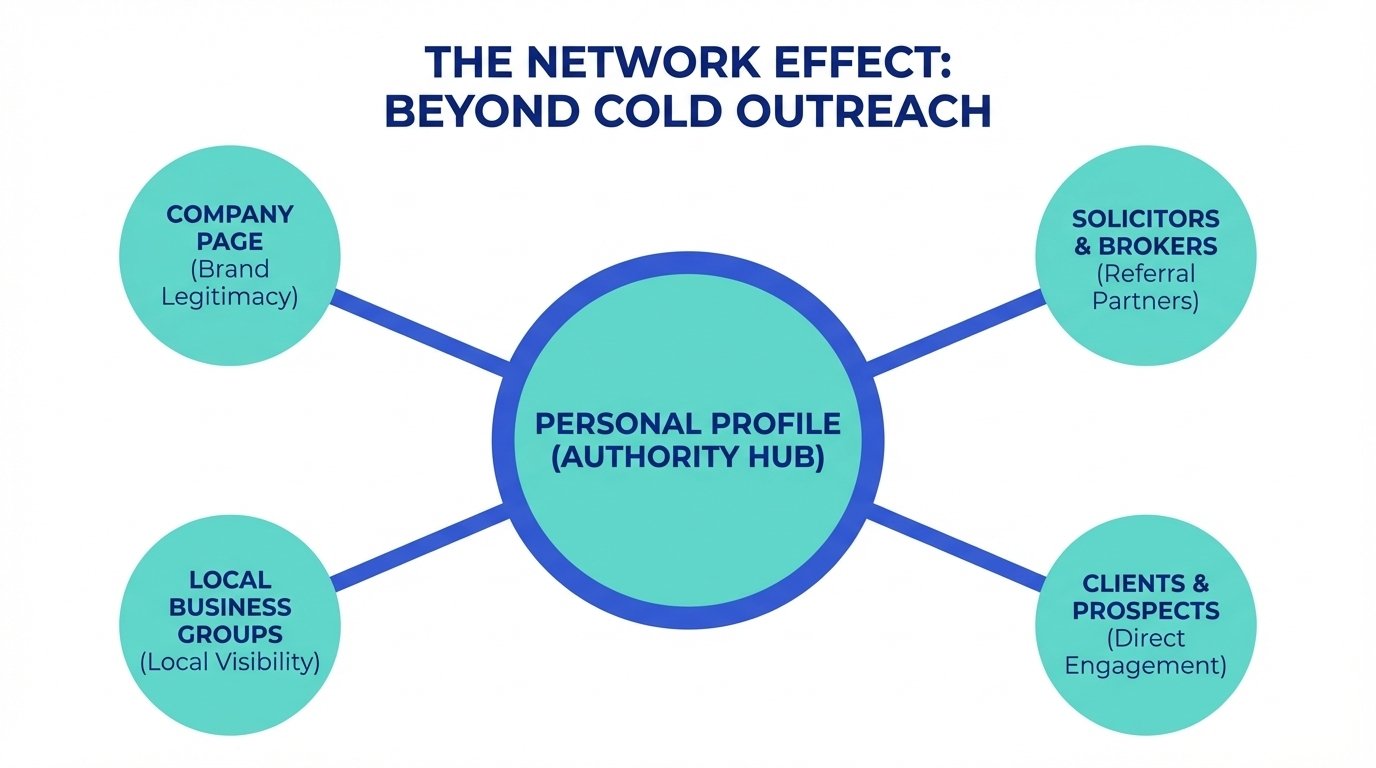
The personal profile should carry the strategy because LinkedIn’s algorithm consistently rewards posts from personal accounts with several times more reach than identical posts from company pages. Social Media Examiner’s annual industry survey has reported this gap for years, and accountants who test it on their own pages see the same pattern within weeks.
The reason is human, not technical. Members open LinkedIn to see what other people think, not what brands announce. A partner sharing a sharp observation on cash flow gets engagement; the same observation under the firm logo gets ignored. Founder-led content also signals that the expertise is real and the firm is led by people the buyer can identify, which is exactly what an accountancy buyer is looking for.
The company page still has a role: it anchors brand legitimacy when a prospect checks the firm after meeting a partner, it carries recruitment and culture content where a personal post would feel off-key, and it gives the firm a place to be tagged in client wins and partnership announcements. A workable split is 80% of effort on partner profiles, 20% on the company page, with company posts reshared by the team to reach personal-feed distribution.
Choosing a niche so every post compounds
A LinkedIn niche multiplies the return on every hour of effort, because the same post written to “small business owners” lands shallower than the same post written to “owner-managed ecommerce brands turning over £1m to £5m on Shopify”. Specificity earns memory, referrals and inbound enquiries that broad positioning never will. We cover the deeper case for this in our work on niche opportunities for accountants.
Three niche routes work for accountancy firms. Sector niches (ecommerce, dental, healthcare, contractors, hospitality, property) match neatly to recurring industry problems. Lifecycle niches (pre-funding startups, scale-ups preparing for an exit, post-acquisition founders) match to financial milestones. Service niches (R&D tax claims, EIS/SEIS work, US-UK cross-border tax, MTD-ready bookkeeping) match to a specific deliverable.
A firm doesn’t have to take only one client type forever. The niche is a content position, not a permanent restriction. The wider client list keeps paying the bills while the niche builds the inbound flow. A Bristol practice we know spent two years publishing only for property landlords on LinkedIn while continuing to serve a mixed book; their referrals from solicitors and brokers became almost exclusively property work within eighteen months, and the average new client fee climbed from around £1,200 to £3,400 a year.
What content to post (and the rough mix)
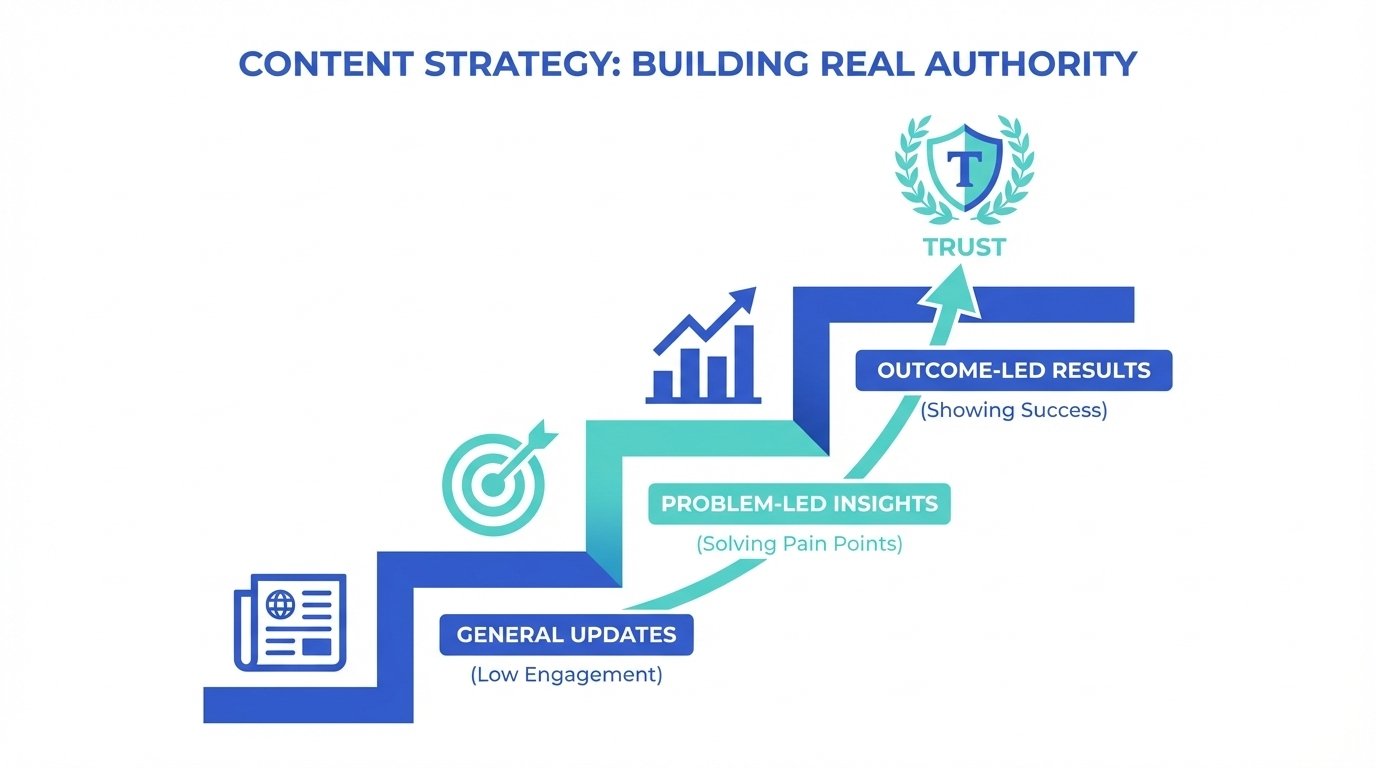
The content mix that works for accountants on LinkedIn is roughly 60% educational and problem-led, 20% perspective and opinion, 10% client-pattern story, and 10% offer or call to action. The point of the mix is to look generous most of the time so the occasional ask reads as fair rather than aggressive.
Educational content covers the problems your buyer loses sleep over, with a clear answer. Cash flow forecasting that catches a January VAT gap, dividend planning under current thresholds, R&D claim eligibility under the merged scheme, MTD timelines and what to do when you’re behind, employer NI changes and what they mean for hiring, common bookkeeping errors that trigger HMRC enquiries. Each is one post, one idea, one clear answer.
Perspective content states a view your buyer will agree or argue with. “Most management accounts arrive too late to be useful” or “When your bookkeeping is three months behind, hire a bookkeeper before you hire an accountant” both invite response. Strong opinions, kept inside the boundaries of professional conduct, build memory faster than neutral observation.
Client-pattern content describes things you keep seeing across many businesses, with no identifying detail. “Across thirty owner-managed ecommerce clients last year, the most common cash leak wasn’t ad spend; it was unclaimed import VAT” reads as proof without breaching confidentiality.
Offer content is the small share where you point to a lead magnet, an event or a discovery call. Make these clean, specific and easy to act on.
Post formats: what to write, what to record, what to design
Text-only posts still carry most of the reach on LinkedIn because the platform’s feed rewards clear writing over expensive production. A well-structured 150 to 250-word post with a sharp first line, one idea, a short payoff and a soft prompt at the end is the default format for accountants.
Carousel-style document posts (PDF or native carousel) work for sequential ideas: “five mistakes on first-year R&D claims”, “the seven numbers every owner should know monthly”, “a four-step cash forecast for seasonal businesses”. Carousels keep readers in the feed longer, which lifts distribution. Design them in Canva or Figma at 1080 x 1350 pixels per slide.
Short-form video (60 to 120 seconds) is increasingly important. LinkedIn’s own data shows video posts attract significantly higher comment rates than text posts, and the platform is actively pushing video distribution in 2025. The bar for production is low: a clear face, decent light, one idea explained in plain English. Captions are essential because a large share of feed viewing happens on mute.
Long-form articles published natively on LinkedIn (Pulse) work where the topic deserves 1,500 words and the partner wants a searchable record. Use these sparingly; the regular feed post is what builds the daily relationship.
How often to post, and how to keep the rhythm
Two to four posts a week, sustained for at least six months, beats every other publishing pattern for accountancy firms. Daily posting can work for a partner with a strong content engine, but the failure rate is high and inconsistency damages the algorithm’s distribution more than slow rhythm does.
Pair posting with daily commenting on the right people’s content. Twenty thoughtful comments a week on posts from your target buyers, referral partners and respected sector voices builds visibility without writing a single new post. LinkedIn’s algorithm treats comment activity as a strong relevance signal, and prospects who see your name on six posts before they read one of yours warm up faster.
A workable structure: batch-write the week’s posts in one 90-minute session, schedule them through a tool (covered below), then spend fifteen minutes each weekday morning commenting and replying. That’s roughly three hours a week of active partner time, which is the realistic ceiling for most fee-earners.
The tools that actually help
The tool stack for LinkedIn marketing splits into five jobs: targeting, writing, scheduling, designing and measuring. Most accountancy firms over-invest in tools and under-invest in writing time; pick one tool per job.
For targeting and research, LinkedIn Sales Navigator (around £79 per month per seat) is the only credible option for serious lead identification. It opens advanced filters by company size, industry, role, posting activity and engagement, which means a partner can build a list of, for example, every UK Shopify-using founder of a 10 to 50-person business who has posted in the last 30 days.
For writing, AuthoredUp and Taplio (both around £25 to £50 a month) offer post formatting, hook libraries and preview tools that lift readability. ChatGPT or Claude can be used for first drafts, but every post needs human editing for voice and accuracy. We’ve written separately on using AI for content writing without losing your voice.
For scheduling, Buffer, Hootsuite, Publer or Taplio all cover the job. Free tiers handle most accountancy firms’ volume.
For designing, Canva (free or around £10 a month Pro) handles carousels, banners and post images. Figma works where a designer is involved.
For measuring, LinkedIn’s native analytics covers post and profile data. Shield Analytics (around $12 a month) gives deeper personal-profile insight, including content performance trends and best posting times. Pipe LinkedIn data into your CRM (HubSpot, Capsule, Pipedrive) so you can attribute booked calls to source.
Lead magnets that convert accountancy buyers
The lead magnets that earn email addresses from LinkedIn followers are specific, useful in under thirty minutes, and tied to a paid service. Vague guides (“Top 10 Tax Tips”) under-convert because they ask the reader to extract value themselves. Specific tools convert because they deliver value on the spot.
Lead magnets that consistently work for accountants include a cash flow scorecard the reader can complete in fifteen minutes, a tax-year-end checklist for owner-managed businesses, a directors’ loan account calculator, an R&D claim eligibility quiz, a business valuation rough-cut spreadsheet, and a “is your bookkeeping fit for funding” diagnostic. Each one mirrors a service the firm sells, so a download is a warm signal.
Delivery matters as much as the magnet itself. Host the form on the firm website, not on LinkedIn, so the download triggers a website visit, a CRM record and an email sequence. The LinkedIn post earns the click; the conversion happens inside a tight on-site funnel, and a weak landing page wastes the attention the post earned. This is the join between your LinkedIn visibility and the conversion-rate work on the website itself, and the firms winning fees on LinkedIn are the same firms that have already built a sharp conversion path through optimised web design. The LinkedIn audience, the lead magnet, and the page that catches the click are one system, not three.
Outreach and messaging without the spam
Direct messaging on LinkedIn works for accountants when it’s slow, warm and relevant. It fails when it’s templated, fast and pitch-led. Most cold outreach on the platform now hits a tired buyer, so the bar for a worthwhile message has risen sharply.
Three message types perform. The thank-you-with-question, sent after a prospect has commented on your post, simply thanks them and asks a follow-up question about their business; the conversation often starts naturally. The contextual-share, where you send a relevant guide, article or piece of research with one line of why you thought they’d find it useful, builds goodwill with no ask. The light-invitation, sent after several months of warm contact, mentions you’re opening a few discovery slots and offers one to them.
The numbers help calibrate effort. The Hinge Research Institute’s research on B2B services marketing finds personalised outreach to warm contacts converts at multiples of cold-outreach rates. A partner who sends five well-researched messages a week to people who have engaged with their content will typically book one to three discovery calls a month from the activity, which compounds over time.
UK GDPR and PECR (Privacy and Electronic Communications Regulations) treat LinkedIn messaging as direct marketing where there’s a commercial intent. The platform’s built-in messaging falls inside LinkedIn’s terms rather than email rules, but exporting connection emails and emailing them without consent breaches PECR. Keep outreach inside the platform unless the recipient has separately opted into your email list.
LinkedIn Ads: when (and when not) to pay
LinkedIn Ads can work for accountancy firms with a high-value service and a clear buyer profile, but the platform is expensive and the test budget has to be realistic. UK cost per click on LinkedIn typically runs three to ten times higher than Google Search for comparable B2B keywords, with averages often quoted in the £6 to £15 range depending on targeting tightness, according to data published by WordStream and other benchmark trackers.
Where ads pay back: promoting a strong lead magnet to a tightly targeted audience (for example, finance directors at UK manufacturing businesses with 50 to 250 staff), retargeting website visitors who didn’t book a call, and amplifying a single high-performing organic post to a wider audience of the same buyer type.
Where ads waste money: brand awareness with no offer, generic “book a call” ads with no content warm-up, and broad targeting because the buyer “could be anyone”. A useful rule of thumb: don’t spend on LinkedIn ads until your organic content has proven what message your buyer responds to. Then put paid spend behind the message that’s already working.
For most firms under £1m in fees, organic LinkedIn plus a strong website earns more per pound than paid LinkedIn. Above that scale, paid amplification of proven organic content starts to make sense.
Quick self-assessment
How strong is your firm’s LinkedIn system right now? Answer five questions and get a recommendation.
1. Is your LinkedIn headline written around a specific buyer and outcome?
2. Is your firm posting on LinkedIn at least twice a week, every week?
3. Do you have a defined niche (sector, lifecycle or service) you publish for?
4. Do you have a lead magnet that mirrors a paid service, hosted on your own website?
5. Can you attribute booked discovery calls to LinkedIn with UTM tags or a source field?
Not ready for the quiz? Talk to us directly.
Metrics, KPIs and how to track each one
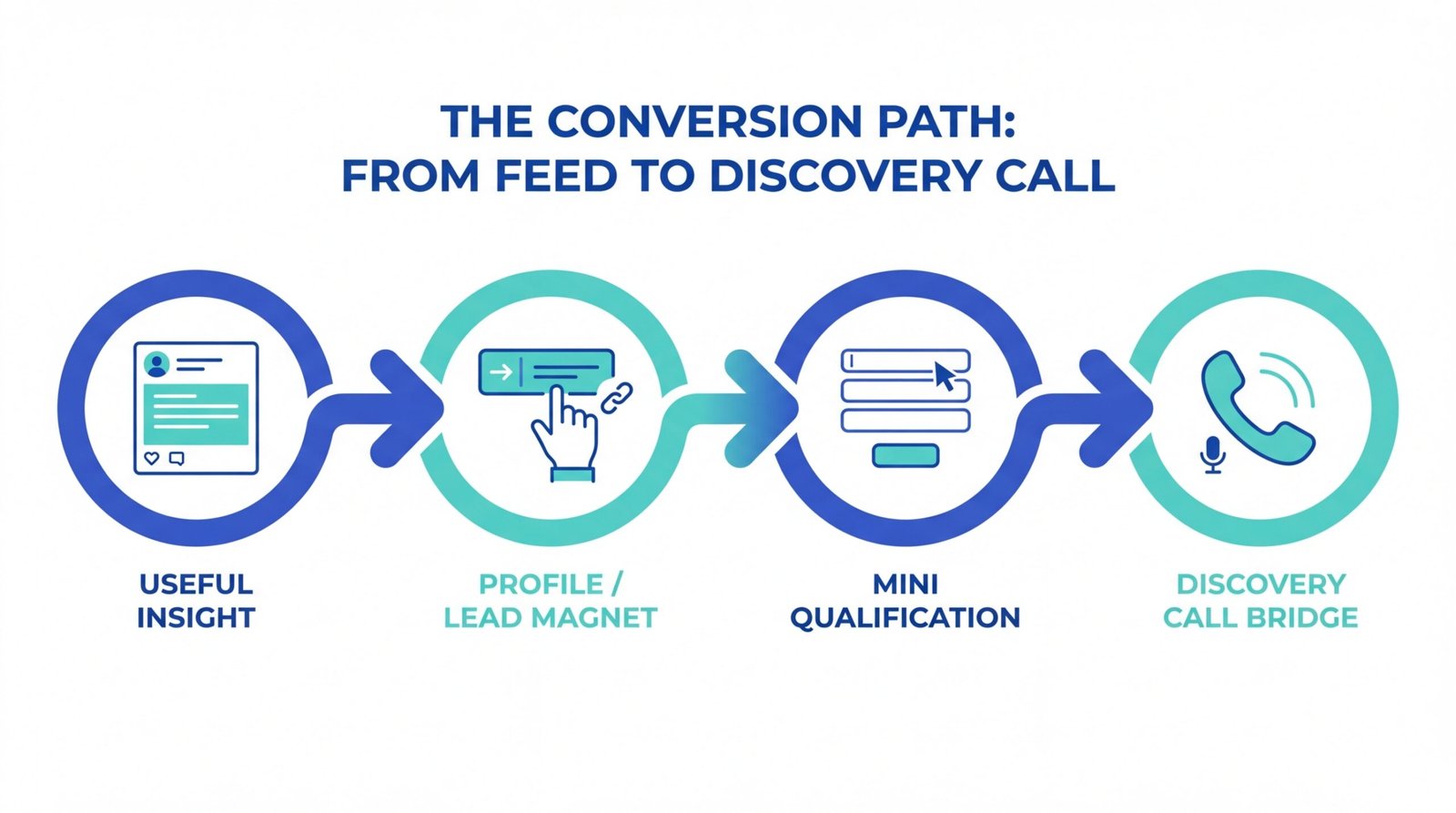
The metrics that matter for an accountancy firm’s LinkedIn marketing split into three layers: leading indicators (early signals), middle indicators (engagement quality) and lagging indicators (commercial outcome). Track all three; reporting on only the first layer hides whether the strategy actually pays.
Leading indicators include profile views (tracked in LinkedIn’s “Who viewed your profile” panel, weekly), follower and connection growth (Profile dashboard and Sales Navigator account lists), post impressions (Post analytics, per post) and search appearance (the “Search appearances” widget on the dashboard). These tell you visibility is rising; they don’t tell you it’s the right people.
Middle indicators include engagement rate per post (likes plus comments plus reshares divided by impressions, tracked in Shield or built manually in a spreadsheet), comment quality (the ratio of comments from your target buyer profile to total comments, tracked manually), connection acceptance rate (Sales Navigator reports), message reply rate (track in a CRM tag or a simple Google Sheet) and lead magnet click-throughs (UTM tags on every link out of LinkedIn, read in Google Analytics 4).
Lagging indicators are the ones that matter to the partners: booked discovery calls attributed to LinkedIn (Calendly source tags or “How did you hear about us?” field), proposals issued, won fees and average client value. Pipe each into a single dashboard, even a basic Google Sheet, and review monthly.
UTM tagging is the single highest-ROI tracking improvement most accountancy firms can make. Every link you post or message out of LinkedIn should carry source=linkedin and a campaign tag identifying the post or magnet, so GA4 attribution stays clean. Without this, you’re guessing.
Cardiff firm rebuilt tracking, then proved LinkedIn’s commercial weight
UTM tags, a CRM source field and a weekly metrics review showed 38% of new fee income that quarter had touched LinkedIn somewhere in the journey, which justified doubling content investment.
How LinkedIn now feeds AI search
LinkedIn content is increasingly being read, summarised and cited by AI search engines including ChatGPT, Perplexity, Google’s AI Overviews and Bing Copilot. A partner with a strong, consistent LinkedIn footprint on a defined topic is more likely to be named when a buyer asks an AI assistant “who’s a good accountant for ecommerce founders in the UK?”. This is the answer-engine layer, and it’s becoming a meaningful visibility channel in its own right.
Close to a third of UK Google searches already show an AI summary above the normal results, and more than half of UK adults say they see these summaries regularly. The buyers your firm wants are already asking AI assistants questions that accountancy firms used to answer through Google search and word of mouth. Being visible on LinkedIn helps you appear in those answers because LinkedIn is a high-trust source these models weight heavily.
The practical implication: write posts that are clearly attributed to a named expert on a defined topic, repeat the topic across many posts so the association becomes obvious, and link from your profile to a well-built AI and voice-search-ready website. The same principles drive whether your firm gets cited and ranked on AI assistants like ChatGPT, Gemini and Perplexity: named-expert content with consistent topical coverage carries the weight, and LinkedIn is one of the strongest signals telling those models who specialises in what.
Compliance, conduct and reputation
LinkedIn content for accountants sits under professional conduct rules from ICAEW, ACCA, AAT, ICAS and CIOT depending on membership, and ignoring those rules creates avoidable risk. Three areas catch firms out.
Specific advice in public posts can create a duty of care to readers who act on it. The safer wording frames the post as general information and explicitly tells readers to take advice for their own circumstances. This isn’t a legal disclaimer at the bottom of every post; it’s the way the post is written.
Client confidentiality applies to LinkedIn the way it applies to everything else. Any post built from a client situation should be sufficiently anonymised that no one (including the client) can identify the case from the description. The test: would you be comfortable showing this post to the client first? When the answer is no, change the post.
Promotional claims must be evidenced. “We’re Cardiff’s leading firm for ecommerce founders” is a comparative claim under the Consumer Protection from Unfair Trading Regulations 2008 unless you can prove it, and the same rules apply to client testimonials, which must be genuine, unedited beyond minor proofreading, and not solicited with incentives. UK consumer law tightened further on fake and incentivised reviews from April 2025, with penalties that can reach 10% of worldwide turnover.
How LinkedIn connects to the rest of your marketing
LinkedIn earns its return when it’s connected to the rest of the firm’s marketing. On its own it builds awareness; connected, it builds fees. The connection points are the website, your SEO, your CRM and your sales process.
The website is where most of the conversion actually happens. A LinkedIn post drives a click; the website page that catches the click has to be specific, fast, trust-built and clearly answer the question the post raised. We cover this in detail in our accounting blog SEO strategy guide, and the same logic applies to service pages and lead magnet landing pages.
Your SEO and LinkedIn feed each other. LinkedIn posts often generate brand searches (“Smith Partners Cardiff accountants”), and a well-built site for those branded searches converts that interest. In the other direction, ranking pages on your site become the topical proof that backs up the LinkedIn voice, so a partner’s claim to expertise on R&D claims is reinforced by a 1,500-word page on the site doing the same work in long form. Pick a topic and dominate it across both channels.
CRM integration is what stops leads being lost between platforms. Every connection, message reply, lead magnet download and booked call should land in the CRM with a LinkedIn source tag, so the partners can see at month-end which platform actually delivered. Without this, LinkedIn looks like work with no return, and the budget gets cut.
We build the full system for accountancy firms: positioning, content, website conversion, AI-search visibility and the metrics that prove it pays. Our founder is an ACCA-qualified accountant, so the strategy is built from inside the profession.
Grow your accountancy firm onlineMistakes that cost accountancy firms most
Five mistakes do the most damage on LinkedIn for accountancy firms, and all five are common.
Posting without positioning is the first. A firm that posts general tax updates to “small business owners” attracts no one in particular. The fix is to define a buyer before publishing anything else.
Inconsistency is the second. Three weeks of daily posts followed by two months of silence trains the algorithm to drop the account’s reach. The fix is a sustainable rhythm (two to four posts a week) maintained for six months minimum.
Hard selling is the third. Posts that read as adverts get scrolled past, and worse, they damage the goodwill earlier useful content built up. The fix is a content mix where offer posts are the minority.
Vanity metrics are the fourth. Counting likes instead of booked calls hides whether the activity is paying. The fix is the three-layer metric setup above, reviewed monthly.
Mass-templated DMs are the fifth and most damaging to reputation. Connection-then-pitch sequences (often automated) annoy the exact buyers a firm is trying to attract, and they get screenshotted and shared in finance communities with the firm name attached. The fix is slow, warm, manual outreach to people who have already engaged with your content.
What it costs
LinkedIn marketing for an accountancy firm has two cost layers: time and money. The time cost is the bigger one for most firms.
Time cost for a working organic strategy: roughly three to five hours per week of a fee-earning partner’s time, plus one to two hours of an admin or marketing support person for scheduling, repurposing and metrics tracking. That’s the floor; above-floor effort scales with content ambition.
Money cost ranges widely. A DIY setup using free tiers of Canva, Buffer and LinkedIn’s native analytics, plus a £79-a-month Sales Navigator seat, runs around £100 a month. Add Shield Analytics, Taplio and a CRM and you’re at £200 to £400 a month. Bring in an outsourced agency to manage content, scheduling and metrics, and UK rates typically run £1,500 to £5,000 a month depending on output and seniority.
For most firms, the highest-return spend is on a strong website, a clear lead magnet, and one or two tools that save the partner’s time. Paying for agency-written posts before the firm knows what its buyer responds to is usually money wasted; let the partner’s voice prove the message first.
A four-month plan you can start tomorrow
Month one: positioning and base setup
Rewrite the headline, banner and About section of every fee-earning partner. Define the niche. Set up Sales Navigator. Install UTM tracking, a CRM source field and a simple metrics spreadsheet. Build the first lead magnet. Don’t post anything new until the foundation is in place.
Month two: publishing and engagement
Publish two to four posts a week using the content mix above. Comment fifteen minutes a day on target-buyer posts. Send three to five warm messages a week to people who have engaged with your content. Track every metric weekly.
Month three: conversion
Review which posts attracted the right comments and connections. Double down on those topics. Promote the lead magnet through the highest-performing post types. Book the first batch of discovery calls from accumulated warm contacts. Refine the website pages that LinkedIn traffic is landing on.
Month four onward: refinement and scale
Identify the top three topics that are working. Build long-form website content on each so they reinforce the LinkedIn position. Test a small LinkedIn Ads budget (£500 to £1,000) behind the strongest organic post. Set a monthly metrics review with the partners. Iterate.
FAQ
How long does it take to get leads from LinkedIn for an accountancy firm?
Most accountancy firms see the first qualified discovery calls from LinkedIn in three to four months of consistent activity, with meaningful inbound flow from month six onward. The activity has to be steady and the positioning specific; sporadic posting can take a year to produce the same result, when it produces it at all.
Should I post on LinkedIn from my personal profile or the firm’s company page?
The personal profile should lead because LinkedIn’s algorithm gives personal posts several times more reach than company-page posts, and accountancy buyers trust named experts over logos. The company page plays a supporting role for brand legitimacy, recruitment and tagged announcements.
How many posts a week is right for an accountancy firm on LinkedIn?
Two to four posts a week sustained for at least six months is the right pace for most accountancy firms. Daily posting can work but the failure rate is high; inconsistency damages reach more than a slower steady rhythm does.
Can I run LinkedIn Ads instead of posting organically?
LinkedIn Ads work best after organic content has proven which message your buyer responds to. Running ads before that point usually wastes budget because the offer hasn’t been tested. For firms under £1m in fees, organic plus a strong website typically out-earns paid spend.
Is LinkedIn content covered by accountancy professional conduct rules?
Yes. ICAEW, ACCA, AAT, ICAS and CIOT conduct rules cover public communications including LinkedIn, and UK GDPR, PECR and consumer protection rules apply to outreach and promotional claims. Posts giving specific advice, sharing client details, or making comparative claims need to be written with these rules in mind.
Turning LinkedIn into a working channel for your firm
LinkedIn rewards the accountancy firms that treat it as a long-term positioning and conversation system, not a noticeboard. The firms winning fees on the platform have a sharp niche, a partner-led publishing rhythm, a small tool stack, a clear set of metrics, a lead magnet that mirrors a paid service, and a website built to convert the traffic the platform sends. None of those parts are optional.
At True SEO Consultants Ltd we help accountancy firms across Cardiff and the UK build the full system: the positioning, the content engine, the website conversion path, the AI-search visibility, and the metrics that prove the work pays. Mohammad A Mahmud, our founder, is an ACCA-qualified accountant with around fifteen years of digital growth experience, so the strategy is built from inside the profession rather than from outside it.
Turn LinkedIn visibility into booked accountancy clients
We’ll map your LinkedIn positioning, your website conversion path and your AI-search position together, then show you the fastest route from where you are to a reliable inbound flow.
Table of Contents
- What LinkedIn marketing for accountants actually means
- Why LinkedIn works for accountants (and where it doesn’t)
- How to position your profile so the right buyers notice
- Personal profile vs company page: which to prioritise
- Choosing a niche so every post compounds
- What content to post (and the rough mix)
- Post formats: what to write, what to record, what to design
- How often to post, and how to keep the rhythm
- The tools that actually help
- Lead magnets that convert accountancy buyers
- Outreach and messaging without the spam
- LinkedIn Ads: when (and when not) to pay
- Metrics, KPIs and how to track each one
- How LinkedIn now feeds AI search
- Compliance, conduct and reputation
- How LinkedIn connects to the rest of your marketing
- Mistakes that cost accountancy firms most
- What it costs
- A four-month plan you can start tomorrow
- FAQ
- Turning LinkedIn into a working channel for your firm
