
SEO services across South Wales, from the Valleys to the coast
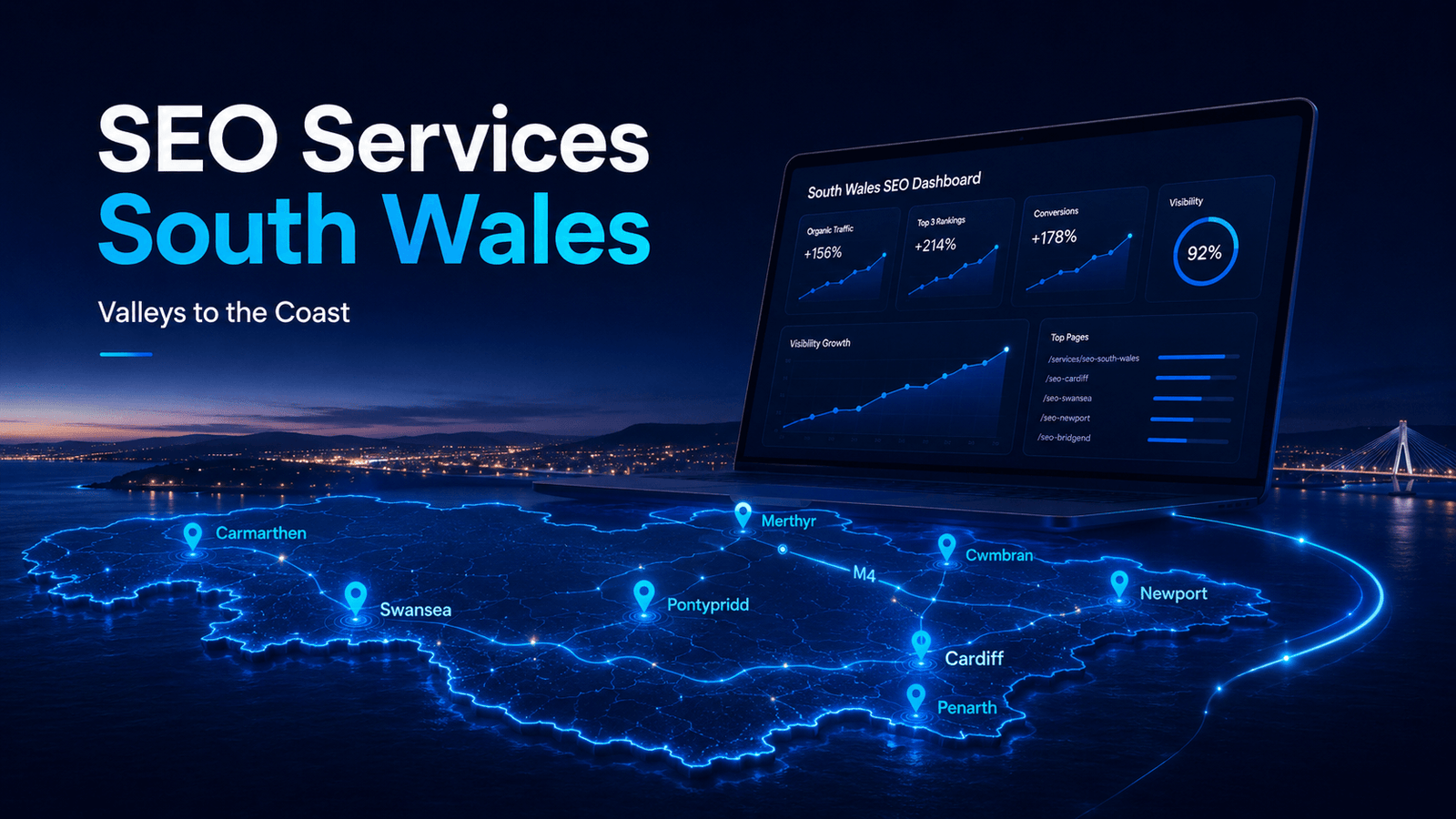
True SEO covers the whole of South Wales, from Caerphilly, Merthyr Tydfil and Pontypridd through Bridgend, Cwmbran and Penarth to Carmarthen in the west, running the same method we run in Cardiff at a scope sized to the local market. Local work starts at 399 pounds a month, full monthly SEO at 699 pounds, and every engagement opens with a free 30-minute consultancy and SEO audit rather than a quote from a form. That answers the two questions owners outside Cardiff arrive with: do you cover my town, and is this affordable at my scale. What follows sets out the workstreams, the towns and what each one needs handled first, the cost and the timescales, the industries where search decides the enquiry, and how you measure whether any of it worked. After that comes the regional detail: how South Wales actually behaves in search, whether you should build a page for every town you serve, what the map pack takes in a place with forty businesses in a category rather than four hundred, and whether Welsh-language pages repay their cost.
Key takeaways
- Coverage runs across ten named South Wales towns and the surrounding valleys, with one named consultant on the account wherever the business trades.
- Prices start at 399 pounds a month for local work and 699 pounds for full monthly SEO, quoted after a call rather than from a form.
- Smaller South Wales towns are cheaper search markets to win, because far fewer local competitors run structured SEO.
- Map pack visibility in a small town often takes profile and review work alone, with no content spend at all.
- A page for every town you serve is usually a mistake. Build one page per distinct commercial reality, and sections for the rest.
- Welsh-language pages earn contracts far more often than traffic. Build them for tenders, not rankings.
- A South Wales business can compete UK-wide on the normal results. It cannot enter another city’s map pack without an address there.
We work with businesses from Merthyr to Carmarthen on the same method we use in Cardiff, scoped to the size of the market. Our monthly SEO package for small businesses names the queries we intend to win before any work starts, so a smaller budget still buys a plan you can hold us to. Book the free 30-minute consultancy and SEO audit and we will tell you straight whether your town has enough search demand to be worth the spend.
Which SEO agency covers South Wales and the Valleys?
True SEO covers South Wales from Cardiff, including Caerphilly, Merthyr Tydfil, Pontypridd, Bridgend, Cwmbran, Penarth and Carmarthen, on the same retainer structure used for Cardiff, Newport and Swansea clients.
One named consultant owns the account wherever the business trades.
Coverage means the work runs remotely, with on-site strategy sessions by arrangement. You are not buying a rep who drives out once a quarter. You get the same consultant reading your Search Console every month, the same reporting against named queries, and no minimum term beyond 30 days’ notice to cancel.
We are a consultancy rather than a volume agency, which matters more outside Cardiff than in it. Volume agencies price against a standard scope calibrated for a city market, so a Merthyr firm buying a Cardiff-sized package pays for work its category does not require. The right answer in a smaller town is a narrower plan run properly, which is what our SEO consultancy service sets out.
What does an SEO agency covering South Wales actually do?
Four jobs, in this order.
| Order | Workstream | Weighting in Cardiff | Weighting in a smaller town |
|---|---|---|---|
| First | Clearing technical faults so the site can be read and indexed | Essential | Essential, and page weight matters more here |
| Second | Pages answering what buyers in your town or valley type | Heavy, competition demands depth | Lighter, and it compounds after the local work |
| Third | Local signals: verified profile, identical details, steady reviews | One input among several | Usually the majority of the result |
| Fourth | Reporting against named queries in Search Console | Monthly | Monthly, and cheaper to judge on a small query set |
A Cardiff-calibrated scope spends most of its budget on the second row. Outside Cardiff, most of the movement comes from the third.
It clears the technical faults stopping Google reading and indexing the site. It builds pages answering what buyers in your town or valley type. It earns the local signals behind map pack placement, meaning a verified profile, identical business details everywhere and steady reviews. And it reports against named queries in Search Console.
Outside Cardiff the weighting shifts heavily towards the third of those. Local signals do most of the work in a thin category, and content compounds afterwards. Our technical and on-page SEO work still comes first, because publishing into a site Google struggles to crawl wastes whatever you spend next.
Links sit underneath all four and are where regional businesses either overspend or do nothing at all. A South Wales firm does not need a national link programme. It needs the county paper, the trade body directory, the local chamber, the sponsored junior team and the supplier who will cite its data, all of which are earned rather than bought. The outreach sequence in our guide to earning regional coverage links without buying them was written for accountancy firms and transfers to any local business with a story and a postcode.
Which South Wales towns does True SEO cover?
Every town below, plus the rest of the region on request. Each has its own commercial reality, which is why the notes differ rather than repeat.
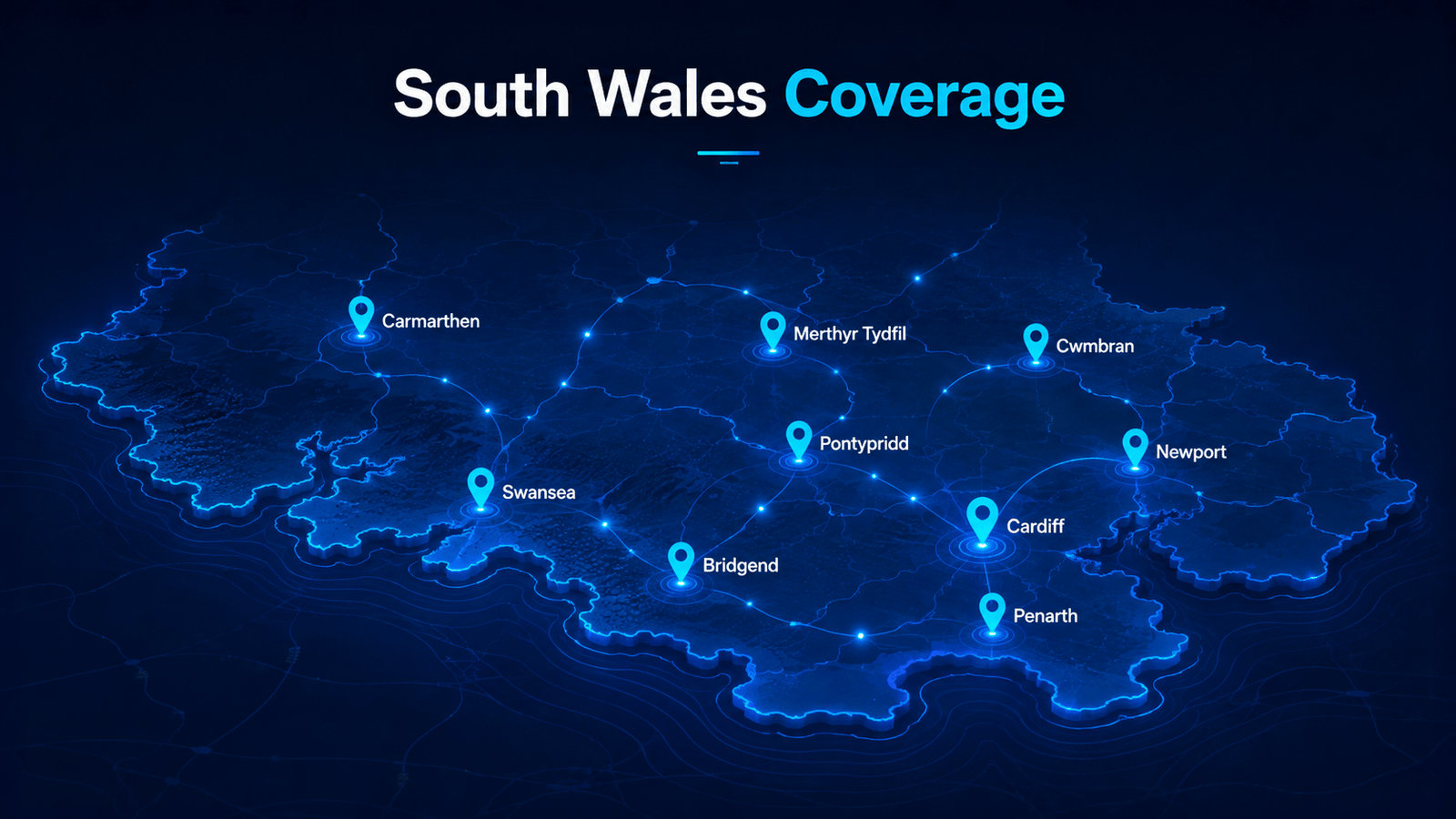
Three of these ten cleared the test for a page of their own. The other seven are sections on this page, which is the same rule we would apply to your town list.
The covered towns, as a list
- Cardiff
- Newport
- Swansea
- Caerphilly
- Merthyr Tydfil
- Pontypridd
- Bridgend
- Cwmbran
- Penarth
- Carmarthen
Plus the surrounding valleys, the Vale of Glamorgan and the Monmouthshire border. Normal search results are covered across the whole of Wales and the UK.
The covered towns are Cardiff, Newport, Swansea, Caerphilly, Merthyr Tydfil, Pontypridd, Bridgend, Cwmbran, Penarth and Carmarthen, together with the surrounding valleys, the Vale of Glamorgan and the Monmouthshire border. Cardiff, Newport and Swansea hold pages of their own. The seven below are sections on this page, for reasons the town-page test further down explains.
| Town | Market type | What it needs handled first | Page or section |
|---|---|---|---|
| Cardiff | City market, dense competition | Content depth and earned links | Its own page, at SEO in Cardiff |
| Newport | City market competing against Cardiff results | Local signals plus content that names the difference | Its own page, at SEO in Newport |
| Swansea | Seasonal, tourism-weighted city market | Publishing calendar and service area configuration | Its own page, at SEO in Swansea |
| Caerphilly | Commuter market inside Cardiff’s radius | Cardiff radius bleed, then the category locally | Section |
| Merthyr Tydfil | Valleys head of catchment | Service area configuration across several valleys | Section |
| Pontypridd | Two-valley confluence with a campus | Multi-location structure disguised as one town | Section |
| Bridgend | M4 corridor, results bleed both ways | Content depth earlier than in the Valleys | Section |
| Cwmbran | Planned town overlapping Newport | Handled with Newport rather than separately | Section |
| Penarth | Affluent coastal town adjoining Cardiff Bay | Holding the town term against Cardiff defaults | Section |
| Carmarthen | Rural market town with its own supply chain | Bilingual content, and a western rather than M4 plan | Section |
Caerphilly
A commuter market roughly eight miles north of Cardiff on the A469, so buyers routinely see Cardiff businesses in local results and Caerphilly firms compete against them directly. The town supports a trade, retail and hospitality base around the castle and the town centre, with a residential belt that works in Cardiff and spends locally. Caerphilly businesses need the Cardiff radius bleed handled first, then the category taken locally. Ranking third in Caerphilly behind two Cardiff firms is a service area problem, not a content one.
Merthyr Tydfil
The head of the Taff valley and the A470 corridor, with a retail and leisure draw pulling from a wide catchment across the northern valleys. Demand here is small but poorly served, which makes it one of the cheapest categories in the region to enter. Merthyr firms serving several valleys need service area configuration handled carefully, since the catchment is wider than the population suggests. A Merthyr trade that sets its area to the whole of South Wales usually loses the searches happening in its own high street.
Pontypridd
The confluence of the Taff and Rhondda valleys, with a university campus at Treforest, a long-standing market and a service base supplying both valleys. Pontypridd businesses often trade across Rhondda, Cynon and Taff at once, which is a multi-location problem disguised as a single-town one. The practical test is simple: count the towns you invoice from, and see whether your site names any of them.
Bridgend
An M4 corridor town between Cardiff and Swansea, with the designer outlet, the coastal trade around Porthcawl and a manufacturing and engineering base behind it. Results bleed in both directions, so a Bridgend firm competes against Cardiff and Swansea businesses rather than only local ones, which makes content depth matter earlier here than in the Valleys. Bridgend is the one town on this list where we would expect to spend on pages before profiles.
Cwmbran
A planned town in Torfaen five miles from Newport, with a large town centre retail draw and an industrial base around it. Cwmbran demand overlaps heavily with Newport, so the two are handled together rather than as separate campaigns. Splitting them into two budgets buys the same visibility twice.
Penarth
A coastal Vale of Glamorgan town adjoining Cardiff Bay, with an affluent residential base and a service economy weighted towards professional practices, healthcare, hospitality and independent retail. Penarth buyers search Penarth specifically rather than defaulting to Cardiff, so the town term is worth holding despite the small population. That single behaviour is what makes a small town worth its own section.
Carmarthen
The county town of Carmarthenshire, west of Swansea, with an agricultural, retail and public sector base built around the county council, the hospital and the livestock market, and a far higher proportion of Welsh speakers than the Wales-wide average. Carmarthen behaves as a rural market town with its own supply chain, and bilingual content earns its place here more often than anywhere else on this list.
Do you cover Mid and North Wales?
Yes for the normal search results, which depend on content and links rather than proximity. Map pack work in Mid or North Wales needs your own verified address there, and we will say so rather than sell you coverage we cannot deliver. Most of our work sits in South Wales because that is where the demand concentrates, and the same remote model reaches clients in Bristol, Birmingham, Manchester and London on identical terms.
What does SEO cost for a business in Merthyr, Bridgend or Pontypridd?
Local SEO starts at 399 pounds a month, full monthly SEO at 699 pounds a month, and SEO-ready web design at 799 pounds as a one-off.
| Engagement | From | Basis | Usually right for |
|---|---|---|---|
| Local SEO | 399 pounds | Per month | A single town or valley, thin category, map pack first |
| Full monthly SEO | 699 pounds | Per month | Several towns, or an M4 corridor category with real competition |
| SEO-ready web design | 799 pounds | One-off | A site whose structure would waste the content budget as it stands |
| Mentoring instead of delivery | Scoped on the call | Programme | Owners who would rather run the work in-house |
Prices are reviewed periodically and are subject to change. No figure is quoted before a strategy call, which is the point of quoting the smaller towns separately.
Those are starting figures rather than a fixed menu. Price moves with how fast you want results and how broadly you want to be visible, since covering the normal results, the map pack and AI answers together costs more than sequencing them.
| Driver | Pushes it down | Pushes it up |
|---|---|---|
| Competitor count | Eleven local businesses, most with half-finished profiles | Forty, several publishing actively |
| Number of towns | One town, one commercial reality | Four valleys needing branch-level pages |
| Speed | Map pack first, content after | Normal results, map pack and AI answers together |
| Site condition | Crawlable, with a workable structure | A rebuild before content can earn anything |
| Proof available | Reviews and local work already in place | Starting from nothing in a category with no history |
Smaller towns usually sit at the lower end, which is the point of quoting them separately. A Merthyr trade competing against eleven local businesses does not need the scope a Cardiff practice competing against forty does. We would rather scope on a call than quote from a form, because thirty minutes gives us your Search Console, your competitor set and your real capacity. Prices are reviewed periodically and are subject to change.
The drivers in the table above are what move the figure away from the starting price, and owners who would rather run the work themselves can take our SEO consultancy and mentoring programme instead, which teaches the method rather than delivering it.
How long does SEO take to work in a smaller South Wales town?
Map pack movement often shows in six to ten weeks, faster than in Cardiff, because the local signals in a thin category are easier to lead on.
| Surface | Smaller South Wales town | Cardiff | What decides it |
|---|---|---|---|
| Google map pack | Six to ten weeks | Longer, and contested | Profile completeness, details, review flow |
| Competitive town terms | Four to nine months | Six to twelve months | How many competitors are actively publishing |
| UK-wide terms | Longer again | Longer again | Topical depth rather than geography |
Normal search results on competitive town terms take four to nine months depending on how many competitors are actively publishing. Any agency giving one number for both is describing a sales cycle rather than a search one.
The gap between the two numbers is the thing to plan around. Profile and review work pays back inside a quarter and funds the content that takes three times as long. Reversing that order is the most common way a small budget gets spent with nothing to show at month six.
A smaller budget should still buy a plan you can audit
Named queries, a date we expect movement, and a monthly Search Console review against both. That is what makes a 399 pound month judgeable rather than hopeful, and it is the same reporting a Cardiff account gets.
See what a small-town retainer commits toWhat happens in the free 30-minute SEO consultation?
You get your own Search Console read live, the three queries worth chasing named, and a straight answer on whether SEO is the right spend right now. No deck, no audit PDF, no obligation.
Your own data, on screen
Read together in the call rather than summarised in a deck afterwards. Access takes a few minutes to set up, and we show you how before the half hour starts.
Three queries named for your town
Not a keyword list of two hundred rows. Three phrasings, with the competitor sitting above you on each one.
The honest verdict on demand
Including the verdict that costs us the sale, and what to do for nothing instead of a retainer.
The call runs in three parts. We open your Search Console together, filtered to the United Kingdom, and read what the site already earns rather than what a tool estimates. We then name three query phrasings buyers in your valley or corridor actually use, with the reason each one is winnable from where you sit now. We finish with the verdict on demand, including the verdict where there is not enough of it.
Businesses in the smaller towns sometimes leave that call being told their category has too little demand to justify a retainer, and that a finished Google Business Profile plus a review process would do most of the job for nothing. We would rather say that than take twelve months of fees for work the market cannot repay. Bring your website login details if you have them, and the two or three competitors you keep losing to. Neither is required, and both make the half hour worth more.
Which South Wales industries are worth targeting?
The categories with genuine search demand and nobody optimising for it.
| Category | What decides the enquiry | First job |
|---|---|---|
| Accountancy practices | Specialism rather than location | Service pages that name the niche |
| Financial advisers | Named advisers and permissions | Adviser profiles and regulatory clarity |
| Solicitors | Named people and trust signals | Author and team credibility before rankings |
| Dentists and private clinics | Map pack position and review volume | Profile completeness and a review process |
| Hotels and holiday lets | Season and direct booking path | A publishing calendar, not a flat retainer |
| Motor traders | Stock visibility | Indexable stock pages and structured data |
| Letting and estate agents | Branch-level coverage | One page and one profile per branch |
| Ecommerce brands | National category competition | Product and category structure, not local signals |
Trades, manufacturing, logistics and agriculture sit outside this table because their enquiries are split between search and long-standing local relationships.
Across South Wales that spans construction and trades, manufacturing and engineering, logistics along the M4, agriculture and food production in the west, healthcare and social care, tourism along the coast and in the Brecon fringe, and the professional services supplying all of them.
The professional categories are where search decides most enquiries, and each behaves differently. Accountancy practices win on specialism rather than location, which is where our SEO for accountants work concentrates. Financial advisers convert on named advisers and permissions rather than town terms. Solicitors need named people and trust signals before rankings do anything. Dentists and private clinics convert on map pack position and review volume more than on any page they publish. Hotels and holiday lets run on a seasonal publishing calendar rather than a flat retainer. Motor traders live on indexable stock pages and structured data. Letting and estate agents need branch-level pages, since one office page cannot rank four towns. Ecommerce brands on Shopify, Shopwired and WooCommerce compete nationally from a Valleys unit and barely touch local search at all.
Specialism beats geography in every one of those categories. A Bridgend accountant ranking for “accountant Bridgend” is competing with everyone in town; the same firm ranking for the trade it actually serves is competing with four practices in Wales. Our study of why a named specialism beats a town name in the professional categories works through that arithmetic with real niches, and the logic holds for solicitors, advisers and clinics as readily as for accountants.
Roughly 5.7 million UK SMEs make up close to 99.9% of all UK businesses, and in a South Wales town that means your competition is other small firms with the same shortage of time to do this properly. Consistency wins these categories, not budget.
How do you know if your South Wales SEO is actually working?
Track three things.
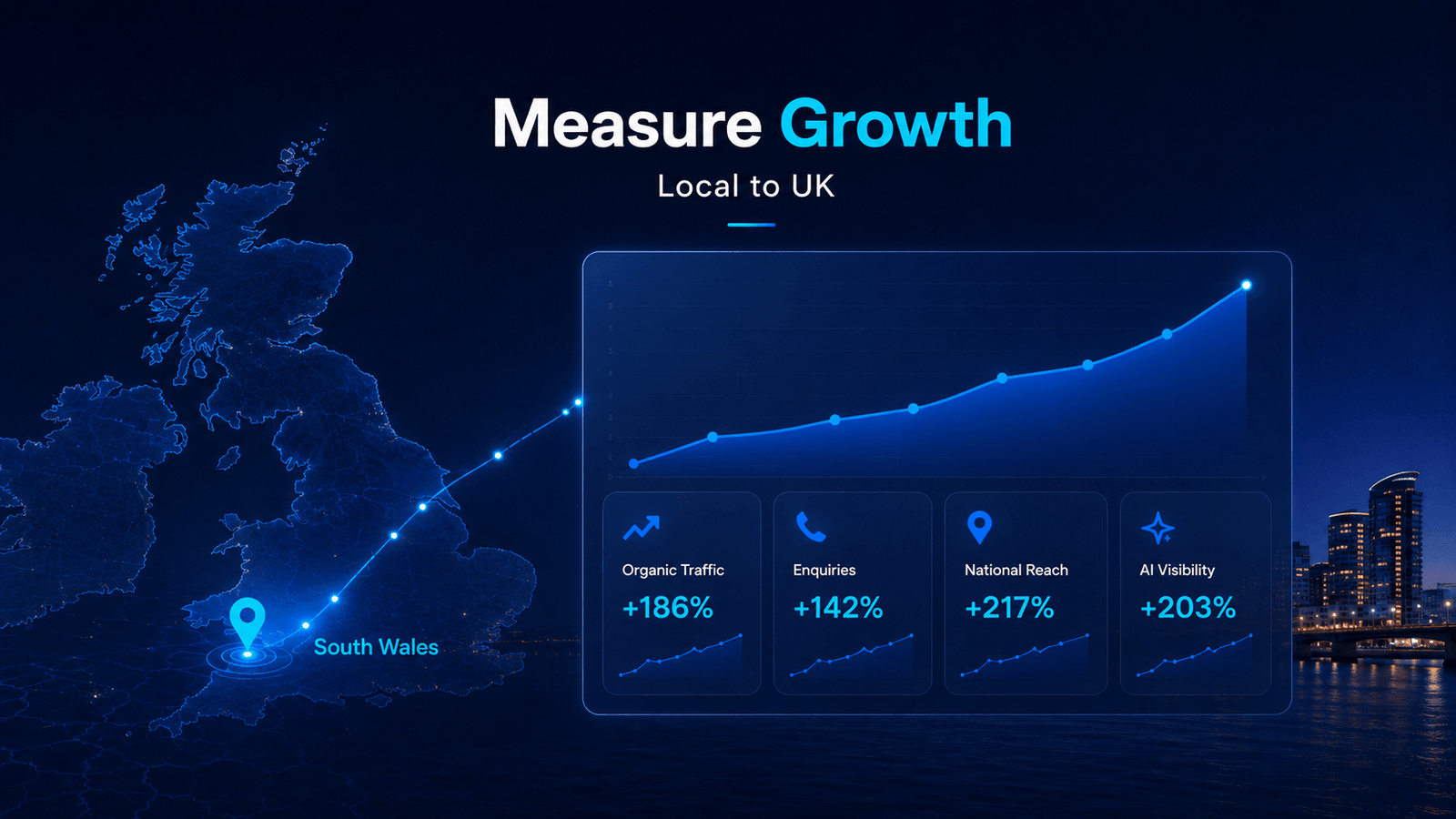
A rank tracker runs from one fixed point. Across a region that is the one measure it cannot report accurately.
| Measure | Where it lives | What good looks like |
|---|---|---|
| Map pack impressions and calls | Google Business Profile, per location | Calls rising, not just views, in each town separately |
| Non-branded clicks | Search Console, filtered to the United Kingdom | Clicks moving with position rather than position alone |
| Logged enquiries | Your own enquiry log | Every enquiry carrying a source and a town |
Watch map pack impressions and calls inside your Google Business Profile. Watch non-branded clicks in Search Console filtered to the United Kingdom, since a top-three position producing no UK clicks is not a ranking worth paying for. And log every enquiry against its source, because attribution beats any dashboard.
Rank tracking misleads across a region more than anywhere. Local results shift with the searcher’s position, so a customer in Aberdare and one in Bridgend can search the same phrase and see entirely different businesses, and both are real. A rank tracker running from one fixed point cannot see that. A one-off SEO audit is the cheapest way to establish what your spend is producing before you renew it.
Two South Wales examples
A commercial vehicle workshop in Bridgend serving customers from Porthcawl to Pencoed had 290 organic visits a month and no map pack presence beyond its own name. Its profile carried a broad category shared with most of the county, a service area covering half of South Wales, and nine reviews naming no service. We narrowed the category, cut the service area to what the workshop covered, corrected the name across eight directories, and rebuilt five service pages around the fleet terms operators search. Map pack placement for two core terms arrived in eight weeks, organic visits reached 1,050 a month by month six, and logged enquiries went from three to seventeen.
- Map pack in 8 weeks
- 290 to 1,050 visits
- 3 to 17 enquiries
A three-branch practice with offices in Pontypridd, Merthyr Tydfil and Aberdare ran one combined location page and ranked in none of the three towns. Every branch shared the same phone number and address block, so Google had no way to separate them. We built three distinct branch pages, each with its own team, service emphasis and local proof, gave each branch its own verified profile and local number, and added a regional parent page above them. All three entered the map pack for their main service term within eleven weeks, and combined enquiries from search rose from eight a month to thirty-one across two quarters.
- 3 towns in 11 weeks
- 8 to 31 enquiries
- 2 quarters
Both sets of figures are illustrative rather than drawn from a named client account.
Work out whether your town pages are helping or competing
Six questions on the structural decisions that decide whether a regional business ranks in more than one place. Nothing is stored and nothing is sent anywhere.
Question 1 of 6
How many towns does your business actually serve?
Question 2 of 6
How different are your town pages from each other?
Question 3 of 6
Is your Google Business Profile verified, with a service area you actually cover?
Question 4 of 6
Do you have proof specific to more than one town?
Question 5 of 6
How are your branches set up online?
Question 6 of 6
Do you know whether anyone in your category locally is running structured SEO?
Do not buy a retainer to fix something that is not broken. Buy one audit.
Distinct pages, correct profiles and proof in each town is the setup most regional businesses never reach. The constraint at this point is almost always technical or competitive rather than structural, and one audit will name it. Come back for monthly work when the audit shows content is the next limit.
Collapse the near-identical pages into one regional page with sections, then fix the profile.
Two or three of your answers point at pages saying the same thing in different towns, or a service area set wider than you travel. Both split the signal rather than spreading it. The fix is structural and cheap: one strong page per distinct commercial reality, sections for the rest, and a profile that matches where you actually work.
In a thin category, the profile and the review habit will out-earn anything you publish this quarter.
On these answers, new town pages would land on a foundation Google cannot separate or verify. The first quarter goes on verifying the listing, narrowing the category, giving each branch its own number and details, and asking real customers for reviews that name the service and the town. In a category where nobody else has done that, it is frequently enough on its own.
Answer the first question to start. Nothing moving means the page still reads perfectly well, and you can talk the town list through with us instead.
What counts as South Wales for SEO purposes?
For search, South Wales is the corridor running from Carmarthenshire in the west through Swansea, Bridgend and the Vale of Glamorgan to Cardiff, Newport and Monmouthshire in the east, with the Valleys sitting north of the M4 between them.
| Sub-region | Towns | How search behaves | What the plan has to do |
|---|---|---|---|
| M4 corridor | Bridgend, Cardiff, Newport, Swansea | Connected city markets, results bleed across boundaries | Content depth early, because you compete outward as well as locally |
| The Valleys | Merthyr Tydfil, Aberdare, Pontypridd, Rhondda, Ebbw Vale | Separate markets divided by the valleys rather than by mileage | Branch-level pages and tight service areas per valley |
| Western towns | Carmarthen, Llanelli | Rural market towns with their own supply chains | Local supply chain terms, and bilingual pages where tenders require them |
The Valleys split is the one most regional campaigns get wrong, because it does not show up on a map measured in miles.
It holds the large majority of the Welsh population and almost all of its commercial search demand.
That definition matters because Google does not treat it as one place. Search behaviour splits three ways. The M4 corridor towns, such as Bridgend, Cardiff, Newport and Swansea, behave like connected city markets where results bleed across boundaries. The Valleys towns, including Merthyr Tydfil, Aberdare, Pontypridd, Rhondda and Ebbw Vale, behave as separate markets divided by the valleys rather than by mileage. And the western towns, such as Carmarthen and Llanelli, behave as rural market towns with their own supply chains. One strategy covering all three produces a page that ranks nowhere.
Should you build a page for every town you serve?
Only where the content really differs. Two town pages that say the same thing with the name swapped give Google a duplication problem rather than a coverage advantage, and it will pick one and ignore the other.
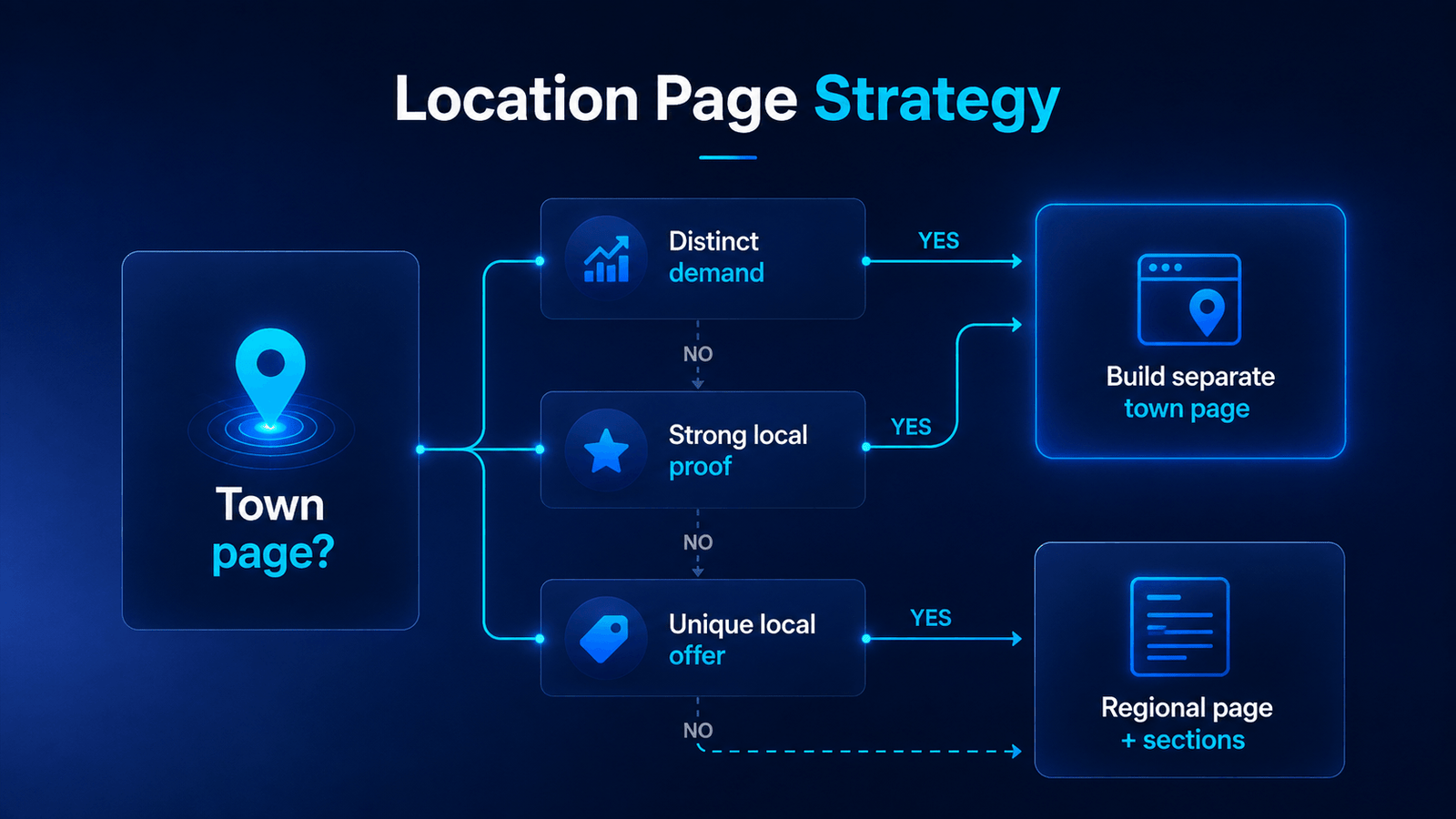
Three of the ten towns on this page passed all three tests. The other seven became sections, which is why this page exists in the shape it does.
Test one: does the commercial reality differ?
Fails when the only difference you can name is the town name in the heading.
Test two: is there measurable local demand?
Fails when the volume has never been looked at, only assumed from population size.
Test three: do you hold proof specific to that town?
Fails when the page carries no client, review or piece of work from that town, which reads as a template to a person as well as to Google.
Build one regional page with a named section per town instead.
Apply three tests before building any town page. The first asks whether the commercial reality differs, meaning different competitors, different buyer behaviour or a different industry mix. The second asks whether there is measurable local demand, meaning search volume you have looked at rather than an assumption that people must be searching. The third asks whether you hold proof specific to that town, such as clients, reviews or work you can point at. A town clearing all three earns a page. A town clearing one or two earns a section on a regional page, which loses nothing and competes with nothing.
That is the test we applied to our own site. Cardiff, Newport and Swansea cleared all three, so each has its own page. Caerphilly, Merthyr Tydfil, Pontypridd, Bridgend, Cwmbran, Penarth and Carmarthen did not, so they are sections above rather than seven near-identical pages. Run the same three questions down your own town list before you commission anything.
How does SEO in a Valleys town differ from SEO in Cardiff?
The competition is thinner and the geography is stricter.
| Variable | Cardiff | A Valleys town | What it changes |
|---|---|---|---|
| Active competitors | Three or four running SEO in a category | Often nobody at all | A profile and twenty reviews can take the map pack in a quarter |
| Geography | Radius behaves roughly like the map | Demand runs up and down valley floors | Two towns eight miles apart rarely share results |
| Connectivity | City centre speeds | Parts of rural and valley Wales trail the UK average | Page weight becomes a local ranking issue |
Ofcom’s Connected Nations reporting is the source for the coverage gap. No percentage is quoted here on purpose, because the figure moves with every edition of the report.
A Cardiff category commonly has three or four businesses running active SEO, so entry requires content depth and earned links before anything moves. A Valleys category often has nobody doing it at all, which means a properly configured Google Business Profile and twenty genuine reviews can take the map pack within a quarter.
Geography behaves differently too. Valleys settlements run in lines up and down the valley floors, so the driving distance between two towns eight miles apart can be far longer, and Google’s local results follow the practical geography rather than the map. A business in Aberdare and one in Ebbw Vale rarely appear in each other’s results despite sitting close together. Businesses covering several valleys need branch-level pages rather than one head office page, which is what our local and multi-location SEO service is built for.
Connectivity is the third difference. Ofcom’s Connected Nations reporting has consistently found parts of rural and valley Wales trailing the UK average on fixed and mobile coverage, so a heavy site punishes you harder here than in Cardiff city centre. Page weight is a local ranking issue in the Valleys, not a technical footnote.
Do you need an office in the town to rank there?
For the map pack, yes. Google needs a verifiable address in the area or a declared service area attached to a real registered location, and it removes listings it cannot verify.
For the normal blue-link results, no. A business in Bridgend can rank a Merthyr page on content alone, and frequently does.
That split decides where a regional business should spend. A firm trading across four valley towns from one base should build one strong page per town it serves differently, accept that the map pack only works around the verified address, and set a realistic service area. Inflating the service area weakens the listing rather than extending it.
How do you get into the Google map pack in a small town?
Verify at a real address, choose the narrowest primary category that still describes you, match the business name, address and phone identically across every listing, add each service as its own profile entry, then earn reviews steadily.
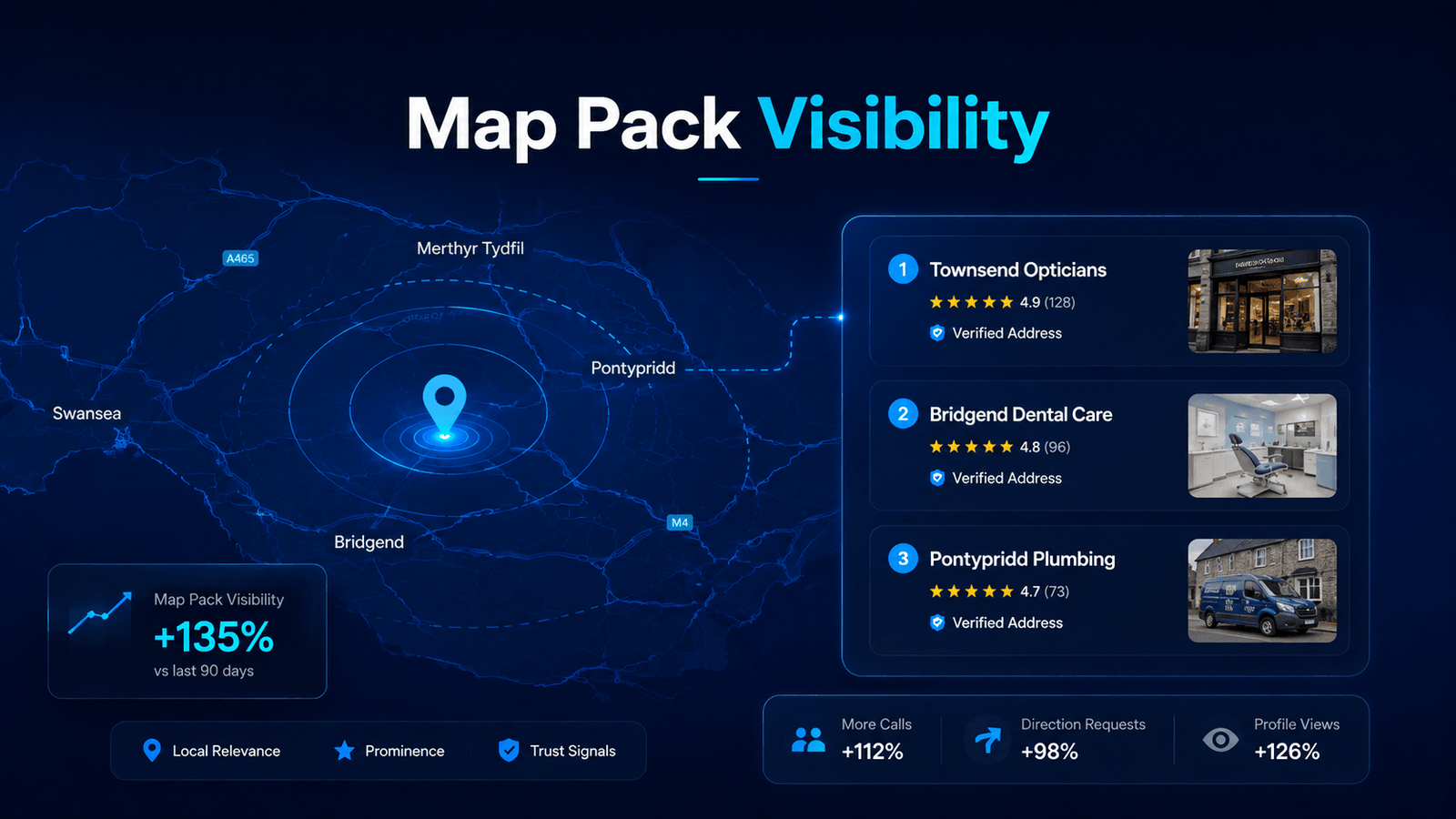
Where thirty businesses share a category rather than three hundred, a complete listing is a bigger advantage than any amount of published content.
Google’s Business Profile documentation names relevance, distance and prominence as the three ranking factors, and prominence is the one you can actually build.
Small towns reward this faster than cities. Where a category holds thirty businesses rather than three hundred, and most carry an unclaimed or half-finished profile, a complete listing with twenty-five service-specific reviews frequently takes the top three within a quarter. Use the local area code rather than an 0333 number, correct your details on Bing Places, Apple Business Connect, Yell and your trade bodies as well as Google, and upload real photographs.
| Source | Why it counts | What usually breaks |
|---|---|---|
| Google Business Profile | Decides map pack eligibility | A category shared with half the county |
| Bing Places | Feeds Copilot and other assistants | Never claimed at all |
| Apple Business Connect | Apple Maps and Siri results | An old address left behind after a move |
| Yell | Long-standing UK citation weight | A legacy 0333 or tracking number |
| Trade bodies and membership lists | Category-specific prominence | Trading name written three different ways |
| Branch pages on your own site | The reference every other source is checked against | One shared phone number across every branch |
Keep the review process legal. UK consumer law in force since April 2025 bans fake reviews and concealed incentives, with penalties reaching 10% of worldwide turnover. Ask real customers at the point the work lands and prompt them to name the service and the town in their own words.
Is Welsh-language content worth it for a Welsh business?
Rarely for search volume, often for public sector and education contracts.
| Situation | Build bilingual pages? | Reason |
|---|---|---|
| Welsh Government or local authority tenders | Yes | Bilingual operation is commonly expected in the bid |
| Health board or university partnerships | Yes | A procurement requirement rather than a traffic play |
| Trading in Carmarthen or the western towns | Usually | Welsh speaker share runs well above the Wales-wide average |
| Consumer trade along the M4 corridor | No | Most Cardiff, Newport and Bridgend buyers search in English |
| Whole site translated to chase rankings | No | Spends money on demand that does not exist in the corridor |
The 17.8% figure below is Wales-wide. County-level figures differ sharply, and Carmarthenshire sits well above it.
The 2021 Census recorded around 17.8% of people in Wales aged three and over as able to speak Welsh, and the commercial search behaviour behind that concentrates in the west and north rather than in the M4 corridor. Most South Wales buyers search in English.
Build bilingual pages for the contract rather than the traffic. Businesses bidding for Welsh Government work, local authority contracts, health board tenders or university partnerships are commonly expected to operate bilingually, and proper Welsh versions of the relevant pages support that. Translating an entire commercial site to chase rankings spends money on demand that does not exist in Cardiff, Newport or Bridgend. Carmarthen and the western towns are the exception, and we will tell you when you are in one.
Can a South Wales business rank across the whole UK?
Yes for the normal search results. Those rank on content, structure and links rather than your postcode, so a Bridgend manufacturer or a Pontypridd software firm can hold UK-wide terms without an office outside Wales.
| Surface | Reachable from South Wales? | What carries it |
|---|---|---|
| UK-wide normal results | Yes | Topical depth, structure and earned links |
| Another city’s map pack | No | A verifiable address in that city, and nothing else |
| AI assistant answers | Yes | Entity clarity and complete subject coverage |
| Your own town’s map pack | Yes | Profile completeness, details and review flow |
A defined specialism is what makes national terms reachable from a small town. A general offer competes on authority it does not have.
No for another city’s map pack, which requires a verifiable address in that city and cannot be manufactured.
The route out of the region is subject depth rather than geography. Google rewards sites covering a subject completely over sites that mention it once, and the twelve steps in our guide to how a small-town firm reaches UK-wide terms through subject depth rather than geography are the sequence we run when a client wants national reach from a Valleys unit. The same depth is what gets a business named by AI assistants, since those systems read entities and completeness rather than adverts, which our AI and LLM search optimisation service is built around.
A South Wales business with a defined specialism can hold national terms a general Cardiff competitor cannot. We run that work for clients well beyond Wales on the same model, so the national ambition is not a separate service and it is not a separate price list.
Working with a Cardiff consultancy across South Wales
True SEO Consultants Ltd is based at Startup Stiwdio, University of South Wales, 86-88 Adam Street, Cardiff, CF24 2FN, and works with businesses across the whole of South Wales, from Carmarthen and Swansea in the west through Bridgend, Pontypridd, Merthyr Tydfil and Caerphilly to Newport, Cwmbran and the Monmouthshire border. We also work with clients throughout the UK, from Bristol and Birmingham to Manchester, Edinburgh and London, and onboard clients worldwide through a fully remote digital onboarding and delivery process. The location pages you have just read are a specialism rather than a limit. Every client gets one named consultant, a monthly Search Console review and KPI-based reporting, with no minimum commitment and 30 days’ notice to cancel.
You can read the city-level detail on our SEO agency in Cardiff page. For everywhere else in the region, get the honest read on your town’s search market and we will tell you what it is actually worth before you spend anything on it.
- Consultancy
- True SEO Consultants Ltd
- Registered office
- Startup Stiwdio, University of South Wales, 86-88 Adam Street, Cardiff, CF24 2FN
- Regional delivery
- Remote across South Wales, with on-site strategy sessions by arrangement
- National and international
- UK-wide clients, worldwide onboarding, fully remote digital delivery
- Account structure
- One named consultant, monthly Search Console review, KPI-based reporting
- Commitment
- No minimum term, 30 days’ notice to cancel
Frequently asked questions
Which South Wales towns do you cover?
Cardiff, Newport, Swansea, Caerphilly, Merthyr Tydfil, Pontypridd, Bridgend, Cwmbran, Penarth and Carmarthen, plus the surrounding valleys and the Vale of Glamorgan. Coverage for the normal search results extends across the whole of Wales and the UK.
Is SEO worth it for a business in a small Welsh town?
Usually yes, because the category is cheaper to win. Fewer local competitors run structured SEO, so profile and review work alone often takes the map pack. We will tell you on the first call where demand is too small to justify the spend.
Should I build a separate page for every town I serve?
No, unless each town has a distinct commercial reality, measurable local demand and proof specific to that town. Otherwise build one regional page with a named section per town, since near-identical town pages compete against each other.
Do you need to be based in my town to rank my business there?
No for the normal search results, which rank on content and links. Yes for the map pack, where your own business needs a verifiable address or declared service area in the area. Your agency’s location is irrelevant to both.
How long before a Valleys business sees results?
Map pack movement often shows in six to ten weeks, faster than in Cardiff, because local categories are thinner. Competitive town terms in the normal results take four to nine months.
Do I need Welsh-language pages?
Build them for public sector, education and tender requirements. Search demand in Welsh across the M4 corridor is small, so bilingual pages rarely repay the cost on traffic alone. Carmarthen and the western towns are the exception.
Where regional work usually goes next
Want the research without the retainer?
The keyword research and competitor analysis that sits underneath a regional plan is available on its own from the marketplace. You get the query set, the intent mapping and the competitor read for your towns, and you can hand it to whoever builds the pages, including yourself.
Buy the town-level research on its ownFind out what your town is worth before you spend anything on it
Thirty minutes, your own Search Console, three named queries and a straight answer on whether the demand in your category justifies a retainer. Sometimes it does not, and we will say so.