

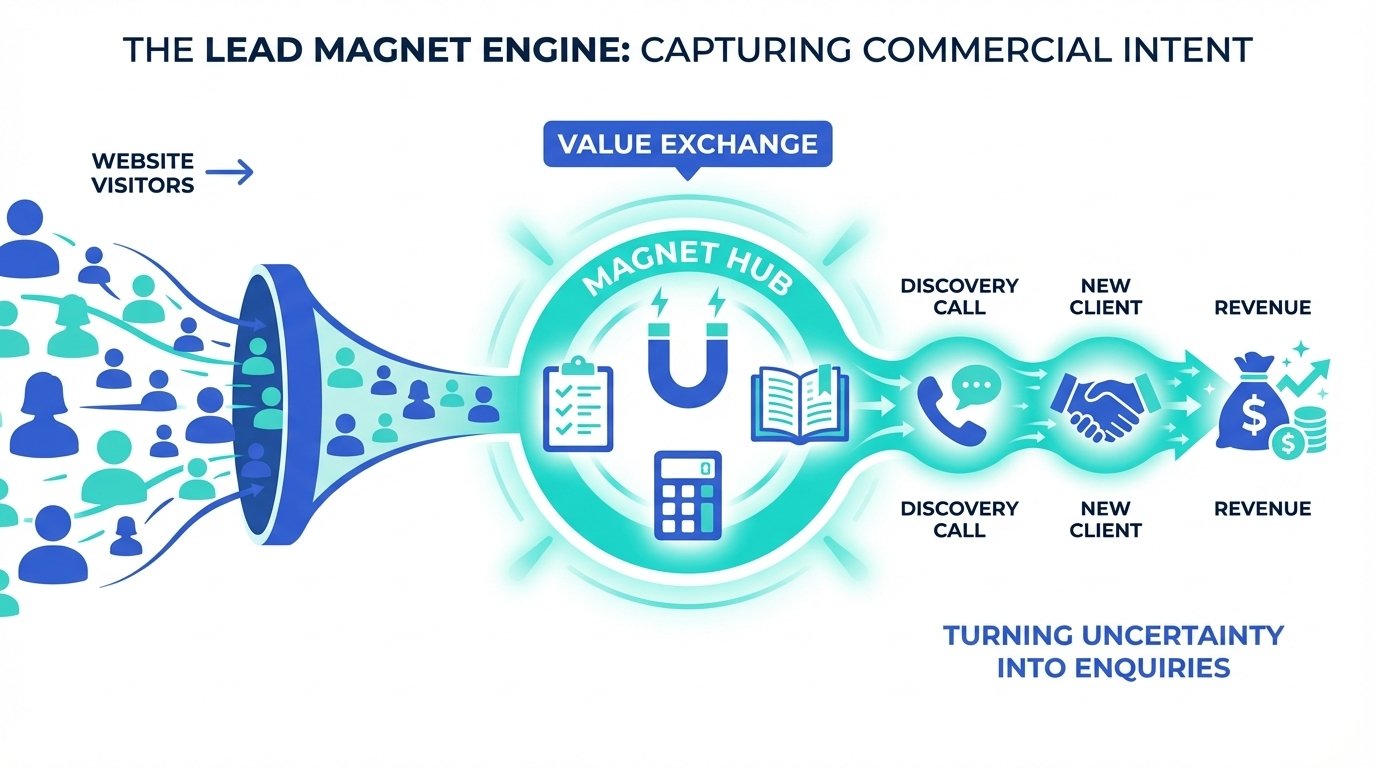
Most accountancy websites collect contact details only from people already convinced enough to fill in an enquiry form. The real prospect group is the silent majority who land, read, weigh the firm against three others and leave without trace. Lead magnets close that gap. We help UK accountancy firms turn passing visitors into named, segmented, contactable prospects by giving them something useful in exchange for attention, then routing that interest into a booked call. This guide covers the topics that actually convert for accountancy buyers, the formats that suit each service line, the tools UK firms already trust, the GDPR and PECR rules that apply to every download form, the measurement that proves what works, and the way lead magnets now feed AI search alongside Google rankings.
Key takeaways
- Lead magnets convert the 95%+ of accountancy site visitors a single contact form never reaches.
- Topic and audience fit decide performance. A year-end checklist will outperform a 60-page ebook nine times out of ten.
- Checklists, calculators, templates and mini-audits convert better than long PDFs for busy SME owners.
- Tools matter less than placement. A simple form on the right service page beats an expensive platform on the wrong one.
- UK GDPR and PECR require separate, specific consent for marketing follow-up, and the ICO enforces it.
- AI Overviews now cite the pages they can read and parse, so lead magnet pages need open, structured content.
- Success is measured in booked calls and signed retainers, not download counts.
- A focused 90-day rollout outperforms six rushed magnets bolted onto a tired site.
We’re True SEO Consultants Ltd, a Cardiff-based SEO consultancy serving accountancy firms across the UK. Our founder Mohammad A Mahmud is ACCA-qualified with around 15 years of SEO experience, and our co-director Julie Williams is a fractional CFO with over 30 years inside the profession. That gives us a rare combination: we understand how accountancy clients buy and how Google ranks accountancy content. Our engagements run on KPI-led monthly retainers with no minimum commitment, starting with a free 30-minute consultancy and SEO audit.
What a lead magnet means for an accountancy firm
A lead magnet is a useful asset, calculator, mini-audit, template or guide given to a website visitor in exchange for their contact details or a next step in the funnel. For accountants, it’s the bridge between casual research and a booked discovery call.
Buyer readiness explains why it works. Financial services carry switching cost, trust requirements and a quiet anxiety about getting tax or compliance wrong. Most prospects research two or three firms quietly before they pick up the phone. A useful download gives them a low-risk reason to stay in contact while they make up their mind.
The commercial point is segmentation, not volume. A landlord download tells the firm to follow up with property tax expertise. A startup tax checklist tells the firm to talk about formation and first-year compliance. Each download identifies what the prospect cares about and lets the team open the right conversation at the right moment. This sits at the heart of our wider SEO for accountants approach, where every page is built to capture and qualify the visitor, not just inform them.
Why lead magnets work better than a single contact form
Lead magnets work because the typical accountancy website converts somewhere between 1% and 3% of visitors into direct enquiries, leaving the other 97% to compete on price elsewhere or never come back. A secondary capture layer recovers a meaningful share of that lost interest.
The maths makes the case quickly. A firm getting 1,500 monthly visits across Cardiff, Bristol and the South Wales corridor with a 2% enquiry rate generates 30 enquiries a month. Adding a lead magnet that converts at 8% of remaining visitors adds another 117 leads into a nurture sequence. Even if only one in six convert later, that’s nineteen extra opportunities the firm previously lost.
Buyer behaviour reinforces the point. Gartner research on B2B buying found the average buyer spends only around 17% of total purchase time meeting potential suppliers. The rest is spent researching independently, reviewing content and discussing internally. A firm visible only at the enquiry stage misses the 83% of the journey where the decision is actually formed.
There’s a third reason worth naming. Algorithm updates, AI Overviews and rising paid search costs all change the cost of traffic. Email subscribers and CRM contacts don’t. Building a list of identified prospects gives an accountancy firm an asset it controls, independent of what Google does next.
Lead magnet topics that convert for UK accountancy buyers
The topics that convert are the ones a worried owner would search at 11pm. Tax stress, cash flow gaps, payroll fines, VAT confusion, year-end panic and growth uncertainty. Every strong accountancy lead magnet sits on one of those nerves.
Three topic categories carry most of the conversions:
- Deadline-driven topics, such as self-assessment preparation checklists, VAT return calendars, P11D reminders, year-end document lists and CIS submission planners. The urgency does the persuasion.
- Compliance-anxiety topics, such as MTD readiness audits, director loan account checks, dividend documentation guides, IR35 status starter packs and HMRC enquiry response checklists. The fear of error drives the download.
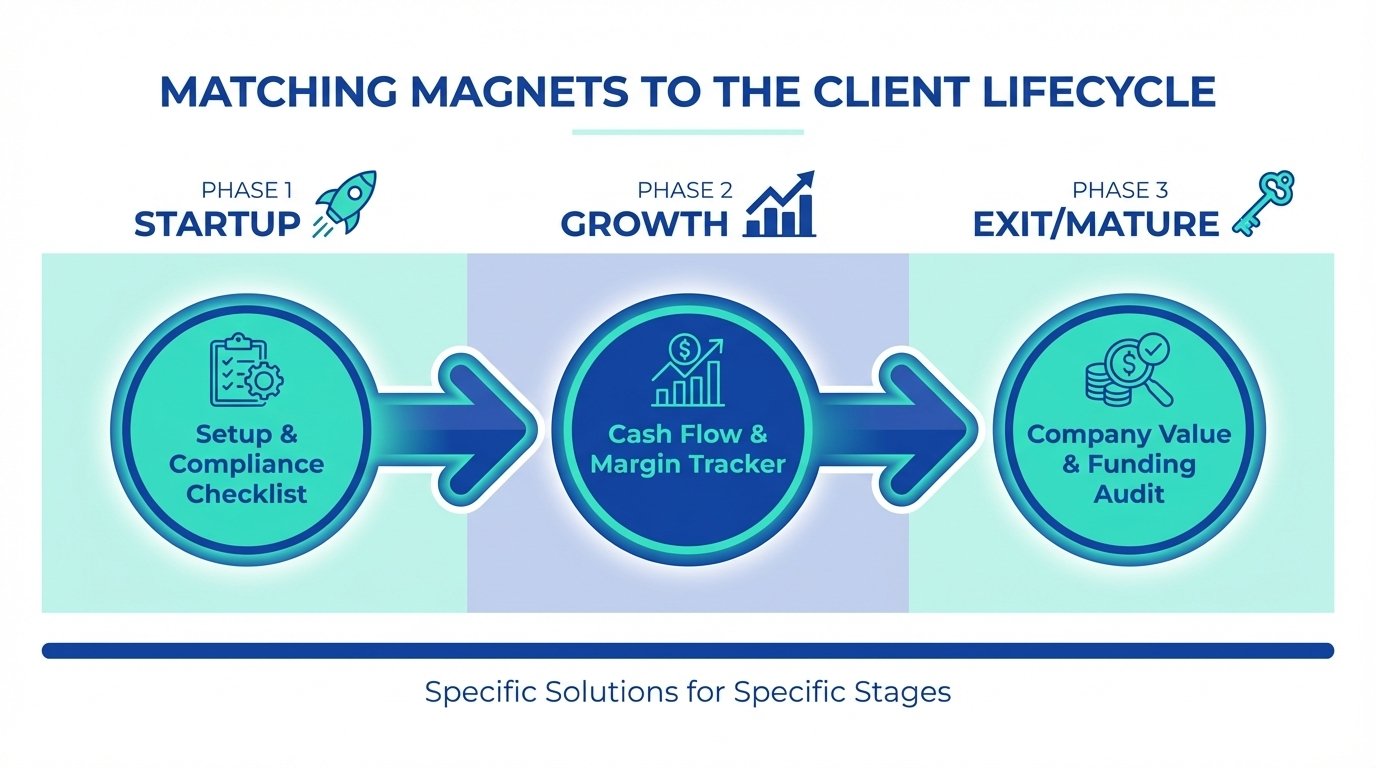
- Growth-led topics, such as cash flow forecast templates, profit improvement scorecards, business valuation starter tools, funding readiness audits and management report templates. These attract higher-value prospects, often suited to advisory and virtual finance director work.
Sector and lifecycle slicing sharpens results further. A startup founder cares about company formation and first-year deadlines. A landlord cares about Section 24, allowable expenses and Making Tax Digital for Income Tax, which begins to apply to landlords and sole traders earning above £50,000 from April 2026 under HMRC’s published timetable. A growing limited company cares about reporting, valuation and cash position. The same topic in different language produces very different download rates. Mapping topics to real searcher motivation, which we cover in detail in our guide on keyword intent, is what separates magnets that convert from magnets that sit dormant.
A useful test before building anything: would a real client thank the team for sending this asset by email tomorrow? If the answer is no, the topic is wrong.
Lead magnet formats that match each accountancy service
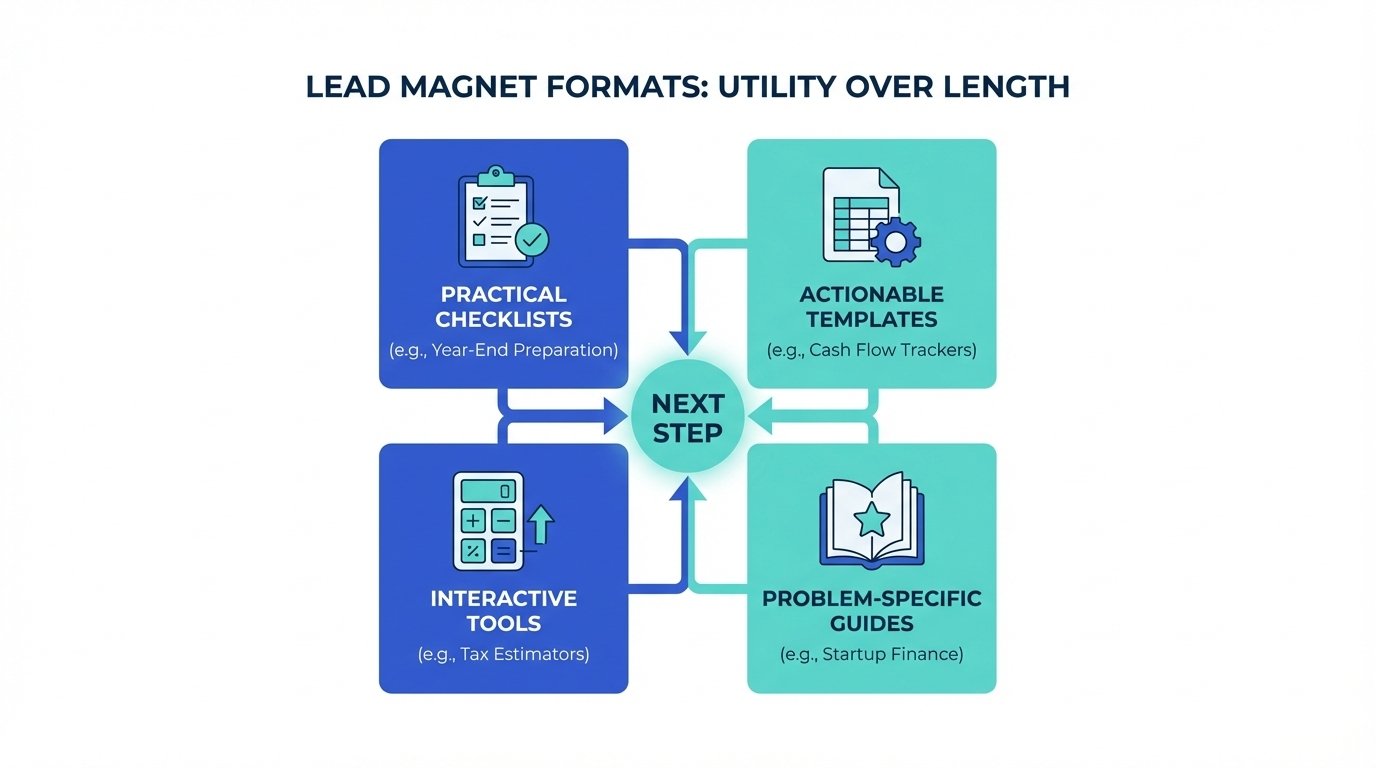
The right format depends on the paid service it points towards. Format choice should match the service buyer’s mental load and the speed of decision.
For bookkeeping, operational tools outperform long reads. A bookkeeping cleanup checklist, software comparison sheet, monthly close calendar or 12-month record-keeping planner gives quick value and matches the operational mindset of the buyer.
For payroll, process clarity is the win. New employer setup checklists, RTI submission calendars, statutory pay calculators and onboarding paperwork templates each map to a frequent stress point.
For tax services, anxiety reduction is the offer. Self-assessment document lists, dividend planning sheets, capital gains examples, IR35 status questionnaires and director expense rule summaries each address fears that drive Google searches at year end.
For advisory, virtual FD and outsourced finance work, the magnet must match strategic intent. A profit leak audit, KPI scorecard template, board-pack starter, three-year cash forecast template or business valuation tool fits owners thinking about growth, funding or exit. These are also the formats that surface prospects suited to higher-value retainers, where margins justify a longer nurture cycle.
Long-form ebooks have a place, but only when the topic genuinely needs depth (Making Tax Digital for landlords, R&D claim preparation, EOT transitions). Short, specific assets outperform broad ones for almost every other accountancy use case.
For accountancy firms
Turn site traffic into a steady flow of qualified accountancy leads
We build the topic strategy, the magnets, the landing pages and the measurement together, so the right kind of prospect lands, downloads and books a call.
Win more accountancy clientsTools UK accountants use to build and run lead magnets
The tooling decision splits into five jobs: capture forms, landing pages, email delivery, lead scoring and analytics. Pick one tool per job and integrate them, rather than buying a single platform that does each badly.
For form capture and pop-ups, common choices include Gravity Forms or Fluent Forms inside WordPress, plus pop-up tools such as OptinMonster, ConvertBox or Sumo for exit intent and scroll-triggered offers. Each integrates cleanly with major email platforms.
For landing pages, accountants either build inside the existing CMS (WordPress with Elementor, Bricks or the native block editor) or use a dedicated builder such as Leadpages, Unbounce or HubSpot Landing Pages. The dedicated builders are quicker to test. The CMS route keeps everything inside one SEO and analytics setup.
For email delivery and automation, the most common tools in UK accountancy firms are Mailchimp, ActiveCampaign, Brevo and HubSpot Marketing Hub. ActiveCampaign and HubSpot handle conditional follow-up sequences well, which matters when segmenting startups from established companies after a single download.
For calculators and interactive tools, ScoreApp, Outgrow, Involve.me and Typeform handle quiz logic, scoring and conditional output without bespoke development. ScoreApp has become particularly popular with UK accountancy and consulting firms because it allows white-labelled scorecards mapped to follow-up emails.
For CRM and lead scoring, HubSpot CRM (free tier upwards), Pipedrive, Capsule and Zoho cover most accountancy needs. The brand isn’t what matters. What matters is whether the system tells the partner which leads downloaded which asset and how recently.
For analytics, Google Analytics 4 with proper event tracking, Microsoft Clarity for session recordings, and either Hotjar or Plausible for behavioural insight cover the measurement stack at low or zero cost. Without this layer, the firm can’t see why a magnet converts on one page but not another.
A sensible starter stack for a single-office UK accountancy firm: WordPress + Gravity Forms + Mailchimp or Brevo + HubSpot CRM (free) + GA4 + Microsoft Clarity. Total monthly cost sits below £100 for most firms with a list under 2,000. Our breakdown of SEO cost in the UK covers the wider numbers around content, technical work and ongoing campaigns for context.
Where to place lead magnets across an accountancy website
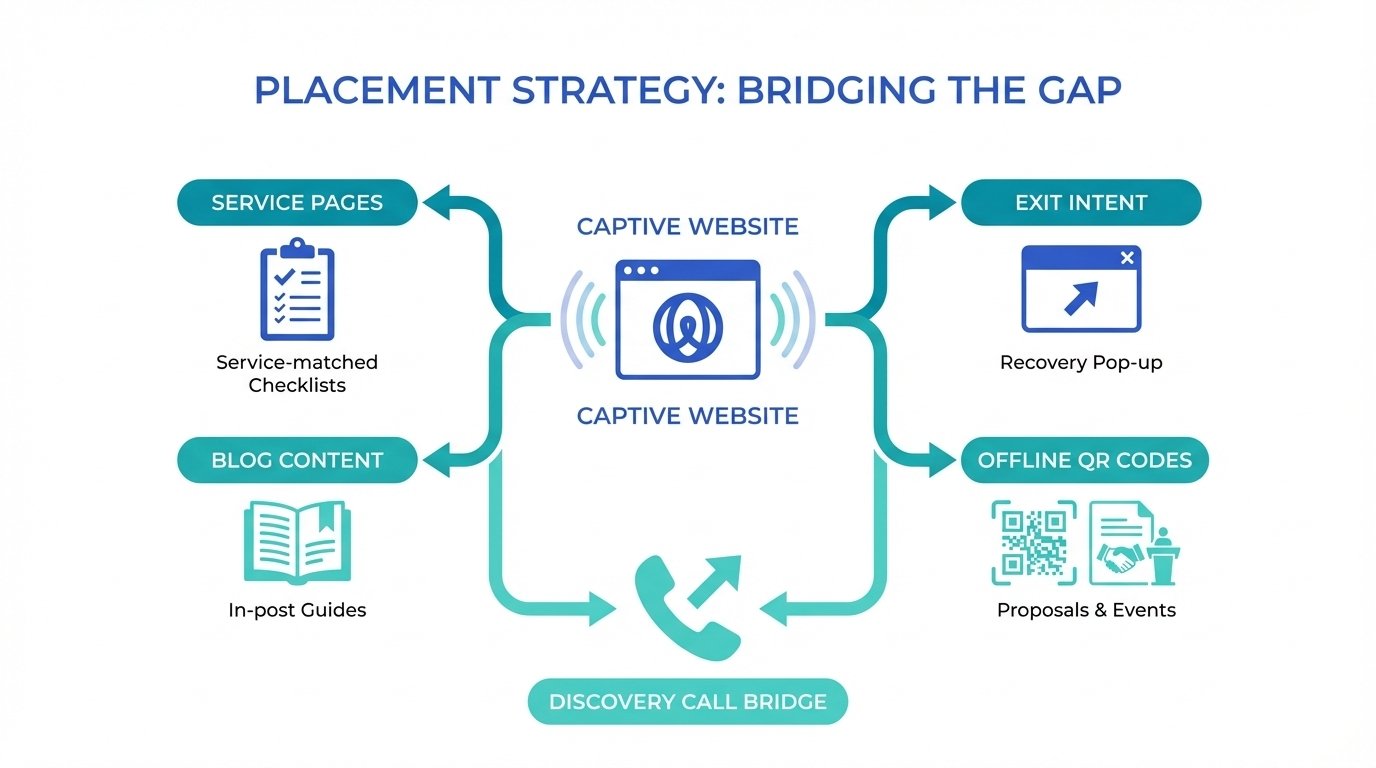
Placement should match the visitor’s intent at each page. The wrong asset on the right page converts at zero, and the right asset in the wrong location does the same.
Service pages carry the highest-intent traffic. A payroll page should offer a payroll setup or compliance checklist. A bookkeeping page should offer a cleanup checklist or software comparison. A self-assessment page should offer a document preparation list. The magnet completes the page rather than competing with the booking call CTA.
Blog pages carry mid-funnel interest. A reader inside an article on dividend rules will respond well to a director tax checklist. A reader inside a piece on cash flow forecasting will respond well to a forecast template. The match between article and asset is what drives the click. Our SEO strategy for accounting blogs approach explicitly maps each blog topic to a paired lead magnet at planning stage.
Homepage placement can work for the firm’s headline asset, usually a free consultation or a top-of-funnel scorecard, presented above or just below the fold without dominating the page.
Dedicated landing pages matter where the lead magnet drives campaign traffic. A focused page strips out navigation, sells one outcome, carries one form, removes everything else. Conversion rates on dedicated landing pages typically run two to four times higher than on general site pages, according to Unbounce’s published conversion benchmark data.
Exit-intent overlays work where the offer matches the page the visitor is leaving. A bookkeeping page exit overlay shouldn’t offer a generic newsletter. It should offer the bookkeeping checklist that matches the page topic.
A practical placement rule: every commercial page on the site should pair a primary CTA (book a call) with a secondary CTA (download a relevant asset). The two routes serve the two readiness states sitting on every page.
GDPR, PECR and consent rules for accountant lead magnets
Lead magnet collection in the UK sits under UK GDPR and the Privacy and Electronic Communications Regulations 2003 (PECR), both enforced by the Information Commissioner’s Office. Both apply whether the firm has one office in Cardiff or ten across the UK.
Three rules matter most:
- Lawful basis must be specific. ICO guidance is explicit that bundling marketing consent with a lead magnet download (the classic “tick this to download and receive our newsletter” combined box) is not valid consent. The two must be separated. Visitors should be able to download the asset without agreeing to ongoing marketing.
- Marketing emails to individuals need consent, not interest. Under PECR, B2C marketing emails require opt-in consent. B2B emails to corporate subscribers (firm@company.co.uk) can rely on legitimate interest with a clear opt-out, but emails to sole traders, partnerships and individuals fall under the consent rule. Most accountancy lists carry a mix, so the safer default is opt-in.
- Records of consent must be kept. ICO requires firms to evidence when, how and what the subscriber agreed to. The CRM or email tool should store the consent timestamp, the form used and the wording shown.
Cookie consent runs in parallel. Tracking pixels (Meta, LinkedIn, Google Ads remarketing) and analytics cookies require prior consent under PECR’s cookie rules. A compliant consent banner from a tool such as Cookiebot, OneTrust or Complianz handles this for most WordPress sites.
UK regulatory note
The ICO has actively investigated direct marketing complaints across the professional services sector, including financial firms. UK GDPR penalties for serious breaches can reach £17.5 million or 4% of worldwide annual turnover, whichever is higher. The compliance overhead is small. The fine is not.
How to follow up so a download becomes a discovery call
Delivery is the first step, not the goal. The follow-up sequence is what turns a downloader into a client. Without one, most leads cool within 14 days.
The first email should land within minutes, deliver the asset, and restate the one key insight the recipient will get from it. Speed and clarity reduce the regret-of-signing-up that drives unsubscribe rates.
A simple three-step follow-up sequence works for most accountancy magnets:
- Email 1 (immediate): delivery, key takeaway, soft mention of the related service.
- Email 2 (day 2 or 3): a second insight, a short case-style example, and a direct offer of a 30-minute call.
- Email 3 (day 5 to 7): a final answer to a common objection, with the booking link repeated.
The accountancy lead magnet funnel from search to signed client
Calls beat emails for closing. Sales benchmark research from HubSpot and other B2B sales platforms consistently shows booked discovery calls convert at multiples of email-only nurture. The job of the email sequence is to make booking the call feel easy, not to close the sale itself.
Personal touch matters at higher-value tiers. A landlord who downloaded a Section 24 guide shouldn’t get the same generic email as a startup founder who downloaded a formation checklist. Segmenting by download topic often doubles open rates in accountancy lists. Mailchimp’s published industry benchmarks place financial services around 26-27% average open rate against the cross-industry average of roughly 21%, and segmented sends sit comfortably above that.
Quick self-check
How strong is your accountancy lead magnet setup?
Six quick questions. Your answers reveal where the biggest conversion gain is hiding on your site.
1. How many active lead magnets does your site currently run?
2. Does each magnet topic point at a specific paid service?
3. What follow-up runs after a download?
4. Is consent collected in line with UK GDPR and PECR?
5. Can you trace signed clients back to a specific magnet?
6. Where do your magnets actually appear?
Your recommendation
Solid foundation, fine-tune from here
Your lead magnet system is genuinely working.
How to measure lead magnet performance and what to track
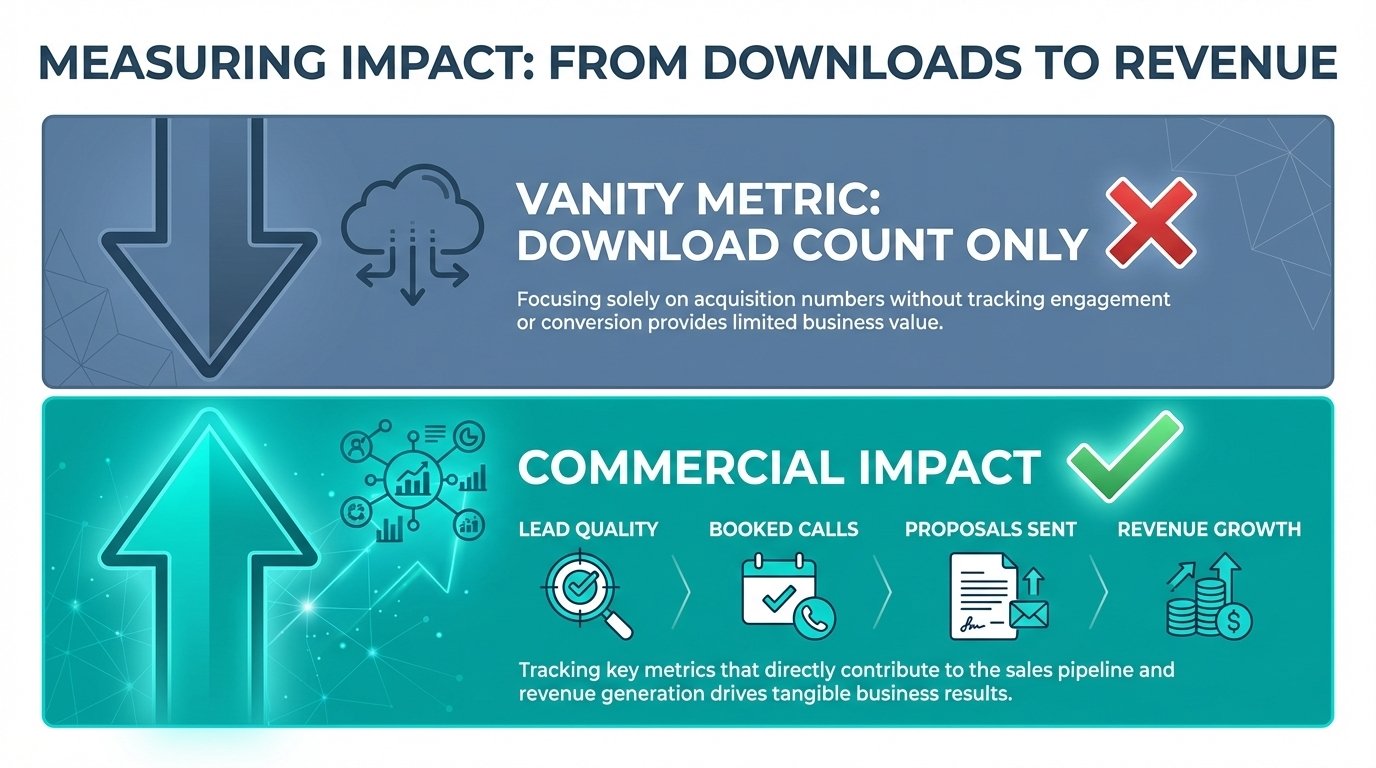
Lead magnet performance is measured by client revenue generated, not by downloads. Every other metric is a leading indicator pointing at that one number.
Five metrics worth tracking each month:
- Form conversion rate. Visitors to the lead magnet page who submit the form. Track per page in GA4 using a form-submit event, segmented by source.
- Email engagement. Open rate, click rate and unsubscribe rate by sequence. Track inside the email platform and compare against its published industry benchmark.
- Call booking rate. Downloaders who book a discovery call. Track via the booking tool (Calendly, HubSpot Meetings, SavvyCal) tagged with the source magnet.
- Proposal-to-client conversion. Discovery calls that become proposals, and proposals that become signed clients, tagged by originating magnet in the CRM.
- Revenue per lead magnet. Total fees signed against each magnet over a rolling 6 or 12-month window. The figure exposes which magnets attract clients worth retaining.
Tracking setup matters as much as the metrics. UTM parameters on every promotion link, event tracking in GA4 for form submits and CTA clicks, conversion tracking inside Mailchimp or HubSpot, and a single field in the CRM recording the entry magnet. Without this, a firm can’t tell whether the year-end checklist or the cash flow template is producing real clients.
The point is to retire weak magnets and double down on strong ones. A large share of marketing spend in most professional services firms goes into assets that produce nothing measurable. A simple measurement layer corrects that within one quarter. For a structured analysis of where your current setup leaks leads, our SEO audit service reviews the full path from search to enquiry.
How lead magnets feed AI search and Google AI Overviews
AI Overviews and AI assistants such as ChatGPT, Gemini and Perplexity now sit above or beside traditional Google results for a growing share of accountancy queries. Close to a third of UK Google searches already show an AI summary above the normal results. Lead magnet pages can be cited by these systems if they answer the underlying question well, which makes them visible at the very top of the new search journey.
Three things make a lead magnet page citable by AI:
- Clear, answer-first content on the page itself, not buried inside the downloadable PDF. AI systems read HTML, not gated downloads.
- Structured data marking up the FAQ section, the article body and the offer. Schema gives AI systems a clean route to extract the relevant block.
- Topical authority across the wider site. A single landing page on cash flow forecasting won’t be cited if the rest of the site lacks supporting content. The page needs an ecosystem around it, which is exactly what our work on topical authority in 12 proven steps builds.
Gating only the downloadable resource (the actual PDF, template or tool) while keeping the page content open and structured solves the AI-versus-conversion tension. The AI system reads the page, cites the firm and sends a reader. The reader then exchanges contact details for the downloadable version of the asset. Our broader work on AI and voice search optimisation treats every commercial page this way by default.
AI search rewards the same things human readers reward: directness, evidence, structure and depth. A lead magnet page that’s genuinely useful before the form is filled tends to perform on both fronts.
Common mistakes UK accountants make with lead magnets
The recurring mistakes are predictable and fixable. Each one undermines what’s otherwise a working strategy.
The first is building one giant ebook and treating it as a lead magnet. A 60-page guide on accounting basics looks impressive and converts at almost nothing because the time cost feels too high. A four-page checklist on the same topic typically converts four to six times better in our experience across UK accountancy clients.
The second is the generic newsletter signup dressed up as a lead magnet. “Subscribe for tax tips” attracts existing clients and competitors, not new prospects. Specific assets attract specific prospects.
The third is no follow-up sequence. The asset is delivered, the lead enters the database, no automated nurture runs, and the lead cools. The firm then blames the lead magnet rather than the missing sequence.
The fourth is placing the magnet where nobody looks. A lead magnet hidden in the footer or buried on a deep page collects no submissions. Service pages, blog pages and dedicated landing pages outperform site furniture by a factor of ten.
The fifth is measuring downloads only. A magnet that produces 500 downloads and no clients is failing. A magnet that produces 30 downloads and four signed retainers is working. The metric that matters is signed revenue, not download volume.
The sixth is ignoring GDPR. Bundled consent, unclear opt-ins, no record of how consent was captured, and ICO complaints from cold approaches all create avoidable risk. Compliance is a one-week setup task, not an ongoing burden.
A 90-day lead magnet rollout plan for accountancy firms
A focused 90-day rollout produces more enquiries than six rushed magnets bolted on quickly. Discipline beats volume in the first cycle.
Days 1 to 30: build and place
Pick one paid service to support. Choose one lead magnet topic that matches an active client pain. Build the asset (checklist, template or scorecard). Build the landing page with answer-first copy and schema. Set up the form, the email delivery, the three-step nurture sequence and the CRM tagging. Add the magnet to the matching service page, two relevant blog posts and an exit-intent overlay on the same service page.
Days 31 to 60: drive traffic and observe
Promote the magnet through email signatures, an existing client newsletter, LinkedIn posts from the partners, and (where budget allows) a small paid test on Google Ads or LinkedIn for the most commercial keywords. Watch the form conversion rate, the email engagement and the call booking rate weekly. Don’t change anything for the first three weeks. Early data is noisy.
Days 61 to 90: refine and repeat
Review the numbers properly. Strong magnets get a second matching asset built on the same theme, and a paid amplification budget. Weak magnets get one fix attempt (usually the topic, the title or the placement). Then plan magnet two on a different service line.
Below is a simple comparison of where firms typically invest effort versus where the highest return sits:
| Activity | Typical time spent | Impact on signed clients |
|---|---|---|
| Designing the PDF asset | High | Low |
| Choosing the right topic | Low | High |
| Building the landing page | Medium | High |
| Writing the follow-up sequence | Low | High |
| Tracking and measurement setup | Low | High |
| Distribution and promotion | Medium | High |
The bit most firms miss
Most firms over-invest in how the asset looks and under-invest in topic choice, follow-up and measurement, where the actual conversion lives.
Two real-world examples of accountant lead magnets in action
A Cardiff-based accountancy practice with around 800 monthly website visits ran a single contact form and was generating between 12 and 15 enquiries a month. The team built a year-end document checklist for limited company directors, placed it on the homepage, the year-end blog post and the company accounts service page, and connected it to a three-email follow-up sequence ending with a Calendly link. Within 90 days, the firm added 142 new contacts to its list, booked 31 discovery calls and signed 9 new annual retainers worth roughly £28,000 in recurring fees. Same site, same traffic, one extra asset.
Cardiff accountancy practice, 90-day lead magnet results
A property-focused accountancy firm in Bristol serving around 200 landlord clients wanted to attract more multi-property investors before the MTD for Income Tax window. The team built a landlord MTD readiness scorecard using ScoreApp, gated behind a 9-question quiz with a personalised PDF result. The scorecard sat on the landlord tax service page and was promoted through a single LinkedIn article and the firm’s existing newsletter. Over three months the quiz attracted 318 completions, of which 47 booked a discovery call and 12 became long-term clients, each on a monthly retainer between £180 and £350. The scorecard now runs continuously, and the firm has rebuilt its sales conversation around the result rather than around the firm’s services list.
Frequently asked questions
How long does it take to see results from an accountancy lead magnet?
Most firms see meaningful data within 30 to 60 days of launch, with signed clients typically appearing in the 60 to 120-day window. The lag reflects the buying cycle for accountancy services, not a problem with the magnet. Tracking matters early, because clear measurement in the first month protects against premature decisions.
Should we charge for the lead magnet to filter out tyre-kickers?
No. The point of a lead magnet is volume of identified prospects at the top of the funnel, not pre-qualified leads. Filtering happens in the follow-up sequence and the discovery call, where the time investment is smaller. Charging for the asset usually cuts download volume by 90% or more and removes the segmentation benefit entirely.
Can we use the same lead magnet for every service?
No. Different services attract different prospects with different worries. A bookkeeping lead magnet attracts cost-sensitive operational buyers, an advisory lead magnet attracts growth-focused owners, and the two need different topics, formats and follow-up sequences. Matching magnet to service is what creates the high conversion rate.
Do we need a separate landing page for each lead magnet?
For magnets that drive paid or campaign traffic, yes. The focused page typically converts two to four times better than placing the same form on a busy service page. For magnets supporting existing service pages, an inline form or pop-up on the matching page works well without a separate landing page.
Is it worth running lead magnets if we already get enough referrals?
Yes, for two reasons. Referrals are unpredictable, and a lead magnet system gives the firm a controllable second source of new clients. A nurtured list also makes referred prospects easier to close, because the firm has demonstrated expertise before the referral conversation begins. Most firms that introduce a serious lead magnet strategy report a meaningful uplift in new client volume within a year.
True SEO Consultants Ltd, Cardiff
Turn the traffic you already earn into booked calls and signed accountancy clients
We design, build, place and measure the conversion layer that sits between your traffic and your signed retainers. Cardiff-based, working with accountancy firms across the UK, onboarding worldwide through a fully remote process.
Table of Contents
- What a lead magnet means for an accountancy firm
- Why lead magnets work better than a single contact form
- Lead magnet topics that convert for UK accountancy buyers
- Lead magnet formats that match each accountancy service
- Tools UK accountants use to build and run lead magnets
- Where to place lead magnets across an accountancy website
- GDPR, PECR and consent rules for accountant lead magnets
- How to follow up so a download becomes a discovery call
- How to measure lead magnet performance and what to track
- How lead magnets feed AI search and Google AI Overviews
- Common mistakes UK accountants make with lead magnets
- A 90-day lead magnet rollout plan for accountancy firms
- Two real-world examples of accountant lead magnets in action
- Frequently asked questions
