Three months of semantic SEO on a live product catalogue, measured in profit.
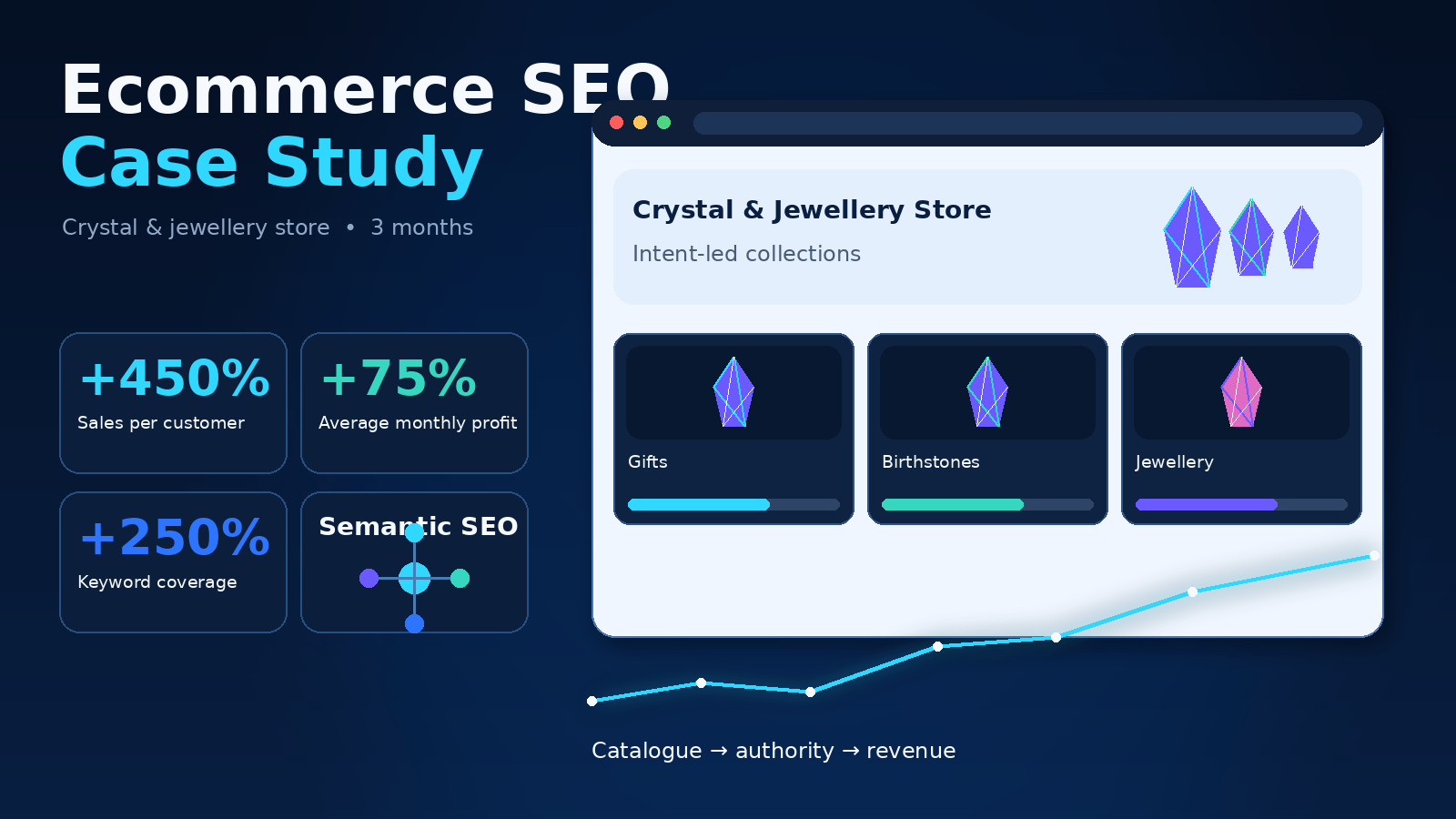
An online crystal, gemstone and jewellery retailer lifted average sales per customer by 450% in three months. Tracked keyword coverage grew 250%, average monthly profit rose 75%, and local search now adds a further 45% on top of national online sales. The store runs on Shopwired. Nothing in the method depends on that.
- 2.35K clicks and 290K impressions in the three-month Search Console window, at an average position of 14.5 and improving
- Zero invalid rich results across review snippets and merchant listings, on a catalogue that previously showed markup inconsistently
- Billed at 3% of monthly profit, so the fee falls in a poor month and rises only when the work compounds
- Product-level intent
- Customer lifecycle mapping
- Topical clusters
- Visual semantics
- Structured data
- AEO and GEO
The free review, in 30 minutes
See where the revenue is sitting in your own catalogue
- The intents your product range answers, and the ones it misses
- Your Search Console picture read against your three closest competitors
- An honest answer on whether we can move your numbers
No minimum term. Cancel on 30 days’ notice.
Key takeaways
- Average sales per customer rose 450% over the engagement, driven by intent-matched category and guide content rather than discounting.
- Tracked keyword coverage grew 250% in three months as the topical map filled gaps across the crystal, gemstone and jewellery range.
- Average monthly profit increased 75%, which matters more than traffic on a product catalogue with variable margins.
- Search Console recorded 2.35K clicks and 290K impressions across the three-month window, at an average position of 14.5 and climbing.
- Local SEO now contributes an extra 45% on top of the store’s national online sales.
- Our fee is 3% of the profit the store makes each month, so the engagement only grows when the client’s profit grows.
The client is anonymised at their request. The sector, the platform and the figures are real. Every catalogue starts from a different place, and the fastest way to find out where yours sits is a conversation about your actual numbers. Our Shopwired SEO service for ecommerce growth rebuilds the topical structure, schema and AI visibility of a store so shoppers find it at the moment they are ready to buy, and the equivalent programme runs on Shopify and WooCommerce. You can talk through your catalogue on a 30-minute call and we will look at your products, your Search Console data and your nearest three competitors together.
The results: what three months of semantic SEO produced
Organic performance moved on all four Search Console metrics at once, which is the pattern that tells you structure changed rather than one lucky page ranking.
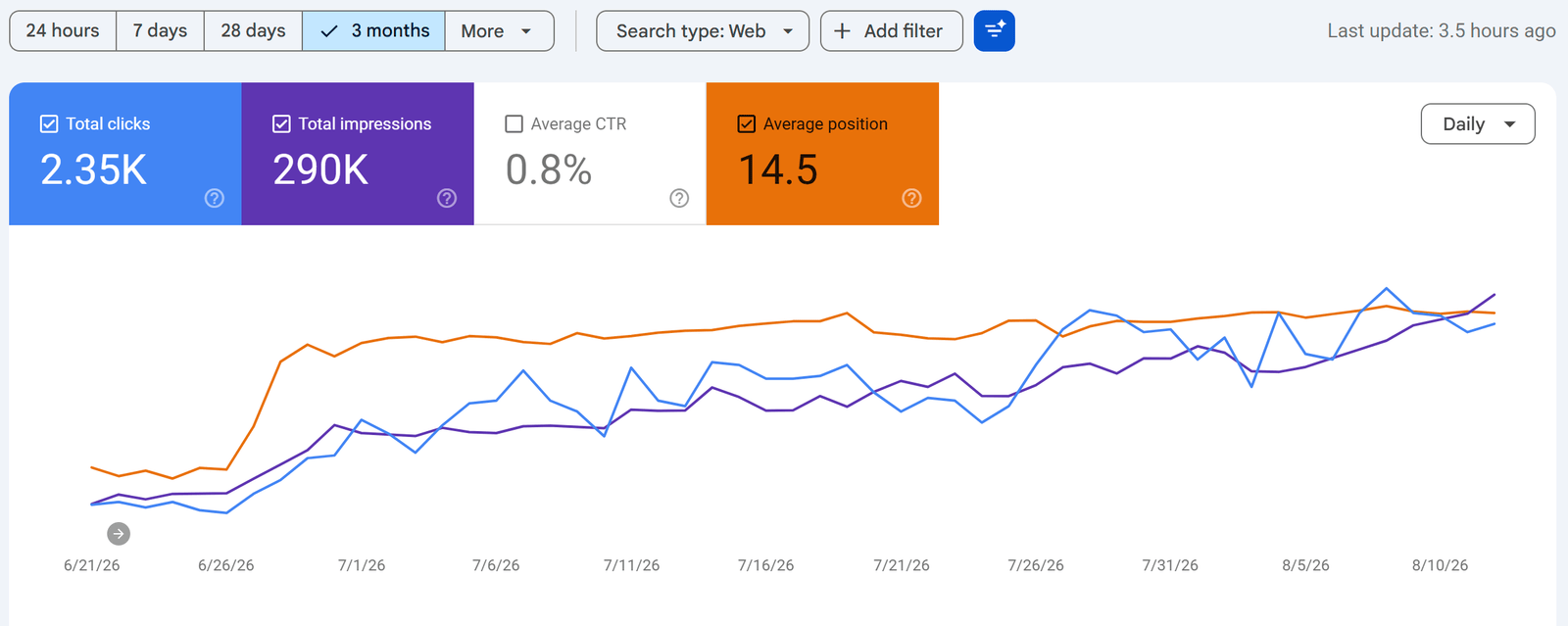
Read the shape of that graph rather than the totals. Impressions and clicks both start near the floor on 21 June and rise together through August, while average position improves in the same window. Three lines moving in the same direction over eight weeks means the site is being understood better, not just crawled more.
| Measure | Movement | Source |
|---|---|---|
| Average sales per customer | Up 450% | Client sales reporting |
| Tracked keyword coverage | Up 250% | Rank tracking, three months |
| Average monthly profit | Up 75% | Client management accounts |
| Revenue from local search | Plus 45% on top of national online sales | Client sales reporting |
| Organic clicks | 2,350 in three months | Google Search Console |
| Organic impressions | 290,000 in three months | Google Search Console |
| Average position | 14.5, improving through the window | Google Search Console |
Average order value moved because the content answers the question a crystal buyer actually has. Somebody searching for a stone by its purpose, its birth month or its use in a gift is not price shopping. They are looking for the right item, and they buy more of it when the page explains the range properly.
Keyword growth came from covering intent, not from chasing volume
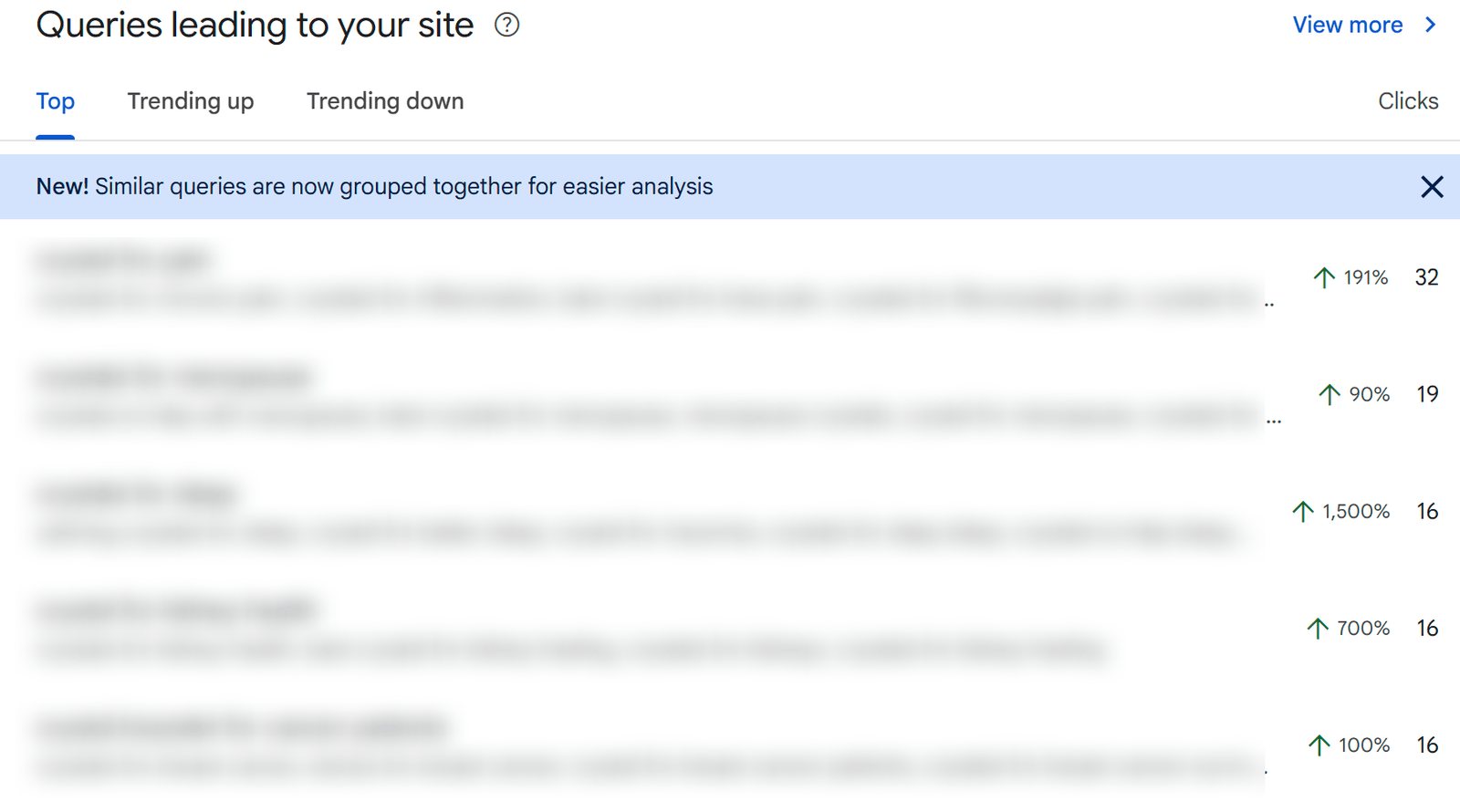
The five leading query groups grew between 90% and 1,500% in clicks. The two largest jumps came from queries that had almost no ranking page before the engagement started, which is the signature of a genuine content gap rather than a rankings nudge.
The pages that carried the growth were the ones we rebuilt
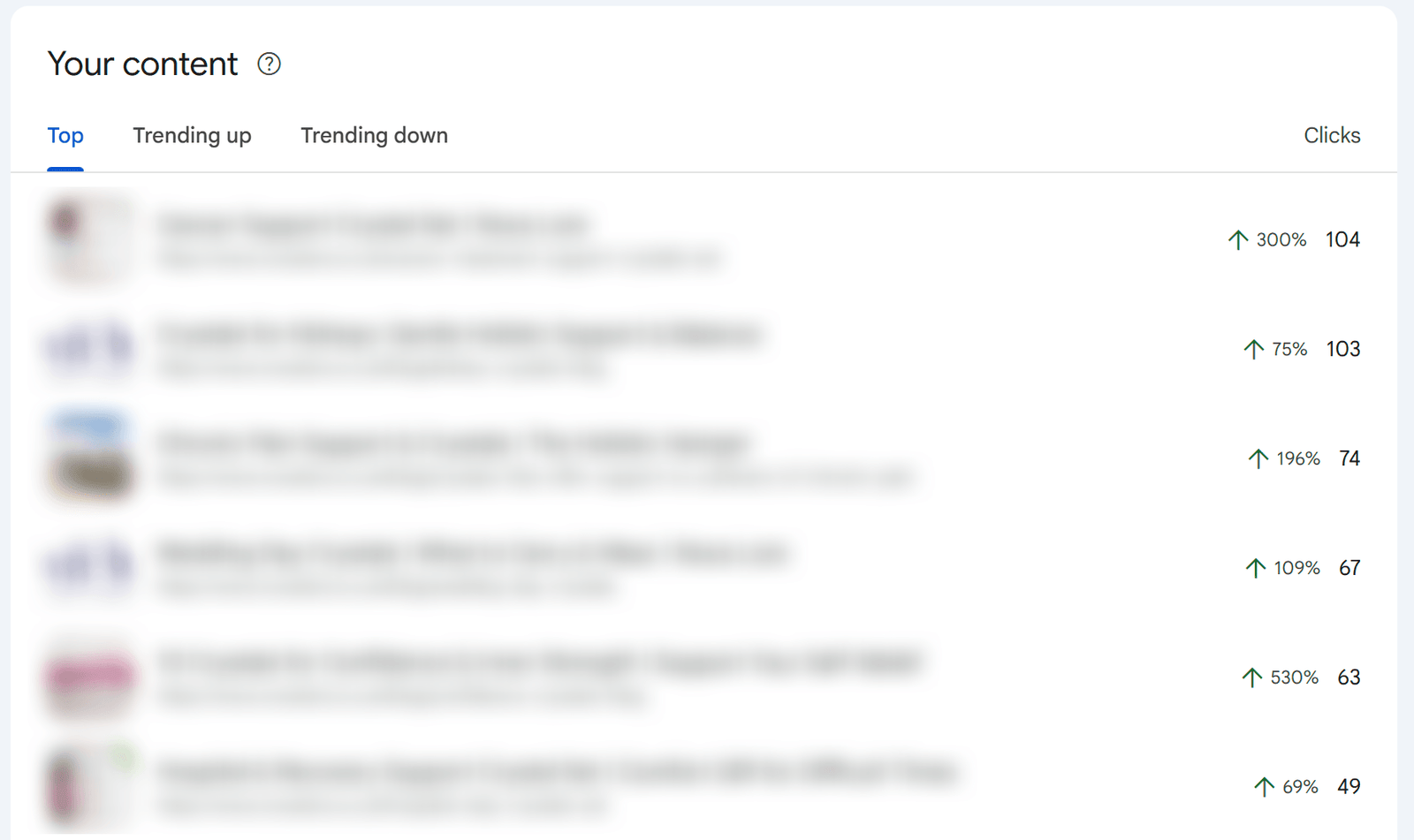
Six pages carry the bulk of the traffic, at 104, 103, 74, 67, 63 and 49 clicks. All six are purpose-led or occasion-led pages rather than generic category listings. The 530% riser is a gifting page built specifically around a lifecycle moment we identified in the intent work below.
Where the store started: a good catalogue with no semantic structure
The store sold well to returning customers and almost nothing to strangers, because its product architecture gave a search engine no way to read one group of pages as a topic.
Shopwired gives you sound commercial foundations, editable titles, meta descriptions, URL handles and a clean template, and those foundations are where most stores stop. Built-in fields let you label a page. They do not tell a search engine what the page is about in relation to everything else you sell.
Three problems showed up in the first fortnight:
- Flat product architecture. Hundreds of products sat under a handful of broad categories, so no group of pages ever accumulated enough related signal to be read as a topic.
- Attribute-blind product copy. Descriptions listed size, weight and finish. They rarely named the stone’s properties, its origin, its association with a month or occasion, or the reason a buyer chooses it over an adjacent stone.
- Missing and partial structured data. Review and product markup existed on some templates and not others, so rich results appeared inconsistently in the search results.
None of that is unusual. According to ONS figures, internet sales account for close to a quarter of total retail sales in Great Britain, and the stores winning that share are the ones whose catalogue is legible to a machine as well as a human.
The client lifecycle, from first call to month three
The engagement runs in six stages, starting with a free 30-minute strategy call and reaching profit movement in the third month.
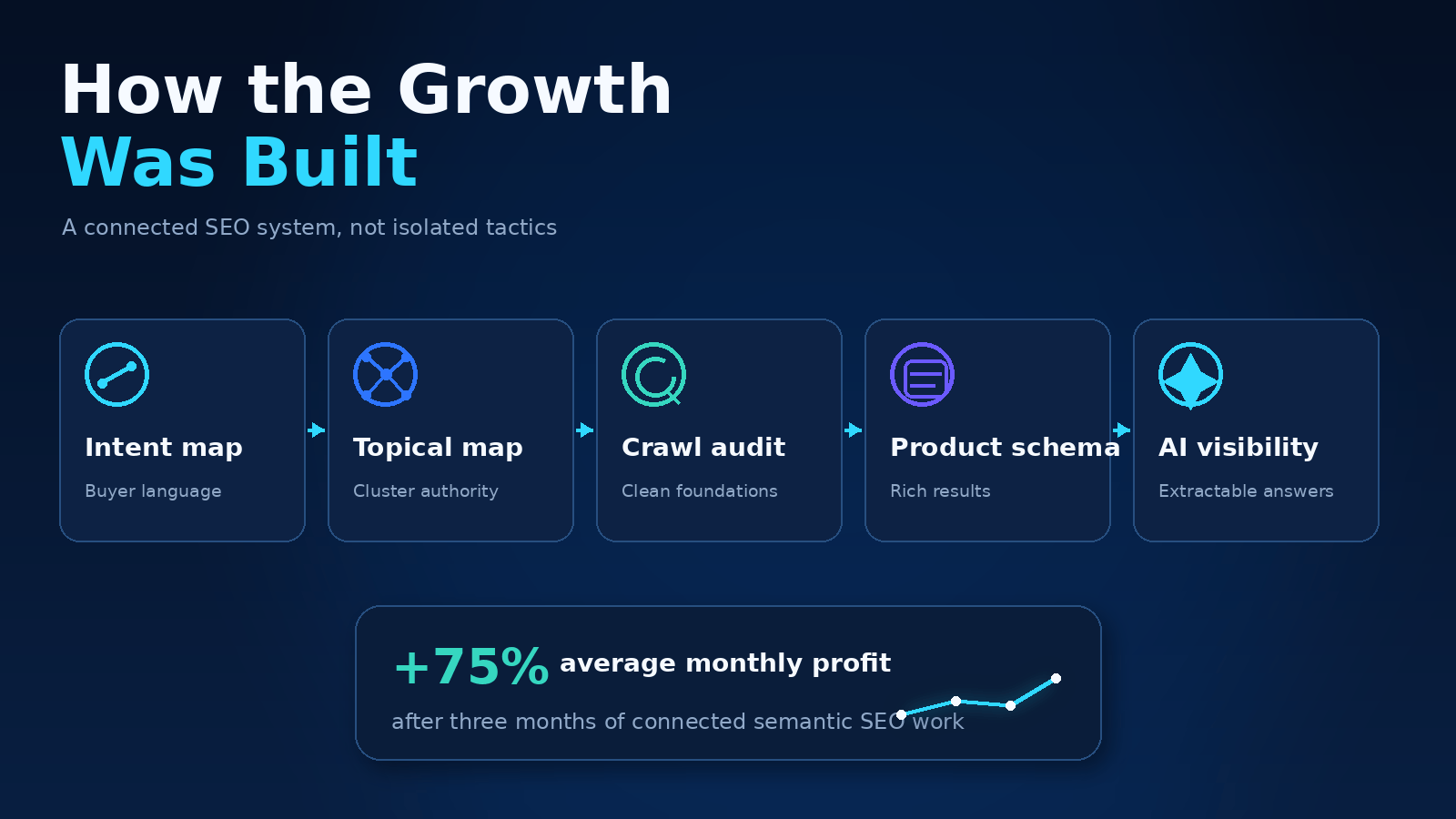
- The 30-minute strategy call. Free, no obligation. We look at the store, the Search Console data and the nearest competitors, and say plainly whether we think we can move the numbers.
- The audit. A full crawl worked through the semantic framework, plus a Search Console and competitor review. The output is a tiered diagnostic and a prioritised backlog, not a list of warnings. This is our SEO audit service run at engagement start.
- Intent discovery. Product-level and lifecycle intent mapping across the catalogue, converted into a de-duplicated must-cover intent list.
- The topical map. Clusters, hub pages, supporting pages and the internal link architecture that connects them, sequenced so each cluster completes before the next begins.
- Build. Technical fixes first, then structured data, then visual semantics, then content cluster by cluster.
- Grow. Biweekly performance checks, monthly client reporting, quarterly re-mapping as the catalogue and the market change.
By week six the impression curve had turned. By week ten the click curve caught up. Profit followed a few weeks behind both, which is the normal order on an ecommerce site: visibility, then traffic, then basket value, then margin.
What the client pays: 3% of monthly profit
The store pays us 3% of the profit it makes each month, so our fee falls when the store has a poor month and rises only when the work compounds.
That model exists because ecommerce SEO deserves to be judged on profit rather than traffic. A retainer paid regardless of outcome puts the risk entirely on the client. A percentage of profit also settles the argument about which metric matters: we stop optimising for the rankings that look good in a report and start optimising for margin.
| Model | Who it suits | What changes the number |
|---|---|---|
| Percentage of monthly profit | Stores with clean margin reporting and a genuine appetite to grow, willing to share their accounts | Your profit. Nothing else. A flat month costs you less. |
| Fixed monthly fee | Stores that want a predictable cost line, or whose margin data is not yet reliable enough to bill against | Catalogue size, the number of clusters in scope, and how much technical remediation the audit finds |
| One-off audit and topical map | Stores with an in-house team who want the plan rather than the delivery | Catalogue size and the depth of competitor analysis requested |
On the published figure. Our Shopwired SEO pricing starts from £899 a month with no minimum term and 30 days’ notice. Treat that as a starting band rather than a quote: the real number depends on catalogue size, cluster count and the remediation the audit finds, and the profit-share arrangement replaces it entirely where it fits. There is also a monthly SEO package built for smaller businesses where a fixed fee suits better.
Not every engagement should run on profit share, and we will say so on the call. A store with unreliable cost-of-goods data cannot bill this way honestly, and forcing it produces an argument in month four rather than a partnership.
Step one: product-level and lifecycle intent discovery
We map intent twice on every ecommerce engagement, once across the product range and once across the customer lifecycle, and the overlap between the two maps is where the money is.
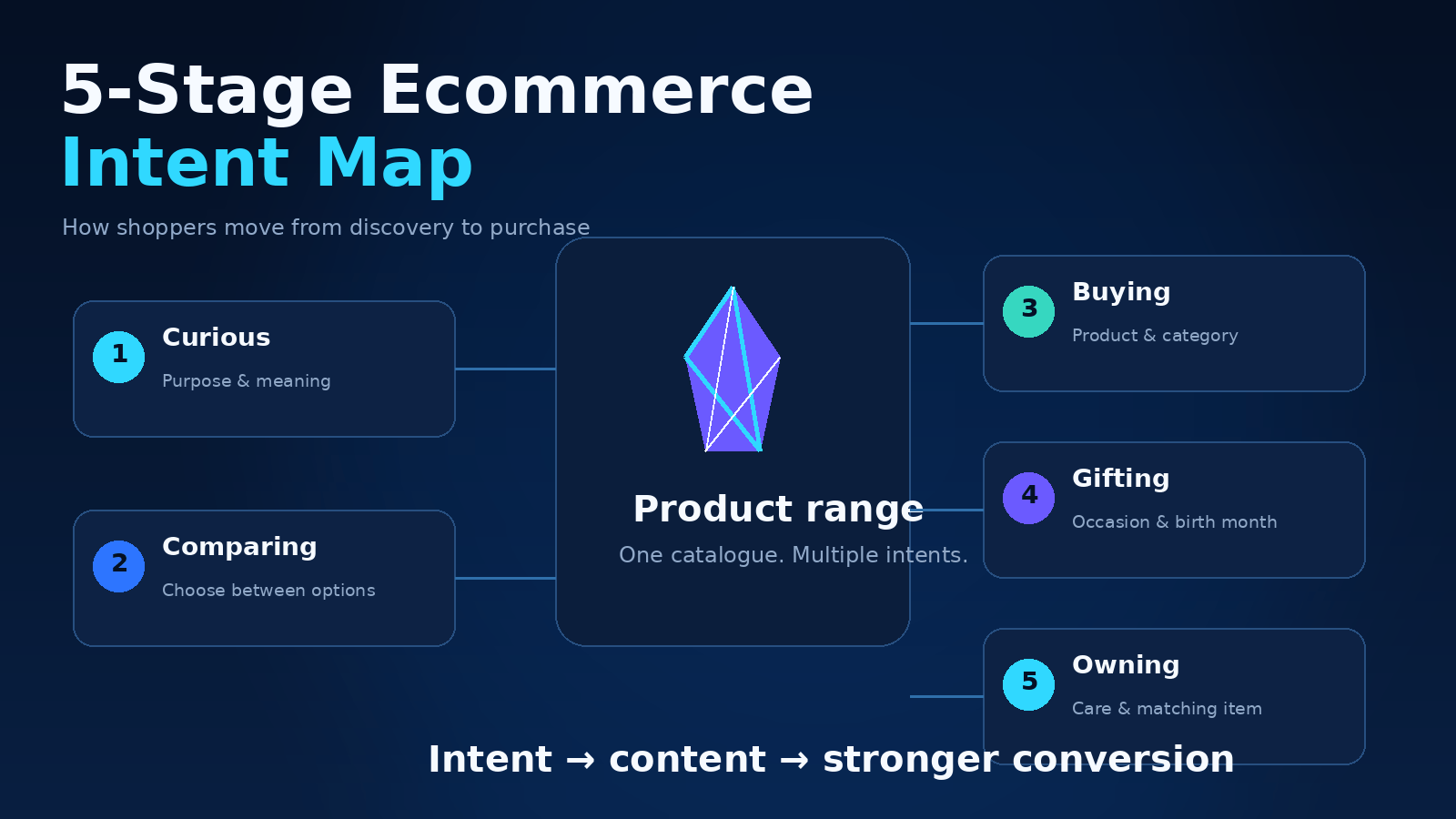
Product-level intent asks what each item in the catalogue is actually searched for. A single stone carries several distinct intents: what it is, what it is believed to do, who it suits, how to tell a genuine piece from a treated one, how to care for it, and what to pair it with. Six intents on one product, and the standard product page answers one of them.
Lifecycle intent asks where the buyer sits when they search. We worked the range through five stages, each with its own query language and its own page type.
| Stage | What the buyer searches | Page type that wins |
|---|---|---|
| Curious | Names a feeling, not a product. Purpose and meaning queries. | Guides and explainers |
| Comparing | Knows the category, wants to choose between stones, cuts, settings or price bands. | Comparison pages and buying guides |
| Buying | Names the product, the size or the setting. | Product and refined category pages |
| Gifting | Shopping for somebody else against an occasion or a birth month. | Occasion pages, highest basket value |
| Owning | Already has the piece. Care, cleansing, storage, matching items. | Care and pairing pages, almost always missing |
Stage four and stage five are where average order value moved. Gift buyers buy sets. Existing owners come back for the matching piece. The method behind this mapping is the same one we set out in our guide to how keyword intent decides which page should rank for which stage of a purchase, applied product by product across a live catalogue.
Every intent we found was written as a real question a person would type or ask an assistant, then de-duplicated, then sorted into must-cover and supporting. That list became the content plan. Nothing got written because it looked like a good topic.
Step two: the topical map that turned a catalogue into an authority
Intents on their own produce a list. A topical map turns the list into an architecture, with a central entity, a hub page and an internal link pattern per cluster.
We grouped the intent set into topical clusters, each with a central entity and a set of attributes that belong to it. One cluster covered stones by purpose. Another covered stones by birth month and occasion. Another covered jewellery types and settings. Another covered care, cleansing and authenticity. Each cluster got a hub page, a set of supporting pages, and an internal link pattern that pointed inward to the commercial page the cluster was built to lift.
Two rules governed the build. Complete a cluster before starting the next one, because a half-finished cluster earns no authority and competes with itself. Link on the relationship rather than the keyword, because an anchor that describes how two pages relate is what shortens the semantic distance between them and lets a search engine read the group as a single body of work.
This is the semantic SEO and topical-authority programme we run on every engagement, and it is the reason keyword coverage grew 250% without a single new backlink campaign. Coverage grows when the map is filled, not when links are bought. The twelve-step sequence we follow is documented in our walkthrough of the steps that take a site from scattered pages to recognised topical authority.
Step three: the semantic crawl audit that fixed the foundations
Before a word of content went live, we ran a full crawl and worked it through the Koray semantic framework: central entity, source context, attribute coverage, internal link topology and crawl efficiency.
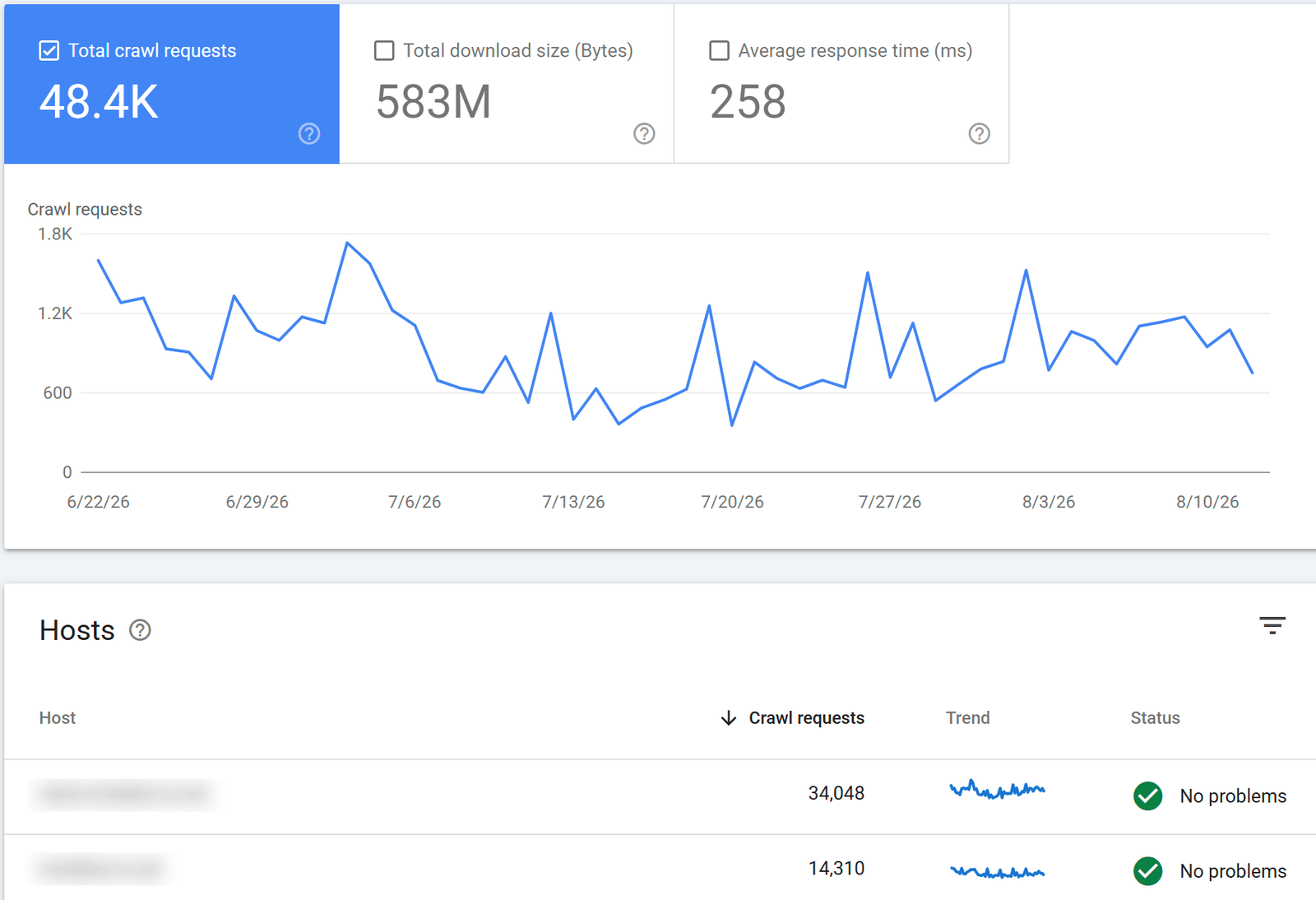
Across the window Google made 48.4K crawl requests at an average response time of 258ms, with both hosts clean. Response time matters commercially, because a sluggish store gets less of its catalogue refreshed.
The audit produced a tiered backlog. Tier one items shipped first: consolidating thin and near-duplicate product variants so one strong page absorbed the signal instead of five weak ones splitting it, rewriting title and heading patterns across categories so each page stated its own distinct topic rather than repeating the brand, rebuilding internal links from guides into commercial pages using descriptive anchors, and repairing crawl waste on filtered and parameter URLs that were consuming budget without earning impressions.
That work sits inside our technical and on-page SEO service, and on an ecommerce site it is never optional. A catalogue with a broken structure will not hold the authority that content earns.
Step four: visual semantics, the part most stores ignore
Product photography is data, and on a jewellery catalogue the image is often what the buyer is actually searching for.
Visual semantics is the work we have been developing to make imagery contribute to relevance rather than sit outside it. On this store it meant four things: naming files by entity and attribute so a filename describes the stone, the cut and the setting rather than a camera reference; writing alt text as a factual description of what is in the frame, using the same vocabulary as the page’s body copy; matching image context to page context, so a stone photographed against a gifting arrangement sits on the gifting page and not on the technical specification page; and compressing and sizing consistently, which protects the crawl response times shown above.
Images then stopped being decoration and started carrying topical signal. On a range where two stones can look similar and behave differently, that distinction is worth real money.
Step five: structured data that earns rich results
Structured data is how a store tells Google what a page is without relying on the copy alone, and clean validation changes how the listing looks in the results.
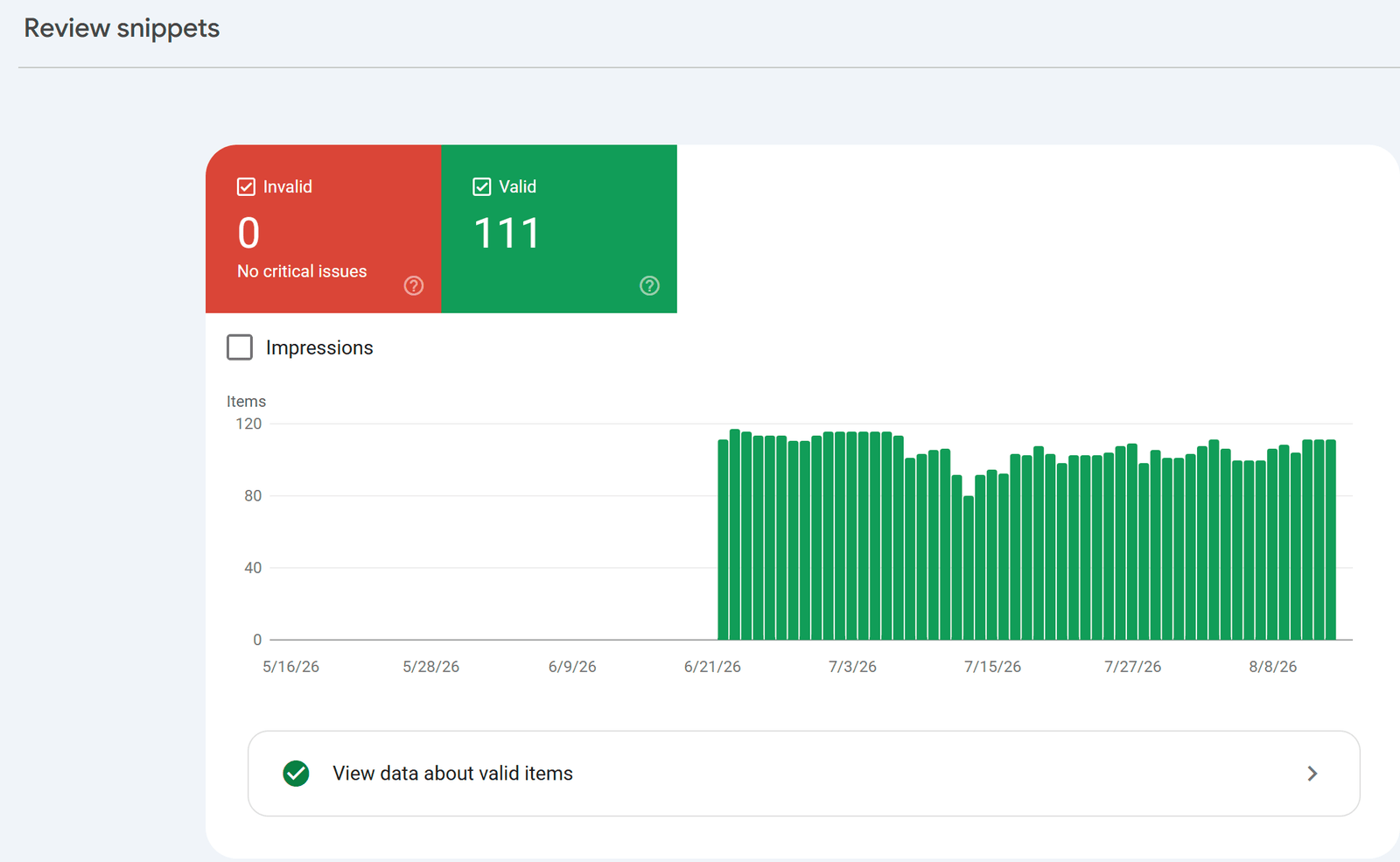
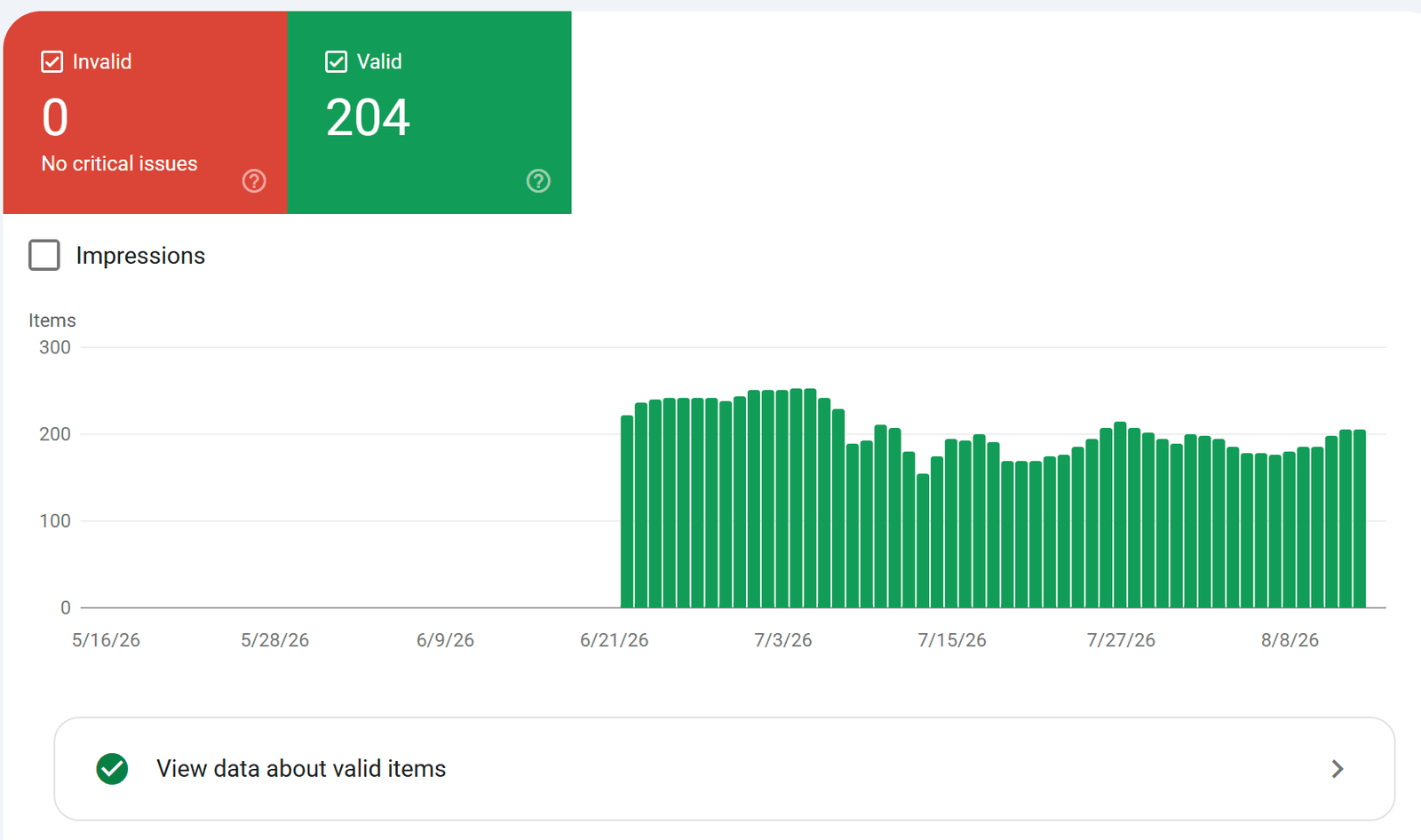
Clean validation is not a vanity metric on a retail site. Review stars and price and availability data change how a listing looks in the search results, and a listing that shows them takes clicks from listings that do not, at the same position.
One caution on reviews. UK consumer law banned fake and concealed-incentive reviews from April 2025, with penalties that can reach 10% of worldwide turnover and active enforcement from mid-2025. Every review feeding this markup is a genuine verified purchase. Rich results built on anything else are a liability, not an asset.
Step six: AI, AEO and GEO visibility
Close to a third of UK Google searches now show an AI summary above the normal results, so a store that only ranks in blue links is competing for a shrinking part of the page.
More than half of UK adults say they see these summaries regularly. We optimise holistically for AI and generative engines alongside classic search. On this store that meant writing crisp extractable definitions for every stone and setting, structuring comparison content as clear prose statements an assistant can lift, publishing direct question and answer pairs at the point of purchase, and keeping entity naming consistent so the store is recognised as the same business wherever it is mentioned.
The work is the same discipline we describe in our AI and LLM search service, and we have written about how it plays out in practice in our piece on earning AI-answer visibility when the assistant, not the search page, is the first stop.
Step seven: local SEO added 45% on top of online sales
An online catalogue still sells locally, and local search now contributes an extra 45% on top of this store’s national online revenue.
Crystal and jewellery buyers search for a place to see a piece before they commit, particularly on higher-value items, and gifting searches skew local as the occasion gets closer. We built the local layer alongside the national one: an optimised Google Business Profile with the full product range categorised, consistent name, address and phone data across citations, location-relevant landing content, and review generation tied to genuine purchases.
That 45% surprised the client more than any other number in this case study. Our local and multi-location SEO service exists for exactly this pattern: businesses that assume they are national-only and are leaving a fifth to half of their potential revenue on the table.
How we track and report
We check performance every two weeks and report to the client monthly, so problems get caught within a fortnight rather than at month end.
The biweekly check is internal and operational. We look at movement on tracked keywords, crawl stats, indexation, rich result validity and any page that has slipped, then adjust the sprint backlog.
The monthly report goes to the client and covers clicks, impressions, average position, keyword coverage, revenue and profit movement, what shipped, what it did, and what ships next. No screenshot dumps. A store owner should be able to read the first page and know whether the money is working.
Score your own store in two minutes
Answer five questions about your catalogue. You get a specific recommendation at the end, not a grade.
Question 1 of 5
How much copy sits on your main category pages?
Question 2 of 5
Do you have pages for people who already own the product?
Question 3 of 5
When did you last check your product markup in a rich results test?
Question 4 of 5
What proportion of your product images carry written alt text?
Question 5 of 5
Can you say what your organic traffic did to your profit last month?
Your foundations are sound. Spend on coverage, not on fixes.
Your catalogue is already legible, so a technical rebuild would waste your money. The gain sits in the two lifecycle stages most stores skip: gifting and owning. Build one occasion cluster and one care cluster, complete each before starting the next, and point both at the collection you most want ranking. Expect impression movement within six to eight weeks.
Fix the markup and the category copy before you publish anything new.
You have gaps in the two things that decide how your listings look and how your commercial pages read. Validate your product markup, write real introductions on your top six collections, then run the intent map. Publishing guides on top of thin collections sends readers to a page that cannot convert them.
Start with the audit, and do not buy content yet.
Buying content now would be the wrong purchase. Your catalogue has structural problems that will absorb whatever you publish, and without margin data nobody can tell you whether the work paid. Run a crawl audit, get your cost-of-goods reporting straight, then map intent. That order costs less and settles what to do next.
Answer the first question to begin, or skip it and request an SEO quote for your store.
Two more stores, same method
The same sequence has produced the same shape of result on catalogues that share nothing with crystals except the structural problem.
A three-branch independent homeware retailer selling online and in store came to us with 340 organic visits a month and an average order value of £28. Their catalogue sat under four categories with no guide content at all. We built three clusters around room, material and occasion, rebuilt the product schema, and pointed every guide at a refined category page. Nine months on they were taking 2,100 organic visits a month at an average order value of £61, with gifting pages producing the highest baskets in the store.
A specialist watch and accessories seller had the opposite problem: strong brand searches, almost no non-brand visibility, and 92% of organic clicks landing on the homepage. The intent map showed they had never answered a single comparison or servicing query. Twelve comparison and care pages later, non-brand clicks made up 46% of organic traffic and enquiries for high-value pieces had roughly doubled.
This applies well beyond crystals and jewellery
The method does not care what you sell. It cares whether your catalogue is legible.
We run the same process for ecommerce brands on Shopwired, Shopify and WooCommerce, where the same catalogue-to-cluster problem shows up under a different template. Luxury and heritage brands use it to protect brand terms while opening non-brand demand. Hotels use lifecycle intent mapping to separate the browsing guest from the booking guest. Automotive retailers use product-level intent to cover parts, fitment and compatibility queries that generic category pages never reach. Accountancy firms and law firms use the identical topical map logic on services rather than products.
| Platform | Where it helps | Where the work goes |
|---|---|---|
| Shopwired | Clean template structure makes schema and internal link changes quick to implement | Category depth and attribute-led product copy |
| Shopify | Large app ecosystem and reliable hosting | Duplicate product paths, thin collections, filter URLs and theme markup |
| WooCommerce | Full control of templates, URLs and markup | Speed, plugin conflicts and crawl waste on archives |
We hold a strategic alliance with Shopwired, so the platform’s constraints and its opportunities are familiar territory.
The programme behind these numbers
Our Shopwired SEO service runs the seven steps above as one accountable programme, so your collections, product pages and guides carry the authority that holds a position instead of borrowing one.
Ecommerce SEO tips for Shopify stores
Shopify carries a specific set of default behaviours that cost stores visibility before anybody writes a word of content. Fix these ten first.
Every one of them is a settings or template change, not a rebuild.
| Default behaviour | Why it costs you | The fix |
|---|---|---|
| Duplicate product paths | The same product serves at /products/handle and at /collections/x/products/handle, splitting signal across two URLs | Check the canonical on a product reached through a collection; most themes point at the short path, older or customised ones do not |
| Thin collection pages | A grid of products is not a page, and collections are the highest-value commercial URLs you own | Write a real introduction above the grid and the longer supporting copy below it |
| Filter and tag URLs | Tag filtering and the newer filter system generate parameter URLs that eat crawl budget without earning impressions | Block the valueless patterns in robots.txt.liquid, editable since 2021, and build the ones with real demand as dedicated collections |
| Theme-supplied Product markup | Themes vary widely; some omit availability, some omit aggregateRating, some emit two conflicting Product blocks | Run several product URLs through Google’s Rich Results Test and read what the theme actually outputs |
| The default blog handle | Content sits at /blogs/news/, so the URL carries no meaning and the blog reads as a noticeboard | Rename the handle to describe the topic the blog covers |
| Empty image alt text | Alt stays blank unless somebody fills it in, so hundreds of catalogue images contribute nothing | Describe what is in the frame using the same vocabulary as the page body, through the media editor or a bulk edit |
| App script bloat | Every app injects scripts, and the scripts usually stay behind after the app is uninstalled | Review the theme for orphaned app code, remove what is dead, and measure the result |
| Blog links pointing at products | A guide linking to five individual products sends readers past the page you want ranking | Point the guide at the collection first, then link one or two products as supporting examples |
| Attributes buried in descriptions | Material, size and compatibility sit in a paragraph where no template can reuse them | Store them as metafields so they feed cleaner markup and make faceted collections worth building |
| Deep collection pagination | Products beyond page three or four are rarely crawled | Split oversized collections into narrower ones that match real search demand |
Working through that list will lift a Shopify store’s foundations. Growth still comes from the intent map and the topical clusters described above, and our Shopify ecommerce SEO service runs the same seven-step programme this case study documents, so your collections, product pages and guides carry the authority Google and AI assistants reward with stable positions.
Frequently asked questions
How long does ecommerce SEO take to show revenue movement?
Expect visibility movement in six to eight weeks and revenue movement in ten to sixteen, on a store with a working catalogue and no penalty history. This store’s impression curve turned in week six and profit followed in the third month. Older domains with existing authority move faster; brand new stores take longer.
Does SEO work for small ecommerce stores, or only large catalogues?
It works for small catalogues, often faster, because a cluster can be completed in weeks rather than months. Coverage depth beats catalogue size. A 60-product store that answers every intent around its range will outrank a 6,000-product store that answers none.
Is Shopwired good for SEO compared with Shopify or WooCommerce?
Shopwired handles the fundamentals well: editable titles, meta descriptions, URL handles, clean templates and reliable hosting. Platform choice is rarely the ranking constraint. Topical structure, schema and internal linking decide outcomes on all three platforms.
Can an online-only store benefit from local SEO?
Yes, and most underestimate it. Local search added 45% on top of this store’s national online sales. Buyers researching higher-value or gift purchases frequently search locally before committing, even when they eventually buy online.
How do you price ecommerce SEO?
Shopwired SEO starts from £899 a month with no minimum term and 30 days’ notice, which is a starting band rather than a quote. Where a store has clean margin reporting and wants the risk shared, we agree a percentage of monthly profit instead, as with the store in this case study.
Where to go next
Rebuild the store’s structure
The full ecommerce programme for stores on this platform, covering topical structure, schema and AI visibility. The Shopwired store programme behind these numbers.
Find out what is broken first
A tiered diagnostic and a prioritised backlog before any content is commissioned. Start with a full crawl audit.
Buy the plan, not the retainer
Topical maps, keyword research and competitor analysis sold as fixed deliverables for teams who execute in house. Browse the True SEO marketplace.
True SEO Consultants Ltd, based at Startup Stiwdio, University of South Wales, 86-88 Adam Street, Cardiff, CF24 2FN, works with ecommerce brands and professional-service firms across the UK and onboards clients worldwide through a fully remote digital onboarding and delivery process. The store in this case study never met us in person. Everything described above ran through screen shares, shared reporting and a monthly call.
Our position on this is simple. Bought links and paid ads rent you attention. Topical completeness earns it, and it keeps earning after the invoice is paid.
Start here
Bring your catalogue. We will tell you where the revenue is sitting.
Thirty minutes, no charge, no obligation. Bring your store, your Search Console access and your three closest competitors, and we will show you what it would take to reach the revenue your catalogue is already close to.