- Pick one niche and one primary platform before publishing anything else.
- Run educational, trust, authority, personality and conversion content in a 60/15/10/10/5 mix.
- LinkedIn drives the strongest B2B return for most accountancy firms; Facebook still earns local enquiries.
- Tools like Metricool, Canva, Buffer and ChatGPT cut content time by around half when used well.
- Track profile views, website clicks, lead magnet downloads and booked calls, not likes.
- ICAEW, ACCA and AAT professional conduct rules apply to every public post.
- A focused 90-day plan beats a 12-month vision every time.
Run a focused social media strategy alongside the wider growth system. We map the platform mix, content rhythm and conversion path your firm needs in one call.
Book your free 30-minute consultancyWhat social media marketing for accountants really means
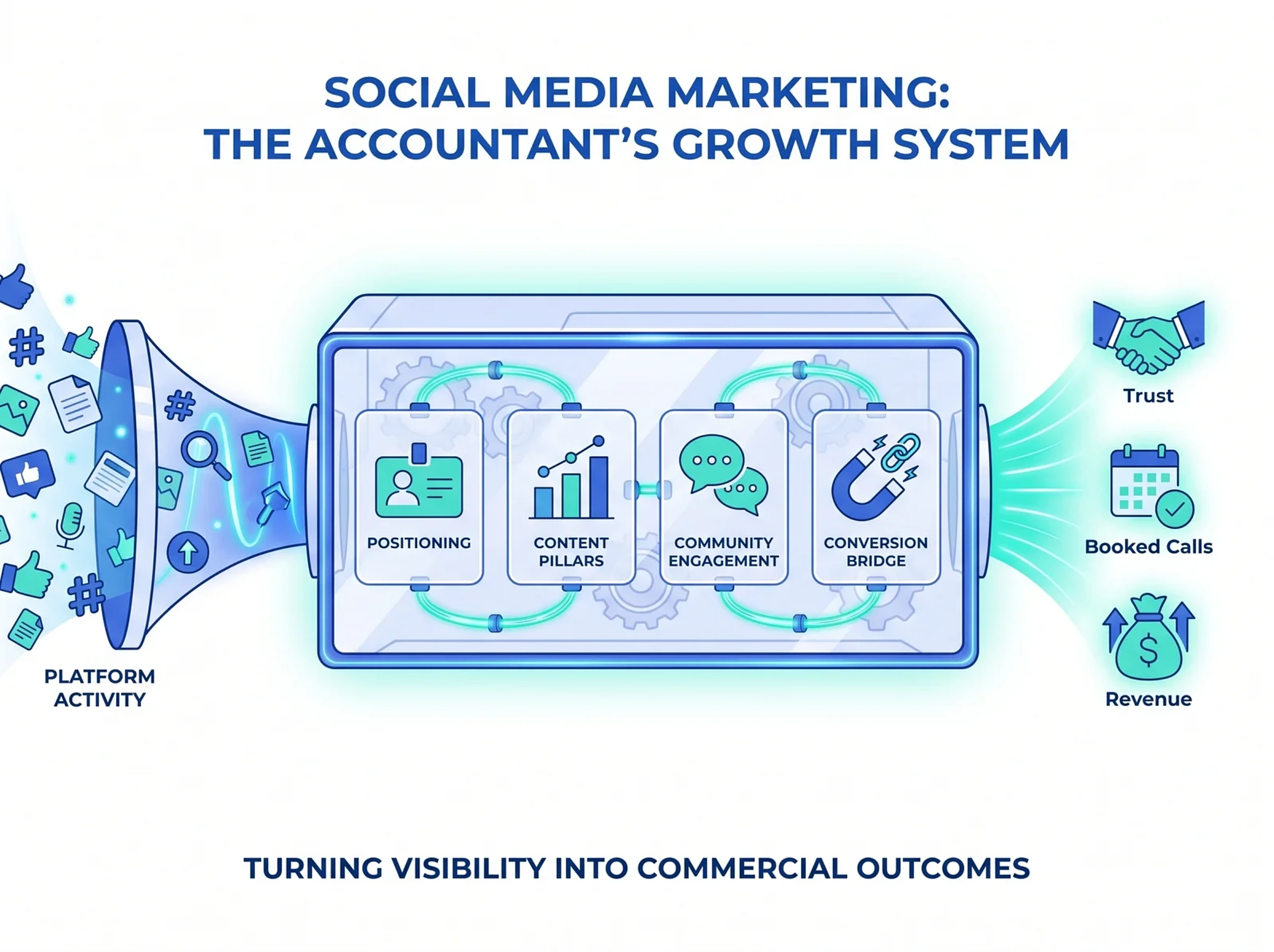
Social media marketing for accountants means using social platforms to build authority, earn trust and move the right business owners into discovery calls, lead magnets and fee enquiries. It is not posting tax deadlines or office news. It is a sustained content, engagement and conversion system, judged on commercial outcomes.
The UK context matters here. Around 95% of UK adults are online and spend close to four and a half hours a day on the internet, with around 5.7 million SMEs sitting inside that addressable market. Social platforms hold a large share of that daily attention, and the firms that show up consistently with useful financial guidance get remembered when an enquiry happens.
How it differs from generic social media marketing
Most “social media marketing” advice is built for ecommerce, lifestyle brands or B2C personalities. Accountants need something different. Buyers in this market take longer to decide, value trust over novelty, and judge a firm on expertise rather than aesthetics. The activity behaves like consulting in public, not a brand campaign. Posts educate. Comments demonstrate competence. Profiles act as a portfolio.
Where social media fits in the wider growth system
Social media sits beside SEO, email marketing, referrals and direct outreach inside one connected commercial engine. We cover the full picture in our guide to marketing strategy for accountants, and we run the build for firms that want it delivered rather than just planned through our social media marketing service for professional services. Treat social media as the visibility layer that feeds the trust, content and conversion layers, never as a standalone channel.
Why social media is worth the time for accountancy firms
Social media is worth the time because it compounds visibility, builds authority cheaply, and creates assisted conversions that other channels rarely match. Sprout Social’s 2024 Index reports that 76% of consumers notice and appreciate brands that prioritise customer support on social, and HubSpot’s State of Marketing 2024 report finds that LinkedIn generates the highest-quality leads for B2B service businesses. Both findings transfer cleanly to accountancy.
The commercial logic is straightforward. A UK accountancy market worth close to £40 billion across roughly 30,000 firms means competition is real, yet most of those firms do not post weekly, do not have a content niche, and do not engage in comments. A consistent, well-positioned voice cuts through quickly.
The three commercial roles social media plays
Awareness comes first. Repeated visibility creates familiarity, and familiarity makes a brand search or website visit more likely later. The Edelman Trust Barometer 2024 reports that 63% of buyers need to hear from a brand three to five times before they trust its expertise.
Trust comes next. Reviews, anonymised client outcome stories, behind-the-scenes process notes, and named team expertise reduce hesitation before an enquiry. UK consumer law has tightened here: from April 2025 fake and concealed-incentive reviews are banned, with penalties reaching 10% of worldwide turnover, so social proof must be real to be useful.
Lead movement comes last. Social content moves the right people towards lead magnets, discovery calls, direct messages and introductions. A post on landlord tax mistakes that ends with a checklist offer does more than a generic “contact us today” sign-off.
Which platforms work best for accountants
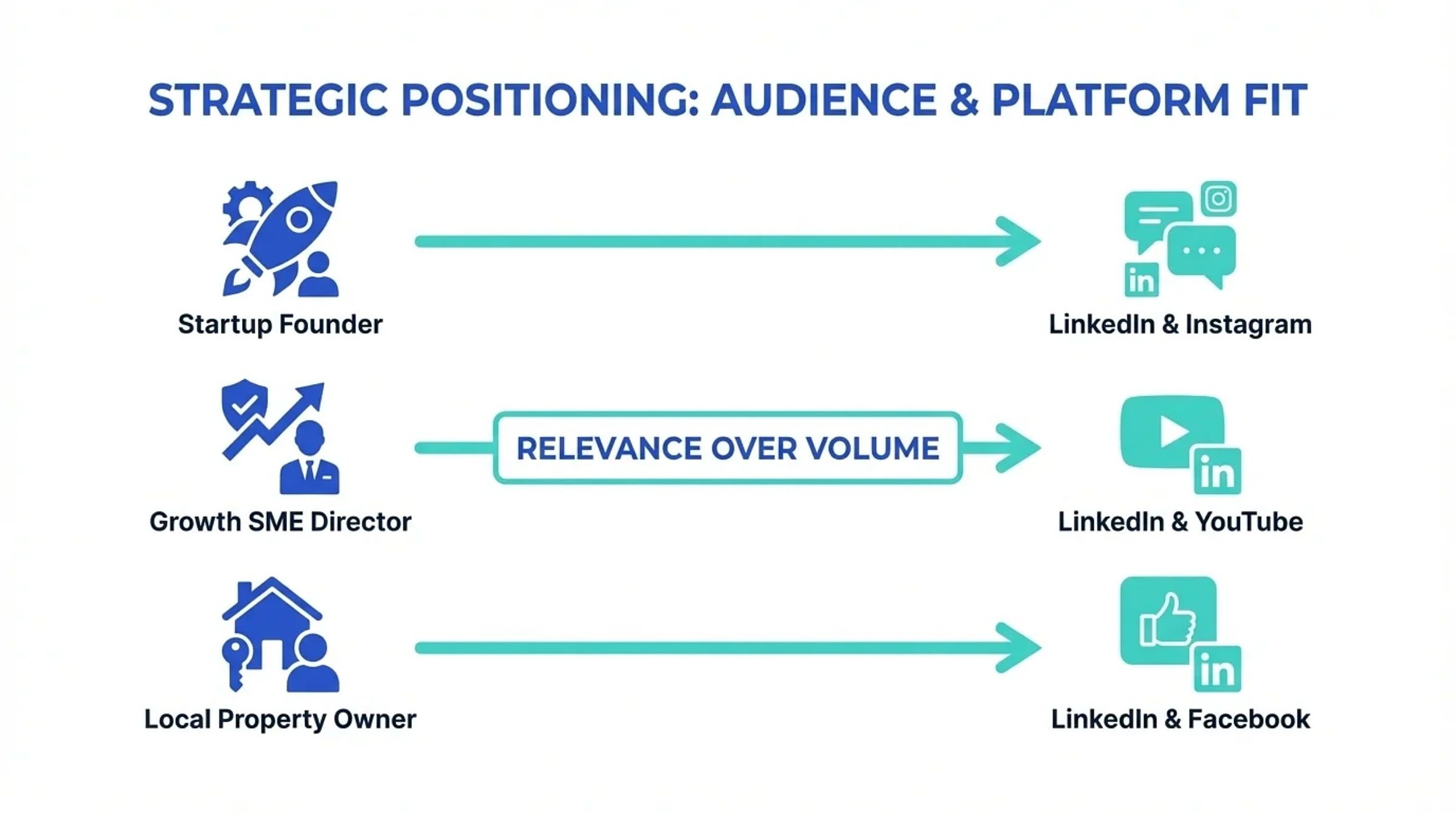
LinkedIn works best for most accountancy firms because the audience sits in a professional mindset and the algorithm rewards expertise. Facebook earns local enquiries. Instagram and YouTube work for specific niches. TikTok and X serve narrower use cases.
LinkedIn: the default first platform
LinkedIn carries roughly 35 million UK users according to LinkedIn’s own UK Economic Graph data, and most of them are decision-makers, directors or finance leaders. For advisory-led firms, fractional finance director services and growth-stage accountancy, this is the single platform that pays back. Our LinkedIn marketing guide for accountants covers profile structure, content rhythm, Sales Navigator use and inbound lead capture in detail.
LinkedIn rewards three behaviours: posting two to four times a week with text-led, opinion-led posts; engaging meaningfully in the comments of others in your network; and treating the profile as a landing page with a clear above-the-fold pitch. Firms that do all three see profile views climb within four to six weeks.
Facebook: still strong for local compliance-led firms
Facebook still earns enquiries for high-street accountants, payroll bureaus and bookkeeping practices serving owner-managed businesses. Local community groups, business networking groups and area-specific pages create steady warm referrals. Meta reports around 44 million UK Facebook users in 2024, with a demographic that skews toward owner-operators aged 35 to 64, which matches the buyer for many practices.
Instagram: niche fit only
Instagram works for accountants serving creative agencies, ecommerce founders, fitness businesses or hospitality clients where the audience already lives on the platform. Carousels that explain VAT thresholds, profit margin issues or pricing mistakes perform well. Skip the platform if your audience does not spend time there.
YouTube: for educational depth
YouTube suits firms willing to publish a weekly five-to-ten-minute video on tax planning, business growth or finance habits. It compounds slowly, then powerfully. Videos rank in Google and feed AI overviews, which doubles the search return on every recording.
TikTok and X: selective use
TikTok can work for early-stage founders, but the audience and tone often clash with accountancy positioning. X (formerly Twitter) suits a small group of accountants engaged in tax policy debate, fintech commentary, or industry network building. Neither is a sensible first platform.
How to choose the platform for your firm
Choose the platform where your audience already pays attention and where the content format fits how you naturally communicate. A partner who writes well picks LinkedIn. A team that records easily picks YouTube. A local family practice picks Facebook. A founder-led startup-focused firm may run LinkedIn plus Instagram. Pick one primary and one secondary; ignore the rest until both work.
The five content pillars accountancy firms should use
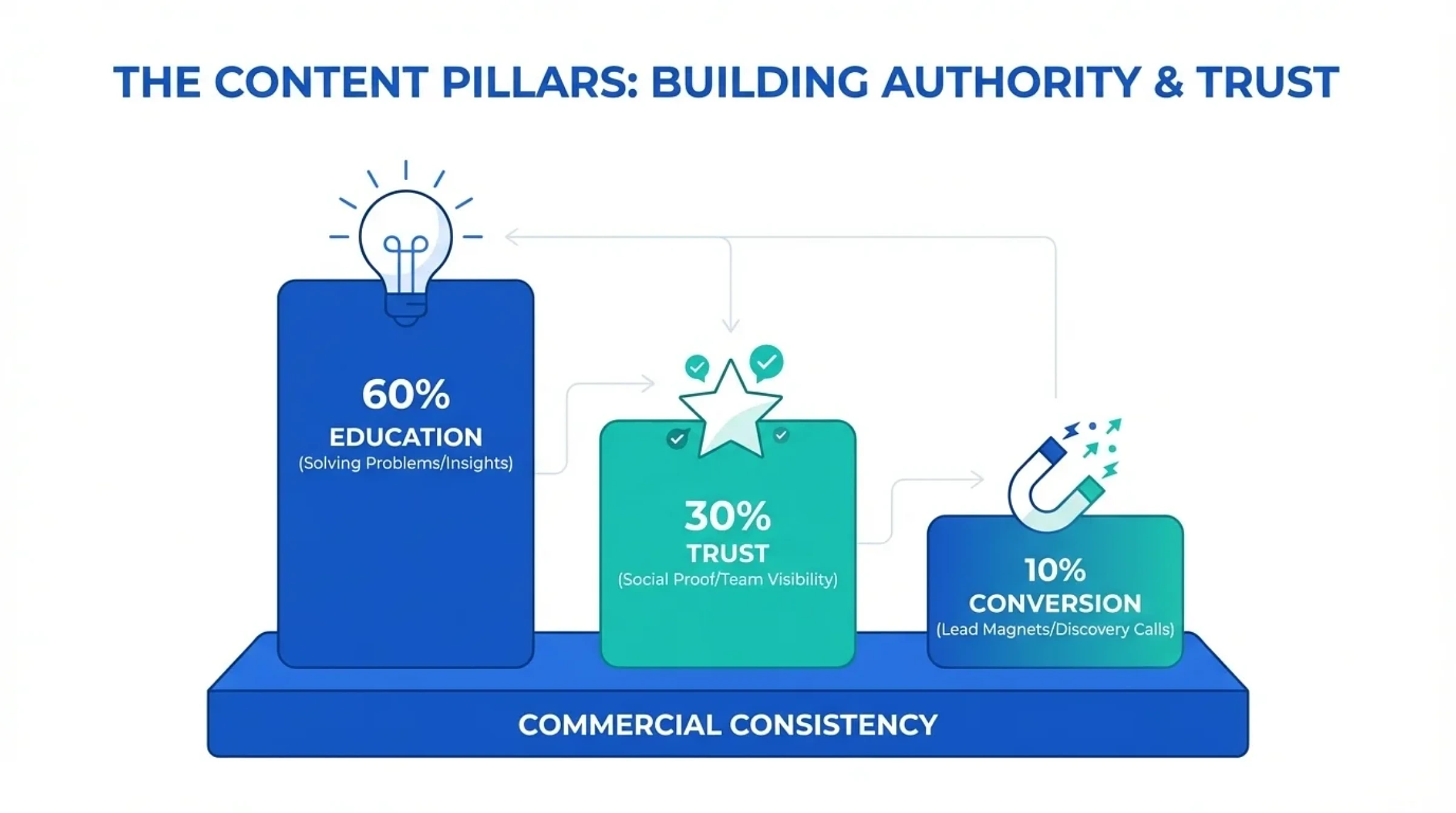
A working content plan combines five pillars: education, trust, authority, personality and conversion. Most firms over-index on education and under-deliver on the other four, which is why their content gets read but rarely creates calls.
Education: the foundation
Educational content explains real business problems clearly. Cash flow gaps, late VAT registrations, payroll errors, dividend planning mistakes, R&D claim risks and management accounts gaps all make strong posts. Aim for around 60% of weekly content here. Always include one practical takeaway the reader can act on the same day.
Trust: the proof layer
Trust content reduces hesitation. Examples include anonymised client outcome stories, process explainers showing how a year-end actually runs, team expertise notes naming who handles what, software stack notes (Xero, QuickBooks, Dext, Hubdoc, IRIS) and screenshots of verified reviews. Around 15% of weekly content.
Authority: the opinion layer
Authority content positions the firm as commercially useful by taking a clear view. Strong opinions on Making Tax Digital, on dividend strategy, on advisory pricing, or on the value of cloud bookkeeping all qualify. Around 10% of weekly content. The KPMG 2024 UK Customer Experience Excellence report found that companies showing clear expertise outperform competitors by 29% on net promoter score, which transfers directly to professional services.
Personality: the human layer
Personality content makes the firm feel real. Founder perspective, team culture moments, learning posts, conference notes and local community involvement all fit. Around 10% of weekly content. Keep it professional but human; this is where firms wrongly post wedding photos or holiday selfies and break trust.
Conversion: the next-step layer
Conversion content invites the next step. Discovery call slots, lead magnet downloads, webinar invites, paid product launches and strategic review offers all belong here. Around 5% of weekly content. Less is more. A discovery-call offer that lands after four useful educational posts converts better than a weekly sales push.
Holding conversion content to 5% feels counterintuitive. The firms that do it earn permission to ask. The firms that flood the feed with “book a call” lose followers, lose attention, and lose the trust that makes the eventual call happen.
The tools accountants should use to run social media efficiently
The right toolset cuts social media time by around half and keeps quality consistent. Most firms can run a serious operation with five categories of tool: scheduling, design, analytics, content assistance and engagement.
Scheduling tools
Buffer, Metricool, Hootsuite and Later all do the same core job: schedule posts across platforms from one calendar. Metricool publishes user data showing average time savings of around six hours a week, and Buffer’s free tier handles three channels at no cost, which suits most one-partner firms. Pick one and stick with it for at least six months.
Design tools
Canva is the standard. The free tier covers most needs, and the Pro tier at around £109 a year unlocks brand kits, magic resize and team folders. Adobe Express works similarly. Both produce LinkedIn carousels, Instagram posts, video covers and quote graphics in minutes.
Analytics tools
LinkedIn’s native analytics, Meta Business Suite, Metricool and Buffer Analyse all surface the basics. Metricool stands out for cross-platform reporting on a single dashboard. Most firms only need to track profile views, website clicks and engagement rate, which the native tools deliver free.
Content assistance tools
ChatGPT, Claude and Gemini accelerate first drafts, idea generation and repurposing. The risk is generic AI-sounding copy that erodes trust. Use them to outline and brainstorm, never to publish unedited. A short human pass that adds specifics, removes filler and varies sentence length keeps the voice credible.
Engagement tools
Taplio, Shield and AuthoredUp focus on LinkedIn engagement: post analytics, comment templates and audience tracking. Useful once content rhythm is set, unnecessary before that. Spend on tools only when the time saved exceeds the cost.
Is your firm’s social media built to earn fees?
Six questions. Pick one answer for each. You will get a specific next move at the end.
1. How clearly is your firm’s social niche defined?
2. How often does your firm post on its primary platform?
3. What does your content mix look like across a typical month?
4. Do you run an active lead magnet behind a landing page?
5. Can you name how many booked discovery calls came from social last month?
6. Where does a social click on your profile land first?
Fine-tune, test, and scale what works.
Your social engine is built on the right pillars. The fastest gains now come from sharper measurement, paid amplification of your best lead magnet, and tightening the discovery-call funnel. Book a strategy call and we will identify the two or three tweaks that lift conversion fastest.
Fix the two or three weakest pillars first.
The bones are there, but conversion is leaking. Common gaps include a thin niche, a missing lead magnet, weak measurement, or social traffic landing on a generic homepage. Let us audit your setup and prioritise the fixes that pay back inside a quarter.
Begin with a full audit and a 90-day plan.
Your social activity is producing visibility without commercial outcomes. That changes with a clear niche, the right platform focus, a content calendar, a lead magnet, and a working measurement layer. We rebuild the whole system inside 90 days. Start with a free strategy call.
How to measure social media success for an accountancy firm
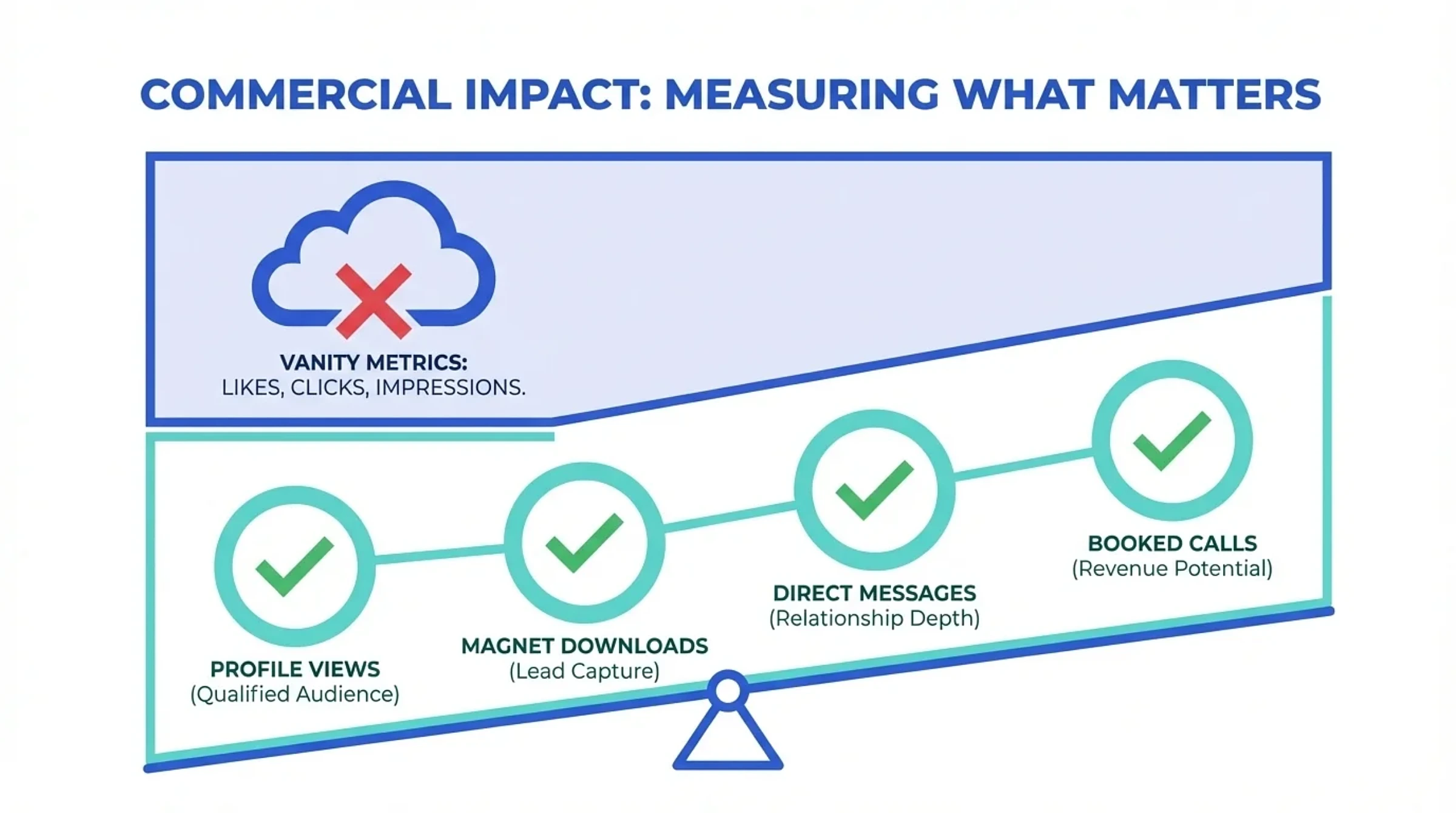
Measure social media success against four commercial metrics, not platform vanity. The four that matter are profile views, website clicks from social, lead magnet downloads and booked discovery calls. Each tells a different part of the funnel.
Profile views
Profile views show top-of-funnel attention. LinkedIn shows this natively under “Who viewed your profile” with weekly counts. Facebook reports similar data inside Meta Business Suite. Healthy growth looks like a 15 to 30% increase month over month for the first six months on a primary platform.
Website clicks from social
Website clicks reveal whether content moves people from the platform to your owned channels. Track this through Google Analytics 4 under Acquisition then Traffic acquisition, filtered by source. A working content rhythm typically lifts social traffic from low single digits to between 8 and 15% of total website sessions within three to six months.
Lead magnet downloads
Lead magnet downloads measure whether your content earns email addresses. Track this directly in Mailchimp, ConvertKit, ActiveCampaign or whichever email tool runs the capture. A useful magnet should convert between 12 and 25% of landing-page visitors, and a working social feed should drive between 20 and 60 new signups a month for a mid-sized firm.
Booked discovery calls
Booked discovery calls are the metric that pays the bills. Track them in your CRM or scheduling tool (Calendly, HubSpot Meetings, Acuity), tagged by source. A typical pattern: months one to three produce few or none, months four to six produce two to five, months seven to twelve settle at five to fifteen a month for a focused firm.
What not to measure
Likes and follower counts barely matter for B2B accountancy work. A firm with 800 well-targeted followers and 30 commercial conversations a year beats a firm with 8,000 broad followers and zero conversations. Vanity metrics distract from commercial reality.
Organic vs paid, DIY vs agency: the real comparison
Organic social and paid social do different jobs. DIY and agency delivery suit different stages. Choose the combination that matches your time, budget and current visibility.
Organic versus paid
Organic content builds trust and authority slowly but cheaply. Paid social moves a specific offer to a specific audience quickly. For most accountancy firms organic comes first, paid follows once an offer (a lead magnet, a webinar, a service launch) is proven through organic engagement. Running paid traffic to a weak landing page wastes budget within weeks, which WordStream’s 2024 UK benchmark report confirms with an average cost per lead of £35 to £75 for accountancy services on Meta and LinkedIn Ads.
DIY versus freelancer versus agency
A founder who can write and has two clear hours a week handles social DIY at zero direct cost. Once that founder runs out of capacity, options open. A specialist freelancer typically charges £400 to £1,200 a month for content and scheduling. An agency typically charges £1,500 to £4,000 a month for content, scheduling, engagement and reporting. White-label support sits between the two.
The deciding question is opportunity cost. When the partner’s chargeable rate is £150 an hour and social takes eight hours a week, the in-house cost is around £4,800 a month in foregone billing. A £2,000 retainer often pays back the first month.
What social media marketing for accountants actually costs
Real costs sit in four buckets: time, tools, paid ads and outsourced delivery. A serious operation in 2025 runs between £150 and £4,000 a month depending on scope.
Time cost
A founder doing it well spends three to six hours a week: one hour planning, two hours writing, one hour engaging, one hour creating images or video, plus thirty minutes reporting monthly. At £150 an hour, that is between £1,950 and £3,900 a month of partner time.
Tools cost
A working toolset (Canva Pro at £109 a year, Metricool at around £18 a month, an email tool at £15 to £50 a month) lands at around £40 to £80 a month in total.
Paid ads cost
A test budget for paid social starts at £500 to £1,500 a month. Anything less rarely produces enough data to optimise. A working lead-magnet campaign typically delivers a cost per lead between £8 and £35 once the targeting and creative are tuned, according to WordStream UK benchmark data.
Outsourced delivery cost
A specialist agency or white-label partner for content, scheduling, engagement and analytics typically charges £1,500 to £4,000 a month depending on scope and platform count. A productised setup (a topical map, content plan and scripts your team then executes in-house) sits at our True SEO marketplace for firms wanting a deliverable rather than a retainer.
Mistakes accountants make on social media, and how to avoid them
The five most damaging mistakes share one root cause: treating social media as a noticeboard instead of a commercial system. All five are fixable inside a month.
Posting without a niche
A firm that says “we serve all SMEs” gets ignored. A firm that says “we serve UK ecommerce brands turning over £500k to £5m” gets remembered. Pick a sector, a stage or a problem and own it. Our work on niche opportunities for accountants shows how the right niche compounds across every channel, social included.
Sharing only deadline reminders
Tax deadline calendars, “Self Assessment is due”, “MTD goes live” and similar posts get scrolled past. They show no expertise and create no curiosity. Replace them with the underlying mistakes those deadlines expose.
Selling on every post
Buyers feel pushed and unfollow. Hold the conversion content at 5% of the feed and let the other 95% earn the right to ask.
Ignoring comments
A post that gets ten comments and no replies from the firm signals indifference. Reply within 24 hours, every time. The interaction is where trust actually forms.
Breaching professional conduct standards
ICAEW’s Code of Ethics and ACCA’s Code of Conduct both require honesty, integrity and avoidance of misleading marketing claims in any public communication, including social media. Specific risks include guaranteeing tax savings, naming clients without consent, sharing case figures without permission, and making any claim that cannot be substantiated. AAT’s professional ethics standard mirrors these. A short internal review process, where one partner approves all posts referencing client outcomes, prevents most issues.
That review process works best against a written standard rather than a partner’s instinct. ICAEW and ACCA marketing rules for accountants sets out what both codes actually require of a firm’s marketing, so there is something concrete to approve against.
How social media connects to website conversion, lead magnets and discovery calls
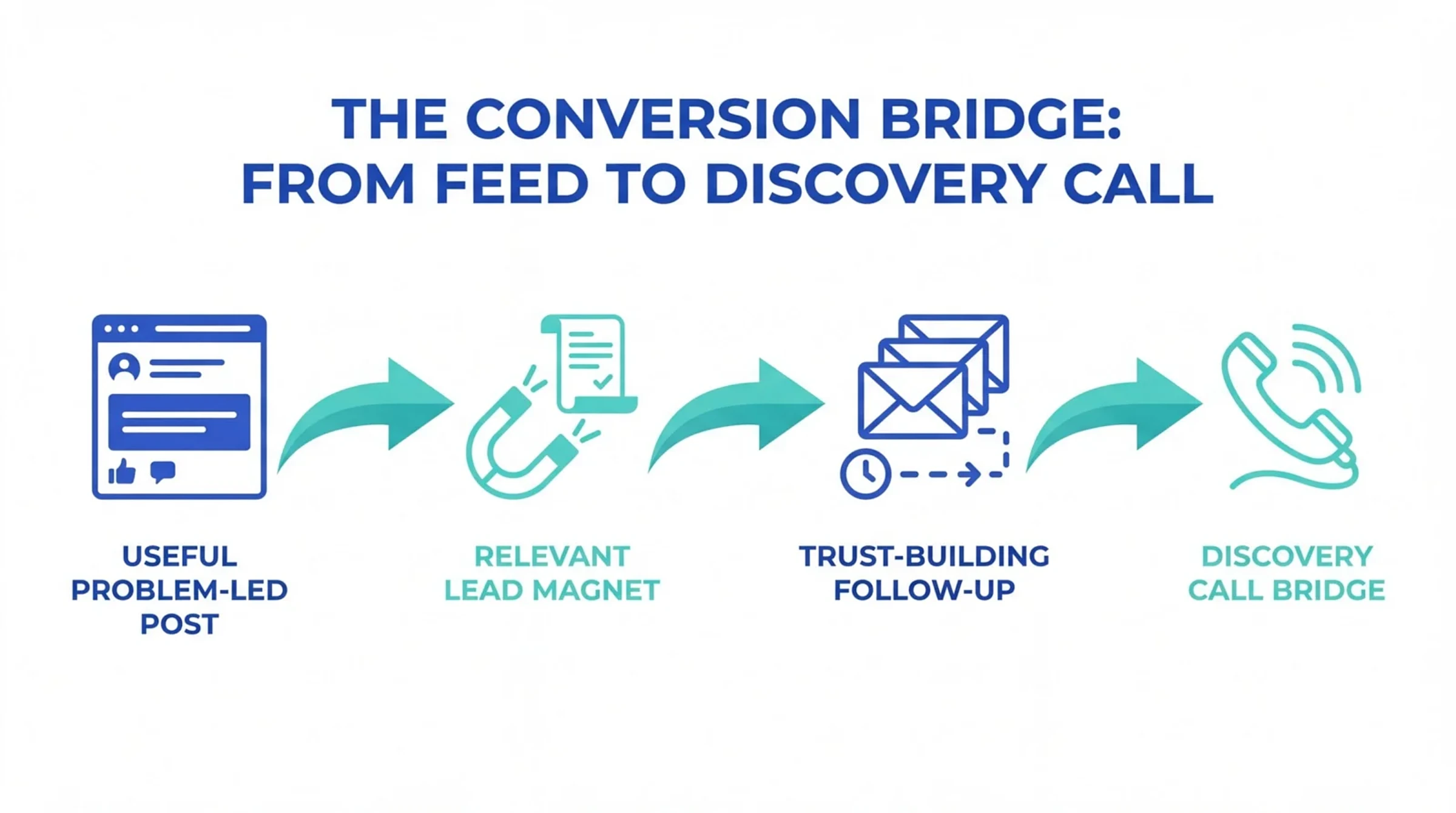
Social media is the visibility layer. The website is where trust becomes action. Lead magnets and discovery calls are the bridges between the two. Get all four working together and social activity converts; leave any one weak and the rest underperform.
Profile and post links must point somewhere useful
A LinkedIn profile that links to a generic homepage loses momentum. Send profile traffic to a single landing page that explains who the firm helps, what happens on the discovery call and how to book. The same goes for post links. Send Cardiff-specific traffic to a Cardiff page; send landlord-specific traffic to a landlord page.
Lead magnets bridge attention into capture
Lead magnets give early-interest readers something useful in exchange for an email address. Tax checklists, cash flow templates, R&D claim guides and pricing diagnostic tools all work. Our complete lead magnet guide for accountants explains which formats convert highest and how to position them across LinkedIn, Facebook and the website.
Discovery calls do the closing
Discovery calls move warm prospects into fee conversations. A 25 to 30 minute structured call, booked through Calendly or HubSpot, with a clear agenda (current setup, current frustration, possible fix) outperforms an open “let’s chat” invitation. Use a scheduling tool that confirms the call by email, reminds the prospect twice and lets them reschedule without friction.
Website conversion still matters most
A strong social feed pointing at a slow, generic website wastes the work. A page load under three seconds, clear positioning above the fold, named team, real review proof, and a single dominant call-to-action are the minimum standards. We cover the search and conversion path together inside our SEO for accountants service so the visibility and the conversion sit in one plan.
Built for accountancy firms that want this run, not just read. We design the platform mix, build the lead magnets, write the content rhythm, set up the measurement, and connect every part to a website that converts. One service, one team, one accountable plan.
Turn your social presence into booked callsHow social media feeds AI search and answer engines
Social media now feeds AI search visibility because large language models and AI overviews crawl, cite and reflect public content from authoritative voices. Close to a third of UK Google searches show an AI summary above the normal results, and more than half of UK adults say they see these summaries regularly. Being the voice the AI quotes matters more every quarter.
Why LinkedIn posts and YouTube videos get cited
LLMs prioritise public, structured, authoritative content. LinkedIn posts from a named author with a clear professional history and consistent posting pattern carry weight. YouTube transcripts get indexed and surface in AI answers. X and Facebook posts feed the picture less directly but still contribute to topical signal.
How to make social content AI-friendly
Write posts that answer a specific question in the first line, support the answer with one number or one example, and end with a clear takeaway. Use named entities (HMRC, ICAEW, ACCA, Xero, QuickBooks) where natural. Repeat the niche framing, for example “for UK landlords” or “for ecommerce founders”, so AI models associate the named author with the niche. We cover the wider technique in our work on optimising for AI and voice search.
A 90-day social media plan for accountancy firms
A practical 90-day plan moves a firm from inconsistent posting to a working commercial channel. Each month builds on the last.
- Month one: foundations. Audit the existing profiles, choose one primary platform and one secondary, define the niche in one sentence, write five content pillars, rewrite the profile banner and headline, plan four weeks of posts, and connect Google Analytics 4 to the website. End the month with one lead magnet live behind a landing page.
- Month two: rhythm. Post three to four times a week on the primary platform, twice on the secondary, comment thoughtfully on twenty posts a week from people in the target audience, and send one weekly email to the growing list. Track profile views, website clicks and lead magnet downloads at the end of each week.
- Month three: conversion. Add a soft discovery-call offer once a fortnight, run one paid lead-magnet test on a £500 budget, write a case-led trust post each week, and review what content actually drives website clicks. End the month with at least one booked discovery call from social.
- Beyond 90 days. Refine the rhythm, double down on the formats that work, retire what does not, and connect the social engine to the wider growth system. Repeatable monthly improvement beats grand quarterly relaunches.
Two firms that turned social media into real fees
A Cardiff-based advisory-focused accountancy practice was posting twice a month on LinkedIn with deadline reminders and getting around 200 impressions per post and zero enquiries. We restructured the content around five pillars (cash flow, growth, tax mistakes, leadership, founder lessons), set a three-posts-a-week rhythm, and added a free profit-leak checklist as the lead magnet. Within 90 days, average post impressions reached 4,800, the lead magnet captured 187 emails, and the firm booked nine discovery calls directly attributable to social. Three converted into advisory retainers worth roughly £36,000 a year combined.
A four-person practice serving UK landlords was running a steady Facebook presence but no lead capture. We built a landlord tax checklist as a downloadable, ran it organically across Facebook and LinkedIn for £680 a month in content production, and tracked downloads through a tagged landing page. Across four months, 240 landlords downloaded the checklist, the firm opened 38 substantive conversations, and 14 became fee-paying clients on retainers averaging £250 a month, producing about £42,000 in annualised recurring revenue from a content investment of around £2,720.
Frequently asked questions
How often should accountants post on social media?
Three to four times a week on the primary platform is the working baseline, with daily engagement in comments. More frequency without quality reduces returns; less than twice a week struggles to build any algorithmic momentum.
Is LinkedIn enough, or do accountants need other platforms?
LinkedIn is enough for most UK accountancy firms in the first 12 months. Add a secondary platform only when LinkedIn is performing and the team has genuine extra capacity. Most firms over-extend too early and dilute every channel.
How long before social media produces real enquiries?
Three to six months for the first booked calls, six to twelve months for a steady monthly flow. Firms expecting four-week results almost always abandon before the rhythm pays back.
Can accountants use AI tools to write social media posts?
Yes for drafts, outlines and repurposing. No for finished posts published verbatim. AI drafts read generic without human editing, and generic posts erode the trust that drives accountancy enquiries. Use ChatGPT or Claude for speed, then rewrite for voice.
Do professional conduct rules restrict what accountants can post?
Yes. ICAEW, ACCA and AAT codes all require honest, non-misleading marketing claims, prohibit unsubstantiated guarantees, and require client consent before naming or sharing client outcomes. A one-partner approval step before publishing any client-referenced content keeps the practice safe.
Where this leaves your firm
Social media marketing for accountants pays back when the platform, content, tools, metrics, lead capture and website all reinforce one focused commercial position. The firms that win do not post more; they post with sharper niche clarity, stronger trust signals and a connected conversion path. We help UK accountancy practices build that whole system at True SEO, from the niche audit through to the lead magnets, the discovery-call funnel and the website that converts what social earns.
Table of Contents
- What social media marketing for accountants really means
- Why social media is worth the time for accountancy firms
- Which platforms work best for accountants
- The five content pillars accountancy firms should use
- The tools accountants should use to run social media efficiently
- How to measure social media success for an accountancy firm
- Organic vs paid, DIY vs agency: the real comparison
- What social media marketing for accountants actually costs
- Mistakes accountants make on social media, and how to avoid them
- How social media connects to website conversion, lead magnets and discovery calls
- How social media feeds AI search and answer engines
- A 90-day social media plan for accountancy firms
- Two firms that turned social media into real fees
- Frequently asked questions
- Where this leaves your firm